
Request Free Sample ×

Kindly complete the form below to receive a free sample of this Report

* Please use a valid business email

Leading companies partner with us for data-driven Insights

clients tt-cursor
Hero Background
English
Chinese
French
Japanese
Korean
German
Spanish

Immersive Technology in Healthcare Market Share

ID: MRFR/ICT/10722-HCR
128 Pages
Ankit Gupta
March 2026

Immersive Technology in Healthcare Market Research Report: Information By Component (Hardware (Head-Mounted Display (HMD), Gesture Tracking Devices (GTD), Projectors & Display Walls (PDW)), Software/Platform, Services (Professional and Managed)), By Technology (Mixed Reality (MR), Virtual Reality (VR), Augmented Reality (AR) and 360 Film), By Application (Training & Learning, Emergency Services, Product Development and Sales & Marketing) And By Region (North America, Europe, Asia-Pacific, And Rest Of The World) –Market Forecast Till 2035.

Share:
Download PDF ×

We do not share your information with anyone. However, we may send you emails based on your report interest from time to time. You may contact us at any time to opt-out.

Immersive Technology in Healthcare Market Infographic
Purchase Options

Market Share

Immersive Technology in Healthcare Market Share Analysis

VR has been used to create immersive environments for pain management, anxiety reduction and rehabilitation purposes. This new development ranging from virtual relaxation experiences to interactive VR therapy sessions offers innovative tools to medical personnel aimed at restoring patient’s well-being guaranteeing success during treatment methodologies. Another major trend is the use of AR in medical education and training. Health professionals use AR applications to overlay digital information on real-world environments, such as anatomical models and surgical guidance. These experiences promote interactivity and facilitate hands-on learning whereby complex medical concepts and procedures can be visualized by medical students or practitioners. The integration of AR into medicine will change how doctors learn and retain information, thus enhancing their skills. Additionally, immersive technology is being employed in surgical planning and visualization within the healthcare market. VR and AR allow surgeons to see 3D models of the patient’s body enabling them to plan for surgeries in high precision. This development enhances preoperative planning thereby lowering the chances of complications resulting into improved surgical outcomes. For accurate visualization, especially, orthopedics neurosurgery cardiology etc., immersive technologies are increasingly being incorporated during surgery. In addition, Virtual Reality (VR) is gaining ground in mental health treatment through exposure therapy. VR simulates environments that enable individuals to confront their fears, fight PTSD or even anxiety disorders among others. It creates a controlled environment where patients can safely work through mental health issues using immersion technology. Moreover, through use virtual reality in this context shows that it has potential for addressing various psychological conditions. Moreover remote patient monitoring and telemedicine solutions are some other trends observed in the healthcare industry concerning immersive technology development . VR enables healthcare providers to monitor patients remotely, have virtual consultations with them or even offer rehabilitation programs that do not require physical presence at all times. This is becoming more popular especially among populations facing global challenges like pandemics which make it difficult for human beings to move into different places physically at will. With telemedicine having integrated immersion technology they have become more accessible improving patient engagement which ultimately increases efficiency of healthcare provision.


Author
Author Profile
Ankit Gupta
Team Lead - Research

Ankit Gupta is a seasoned market intelligence and strategic research professional with over six plus years of experience in the ICT and Semiconductor industries. With academic roots in Telecom, Marketing, and Electronics, he blends technical insight with business strategy. Ankit has led 200+ projects, including work for Fortune 500 clients like Microsoft and Rio Tinto, covering market sizing, tech forecasting, and go-to-market strategies. Known for bridging engineering and enterprise decision-making, his insights support growth, innovation, and investment planning across diverse technology markets.

Leave a Comment

FAQs

What is the projected market valuation for Immersive Technology in Healthcare by 2035?

<p>The projected market valuation for Immersive Technology in Healthcare is expected to reach 9.142 USD Billion by 2035.</p>

What was the market valuation for Immersive Technology in Healthcare in 2024?

<p>The overall market valuation for Immersive Technology in Healthcare was 1.41 USD Billion in 2024.</p>

What is the expected CAGR for the Immersive Technology in Healthcare Market from 2025 to 2035?

<p>The expected CAGR for the Immersive Technology in Healthcare Market during the forecast period 2025 - 2035 is 18.52%.</p>

Which companies are considered key players in the Immersive Technology in Healthcare Market?

<p>Key players in the market include Medtronic, Philips, Siemens Healthineers, GE Healthcare, Johnson & Johnson, Accenture, Osso VR, ImmersiveTouch, and VRHealth.</p>

What are the main components of the Immersive Technology in Healthcare Market?

<p>The main components include Hardware, Software/Platform, and Services, with valuations of 3.5 USD Billion for both Hardware and Software/Platform, and 2.142 USD Billion for Services.</p>

How does the market for Virtual Reality (VR) compare to Augmented Reality (AR) in terms of valuation?

<p>In 2024, the market for Virtual Reality (VR) was valued at 3.5 USD Billion, whereas Augmented Reality (AR) was valued at 2.0 USD Billion.</p>

What applications are driving growth in the Immersive Technology in Healthcare Market?

Key applications driving growth include Training &amp; Learning, Emergency Services, Product Development, and Sales &amp; Marketing, with Training &amp; Learning valued at 3.5 USD Billion.

What is the valuation of Mixed Reality (MR) technology in the market?

The valuation of Mixed Reality (MR) technology in the Immersive Technology in Healthcare Market is 2.5 USD Billion.

What is the expected growth trajectory for the Services segment in the Immersive Technology in Healthcare Market?

The Services segment is projected to grow to 2.142 USD Billion by 2035, indicating a robust growth trajectory.

How does the market for 360 Film technology perform compared to other technologies?

The market for 360 Film technology is valued at 1.14 USD Billion, which is lower than Mixed Reality, Virtual Reality, and Augmented Reality technologies.

Market Summary

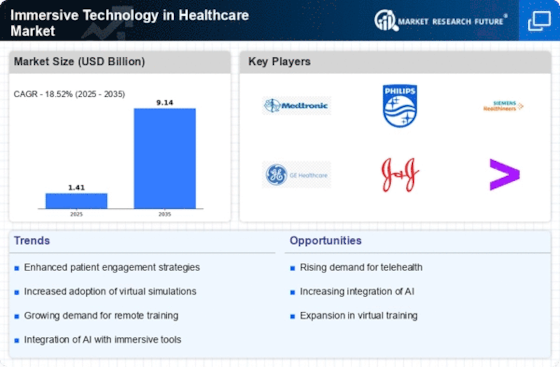
As per Market Research Future analysis, the Immersive Technology in Healthcare Market was estimated at 1.41 USD Billion in 2024. The immersive technology industry is projected to grow from 1.672 USD Billion in 2025 to 9.142 USD Billion by 2035, exhibiting a compound annual growth rate (CAGR) of 18.52% during the forecast period 2025 - 2035

Key Market Trends & Highlights

The Immersive Technology in Healthcare Market is poised for substantial growth, driven by advancements in training and patient engagement.

  • North America remains the largest market for immersive technology in healthcare, reflecting a robust demand for innovative solutions. Asia-Pacific is emerging as the fastest-growing region, indicating a rising adoption of immersive technologies in healthcare settings. The hardware segment continues to dominate the market, while the software/platform segment is experiencing rapid growth due to increasing digitalization. Key market drivers include enhanced training and education, alongside the growing emphasis on patient engagement and therapy.

Market Size & Forecast

2024 Market Size 1.41 (USD Billion)
2035 Market Size 9.142 (USD Billion)
CAGR (2025 - 2035) 18.52%
Largest Regional Market Share in 2024 North America

Major Players

Medtronic (US), <a href="https://www.usa.philips.com/">Philips</a> (NL), Siemens Healthineers (DE), GE Healthcare (US), <a href="https://www.jnj.com/">Johnson &amp; Johnson</a> (US), Accenture (IE), Osso VR (US), ImmersiveTouch (US), VRHealth (IL)

Market Trends

The Immersive Technology in Healthcare Market is currently experiencing a transformative phase, characterized by the integration of advanced technologies such as virtual reality, augmented reality, and mixed reality into various healthcare applications. This evolution appears to enhance patient engagement, improve training for medical professionals, and facilitate innovative therapeutic approaches. As healthcare providers increasingly recognize the potential of immersive technologies, the market is likely to expand, driven by a growing demand for more effective and interactive solutions. Furthermore, the ongoing development of user-friendly platforms and devices suggests that accessibility will improve, allowing a broader range of healthcare facilities to adopt these technologies. In addition, the Immersive Technology in Healthcare Market seems to be influenced by a shift towards personalized medicine and patient-centered care. This trend indicates a movement away from traditional methods, as immersive technologies offer tailored experiences that cater to individual patient needs. The potential for enhanced visualization and simulation capabilities may lead to better diagnostic accuracy and treatment planning. As the market continues to evolve, collaboration among technology developers, healthcare providers, and regulatory bodies will likely play a crucial role in shaping the future landscape of immersive technologies in healthcare.

Enhanced Training and Education

Immersive technology is revolutionizing the training and education of healthcare professionals. By utilizing virtual and augmented reality, medical students and practitioners can engage in realistic simulations that replicate complex medical scenarios. This hands-on experience fosters deeper understanding and retention of knowledge, ultimately leading to improved patient care.

Patient Engagement and Therapy

The use of immersive technology in therapeutic settings is gaining traction, as it appears to enhance patient engagement. Virtual reality experiences can distract patients during painful procedures or assist in rehabilitation by providing motivating environments. This innovative approach may lead to better patient outcomes and satisfaction.

Data Visualization and Analysis

Immersive technology is increasingly being employed for data visualization in healthcare. By transforming complex data into interactive, three-dimensional formats, healthcare professionals can gain insights that were previously difficult to discern. This capability may enhance decision-making processes and improve overall healthcare delivery.

Immersive Technology in Healthcare Market Market Drivers

Mental Health Applications

The Immersive Technology in Healthcare Market is increasingly focusing on mental health applications. Technologies such as VR are being utilized to create therapeutic environments for patients suffering from anxiety, PTSD, and other mental health disorders. These immersive experiences allow patients to confront their fears in a controlled setting, which can lead to significant improvements in their mental well-being. Recent research suggests that VR therapy can reduce symptoms of anxiety by up to 60%. As mental health awareness continues to grow, the demand for innovative treatment options is likely to rise, positioning immersive technology as a key player in the future of mental health care.

Patient Engagement and Therapy

The Immersive Technology in Healthcare Market is witnessing a transformation in patient engagement strategies. Technologies such as VR and AR are being integrated into therapeutic practices, providing patients with interactive experiences that enhance their understanding of treatment processes. For instance, VR is utilized in pain management and rehabilitation, allowing patients to engage in therapeutic exercises in a controlled environment. Recent studies indicate that immersive experiences can lead to a 30% reduction in perceived pain levels among patients. This trend not only improves patient satisfaction but also encourages adherence to treatment plans, ultimately leading to better health outcomes. As healthcare providers recognize the potential of immersive technology, its adoption is likely to increase.

Data Visualization and Analysis

The Immersive Technology in Healthcare Market is increasingly leveraging data visualization tools to enhance decision-making processes. Advanced analytics combined with immersive technology allows healthcare professionals to visualize complex data sets in a more intuitive manner. This capability is particularly beneficial in areas such as diagnostics and treatment planning, where understanding intricate data relationships is crucial. The market for data visualization in healthcare is expected to grow significantly, with estimates suggesting a compound annual growth rate of over 20% in the coming years. By utilizing immersive technology, healthcare organizations can improve their operational efficiency and patient outcomes through better-informed decisions.

Enhanced Training and Education

The Immersive Technology in Healthcare Market is experiencing a surge in demand for advanced training solutions. Medical professionals increasingly utilize virtual reality (VR) and augmented reality (AR) to enhance their skills and knowledge. This technology allows for realistic simulations of surgical procedures and patient interactions, which can lead to improved outcomes. According to recent data, the market for VR in medical training is projected to reach USD 1.5 billion by 2026. This growth is driven by the need for continuous education and the desire to reduce training costs while increasing effectiveness. As healthcare systems seek to improve the quality of care, immersive technology becomes a vital tool in the education of healthcare professionals.

Remote Consultations and Telemedicine

The Immersive Technology in Healthcare Market is adapting to the growing trend of remote consultations and telemedicine. With the rise of telehealth services, immersive technologies are being integrated to create more engaging and interactive virtual consultations. This approach not only enhances the patient experience but also allows healthcare providers to reach a broader audience. The market for telemedicine is projected to exceed USD 130 billion by 2025, indicating a strong shift towards remote healthcare solutions. Immersive technology plays a crucial role in this transition, as it enables more effective communication and interaction between patients and providers, thereby improving overall healthcare delivery.

Market Segment Insights

By Component: Hardware (Largest) vs. Software/Platform (Fastest-Growing)

The Immersive Technology in Healthcare Market is primarily driven by the Hardware segment, which holds the largest share among the various components. This segment includes devices such as virtual reality headsets, augmented reality glasses, and simulation tools utilized for training and therapeutic purposes. On the other hand, the Software/Platform segment is gaining momentum as healthcare providers increasingly seek integrated solutions that enhance user experience and streamline operations. This shift is indicative of a growing preference for software solutions that complement the hardware offerings, thus fostering collaboration between technology and healthcare providers.

Hardware (Dominant) vs. Software/Platform (Emerging)

The Hardware segment remains dominant in the Immersive Technology in Healthcare Market, characterized by its robust portfolio of physical devices essential for implementation. These devices are crucial for virtual simulations, surgical training, and patient engagement, making them indispensable in the healthcare landscape. In contrast, the Software/Platform segment is emerging, marked by solutions that facilitate the integration of immersive technologies into daily healthcare practices. Software solutions focus on interoperability and user-friendly interfaces, catering to the diverse needs of healthcare professionals. As the demand for comprehensive immersive experiences grows, the synergy between these two segments becomes increasingly important to drive advancements in patient care and training methodologies.

By Technology: Virtual Reality (Largest) vs. Augmented Reality (Fastest-Growing)

In the Immersive Technology in Healthcare Market, Virtual Reality (VR) holds the largest share among the various technology segments, predominantly utilized for surgical simulations and training purposes. Mixed Reality (MR) and Augmented Reality (AR) also contribute significantly, with AR gaining momentum due to its applications in real-time data overlay during surgeries and patient treatment processes. 360 Film offers immersive experiences mainly in educational settings, albeit with a smaller market share compared to VR and AR. The growth trends in this segment are largely driven by advancements in technology and increased adoption of immersive training solutions in healthcare. The demand for AR technologies in particular is surging, as healthcare professionals leverage AR for enhanced visualization and interaction with 3D models. VR continues to lead due to its established use cases in rehabilitation and training, while MR is emerging as a noteworthy alternative due to its interactive features that blend physical and digital environments.

Technology: Virtual Reality (Dominant) vs. Augmented Reality (Emerging)

Virtual Reality (VR) is positioned as the dominant player in the Immersive Technology in Healthcare Market, owing to its proven applications in various medical training and rehabilitation domains. Its immersive nature allows for realistic simulations, greatly enhancing skill acquisition among healthcare professionals. On the other hand, Augmented Reality (AR) is emerging rapidly, transforming how clinicians interact with digital information during procedures. AR's ability to superimpose digital data onto the real world fosters more efficient workflows and improved patient outcomes. As healthcare embraces digital transformation, both VR and AR serve complementary roles, with VR focusing on immersive training scenarios and AR enhancing real-time interaction. The evolving regulatory landscape further supports these technologies, promoting innovative applications that elevate the standard of patient care.

By Application: Training & Learning (Largest) vs. Emergency Services (Fastest-Growing)

In the Immersive Technology in Healthcare Market, the application of Training &amp; Learning holds the largest share, as healthcare professionals increasingly adopt virtual and augmented reality for interactive training experiences. This segment is bolstered by the need for continuous education and skill enhancement among practitioners, ensuring they stay updated with the latest techniques and technologies. Meanwhile, Emergency Services is rapidly emerging as the fastest-growing segment, driven by the critical demand for simulation-based training for first responders and healthcare teams during crises. This growing acceptance of immersive solutions is reshaping emergency preparedness and response effectiveness.

Application: Training &amp; Learning (Dominant) vs. Emergency Services (Emerging)

The Training &amp; Learning segment stands out as the dominant application in the Immersive Technology in Healthcare Market, characterized by its versatile nature in providing realistic, hands-on experiences through VR and AR. This segment is instrumental in training future healthcare providers, allowing them to practice procedures in a risk-free environment. Conversely, the Emergency Services segment is emerging rapidly, capitalizing on the urgent need for effective training solutions that enhance quick decision-making and coordination during medical emergencies. This segment prioritizes developing robust simulation programs that prepare teams for real-life situations, indicating a shift towards innovation in training that directly impacts patient outcomes during critical incidents.

Get more detailed insights about Immersive Technology in Healthcare Market Research Report – Forecast till 2035

Regional Insights

North America : Innovation and Leadership Hub

North America is the largest market for immersive technology in healthcare, holding approximately 45% of the global market share. The region's growth is driven by advanced healthcare infrastructure, increasing adoption of virtual reality (VR) and augmented reality (AR) technologies, and supportive government regulations. The demand for innovative solutions in medical training and patient care is also on the rise, further propelling market expansion. The United States leads the North American market, with significant contributions from key players such as Medtronic, GE Healthcare, and Johnson & Johnson. The competitive landscape is characterized by continuous innovation and strategic partnerships among companies. The presence of major technology firms and healthcare providers fosters a robust ecosystem for immersive technology applications, enhancing patient outcomes and operational efficiency.

Europe : Emerging Market with Potential

Europe is witnessing a rapid increase in the adoption of immersive technology in healthcare, holding around 30% of the global market share. The region benefits from strong regulatory support and initiatives aimed at enhancing digital health solutions. Countries like Germany and the Netherlands are at the forefront, driving demand for immersive technologies in medical training and rehabilitation, supported by government funding and research initiatives. Germany is the largest market in Europe, followed closely by the Netherlands. The competitive landscape features key players such as Philips and Siemens Healthineers, who are investing heavily in R&D to develop cutting-edge solutions. The presence of various healthcare institutions and universities fosters collaboration, further enhancing the region's capabilities in immersive technology applications.

Asia-Pacific : Rapidly Growing Market

Asia-Pacific is emerging as a significant player in the immersive technology in healthcare market, accounting for approximately 20% of the global share. The region's growth is fueled by increasing healthcare expenditure, a rising population, and a growing emphasis on digital health solutions. Countries like China and Japan are leading the charge, with government initiatives promoting the integration of advanced technologies in healthcare settings. China is the largest market in the region, driven by substantial investments in healthcare infrastructure and technology. The competitive landscape is evolving, with local startups and established companies like Accenture and Osso VR making strides in immersive healthcare solutions. The region's diverse healthcare needs and rapid technological advancements create a fertile ground for innovation and growth in immersive technologies.

Middle East and Africa : Emerging Frontier for Innovation

The Middle East and Africa region is gradually recognizing the potential of immersive technology in healthcare, holding about 5% of the global market share. The growth is driven by increasing investments in healthcare infrastructure and a rising demand for innovative medical solutions. Countries like the UAE and South Africa are leading the way, with government initiatives aimed at enhancing healthcare delivery through technology. The UAE is at the forefront of adopting immersive technologies, supported by strategic partnerships between government and private sectors. The competitive landscape is characterized by a mix of local and international players, with a focus on developing tailored solutions for the region's unique healthcare challenges. As awareness and acceptance of immersive technologies grow, the market is poised for significant expansion in the coming years.

Key Players and Competitive Insights

Leading market players are investing heavily in research and development in order to expand their product lines, which will help the Immersive Technology in Healthcare Market, grow even more. Market participants are also undertaking a variety of strategic activities to expand their footprint, with important market developments including new product launches, contractual agreements, mergers and acquisitions, higher investments, and collaboration with other organizations. To expand and survive in a more competitive and rising market climate, Immersive Technology in Healthcare industry must offer cost-effective items.
Manufacturing locally to minimize operational costs is one of the key business tactics used by manufacturers in the Immersive Technology in Healthcare industry to benefit clients and increase the market sector. In recent years, the Immersive Technology in Healthcare industry has offered some of the most significant advantages to medicine.
Major players in the Immersive Technology in Healthcare Market, including Acer Inc., Atheer, Inc., AVEVA Group PLC, Barco NV, Blippar Ltd., Carl Zeiss AG, CM Labs Simulations Inc., EON Reality, Inc., FAAC Incorporated, Google, LLC, HCL Technologies Limited, Honeywell International, Inc., HTC Corporation, Immersive Media Company, Immersive Technologies Pty Limited, Lockheed Martin Corporation, Magic Leap, Inc., NCTech Limited, Oculus (Facebook Technologies, LLC.), Samsung Group, Sony Corporation, Unity Software Inc., Varjo Technologies Oy, VI-grade GmbH, Zeality Inc. and others, are attempting to increase market demand by investing in research and development operations.
A technological business called Unity Software Inc. (Unity Technologies) creates software platforms. The business offers the (RT3D) development platform, which gives programmers the means to make complex, interactive 2D, 3D, VR, and AR experiences. The product lines offered by Unity Technologies include, among others, Unity Plus, Unity Enterprise, Unity MARS, Unity Build Server, Pixyz, Optimization Accelerator, and multiplayer games. In addition, the business offers RT3D in a variety of industries, including architecture, games, movies, and engineering and construction. San Francisco, California, in the United States, serves as the home base for Unity Technologies.
Sony Group Corp. (Sony) manufactures a variety of products, including devices, tools, medical equipment, semiconductors, and electronics. The company's products include batteries, software, televisions, cell phones, cameras, music systems, game consoles, and other electrical equipment. Sony produces, buys, and distributes motion films, television programs, and recorded music in addition to operating television and digital networks. Through distributors, sales divisions, and online direct sales, the company promotes its products. Under the names Airpeak, Sony, PlayStation, Walkman, Blu-ray, Cyber-shot, Bravia, Exmor, and Experia, it offers products for sale.
Africa, the Middle East, Asia-Pacific, and the Americas are all where the company has activities. Sony's corporate headquarters are in Minato-Ku, Tokyo, Japan.

Key Companies in the Immersive Technology in Healthcare Market include

Industry Developments

Future Outlook

Immersive Technology in Healthcare Market Future Outlook

The Immersive Technology in Healthcare Market is projected to grow at an 18.52% CAGR from 2025 to 2035, driven by advancements in virtual reality, augmented reality, and simulation technologies.

New opportunities lie in:

  • Development of immersive training programs for medical professionals
  • Integration of AR for real-time surgical assistance
  • Creation of virtual therapy platforms for mental health treatment

By 2035, the market is expected to be robust, driven by innovative applications and widespread adoption.

Market Segmentation

Immersive Technology in Healthcare Market Component Outlook

  • Hardware
  • Software/Platform
  • Services

Immersive Technology in Healthcare Market Technology Outlook

  • Mixed Reality (MR)
  • Virtual Reality (VR)
  • Augmented Reality (AR)
  • 360 Film

Immersive Technology in Healthcare Market Application Outlook

  • Training & Learning
  • Emergency Services
  • Product Development
  • Sales & Marketing

Report Scope

MARKET SIZE 2024 1.41(USD Billion)
MARKET SIZE 2025 1.672(USD Billion)
MARKET SIZE 2035 9.142(USD Billion)
COMPOUND ANNUAL GROWTH RATE (CAGR) 18.52% (2025 - 2035)
REPORT COVERAGE Revenue Forecast, Competitive Landscape, Growth Factors, and Trends
BASE YEAR 2024
Market Forecast Period 2025 - 2035
Historical Data 2019 - 2024
Market Forecast Units USD Billion
Key Companies Profiled Medtronic (US), Philips (NL), Siemens Healthineers (DE), GE Healthcare (US), Johnson & Johnson (US), Accenture (IE), Osso VR (US), ImmersiveTouch (US), VRHealth (IL)
Segments Covered Component, Technology, Application, Region
Key Market Opportunities Integration of virtual reality for enhanced surgical training and patient rehabilitation in the Immersive Technology in Healthcare Market.
Key Market Dynamics Rising adoption of immersive technologies enhances patient engagement and training efficiency in healthcare settings.
Countries Covered North America, Europe, APAC, South America, MEA

FAQs

What is the projected market valuation for Immersive Technology in Healthcare by 2035?

<p>The projected market valuation for Immersive Technology in Healthcare is expected to reach 9.142 USD Billion by 2035.</p>

What was the market valuation for Immersive Technology in Healthcare in 2024?

<p>The overall market valuation for Immersive Technology in Healthcare was 1.41 USD Billion in 2024.</p>

What is the expected CAGR for the Immersive Technology in Healthcare Market from 2025 to 2035?

<p>The expected CAGR for the Immersive Technology in Healthcare Market during the forecast period 2025 - 2035 is 18.52%.</p>

Which companies are considered key players in the Immersive Technology in Healthcare Market?

<p>Key players in the market include Medtronic, Philips, Siemens Healthineers, GE Healthcare, Johnson & Johnson, Accenture, Osso VR, ImmersiveTouch, and VRHealth.</p>

What are the main components of the Immersive Technology in Healthcare Market?

<p>The main components include Hardware, Software/Platform, and Services, with valuations of 3.5 USD Billion for both Hardware and Software/Platform, and 2.142 USD Billion for Services.</p>

How does the market for Virtual Reality (VR) compare to Augmented Reality (AR) in terms of valuation?

<p>In 2024, the market for Virtual Reality (VR) was valued at 3.5 USD Billion, whereas Augmented Reality (AR) was valued at 2.0 USD Billion.</p>

What applications are driving growth in the Immersive Technology in Healthcare Market?

Key applications driving growth include Training &amp; Learning, Emergency Services, Product Development, and Sales &amp; Marketing, with Training &amp; Learning valued at 3.5 USD Billion.

What is the valuation of Mixed Reality (MR) technology in the market?

The valuation of Mixed Reality (MR) technology in the Immersive Technology in Healthcare Market is 2.5 USD Billion.

What is the expected growth trajectory for the Services segment in the Immersive Technology in Healthcare Market?

The Services segment is projected to grow to 2.142 USD Billion by 2035, indicating a robust growth trajectory.

How does the market for 360 Film technology perform compared to other technologies?

The market for 360 Film technology is valued at 1.14 USD Billion, which is lower than Mixed Reality, Virtual Reality, and Augmented Reality technologies.

  1. SECTION I: EXECUTIVE SUMMARY AND KEY HIGHLIGHTS
    1. | 1.1 EXECUTIVE SUMMARY
    2. | | 1.1.1 Market Overview
    3. | | 1.1.2 Key Findings
    4. | | 1.1.3 Market Segmentation
    5. | | 1.1.4 Competitive Landscape
    6. | | 1.1.5 Challenges and Opportunities
    7. | | 1.1.6 Future Outlook
  2. SECTION II: SCOPING, METHODOLOGY AND MARKET STRUCTURE
    1. | 2.1 MARKET INTRODUCTION
    2. | | 2.1.1 Definition
    3. | | 2.1.2 Scope of the study
    4. | | | 2.1.2.1 Research Objective
    5. | | | 2.1.2.2 Assumption
    6. | | | 2.1.2.3 Limitations
    7. | 2.2 RESEARCH METHODOLOGY
    8. | | 2.2.1 Overview
    9. | | 2.2.2 Data Mining
    10. | | 2.2.3 Secondary Research
    11. | | 2.2.4 Primary Research
    12. | | | 2.2.4.1 Primary Interviews and Information Gathering Process
    13. | | | 2.2.4.2 Breakdown of Primary Respondents
    14. | | 2.2.5 Forecasting Model
    15. | | 2.2.6 Market Size Estimation
    16. | | | 2.2.6.1 Bottom-Up Approach
    17. | | | 2.2.6.2 Top-Down Approach
    18. | | 2.2.7 Data Triangulation
    19. | | 2.2.8 Validation
  3. SECTION III: QUALITATIVE ANALYSIS
    1. | 3.1 MARKET DYNAMICS
    2. | | 3.1.1 Overview
    3. | | 3.1.2 Drivers
    4. | | 3.1.3 Restraints
    5. | | 3.1.4 Opportunities
    6. | 3.2 MARKET FACTOR ANALYSIS
    7. | | 3.2.1 Value chain Analysis
    8. | | 3.2.2 Porter's Five Forces Analysis
    9. | | | 3.2.2.1 Bargaining Power of Suppliers
    10. | | | 3.2.2.2 Bargaining Power of Buyers
    11. | | | 3.2.2.3 Threat of New Entrants
    12. | | | 3.2.2.4 Threat of Substitutes
    13. | | | 3.2.2.5 Intensity of Rivalry
    14. | | 3.2.3 COVID-19 Impact Analysis
    15. | | | 3.2.3.1 Market Impact Analysis
    16. | | | 3.2.3.2 Regional Impact
    17. | | | 3.2.3.3 Opportunity and Threat Analysis
  4. SECTION IV: QUANTITATIVE ANALYSIS
    1. | 4.1 Information and Communications Technology, BY Component (USD Billion)
    2. | | 4.1.1 Hardware
    3. | | 4.1.2 Software/Platform
    4. | | 4.1.3 Services
    5. | 4.2 Information and Communications Technology, BY Technology (USD Billion)
    6. | | 4.2.1 Mixed Reality (MR)
    7. | | 4.2.2 Virtual Reality (VR)
    8. | | 4.2.3 Augmented Reality (AR)
    9. | | 4.2.4 360 Film
    10. | 4.3 Information and Communications Technology, BY Application (USD Billion)
    11. | | 4.3.1 Training & Learning
    12. | | 4.3.2 Emergency Services
    13. | | 4.3.3 Product Development
    14. | | 4.3.4 Sales & Marketing
    15. | 4.4 Information and Communications Technology, BY Region (USD Billion)
    16. | | 4.4.1 North America
    17. | | | 4.4.1.1 US
    18. | | | 4.4.1.2 Canada
    19. | | 4.4.2 Europe
    20. | | | 4.4.2.1 Germany
    21. | | | 4.4.2.2 UK
    22. | | | 4.4.2.3 France
    23. | | | 4.4.2.4 Russia
    24. | | | 4.4.2.5 Italy
    25. | | | 4.4.2.6 Spain
    26. | | | 4.4.2.7 Rest of Europe
    27. | | 4.4.3 APAC
    28. | | | 4.4.3.1 China
    29. | | | 4.4.3.2 India
    30. | | | 4.4.3.3 Japan
    31. | | | 4.4.3.4 South Korea
    32. | | | 4.4.3.5 Malaysia
    33. | | | 4.4.3.6 Thailand
    34. | | | 4.4.3.7 Indonesia
    35. | | | 4.4.3.8 Rest of APAC
    36. | | 4.4.4 South America
    37. | | | 4.4.4.1 Brazil
    38. | | | 4.4.4.2 Mexico
    39. | | | 4.4.4.3 Argentina
    40. | | | 4.4.4.4 Rest of South America
    41. | | 4.4.5 MEA
    42. | | | 4.4.5.1 GCC Countries
    43. | | | 4.4.5.2 South Africa
    44. | | | 4.4.5.3 Rest of MEA
  5. SECTION V: COMPETITIVE ANALYSIS
    1. | 5.1 Competitive Landscape
    2. | | 5.1.1 Overview
    3. | | 5.1.2 Competitive Analysis
    4. | | 5.1.3 Market share Analysis
    5. | | 5.1.4 Major Growth Strategy in the Information and Communications Technology
    6. | | 5.1.5 Competitive Benchmarking
    7. | | 5.1.6 Leading Players in Terms of Number of Developments in the Information and Communications Technology
    8. | | 5.1.7 Key developments and growth strategies
    9. | | | 5.1.7.1 New Product Launch/Service Deployment
    10. | | | 5.1.7.2 Merger & Acquisitions
    11. | | | 5.1.7.3 Joint Ventures
    12. | | 5.1.8 Major Players Financial Matrix
    13. | | | 5.1.8.1 Sales and Operating Income
    14. | | | 5.1.8.2 Major Players R&D Expenditure. 2023
    15. | 5.2 Company Profiles
    16. | | 5.2.1 Medtronic (US)
    17. | | | 5.2.1.1 Financial Overview
    18. | | | 5.2.1.2 Products Offered
    19. | | | 5.2.1.3 Key Developments
    20. | | | 5.2.1.4 SWOT Analysis
    21. | | | 5.2.1.5 Key Strategies
    22. | | 5.2.2 Philips (NL)
    23. | | | 5.2.2.1 Financial Overview
    24. | | | 5.2.2.2 Products Offered
    25. | | | 5.2.2.3 Key Developments
    26. | | | 5.2.2.4 SWOT Analysis
    27. | | | 5.2.2.5 Key Strategies
    28. | | 5.2.3 Siemens Healthineers (DE)
    29. | | | 5.2.3.1 Financial Overview
    30. | | | 5.2.3.2 Products Offered
    31. | | | 5.2.3.3 Key Developments
    32. | | | 5.2.3.4 SWOT Analysis
    33. | | | 5.2.3.5 Key Strategies
    34. | | 5.2.4 GE Healthcare (US)
    35. | | | 5.2.4.1 Financial Overview
    36. | | | 5.2.4.2 Products Offered
    37. | | | 5.2.4.3 Key Developments
    38. | | | 5.2.4.4 SWOT Analysis
    39. | | | 5.2.4.5 Key Strategies
    40. | | 5.2.5 Johnson & Johnson (US)
    41. | | | 5.2.5.1 Financial Overview
    42. | | | 5.2.5.2 Products Offered
    43. | | | 5.2.5.3 Key Developments
    44. | | | 5.2.5.4 SWOT Analysis
    45. | | | 5.2.5.5 Key Strategies
    46. | | 5.2.6 Accenture (IE)
    47. | | | 5.2.6.1 Financial Overview
    48. | | | 5.2.6.2 Products Offered
    49. | | | 5.2.6.3 Key Developments
    50. | | | 5.2.6.4 SWOT Analysis
    51. | | | 5.2.6.5 Key Strategies
    52. | | 5.2.7 Osso VR (US)
    53. | | | 5.2.7.1 Financial Overview
    54. | | | 5.2.7.2 Products Offered
    55. | | | 5.2.7.3 Key Developments
    56. | | | 5.2.7.4 SWOT Analysis
    57. | | | 5.2.7.5 Key Strategies
    58. | | 5.2.8 ImmersiveTouch (US)
    59. | | | 5.2.8.1 Financial Overview
    60. | | | 5.2.8.2 Products Offered
    61. | | | 5.2.8.3 Key Developments
    62. | | | 5.2.8.4 SWOT Analysis
    63. | | | 5.2.8.5 Key Strategies
    64. | | 5.2.9 VRHealth (IL)
    65. | | | 5.2.9.1 Financial Overview
    66. | | | 5.2.9.2 Products Offered
    67. | | | 5.2.9.3 Key Developments
    68. | | | 5.2.9.4 SWOT Analysis
    69. | | | 5.2.9.5 Key Strategies
    70. | 5.3 Appendix
    71. | | 5.3.1 References
    72. | | 5.3.2 Related Reports
  6. LIST OF FIGURES
    1. | 6.1 MARKET SYNOPSIS
    2. | 6.2 NORTH AMERICA MARKET ANALYSIS
    3. | 6.3 US MARKET ANALYSIS BY COMPONENT
    4. | 6.4 US MARKET ANALYSIS BY TECHNOLOGY
    5. | 6.5 US MARKET ANALYSIS BY APPLICATION
    6. | 6.6 CANADA MARKET ANALYSIS BY COMPONENT
    7. | 6.7 CANADA MARKET ANALYSIS BY TECHNOLOGY
    8. | 6.8 CANADA MARKET ANALYSIS BY APPLICATION
    9. | 6.9 EUROPE MARKET ANALYSIS
    10. | 6.10 GERMANY MARKET ANALYSIS BY COMPONENT
    11. | 6.11 GERMANY MARKET ANALYSIS BY TECHNOLOGY
    12. | 6.12 GERMANY MARKET ANALYSIS BY APPLICATION
    13. | 6.13 UK MARKET ANALYSIS BY COMPONENT
    14. | 6.14 UK MARKET ANALYSIS BY TECHNOLOGY
    15. | 6.15 UK MARKET ANALYSIS BY APPLICATION
    16. | 6.16 FRANCE MARKET ANALYSIS BY COMPONENT
    17. | 6.17 FRANCE MARKET ANALYSIS BY TECHNOLOGY
    18. | 6.18 FRANCE MARKET ANALYSIS BY APPLICATION
    19. | 6.19 RUSSIA MARKET ANALYSIS BY COMPONENT
    20. | 6.20 RUSSIA MARKET ANALYSIS BY TECHNOLOGY
    21. | 6.21 RUSSIA MARKET ANALYSIS BY APPLICATION
    22. | 6.22 ITALY MARKET ANALYSIS BY COMPONENT
    23. | 6.23 ITALY MARKET ANALYSIS BY TECHNOLOGY
    24. | 6.24 ITALY MARKET ANALYSIS BY APPLICATION
    25. | 6.25 SPAIN MARKET ANALYSIS BY COMPONENT
    26. | 6.26 SPAIN MARKET ANALYSIS BY TECHNOLOGY
    27. | 6.27 SPAIN MARKET ANALYSIS BY APPLICATION
    28. | 6.28 REST OF EUROPE MARKET ANALYSIS BY COMPONENT
    29. | 6.29 REST OF EUROPE MARKET ANALYSIS BY TECHNOLOGY
    30. | 6.30 REST OF EUROPE MARKET ANALYSIS BY APPLICATION
    31. | 6.31 APAC MARKET ANALYSIS
    32. | 6.32 CHINA MARKET ANALYSIS BY COMPONENT
    33. | 6.33 CHINA MARKET ANALYSIS BY TECHNOLOGY
    34. | 6.34 CHINA MARKET ANALYSIS BY APPLICATION
    35. | 6.35 INDIA MARKET ANALYSIS BY COMPONENT
    36. | 6.36 INDIA MARKET ANALYSIS BY TECHNOLOGY
    37. | 6.37 INDIA MARKET ANALYSIS BY APPLICATION
    38. | 6.38 JAPAN MARKET ANALYSIS BY COMPONENT
    39. | 6.39 JAPAN MARKET ANALYSIS BY TECHNOLOGY
    40. | 6.40 JAPAN MARKET ANALYSIS BY APPLICATION
    41. | 6.41 SOUTH KOREA MARKET ANALYSIS BY COMPONENT
    42. | 6.42 SOUTH KOREA MARKET ANALYSIS BY TECHNOLOGY
    43. | 6.43 SOUTH KOREA MARKET ANALYSIS BY APPLICATION
    44. | 6.44 MALAYSIA MARKET ANALYSIS BY COMPONENT
    45. | 6.45 MALAYSIA MARKET ANALYSIS BY TECHNOLOGY
    46. | 6.46 MALAYSIA MARKET ANALYSIS BY APPLICATION
    47. | 6.47 THAILAND MARKET ANALYSIS BY COMPONENT
    48. | 6.48 THAILAND MARKET ANALYSIS BY TECHNOLOGY
    49. | 6.49 THAILAND MARKET ANALYSIS BY APPLICATION
    50. | 6.50 INDONESIA MARKET ANALYSIS BY COMPONENT
    51. | 6.51 INDONESIA MARKET ANALYSIS BY TECHNOLOGY
    52. | 6.52 INDONESIA MARKET ANALYSIS BY APPLICATION
    53. | 6.53 REST OF APAC MARKET ANALYSIS BY COMPONENT
    54. | 6.54 REST OF APAC MARKET ANALYSIS BY TECHNOLOGY
    55. | 6.55 REST OF APAC MARKET ANALYSIS BY APPLICATION
    56. | 6.56 SOUTH AMERICA MARKET ANALYSIS
    57. | 6.57 BRAZIL MARKET ANALYSIS BY COMPONENT
    58. | 6.58 BRAZIL MARKET ANALYSIS BY TECHNOLOGY
    59. | 6.59 BRAZIL MARKET ANALYSIS BY APPLICATION
    60. | 6.60 MEXICO MARKET ANALYSIS BY COMPONENT
    61. | 6.61 MEXICO MARKET ANALYSIS BY TECHNOLOGY
    62. | 6.62 MEXICO MARKET ANALYSIS BY APPLICATION
    63. | 6.63 ARGENTINA MARKET ANALYSIS BY COMPONENT
    64. | 6.64 ARGENTINA MARKET ANALYSIS BY TECHNOLOGY
    65. | 6.65 ARGENTINA MARKET ANALYSIS BY APPLICATION
    66. | 6.66 REST OF SOUTH AMERICA MARKET ANALYSIS BY COMPONENT
    67. | 6.67 REST OF SOUTH AMERICA MARKET ANALYSIS BY TECHNOLOGY
    68. | 6.68 REST OF SOUTH AMERICA MARKET ANALYSIS BY APPLICATION
    69. | 6.69 MEA MARKET ANALYSIS
    70. | 6.70 GCC COUNTRIES MARKET ANALYSIS BY COMPONENT
    71. | 6.71 GCC COUNTRIES MARKET ANALYSIS BY TECHNOLOGY
    72. | 6.72 GCC COUNTRIES MARKET ANALYSIS BY APPLICATION
    73. | 6.73 SOUTH AFRICA MARKET ANALYSIS BY COMPONENT
    74. | 6.74 SOUTH AFRICA MARKET ANALYSIS BY TECHNOLOGY
    75. | 6.75 SOUTH AFRICA MARKET ANALYSIS BY APPLICATION
    76. | 6.76 REST OF MEA MARKET ANALYSIS BY COMPONENT
    77. | 6.77 REST OF MEA MARKET ANALYSIS BY TECHNOLOGY
    78. | 6.78 REST OF MEA MARKET ANALYSIS BY APPLICATION
    79. | 6.79 KEY BUYING CRITERIA OF INFORMATION AND COMMUNICATIONS TECHNOLOGY
    80. | 6.80 RESEARCH PROCESS OF MRFR
    81. | 6.81 DRO ANALYSIS OF INFORMATION AND COMMUNICATIONS TECHNOLOGY
    82. | 6.82 DRIVERS IMPACT ANALYSIS: INFORMATION AND COMMUNICATIONS TECHNOLOGY
    83. | 6.83 RESTRAINTS IMPACT ANALYSIS: INFORMATION AND COMMUNICATIONS TECHNOLOGY
    84. | 6.84 SUPPLY / VALUE CHAIN: INFORMATION AND COMMUNICATIONS TECHNOLOGY
    85. | 6.85 INFORMATION AND COMMUNICATIONS TECHNOLOGY, BY COMPONENT, 2024 (% SHARE)
    86. | 6.86 INFORMATION AND COMMUNICATIONS TECHNOLOGY, BY COMPONENT, 2024 TO 2035 (USD Billion)
    87. | 6.87 INFORMATION AND COMMUNICATIONS TECHNOLOGY, BY TECHNOLOGY, 2024 (% SHARE)
    88. | 6.88 INFORMATION AND COMMUNICATIONS TECHNOLOGY, BY TECHNOLOGY, 2024 TO 2035 (USD Billion)
    89. | 6.89 INFORMATION AND COMMUNICATIONS TECHNOLOGY, BY APPLICATION, 2024 (% SHARE)
    90. | 6.90 INFORMATION AND COMMUNICATIONS TECHNOLOGY, BY APPLICATION, 2024 TO 2035 (USD Billion)
    91. | 6.91 BENCHMARKING OF MAJOR COMPETITORS
  7. LIST OF TABLES
    1. | 7.1 LIST OF ASSUMPTIONS
    2. | | 7.1.1
    3. | 7.2 North America MARKET SIZE ESTIMATES; FORECAST
    4. | | 7.2.1 BY COMPONENT, 2025-2035 (USD Billion)
    5. | | 7.2.2 BY TECHNOLOGY, 2025-2035 (USD Billion)
    6. | | 7.2.3 BY APPLICATION, 2025-2035 (USD Billion)
    7. | 7.3 US MARKET SIZE ESTIMATES; FORECAST
    8. | | 7.3.1 BY COMPONENT, 2025-2035 (USD Billion)
    9. | | 7.3.2 BY TECHNOLOGY, 2025-2035 (USD Billion)
    10. | | 7.3.3 BY APPLICATION, 2025-2035 (USD Billion)
    11. | 7.4 Canada MARKET SIZE ESTIMATES; FORECAST
    12. | | 7.4.1 BY COMPONENT, 2025-2035 (USD Billion)
    13. | | 7.4.2 BY TECHNOLOGY, 2025-2035 (USD Billion)
    14. | | 7.4.3 BY APPLICATION, 2025-2035 (USD Billion)
    15. | 7.5 Europe MARKET SIZE ESTIMATES; FORECAST
    16. | | 7.5.1 BY COMPONENT, 2025-2035 (USD Billion)
    17. | | 7.5.2 BY TECHNOLOGY, 2025-2035 (USD Billion)
    18. | | 7.5.3 BY APPLICATION, 2025-2035 (USD Billion)
    19. | 7.6 Germany MARKET SIZE ESTIMATES; FORECAST
    20. | | 7.6.1 BY COMPONENT, 2025-2035 (USD Billion)
    21. | | 7.6.2 BY TECHNOLOGY, 2025-2035 (USD Billion)
    22. | | 7.6.3 BY APPLICATION, 2025-2035 (USD Billion)
    23. | 7.7 UK MARKET SIZE ESTIMATES; FORECAST
    24. | | 7.7.1 BY COMPONENT, 2025-2035 (USD Billion)
    25. | | 7.7.2 BY TECHNOLOGY, 2025-2035 (USD Billion)
    26. | | 7.7.3 BY APPLICATION, 2025-2035 (USD Billion)
    27. | 7.8 France MARKET SIZE ESTIMATES; FORECAST
    28. | | 7.8.1 BY COMPONENT, 2025-2035 (USD Billion)
    29. | | 7.8.2 BY TECHNOLOGY, 2025-2035 (USD Billion)
    30. | | 7.8.3 BY APPLICATION, 2025-2035 (USD Billion)
    31. | 7.9 Russia MARKET SIZE ESTIMATES; FORECAST
    32. | | 7.9.1 BY COMPONENT, 2025-2035 (USD Billion)
    33. | | 7.9.2 BY TECHNOLOGY, 2025-2035 (USD Billion)
    34. | | 7.9.3 BY APPLICATION, 2025-2035 (USD Billion)
    35. | 7.10 Italy MARKET SIZE ESTIMATES; FORECAST
    36. | | 7.10.1 BY COMPONENT, 2025-2035 (USD Billion)
    37. | | 7.10.2 BY TECHNOLOGY, 2025-2035 (USD Billion)
    38. | | 7.10.3 BY APPLICATION, 2025-2035 (USD Billion)
    39. | 7.11 Spain MARKET SIZE ESTIMATES; FORECAST
    40. | | 7.11.1 BY COMPONENT, 2025-2035 (USD Billion)
    41. | | 7.11.2 BY TECHNOLOGY, 2025-2035 (USD Billion)
    42. | | 7.11.3 BY APPLICATION, 2025-2035 (USD Billion)
    43. | 7.12 Rest of Europe MARKET SIZE ESTIMATES; FORECAST
    44. | | 7.12.1 BY COMPONENT, 2025-2035 (USD Billion)
    45. | | 7.12.2 BY TECHNOLOGY, 2025-2035 (USD Billion)
    46. | | 7.12.3 BY APPLICATION, 2025-2035 (USD Billion)
    47. | 7.13 APAC MARKET SIZE ESTIMATES; FORECAST
    48. | | 7.13.1 BY COMPONENT, 2025-2035 (USD Billion)
    49. | | 7.13.2 BY TECHNOLOGY, 2025-2035 (USD Billion)
    50. | | 7.13.3 BY APPLICATION, 2025-2035 (USD Billion)
    51. | 7.14 China MARKET SIZE ESTIMATES; FORECAST
    52. | | 7.14.1 BY COMPONENT, 2025-2035 (USD Billion)
    53. | | 7.14.2 BY TECHNOLOGY, 2025-2035 (USD Billion)
    54. | | 7.14.3 BY APPLICATION, 2025-2035 (USD Billion)
    55. | 7.15 India MARKET SIZE ESTIMATES; FORECAST
    56. | | 7.15.1 BY COMPONENT, 2025-2035 (USD Billion)
    57. | | 7.15.2 BY TECHNOLOGY, 2025-2035 (USD Billion)
    58. | | 7.15.3 BY APPLICATION, 2025-2035 (USD Billion)
    59. | 7.16 Japan MARKET SIZE ESTIMATES; FORECAST
    60. | | 7.16.1 BY COMPONENT, 2025-2035 (USD Billion)
    61. | | 7.16.2 BY TECHNOLOGY, 2025-2035 (USD Billion)
    62. | | 7.16.3 BY APPLICATION, 2025-2035 (USD Billion)
    63. | 7.17 South Korea MARKET SIZE ESTIMATES; FORECAST
    64. | | 7.17.1 BY COMPONENT, 2025-2035 (USD Billion)
    65. | | 7.17.2 BY TECHNOLOGY, 2025-2035 (USD Billion)
    66. | | 7.17.3 BY APPLICATION, 2025-2035 (USD Billion)
    67. | 7.18 Malaysia MARKET SIZE ESTIMATES; FORECAST
    68. | | 7.18.1 BY COMPONENT, 2025-2035 (USD Billion)
    69. | | 7.18.2 BY TECHNOLOGY, 2025-2035 (USD Billion)
    70. | | 7.18.3 BY APPLICATION, 2025-2035 (USD Billion)
    71. | 7.19 Thailand MARKET SIZE ESTIMATES; FORECAST
    72. | | 7.19.1 BY COMPONENT, 2025-2035 (USD Billion)
    73. | | 7.19.2 BY TECHNOLOGY, 2025-2035 (USD Billion)
    74. | | 7.19.3 BY APPLICATION, 2025-2035 (USD Billion)
    75. | 7.20 Indonesia MARKET SIZE ESTIMATES; FORECAST
    76. | | 7.20.1 BY COMPONENT, 2025-2035 (USD Billion)
    77. | | 7.20.2 BY TECHNOLOGY, 2025-2035 (USD Billion)
    78. | | 7.20.3 BY APPLICATION, 2025-2035 (USD Billion)
    79. | 7.21 Rest of APAC MARKET SIZE ESTIMATES; FORECAST
    80. | | 7.21.1 BY COMPONENT, 2025-2035 (USD Billion)
    81. | | 7.21.2 BY TECHNOLOGY, 2025-2035 (USD Billion)
    82. | | 7.21.3 BY APPLICATION, 2025-2035 (USD Billion)
    83. | 7.22 South America MARKET SIZE ESTIMATES; FORECAST
    84. | | 7.22.1 BY COMPONENT, 2025-2035 (USD Billion)
    85. | | 7.22.2 BY TECHNOLOGY, 2025-2035 (USD Billion)
    86. | | 7.22.3 BY APPLICATION, 2025-2035 (USD Billion)
    87. | 7.23 Brazil MARKET SIZE ESTIMATES; FORECAST
    88. | | 7.23.1 BY COMPONENT, 2025-2035 (USD Billion)
    89. | | 7.23.2 BY TECHNOLOGY, 2025-2035 (USD Billion)
    90. | | 7.23.3 BY APPLICATION, 2025-2035 (USD Billion)
    91. | 7.24 Mexico MARKET SIZE ESTIMATES; FORECAST
    92. | | 7.24.1 BY COMPONENT, 2025-2035 (USD Billion)
    93. | | 7.24.2 BY TECHNOLOGY, 2025-2035 (USD Billion)
    94. | | 7.24.3 BY APPLICATION, 2025-2035 (USD Billion)
    95. | 7.25 Argentina MARKET SIZE ESTIMATES; FORECAST
    96. | | 7.25.1 BY COMPONENT, 2025-2035 (USD Billion)
    97. | | 7.25.2 BY TECHNOLOGY, 2025-2035 (USD Billion)
    98. | | 7.25.3 BY APPLICATION, 2025-2035 (USD Billion)
    99. | 7.26 Rest of South America MARKET SIZE ESTIMATES; FORECAST
    100. | | 7.26.1 BY COMPONENT, 2025-2035 (USD Billion)
    101. | | 7.26.2 BY TECHNOLOGY, 2025-2035 (USD Billion)
    102. | | 7.26.3 BY APPLICATION, 2025-2035 (USD Billion)
    103. | 7.27 MEA MARKET SIZE ESTIMATES; FORECAST
    104. | | 7.27.1 BY COMPONENT, 2025-2035 (USD Billion)
    105. | | 7.27.2 BY TECHNOLOGY, 2025-2035 (USD Billion)
    106. | | 7.27.3 BY APPLICATION, 2025-2035 (USD Billion)
    107. | 7.28 GCC Countries MARKET SIZE ESTIMATES; FORECAST
    108. | | 7.28.1 BY COMPONENT, 2025-2035 (USD Billion)
    109. | | 7.28.2 BY TECHNOLOGY, 2025-2035 (USD Billion)
    110. | | 7.28.3 BY APPLICATION, 2025-2035 (USD Billion)
    111. | 7.29 South Africa MARKET SIZE ESTIMATES; FORECAST
    112. | | 7.29.1 BY COMPONENT, 2025-2035 (USD Billion)
    113. | | 7.29.2 BY TECHNOLOGY, 2025-2035 (USD Billion)
    114. | | 7.29.3 BY APPLICATION, 2025-2035 (USD Billion)
    115. | 7.30 Rest of MEA MARKET SIZE ESTIMATES; FORECAST
    116. | | 7.30.1 BY COMPONENT, 2025-2035 (USD Billion)
    117. | | 7.30.2 BY TECHNOLOGY, 2025-2035 (USD Billion)
    118. | | 7.30.3 BY APPLICATION, 2025-2035 (USD Billion)
    119. | 7.31 PRODUCT LAUNCH/PRODUCT DEVELOPMENT/APPROVAL
    120. | | 7.31.1
    121. | 7.32 ACQUISITION/PARTNERSHIP
    122. | | 7.32.1

Information and Communications Technology Market Segmentation

Information and Communications Technology By Component (USD Billion, 2025-2035)

  • Hardware
  • Software/Platform
  • Services

Information and Communications Technology By Technology (USD Billion, 2025-2035)

  • Mixed Reality (MR)
  • Virtual Reality (VR)
  • Augmented Reality (AR)
  • 360 Film

Information and Communications Technology By Application (USD Billion, 2025-2035)

  • Training & Learning
  • Emergency Services
  • Product Development
  • Sales & Marketing
Infographic

Free Sample Request

Kindly complete the form below to receive a free sample of this Report

Get Free Sample

Customer Strories

Compare Licence

×
Features License Type
Single User Multiuser License Enterprise User
Price $4,950 $5,950 $7,250
Maximum User Access Limit 1 User Upto 10 Users Unrestricted Access Throughout the Organization
Free Customization
Direct Access to Analyst
Deliverable Format
Platform Access
Discount on Next Purchase 10% 15% 15%
Printable Versions