×
Request Free Sample ×

Kindly complete the form below to receive a free sample of this Report

Leading companies partner with us for data-driven Insights

clients tt-cursor
Hero Background

Immersive Experiment Market

ID: MRFR/ICT/42121-HCR
200 Pages
Aarti Dhapte
October 2025

Immersive Experiment Market Research Report By Application (Education, Entertainment, Healthcare, Training, Marketing), By Technology (Virtual Reality, Augmented Reality, Mixed Reality), By End Use (B2B, B2C), By Content Type (Simulation, Interactive Experiences, Immersive Storytelling) and By Regional (North America, Europe, South America, Asia Pacific, Middle East and Africa) - Forecast to 2035

Share:
Download PDF ×

We do not share your information with anyone. However, we may send you emails based on your report interest from time to time. You may contact us at any time to opt-out.

Immersive Experiment Market Infographic
Purchase Options

Immersive Experiment Market Summary

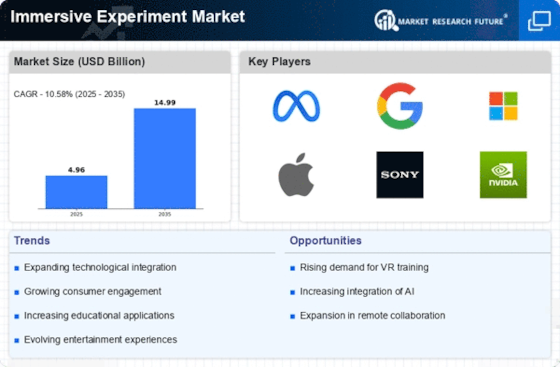
As per MRFR analysis, the Immersive Experiment Market Size was estimated at 4.96 USD Billion in 2024. The Immersive Experiment industry is projected to grow from 5.485 USD Billion in 2025 to 14.99 USD Billion by 2035, exhibiting a compound annual growth rate (CAGR) of 10.58 during the forecast period 2025 - 2035.

Key Market Trends & Highlights

The Immersive Experiment Market is poised for substantial growth driven by technological advancements and user-centric innovations.

  • North America remains the largest market for immersive experiments, showcasing a robust demand across various sectors.
  • Asia-Pacific is emerging as the fastest-growing region, fueled by increasing investments in technology and education.
  • The education segment leads the market, while the entertainment segment is rapidly gaining traction due to evolving consumer preferences.
  • Technological advancements and the rising demand for training solutions are key drivers propelling market expansion.

Market Size & Forecast

2024 Market Size 4.96 (USD Billion)
2035 Market Size 14.99 (USD Billion)
CAGR (2025 - 2035) 10.58%

Major Players

Meta Platforms (US), Google (US), Microsoft (US), Apple (US), Sony (JP), NVIDIA (US), Unity Technologies (US), Epic Games (US), HTC (TW)

Immersive Experiment Market Trends

The Immersive Experiment Market is currently experiencing a notable evolution, driven by advancements in technology and a growing interest in experiential learning. This market encompasses a variety of applications, including virtual reality, augmented reality, and mixed reality experiences, which are increasingly utilized across sectors such as education, entertainment, and healthcare. As organizations seek innovative ways to engage audiences and enhance learning outcomes, the demand for immersive experiences appears to be on the rise. Furthermore, the integration of artificial intelligence and machine learning into immersive technologies suggests a potential for more personalized and adaptive experiences, catering to individual user preferences and learning styles. In addition, the Immersive Experiment Market is likely to witness a surge in collaboration between technology providers and content creators. This partnership may lead to the development of more sophisticated and engaging content, thereby attracting a broader audience. As the market matures, it seems that the focus will shift towards creating seamless and intuitive user experiences, which could further drive adoption across various industries. Overall, the Immersive Experiment Market is poised for growth, with a promising outlook for the future as it continues to evolve and adapt to changing consumer needs and technological advancements.

Technological Integration

The Immersive Experiment Market is increasingly characterized by the integration of advanced technologies. Innovations in virtual reality, augmented reality, and artificial intelligence are reshaping how experiences are designed and delivered. This trend indicates a shift towards more interactive and engaging environments, enhancing user participation and satisfaction.

Cross-Industry Collaboration

There appears to be a growing trend of collaboration between technology firms and content creators within the Immersive Experiment Market. Such partnerships are likely to foster the development of unique and compelling content, which may attract diverse audiences and expand market reach.

Focus on User Experience

The emphasis on user experience within the Immersive Experiment Market is becoming increasingly pronounced. Companies are prioritizing the creation of intuitive and seamless interactions, which could lead to higher engagement levels and improved learning outcomes across various applications.

Immersive Experiment Market Drivers

Technological Advancements

The Immersive Experiment Market is experiencing rapid technological advancements that enhance user engagement and interaction. Innovations in virtual reality (VR), augmented reality (AR), and mixed reality (MR) are driving the development of more sophisticated immersive experiences. For instance, the integration of artificial intelligence (AI) into immersive platforms allows for personalized experiences, adapting content to user preferences. According to recent data, the market for VR and AR technologies is projected to reach USD 300 billion by 2025, indicating a robust growth trajectory. This surge in technology not only attracts consumers but also encourages businesses to invest in immersive solutions, thereby expanding the Immersive Experiment Market.

Rise of Remote Collaboration

The Immersive Experiment Market is benefiting from the rise of remote collaboration tools that leverage immersive technologies. As organizations adapt to hybrid work models, immersive platforms facilitate real-time collaboration among geographically dispersed teams. These tools enable users to interact in virtual environments, enhancing communication and teamwork. Market analysis indicates that the demand for remote collaboration solutions is expected to grow significantly, with immersive technologies playing a crucial role in this evolution. This trend not only enhances productivity but also positions the Immersive Experiment Market as a vital component in the future of work.

Expansion of Educational Applications

The Immersive Experiment Market is expanding rapidly within the education sector, as institutions increasingly recognize the benefits of immersive learning experiences. Technologies such as VR and AR are being utilized to create interactive educational content that enhances student engagement and understanding. Studies indicate that immersive learning can improve knowledge retention and foster critical thinking skills. As educational institutions seek innovative methods to enhance learning outcomes, the Immersive Experiment Market is poised for substantial growth. This trend reflects a broader shift towards experiential learning, positioning immersive technologies as essential tools in modern education.

Increased Demand for Training Solutions

The Immersive Experiment Market is witnessing a notable increase in demand for training solutions across various sectors. Industries such as healthcare, aviation, and manufacturing are increasingly adopting immersive technologies for training purposes. For example, simulations in medical training allow practitioners to hone their skills in a risk-free environment. Reports suggest that the use of immersive training solutions can enhance retention rates by up to 75%, compared to traditional methods. This growing recognition of the effectiveness of immersive training is likely to propel the Immersive Experiment Market forward, as organizations seek innovative ways to improve employee performance and safety.

Growing Interest in Entertainment and Gaming

The Immersive Experiment Market is experiencing a surge in interest from the entertainment and gaming sectors. As consumers seek more engaging and interactive experiences, immersive technologies are becoming integral to game development and entertainment offerings. The gaming industry alone is projected to reach USD 200 billion by 2025, with immersive experiences at the forefront of this growth. This trend is likely to attract significant investment in the Immersive Experiment Market, as developers and content creators strive to meet the evolving demands of consumers for more immersive and captivating experiences.


Market Segment Insights

By Application: Education (Largest) vs. Entertainment (Fastest-Growing)

The Immersive Experiment Market is diversified across several application segments, with Education leading in market share. Institutions are increasingly adopting immersive technologies to enhance learning experiences, making this segment pivotal in driving market dynamics. Entertainment follows closely, attracting significant attention, especially in the gaming and media sectors where immersive experiences are becoming more prevalent. Other applications like Healthcare, Training, and Marketing also contribute but remain smaller in comparison. Growth trends within the Immersive Experiment Market highlight Education's substantial foothold and the rapid ascent of Entertainment. The integration of augmented reality (AR) and virtual reality (VR) in educational settings showcases the potential for deeper engagement and knowledge retention. Entertainment's growth is fueled by technological advancements and consumer demand for interactive experiences that redefine leisure activities, making it the fastest-growing sector in this market.

Education (Dominant) vs. Entertainment (Emerging)

The Education segment stands as the dominant force within the Immersive Experiment Market, characterized by its robust adoption in classrooms and training facilities. Educational institutions leverage immersive technologies to create engaging environments that facilitate hands-on learning and critical thinking. This segment is often regarded as a driver of innovation, utilizing tools such as VR simulations to provide students with real-world experiences. Conversely, the Entertainment segment is emerging rapidly, powered by trends in the gaming industry and VR experiences in media. As consumer interest in personalized and immersive content surges, this segment is redefining entertainment consumption patterns while offering substantial opportunities for developers and content creators. Together, these segments illustrate the diverse application landscape driving market growth.

By Technology: Virtual Reality (Largest) vs. Augmented Reality (Fastest-Growing)

In the Immersive Experiment Market, Virtual Reality holds the largest market share due to its widespread adoption across various sectors such as gaming, education, and training. Its immersive experiences create engaging environments that attract a significant user base, establishing it as the dominant technology in this landscape. On the other hand, Augmented Reality, while smaller in share relative to Virtual Reality, is rapidly gaining momentum, particularly in retail and marketing sectors, where interaction is key to customer engagement.

Technology: Virtual Reality (Dominant) vs. Augmented Reality (Emerging)

Virtual Reality is characterized by its fully immersive environments that replace the real world with simulated experiences, making it highly effective for training and entertainment applications. It is favored for its ability to create convincing replicas of diverse scenarios, enhancing user engagement. In contrast, Augmented Reality overlays digital information onto the real world, which offers a more blended experience. It is emerging as a powerful tool in commerce, where it enhances shopping experiences by providing interactive elements without isolating users from their physical surroundings. Both segments continue to innovate, addressing specific needs and user experiences.

By End Use: B2B (Largest) vs. B2C (Fastest-Growing)

In the Immersive Experiment Market, the distribution between B2B and B2C end uses shows a clear dominance of the B2B sector. This segment is characterized by substantial investments from businesses leveraging immersive technologies for training, simulations, and product demonstrations. B2B applications tend to have more extended purchase cycles and higher budgets, which contributes to its larger market share. On the other hand, the B2C sector is witnessing rapid growth, fueled by the increasing popularity of virtual reality experiences among consumers. The rise of immersive gaming, virtual tours, and consumer-focused educational tools is propelling the B2C segment to new heights. Innovations in accessible technology and mobile solutions are further accelerating this trend, positioning B2C as the fastest-growing segment in the market.

End Use: B2B (Dominant) vs. B2C (Emerging)

The B2B segment in the Immersive Experiment Market is well-established, with businesses recognizing the value of immersive technology for enhancing employee training and client engagement. This segment benefits from long-term contracts and collaborations, thereby ensuring stability and consistent demand. Companies invest in powerful simulations and virtual environments that facilitate learning and decision-making processes effectively. In contrast, the B2C segment is emerging rapidly due to innovations in gaming and immersive experiences available to consumers. It attracts attention through social media, influencers, and a growing community interested in virtual experiences. The increasing affordability of VR headsets and mobile applications has also paved the way for this sector, enabling a wider audience to explore and benefit from immersive technologies.

By Content Type: Simulation (Largest) vs. Interactive Experiences (Fastest-Growing)

The Content Type segment in the Immersive Experiment Market is predominantly led by Simulation, which commands the largest share of the market. Simulation offers users immersive interactions that closely replicate real-world scenarios, driving its widespread adoption across various industries such as education, healthcare, and entertainment. Following closely, Interactive Experiences are rapidly gaining traction, appealing especially to younger demographics who crave engaging and participatory content. This growing preference for hands-on experiences over passive consumption is reshaping the landscape of immersive content.

Content Type: Simulation (Dominant) vs. Interactive Experiences (Emerging)

Simulation serves as the dominant force in the Immersive Experiment Market by providing realistic and practical applications, especially in training and educational contexts. Its strength lies in its ability to replicate complex real-world situations, facilitating experiential learning. On the other hand, Interactive Experiences are emerging as a powerful alternative, featuring user-driven involvement that enhances engagement and satisfaction. These experiences resonate well with audiences seeking novelty and entertainment, positioning them as crucial for future growth in the market. Both segments complement each other, with Simulation focusing on training and skill development, while Interactive Experiences emphasize entertainment and engagement.

Get more detailed insights about Immersive Experiment Market

Regional Insights

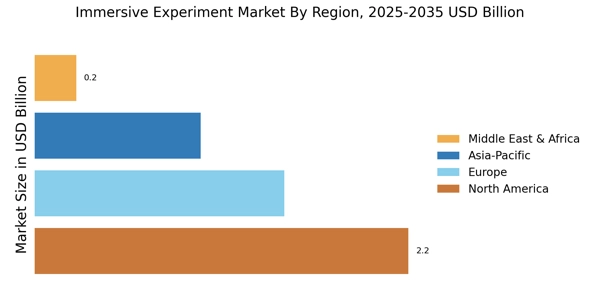
The Immersive Experiment Market revenue is forecasted to reach 4.96 USD Billion in 2024, driven by heightened interest in engagement-driven technologies across various sectors. In terms of regional segmentation, North America leads with a valuation of 1.673 USD Billion in 2024, indicating a significant appetite for advanced immersive experiences in both enterprise and entertainment applications. Europe follows with a valuation of 1.223 USD Billion, reflecting a competitive landscape as businesses invest in immersive technologies to enhance consumer engagement.

The APAC region is also noteworthy, valued at 1.057 USD Billion in 2024, as technological advancements and growing gaming markets enhance its importance in the Immersive Experiment Market industry. South America, valued at 0.624 USD Billion, shows potential for growth as emerging economies increasingly adopt immersive technologies. The MEA region, while currently at a valuation of 0.383 USD Billion, is gradually gaining traction, and its diverse cultural landscape presents unique opportunities for immersive experiences.

Collectively, these regional insights reveal a dynamic global landscape driven by market trends that emphasize user engagement, innovation, and technological advancements, leading to promising growth avenues in the coming years.

Immersive Experiment Market Regional Insights

Source: Primary Research, Secondary Research, Market Research Future Database and Analyst Review

Immersive Experiment Market Regional Image

Key Players and Competitive Insights

The Immersive Experiment Market has shown tremendous growth, driven by advancements in technology and an increasing demand for engaging experiences across various sectors, including entertainment, education, and gaming. Companies within this market continually strive to innovate and differentiate their offerings to capture a larger share of the market. By leveraging cutting-edge technologies such as virtual reality (VR) and augmented reality (AR), firms are enhancing user interactions, thereby facilitating immersive and interactive experiences. The competitive landscape is characterized by constant evolution as organizations seek to meet the changing preferences of consumers, who are increasingly drawn to immersive experimental environments.

As the competition escalates, key players are not only focusing on technological enhancements but also on strategic partnerships, marketing initiatives, and customer engagement strategies to stay ahead in this dynamic arena. HTC has firmly established its presence in the Immersive Experiment Market, recognized for its innovation and commitment to delivering high-quality VR experiences. Leveraging its extensive expertise in hardware and software development, HTC offers a line of advanced VR products that cater to both consumers and enterprises.

The company's strengths lie in its strong brand reputation, a well-established ecosystem of developers, and a wide array of content that enriches the user experience. Furthermore, HTC's focus on creating immersive experiences that extend beyond entertainment to applications in education, healthcare, and business sets it apart in a crowded marketplace. Its strategic investments in research and development help to ensure that the company remains at the forefront of emerging trends, fostering a robust framework for future innovations in the immersive experiment sector.

Oculus stands as a powerful player in the Immersive Experiment Market, largely renowned for its focus on consumer-grade virtual reality headsets. As a subsidiary of a major technology leader, Oculus benefits from significant resources and expertise that enable it to create highly immersive experiences that connect with users worldwide. The company's strengths include a user-friendly interface and a diverse portfolio of VR content that appeals to various demographics, ensuring broader adoption of its technologies. Oculus is notable for continuously enhancing its product offerings, featuring improved graphics, performance, and affordability, thus attracting a diverse audience to experience immersive content.

The alignment of Oculus with gaming, educational tools, and social experiences has further solidified its standing in the market. Its ability to integrate seamlessly with various platforms contributes to an ever-growing user base, enhancing its competitive edge in the expanding landscape of immersive experiences.

Key Companies in the Immersive Experiment Market market include

Industry Developments

  • Q2 2024: Apple launches Vision Pro headset, entering the spatial computing market Apple officially launched its Vision Pro mixed reality headset in the United States, marking its entry into the immersive spatial computing sector and expanding its hardware ecosystem with a focus on AR/VR experiences.
  • Q2 2024: Meta Announces Partnership with BMW to Integrate AR/VR in Automotive Experiences Meta announced a strategic partnership with BMW to develop and integrate augmented and virtual reality technologies into future BMW vehicles, aiming to enhance in-car entertainment and driver assistance systems.
  • Q2 2024: HTC VIVE Unveils VIVE Ultimate Tracker, Expanding Full-Body Tracking for VR HTC launched the VIVE Ultimate Tracker, a new device designed to provide advanced full-body tracking capabilities for immersive VR experiences, targeting both consumer and enterprise markets.
  • Q2 2024: Magic Leap and Google Announce Strategic Technology Partnership Magic Leap and Google announced a partnership to collaborate on the development of immersive AR solutions, combining Magic Leap’s hardware expertise with Google’s software and cloud capabilities.
  • Q3 2024: Sony launches new PlayStation VR2 headset in Europe and Asia Sony expanded the availability of its PlayStation VR2 headset to European and Asian markets, aiming to capture a larger share of the global immersive gaming and entertainment sector.
  • Q3 2024: Niantic acquires immersive AR startup 8th Wall Niantic, known for Pokémon Go, acquired 8th Wall, a startup specializing in web-based augmented reality development tools, to strengthen its position in the immersive AR content creation market.
  • Q3 2024: Meta launches Horizon Workrooms 2.0 for enterprise VR collaboration Meta released Horizon Workrooms 2.0, an upgraded version of its VR collaboration platform, introducing new features for immersive remote meetings and productivity in enterprise environments.
  • Q4 2024: Varjo raises $40M Series D to expand enterprise XR solutions Varjo, a Finnish maker of high-end XR headsets, secured $40 million in Series D funding to accelerate the development and global rollout of its immersive enterprise solutions.
  • Q4 2024: Unity appoints new CEO to drive immersive technology growth Unity Technologies announced the appointment of a new CEO, signaling a strategic focus on expanding its immersive technology offerings for gaming, industrial, and training applications.
  • Q1 2025: Meta opens new XR research facility in Dublin Meta opened a new research and development facility in Dublin dedicated to advancing XR (extended reality) technologies, supporting innovation in immersive experiences.
  • Q1 2025: Snap partners with Samsung to bring AR features to Galaxy devices Snap Inc. announced a partnership with Samsung to integrate advanced AR features into Galaxy smartphones, expanding the reach of immersive social and creative experiences.
  • Q2 2025: Epic Games secures $100M investment to boost metaverse and immersive content Epic Games raised $100 million in new funding to accelerate the development of its metaverse platform and immersive content creation tools, reinforcing its leadership in the immersive experiment market.

Future Outlook

Immersive Experiment Market Future Outlook

The Immersive Experiment Market is projected to grow at a 10.58% CAGR from 2024 to 2035, driven by technological advancements, increasing consumer engagement, and expanding applications across industries.

New opportunities lie in:

  • Development of immersive training programs for corporate clients.
  • Integration of augmented reality in retail environments.
  • Creation of subscription-based immersive content platforms.

By 2035, the market is expected to be robust, driven by innovation and diverse applications.

Market Segmentation

Immersive Experiment Market End Use Outlook

  • B2B
  • B2C

Immersive Experiment Market Technology Outlook

  • Virtual Reality
  • Augmented Reality
  • Mixed Reality

Immersive Experiment Market Application Outlook

  • Education
  • Entertainment
  • Healthcare
  • Training
  • Marketing

Immersive Experiment Market Content Type Outlook

  • Simulation
  • Interactive Experiences
  • Immersive Storytelling

Report Scope

MARKET SIZE 20244.96(USD Billion)
MARKET SIZE 20255.485(USD Billion)
MARKET SIZE 203514.99(USD Billion)
COMPOUND ANNUAL GROWTH RATE (CAGR)10.58% (2024 - 2035)
REPORT COVERAGERevenue Forecast, Competitive Landscape, Growth Factors, and Trends
BASE YEAR2024
Market Forecast Period2025 - 2035
Historical Data2019 - 2024
Market Forecast UnitsUSD Billion
Key Companies ProfiledMarket analysis in progress
Segments CoveredMarket segmentation analysis in progress
Key Market OpportunitiesIntegration of artificial intelligence in immersive experiences enhances user engagement and personalization.
Key Market DynamicsTechnological advancements drive immersive experiences, reshaping consumer engagement and competitive dynamics in the immersive experiment market.
Countries CoveredNorth America, Europe, APAC, South America, MEA

Leave a Comment

FAQs

What is the current valuation of the Immersive Experiment Market as of 2024?

The Immersive Experiment Market was valued at 4.96 USD Billion in 2024.

What is the projected market size for the Immersive Experiment Market by 2035?

The market is projected to reach 14.99 USD Billion by 2035.

What is the expected CAGR for the Immersive Experiment Market during the forecast period 2025 - 2035?

The expected CAGR for the market during 2025 - 2035 is 10.58%.

Which companies are considered key players in the Immersive Experiment Market?

Key players include Meta Platforms, Google, Microsoft, Apple, Sony, NVIDIA, Unity Technologies, Epic Games, and HTC.

How does the Immersive Experiment Market segment by application?

The market segments by application include Education, Entertainment, Healthcare, Training, and Marketing.

What are the projected valuations for the Education segment by 2035?

The Education segment is projected to grow from 0.75 USD Billion to 2.25 USD Billion by 2035.

What is the expected growth for the Entertainment segment in the Immersive Experiment Market?

The Entertainment segment is anticipated to expand from 1.5 USD Billion to 4.5 USD Billion by 2035.

How is the Immersive Experiment Market segmented by technology?

The market is segmented into Virtual Reality, Augmented Reality, and Mixed Reality.

What are the projected valuations for the Mixed Reality segment by 2035?

The Mixed Reality segment is expected to grow from 1.49 USD Billion to 4.44 USD Billion by 2035.

What types of content are included in the Immersive Experiment Market?

Content types include Simulation, Interactive Experiences, and Immersive Storytelling.

Download Free Sample

Kindly complete the form below to receive a free sample of this Report

Compare Licence

×
Features License Type
Single User Multiuser License Enterprise User
Price $4,950 $5,950 $7,250
Maximum User Access Limit 1 User Upto 10 Users Unrestricted Access Throughout the Organization
Free Customization
Direct Access to Analyst
Deliverable Format
Platform Access
Discount on Next Purchase 10% 15% 15%
Printable Versions