
×
Request Free Sample ×

Kindly complete the form below to receive a free sample of this Report

* Please use a valid business email

Leading companies partner with us for data-driven Insights

clients tt-cursor
Hero Background
English
Chinese
French
Japanese
Korean
German
Spanish

Immersion Coolers Market Share

ID: MRFR/EnP/10423-CR
128 Pages
Anshula Mandaokar
July 2023

Immersion Coolers Market Research Report Information By Cooling Capacity (10-20kW, 21-50kW, 51-80kW and 80-120kW and 121-150kW), By Type (low temperature and high temperature), By Application (Manufacturing Industry, Food Industry, Consumer Industry and Other) By Sales Channel (Manufacturer/Distributor/Service provider and aftermarket) and By Region - Growth & Industry Forecast to 2035

Share:
Download PDF ×

We do not share your information with anyone. However, we may send you emails based on your report interest from time to time. You may contact us at any time to opt-out.

Immersion Coolers Market Infographic
Purchase Options

Market Share

Immersion Coolers Market Share Analysis

The rapid progress in technology has given rise to innovative immersion coolers, ushering in a host of advantages for end-users, particularly in terms of enhanced portability and user-friendliness. These technological strides are not only elevating the efficiency of immersion coolers but also paving the way for significant expansion within the market.

A notable technological advancement contributing to the growth of the immersion coolers market is the introduction of portable immersion coolers. Engineered to be compact and lightweight, these coolers facilitate easy transport and usage in diverse locations. Their portability proves especially valuable in field research scenarios, where samples necessitate movement to various sites for analysis. In such contexts, portable immersion coolers emerge as an effective solution for preserving sample integrity during both transport and analysis.

Another key advancement propelling market growth is the evolution of user-friendly interfaces. The incorporation of touch screens and intuitive controls simplifies the cooling process for end-users. This user-friendly feature proves particularly beneficial in research and development applications, where precise temperature control is imperative for obtaining accurate and reliable results. The advent of interfaces that allow easy customization of the cooling process is aligning immersion coolers with the demands of modern research practices.

Furthermore, the integration of automation and connectivity features into immersion coolers presents an additional avenue for market expansion. Automated immersion coolers deliver a spectrum of advantages to end-users, including heightened process efficiency, reduced operator error, and enhanced safety measures. These coolers can be programmed to automatically adapt the cooling process based on user-defined parameters, providing greater control and precision.

The inclusion of connectivity features, such as Wi-Fi and Bluetooth, is a noteworthy development enhancing immersion coolers. This allows users to remotely monitor and control the cooling process, proving particularly beneficial in settings requiring continuous oversight, such as pharmaceutical manufacturing and laboratory research. The ability to manage cooling processes remotely through connectivity features streamlines operations and enhances overall efficiency.

The immersion coolers market is experiencing significant growth propelled by technological advancements. Portable immersion coolers address the need for mobility, user-friendly interfaces cater to the demand for ease of use, and the incorporation of automation and connectivity features introduces a new level of control and efficiency. As technology continues to advance, immersion coolers are poised to play an increasingly vital role in diverse industries, ensuring the preservation of samples, precision in cooling processes, and seamless integration into modern research and development practices.


Author
Anshula Mandaokar
Team Lead - Research

Anshula Mandaokar holds an academic degree in Chemical Engineering and has been contributing to the field for more than 5 years. She has expertise in Market Research and Business Consulting and serves as a Team Lead for a reputed Market Research firm under the Chemicals and Materials domain spectrum. She has worked on multiple projects, generating explicit results in a quick turnaround time. Her understanding of data interpretation justifies her role as a leader.

Leave a Comment

FAQs

What is the current valuation of the Immersion Coolers Market?

<p>The Immersion Coolers Market was valued at approximately 2972.83 USD Million in 2024.</p>

What is the projected market valuation for the Immersion Coolers Market in 2035?

<p>The market is projected to reach around 6263.81 USD Million by 2035.</p>

What is the expected CAGR for the Immersion Coolers Market during the forecast period 2025 - 2035?

<p>The expected CAGR for the Immersion Coolers Market during 2025 - 2035 is 7.01%.</p>

Which companies are considered key players in the Immersion Coolers Market?

<p>Key players in the market include Thermo Fisher Scientific, Watlow Electric Manufacturing, and Julabo GmbH, among others.</p>

What are the different cooling capacity segments in the Immersion Coolers Market?

<p>The cooling capacity segments include 10-20kW, 21-50kW, 51-80kW, 80-120kW, and 121-150kW, with valuations ranging from 372.83 to 1500.0 USD Million.</p>

How does the Immersion Coolers Market perform across different applications?

<p>The market performance varies, with the Food Industry segment valued at 1185.0 to 2500.0 USD Million and the Manufacturing Industry at 891.42 to 1890.0 USD Million.</p>

What types of immersion coolers are available in the market?

<p>The market features Low Temperature and High Temperature types, with valuations of 1185.13 to 3783.81 USD Million.</p>

What sales channels are utilized in the Immersion Coolers Market?

<p>Sales channels include Manufacturer/Distributor/Service Provider and Aftermarket, with valuations of 1780.0 to 3780.0 USD Million and 1192.83 to 2483.81 USD Million, respectively.</p>

What trends are influencing the growth of the Immersion Coolers Market?

<p>Trends such as increasing demand in the Food Industry and advancements in cooling technology appear to drive market growth.</p>

How does the Immersion Coolers Market compare to other segments in terms of growth?

<p>The Immersion Coolers Market shows promising growth potential, particularly in the Food Industry, which is projected to expand significantly by 2035.</p>

Market Summary

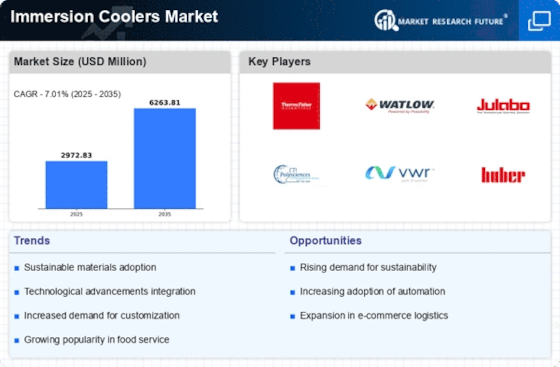
As per Market Research Future analysis, the Immersion Coolers Market Size was estimated at 2972.83 USD Million in 2024. The Immersion Coolers industry is projected to grow from 3181.23 USD Million in 2025 to 6263.81 USD Million by 2035, exhibiting a compound annual growth rate (CAGR) of 7.0% during the forecast period 2025 - 2035

Key Market Trends & Highlights

The Immersion Coolers Market is poised for growth driven by sustainability and technological advancements.

  • The market is increasingly characterized by a strong focus on sustainability and energy efficiency. North America remains the largest market, while Asia-Pacific is emerging as the fastest-growing region. The 51-80kW segment dominates the market, whereas the 21-50kW segment is witnessing rapid growth. Key drivers include rising demand for energy efficiency and technological innovations in cooling solutions.

Market Size & Forecast

2024 Market Size 2972.83 (USD Million)
2035 Market Size 6263.81 (USD Million)
CAGR (2025 - 2035) 7.01%
Largest Regional Market Share in 2024 North America

Major Players

<a href="https://www.thermofisher.com/order/catalog/product/329-1901">Thermo Fisher Scientific</a> (US), Watlow Electric Manufacturing (US), Julabo GmbH (DE), PolyScience (US), VWR International (US), Huber Kältemaschinenbau (DE), <a href="https://www.lauda.de/uk/products/constant-temperature-equipment/thermostats/immersion-and-bridge-thermostats">Lauda Dr. R. Wobser GmbH &amp; Co. KG</a> (DE), Büchi Labortechnik AG (CH)

Market Trends

The Immersion Coolers Market is currently experiencing a notable transformation, driven by advancements in technology and evolving consumer preferences. As industries increasingly prioritize energy efficiency and sustainability, immersion coolers are being designed with innovative features that enhance performance while minimizing environmental impact. This shift appears to be influencing purchasing decisions, as businesses seek solutions that not only meet their cooling needs but also align with broader sustainability goals. Furthermore, the growing demand for portable and versatile cooling solutions in various sectors, including food and beverage, pharmaceuticals, and electronics, suggests a dynamic landscape where immersion coolers are becoming integral to operational efficiency. In addition, the Immersion Coolers Market is likely to witness increased competition as new entrants emerge, offering diverse product lines that cater to specific industry requirements. This competitive environment may drive innovation, leading to the development of advanced cooling technologies that promise improved reliability and user experience. As the market evolves, stakeholders must remain vigilant to emerging trends and consumer demands, ensuring that their offerings remain relevant and effective in addressing the challenges faced by various sectors. Overall, the Immersion Coolers Market is poised for growth, with opportunities for both established players and newcomers to capitalize on the changing landscape.

Sustainability Focus

The emphasis on eco-friendly solutions is reshaping the Immersion Coolers Market. Manufacturers are increasingly integrating sustainable materials and energy-efficient technologies into their designs, appealing to environmentally conscious consumers and businesses.

Technological Advancements

Innovations in cooling technology are driving the evolution of immersion coolers. Enhanced features such as smart controls, IoT integration, and improved thermal management systems are becoming more prevalent, offering users greater efficiency and convenience.

Diverse Applications

The versatility of immersion coolers is expanding their use across various industries. From food preservation to medical applications, the adaptability of these cooling systems is fostering new market opportunities and driving demand.

Immersion Coolers Market Market Drivers

Growth in the Electronics Sector

The Immersion Coolers Market is benefiting from the rapid growth in the electronics sector, particularly with the rise of high-performance computing and data centers. As electronic devices become more powerful, the need for effective cooling solutions to manage heat generation is paramount. Immersion cooling technology offers a highly efficient method for dissipating heat, which is essential for maintaining optimal performance and reliability of electronic components. This trend is likely to drive significant investments in immersion cooling systems, with market analysts projecting a robust growth trajectory as the electronics industry continues to expand.

Rising Demand for Energy Efficiency

The Immersion Coolers Market is experiencing a notable surge in demand for energy-efficient cooling solutions. As industries increasingly prioritize sustainability, immersion coolers, known for their lower energy consumption compared to traditional cooling methods, are becoming more appealing. This shift is driven by regulatory pressures and consumer preferences for environmentally friendly products. According to recent data, energy-efficient cooling systems can reduce operational costs by up to 30%, making them a financially attractive option for businesses. Consequently, manufacturers are innovating to enhance the energy efficiency of their immersion coolers, which is likely to further stimulate market growth.

Expanding Applications Across Industries

The Immersion Coolers Market is witnessing an expansion in applications across various sectors, including food and beverage, pharmaceuticals, and electronics. The versatility of immersion coolers makes them suitable for a wide range of cooling needs, from preserving temperature-sensitive products to cooling electronic components. For instance, the food and beverage sector is increasingly adopting immersion cooling for its efficiency in maintaining product quality during processing and storage. This diversification of applications is likely to drive market growth, with projections indicating a compound annual growth rate (CAGR) of approximately 10% over the next five years.

Increased Focus on Food Safety Regulations

The Immersion Coolers Market is significantly influenced by the heightened focus on food safety regulations. As governments implement stricter guidelines to ensure food quality and safety, the demand for reliable cooling solutions has intensified. Immersion coolers are recognized for their ability to maintain consistent temperatures, which is crucial for preventing food spoilage and contamination. This regulatory environment is compelling food manufacturers and distributors to invest in advanced cooling technologies, thereby propelling the immersion coolers market forward. The market is expected to see a substantial increase in demand as compliance with these regulations becomes more stringent.

Technological Innovations in Cooling Solutions

Technological advancements are playing a pivotal role in shaping the Immersion Coolers Market. Innovations such as advanced heat exchange materials and smart cooling technologies are enhancing the performance and reliability of immersion coolers. These developments not only improve cooling efficiency but also extend the lifespan of the equipment. The integration of IoT technology allows for real-time monitoring and control, which can optimize energy usage and reduce maintenance costs. As industries seek to modernize their cooling systems, the demand for technologically advanced immersion coolers is expected to rise, potentially leading to a market expansion of over 15% in the coming years.

Market Segment Insights

By Cooling Capacity: 51-80kW (Largest) vs. 21-50kW (Fastest-Growing)

In the Immersion Coolers Market, the 51-80kW segment commands the largest market share due to its balanced performance capabilities and efficiency in various industrial applications. This capacity range is widely adopted across sectors requiring consistent cooling solutions, making it a preferred choice among industries such as electronics and pharmaceuticals. Conversely, the 21-50kW segment, while currently smaller in total market share, is noted for its rapid growth and increasing adoption as companies seek more versatile cooling options for mid-sized operations. This shift reflects a trend toward optimizing energy usage and operational efficiency. The growth of the 21-50kW segment is driven by the rising demand for energy-efficient solutions and the need for cost-effective cooling systems in diverse applications. Industries are increasingly leaning towards mid-range cooling capacities that provide flexibility without compromising performance. Technological advancements have also played a pivotal role in enhancing the efficiency of these coolers, making them appealing for both new installations and retrofits in existing setups. As companies prioritize sustainability, the 21-50kW segment stands to capture a larger portion of the market, supported by ongoing innovations in immersion cooler design and functionality.

51-80kW (Dominant) vs. 21-50kW (Emerging)

The 51-80kW segment is characterized by its robust performance and versatility, making it the dominant choice in the Immersion Coolers Market. This capacity range offers reliable cooling solutions for various larger-scale applications, particularly in sectors like manufacturing and data centers, where thermal management is crucial. The established market presence of 51-80kW coolers is bolstered by their proven efficiency and effectiveness in maintaining optimal operating temperatures. On the other hand, the 21-50kW segment is emerging rapidly, driven by a shift in industrial cooling needs towards more modular and scalable solutions. This capacity range is increasingly favored in small-to-medium-sized operations, where adaptability and energy savings are paramount. As industries evolve and technology advances, the 21-50kW segment is positioned for significant growth, appealing to customers looking for innovative and efficient cooling solutions.

By Type: Low Temperature (Largest) vs. High Temperature (Fastest-Growing)

In the Immersion Coolers Market, the segment is notably divided into two main types: low temperature and high temperature. The low temperature segment currently holds the largest share as it caters to industries with stringent cooling requirements, such as pharmaceuticals and food preservation. The high temperature segment, meanwhile, is experiencing rapid growth as more enterprises recognize its benefits for specific applications that require less cooling capacity and greater energy efficiency. Growth trends in the Immersion Coolers Market are primarily driven by technological advancements and increased demand from various sectors. Low temperature coolers have solidified their position by maximizing efficiency and reliability in maintaining product integrity over extended periods. Conversely, high temperature immersion coolers are gaining traction among businesses seeking innovative cooling solutions that are both cost-effective and energy-efficient, making them an emerging favorite in the market.

Type: Low Temperature (Dominant) vs. High Temperature (Emerging)

The low temperature segment of the Immersion Coolers Market is characterized by its ability to maintain precise cooling conditions, making it essential for sectors like food processing, pharmaceuticals, and biotechnology, where temperature control is crucial to product quality and safety. This segment enjoys established customer loyalty due to its proven reliability. In contrast, the high temperature segment represents a burgeoning market choice, tailored for applications requiring moderate cooling effects. It appeals particularly to industries striving for efficiency and lower operational costs. The high temperature coolers are becoming increasingly popular for their reduced energy consumption and flexibility in cooling strategies, thereby catering to businesses looking for sustainable and economically viable options.

By Application: Food Industry (Largest) vs. Manufacturing Industry (Fastest-Growing)

The Immersion Coolers Market is primarily segmented into four key applications: the manufacturing industry, the food industry, the consumer industry, and other. Among these segments, the food industry holds the largest market share, driven by the increasing demand for optimized cooling solutions in food processing and storage. On the other hand, the manufacturing industry, while having a smaller share, is emerging as the fastest-growing sector in the immersion coolers market, particularly due to rising technological advancements and efficiency needs in manufacturing processes.

Food Industry: Dominant vs. Manufacturing Industry: Emerging

The food industry serves as the dominant application for immersion coolers, owing to its critical role in maintaining the quality and safety of food products. Innovations in food preservation techniques and a growing emphasis on food safety regulations have propelled this sector forward. In contrast, the manufacturing industry is marked as an emerging segment, with rapid adoption rates of immersion cooling solutions fueled by the need to enhance process efficiency and reduce operational costs. As manufacturing processes evolve, the demand for reliable and efficient cooling systems is expected to increase, positioning it as a key player in the market.

By Sales Channel: Manufacturer/Distributor (Largest) vs. Aftermarket (Fastest-Growing)

The Immersion Coolers Market has observed a significant distribution of market share between its key sales channels, namely Manufacturer/Distributor and Aftermarket. The Manufacturer/Distributor segment captures the largest share, thanks to established supply chains and strong relationships with end-users. This segment benefits from direct sales and comprehensive service options, making it a preferred choice for many businesses. Conversely, the Aftermarket segment, which includes parts and service solutions, is gaining traction, driven by the growing trend toward maintenance and repair of installed systems, making it a lucrative area for growth.

Sales Channel: Manufacturer/Distributor (Dominant) vs. Aftermarket (Emerging)

The Manufacturer/Distributor segment in the Immersion Coolers Market is characterized by a well-established network that facilitates direct access to customers and extensive technical support. This dominance is underscored by a strong focus on customer relationships and tailored solutions that meet diverse customer needs. In contrast, the Aftermarket segment is emerging rapidly, fueled by increased demand for replacement parts and maintenance services. This growth is influenced by the rising number of installed immersion cooler units and the emphasis on optimizing their performance through aftermarket solutions. As end-users recognize the value of maintaining their systems, the Aftermarket is poised to become a significant player in the market.

Get more detailed insights about Immersion Coolers Market Research Report—Global Forecast till 2035

Regional Insights

North America : Innovation and Demand Surge

North America is the largest market for immersion coolers, accounting for approximately 45% of the global market share. The region's growth is driven by increasing demand in pharmaceuticals, biotechnology, and food processing sectors. Regulatory support from agencies like the FDA and EPA further catalyzes market expansion, ensuring compliance with safety and environmental standards. The trend towards automation and advanced cooling technologies also boosts demand. The United States dominates the North American market, with key players such as Thermo Fisher Scientific and PolyScience leading the charge. Canada follows as the second-largest market, benefiting from a robust healthcare sector and research initiatives. The competitive landscape is characterized by innovation, with companies investing heavily in R&D to enhance product offerings and meet evolving customer needs.

Europe : Regulatory Framework Drives Growth

Europe is a significant player in the immersion coolers market, holding around 30% of the global share. The region's growth is propelled by stringent regulations regarding temperature control in laboratories and food safety, which are enforced by the European Food Safety Authority (EFSA) and other regulatory bodies. The increasing focus on research and development in life sciences and environmental sustainability also contributes to market expansion. Germany and the United Kingdom are the leading countries in this region, with Germany accounting for the largest share due to its advanced manufacturing capabilities. Key players like Julabo GmbH and Huber Kältemaschinenbau are prominent in the market, driving innovation and quality. The competitive landscape is marked by collaborations and partnerships aimed at enhancing product efficiency and compliance with regulatory standards.

Asia-Pacific : Rapid Growth and Adoption

Asia-Pacific is rapidly emerging as a key market for immersion coolers, accounting for approximately 20% of the global market share. The region's growth is driven by increasing investments in healthcare and biotechnology, coupled with a rising demand for advanced cooling solutions in laboratories and industrial applications. Countries like China and India are witnessing significant growth due to expanding research facilities and a focus on quality control in manufacturing processes. China is the largest market in the region, supported by government initiatives aimed at enhancing scientific research and development. India follows closely, with a growing number of pharmaceutical companies investing in advanced cooling technologies. The competitive landscape features both local and international players, with companies like Thermo Fisher Scientific and VWR International establishing a strong presence to cater to the increasing demand.

Middle East and Africa : Emerging Market with Potential

The Middle East and Africa region is gradually emerging in the immersion coolers market, holding about 5% of the global share. The growth is primarily driven by increasing investments in healthcare infrastructure and research facilities, particularly in countries like the UAE and South Africa. The region's focus on improving laboratory standards and compliance with international regulations is also a significant catalyst for market growth. The UAE is leading the market in the Middle East, supported by government initiatives to enhance scientific research capabilities. South Africa follows as a key player, with a growing number of laboratories adopting advanced cooling technologies. The competitive landscape is characterized by a mix of local and international companies, with opportunities for growth as the region continues to develop its scientific and industrial sectors.

Key Players and Competitive Insights

Major market players are spending a lot of money on R&D to increase their product lines, which will help the Immersion Coolers Market grow even more. Market participants are also taking a range of strategic initiatives to grow their worldwide footprint, including new product launches, contractual agreements, mergers and acquisitions, increased investments, and collaboration with other organizations. Competitors in the Immersion Coolers Market industry must offer cost-effective products to expand and survive in an increasingly competitive and rising market environment. One of the primary business strategies adopted by manufacturers in the global Immersion Coolers industry to benefit clients and expand the Immersion Coolers Market sector is to manufacture locally to reduce operating costs. The market for Immersion Coolers Market is recognized as being extremely competitive and fragmented. The market for Immersion Coolers Market offers considerable potential opportunities for domestic and unorganised companies. Some of the key players operating in the Immersion Coolers Market are Thermo Fisher Scientific, VWR International, LLC, Daikin Industries, Ltd, JULABO GmbH, Peter Huber Kältemaschinenbau AG, Sp Scientific, Polyscience, Northern Brewer, Analis and Lister Gmbh. To increase their global reach and client base, key firms are concentrating on acquisitions and product innovation. JULABO GmbH manufactures temperature control devices. The company offers refrigerated and heating circulators, recirculating coolers, and water baths used for research, science and industry. It focuses on modern production technologies and high quality for outstanding products and services. Through its subsidiaries and also with the cooperation with distribution and service partners around the world it serves customers worldwide ensuring the best service. VWR International, LLCis a leading global provider of mission-critical products and services to customers in the biopharma, healthcare, education & government, and advanced technologies & applied materials industries. Its portfolio is used in virtually every stage of the most important research, development and production activities in the industries. The Company offers products such as biosafety cabinets, cleaning systems, gloves, swabs and wipers, environmental monitoring, labeling, and documentation. VWR International operates worldwide.

Key Companies in the Immersion Coolers Market include

Industry Developments

November 2021JULABO GmbH has completed acquisition of GAF from Saxony, the medium-sized company that carried additional expertise in electronics and automation to the company.

June 2019JULABO GmbH has launched CORIO CP. This CORIO circulators have been developed with pioneering technologies for these laboratories and are manufactured to the highest quality standards in Germany. With the new CP models, the CORIO family has added powerful heating immersion circulators, refrigerated circulators, and heating circulators.

Future Outlook

Immersion Coolers Market Future Outlook

The Immersion Coolers Market is projected to grow at a 7.01% CAGR from 2025 to 2035, driven by technological advancements, increasing demand for energy-efficient solutions, and expanding applications across various industries.

New opportunities lie in:

  • <p>Development of smart immersion cooling systems for data centers. Expansion into emerging markets with tailored cooling solutions. Partnerships with renewable energy firms for sustainable cooling technologies.</p>

By 2035, the Immersion Coolers Market is expected to achieve substantial growth, reflecting evolving industry needs.

Market Segmentation

Immersion Coolers Market Type Outlook

  • Low Temperature
  • High Temperature

Immersion Coolers Market Application Outlook

  • Manufacturing Industry
  • Food Industry
  • Consumer Industry
  • Other

Immersion Coolers Market Sales Channel Outlook

  • Manufacturer/Distributor/Service Provider
  • Aftermarket

Immersion Coolers Market Cooling Capacity Outlook

  • 10-20kW
  • 21-50kW
  • 51-80kW
  • 80-120kW
  • 121-150kW

Report Scope

MARKET SIZE 2024 2972.83(USD Million)
MARKET SIZE 2025 3181.23(USD Million)
MARKET SIZE 2035 6263.81(USD Million)
COMPOUND ANNUAL GROWTH RATE (CAGR) 7.01% (2025 - 2035)
REPORT COVERAGE Revenue Forecast, Competitive Landscape, Growth Factors, and Trends
BASE YEAR 2024
Market Forecast Period 2025 - 2035
Historical Data 2019 - 2024
Market Forecast Units USD Million
Key Companies Profiled Thermo Fisher Scientific (US), Watlow Electric Manufacturing (US), Julabo GmbH (DE), PolyScience (US), VWR International (US), Huber Kältemaschinenbau (DE), Lauda Dr. R. Wobser GmbH & Co. KG (DE), Büchi Labortechnik AG (CH)
Segments Covered Cooling Capacity, Type, Application, Sales Channel, Region - Global Forecast to 2035
Key Market Opportunities Integration of advanced cooling technologies enhances efficiency in the Immersion Coolers Market.
Key Market Dynamics Rising demand for energy-efficient immersion coolers drives innovation and competition among manufacturers in the market.
Countries Covered North America, Europe, APAC, South America, MEA

FAQs

What is the current valuation of the Immersion Coolers Market?

<p>The Immersion Coolers Market was valued at approximately 2972.83 USD Million in 2024.</p>

What is the projected market valuation for the Immersion Coolers Market in 2035?

<p>The market is projected to reach around 6263.81 USD Million by 2035.</p>

What is the expected CAGR for the Immersion Coolers Market during the forecast period 2025 - 2035?

<p>The expected CAGR for the Immersion Coolers Market during 2025 - 2035 is 7.01%.</p>

Which companies are considered key players in the Immersion Coolers Market?

<p>Key players in the market include Thermo Fisher Scientific, Watlow Electric Manufacturing, and Julabo GmbH, among others.</p>

What are the different cooling capacity segments in the Immersion Coolers Market?

<p>The cooling capacity segments include 10-20kW, 21-50kW, 51-80kW, 80-120kW, and 121-150kW, with valuations ranging from 372.83 to 1500.0 USD Million.</p>

How does the Immersion Coolers Market perform across different applications?

<p>The market performance varies, with the Food Industry segment valued at 1185.0 to 2500.0 USD Million and the Manufacturing Industry at 891.42 to 1890.0 USD Million.</p>

What types of immersion coolers are available in the market?

<p>The market features Low Temperature and High Temperature types, with valuations of 1185.13 to 3783.81 USD Million.</p>

What sales channels are utilized in the Immersion Coolers Market?

<p>Sales channels include Manufacturer/Distributor/Service Provider and Aftermarket, with valuations of 1780.0 to 3780.0 USD Million and 1192.83 to 2483.81 USD Million, respectively.</p>

What trends are influencing the growth of the Immersion Coolers Market?

<p>Trends such as increasing demand in the Food Industry and advancements in cooling technology appear to drive market growth.</p>

How does the Immersion Coolers Market compare to other segments in terms of growth?

<p>The Immersion Coolers Market shows promising growth potential, particularly in the Food Industry, which is projected to expand significantly by 2035.</p>

  1. SECTION I: EXECUTIVE SUMMARY AND KEY HIGHLIGHTS
    1. | 1.1 EXECUTIVE SUMMARY
    2. | | 1.1.1 Market Overview
    3. | | 1.1.2 Key Findings
    4. | | 1.1.3 Market Segmentation
    5. | | 1.1.4 Competitive Landscape
    6. | | 1.1.5 Challenges and Opportunities
    7. | | 1.1.6 Future Outlook
  2. SECTION II: SCOPING, METHODOLOGY AND MARKET STRUCTURE
    1. | 2.1 MARKET INTRODUCTION
    2. | | 2.1.1 Definition
    3. | | 2.1.2 Scope of the study
    4. | | | 2.1.2.1 Research Objective
    5. | | | 2.1.2.2 Assumption
    6. | | | 2.1.2.3 Limitations
    7. | 2.2 RESEARCH METHODOLOGY
    8. | | 2.2.1 Overview
    9. | | 2.2.2 Data Mining
    10. | | 2.2.3 Secondary Research
    11. | | 2.2.4 Primary Research
    12. | | | 2.2.4.1 Primary Interviews and Information Gathering Process
    13. | | | 2.2.4.2 Breakdown of Primary Respondents
    14. | | 2.2.5 Forecasting Model
    15. | | 2.2.6 Market Size Estimation
    16. | | | 2.2.6.1 Bottom-Up Approach
    17. | | | 2.2.6.2 Top-Down Approach
    18. | | 2.2.7 Data Triangulation
    19. | | 2.2.8 Validation
  3. SECTION III: QUALITATIVE ANALYSIS
    1. | 3.1 MARKET DYNAMICS
    2. | | 3.1.1 Overview
    3. | | 3.1.2 Drivers
    4. | | 3.1.3 Restraints
    5. | | 3.1.4 Opportunities
    6. | 3.2 MARKET FACTOR ANALYSIS
    7. | | 3.2.1 Value chain Analysis
    8. | | 3.2.2 Porter's Five Forces Analysis
    9. | | | 3.2.2.1 Bargaining Power of Suppliers
    10. | | | 3.2.2.2 Bargaining Power of Buyers
    11. | | | 3.2.2.3 Threat of New Entrants
    12. | | | 3.2.2.4 Threat of Substitutes
    13. | | | 3.2.2.5 Intensity of Rivalry
    14. | | 3.2.3 COVID-19 Impact Analysis
    15. | | | 3.2.3.1 Market Impact Analysis
    16. | | | 3.2.3.2 Regional Impact
    17. | | | 3.2.3.3 Opportunity and Threat Analysis
  4. SECTION IV: QUANTITATIVE ANALYSIS
    1. | 4.1 Energy & Power, BY Cooling Capacity (USD Million)
    2. | | 4.1.1 10-20kW
    3. | | 4.1.2 21-50kW
    4. | | 4.1.3 51-80kW
    5. | | 4.1.4 80-120kW
    6. | | 4.1.5 121-150kW
    7. | 4.2 Energy & Power, BY Type (USD Million)
    8. | | 4.2.1 Low Temperature
    9. | | 4.2.2 High Temperature
    10. | 4.3 Energy & Power, BY Application (USD Million)
    11. | | 4.3.1 Manufacturing Industry
    12. | | 4.3.2 Food Industry
    13. | | 4.3.3 Consumer Industry
    14. | | 4.3.4 Other
    15. | 4.4 Energy & Power, BY Sales Channel (USD Million)
    16. | | 4.4.1 Manufacturer/Distributor/Service Provider
    17. | | 4.4.2 Aftermarket
    18. | 4.5 Energy & Power, BY Region (USD Million)
    19. | | 4.5.1 North America
    20. | | | 4.5.1.1 US
    21. | | | 4.5.1.2 Canada
    22. | | 4.5.2 Europe
    23. | | | 4.5.2.1 Germany
    24. | | | 4.5.2.2 UK
    25. | | | 4.5.2.3 France
    26. | | | 4.5.2.4 Russia
    27. | | | 4.5.2.5 Italy
    28. | | | 4.5.2.6 Spain
    29. | | | 4.5.2.7 Rest of Europe
    30. | | 4.5.3 APAC
    31. | | | 4.5.3.1 China
    32. | | | 4.5.3.2 India
    33. | | | 4.5.3.3 Japan
    34. | | | 4.5.3.4 South Korea
    35. | | | 4.5.3.5 Malaysia
    36. | | | 4.5.3.6 Thailand
    37. | | | 4.5.3.7 Indonesia
    38. | | | 4.5.3.8 Rest of APAC
    39. | | 4.5.4 South America
    40. | | | 4.5.4.1 Brazil
    41. | | | 4.5.4.2 Mexico
    42. | | | 4.5.4.3 Argentina
    43. | | | 4.5.4.4 Rest of South America
    44. | | 4.5.5 MEA
    45. | | | 4.5.5.1 GCC Countries
    46. | | | 4.5.5.2 South Africa
    47. | | | 4.5.5.3 Rest of MEA
  5. SECTION V: COMPETITIVE ANALYSIS
    1. | 5.1 Competitive Landscape
    2. | | 5.1.1 Overview
    3. | | 5.1.2 Competitive Analysis
    4. | | 5.1.3 Market share Analysis
    5. | | 5.1.4 Major Growth Strategy in the Energy & Power
    6. | | 5.1.5 Competitive Benchmarking
    7. | | 5.1.6 Leading Players in Terms of Number of Developments in the Energy & Power
    8. | | 5.1.7 Key developments and growth strategies
    9. | | | 5.1.7.1 New Product Launch/Service Deployment
    10. | | | 5.1.7.2 Merger & Acquisitions
    11. | | | 5.1.7.3 Joint Ventures
    12. | | 5.1.8 Major Players Financial Matrix
    13. | | | 5.1.8.1 Sales and Operating Income
    14. | | | 5.1.8.2 Major Players R&D Expenditure. 2023
    15. | 5.2 Company Profiles
    16. | | 5.2.1 Thermo Fisher Scientific (US)
    17. | | | 5.2.1.1 Financial Overview
    18. | | | 5.2.1.2 Products Offered
    19. | | | 5.2.1.3 Key Developments
    20. | | | 5.2.1.4 SWOT Analysis
    21. | | | 5.2.1.5 Key Strategies
    22. | | 5.2.2 Watlow Electric Manufacturing (US)
    23. | | | 5.2.2.1 Financial Overview
    24. | | | 5.2.2.2 Products Offered
    25. | | | 5.2.2.3 Key Developments
    26. | | | 5.2.2.4 SWOT Analysis
    27. | | | 5.2.2.5 Key Strategies
    28. | | 5.2.3 Julabo GmbH (DE)
    29. | | | 5.2.3.1 Financial Overview
    30. | | | 5.2.3.2 Products Offered
    31. | | | 5.2.3.3 Key Developments
    32. | | | 5.2.3.4 SWOT Analysis
    33. | | | 5.2.3.5 Key Strategies
    34. | | 5.2.4 PolyScience (US)
    35. | | | 5.2.4.1 Financial Overview
    36. | | | 5.2.4.2 Products Offered
    37. | | | 5.2.4.3 Key Developments
    38. | | | 5.2.4.4 SWOT Analysis
    39. | | | 5.2.4.5 Key Strategies
    40. | | 5.2.5 VWR International (US)
    41. | | | 5.2.5.1 Financial Overview
    42. | | | 5.2.5.2 Products Offered
    43. | | | 5.2.5.3 Key Developments
    44. | | | 5.2.5.4 SWOT Analysis
    45. | | | 5.2.5.5 Key Strategies
    46. | | 5.2.6 Huber Kältemaschinenbau (DE)
    47. | | | 5.2.6.1 Financial Overview
    48. | | | 5.2.6.2 Products Offered
    49. | | | 5.2.6.3 Key Developments
    50. | | | 5.2.6.4 SWOT Analysis
    51. | | | 5.2.6.5 Key Strategies
    52. | | 5.2.7 Lauda Dr. R. Wobser GmbH & Co. KG (DE)
    53. | | | 5.2.7.1 Financial Overview
    54. | | | 5.2.7.2 Products Offered
    55. | | | 5.2.7.3 Key Developments
    56. | | | 5.2.7.4 SWOT Analysis
    57. | | | 5.2.7.5 Key Strategies
    58. | | 5.2.8 Büchi Labortechnik AG (CH)
    59. | | | 5.2.8.1 Financial Overview
    60. | | | 5.2.8.2 Products Offered
    61. | | | 5.2.8.3 Key Developments
    62. | | | 5.2.8.4 SWOT Analysis
    63. | | | 5.2.8.5 Key Strategies
    64. | 5.3 Appendix
    65. | | 5.3.1 References
    66. | | 5.3.2 Related Reports
  6. LIST OF FIGURES
    1. | 6.1 MARKET SYNOPSIS
    2. | 6.2 NORTH AMERICA MARKET ANALYSIS
    3. | 6.3 US MARKET ANALYSIS BY COOLING CAPACITY
    4. | 6.4 US MARKET ANALYSIS BY TYPE
    5. | 6.5 US MARKET ANALYSIS BY APPLICATION
    6. | 6.6 US MARKET ANALYSIS BY SALES CHANNEL
    7. | 6.7 CANADA MARKET ANALYSIS BY COOLING CAPACITY
    8. | 6.8 CANADA MARKET ANALYSIS BY TYPE
    9. | 6.9 CANADA MARKET ANALYSIS BY APPLICATION
    10. | 6.10 CANADA MARKET ANALYSIS BY SALES CHANNEL
    11. | 6.11 EUROPE MARKET ANALYSIS
    12. | 6.12 GERMANY MARKET ANALYSIS BY COOLING CAPACITY
    13. | 6.13 GERMANY MARKET ANALYSIS BY TYPE
    14. | 6.14 GERMANY MARKET ANALYSIS BY APPLICATION
    15. | 6.15 GERMANY MARKET ANALYSIS BY SALES CHANNEL
    16. | 6.16 UK MARKET ANALYSIS BY COOLING CAPACITY
    17. | 6.17 UK MARKET ANALYSIS BY TYPE
    18. | 6.18 UK MARKET ANALYSIS BY APPLICATION
    19. | 6.19 UK MARKET ANALYSIS BY SALES CHANNEL
    20. | 6.20 FRANCE MARKET ANALYSIS BY COOLING CAPACITY
    21. | 6.21 FRANCE MARKET ANALYSIS BY TYPE
    22. | 6.22 FRANCE MARKET ANALYSIS BY APPLICATION
    23. | 6.23 FRANCE MARKET ANALYSIS BY SALES CHANNEL
    24. | 6.24 RUSSIA MARKET ANALYSIS BY COOLING CAPACITY
    25. | 6.25 RUSSIA MARKET ANALYSIS BY TYPE
    26. | 6.26 RUSSIA MARKET ANALYSIS BY APPLICATION
    27. | 6.27 RUSSIA MARKET ANALYSIS BY SALES CHANNEL
    28. | 6.28 ITALY MARKET ANALYSIS BY COOLING CAPACITY
    29. | 6.29 ITALY MARKET ANALYSIS BY TYPE
    30. | 6.30 ITALY MARKET ANALYSIS BY APPLICATION
    31. | 6.31 ITALY MARKET ANALYSIS BY SALES CHANNEL
    32. | 6.32 SPAIN MARKET ANALYSIS BY COOLING CAPACITY
    33. | 6.33 SPAIN MARKET ANALYSIS BY TYPE
    34. | 6.34 SPAIN MARKET ANALYSIS BY APPLICATION
    35. | 6.35 SPAIN MARKET ANALYSIS BY SALES CHANNEL
    36. | 6.36 REST OF EUROPE MARKET ANALYSIS BY COOLING CAPACITY
    37. | 6.37 REST OF EUROPE MARKET ANALYSIS BY TYPE
    38. | 6.38 REST OF EUROPE MARKET ANALYSIS BY APPLICATION
    39. | 6.39 REST OF EUROPE MARKET ANALYSIS BY SALES CHANNEL
    40. | 6.40 APAC MARKET ANALYSIS
    41. | 6.41 CHINA MARKET ANALYSIS BY COOLING CAPACITY
    42. | 6.42 CHINA MARKET ANALYSIS BY TYPE
    43. | 6.43 CHINA MARKET ANALYSIS BY APPLICATION
    44. | 6.44 CHINA MARKET ANALYSIS BY SALES CHANNEL
    45. | 6.45 INDIA MARKET ANALYSIS BY COOLING CAPACITY
    46. | 6.46 INDIA MARKET ANALYSIS BY TYPE
    47. | 6.47 INDIA MARKET ANALYSIS BY APPLICATION
    48. | 6.48 INDIA MARKET ANALYSIS BY SALES CHANNEL
    49. | 6.49 JAPAN MARKET ANALYSIS BY COOLING CAPACITY
    50. | 6.50 JAPAN MARKET ANALYSIS BY TYPE
    51. | 6.51 JAPAN MARKET ANALYSIS BY APPLICATION
    52. | 6.52 JAPAN MARKET ANALYSIS BY SALES CHANNEL
    53. | 6.53 SOUTH KOREA MARKET ANALYSIS BY COOLING CAPACITY
    54. | 6.54 SOUTH KOREA MARKET ANALYSIS BY TYPE
    55. | 6.55 SOUTH KOREA MARKET ANALYSIS BY APPLICATION
    56. | 6.56 SOUTH KOREA MARKET ANALYSIS BY SALES CHANNEL
    57. | 6.57 MALAYSIA MARKET ANALYSIS BY COOLING CAPACITY
    58. | 6.58 MALAYSIA MARKET ANALYSIS BY TYPE
    59. | 6.59 MALAYSIA MARKET ANALYSIS BY APPLICATION
    60. | 6.60 MALAYSIA MARKET ANALYSIS BY SALES CHANNEL
    61. | 6.61 THAILAND MARKET ANALYSIS BY COOLING CAPACITY
    62. | 6.62 THAILAND MARKET ANALYSIS BY TYPE
    63. | 6.63 THAILAND MARKET ANALYSIS BY APPLICATION
    64. | 6.64 THAILAND MARKET ANALYSIS BY SALES CHANNEL
    65. | 6.65 INDONESIA MARKET ANALYSIS BY COOLING CAPACITY
    66. | 6.66 INDONESIA MARKET ANALYSIS BY TYPE
    67. | 6.67 INDONESIA MARKET ANALYSIS BY APPLICATION
    68. | 6.68 INDONESIA MARKET ANALYSIS BY SALES CHANNEL
    69. | 6.69 REST OF APAC MARKET ANALYSIS BY COOLING CAPACITY
    70. | 6.70 REST OF APAC MARKET ANALYSIS BY TYPE
    71. | 6.71 REST OF APAC MARKET ANALYSIS BY APPLICATION
    72. | 6.72 REST OF APAC MARKET ANALYSIS BY SALES CHANNEL
    73. | 6.73 SOUTH AMERICA MARKET ANALYSIS
    74. | 6.74 BRAZIL MARKET ANALYSIS BY COOLING CAPACITY
    75. | 6.75 BRAZIL MARKET ANALYSIS BY TYPE
    76. | 6.76 BRAZIL MARKET ANALYSIS BY APPLICATION
    77. | 6.77 BRAZIL MARKET ANALYSIS BY SALES CHANNEL
    78. | 6.78 MEXICO MARKET ANALYSIS BY COOLING CAPACITY
    79. | 6.79 MEXICO MARKET ANALYSIS BY TYPE
    80. | 6.80 MEXICO MARKET ANALYSIS BY APPLICATION
    81. | 6.81 MEXICO MARKET ANALYSIS BY SALES CHANNEL
    82. | 6.82 ARGENTINA MARKET ANALYSIS BY COOLING CAPACITY
    83. | 6.83 ARGENTINA MARKET ANALYSIS BY TYPE
    84. | 6.84 ARGENTINA MARKET ANALYSIS BY APPLICATION
    85. | 6.85 ARGENTINA MARKET ANALYSIS BY SALES CHANNEL
    86. | 6.86 REST OF SOUTH AMERICA MARKET ANALYSIS BY COOLING CAPACITY
    87. | 6.87 REST OF SOUTH AMERICA MARKET ANALYSIS BY TYPE
    88. | 6.88 REST OF SOUTH AMERICA MARKET ANALYSIS BY APPLICATION
    89. | 6.89 REST OF SOUTH AMERICA MARKET ANALYSIS BY SALES CHANNEL
    90. | 6.90 MEA MARKET ANALYSIS
    91. | 6.91 GCC COUNTRIES MARKET ANALYSIS BY COOLING CAPACITY
    92. | 6.92 GCC COUNTRIES MARKET ANALYSIS BY TYPE
    93. | 6.93 GCC COUNTRIES MARKET ANALYSIS BY APPLICATION
    94. | 6.94 GCC COUNTRIES MARKET ANALYSIS BY SALES CHANNEL
    95. | 6.95 SOUTH AFRICA MARKET ANALYSIS BY COOLING CAPACITY
    96. | 6.96 SOUTH AFRICA MARKET ANALYSIS BY TYPE
    97. | 6.97 SOUTH AFRICA MARKET ANALYSIS BY APPLICATION
    98. | 6.98 SOUTH AFRICA MARKET ANALYSIS BY SALES CHANNEL
    99. | 6.99 REST OF MEA MARKET ANALYSIS BY COOLING CAPACITY
    100. | 6.100 REST OF MEA MARKET ANALYSIS BY TYPE
    101. | 6.101 REST OF MEA MARKET ANALYSIS BY APPLICATION
    102. | 6.102 REST OF MEA MARKET ANALYSIS BY SALES CHANNEL
    103. | 6.103 KEY BUYING CRITERIA OF ENERGY & POWER
    104. | 6.104 RESEARCH PROCESS OF MRFR
    105. | 6.105 DRO ANALYSIS OF ENERGY & POWER
    106. | 6.106 DRIVERS IMPACT ANALYSIS: ENERGY & POWER
    107. | 6.107 RESTRAINTS IMPACT ANALYSIS: ENERGY & POWER
    108. | 6.108 SUPPLY / VALUE CHAIN: ENERGY & POWER
    109. | 6.109 ENERGY & POWER, BY COOLING CAPACITY, 2024 (% SHARE)
    110. | 6.110 ENERGY & POWER, BY COOLING CAPACITY, 2024 TO 2035 (USD Million)
    111. | 6.111 ENERGY & POWER, BY TYPE, 2024 (% SHARE)
    112. | 6.112 ENERGY & POWER, BY TYPE, 2024 TO 2035 (USD Million)
    113. | 6.113 ENERGY & POWER, BY APPLICATION, 2024 (% SHARE)
    114. | 6.114 ENERGY & POWER, BY APPLICATION, 2024 TO 2035 (USD Million)
    115. | 6.115 ENERGY & POWER, BY SALES CHANNEL, 2024 (% SHARE)
    116. | 6.116 ENERGY & POWER, BY SALES CHANNEL, 2024 TO 2035 (USD Million)
    117. | 6.117 BENCHMARKING OF MAJOR COMPETITORS
  7. LIST OF TABLES
    1. | 7.1 LIST OF ASSUMPTIONS
    2. | | 7.1.1
    3. | 7.2 North America MARKET SIZE ESTIMATES; FORECAST
    4. | | 7.2.1 BY COOLING CAPACITY, 2025-2035 (USD Million)
    5. | | 7.2.2 BY TYPE, 2025-2035 (USD Million)
    6. | | 7.2.3 BY APPLICATION, 2025-2035 (USD Million)
    7. | | 7.2.4 BY SALES CHANNEL, 2025-2035 (USD Million)
    8. | 7.3 US MARKET SIZE ESTIMATES; FORECAST
    9. | | 7.3.1 BY COOLING CAPACITY, 2025-2035 (USD Million)
    10. | | 7.3.2 BY TYPE, 2025-2035 (USD Million)
    11. | | 7.3.3 BY APPLICATION, 2025-2035 (USD Million)
    12. | | 7.3.4 BY SALES CHANNEL, 2025-2035 (USD Million)
    13. | 7.4 Canada MARKET SIZE ESTIMATES; FORECAST
    14. | | 7.4.1 BY COOLING CAPACITY, 2025-2035 (USD Million)
    15. | | 7.4.2 BY TYPE, 2025-2035 (USD Million)
    16. | | 7.4.3 BY APPLICATION, 2025-2035 (USD Million)
    17. | | 7.4.4 BY SALES CHANNEL, 2025-2035 (USD Million)
    18. | 7.5 Europe MARKET SIZE ESTIMATES; FORECAST
    19. | | 7.5.1 BY COOLING CAPACITY, 2025-2035 (USD Million)
    20. | | 7.5.2 BY TYPE, 2025-2035 (USD Million)
    21. | | 7.5.3 BY APPLICATION, 2025-2035 (USD Million)
    22. | | 7.5.4 BY SALES CHANNEL, 2025-2035 (USD Million)
    23. | 7.6 Germany MARKET SIZE ESTIMATES; FORECAST
    24. | | 7.6.1 BY COOLING CAPACITY, 2025-2035 (USD Million)
    25. | | 7.6.2 BY TYPE, 2025-2035 (USD Million)
    26. | | 7.6.3 BY APPLICATION, 2025-2035 (USD Million)
    27. | | 7.6.4 BY SALES CHANNEL, 2025-2035 (USD Million)
    28. | 7.7 UK MARKET SIZE ESTIMATES; FORECAST
    29. | | 7.7.1 BY COOLING CAPACITY, 2025-2035 (USD Million)
    30. | | 7.7.2 BY TYPE, 2025-2035 (USD Million)
    31. | | 7.7.3 BY APPLICATION, 2025-2035 (USD Million)
    32. | | 7.7.4 BY SALES CHANNEL, 2025-2035 (USD Million)
    33. | 7.8 France MARKET SIZE ESTIMATES; FORECAST
    34. | | 7.8.1 BY COOLING CAPACITY, 2025-2035 (USD Million)
    35. | | 7.8.2 BY TYPE, 2025-2035 (USD Million)
    36. | | 7.8.3 BY APPLICATION, 2025-2035 (USD Million)
    37. | | 7.8.4 BY SALES CHANNEL, 2025-2035 (USD Million)
    38. | 7.9 Russia MARKET SIZE ESTIMATES; FORECAST
    39. | | 7.9.1 BY COOLING CAPACITY, 2025-2035 (USD Million)
    40. | | 7.9.2 BY TYPE, 2025-2035 (USD Million)
    41. | | 7.9.3 BY APPLICATION, 2025-2035 (USD Million)
    42. | | 7.9.4 BY SALES CHANNEL, 2025-2035 (USD Million)
    43. | 7.10 Italy MARKET SIZE ESTIMATES; FORECAST
    44. | | 7.10.1 BY COOLING CAPACITY, 2025-2035 (USD Million)
    45. | | 7.10.2 BY TYPE, 2025-2035 (USD Million)
    46. | | 7.10.3 BY APPLICATION, 2025-2035 (USD Million)
    47. | | 7.10.4 BY SALES CHANNEL, 2025-2035 (USD Million)
    48. | 7.11 Spain MARKET SIZE ESTIMATES; FORECAST
    49. | | 7.11.1 BY COOLING CAPACITY, 2025-2035 (USD Million)
    50. | | 7.11.2 BY TYPE, 2025-2035 (USD Million)
    51. | | 7.11.3 BY APPLICATION, 2025-2035 (USD Million)
    52. | | 7.11.4 BY SALES CHANNEL, 2025-2035 (USD Million)
    53. | 7.12 Rest of Europe MARKET SIZE ESTIMATES; FORECAST
    54. | | 7.12.1 BY COOLING CAPACITY, 2025-2035 (USD Million)
    55. | | 7.12.2 BY TYPE, 2025-2035 (USD Million)
    56. | | 7.12.3 BY APPLICATION, 2025-2035 (USD Million)
    57. | | 7.12.4 BY SALES CHANNEL, 2025-2035 (USD Million)
    58. | 7.13 APAC MARKET SIZE ESTIMATES; FORECAST
    59. | | 7.13.1 BY COOLING CAPACITY, 2025-2035 (USD Million)
    60. | | 7.13.2 BY TYPE, 2025-2035 (USD Million)
    61. | | 7.13.3 BY APPLICATION, 2025-2035 (USD Million)
    62. | | 7.13.4 BY SALES CHANNEL, 2025-2035 (USD Million)
    63. | 7.14 China MARKET SIZE ESTIMATES; FORECAST
    64. | | 7.14.1 BY COOLING CAPACITY, 2025-2035 (USD Million)
    65. | | 7.14.2 BY TYPE, 2025-2035 (USD Million)
    66. | | 7.14.3 BY APPLICATION, 2025-2035 (USD Million)
    67. | | 7.14.4 BY SALES CHANNEL, 2025-2035 (USD Million)
    68. | 7.15 India MARKET SIZE ESTIMATES; FORECAST
    69. | | 7.15.1 BY COOLING CAPACITY, 2025-2035 (USD Million)
    70. | | 7.15.2 BY TYPE, 2025-2035 (USD Million)
    71. | | 7.15.3 BY APPLICATION, 2025-2035 (USD Million)
    72. | | 7.15.4 BY SALES CHANNEL, 2025-2035 (USD Million)
    73. | 7.16 Japan MARKET SIZE ESTIMATES; FORECAST
    74. | | 7.16.1 BY COOLING CAPACITY, 2025-2035 (USD Million)
    75. | | 7.16.2 BY TYPE, 2025-2035 (USD Million)
    76. | | 7.16.3 BY APPLICATION, 2025-2035 (USD Million)
    77. | | 7.16.4 BY SALES CHANNEL, 2025-2035 (USD Million)
    78. | 7.17 South Korea MARKET SIZE ESTIMATES; FORECAST
    79. | | 7.17.1 BY COOLING CAPACITY, 2025-2035 (USD Million)
    80. | | 7.17.2 BY TYPE, 2025-2035 (USD Million)
    81. | | 7.17.3 BY APPLICATION, 2025-2035 (USD Million)
    82. | | 7.17.4 BY SALES CHANNEL, 2025-2035 (USD Million)
    83. | 7.18 Malaysia MARKET SIZE ESTIMATES; FORECAST
    84. | | 7.18.1 BY COOLING CAPACITY, 2025-2035 (USD Million)
    85. | | 7.18.2 BY TYPE, 2025-2035 (USD Million)
    86. | | 7.18.3 BY APPLICATION, 2025-2035 (USD Million)
    87. | | 7.18.4 BY SALES CHANNEL, 2025-2035 (USD Million)
    88. | 7.19 Thailand MARKET SIZE ESTIMATES; FORECAST
    89. | | 7.19.1 BY COOLING CAPACITY, 2025-2035 (USD Million)
    90. | | 7.19.2 BY TYPE, 2025-2035 (USD Million)
    91. | | 7.19.3 BY APPLICATION, 2025-2035 (USD Million)
    92. | | 7.19.4 BY SALES CHANNEL, 2025-2035 (USD Million)
    93. | 7.20 Indonesia MARKET SIZE ESTIMATES; FORECAST
    94. | | 7.20.1 BY COOLING CAPACITY, 2025-2035 (USD Million)
    95. | | 7.20.2 BY TYPE, 2025-2035 (USD Million)
    96. | | 7.20.3 BY APPLICATION, 2025-2035 (USD Million)
    97. | | 7.20.4 BY SALES CHANNEL, 2025-2035 (USD Million)
    98. | 7.21 Rest of APAC MARKET SIZE ESTIMATES; FORECAST
    99. | | 7.21.1 BY COOLING CAPACITY, 2025-2035 (USD Million)
    100. | | 7.21.2 BY TYPE, 2025-2035 (USD Million)
    101. | | 7.21.3 BY APPLICATION, 2025-2035 (USD Million)
    102. | | 7.21.4 BY SALES CHANNEL, 2025-2035 (USD Million)
    103. | 7.22 South America MARKET SIZE ESTIMATES; FORECAST
    104. | | 7.22.1 BY COOLING CAPACITY, 2025-2035 (USD Million)
    105. | | 7.22.2 BY TYPE, 2025-2035 (USD Million)
    106. | | 7.22.3 BY APPLICATION, 2025-2035 (USD Million)
    107. | | 7.22.4 BY SALES CHANNEL, 2025-2035 (USD Million)
    108. | 7.23 Brazil MARKET SIZE ESTIMATES; FORECAST
    109. | | 7.23.1 BY COOLING CAPACITY, 2025-2035 (USD Million)
    110. | | 7.23.2 BY TYPE, 2025-2035 (USD Million)
    111. | | 7.23.3 BY APPLICATION, 2025-2035 (USD Million)
    112. | | 7.23.4 BY SALES CHANNEL, 2025-2035 (USD Million)
    113. | 7.24 Mexico MARKET SIZE ESTIMATES; FORECAST
    114. | | 7.24.1 BY COOLING CAPACITY, 2025-2035 (USD Million)
    115. | | 7.24.2 BY TYPE, 2025-2035 (USD Million)
    116. | | 7.24.3 BY APPLICATION, 2025-2035 (USD Million)
    117. | | 7.24.4 BY SALES CHANNEL, 2025-2035 (USD Million)
    118. | 7.25 Argentina MARKET SIZE ESTIMATES; FORECAST
    119. | | 7.25.1 BY COOLING CAPACITY, 2025-2035 (USD Million)
    120. | | 7.25.2 BY TYPE, 2025-2035 (USD Million)
    121. | | 7.25.3 BY APPLICATION, 2025-2035 (USD Million)
    122. | | 7.25.4 BY SALES CHANNEL, 2025-2035 (USD Million)
    123. | 7.26 Rest of South America MARKET SIZE ESTIMATES; FORECAST
    124. | | 7.26.1 BY COOLING CAPACITY, 2025-2035 (USD Million)
    125. | | 7.26.2 BY TYPE, 2025-2035 (USD Million)
    126. | | 7.26.3 BY APPLICATION, 2025-2035 (USD Million)
    127. | | 7.26.4 BY SALES CHANNEL, 2025-2035 (USD Million)
    128. | 7.27 MEA MARKET SIZE ESTIMATES; FORECAST
    129. | | 7.27.1 BY COOLING CAPACITY, 2025-2035 (USD Million)
    130. | | 7.27.2 BY TYPE, 2025-2035 (USD Million)
    131. | | 7.27.3 BY APPLICATION, 2025-2035 (USD Million)
    132. | | 7.27.4 BY SALES CHANNEL, 2025-2035 (USD Million)
    133. | 7.28 GCC Countries MARKET SIZE ESTIMATES; FORECAST
    134. | | 7.28.1 BY COOLING CAPACITY, 2025-2035 (USD Million)
    135. | | 7.28.2 BY TYPE, 2025-2035 (USD Million)
    136. | | 7.28.3 BY APPLICATION, 2025-2035 (USD Million)
    137. | | 7.28.4 BY SALES CHANNEL, 2025-2035 (USD Million)
    138. | 7.29 South Africa MARKET SIZE ESTIMATES; FORECAST
    139. | | 7.29.1 BY COOLING CAPACITY, 2025-2035 (USD Million)
    140. | | 7.29.2 BY TYPE, 2025-2035 (USD Million)
    141. | | 7.29.3 BY APPLICATION, 2025-2035 (USD Million)
    142. | | 7.29.4 BY SALES CHANNEL, 2025-2035 (USD Million)
    143. | 7.30 Rest of MEA MARKET SIZE ESTIMATES; FORECAST
    144. | | 7.30.1 BY COOLING CAPACITY, 2025-2035 (USD Million)
    145. | | 7.30.2 BY TYPE, 2025-2035 (USD Million)
    146. | | 7.30.3 BY APPLICATION, 2025-2035 (USD Million)
    147. | | 7.30.4 BY SALES CHANNEL, 2025-2035 (USD Million)
    148. | 7.31 PRODUCT LAUNCH/PRODUCT DEVELOPMENT/APPROVAL
    149. | | 7.31.1
    150. | 7.32 ACQUISITION/PARTNERSHIP
    151. | | 7.32.1

Energy & Power Market Segmentation

Energy & Power By Cooling Capacity (USD Million, 2025-2035)

  • 10-20kW
  • 21-50kW
  • 51-80kW
  • 80-120kW
  • 121-150kW

Energy & Power By Type (USD Million, 2025-2035)

  • Low Temperature
  • High Temperature

Energy & Power By Application (USD Million, 2025-2035)

  • Manufacturing Industry
  • Food Industry
  • Consumer Industry
  • Other

Energy & Power By Sales Channel (USD Million, 2025-2035)

  • Manufacturer/Distributor/Service Provider
  • Aftermarket
Infographic

Free Sample Request

Kindly complete the form below to receive a free sample of this Report

Get Free Sample

Customer Strories

Compare Licence

×
Features License Type
Single User Multiuser License Enterprise User
Price $4,950 $5,950 $7,250
Maximum User Access Limit 1 User Upto 10 Users Unrestricted Access Throughout the Organization
Free Customization
Direct Access to Analyst
Deliverable Format
Platform Access
Discount on Next Purchase 10% 15% 15%
Printable Versions