×
Request Free Sample ×

Kindly complete the form below to receive a free sample of this Report

* Please use a valid business email

Leading companies partner with us for data-driven Insights

clients tt-cursor
Hero Background
English
Chinese
French
Japanese
Korean
German
Spanish

Imaging Chemicals Market Size

ID: MRFR/CnM/4635-HCR
100 Pages
Anshula Mandaokar
October 2025

Imaging Chemicals Market Research Report Information: By Product Type (Imaging Agents & Toners, Printing Inks, Image Developers), Application (Medical Diagnostics, Packaging & Printing, Textile Processing, Mining, And Others), And Region- Forecast Till 2035

Share:
Download PDF ×

We do not share your information with anyone. However, we may send you emails based on your report interest from time to time. You may contact us at any time to opt-out.

Imaging Chemicals Market Infographic
Purchase Options

Imaging Chemicals Size

Imaging Chemicals Market Growth Projections and Opportunities

The Imaging Chemicals Market is influenced by a myriad of market factors that collectively shape its dynamics and growth trajectory. One key determinant is technological advancements in imaging technologies. As the imaging industry continues to evolve, the demand for cutting-edge imaging chemicals rises in tandem. Innovations in medical imaging, such as advanced diagnostic techniques and the increasing use of imaging in research and development, drive the need for specialized chemicals that can enhance image quality and provide more accurate results. Similarly, in the photography and printing sectors, the push for higher resolutions and improved color reproduction fuels the demand for sophisticated imaging chemicals.

Economic factors also play a crucial role in shaping the Imaging Chemicals Market. The overall economic health of a region or country influences spending patterns on healthcare, research, and development, and photography-related services. When economies thrive, there tends to be more investment in advanced medical imaging equipment and technologies, leading to an increased demand for imaging chemicals. Conversely, during economic downturns, there may be a temporary decline in spending on non-essential services, impacting the market for imaging chemicals.

Government regulations and policies represent another significant factor affecting the Imaging Chemicals Market. Stringent regulations in healthcare, environmental standards, and product safety can impact the formulation and use of imaging chemicals. For instance, the introduction of regulations promoting environmentally friendly chemicals can drive the development and adoption of greener alternatives in the market. Additionally, changes in reimbursement policies in healthcare can influence the adoption of certain imaging techniques and, consequently, the demand for specific imaging chemicals.

The competitive landscape within the Imaging Chemicals Market is shaped by factors such as market consolidation, mergers, and acquisitions. Large companies acquiring smaller players can lead to a concentration of market share, altering the competitive dynamics. Market players must adapt to these changes by exploring strategic partnerships or focusing on niche markets to maintain their relevance and competitiveness. Furthermore, the emergence of new entrants and startups with innovative solutions can disrupt the market, prompting established players to adapt or face potential challenges to their market share.

Consumer preferences and trends contribute significantly to the fluctuations in the Imaging Chemicals Market. As consumers increasingly prioritize sustainable and eco-friendly products, the demand for environmentally conscious imaging chemicals rises. Similarly, changing preferences in the healthcare sector, such as a growing inclination towards non-invasive imaging techniques, impact the demand for specific types of imaging chemicals. Market players must stay attuned to these shifts to anticipate and meet evolving consumer needs.

Global events and crises, such as the COVID-19 pandemic, can also exert considerable influence on the Imaging Chemicals Market. The pandemic highlighted the critical role of medical imaging in healthcare, leading to increased investments in diagnostic imaging equipment and related chemicals. However, disruptions in the supply chain and manufacturing processes due to lockdowns and restrictions posed challenges for the market. Adapting to such unforeseen circumstances becomes essential for market players to navigate uncertainties and maintain resilience.
Imaging Chemicals Market Size Graph
Author
Anshula Mandaokar
Team Lead - Research

Anshula Mandaokar holds an academic degree in Chemical Engineering and has been contributing to the field for more than 5 years. She has expertise in Market Research and Business Consulting and serves as a Team Lead for a reputed Market Research firm under the Chemicals and Materials domain spectrum. She has worked on multiple projects, generating explicit results in a quick turnaround time. Her understanding of data interpretation justifies her role as a leader.

Leave a Comment

FAQs

What is the biggest driver of the global imaging chemicals market?

The medical sector with its huge demand for imaging chemicals is driving the market growth.

What are upcoming trends within the global imaging chemicals market?

Eco-friendly printing techniques and organic color development are two trends to look out for in the global imaging chemicals market.

What is the biggest strategy of players in the global imaging chemicals market?

Acquisitions is seen as the biggest strategy of players to sustain in the global imaging chemicals market.

Which region is deemed to be highly lucrative for the global imaging chemicals market?

APAC will contribute the maximum to the global imaging chemicals market owing to the burgeoning medical sector.

Name the key players of the global imaging chemicals market.

Vivimed Labs, Qingdao Scienoc Chemical Co., Ltd, TOYO INK SC HOLDINGS CO., LTD., DIC CORPORATION, Eastman Kodak Company, T&K TOKA Corporation, Flint Group, SAKATA INX CORPORATION, Fujifilm, and Siegwerk Druckfarben AG & Co. KGaA are key players of the global imaging chemicals market.

Market Summary

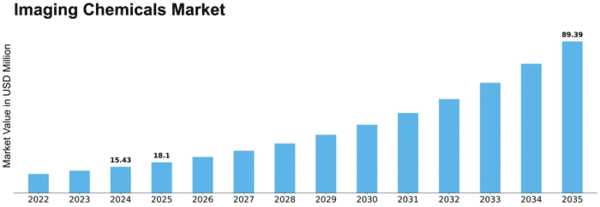
As per MRFR analysis, the Imaging Chemicals Market Size was estimated at 15.43 USD Million in 2024. The Imaging Chemicals industry is projected to grow from 18.1 USD Million in 2025 to 89.39 USD Million by 2035, exhibiting a compound annual growth rate (CAGR) of 17.31 during the forecast period 2025 - 2035.

Key Market Trends & Highlights

The Imaging Chemicals Market is experiencing a dynamic shift driven by sustainability and technological advancements.

  • North America remains the largest market for imaging chemicals, reflecting robust demand across various sectors.
  • Asia-Pacific is identified as the fastest-growing region, propelled by rapid urbanization and increasing healthcare investments.
  • Medical imaging continues to dominate the market, while photographic imaging is emerging as the fastest-growing segment due to digital transformation.
  • Technological advancements and rising demand in healthcare are key drivers fueling growth in the imaging chemicals market.

Market Size & Forecast

2024 Market Size 15.43 (USD Million)
2035 Market Size 89.39 (USD Million)
CAGR (2025 - 2035) 17.31%
Largest Regional Market Share in 2024 North America

Major Players

BASF SE (DE), Eastman Chemical Company (US), Fujifilm Holdings Corporation (JP), Kodak Alaris Inc. (GB), Merck KGaA (DE), Nippon Kayaku Co., Ltd. (JP), SABIC (SA), Toyo Ink SC Holdings Co., Ltd. (JP), Agfa-Gevaert Group (BE)

Market Trends

The Imaging Chemicals Market is currently experiencing a dynamic evolution, driven by advancements in technology and increasing demand across various sectors. The proliferation of digital imaging applications, including photography, medical imaging, and industrial uses, appears to be a primary catalyst for growth. As industries seek to enhance image quality and efficiency, the need for innovative imaging chemicals has become more pronounced. Furthermore, environmental considerations are influencing the development of sustainable and eco-friendly chemical solutions, which may reshape product offerings in the market. In addition, the Imaging Chemicals Market is witnessing a shift towards automation and digitalization. This trend suggests that manufacturers are increasingly adopting automated processes to improve production efficiency and reduce costs. The integration of artificial intelligence and machine learning into imaging technologies could further enhance the capabilities of imaging chemicals, potentially leading to new applications and market opportunities. Overall, the Imaging Chemicals Market seems poised for continued growth, driven by technological advancements and evolving consumer preferences.

Sustainability Initiatives

The Imaging Chemicals Market is increasingly focusing on sustainability, with manufacturers exploring eco-friendly alternatives to traditional chemicals. This trend indicates a growing awareness of environmental impacts and regulatory pressures, prompting companies to innovate in developing biodegradable and less harmful products.

Digital Transformation

Digital transformation is reshaping the Imaging Chemicals Market, as industries adopt advanced imaging technologies. This shift suggests a rising demand for high-performance chemicals that cater to digital applications, enhancing image quality and processing speed.

Customization and Specialization

Customization and specialization are becoming prominent trends within the Imaging Chemicals Market. Companies are likely to tailor their products to meet specific industry needs, indicating a move towards more specialized solutions that address unique challenges in various applications.

Imaging Chemicals Market Market Drivers

Market Growth Projections

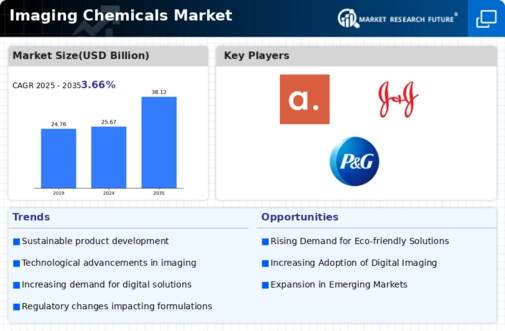
The Global Imaging Chemicals Market Industry is projected to experience substantial growth over the next decade. With a market value of 25.67 USD Billion in 2024, it is anticipated to reach 38.12 USD Billion by 2035. This growth trajectory indicates a compound annual growth rate of 3.66% from 2025 to 2035. Such projections reflect the increasing demand for imaging chemicals across various sectors, driven by technological advancements and expanding applications. The market's resilience and adaptability suggest a promising future, with opportunities for innovation and development in imaging chemical formulations.

Technological Advancements

The Global Imaging Chemicals Market Industry is witnessing rapid technological advancements that enhance imaging processes. Innovations in digital imaging technologies, such as high-resolution sensors and advanced software, are driving demand for imaging chemicals. For instance, the integration of artificial intelligence in imaging applications is improving accuracy and efficiency. These advancements not only streamline production but also expand the range of applications for imaging chemicals across various sectors, including healthcare and manufacturing. As a result, the market is projected to reach 25.67 USD Billion in 2024, reflecting the impact of these technological developments.

Growing Demand in Healthcare

The Global Imaging Chemicals Market Industry is significantly influenced by the increasing demand for imaging solutions in healthcare. Medical imaging techniques, such as MRI and CT scans, rely heavily on specialized imaging chemicals. The rising prevalence of chronic diseases and the need for accurate diagnostics are propelling this demand. Furthermore, the aging population is contributing to a higher volume of medical imaging procedures. This trend is expected to sustain growth in the market, with projections indicating a rise to 38.12 USD Billion by 2035, highlighting the critical role of imaging chemicals in modern healthcare.

Expansion of End-Use Industries

The Global Imaging Chemicals Market Industry is benefiting from the expansion of various end-use industries, including automotive, electronics, and packaging. As these sectors evolve, the need for high-quality imaging solutions becomes paramount. For example, the automotive industry increasingly utilizes imaging chemicals for advanced driver-assistance systems and vehicle safety features. Similarly, the electronics sector demands imaging chemicals for circuit board manufacturing and display technologies. This diversification of applications is likely to drive a compound annual growth rate of 3.66% from 2025 to 2035, underscoring the market's adaptability to changing industry needs.

Rising Consumer Electronics Market

The Global Imaging Chemicals Market Industry is experiencing growth driven by the rising consumer electronics market. With the proliferation of smartphones, tablets, and other electronic devices, the demand for high-quality imaging solutions is escalating. Imaging chemicals play a crucial role in enhancing the visual quality of displays and cameras in these devices. As consumer preferences shift towards better imaging capabilities, manufacturers are likely to invest in advanced imaging chemicals to meet these demands. This trend is expected to contribute positively to the market's growth, reinforcing the importance of imaging chemicals in the consumer electronics sector.

Environmental Regulations and Sustainability

The Global Imaging Chemicals Market Industry is also shaped by stringent environmental regulations and a growing emphasis on sustainability. As governments worldwide implement stricter guidelines on chemical usage and waste management, manufacturers are compelled to innovate and develop eco-friendly imaging chemicals. This shift towards sustainable practices not only aligns with regulatory requirements but also meets consumer demand for greener products. Companies that invest in sustainable imaging solutions may gain a competitive edge in the market, potentially influencing overall growth trajectories in the coming years.

Market Segment Insights

By Application: Medical Imaging (Largest) vs. Photographic Imaging (Fastest-Growing)

The Imaging Chemicals Market exhibits a diversified application landscape, with Medical Imaging commanding the largest share. This segment significantly contributes to overall market dynamics thanks to its indispensable role in healthcare. Following closely, the Photographic Imaging segment has been witnessing a resurgence, driven by both professional and amateur photography trends, as well as advancements in digital imaging technologies. As we look towards the future, the growth potential within these segments varies. Medical Imaging continues to benefit from technological innovations and an aging population that demands precise diagnostic tools. On the other hand, Photographic Imaging is experiencing a revival influenced by the rising popularity of social media and a renewed interest in analog photography, making it the fastest-growing segment in the market.

Medical Imaging: Dominant vs. Photographic Imaging: Emerging

Medical Imaging stands as the dominant force within the Imaging Chemicals Market largely due to the critical nature of its applications. This segment encompasses various chemical solutions used in diagnostic imaging processes, including MRI, CT scans, and ultrasound imaging. The segment's reliance on precision and efficacy ensures steady demand, fueled by ongoing advancements in medical technology. Meanwhile, Photographic Imaging represents an emerging segment experiencing revitalization as consumer preferences shift toward more nostalgic and artistic approaches to photography. The increase in social media usage and a cultural shift toward personal content creation give Photographic Imaging a unique position to grow rapidly. Both segments highlight contrasting yet vital roles within the broader market.

By End Use: Healthcare (Largest) vs. Media and Entertainment (Fastest-Growing)

In the Imaging Chemicals Market, the end use segments are primarily distributed among Healthcare, Media and Entertainment, Manufacturing, and Research and Development. Among these, the Healthcare sector holds the largest market share due to its critical reliance on imaging technologies such as X-rays, MRIs, and ultrasound. Media and Entertainment, on the other hand, is experiencing rapid growth given the increasing demand for high-quality imaging in film production, digital media, and photography. The growth trends in this segment are driven by technological advancements and the rising applications of imaging chemicals across various industries. Healthcare is witnessing a stable demand for imaging chemicals due to aging populations and increased health awareness. Meanwhile, Media and Entertainment is thriving on social media's visual content and technological innovations in imaging techniques that cater to high dynamic range and enhanced color accuracy.

Healthcare (Dominant) vs. Research and Development (Emerging)

Healthcare is the dominant segment in the Imaging Chemicals Market, driven by essential diagnostic procedures that utilize various imaging modalities. This segment has established a strong foothold due to the critical need for precision and accuracy in medical diagnostics, leading to sustained investment in imaging technologies. On the other hand, Research and Development is an emerging segment, showcasing an increasing focus on innovation and product development. This segment benefits from collaborations between imaging chemical manufacturers and research institutions, aiming to develop novel imaging agents and techniques. As the needs for enhanced imaging methods grow, Research and Development is expected to evolve rapidly, expanding its influence in the overall market.

By Type: X-ray Imaging Chemicals (Largest) vs. Digital Imaging Chemicals (Fastest-Growing)

The Imaging Chemicals Market is segmented into four main types: X-ray Imaging Chemicals, Film Processing Chemicals, Digital Imaging Chemicals, and Photoresist Chemicals. Among these, X-ray Imaging Chemicals hold the largest market share, primarily due to the widespread use of X-ray imaging in healthcare settings for diagnostics. Film Processing Chemicals, while still relevant, have seen a decline with the advent of digital technology, whereas Digital Imaging Chemicals are gaining traction due to their adaptability in various applications, including medical, industrial, and security use. Photoresist Chemicals also play a crucial role in electronic component manufacturing, further diversifying the market landscape.

X-ray Imaging Chemicals (Dominant) vs. Digital Imaging Chemicals (Emerging)

X-ray Imaging Chemicals are critical to the healthcare sector, particularly in radiography and diagnostic imaging. These chemicals are specifically formulated to enhance image clarity and quality while ensuring safety standards are met. On the other hand, Digital Imaging Chemicals, which are crucial in the production of digital images, are emerging rapidly, driven by technological advancements in imaging techniques. They cater to diverse applications, showcasing their versatility. The shift towards non-film-based imaging methods and innovations in digital technology has created new avenues for growth in this segment, making it a significant player in the Imaging Chemicals Market.

By Formulation: Liquid Formulation (Largest) vs. Powder Formulation (Fastest-Growing)

In the Imaging Chemicals Market, the formulation segment is characterized by diverse categories, including liquid, powder, and emulsion formulations. Among these, liquid formulation holds the largest market share, driven by its widespread application in various imaging processes, including photography and printing. Following closely, powder formulation is emerging as a competitive player, crucial for specialized applications, particularly in dry imaging techniques. Emulsion formulation, though smaller in share, is gaining attention for its unique properties. The growth trends within the formulation segment are propelled by advancements in technology and increasing demand for high-quality imaging solutions. Liquid formulations, being the established choice, benefit from continuous innovation that enhances their performance. On the other hand, powder formulations show the fastest growth, supported by a shift towards sustainable and efficient imaging methods. Emulsion formulations are also witnessing a gradual rise due to their adaptability in emerging markets, indicating a dynamic evolution of this sector.

Liquid Formulation (Dominant) vs. Powder Formulation (Emerging)

Liquid formulation stands as the dominant force in the Imaging Chemicals Market, attributed to its versatile application across multiple imaging sectors, including medical imaging and graphic arts. Its characteristics, such as ease of use, quick processing times, and superior image quality, solidify its position as the preferred choice among professionals. Conversely, powder formulation is marked as an emerging player, often recognized for its efficiency in producing high-resolution images without the need for solvents. This formulation type is gaining traction, particularly in environmentally-conscious sectors, where the demand for sustainable solutions is rising. Both formulations are critical, but their unique attributes and applications reflect the dynamic nature of the imaging chemicals landscape.

Get more detailed insights about Imaging Chemicals Market Research Report – Forecast to 2035

Regional Insights

North America : Market Leader in Imaging Chemicals

North America is poised to maintain its leadership in the Imaging Chemicals Market, holding a significant market share of 7.5 in 2024. The region's growth is driven by advancements in imaging technology, increasing demand for high-quality imaging solutions, and supportive regulatory frameworks. The presence of major players and a robust manufacturing base further bolster market expansion, with a focus on sustainable practices and innovation. The United States stands out as the leading country in this sector, hosting key players such as Eastman Chemical Company and Kodak Alaris Inc. The competitive landscape is characterized by continuous innovation and strategic partnerships among companies like BASF SE and Fujifilm Holdings Corporation. This dynamic environment fosters a strong market presence, ensuring North America's dominance in the global imaging chemicals arena.

Europe : Emerging Market with Growth Potential

Europe is witnessing a notable surge in the Imaging Chemicals Market, with a market size of 4.0 in 2024. The region benefits from stringent environmental regulations that encourage the adoption of eco-friendly imaging solutions. Additionally, the increasing demand for digital imaging in healthcare and commercial sectors acts as a catalyst for growth. The European market is also supported by government initiatives aimed at fostering innovation and sustainability in chemical manufacturing. Leading countries such as Germany, France, and the UK are at the forefront of this growth, with companies like BASF SE and Agfa-Gevaert Group driving innovation. The competitive landscape is marked by a mix of established players and emerging startups, all vying for market share. The focus on research and development, coupled with strategic collaborations, positions Europe as a key player in The Imaging Chemicals.

Asia-Pacific : Rapidly Growing Imaging Chemicals Sector

The Asia-Pacific region is rapidly emerging as a significant player in the Imaging Chemicals Market, with a market size of 3.0 in 2024. The growth is primarily driven by increasing urbanization, rising disposable incomes, and a growing demand for imaging solutions in various sectors, including healthcare and entertainment. Additionally, favorable government policies and investments in technology are propelling market expansion, making it a hotspot for innovation in imaging chemicals. Countries like Japan, China, and India are leading the charge, with major companies such as Fujifilm Holdings Corporation and Nippon Kayaku Co., Ltd. playing pivotal roles. The competitive landscape is characterized by a blend of local and international players, fostering a dynamic environment for growth. As the region continues to invest in advanced imaging technologies, its market share is expected to increase significantly in the coming years.

Middle East and Africa : Emerging Market with Untapped Potential

The Middle East and Africa region is gradually emerging in the Imaging Chemicals Market, with a market size of 0.93 in 2024. The growth is driven by increasing investments in infrastructure and healthcare, alongside a rising demand for imaging solutions. However, the market remains relatively untapped, presenting opportunities for growth as governments focus on diversifying their economies and enhancing technological capabilities in the chemical sector. Countries like South Africa and the UAE are leading the way, with a growing presence of international players looking to establish a foothold in this market. The competitive landscape is evolving, with local companies beginning to innovate and adapt to global standards. As the region continues to develop, the imaging chemicals market is expected to gain traction, attracting investments and fostering partnerships.

Key Players and Competitive Insights

The Imaging Chemicals Market is currently characterized by a dynamic competitive landscape, driven by innovation, sustainability, and technological advancements. Key players such as BASF SE (DE), Fujifilm Holdings Corporation (JP), and Kodak Alaris Inc. (GB) are actively shaping the market through strategic initiatives. BASF SE (DE) focuses on enhancing its product portfolio with sustainable imaging solutions, while Fujifilm Holdings Corporation (JP) emphasizes digital transformation and the integration of AI in imaging technologies. Kodak Alaris Inc. (GB) is leveraging partnerships to expand its market reach, indicating a collective shift towards innovation and collaboration among these companies.In terms of business tactics, companies are increasingly localizing manufacturing and optimizing supply chains to enhance operational efficiency. The Imaging Chemicals Market appears moderately fragmented, with several key players exerting influence over various segments. This competitive structure allows for a diverse range of products and services, fostering innovation and responsiveness to market demands.

In November BASF SE (DE) announced a strategic partnership with a leading technology firm to develop eco-friendly imaging chemicals. This collaboration aims to reduce the environmental impact of imaging processes, aligning with global sustainability goals. The strategic importance of this partnership lies in its potential to position BASF as a leader in sustainable imaging solutions, appealing to environmentally conscious consumers and businesses alike.

In October Fujifilm Holdings Corporation (JP) launched a new line of imaging chemicals that incorporate advanced AI technologies. This product line is designed to enhance image quality and processing speed, catering to the growing demand for high-performance imaging solutions. The introduction of AI-driven products signifies Fujifilm's commitment to innovation and its ability to adapt to evolving market needs, potentially strengthening its competitive edge.

In September Kodak Alaris Inc. (GB) expanded its distribution network in Asia through a strategic acquisition of a regional imaging chemicals supplier. This move not only enhances Kodak's market presence in Asia but also allows for better supply chain management and localized product offerings. The acquisition underscores Kodak's strategy to bolster its competitive position in emerging markets, where demand for imaging chemicals is on the rise.

As of December current trends in the Imaging Chemicals Market include a strong emphasis on digitalization, sustainability, and the integration of AI technologies. Strategic alliances are increasingly shaping the competitive landscape, enabling companies to pool resources and expertise. Looking ahead, competitive differentiation is likely to evolve from traditional price-based competition to a focus on innovation, technological advancements, and supply chain reliability. This shift suggests that companies that prioritize these aspects will be better positioned to thrive in the rapidly changing market.

Key Companies in the Imaging Chemicals Market include

Industry Developments

    • In Jan 2022 - Professor Ke Xu of the University of California, Berkeley, collaborated with Biotium for developing an approach for optimizing the photo-switching behavior of rhodamine dyes for optimal (d)STORM performance. The two rhodamine-based and green-excitable CF® Dyes developed, CF®583R and CF®597R, are showing significant photo-switching sensitization and performs similarly to the red-excitable Alexa Fluor® 647 dye.
    • Chemical imaging is increasingly popular in the pharmaceutical industry due to its applications to identify counterfeit medicinal products, examine the packaging materials and equipment production and identification of foreign particles or contaminants.

Report Overview

The overall study of the Imaging Chemicals Market Analysis shows that it has acquired a good position, and further, the market is expected to grow higher in the forecasted period. The market dynamics and their factors are showing crucial effects on the major's growth. Further, the market's performance will be based on the opportunities and trends. The segment report covers the major fragments and their types alongside the regional analysis giving a clear idea of the geographical growth. The competitive analysis has stated the vital role of industrial players based on their developments and improvements.

The pandemic information was mentioned showing the market's performance during the period. Further, the Imaging Chemicals Market is expected to reach a significant value during the review period.

Key Industrial Segments

By Product Type

    • Imaging Agents & Toners
    • Printing Inks
    • Image Developers 

By Application

    • Medical Diagnostics
    • Packaging & Printing
    • Textile Processing
    • Mining
    • Others

Future Outlook

Imaging Chemicals Market Future Outlook

The Imaging Chemicals Market is projected to grow at a 17.31% CAGR from 2025 to 2035, driven by technological advancements, increasing demand for imaging solutions, and environmental regulations.

New opportunities lie in:

  • Development of eco-friendly imaging chemicals for sustainable practices.
  • Expansion into emerging markets with tailored product offerings.
  • Investment in R&D for innovative imaging technologies and applications.

By 2035, the Imaging Chemicals Market is expected to achieve substantial growth, reflecting evolving industry demands.

Market Segmentation

Imaging Chemicals Market Type Outlook

  • X-ray Imaging Chemicals
  • Film Processing Chemicals
  • Digital Imaging Chemicals
  • Photoresist Chemicals

Imaging Chemicals Market End Use Outlook

  • Healthcare
  • Media and Entertainment
  • Manufacturing
  • Research and Development

Imaging Chemicals Market Application Outlook

  • Photographic Imaging
  • Medical Imaging
  • Industrial Imaging
  • Graphic Arts
  • Non-Destructive Testing

Imaging Chemicals Market Formulation Outlook

  • Liquid Formulation
  • Powder Formulation
  • Emulsion Formulation

Report Scope

MARKET SIZE 202415.43(USD Million)
MARKET SIZE 202518.1(USD Million)
MARKET SIZE 203589.39(USD Million)
COMPOUND ANNUAL GROWTH RATE (CAGR)17.31% (2025 - 2035)
REPORT COVERAGERevenue Forecast, Competitive Landscape, Growth Factors, and Trends
BASE YEAR2024
Market Forecast Period2025 - 2035
Historical Data2019 - 2024
Market Forecast UnitsUSD Million
Key Companies ProfiledBASF SE (DE), Eastman Chemical Company (US), Fujifilm Holdings Corporation (JP), Kodak Alaris Inc. (GB), Merck KGaA (DE), Nippon Kayaku Co., Ltd. (JP), SABIC (SA), Toyo Ink SC Holdings Co., Ltd. (JP), Agfa-Gevaert Group (BE)
Segments CoveredApplication, End Use, Type, Formulation
Key Market OpportunitiesAdvancements in digital imaging technologies drive demand for innovative Imaging Chemicals Market solutions.
Key Market DynamicsTechnological advancements and regulatory changes drive innovation and competition in the Imaging Chemicals Market.
Countries CoveredNorth America, Europe, APAC, South America, MEA

FAQs

What is the biggest driver of the global imaging chemicals market?

The medical sector with its huge demand for imaging chemicals is driving the market growth.

What are upcoming trends within the global imaging chemicals market?

Eco-friendly printing techniques and organic color development are two trends to look out for in the global imaging chemicals market.

What is the biggest strategy of players in the global imaging chemicals market?

Acquisitions is seen as the biggest strategy of players to sustain in the global imaging chemicals market.

Which region is deemed to be highly lucrative for the global imaging chemicals market?

APAC will contribute the maximum to the global imaging chemicals market owing to the burgeoning medical sector.

Name the key players of the global imaging chemicals market.

Vivimed Labs, Qingdao Scienoc Chemical Co., Ltd, TOYO INK SC HOLDINGS CO., LTD., DIC CORPORATION, Eastman Kodak Company, T&K TOKA Corporation, Flint Group, SAKATA INX CORPORATION, Fujifilm, and Siegwerk Druckfarben AG & Co. KGaA are key players of the global imaging chemicals market.

  1. SECTION I: EXECUTIVE SUMMARY AND KEY HIGHLIGHTS
    1. | 1.1 EXECUTIVE SUMMARY
    2. | 1.1.1 Market Overview
    3. | 1.1.2 Key Findings
    4. | 1.1.3 Market Segmentation
    5. | 1.1.4 Competitive Landscape
    6. | 1.1.5 Challenges and Opportunities
    7. | 1.1.6 Future Outlook
  2. SECTION II: SCOPING, METHODOLOGY AND MARKET STRUCTURE
    1. | 2.1 MARKET INTRODUCTION
    2. | 2.1.1 Definition
    3. | 2.1.2 Scope of the study
    4. |-- 2.1.2.1 Research Objective
    5. |-- 2.1.2.2 Assumption
    6. |-- 2.1.2.3 Limitations
    7. | 2.2 RESEARCH METHODOLOGY
    8. | 2.2.1 Overview
    9. | 2.2.2 Data Mining
    10. | 2.2.3 Secondary Research
    11. | 2.2.4 Primary Research
    12. |-- 2.2.4.1 Primary Interviews and Information Gathering Process
    13. |-- 2.2.4.2 Breakdown of Primary Respondents
    14. | 2.2.5 Forecasting Model
    15. | 2.2.6 Market Size Estimation
    16. |-- 2.2.6.1 Bottom-Up Approach
    17. |-- 2.2.6.2 Top-Down Approach
    18. | 2.2.7 Data Triangulation
    19. | 2.2.8 Validation
  3. SECTION III: QUALITATIVE ANALYSIS
    1. | 3.1 MARKET DYNAMICS
    2. | 3.1.1 Overview
    3. | 3.1.2 Drivers
    4. | 3.1.3 Restraints
    5. | 3.1.4 Opportunities
    6. | 3.2 MARKET FACTOR ANALYSIS
    7. | 3.2.1 Value chain Analysis
    8. | 3.2.2 Porter's Five Forces Analysis
    9. |-- 3.2.2.1 Bargaining Power of Suppliers
    10. |-- 3.2.2.2 Bargaining Power of Buyers
    11. |-- 3.2.2.3 Threat of New Entrants
    12. |-- 3.2.2.4 Threat of Substitutes
    13. |-- 3.2.2.5 Intensity of Rivalry
    14. | 3.2.3 COVID-19 Impact Analysis
    15. |-- 3.2.3.1 Market Impact Analysis
    16. |-- 3.2.3.2 Regional Impact
    17. |-- 3.2.3.3 Opportunity and Threat Analysis
  4. SECTION IV: QUANTITATIVE ANALYSIS
    1. | 4.1 Chemicals and Materials, BY Application (USD Million)
    2. | 4.1.1 Photographic Imaging
    3. | 4.1.2 Medical Imaging
    4. | 4.1.3 Industrial Imaging
    5. | 4.1.4 Graphic Arts
    6. | 4.1.5 Non-Destructive Testing
    7. | 4.2 Chemicals and Materials, BY End Use (USD Million)
    8. | 4.2.1 Healthcare
    9. | 4.2.2 Media and Entertainment
    10. | 4.2.3 Manufacturing
    11. | 4.2.4 Research and Development
    12. | 4.3 Chemicals and Materials, BY Type (USD Million)
    13. | 4.3.1 X-ray Imaging Chemicals
    14. | 4.3.2 Film Processing Chemicals
    15. | 4.3.3 Digital Imaging Chemicals
    16. | 4.3.4 Photoresist Chemicals
    17. | 4.4 Chemicals and Materials, BY Formulation (USD Million)
    18. | 4.4.1 Liquid Formulation
    19. | 4.4.2 Powder Formulation
    20. | 4.4.3 Emulsion Formulation
    21. | 4.5 Chemicals and Materials, BY Region (USD Million)
    22. | 4.5.1 North America
    23. |-- 4.5.1.1 US
    24. |-- 4.5.1.2 Canada
    25. | 4.5.2 Europe
    26. |-- 4.5.2.1 Germany
    27. |-- 4.5.2.2 UK
    28. |-- 4.5.2.3 France
    29. |-- 4.5.2.4 Russia
    30. |-- 4.5.2.5 Italy
    31. |-- 4.5.2.6 Spain
    32. |-- 4.5.2.7 Rest of Europe
    33. | 4.5.3 APAC
    34. |-- 4.5.3.1 China
    35. |-- 4.5.3.2 India
    36. |-- 4.5.3.3 Japan
    37. |-- 4.5.3.4 South Korea
    38. |-- 4.5.3.5 Malaysia
    39. |-- 4.5.3.6 Thailand
    40. |-- 4.5.3.7 Indonesia
    41. |-- 4.5.3.8 Rest of APAC
    42. | 4.5.4 South America
    43. |-- 4.5.4.1 Brazil
    44. |-- 4.5.4.2 Mexico
    45. |-- 4.5.4.3 Argentina
    46. |-- 4.5.4.4 Rest of South America
    47. | 4.5.5 MEA
    48. |-- 4.5.5.1 GCC Countries
    49. |-- 4.5.5.2 South Africa
    50. |-- 4.5.5.3 Rest of MEA
  5. SECTION V: COMPETITIVE ANALYSIS
    1. | 5.1 Competitive Landscape
    2. | 5.1.1 Overview
    3. | 5.1.2 Competitive Analysis
    4. | 5.1.3 Market share Analysis
    5. | 5.1.4 Major Growth Strategy in the Chemicals and Materials
    6. | 5.1.5 Competitive Benchmarking
    7. | 5.1.6 Leading Players in Terms of Number of Developments in the Chemicals and Materials
    8. | 5.1.7 Key developments and growth strategies
    9. |-- 5.1.7.1 New Product Launch/Service Deployment
    10. |-- 5.1.7.2 Merger & Acquisitions
    11. |-- 5.1.7.3 Joint Ventures
    12. | 5.1.8 Major Players Financial Matrix
    13. |-- 5.1.8.1 Sales and Operating Income
    14. |-- 5.1.8.2 Major Players R&D Expenditure. 2023
    15. | 5.2 Company Profiles
    16. | 5.2.1 BASF SE (DE)
    17. |-- 5.2.1.1 Financial Overview
    18. |-- 5.2.1.2 Products Offered
    19. |-- 5.2.1.3 Key Developments
    20. |-- 5.2.1.4 SWOT Analysis
    21. |-- 5.2.1.5 Key Strategies
    22. | 5.2.2 Eastman Chemical Company (US)
    23. |-- 5.2.2.1 Financial Overview
    24. |-- 5.2.2.2 Products Offered
    25. |-- 5.2.2.3 Key Developments
    26. |-- 5.2.2.4 SWOT Analysis
    27. |-- 5.2.2.5 Key Strategies
    28. | 5.2.3 Fujifilm Holdings Corporation (JP)
    29. |-- 5.2.3.1 Financial Overview
    30. |-- 5.2.3.2 Products Offered
    31. |-- 5.2.3.3 Key Developments
    32. |-- 5.2.3.4 SWOT Analysis
    33. |-- 5.2.3.5 Key Strategies
    34. | 5.2.4 Kodak Alaris Inc. (GB)
    35. |-- 5.2.4.1 Financial Overview
    36. |-- 5.2.4.2 Products Offered
    37. |-- 5.2.4.3 Key Developments
    38. |-- 5.2.4.4 SWOT Analysis
    39. |-- 5.2.4.5 Key Strategies
    40. | 5.2.5 Merck KGaA (DE)
    41. |-- 5.2.5.1 Financial Overview
    42. |-- 5.2.5.2 Products Offered
    43. |-- 5.2.5.3 Key Developments
    44. |-- 5.2.5.4 SWOT Analysis
    45. |-- 5.2.5.5 Key Strategies
    46. | 5.2.6 Nippon Kayaku Co., Ltd. (JP)
    47. |-- 5.2.6.1 Financial Overview
    48. |-- 5.2.6.2 Products Offered
    49. |-- 5.2.6.3 Key Developments
    50. |-- 5.2.6.4 SWOT Analysis
    51. |-- 5.2.6.5 Key Strategies
    52. | 5.2.7 SABIC (SA)
    53. |-- 5.2.7.1 Financial Overview
    54. |-- 5.2.7.2 Products Offered
    55. |-- 5.2.7.3 Key Developments
    56. |-- 5.2.7.4 SWOT Analysis
    57. |-- 5.2.7.5 Key Strategies
    58. | 5.2.8 Toyo Ink SC Holdings Co., Ltd. (JP)
    59. |-- 5.2.8.1 Financial Overview
    60. |-- 5.2.8.2 Products Offered
    61. |-- 5.2.8.3 Key Developments
    62. |-- 5.2.8.4 SWOT Analysis
    63. |-- 5.2.8.5 Key Strategies
    64. | 5.2.9 Agfa-Gevaert Group (BE)
    65. |-- 5.2.9.1 Financial Overview
    66. |-- 5.2.9.2 Products Offered
    67. |-- 5.2.9.3 Key Developments
    68. |-- 5.2.9.4 SWOT Analysis
    69. |-- 5.2.9.5 Key Strategies
    70. | 5.3 Appendix
    71. | 5.3.1 References
    72. | 5.3.2 Related Reports

Chemicals and Materials Market Segmentation

Chemicals and Materials By Application (USD Million, 2025-2035)

  • Photographic Imaging
  • Medical Imaging
  • Industrial Imaging
  • Graphic Arts
  • Non-Destructive Testing

Chemicals and Materials By End Use (USD Million, 2025-2035)

  • Healthcare
  • Media and Entertainment
  • Manufacturing
  • Research and Development

Chemicals and Materials By Type (USD Million, 2025-2035)

  • X-ray Imaging Chemicals
  • Film Processing Chemicals
  • Digital Imaging Chemicals
  • Photoresist Chemicals

Chemicals and Materials By Formulation (USD Million, 2025-2035)

  • Liquid Formulation
  • Powder Formulation
  • Emulsion Formulation
Infographic

Free Sample Request

Kindly complete the form below to receive a free sample of this Report

Get Free Sample

Customer Strories

Compare Licence

×
Features License Type
Single User Multiuser License Enterprise User
Price $4,950 $5,950 $7,250
Maximum User Access Limit 1 User Upto 10 Users Unrestricted Access Throughout the Organization
Free Customization
Direct Access to Analyst
Deliverable Format
Platform Access
Discount on Next Purchase 10% 15% 15%
Printable Versions