Segmentation Quick Reference
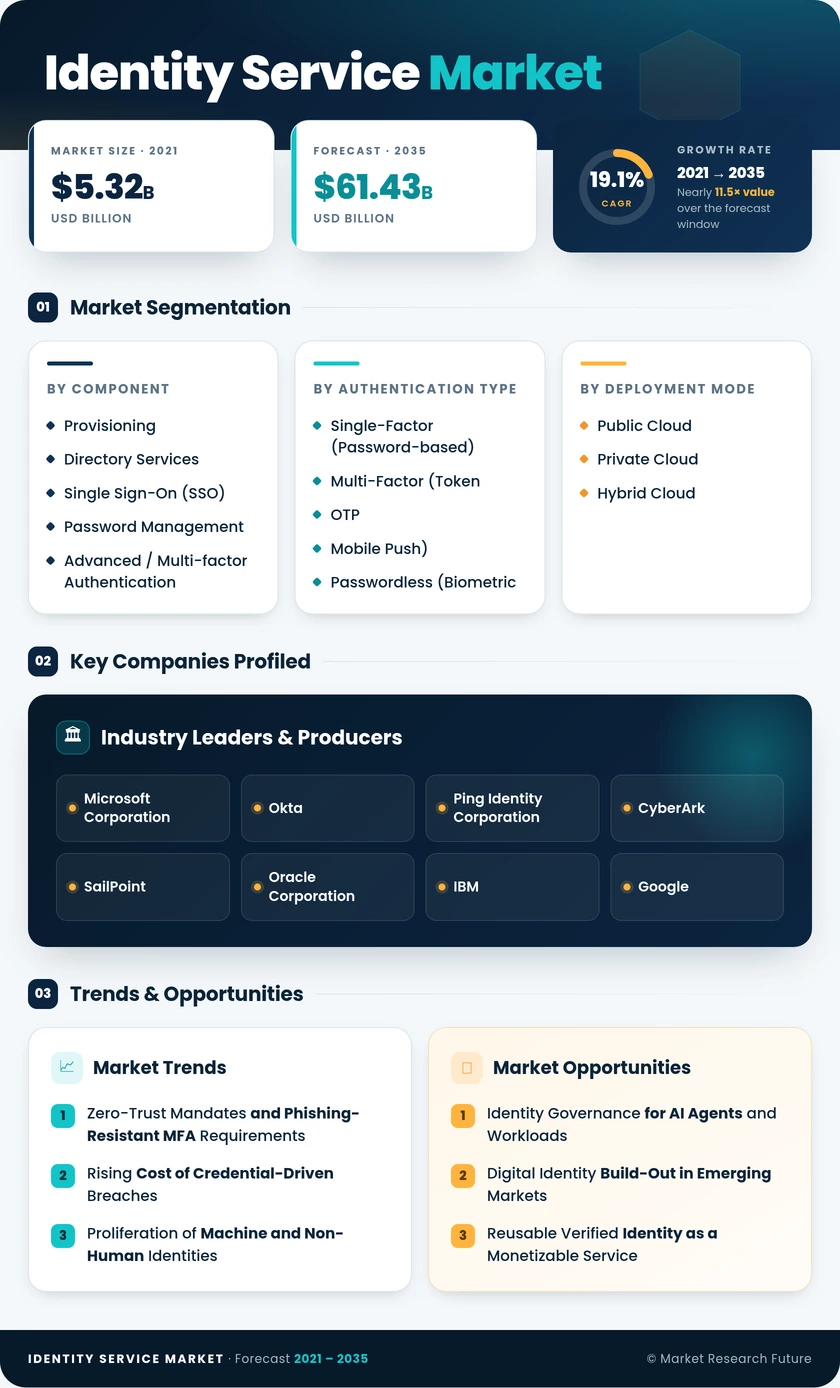
| Dimension | Sub-Segments | Dominant Segment | Fastest Growing Segment |
|---|
| By Component | Provisioning, Directory Services, Single Sign-On (SSO), Password Management, Advanced / Multi-factor Authentication, Access Governance and Compliance | Provisioning (31.2% share) | Advanced / Multi-factor Authentication (20.5% CAGR) |
| By Authentication Type | Single-Factor (Password-based), Multi-Factor (Token, OTP, Mobile Push), Passwordless (Biometric, FIDO2) | Single-Factor (Password-based) (42.6% share) | Passwordless (Biometric, FIDO2) (22.8% CAGR) |
| By Deployment Mode | Public Cloud, Private Cloud, Hybrid Cloud | Public Cloud (58.6% share) | Hybrid Cloud (20.3% CAGR) |
| By User Type | Workforce Identity, Customer / Consumer Identity (CIAM) | Workforce Identity (60.1% share) | Customer / Consumer Identity (CIAM) (22.1% CAGR) |
| By Organization Size | Large Enterprise, Small and Medium Enterprise (SME) | Large Enterprise (63.4% share) | Small and Medium Enterprise (SME) (21.4% CAGR) |
| By End-User Vertical | BFSI, Telecom and IT, Public Sector and Government, Healthcare and Life Sciences, Energy and Utilities, Manufacturing, Retail and E-commerce, Education, Others | Public Sector and Government (23.9% share) | BFSI (21.7% CAGR) |
| By Region | North America, South America, Europe, Asia Pacific, Middle East and Africa | North America (41.2% share) | Asia Pacific (22.6% CAGR) |
Market Segmentation Overview
| Sub-Segment | Key Trend |
|---|
| Provisioning | Lifecycle automation extending to machine identities |
| Directory Services | Cloud directories replacing on-premises stores |
| Single Sign-On (SSO) | Consolidation of SaaS access behind one portal |
| Password Management | Gradual displacement by passkeys |
| Advanced / Multi-factor Authentication | Shift to phishing-resistant factors. |
| Access Governance and Compliance | AI-assisted access reviews and audit evidence |
Provisioning leads the component mix because automated joiner-mover-leaver workflows deliver measurable savings and audit evidence for every SaaS application. Advanced / Multi-factor Authentication grows fastest as federal and payment-card rules demand phishing-resistant factors. Password Management faces slow erosion as passkeys spread, while Access Governance and Compliance gains from machine-identity reviews.
| Sub-Segment | Key Trend |
|---|
| Single-Factor (Password-based) | Persisting in legacy and OT applications |
| Multi-Factor (Token, OTP, Mobile Push) | Number matching replacing simple push approvals |
| Passwordless (Biometric, FIDO2) | Passkeys becoming default on major platforms |
Single-Factor (Password-based) retains the largest share only because legacy applications cannot yet support modern protocols. Passwordless (Biometric, FIDO2) grows fastest as passkeys remove shared secrets and gain formal recognition in NIST guidance. Multi-Factor (Token, OTP, Mobile Push) remains the transitional baseline, with push-fatigue attacks pushing buyers toward number matching and FIDO2.
| Sub-Segment | Key Trend |
|---|
| Public Cloud | Multi-tenant SaaS as default for new projects |
| Private Cloud | Dedicated tenancy for regulated buyers |
| Hybrid Cloud | Cloud policy with edge and on-premises enforcement |
Public Cloud dominates because multi-tenant delivery offers the fastest rollout and continuous feature releases. Hybrid Cloud grows fastest as data-residency laws in Europe and India and latency-sensitive industrial workloads require local enforcement points. Private Cloud remains a niche choice for defense, banking, and public agencies that mandate dedicated tenancy.
| Sub-Segment | Key Trend |
|---|
| Workforce Identity | Zero-trust access across employees, contractors and partners |
| Customer / Consumer Identity (CIAM) | Fraud-aware onboarding and consent management |
Workforce Identity holds the larger share because zero-trust programs cover every employee, contractor, and partner account. Customer / Consumer Identity (CIAM) grows faster since login friction directly reduces digital revenue and synthetic-identity fraud demands stronger onboarding checks. Vendors increasingly share one policy engine across both user types while tuning consumer stacks for higher transaction volumes.
| Sub-Segment | Key Trend |
|---|
| Large Enterprise | Platform consolidation across hybrid estates |
| Small and Medium Enterprise (SME) | Packaged bundles sold through managed service providers |
Large Enterprise buyers lead spending because they run thousands of applications under formal audit programs. Small and Medium Enterprise (SME) adoption grows fastest as cyber-insurers require MFA and subscription pricing removes capital approval barriers. Template-driven deployments let SMEs move from basic SSO toward lifecycle automation without dedicated identity staff.
| Sub-Segment | Key Trend |
|---|
| BFSI | Synthetic-identity fraud defense and PCI DSS v4.0 MFA |
| Telecom and IT | SIM-swap prevention and developer access control |
| Public Sector and Government | Citizen portals and federal zero-trust deadlines |
| Healthcare and Life Sciences | MFA under proposed HIPAA Security Rule changes |
| Energy and Utilities | Critical-infrastructure access controls |
| Manufacturing | IT/OT convergence and supplier federation |
| Retail and E-commerce | Account-takeover defense at checkout |
| Education | Campus-wide SSO for students and faculty |
| Others | Compliance-led adoption in professional services |
Public Sector and Government leads vertical demand because citizen-service portals and federal zero-trust deadlines require large-scale authentication programs. BFSI grows fastest as synthetic-identity fraud losses climb and PCI DSS v4.0 extends MFA across cardholder data environments. Healthcare and Life Sciences and Retail and E-commerce follow, driven respectively by proposed HIPAA MFA rules and account-takeover defense.


 Noah Malgeri
Co-Founder

 Peter Groot koerkamp
Account and Business Manager

 Younghwan Choi
Senior Retail Manager

 Mark Irwin
Management Consultant

 Akif Moroglu
Strategy & Business Development Director

 Guilherme Gomes Martins
Product Management Director

 Joseph Aguayo
Sales Operations & Pricing Manager

 La Terria Dodd
Program Support Specialist

 Rob Kooiker
Group Product Manager HVAC & Fire Protection GMA