
Request Free Sample ×

Kindly complete the form below to receive a free sample of this Report

* Please use a valid business email

Leading companies partner with us for data-driven Insights

clients tt-cursor
Hero Background
English
Chinese
French
Japanese
Korean
German
Spanish

Hyper-converged Infrastructure Market Trends

ID: MRFR/SEM/4664-HCR
200 Pages
Ankit Gupta
March 2026

Hyper-Converged Infrastructure Market Size, Share and Research Report: By Hypervisor Type (VMware, KVM, Hyper-V), By Application (Virtual Desktop Infrastructure, Server Virtualization, Data Protection, Remote Office, Cloud), and By Regional (North America, Europe, South America, Asia Pacific, Middle East and Africa) - Industry Forecast Till 2035

Share:
Download PDF ×

We do not share your information with anyone. However, we may send you emails based on your report interest from time to time. You may contact us at any time to opt-out.

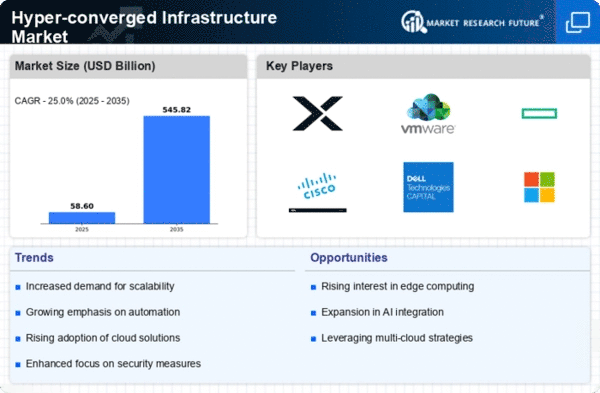
Hyper-converged Infrastructure Market Infographic
Purchase Options

Market Trends

Key Emerging Trends in the Hyper-converged Infrastructure Market

The hyper-converged infrastructure (HCI) market presents processes with incredible traits that replicate the evolving landscape of IT solutions. One outstanding trend is the increasing adoption of hybrid cloud architectures. Organizations are recognizing the advantages of a hybrid technique, combining on-premises infrastructure with cloud offerings. HCI allows this trend with the aid of supplying a platform that seamlessly integrates with public and personal clouds, providing organizations the flexibility to scale resources based on their dynamic workloads. Another substantial trend within the HCI market is the emphasis on side computing. As the quantity of information generated at the threshold of networks keeps surging, companies are seeking infrastructure answers that could assist in processing and evaluating the records supply. Hyper-converged infrastructure is well-desirable for facet computing, providing a compact and green answer for far-off or branch locations. This fashion is, in particular, applicable to industries like retail, healthcare, and manufacturing, wherein actual-time records processing at the threshold is important for operational efficiency. Automation and synthetic intelligence (AI) integration are shaping the marketplace dynamics of HCI. Organizations are leveraging automation to streamline IT operations, lessen manual intervention, and beautify ordinary performance. HCI answers that comprise AI skills permit predictive analytics, sensible resource allocation, and proactive issue resolution. The cognizance of statistics protection and compliance is a persistent trend influencing the HCI marketplace. As cyber threats become more sophisticated, businesses prioritize infrastructure answers that can guard sensitive records. Interoperability is emerging as a key consideration inside the HCI marketplace. Organizations are looking for solutions that can seamlessly integrate with their existing IT environments, such as legacy systems. This trend recognizes the truth that many corporations function in hybrid situations, with a mix of traditional and current infrastructure. The rise of containerization and field orchestration gear is impacting the HCI marketplace. Containers offer a lightweight and scalable answer for deploying packages, and businesses are exploring methods to combine containerized workloads with HCI. In terms of marketplace opposition, consolidation, and partnerships are fantastic tendencies. Established IT companies are obtaining or forming strategic partnerships with HCI vendors to bolster their offerings and enlarge marketplace attain. In conclusion, the hyper-converged infrastructure marketplace is characterized by dynamic developments that replicate the evolving wishes of contemporary companies. The adoption of a hybrid cloud, the point of interest in facet computing, the mixing of automation and AI, the emphasis on security and compliance, considerations of interoperability, and the intersection with containerization are all shaping the modern-day landscape.


Author
Author Profile
Ankit Gupta
Team Lead - Research

Ankit Gupta is a seasoned market intelligence and strategic research professional with over six plus years of experience in the ICT and Semiconductor industries. With academic roots in Telecom, Marketing, and Electronics, he blends technical insight with business strategy. Ankit has led 200+ projects, including work for Fortune 500 clients like Microsoft and Rio Tinto, covering market sizing, tech forecasting, and go-to-market strategies. Known for bridging engineering and enterprise decision-making, his insights support growth, innovation, and investment planning across diverse technology markets.

Leave a Comment

FAQs

What is the projected market valuation of the Hyper-converged Infrastructure Market by 2035?

<p>The Hyper-converged Infrastructure Market is projected to reach a valuation of 545.82 USD Billion by 2035.</p>

What was the market valuation of the Hyper-converged Infrastructure Market in 2024?

<p>In 2024, the market valuation of the Hyper-converged Infrastructure Market was 46.88 USD Billion.</p>

What is the expected CAGR for the Hyper-converged Infrastructure Market during the forecast period 2025 - 2035?

<p>The expected CAGR for the Hyper-converged Infrastructure Market during the forecast period 2025 - 2035 is 25.0%.</p>

Which companies are considered key players in the Hyper-converged Infrastructure Market?

<p>Key players in the Hyper-converged Infrastructure Market include Nutanix, VMware, Hewlett Packard Enterprise, Cisco Systems, Dell Technologies, Microsoft, Lenovo, Scale Computing, and DataCore Software.</p>

What are the primary applications driving the Hyper-converged Infrastructure Market?

<p>The primary applications driving the market include Data Center, Disaster Recovery, Virtual Desktop Infrastructure, and Cloud Computing.</p>

How does the market size for Large Enterprises compare to Small and Medium Enterprises in 2025?

<p>In 2025, the market size for Large Enterprises is expected to be 225.0 USD Billion, significantly higher than the 112.0 USD Billion for Small and Medium Enterprises.</p>

What is the market size for On-Premises deployment in 2025?

<p>The market size for On-Premises deployment in 2025 is anticipated to be 225.0 USD Billion.</p>

What segment is expected to have the highest valuation in the Hyper-converged Infrastructure Market by 2035?

<p>By 2035, the Compute segment is expected to have the highest valuation at 180.0 USD Billion.</p>

What is the projected market size for Government Organizations in 2025?

<p>The projected market size for Government Organizations in 2025 is 130.0 USD Billion.</p>

How does the market size for Hybrid deployment compare to Cloud-Based deployment in 2025?

<p>In 2025, the market size for Hybrid deployment is projected to be 140.82 USD Billion, slightly lower than the 180.0 USD Billion for Cloud-Based deployment.</p>

Market Summary

As per MRFR analysis, the Hyper-converged Infrastructure Market Size was estimated at 46.88 USD Billion in 2024. The Hyper-converged Infrastructure industry is projected to grow from 58.6 USD Billion in 2025 to 545.82 USD Billion by 2035, exhibiting a compound annual growth rate (CAGR) of 25.0% during the forecast period 2025 - 2035.

Key Market Trends & Highlights

The Hyper-converged Infrastructure Market is experiencing robust growth driven by technological advancements and evolving business needs.

  • The integration of AI and machine learning is transforming operational efficiencies within hyper-converged infrastructure solutions. North America remains the largest market, while the Asia-Pacific region is emerging as the fastest-growing area for hyper-converged infrastructure adoption. Data center solutions continue to dominate the market, yet cloud computing is rapidly gaining traction among enterprises. Rising demand for scalability and cost efficiency are key drivers propelling the growth of hyper-converged infrastructure, particularly among small and medium enterprises.

Market Size & Forecast

2024 Market Size 46.88 (USD Billion)
2035 Market Size 545.82 (USD Billion)
CAGR (2025 - 2035) 25.0%
Largest Regional Market Share in 2024 North America

Major Players

Nutanix (US), VMware (US), Hewlett Packard Enterprise (US), Cisco Systems (US), Dell Technologies (US), Microsoft (US), Lenovo (CN), Scale Computing (US), DataCore Software (US) all recognized as leading hyper converged infrastructure vendors and hci vendors.

Market Trends

The Hyper-converged Infrastructure Market is currently experiencing a notable transformation, driven by the increasing demand for integrated solutions that simplify IT management. Organizations are gravitating towards hyperconverged infrastructure software due to its ability to consolidate storage, computing, and networking into a single framework. This shift appears to be fueled by the need for enhanced operational efficiency and cost-effectiveness, as businesses seek to streamline their infrastructure while maintaining flexibility. Furthermore, the rise of cloud computing and virtualization technologies is likely to bolster the adoption of hyperconverged infrastructure solutions, as they offer seamless scalability and improved resource utilization.

In addition, the growing emphasis on data security and compliance is influencing the Hyper-converged Infrastructure Market. Enterprises are increasingly aware of the vulnerabilities associated with traditional infrastructure models, prompting a shift towards more secure, integrated systems. This trend suggests that organizations are prioritizing solutions that not only enhance performance but also provide robust security features. As the market evolves, it seems poised for further growth, with innovations in artificial intelligence and machine learning potentially enhancing the capabilities of hyperconverged infrastructure software, thereby attracting a broader range of users across various sectors.

Increased Adoption of Cloud Solutions

Organizations are increasingly embracing cloud-based hyperconverged infrastructure solutions. This trend indicates a shift towards more flexible and scalable IT environments, allowing businesses to respond swiftly to changing demands.

Focus on Security and Compliance

As data breaches become more prevalent, there is a heightened focus on security within the Hyper-converged Infrastructure Market. Companies are seeking solutions from top hyperconverged infrastructure vendors that integrate advanced security features to protect sensitive information.

Integration of AI and Automation

The integration of artificial intelligence and automation technologies into hyperconverged infrastructure software is emerging as a key trend. This development suggests that organizations are looking to enhance operational efficiency and reduce manual intervention.

Hyper-converged Infrastructure Market Market Drivers

Market Growth Projections

The Global Hyper-Converged Infrastructure Market Industry is poised for substantial growth, with projections indicating a market size of 46.9 USD Billion in 2024 and an anticipated increase to 545.8 USD Billion by 2035. This growth trajectory reflects a compound annual growth rate (CAGR) of 25.0% from 2025 to 2035. Such figures suggest a robust demand for hyper-converged solutions as organizations increasingly recognize the benefits of integrated IT infrastructure. The market's expansion is likely to be fueled by various factors, including the need for simplified management, cost efficiency, and enhanced security. As businesses continue to evolve, the hyper-converged infrastructure market appears well-positioned for sustained growth.

Scalability and Flexibility

Scalability and flexibility are critical attributes driving the Global Hyper-Converged Infrastructure Market Industry. Organizations are increasingly facing fluctuating workloads and the need for rapid scalability to accommodate growth. HCI solutions provide the ability to scale resources seamlessly, allowing businesses to add or remove capacity as needed without significant disruption. This adaptability is particularly beneficial for enterprises operating in dynamic environments, where demand can change rapidly. The flexibility of HCI also enables organizations to deploy applications in various configurations, catering to specific business needs. As the market is expected to grow at a CAGR of 25.0% from 2025 to 2035, scalability will likely remain a key consideration for enterprises.

Increased Adoption of Cloud Services

The rise of cloud computing is a significant driver of the Global Hyper-Converged Infrastructure Market Industry. Organizations are increasingly adopting hybrid and multi-cloud strategies to leverage the benefits of both on-premises and cloud environments. HCI solutions facilitate this transition by providing a unified platform that integrates seamlessly with cloud services. This integration allows businesses to manage workloads across different environments efficiently, enhancing operational agility. As enterprises seek to optimize their cloud investments and ensure data security, the demand for HCI solutions that support cloud integration is likely to grow. The market's trajectory suggests a potential reach of 545.8 USD Billion by 2035, underscoring the importance of cloud adoption.

Enhanced Data Security and Compliance

Data security and compliance are paramount concerns for organizations, driving the Global Hyper-Converged Infrastructure Market Industry. With increasing regulatory requirements and the growing threat of cyberattacks, businesses are prioritizing solutions that offer robust security features. HCI solutions often come with built-in security measures, such as encryption and access controls, which help organizations safeguard sensitive data. Furthermore, the centralized management capabilities of HCI facilitate compliance with various regulations by providing comprehensive visibility and control over data. As organizations navigate the complexities of data protection, the demand for hyper-converged infrastructure that addresses these challenges is likely to rise, contributing to the overall market growth.

Cost Efficiency and Resource Optimization

Cost efficiency remains a pivotal driver in the Global Hyper-Converged Infrastructure Market Industry. Organizations are increasingly recognizing the financial benefits of adopting HCI solutions, which often lead to reduced capital expenditures and lower operational costs. By integrating various IT functions into a single platform, companies can minimize the need for extensive hardware investments and reduce energy consumption. Furthermore, HCI solutions often come with simplified licensing models, which can lead to predictable budgeting. This financial advantage is particularly appealing to small and medium-sized enterprises looking to optimize their IT spending while maintaining performance. As the market evolves, the potential for cost savings will likely continue to attract new adopters.

Growing Demand for Simplified IT Management

The Global Hyper-Converged Infrastructure Market Industry experiences a surge in demand for simplified IT management solutions. Organizations are increasingly seeking to streamline their IT operations, reduce complexity, and enhance efficiency. Hyper-converged infrastructure (HCI) offers an integrated approach that combines storage, computing, and networking into a single solution. This consolidation not only reduces the need for multiple hardware components but also simplifies management through centralized control. As a result, businesses can allocate resources more effectively and respond to changing demands swiftly. The market is projected to reach 46.9 USD Billion in 2024, indicating a robust growth trajectory driven by this demand.

Market Segment Insights

By Application: Cloud Computing (Largest) vs. Virtual Desktop Infrastructure (Fastest-Growing)

<p>Within the Hyper-converged Infrastructure Market, the application segment is characterized by diverse uses, with Cloud Computing holding the largest share. It has become the cornerstone for organizations migrating to integrated IT infrastructures, allowing for seamless scalability and resource optimization. Meanwhile, Virtual Desktop Infrastructure is rapidly gaining traction due to its capacity to centralize desktop management and enhance security, marking it as a preferred choice for businesses aiming for cost efficiency and operational flexibility. In addition to market share dynamics, growth trends show that Cloud Computing is encouraged by the continuous demand for enhanced data accessibility and collaborative capabilities. Conversely, the rising trend towards remote work and the need for flexible, secure work environments has positioned Virtual Desktop Infrastructure as the fastest-growing segment due to its adaptability to various business models and emphasis on workforce mobility.</p>

<p>Application: Cloud Computing (Dominant) vs. Virtual Desktop Infrastructure (Emerging)</p>

<p>In the Hyper-converged Infrastructure Market, Cloud Computing is the dominant application, providing organizations with a comprehensive solution that encompasses storage, computing, and networking in a single platform. This versatility allows for reduced operational costs and improved efficiency, making it highly attractive to enterprises of all sizes. On the other hand, Virtual Desktop Infrastructure is identified as an emerging technology, resonating particularly with companies transitioning to remote work setups. Its ability to deliver secure, virtualized desktops allows businesses to maintain productivity while ensuring data security in a decentralized work environment. Both applications play critical roles in meeting the evolving demands of modern businesses.</p>

By End Use: Large Enterprises (Largest) vs. Small and Medium Enterprises (Fastest-Growing)

<p>The market share distribution within the Hyper-converged Infrastructure Market reveals that Large Enterprises currently hold a significant position due to their extensive resources and larger IT infrastructures. In contrast, Small and Medium Enterprises are rapidly increasing their share as they begin to adopt hyper-converged solutions for enhanced operational efficiency, leading to a shifting dynamic in the market landscape. As these enterprises recognize the benefits of cost-effectiveness and scalability, their contributions to the overall market continue to rise.</p>

<p>Large Enterprises: Dominant vs. Small and Medium Enterprises: Emerging</p>

<p>Large Enterprises dominate the Hyper-converged Infrastructure Market as they leverage their substantial investments in technology and robust IT strategies to integrate hyper-converged infrastructure seamlessly into their operations. Their ability to manage vast amounts of data efficiently and securely gives them a competitive edge. In contrast, Small and Medium Enterprises, characterized by their agility and flexibility, are emerging as a vital component of the market. These entities prioritize cost savings and simplified management in IT, making hyper-converged infrastructure an attractive solution. As they scale their operations, they increasingly rely on these innovative solutions to drive growth and maintain competitive advantage.</p>

By Deployment Type: On-Premises (Largest) vs. Cloud-Based (Fastest-Growing)

The Hyper-converged Infrastructure Market is significantly shaped by its deployment types, with On-Premises solutions currently holding the largest market share. Their dominance is attributed to organizations' preference for control and management of their own infrastructure, as well as security concerns related to data storage. In contrast, Cloud-Based deployments are rapidly rising, driven by their scalability and flexibility, appealing to businesses seeking efficient solutions without substantial upfront investments. This dynamic is leading to an increasing share for cloud offerings as enterprises transition to digital frameworks. The growth trends in the Hyper-converged Infrastructure Market reflect a shifting focus towards hybrid deployments, combining the benefits of both on-premises and cloud solutions. This trend is propelled by the growing demand for remote access and disaster recovery capabilities. Businesses recognize that hybrid models provide optimal flexibility and operational efficiency, allowing them to scale resources as needed. As technology advances, both On-Premises and Cloud-Based solutions are expected to evolve, with organizations adapting to newer methodologies and customer preferences to stay competitive.

On-Premises (Dominant) vs. Cloud-Based (Emerging)

On-Premises deployment remains the dominant format within the Hyper-converged Infrastructure Market, catering to enterprises that prioritize robust security and control over sensitive data. Companies adopting this model benefit from customization capabilities tailored to their specific operational needs, allowing for enhanced performance. Meanwhile, Cloud-Based deployment is emerging rapidly as an attractive alternative, particularly among small to mid-sized enterprises seeking cost-effective and scalable solutions. It enables businesses to leverage the latest technologies without hefty investments in physical infrastructure. As organizations increasingly shift towards digital-first strategies, hybrid approaches that integrate both deployments are gaining traction, balancing performance and flexibility in an evolving market landscape.

By Component: Storage (Largest) vs. Networking (Fastest-Growing)

<p>In the Hyper-converged Infrastructure Market, the Component segment showcases a diverse distribution among its four primary values: Storage, Networking, Compute, and Management Software. The Storage component emerges as the largest contributor, effectively leveraging the rising demand for scalable data storage solutions in various enterprises. Networking, however, is positioned as the fastest-growing segment, driven by the need for increased connectivity and data transmission speed in hyper-converged systems that combine compute and storage solutions seamlessly.</p>

<p>Infrastructure: Storage (Dominant) vs. Networking (Emerging)</p>

<p>The Storage segment stands out in the hyper-converged infrastructure landscape as the dominant force, primarily due to its robust capabilities in handling large volumes of data and supporting diverse workloads across enterprises. This segment comprises various storage technologies, including flash storage and traditional spinning disks, tailored for enhanced performance and reliability. Conversely, the Networking segment represents an emerging player, rapidly gaining traction as organizations seek to optimize data flow and interconnectivity between hyper-converged components. Innovations in software-defined networking and increased bandwidth requirements fuel its growth, pushing it to the forefront as a vital aspect of hyper-converged infrastructure solutions.</p>

By Organization Size: Large Organizations (Largest) vs. Small Organizations (Fastest-Growing)

<p>In the Hyper-converged Infrastructure market, the distribution of market share among organization sizes reveals that large organizations hold the largest share, capitalizing on their significant IT infrastructure needs and resources. These enterprises leverage hyper-converged infrastructure to streamline operations and improve efficiency, leading to substantial investments in this technology. In contrast, small organizations, while holding a smaller overall share, represent the fastest-growing segment as they increasingly adopt HCI solutions to gain competitive advantages and enhance scalability without hefty investments in traditional IT.</p>

<p>Large Organizations: Dominant vs. Small Organizations: Emerging</p>

<p>Large organizations remain dominant in the Hyper-converged Infrastructure market, equipped with the necessary resources and capital to implement comprehensive HCI solutions. This segment benefits from advantages such as enhanced system performance, simplified management, and reduced IT costs. On the other hand, small organizations are emerging rapidly as a significant force in the market. Driven by the need for flexibility and cost-effectiveness, these organizations are beginning to adopt hyper-converged infrastructure as a game-changing solution that aligns with their growth strategies. Their needs for scalable and efficient IT solutions make them a key focus for vendors, eager to address their specific use cases and budget constraints.</p>

Get more detailed insights about Hyper-converged Infrastructure Market Research Report – Forecast to 2035

Regional Insights

North America : Market Leader in Innovation

North America continues to lead the Hyper-converged Infrastructure (HCI) market, holding a significant share of 24.0 in 2025. The region's growth is driven by increasing demand for cloud-based solutions, data center modernization, and the need for scalable IT infrastructure. Regulatory support for digital transformation initiatives further catalyzes market expansion, as organizations seek to enhance operational efficiency and reduce costs. The competitive landscape is robust, with key players like Nutanix, VMware, and Dell Technologies dominating the market. The U.S. remains the largest contributor, supported by a strong presence of technology firms and a favorable investment climate. Companies are increasingly adopting HCI solutions to streamline operations and improve resource management, positioning North America as a hub for innovation in the HCI space.

Europe : Emerging Market with Growth Potential

Europe's Hyper-converged Infrastructure market is poised for growth, with a market size of 12.0 in 2025. The region is experiencing a surge in demand for integrated IT solutions, driven by the need for enhanced data security and compliance with stringent regulations. Government initiatives promoting digital transformation and cloud adoption are key catalysts for this growth, as organizations seek to modernize their IT infrastructure. Leading countries such as Germany, the UK, and France are at the forefront of this expansion, with a competitive landscape featuring major players like VMware and HPE. The presence of innovative startups and established tech giants fosters a dynamic environment for HCI adoption. As organizations increasingly recognize the benefits of HCI, Europe is set to become a significant player in the global market.

Asia-Pacific : Rapid Growth in Emerging Markets

The Asia-Pacific region is witnessing rapid growth in the Hyper-converged Infrastructure market, with a projected size of 8.0 in 2025. Factors such as increasing cloud adoption, the rise of digital enterprises, and government initiatives supporting technology investments are driving this growth. The demand for cost-effective and scalable IT solutions is also on the rise, as businesses seek to enhance operational efficiency and agility in a competitive landscape. Countries like China, India, and Australia are leading the charge, with a mix of local and international players competing for market share. Key companies such as Lenovo and VMware are actively expanding their presence in the region. As organizations increasingly embrace HCI solutions, the Asia-Pacific market is expected to continue its upward trajectory, contributing significantly to the global landscape.

Middle East and Africa : Emerging Market with Untapped Potential

The Middle East and Africa (MEA) region is gradually emerging in the Hyper-converged Infrastructure market, with a market size of 2.88 in 2025. The growth is primarily driven by increasing investments in IT infrastructure and a rising demand for cloud services. Governments in the region are focusing on digital transformation initiatives, which are expected to boost the adoption of HCI solutions across various sectors, including healthcare and finance. Countries like the UAE and South Africa are leading the way, with a growing number of local and international players entering the market. The competitive landscape is evolving, with companies recognizing the potential of HCI to streamline operations and reduce costs. As the region continues to develop its digital capabilities, the HCI market is set for significant growth in the coming years.

Key Players and Competitive Insights

The Hyper-converged Infrastructure Market is currently characterized by a dynamic competitive landscape, driven by the increasing demand for integrated solutions that streamline IT operations. Key players such as Nutanix (US), VMware (US), and Hewlett Packard Enterprise (US) are at the forefront, each adopting distinct strategies to enhance their market positioning. Nutanix (US) focuses on innovation through continuous product development, particularly in cloud services, while VMware (US) emphasizes partnerships to expand its ecosystem. Hewlett Packard Enterprise (US) is leveraging its extensive portfolio to offer tailored solutions, thereby enhancing customer engagement and satisfaction. Collectively, these strategies contribute to a competitive environment that is increasingly centered around technological advancement and customer-centric solutions. In terms of business tactics, companies are increasingly localizing manufacturing and optimizing supply chains to enhance operational efficiency. The market structure appears moderately fragmented, with several key players exerting influence over various segments. This fragmentation allows for a diverse range of offerings, catering to different customer needs and preferences, while also fostering competition that drives innovation. In November 2025, Nutanix (US) announced a strategic partnership with a leading cloud service provider to enhance its hybrid cloud capabilities. This move is significant as it positions Nutanix (US) to better serve enterprises looking for seamless integration between on-premises and cloud environments, thereby reinforcing its competitive edge in the market. The partnership is expected to facilitate the development of new solutions that address the evolving needs of customers in a rapidly changing technological landscape. In October 2025, VMware (US) launched a new version of its hyper-converged infrastructure platform, which includes advanced AI-driven analytics features. This development is crucial as it not only enhances the platform's performance but also aligns with the growing trend of AI integration in IT solutions. By incorporating AI capabilities, VMware (US) aims to provide customers with deeper insights into their infrastructure, ultimately leading to improved operational efficiency and decision-making. In September 2025, Hewlett Packard Enterprise (US) expanded its global reach by establishing new data centers in Asia-Pacific regions. This expansion is strategically important as it allows HPE (US) to cater to the increasing demand for hyper-converged solutions in emerging markets. By enhancing its geographical footprint, HPE (US) is likely to capture a larger share of the market, particularly among enterprises seeking localized support and services. As of December 2025, the competitive trends in the Hyper-converged Infrastructure Market are increasingly defined by digitalization, sustainability, and the integration of AI technologies. Strategic alliances are playing a pivotal role in shaping the current landscape, enabling companies to pool resources and expertise to deliver innovative solutions. Looking ahead, competitive differentiation is expected to evolve, with a notable shift from price-based competition to a focus on innovation, technology, and supply chain reliability. This transition underscores the importance of adaptability and forward-thinking strategies in maintaining a competitive advantage.

Key Companies in the Hyper-converged Infrastructure Market include

Industry Developments

HPE positioned its dHCI as a fully integrated hyper-converged infrastructure solution in May 2025 with the release of its Private Cloud Business Edition, which is powered by HPE Morpheus software and offers multi-hypervisor support and AI-driven AIOps.

With the integration of edge hyper-converged installations with unified administration and on-demand scaling, HPE GreenLake extended support for Alletra MP and SimpliVity Gen11 in April 2024. Cisco released NFVI 2.0, a next-generation Virtual Network Function Manager that supports Open RAN and multi-cloud use cases, in March 2024.

In June 2025, it debuted NFV-as-a-Service, which makes VNF implementation easier everywhere. Cisco introduced AI-Ready Secure Network Architecture with IOS XE Automation in June 2025 as well, allowing for harmonized, AI-driven operations across campuses, branches, and clouds.

In addition to releasing NCI Compute with Dell PowerFlex and Pure Storage connectors and previewing Nutanix Cloud Clusters on Google Cloud, Nutanix also unveiled Cloud Native AOS in May 2025, allowing enterprise data services for Kubernetes and bare-metal environments.

With Terraform integration and Azure networking API improvements, Microsoft Azure expanded hybrid-cloud networking and multi-cloud infrastructure automation in June 2025.

Future Outlook

Hyper-converged Infrastructure Market Future Outlook

The Hyper-converged Infrastructure Market is projected to grow at a 25.0% CAGR from 2025 to 2035, driven by increasing demand for cloud solutions, operational efficiency, and scalability.

New opportunities lie in:

  • <p>Development of AI-driven management tools for resource optimization. Expansion into edge computing solutions for real-time data processing. Partnerships with cloud service providers to enhance service offerings.</p>

By 2035, the Hyper-converged Infrastructure Market is expected to be robust, reflecting substantial growth and innovation.

Market Segmentation

Hyper-converged Infrastructure Market End Use Outlook

  • Small and Medium Enterprises
  • Large Enterprises
  • Government Organizations
  • Educational Institutions

Hyper-converged Infrastructure Market Component Outlook

  • Storage
  • Networking
  • Compute
  • Management Software

Hyper-converged Infrastructure Market Application Outlook

  • Data Center
  • Disaster Recovery
  • Virtual Desktop Infrastructure
  • Cloud Computing

Hyper-converged Infrastructure Market Deployment Type Outlook

  • On-Premises
  • Cloud-Based
  • Hybrid

Hyper-converged Infrastructure Market Organization Size Outlook

  • Small Organizations
  • Medium Organizations
  • Large Organizations

Report Scope

MARKET SIZE 2024 46.88(USD Billion)
MARKET SIZE 2025 58.6(USD Billion)
MARKET SIZE 2035 545.82(USD Billion)
COMPOUND ANNUAL GROWTH RATE (CAGR) 25.0% (2025 - 2035)
REPORT COVERAGE Revenue Forecast, Competitive Landscape, Growth Factors, and Trends
BASE YEAR 2024
Market Forecast Period 2025 - 2035
Historical Data 2019 - 2024
Market Forecast Units USD Billion
Key Companies Profiled Nutanix (US), VMware (US), Hewlett Packard Enterprise (US), Cisco Systems (US), Dell Technologies (US), Microsoft (US), Lenovo (CN), Scale Computing (US), DataCore Software (US)
Segments Covered Application, End Use, Deployment Type, Component, Organization Size
Key Market Opportunities Integration of artificial intelligence in Hyper-converged Infrastructure Market enhances operational efficiency and resource management.
Key Market Dynamics Rising demand for integrated solutions drives competitive dynamics in the Hyper-converged Infrastructure Market.
Countries Covered North America, Europe, APAC, South America, MEA

FAQs

What is the projected market valuation of the Hyper-converged Infrastructure Market by 2035?

<p>The Hyper-converged Infrastructure Market is projected to reach a valuation of 545.82 USD Billion by 2035.</p>

What was the market valuation of the Hyper-converged Infrastructure Market in 2024?

<p>In 2024, the market valuation of the Hyper-converged Infrastructure Market was 46.88 USD Billion.</p>

What is the expected CAGR for the Hyper-converged Infrastructure Market during the forecast period 2025 - 2035?

<p>The expected CAGR for the Hyper-converged Infrastructure Market during the forecast period 2025 - 2035 is 25.0%.</p>

Which companies are considered key players in the Hyper-converged Infrastructure Market?

<p>Key players in the Hyper-converged Infrastructure Market include Nutanix, VMware, Hewlett Packard Enterprise, Cisco Systems, Dell Technologies, Microsoft, Lenovo, Scale Computing, and DataCore Software.</p>

What are the primary applications driving the Hyper-converged Infrastructure Market?

<p>The primary applications driving the market include Data Center, Disaster Recovery, Virtual Desktop Infrastructure, and Cloud Computing.</p>

How does the market size for Large Enterprises compare to Small and Medium Enterprises in 2025?

<p>In 2025, the market size for Large Enterprises is expected to be 225.0 USD Billion, significantly higher than the 112.0 USD Billion for Small and Medium Enterprises.</p>

What is the market size for On-Premises deployment in 2025?

<p>The market size for On-Premises deployment in 2025 is anticipated to be 225.0 USD Billion.</p>

What segment is expected to have the highest valuation in the Hyper-converged Infrastructure Market by 2035?

<p>By 2035, the Compute segment is expected to have the highest valuation at 180.0 USD Billion.</p>

What is the projected market size for Government Organizations in 2025?

<p>The projected market size for Government Organizations in 2025 is 130.0 USD Billion.</p>

How does the market size for Hybrid deployment compare to Cloud-Based deployment in 2025?

<p>In 2025, the market size for Hybrid deployment is projected to be 140.82 USD Billion, slightly lower than the 180.0 USD Billion for Cloud-Based deployment.</p>

  1. SECTION I: EXECUTIVE SUMMARY AND KEY HIGHLIGHTS
    1. | 1.1 EXECUTIVE SUMMARY
    2. | | 1.1.1 Market Overview
    3. | | 1.1.2 Key Findings
    4. | | 1.1.3 Market Segmentation
    5. | | 1.1.4 Competitive Landscape
    6. | | 1.1.5 Challenges and Opportunities
    7. | | 1.1.6 Future Outlook
  2. SECTION II: SCOPING, METHODOLOGY AND MARKET STRUCTURE
    1. | 2.1 MARKET INTRODUCTION
    2. | | 2.1.1 Definition
    3. | | 2.1.2 Scope of the study
    4. | | | 2.1.2.1 Research Objective
    5. | | | 2.1.2.2 Assumption
    6. | | | 2.1.2.3 Limitations
    7. | 2.2 RESEARCH METHODOLOGY
    8. | | 2.2.1 Overview
    9. | | 2.2.2 Data Mining
    10. | | 2.2.3 Secondary Research
    11. | | 2.2.4 Primary Research
    12. | | | 2.2.4.1 Primary Interviews and Information Gathering Process
    13. | | | 2.2.4.2 Breakdown of Primary Respondents
    14. | | 2.2.5 Forecasting Model
    15. | | 2.2.6 Market Size Estimation
    16. | | | 2.2.6.1 Bottom-Up Approach
    17. | | | 2.2.6.2 Top-Down Approach
    18. | | 2.2.7 Data Triangulation
    19. | | 2.2.8 Validation
  3. SECTION III: QUALITATIVE ANALYSIS
    1. | 3.1 MARKET DYNAMICS
    2. | | 3.1.1 Overview
    3. | | 3.1.2 Drivers
    4. | | 3.1.3 Restraints
    5. | | 3.1.4 Opportunities
    6. | 3.2 MARKET FACTOR ANALYSIS
    7. | | 3.2.1 Value chain Analysis
    8. | | 3.2.2 Porter's Five Forces Analysis
    9. | | | 3.2.2.1 Bargaining Power of Suppliers
    10. | | | 3.2.2.2 Bargaining Power of Buyers
    11. | | | 3.2.2.3 Threat of New Entrants
    12. | | | 3.2.2.4 Threat of Substitutes
    13. | | | 3.2.2.5 Intensity of Rivalry
    14. | | 3.2.3 COVID-19 Impact Analysis
    15. | | | 3.2.3.1 Market Impact Analysis
    16. | | | 3.2.3.2 Regional Impact
    17. | | | 3.2.3.3 Opportunity and Threat Analysis
  4. SECTION IV: QUANTITATIVE ANALYSIS
    1. | 4.1 Semiconductor & Electronics, BY Application (USD Billion)
    2. | | 4.1.1 Data Center
    3. | | 4.1.2 Disaster Recovery
    4. | | 4.1.3 Virtual Desktop Infrastructure
    5. | | 4.1.4 Cloud Computing
    6. | 4.2 Semiconductor & Electronics, BY End Use (USD Billion)
    7. | | 4.2.1 Small and Medium Enterprises
    8. | | 4.2.2 Large Enterprises
    9. | | 4.2.3 Government Organizations
    10. | | 4.2.4 Educational Institutions
    11. | 4.3 Semiconductor & Electronics, BY Deployment Type (USD Billion)
    12. | | 4.3.1 On-Premises
    13. | | 4.3.2 Cloud-Based
    14. | | 4.3.3 Hybrid
    15. | 4.4 Semiconductor & Electronics, BY Component (USD Billion)
    16. | | 4.4.1 Storage
    17. | | 4.4.2 Networking
    18. | | 4.4.3 Compute
    19. | | 4.4.4 Management Software
    20. | 4.5 Semiconductor & Electronics, BY Organization Size (USD Billion)
    21. | | 4.5.1 Small Organizations
    22. | | 4.5.2 Medium Organizations
    23. | | 4.5.3 Large Organizations
    24. | 4.6 Semiconductor & Electronics, BY Region (USD Billion)
    25. | | 4.6.1 North America
    26. | | | 4.6.1.1 US
    27. | | | 4.6.1.2 Canada
    28. | | 4.6.2 Europe
    29. | | | 4.6.2.1 Germany
    30. | | | 4.6.2.2 UK
    31. | | | 4.6.2.3 France
    32. | | | 4.6.2.4 Russia
    33. | | | 4.6.2.5 Italy
    34. | | | 4.6.2.6 Spain
    35. | | | 4.6.2.7 Rest of Europe
    36. | | 4.6.3 APAC
    37. | | | 4.6.3.1 China
    38. | | | 4.6.3.2 India
    39. | | | 4.6.3.3 Japan
    40. | | | 4.6.3.4 South Korea
    41. | | | 4.6.3.5 Malaysia
    42. | | | 4.6.3.6 Thailand
    43. | | | 4.6.3.7 Indonesia
    44. | | | 4.6.3.8 Rest of APAC
    45. | | 4.6.4 South America
    46. | | | 4.6.4.1 Brazil
    47. | | | 4.6.4.2 Mexico
    48. | | | 4.6.4.3 Argentina
    49. | | | 4.6.4.4 Rest of South America
    50. | | 4.6.5 MEA
    51. | | | 4.6.5.1 GCC Countries
    52. | | | 4.6.5.2 South Africa
    53. | | | 4.6.5.3 Rest of MEA
  5. SECTION V: COMPETITIVE ANALYSIS
    1. | 5.1 Competitive Landscape
    2. | | 5.1.1 Overview
    3. | | 5.1.2 Competitive Analysis
    4. | | 5.1.3 Market share Analysis
    5. | | 5.1.4 Major Growth Strategy in the Semiconductor & Electronics
    6. | | 5.1.5 Competitive Benchmarking
    7. | | 5.1.6 Leading Players in Terms of Number of Developments in the Semiconductor & Electronics
    8. | | 5.1.7 Key developments and growth strategies
    9. | | | 5.1.7.1 New Product Launch/Service Deployment
    10. | | | 5.1.7.2 Merger & Acquisitions
    11. | | | 5.1.7.3 Joint Ventures
    12. | | 5.1.8 Major Players Financial Matrix
    13. | | | 5.1.8.1 Sales and Operating Income
    14. | | | 5.1.8.2 Major Players R&D Expenditure. 2023
    15. | 5.2 Company Profiles
    16. | | 5.2.1 Nutanix (US)
    17. | | | 5.2.1.1 Financial Overview
    18. | | | 5.2.1.2 Products Offered
    19. | | | 5.2.1.3 Key Developments
    20. | | | 5.2.1.4 SWOT Analysis
    21. | | | 5.2.1.5 Key Strategies
    22. | | 5.2.2 VMware (US)
    23. | | | 5.2.2.1 Financial Overview
    24. | | | 5.2.2.2 Products Offered
    25. | | | 5.2.2.3 Key Developments
    26. | | | 5.2.2.4 SWOT Analysis
    27. | | | 5.2.2.5 Key Strategies
    28. | | 5.2.3 Hewlett Packard Enterprise (US)
    29. | | | 5.2.3.1 Financial Overview
    30. | | | 5.2.3.2 Products Offered
    31. | | | 5.2.3.3 Key Developments
    32. | | | 5.2.3.4 SWOT Analysis
    33. | | | 5.2.3.5 Key Strategies
    34. | | 5.2.4 Cisco Systems (US)
    35. | | | 5.2.4.1 Financial Overview
    36. | | | 5.2.4.2 Products Offered
    37. | | | 5.2.4.3 Key Developments
    38. | | | 5.2.4.4 SWOT Analysis
    39. | | | 5.2.4.5 Key Strategies
    40. | | 5.2.5 Dell Technologies (US)
    41. | | | 5.2.5.1 Financial Overview
    42. | | | 5.2.5.2 Products Offered
    43. | | | 5.2.5.3 Key Developments
    44. | | | 5.2.5.4 SWOT Analysis
    45. | | | 5.2.5.5 Key Strategies
    46. | | 5.2.6 Microsoft (US)
    47. | | | 5.2.6.1 Financial Overview
    48. | | | 5.2.6.2 Products Offered
    49. | | | 5.2.6.3 Key Developments
    50. | | | 5.2.6.4 SWOT Analysis
    51. | | | 5.2.6.5 Key Strategies
    52. | | 5.2.7 Lenovo (CN)
    53. | | | 5.2.7.1 Financial Overview
    54. | | | 5.2.7.2 Products Offered
    55. | | | 5.2.7.3 Key Developments
    56. | | | 5.2.7.4 SWOT Analysis
    57. | | | 5.2.7.5 Key Strategies
    58. | | 5.2.8 Scale Computing (US)
    59. | | | 5.2.8.1 Financial Overview
    60. | | | 5.2.8.2 Products Offered
    61. | | | 5.2.8.3 Key Developments
    62. | | | 5.2.8.4 SWOT Analysis
    63. | | | 5.2.8.5 Key Strategies
    64. | | 5.2.9 DataCore Software (US)
    65. | | | 5.2.9.1 Financial Overview
    66. | | | 5.2.9.2 Products Offered
    67. | | | 5.2.9.3 Key Developments
    68. | | | 5.2.9.4 SWOT Analysis
    69. | | | 5.2.9.5 Key Strategies
    70. | 5.3 Appendix
    71. | | 5.3.1 References
    72. | | 5.3.2 Related Reports
  6. LIST OF FIGURES
    1. | 6.1 MARKET SYNOPSIS
    2. | 6.2 NORTH AMERICA MARKET ANALYSIS
    3. | 6.3 US MARKET ANALYSIS BY APPLICATION
    4. | 6.4 US MARKET ANALYSIS BY END USE
    5. | 6.5 US MARKET ANALYSIS BY DEPLOYMENT TYPE
    6. | 6.6 US MARKET ANALYSIS BY COMPONENT
    7. | 6.7 US MARKET ANALYSIS BY ORGANIZATION SIZE
    8. | 6.8 CANADA MARKET ANALYSIS BY APPLICATION
    9. | 6.9 CANADA MARKET ANALYSIS BY END USE
    10. | 6.10 CANADA MARKET ANALYSIS BY DEPLOYMENT TYPE
    11. | 6.11 CANADA MARKET ANALYSIS BY COMPONENT
    12. | 6.12 CANADA MARKET ANALYSIS BY ORGANIZATION SIZE
    13. | 6.13 EUROPE MARKET ANALYSIS
    14. | 6.14 GERMANY MARKET ANALYSIS BY APPLICATION
    15. | 6.15 GERMANY MARKET ANALYSIS BY END USE
    16. | 6.16 GERMANY MARKET ANALYSIS BY DEPLOYMENT TYPE
    17. | 6.17 GERMANY MARKET ANALYSIS BY COMPONENT
    18. | 6.18 GERMANY MARKET ANALYSIS BY ORGANIZATION SIZE
    19. | 6.19 UK MARKET ANALYSIS BY APPLICATION
    20. | 6.20 UK MARKET ANALYSIS BY END USE
    21. | 6.21 UK MARKET ANALYSIS BY DEPLOYMENT TYPE
    22. | 6.22 UK MARKET ANALYSIS BY COMPONENT
    23. | 6.23 UK MARKET ANALYSIS BY ORGANIZATION SIZE
    24. | 6.24 FRANCE MARKET ANALYSIS BY APPLICATION
    25. | 6.25 FRANCE MARKET ANALYSIS BY END USE
    26. | 6.26 FRANCE MARKET ANALYSIS BY DEPLOYMENT TYPE
    27. | 6.27 FRANCE MARKET ANALYSIS BY COMPONENT
    28. | 6.28 FRANCE MARKET ANALYSIS BY ORGANIZATION SIZE
    29. | 6.29 RUSSIA MARKET ANALYSIS BY APPLICATION
    30. | 6.30 RUSSIA MARKET ANALYSIS BY END USE
    31. | 6.31 RUSSIA MARKET ANALYSIS BY DEPLOYMENT TYPE
    32. | 6.32 RUSSIA MARKET ANALYSIS BY COMPONENT
    33. | 6.33 RUSSIA MARKET ANALYSIS BY ORGANIZATION SIZE
    34. | 6.34 ITALY MARKET ANALYSIS BY APPLICATION
    35. | 6.35 ITALY MARKET ANALYSIS BY END USE
    36. | 6.36 ITALY MARKET ANALYSIS BY DEPLOYMENT TYPE
    37. | 6.37 ITALY MARKET ANALYSIS BY COMPONENT
    38. | 6.38 ITALY MARKET ANALYSIS BY ORGANIZATION SIZE
    39. | 6.39 SPAIN MARKET ANALYSIS BY APPLICATION
    40. | 6.40 SPAIN MARKET ANALYSIS BY END USE
    41. | 6.41 SPAIN MARKET ANALYSIS BY DEPLOYMENT TYPE
    42. | 6.42 SPAIN MARKET ANALYSIS BY COMPONENT
    43. | 6.43 SPAIN MARKET ANALYSIS BY ORGANIZATION SIZE
    44. | 6.44 REST OF EUROPE MARKET ANALYSIS BY APPLICATION
    45. | 6.45 REST OF EUROPE MARKET ANALYSIS BY END USE
    46. | 6.46 REST OF EUROPE MARKET ANALYSIS BY DEPLOYMENT TYPE
    47. | 6.47 REST OF EUROPE MARKET ANALYSIS BY COMPONENT
    48. | 6.48 REST OF EUROPE MARKET ANALYSIS BY ORGANIZATION SIZE
    49. | 6.49 APAC MARKET ANALYSIS
    50. | 6.50 CHINA MARKET ANALYSIS BY APPLICATION
    51. | 6.51 CHINA MARKET ANALYSIS BY END USE
    52. | 6.52 CHINA MARKET ANALYSIS BY DEPLOYMENT TYPE
    53. | 6.53 CHINA MARKET ANALYSIS BY COMPONENT
    54. | 6.54 CHINA MARKET ANALYSIS BY ORGANIZATION SIZE
    55. | 6.55 INDIA MARKET ANALYSIS BY APPLICATION
    56. | 6.56 INDIA MARKET ANALYSIS BY END USE
    57. | 6.57 INDIA MARKET ANALYSIS BY DEPLOYMENT TYPE
    58. | 6.58 INDIA MARKET ANALYSIS BY COMPONENT
    59. | 6.59 INDIA MARKET ANALYSIS BY ORGANIZATION SIZE
    60. | 6.60 JAPAN MARKET ANALYSIS BY APPLICATION
    61. | 6.61 JAPAN MARKET ANALYSIS BY END USE
    62. | 6.62 JAPAN MARKET ANALYSIS BY DEPLOYMENT TYPE
    63. | 6.63 JAPAN MARKET ANALYSIS BY COMPONENT
    64. | 6.64 JAPAN MARKET ANALYSIS BY ORGANIZATION SIZE
    65. | 6.65 SOUTH KOREA MARKET ANALYSIS BY APPLICATION
    66. | 6.66 SOUTH KOREA MARKET ANALYSIS BY END USE
    67. | 6.67 SOUTH KOREA MARKET ANALYSIS BY DEPLOYMENT TYPE
    68. | 6.68 SOUTH KOREA MARKET ANALYSIS BY COMPONENT
    69. | 6.69 SOUTH KOREA MARKET ANALYSIS BY ORGANIZATION SIZE
    70. | 6.70 MALAYSIA MARKET ANALYSIS BY APPLICATION
    71. | 6.71 MALAYSIA MARKET ANALYSIS BY END USE
    72. | 6.72 MALAYSIA MARKET ANALYSIS BY DEPLOYMENT TYPE
    73. | 6.73 MALAYSIA MARKET ANALYSIS BY COMPONENT
    74. | 6.74 MALAYSIA MARKET ANALYSIS BY ORGANIZATION SIZE
    75. | 6.75 THAILAND MARKET ANALYSIS BY APPLICATION
    76. | 6.76 THAILAND MARKET ANALYSIS BY END USE
    77. | 6.77 THAILAND MARKET ANALYSIS BY DEPLOYMENT TYPE
    78. | 6.78 THAILAND MARKET ANALYSIS BY COMPONENT
    79. | 6.79 THAILAND MARKET ANALYSIS BY ORGANIZATION SIZE
    80. | 6.80 INDONESIA MARKET ANALYSIS BY APPLICATION
    81. | 6.81 INDONESIA MARKET ANALYSIS BY END USE
    82. | 6.82 INDONESIA MARKET ANALYSIS BY DEPLOYMENT TYPE
    83. | 6.83 INDONESIA MARKET ANALYSIS BY COMPONENT
    84. | 6.84 INDONESIA MARKET ANALYSIS BY ORGANIZATION SIZE
    85. | 6.85 REST OF APAC MARKET ANALYSIS BY APPLICATION
    86. | 6.86 REST OF APAC MARKET ANALYSIS BY END USE
    87. | 6.87 REST OF APAC MARKET ANALYSIS BY DEPLOYMENT TYPE
    88. | 6.88 REST OF APAC MARKET ANALYSIS BY COMPONENT
    89. | 6.89 REST OF APAC MARKET ANALYSIS BY ORGANIZATION SIZE
    90. | 6.90 SOUTH AMERICA MARKET ANALYSIS
    91. | 6.91 BRAZIL MARKET ANALYSIS BY APPLICATION
    92. | 6.92 BRAZIL MARKET ANALYSIS BY END USE
    93. | 6.93 BRAZIL MARKET ANALYSIS BY DEPLOYMENT TYPE
    94. | 6.94 BRAZIL MARKET ANALYSIS BY COMPONENT
    95. | 6.95 BRAZIL MARKET ANALYSIS BY ORGANIZATION SIZE
    96. | 6.96 MEXICO MARKET ANALYSIS BY APPLICATION
    97. | 6.97 MEXICO MARKET ANALYSIS BY END USE
    98. | 6.98 MEXICO MARKET ANALYSIS BY DEPLOYMENT TYPE
    99. | 6.99 MEXICO MARKET ANALYSIS BY COMPONENT
    100. | 6.100 MEXICO MARKET ANALYSIS BY ORGANIZATION SIZE
    101. | 6.101 ARGENTINA MARKET ANALYSIS BY APPLICATION
    102. | 6.102 ARGENTINA MARKET ANALYSIS BY END USE
    103. | 6.103 ARGENTINA MARKET ANALYSIS BY DEPLOYMENT TYPE
    104. | 6.104 ARGENTINA MARKET ANALYSIS BY COMPONENT
    105. | 6.105 ARGENTINA MARKET ANALYSIS BY ORGANIZATION SIZE
    106. | 6.106 REST OF SOUTH AMERICA MARKET ANALYSIS BY APPLICATION
    107. | 6.107 REST OF SOUTH AMERICA MARKET ANALYSIS BY END USE
    108. | 6.108 REST OF SOUTH AMERICA MARKET ANALYSIS BY DEPLOYMENT TYPE
    109. | 6.109 REST OF SOUTH AMERICA MARKET ANALYSIS BY COMPONENT
    110. | 6.110 REST OF SOUTH AMERICA MARKET ANALYSIS BY ORGANIZATION SIZE
    111. | 6.111 MEA MARKET ANALYSIS
    112. | 6.112 GCC COUNTRIES MARKET ANALYSIS BY APPLICATION
    113. | 6.113 GCC COUNTRIES MARKET ANALYSIS BY END USE
    114. | 6.114 GCC COUNTRIES MARKET ANALYSIS BY DEPLOYMENT TYPE
    115. | 6.115 GCC COUNTRIES MARKET ANALYSIS BY COMPONENT
    116. | 6.116 GCC COUNTRIES MARKET ANALYSIS BY ORGANIZATION SIZE
    117. | 6.117 SOUTH AFRICA MARKET ANALYSIS BY APPLICATION
    118. | 6.118 SOUTH AFRICA MARKET ANALYSIS BY END USE
    119. | 6.119 SOUTH AFRICA MARKET ANALYSIS BY DEPLOYMENT TYPE
    120. | 6.120 SOUTH AFRICA MARKET ANALYSIS BY COMPONENT
    121. | 6.121 SOUTH AFRICA MARKET ANALYSIS BY ORGANIZATION SIZE
    122. | 6.122 REST OF MEA MARKET ANALYSIS BY APPLICATION
    123. | 6.123 REST OF MEA MARKET ANALYSIS BY END USE
    124. | 6.124 REST OF MEA MARKET ANALYSIS BY DEPLOYMENT TYPE
    125. | 6.125 REST OF MEA MARKET ANALYSIS BY COMPONENT
    126. | 6.126 REST OF MEA MARKET ANALYSIS BY ORGANIZATION SIZE
    127. | 6.127 KEY BUYING CRITERIA OF SEMICONDUCTOR & ELECTRONICS
    128. | 6.128 RESEARCH PROCESS OF MRFR
    129. | 6.129 DRO ANALYSIS OF SEMICONDUCTOR & ELECTRONICS
    130. | 6.130 DRIVERS IMPACT ANALYSIS: SEMICONDUCTOR & ELECTRONICS
    131. | 6.131 RESTRAINTS IMPACT ANALYSIS: SEMICONDUCTOR & ELECTRONICS
    132. | 6.132 SUPPLY / VALUE CHAIN: SEMICONDUCTOR & ELECTRONICS
    133. | 6.133 SEMICONDUCTOR & ELECTRONICS, BY APPLICATION, 2024 (% SHARE)
    134. | 6.134 SEMICONDUCTOR & ELECTRONICS, BY APPLICATION, 2024 TO 2035 (USD Billion)
    135. | 6.135 SEMICONDUCTOR & ELECTRONICS, BY END USE, 2024 (% SHARE)
    136. | 6.136 SEMICONDUCTOR & ELECTRONICS, BY END USE, 2024 TO 2035 (USD Billion)
    137. | 6.137 SEMICONDUCTOR & ELECTRONICS, BY DEPLOYMENT TYPE, 2024 (% SHARE)
    138. | 6.138 SEMICONDUCTOR & ELECTRONICS, BY DEPLOYMENT TYPE, 2024 TO 2035 (USD Billion)
    139. | 6.139 SEMICONDUCTOR & ELECTRONICS, BY COMPONENT, 2024 (% SHARE)
    140. | 6.140 SEMICONDUCTOR & ELECTRONICS, BY COMPONENT, 2024 TO 2035 (USD Billion)
    141. | 6.141 SEMICONDUCTOR & ELECTRONICS, BY ORGANIZATION SIZE, 2024 (% SHARE)
    142. | 6.142 SEMICONDUCTOR & ELECTRONICS, BY ORGANIZATION SIZE, 2024 TO 2035 (USD Billion)
    143. | 6.143 BENCHMARKING OF MAJOR COMPETITORS
  7. LIST OF TABLES
    1. | 7.1 LIST OF ASSUMPTIONS
    2. | | 7.1.1
    3. | 7.2 North America MARKET SIZE ESTIMATES; FORECAST
    4. | | 7.2.1 BY APPLICATION, 2025-2035 (USD Billion)
    5. | | 7.2.2 BY END USE, 2025-2035 (USD Billion)
    6. | | 7.2.3 BY DEPLOYMENT TYPE, 2025-2035 (USD Billion)
    7. | | 7.2.4 BY COMPONENT, 2025-2035 (USD Billion)
    8. | | 7.2.5 BY ORGANIZATION SIZE, 2025-2035 (USD Billion)
    9. | 7.3 US MARKET SIZE ESTIMATES; FORECAST
    10. | | 7.3.1 BY APPLICATION, 2025-2035 (USD Billion)
    11. | | 7.3.2 BY END USE, 2025-2035 (USD Billion)
    12. | | 7.3.3 BY DEPLOYMENT TYPE, 2025-2035 (USD Billion)
    13. | | 7.3.4 BY COMPONENT, 2025-2035 (USD Billion)
    14. | | 7.3.5 BY ORGANIZATION SIZE, 2025-2035 (USD Billion)
    15. | 7.4 Canada MARKET SIZE ESTIMATES; FORECAST
    16. | | 7.4.1 BY APPLICATION, 2025-2035 (USD Billion)
    17. | | 7.4.2 BY END USE, 2025-2035 (USD Billion)
    18. | | 7.4.3 BY DEPLOYMENT TYPE, 2025-2035 (USD Billion)
    19. | | 7.4.4 BY COMPONENT, 2025-2035 (USD Billion)
    20. | | 7.4.5 BY ORGANIZATION SIZE, 2025-2035 (USD Billion)
    21. | 7.5 Europe MARKET SIZE ESTIMATES; FORECAST
    22. | | 7.5.1 BY APPLICATION, 2025-2035 (USD Billion)
    23. | | 7.5.2 BY END USE, 2025-2035 (USD Billion)
    24. | | 7.5.3 BY DEPLOYMENT TYPE, 2025-2035 (USD Billion)
    25. | | 7.5.4 BY COMPONENT, 2025-2035 (USD Billion)
    26. | | 7.5.5 BY ORGANIZATION SIZE, 2025-2035 (USD Billion)
    27. | 7.6 Germany MARKET SIZE ESTIMATES; FORECAST
    28. | | 7.6.1 BY APPLICATION, 2025-2035 (USD Billion)
    29. | | 7.6.2 BY END USE, 2025-2035 (USD Billion)
    30. | | 7.6.3 BY DEPLOYMENT TYPE, 2025-2035 (USD Billion)
    31. | | 7.6.4 BY COMPONENT, 2025-2035 (USD Billion)
    32. | | 7.6.5 BY ORGANIZATION SIZE, 2025-2035 (USD Billion)
    33. | 7.7 UK MARKET SIZE ESTIMATES; FORECAST
    34. | | 7.7.1 BY APPLICATION, 2025-2035 (USD Billion)
    35. | | 7.7.2 BY END USE, 2025-2035 (USD Billion)
    36. | | 7.7.3 BY DEPLOYMENT TYPE, 2025-2035 (USD Billion)
    37. | | 7.7.4 BY COMPONENT, 2025-2035 (USD Billion)
    38. | | 7.7.5 BY ORGANIZATION SIZE, 2025-2035 (USD Billion)
    39. | 7.8 France MARKET SIZE ESTIMATES; FORECAST
    40. | | 7.8.1 BY APPLICATION, 2025-2035 (USD Billion)
    41. | | 7.8.2 BY END USE, 2025-2035 (USD Billion)
    42. | | 7.8.3 BY DEPLOYMENT TYPE, 2025-2035 (USD Billion)
    43. | | 7.8.4 BY COMPONENT, 2025-2035 (USD Billion)
    44. | | 7.8.5 BY ORGANIZATION SIZE, 2025-2035 (USD Billion)
    45. | 7.9 Russia MARKET SIZE ESTIMATES; FORECAST
    46. | | 7.9.1 BY APPLICATION, 2025-2035 (USD Billion)
    47. | | 7.9.2 BY END USE, 2025-2035 (USD Billion)
    48. | | 7.9.3 BY DEPLOYMENT TYPE, 2025-2035 (USD Billion)
    49. | | 7.9.4 BY COMPONENT, 2025-2035 (USD Billion)
    50. | | 7.9.5 BY ORGANIZATION SIZE, 2025-2035 (USD Billion)
    51. | 7.10 Italy MARKET SIZE ESTIMATES; FORECAST
    52. | | 7.10.1 BY APPLICATION, 2025-2035 (USD Billion)
    53. | | 7.10.2 BY END USE, 2025-2035 (USD Billion)
    54. | | 7.10.3 BY DEPLOYMENT TYPE, 2025-2035 (USD Billion)
    55. | | 7.10.4 BY COMPONENT, 2025-2035 (USD Billion)
    56. | | 7.10.5 BY ORGANIZATION SIZE, 2025-2035 (USD Billion)
    57. | 7.11 Spain MARKET SIZE ESTIMATES; FORECAST
    58. | | 7.11.1 BY APPLICATION, 2025-2035 (USD Billion)
    59. | | 7.11.2 BY END USE, 2025-2035 (USD Billion)
    60. | | 7.11.3 BY DEPLOYMENT TYPE, 2025-2035 (USD Billion)
    61. | | 7.11.4 BY COMPONENT, 2025-2035 (USD Billion)
    62. | | 7.11.5 BY ORGANIZATION SIZE, 2025-2035 (USD Billion)
    63. | 7.12 Rest of Europe MARKET SIZE ESTIMATES; FORECAST
    64. | | 7.12.1 BY APPLICATION, 2025-2035 (USD Billion)
    65. | | 7.12.2 BY END USE, 2025-2035 (USD Billion)
    66. | | 7.12.3 BY DEPLOYMENT TYPE, 2025-2035 (USD Billion)
    67. | | 7.12.4 BY COMPONENT, 2025-2035 (USD Billion)
    68. | | 7.12.5 BY ORGANIZATION SIZE, 2025-2035 (USD Billion)
    69. | 7.13 APAC MARKET SIZE ESTIMATES; FORECAST
    70. | | 7.13.1 BY APPLICATION, 2025-2035 (USD Billion)
    71. | | 7.13.2 BY END USE, 2025-2035 (USD Billion)
    72. | | 7.13.3 BY DEPLOYMENT TYPE, 2025-2035 (USD Billion)
    73. | | 7.13.4 BY COMPONENT, 2025-2035 (USD Billion)
    74. | | 7.13.5 BY ORGANIZATION SIZE, 2025-2035 (USD Billion)
    75. | 7.14 China MARKET SIZE ESTIMATES; FORECAST
    76. | | 7.14.1 BY APPLICATION, 2025-2035 (USD Billion)
    77. | | 7.14.2 BY END USE, 2025-2035 (USD Billion)
    78. | | 7.14.3 BY DEPLOYMENT TYPE, 2025-2035 (USD Billion)
    79. | | 7.14.4 BY COMPONENT, 2025-2035 (USD Billion)
    80. | | 7.14.5 BY ORGANIZATION SIZE, 2025-2035 (USD Billion)
    81. | 7.15 India MARKET SIZE ESTIMATES; FORECAST
    82. | | 7.15.1 BY APPLICATION, 2025-2035 (USD Billion)
    83. | | 7.15.2 BY END USE, 2025-2035 (USD Billion)
    84. | | 7.15.3 BY DEPLOYMENT TYPE, 2025-2035 (USD Billion)
    85. | | 7.15.4 BY COMPONENT, 2025-2035 (USD Billion)
    86. | | 7.15.5 BY ORGANIZATION SIZE, 2025-2035 (USD Billion)
    87. | 7.16 Japan MARKET SIZE ESTIMATES; FORECAST
    88. | | 7.16.1 BY APPLICATION, 2025-2035 (USD Billion)
    89. | | 7.16.2 BY END USE, 2025-2035 (USD Billion)
    90. | | 7.16.3 BY DEPLOYMENT TYPE, 2025-2035 (USD Billion)
    91. | | 7.16.4 BY COMPONENT, 2025-2035 (USD Billion)
    92. | | 7.16.5 BY ORGANIZATION SIZE, 2025-2035 (USD Billion)
    93. | 7.17 South Korea MARKET SIZE ESTIMATES; FORECAST
    94. | | 7.17.1 BY APPLICATION, 2025-2035 (USD Billion)
    95. | | 7.17.2 BY END USE, 2025-2035 (USD Billion)
    96. | | 7.17.3 BY DEPLOYMENT TYPE, 2025-2035 (USD Billion)
    97. | | 7.17.4 BY COMPONENT, 2025-2035 (USD Billion)
    98. | | 7.17.5 BY ORGANIZATION SIZE, 2025-2035 (USD Billion)
    99. | 7.18 Malaysia MARKET SIZE ESTIMATES; FORECAST
    100. | | 7.18.1 BY APPLICATION, 2025-2035 (USD Billion)
    101. | | 7.18.2 BY END USE, 2025-2035 (USD Billion)
    102. | | 7.18.3 BY DEPLOYMENT TYPE, 2025-2035 (USD Billion)
    103. | | 7.18.4 BY COMPONENT, 2025-2035 (USD Billion)
    104. | | 7.18.5 BY ORGANIZATION SIZE, 2025-2035 (USD Billion)
    105. | 7.19 Thailand MARKET SIZE ESTIMATES; FORECAST
    106. | | 7.19.1 BY APPLICATION, 2025-2035 (USD Billion)
    107. | | 7.19.2 BY END USE, 2025-2035 (USD Billion)
    108. | | 7.19.3 BY DEPLOYMENT TYPE, 2025-2035 (USD Billion)
    109. | | 7.19.4 BY COMPONENT, 2025-2035 (USD Billion)
    110. | | 7.19.5 BY ORGANIZATION SIZE, 2025-2035 (USD Billion)
    111. | 7.20 Indonesia MARKET SIZE ESTIMATES; FORECAST
    112. | | 7.20.1 BY APPLICATION, 2025-2035 (USD Billion)
    113. | | 7.20.2 BY END USE, 2025-2035 (USD Billion)
    114. | | 7.20.3 BY DEPLOYMENT TYPE, 2025-2035 (USD Billion)
    115. | | 7.20.4 BY COMPONENT, 2025-2035 (USD Billion)
    116. | | 7.20.5 BY ORGANIZATION SIZE, 2025-2035 (USD Billion)
    117. | 7.21 Rest of APAC MARKET SIZE ESTIMATES; FORECAST
    118. | | 7.21.1 BY APPLICATION, 2025-2035 (USD Billion)
    119. | | 7.21.2 BY END USE, 2025-2035 (USD Billion)
    120. | | 7.21.3 BY DEPLOYMENT TYPE, 2025-2035 (USD Billion)
    121. | | 7.21.4 BY COMPONENT, 2025-2035 (USD Billion)
    122. | | 7.21.5 BY ORGANIZATION SIZE, 2025-2035 (USD Billion)
    123. | 7.22 South America MARKET SIZE ESTIMATES; FORECAST
    124. | | 7.22.1 BY APPLICATION, 2025-2035 (USD Billion)
    125. | | 7.22.2 BY END USE, 2025-2035 (USD Billion)
    126. | | 7.22.3 BY DEPLOYMENT TYPE, 2025-2035 (USD Billion)
    127. | | 7.22.4 BY COMPONENT, 2025-2035 (USD Billion)
    128. | | 7.22.5 BY ORGANIZATION SIZE, 2025-2035 (USD Billion)
    129. | 7.23 Brazil MARKET SIZE ESTIMATES; FORECAST
    130. | | 7.23.1 BY APPLICATION, 2025-2035 (USD Billion)
    131. | | 7.23.2 BY END USE, 2025-2035 (USD Billion)
    132. | | 7.23.3 BY DEPLOYMENT TYPE, 2025-2035 (USD Billion)
    133. | | 7.23.4 BY COMPONENT, 2025-2035 (USD Billion)
    134. | | 7.23.5 BY ORGANIZATION SIZE, 2025-2035 (USD Billion)
    135. | 7.24 Mexico MARKET SIZE ESTIMATES; FORECAST
    136. | | 7.24.1 BY APPLICATION, 2025-2035 (USD Billion)
    137. | | 7.24.2 BY END USE, 2025-2035 (USD Billion)
    138. | | 7.24.3 BY DEPLOYMENT TYPE, 2025-2035 (USD Billion)
    139. | | 7.24.4 BY COMPONENT, 2025-2035 (USD Billion)
    140. | | 7.24.5 BY ORGANIZATION SIZE, 2025-2035 (USD Billion)
    141. | 7.25 Argentina MARKET SIZE ESTIMATES; FORECAST
    142. | | 7.25.1 BY APPLICATION, 2025-2035 (USD Billion)
    143. | | 7.25.2 BY END USE, 2025-2035 (USD Billion)
    144. | | 7.25.3 BY DEPLOYMENT TYPE, 2025-2035 (USD Billion)
    145. | | 7.25.4 BY COMPONENT, 2025-2035 (USD Billion)
    146. | | 7.25.5 BY ORGANIZATION SIZE, 2025-2035 (USD Billion)
    147. | 7.26 Rest of South America MARKET SIZE ESTIMATES; FORECAST
    148. | | 7.26.1 BY APPLICATION, 2025-2035 (USD Billion)
    149. | | 7.26.2 BY END USE, 2025-2035 (USD Billion)
    150. | | 7.26.3 BY DEPLOYMENT TYPE, 2025-2035 (USD Billion)
    151. | | 7.26.4 BY COMPONENT, 2025-2035 (USD Billion)
    152. | | 7.26.5 BY ORGANIZATION SIZE, 2025-2035 (USD Billion)
    153. | 7.27 MEA MARKET SIZE ESTIMATES; FORECAST
    154. | | 7.27.1 BY APPLICATION, 2025-2035 (USD Billion)
    155. | | 7.27.2 BY END USE, 2025-2035 (USD Billion)
    156. | | 7.27.3 BY DEPLOYMENT TYPE, 2025-2035 (USD Billion)
    157. | | 7.27.4 BY COMPONENT, 2025-2035 (USD Billion)
    158. | | 7.27.5 BY ORGANIZATION SIZE, 2025-2035 (USD Billion)
    159. | 7.28 GCC Countries MARKET SIZE ESTIMATES; FORECAST
    160. | | 7.28.1 BY APPLICATION, 2025-2035 (USD Billion)
    161. | | 7.28.2 BY END USE, 2025-2035 (USD Billion)
    162. | | 7.28.3 BY DEPLOYMENT TYPE, 2025-2035 (USD Billion)
    163. | | 7.28.4 BY COMPONENT, 2025-2035 (USD Billion)
    164. | | 7.28.5 BY ORGANIZATION SIZE, 2025-2035 (USD Billion)
    165. | 7.29 South Africa MARKET SIZE ESTIMATES; FORECAST
    166. | | 7.29.1 BY APPLICATION, 2025-2035 (USD Billion)
    167. | | 7.29.2 BY END USE, 2025-2035 (USD Billion)
    168. | | 7.29.3 BY DEPLOYMENT TYPE, 2025-2035 (USD Billion)
    169. | | 7.29.4 BY COMPONENT, 2025-2035 (USD Billion)
    170. | | 7.29.5 BY ORGANIZATION SIZE, 2025-2035 (USD Billion)
    171. | 7.30 Rest of MEA MARKET SIZE ESTIMATES; FORECAST
    172. | | 7.30.1 BY APPLICATION, 2025-2035 (USD Billion)
    173. | | 7.30.2 BY END USE, 2025-2035 (USD Billion)
    174. | | 7.30.3 BY DEPLOYMENT TYPE, 2025-2035 (USD Billion)
    175. | | 7.30.4 BY COMPONENT, 2025-2035 (USD Billion)
    176. | | 7.30.5 BY ORGANIZATION SIZE, 2025-2035 (USD Billion)
    177. | 7.31 PRODUCT LAUNCH/PRODUCT DEVELOPMENT/APPROVAL
    178. | | 7.31.1
    179. | 7.32 ACQUISITION/PARTNERSHIP
    180. | | 7.32.1

Semiconductor & Electronics Market Segmentation

Semiconductor & Electronics By Application (USD Billion, 2025-2035)

  • Data Center
  • Disaster Recovery
  • Virtual Desktop Infrastructure
  • Cloud Computing

Semiconductor & Electronics By End Use (USD Billion, 2025-2035)

  • Small and Medium Enterprises
  • Large Enterprises
  • Government Organizations
  • Educational Institutions

Semiconductor & Electronics By Deployment Type (USD Billion, 2025-2035)

  • On-Premises
  • Cloud-Based
  • Hybrid

Semiconductor & Electronics By Component (USD Billion, 2025-2035)

  • Storage
  • Networking
  • Compute
  • Management Software

Semiconductor & Electronics By Organization Size (USD Billion, 2025-2035)

  • Small Organizations
  • Medium Organizations
  • Large Organizations
Infographic

Free Sample Request

Kindly complete the form below to receive a free sample of this Report

Get Free Sample

Customer Strories

Compare Licence

×
Features License Type
Single User Multiuser License Enterprise User
Price $4,950 $5,950 $7,250
Maximum User Access Limit 1 User Upto 10 Users Unrestricted Access Throughout the Organization
Free Customization
Direct Access to Analyst
Deliverable Format
Platform Access
Discount on Next Purchase 10% 15% 15%
Printable Versions
%>