Request Free Sample ×

Kindly complete the form below to receive a free sample of this Report

* Please use a valid business email

Leading companies partner with us for data-driven Insights

clients tt-cursor
Hero Background
English
Chinese
French
Japanese
Korean
German
Spanish

Hydroxychloroquine Market Trends

ID: MRFR/HC/8604-HCR
90 Pages
Rahul Gotadki
Last Updated: April 06, 2026

Hydroxychloroquine Market Research Report: Information By Application (Rheumatoid Arthritis, COVID-19, Malaria, Lupus Erythematosus, Q-fever, and Porphyria Cutnea Tarda (PCT)), By Strength (500 mg, 200 mg and Others), and By Region (North America, Europe, Asia-Pacific, and Rest Of The World) - Growth & Industry Forecast 2025 To 2035

Share:
Download PDF ×

We do not share your information with anyone. However, we may send you emails based on your report interest from time to time. You may contact us at any time to opt-out.

Hydroxychloroquine Market Infographic
Purchase Options

Market Trends

Key Emerging Trends in the Hydroxychloroquine Market

The hydroxychloroquine marketplace saw a surge in demand at some stage in the early degrees of the COVID-19 pandemic. Initially explored as a capacity remedy for the virus, hydroxychloroquine won international demand, leading to expanded manufacturing and intake of the drug. Outside the context of the pandemic, the hydroxychloroquine market has visible sustained demand for the remedy of autoimmune disorders together with rheumatoid arthritis and lupus. The drug's anti-inflammatory residences make it a treasured option for handling these continual situations. The aid of the great presence of general variations of the drug characterizes the hydroxychloroquine market. Generic manufacturers contribute to the accessibility and affordability of hydroxychloroquine, particularly in areas in which the logo-call model can be much less accessible. Ongoing research is exploring the capability to make use of hydroxychloroquine in different therapeutic areas, which include cancer treatment and prevention. While those investigations are within the early tiers, they make contributions to the diversification of the drug's ability applications and market scope. The hydroxychloroquine marketplace faced supply chain demanding situations, in particular for the duration of the height of the pandemic. Increased demand, disruptions in production, and global delivery chain problems impacted the availability of the drug, mainly due to concerns about its accessibility for sufferers with permitted symptoms. Safety concerns and reports of unfavorable outcomes related to hydroxychloroquine have stimulated market developments. Cardiac headaches and different facet outcomes have triggered caution in prescribing the drug, leading to a reassessment of its danger-gain profile in diverse clinical contexts. Regulatory scrutiny intensified for the duration of the pandemic, with fitness authorities carefully monitoring the use of hydroxychloroquine. Regulatory interventions, inclusive of emergency use authorizations and next revocations, played a pivotal position in shaping the market landscape and influencing prescribing practices. In reaction to the evolving knowledge of hydroxychloroquine's position in COVID-19 remedies, there was a shift towards exploring alternative treatment options and drug combinations. The clinical community's emphasis on proof-based totally treatments has redirected attention to other antiviral medicines and healing methods.


Author
Author Profile
Rahul Gotadki
Research Manager

He holds an experience of about 9+ years in Market Research and Business Consulting, working under the spectrum of Life Sciences and Healthcare domains. Rahul conceptualizes and implements a scalable business strategy and provides strategic leadership to the clients. His expertise lies in market estimation, competitive intelligence, pipeline analysis, customer assessment, etc.

Leave a Comment

FAQs

What is the current market valuation of the Hydroxychloroquine Market as of 2024?

<p>The Hydroxychloroquine Market was valued at 204.36 USD Million in 2024.</p>

What is the projected market valuation for the Hydroxychloroquine Market in 2035?

<p>The market is projected to reach 2809.05 USD Million by 2035.</p>

What is the expected CAGR for the Hydroxychloroquine Market during the forecast period 2025 - 2035?

<p>The expected CAGR for the Hydroxychloroquine Market during 2025 - 2035 is 26.9%.</p>

Which companies are considered key players in the Hydroxychloroquine Market?

<p>Key players in the market include Sanofi, Bristol-Myers Squibb, Teva Pharmaceuticals, Mylan, Zydus Cadila, Hikma Pharmaceuticals, Lupin Pharmaceuticals, and Aurobindo Pharma.</p>

What are the primary applications of Hydroxychloroquine and their market values?

<p>The primary applications include Rheumatoid Arthritis at 550.0 USD Million, Lupus Erythematosus at 400.0 USD Million, and Malaria at 700.0 USD Million.</p>

How does the Hydroxychloroquine Market perform across different end-use segments?

<p>In 2024, the market performance by end-use showed Hospitals at 800.0 USD Million, Clinics at 500.0 USD Million, and Pharmacies at 1209.05 USD Million.</p>

What distribution channels are utilized in the Hydroxychloroquine Market?

Distribution channels include Retail Pharmacies at 1200.0 USD Million, Hospital Pharmacies at 800.0 USD Million, and Online Pharmacies at 400.0 USD Million.

What formulations of Hydroxychloroquine are available and their market values?

Available formulations include Tablets at 1400.0 USD Million, Injectables at 800.0 USD Million, and Oral Solutions at 609.05 USD Million.

How does the Hydroxychloroquine Market's growth compare across different applications?

The market growth appears robust, particularly in Malaria, which reached 700.0 USD Million, indicating a strong demand.

What trends are anticipated for the Hydroxychloroquine Market in the coming years?

Trends suggest a substantial increase in market valuation, potentially driven by rising demand across various applications and distribution channels.

Market Summary

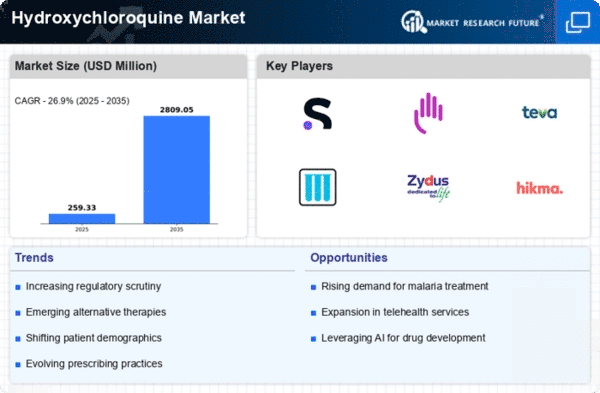
As per MRFR analysis, the Hydroxychloroquine Market Size was estimated at 204.36 USD Million in 2024. The Hydroxychloroquine industry is projected to grow from 259.34 in 2025 to 2809.05 by 2035, exhibiting a compound annual growth rate (CAGR) of 26.9% during the forecast period 2025 - 2035.

Key Market Trends & Highlights

The Hydroxychloroquine market is currently experiencing a dynamic shift driven by diverse applications and evolving healthcare needs.

  • North America remains the largest market for Hydroxychloroquine, driven by a robust healthcare infrastructure and high prevalence of autoimmune diseases. The Asia-Pacific region is emerging as the fastest-growing market, fueled by increasing investments in healthcare and rising awareness of preventive care. Rheumatoid Arthritis continues to be the largest segment, while the COVID-19 segment is witnessing rapid growth due to ongoing research and development. Key market drivers include the rising prevalence of autoimmune diseases and regulatory support for Hydroxychloroquine, which are shaping market dynamics.

Market Size & Forecast

2024 Market Size 204.36 (USD Million)
2035 Market Size 2809.05 (USD Million)
CAGR (2025 - 2035) 26.9%
Largest Regional Market Share in 2024 North America

Major Players

Sanofi (FR), Bristol-Myers Squibb (US), Teva Pharmaceuticals (IL), Mylan (US), Zydus Cadila (IN), Hikma Pharmaceuticals (GB), Lupin Pharmaceuticals (IN), Aurobindo Pharma (IN)

Market Trends

The Hydroxychloroquine Market is currently experiencing a complex landscape characterized by evolving demand dynamics and regulatory scrutiny. As healthcare professionals and researchers continue to explore the therapeutic applications of hydroxychloroquine, the market appears to be influenced by a variety of factors, including shifts in treatment protocols and emerging research findings. The ongoing interest in this medication, particularly in relation to autoimmune diseases and malaria, suggests a potential for sustained market activity. Furthermore, the global supply chain for hydroxychloroquine remains a critical aspect, as manufacturers navigate challenges related to production and distribution. In December 2025, the Hydroxychloroquine Market reflects a nuanced interplay between innovation and established practices. Stakeholders are increasingly focused on ensuring quality and compliance with regulatory standards, which may impact market accessibility. Additionally, the rise of alternative therapies and generics could reshape competitive dynamics within the sector. Overall, the Hydroxychloroquine Market is poised for continued evolution, with opportunities for growth tempered by the need for rigorous scientific validation and market adaptation.

Increased Research and Development

There is a noticeable uptick in research initiatives aimed at exploring the broader applications of hydroxychloroquine. This trend indicates a commitment to understanding its efficacy in various therapeutic areas, potentially expanding its market reach.

Regulatory Developments

The Hydroxychloroquine Market is currently influenced by ongoing regulatory developments that shape its availability and usage. Authorities are increasingly focused on ensuring drug safety and efficacy, which may lead to revised guidelines and approval processes. This trend suggests that hydroxychloroquine manufacturers must remain vigilant in adhering to compliance standards to maintain market presence.

Emergence of Generic Alternatives

The rise of generic versions of hydroxychloroquine is reshaping the market landscape. This trend could lead to increased accessibility for patients while simultaneously intensifying competition among manufacturers.

Hydroxychloroquine Market Market Drivers

Government Initiatives and Funding

Government initiatives and funding play a crucial role in shaping the Global Hydroxychloroquine Market Industry. Various governments are allocating resources to support the development and distribution of hydroxychloroquine, particularly in low-income countries where access to essential medications is limited. These initiatives often include subsidies, grants, and partnerships with pharmaceutical companies to ensure a steady supply of hydroxychloroquine. Such efforts not only enhance the drug's availability but also contribute to public health goals. As governments prioritize healthcare access, the market is expected to witness sustained growth, driven by these supportive policies.

Emerging Markets and Economic Growth

The Global Hydroxychloroquine Market Industry is poised for growth in emerging markets, where economic development is leading to increased healthcare spending. Countries in Asia and Africa are experiencing improvements in healthcare infrastructure, which facilitates better access to medications like hydroxychloroquine. As these regions invest in healthcare, the demand for effective treatments is likely to rise. This trend is supported by a growing middle class that prioritizes health and wellness. Consequently, the market may see a substantial increase in sales, reflecting the broader economic growth and the need for reliable healthcare solutions.

Rising Demand for Antimalarial Drugs

The Global Hydroxychloroquine Market Industry experiences a notable increase in demand for antimalarial drugs, particularly in regions where malaria remains endemic. Hydroxychloroquine Market is recognized for its efficacy in treating malaria, which contributes to its sustained relevance in public health. In 2024, the market is valued at approximately 0.2 USD Billion, reflecting the ongoing need for effective treatments. This demand is further driven by initiatives from global health organizations aimed at eradicating malaria, which may enhance the visibility and availability of hydroxychloroquine. As awareness of malaria prevention grows, the market is likely to expand significantly.

Growing Awareness of Autoimmune Disorders

The Global Hydroxychloroquine Market Industry is significantly influenced by the increasing awareness of autoimmune disorders. Conditions such as rheumatoid arthritis and lupus are gaining recognition, leading to a higher demand for effective treatments. Hydroxychloroquine Market is a cornerstone in managing these diseases, and as more patients seek diagnosis and treatment, the market is likely to expand. Educational campaigns and advocacy from patient organizations are instrumental in raising awareness, which may result in a larger patient population requiring hydroxychloroquine. This trend suggests a promising future for the market as it aligns with the growing focus on chronic disease management.

Increased Research and Development Activities

The Global Hydroxychloroquine Market Industry benefits from heightened research and development activities aimed at exploring new therapeutic applications of hydroxychloroquine. Researchers are investigating its potential use in various autoimmune diseases, which could broaden its market scope. The ongoing studies may lead to innovative formulations and delivery methods, enhancing patient compliance and treatment outcomes. As a result, the market is projected to grow at a compound annual growth rate of 27.13% from 2025 to 2035. This growth trajectory indicates a robust interest in hydroxychloroquine, potentially leading to a market valuation of 2.8 USD Billion by 2035.

Market Segment Insights

By Application: Rheumatoid Arthritis (Largest) vs. COVID-19 (Fastest-Growing)

The Hydroxychloroquine market shows a diverse application distribution, with Rheumatoid Arthritis emerging as the dominant segment, holding the largest market share. Lupus Erythematosus and Malaria follow, contributing significantly, while Other Autoimmune Diseases form a smaller portion of the overall landscape. This distribution indicates a robust demand for Hydroxychloroquine treatments tailored to chronic conditions, reflecting the ongoing needs of patient populations affected by these diseases. COVID-19 represents the fastest-growing application segment due to the heightened focus on antiviral treatments in response to the pandemic. The urgency of addressing COVID-19 and the subsequent research into Hydroxychloroquine's efficacy have catalyzed increased investments and interest. This surge illustrates a shift in the market dynamics, with a growing emphasis on emerging health threats alongside established therapeutic areas like Rheumatoid Arthritis and Lupus Erythematosus.

Rheumatoid Arthritis (Dominant) vs. COVID-19 (Emerging)

Rheumatoid Arthritis stands as the dominant application in the Hydroxychloroquine market, attributed to its chronic nature and the extensive patient base seeking long-term management options. Treatments in this segment are well-established, reflecting significant clinical evidence supporting Hydroxychloroquine's efficacy in alleviating symptoms. In contrast, the COVID-19 segment, while emerging, signifies a rapid shift in focus towards acute, viral infections. The pandemic has prompted a surge of clinical trials and research into Hydroxychloroquine's potential, leading to a dynamic environment where emerging treatments are continuously evaluated. These contrasting characteristics highlight the stability of established applications against the backdrop of a rapidly evolving therapeutic landscape.

By End Use: Hospitals (Largest) vs. Clinics (Fastest-Growing)

<p>The Hydroxychloroquine Market shows a diverse distribution across various end-use segments. Hospitals remain the largest segment, leveraging the demand for hydroxychloroquine for various therapeutic applications. Clinics, on the other hand, are witnessing increasing adoption rates, indicating a shift in patient care towards outpatient settings. Homecare and pharmacies also play pivotal roles, but their market share is comparatively smaller, focusing mostly on patient follow-ups and over-the-counter sales.</p>

<p>Hospitals (Dominant) vs. Clinics (Emerging)</p>

<p>Hospitals dominate the Hydroxychloroquine Market, driven by their robust infrastructure and the ability to administer complex treatment plans. They are critical in managing patients with severe conditions where hydroxychloroquine is prescribed. Clinics, emerging as a significant segment, are adapting to a growing trend where outpatient care is preferred for chronic conditions. Clinics benefit from easier accessibility and personalized patient care, contributing to their rising market presence. Together, these segments illustrate a dynamic structure, with hospitals leading the charge while clinics rapidly gain ground.</p>

By Distribution Channel: Retail Pharmacies (Largest) vs. Online Pharmacies (Fastest-Growing)

<p>In the Hydroxychloroquine market, retail pharmacies account for the largest share of distribution channels, providing patients with direct access to medications through established networks. These pharmacies have the advantage of physical locations, allowing for immediate availability of Hydroxychloroquine prescriptions. In contrast, online pharmacies are quickly gaining traction, appealing to consumers' preference for convenience and accessibility, particularly in recent years. This shift reflects changes in patient behavior and the healthcare landscape, where digital solutions are becoming essential for medication distribution. The growth trends for distribution channels in the Hydroxychloroquine market showcase a dynamic landscape. Online pharmacies are currently the fastest-growing segment, driven by an increase in e-commerce adoption and the desire for safer, contactless shopping experiences. Additionally, the COVID-19 pandemic accelerated the acceptance of telemedicine and online prescriptions, further boosting online pharmacy growth. Meanwhile, retail pharmacies continue to thrive due to their established trust and reputation within communities, allowing them to maintain relevance in this evolving market.</p>

<p>Retail Pharmacies (Dominant) vs. Online Pharmacies (Emerging)</p>

<p>Retail pharmacies are the dominant force in the distribution of Hydroxychloroquine, leveraging their extensive network and the trust they have built with consumers over the years. They provide a tangible point of contact, where patients can receive professional guidance and immediate assistance in obtaining their prescriptions. Furthermore, retail pharmacies often offer additional healthcare services, enhancing their value proposition. On the other hand, online pharmacies are emerging as a significant competitor, appealing especially to tech-savvy consumers who prefer the convenience of ordering medications from home. This segment is characterized by competitive pricing and a user-friendly shopping experience, attributes critical for capturing a larger market share. As patients increasingly turn to digital options, online pharmacies are positioning themselves effectively to meet this rising demand.</p>

By Formulation: Tablets (Largest) vs. Injectables (Fastest-Growing)

<p>In the Hydroxychloroquine Market, Tablets hold the largest share, providing a significant portion of the overall formulation landscape. This popularity can be attributed to their convenience, stability, and the longstanding history of their use in treating conditions such as malaria and autoimmune diseases. Alternatively, Injectables, although currently a smaller segment, are experiencing rapid growth driven by the increasing need for immediate therapeutic effects and patient compliance in acute cases. The growth trajectory for the Hydroxychloroquine formulation segment indicates a notable shift towards Injectables, reflecting a broader trend in the pharmaceutical industry aimed at enhancing patient outcomes. Factors influencing this growth include technological advancements in drug delivery systems, increased investment in outpatient care settings, and a growing preference among healthcare providers for formulations that ensure rapid onset of action. This trend emphasizes the evolving needs of patients and the market's response to those needs.</p>

<p>Tablets (Dominant) vs. Injectables (Emerging)</p>

<p>Tablets are the dominant formulation in the Hydroxychloroquine Market, favored for their ease of use and established efficacy. They offer advantages such as accurate dosing and long shelf life, which are crucial for patient adherence and treatment consistency. In contrast, Injectables represent an emerging formulation, gaining traction in recent years. They cater to specific patient needs, especially in cases where a rapid therapeutic response is critical. The injectable segment is characterized by innovations in formulation technology, making them easier to administer and more effective in acute care scenarios. This growing preference highlights a shift towards more dynamic treatment strategies, reflecting a broader trend in healthcare towards personalized medicine.</p>

Get more detailed insights about Hydroxychloroquine Market Research Report - Global Forecast Until 2035

Regional Insights

North America : Market Leader in Hydroxychloroquine

North America is poised to maintain its leadership in the Hydroxychloroquine market, holding a significant market share of $102.18M in 2025. The region's growth is driven by increasing demand for effective treatments for autoimmune diseases and malaria, alongside supportive regulatory frameworks. The FDA's approval processes and ongoing research initiatives further catalyze market expansion, ensuring a steady supply of Hydroxychloroquine to meet rising healthcare needs. The competitive landscape in North America is characterized by the presence of major players such as Sanofi, Bristol-Myers Squibb, and Teva Pharmaceuticals. These companies are investing heavily in R&D to innovate and enhance their product offerings. The U.S. remains the largest market, with Canada also contributing significantly. The strategic collaborations and mergers among these key players are expected to strengthen their market positions and drive future growth.

Europe : Emerging Market with Growth Potential

Europe's Hydroxychloroquine market is valued at $56.0M, reflecting a growing interest in the drug for treating various diseases. The region benefits from robust healthcare systems and increasing awareness of Hydroxychloroquine's therapeutic benefits. Regulatory bodies like the European Medicines Agency (EMA) are actively involved in ensuring the safety and efficacy of these treatments, which is crucial for market growth. The rising prevalence of autoimmune diseases is also a significant driver of demand in this region. Leading countries in Europe include Germany, France, and the UK, where the presence of established pharmaceutical companies enhances market dynamics. Key players such as Mylan and Hikma Pharmaceuticals are focusing on expanding their product lines and improving accessibility. The competitive landscape is marked by collaborations and partnerships aimed at enhancing distribution channels and market reach, positioning Europe as a vital player in the Hydroxychloroquine market.

Asia-Pacific : Rapidly Growing Market Segment

The Asia-Pacific region is witnessing a significant surge in the Hydroxychloroquine market, valued at $38.0M. This growth is driven by increasing healthcare expenditures and a rising prevalence of malaria and autoimmune diseases. Governments in countries like India and China are implementing policies to enhance drug accessibility, which is expected to further boost market demand. The region's diverse population and varying healthcare needs create a unique landscape for Hydroxychloroquine utilization. India stands out as a key player in the Asia-Pacific market, with companies like Zydus Cadila and Lupin Pharmaceuticals leading the charge. The competitive environment is characterized by a mix of local and international players, all vying for market share. The focus on affordable healthcare solutions and the expansion of distribution networks are critical strategies for these companies, ensuring that Hydroxychloroquine remains accessible to those in need.

Middle East and Africa : Emerging Market with Challenges

Leading countries in this region include South Africa and Nigeria, where local hydroxychloroquine manufacturers are striving to meet the growing demand for Hydroxychloroquine. The competitive landscape is characterized by a mix of multinational corporations and local players, focusing on affordability and accessibility. Collaborative efforts among stakeholders are essential to address healthcare challenges and improve patient access to essential medications.

Key Players and Competitive Insights

The Hydroxychloroquine Market exhibits a complex competitive landscape characterized by a blend of established players and emerging companies. Key growth drivers include the increasing prevalence of autoimmune diseases and the ongoing demand for antimalarial treatments. Major companies such as Sanofi (FR), Teva Pharmaceuticals (IL), and Mylan (US) are strategically positioned to leverage their extensive distribution networks and manufacturing capabilities. Sanofi (FR) focuses on innovation and research, aiming to enhance the therapeutic applications of Hydroxychloroquine, while Teva Pharmaceuticals (IL) emphasizes cost-effective production methods to maintain competitive pricing. Mylan (US) is actively pursuing partnerships to expand its market reach, thereby shaping a competitive environment that is both dynamic and multifaceted.In terms of business tactics, companies are increasingly localizing manufacturing to reduce supply chain vulnerabilities and optimize logistics. The Hydroxychloroquine Market appears moderately fragmented, with a mix of large multinational corporations and smaller regional players. This structure allows for a diverse range of products and pricing strategies, which collectively influence market dynamics. The presence of key players fosters a competitive atmosphere where innovation and operational efficiency are paramount.
In November Sanofi (FR) announced a collaboration with a leading biotechnology firm to develop a new formulation of Hydroxychloroquine aimed at improving patient compliance and therapeutic outcomes. This strategic move underscores Sanofi's commitment to innovation and positions the company to capture a larger share of the market by addressing unmet medical needs. The partnership is expected to enhance research capabilities and accelerate the development timeline for new products.
In October Teva Pharmaceuticals (IL) launched a new initiative focused on sustainability in its manufacturing processes, aiming to reduce carbon emissions by 30% over the next five years. This initiative not only aligns with global sustainability trends but also enhances Teva's brand reputation as a responsible manufacturer. By investing in greener technologies, Teva is likely to attract environmentally conscious consumers and stakeholders, thereby strengthening its market position.
In September Mylan (US) expanded its distribution network in Asia by entering into a strategic alliance with a local pharmaceutical company. This move is anticipated to enhance Mylan's market penetration in the region, allowing for greater accessibility of Hydroxychloroquine to patients. The partnership is indicative of Mylan's strategy to leverage local expertise and infrastructure, which could lead to increased sales and market share in a rapidly growing segment.
As of December the Hydroxychloroquine Market is witnessing trends such as digitalization and AI integration, which are reshaping competitive strategies. Companies are increasingly forming strategic alliances to enhance their research capabilities and market reach. The competitive differentiation is likely to evolve from traditional price-based competition to a focus on innovation, technology, and supply chain reliability. This shift suggests that companies that prioritize these aspects will be better positioned to thrive in an increasingly complex market environment.

Key Companies in the Hydroxychloroquine Market include

Industry Developments

June 2021:A prominent creator and producer of GMP-grade human induced pluripotent stem cells, RheinCell Therapeutics GmbH, will be acquired by Catalent, Inc., according to the company's announcement. The company's current stem cell therapy process development and production capabilities will benefit from this purchase.

December 2020:In order to increase the manufacturing capacity for efficient production and manufacturing of voclosporin, Lonza stated that they have expanded their relationship with Aurinia Pharmaceuticals.

Future Outlook

Hydroxychloroquine Market Future Outlook

The Hydroxychloroquine Market is projected to grow at a 26.9% CAGR from 2025 to 2035, driven by increasing demand for autoimmune disease treatments and expanding applications in infectious diseases.

New opportunities lie in:

  • <p>Development of targeted marketing strategies for autoimmune disease patients Expansion into emerging markets with tailored distribution channels Investment in research for new therapeutic applications of Hydroxychloroquine</p>

By 2035, the Hydroxychloroquine Market is expected to achieve substantial growth and diversification.

Market Segmentation

Hydroxychloroquine Market End Use Outlook

  • Hospitals
  • Clinics
  • Homecare Settings
  • Pharmacies

Hydroxychloroquine Market Application Outlook

  • Rheumatoid Arthritis
  • Lupus Erythematosus
  • Malaria
  • COVID-19
  • Other Autoimmune Diseases

Hydroxychloroquine Market Formulation Outlook

  • Tablets
  • Injectables
  • Oral Solutions

Hydroxychloroquine Market Distribution Channel Outlook

  • Direct Sales
  • Online Pharmacies
  • Retail Pharmacies

Report Scope

MARKET SIZE 2024 204.36(USD Million)
MARKET SIZE 2025 259.34(USD Million)
MARKET SIZE 2035 2809.05(USD Million)
COMPOUND ANNUAL GROWTH RATE (CAGR) 26.9% (2025 - 2035)
REPORT COVERAGE Revenue Forecast, Competitive Landscape, Growth Factors, and Trends
BASE YEAR 2024
Market Forecast Period 2025 - 2035
Historical Data 2019 - 2024
Market Forecast Units USD Million
Key Companies Profiled Sanofi (FR), Bristol-Myers Squibb (US), Teva Pharmaceuticals (IL), Mylan (US), Zydus Cadila (IN), Hikma Pharmaceuticals (GB), Lupin Pharmaceuticals (IN), Aurobindo Pharma (IN)
Segments Covered Application, End Use, Formulation, Distribution Channel
Key Market Opportunities Emerging applications in autoimmune diseases create growth potential in the Hydroxychloroquine Market.
Key Market Dynamics Regulatory scrutiny and evolving consumer preferences shape the competitive landscape of the Hydroxychloroquine Market.
Countries Covered North America, Europe, APAC, South America, MEA

FAQs

What is the current market valuation of the Hydroxychloroquine Market as of 2024?

<p>The Hydroxychloroquine Market was valued at 204.36 USD Million in 2024.</p>

What is the projected market valuation for the Hydroxychloroquine Market in 2035?

<p>The market is projected to reach 2809.05 USD Million by 2035.</p>

What is the expected CAGR for the Hydroxychloroquine Market during the forecast period 2025 - 2035?

<p>The expected CAGR for the Hydroxychloroquine Market during 2025 - 2035 is 26.9%.</p>

Which companies are considered key players in the Hydroxychloroquine Market?

<p>Key players in the market include Sanofi, Bristol-Myers Squibb, Teva Pharmaceuticals, Mylan, Zydus Cadila, Hikma Pharmaceuticals, Lupin Pharmaceuticals, and Aurobindo Pharma.</p>

What are the primary applications of Hydroxychloroquine and their market values?

<p>The primary applications include Rheumatoid Arthritis at 550.0 USD Million, Lupus Erythematosus at 400.0 USD Million, and Malaria at 700.0 USD Million.</p>

How does the Hydroxychloroquine Market perform across different end-use segments?

<p>In 2024, the market performance by end-use showed Hospitals at 800.0 USD Million, Clinics at 500.0 USD Million, and Pharmacies at 1209.05 USD Million.</p>

What distribution channels are utilized in the Hydroxychloroquine Market?

Distribution channels include Retail Pharmacies at 1200.0 USD Million, Hospital Pharmacies at 800.0 USD Million, and Online Pharmacies at 400.0 USD Million.

What formulations of Hydroxychloroquine are available and their market values?

Available formulations include Tablets at 1400.0 USD Million, Injectables at 800.0 USD Million, and Oral Solutions at 609.05 USD Million.

How does the Hydroxychloroquine Market's growth compare across different applications?

The market growth appears robust, particularly in Malaria, which reached 700.0 USD Million, indicating a strong demand.

What trends are anticipated for the Hydroxychloroquine Market in the coming years?

Trends suggest a substantial increase in market valuation, potentially driven by rising demand across various applications and distribution channels.

  1. SECTION I: EXECUTIVE SUMMARY AND KEY HIGHLIGHTS
    1. | 1.1 EXECUTIVE SUMMARY
    2. | | 1.1.1 Market Overview
    3. | | 1.1.2 Key Findings
    4. | | 1.1.3 Market Segmentation
    5. | | 1.1.4 Competitive Landscape
    6. | | 1.1.5 Challenges and Opportunities
    7. | | 1.1.6 Future Outlook
  2. SECTION II: SCOPING, METHODOLOGY AND MARKET STRUCTURE
    1. | 2.1 MARKET INTRODUCTION
    2. | | 2.1.1 Definition
    3. | | 2.1.2 Scope of the study
    4. | | | 2.1.2.1 Research Objective
    5. | | | 2.1.2.2 Assumption
    6. | | | 2.1.2.3 Limitations
    7. | 2.2 RESEARCH METHODOLOGY
    8. | | 2.2.1 Overview
    9. | | 2.2.2 Data Mining
    10. | | 2.2.3 Secondary Research
    11. | | 2.2.4 Primary Research
    12. | | | 2.2.4.1 Primary Interviews and Information Gathering Process
    13. | | | 2.2.4.2 Breakdown of Primary Respondents
    14. | | 2.2.5 Forecasting Model
    15. | | 2.2.6 Market Size Estimation
    16. | | | 2.2.6.1 Bottom-Up Approach
    17. | | | 2.2.6.2 Top-Down Approach
    18. | | 2.2.7 Data Triangulation
    19. | | 2.2.8 Validation
  3. SECTION III: QUALITATIVE ANALYSIS
    1. | 3.1 MARKET DYNAMICS
    2. | | 3.1.1 Overview
    3. | | 3.1.2 Drivers
    4. | | 3.1.3 Restraints
    5. | | 3.1.4 Opportunities
    6. | 3.2 MARKET FACTOR ANALYSIS
    7. | | 3.2.1 Value chain Analysis
    8. | | 3.2.2 Porter's Five Forces Analysis
    9. | | | 3.2.2.1 Bargaining Power of Suppliers
    10. | | | 3.2.2.2 Bargaining Power of Buyers
    11. | | | 3.2.2.3 Threat of New Entrants
    12. | | | 3.2.2.4 Threat of Substitutes
    13. | | | 3.2.2.5 Intensity of Rivalry
    14. | | 3.2.3 COVID-19 Impact Analysis
    15. | | | 3.2.3.1 Market Impact Analysis
    16. | | | 3.2.3.2 Regional Impact
    17. | | | 3.2.3.3 Opportunity and Threat Analysis
  4. SECTION IV: QUANTITATIVE ANALYSIS
    1. | 4.1 Healthcare, BY Application (USD Million)
    2. | | 4.1.1 Rheumatoid Arthritis
    3. | | 4.1.2 Lupus Erythematosus
    4. | | 4.1.3 Malaria
    5. | | 4.1.4 COVID-19
    6. | | 4.1.5 Other Applications
    7. | 4.2 Healthcare, BY End Use (USD Million)
    8. | | 4.2.1 Hospitals
    9. | | 4.2.2 Clinics
    10. | | 4.2.3 Homecare
    11. | | 4.2.4 Pharmacies
    12. | 4.3 Healthcare, BY Distribution Channel (USD Million)
    13. | | 4.3.1 Online Pharmacies
    14. | | 4.3.2 Retail Pharmacies
    15. | | 4.3.3 Hospital Pharmacies
    16. | | 4.3.4 Direct Sales
    17. | 4.4 Healthcare, BY Formulation (USD Million)
    18. | | 4.4.1 Tablets
    19. | | 4.4.2 Injectables
    20. | | 4.4.3 Oral Solutions
    21. | 4.5 Healthcare, BY Region (USD Million)
    22. | | 4.5.1 North America
    23. | | | 4.5.1.1 US
    24. | | | 4.5.1.2 Canada
    25. | | 4.5.2 Europe
    26. | | | 4.5.2.1 Germany
    27. | | | 4.5.2.2 UK
    28. | | | 4.5.2.3 France
    29. | | | 4.5.2.4 Russia
    30. | | | 4.5.2.5 Italy
    31. | | | 4.5.2.6 Spain
    32. | | | 4.5.2.7 Rest of Europe
    33. | | 4.5.3 APAC
    34. | | | 4.5.3.1 China
    35. | | | 4.5.3.2 India
    36. | | | 4.5.3.3 Japan
    37. | | | 4.5.3.4 South Korea
    38. | | | 4.5.3.5 Malaysia
    39. | | | 4.5.3.6 Thailand
    40. | | | 4.5.3.7 Indonesia
    41. | | | 4.5.3.8 Rest of APAC
    42. | | 4.5.4 South America
    43. | | | 4.5.4.1 Brazil
    44. | | | 4.5.4.2 Mexico
    45. | | | 4.5.4.3 Argentina
    46. | | | 4.5.4.4 Rest of South America
    47. | | 4.5.5 MEA
    48. | | | 4.5.5.1 GCC Countries
    49. | | | 4.5.5.2 South Africa
    50. | | | 4.5.5.3 Rest of MEA
  5. SECTION V: COMPETITIVE ANALYSIS
    1. | 5.1 Competitive Landscape
    2. | | 5.1.1 Overview
    3. | | 5.1.2 Competitive Analysis
    4. | | 5.1.3 Market share Analysis
    5. | | 5.1.4 Major Growth Strategy in the Healthcare
    6. | | 5.1.5 Competitive Benchmarking
    7. | | 5.1.6 Leading Players in Terms of Number of Developments in the Healthcare
    8. | | 5.1.7 Key developments and growth strategies
    9. | | | 5.1.7.1 New Product Launch/Service Deployment
    10. | | | 5.1.7.2 Merger & Acquisitions
    11. | | | 5.1.7.3 Joint Ventures
    12. | | 5.1.8 Major Players Financial Matrix
    13. | | | 5.1.8.1 Sales and Operating Income
    14. | | | 5.1.8.2 Major Players R&D Expenditure. 2023
    15. | 5.2 Company Profiles
    16. | | 5.2.1 Sanofi (FR)
    17. | | | 5.2.1.1 Financial Overview
    18. | | | 5.2.1.2 Products Offered
    19. | | | 5.2.1.3 Key Developments
    20. | | | 5.2.1.4 SWOT Analysis
    21. | | | 5.2.1.5 Key Strategies
    22. | | 5.2.2 Bristol-Myers Squibb (US)
    23. | | | 5.2.2.1 Financial Overview
    24. | | | 5.2.2.2 Products Offered
    25. | | | 5.2.2.3 Key Developments
    26. | | | 5.2.2.4 SWOT Analysis
    27. | | | 5.2.2.5 Key Strategies
    28. | | 5.2.3 Teva Pharmaceuticals (IL)
    29. | | | 5.2.3.1 Financial Overview
    30. | | | 5.2.3.2 Products Offered
    31. | | | 5.2.3.3 Key Developments
    32. | | | 5.2.3.4 SWOT Analysis
    33. | | | 5.2.3.5 Key Strategies
    34. | | 5.2.4 Mylan (US)
    35. | | | 5.2.4.1 Financial Overview
    36. | | | 5.2.4.2 Products Offered
    37. | | | 5.2.4.3 Key Developments
    38. | | | 5.2.4.4 SWOT Analysis
    39. | | | 5.2.4.5 Key Strategies
    40. | | 5.2.5 Zydus Cadila (IN)
    41. | | | 5.2.5.1 Financial Overview
    42. | | | 5.2.5.2 Products Offered
    43. | | | 5.2.5.3 Key Developments
    44. | | | 5.2.5.4 SWOT Analysis
    45. | | | 5.2.5.5 Key Strategies
    46. | | 5.2.6 Hikma Pharmaceuticals (GB)
    47. | | | 5.2.6.1 Financial Overview
    48. | | | 5.2.6.2 Products Offered
    49. | | | 5.2.6.3 Key Developments
    50. | | | 5.2.6.4 SWOT Analysis
    51. | | | 5.2.6.5 Key Strategies
    52. | | 5.2.7 Lupin Pharmaceuticals (IN)
    53. | | | 5.2.7.1 Financial Overview
    54. | | | 5.2.7.2 Products Offered
    55. | | | 5.2.7.3 Key Developments
    56. | | | 5.2.7.4 SWOT Analysis
    57. | | | 5.2.7.5 Key Strategies
    58. | | 5.2.8 Aurobindo Pharma (IN)
    59. | | | 5.2.8.1 Financial Overview
    60. | | | 5.2.8.2 Products Offered
    61. | | | 5.2.8.3 Key Developments
    62. | | | 5.2.8.4 SWOT Analysis
    63. | | | 5.2.8.5 Key Strategies
    64. | 5.3 Appendix
    65. | | 5.3.1 References
    66. | | 5.3.2 Related Reports
  6. LIST OF FIGURES
    1. | 6.1 MARKET SYNOPSIS
    2. | 6.2 NORTH AMERICA MARKET ANALYSIS
    3. | 6.3 US MARKET ANALYSIS BY APPLICATION
    4. | 6.4 US MARKET ANALYSIS BY END USE
    5. | 6.5 US MARKET ANALYSIS BY DISTRIBUTION CHANNEL
    6. | 6.6 US MARKET ANALYSIS BY FORMULATION
    7. | 6.7 CANADA MARKET ANALYSIS BY APPLICATION
    8. | 6.8 CANADA MARKET ANALYSIS BY END USE
    9. | 6.9 CANADA MARKET ANALYSIS BY DISTRIBUTION CHANNEL
    10. | 6.10 CANADA MARKET ANALYSIS BY FORMULATION
    11. | 6.11 EUROPE MARKET ANALYSIS
    12. | 6.12 GERMANY MARKET ANALYSIS BY APPLICATION
    13. | 6.13 GERMANY MARKET ANALYSIS BY END USE
    14. | 6.14 GERMANY MARKET ANALYSIS BY DISTRIBUTION CHANNEL
    15. | 6.15 GERMANY MARKET ANALYSIS BY FORMULATION
    16. | 6.16 UK MARKET ANALYSIS BY APPLICATION
    17. | 6.17 UK MARKET ANALYSIS BY END USE
    18. | 6.18 UK MARKET ANALYSIS BY DISTRIBUTION CHANNEL
    19. | 6.19 UK MARKET ANALYSIS BY FORMULATION
    20. | 6.20 FRANCE MARKET ANALYSIS BY APPLICATION
    21. | 6.21 FRANCE MARKET ANALYSIS BY END USE
    22. | 6.22 FRANCE MARKET ANALYSIS BY DISTRIBUTION CHANNEL
    23. | 6.23 FRANCE MARKET ANALYSIS BY FORMULATION
    24. | 6.24 RUSSIA MARKET ANALYSIS BY APPLICATION
    25. | 6.25 RUSSIA MARKET ANALYSIS BY END USE
    26. | 6.26 RUSSIA MARKET ANALYSIS BY DISTRIBUTION CHANNEL
    27. | 6.27 RUSSIA MARKET ANALYSIS BY FORMULATION
    28. | 6.28 ITALY MARKET ANALYSIS BY APPLICATION
    29. | 6.29 ITALY MARKET ANALYSIS BY END USE
    30. | 6.30 ITALY MARKET ANALYSIS BY DISTRIBUTION CHANNEL
    31. | 6.31 ITALY MARKET ANALYSIS BY FORMULATION
    32. | 6.32 SPAIN MARKET ANALYSIS BY APPLICATION
    33. | 6.33 SPAIN MARKET ANALYSIS BY END USE
    34. | 6.34 SPAIN MARKET ANALYSIS BY DISTRIBUTION CHANNEL
    35. | 6.35 SPAIN MARKET ANALYSIS BY FORMULATION
    36. | 6.36 REST OF EUROPE MARKET ANALYSIS BY APPLICATION
    37. | 6.37 REST OF EUROPE MARKET ANALYSIS BY END USE
    38. | 6.38 REST OF EUROPE MARKET ANALYSIS BY DISTRIBUTION CHANNEL
    39. | 6.39 REST OF EUROPE MARKET ANALYSIS BY FORMULATION
    40. | 6.40 APAC MARKET ANALYSIS
    41. | 6.41 CHINA MARKET ANALYSIS BY APPLICATION
    42. | 6.42 CHINA MARKET ANALYSIS BY END USE
    43. | 6.43 CHINA MARKET ANALYSIS BY DISTRIBUTION CHANNEL
    44. | 6.44 CHINA MARKET ANALYSIS BY FORMULATION
    45. | 6.45 INDIA MARKET ANALYSIS BY APPLICATION
    46. | 6.46 INDIA MARKET ANALYSIS BY END USE
    47. | 6.47 INDIA MARKET ANALYSIS BY DISTRIBUTION CHANNEL
    48. | 6.48 INDIA MARKET ANALYSIS BY FORMULATION
    49. | 6.49 JAPAN MARKET ANALYSIS BY APPLICATION
    50. | 6.50 JAPAN MARKET ANALYSIS BY END USE
    51. | 6.51 JAPAN MARKET ANALYSIS BY DISTRIBUTION CHANNEL
    52. | 6.52 JAPAN MARKET ANALYSIS BY FORMULATION
    53. | 6.53 SOUTH KOREA MARKET ANALYSIS BY APPLICATION
    54. | 6.54 SOUTH KOREA MARKET ANALYSIS BY END USE
    55. | 6.55 SOUTH KOREA MARKET ANALYSIS BY DISTRIBUTION CHANNEL
    56. | 6.56 SOUTH KOREA MARKET ANALYSIS BY FORMULATION
    57. | 6.57 MALAYSIA MARKET ANALYSIS BY APPLICATION
    58. | 6.58 MALAYSIA MARKET ANALYSIS BY END USE
    59. | 6.59 MALAYSIA MARKET ANALYSIS BY DISTRIBUTION CHANNEL
    60. | 6.60 MALAYSIA MARKET ANALYSIS BY FORMULATION
    61. | 6.61 THAILAND MARKET ANALYSIS BY APPLICATION
    62. | 6.62 THAILAND MARKET ANALYSIS BY END USE
    63. | 6.63 THAILAND MARKET ANALYSIS BY DISTRIBUTION CHANNEL
    64. | 6.64 THAILAND MARKET ANALYSIS BY FORMULATION
    65. | 6.65 INDONESIA MARKET ANALYSIS BY APPLICATION
    66. | 6.66 INDONESIA MARKET ANALYSIS BY END USE
    67. | 6.67 INDONESIA MARKET ANALYSIS BY DISTRIBUTION CHANNEL
    68. | 6.68 INDONESIA MARKET ANALYSIS BY FORMULATION
    69. | 6.69 REST OF APAC MARKET ANALYSIS BY APPLICATION
    70. | 6.70 REST OF APAC MARKET ANALYSIS BY END USE
    71. | 6.71 REST OF APAC MARKET ANALYSIS BY DISTRIBUTION CHANNEL
    72. | 6.72 REST OF APAC MARKET ANALYSIS BY FORMULATION
    73. | 6.73 SOUTH AMERICA MARKET ANALYSIS
    74. | 6.74 BRAZIL MARKET ANALYSIS BY APPLICATION
    75. | 6.75 BRAZIL MARKET ANALYSIS BY END USE
    76. | 6.76 BRAZIL MARKET ANALYSIS BY DISTRIBUTION CHANNEL
    77. | 6.77 BRAZIL MARKET ANALYSIS BY FORMULATION
    78. | 6.78 MEXICO MARKET ANALYSIS BY APPLICATION
    79. | 6.79 MEXICO MARKET ANALYSIS BY END USE
    80. | 6.80 MEXICO MARKET ANALYSIS BY DISTRIBUTION CHANNEL
    81. | 6.81 MEXICO MARKET ANALYSIS BY FORMULATION
    82. | 6.82 ARGENTINA MARKET ANALYSIS BY APPLICATION
    83. | 6.83 ARGENTINA MARKET ANALYSIS BY END USE
    84. | 6.84 ARGENTINA MARKET ANALYSIS BY DISTRIBUTION CHANNEL
    85. | 6.85 ARGENTINA MARKET ANALYSIS BY FORMULATION
    86. | 6.86 REST OF SOUTH AMERICA MARKET ANALYSIS BY APPLICATION
    87. | 6.87 REST OF SOUTH AMERICA MARKET ANALYSIS BY END USE
    88. | 6.88 REST OF SOUTH AMERICA MARKET ANALYSIS BY DISTRIBUTION CHANNEL
    89. | 6.89 REST OF SOUTH AMERICA MARKET ANALYSIS BY FORMULATION
    90. | 6.90 MEA MARKET ANALYSIS
    91. | 6.91 GCC COUNTRIES MARKET ANALYSIS BY APPLICATION
    92. | 6.92 GCC COUNTRIES MARKET ANALYSIS BY END USE
    93. | 6.93 GCC COUNTRIES MARKET ANALYSIS BY DISTRIBUTION CHANNEL
    94. | 6.94 GCC COUNTRIES MARKET ANALYSIS BY FORMULATION
    95. | 6.95 SOUTH AFRICA MARKET ANALYSIS BY APPLICATION
    96. | 6.96 SOUTH AFRICA MARKET ANALYSIS BY END USE
    97. | 6.97 SOUTH AFRICA MARKET ANALYSIS BY DISTRIBUTION CHANNEL
    98. | 6.98 SOUTH AFRICA MARKET ANALYSIS BY FORMULATION
    99. | 6.99 REST OF MEA MARKET ANALYSIS BY APPLICATION
    100. | 6.100 REST OF MEA MARKET ANALYSIS BY END USE
    101. | 6.101 REST OF MEA MARKET ANALYSIS BY DISTRIBUTION CHANNEL
    102. | 6.102 REST OF MEA MARKET ANALYSIS BY FORMULATION
    103. | 6.103 KEY BUYING CRITERIA OF HEALTHCARE
    104. | 6.104 RESEARCH PROCESS OF MRFR
    105. | 6.105 DRO ANALYSIS OF HEALTHCARE
    106. | 6.106 DRIVERS IMPACT ANALYSIS: HEALTHCARE
    107. | 6.107 RESTRAINTS IMPACT ANALYSIS: HEALTHCARE
    108. | 6.108 SUPPLY / VALUE CHAIN: HEALTHCARE
    109. | 6.109 HEALTHCARE, BY APPLICATION, 2024 (% SHARE)
    110. | 6.110 HEALTHCARE, BY APPLICATION, 2024 TO 2035 (USD Million)
    111. | 6.111 HEALTHCARE, BY END USE, 2024 (% SHARE)
    112. | 6.112 HEALTHCARE, BY END USE, 2024 TO 2035 (USD Million)
    113. | 6.113 HEALTHCARE, BY DISTRIBUTION CHANNEL, 2024 (% SHARE)
    114. | 6.114 HEALTHCARE, BY DISTRIBUTION CHANNEL, 2024 TO 2035 (USD Million)
    115. | 6.115 HEALTHCARE, BY FORMULATION, 2024 (% SHARE)
    116. | 6.116 HEALTHCARE, BY FORMULATION, 2024 TO 2035 (USD Million)
    117. | 6.117 BENCHMARKING OF MAJOR COMPETITORS
  7. LIST OF TABLES
    1. | 7.1 LIST OF ASSUMPTIONS
    2. | | 7.1.1
    3. | 7.2 North America MARKET SIZE ESTIMATES; FORECAST
    4. | | 7.2.1 BY APPLICATION, 2025-2035 (USD Million)
    5. | | 7.2.2 BY END USE, 2025-2035 (USD Million)
    6. | | 7.2.3 BY DISTRIBUTION CHANNEL, 2025-2035 (USD Million)
    7. | | 7.2.4 BY FORMULATION, 2025-2035 (USD Million)
    8. | 7.3 US MARKET SIZE ESTIMATES; FORECAST
    9. | | 7.3.1 BY APPLICATION, 2025-2035 (USD Million)
    10. | | 7.3.2 BY END USE, 2025-2035 (USD Million)
    11. | | 7.3.3 BY DISTRIBUTION CHANNEL, 2025-2035 (USD Million)
    12. | | 7.3.4 BY FORMULATION, 2025-2035 (USD Million)
    13. | 7.4 Canada MARKET SIZE ESTIMATES; FORECAST
    14. | | 7.4.1 BY APPLICATION, 2025-2035 (USD Million)
    15. | | 7.4.2 BY END USE, 2025-2035 (USD Million)
    16. | | 7.4.3 BY DISTRIBUTION CHANNEL, 2025-2035 (USD Million)
    17. | | 7.4.4 BY FORMULATION, 2025-2035 (USD Million)
    18. | 7.5 Europe MARKET SIZE ESTIMATES; FORECAST
    19. | | 7.5.1 BY APPLICATION, 2025-2035 (USD Million)
    20. | | 7.5.2 BY END USE, 2025-2035 (USD Million)
    21. | | 7.5.3 BY DISTRIBUTION CHANNEL, 2025-2035 (USD Million)
    22. | | 7.5.4 BY FORMULATION, 2025-2035 (USD Million)
    23. | 7.6 Germany MARKET SIZE ESTIMATES; FORECAST
    24. | | 7.6.1 BY APPLICATION, 2025-2035 (USD Million)
    25. | | 7.6.2 BY END USE, 2025-2035 (USD Million)
    26. | | 7.6.3 BY DISTRIBUTION CHANNEL, 2025-2035 (USD Million)
    27. | | 7.6.4 BY FORMULATION, 2025-2035 (USD Million)
    28. | 7.7 UK MARKET SIZE ESTIMATES; FORECAST
    29. | | 7.7.1 BY APPLICATION, 2025-2035 (USD Million)
    30. | | 7.7.2 BY END USE, 2025-2035 (USD Million)
    31. | | 7.7.3 BY DISTRIBUTION CHANNEL, 2025-2035 (USD Million)
    32. | | 7.7.4 BY FORMULATION, 2025-2035 (USD Million)
    33. | 7.8 France MARKET SIZE ESTIMATES; FORECAST
    34. | | 7.8.1 BY APPLICATION, 2025-2035 (USD Million)
    35. | | 7.8.2 BY END USE, 2025-2035 (USD Million)
    36. | | 7.8.3 BY DISTRIBUTION CHANNEL, 2025-2035 (USD Million)
    37. | | 7.8.4 BY FORMULATION, 2025-2035 (USD Million)
    38. | 7.9 Russia MARKET SIZE ESTIMATES; FORECAST
    39. | | 7.9.1 BY APPLICATION, 2025-2035 (USD Million)
    40. | | 7.9.2 BY END USE, 2025-2035 (USD Million)
    41. | | 7.9.3 BY DISTRIBUTION CHANNEL, 2025-2035 (USD Million)
    42. | | 7.9.4 BY FORMULATION, 2025-2035 (USD Million)
    43. | 7.10 Italy MARKET SIZE ESTIMATES; FORECAST
    44. | | 7.10.1 BY APPLICATION, 2025-2035 (USD Million)
    45. | | 7.10.2 BY END USE, 2025-2035 (USD Million)
    46. | | 7.10.3 BY DISTRIBUTION CHANNEL, 2025-2035 (USD Million)
    47. | | 7.10.4 BY FORMULATION, 2025-2035 (USD Million)
    48. | 7.11 Spain MARKET SIZE ESTIMATES; FORECAST
    49. | | 7.11.1 BY APPLICATION, 2025-2035 (USD Million)
    50. | | 7.11.2 BY END USE, 2025-2035 (USD Million)
    51. | | 7.11.3 BY DISTRIBUTION CHANNEL, 2025-2035 (USD Million)
    52. | | 7.11.4 BY FORMULATION, 2025-2035 (USD Million)
    53. | 7.12 Rest of Europe MARKET SIZE ESTIMATES; FORECAST
    54. | | 7.12.1 BY APPLICATION, 2025-2035 (USD Million)
    55. | | 7.12.2 BY END USE, 2025-2035 (USD Million)
    56. | | 7.12.3 BY DISTRIBUTION CHANNEL, 2025-2035 (USD Million)
    57. | | 7.12.4 BY FORMULATION, 2025-2035 (USD Million)
    58. | 7.13 APAC MARKET SIZE ESTIMATES; FORECAST
    59. | | 7.13.1 BY APPLICATION, 2025-2035 (USD Million)
    60. | | 7.13.2 BY END USE, 2025-2035 (USD Million)
    61. | | 7.13.3 BY DISTRIBUTION CHANNEL, 2025-2035 (USD Million)
    62. | | 7.13.4 BY FORMULATION, 2025-2035 (USD Million)
    63. | 7.14 China MARKET SIZE ESTIMATES; FORECAST
    64. | | 7.14.1 BY APPLICATION, 2025-2035 (USD Million)
    65. | | 7.14.2 BY END USE, 2025-2035 (USD Million)
    66. | | 7.14.3 BY DISTRIBUTION CHANNEL, 2025-2035 (USD Million)
    67. | | 7.14.4 BY FORMULATION, 2025-2035 (USD Million)
    68. | 7.15 India MARKET SIZE ESTIMATES; FORECAST
    69. | | 7.15.1 BY APPLICATION, 2025-2035 (USD Million)
    70. | | 7.15.2 BY END USE, 2025-2035 (USD Million)
    71. | | 7.15.3 BY DISTRIBUTION CHANNEL, 2025-2035 (USD Million)
    72. | | 7.15.4 BY FORMULATION, 2025-2035 (USD Million)
    73. | 7.16 Japan MARKET SIZE ESTIMATES; FORECAST
    74. | | 7.16.1 BY APPLICATION, 2025-2035 (USD Million)
    75. | | 7.16.2 BY END USE, 2025-2035 (USD Million)
    76. | | 7.16.3 BY DISTRIBUTION CHANNEL, 2025-2035 (USD Million)
    77. | | 7.16.4 BY FORMULATION, 2025-2035 (USD Million)
    78. | 7.17 South Korea MARKET SIZE ESTIMATES; FORECAST
    79. | | 7.17.1 BY APPLICATION, 2025-2035 (USD Million)
    80. | | 7.17.2 BY END USE, 2025-2035 (USD Million)
    81. | | 7.17.3 BY DISTRIBUTION CHANNEL, 2025-2035 (USD Million)
    82. | | 7.17.4 BY FORMULATION, 2025-2035 (USD Million)
    83. | 7.18 Malaysia MARKET SIZE ESTIMATES; FORECAST
    84. | | 7.18.1 BY APPLICATION, 2025-2035 (USD Million)
    85. | | 7.18.2 BY END USE, 2025-2035 (USD Million)
    86. | | 7.18.3 BY DISTRIBUTION CHANNEL, 2025-2035 (USD Million)
    87. | | 7.18.4 BY FORMULATION, 2025-2035 (USD Million)
    88. | 7.19 Thailand MARKET SIZE ESTIMATES; FORECAST
    89. | | 7.19.1 BY APPLICATION, 2025-2035 (USD Million)
    90. | | 7.19.2 BY END USE, 2025-2035 (USD Million)
    91. | | 7.19.3 BY DISTRIBUTION CHANNEL, 2025-2035 (USD Million)
    92. | | 7.19.4 BY FORMULATION, 2025-2035 (USD Million)
    93. | 7.20 Indonesia MARKET SIZE ESTIMATES; FORECAST
    94. | | 7.20.1 BY APPLICATION, 2025-2035 (USD Million)
    95. | | 7.20.2 BY END USE, 2025-2035 (USD Million)
    96. | | 7.20.3 BY DISTRIBUTION CHANNEL, 2025-2035 (USD Million)
    97. | | 7.20.4 BY FORMULATION, 2025-2035 (USD Million)
    98. | 7.21 Rest of APAC MARKET SIZE ESTIMATES; FORECAST
    99. | | 7.21.1 BY APPLICATION, 2025-2035 (USD Million)
    100. | | 7.21.2 BY END USE, 2025-2035 (USD Million)
    101. | | 7.21.3 BY DISTRIBUTION CHANNEL, 2025-2035 (USD Million)
    102. | | 7.21.4 BY FORMULATION, 2025-2035 (USD Million)
    103. | 7.22 South America MARKET SIZE ESTIMATES; FORECAST
    104. | | 7.22.1 BY APPLICATION, 2025-2035 (USD Million)
    105. | | 7.22.2 BY END USE, 2025-2035 (USD Million)
    106. | | 7.22.3 BY DISTRIBUTION CHANNEL, 2025-2035 (USD Million)
    107. | | 7.22.4 BY FORMULATION, 2025-2035 (USD Million)
    108. | 7.23 Brazil MARKET SIZE ESTIMATES; FORECAST
    109. | | 7.23.1 BY APPLICATION, 2025-2035 (USD Million)
    110. | | 7.23.2 BY END USE, 2025-2035 (USD Million)
    111. | | 7.23.3 BY DISTRIBUTION CHANNEL, 2025-2035 (USD Million)
    112. | | 7.23.4 BY FORMULATION, 2025-2035 (USD Million)
    113. | 7.24 Mexico MARKET SIZE ESTIMATES; FORECAST
    114. | | 7.24.1 BY APPLICATION, 2025-2035 (USD Million)
    115. | | 7.24.2 BY END USE, 2025-2035 (USD Million)
    116. | | 7.24.3 BY DISTRIBUTION CHANNEL, 2025-2035 (USD Million)
    117. | | 7.24.4 BY FORMULATION, 2025-2035 (USD Million)
    118. | 7.25 Argentina MARKET SIZE ESTIMATES; FORECAST
    119. | | 7.25.1 BY APPLICATION, 2025-2035 (USD Million)
    120. | | 7.25.2 BY END USE, 2025-2035 (USD Million)
    121. | | 7.25.3 BY DISTRIBUTION CHANNEL, 2025-2035 (USD Million)
    122. | | 7.25.4 BY FORMULATION, 2025-2035 (USD Million)
    123. | 7.26 Rest of South America MARKET SIZE ESTIMATES; FORECAST
    124. | | 7.26.1 BY APPLICATION, 2025-2035 (USD Million)
    125. | | 7.26.2 BY END USE, 2025-2035 (USD Million)
    126. | | 7.26.3 BY DISTRIBUTION CHANNEL, 2025-2035 (USD Million)
    127. | | 7.26.4 BY FORMULATION, 2025-2035 (USD Million)
    128. | 7.27 MEA MARKET SIZE ESTIMATES; FORECAST
    129. | | 7.27.1 BY APPLICATION, 2025-2035 (USD Million)
    130. | | 7.27.2 BY END USE, 2025-2035 (USD Million)
    131. | | 7.27.3 BY DISTRIBUTION CHANNEL, 2025-2035 (USD Million)
    132. | | 7.27.4 BY FORMULATION, 2025-2035 (USD Million)
    133. | 7.28 GCC Countries MARKET SIZE ESTIMATES; FORECAST
    134. | | 7.28.1 BY APPLICATION, 2025-2035 (USD Million)
    135. | | 7.28.2 BY END USE, 2025-2035 (USD Million)
    136. | | 7.28.3 BY DISTRIBUTION CHANNEL, 2025-2035 (USD Million)
    137. | | 7.28.4 BY FORMULATION, 2025-2035 (USD Million)
    138. | 7.29 South Africa MARKET SIZE ESTIMATES; FORECAST
    139. | | 7.29.1 BY APPLICATION, 2025-2035 (USD Million)
    140. | | 7.29.2 BY END USE, 2025-2035 (USD Million)
    141. | | 7.29.3 BY DISTRIBUTION CHANNEL, 2025-2035 (USD Million)
    142. | | 7.29.4 BY FORMULATION, 2025-2035 (USD Million)
    143. | 7.30 Rest of MEA MARKET SIZE ESTIMATES; FORECAST
    144. | | 7.30.1 BY APPLICATION, 2025-2035 (USD Million)
    145. | | 7.30.2 BY END USE, 2025-2035 (USD Million)
    146. | | 7.30.3 BY DISTRIBUTION CHANNEL, 2025-2035 (USD Million)
    147. | | 7.30.4 BY FORMULATION, 2025-2035 (USD Million)
    148. | 7.31 PRODUCT LAUNCH/PRODUCT DEVELOPMENT/APPROVAL
    149. | | 7.31.1
    150. | 7.32 ACQUISITION/PARTNERSHIP
    151. | | 7.32.1

Healthcare Market Segmentation

Healthcare By Application (USD Million, 2025-2035)

  • Rheumatoid Arthritis
  • Lupus Erythematosus
  • Malaria
  • COVID-19
  • Other Applications

Healthcare By End Use (USD Million, 2025-2035)

  • Hospitals
  • Clinics
  • Homecare
  • Pharmacies

Healthcare By Distribution Channel (USD Million, 2025-2035)

  • Online Pharmacies
  • Retail Pharmacies
  • Hospital Pharmacies
  • Direct Sales

Healthcare By Formulation (USD Million, 2025-2035)

  • Tablets
  • Injectables
  • Oral Solutions
Infographic

Free Sample Request

Kindly complete the form below to receive a free sample of this Report

Get Free Sample

Customer Strories

Compare Licence

×
Features License Type
Single User Multiuser License Enterprise User
Price $4,950 $5,950 $7,250
Maximum User Access Limit 1 User Upto 10 Users Unrestricted Access Throughout the Organization
Free Customization
Direct Access to Analyst
Deliverable Format
Platform Access
Discount on Next Purchase 10% 15% 15%
Printable Versions