Hydrophobic Interaction Chromatography Market (2026 - 2035)

ID: MRFR/MED/4905-HCR
85 Pages
Nidhi Mandole
Last Updated: July 24, 2026
Hydrophobic Interaction Chromatography Market Research Report Information By Product and Service (Resins, Columns, Services, Others), Sample Type (Monoclonal Antibodies, Vaccines, Others), End-User (Research & Academic Institutes) - Forecast Till 2035
Hydrophobic Interaction Chromatography Market
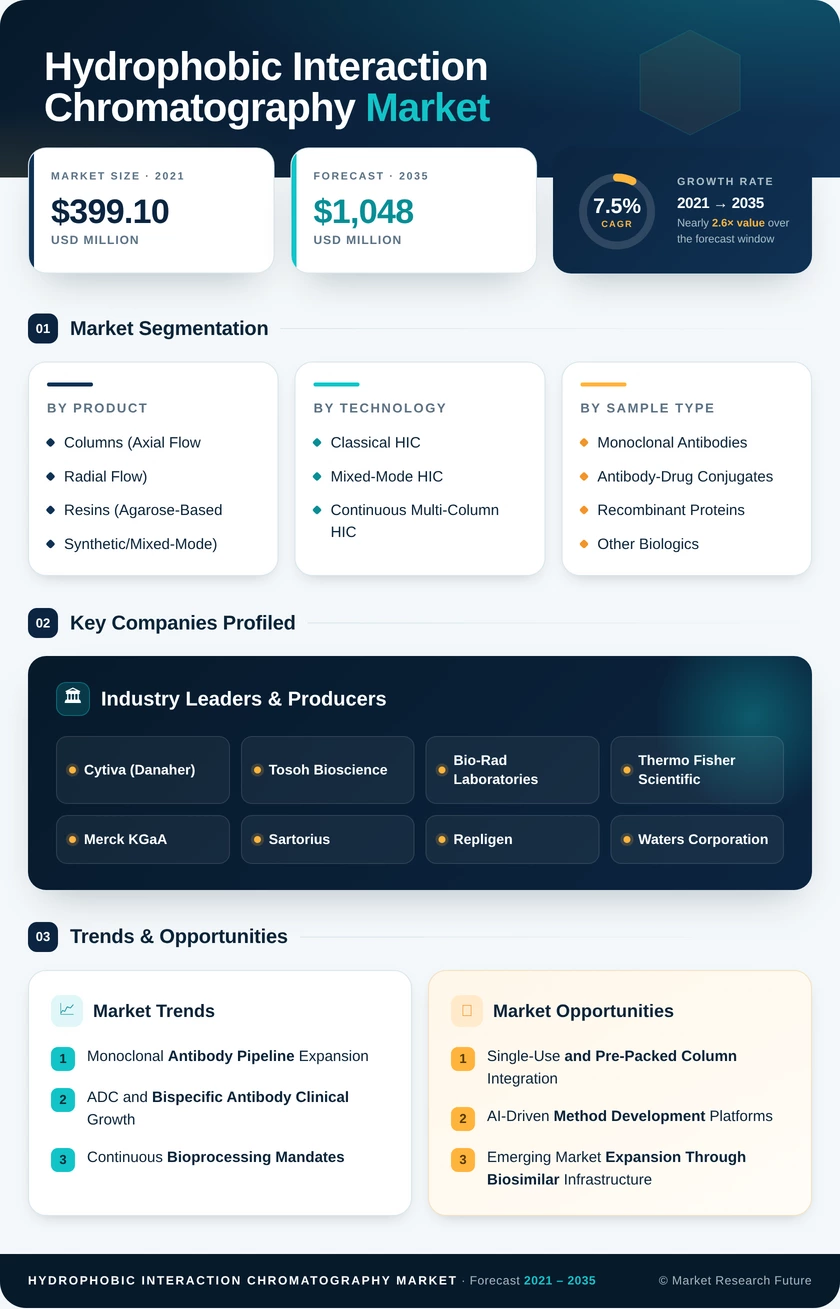
Market Size
Forecast Period2026-2035
CAGR (2026-2035)7.5%
2025 Market SizeUSD 508.5 Million
2035 Market SizeUSD 1,048.0 Million
Key Players
Cytiva
Tosoh Bioscience
Bio-Rad Laboratories
Thermo Fisher Scientific
Merck KGaA
Sartorius
Opportunities
  • Single-Use and Pre-Packed Column Integration
  • AI-Driven Method Development Platforms
  • Emerging Market Expansion Through Biosimilar Infrastructure
  1. 1 Market Overview |
    1. 1.1 Study Assumptions & Market Definition |
    2. 1.2 Scope of the Study |
    3. 1.3 Research Methodology
  2. 2 Market Summary & Key Takeaways
  3. 3 Market Dynamics |
    1. 3.1 Market Drivers Analysis | |
      1. 3.1.1 Monoclonal Antibody Pipeline Expansion | |
      2. 3.1.2 ADC and Bispecific Antibody Clinical Growth | |
      3. 3.1.3 Continuous Bioprocessing Mandates | |
      4. 3.1.4 Biosimilar Approval Surges in Asia-Pacific | |
      5. 3.1.5 CDMO Capacity Investments | |
      6. 3.1.6 Mixed-Mode Resin Technology Advances | |
      7. 3.1.7 Cell and Gene Therapy Downstream Needs |
    2. 3.2 Market Restraints Analysis | |
      1. 3.2.1 High Resin Replacement Costs | |
      2. 3.2.2 Salt Disposal and Environmental Compliance | |
      3. 3.2.3 Competition from Alternative Polishing Modes | |
      4. 3.2.4 Skilled Chromatography Operator Shortage | |
      5. 3.2.5 Long Validation Timelines for Process Changes |
    3. 3.3 Market Opportunity Analysis | |
      1. 3.3.1 Single-Use and Pre-Packed Column Integration | |
      2. 3.3.2 AI-Driven Method Development Platforms | |
      3. 3.3.3 Emerging Market Expansion Through Biosimilar Infrastructure | |
      4. 3.3.4 Cell and Gene Therapy Purification Demand | |
      5. 3.3.5 Data Monetization and Digital Chromatography Services |
    4. 3.4 Industry Value Chain Analysis |
    5. 3.5 Porter's Five Forces Analysis
  4. 4 Global Hydrophobic Interaction Chromatography Market Size & Forecast (2021–2035) |
    1. 4.1 Historical Market Size (2021–2025) |
    2. 4.2 Current & Forecast Market Size (2026–2035) |
    3. 4.3 Market Size by Revenue (USD Million) |
    4. 4.4 Year-over-Year Growth Analysis
  5. 5 Segmentation Analysis |
    1. 5.1 By Product | |
      1. 5.1.1 Columns — Axial Flow | |
      2. 5.1.2 Columns — Radial Flow | |
      3. 5.1.3 Resins — Agarose-Based | |
      4. 5.1.4 Resins — Synthetic / Mixed-Mode |
    2. 5.2 By Technology | |
      1. 5.2.1 Classical HIC | |
      2. 5.2.2 Mixed-Mode HIC | |
      3. 5.2.3 Continuous Multi-Column HIC |
    3. 5.3 By Sample Type | |
      1. 5.3.1 Monoclonal Antibodies | |
      2. 5.3.2 Antibody-Drug Conjugates | |
      3. 5.3.3 Recombinant Proteins | |
      4. 5.3.4 Other Biologics |
    4. 5.4 By End User | |
      1. 5.4.1 Pharma & Biopharma Companies | |
      2. 5.4.2 CDMOs | |
      3. 5.4.3 Academic & Research Institutes
  6. 6 Regional Analysis |
    1. 6.1 North America | |
      1. 6.1.1 United States | |
      2. 6.1.2 Canada | |
      3. 6.1.3 Mexico |
    2. 6.2 Europe | |
      1. 6.2.1 Germany | |
      2. 6.2.2 United Kingdom | |
      3. 6.2.3 France | |
      4. 6.2.4 Italy | |
      5. 6.2.5 Spain | |
      6. 6.2.6 Nordic Countries | |
      7. 6.2.7 Russia | |
      8. 6.2.8 Rest of Europe |
    3. 6.3 Asia-Pacific | |
      1. 6.3.1 China | |
      2. 6.3.2 India | |
      3. 6.3.3 Japan | |
      4. 6.3.4 South Korea | |
      5. 6.3.5 ASEAN | |
      6. 6.3.6 Rest of Asia-Pacific |
    4. 6.4 South America | |
      1. 6.4.1 Brazil | |
      2. 6.4.2 Argentina | |
      3. 6.4.3 Rest of South America |
    5. 6.5 Middle East & Africa | |
      1. 6.5.1 Saudi Arabia | |
      2. 6.5.2 UAE | |
      3. 6.5.3 South Africa | |
      4. 6.5.4 Egypt | |
      5. 6.5.5 Rest of MEA
  7. 7 Competitive Landscape |
    1. 7.1 Market Share Analysis (2025) |
    2. 7.2 Competitive Benchmarking Matrix |
    3. 7.3 Company Profiles | |
      1. 7.3.1 Cytiva (Danaher) | |
      2. 7.3.2 Tosoh Bioscience | |
      3. 7.3.3 Bio-Rad Laboratories | |
      4. 7.3.4 Thermo Fisher Scientific | |
      5. 7.3.5 Merck KGaA | |
      6. 7.3.6 Sartorius | |
      7. 7.3.7 Repligen | |
      8. 7.3.8 Waters Corporation | |
      9. 7.3.9 Agilent Technologies | |
      10. 7.3.10 Phenomenex
  8. 8 Future Outlook & Strategic Recommendations (2026–2035) |
    1. 8.1 Autonomous and AI-Integrated Chromatography |
    2. 8.2 Platform Economy and Consumable Subscription Models |
    3. 8.3 Sustainability-Driven Process Redesign |
    4. 8.4 Convergence with Cell and Gene Therapy Manufacturing
  9. 9 Recent Developments & News
  10. 10 Frequently Asked Questions (FAQs)
  11. 11 Report Scope & Methodology |
    1. 11.1 Study Period & Base Year |
    2. 11.2 Data Sources & Citations |
    3. 11.3 Abbreviations
  12. 12 LIST OF TABLES |
  13. TABLE 1 Global Hydrophobic Interaction Chromatography Market Size & Forecast, by Revenue (USD Million), 2021–2035 |
  14. TABLE 2 Global Hydrophobic Interaction Chromatography Market — Year-over-Year Growth Analysis, 2021–2035 |
  15. TABLE 3 Market Driver Impact Analysis, 2026–2035 |
  16. TABLE 4 Market Restraint Impact Analysis, 2026–2035 |
  17. TABLE 5 Regional Market Summary — Key Metrics, 2025 |
  18. TABLE 6 North America Hydrophobic Interaction Chromatography Market, by Country, 2021–2035 (USD Million) |
  19. TABLE 7 Europe Hydrophobic Interaction Chromatography Market, by Country, 2021–2035 (USD Million) |
  20. TABLE 8 Asia-Pacific Hydrophobic Interaction Chromatography Market, by Country, 2021–2035 (USD Million) |
  21. TABLE 9 South America Hydrophobic Interaction Chromatography Market, by Country, 2021–2035 (USD Million) |
  22. TABLE 10 Middle East & Africa Hydrophobic Interaction Chromatography Market, by Country, 2021–2035 (USD Million) |
  23. TABLE 11 Global Hydrophobic Interaction Chromatography Market Size, by Product, 2021–2035 (USD Million) |
  24. TABLE 12 Global Hydrophobic Interaction Chromatography Market Size, by Sample Type, 2021–2035 (USD Million) |
  25. TABLE 13 Global Hydrophobic Interaction Chromatography Market Size, by End User, 2021–2035 (USD Million) |
  26. TABLE 14 Competitive Benchmarking Matrix — Global Hydrophobic Interaction Chromatography Market, 2025 |
  27. TABLE 15 Company Profiles — Key Players, Global Hydrophobic Interaction Chromatography Market |
  28. TABLE 16 Recent Developments & Strategic Announcements, 2023–2025 |
  29. TABLE 17 Report Scope & Methodology Summary |
  30. TABLE 18 Detailed Sources and Citations
  31. 13 LIST OF FIGURES |
  32. FIGURE 1 Hydrophobic Interaction Chromatography Market Dynamics — Drivers, Restraints & Opportunities |
  33. FIGURE 2 Industry Value Chain Analysis |
  34. FIGURE 3 Porter's Five Forces Analysis |
  35. FIGURE 4 Global Hydrophobic Interaction Chromatography Market Size Trend (USD Million), 2021–2035 |
  36. FIGURE 5 Global Hydrophobic Interaction Chromatography Market Share, by Product (2025) |
  37. FIGURE 6 Global Hydrophobic Interaction Chromatography Market Share, by Sample Type (2025) |
  38. FIGURE 7 Global Hydrophobic Interaction Chromatography Market Share, by End User (2025) |
  39. FIGURE 8 Global Hydrophobic Interaction Chromatography Market Share, by Region (2025) |
  40. FIGURE 9 North America Hydrophobic Interaction Chromatography Market Share, by Country (2025) |
  41. FIGURE 10 Europe Hydrophobic Interaction Chromatography Market Share, by Country (2025) |
  42. FIGURE 11 Asia-Pacific Hydrophobic Interaction Chromatography Market Share, by Country (2025) |
  43. FIGURE 12 Competitive Landscape — Market Share Analysis (2025)

Segmentation Quick Reference

DimensionSub-SegmentsDominant SegmentFastest Growing Segment
By ProductColumns (Axial Flow, Radial Flow); Resins (Agarose-Based, Synthetic/Mixed-Mode)Columns — Axial FlowResins — Synthetic / Mixed-Mode
By TechnologyClassical HIC; Mixed-Mode HIC; Continuous Multi-Column HICClassical HICContinuous Multi-Column HIC
By Sample TypeMonoclonal Antibodies; Antibody-Drug Conjugates; Recombinant Proteins; Other BiologicsMonoclonal AntibodiesAntibody-Drug Conjugates
By End UserPharma & Biopharma Companies; CDMOs; Academic & Research InstitutesPharma & Biopharma CompaniesCDMOs
By RegionNorth America; Europe; Asia-Pacific; South America; Middle East & AfricaNorth AmericaAsia-Pacific


Market Segmentation Overview

By Product

Sub-SegmentKey Trend
Columns — Axial FlowStandard format for GMP purification with established regulatory acceptance
Columns — Radial FlowGrowing adoption in large-diameter, high-throughput biosimilar facilities
Resins — Agarose-BasedProven lifecycle track record; dominant in validated legacy processes
Resins — Synthetic / Mixed-ModeHigher binding capacity and chemical stability driving greenfield adoption


Columns remain the dominant revenue contributor because pre-packed formats simplify validation and reduce fill-finish downtime. Resins are growing faster as next-generation synthetic ligands offer extended cycle life and broader chemical compatibility, making them attractive for both new installations and resin-replacement cycles in existing facilities.

By Technology

Sub-SegmentKey Trend
Classical HICWorkhorse mode for batch-based mAb polishing with ammonium sulfate gradients
Mixed-Mode HICCombines hydrophobic and ionic interactions for enhanced selectivity
Continuous Multi-Column HICEmerging format supported by FDA/EMA continuous manufacturing guidance


Classical HIC dominates installed capacity, but continuous multi-column configurations are gaining regulatory endorsement and commercial interest as biomanufacturers pursue process intensification to handle rising upstream titers without proportional facility expansion.

By Sample Type

Sub-SegmentKey Trend
Monoclonal AntibodiesLargest therapeutic class, anchoring baseline HIC consumable demand
Antibody-Drug ConjugatesFastest growth, driven by DAR resolution requirements unique to HIC
Recombinant ProteinsStable demand from industrial enzyme and vaccine antigen production
Other BiologicsEmerging demand from fusion proteins and bispecific formats


Monoclonal antibodies set the baseline consumption pattern for the market, while antibody-drug conjugates represent the fastest-growing application segment because HIC provides resolution capabilities for DAR species that few alternative chromatographic modes can match at preparative scale.

By End User

Sub-SegmentKey Trend
Pharma & Biopharma CompaniesLargest installed base of validated HIC systems for commercial manufacturing
CDMOsFastest growth as outsourced purification demand rises with pipeline diversity
Academic & Research InstitutesSteady demand supported by public grant funding for protein research


Pharma and biopharma companies drive majority share through long-term validated manufacturing processes, while CDMOs are capturing incremental growth as the industry's shift toward outsourced and multi-product manufacturing models accelerates demand for flexible downstream platforms.


 

Download PDF ×

We do not share your information with anyone. However, we may send you emails based on your report interest from time to time. You may contact us at any time to opt-out.