Segmentation Quick Reference
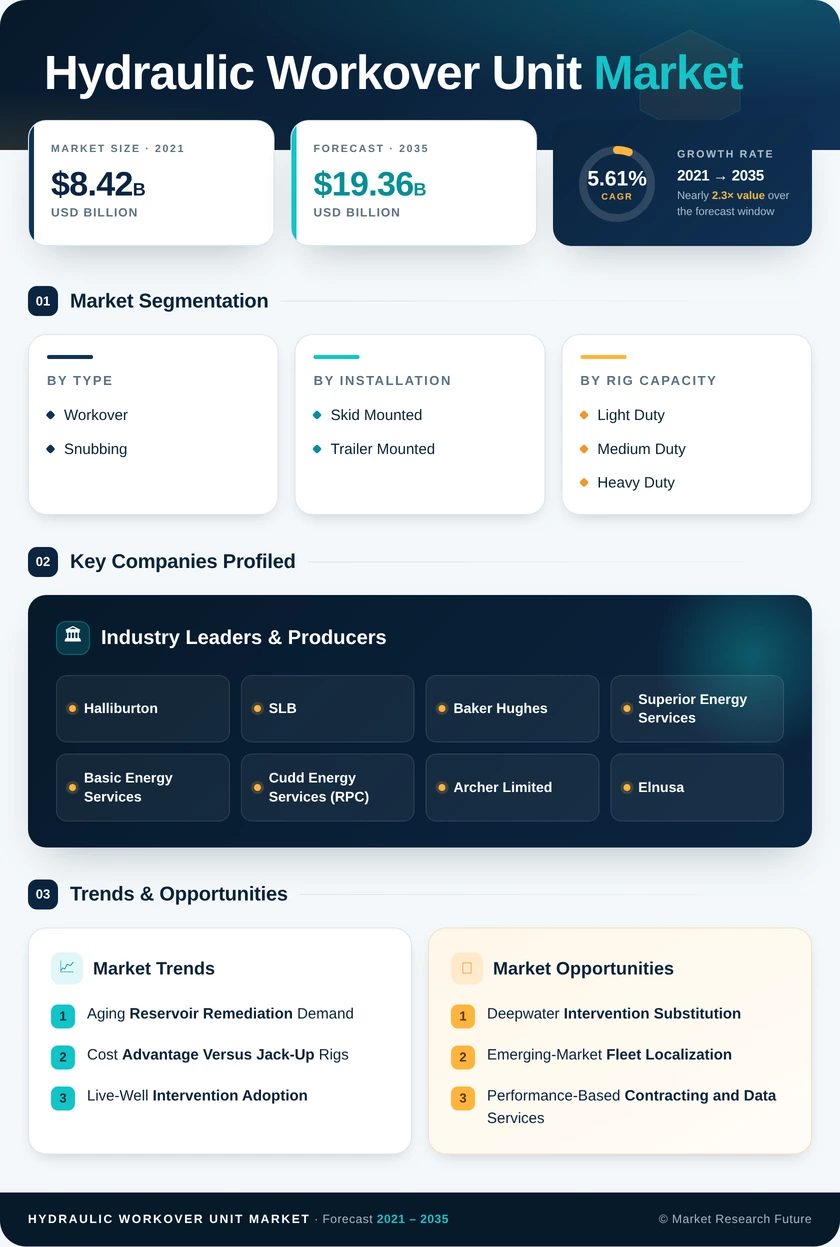
| Dimension | Sub-Segments | Dominant Segment | Fastest Growing Segment |
| By Type | Workover; Snubbing | Workover (78.9% share, 2025) | Snubbing (6.9% CAGR) |
| By Installation | Skid Mounted; Trailer Mounted | Skid Mounted (USD 6.65 Billion, 2025) | Trailer Mounted (6.1% CAGR) |
| By Rig Capacity | Light Duty; Medium Duty; Heavy Duty | Medium Duty (63.7% share, 2025) | Heavy Duty (6.3% CAGR) |
| By Well Status | Live Well; Dead Well | Dead Well (78.2% share, 2025) | Live Well (5.8% CAGR) |
| By Application | Onshore; Offshore | Onshore (USD 7.60 Billion, 2025) | Offshore (5.9% CAGR) |
Market Segmentation Overview
By Type
| Sub-Segment | Key Trend |
| Workover | Broad global fleet base handling tubing replacement, fishing, and milling on killed wells |
| Snubbing | Certification to 15,000 psi wellhead pressure, expanding the eligible well population |
Workover leads on installed fleet count, and the sheer breadth of conventional scopes it covers, from tubing pulls to routine artificial-lift repair. Snubbing grows fastest because operators in sour and unconventional reservoirs will no longer accept the permeability damage that kill fluids cause. Pressure-rating advances and deeper crew certification are moving snubbing from specialist procurement into standard tender packages.
By Installation
| Sub-Segment | Key Trend |
| Skid Mounted | Preferred on fixed platforms where deck stability and payload tolerance govern |
| Trailer Mounted | Quick rig-up substructures enabling inter-well relocation within 24 hours |
Skid Mounted configurations dominate because offshore platforms and established onshore facilities are built around fixed foundations and cannot accommodate wheeled spreads. Trailer Mounted units grow faster wherever pad development clusters wells within short distances, since hydraulic mast deployment and rapid rig-down convert transit time into billable hours. Harmonized cross-border transport rules have further improved trailer fleet utilization for regionally mobile contractors.
By Rig Capacity
| Sub-Segment | Key Trend |
| Light Duty | Shallow stripper-well remediation with minimal mobilization cost |
| Medium Duty | 150–300 ton class matching most onshore and shelf intervention scopes |
| Heavy Duty | 600,000-pound-class units milling long-reach liners without subsea tree removal |
Medium Duty rigs hold the largest installed value because their 150–300 ton range covers the majority of tubing and completion loads without imposing excessive deck weight or mobilization expense. Heavy Duty grows fastest as completion strings lengthen and water depths increase, letting contractors bid premium deepwater scopes that lighter equipment cannot service. Light Duty remains a steady but structurally capped niche tied to shallow, cost-sensitive wells.
By Well Status
| Sub-Segment | Key Trend |
| Live Well | Improved blowout preventer stacks and real-time pressure monitoring reducing risk premium |
| Dead Well | Regulatory precedent and internal operator standards sustaining kill-before-repair practice |
Dead Well operations retain the revenue majority because many regulators and operator standards still mandate killing a well before mechanical intervention. Live Well grows faster as barrier technology and monitoring mature, cutting clean-up time and environmental discharge volumes while preserving reservoir pressure. Most contractors now maintain dual capability, since tender flexibility across both modes materially improves fleet utilization.
By Application
| Sub-Segment | Key Trend |
| Onshore | Large backlog of stimulation, re-perforation, and integrity scopes in mature basins |
| Offshore | Modular units substituting for rig-based intervention at premium day rates |
Onshore generates most revenue on the strength of North American recompletion volume and continuous remedial work in mature basins worldwide, where lower complexity keeps unit economics attractive. Offshore expands faster and prices higher, as validated deepwater campaigns and hybrid liftboat deployments prove modular packages can replace far more expensive rig spreads. Deck space and crane limits, not lifting capacity, usually decide equipment selection offshore.


 Noah Malgeri
Co-Founder

 Peter Groot koerkamp
Account and Business Manager

 Younghwan Choi
Senior Retail Manager

 Mark Irwin
Management Consultant

 Akif Moroglu
Strategy & Business Development Director

 Guilherme Gomes Martins
Product Management Director

 Joseph Aguayo
Sales Operations & Pricing Manager

 La Terria Dodd
Program Support Specialist

 Rob Kooiker
Group Product Manager HVAC & Fire Protection GMA