×
Hero Background
English
Chinese
French
Japanese
Korean
German
Spanish

Hydrated Lime Market Trends

ID: MRFR/CnM/17688-HCR
128 Pages
Chitranshi Jaiswal
October 2025

Hydrated Lime Market Research Report Information By Type (Food Grade, and Industrial Grade), By Application (Chemical Industry, Food Industry, Agriculture Industry, Construction, Environment and Others), And By Region (North America, Europe, Asia-Pacific, And Rest Of The World) –Market Forecast Till 2035.

Share:
Download PDF ×

We do not share your information with anyone. However, we may send you emails based on your report interest from time to time. You may contact us at any time to opt-out.

Hydrated Lime Market Infographic
Purchase Options

Market Trends

Key Emerging Trends in the Hydrated Lime Market

The hydrated lime market has been witnessing notable trends in recent years, influenced by various factors such as industrialization, environmental regulations, and advancements in manufacturing processes. One significant trend in the market is the growing demand for hydrated lime in the construction industry. Hydrated lime is widely used in construction applications such as mortar and plaster due to its ability to improve workability, durability, and adhesive properties of building materials. With increasing construction activities worldwide, particularly in emerging economies, the demand for hydrated lime is expected to continue rising, driving market growth in the construction sector.

Moreover, sustainability has emerged as a key trend shaping the hydrated lime market. As environmental concerns gain prominence, there is a growing emphasis on sustainable building materials and construction practices. Hydrated lime offers several environmental benefits, including its natural abundance, low energy consumption during production, and ability to improve the durability and longevity of concrete structures. Additionally, hydrated lime can be used in soil stabilization and environmental remediation applications, contributing to sustainable infrastructure development and environmental protection efforts. Manufacturers are increasingly focusing on eco-friendly production processes and promoting the use of hydrated lime as a sustainable solution in construction and environmental projects.

Furthermore, technological advancements have led to innovations in the production and application of hydrated lime, driving market growth and diversification. Advanced manufacturing techniques, such as hydration plants with high efficiency and automation, have enabled manufacturers to produce hydrated lime more cost-effectively and with higher quality. Moreover, advancements in lime-based products, such as hydrated lime-based mortars, plasters, and coatings, offer improved performance characteristics and versatility for various construction and industrial applications. These technological advancements are driving innovation and differentiation in the hydrated lime market, catering to the evolving needs of industries such as construction, mining, and wastewater treatment.

Additionally, the COVID-19 pandemic has had a significant impact on the hydrated lime market, influencing consumer behavior, supply chain dynamics, and market trends. With lockdowns and restrictions disrupting economic activities and construction projects, the demand for hydrated lime faced challenges such as reduced consumption and production disruptions. However, as economies gradually reopen and infrastructure investments resume, the demand for hydrated lime is expected to rebound, driving market recovery and growth in the post-pandemic period. Moreover, the pandemic has accelerated trends such as digitalization and remote monitoring in the lime industry, as manufacturers seek to improve efficiency, resilience, and adaptability in response to changing market conditions.

On the other hand, the hydrated lime market is facing challenges such as fluctuating raw material prices, regulatory uncertainties, and competition from alternative materials. Fluctuations in the prices of raw materials such as limestone and quicklime can impact production costs and pricing strategies for hydrated lime manufacturers, influencing market trends and competitiveness. Moreover, regulatory uncertainties related to environmental regulations and safety standards can pose challenges for manufacturers in terms of compliance and market access. Additionally, competition from alternative materials such as Portland cement and synthetic additives may limit the growth potential of the hydrated lime market, particularly in certain applications and regions.

Author
Chitranshi Jaiswal
Research Analyst Level I

In her 3 years of experience in the market research field, she has handled critical cross-domain projects. She has an in-depth knowledge of market estimation & analysis, problem-solving, primary as well as secondary research, and team management.She holds an engineering degree and is an MBA professional from a well-known university, capable of evaluating the market and competitive conditions. An exceptional strategist with excellent communication skills and a passion for delivering cutting-edge & practical insights for the market. Proficient in multi-tasking, and can successfully deal with competing demands, while maintaining complete confidentiality. Generated business through active client and project development, networking, and high-quality responses. Her knowledge and skills have helped in making solid business decisions, securing funding from investors, and avoiding business failures.

Leave a Comment

FAQs

What is the projected market valuation of the Hydrated Lime Market by 2035?

The Hydrated Lime Market is projected to reach a valuation of 31.32 USD Billion by 2035.

What was the market valuation of the Hydrated Lime Market in 2024?

In 2024, the Hydrated Lime Market was valued at 17.93 USD Billion.

What is the expected CAGR for the Hydrated Lime Market during the forecast period 2025 - 2035?

The expected CAGR for the Hydrated Lime Market during the forecast period 2025 - 2035 is 5.2%.

Which segments are included in the Hydrated Lime Market?

The Hydrated Lime Market includes segments such as Food Grade and Industrial Grade.

What are the projected valuations for the Food Grade and Industrial Grade segments by 2035?

By 2035, the Food Grade segment is projected to reach 9.12 USD Billion, while the Industrial Grade segment may reach 22.2 USD Billion.

What applications are driving the Hydrated Lime Market?

Key applications driving the Hydrated Lime Market include the Chemical Industry, Food Industry, Agriculture Industry, Construction, and Environment.

Market Summary

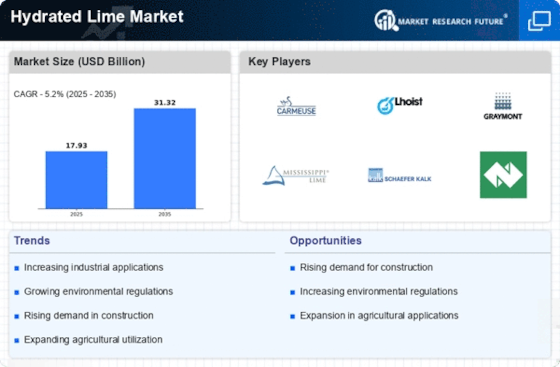
As per MRFR analysis, the Hydrated Lime Market Size was estimated at 17.93 USD Billion in 2024. The Hydrated Lime industry is projected to grow from 18.86 USD Billion in 2025 to 31.32 USD Billion by 2035, exhibiting a compound annual growth rate (CAGR) of 5.2 during the forecast period 2025 - 2035.

Key Market Trends & Highlights

The Hydrated Lime Market is experiencing robust growth driven by sustainability and technological advancements.

  • North America remains the largest market for hydrated lime, driven by extensive construction activities.
  • Asia-Pacific is emerging as the fastest-growing region, fueled by increasing industrialization and urbanization.
  • The food grade segment holds the largest share, while the industrial grade segment is witnessing rapid growth due to diverse applications.
  • Key market drivers include rising demand in agriculture and stringent environmental regulations that promote sustainable practices.

Market Size & Forecast

2024 Market Size 17.93 (USD Billion)
2035 Market Size 31.32 (USD Billion)
CAGR (2025 - 2035) 5.2%
Largest Regional Market Share in 2024 Europe

Major Players

<p>Carmeuse (BE), Lhoist (BE), Graymont (CA), Mississippi Lime Company (US), Schäfer Kalk (DE), Nordkalk (FI), Omya (CH), Sibelco (BE), Calcium Products (US)</p>

Market Trends

The Hydrated Lime Market is currently experiencing a dynamic phase characterized by evolving applications and increasing demand across various industries. This product, known for its versatility, is utilized in sectors such as construction, water treatment, and agriculture. The growing emphasis on environmental sustainability appears to drive innovations in production processes, leading to enhanced efficiency and reduced waste. Furthermore, the rising awareness regarding the importance of water quality management is likely to bolster the market, as hydrated lime plays a crucial role in treating drinking water and wastewater. In addition, the construction industry’s expansion seems to contribute significantly to the Hydrated Lime Market's growth. As urbanization accelerates, the need for building materials that ensure structural integrity and longevity becomes paramount. Hydrated lime, with its properties of improving soil stability and enhancing the durability of concrete, is increasingly favored. Moreover, the potential for new applications in emerging markets suggests a promising outlook for the Hydrated Lime Market, as industries seek to leverage its benefits for various innovative uses.

Sustainability Initiatives

The Hydrated Lime Market is witnessing a shift towards sustainable practices, as industries increasingly prioritize eco-friendly solutions. This trend indicates a growing preference for products that minimize environmental impact, leading to innovations in production methods and applications.

Technological Advancements

Technological progress in the production of hydrated lime is enhancing efficiency and reducing costs. Innovations in processing techniques are likely to improve product quality and expand its applications, thereby driving market growth.

Rising Demand in Water Treatment

The demand for hydrated lime in water treatment processes is on the rise, as municipalities and industries focus on improving water quality. This trend suggests a robust future for the Hydrated Lime Market, as it plays a vital role in ensuring safe drinking water.

Hydrated Lime Market Market Drivers

Rising Demand in Agriculture

The Hydrated Lime Market is witnessing a notable increase in demand from the agricultural sector. Hydrated lime is extensively used to improve soil quality and manage soil pH levels, which is essential for optimal crop growth. In recent years, the agricultural sector has recognized the benefits of hydrated lime in enhancing soil fertility and promoting sustainable farming practices. The market for hydrated lime in agriculture is projected to grow at a rate of around 3.5% annually, driven by the need for effective soil management solutions. As farmers increasingly adopt precision agriculture techniques, the demand for hydrated lime is likely to rise, further solidifying its role in the Hydrated Lime Market.

Growth in the Chemical Industry

The Hydrated Lime Market is significantly impacted by the growth of the chemical industry, where hydrated lime serves as a vital raw material. It is utilized in the production of various chemicals, including calcium carbonate and calcium hydroxide, which are essential in numerous industrial applications. The chemical industry is expected to expand at a compound annual growth rate of approximately 4%, thereby increasing the demand for hydrated lime. This growth is attributed to the rising need for chemical products in sectors such as pharmaceuticals, plastics, and food processing. As the chemical industry continues to evolve, the Hydrated Lime Market is likely to benefit from this upward trend, reinforcing its importance in the supply chain.

Increasing Construction Activities

The Hydrated Lime Market is experiencing a surge in demand due to the increasing construction activities across various sectors. As urbanization accelerates, the need for construction materials rises, with hydrated lime being a crucial component in cement and mortar production. In 2025, the construction sector is projected to grow at a rate of approximately 5.5% annually, driving the demand for hydrated lime. This growth is further fueled by infrastructure development projects, which require high-quality materials for durability and strength. Hydrated lime's properties, such as its ability to enhance workability and improve the longevity of structures, make it a preferred choice among builders. Consequently, the increasing construction activities are likely to bolster the Hydrated Lime Market significantly.

Advancements in Production Technologies

The Hydrated Lime Market is being shaped by advancements in production technologies that enhance the efficiency and quality of hydrated lime production. Innovations such as improved calcination processes and automated production lines are enabling manufacturers to produce higher-quality hydrated lime at lower costs. These technological advancements are expected to drive market growth by increasing production capacity and reducing operational costs. In 2025, the market is anticipated to witness a growth rate of around 3%, as manufacturers adopt these new technologies to meet the rising demand. Consequently, the Hydrated Lime Market is likely to experience a transformation, characterized by enhanced product quality and competitive pricing.

Environmental Regulations and Compliance

The Hydrated Lime Market is influenced by stringent environmental regulations aimed at reducing pollution and promoting sustainable practices. Hydrated lime is widely utilized in various applications, including flue gas treatment and wastewater management, due to its effectiveness in neutralizing acids and removing impurities. As governments implement stricter environmental policies, industries are compelled to adopt hydrated lime solutions to comply with these regulations. For instance, the market for hydrated lime in environmental applications is expected to grow by approximately 4% annually, reflecting the increasing emphasis on eco-friendly practices. This trend not only enhances the demand for hydrated lime but also positions the Hydrated Lime Market as a key player in the transition towards sustainable industrial practices.

Market Segment Insights

By Type: Food Grade (Largest) vs. Industrial Grade (Fastest-Growing)

<p>In the hydrated lime market, the distribution of market share between food grade and industrial grade is significant. The food grade segment, primarily utilized in food processing and water treatment, holds the largest portion of the market. This segment is favored for its purity and compliance with strict regulations, making it a preferred choice among manufacturers. Conversely, the industrial grade hydrated lime is utilized in construction, environmental applications, and chemical processes, reflecting a growing demand as industries expand and innovate.</p>

<p>Hydrated Lime Market: Food Grade (Dominant) vs. Industrial Grade (Emerging)</p>

<p>The food grade hydrated lime is characterized by its high purity and safety for consumption, making it essential in the food industry, particularly in processes involving sugar and drinking water treatment. As consumers demand more sustainable and safe food production practices, the food grade segment remains dominant. On the other hand, the industrial grade hydrated lime caters to a rapidly growing market, spurred by increased infrastructural development and environmental regulations that drive demand in various sectors. This segment is emerging as a key player due to its versatility in applications ranging from soil stabilization to flue gas treatment, indicating a shift in market dynamics.</p>

By Application: Chemical Industry (Largest) vs. Agriculture Industry (Fastest-Growing)

<p>The Hydrated Lime Market exhibits a diverse application landscape, with the Chemical Industry holding a substantial share due to its extensive use in various chemical processes. Additionally, the Food Industry and Construction sectors also contribute significantly, while the Environment sector is gaining traction. The Agriculture Industry, although smaller in share, is rapidly expanding as sustainable practices influence market dynamics, enhancing the demand for hydrated lime within soil treatment and crop protection tasks.</p>

<p>Chemical Industry: Dominant vs. Agriculture Industry: Emerging</p>

<p>The Chemical Industry stands out as the dominant application segment for hydrated lime, characterized by its critical role in producing various chemicals, including calcium hydroxide and hydrated lime as a neutralizing agent. This industry's established presence offers stability and consistent demand. Conversely, the Agriculture Industry emerges as a key growth area, driven by increasing awareness of sustainable agriculture and the importance of soil health. Hydrated lime is used to improve soil acidity, making it increasingly vital for crop production. With an emphasis on organic farming and eco-friendly practices, this segment is poised for rapid growth, attracting investments and innovation.</p>

Get more detailed insights about Hydrated Lime Market Research Report - Global Forecast by 2035

Regional Insights

North America : Market Leader in Hydrated Lime Market

North America is the largest market for hydrated lime, holding approximately 40% of the global share. The growth is driven by increasing demand from the construction, water treatment, and environmental sectors. Regulatory support for sustainable practices and infrastructure development further catalyzes market expansion. The U.S. and Canada are the primary contributors, with significant investments in infrastructure projects and environmental regulations promoting lime usage. The competitive landscape is characterized by key players such as Graymont and Mississippi Lime Company, which dominate the market. These companies leverage advanced technologies and sustainable practices to enhance production efficiency. The presence of established firms ensures a robust supply chain, while ongoing innovations in product applications are expected to drive future growth. The market is also witnessing a trend towards consolidation, with companies seeking to expand their geographical footprint and product offerings.

Europe : Regulatory-Driven Market Growth

Europe is the second-largest market for hydrated lime, accounting for approximately 30% of the global market share. The region's growth is significantly influenced by stringent environmental regulations and a strong focus on sustainability. Countries like Germany and France are leading the charge, with policies promoting the use of hydrated lime in construction and waste management applications. The European Green Deal further emphasizes the importance of sustainable materials, driving demand for lime products. Leading countries in this market include Germany, France, and the UK, where major players like Lhoist and Omya operate. The competitive landscape is marked by a mix of local and international firms, all striving to meet the increasing demand for eco-friendly solutions. Innovations in product formulations and applications are prevalent, with companies investing in research and development to enhance their offerings. This dynamic environment is expected to foster further growth in the coming years.

Asia-Pacific : Emerging Market with Potential

Asia-Pacific is an emerging powerhouse in the hydrated lime market, holding around 25% of the global share. The region's rapid industrialization and urbanization are key growth drivers, particularly in countries like China and India. The increasing demand for hydrated lime in construction, steel manufacturing, and environmental applications is expected to propel market growth. Government initiatives aimed at infrastructure development and pollution control are also significant catalysts for demand. China is the largest market in the region, followed by India and Japan, with several local and international players competing for market share. Companies like Nordkalk and Sibelco are expanding their operations to meet the growing demand. The competitive landscape is characterized by a mix of established firms and new entrants, all focusing on innovation and sustainability. As the region continues to develop, the hydrated lime market is poised for substantial growth, driven by both industrial and environmental needs.

Middle East and Africa : Resource-Rich Market Opportunities

The Middle East and Africa region is witnessing a growing demand for hydrated lime, accounting for approximately 5% of the global market share. The growth is primarily driven by the construction and mining sectors, with countries like South Africa and the UAE leading the way. The region's abundant natural resources and ongoing infrastructure projects are significant catalysts for market expansion. Additionally, regulatory frameworks promoting environmental sustainability are encouraging the use of hydrated lime in various applications. South Africa is the largest market in the region, with a competitive landscape featuring both local and international players. Companies are increasingly focusing on sustainable practices and product innovation to meet the diverse needs of the market. The presence of key players such as Calcium Products and local firms ensures a robust supply chain. As the region continues to develop, the hydrated lime market is expected to grow, driven by both industrial and environmental applications.

Key Players and Competitive Insights

Leading market players are investing heavily in research and development in order to expand their application lines, which will help the hydrated lime market, grow even more. The hydrated lime market is a fast-paced and competitive industry that includes everything from product with trade hydrated limes, with important market developments and the landscape of rivalry greatly relies on the kind and scope of product, and also the region in which they occur.

To expand and survive in a more competitive and rising market climate, hydrated lime industry must offer business meetings, conventions, and various other kinds of incidents constitute a part of the hydrated lime market.

Each of these markets has its own set of characteristics and competitors in the hydrated lime industry to benefit clients and increase the market sector. In recent years, the hydrated lime industry has offered some of the most significant Products. Major players in the hydrated lime market, including Graymont, Lhoist, USLM, Carmeuse, Mississippi Lime, Pete Lien & Sons, Unimin, Nordkalk, Cape Lime (Pty) Ltd, and others, are attempting to increase market demand by investing in research and development operations.

Graymont is a leading supplier of lime and limestone solutions, providing a wide range of high-quality products to various industries. With a rich history dating back to 1948, the company has established itself as a key player in the lime industry, operating numerous production facilities across North America, Europe, and Asia. Graymont's core focus lies in producing and supplying lime-based products that cater to diverse sectors such as construction, agriculture, mining, and environmental applications. The company is known for its commitment to sustainability, implementing environmentally responsible practices throughout its operations.

Leveraging advanced technologies and a dedicated team, Graymont continues to play a pivotal role in supporting industries with essential lime products, contributing to the development of sustainable and efficient solutions worldwide.

Lhoist is a leader in lime, dolime, and minerals, renowned for its comprehensive range of high-quality products and services. Founded in 1889, the company has evolved into a major player in the lime industry with a strong international presence. Lhoist operates in various markets, including steel and metals, environmental protection, construction, and chemicals. With a focus on innovation and sustainability, Lhoist is dedicated to providing solutions that meet the evolving needs of its customers while minimizing environmental impact.

The company's commitment to responsible resource management and its extensive portfolio of lime-based products position Lhoist as a trusted partner for industries seeking reliable and environmentally conscious solutions globally.

Key Companies in the Hydrated Lime Market market include

Industry Developments

In May 2020: Lhoist North America received a permit from the Texas Commission on Environmental Quality to construct a novel energy-efficient lime kiln at its facility in New Braunfels, Texas. The regulatory approval shall support the company's capacity expansion and help serve the customers in North America at a lower turnaround time.

Future Outlook

Hydrated Lime Market Future Outlook

<p>The Hydrated Lime Market is projected to grow at a 5.2% CAGR from 2024 to 2035, driven by increasing demand in construction, water treatment, and environmental applications.</p>

New opportunities lie in:

  • <p>Expansion into emerging markets with tailored product offerings.</p>
  • <p>Development of eco-friendly hydrated lime products for sustainable construction.</p>
  • <p>Investment in advanced production technologies to enhance efficiency and reduce costs.</p>

<p>By 2035, the Hydrated Lime Market is expected to solidify its position as a key player in various industrial applications.</p>

Market Segmentation

Hydrated Lime Market Type Outlook

  • Food Grade
  • Industrial Grade

Hydrated Lime Market Application Outlook

  • Chemical Industry
  • Food Industry
  • Agriculture Industry
  • Construction
  • Environment
  • Other

Report Scope

MARKET SIZE 202417.93(USD Billion)
MARKET SIZE 202518.86(USD Billion)
MARKET SIZE 203531.32(USD Billion)
COMPOUND ANNUAL GROWTH RATE (CAGR)5.2% (2024 - 2035)
REPORT COVERAGERevenue Forecast, Competitive Landscape, Growth Factors, and Trends
BASE YEAR2024
Market Forecast Period2025 - 2035
Historical Data2019 - 2024
Market Forecast UnitsUSD Billion
Key Companies ProfiledMarket analysis in progress
Segments CoveredMarket segmentation analysis in progress
Key Market OpportunitiesGrowing demand for sustainable construction materials drives innovation in the Hydrated Lime Market.
Key Market DynamicsRising demand for hydrated lime in construction and environmental applications drives market growth and competitive dynamics.
Countries CoveredNorth America, Europe, APAC, South America, MEA

FAQs

What is the projected market valuation of the Hydrated Lime Market by 2035?

The Hydrated Lime Market is projected to reach a valuation of 31.32 USD Billion by 2035.

What was the market valuation of the Hydrated Lime Market in 2024?

In 2024, the Hydrated Lime Market was valued at 17.93 USD Billion.

What is the expected CAGR for the Hydrated Lime Market during the forecast period 2025 - 2035?

The expected CAGR for the Hydrated Lime Market during the forecast period 2025 - 2035 is 5.2%.

Which segments are included in the Hydrated Lime Market?

The Hydrated Lime Market includes segments such as Food Grade and Industrial Grade.

What are the projected valuations for the Food Grade and Industrial Grade segments by 2035?

By 2035, the Food Grade segment is projected to reach 9.12 USD Billion, while the Industrial Grade segment may reach 22.2 USD Billion.

What applications are driving the Hydrated Lime Market?

Key applications driving the Hydrated Lime Market include the Chemical Industry, Food Industry, Agriculture Industry, Construction, and Environment.

  1. SECTION I: EXECUTIVE SUMMARY AND KEY HIGHLIGHTS
    1. EXECUTIVE SUMMARY
      1. Market Overview
      2. Key Findings
      3. Market Segmentation
      4. Competitive Landscape
      5. Challenges and Opportunities
      6. Future Outlook
  2. SECTION II: SCOPING, METHODOLOGY AND MARKET STRUCTURE
    1. MARKET INTRODUCTION
      1. Definition
      2. Scope of the study
    2. RESEARCH METHODOLOGY
      1. Overview
      2. Data Mining
      3. Secondary Research
      4. Primary Research
      5. Forecasting Model
      6. Market Size Estimation
      7. Data Triangulation
      8. Validation
  3. SECTION III: QUALITATIVE ANALYSIS
    1. MARKET DYNAMICS
      1. Overview
      2. Drivers
      3. Restraints
      4. Opportunities
    2. MARKET FACTOR ANALYSIS
      1. Value chain Analysis
      2. Porter's Five Forces Analysis
      3. COVID-19 Impact Analysis
  4. SECTION IV: QUANTITATIVE ANALYSIS
    1. Chemicals and Materials, BY Type (USD Billion)
      1. Food Grade
      2. Industrial Grade
    2. Chemicals and Materials, BY Application (USD Billion)
      1. Chemical Industry
      2. Food Industry
      3. Agriculture Industry
      4. Construction
      5. Environment
      6. Other
    3. Chemicals and Materials, BY Region (USD Billion)
      1. North America
      2. Europe
      3. APAC
      4. South America
      5. MEA
  5. SECTION V: COMPETITIVE ANALYSIS
    1. Competitive Landscape
      1. Overview
      2. Competitive Analysis
      3. Market share Analysis
      4. Major Growth Strategy in the Chemicals and Materials
      5. Competitive Benchmarking
      6. Leading Players in Terms of Number of Developments in the Chemicals and Materials
      7. Key developments and growth strategies
      8. Major Players Financial Matrix
    2. Company Profiles
      1. Carmeuse (BE)
      2. Lhoist (BE)
      3. Graymont (CA)
      4. Mississippi Lime Company (US)
      5. Schäfer Kalk (DE)
      6. Nordkalk (FI)
      7. Omya (CH)
      8. Sibelco (BE)
      9. Calcium Products (US)
    3. Appendix
      1. References
      2. Related Reports
  6. LIST OF FIGURES
    1. MARKET SYNOPSIS
    2. NORTH AMERICA MARKET ANALYSIS
    3. US MARKET ANALYSIS BY TYPE
    4. US MARKET ANALYSIS BY APPLICATION
    5. CANADA MARKET ANALYSIS BY TYPE
    6. CANADA MARKET ANALYSIS BY APPLICATION
    7. EUROPE MARKET ANALYSIS
    8. GERMANY MARKET ANALYSIS BY TYPE
    9. GERMANY MARKET ANALYSIS BY APPLICATION
    10. UK MARKET ANALYSIS BY TYPE
    11. UK MARKET ANALYSIS BY APPLICATION
    12. FRANCE MARKET ANALYSIS BY TYPE
    13. FRANCE MARKET ANALYSIS BY APPLICATION
    14. RUSSIA MARKET ANALYSIS BY TYPE
    15. RUSSIA MARKET ANALYSIS BY APPLICATION
    16. ITALY MARKET ANALYSIS BY TYPE
    17. ITALY MARKET ANALYSIS BY APPLICATION
    18. SPAIN MARKET ANALYSIS BY TYPE
    19. SPAIN MARKET ANALYSIS BY APPLICATION
    20. REST OF EUROPE MARKET ANALYSIS BY TYPE
    21. REST OF EUROPE MARKET ANALYSIS BY APPLICATION
    22. APAC MARKET ANALYSIS
    23. CHINA MARKET ANALYSIS BY TYPE
    24. CHINA MARKET ANALYSIS BY APPLICATION
    25. INDIA MARKET ANALYSIS BY TYPE
    26. INDIA MARKET ANALYSIS BY APPLICATION
    27. JAPAN MARKET ANALYSIS BY TYPE
    28. JAPAN MARKET ANALYSIS BY APPLICATION
    29. SOUTH KOREA MARKET ANALYSIS BY TYPE
    30. SOUTH KOREA MARKET ANALYSIS BY APPLICATION
    31. MALAYSIA MARKET ANALYSIS BY TYPE
    32. MALAYSIA MARKET ANALYSIS BY APPLICATION
    33. THAILAND MARKET ANALYSIS BY TYPE
    34. THAILAND MARKET ANALYSIS BY APPLICATION
    35. INDONESIA MARKET ANALYSIS BY TYPE
    36. INDONESIA MARKET ANALYSIS BY APPLICATION
    37. REST OF APAC MARKET ANALYSIS BY TYPE
    38. REST OF APAC MARKET ANALYSIS BY APPLICATION
    39. SOUTH AMERICA MARKET ANALYSIS
    40. BRAZIL MARKET ANALYSIS BY TYPE
    41. BRAZIL MARKET ANALYSIS BY APPLICATION
    42. MEXICO MARKET ANALYSIS BY TYPE
    43. MEXICO MARKET ANALYSIS BY APPLICATION
    44. ARGENTINA MARKET ANALYSIS BY TYPE
    45. ARGENTINA MARKET ANALYSIS BY APPLICATION
    46. REST OF SOUTH AMERICA MARKET ANALYSIS BY TYPE
    47. REST OF SOUTH AMERICA MARKET ANALYSIS BY APPLICATION
    48. MEA MARKET ANALYSIS
    49. GCC COUNTRIES MARKET ANALYSIS BY TYPE
    50. GCC COUNTRIES MARKET ANALYSIS BY APPLICATION
    51. SOUTH AFRICA MARKET ANALYSIS BY TYPE
    52. SOUTH AFRICA MARKET ANALYSIS BY APPLICATION
    53. REST OF MEA MARKET ANALYSIS BY TYPE
    54. REST OF MEA MARKET ANALYSIS BY APPLICATION
    55. KEY BUYING CRITERIA OF CHEMICALS AND MATERIALS
    56. RESEARCH PROCESS OF MRFR
    57. DRO ANALYSIS OF CHEMICALS AND MATERIALS
    58. DRIVERS IMPACT ANALYSIS: CHEMICALS AND MATERIALS
    59. RESTRAINTS IMPACT ANALYSIS: CHEMICALS AND MATERIALS
    60. SUPPLY / VALUE CHAIN: CHEMICALS AND MATERIALS
    61. CHEMICALS AND MATERIALS, BY TYPE, 2024 (% SHARE)
    62. CHEMICALS AND MATERIALS, BY TYPE, 2024 TO 2035 (USD Billion)
    63. CHEMICALS AND MATERIALS, BY APPLICATION, 2024 (% SHARE)
    64. CHEMICALS AND MATERIALS, BY APPLICATION, 2024 TO 2035 (USD Billion)
    65. BENCHMARKING OF MAJOR COMPETITORS
  7. LIST OF TABLES
    1. LIST OF ASSUMPTIONS
    2. North America MARKET SIZE ESTIMATES; FORECAST
      1. BY TYPE, 2025-2035 (USD Billion)
      2. BY APPLICATION, 2025-2035 (USD Billion)
    3. US MARKET SIZE ESTIMATES; FORECAST
      1. BY TYPE, 2025-2035 (USD Billion)
      2. BY APPLICATION, 2025-2035 (USD Billion)
    4. Canada MARKET SIZE ESTIMATES; FORECAST
      1. BY TYPE, 2025-2035 (USD Billion)
      2. BY APPLICATION, 2025-2035 (USD Billion)
    5. Europe MARKET SIZE ESTIMATES; FORECAST
      1. BY TYPE, 2025-2035 (USD Billion)
      2. BY APPLICATION, 2025-2035 (USD Billion)
    6. Germany MARKET SIZE ESTIMATES; FORECAST
      1. BY TYPE, 2025-2035 (USD Billion)
      2. BY APPLICATION, 2025-2035 (USD Billion)
    7. UK MARKET SIZE ESTIMATES; FORECAST
      1. BY TYPE, 2025-2035 (USD Billion)
      2. BY APPLICATION, 2025-2035 (USD Billion)
    8. France MARKET SIZE ESTIMATES; FORECAST
      1. BY TYPE, 2025-2035 (USD Billion)
      2. BY APPLICATION, 2025-2035 (USD Billion)
    9. Russia MARKET SIZE ESTIMATES; FORECAST
      1. BY TYPE, 2025-2035 (USD Billion)
      2. BY APPLICATION, 2025-2035 (USD Billion)
    10. Italy MARKET SIZE ESTIMATES; FORECAST
      1. BY TYPE, 2025-2035 (USD Billion)
      2. BY APPLICATION, 2025-2035 (USD Billion)
    11. Spain MARKET SIZE ESTIMATES; FORECAST
      1. BY TYPE, 2025-2035 (USD Billion)
      2. BY APPLICATION, 2025-2035 (USD Billion)
    12. Rest of Europe MARKET SIZE ESTIMATES; FORECAST
      1. BY TYPE, 2025-2035 (USD Billion)
      2. BY APPLICATION, 2025-2035 (USD Billion)
    13. APAC MARKET SIZE ESTIMATES; FORECAST
      1. BY TYPE, 2025-2035 (USD Billion)
      2. BY APPLICATION, 2025-2035 (USD Billion)
    14. China MARKET SIZE ESTIMATES; FORECAST
      1. BY TYPE, 2025-2035 (USD Billion)
      2. BY APPLICATION, 2025-2035 (USD Billion)
    15. India MARKET SIZE ESTIMATES; FORECAST
      1. BY TYPE, 2025-2035 (USD Billion)
      2. BY APPLICATION, 2025-2035 (USD Billion)
    16. Japan MARKET SIZE ESTIMATES; FORECAST
      1. BY TYPE, 2025-2035 (USD Billion)
      2. BY APPLICATION, 2025-2035 (USD Billion)
    17. South Korea MARKET SIZE ESTIMATES; FORECAST
      1. BY TYPE, 2025-2035 (USD Billion)
      2. BY APPLICATION, 2025-2035 (USD Billion)
    18. Malaysia MARKET SIZE ESTIMATES; FORECAST
      1. BY TYPE, 2025-2035 (USD Billion)
      2. BY APPLICATION, 2025-2035 (USD Billion)
    19. Thailand MARKET SIZE ESTIMATES; FORECAST
      1. BY TYPE, 2025-2035 (USD Billion)
      2. BY APPLICATION, 2025-2035 (USD Billion)
    20. Indonesia MARKET SIZE ESTIMATES; FORECAST
      1. BY TYPE, 2025-2035 (USD Billion)
      2. BY APPLICATION, 2025-2035 (USD Billion)
    21. Rest of APAC MARKET SIZE ESTIMATES; FORECAST
      1. BY TYPE, 2025-2035 (USD Billion)
      2. BY APPLICATION, 2025-2035 (USD Billion)
    22. South America MARKET SIZE ESTIMATES; FORECAST
      1. BY TYPE, 2025-2035 (USD Billion)
      2. BY APPLICATION, 2025-2035 (USD Billion)
    23. Brazil MARKET SIZE ESTIMATES; FORECAST
      1. BY TYPE, 2025-2035 (USD Billion)
      2. BY APPLICATION, 2025-2035 (USD Billion)
    24. Mexico MARKET SIZE ESTIMATES; FORECAST
      1. BY TYPE, 2025-2035 (USD Billion)
      2. BY APPLICATION, 2025-2035 (USD Billion)
    25. Argentina MARKET SIZE ESTIMATES; FORECAST
      1. BY TYPE, 2025-2035 (USD Billion)
      2. BY APPLICATION, 2025-2035 (USD Billion)
    26. Rest of South America MARKET SIZE ESTIMATES; FORECAST
      1. BY TYPE, 2025-2035 (USD Billion)
      2. BY APPLICATION, 2025-2035 (USD Billion)
    27. MEA MARKET SIZE ESTIMATES; FORECAST
      1. BY TYPE, 2025-2035 (USD Billion)
      2. BY APPLICATION, 2025-2035 (USD Billion)
    28. GCC Countries MARKET SIZE ESTIMATES; FORECAST
      1. BY TYPE, 2025-2035 (USD Billion)
      2. BY APPLICATION, 2025-2035 (USD Billion)
    29. South Africa MARKET SIZE ESTIMATES; FORECAST
      1. BY TYPE, 2025-2035 (USD Billion)
      2. BY APPLICATION, 2025-2035 (USD Billion)
    30. Rest of MEA MARKET SIZE ESTIMATES; FORECAST
      1. BY TYPE, 2025-2035 (USD Billion)
      2. BY APPLICATION, 2025-2035 (USD Billion)
    31. PRODUCT LAUNCH/PRODUCT DEVELOPMENT/APPROVAL
    32. ACQUISITION/PARTNERSHIP

Market Segmentation

Hydrated lime Type Outlook (USD Billion, 2018-2032)

  • Food Grade
  • Industrial Grade

Hydrated lime Application Outlook (USD Billion, 2018-2032)

  • Chemical Industry
  • Food Industry
  • Agriculture Industry
  • Construction
  • Environment
  • Others

Hydrated lime Regional Outlook (USD Billion, 2018-2032)

  • North America Outlook (USD Billion, 2018-2032)

    • North America Hydrated lime by Type
      • Food Grade
      • Industrial Grade
    • North America Hydrated lime by Application
      • Chemical Industry
      • Food Industry
      • Agriculture Industry
      • Construction
      • Environment
      • Others
    • US Outlook (USD Billion, 2018-2032)

    • US Hydrated lime by Type
      • Food Grade
      • Industrial Grade
    • US Hydrated lime by Application
      • Chemical Industry
      • Food Industry
      • Agriculture Industry
      • Construction
      • Environment
      • Others
    • CANADA Outlook (USD Billion, 2018-2032)

    • Canada Hydrated lime by Type
      • Food Grade
      • Industrial Grade
    • Canada Hydrated lime by Application
      • Chemical Industry
      • Food Industry
      • Agriculture Industry
      • Construction
      • Environment
      • Others
  • Europe Outlook (USD Billion, 2018-2032)

    • Europe Hydrated lime by Type
      • Food Grade
      • Industrial Grade
    • Europe Hydrated lime by Application
      • Chemical Industry
      • Food Industry
      • Agriculture Industry
      • Construction
      • Environment
      • Others
    • Germany Outlook (USD Billion, 2018-2032)

    • Germany Hydrated lime by Type
      • Food Grade
      • Industrial Grade
    • Germany Hydrated lime by Application
      • Chemical Industry
      • Food Industry
      • Agriculture Industry
      • Construction
      • Environment
      • Others
    • France Outlook (USD Billion, 2018-2032)

    • France Hydrated lime by Type
      • Food Grade
      • Industrial Grade
    • France Hydrated lime by Application
      • Chemical Industry
      • Food Industry
      • Agriculture Industry
      • Construction
      • Environment
      • Others
    • UK Outlook (USD Billion, 2018-2032)

    • UK Hydrated lime by Type
      • Food Grade
      • Industrial Grade
    • UK Hydrated lime by Application
      • Chemical Industry
      • Food Industry
      • Agriculture Industry
      • Construction
      • Environment
      • Others
    • ITALY Outlook (USD Billion, 2018-2032)

    • Italy Hydrated lime by Type
      • Food Grade
      • Industrial Grade
    • Italy Hydrated lime by Application
      • Chemical Industry
      • Food Industry
      • Agriculture Industry
      • Construction
      • Environment
      • Others
    • SPAIN Outlook (USD Billion, 2018-2032)

    • Spain Hydrated lime by Type
      • Food Grade
      • Industrial Grade
    • Spain Hydrated lime by Application
      • Chemical Industry
      • Food Industry
      • Agriculture Industry
      • Construction
      • Environment
      • Others
    • Rest Of Europe Outlook (USD Billion, 2018-2032)

    • Rest of Europe Hydrated lime by Type
      • Food Grade
      • Industrial Grade
    • Rest of Europe Hydrated lime by Application
      • Chemical Industry
      • Food Industry
      • Agriculture Industry
      • Construction
      • Environment
      • Others
  • Asia-Pacific Outlook (USD Billion, 2018-2032)

    • Asia Pacific Hydrated lime by Type
      • Food Grade
      • Industrial Grade
    • Asia Pacific Hydrated lime by Application
      • Chemical Industry
      • Food Industry
      • Agriculture Industry
      • Construction
      • Environment
      • Others
    • China Outlook (USD Billion, 2018-2032)

    • China Hydrated lime by Type
      • Food Grade
      • Industrial Grade
    • China Hydrated lime by Application
      • Chemical Industry
      • Food Industry
      • Agriculture Industry
      • Construction
      • Environment
      • Others
    • Japan Outlook (USD Billion, 2018-2032)

    • Japan Hydrated lime by Type
      • Food Grade
      • Industrial Grade
    • Japan Hydrated lime by Application
      • Chemical Industry
      • Food Industry
      • Agriculture Industry
      • Construction
      • Environment
      • Others
    • India Outlook (USD Billion, 2018-2032)

    • India Hydrated lime by Type
      • Food Grade
      • Industrial Grade
    • India Hydrated lime by Application
      • Chemical Industry
      • Food Industry
      • Agriculture Industry
      • Construction
      • Environment
      • Others
    • Australia Outlook (USD Billion, 2018-2032)

    • Australia Hydrated lime by Type
      • Food Grade
      • Industrial Grade
    • Australia Hydrated lime by Application
      • Chemical Industry
      • Food Industry
      • Agriculture Industry
      • Construction
      • Environment
      • Others
    • Rest of Asia-Pacific Outlook (USD Billion, 2018-2032)

    • Rest of Asia Pacific Hydrated lime by Type
      • Food Grade
      • Industrial Grade
    • Rest of Asia Pacific Hydrated lime by Application
      • Chemical Industry
      • Food Industry
      • Agriculture Industry
      • Construction
      • Environment
      • Others
  • Rest of the World Outlook (USD Billion, 2018-2032)

    • Rest of World Hydrated lime by Type
      • Food Grade
      • Industrial Grade
    • Rest of World Hydrated lime by Application
      • Chemical Industry
      • Food Industry
      • Agriculture Industry
      • Construction
      • Environment
      • Others
  • Middle East Outlook (USD Billion, 2018-2032)

    • Middle East Hydrated lime by Type
      • Food Grade
      • Industrial Grade
    • Middle East Hydrated lime by Application
      • Chemical Industry
      • Food Industry
      • Agriculture Industry
      • Construction
      • Environment
      • Others
  • Africa Outlook (USD Billion, 2018-2032)

    • Africa Hydrated lime by Type
      • Food Grade
      • Industrial Grade
    • Africa Hydrated lime by Application
      • Chemical Industry
      • Food Industry
      • Agriculture Industry
      • Construction
      • Environment
      • Others
  • Latin America Outlook (USD Billion, 2018-2032)

    • Latin America Hydrated lime by Type
      • Food Grade
      • Industrial Grade
    • Latin America Hydrated lime by Application
      • Chemical Industry
      • Food Industry
      • Agriculture Industry
      • Construction
      • Environment
      • Others
Infographic

Free Sample Request

Kindly complete the form below to receive a free sample of this Report

Get Free Sample

Customer Strories

Compare Licence

×
Features License Type
Single User Multiuser License Enterprise User
Price $4,950 $5,950 $7,250
Maximum User Access Limit 1 User Upto 10 Users Unrestricted Access Throughout the Organization
Free Customization
Direct Access to Analyst
Deliverable Format
Platform Access
Discount on Next Purchase 10% 15% 15%
Printable Versions