×
Hero Background
English
Chinese
French
Japanese
Korean
German
Spanish

Hybrid EV Battery Market Trends

ID: MRFR/AT/6816-CR
155 Pages
Chitranshi Jaiswal
April 2020

Hybrid EV Battery Market Research Report Information By Type (Lead-Acid, Lithium-Ion, Nickel-Based, and Others), By Application (Hybrid EV and Plug-In Hybrid EV), And By Region (North America, Europe, Asia-Pacific, And Rest Of The World) – Market Forecast Till 2035

Share:
Download PDF ×

We do not share your information with anyone. However, we may send you emails based on your report interest from time to time. You may contact us at any time to opt-out.

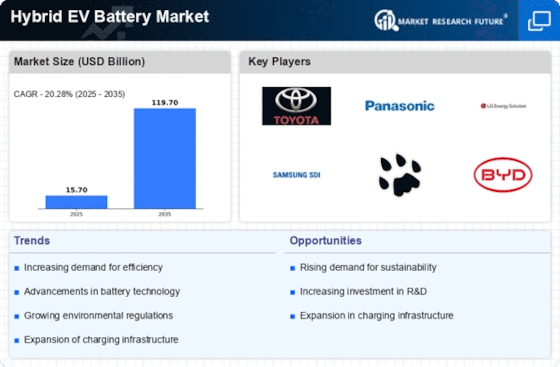
Hybrid EV Battery Market Infographic
Purchase Options

Market Trends

Key Emerging Trends in the Hybrid EV Battery Market

The hybrid electric vehicle (HEV) battery market is currently experiencing noteworthy trends that signify the ongoing evolution of the automotive industry towards greener and more sustainable transportation solutions. One key trend is the increasing demand for high-capacity and long-range batteries in hybrid electric vehicles. As the automotive sector embraces electrification, there is a growing emphasis on enhancing the efficiency and driving range of hybrid vehicles. This trend is driving advancements in battery technology, with manufacturers focusing on developing batteries with higher energy density and improved performance to meet the evolving expectations of consumers. Secondly, solid state batteries for hybrid electric vehicles have also positively emerged as one of the most rapidly developing and adopted market trends. Solid-state batteries have benefits, which consist of enhanced energy thicknesses, quicker charging times and better safety when compared to essential li’ ion batteries. The quest for solid-state battery technology is motivated by the longing and concerted effort of the industry to leap beyond the current limitations of modern batteries and million miles in order to achieve more advanced energy storage materials that can serve as hybrids. This pattern also coincides with the overall objective of promoting competitive hybrids by ensuring they are proficient and enduring. The major trend molding the market is cost decrease of hybrid electric motive force batteries. The high cost of batteries has been one main aspect that has restricted hybrid cars from becoming popular on overarching scale. But technology as a part of ongoing research continue to provide scale economies in addition with increasing efficiency in manufacturing process that translates to a reduction in the costs of batteries day after day. This pattern is making the hybrid electric vehicle more competitive in terms of economic perspectives and also attracting the different consumer markets on a wider spectrum, hence considerably improving their popularity. With the automotive sectors determines from sustainability, increasing interest in batteries with vitamin E components and means of fabrics has been observed. This trend aligns with the broader commitment to achieving a more sustainable and circular economy, where end-of-life considerations for batteries are an integral part of the design and production cycle. The market for hybrid electric vehicle batteries is also influenced by the regulatory landscape, with governments implementing policies to incentivize the adoption of low-emission vehicles. Incentives such as tax credits, rebates, and preferential treatment for hybrid vehicles contribute to the market's growth. This trend underscores the importance of regulatory support in shaping the trajectory of the hybrid electric vehicle market and driving consumer adoption.

Author
Chitranshi Jaiswal
Research Analyst Level I

In her 3 years of experience in the market research field, she has handled critical cross-domain projects. She has an in-depth knowledge of market estimation & analysis, problem-solving, primary as well as secondary research, and team management.She holds an engineering degree and is an MBA professional from a well-known university, capable of evaluating the market and competitive conditions. An exceptional strategist with excellent communication skills and a passion for delivering cutting-edge & practical insights for the market. Proficient in multi-tasking, and can successfully deal with competing demands, while maintaining complete confidentiality. Generated business through active client and project development, networking, and high-quality responses. Her knowledge and skills have helped in making solid business decisions, securing funding from investors, and avoiding business failures.

Leave a Comment

FAQs

What is the current valuation of the Hybrid EV Battery Market as of 2024?

The Hybrid EV Battery Market was valued at 15.7 USD Billion in 2024.

What is the projected market valuation for the Hybrid EV Battery Market in 2035?

The market is projected to reach a valuation of 119.7 USD Billion by 2035.

What is the expected CAGR for the Hybrid EV Battery Market during the forecast period 2025 - 2035?

The expected CAGR for the Hybrid EV Battery Market during 2025 - 2035 is 20.28%.

Which companies are considered key players in the Hybrid EV Battery Market?

Key players include Toyota Motor Corporation, Panasonic Corporation, LG Energy Solution, and CATL, among others.

What are the main types of batteries used in the Hybrid EV Battery Market?

The main types include Lead-Acid, Lithium-Ion, Nickel-Based, and others, with Lithium-Ion expected to dominate.

How much was the market value for Lithium-Ion batteries in 2024?

The market value for Lithium-Ion batteries was 8.0 USD Billion in 2024.

Market Summary

As per MRFR analysis, the Hybrid EV Battery Market Size was estimated at 15.7 USD Billion in 2024. The Hybrid EV Battery industry is projected to grow from 18.88 USD Billion in 2025 to 119.7 USD Billion by 2035, exhibiting a compound annual growth rate (CAGR) of 20.28 during the forecast period 2025 - 2035.

Key Market Trends & Highlights

The Hybrid EV Battery Market is poised for substantial growth driven by technological advancements and increasing consumer demand for sustainable solutions.

  • Technological advancements in battery chemistry are enhancing the performance and efficiency of hybrid EV batteries.
  • North America remains the largest market for hybrid EV batteries, while Asia-Pacific is emerging as the fastest-growing region.
  • The lithium-ion segment dominates the market, whereas the lead-acid segment is experiencing rapid growth.
  • Rising environmental concerns and government policies are significant drivers propelling the hybrid EV battery market forward.

Market Size & Forecast

2024 Market Size 15.7 (USD Billion)
2035 Market Size 119.7 (USD Billion)
CAGR (2025 - 2035) 20.28%
Largest Regional Market Share in 2024 North America

Major Players

<p>Toyota Motor Corporation (JP), Panasonic Corporation (JP), LG Energy Solution (KR), Samsung SDI Co., Ltd. (KR), CATL (CN), BYD Company Limited (CN), A123 Systems LLC (US), Hitachi Chemical Co., Ltd. (JP), SK Innovation Co., Ltd. (KR)</p>

Market Trends

The Hybrid EV Battery Market is currently experiencing a transformative phase, driven by advancements in technology and increasing consumer demand for sustainable transportation solutions. As automakers pivot towards electrification, the emphasis on efficient, high-performance batteries has intensified. This shift is not merely a trend but appears to be a fundamental change in how vehicles are powered. The integration of hybrid systems allows for reduced emissions and improved fuel economy, which resonates with environmentally conscious consumers. Furthermore, government policies promoting electric vehicles are likely to bolster market growth, creating a favorable environment for innovation and investment. In addition to technological advancements, the Hybrid EV Battery Market is witnessing a diversification of battery chemistries. Manufacturers are exploring various materials to enhance energy density and longevity, which may lead to more efficient and cost-effective solutions. The competitive landscape is evolving, with both established players and new entrants vying for market share. This dynamic environment suggests that collaboration and strategic partnerships could play a crucial role in shaping the future of hybrid battery technologies. As the market continues to mature, it is essential to monitor these developments closely, as they may significantly influence consumer choices and industry standards.

Technological Advancements in Battery Chemistry

The Hybrid EV Battery Market is seeing rapid innovations in battery chemistry, which may enhance energy density and reduce charging times. Manufacturers are increasingly focusing on developing new materials that could lead to lighter and more efficient batteries, potentially improving overall vehicle performance.

Government Incentives and Regulations

Government policies aimed at reducing carbon emissions are likely to drive the Hybrid EV Battery Market forward. Incentives for electric vehicle adoption and stricter emissions regulations may encourage consumers to consider hybrid options, thereby expanding the market.

Consumer Demand for Sustainable Solutions

There is a growing consumer preference for environmentally friendly transportation options. This trend suggests that the Hybrid EV Battery Market could benefit from increased awareness and demand for sustainable products, influencing manufacturers to prioritize eco-friendly practices.

Hybrid EV Battery Market Market Drivers

Increasing Fuel Prices

The volatility of fuel prices is another factor that appears to be propelling the Hybrid EV Battery Market. As fuel costs rise, consumers are increasingly seeking alternatives that offer better fuel efficiency and lower operating costs. Hybrid vehicles, which combine an internal combustion engine with an electric motor, provide a compelling solution by reducing fuel consumption. This trend is likely to encourage more consumers to consider hybrid options, particularly in regions where fuel prices are consistently high. Consequently, the demand for hybrid batteries is expected to increase, further driving the Hybrid EV Battery Market.

Rising Environmental Concerns

The increasing awareness of environmental issues appears to drive the Hybrid EV Battery Market. Consumers and governments alike are becoming more conscious of the impact of traditional vehicles on air quality and climate change. This shift in perception is likely to lead to a surge in demand for hybrid electric vehicles, which utilize advanced battery technologies to reduce emissions. According to recent data, the market for hybrid vehicles is projected to grow at a compound annual growth rate of approximately 15% over the next five years. This growth is expected to be fueled by the desire for cleaner transportation options, thereby enhancing the Hybrid EV Battery Market.

Advancements in Battery Technology

Technological innovations in battery chemistry and design are significantly influencing the Hybrid EV Battery Market. Recent developments in lithium-ion and solid-state batteries have improved energy density, charging speed, and overall efficiency. These advancements not only enhance vehicle performance but also reduce costs, making hybrid vehicles more accessible to a broader audience. As manufacturers continue to invest in research and development, the market is likely to witness a shift towards more efficient and longer-lasting battery solutions. This trend suggests that the Hybrid EV Battery Market will continue to evolve, driven by the need for better performance and sustainability.

Government Policies and Incentives

Government regulations and incentives play a crucial role in shaping the Hybrid EV Battery Market. Many countries have implemented policies aimed at reducing carbon emissions, which often include tax breaks, rebates, and subsidies for hybrid vehicle purchases. These initiatives encourage consumers to opt for hybrid solutions over traditional combustion engines. For instance, in several regions, incentives can reduce the overall cost of hybrid vehicles by up to 20%. Such financial support is likely to stimulate market growth, as consumers are more inclined to invest in environmentally friendly technologies, thereby bolstering the Hybrid EV Battery Market.

Growing Urbanization and Infrastructure Development

Urbanization trends and the development of infrastructure are likely to impact the Hybrid EV Battery Market positively. As cities expand, the demand for efficient and sustainable transportation solutions becomes more pressing. Urban areas often face challenges such as traffic congestion and pollution, prompting local governments to promote hybrid vehicles as a viable alternative. Additionally, the expansion of charging infrastructure is expected to facilitate the adoption of hybrid technologies. This growing urban focus on sustainability suggests that the Hybrid EV Battery Market will continue to thrive as cities seek to implement cleaner transportation solutions.

Market Segment Insights

By Type: Lithium-Ion (Largest) vs. Lead-Acid (Fastest-Growing)

<p>In the Hybrid EV Battery Market, the segmentation by type reveals a significant preference for Lithium-Ion batteries, which dominate the market due to their superior energy density and performance. On the other hand, Lead-Acid batteries, while traditionally utilized, are experiencing a resurgence as they offer cost-effectiveness and recycling benefits. The diversification within the segment, including Nickel-Based and other variations, indicates a competitive landscape that caters to various consumer needs, leading to a dynamic distribution of market share.</p>

<p>Battery Type: Lithium-Ion (Dominant) vs. Lead-Acid (Emerging)</p>

<p>Lithium-Ion batteries are the dominant force in the Hybrid EV Battery Market, primarily due to their lightweight design, longer lifespan, and higher energy capacity, making them ideal for performance-oriented hybrid vehicles. Meanwhile, Lead-Acid batteries, often labeled as emerging, are gaining traction, particularly in cost-sensitive markets. Their ability to be recycled and lower initial costs attract budget-conscious consumers. Nickel-Based batteries hold a niche position, offering robust performance in specific applications, but face stiff competition from the more advanced Lithium-Ion technology. Overall, the market dynamics are shaped by technological innovations and shifting consumer preferences, with an increasing push towards sustainability.</p>

By Application: Hybrid EV (Largest) vs. Plug-In Hybrid EV (Fastest-Growing)

<p>In the Hybrid EV Battery Market, the Hybrid Electric Vehicles (HEVs) segment holds a significant share, being the dominant application. This can be attributed to their widespread acceptance and established infrastructure, making them the preferred choice for consumers looking for eco-friendly alternatives. In contrast, Plug-In Hybrid Electric Vehicles (PHEVs) are rapidly gaining traction, as they offer the flexibility of both electric and conventional powertrains, catering to a broader audience and appealing to environmentally-conscious consumers.</p>

<p>Application: Hybrid EV (Dominant) vs. Plug-In Hybrid EV (Emerging)</p>

<p>The Hybrid Electric Vehicle (HEV) segment remains dominant in the Hybrid EV Battery Market due to its extensive use in urban commuting and longer-range capabilities compared to purely electric vehicles. These vehicles utilize a combination of internal combustion engines and electric propulsion, which enhances fuel efficiency and reduces emissions, making them favorable for consumers. On the other hand, Plug-In Hybrid Electric Vehicles (PHEVs) are emerging as a crucial segment due to their ability to operate on electric power for shorter trips while also relying on gasoline engines for longer journeys. This dual functionality allows PHEVs to target a wider consumer base, particularly for users who may be hesitant to fully transition to electric vehicles, thereby driving the growth of this segment.</p>

Get more detailed insights about Hybrid EV Battery Market Research Report - Global Forecast till 2035

Regional Insights

North America : Leading Innovation and Adoption

North America is poised to lead the hybrid EV battery market, driven by stringent emissions regulations and a growing consumer preference for eco-friendly vehicles. The U.S. holds approximately 60% of the market share, followed by Canada at 25%. Government incentives and investments in charging infrastructure are further propelling growth, making this region a key player in the global transition to hybrid technology. The competitive landscape is characterized by major players such as Toyota Motor Corporation and A123 Systems LLC, alongside significant contributions from Panasonic and LG Energy Solution. The presence of established automotive manufacturers and battery producers fosters innovation and collaboration, ensuring a robust supply chain. As the market evolves, partnerships between automakers and tech companies are expected to enhance battery efficiency and performance.

Europe : Sustainable Mobility Initiatives

Europe is rapidly advancing in the hybrid EV battery market, driven by ambitious sustainability goals and regulatory frameworks aimed at reducing carbon emissions. The European Union's Green Deal aims for a 55% reduction in emissions by 2030, significantly boosting demand for hybrid vehicles. Germany and France are the largest markets, holding approximately 35% and 20% of the market share, respectively, as they invest heavily in EV infrastructure and incentives. Leading countries in Europe are spearheading innovation, with companies like CATL and BYD Company Limited establishing manufacturing bases. The competitive landscape is further enhanced by collaborations between automotive giants and battery manufacturers, ensuring a steady supply of advanced battery technologies. The region's commitment to sustainability is evident in its policies, which encourage the adoption of hybrid vehicles and the development of efficient battery systems.

Asia-Pacific : Emerging Powerhouse in EV Technology

Asia-Pacific is emerging as a powerhouse in the hybrid EV battery market, driven by rapid urbanization and increasing environmental awareness. China is the largest market, accounting for approximately 50% of the global share, followed by Japan at 20%. Government policies promoting electric mobility and investments in battery technology are key growth drivers, as countries aim to reduce pollution and enhance energy efficiency. The competitive landscape is dominated by major players like LG Energy Solution and Samsung SDI Co., Ltd., alongside local manufacturers such as BYD. The region's focus on research and development is fostering innovation in battery technology, leading to improved performance and cost-effectiveness. As the demand for hybrid vehicles continues to rise, Asia-Pacific is set to play a crucial role in shaping the future of the automotive industry.

Middle East and Africa : Resource-Rich Frontier for EVs

The Middle East and Africa are gradually emerging in the hybrid EV battery market, driven by increasing investments in renewable energy and electric mobility. Countries like South Africa and the UAE are leading the charge, with a combined market share of approximately 15%. Government initiatives aimed at diversifying economies and reducing reliance on fossil fuels are catalyzing growth in the hybrid vehicle sector. The competitive landscape is still developing, with local and international players exploring opportunities in battery production and EV infrastructure. The presence of resource-rich nations provides a unique advantage for sourcing materials essential for battery manufacturing. As awareness of environmental issues grows, the region is expected to see a significant increase in hybrid vehicle adoption and battery technology advancements.

Key Players and Competitive Insights

The Hybrid EV Battery Market is currently characterized by a dynamic competitive landscape, driven by increasing demand for sustainable transportation solutions and advancements in battery technology. Major players such as Toyota Motor Corporation (JP), LG Energy Solution (KR), and CATL (CN) are strategically positioned to leverage their technological expertise and manufacturing capabilities. Toyota Motor Corporation (JP) has focused on enhancing its hybrid technology, while LG Energy Solution (KR) emphasizes innovation in battery chemistry and energy density. CATL (CN), a leader in lithium-ion battery production, is expanding its global footprint through strategic partnerships and investments in production facilities. Collectively, these strategies contribute to a competitive environment that is increasingly focused on technological advancement and market responsiveness.

Key business tactics within the Hybrid EV Battery Market include localizing manufacturing and optimizing supply chains to enhance efficiency and reduce costs. The market appears moderately fragmented, with several key players exerting significant influence. This fragmentation allows for a variety of competitive strategies, as companies seek to differentiate themselves through innovation and operational excellence. The collective influence of these players shapes market dynamics, as they navigate challenges such as raw material sourcing and regulatory compliance.

In August 2025, Toyota Motor Corporation (JP) announced a partnership with a leading semiconductor manufacturer to develop advanced battery management systems. This strategic move is likely to enhance the efficiency and performance of their hybrid vehicles, positioning Toyota to better compete in the evolving market landscape. The collaboration underscores the importance of integrating cutting-edge technology into battery systems, which may lead to improved vehicle range and reduced charging times.

In September 2025, LG Energy Solution (KR) unveiled a new production facility in North America, aimed at increasing its capacity to meet the growing demand for hybrid batteries. This expansion is significant as it not only enhances LG's manufacturing capabilities but also aligns with regional supply chain optimization efforts. By localizing production, LG Energy Solution (KR) is likely to reduce lead times and improve responsiveness to market demands, thereby strengthening its competitive position.

In July 2025, CATL (CN) secured a long-term supply agreement with a major automotive manufacturer, which is expected to bolster its market share in the hybrid battery segment. This agreement highlights CATL's strategic focus on building strong partnerships within the automotive industry, ensuring a steady demand for its products. Such alliances are crucial in a market where collaboration can lead to shared technological advancements and improved product offerings.

As of October 2025, current competitive trends in the Hybrid EV Battery Market are increasingly defined by digitalization, sustainability, and the integration of artificial intelligence in battery management systems. Strategic alliances are shaping the landscape, enabling companies to pool resources and expertise to drive innovation. Looking ahead, competitive differentiation is likely to evolve from traditional price-based competition to a focus on technological innovation, supply chain reliability, and sustainability initiatives. This shift may redefine how companies position themselves in the market, emphasizing the importance of adaptability and forward-thinking strategies.

Key Companies in the Hybrid EV Battery Market market include

Industry Developments

May 2023: LG Chem has joined forces with Huayou Cobalt of China to boost the supply chain for its battery components, and the two companies plan to build a precursor factory at the Saemangeum National Industrial Complex. LG Chem has revealed that it has signed a memorandum of understanding with potential investors to build a precursor plant in Saemangeum. Local groups such as the Saemangeum Development and Investment Agency, Jeollabuk-do, Gunsan-si, and the Korea Rural Community Corporation and investors LG Chem and Huayou Cobalt will attend the MOU signing ceremony.

January 2023: Panasonic Holdings Corporation (hereafter referred to as Panasonic HD) has created a novel technology that can cut the price of data preparation (gathering and annotating massive amounts of datasets) in half while preventing the object detection accuracy from declining.

Future Outlook

Hybrid EV Battery Market Future Outlook

<p>The Hybrid EV Battery Market is projected to grow at a 20.28% CAGR from 2024 to 2035, driven by technological advancements, increasing environmental regulations, and rising consumer demand for sustainable transportation.</p>

New opportunities lie in:

  • <p>Development of high-capacity solid-state batteries for enhanced performance.</p>
  • <p>Expansion into emerging markets with tailored battery solutions.</p>
  • <p>Partnerships with renewable energy providers for integrated charging solutions.</p>

<p>By 2035, the Hybrid EV Battery Market is expected to be robust, driven by innovation and strategic partnerships.</p>

Market Segmentation

Hybrid EV Battery Market Type Outlook

  • Lead-Acid
  • Lithium-Ion
  • Nickel-Based
  • Others

Hybrid EV Battery Market Application Outlook

  • Hybrid EV
  • Plug-In Hybrid EV

Report Scope

MARKET SIZE 202415.7(USD Billion)
MARKET SIZE 202518.88(USD Billion)
MARKET SIZE 2035119.7(USD Billion)
COMPOUND ANNUAL GROWTH RATE (CAGR)20.28% (2024 - 2035)
REPORT COVERAGERevenue Forecast, Competitive Landscape, Growth Factors, and Trends
BASE YEAR2024
Market Forecast Period2025 - 2035
Historical Data2019 - 2024
Market Forecast UnitsUSD Billion
Key Companies ProfiledMarket analysis in progress
Segments CoveredMarket segmentation analysis in progress
Key Market OpportunitiesAdvancements in battery technology and increasing regulatory support drive growth in the Hybrid EV Battery Market.
Key Market DynamicsRising demand for efficient energy storage solutions drives innovation and competition in the Hybrid Electric Vehicle Battery sector.
Countries CoveredNorth America, Europe, APAC, South America, MEA

FAQs

What is the current valuation of the Hybrid EV Battery Market as of 2024?

The Hybrid EV Battery Market was valued at 15.7 USD Billion in 2024.

What is the projected market valuation for the Hybrid EV Battery Market in 2035?

The market is projected to reach a valuation of 119.7 USD Billion by 2035.

What is the expected CAGR for the Hybrid EV Battery Market during the forecast period 2025 - 2035?

The expected CAGR for the Hybrid EV Battery Market during 2025 - 2035 is 20.28%.

Which companies are considered key players in the Hybrid EV Battery Market?

Key players include Toyota Motor Corporation, Panasonic Corporation, LG Energy Solution, and CATL, among others.

What are the main types of batteries used in the Hybrid EV Battery Market?

The main types include Lead-Acid, Lithium-Ion, Nickel-Based, and others, with Lithium-Ion expected to dominate.

How much was the market value for Lithium-Ion batteries in 2024?

The market value for Lithium-Ion batteries was 8.0 USD Billion in 2024.

  1. SECTION I: EXECUTIVE SUMMARY AND KEY HIGHLIGHTS
    1. EXECUTIVE SUMMARY
      1. Market Overview
      2. Key Findings
      3. Market Segmentation
      4. Competitive Landscape
      5. Challenges and Opportunities
      6. Future Outlook
  2. SECTION II: SCOPING, METHODOLOGY AND MARKET STRUCTURE
    1. MARKET INTRODUCTION
      1. Definition
      2. Scope of the study
    2. RESEARCH METHODOLOGY
      1. Overview
      2. Data Mining
      3. Secondary Research
      4. Primary Research
      5. Forecasting Model
      6. Market Size Estimation
      7. Data Triangulation
      8. Validation
  3. SECTION III: QUALITATIVE ANALYSIS
    1. MARKET DYNAMICS
      1. Overview
      2. Drivers
      3. Restraints
      4. Opportunities
    2. MARKET FACTOR ANALYSIS
      1. Value chain Analysis
      2. Porter's Five Forces Analysis
      3. COVID-19 Impact Analysis
  4. SECTION IV: QUANTITATIVE ANALYSIS
    1. Automobile, BY Type (USD Billion)
      1. Lead-Acid
      2. Lithium-Ion
      3. Nickel-Based
      4. Others
    2. Automobile, BY Application (USD Billion)
      1. Hybrid EV
      2. Plug-In Hybrid EV
    3. Automobile, BY Region (USD Billion)
      1. North America
      2. Europe
      3. APAC
      4. South America
      5. MEA
  5. SECTION V: COMPETITIVE ANALYSIS
    1. Competitive Landscape
      1. Overview
      2. Competitive Analysis
      3. Market share Analysis
      4. Major Growth Strategy in the Automobile
      5. Competitive Benchmarking
      6. Leading Players in Terms of Number of Developments in the Automobile
      7. Key developments and growth strategies
      8. Major Players Financial Matrix
    2. Company Profiles
      1. Toyota Motor Corporation (JP)
      2. Panasonic Corporation (JP)
      3. LG Energy Solution (KR)
      4. Samsung SDI Co., Ltd. (KR)
      5. CATL (CN)
      6. BYD Company Limited (CN)
      7. A123 Systems LLC (US)
      8. Hitachi Chemical Co., Ltd. (JP)
      9. SK Innovation Co., Ltd. (KR)
    3. Appendix
      1. References
      2. Related Reports
  6. LIST OF FIGURES
    1. MARKET SYNOPSIS
    2. NORTH AMERICA MARKET ANALYSIS
    3. US MARKET ANALYSIS BY TYPE
    4. US MARKET ANALYSIS BY APPLICATION
    5. CANADA MARKET ANALYSIS BY TYPE
    6. CANADA MARKET ANALYSIS BY APPLICATION
    7. EUROPE MARKET ANALYSIS
    8. GERMANY MARKET ANALYSIS BY TYPE
    9. GERMANY MARKET ANALYSIS BY APPLICATION
    10. UK MARKET ANALYSIS BY TYPE
    11. UK MARKET ANALYSIS BY APPLICATION
    12. FRANCE MARKET ANALYSIS BY TYPE
    13. FRANCE MARKET ANALYSIS BY APPLICATION
    14. RUSSIA MARKET ANALYSIS BY TYPE
    15. RUSSIA MARKET ANALYSIS BY APPLICATION
    16. ITALY MARKET ANALYSIS BY TYPE
    17. ITALY MARKET ANALYSIS BY APPLICATION
    18. SPAIN MARKET ANALYSIS BY TYPE
    19. SPAIN MARKET ANALYSIS BY APPLICATION
    20. REST OF EUROPE MARKET ANALYSIS BY TYPE
    21. REST OF EUROPE MARKET ANALYSIS BY APPLICATION
    22. APAC MARKET ANALYSIS
    23. CHINA MARKET ANALYSIS BY TYPE
    24. CHINA MARKET ANALYSIS BY APPLICATION
    25. INDIA MARKET ANALYSIS BY TYPE
    26. INDIA MARKET ANALYSIS BY APPLICATION
    27. JAPAN MARKET ANALYSIS BY TYPE
    28. JAPAN MARKET ANALYSIS BY APPLICATION
    29. SOUTH KOREA MARKET ANALYSIS BY TYPE
    30. SOUTH KOREA MARKET ANALYSIS BY APPLICATION
    31. MALAYSIA MARKET ANALYSIS BY TYPE
    32. MALAYSIA MARKET ANALYSIS BY APPLICATION
    33. THAILAND MARKET ANALYSIS BY TYPE
    34. THAILAND MARKET ANALYSIS BY APPLICATION
    35. INDONESIA MARKET ANALYSIS BY TYPE
    36. INDONESIA MARKET ANALYSIS BY APPLICATION
    37. REST OF APAC MARKET ANALYSIS BY TYPE
    38. REST OF APAC MARKET ANALYSIS BY APPLICATION
    39. SOUTH AMERICA MARKET ANALYSIS
    40. BRAZIL MARKET ANALYSIS BY TYPE
    41. BRAZIL MARKET ANALYSIS BY APPLICATION
    42. MEXICO MARKET ANALYSIS BY TYPE
    43. MEXICO MARKET ANALYSIS BY APPLICATION
    44. ARGENTINA MARKET ANALYSIS BY TYPE
    45. ARGENTINA MARKET ANALYSIS BY APPLICATION
    46. REST OF SOUTH AMERICA MARKET ANALYSIS BY TYPE
    47. REST OF SOUTH AMERICA MARKET ANALYSIS BY APPLICATION
    48. MEA MARKET ANALYSIS
    49. GCC COUNTRIES MARKET ANALYSIS BY TYPE
    50. GCC COUNTRIES MARKET ANALYSIS BY APPLICATION
    51. SOUTH AFRICA MARKET ANALYSIS BY TYPE
    52. SOUTH AFRICA MARKET ANALYSIS BY APPLICATION
    53. REST OF MEA MARKET ANALYSIS BY TYPE
    54. REST OF MEA MARKET ANALYSIS BY APPLICATION
    55. KEY BUYING CRITERIA OF AUTOMOBILE
    56. RESEARCH PROCESS OF MRFR
    57. DRO ANALYSIS OF AUTOMOBILE
    58. DRIVERS IMPACT ANALYSIS: AUTOMOBILE
    59. RESTRAINTS IMPACT ANALYSIS: AUTOMOBILE
    60. SUPPLY / VALUE CHAIN: AUTOMOBILE
    61. AUTOMOBILE, BY TYPE, 2024 (% SHARE)
    62. AUTOMOBILE, BY TYPE, 2024 TO 2035 (USD Billion)
    63. AUTOMOBILE, BY APPLICATION, 2024 (% SHARE)
    64. AUTOMOBILE, BY APPLICATION, 2024 TO 2035 (USD Billion)
    65. BENCHMARKING OF MAJOR COMPETITORS
  7. LIST OF TABLES
    1. LIST OF ASSUMPTIONS
    2. North America MARKET SIZE ESTIMATES; FORECAST
      1. BY TYPE, 2025-2035 (USD Billion)
      2. BY APPLICATION, 2025-2035 (USD Billion)
    3. US MARKET SIZE ESTIMATES; FORECAST
      1. BY TYPE, 2025-2035 (USD Billion)
      2. BY APPLICATION, 2025-2035 (USD Billion)
    4. Canada MARKET SIZE ESTIMATES; FORECAST
      1. BY TYPE, 2025-2035 (USD Billion)
      2. BY APPLICATION, 2025-2035 (USD Billion)
    5. Europe MARKET SIZE ESTIMATES; FORECAST
      1. BY TYPE, 2025-2035 (USD Billion)
      2. BY APPLICATION, 2025-2035 (USD Billion)
    6. Germany MARKET SIZE ESTIMATES; FORECAST
      1. BY TYPE, 2025-2035 (USD Billion)
      2. BY APPLICATION, 2025-2035 (USD Billion)
    7. UK MARKET SIZE ESTIMATES; FORECAST
      1. BY TYPE, 2025-2035 (USD Billion)
      2. BY APPLICATION, 2025-2035 (USD Billion)
    8. France MARKET SIZE ESTIMATES; FORECAST
      1. BY TYPE, 2025-2035 (USD Billion)
      2. BY APPLICATION, 2025-2035 (USD Billion)
    9. Russia MARKET SIZE ESTIMATES; FORECAST
      1. BY TYPE, 2025-2035 (USD Billion)
      2. BY APPLICATION, 2025-2035 (USD Billion)
    10. Italy MARKET SIZE ESTIMATES; FORECAST
      1. BY TYPE, 2025-2035 (USD Billion)
      2. BY APPLICATION, 2025-2035 (USD Billion)
    11. Spain MARKET SIZE ESTIMATES; FORECAST
      1. BY TYPE, 2025-2035 (USD Billion)
      2. BY APPLICATION, 2025-2035 (USD Billion)
    12. Rest of Europe MARKET SIZE ESTIMATES; FORECAST
      1. BY TYPE, 2025-2035 (USD Billion)
      2. BY APPLICATION, 2025-2035 (USD Billion)
    13. APAC MARKET SIZE ESTIMATES; FORECAST
      1. BY TYPE, 2025-2035 (USD Billion)
      2. BY APPLICATION, 2025-2035 (USD Billion)
    14. China MARKET SIZE ESTIMATES; FORECAST
      1. BY TYPE, 2025-2035 (USD Billion)
      2. BY APPLICATION, 2025-2035 (USD Billion)
    15. India MARKET SIZE ESTIMATES; FORECAST
      1. BY TYPE, 2025-2035 (USD Billion)
      2. BY APPLICATION, 2025-2035 (USD Billion)
    16. Japan MARKET SIZE ESTIMATES; FORECAST
      1. BY TYPE, 2025-2035 (USD Billion)
      2. BY APPLICATION, 2025-2035 (USD Billion)
    17. South Korea MARKET SIZE ESTIMATES; FORECAST
      1. BY TYPE, 2025-2035 (USD Billion)
      2. BY APPLICATION, 2025-2035 (USD Billion)
    18. Malaysia MARKET SIZE ESTIMATES; FORECAST
      1. BY TYPE, 2025-2035 (USD Billion)
      2. BY APPLICATION, 2025-2035 (USD Billion)
    19. Thailand MARKET SIZE ESTIMATES; FORECAST
      1. BY TYPE, 2025-2035 (USD Billion)
      2. BY APPLICATION, 2025-2035 (USD Billion)
    20. Indonesia MARKET SIZE ESTIMATES; FORECAST
      1. BY TYPE, 2025-2035 (USD Billion)
      2. BY APPLICATION, 2025-2035 (USD Billion)
    21. Rest of APAC MARKET SIZE ESTIMATES; FORECAST
      1. BY TYPE, 2025-2035 (USD Billion)
      2. BY APPLICATION, 2025-2035 (USD Billion)
    22. South America MARKET SIZE ESTIMATES; FORECAST
      1. BY TYPE, 2025-2035 (USD Billion)
      2. BY APPLICATION, 2025-2035 (USD Billion)
    23. Brazil MARKET SIZE ESTIMATES; FORECAST
      1. BY TYPE, 2025-2035 (USD Billion)
      2. BY APPLICATION, 2025-2035 (USD Billion)
    24. Mexico MARKET SIZE ESTIMATES; FORECAST
      1. BY TYPE, 2025-2035 (USD Billion)
      2. BY APPLICATION, 2025-2035 (USD Billion)
    25. Argentina MARKET SIZE ESTIMATES; FORECAST
      1. BY TYPE, 2025-2035 (USD Billion)
      2. BY APPLICATION, 2025-2035 (USD Billion)
    26. Rest of South America MARKET SIZE ESTIMATES; FORECAST
      1. BY TYPE, 2025-2035 (USD Billion)
      2. BY APPLICATION, 2025-2035 (USD Billion)
    27. MEA MARKET SIZE ESTIMATES; FORECAST
      1. BY TYPE, 2025-2035 (USD Billion)
      2. BY APPLICATION, 2025-2035 (USD Billion)
    28. GCC Countries MARKET SIZE ESTIMATES; FORECAST
      1. BY TYPE, 2025-2035 (USD Billion)
      2. BY APPLICATION, 2025-2035 (USD Billion)
    29. South Africa MARKET SIZE ESTIMATES; FORECAST
      1. BY TYPE, 2025-2035 (USD Billion)
      2. BY APPLICATION, 2025-2035 (USD Billion)
    30. Rest of MEA MARKET SIZE ESTIMATES; FORECAST
      1. BY TYPE, 2025-2035 (USD Billion)
      2. BY APPLICATION, 2025-2035 (USD Billion)
    31. PRODUCT LAUNCH/PRODUCT DEVELOPMENT/APPROVAL
    32. ACQUISITION/PARTNERSHIP

Hybrid EV Battery Market Segmentation

Market Segmentation Overview

  • Detailed segmentation data will be available in the full report
  • Comprehensive analysis by multiple parameters
  • Regional and country-level breakdowns
  • Market size forecasts by segment
Infographic

Free Sample Request

Kindly complete the form below to receive a free sample of this Report

Get Free Sample

Customer Strories

Compare Licence

×
Features License Type
Single User Multiuser License Enterprise User
Price $4,950 $5,950 $7,250
Maximum User Access Limit 1 User Upto 10 Users Unrestricted Access Throughout the Organization
Free Customization
Direct Access to Analyst
Deliverable Format
Platform Access
Discount on Next Purchase 10% 15% 15%
Printable Versions