×
Hero Background
English
Chinese
French
Japanese
Korean
German
Spanish

Hybrid Composites Market Trends

ID: MRFR/CnM/5455-HCR
140 Pages
Chitranshi Jaiswal
October 2025

Hybrid Composites Market Research Report Information by Fiber Type (carbon/Glass, Carbon/Aramid), Resin Type (Thermoplastic, Thermosetting), End-Use Industry (Aerospace & Defense, Building & Construction, Automotive & Transportation), Region—Forecast till 2035

Share:
Download PDF ×

We do not share your information with anyone. However, we may send you emails based on your report interest from time to time. You may contact us at any time to opt-out.

Hybrid Composites Market Infographic
Purchase Options

Market Trends

Key Emerging Trends in the Hybrid Composites Market

The Hybrid Composites Market is currently witnessing significant trends that are reshaping the landscape across various industries. One notable trend is the increasing adoption of hybrid composites in the automotive sector. As automakers seek lightweight materials to enhance fuel efficiency and reduce emissions, hybrid composites, combining different types of fibers and matrices, are gaining popularity for manufacturing lightweight and high-strength automotive components. This trend aligns with the global automotive industry's push towards sustainability and the production of electric and hybrid vehicles, where weight reduction is crucial for optimizing performance and range.

Environmental sustainability is a key driver influencing market trends in the Hybrid Composites Market. With a growing emphasis on eco-friendly and recyclable materials, there is a shift towards the development of sustainable hybrid composites. Manufacturers are exploring the use of bio-based and recycled fibers in hybrid composites to reduce the environmental impact of the materials. This trend responds to the increasing demand for green and sustainable solutions in industries like automotive, aerospace, and construction, aligning with broader efforts towards circular economy principles.

Technological advancements play a pivotal role in shaping market trends in the Hybrid Composites Market. Ongoing research and development efforts focus on enhancing the performance and processing capabilities of hybrid composites. Innovations in manufacturing processes, such as automated lay-up and advanced molding techniques, contribute to improving the efficiency and cost-effectiveness of producing hybrid composite components. These technological trends cater to the demand for high-performance materials with improved mechanical properties and processing characteristics.

The aerospace industry is another significant influencer of market trends in the Hybrid Composites Market. With the aerospace sector's emphasis on lightweight materials for aircraft components, hybrid composites find applications in structural elements and interior components. The combination of different fibers, such as carbon and glass, allows for a tailored balance of strength, stiffness, and weight reduction, meeting the stringent requirements of the aerospace industry. This trend is driven by the continuous need for fuel-efficient and high-performance aircraft.

Supply chain dynamics and raw material costs are critical factors impacting market trends in the Hybrid Composites Market. The availability and pricing of raw materials, including various fibers and matrices, can influence the overall cost of hybrid composite production. Fluctuations in raw material prices and supply chain disruptions can pose challenges for manufacturers. Companies in the Hybrid Composites Market are actively managing their supply chains, exploring alternative materials, and seeking strategic partnerships to ensure a stable and cost-effective production process.

Moreover, there is a growing trend towards customization and application-specific solutions in the Hybrid Composites Market. As industries recognize the unique advantages offered by hybrid composites, there is an increasing demand for tailored solutions that meet specific performance criteria. Manufacturers are responding to this trend by offering customization options in terms of fiber combinations, matrix materials, and manufacturing processes, allowing customers to benefit from hybrid composites optimized for their particular applications.


Author
Chitranshi Jaiswal
Research Analyst Level I

In her 3 years of experience in the market research field, she has handled critical cross-domain projects. She has an in-depth knowledge of market estimation & analysis, problem-solving, primary as well as secondary research, and team management.She holds an engineering degree and is an MBA professional from a well-known university, capable of evaluating the market and competitive conditions. An exceptional strategist with excellent communication skills and a passion for delivering cutting-edge & practical insights for the market. Proficient in multi-tasking, and can successfully deal with competing demands, while maintaining complete confidentiality. Generated business through active client and project development, networking, and high-quality responses. Her knowledge and skills have helped in making solid business decisions, securing funding from investors, and avoiding business failures.

Leave a Comment

FAQs

What is the study period of the hybrid composites market report?

The hybrid composites market forecast period is 2025 - 2035

What is the hybrid composites market growth rate?

The market is expected to register a CAGR of Significant Value over the next 10 years, according to the hybrid composites market research.

Which region has the highest market growth rate?

Europe is expected to register the highest CAGR during 2025 - 2035

Which region has the largest share in the market?

Asia Pacific held the largest share in 2021

What is the expected hybrid composites market size by 2035?

The market size is expected to be USD Significant Value by 2035.

Who are the key players in the Market?

Royal DSM (the Netherlands), Quantum Composites (US), Gurit (Switzerland), Hexcel Corporation (US), The Carbon Company (Germany), Excel Group World Wide (Finland), TEIJIN LIMITED (Japan), Solvay (Belgium), and PlastiComp Inc. (US) are the major companies operating in the market.

Market Summary

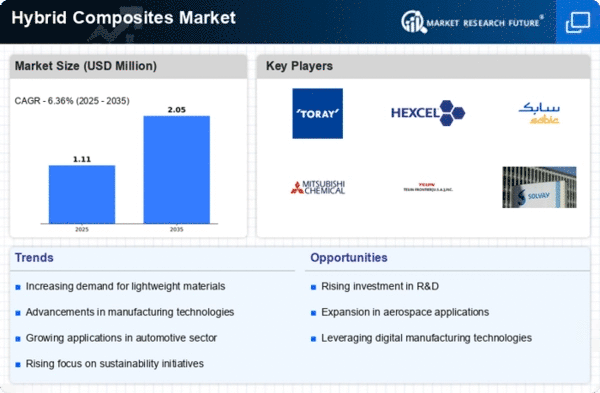
As per MRFR analysis, the Hybrid Composites Market Size was estimated at 1.04 USD Million in 2024. The Hybrid Composites industry is projected to grow from 1.11 in 2025 to 2.05 by 2035, exhibiting a compound annual growth rate (CAGR) of 6.36 during the forecast period 2025 - 2035.

Key Market Trends & Highlights

The Hybrid Composites Market is poised for substantial growth driven by sustainability and technological advancements.

  • North America remains the largest market for hybrid composites, driven by robust aerospace applications.
  • Asia-Pacific is recognized as the fastest-growing region, particularly in the automotive sector.
  • The aerospace segment continues to dominate, while the automotive segment is experiencing rapid growth due to innovative applications.
  • Key market drivers include sustainability initiatives and regulatory support, which are enhancing the adoption of hybrid composites.

Market Size & Forecast

2024 Market Size 1.04 (USD Million)
2035 Market Size 2.05 (USD Million)
CAGR (2025 - 2035) 6.36%
Largest Regional Market Share in 2024 North America

Major Players

<p>Toray Industries (JP), Hexcel Corporation (US), SGL Carbon (DE), Mitsubishi Chemical Corporation (JP), Teijin Limited (JP), Solvay SA (BE), BASF SE (DE), Cytec Industries (US), Owens Corning (US)</p>

Market Trends

The Hybrid Composites Market is currently experiencing a notable transformation, driven by advancements in material science and increasing demand across various industries. This market encompasses a diverse range of composite materials that combine different fibers, such as carbon and glass, to enhance performance characteristics. The growing emphasis on lightweight materials in sectors like automotive and aerospace is propelling the adoption of hybrid composites, as they offer improved strength-to-weight ratios and durability. Furthermore, the rising focus on sustainability is prompting manufacturers to explore eco-friendly alternatives, which may lead to innovative developments in hybrid composite formulations. In addition to the automotive and aerospace industries, the construction sector is also recognizing the potential of hybrid composites. These materials are being utilized in applications ranging from structural components to aesthetic finishes, showcasing their versatility. As the Hybrid Composites Market continues to evolve, it appears that ongoing research and development efforts will play a crucial role in addressing challenges related to cost and processing techniques. Overall, the market seems poised for growth, with opportunities emerging from technological advancements and shifting consumer preferences towards more sustainable solutions.

Sustainability Initiatives

The Hybrid Composites Market is witnessing a shift towards sustainable practices, as manufacturers increasingly prioritize eco-friendly materials. This trend reflects a broader commitment to reducing environmental impact, with companies exploring bio-based resins and recyclable fibers. Such initiatives not only align with regulatory requirements but also cater to consumer demand for greener products.

Technological Advancements

Innovations in manufacturing processes are significantly influencing the Hybrid Composites Market. Advanced techniques, such as automated fiber placement and additive manufacturing, are enhancing production efficiency and material performance. These technological strides are likely to facilitate the development of more complex composite structures, expanding application possibilities.

Diverse Applications

The versatility of hybrid composites is leading to their adoption across a wide array of sectors. From automotive to construction, these materials are being integrated into various applications, driven by their unique properties. This trend indicates a growing recognition of hybrid composites as a solution for enhancing performance and reducing weight in critical components.

Hybrid Composites Market Market Drivers

Growing Demand in Aerospace Sector

The Global Hybrid Composites Market Industry experiences a notable surge in demand from the aerospace sector, driven by the need for lightweight materials that enhance fuel efficiency. Hybrid composites, which combine different fibers such as carbon and glass, are increasingly utilized in aircraft components. For instance, the Boeing 787 Dreamliner incorporates hybrid composites to reduce weight and improve performance. This trend is expected to contribute significantly to the market, with projections indicating a market value of 1.19 USD Billion in 2024, potentially reaching 3.42 USD Billion by 2035, reflecting a robust CAGR of 10.04% from 2025 to 2035.

Market Segment Insights

By Application: Aerospace (Largest) vs. Automotive (Fastest-Growing)

<p>In the Hybrid Composites Market, the application segments reveal varied market share distributions. Aerospace dominates this sector, driven by the increasing demand for lightweight materials that enhance fuel efficiency and performance. The automotive segment, while currently smaller, is rapidly gaining traction as manufacturers prioritize sustainability and the integration of advanced materials for electric and hybrid vehicles. This dynamic landscape highlights the pivotal role of hybrid composites in innovative applications across industries. Analyzing growth trends, the aerospace sector benefits from ongoing advancements in composite manufacturing technologies and a shift towards sustainable aviation solutions. Conversely, the automotive industry is experiencing a surge in demand for hybrid composites, prompted by the rising emphasis on electric vehicles and stringent regulatory frameworks for lowering emissions. This combined focus on efficiency and eco-friendliness positions both segments for robust growth in the coming years.</p>

<p>Aerospace: Leading Manufacturer (Dominant) vs. Automotive: Future Innovator (Emerging)</p>

<p>Aerospace stands as a leading manufacturer of hybrid composites, leveraging cutting-edge technologies to produce lightweight yet robust materials crucial for aircraft design and functionality. The sector's significant investments in research and innovation set it apart as a dominant force in the market, aiming to reduce environmental impact while enhancing performance. In contrast, the automotive industry is viewed as an emerging innovator in hybrid composites, driven by the need to develop sustainable transportation solutions. The collaboration between automakers and material scientists fosters advancements in composite applications, allowing for increased efficiency and durability in vehicles. As both sectors evolve, their unique characteristics and corresponding market positions will significantly influence the future of hybrid composites.</p>

By End Use: Transportation (Largest) vs. Industrial (Fastest-Growing)

<p>In the Hybrid Composites Market, the end-use segment is primarily dominated by transportation, which captures the largest market share due to the increasing demand for lightweight and fuel-efficient materials in automotive and aerospace applications. Following closely, the industrial sector is witnessing substantial growth, driven by advancements in manufacturing processes and the need for durable materials in construction and machinery. Other segments, including consumer goods, defense, and energy, also contribute to market dynamics but to a lesser extent.</p>

<p>Transportation: Dominant vs. Industrial: Emerging</p>

<p>The transportation sector stands out as the dominant end-use segment in the Hybrid Composites Market, driven by the ongoing transition toward lightweight materials that enhance fuel economy and performance in vehicles and aircraft. Hybrid composites used in this sector offer excellent strength-to-weight ratios, which are crucial for various applications. Conversely, the industrial segment is emerging rapidly, fueled by innovations in composite manufacturing technologies and the increased focus on sustainability. This segment is gaining traction as industries adopt hybrid composites for applications in machinery and structural components, enhancing durability and reducing maintenance costs.</p>

By Material Type: Polymer Matrix Composites (Largest) vs. Natural Fiber Composites (Fastest-Growing)

<p>The Hybrid Composites Market exhibits a diverse range of material types, with Polymer Matrix Composites commanding the largest market share due to their versatility and widespread application across multiple industries including aerospace, automotive, and construction. In contrast, Natural Fiber Composites, characterized by their eco-friendliness and sustainability, are witnessing significant traction, particularly in consumer goods and automotive sectors. This dynamic reflects an ongoing shift towards green materials, paving the way for a more sustainable future in composite products. Growth in the Hybrid Composites Market is primarily driven by advancements in manufacturing processes and an increased focus on lightweight materials that enhance performance while reducing environmental impact. Moreover, ongoing research and development efforts are amplifying the capabilities of Natural Fiber Composites, contributing to their rapid ascension within the market. As industries prioritize sustainability alongside performance, the demand for innovative hybrid composite materials is expected to rise, fostering a competitive market landscape.</p>

<p>Polymer Matrix Composites (Dominant) vs. Ceramic Matrix Composites (Emerging)</p>

<p>Polymer Matrix Composites are at the forefront of the Hybrid Composites Market, dominating due to their excellent mechanical properties, lightweight nature, and adaptability across various applications. These composites are extensively used in industries where performance and durability are critical, such as aerospace and automotive. On the other hand, Ceramic Matrix Composites are emerging as promising materials capable of withstanding extreme temperatures and harsh conditions, making them suitable for aerospace and defense applications. While Polymer Matrix Composites continue to lead in terms of volume and versatility, the advancements in Ceramic Matrix technology are opening new avenues for growth and application, particularly in high-performance sectors where thermal stability is paramount.</p>

By Manufacturing Process: Layup (Largest) vs. Filament Winding (Fastest-Growing)

<p>In the Hybrid Composites Market, the manufacturing process segment showcases a dynamic distribution among various methods. Layup remains the largest, leveraging its simplicity and cost-effectiveness, appealing to a broad range of applications. Meanwhile, Filament Winding is gaining significant traction due to its efficiency in producing high-strength components while simultaneously reducing material wastage. This balance of strength and sustainability is reshaping market preferences.</p>

<p>Layup (Dominant) vs. Pultrusion (Emerging)</p>

<p>The Layup process is a dominant force in the manufacturing of hybrid composites, offering versatility across various industries from aerospace to automotive. Its user-friendly nature enables manufacturers to efficiently produce intricate designs without extensive tooling investments. On the other hand, Pultrusion is emerging as a promising method, thanks to its capability for continuous production of complex cross-sections and enhanced consistency in quality. As demands for lighter and stronger materials grow, Pultrusion's ability to combine innovative resin formulations strengthens its position in the market.</p>

Get more detailed insights about Hybrid Composites Market Research Report - Forecast to 2035

Regional Insights

North America : Market Leader in Hybrid Composites

North America is poised to maintain its leadership in the hybrid composites market, holding a significant market share of 52% in 2024. The region's growth is driven by increasing demand in aerospace, automotive, and construction sectors, alongside supportive regulations promoting lightweight materials. The push for sustainability and energy efficiency further fuels this demand, making hybrid composites a preferred choice for manufacturers. The United States stands out as the leading country, with major players like Hexcel Corporation and Owens Corning driving innovation and production. The competitive landscape is characterized by strategic partnerships and investments in R&D, ensuring a steady supply of advanced materials. The presence of key players such as Toray Industries and SGL Carbon enhances the region's market dynamics, fostering a robust ecosystem for hybrid composites.

Europe : Emerging Market with Growth Potential

Europe is witnessing a notable rise in the hybrid composites market, with a market share of 25% in 2024. The region's growth is propelled by stringent regulations aimed at reducing carbon emissions and enhancing energy efficiency. The automotive and aerospace industries are particularly driving demand, as manufacturers seek lightweight materials to improve fuel efficiency and performance. Government initiatives supporting innovation in composite materials further catalyze market expansion. Leading countries such as Germany and France are at the forefront, with companies like SGL Carbon and BASF SE playing pivotal roles. The competitive landscape is marked by a focus on sustainability and technological advancements, with firms investing heavily in R&D to develop next-generation hybrid composites. The presence of regulatory bodies ensures compliance and fosters a conducive environment for market growth.

Asia-Pacific : Rapidly Growing Market Segment

Asia-Pacific is emerging as a significant player in the hybrid composites market, holding an 18% market share in 2024. The region's growth is driven by rapid industrialization and increasing demand from the automotive and aerospace sectors. Countries like Japan and China are investing heavily in advanced materials to enhance product performance and reduce weight, aligning with global sustainability trends. Regulatory support for innovative materials further boosts market potential. Japan leads the region with key players such as Mitsubishi Chemical Corporation and Teijin Limited, who are actively developing hybrid composites for various applications. The competitive landscape is characterized by collaborations and joint ventures aimed at leveraging technological advancements. As the region continues to grow, the focus on R&D and sustainable practices will be crucial for maintaining a competitive edge in the hybrid composites market.

Middle East and Africa : Emerging Market with Challenges

The Middle East and Africa region is gradually developing its hybrid composites market, currently holding a 9% market share in 2024. The growth is primarily driven by increasing investments in infrastructure and construction, where lightweight materials are gaining traction. However, challenges such as limited local manufacturing capabilities and reliance on imports hinder rapid market expansion. Regulatory frameworks are evolving to support the adoption of advanced materials, which could catalyze growth in the coming years. Countries like South Africa and the UAE are leading the charge, with a growing number of companies exploring hybrid composites for various applications. The competitive landscape is still in its nascent stages, with opportunities for international players to enter the market. As local industries develop, the focus on innovation and sustainability will be key to unlocking the region's full potential in hybrid composites.

Key Players and Competitive Insights

The Hybrid Composites Market is currently characterized by a dynamic competitive landscape, driven by increasing demand for lightweight materials across various industries, including aerospace, automotive, and construction. Key players such as Toray Industries (Japan), Hexcel Corporation (US), and SGL Carbon (Germany) are strategically positioned to leverage their technological advancements and extensive product portfolios. Toray Industries (Japan) focuses on innovation in carbon fiber production, while Hexcel Corporation (US) emphasizes partnerships with aerospace manufacturers to enhance its market reach. SGL Carbon (Germany) is investing in sustainable production methods, which aligns with the growing emphasis on environmental responsibility in manufacturing processes. Collectively, these strategies contribute to a competitive environment that is increasingly focused on innovation and sustainability.

In terms of business tactics, companies are localizing manufacturing to reduce lead times and optimize supply chains. The market structure appears moderately fragmented, with several players vying for market share. However, the influence of major companies is significant, as they set industry standards and drive technological advancements. This competitive structure allows for a diverse range of products and innovations, catering to various customer needs and preferences.

In November 2025, Toray Industries (Japan) announced a partnership with a leading automotive manufacturer to develop hybrid composite materials aimed at enhancing vehicle performance and fuel efficiency. This collaboration is strategically important as it not only expands Toray's footprint in the automotive sector but also aligns with the industry's shift towards more sustainable and efficient materials. The partnership is expected to yield innovative solutions that could redefine performance standards in the automotive market.

In October 2025, Hexcel Corporation (US) unveiled a new line of lightweight composite materials specifically designed for the aerospace industry. This launch is significant as it positions Hexcel to capitalize on the increasing demand for fuel-efficient aircraft. By focusing on lightweight solutions, Hexcel is likely to enhance its competitive edge, particularly as airlines seek to reduce operational costs and meet stringent environmental regulations.

In September 2025, SGL Carbon (Germany) completed the acquisition of a small but innovative composite materials firm, which specializes in bio-based composites. This acquisition is indicative of SGL's commitment to sustainability and innovation. By integrating bio-based materials into its product offerings, SGL Carbon is poised to attract environmentally conscious customers and strengthen its market position in the growing segment of sustainable composites.

As of December 2025, the Hybrid Composites Market is witnessing trends such as digitalization, sustainability, and the integration of AI technologies. These trends are reshaping competitive dynamics, with companies increasingly forming strategic alliances to enhance their capabilities and market presence. The shift from price-based competition to a focus on innovation, technology, and supply chain reliability is evident. Moving forward, competitive differentiation will likely hinge on the ability to innovate and adapt to changing market demands, as companies strive to meet the evolving expectations of their customers.

Key Companies in the Hybrid Composites Market market include

Industry Developments

Future Outlook

Hybrid Composites Market Future Outlook

<p>The Hybrid Composites Market is projected to grow at a 6.36% CAGR from 2024 to 2035, driven by advancements in material technology, increasing demand in aerospace, and automotive sectors.</p>

New opportunities lie in:

  • <p>Development of lightweight hybrid composite materials for electric vehicles.</p>
  • <p>Integration of smart sensors in hybrid composites for real-time monitoring.</p>
  • <p>Expansion into emerging markets with tailored hybrid composite solutions.</p>

<p>By 2035, the Hybrid Composites Market is expected to achieve substantial growth and innovation.</p>

Market Segmentation

Hybrid Composites Market End Use Outlook

  • Transportation
  • Industrial
  • Consumer Goods
  • Defense
  • Energy

Hybrid Composites Market Application Outlook

  • Aerospace
  • Automotive
  • Construction
  • Marine
  • Sports Equipment

Hybrid Composites Market Material Type Outlook

  • Polymer Matrix Composites
  • Metal Matrix Composites
  • Ceramic Matrix Composites
  • Natural Fiber Composites
  • Glass Fiber Composites

Hybrid Composites Market Manufacturing Process Outlook

  • Layup
  • Filament Winding
  • Pultrusion
  • Resin Transfer Molding
  • Injection Molding

Report Scope

MARKET SIZE 20241.04(USD Million)
MARKET SIZE 20251.11(USD Million)
MARKET SIZE 20352.05(USD Million)
COMPOUND ANNUAL GROWTH RATE (CAGR)6.36% (2024 - 2035)
REPORT COVERAGERevenue Forecast, Competitive Landscape, Growth Factors, and Trends
BASE YEAR2024
Market Forecast Period2025 - 2035
Historical Data2019 - 2024
Market Forecast UnitsUSD Million
Key Companies ProfiledToray Industries (JP), Hexcel Corporation (US), SGL Carbon (DE), Mitsubishi Chemical Corporation (JP), Teijin Limited (JP), Solvay SA (BE), BASF SE (DE), Cytec Industries (US), Owens Corning (US)
Segments CoveredApplication, End Use, Material Type, Manufacturing Process
Key Market OpportunitiesAdvancements in lightweight materials drive demand in the Hybrid Composites Market for automotive and aerospace applications.
Key Market DynamicsRising demand for lightweight materials drives innovation and competition in the hybrid composites sector.
Countries CoveredNorth America, Europe, APAC, South America, MEA

FAQs

What is the study period of the hybrid composites market report?

The hybrid composites market forecast period is 2025 - 2035

What is the hybrid composites market growth rate?

The market is expected to register a CAGR of Significant Value over the next 10 years, according to the hybrid composites market research.

Which region has the highest market growth rate?

Europe is expected to register the highest CAGR during 2025 - 2035

Which region has the largest share in the market?

Asia Pacific held the largest share in 2021

What is the expected hybrid composites market size by 2035?

The market size is expected to be USD Significant Value by 2035.

Who are the key players in the Market?

Royal DSM (the Netherlands), Quantum Composites (US), Gurit (Switzerland), Hexcel Corporation (US), The Carbon Company (Germany), Excel Group World Wide (Finland), TEIJIN LIMITED (Japan), Solvay (Belgium), and PlastiComp Inc. (US) are the major companies operating in the market.

  1. Executive Summary
  2. Scope of the Report
    1. Market Definition
    2. Scope of the Study
      1. Research Objectives
      2. Assumptions & Limitations
    3. Market Structure
  3. Market Research
    1. Methodology
    2. Research Process
    3. Secondary Research
    4. Primary
    5. Research
    6. Forecast Model
  4. Market Landscape
    1. Supply Chain Analysis
      1. Raw Material Suppliers
      2. Manufacturers/Producers
      3. Distributors/Retailers/Wholesalers/E-Commerce
      4. End-Users
    2. Porter’s Five Forces Analysis
      1. Threat
      2. Bargaining Power of Buyers
      3. Bargaining Power
      4. Threat of Substitutes
      5. Intensity of Competitive
    3. of New Entrants
    4. of Suppliers
    5. Rivalry
  5. Market Dynamics of Global Hybrid Composites Market
    1. Introduction
    2. Drivers
    3. Restraints
    4. Opportunities
    5. Challenges
    6. Trends/Strategies
  6. Global Hybrid Composites Market, by Fiber Type
    1. Introduction
    2. Carbon/Glass
      1. Market Estimates & Forecast,
      2. Market Estimates & Forecast, by Region, 2022–2030
    3. Carbon/Aramid
      1. Market Estimates & Forecast, 2022–2030
      2. Market Estimates & Forecast, by Region, 2022–2030
    4. Metal/Plastic
      1. Market Estimates & Forecast, 2022–2030
      2. Market Estimates
    5. & Forecast, by Region, 2022–2030
    6. Wood/Plastic
      1. Market
      2. Market Estimates & Forecast,
    7. Estimates & Forecast, 2022–2030
    8. by Region, 2022–2030
    9. HMPP/Carbon
      1. Market Estimates &
      2. Market Estimates & Forecast, by Region,
    10. Forecast, 2022–2030
    11. UHMWPE/Carbon
      1. Market Estimates & Forecast,
      2. Market Estimates & Forecast, by Region, 2022–2030
  7. Others
  8. Market Estimates & Forecast, 2022–2030
  9. Market Estimates & Forecast, by Region, 2022–2030
  10. Global
  11. Hybrid Composites Market, by Resin Type
    1. Introduction
    2. Thermoplastic
      1. Market Estimates & Forecast, 2022–2030
      2. Market Estimates
    3. & Forecast, by Region, 2022–2030
    4. Thermosetting
      1. Market
      2. Market Estimates & Forecast,
    5. Estimates & Forecast, 2022–2030
    6. by Region, 2022–2030
  12. Global Hybrid Composites Market, by End-Use
    1. Industry
    2. Introduction
    3. Aerospace & Defense
      1. Market
      2. Market Estimates & Forecast,
    4. Estimates & Forecast, 2022–2030
    5. by Region, 2022–2030
    6. Automotive & Transportation
      1. Market
      2. Market Estimates & Forecast,
    7. Estimates & Forecast, 2022–2030
    8. by Region, 2022–2030
    9. Building & Construction
      1. Market
      2. Market Estimates & Forecast,
    10. Estimates & Forecast, 2022–2030
    11. by Region, 2022–2030
    12. Wind Energy
      1. Market Estimates &
      2. Market Estimates & Forecast, by Region,
    13. Forecast, 2022–2030
    14. Marine
      1. Market Estimates & Forecast, 2022–2030
      2. Market Estimates & Forecast, by Region, 2022–2030
    15. Others
      1. Market Estimates & Forecast, 2022–2030
      2. Market Estimates
    16. & Forecast, by Region, 2022–2030
  13. Global Hybrid Composites Market,
    1. by Region
    2. Introduction
    3. North America
      1. Market Estimates
      2. Market Estimates & Forecast, by Fiber
      3. Market Estimates & Forecast, by Resin Type,
      4. Market Estimates & Forecast, by End-use Industry,
      5. US
    4. & Forecast, 2022–2030
    5. Type, 2022–2030
  14. Market Estimates & Forecast, by Resin Type, 2022–2030
    1. Estimates & Forecast, by End-use Industry, 2022–2030
    2. & Forecast, by Fiber Type, 2022–2030
    3. Forecast, by Resin Type, 2022–2030
    4. by End-use Industry, 2022–2030
    5. & Forecast, 2022–2030
    6. Type, 2022–2030
  15. Market
  16. Canada
  17. Market Estimates & Forecast, 2022–2030
  18. Market Estimates
  19. Market Estimates &
  20. Market Estimates & Forecast,
    1. Europe
      1. Market Estimates
      2. Market Estimates & Forecast, by Fiber
      3. Market Estimates & Forecast, by Resin Type,
      4. Market Estimates & Forecast, by End-use Industry,
      5. Germany
  21. Market Estimates & Forecast, by End-use Industry, 2022–2030
    1. France
  22. Market Estimates & Forecast, 2022–2030
  23. Market Estimates & Forecast, by Fiber Type, 2022–2030
    1. Estimates & Forecast, by Resin Type, 2022–2030
    2. & Forecast, by End-use Industry, 2022–2030
    3. Market Estimates & Forecast, 2022–2030
    4. Forecast, by Fiber Type, 2022–2030
    5. by Resin Type, 2022–2030
    6. End-use Industry, 2022–2030
    7. & Forecast, 2022–2030
    8. Fiber Type, 2022–2030
    9. Type, 2022–2030
  24. Market
  25. Market Estimates
  26. Italy
  27. Market Estimates &
  28. Market Estimates & Forecast,
  29. Market Estimates & Forecast, by
  30. Spain
  31. Market Estimates
  32. Market Estimates & Forecast, by
  33. Market Estimates & Forecast, by Resin
  34. Market Estimates & Forecast, by End-use Industry,
  35. UK
  36. Market Estimates & Forecast, 2022–2030
  37. Market Estimates & Forecast, by Fiber Type, 2022–2030
  38. Market Estimates & Forecast, by Resin Type, 2022–2030
    1. Estimates & Forecast, by End-use Industry, 2022–2030
    2. Estimates & Forecast, by Fiber Type, 2022–2030
    3. & Forecast, by Resin Type, 2022–2030
    4. Forecast, by End-use Industry, 2022–2030
    5. Market Estimates & Forecast, 2022–2030
    6. & Forecast, by Fiber Type, 2022–2030
    7. Forecast, by Resin Type, 2022–2030
    8. by End-use Industry, 2022–2030
    9. Estimates & Forecast, 2022–2030
    10. by Fiber Type, 2022–2030
    11. Resin Type, 2022–2030
    12. Industry, 2022–2030
    13. Forecast, 2022–2030
  39. Market
  40. Russia
  41. Market Estimates & Forecast, 2022–2030
  42. Market
  43. Market Estimates
  44. Market Estimates &
  45. Poland
  46. Market Estimates
  47. Market Estimates &
  48. Market Estimates & Forecast,
  49. Rest of Europe
  50. Market
  51. Market Estimates & Forecast,
  52. Market Estimates & Forecast, by
  53. Market Estimates & Forecast, by End-use
    1. Asia-Pacific
      1. Market Estimates &
      2. Market Estimates & Forecast, by Fiber Type,
      3. Market Estimates & Forecast, by Resin Type, 2022–2030
      4. Market Estimates & Forecast, by End-use Industry, 2022–2030
      5. China
  54. Market Estimates & Forecast, by Fiber Type, 2022–2030
    1. Estimates & Forecast, by Resin Type, 2022–2030
    2. & Forecast, by End-use Industry, 2022–2030
    3. Market Estimates & Forecast, 2022–2030
    4. Forecast, by Fiber Type, 2022–2030
    5. by Resin Type, 2022–2030
    6. End-use Industry, 2022–2030
    7. & Forecast, 2022–2030
    8. Fiber Type, 2022–2030
    9. Type, 2022–2030
    10. & Forecast, 2022–2030
    11. Fiber Type, 2022–2030
    12. Type, 2022–2030
    13. & Forecast, 2022–2030
    14. Fiber Type, 2022–2030
    15. Type, 2022–2030
    16. & Forecast, 2022–2030
    17. Fiber Type, 2022–2030
    18. Type, 2022–2030
    19. Industry, 2022–2030
    20. Estimates & Forecast, 2022–2030
    21. by Fiber Type, 2022–2030
    22. Type, 2022–2030
  55. Market
  56. Market Estimates
  57. India
  58. Market Estimates &
  59. Market Estimates & Forecast,
  60. Market Estimates & Forecast, by
  61. Japan
  62. Market Estimates
  63. Market Estimates & Forecast, by
  64. Market Estimates & Forecast, by Resin
  65. Market Estimates & Forecast, by End-use Industry,
  66. Australia & New Zealand
  67. Market Estimates
  68. Market Estimates & Forecast, by
  69. Market Estimates & Forecast, by Resin
  70. Market Estimates & Forecast, by End-use Industry,
  71. Indonesia & South Korea
  72. Market Estimates
  73. Market Estimates & Forecast, by
  74. Market Estimates & Forecast, by Resin
  75. Market Estimates & Forecast, by End-use Industry,
  76. Rest of Asia-Pacific
  77. Market Estimates
  78. Market Estimates & Forecast, by
  79. Market Estimates & Forecast, by Resin
  80. Market Estimates & Forecast, by End-use
    1. Middle East & Africa
      1. Market
      2. Market Estimates & Forecast,
      3. Market Estimates & Forecast, by Resin
      4. Market Estimates & Forecast, by End-use Industry,
      5. GCC
  81. Market Estimates & Forecast, by Resin Type, 2022–2030
    1. Estimates & Forecast, by End-use Industry, 2022–2030
    2. & Forecast, by Fiber Type, 2022–2030
    3. Forecast, by Resin Type, 2022–2030
    4. by End-use Industry, 2022–2030
    5. Estimates & Forecast, 2022–2030
    6. by Fiber Type, 2022–2030
    7. Resin Type, 2022–2030
    8. Industry, 2022–2030
    9. Forecast, 2022–2030
    10. Type, 2022–2030
    11. Estimates & Forecast, 2022–2030
    12. by Fiber Type, 2022–2030
    13. Resin Type, 2022–2030
    14. Industry, 2022–2030
    15. Forecast, 2022–2030
  82. Market
  83. Israel
  84. Market Estimates & Forecast, 2022–2030
  85. Market Estimates
  86. Market Estimates &
  87. Market Estimates & Forecast,
  88. North Africa
  89. Market
  90. Market Estimates & Forecast,
  91. Market Estimates & Forecast, by
  92. Market Estimates & Forecast, by End-use
  93. Turkey
  94. Market Estimates &
  95. Market Estimates & Forecast, by Fiber
  96. Market Estimates & Forecast, by Resin Type,
  97. Market Estimates & Forecast, by End-use Industry,
  98. Rest of the Middle East & Africa
  99. Market
  100. Market Estimates & Forecast,
  101. Market Estimates & Forecast, by
  102. Market Estimates & Forecast, by End-use
    1. Latin America
      1. Market Estimates &
      2. Market Estimates & Forecast, by Fiber Type,
      3. Market Estimates & Forecast, by Resin Type, 2022–2030
      4. Market Estimates & Forecast, by End-use Industry, 2022–2030
      5. Brazil
  103. Market Estimates & Forecast, by Resin Type, 2022–2030
    1. Estimates & Forecast, by End-use Industry, 2022–2030
    2. & Forecast, by Fiber Type, 2022–2030
    3. Forecast, by Resin Type, 2022–2030
    4. by End-use Industry, 2022–2030
    5. & Forecast, 2022–2030
    6. Fiber Type, 2022–2030
    7. Type, 2022–2030
    8. Forecast, 2022–2030
    9. Type, 2022–2030
  104. Market
  105. Mexico
  106. Market Estimates & Forecast, 2022–2030
  107. Market Estimates
  108. Market Estimates &
  109. Market Estimates & Forecast,
  110. Argentina
  111. Market Estimates
  112. Market Estimates & Forecast, by
  113. Market Estimates & Forecast, by Resin
  114. Market Estimates & Forecast, by End-use Industry,
  115. Rest of Latin America
  116. Market Estimates &
  117. Market Estimates & Forecast, by Fiber
  118. Market Estimates & Forecast, by Resin Type,
  119. Market Estimates & Forecast, by End-use Industry,
  120. Company Landscape
    1. Introduction
    2. Market
    3. Strategy
    4. Key Development Analysis
    5. (Expansions/Mergers & Acquisitions/Joint
    6. Ventures/New Resin Type Developments/Agreements/Investments)
  121. Company Profiles
    1. Royal DSM
      1. Company Overview
      2. Financial Updates
      3. Strategy
      4. Key Developments
      5. SWOT Analysis
    2. Resin Type/Business Segment Overview
    3. SGL Group – The Carbon Company
      1. Financial Updates
      2. Resin Type/Business Segment
      3. Strategy
      4. Key Developments
      5. SWOT Analysis
    4. Company Overview
    5. Overview
    6. Gurit
      1. Company Overview
      2. Financial Updates
      3. Strategy
      4. Key Developments
      5. SWOT Analysis
    7. Resin Type/Business Segment Overview
    8. Hexcel Corporation
      1. Company Overview
      2. Financial Updates
      3. Resin Type/Business Segment Overview
      4. Key Developments
      5. SWOT Analysis
    9. Strategy
    10. TEIJIN
      1. Company Overview
      2. Financial Updates
      3. Resin
      4. Strategy
      5. Key Developments
      6. SWOT Analysis
    11. LIMITED
    12. Type/Business Segment Overview
    13. Exel Group World Wide
      1. Company Overview
      2. Financial Updates
      3. Resin Type/Business Segment Overview
      4. Key Developments
      5. SWOT Analysis
    14. Strategy
    15. Solvay
      1. Company Overview
      2. Financial Updates
      3. Resin Type/Business
      4. Strategy
      5. Key Developments
      6. SWOT
    16. Segment Overview
    17. Analysis
    18. PlastiComp, Inc.
      1. Company Overview
      2. Financial
      3. Resin Type/Business Segment Overview
      4. Strategy
      5. Key Developments
      6. SWOT Analysis
    19. Updates
    20. Innegra Technologies,
      1. Company Overview
      2. Financial Updates
      3. Resin
      4. Strategy
      5. Key Developments
      6. SWOT Analysis
    21. LLC
    22. Type/Business Segment Overview
    23. Quantum Composites
      1. Company Overview
      2. Financial Updates
      3. Resin Type/Business Segment Overview
      4. Strategy
      5. Key Developments
      6. SWOT Analysis
    24. Conclusion
  122. LIST OF TABLES
  123. Global Hybrid Composites
  124. Market, by Region, 2022–2030
  125. North America: Hybrid Composites
  126. Market, by Country, 2022–2030
  127. Europe: Hybrid Composites Market,
    1. by Country, 2022–2030
  128. Asia-Pacific: Hybrid Composites Market,
    1. by Country, 2022–2030
  129. Middle East & Africa: Hybrid Composites
  130. Market, by Country, 2022–2030
  131. Latin America: Hybrid Composites
  132. Market, by Country, 2022–2030
  133. Global Hybrid Composites Fiber
  134. Type Market, by Region, 2022–2030
  135. North America: Hybrid Composites
  136. Fiber Type Market, by Country, 2022–2030
  137. Europe: Hybrid Composites
  138. Fiber Type Market, by Country, 2022–2030
    1. Table10 Asia-Pacific: Hybrid
  139. Composites Fiber Type Market, by Country, 2022–2030
    1. Table11 Middle East
  140. & Africa: Hybrid Composites Fiber Type Market, by Country, 2022–2030
  141. Table12 Latin America: Hybrid Composites Fiber Type Market, by Country, 2022–2030
  142. Table13 Global Hybrid Composites Resin Type Market, by Region, 2022–2030
  143. Table14 North America: Hybrid Composites Resin Type Market, by Country, 2022–2030
  144. Table15 Europe: Hybrid Composites Resin Type Market, by Country, 2022–2030
  145. Table16 Asia-Pacific: Hybrid Composites Resin Type Market, by Country, 2022–2030
  146. Table17 Middle East & Africa: Hybrid Composites Resin Type Market, by Country,
    1. Table18 Latin America: Hybrid Composites Resin Type Market,
    2. by Country, 2022–2030
    3. Table19 Global Hybrid Composites End-Use Industry
  147. Market, by Region, 2022–2030
    1. Table20 North America: Hybrid Composites
  148. End-Use Industry Market, by Country, 2022–2030
    1. Table21 Europe: Hybrid
  149. Composites End-Use Industry Market, by Country, 2022–2030
    1. Table22 Asia-Pacific:
  150. Hybrid Composites End-Use Industry Market, by Country, 2022–2030
    1. Table23
  151. Middle East & Africa: Hybrid Composites End-Use Industry Market, by Country,
    1. Table24 Latin America: Hybrid Composites End-Use Industry Market,
    2. by Country, 2022–2030
  152. Table25 Global Fiber Type Market, by Region, 2022–2030
  153. Table26 Global Resin Type Market, by Region, 2022–2030
    1. Table27 Global
  154. End-Use Industry Market, by Region, 2022–2030
    1. Table28 North America:
  155. Hybrid Composites Market, by Country
    1. Table29 North America: Hybrid Composites
  156. Market, by Fiber Type
  157. Table30 North America: Hybrid Composites Market, by Resin
    1. Type
  158. Table31 North America: Hybrid Composites Market, by End-Use Industry
  159. Table32 Europe: Hybrid Composites Market, by Country
    1. Table33 Europe: Hybrid
  160. Composites Market, by Fiber Type
    1. Table34 Europe: Hybrid Composites Market,
    2. by Resin Type
  161. Table35 Europe: Hybrid Composites Market, by End-Use Industry
  162. Table36 Asia-Pacific: Hybrid Composites Market, by Country
    1. Table37 Asia-Pacific:
  163. Hybrid Composites Market, by Fiber Type
    1. Table38 Asia-Pacific: Hybrid Composites
  164. Market, by Resin Type
  165. Table39 Asia-Pacific: Hybrid Composites Market, by End-Use
    1. Industry
  166. Table40 Middle East & Africa: Hybrid Composites Market, by Country
  167. Table41 Middle East & Africa Hybrid Composites Market, by Fiber Type
    1. Table42
  168. Middle East & Africa Hybrid Composites Market, by Resin Type
    1. Table43 Middle
  169. East & Africa: Hybrid Composites Market, by End-Use Industry
    1. Table44 Latin
  170. America: Hybrid Composites Market, by Country
    1. Table45 Latin America Hybrid
  171. Composites Market, by Fiber Type
    1. Table46 Latin America Hybrid Composites Market,
    2. by Resin Type
  172. Table47 Latin America: Hybrid Composites Market, by End-Use Industry
  173. LIST OF FIGURES
  174. Global Hybrid Composites Market Segmentation
  175. Forecast Research Methodology
  176. Porter’s Five Forces
    1. Analysis of Global Hybrid Composites Market
  177. Value Chain of Global
    1. Hybrid Composites Market
  178. Share of Global Hybrid Composites Market
    1. in 2022, by Country (%)
  179. Global Hybrid Composites Market, 2022–2030,
  180. Global Hybrid Composites Market Size by Fiber Types, 2022
    1. FIGURE
  181. Share of Global Hybrid Composites Market, by Fiber Type, 2022–2030
    1. FIGURE
  182. Global Hybrid Composites Market Size, by Resin Type, 2022
  183. Share
  184. of Global Hybrid Composites Market, by Resin Type, 2022–2030
    1. FIGURE 11
  185. Global Hybrid Composites Market Size, by End-Use Industry, 2022
  186. Share
  187. of Global Hybrid Composites Market, by End-Use Industry, 2022–2030

Hybrid Composites Market Segmentation

Market Segmentation Overview

  • Detailed segmentation data will be available in the full report
  • Comprehensive analysis by multiple parameters
  • Regional and country-level breakdowns
  • Market size forecasts by segment
Infographic

Free Sample Request

Kindly complete the form below to receive a free sample of this Report

Get Free Sample

Customer Strories

Compare Licence

×
Features License Type
Single User Multiuser License Enterprise User
Price $4,950 $5,950 $7,250
Maximum User Access Limit 1 User Upto 10 Users Unrestricted Access Throughout the Organization
Free Customization
Direct Access to Analyst
Deliverable Format
Platform Access
Discount on Next Purchase 10% 15% 15%
Printable Versions