×
Request Free Sample ×

Kindly complete the form below to receive a free sample of this Report

* Please use a valid business email

Leading companies partner with us for data-driven Insights

clients tt-cursor
Hero Background
English
Chinese
French
Japanese
Korean
German
Spanish

Humanoid Robots Market Share

ID: MRFR/SEM/5097-HCR
200 Pages
Shubham Munde
October 2025

Humanoid Robots Market Size, Share & Industry Analysis: By Component (Actuator, Control System, Power Source, Sensor), Motion (Bipedal), Application (Education & Entertainment, Personal Assistance, Public Relation, Research & Space Exploration) - Industry Forecast Till 2035

Share:
Download PDF ×

We do not share your information with anyone. However, we may send you emails based on your report interest from time to time. You may contact us at any time to opt-out.

Humanoid Robots Market Infographic
×
Humanoid Robots Market Infographic Full View
Purchase Options

Market Share

Humanoid Robots Market Share Analysis

Various market share targeting techniques are utilized by enterprises to establish their authority, differentiate their offers, and secure a substantial market share in the highly competitive humanoid robot market. A common tactic is technological differentiation, in which businesses concentrate on creating state-of-the-art functionalities and features for their humanoid robots. Organizations may establish themselves as cutting-edge leaders in the industry and draw in clients looking for cutting-edge solutions by remaining at the vanguard of robots and artificial intelligence. This tactic entails ongoing research and development to improve the robots' overall performance, movement accuracy, and sensing capabilities—thereby differentiating them in terms of technological superiority. Flexibility to fulfill industry needs is another important market positioning tactic. Businesses understand that every industry has various needs when it comes to humanoid robots. Robots that can aid and care for patients are of particular importance to the healthcare business, whereas precision and teamwork are sought after by the manufacturing sector. Companies may efficiently access niche markets and satisfy the specialized requirements of customers by customizing humanoid robots to meet industry needs. This gives them a competitive advantage. A company's ideals may be communicated, a unique identity can be developed, and customer trust can be increased with effective branding. This could entail emphasizing in marketing campaigns the dependability, security, and user-friendliness of humanoid robots. Businesses that put a high priority on client happiness and offer extensive support services set themselves out in a good way. This entails providing maintenance services, training courses, and prompt technical assistance. Building a loyal client base and strengthening a company's position in the market are two benefits of ensuring a great user experience and attending to customer issues. Moreover, organizations looking to increase their market share should consider overseas expansion as a key component of their market positioning strategy. Because humanoid robot adoption is a worldwide trend, businesses may deliberately penetrate new markets or bolster their current ones. This approach is essential for recognizing local tastes, following laws and ordinances, and customizing goods for various cultural settings. Businesses can customize their humanoid robots according to regional demands, work with regional distributors, and spend money on regional marketing. The success of these tactics’ hinges on a business's capacity to match consumer needs with its goods, set itself apart from rivals, and cultivate enduring connections with clients. Businesses must modify and improve their positioning strategies as the market for humanoid robots develops to remain competitive and satisfy the ever-changing demands of both consumers and industries.


Author
Shubham Munde
Research Analyst Level II

With a technical background in information technology & semiconductors, Shubham has 4.5+ years of experience in market research and analytics with the tasks of data mining, analysis, and project execution. He is the POC for our clients, for their consulting projects running under the ICT/Semiconductor domain. Shubham holds a Bachelor’s in Information and Technology and a Master of Business Administration (MBA). Shubham has executed over 150 research projects for our clients under the brand name Market Research Future in the last 2 years. His core skill is building the research respondent relation for gathering the primary information from industry and market estimation for niche markets. He is having expertise in conducting secondary & primary research, market estimations, market projections, competitive analysis, analysing current market trends and market dynamics, deep-dive analysis on market scenarios, consumer behaviour, technological impact analysis, consulting, analytics, etc. He has worked on fortune 500 companies' syndicate and consulting projects along with several government projects. He has worked on the projects of top tech brands such as IBM, Google, Microsoft, AWS, Meta, Oracle, Cisco Systems, Samsung, Accenture, VMware, Schneider Electric, Dell, HP, Ericsson, and so many others. He has worked on Metaverse, Web 3.0, Zero-Trust security, cyber-security, blockchain, quantum computing, robotics, 5G technology, High-Performance computing, data centers, AI, automation, IT equipment, sensors, semiconductors, consumer electronics and so many tech domain projects.

Leave a Comment

FAQs

What are humanoid robots?

Humanoid robots are anthropomorphized robots having human like senses.

Which region will lead the humanoid robots market?

APAC region will dominate the humanoid robots market.

What are the key applications of humanoid robots?

Humanoid robots have wide applications in personal assistance and caregiving, retail, public relations, search and rescue, research and space exploration, education and entertainment, and others.

Name the key players profiled in the humanoid robots market.

Key players profiled in the humanoid robots market include Toyota Motor Corporation (Japan), Willow Garage (US), ROBOTIS (Republic of Korea), SoftBank Robotics Corp. (Japan), WowWee Group Limited (Hong Kong), Ubtech Robotics (US), Toshiba (Japan), Samsung Electronics (South Korea), Robo Garage Co.(Japan), Qihan Technology Co.(China), Pal Robotics(Spain), Kawada Robotics (Japan), IstitutoItaliano Di Tecnologia (Italy), Honda Motor Co., Ltd.(Japan), Hanson Robotics(Hong Kong), Hajime Research Institute(Japan), Engineered Arts(UK), and DST Robot Co., Ltd (South Korea).

What are the strategies encompassed by key players to stay ahead in the competition?

Key strategies incorporated by key players to stay ahead in the competition include mergers, acquisitions, new product launches, joint ventures, partnerships, and others.

Market Summary

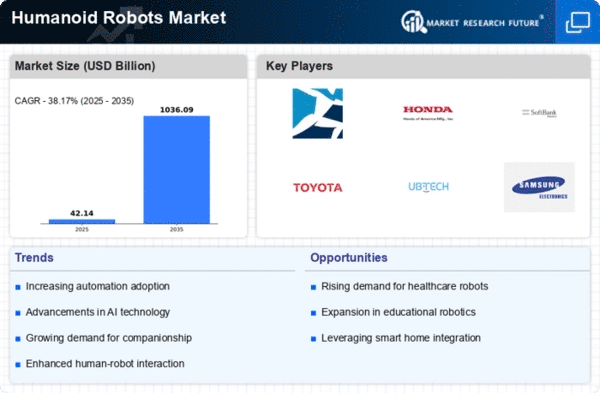
As per MRFR analysis, the Humanoid Robots Market Size was estimated at 30.5 USD Billion in 2024. The Humanoid Robots industry is projected to grow from 40.85 USD Billion in 2025 to 1036.09 USD Billion by 2035, exhibiting a compound annual growth rate (CAGR) of 38.17 during the forecast period 2025 - 2035.

Key Market Trends & Highlights

The humanoid robots market is poised for substantial growth driven by technological advancements and increasing applications across various sectors.

  • North America remains the largest market for humanoid robots, driven by significant investments in robotics technology. The Asia-Pacific region is emerging as the fastest-growing market, fueled by rapid technological adoption and innovation. The healthcare segment continues to dominate the market, while the education segment is experiencing the fastest growth due to rising demand for interactive learning tools. Technological advancements in robotics and growing demand in healthcare are key drivers propelling market expansion.

Market Size & Forecast

2024 Market Size 30.5 (USD Billion)
2035 Market Size 1036.09 (USD Billion)
CAGR (2025 - 2035) 38.17%
Largest Regional Market Share in 2024 North America

Major Players

Boston Dynamics (US), Honda (JP), SoftBank Robotics (JP), Toyota (JP), UBTECH Robotics (CN), Samsung Electronics (KR), NVIDIA (US), Kawada Robotics (JP), Agility Robotics (US)

Market Trends

The Humanoid Robots Market is currently experiencing a transformative phase characterized by rapid advancements in technology and increasing applications across various sectors. As industries seek innovative solutions to enhance productivity and efficiency, humanoid robots are emerging as viable options for tasks ranging from customer service to healthcare assistance. The integration of artificial intelligence and machine learning into these robots is enabling them to perform complex functions, thereby expanding their utility and appeal. Furthermore, the growing acceptance of automation in everyday life is fostering a more favorable environment for the adoption of humanoid robots, suggesting a promising trajectory for future growth. In addition to technological advancements, the Humanoid Robots Market is also influenced by shifting consumer preferences and societal trends. As populations age and labor shortages become more pronounced, the demand for robots capable of assisting in caregiving and companionship roles is likely to increase. Moreover, the entertainment and education sectors are exploring the potential of humanoid robots to engage audiences and facilitate learning experiences. This multifaceted demand indicates that the market is not only evolving but also diversifying, which may lead to new opportunities and challenges in the coming years.

Technological Advancements

The ongoing evolution of artificial intelligence and robotics technology is significantly shaping the Humanoid Robots Market. Enhanced capabilities in machine learning and sensory perception are enabling robots to interact more naturally with humans, thereby increasing their applicability in various fields.

Growing Demand in Healthcare

The healthcare sector is increasingly recognizing the potential of humanoid robots for patient care and assistance. As the need for efficient healthcare solutions rises, robots are being integrated into roles such as rehabilitation support and elderly care, indicating a shift towards automation in this critical industry.

Expansion in Education and Entertainment

Humanoid robots are finding new roles in educational and entertainment contexts, where they serve as interactive tools for learning and engagement. This trend suggests a growing acceptance of robots as companions and educators, potentially reshaping how knowledge is imparted and experiences are shared.

Humanoid Robots Market Market Drivers

Technological Advancements

The Global Humanoid Robots Market Industry is propelled by rapid technological advancements in artificial intelligence and robotics. Innovations in machine learning, computer vision, and sensor technologies enhance the capabilities of humanoid robots, making them more efficient and versatile. For instance, advancements in natural language processing enable robots to interact more seamlessly with humans. As these technologies evolve, they are expected to contribute significantly to the market's growth, with the industry projected to reach 30.5 USD Billion in 2024. This growth reflects a broader trend towards automation and intelligent systems across various sectors.

Market Charts and Projections

The Global Humanoid Robots Market Industry is characterized by various charts and projections that illustrate its growth trajectory. Key metrics indicate a market value of 30.5 USD Billion in 2024, with expectations to reach 75.2 USD Billion by 2035. The compound annual growth rate (CAGR) is projected at 8.55% from 2025 to 2035, highlighting the robust potential for expansion. These visual representations provide insights into market dynamics, trends, and future opportunities, aiding stakeholders in making informed decisions.

Growing Interest in Automation

The Global Humanoid Robots Market Industry is also influenced by the growing interest in automation across various industries. Businesses are increasingly adopting humanoid robots to enhance productivity and reduce operational costs. For instance, companies in manufacturing and logistics are integrating robots for tasks such as assembly and inventory management. This shift towards automation is expected to drive the market's compound annual growth rate (CAGR) of 8.55% from 2025 to 2035. As organizations seek to optimize their processes, the demand for humanoid robots is likely to rise, further solidifying their role in the global economy.

Increased Demand in Healthcare

The Global Humanoid Robots Market Industry experiences heightened demand within the healthcare sector. Humanoid robots are increasingly utilized for patient care, rehabilitation, and assistance in medical procedures. For example, robots like ASIMO and Pepper are being deployed in hospitals to assist staff and improve patient interactions. This trend is likely to continue, as the aging population necessitates innovative solutions for healthcare delivery. The market is expected to expand significantly, with projections indicating a growth to 75.2 USD Billion by 2035, driven by the need for efficient healthcare solutions.

Rising Investment in Research and Development

Investment in research and development is a crucial driver for the Global Humanoid Robots Market Industry. Governments and private entities are increasingly funding projects aimed at advancing humanoid robotics. This investment fosters innovation and accelerates the development of new technologies, which can enhance the functionality and applicability of humanoid robots. For instance, initiatives in various countries focus on creating robots that can perform complex tasks in unpredictable environments. As R&D continues to flourish, the market is poised for substantial growth, reflecting the commitment to advancing robotics technology.

Market Segment Insights

By Application: Healthcare (Largest) vs. Education (Fastest-Growing)

The humanoid robots market segmented by application showcases healthcare as the dominant sector, representing a significant percentage of the overall market. This segment thrives due to the rising demand for automation in hospitals and elder care facilities, where robots assist in patient monitoring and rehabilitation. Conversely, education emerges as a vibrant segment, growing rapidly as institutions adopt humanoid robots for interactive learning and student engagement, capitalizing on advancements in artificial intelligence and robotics.

Healthcare: Robotic Assistants (Dominant) vs. Education: Interactive Tutors (Emerging)

Within the healthcare application, robotic assistants are recognized as the dominant players, providing essential support in surgeries, data management, and patient care. Their reliability and adaptability in performing routine tasks not only improve efficiency but also enhance patient outcomes. Conversely, in education, interactive tutors represent an emerging trend, facilitating personalized learning experiences for students. These robots are designed to engage students in a relatable manner, promoting STEM education through interactive lessons and adaptive learning. As educational institutions increasingly adopt these innovations, the demand for humanoid robots in classrooms continues to rise, showcasing their role as pivotal educational tools.

By End Use: Domestic (Largest) vs. Healthcare (Fastest-Growing)

The humanoid robots market is bifurcated into several end-use segments, with the domestic and healthcare sectors leading the way. The domestic segment holds the largest share, driven by increasing adoption in households for tasks such as cleaning, companionship, and monitoring. On the other hand, the healthcare segment is witnessing rapid growth due to the rising demand for automated assistance, rehabilitation, and patient care services. As healthcare providers look to enhance service delivery, humanoid robots are emerging as essential tools in these settings.

End Use: Domestic (Dominant) vs. Healthcare (Emerging)

The domestic sector has been the dominant player in the humanoid robots market, as these robots are increasingly integrated into homes for daily assistance and social interaction. Consumers seek convenience, leading to a rise in robot assistants for household chores and companionship. Conversely, the healthcare sector is an emerging power, benefiting from technological advancements and a shift towards automation in patient care. Humanoid robots in healthcare demonstrate versatility, offering solutions such as telepresence for remote consultations, robotic surgery assistance, and rehabilitation programs, thus positioning themselves as pivotal components in modern healthcare systems.

By Technology: Artificial Intelligence (Largest) vs. Machine Learning (Fastest-Growing)

In the Humanoid Robots Market, the technology segment is primarily dominated by Artificial Intelligence (AI), which plays a pivotal role in enhancing the capabilities of humanoid robots. AI encompasses various applications that allow robots to perform tasks autonomously, analyze data, and interact with humans effectively. Following closely is Machine Learning (ML), which is emerging rapidly as it enables robots to learn from experiences, improve performance over time, and optimize decision-making processes. Together, these technologies are transforming the landscape of humanoid robotics by increasing automation and making robots more responsive to user needs. The growth trends within the technology segment of the Humanoid Robots Market are driven by advancements in computer processing, an increase in data availability, and a surge in demand for intelligent machines in various sectors. Emerging technologies such as Natural Language Processing (NLP) and Computer Vision are also gaining traction as they enhance the overall functionality of humanoid robots, enabling more nuanced interactions with humans and enriching user experiences. These factors propel the adoption of machine learning, as developers strive to leverage real-time data and create more sophisticated and user-friendly robots that can adapt to dynamic environments.

Technology: Artificial Intelligence (Dominant) vs. Machine Learning (Emerging)

Artificial Intelligence (AI) is the dominant force in the Humanoid Robots Market, primarily because it transforms traditional robotic functionalities into sophisticated systems capable of performing complex tasks autonomously. AI facilitates real-time processing and decision-making, making humanoid robots more versatile and capable of interacting with humans in various settings. Its applications range from healthcare to customer service, underscoring its critical importance in industry adoption. Conversely, Machine Learning (ML) is seen as an emerging technology that complements AI by allowing humanoid robots to improve their skills through exposure to data and experience. This learning capability is essential for robots to adapt to changing environments and enhance their operational efficiency, positioning ML as a crucial component for future advancements in the humanoid robotics domain.

Get more detailed insights about Humanoid Robots Market Research Report – Forecast to 2035

Regional Insights

North America : Innovation and Leadership Hub

North America leads the humanoid robots market with a share of 12.15 in 2024, driven by technological advancements and significant investments in R&D. The region's growth is fueled by increasing demand for automation across various sectors, including healthcare and manufacturing. Regulatory support for robotics innovation further enhances market potential, making it a key player in the global landscape. The United States stands out as a leader, hosting major companies like Boston Dynamics and NVIDIA. The competitive landscape is characterized by a mix of established firms and startups, all vying for market share. The presence of key players fosters innovation and collaboration, ensuring that North America remains at the forefront of humanoid robotics development.

Europe : Emerging Robotics Powerhouse

Europe's humanoid robots market is projected at 9.1, reflecting a growing interest in automation and robotics across various industries. The region benefits from strong regulatory frameworks that encourage innovation and investment in robotics technology. Countries like Germany and France are leading the charge, with increasing government initiatives aimed at integrating humanoid robots into everyday applications. Germany is a key player, with companies like SoftBank Robotics and Honda making significant contributions. The competitive landscape is vibrant, with numerous startups emerging alongside established firms. This dynamic environment fosters collaboration and innovation, positioning Europe as a significant player in The Humanoid Robots.

Asia-Pacific : Rapidly Growing Robotics Market

The Asia-Pacific region, with a market size of 8.0, is witnessing a rapid increase in the adoption of humanoid robots, driven by technological advancements and rising labor costs. Countries like Japan and China are at the forefront, investing heavily in robotics to enhance productivity and efficiency. The regulatory environment is becoming more supportive, encouraging innovation and development in the sector. Japan is particularly notable, with key players like Toyota and Kawada Robotics leading the market. The competitive landscape is characterized by a mix of established companies and emerging startups, all focused on advancing humanoid robotics technology. This region's growth potential is significant, making it a critical area for future developments in the humanoid robots market.

Middle East and Africa : Emerging Market Potential

The Middle East and Africa region, with a market size of 1.25, is beginning to explore the potential of humanoid robots, driven by increasing interest in automation and technological innovation. Governments are recognizing the importance of robotics in enhancing efficiency across various sectors, including healthcare and education. Regulatory frameworks are gradually evolving to support this emerging market. Countries like the UAE are leading the way, with initiatives aimed at integrating robotics into public services. The competitive landscape is still developing, with a few key players starting to emerge. As investments in technology increase, the region is poised for growth in the humanoid robots market, making it an area to watch in the coming years.

Key Players and Competitive Insights

The Humanoid Robots Market is currently characterized by a dynamic competitive landscape, driven by advancements in artificial intelligence (AI), automation, and increasing demand for robots in various sectors such as healthcare, manufacturing, and service industries. Major players like Boston Dynamics (US), SoftBank Robotics (JP), and Toyota (JP) are at the forefront, each adopting distinct strategies to enhance their market positioning. Boston Dynamics (US) focuses on innovation and cutting-edge robotics technology, while SoftBank Robotics (JP) emphasizes partnerships and collaborations to expand its product offerings. Toyota (JP) is leveraging its automotive expertise to integrate humanoid robots into its manufacturing processes, thereby enhancing operational efficiency. Collectively, these strategies contribute to a competitive environment that is increasingly centered around technological advancement and strategic partnerships.
Key business tactics within the Humanoid Robots Market include localizing manufacturing and optimizing supply chains to enhance responsiveness to market demands. The market structure appears moderately fragmented, with several key players exerting influence over various segments. This fragmentation allows for niche players to emerge, while larger companies consolidate their positions through strategic acquisitions and partnerships, thereby shaping the competitive dynamics.
In November 2025, Boston Dynamics (US) announced the launch of its latest humanoid robot, which incorporates advanced AI capabilities for improved interaction with humans. This strategic move is significant as it positions the company to capture a larger share of the service robotics market, particularly in sectors requiring human-robot collaboration. The introduction of this robot is likely to enhance Boston Dynamics' reputation as a leader in innovation, potentially attracting new clients and partnerships.
In October 2025, SoftBank Robotics (JP) entered into a strategic partnership with a leading healthcare provider to deploy humanoid robots in patient care settings. This collaboration is crucial as it not only expands SoftBank's market reach but also demonstrates the practical applications of humanoid robots in enhancing patient experiences. The partnership may serve as a model for future collaborations across various sectors, thereby reinforcing SoftBank's competitive edge.
In September 2025, Toyota (JP) unveiled its humanoid robot designed specifically for manufacturing environments, aimed at assisting workers with repetitive tasks. This initiative underscores Toyota's commitment to integrating robotics into its production lines, enhancing efficiency and safety. The strategic importance of this development lies in its potential to revolutionize manufacturing processes, positioning Toyota as a pioneer in the application of humanoid robotics in industrial settings.
As of December 2025, current competitive trends in the Humanoid Robots Market are heavily influenced by digitalization, sustainability, and the integration of AI technologies. Strategic alliances are increasingly shaping the landscape, allowing companies to pool resources and expertise to drive innovation. Looking ahead, competitive differentiation is likely to evolve from traditional price-based competition to a focus on technological innovation, reliability in supply chains, and the ability to deliver customized solutions. This shift suggests that companies that prioritize R&D and strategic partnerships will be better positioned to thrive in the rapidly evolving market.

Key Companies in the Humanoid Robots Market include

Industry Developments

  • Q3 2025: Humanoid Robots Market Poised to Become a $14 Billion Industry Within a Decade At the 2025 World Robot Conference in Beijing, Beijing Galbot Co. Ltd. announced plans to deploy dozens of its humanoid robots in factories for material handling and palletizing, leveraging Nvidia's simulation platform for training.
  • Q3 2025: Humanoid Robots Market Poised to Become a $14 Billion Industry Within a Decade Unitree Technology Co. Ltd., a Chinese robotics maker, entered the humanoid robot sector in August 2023 and showcased its latest humanoid robot model at the 2025 World Robot Conference.
  • Q3 2025: Beijing 2025 Robot Conference highlights China's humanoid robotics growth The 2025 World Robot Conference in Beijing featured over 60 humanoid robots, with new manufacturing facilities and advances in carbon fibre materials announced to boost robot durability and agility.

Future Outlook

Humanoid Robots Market Future Outlook

The Humanoid Robots Market is projected to grow at a 38.17% CAGR from 2025 to 2035, driven by advancements in AI, automation, and increasing demand for service robots.

New opportunities lie in:

  • Development of humanoid robots for elder care services
  • Integration of humanoid robots in educational institutions
  • Creation of customizable humanoid robots for retail environments

By 2035, the Humanoid Robots Market is expected to be a pivotal sector, reflecting substantial growth and innovation.

Market Segmentation

Humanoid Robots Market End Use Outlook

  • Domestic
  • Industrial
  • Commercial
  • Military
  • Healthcare

Humanoid Robots Market Technology Outlook

  • Artificial Intelligence
  • Machine Learning
  • Natural Language Processing
  • Computer Vision
  • Robotics

Humanoid Robots Market Application Outlook

  • Healthcare
  • Education
  • Entertainment
  • Research
  • Customer Service

Report Scope

MARKET SIZE 2024 30.5(USD Billion)
MARKET SIZE 2025 40.85(USD Billion)
MARKET SIZE 2035 1036.09(USD Billion)
COMPOUND ANNUAL GROWTH RATE (CAGR) 38.17% (2025 - 2035)
REPORT COVERAGE Revenue Forecast, Competitive Landscape, Growth Factors, and Trends
BASE YEAR 2024
Market Forecast Period 2025 - 2035
Historical Data 2019 - 2024
Market Forecast Units USD Billion
Key Companies Profiled Boston Dynamics (US), Honda (JP), SoftBank Robotics (JP), Toyota (JP), UBTECH Robotics (CN), Samsung Electronics (KR), NVIDIA (US), Kawada Robotics (JP), Agility Robotics (US)
Segments Covered Application, End Use, Technology
Key Market Opportunities Integration of artificial intelligence enhances functionality and adaptability in the Humanoid Robots Market.
Key Market Dynamics Technological advancements and regulatory changes drive innovation and competition in the humanoid robots market.
Countries Covered North America, Europe, APAC, South America, MEA

FAQs

What are humanoid robots?

Humanoid robots are anthropomorphized robots having human like senses.

Which region will lead the humanoid robots market?

APAC region will dominate the humanoid robots market.

What are the key applications of humanoid robots?

Humanoid robots have wide applications in personal assistance and caregiving, retail, public relations, search and rescue, research and space exploration, education and entertainment, and others.

Name the key players profiled in the humanoid robots market.

Key players profiled in the humanoid robots market include Toyota Motor Corporation (Japan), Willow Garage (US), ROBOTIS (Republic of Korea), SoftBank Robotics Corp. (Japan), WowWee Group Limited (Hong Kong), Ubtech Robotics (US), Toshiba (Japan), Samsung Electronics (South Korea), Robo Garage Co.(Japan), Qihan Technology Co.(China), Pal Robotics(Spain), Kawada Robotics (Japan), IstitutoItaliano Di Tecnologia (Italy), Honda Motor Co., Ltd.(Japan), Hanson Robotics(Hong Kong), Hajime Research Institute(Japan), Engineered Arts(UK), and DST Robot Co., Ltd (South Korea).

What are the strategies encompassed by key players to stay ahead in the competition?

Key strategies incorporated by key players to stay ahead in the competition include mergers, acquisitions, new product launches, joint ventures, partnerships, and others.

  1. SECTION I: EXECUTIVE SUMMARY AND KEY HIGHLIGHTS
    1. | 1.1 EXECUTIVE SUMMARY
    2. | 1.1.1 Market Overview
    3. | 1.1.2 Key Findings
    4. | 1.1.3 Market Segmentation
    5. | 1.1.4 Competitive Landscape
    6. | 1.1.5 Challenges and Opportunities
    7. | 1.1.6 Future Outlook
  2. SECTION II: SCOPING, METHODOLOGY AND MARKET STRUCTURE
    1. | 2.1 MARKET INTRODUCTION
    2. | 2.1.1 Definition
    3. | 2.1.2 Scope of the study
    4. |-- 2.1.2.1 Research Objective
    5. |-- 2.1.2.2 Assumption
    6. |-- 2.1.2.3 Limitations
    7. | 2.2 RESEARCH METHODOLOGY
    8. | 2.2.1 Overview
    9. | 2.2.2 Data Mining
    10. | 2.2.3 Secondary Research
    11. | 2.2.4 Primary Research
    12. |-- 2.2.4.1 Primary Interviews and Information Gathering Process
    13. |-- 2.2.4.2 Breakdown of Primary Respondents
    14. | 2.2.5 Forecasting Model
    15. | 2.2.6 Market Size Estimation
    16. |-- 2.2.6.1 Bottom-Up Approach
    17. |-- 2.2.6.2 Top-Down Approach
    18. | 2.2.7 Data Triangulation
    19. | 2.2.8 Validation
  3. SECTION III: QUALITATIVE ANALYSIS
    1. | 3.1 MARKET DYNAMICS
    2. | 3.1.1 Overview
    3. | 3.1.2 Drivers
    4. | 3.1.3 Restraints
    5. | 3.1.4 Opportunities
    6. | 3.2 MARKET FACTOR ANALYSIS
    7. | 3.2.1 Value chain Analysis
    8. | 3.2.2 Porter's Five Forces Analysis
    9. |-- 3.2.2.1 Bargaining Power of Suppliers
    10. |-- 3.2.2.2 Bargaining Power of Buyers
    11. |-- 3.2.2.3 Threat of New Entrants
    12. |-- 3.2.2.4 Threat of Substitutes
    13. |-- 3.2.2.5 Intensity of Rivalry
    14. | 3.2.3 COVID-19 Impact Analysis
    15. |-- 3.2.3.1 Market Impact Analysis
    16. |-- 3.2.3.2 Regional Impact
    17. |-- 3.2.3.3 Opportunity and Threat Analysis
  4. SECTION IV: QUANTITATIVE ANALYSIS
    1. | 4.1 Semiconductor & Electronics, BY Application (USD Billion)
    2. | 4.1.1 Healthcare
    3. | 4.1.2 Education
    4. | 4.1.3 Entertainment
    5. | 4.1.4 Research
    6. | 4.1.5 Customer Service
    7. | 4.2 Semiconductor & Electronics, BY End Use (USD Billion)
    8. | 4.2.1 Domestic
    9. | 4.2.2 Industrial
    10. | 4.2.3 Commercial
    11. | 4.2.4 Military
    12. | 4.2.5 Healthcare
    13. | 4.3 Semiconductor & Electronics, BY Technology (USD Billion)
    14. | 4.3.1 Artificial Intelligence
    15. | 4.3.2 Machine Learning
    16. | 4.3.3 Natural Language Processing
    17. | 4.3.4 Computer Vision
    18. | 4.3.5 Robotics
    19. | 4.4 Semiconductor & Electronics, BY Region (USD Billion)
    20. | 4.4.1 North America
    21. |-- 4.4.1.1 US
    22. |-- 4.4.1.2 Canada
    23. | 4.4.2 Europe
    24. |-- 4.4.2.1 Germany
    25. |-- 4.4.2.2 UK
    26. |-- 4.4.2.3 France
    27. |-- 4.4.2.4 Russia
    28. |-- 4.4.2.5 Italy
    29. |-- 4.4.2.6 Spain
    30. |-- 4.4.2.7 Rest of Europe
    31. | 4.4.3 APAC
    32. |-- 4.4.3.1 China
    33. |-- 4.4.3.2 India
    34. |-- 4.4.3.3 Japan
    35. |-- 4.4.3.4 South Korea
    36. |-- 4.4.3.5 Malaysia
    37. |-- 4.4.3.6 Thailand
    38. |-- 4.4.3.7 Indonesia
    39. |-- 4.4.3.8 Rest of APAC
    40. | 4.4.4 South America
    41. |-- 4.4.4.1 Brazil
    42. |-- 4.4.4.2 Mexico
    43. |-- 4.4.4.3 Argentina
    44. |-- 4.4.4.4 Rest of South America
    45. | 4.4.5 MEA
    46. |-- 4.4.5.1 GCC Countries
    47. |-- 4.4.5.2 South Africa
    48. |-- 4.4.5.3 Rest of MEA
  5. SECTION V: COMPETITIVE ANALYSIS
    1. | 5.1 Competitive Landscape
    2. | 5.1.1 Overview
    3. | 5.1.2 Competitive Analysis
    4. | 5.1.3 Market share Analysis
    5. | 5.1.4 Major Growth Strategy in the Semiconductor & Electronics
    6. | 5.1.5 Competitive Benchmarking
    7. | 5.1.6 Leading Players in Terms of Number of Developments in the Semiconductor & Electronics
    8. | 5.1.7 Key developments and growth strategies
    9. |-- 5.1.7.1 New Product Launch/Service Deployment
    10. |-- 5.1.7.2 Merger & Acquisitions
    11. |-- 5.1.7.3 Joint Ventures
    12. | 5.1.8 Major Players Financial Matrix
    13. |-- 5.1.8.1 Sales and Operating Income
    14. |-- 5.1.8.2 Major Players R&D Expenditure. 2023
    15. | 5.2 Company Profiles
    16. | 5.2.1 Boston Dynamics (US)
    17. |-- 5.2.1.1 Financial Overview
    18. |-- 5.2.1.2 Products Offered
    19. |-- 5.2.1.3 Key Developments
    20. |-- 5.2.1.4 SWOT Analysis
    21. |-- 5.2.1.5 Key Strategies
    22. | 5.2.2 Honda (JP)
    23. |-- 5.2.2.1 Financial Overview
    24. |-- 5.2.2.2 Products Offered
    25. |-- 5.2.2.3 Key Developments
    26. |-- 5.2.2.4 SWOT Analysis
    27. |-- 5.2.2.5 Key Strategies
    28. | 5.2.3 SoftBank Robotics (JP)
    29. |-- 5.2.3.1 Financial Overview
    30. |-- 5.2.3.2 Products Offered
    31. |-- 5.2.3.3 Key Developments
    32. |-- 5.2.3.4 SWOT Analysis
    33. |-- 5.2.3.5 Key Strategies
    34. | 5.2.4 Toyota (JP)
    35. |-- 5.2.4.1 Financial Overview
    36. |-- 5.2.4.2 Products Offered
    37. |-- 5.2.4.3 Key Developments
    38. |-- 5.2.4.4 SWOT Analysis
    39. |-- 5.2.4.5 Key Strategies
    40. | 5.2.5 UBTECH Robotics (CN)
    41. |-- 5.2.5.1 Financial Overview
    42. |-- 5.2.5.2 Products Offered
    43. |-- 5.2.5.3 Key Developments
    44. |-- 5.2.5.4 SWOT Analysis
    45. |-- 5.2.5.5 Key Strategies
    46. | 5.2.6 Samsung Electronics (KR)
    47. |-- 5.2.6.1 Financial Overview
    48. |-- 5.2.6.2 Products Offered
    49. |-- 5.2.6.3 Key Developments
    50. |-- 5.2.6.4 SWOT Analysis
    51. |-- 5.2.6.5 Key Strategies
    52. | 5.2.7 NVIDIA (US)
    53. |-- 5.2.7.1 Financial Overview
    54. |-- 5.2.7.2 Products Offered
    55. |-- 5.2.7.3 Key Developments
    56. |-- 5.2.7.4 SWOT Analysis
    57. |-- 5.2.7.5 Key Strategies
    58. | 5.2.8 Kawada Robotics (JP)
    59. |-- 5.2.8.1 Financial Overview
    60. |-- 5.2.8.2 Products Offered
    61. |-- 5.2.8.3 Key Developments
    62. |-- 5.2.8.4 SWOT Analysis
    63. |-- 5.2.8.5 Key Strategies
    64. | 5.2.9 Agility Robotics (US)
    65. |-- 5.2.9.1 Financial Overview
    66. |-- 5.2.9.2 Products Offered
    67. |-- 5.2.9.3 Key Developments
    68. |-- 5.2.9.4 SWOT Analysis
    69. |-- 5.2.9.5 Key Strategies
    70. | 5.3 Appendix
    71. | 5.3.1 References
    72. | 5.3.2 Related Reports

Semiconductor & Electronics Market Segmentation

Semiconductor & Electronics By Application (USD Billion, 2025-2035)

  • Healthcare
  • Education
  • Entertainment
  • Research
  • Customer Service

Semiconductor & Electronics By End Use (USD Billion, 2025-2035)

  • Domestic
  • Industrial
  • Commercial
  • Military
  • Healthcare

Semiconductor & Electronics By Technology (USD Billion, 2025-2035)

  • Artificial Intelligence
  • Machine Learning
  • Natural Language Processing
  • Computer Vision
  • Robotics
Infographic

Free Sample Request

Kindly complete the form below to receive a free sample of this Report

Get Free Sample

Customer Strories

Compare Licence

×
Features License Type
Single User Multiuser License Enterprise User
Price $4,950 $5,950 $7,250
Maximum User Access Limit 1 User Upto 10 Users Unrestricted Access Throughout the Organization
Free Customization
Direct Access to Analyst
Deliverable Format
Platform Access
Discount on Next Purchase 10% 15% 15%
Printable Versions