Request Free Sample ×

Kindly complete the form below to receive a free sample of this Report

* Please use a valid business email

Leading companies partner with us for data-driven Insights

clients tt-cursor
Hero Background
English
Chinese
French
Japanese
Korean
German
Spanish

Human Identification Analysis Software Market Analysis

ID: MRFR/HCIT/2379-HCR
68 Pages
Vikita Thakur
April 2026

Human Identification Analysis Software Market Research Report, by Product (Instrumentation, Consumables), Technology (DNA Testing, Capillary Electrophoresis), Application (Forensics, DNA Analysis, Anthropology, and Others) – Global Forecast to 2035

Share:
Download PDF ×

We do not share your information with anyone. However, we may send you emails based on your report interest from time to time. You may contact us at any time to opt-out.

Human Identification Analysis Software Market Infographic
Purchase Options

Market Analysis

In-depth Analysis of Human Identification Analysis Software Market Industry Landscape

The Human Identification Analysis Software Market is experiencing dynamic shifts driven by technological advancements and increasing applications across various industries. This market revolves around software solutions designed for human identification purposes, catering to sectors such as law enforcement, healthcare, and immigration. Technological advancements stand out as one of the key factors that impact on market dynamics. Biometric technologies, for instance fingerprint recognition, face detection and DNA analysis have dramatically improved the accuracy and performance of human identification software. The market is highly driven by law enforcement sector. Human identification software improves studies as it helps to compare fingerprints, analyze facial characteristics and even profiling DNA. The rising demand for effective crime-solving tools has driven their acceptance. The healthcare is another important player in this market. Human identification software is used for patient ID, proper medical records and the prevention of identity fraud in health care systems. This application has been vital in ensuring data integrity and also improving patient safety. Human identification software serves as a focal point in light of the world’s attention to border security and immigration management. Biometric authentication, for example face recognition and fingerprint scanning is adopted widely in the border crossings as well as immigration checkpoints to identity an individual. The Human Identification Analysis Software Market is highly competitive. Key leaders are always innovating, to come up with more accurate and reliable solutions. To survive in the race, market leaders invest a lot of money on research and development as this is highly competitive. The evolving regulatory landscape further impacts the market dynamics. Governments across the world are coming up with regulations on how humans should use human identification software due to concerns of privacy as well ethics in practicing digital forensic. Adherence to the abovementioned regulations has become a key factor for market players. The globalization of business and the rise in cross-border activities have been propagated by the need for an easy human identification process. Due to the nature of organizations as global entities, demand for identification solutions which are interoperable and standardized has increased significantly causing changes in market dynamics. The complexity of human identification systems increases the threat to cyber security. The issue of protecting sensitive biometric data is a critical matter not only for the providers but also, as evident from this case study, end users. Thus the market dynamics are driven by continuous attempts to boost cybersecurity characteristics of these systems. The evolution of emerging technologies such as AI and machine learning is changing the market by integrating human identification software. People use intelligent algorithms in the processes of identification which makes them more accurate and faster than they could have been before. While the end-users require solutions tailor made for their unique needs, they also want products that can be easily scalable. The competitive advantage of market players offering flexible and scalable human identification software comes from the fact that organizations are looking for solutions which have the capabilities to change according to altering demands.


Author
Author Profile
Vikita Thakur
Senior Research Analyst

She holds an experience of about 5+ years in market research and business consulting projects for sectors such as life sciences, medical devices, and healthcare IT. She possesses a robust background in data analysis, market estimation, competitive intelligence, pipeline analysis market trend identification, and consumer behavior insights. Her expertise lies in technical Sales support, client interaction and project management, designing and implementing market research studies, conducting competitive analysis, and synthesizing complex data into actionable recommendations that drive business growth.

Leave a Comment

FAQs

What is the projected market valuation for the Human Identification Analysis Software Market by 2035?

<p>The projected market valuation for the Human Identification Analysis Software Market is 2012.91 USD Million by 2035.</p>

What was the overall market valuation in 2024?

<p>The overall market valuation for the Human Identification Analysis Software Market was 790.22 USD Million in 2024.</p>

What is the expected CAGR for the Human Identification Analysis Software Market during the forecast period 2025 - 2035?

<p>The expected CAGR for the Human Identification Analysis Software Market during the forecast period 2025 - 2035 is 8.83%.</p>

Which application segment had the highest valuation in 2024?

<p>In 2024, the Access Control application segment had the highest valuation at 197.79 USD Million.</p>

What is the projected valuation for the Cloud-Based deployment type by 2035?

<p>The projected valuation for the Cloud-Based deployment type is 900.0 USD Million by 2035.</p>

Which technology segment is expected to show the highest growth by 2035?

The DNA Analysis technology segment is expected to show the highest growth, with a projected valuation of 762.91 USD Million by 2035.

Who are the key players in the Human Identification Analysis Software Market?

Key players in the market include NEC Corporation, Thales Group, IDEMIA, and Cognitec Systems.

What was the valuation of the Healthcare end-use segment in 2024?

The valuation of the Healthcare end-use segment was 200.0 USD Million in 2024.

How does the Fingerprint Recognition technology segment compare to others in 2024?

In 2024, the Fingerprint Recognition technology segment had a valuation of 197.03 USD Million, making it one of the leading segments.

What is the projected valuation for the Government end-use segment by 2035?

The projected valuation for the Government end-use segment is 400.0 USD Million by 2035.

Market Summary

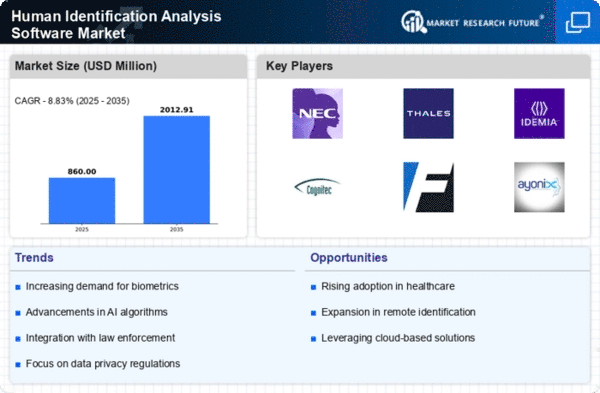
As per MRFR analysis, the Human Identification Analysis Software Market was estimated at 790.22 USD Million in 2024. The Human Identification Analysis Software industry is projected to grow from 869.05 USD Million in 2025 to 2012.91 USD Million by 2035, exhibiting a compound annual growth rate (CAGR) of 8.83% during the forecast period 2025 - 2035.

Key Market Trends & Highlights

The Human Identification Analysis Software Market is poised for substantial growth driven by technological advancements and increasing regulatory demands.

  • The integration of AI and machine learning is transforming the capabilities of human identification analysis software.
  • Data privacy and compliance are becoming paramount as organizations seek to protect sensitive information.
  • North America remains the largest market, while the Asia-Pacific region is emerging as the fastest-growing area for human identification solutions.
  • Rising demand for biometric solutions and increasing regulatory requirements are key drivers propelling market expansion.

Market Size & Forecast

2024 Market Size 790.22 (USD Million)
2035 Market Size 2012.91 (USD Million)
CAGR (2025 - 2035) 8.83%
Largest Regional Market Share in 2024 North America

Major Players

NEC Corporation (JP), Thales Group (FR), IDEMIA (FR), Cognitec Systems (DE), FaceFirst (US), Ayonix (JP), GenKey (NG), MorphoTrust USA (US), SRI International (US)

Market Trends

The Human Identification Analysis Software Market is currently experiencing a transformative phase, driven by advancements in technology and increasing demand for efficient identification solutions. Organizations across various sectors, including law enforcement, healthcare, and corporate security, are increasingly adopting sophisticated software to enhance their identification processes. This trend is largely influenced by the growing need for accurate and reliable identification methods, which are essential for ensuring safety and security in diverse environments. Furthermore, the integration of artificial intelligence and machine learning into these software solutions appears to be revolutionizing the way human identification is conducted, offering enhanced accuracy and speed. In addition to technological advancements, regulatory frameworks and compliance requirements are shaping the landscape of the Human Identification Analysis Software Market. Governments and regulatory bodies are emphasizing the importance of data protection and privacy, which necessitates the development of software that adheres to stringent guidelines. This focus on compliance is likely to drive innovation, as companies strive to create solutions that not only meet legal standards but also address ethical considerations. As the market evolves, it seems poised for growth, with potential opportunities for new entrants and established players alike to capitalize on emerging trends and consumer demands.

Integration of AI and Machine Learning

The incorporation of artificial intelligence and machine learning technologies into human identification analysis software is becoming increasingly prevalent. This trend enhances the accuracy and efficiency of identification processes, allowing for quicker and more reliable results. As these technologies continue to evolve, they may further transform the capabilities of identification systems.

Focus on Data Privacy and Compliance

With growing concerns regarding data privacy, there is a heightened emphasis on compliance with regulations in the Human Identification Analysis Software Market. Organizations are prioritizing solutions that not only provide effective identification but also adhere to legal standards, ensuring the protection of sensitive information.

Expansion in Diverse Sectors

The application of human identification analysis software is expanding across various sectors, including healthcare, law enforcement, and corporate security. This diversification indicates a broader recognition of the importance of reliable identification methods, suggesting that the market may continue to grow as more industries adopt these technologies.

Human Identification Analysis Software Market Market Drivers

Market Growth Projections

The Global Human Identification Analysis Software Market Industry is on a trajectory of substantial growth, with projections indicating a rise from 2.48 USD Billion in 2024 to 6.92 USD Billion by 2035. This growth is underpinned by a compound annual growth rate (CAGR) of 9.77% from 2025 to 2035. The increasing integration of biometric technologies across various sectors, coupled with the growing need for enhanced security measures, suggests a robust demand for human identification analysis software. This upward trend reflects the industry's adaptability to evolving security challenges and technological advancements, positioning it for continued expansion in the coming years.

Rising Cybersecurity Threats

The Global Human Identification Analysis Software Market Industry is increasingly shaped by the rising threats posed by cybercrime and identity theft. As organizations face heightened risks, there is a growing emphasis on implementing robust identification solutions to protect sensitive data and maintain user trust. Biometric authentication methods are being recognized for their effectiveness in mitigating these threats, leading to a surge in adoption across various sectors. This trend is expected to contribute to the market's growth, with projections indicating an increase from 2.48 USD Billion in 2024 to 6.92 USD Billion by 2035. The focus on cybersecurity is likely to drive further innovations in identification technologies.

Regulatory Compliance and Standards

The Global Human Identification Analysis Software Market Industry is significantly influenced by the need for regulatory compliance and adherence to standards. Governments and regulatory bodies worldwide are increasingly mandating the use of identification technologies to enhance security and streamline processes. This regulatory landscape compels organizations to adopt human identification analysis software to meet compliance requirements. As a result, the market is poised for growth, with estimates suggesting an increase from 2.48 USD Billion in 2024 to 6.92 USD Billion by 2035. The emphasis on compliance not only drives demand but also fosters innovation in the development of reliable identification solutions.

Growing Adoption in Healthcare Sector

The healthcare sector is emerging as a key driver for the Global Human Identification Analysis Software Market Industry. With the increasing need for accurate patient identification and data management, healthcare providers are adopting advanced identification technologies to enhance patient safety and streamline operations. Biometric systems facilitate secure access to patient records, thereby reducing errors and improving overall healthcare delivery. The market is projected to grow from 2.48 USD Billion in 2024 to 6.92 USD Billion by 2035, highlighting the sector's pivotal role in driving demand for human identification analysis software. This trend reflects a broader commitment to leveraging technology for improved healthcare outcomes.

Increasing Demand for Security Solutions

The Global Human Identification Analysis Software Market Industry is experiencing a surge in demand for advanced security solutions. This trend is driven by rising concerns over personal safety and the need for enhanced security measures across various sectors, including law enforcement, healthcare, and corporate environments. As organizations increasingly adopt biometric technologies, the market is projected to grow from 2.48 USD Billion in 2024 to an estimated 6.92 USD Billion by 2035, reflecting a compound annual growth rate (CAGR) of 9.77% from 2025 to 2035. This growth indicates a robust shift towards integrating sophisticated identification systems to mitigate security risks.

Technological Advancements in Biometric Systems

Technological innovations play a pivotal role in shaping the Global Human Identification Analysis Software Market Industry. The advent of sophisticated biometric systems, such as facial recognition, fingerprint scanning, and iris recognition, has revolutionized identification processes. These advancements not only enhance accuracy but also improve the speed of identification, making them indispensable in various applications. As organizations seek to leverage these technologies, the market is expected to witness substantial growth, with projections indicating a rise from 2.48 USD Billion in 2024 to 6.92 USD Billion by 2035. This trend underscores the importance of continuous innovation in driving market expansion.

Market Segment Insights

By Application: Biometric Identification (Largest) vs. Forensic Analysis (Fastest-Growing)

<p>The Human Identification Analysis Software Market is significantly driven by <a href="https://www.marketresearchfuture.com/reports/biometric-identification-market-29843" target="_blank" title="biometric identification">Biometric Identification</a>, which dominates with a substantial market share. This segment encompasses a range of technologies such as fingerprint recognition, iris scanning, and facial recognition, which are widely adopted across various sectors including law enforcement, banking, and healthcare. Following closely, Forensic Analysis has emerged as a strong contender, reflecting increasing investment in crime lab technologies and enhancing the accuracy in criminal investigations.</p>

<p>Biometric Identification (Dominant) vs. Forensic Analysis (Emerging)</p>

<p>Biometric Identification is characterized by its extensive use and acceptance, forming the cornerstone of modern security solutions. It combines advanced technologies with user-friendly interfaces, making it an ideal choice for numerous applications. On the other hand, Forensic Analysis is rapidly gaining prominence due to innovations in analytical tools and methods that support law enforcement agencies in solving crimes more effectively. This emerging segment is bolstered by the integration of artificial intelligence and machine learning, streamlining processes and enhancing precision in forensic investigations.</p>

By End Use: Government (Largest) vs. Healthcare (Fastest-Growing)

In the Human Identification Analysis Software Market, the segmentation by end use reveals that the Government sector holds the largest share, primarily due to its extensive applications in national security, law enforcement, and immigration control. The sector relies on advanced identification technologies to enhance safety and streamline operations. Meanwhile, the Healthcare sector is emerging as the fastest-growing segment, driven by the increasing adoption of biometrics for patient identification and fraud prevention. The growth trends in these segments are being fueled by rising security concerns globally, advancements in identification technologies, and their integration into various applications. The Government's demand for fortified security will sustain its position, while the Healthcare sector's focus on enhancing patient safety and streamlining operations will propel it forward rapidly, making it increasingly relevant in the market.

Healthcare: Patient Identification (Dominant) vs. Banking: Fraud Detection (Emerging)

The Patient Identification sub-segment within the Healthcare sector is currently dominant due to its pivotal role in ensuring correct patient identification, which enhances safety and reduces medical errors. Healthcare institutions are leveraging advanced human identification analysis software to manage patient records accurately, contributing to improved patient outcomes. Conversely, the Banking sector's fraud detection segment is considered an emerging force in the market. With fraud becoming more sophisticated, banks are turning to identification software to bolster security, prevent financial losses, and ensure regulatory compliance. While the Patient Identification sub-segment benefits from established regulations and widespread adoption, the Banking sector's emerging focus indicates a significant shift toward integrating cutting-edge identification technologies, highlighting the importance of identity management across varied applications.

By Deployment Type: Cloud-Based (Largest) vs. On-Premises (Fastest-Growing)

In the Human Identification Analysis Software Market, the deployment type segment showcases a notable distribution among On-Premises, Cloud-Based, and Hybrid solutions. Cloud-Based solutions hold the largest market share due to their scalability, ease of access, and affordability, appealing to various organizations. On-Premises and Hybrid deployments, while smaller in share, cater to sectors requiring enhanced security and control over sensitive data, thus maintaining a significant presence in the market. In terms of growth trends, Cloud-Based deployments are witnessing robust adoption driven by organizations seeking efficiency and remote accessibility. Meanwhile, On-Premises solutions are emerging rapidly as businesses prioritize data security in the face of rising cyber threats. The Hybrid model offers a blend of both, facilitating a smooth transition for organizations while keeping pace with evolving technological advancements.

Deployment Type: Cloud-Based (Dominant) vs. Hybrid (Emerging)

Cloud-Based deployment in the Human Identification Analysis Software Market has established itself as the dominant choice due to its flexibility and cost effectiveness, appealing to organizations of varying sizes. By providing real-time updates, collaboration, and easy integration with other cloud services, it meets the growing demands of users. Hybrid deployments, on the other hand, are seen as an emerging trend, representing a strategic solution for organizations that need to balance flexibility with the stringent data governance requirements of On-Premises systems. This combination allows businesses to leverage both cloud efficiency and the security of local storage, making it highly attractive in sectors where data sensitivity is paramount.

By Technology: Facial Recognition (Largest) vs. Fingerprint Recognition (Fastest-Growing)

In the Human Identification Analysis Software Market, Facial Recognition leads significantly, capturing the largest share of the market due to its wide acceptance in security and law enforcement sectors. It is widely implemented in various applications, enhancing identification accuracy and operational efficiency. Fingerprint Recognition, while not as dominant, is experiencing rapid growth, attributed to increasing adoption in mobile devices and biometric <a href="https://www.marketresearchfuture.com/reports/security-systems-market-4405" target="_blank" title="security systems">security systems</a>, making it a critical segment to watch. The growth of the Fingerprint Recognition sector is primarily driven by advancements in technology, which improve the speed and accuracy of fingerprint analysis. Factors such as a growing demand for enhanced security measures across industries and increased awareness of biometric solutions contribute to its rapid market expansion. Furthermore, evolving regulations and standards promote the use of biometric solutions, further supporting this growth trajectory.

Technology: Facial Recognition (Dominant) vs. Iris Recognition (Emerging)

Facial Recognition remains the dominant player in the Human Identification Analysis Software Market, characterized by its ability to deliver quick and non-intrusive identification solutions across varied applications, from public safety to personal devices. Its extensive integration into security systems has solidified its position as the go-to technology for reliable identification. In contrast, Iris Recognition is an emerging segment, recognized for its high accuracy and low false acceptance rates. While still in the growing phase, Iris Recognition is gaining traction in secure facilities and mobile identification, driven by advancements in imaging technology and user acceptance of biometric solutions. As its adoption increases, it stands poised to become a critical contender as security preferences shift towards more sophisticated identification methods.

By User Type: Large Enterprises (Largest) vs. Small and Medium Enterprises (Fastest-Growing)

In the Human Identification Analysis Software Market, the distribution of market share among user types shows that large enterprises hold the largest share. This category benefits from significant investments in robust security systems and advanced technologies to enhance their identification processes. On the other hand, small and medium enterprises, while having a smaller share, exhibit rapid growth due to increasing demand for affordable and effective identification solutions in a competitive market. Their adaptability and need for streamlined operations drive this expansion.

Large Enterprises (Dominant) vs. Small and Medium Enterprises (Emerging)

Large enterprises represent the dominant user type in the Human Identification Analysis Software market. They typically invest substantially in comprehensive identification solutions, ensuring compliance with stringent security standards and meeting the demands of large-scale operations. Their established operations, coupled with significant budgets, allow for tailored implementations that leverage the latest technological advancements. Conversely, small and medium enterprises are emerging as an important segment, demonstrating a keen interest in user-friendly and cost-effective solutions. They are increasingly adopting these technologies to enhance security measures and operational efficiency, aligning with a trend of digital transformation within their businesses.

Get more detailed insights about Human Identification Analysis Software Market Research Report - Forecast To 2035

Regional Insights

North America : Market Leader in Innovation

North America continues to lead the Human Identification Analysis Software Market, holding a significant market share of $395.11M in 2024. The region's growth is driven by increasing demand for advanced security solutions, regulatory support for biometric technologies, and a robust technological infrastructure. Government initiatives aimed at enhancing public safety and security are further propelling market expansion, making it a key player in the global landscape. The competitive landscape in North America is characterized by the presence of major players such as NEC Corporation, Thales Group, and FaceFirst. The U.S. stands out as a leader in adopting innovative identification technologies, supported by a favorable regulatory environment. The market is witnessing a surge in partnerships and collaborations among key players to enhance product offerings and meet the growing demand for secure identification solutions.

Europe : Emerging Market with Growth Potential

Europe's Human Identification Analysis Software Market is valued at $215.06M, reflecting a growing interest in biometric solutions across various sectors. The region's growth is driven by stringent regulations on data protection and privacy, which encourage the adoption of secure identification technologies. Additionally, increasing investments in public safety and law enforcement are significant catalysts for market expansion, positioning Europe as a vital player in this sector. Leading countries such as Germany, France, and the UK are at the forefront of this market, with key players like IDEMIA and Cognitec Systems driving innovation. The competitive landscape is marked by a focus on developing advanced biometric solutions that comply with EU regulations. The presence of established companies and startups alike fosters a dynamic environment for growth and technological advancement.

Asia-Pacific : Rapidly Growing Market Segment

The Asia-Pacific region, with a market size of $145.05M, is witnessing rapid growth in the Human Identification Analysis Software Market. This growth is fueled by increasing urbanization, rising security concerns, and the adoption of advanced technologies in countries like Japan, China, and India. Government initiatives aimed at enhancing national security and public safety are also significant drivers, creating a favorable environment for market expansion. Japan and China are leading the charge in adopting biometric technologies, with key players like Ayonix and NEC Corporation making substantial contributions. The competitive landscape is evolving, with both established companies and new entrants focusing on innovative solutions to meet the growing demand. The region's diverse market dynamics present unique opportunities for growth and collaboration among industry stakeholders.

Middle East and Africa : Emerging Market with Unique Challenges

The Middle East and Africa region, valued at $35.0M, is gradually emerging in the Human Identification Analysis Software Market. The growth is primarily driven by increasing security needs in both public and private sectors, alongside government initiatives aimed at enhancing national security. The region's unique challenges, including political instability and varying regulatory frameworks, impact market dynamics but also create opportunities for innovative solutions tailored to local needs. Countries like South Africa and the UAE are leading the market, with a growing presence of key players such as GenKey and MorphoTrust USA. The competitive landscape is characterized by a mix of local and international companies striving to address the region's specific security challenges. As the market matures, there is potential for significant growth through partnerships and technology transfer initiatives.

Key Players and Competitive Insights

The Human Identification Analysis Software Market is currently characterized by a dynamic competitive landscape, driven by technological advancements and increasing demand for security solutions across various sectors. Key players such as NEC Corporation (Japan), Thales Group (France), and IDEMIA (France) are at the forefront, each adopting distinct strategies to enhance their market positioning. NEC Corporation (Japan) emphasizes innovation through the development of advanced biometric technologies, while Thales Group (France) focuses on strategic partnerships to expand its global footprint. IDEMIA (France) is leveraging its expertise in identity verification to cater to the growing needs of government and commercial sectors, collectively shaping a competitive environment that is increasingly reliant on cutting-edge technology and strategic collaborations.In terms of business tactics, companies are localizing manufacturing and optimizing supply chains to enhance operational efficiency. The market appears moderately fragmented, with several players vying for market share. However, the collective influence of major companies is significant, as they drive innovation and set industry standards. This competitive structure fosters an environment where agility and responsiveness to market demands are crucial for success.

In November Thales Group (France) announced a partnership with a leading cybersecurity firm to integrate advanced AI capabilities into its human identification solutions. This strategic move is likely to enhance the security features of their offerings, positioning Thales as a leader in the integration of AI within biometric systems. Such collaborations may not only improve product performance but also expand their customer base in sectors requiring robust security measures.

In October IDEMIA (France) launched a new biometric authentication platform aimed at the financial services sector. This platform utilizes cutting-edge facial recognition technology to streamline customer onboarding processes. The introduction of this platform signifies IDEMIA's commitment to innovation and its strategic focus on addressing the specific needs of the financial industry, potentially leading to increased market penetration and customer loyalty.

In September NEC Corporation (Japan) unveiled a new suite of biometric solutions designed for smart city applications. This initiative reflects NEC's strategic intent to diversify its offerings and tap into the growing smart city market. By aligning its products with urban development trends, NEC is likely to enhance its competitive edge and establish itself as a key player in the integration of biometric technology within urban infrastructure.

As of December the Human Identification Analysis Software Market is witnessing trends such as digitalization, AI integration, and a heightened focus on sustainability. Strategic alliances are increasingly shaping the competitive landscape, enabling companies to leverage complementary strengths. The shift from price-based competition to a focus on innovation and technology is evident, as firms prioritize reliability in their supply chains and the development of advanced solutions. Looking ahead, competitive differentiation will likely evolve, with an emphasis on technological advancements and the ability to adapt to changing market demands.

Key Companies in the Human Identification Analysis Software Market include

Industry Developments

    • Engineered nanoparticles enable deep proteomics studies at scale by leveraging tunable nano-bio interactions.
    • Facial recognition tech's hidden role in many industries is not acting up to the mark.


Future Outlook

Human Identification Analysis Software Market Future Outlook

The Human Identification Analysis Software Market is projected to grow at an 8.83% CAGR from 2025 to 2035, driven by technological advancements, increasing security concerns, and regulatory compliance.

New opportunities lie in:

  • Integration of AI-driven analytics for enhanced identification accuracy.
  • Development of mobile identification solutions for law enforcement.
  • Expansion into emerging markets with tailored software solutions.

By 2035, the market is expected to be robust, driven by innovation and diverse applications.

Market Segmentation

Human Identification Analysis Software Market End Use Outlook

  • Government
  • Healthcare
  • Banking
  • Retail
  • Education

Human Identification Analysis Software Market User Type Outlook

  • Individual Users
  • Small and Medium Enterprises
  • Large Enterprises

Human Identification Analysis Software Market Technology Outlook

  • Facial Recognition
  • Fingerprint Recognition
  • Iris Recognition
  • Voice Recognition

Human Identification Analysis Software Market Application Outlook

  • Biometric Authentication
  • Forensic Analysis
  • Access Control
  • Identity Verification
  • Surveillance

Human Identification Analysis Software Market Deployment Type Outlook

  • On-Premises
  • Cloud-Based
  • Hybrid

Report Scope

MARKET SIZE 2024 790.22(USD Million)
MARKET SIZE 2025 869.05(USD Million)
MARKET SIZE 2035 2012.91(USD Million)
COMPOUND ANNUAL GROWTH RATE (CAGR) 8.83% (2025 - 2035)
REPORT COVERAGE Revenue Forecast, Competitive Landscape, Growth Factors, and Trends
BASE YEAR 2024
Market Forecast Period 2025 - 2035
Historical Data 2019 - 2024
Market Forecast Units USD Million
Key Companies Profiled NEC Corporation (JP), Thales Group (FR), IDEMIA (FR), Cognitec Systems (DE), FaceFirst (US), Ayonix (JP), GenKey (NG), MorphoTrust USA (US), SRI International (US)
Segments Covered Application, End Use, Deployment Type, Technology, User Type
Key Market Opportunities Integration of artificial intelligence enhances accuracy and efficiency in the Human Identification Analysis Software Market.
Key Market Dynamics Rising demand for advanced biometric solutions drives innovation and competition in the Human Identification Analysis Software market.
Countries Covered North America, Europe, APAC, South America, MEA

FAQs

What is the projected market valuation for the Human Identification Analysis Software Market by 2035?

<p>The projected market valuation for the Human Identification Analysis Software Market is 2012.91 USD Million by 2035.</p>

What was the overall market valuation in 2024?

<p>The overall market valuation for the Human Identification Analysis Software Market was 790.22 USD Million in 2024.</p>

What is the expected CAGR for the Human Identification Analysis Software Market during the forecast period 2025 - 2035?

<p>The expected CAGR for the Human Identification Analysis Software Market during the forecast period 2025 - 2035 is 8.83%.</p>

Which application segment had the highest valuation in 2024?

<p>In 2024, the Access Control application segment had the highest valuation at 197.79 USD Million.</p>

What is the projected valuation for the Cloud-Based deployment type by 2035?

<p>The projected valuation for the Cloud-Based deployment type is 900.0 USD Million by 2035.</p>

Which technology segment is expected to show the highest growth by 2035?

The DNA Analysis technology segment is expected to show the highest growth, with a projected valuation of 762.91 USD Million by 2035.

Who are the key players in the Human Identification Analysis Software Market?

Key players in the market include NEC Corporation, Thales Group, IDEMIA, and Cognitec Systems.

What was the valuation of the Healthcare end-use segment in 2024?

The valuation of the Healthcare end-use segment was 200.0 USD Million in 2024.

How does the Fingerprint Recognition technology segment compare to others in 2024?

In 2024, the Fingerprint Recognition technology segment had a valuation of 197.03 USD Million, making it one of the leading segments.

What is the projected valuation for the Government end-use segment by 2035?

The projected valuation for the Government end-use segment is 400.0 USD Million by 2035.

  1. SECTION I: EXECUTIVE SUMMARY AND KEY HIGHLIGHTS
    1. | 1.1 EXECUTIVE SUMMARY
    2. | | 1.1.1 Market Overview
    3. | | 1.1.2 Key Findings
    4. | | 1.1.3 Market Segmentation
    5. | | 1.1.4 Competitive Landscape
    6. | | 1.1.5 Challenges and Opportunities
    7. | | 1.1.6 Future Outlook
  2. SECTION II: SCOPING, METHODOLOGY AND MARKET STRUCTURE
    1. | 2.1 MARKET INTRODUCTION
    2. | | 2.1.1 Definition
    3. | | 2.1.2 Scope of the study
    4. | | | 2.1.2.1 Research Objective
    5. | | | 2.1.2.2 Assumption
    6. | | | 2.1.2.3 Limitations
    7. | 2.2 RESEARCH METHODOLOGY
    8. | | 2.2.1 Overview
    9. | | 2.2.2 Data Mining
    10. | | 2.2.3 Secondary Research
    11. | | 2.2.4 Primary Research
    12. | | | 2.2.4.1 Primary Interviews and Information Gathering Process
    13. | | | 2.2.4.2 Breakdown of Primary Respondents
    14. | | 2.2.5 Forecasting Model
    15. | | 2.2.6 Market Size Estimation
    16. | | | 2.2.6.1 Bottom-Up Approach
    17. | | | 2.2.6.2 Top-Down Approach
    18. | | 2.2.7 Data Triangulation
    19. | | 2.2.8 Validation
  3. SECTION III: QUALITATIVE ANALYSIS
    1. | 3.1 MARKET DYNAMICS
    2. | | 3.1.1 Overview
    3. | | 3.1.2 Drivers
    4. | | 3.1.3 Restraints
    5. | | 3.1.4 Opportunities
    6. | 3.2 MARKET FACTOR ANALYSIS
    7. | | 3.2.1 Value chain Analysis
    8. | | 3.2.2 Porter's Five Forces Analysis
    9. | | | 3.2.2.1 Bargaining Power of Suppliers
    10. | | | 3.2.2.2 Bargaining Power of Buyers
    11. | | | 3.2.2.3 Threat of New Entrants
    12. | | | 3.2.2.4 Threat of Substitutes
    13. | | | 3.2.2.5 Intensity of Rivalry
    14. | | 3.2.3 COVID-19 Impact Analysis
    15. | | | 3.2.3.1 Market Impact Analysis
    16. | | | 3.2.3.2 Regional Impact
    17. | | | 3.2.3.3 Opportunity and Threat Analysis
  4. SECTION IV: QUANTITATIVE ANALYSIS
    1. | 4.1 Healthcare, BY Application (USD Million)
    2. | | 4.1.1 Biometric Identification
    3. | | 4.1.2 Forensic Analysis
    4. | | 4.1.3 Surveillance Systems
    5. | | 4.1.4 Access Control
    6. | | 4.1.5 Identity Verification
    7. | 4.2 Healthcare, BY End Use (USD Million)
    8. | | 4.2.1 Government
    9. | | 4.2.2 Healthcare
    10. | | 4.2.3 Banking and Financial Services
    11. | | 4.2.4 Retail
    12. | | 4.2.5 Telecommunications
    13. | 4.3 Healthcare, BY Deployment Type (USD Million)
    14. | | 4.3.1 On-Premises
    15. | | 4.3.2 Cloud-Based
    16. | | 4.3.3 Hybrid
    17. | 4.4 Healthcare, BY Technology (USD Million)
    18. | | 4.4.1 Facial Recognition
    19. | | 4.4.2 Fingerprint Recognition
    20. | | 4.4.3 Iris Recognition
    21. | | 4.4.4 Voice Recognition
    22. | | 4.4.5 DNA Analysis
    23. | 4.5 Healthcare, BY Region (USD Million)
    24. | | 4.5.1 North America
    25. | | | 4.5.1.1 US
    26. | | | 4.5.1.2 Canada
    27. | | 4.5.2 Europe
    28. | | | 4.5.2.1 Germany
    29. | | | 4.5.2.2 UK
    30. | | | 4.5.2.3 France
    31. | | | 4.5.2.4 Russia
    32. | | | 4.5.2.5 Italy
    33. | | | 4.5.2.6 Spain
    34. | | | 4.5.2.7 Rest of Europe
    35. | | 4.5.3 APAC
    36. | | | 4.5.3.1 China
    37. | | | 4.5.3.2 India
    38. | | | 4.5.3.3 Japan
    39. | | | 4.5.3.4 South Korea
    40. | | | 4.5.3.5 Malaysia
    41. | | | 4.5.3.6 Thailand
    42. | | | 4.5.3.7 Indonesia
    43. | | | 4.5.3.8 Rest of APAC
    44. | | 4.5.4 South America
    45. | | | 4.5.4.1 Brazil
    46. | | | 4.5.4.2 Mexico
    47. | | | 4.5.4.3 Argentina
    48. | | | 4.5.4.4 Rest of South America
    49. | | 4.5.5 MEA
    50. | | | 4.5.5.1 GCC Countries
    51. | | | 4.5.5.2 South Africa
    52. | | | 4.5.5.3 Rest of MEA
  5. SECTION V: COMPETITIVE ANALYSIS
    1. | 5.1 Competitive Landscape
    2. | | 5.1.1 Overview
    3. | | 5.1.2 Competitive Analysis
    4. | | 5.1.3 Market share Analysis
    5. | | 5.1.4 Major Growth Strategy in the Healthcare
    6. | | 5.1.5 Competitive Benchmarking
    7. | | 5.1.6 Leading Players in Terms of Number of Developments in the Healthcare
    8. | | 5.1.7 Key developments and growth strategies
    9. | | | 5.1.7.1 New Product Launch/Service Deployment
    10. | | | 5.1.7.2 Merger & Acquisitions
    11. | | | 5.1.7.3 Joint Ventures
    12. | | 5.1.8 Major Players Financial Matrix
    13. | | | 5.1.8.1 Sales and Operating Income
    14. | | | 5.1.8.2 Major Players R&D Expenditure. 2023
    15. | 5.2 Company Profiles
    16. | | 5.2.1 NEC Corporation (JP)
    17. | | | 5.2.1.1 Financial Overview
    18. | | | 5.2.1.2 Products Offered
    19. | | | 5.2.1.3 Key Developments
    20. | | | 5.2.1.4 SWOT Analysis
    21. | | | 5.2.1.5 Key Strategies
    22. | | 5.2.2 Thales Group (FR)
    23. | | | 5.2.2.1 Financial Overview
    24. | | | 5.2.2.2 Products Offered
    25. | | | 5.2.2.3 Key Developments
    26. | | | 5.2.2.4 SWOT Analysis
    27. | | | 5.2.2.5 Key Strategies
    28. | | 5.2.3 IDEMIA (FR)
    29. | | | 5.2.3.1 Financial Overview
    30. | | | 5.2.3.2 Products Offered
    31. | | | 5.2.3.3 Key Developments
    32. | | | 5.2.3.4 SWOT Analysis
    33. | | | 5.2.3.5 Key Strategies
    34. | | 5.2.4 Gemalto (NL)
    35. | | | 5.2.4.1 Financial Overview
    36. | | | 5.2.4.2 Products Offered
    37. | | | 5.2.4.3 Key Developments
    38. | | | 5.2.4.4 SWOT Analysis
    39. | | | 5.2.4.5 Key Strategies
    40. | | 5.2.5 MorphoTrust USA (US)
    41. | | | 5.2.5.1 Financial Overview
    42. | | | 5.2.5.2 Products Offered
    43. | | | 5.2.5.3 Key Developments
    44. | | | 5.2.5.4 SWOT Analysis
    45. | | | 5.2.5.5 Key Strategies
    46. | | 5.2.6 Cognitec Systems (DE)
    47. | | | 5.2.6.1 Financial Overview
    48. | | | 5.2.6.2 Products Offered
    49. | | | 5.2.6.3 Key Developments
    50. | | | 5.2.6.4 SWOT Analysis
    51. | | | 5.2.6.5 Key Strategies
    52. | | 5.2.7 FaceFirst (US)
    53. | | | 5.2.7.1 Financial Overview
    54. | | | 5.2.7.2 Products Offered
    55. | | | 5.2.7.3 Key Developments
    56. | | | 5.2.7.4 SWOT Analysis
    57. | | | 5.2.7.5 Key Strategies
    58. | | 5.2.8 Ayonix (JP)
    59. | | | 5.2.8.1 Financial Overview
    60. | | | 5.2.8.2 Products Offered
    61. | | | 5.2.8.3 Key Developments
    62. | | | 5.2.8.4 SWOT Analysis
    63. | | | 5.2.8.5 Key Strategies
    64. | | 5.2.9 VeriFinger (FI)
    65. | | | 5.2.9.1 Financial Overview
    66. | | | 5.2.9.2 Products Offered
    67. | | | 5.2.9.3 Key Developments
    68. | | | 5.2.9.4 SWOT Analysis
    69. | | | 5.2.9.5 Key Strategies
    70. | 5.3 Appendix
    71. | | 5.3.1 References
    72. | | 5.3.2 Related Reports
  6. LIST OF FIGURES
    1. | 6.1 MARKET SYNOPSIS
    2. | 6.2 NORTH AMERICA MARKET ANALYSIS
    3. | 6.3 US MARKET ANALYSIS BY APPLICATION
    4. | 6.4 US MARKET ANALYSIS BY END USE
    5. | 6.5 US MARKET ANALYSIS BY DEPLOYMENT TYPE
    6. | 6.6 US MARKET ANALYSIS BY TECHNOLOGY
    7. | 6.7 CANADA MARKET ANALYSIS BY APPLICATION
    8. | 6.8 CANADA MARKET ANALYSIS BY END USE
    9. | 6.9 CANADA MARKET ANALYSIS BY DEPLOYMENT TYPE
    10. | 6.10 CANADA MARKET ANALYSIS BY TECHNOLOGY
    11. | 6.11 EUROPE MARKET ANALYSIS
    12. | 6.12 GERMANY MARKET ANALYSIS BY APPLICATION
    13. | 6.13 GERMANY MARKET ANALYSIS BY END USE
    14. | 6.14 GERMANY MARKET ANALYSIS BY DEPLOYMENT TYPE
    15. | 6.15 GERMANY MARKET ANALYSIS BY TECHNOLOGY
    16. | 6.16 UK MARKET ANALYSIS BY APPLICATION
    17. | 6.17 UK MARKET ANALYSIS BY END USE
    18. | 6.18 UK MARKET ANALYSIS BY DEPLOYMENT TYPE
    19. | 6.19 UK MARKET ANALYSIS BY TECHNOLOGY
    20. | 6.20 FRANCE MARKET ANALYSIS BY APPLICATION
    21. | 6.21 FRANCE MARKET ANALYSIS BY END USE
    22. | 6.22 FRANCE MARKET ANALYSIS BY DEPLOYMENT TYPE
    23. | 6.23 FRANCE MARKET ANALYSIS BY TECHNOLOGY
    24. | 6.24 RUSSIA MARKET ANALYSIS BY APPLICATION
    25. | 6.25 RUSSIA MARKET ANALYSIS BY END USE
    26. | 6.26 RUSSIA MARKET ANALYSIS BY DEPLOYMENT TYPE
    27. | 6.27 RUSSIA MARKET ANALYSIS BY TECHNOLOGY
    28. | 6.28 ITALY MARKET ANALYSIS BY APPLICATION
    29. | 6.29 ITALY MARKET ANALYSIS BY END USE
    30. | 6.30 ITALY MARKET ANALYSIS BY DEPLOYMENT TYPE
    31. | 6.31 ITALY MARKET ANALYSIS BY TECHNOLOGY
    32. | 6.32 SPAIN MARKET ANALYSIS BY APPLICATION
    33. | 6.33 SPAIN MARKET ANALYSIS BY END USE
    34. | 6.34 SPAIN MARKET ANALYSIS BY DEPLOYMENT TYPE
    35. | 6.35 SPAIN MARKET ANALYSIS BY TECHNOLOGY
    36. | 6.36 REST OF EUROPE MARKET ANALYSIS BY APPLICATION
    37. | 6.37 REST OF EUROPE MARKET ANALYSIS BY END USE
    38. | 6.38 REST OF EUROPE MARKET ANALYSIS BY DEPLOYMENT TYPE
    39. | 6.39 REST OF EUROPE MARKET ANALYSIS BY TECHNOLOGY
    40. | 6.40 APAC MARKET ANALYSIS
    41. | 6.41 CHINA MARKET ANALYSIS BY APPLICATION
    42. | 6.42 CHINA MARKET ANALYSIS BY END USE
    43. | 6.43 CHINA MARKET ANALYSIS BY DEPLOYMENT TYPE
    44. | 6.44 CHINA MARKET ANALYSIS BY TECHNOLOGY
    45. | 6.45 INDIA MARKET ANALYSIS BY APPLICATION
    46. | 6.46 INDIA MARKET ANALYSIS BY END USE
    47. | 6.47 INDIA MARKET ANALYSIS BY DEPLOYMENT TYPE
    48. | 6.48 INDIA MARKET ANALYSIS BY TECHNOLOGY
    49. | 6.49 JAPAN MARKET ANALYSIS BY APPLICATION
    50. | 6.50 JAPAN MARKET ANALYSIS BY END USE
    51. | 6.51 JAPAN MARKET ANALYSIS BY DEPLOYMENT TYPE
    52. | 6.52 JAPAN MARKET ANALYSIS BY TECHNOLOGY
    53. | 6.53 SOUTH KOREA MARKET ANALYSIS BY APPLICATION
    54. | 6.54 SOUTH KOREA MARKET ANALYSIS BY END USE
    55. | 6.55 SOUTH KOREA MARKET ANALYSIS BY DEPLOYMENT TYPE
    56. | 6.56 SOUTH KOREA MARKET ANALYSIS BY TECHNOLOGY
    57. | 6.57 MALAYSIA MARKET ANALYSIS BY APPLICATION
    58. | 6.58 MALAYSIA MARKET ANALYSIS BY END USE
    59. | 6.59 MALAYSIA MARKET ANALYSIS BY DEPLOYMENT TYPE
    60. | 6.60 MALAYSIA MARKET ANALYSIS BY TECHNOLOGY
    61. | 6.61 THAILAND MARKET ANALYSIS BY APPLICATION
    62. | 6.62 THAILAND MARKET ANALYSIS BY END USE
    63. | 6.63 THAILAND MARKET ANALYSIS BY DEPLOYMENT TYPE
    64. | 6.64 THAILAND MARKET ANALYSIS BY TECHNOLOGY
    65. | 6.65 INDONESIA MARKET ANALYSIS BY APPLICATION
    66. | 6.66 INDONESIA MARKET ANALYSIS BY END USE
    67. | 6.67 INDONESIA MARKET ANALYSIS BY DEPLOYMENT TYPE
    68. | 6.68 INDONESIA MARKET ANALYSIS BY TECHNOLOGY
    69. | 6.69 REST OF APAC MARKET ANALYSIS BY APPLICATION
    70. | 6.70 REST OF APAC MARKET ANALYSIS BY END USE
    71. | 6.71 REST OF APAC MARKET ANALYSIS BY DEPLOYMENT TYPE
    72. | 6.72 REST OF APAC MARKET ANALYSIS BY TECHNOLOGY
    73. | 6.73 SOUTH AMERICA MARKET ANALYSIS
    74. | 6.74 BRAZIL MARKET ANALYSIS BY APPLICATION
    75. | 6.75 BRAZIL MARKET ANALYSIS BY END USE
    76. | 6.76 BRAZIL MARKET ANALYSIS BY DEPLOYMENT TYPE
    77. | 6.77 BRAZIL MARKET ANALYSIS BY TECHNOLOGY
    78. | 6.78 MEXICO MARKET ANALYSIS BY APPLICATION
    79. | 6.79 MEXICO MARKET ANALYSIS BY END USE
    80. | 6.80 MEXICO MARKET ANALYSIS BY DEPLOYMENT TYPE
    81. | 6.81 MEXICO MARKET ANALYSIS BY TECHNOLOGY
    82. | 6.82 ARGENTINA MARKET ANALYSIS BY APPLICATION
    83. | 6.83 ARGENTINA MARKET ANALYSIS BY END USE
    84. | 6.84 ARGENTINA MARKET ANALYSIS BY DEPLOYMENT TYPE
    85. | 6.85 ARGENTINA MARKET ANALYSIS BY TECHNOLOGY
    86. | 6.86 REST OF SOUTH AMERICA MARKET ANALYSIS BY APPLICATION
    87. | 6.87 REST OF SOUTH AMERICA MARKET ANALYSIS BY END USE
    88. | 6.88 REST OF SOUTH AMERICA MARKET ANALYSIS BY DEPLOYMENT TYPE
    89. | 6.89 REST OF SOUTH AMERICA MARKET ANALYSIS BY TECHNOLOGY
    90. | 6.90 MEA MARKET ANALYSIS
    91. | 6.91 GCC COUNTRIES MARKET ANALYSIS BY APPLICATION
    92. | 6.92 GCC COUNTRIES MARKET ANALYSIS BY END USE
    93. | 6.93 GCC COUNTRIES MARKET ANALYSIS BY DEPLOYMENT TYPE
    94. | 6.94 GCC COUNTRIES MARKET ANALYSIS BY TECHNOLOGY
    95. | 6.95 SOUTH AFRICA MARKET ANALYSIS BY APPLICATION
    96. | 6.96 SOUTH AFRICA MARKET ANALYSIS BY END USE
    97. | 6.97 SOUTH AFRICA MARKET ANALYSIS BY DEPLOYMENT TYPE
    98. | 6.98 SOUTH AFRICA MARKET ANALYSIS BY TECHNOLOGY
    99. | 6.99 REST OF MEA MARKET ANALYSIS BY APPLICATION
    100. | 6.100 REST OF MEA MARKET ANALYSIS BY END USE
    101. | 6.101 REST OF MEA MARKET ANALYSIS BY DEPLOYMENT TYPE
    102. | 6.102 REST OF MEA MARKET ANALYSIS BY TECHNOLOGY
    103. | 6.103 KEY BUYING CRITERIA OF HEALTHCARE
    104. | 6.104 RESEARCH PROCESS OF MRFR
    105. | 6.105 DRO ANALYSIS OF HEALTHCARE
    106. | 6.106 DRIVERS IMPACT ANALYSIS: HEALTHCARE
    107. | 6.107 RESTRAINTS IMPACT ANALYSIS: HEALTHCARE
    108. | 6.108 SUPPLY / VALUE CHAIN: HEALTHCARE
    109. | 6.109 HEALTHCARE, BY APPLICATION, 2024 (% SHARE)
    110. | 6.110 HEALTHCARE, BY APPLICATION, 2024 TO 2035 (USD Million)
    111. | 6.111 HEALTHCARE, BY END USE, 2024 (% SHARE)
    112. | 6.112 HEALTHCARE, BY END USE, 2024 TO 2035 (USD Million)
    113. | 6.113 HEALTHCARE, BY DEPLOYMENT TYPE, 2024 (% SHARE)
    114. | 6.114 HEALTHCARE, BY DEPLOYMENT TYPE, 2024 TO 2035 (USD Million)
    115. | 6.115 HEALTHCARE, BY TECHNOLOGY, 2024 (% SHARE)
    116. | 6.116 HEALTHCARE, BY TECHNOLOGY, 2024 TO 2035 (USD Million)
    117. | 6.117 BENCHMARKING OF MAJOR COMPETITORS
  7. LIST OF TABLES
    1. | 7.1 LIST OF ASSUMPTIONS
    2. | | 7.1.1
    3. | 7.2 North America MARKET SIZE ESTIMATES; FORECAST
    4. | | 7.2.1 BY APPLICATION, 2025-2035 (USD Million)
    5. | | 7.2.2 BY END USE, 2025-2035 (USD Million)
    6. | | 7.2.3 BY DEPLOYMENT TYPE, 2025-2035 (USD Million)
    7. | | 7.2.4 BY TECHNOLOGY, 2025-2035 (USD Million)
    8. | 7.3 US MARKET SIZE ESTIMATES; FORECAST
    9. | | 7.3.1 BY APPLICATION, 2025-2035 (USD Million)
    10. | | 7.3.2 BY END USE, 2025-2035 (USD Million)
    11. | | 7.3.3 BY DEPLOYMENT TYPE, 2025-2035 (USD Million)
    12. | | 7.3.4 BY TECHNOLOGY, 2025-2035 (USD Million)
    13. | 7.4 Canada MARKET SIZE ESTIMATES; FORECAST
    14. | | 7.4.1 BY APPLICATION, 2025-2035 (USD Million)
    15. | | 7.4.2 BY END USE, 2025-2035 (USD Million)
    16. | | 7.4.3 BY DEPLOYMENT TYPE, 2025-2035 (USD Million)
    17. | | 7.4.4 BY TECHNOLOGY, 2025-2035 (USD Million)
    18. | 7.5 Europe MARKET SIZE ESTIMATES; FORECAST
    19. | | 7.5.1 BY APPLICATION, 2025-2035 (USD Million)
    20. | | 7.5.2 BY END USE, 2025-2035 (USD Million)
    21. | | 7.5.3 BY DEPLOYMENT TYPE, 2025-2035 (USD Million)
    22. | | 7.5.4 BY TECHNOLOGY, 2025-2035 (USD Million)
    23. | 7.6 Germany MARKET SIZE ESTIMATES; FORECAST
    24. | | 7.6.1 BY APPLICATION, 2025-2035 (USD Million)
    25. | | 7.6.2 BY END USE, 2025-2035 (USD Million)
    26. | | 7.6.3 BY DEPLOYMENT TYPE, 2025-2035 (USD Million)
    27. | | 7.6.4 BY TECHNOLOGY, 2025-2035 (USD Million)
    28. | 7.7 UK MARKET SIZE ESTIMATES; FORECAST
    29. | | 7.7.1 BY APPLICATION, 2025-2035 (USD Million)
    30. | | 7.7.2 BY END USE, 2025-2035 (USD Million)
    31. | | 7.7.3 BY DEPLOYMENT TYPE, 2025-2035 (USD Million)
    32. | | 7.7.4 BY TECHNOLOGY, 2025-2035 (USD Million)
    33. | 7.8 France MARKET SIZE ESTIMATES; FORECAST
    34. | | 7.8.1 BY APPLICATION, 2025-2035 (USD Million)
    35. | | 7.8.2 BY END USE, 2025-2035 (USD Million)
    36. | | 7.8.3 BY DEPLOYMENT TYPE, 2025-2035 (USD Million)
    37. | | 7.8.4 BY TECHNOLOGY, 2025-2035 (USD Million)
    38. | 7.9 Russia MARKET SIZE ESTIMATES; FORECAST
    39. | | 7.9.1 BY APPLICATION, 2025-2035 (USD Million)
    40. | | 7.9.2 BY END USE, 2025-2035 (USD Million)
    41. | | 7.9.3 BY DEPLOYMENT TYPE, 2025-2035 (USD Million)
    42. | | 7.9.4 BY TECHNOLOGY, 2025-2035 (USD Million)
    43. | 7.10 Italy MARKET SIZE ESTIMATES; FORECAST
    44. | | 7.10.1 BY APPLICATION, 2025-2035 (USD Million)
    45. | | 7.10.2 BY END USE, 2025-2035 (USD Million)
    46. | | 7.10.3 BY DEPLOYMENT TYPE, 2025-2035 (USD Million)
    47. | | 7.10.4 BY TECHNOLOGY, 2025-2035 (USD Million)
    48. | 7.11 Spain MARKET SIZE ESTIMATES; FORECAST
    49. | | 7.11.1 BY APPLICATION, 2025-2035 (USD Million)
    50. | | 7.11.2 BY END USE, 2025-2035 (USD Million)
    51. | | 7.11.3 BY DEPLOYMENT TYPE, 2025-2035 (USD Million)
    52. | | 7.11.4 BY TECHNOLOGY, 2025-2035 (USD Million)
    53. | 7.12 Rest of Europe MARKET SIZE ESTIMATES; FORECAST
    54. | | 7.12.1 BY APPLICATION, 2025-2035 (USD Million)
    55. | | 7.12.2 BY END USE, 2025-2035 (USD Million)
    56. | | 7.12.3 BY DEPLOYMENT TYPE, 2025-2035 (USD Million)
    57. | | 7.12.4 BY TECHNOLOGY, 2025-2035 (USD Million)
    58. | 7.13 APAC MARKET SIZE ESTIMATES; FORECAST
    59. | | 7.13.1 BY APPLICATION, 2025-2035 (USD Million)
    60. | | 7.13.2 BY END USE, 2025-2035 (USD Million)
    61. | | 7.13.3 BY DEPLOYMENT TYPE, 2025-2035 (USD Million)
    62. | | 7.13.4 BY TECHNOLOGY, 2025-2035 (USD Million)
    63. | 7.14 China MARKET SIZE ESTIMATES; FORECAST
    64. | | 7.14.1 BY APPLICATION, 2025-2035 (USD Million)
    65. | | 7.14.2 BY END USE, 2025-2035 (USD Million)
    66. | | 7.14.3 BY DEPLOYMENT TYPE, 2025-2035 (USD Million)
    67. | | 7.14.4 BY TECHNOLOGY, 2025-2035 (USD Million)
    68. | 7.15 India MARKET SIZE ESTIMATES; FORECAST
    69. | | 7.15.1 BY APPLICATION, 2025-2035 (USD Million)
    70. | | 7.15.2 BY END USE, 2025-2035 (USD Million)
    71. | | 7.15.3 BY DEPLOYMENT TYPE, 2025-2035 (USD Million)
    72. | | 7.15.4 BY TECHNOLOGY, 2025-2035 (USD Million)
    73. | 7.16 Japan MARKET SIZE ESTIMATES; FORECAST
    74. | | 7.16.1 BY APPLICATION, 2025-2035 (USD Million)
    75. | | 7.16.2 BY END USE, 2025-2035 (USD Million)
    76. | | 7.16.3 BY DEPLOYMENT TYPE, 2025-2035 (USD Million)
    77. | | 7.16.4 BY TECHNOLOGY, 2025-2035 (USD Million)
    78. | 7.17 South Korea MARKET SIZE ESTIMATES; FORECAST
    79. | | 7.17.1 BY APPLICATION, 2025-2035 (USD Million)
    80. | | 7.17.2 BY END USE, 2025-2035 (USD Million)
    81. | | 7.17.3 BY DEPLOYMENT TYPE, 2025-2035 (USD Million)
    82. | | 7.17.4 BY TECHNOLOGY, 2025-2035 (USD Million)
    83. | 7.18 Malaysia MARKET SIZE ESTIMATES; FORECAST
    84. | | 7.18.1 BY APPLICATION, 2025-2035 (USD Million)
    85. | | 7.18.2 BY END USE, 2025-2035 (USD Million)
    86. | | 7.18.3 BY DEPLOYMENT TYPE, 2025-2035 (USD Million)
    87. | | 7.18.4 BY TECHNOLOGY, 2025-2035 (USD Million)
    88. | 7.19 Thailand MARKET SIZE ESTIMATES; FORECAST
    89. | | 7.19.1 BY APPLICATION, 2025-2035 (USD Million)
    90. | | 7.19.2 BY END USE, 2025-2035 (USD Million)
    91. | | 7.19.3 BY DEPLOYMENT TYPE, 2025-2035 (USD Million)
    92. | | 7.19.4 BY TECHNOLOGY, 2025-2035 (USD Million)
    93. | 7.20 Indonesia MARKET SIZE ESTIMATES; FORECAST
    94. | | 7.20.1 BY APPLICATION, 2025-2035 (USD Million)
    95. | | 7.20.2 BY END USE, 2025-2035 (USD Million)
    96. | | 7.20.3 BY DEPLOYMENT TYPE, 2025-2035 (USD Million)
    97. | | 7.20.4 BY TECHNOLOGY, 2025-2035 (USD Million)
    98. | 7.21 Rest of APAC MARKET SIZE ESTIMATES; FORECAST
    99. | | 7.21.1 BY APPLICATION, 2025-2035 (USD Million)
    100. | | 7.21.2 BY END USE, 2025-2035 (USD Million)
    101. | | 7.21.3 BY DEPLOYMENT TYPE, 2025-2035 (USD Million)
    102. | | 7.21.4 BY TECHNOLOGY, 2025-2035 (USD Million)
    103. | 7.22 South America MARKET SIZE ESTIMATES; FORECAST
    104. | | 7.22.1 BY APPLICATION, 2025-2035 (USD Million)
    105. | | 7.22.2 BY END USE, 2025-2035 (USD Million)
    106. | | 7.22.3 BY DEPLOYMENT TYPE, 2025-2035 (USD Million)
    107. | | 7.22.4 BY TECHNOLOGY, 2025-2035 (USD Million)
    108. | 7.23 Brazil MARKET SIZE ESTIMATES; FORECAST
    109. | | 7.23.1 BY APPLICATION, 2025-2035 (USD Million)
    110. | | 7.23.2 BY END USE, 2025-2035 (USD Million)
    111. | | 7.23.3 BY DEPLOYMENT TYPE, 2025-2035 (USD Million)
    112. | | 7.23.4 BY TECHNOLOGY, 2025-2035 (USD Million)
    113. | 7.24 Mexico MARKET SIZE ESTIMATES; FORECAST
    114. | | 7.24.1 BY APPLICATION, 2025-2035 (USD Million)
    115. | | 7.24.2 BY END USE, 2025-2035 (USD Million)
    116. | | 7.24.3 BY DEPLOYMENT TYPE, 2025-2035 (USD Million)
    117. | | 7.24.4 BY TECHNOLOGY, 2025-2035 (USD Million)
    118. | 7.25 Argentina MARKET SIZE ESTIMATES; FORECAST
    119. | | 7.25.1 BY APPLICATION, 2025-2035 (USD Million)
    120. | | 7.25.2 BY END USE, 2025-2035 (USD Million)
    121. | | 7.25.3 BY DEPLOYMENT TYPE, 2025-2035 (USD Million)
    122. | | 7.25.4 BY TECHNOLOGY, 2025-2035 (USD Million)
    123. | 7.26 Rest of South America MARKET SIZE ESTIMATES; FORECAST
    124. | | 7.26.1 BY APPLICATION, 2025-2035 (USD Million)
    125. | | 7.26.2 BY END USE, 2025-2035 (USD Million)
    126. | | 7.26.3 BY DEPLOYMENT TYPE, 2025-2035 (USD Million)
    127. | | 7.26.4 BY TECHNOLOGY, 2025-2035 (USD Million)
    128. | 7.27 MEA MARKET SIZE ESTIMATES; FORECAST
    129. | | 7.27.1 BY APPLICATION, 2025-2035 (USD Million)
    130. | | 7.27.2 BY END USE, 2025-2035 (USD Million)
    131. | | 7.27.3 BY DEPLOYMENT TYPE, 2025-2035 (USD Million)
    132. | | 7.27.4 BY TECHNOLOGY, 2025-2035 (USD Million)
    133. | 7.28 GCC Countries MARKET SIZE ESTIMATES; FORECAST
    134. | | 7.28.1 BY APPLICATION, 2025-2035 (USD Million)
    135. | | 7.28.2 BY END USE, 2025-2035 (USD Million)
    136. | | 7.28.3 BY DEPLOYMENT TYPE, 2025-2035 (USD Million)
    137. | | 7.28.4 BY TECHNOLOGY, 2025-2035 (USD Million)
    138. | 7.29 South Africa MARKET SIZE ESTIMATES; FORECAST
    139. | | 7.29.1 BY APPLICATION, 2025-2035 (USD Million)
    140. | | 7.29.2 BY END USE, 2025-2035 (USD Million)
    141. | | 7.29.3 BY DEPLOYMENT TYPE, 2025-2035 (USD Million)
    142. | | 7.29.4 BY TECHNOLOGY, 2025-2035 (USD Million)
    143. | 7.30 Rest of MEA MARKET SIZE ESTIMATES; FORECAST
    144. | | 7.30.1 BY APPLICATION, 2025-2035 (USD Million)
    145. | | 7.30.2 BY END USE, 2025-2035 (USD Million)
    146. | | 7.30.3 BY DEPLOYMENT TYPE, 2025-2035 (USD Million)
    147. | | 7.30.4 BY TECHNOLOGY, 2025-2035 (USD Million)
    148. | 7.31 PRODUCT LAUNCH/PRODUCT DEVELOPMENT/APPROVAL
    149. | | 7.31.1
    150. | 7.32 ACQUISITION/PARTNERSHIP
    151. | | 7.32.1

Healthcare Market Segmentation

Healthcare By Application (USD Million, 2025-2035)

  • Biometric Identification
  • Forensic Analysis
  • Surveillance Systems
  • Access Control
  • Identity Verification

Healthcare By End Use (USD Million, 2025-2035)

  • Government
  • Healthcare
  • Banking and Financial Services
  • Retail
  • Telecommunications

Healthcare By Deployment Type (USD Million, 2025-2035)

  • On-Premises
  • Cloud-Based
  • Hybrid

Healthcare By Technology (USD Million, 2025-2035)

  • Facial Recognition
  • Fingerprint Recognition
  • Iris Recognition
  • Voice Recognition
  • DNA Analysis
Infographic

Free Sample Request

Kindly complete the form below to receive a free sample of this Report

Get Free Sample

Customer Strories

Compare Licence

×
Features License Type
Single User Multiuser License Enterprise User
Price $4,950 $5,950 $7,250
Maximum User Access Limit 1 User Upto 10 Users Unrestricted Access Throughout the Organization
Free Customization
Direct Access to Analyst
Deliverable Format
Platform Access
Discount on Next Purchase 10% 15% 15%
Printable Versions
%>