Request Free Sample ×

Kindly complete the form below to receive a free sample of this Report

* Please use a valid business email

Leading companies partner with us for data-driven Insights

clients tt-cursor
Hero Background
English
Chinese
French
Japanese
Korean
German
Spanish

Human Genetics Market Analysis

ID: MRFR/LS/0243-CR
169 Pages
Kinjoll Dey
February 2022

Human Genetics Market Research Report Information by Application (Wellness & E-Commerce, Preventive Medicine, Diagnostic & Treatment), by Test (NIPT, Carrier Testing, Pharmacogenomic Testing, Karyotype Testing, Thrombophilia Testing, Septin 9 Biomarker Testing, NGS, Others) And By Region (North America, Europe, Asia-Pacific, And Rest Of The World) –Market Forecast Till 2035

Share:
Download PDF ×

We do not share your information with anyone. However, we may send you emails based on your report interest from time to time. You may contact us at any time to opt-out.

Human Genetics Market Infographic
Purchase Options

Market Analysis

In-depth Analysis of Human Genetics Market Industry Landscape

Genetic testing, encompassing a variety of tests like Noninvasive Prenatal Testing (NIPT), carrier testing, pharmacogenomic testing, karyotype testing, thrombophilia testing, predictive testing, ancestry & relationship testing, and others, is gaining significant traction in Spain. The data derived from these tests serves a crucial role in studying the historical context of diseases, enabling individuals to make informed decisions about their health. Moreover, the personalized data obtained through genetic testing empowers consumers to take a proactive stance on their well-being, presenting a lucrative opportunity for market expansion. In recent times, the genetic testing market has experienced noteworthy technological advancements, primarily due to increased investment in Research and Development (R&D). The adoption of Single Nucleotide Polymorphism (SNP) chips is on the rise, given their capability to enhance the efficiency of tests. Several genetic testing providers, such as Synlab Group from Germany, are harnessing SNP array technology to detect chromosomal mutations, including microdeletions and microduplications. These technological strides are poised to further enhance the effectiveness of genetic testing in the future, thereby propelling market growth.

The diverse array of genetic tests available addresses various aspects of healthcare, contributing to a comprehensive understanding of an individual's genetic makeup. Noninvasive Prenatal Testing (NIPT) is instrumental in detecting genetic abnormalities in a developing fetus without invasive procedures, offering valuable insights into potential health concerns. Carrier testing assesses the risk of passing on genetic conditions to offspring, aiding family planning decisions. Pharmacogenomic testing explores how an individual's genes influence their response to medications, paving the way for personalized treatment plans.

Karyotype testing involves examining the structure and number of chromosomes, providing essential information about genetic disorders. Thrombophilia testing evaluates the risk of abnormal blood clotting, which can have implications for cardiovascular health. Predictive testing anticipates the likelihood of developing specific conditions, allowing individuals to take preventive measures. Ancestry and relationship testing delve into genetic heritage and familial connections, contributing to a broader understanding of one's roots.

The growing popularity of genetic testing in Spain is attributed to the increasing awareness among individuals about the potential benefits of understanding their genetic information. Making informed decisions about health, based on comprehensive genetic insights, has become a priority for many. Additionally, the proactive approach facilitated by personalized genetic data aligns with the broader trend of preventive healthcare, where individuals seek to identify and address potential health risks before they manifest.

The surge in technological advancements within the genetic testing market is propelled by substantial investments in research and development. The utilization of SNP chips, with their capacity to enhance test efficiency, signifies a significant breakthrough. Providers like Synlab Group leveraging SNP array technology for detecting chromosomal mutations exemplify the practical application of these advancements in genetic testing.

As technology continues to evolve, it is anticipated that genetic testing will become even more effective, offering deeper insights into individual health profiles. This trajectory aligns with the broader paradigm shift towards precision medicine, where treatment plans are tailored to an individual's genetic makeup. The increasing adoption of genetic testing in Spain and the ongoing technological innovations in the field position the market for continued growth and prominence in the healthcare landscape.


Author
Author Profile
Kinjoll Dey
Senior Research Analyst

He is an extremely curious individual currently working in Healthcare and Medical Devices Domain. Kinjoll is comfortably versed in data centric research backed by healthcare educational background. He leverages extensive data mining and analytics tools such as Primary and Secondary Research, Statistical Analysis, Machine Learning, Data Modelling. His key role also involves Technical Sales Support, Client Interaction and Project management within the Healthcare team. Lastly, he showcases extensive affinity towards learning new skills and remain fascinated in implementing them.

Leave a Comment

FAQs

What is the current valuation of the Human Genetics Market as of 2024?

<p>The Human Genetics Market was valued at 31.79 USD Billion in 2024.</p>

What is the projected market valuation for the Human Genetics Market in 2035?

<p>The market is projected to reach 98.24 USD Billion by 2035.</p>

What is the expected CAGR for the Human Genetics Market during the forecast period 2025 - 2035?

<p>The expected CAGR for the Human Genetics Market during 2025 - 2035 is 10.8%.</p>

Which application segments are driving growth in the Human Genetics Market?

<p>Key application segments include Disease Diagnosis, Drug Development, Genetic Testing, and Personalized Medicine, with Genetic Testing projected to grow from 10.0 to 30.0 USD Billion.</p>

How do healthcare providers contribute to the Human Genetics Market?

<p>Healthcare Providers are anticipated to expand from 10.0 to 31.0 USD Billion, indicating their significant role in the market.</p>

What technologies are influencing the Human Genetics Market?

<p>Technologies such as Next Generation Sequencing and Polymerase Chain Reaction are crucial, with Next Generation Sequencing expected to grow from 10.0 to 32.0 USD Billion.</p>

What types of services are offered in the Human Genetics Market?

The market includes Laboratory Services, Consultation Services, and Data Analysis Services, with Laboratory Services projected to increase from 12.5 to 39.0 USD Billion.

What sample types are utilized in the Human Genetics Market?

Sample types include Blood Samples, Saliva Samples, Tissue Samples, and Cell Lines, with Blood Samples expected to grow from 10.0 to 30.0 USD Billion.

Who are the key players in the Human Genetics Market?

Key players include Illumina, Thermo Fisher Scientific, Roche, Agilent Technologies, and Myriad Genetics, among others.

What is the significance of genetic testing in the Human Genetics Market?

Genetic Testing is projected to grow significantly, indicating its vital role in advancing personalized medicine and disease diagnosis.

Market Summary

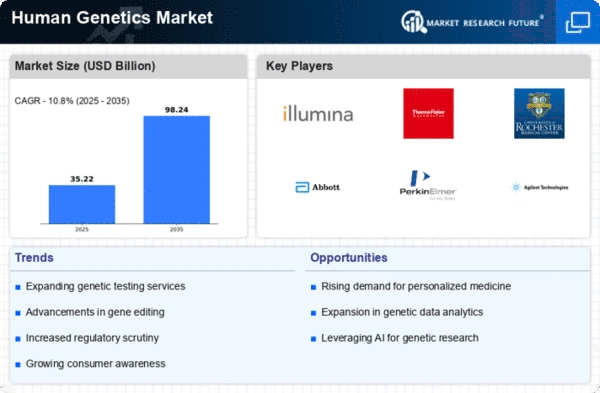
As per MRFR analysis, the Human Genetics Market was estimated at 31.79 USD Billion in 2024. The Human Genetics industry is projected to grow from 35.22 USD Billion in 2025 to 98.24 USD Billion by 2035, exhibiting a compound annual growth rate (CAGR) of 10.8% during the forecast period 2025 - 2035.

Key Market Trends & Highlights

The Human Genetics Market is experiencing robust growth driven by technological advancements and increasing demand for personalized healthcare solutions.

  • Advancements in gene editing technologies, particularly CRISPR, are reshaping therapeutic approaches in the market. The rise of personalized medicine is fostering a shift towards tailored treatment plans, enhancing patient outcomes. Increased demand for genetic testing is evident, particularly in North America, where it remains the largest segment. Growing investment in biotechnology and rising prevalence of genetic disorders are key drivers propelling market expansion.

Market Size & Forecast

2024 Market Size 31.79 (USD Billion)
2035 Market Size 98.24 (USD Billion)
CAGR (2025 - 2035) 10.8%
Largest Regional Market Share in 2024 North America

Major Players

<a href="https://sapac.illumina.com/techniques/sequencing/dna-sequencing/whole-genome-sequencing/human.html">Illumina </a>(US), Thermo Fisher Scientific (US), <a href="https://sequencing.roche.com/global/en/article-listing/human-genetics.html">Roche </a>(CH), Abbott Laboratories (US), PerkinElmer (US), Agilent Technologies (US), BGI Genomics (CN), Myriad Genetics (US), Genomatix (DE)

Market Trends

The Human Genetics Market is currently experiencing a transformative phase, driven by advancements in genomic technologies and an increasing understanding of genetic disorders. This sector encompasses a wide array of applications, including genetic testing, gene therapy, and personalized medicine. As research progresses, the demand for innovative solutions that address hereditary diseases and enhance patient outcomes appears to be on the rise. Furthermore, the integration of artificial intelligence and machine learning into genetic research is likely to streamline processes and improve accuracy, thereby fostering growth within this market.

In addition, the regulatory landscape surrounding genetic testing and therapies is evolving, which may influence market dynamics. Governments and health organizations are increasingly recognizing the importance of genetic research in public health strategies. This recognition could lead to enhanced funding and support for initiatives aimed at understanding genetic predispositions to various conditions. As the Human Genetics Market continues to expand, collaboration among stakeholders, including academic institutions, biotechnology firms, and healthcare providers, seems essential for driving innovation and ensuring ethical practices in genetic research, aligning with emerging human genetics market trends.

Advancements in Gene Editing Technologies

Recent developments in gene editing, particularly CRISPR technology, are reshaping the Human Genetics Market. These innovations enable precise modifications to DNA, offering potential cures for genetic disorders. As research progresses, the applications of gene editing are likely to expand, impacting various fields such as agriculture and medicine.

Rise of Personalized Medicine

The Human Genetics Market is witnessing a shift towards personalized medicine, where treatments are tailored to individual genetic profiles. This approach enhances the efficacy of therapies and minimizes adverse effects. As more genetic data becomes available, the potential for personalized treatment plans continues to grow.

Increased Demand for Genetic Testing

There is a notable surge in demand for genetic testing services, driven by consumer interest in health and ancestry. This trend is facilitated by advancements in technology that allow for more accurate and affordable testing options. As awareness of genetic health issues rises, the market for genetic testing is expected to expand further.

Human Genetics Market Market Drivers

Market Growth Projections

The Global Human Genetics Market Industry is poised for substantial growth, with projections indicating a market value of 31.8 USD Billion in 2024 and an anticipated rise to 98.2 USD Billion by 2035. This growth trajectory reflects a compound annual growth rate of 10.8% from 2025 to 2035. The expansion is driven by various factors, including advancements in genetic testing technologies, increasing prevalence of genetic disorders, and the growing demand for personalized medicine. As the industry evolves, it is likely to attract further investments and innovations, solidifying its position as a critical component of modern healthcare.

Government Initiatives and Funding

Government initiatives and funding play a crucial role in propelling the Global Human Genetics Market Industry forward. Various countries are investing in genetic research and healthcare infrastructure to enhance disease prevention and treatment strategies. For instance, the National Institutes of Health in the United States allocates substantial resources for genomic research, fostering innovation in genetic therapies. Such governmental support not only accelerates research but also encourages public-private partnerships, leading to the development of novel genetic solutions. This supportive environment is likely to contribute to the market's growth trajectory, with projections indicating a rise from 31.8 USD Billion in 2024 to 98.2 USD Billion by 2035.

Increasing Awareness and Education

The rising awareness and education regarding genetic health are vital drivers in the Global Human Genetics Market Industry. Public health campaigns and educational programs are informing individuals about the importance of genetic testing and its implications for health management. This heightened awareness is leading to increased demand for genetic services, as individuals seek proactive measures for disease prevention. Moreover, healthcare professionals are becoming more knowledgeable about genetic testing options, further driving adoption rates. As awareness continues to grow, the market is expected to expand significantly, with a valuation of 31.8 USD Billion in 2024 and a projected increase to 98.2 USD Billion by 2035.

Rising Prevalence of Genetic Disorders

The increasing incidence of genetic disorders globally drives the Global Human Genetics Market Industry. Conditions such as cystic fibrosis, sickle cell anemia, and various hereditary cancers are becoming more prevalent, necessitating advanced genetic testing and therapies. For instance, the World Health Organization reports that genetic disorders affect approximately 1 in 160 children globally. This growing demand for genetic diagnostics and personalized medicine is projected to contribute significantly to the market, with an estimated value of 31.8 USD Billion in 2024, and a forecasted growth to 98.2 USD Billion by 2035, reflecting a compound annual growth rate of 10.8% from 2025 to 2035.

Growing Demand for Personalized Medicine

The shift towards personalized medicine is a pivotal driver in the Global Human Genetics Market Industry. Patients increasingly seek treatments tailored to their genetic profiles, enhancing therapeutic efficacy and minimizing adverse effects. This trend is evident in oncology, where targeted therapies based on genetic mutations have shown improved outcomes. The market's expansion is further supported by the increasing awareness of genetic testing among healthcare providers and patients. As a result, the market is projected to grow significantly, with a valuation of 31.8 USD Billion in 2024 and an expected rise to 98.2 USD Billion by 2035, indicating a robust CAGR of 10.8% from 2025 to 2035.

Advancements in Genetic Testing Technologies

Technological innovations in genetic testing are revolutionizing the Global Human Genetics Market Industry. The development of next-generation sequencing and CRISPR gene-editing technologies has enhanced the accuracy and efficiency of genetic analyses. These advancements allow for comprehensive genomic profiling, enabling early detection of diseases and tailored treatment plans. For example, companies are now offering whole-genome sequencing at reduced costs, making it accessible to a broader population. As these technologies continue to evolve, they are expected to drive market growth, contributing to the anticipated increase in market value from 31.8 USD Billion in 2024 to 98.2 USD Billion by 2035.

Market Segment Insights

By Application: Genetic Testing (Largest) vs. Personalized Medicine (Fastest-Growing)

In the Human Genetics Market, the application segment is dominated by Genetic Testing, which has established a substantial share due to its critical role in detecting genetic disorders and facilitating preventive measures. Following closely is Disease Diagnosis, which leverages genetic insights to enhance accuracy and efficacy in identifying diseases. Drug Development and Personalized Medicine are also significant players but operate on a smaller scale than the two aforementioned segments.

Genetic Testing (Dominant) vs. Personalized Medicine (Emerging)

Genetic Testing is the dominant segment in the Human Genetics Market, playing a pivotal role in the early detection of genetic conditions and advancing patient management strategies. It encompasses a wide range of applications, from carrier screening to prenatal testing, making it essential for healthcare providers. In contrast, Personalized Medicine is an emerging segment that tailors healthcare treatments to individual genetic profiles, demonstrating rapid growth due to advancements in genomics and an increasing emphasis on individualized patient care. This segment is driven by the ongoing integration of genetic data into therapeutic strategies, aiming for improved patient outcomes.

By End Use: Healthcare Providers (Largest) vs. Research Institutions (Fastest-Growing)

The Human Genetics Market is significantly influenced by various end-use segments, with Healthcare Providers commanding the largest share. These providers utilize genetic testing and analysis for diagnostics and personalized medicine, resulting in a substantial demand for genetic services. Following closely, Research Institutions play a pivotal role in advancing genetic research and innovation, thus marking them as a fast-growing sector within the market. Their contributions drive discoveries that enhance clinical applications and our understanding of human diseases. Growth trends in the Human Genetics Market reflect increasing investments in genetic research, expanded applications of genomics in personalized therapies, and a rising demand for healthcare services tailored to genetic information. Healthcare Providers are thus focusing on integrating genetic tests into routine care, while Research Institutions are rapidly advancing their capabilities to identify genetic markers associated with various diseases. This dual growth is expected to transform healthcare delivery and scientific research, solidifying the importance of both segments in shaping the future of genetics.

Healthcare Providers (Dominant) vs. Research Institutions (Emerging)

Healthcare Providers are recognized as the dominant players in the Human Genetics Market, utilizing genomic technologies to facilitate diagnostics, improve clinical outcomes, and personalize patient care. Their extensive integration of genetic testing into health services underscores their pivotal role. In contrast, Research Institutions, while currently less dominant, are emerging as significant contributors to the market. They focus on cutting-edge research and the development of innovative genetic solutions, often collaborating with healthcare providers and pharmaceutical companies. These institutions are characterized by their agility in adapting to technological advances, which positions them well for future growth as the demand for genetic insights in healthcare continues to rise.

By Technology: Next Generation Sequencing (Largest) vs. Gene Editing (Fastest-Growing)

The Human Genetics Market showcases a diverse range of technologies, with Next Generation Sequencing (NGS) holding the largest share due to its wide application in genomics, personalized medicine, and disease diagnosis. The Polymerase Chain Reaction (PCR) and Microarray Technology also play significant roles, contributing to efficient genetic testing and analysis. Each technology serves distinct purposes, catering to various segments of research and clinical applications. PCR is critical for amplifying DNA, while Microarray facilitates large-scale gene expression profiling, cornering their respective niches in the market.

Technology: NGS (Dominant) vs. Gene Editing (Emerging)

Next Generation Sequencing (NGS) leads the market with its advanced capabilities, enabling rapid and comprehensive genomic analysis, which has transformed research and clinical practices alike. Its ability to process multiple samples simultaneously and deliver high accuracy has solidified its dominant position. On the other hand, Gene Editing continues to emerge as a transformative force, gaining traction due to advancements like CRISPR technology. Its potential in therapeutic applications and disease modification positions it as a key player for future growth, attracting significant investment and interest from the biotech industry. Together, these technologies are shaping the future of genetics in both research and healthcare.

By Service Type: Laboratory Services (Largest) vs. Data Analysis Services (Fastest-Growing)

In the Human Genetics Market, the distribution of services is a key driver for growth, with Laboratory Services maintaining the largest market share due to its foundational role in genetic testing and research. Following this, Consultation Services also play a significant part in genetic counseling and support, attracting a notable segment of the market. Data Analysis Services, while currently smaller, show promising growth as advancements in technology enhance big data analytics capabilities, thus becoming increasingly crucial.

Laboratory Services (Dominant) vs. Data Analysis Services (Emerging)

Laboratory Services are integral to the Human Genetics Market, providing essential testing and analytical capabilities that support genetic diagnostics and research. These services are characterized by their established infrastructures, regulatory alignments, and a skilled workforce trained in genetic technologies. In contrast, Data Analysis Services are emerging as vital contributors to the market, driven by the increasing complexity of genetic data and the need for sophisticated analytics to interpret it. This segment benefits from advancements in computational technologies, allowing for rapid analysis and insights that support clinical and research applications.

By Sample Type: Blood Samples (Largest) vs. Saliva Samples (Fastest-Growing)

In the Human Genetics Market, blood samples constitute the largest share due to their widespread acceptance and established protocols for genetic testing. This segment has been the conventional choice for clinicians, offering extensive diagnostic capabilities and a high level of information. Saliva samples, while currently a smaller segment, have gained traction rapidly due to their non-invasive nature, ease of collection, and growing acceptance in both clinical and direct-to-consumer genetic testing scenarios. The rapid advancement in DNA extraction and analysis technologies has catalyzed growth across all sample types. Blood samples are expected to maintain their dominance as the technology matures, while saliva samples are set to experience the fastest growth, driven by consumer preference for convenience and an increasing demand for genetic testing in health and wellness. Tissue and cell line samples are also becoming increasingly relevant as research in personalized medicine expands against a backdrop of ongoing scientific advancements.

Blood Samples (Dominant) vs. Saliva Samples (Emerging)

Blood samples are the dominant form of sample collection in the Human Genetics Market, owing to their richness in genetic material and the robustness of testing methodologies developed over decades. They are utilized extensively in clinical diagnostics and research, providing comprehensive insights into various genetic disorders. On the other hand, saliva samples represent an emerging trend in the market. Their non-invasive collection method and ease of use appeal to both patients and healthcare providers. As technology progresses, saliva-based tests are becoming more accurate and reliable, making them popular for personalized genetic testing and consumer genomics, positioning them as a significant alternative to blood samples in the evolving landscape of genetic analysis.

Get more detailed insights about Human Genetics Market Research Report—Global Forecast till 2035

Regional Insights

North America : Market Leader in Innovation

North America is poised to maintain its leadership in the Human Genetics Market, holding a significant market share of 15.89 in 2024. The region's growth is driven by advanced research facilities, high healthcare expenditure, and a robust regulatory framework that encourages innovation. Increasing demand for genetic testing and personalized medicine further propels market expansion, supported by government initiatives promoting genomics research. The competitive landscape in North America is characterized by the presence of key players such as Illumina, Thermo Fisher Scientific, and Abbott Laboratories. These companies are at the forefront of technological advancements, offering a wide range of genetic testing solutions. The U.S. and Canada are leading countries, with substantial investments in R&D and collaborations between public and private sectors, ensuring a dynamic market environment.

Europe : Emerging Market with Growth Potential

Europe's Human Genetics Market is poised for growth, with a market size of 9.53 in 2024. The region benefits from a strong emphasis on research and development, supported by EU funding and initiatives aimed at advancing genetic research. Europe's Human Genetics Market is poised for growth, with strong contributions from countries such as Germany, making the Germany human genetics market a key regional driver. Regulatory frameworks like GDPR support ethical genetic practices. Regulatory frameworks, such as the General Data Protection Regulation (GDPR), ensure ethical standards in genetic testing, fostering consumer trust and market demand. Leading countries in Europe include Germany, the UK, and France, where significant investments in biotechnology and healthcare infrastructure are evident. Key players like QIAGEN and Roche are actively involved in expanding their product offerings. The competitive landscape is evolving, with a focus on collaboration between academic institutions and industry, enhancing innovation in genetic testing and therapies.

Asia-Pacific : Rapidly Growing Market Segment

The Asia-Pacific region is witnessing rapid growth in the Human Genetics Market, with a market size of 5.95 in 2024. Factors such as increasing healthcare expenditure, rising awareness of genetic disorders, and advancements in technology are driving demand. Governments are implementing supportive policies to enhance research capabilities and access to genetic testing, contributing to market expansion. Countries like China and Japan are leading the charge, with significant investments in biotechnology and healthcare infrastructure. Countries like China are leading this expansion, positioning the China human genetics market as a major contributor to global growth. The presence of companies like BGI Genomics and Genomatix highlights the competitive landscape. Collaborations between public and private sectors are fostering innovation, positioning Asia-Pacific as a key player in the global human genetics arena.

Middle East and Africa : Emerging Market with Challenges

The Middle East and Africa (MEA) region, with a market size of 0.42 in 2024, presents unique challenges and opportunities in the Human Genetics Market. Limited access to advanced healthcare services and genetic testing facilities hampers growth. However, increasing awareness of genetic disorders and government initiatives to improve healthcare infrastructure are driving demand for genetic solutions. Countries like South Africa and the UAE are making strides in genetic research and testing, supported by investments from both public and private sectors. Increasing investments and awareness are contributing to the development of the human genetics market GCC, particularly in countries like the UAE. The competitive landscape is gradually evolving, with local and international players seeking to establish a foothold in the region. Collaborative efforts are essential to overcome existing barriers and unlock the market's potential.

Key Players and Competitive Insights

The Human Genetics Market is characterized by a dynamic competitive landscape, driven by advancements in genomic technologies and increasing demand for personalized medicine. Key players such as Illumina (US), Thermo Fisher Scientific (US), and Roche (CH) are at the forefront, leveraging innovation and strategic partnerships to enhance their market positions. Illumina (US) focuses on expanding its sequencing capabilities, while Thermo Fisher Scientific (US) emphasizes its comprehensive portfolio of genetic analysis tools. Roche (CH) is actively pursuing collaborations to integrate diagnostics with therapeutic solutions, thereby shaping a competitive environment that prioritizes technological advancement and customer-centric solutions. In terms of business tactics, companies are increasingly localizing manufacturing and optimizing supply chains to enhance operational efficiency. The market appears moderately fragmented, with a mix of established players and emerging companies vying for market share. The collective influence of these key players fosters a competitive structure that encourages innovation and responsiveness to market demands, ultimately benefiting end-users through improved product offerings and services. In November 2025, Illumina (US) announced a strategic partnership with a leading healthcare provider to enhance genomic testing accessibility. This collaboration aims to streamline the integration of genomic data into clinical workflows, potentially revolutionizing patient care by enabling more personalized treatment plans. The strategic importance of this partnership lies in its potential to expand Illumina's reach and solidify its position as a leader in the genomic testing space. In October 2025, Thermo Fisher Scientific (US) launched a new line of next-generation sequencing (NGS) products designed to improve throughput and reduce costs for laboratories. This product launch is significant as it addresses the growing demand for efficient and cost-effective genetic analysis solutions, positioning Thermo Fisher as a key player in the competitive landscape. The introduction of these products may enhance customer loyalty and attract new clients seeking advanced genomic technologies. In September 2025, Roche (CH) acquired a biotechnology firm specializing in CRISPR technology, aiming to bolster its research and development capabilities in gene editing. This acquisition is strategically important as it aligns with Roche's commitment to advancing precision medicine and expanding its therapeutic offerings. By integrating CRISPR technology, Roche could potentially accelerate the development of innovative treatments, thereby enhancing its competitive edge in the market. As of December 2025, current trends in the Human Genetics Market include a pronounced shift towards digitalization, sustainability, and the integration of artificial intelligence (AI) in genetic research and diagnostics. Strategic alliances are increasingly shaping the competitive landscape, fostering collaboration that enhances innovation and accelerates product development. Looking ahead, competitive differentiation is likely to evolve, with a greater emphasis on technological innovation and supply chain reliability, moving away from traditional price-based competition. Companies that successfully navigate these trends will likely emerge as leaders in the Human Genetics Market.

Key Companies in the Human Genetics Market include

Industry Developments

2021- Eversana will assist GENinCode in gaining entry to the US market for its portfolio of polygenic cardiovascular disease treatments, which are primarily focused on hereditary risk. GENinCode announced its agreement with Eversana as its launch and commercialization partner.

2019- In the field of oncology, Myriad Genetics and Illumina has formed a strategic alliance.A time-limited exclusive agreement for Illumina to provide a kit-based version of the myChoice CDx test for international markets is part of the strategic partnership between Myriad and Illumina.

Future Outlook

Human Genetics Market Future Outlook

The Human Genetics Market is projected to grow at a 10.8% CAGR from 2025 to 2035, driven by advancements in genomic technologies, personalized medicine, and increasing demand for genetic testing.

New opportunities lie in:

  • <p>Development of AI-driven genetic analysis platforms Expansion of direct-to-consumer genetic testing services Integration of genetic data into electronic health records</p>

By 2035, the Human Genetics Market is expected to be a pivotal sector in healthcare innovation.

Market Segmentation

Human Genetics Market End User Outlook

  • Hospitals
  • Research Laboratories
  • Pharmaceutical Companies
  • Diagnostic Centers
  • Academic Institutions

Human Genetics Market Technology Outlook

  • Next Generation Sequencing
  • Polymerase Chain Reaction
  • Microarray
  • CRISPR
  • Sanger Sequencing

Human Genetics Market Application Outlook

  • Genetic Testing
  • Gene Therapy
  • Pharmacogenomics
  • Genetic Research
  • Personalized Medicine

Report Scope

MARKET SIZE 2024 31.79(USD Billion)
MARKET SIZE 2025 35.22(USD Billion)
MARKET SIZE 2035 98.24(USD Billion)
COMPOUND ANNUAL GROWTH RATE (CAGR) 10.8% (2025 - 2035)
REPORT COVERAGE Revenue Forecast, Competitive Landscape, Growth Factors, and Trends
BASE YEAR 2024
Market Forecast Period 2025 - 2035
Historical Data 2019 - 2024
Market Forecast Units USD Billion
Key Companies Profiled Illumina (US), Thermo Fisher Scientific (US), Roche (CH), Abbott Laboratories (US), PerkinElmer (US), Agilent Technologies (US), BGI Genomics (CN), Myriad Genetics (US), Genomatix (DE)
Segments Covered Application, Technology, End User
Key Market Opportunities Advancements in gene editing technologies create transformative opportunities in the Human Genetics Market.
Key Market Dynamics Rising demand for personalized medicine drives innovation and competition in the Human Genetics Market.
Countries Covered North America, Europe, APAC, South America, MEA

FAQs

What is the current valuation of the Human Genetics Market as of 2024?

<p>The Human Genetics Market was valued at 31.79 USD Billion in 2024.</p>

What is the projected market valuation for the Human Genetics Market in 2035?

<p>The market is projected to reach 98.24 USD Billion by 2035.</p>

What is the expected CAGR for the Human Genetics Market during the forecast period 2025 - 2035?

<p>The expected CAGR for the Human Genetics Market during 2025 - 2035 is 10.8%.</p>

Which application segments are driving growth in the Human Genetics Market?

<p>Key application segments include Disease Diagnosis, Drug Development, Genetic Testing, and Personalized Medicine, with Genetic Testing projected to grow from 10.0 to 30.0 USD Billion.</p>

How do healthcare providers contribute to the Human Genetics Market?

<p>Healthcare Providers are anticipated to expand from 10.0 to 31.0 USD Billion, indicating their significant role in the market.</p>

What technologies are influencing the Human Genetics Market?

<p>Technologies such as Next Generation Sequencing and Polymerase Chain Reaction are crucial, with Next Generation Sequencing expected to grow from 10.0 to 32.0 USD Billion.</p>

What types of services are offered in the Human Genetics Market?

The market includes Laboratory Services, Consultation Services, and Data Analysis Services, with Laboratory Services projected to increase from 12.5 to 39.0 USD Billion.

What sample types are utilized in the Human Genetics Market?

Sample types include Blood Samples, Saliva Samples, Tissue Samples, and Cell Lines, with Blood Samples expected to grow from 10.0 to 30.0 USD Billion.

Who are the key players in the Human Genetics Market?

Key players include Illumina, Thermo Fisher Scientific, Roche, Agilent Technologies, and Myriad Genetics, among others.

What is the significance of genetic testing in the Human Genetics Market?

Genetic Testing is projected to grow significantly, indicating its vital role in advancing personalized medicine and disease diagnosis.

  1. SECTION I: EXECUTIVE SUMMARY AND KEY HIGHLIGHTS |
    1. EXECUTIVE SUMMARY | |
      1. Market Overview | |
      2. Key Findings | |
      3. Market Segmentation | |
      4. Competitive Landscape | |
      5. Challenges and Opportunities | |
      6. Future Outlook 2
  2. SECTION II: SCOPING, METHODOLOGY AND MARKET STRUCTURE |
    1. MARKET INTRODUCTION | |
      1. Definition | |
      2. Scope of the study | | |
    2. RESEARCH METHODOLOGY | |
      1. Overview | |
      2. Data Mining | |
      3. Secondary Research | |
      4. Primary Research | | |
      5. Forecasting Model | |
      6. Market Size Estimation | | |
      7. Data Triangulation | |
      8. Validation 3
  3. SECTION III: QUALITATIVE ANALYSIS |
    1. MARKET DYNAMICS | |
      1. Overview | |
      2. Drivers | |
      3. Restraints | |
      4. Opportunities |
    2. MARKET FACTOR ANALYSIS | |
      1. Value chain Analysis | |
      2. Porter's Five Forces Analysis | | |
      3. COVID-19 Impact Analysis | | |
  4. SECTION IV: QUANTITATIVE ANALYSIS |
    1. Healthcare, BY Application (USD Billion) | |
      1. Disease Diagnosis | |
      2. Drug Development | |
      3. Genetic Testing | |
      4. Personalized Medicine |
    2. Healthcare, BY End Use (USD Billion) | |
      1. Healthcare Providers | |
      2. Research Institutions | |
      3. Pharmaceutical Companies | |
      4. Biotechnology Firms |
    3. Healthcare, BY Technology (USD Billion) | |
      1. Next Generation Sequencing | |
      2. Polymerase Chain Reaction | |
      3. Microarray Technology | |
      4. Gene Editing |
    4. Healthcare, BY Service Type (USD Billion) | |
      1. Laboratory Services | |
      2. Consultation Services | |
      3. Data Analysis Services |
    5. Healthcare, BY Sample Type (USD Billion) | |
      1. Blood Samples | |
      2. Saliva Samples | |
      3. Tissue Samples | |
      4. Cell Lines |
    6. Healthcare, BY Region (USD Billion) | |
      1. North America | | |
      2. Europe | | |
      3. APAC | | |
      4. South America | | |
      5. MEA | | |
  5. SECTION V: COMPETITIVE ANALYSIS |
    1. Competitive Landscape | |
      1. Overview | |
      2. Competitive Analysis | |
      3. Market share Analysis | |
      4. Major Growth Strategy in the Healthcare | |
      5. Competitive Benchmarking | |
      6. Leading Players in Terms of Number of Developments in the Healthcare | |
      7. Key developments and growth strategies | | |
      8. Major Players Financial Matrix | | |
    2. Company Profiles | |
      1. Illumina (US) | | |
      2. Thermo Fisher Scientific (US) | | |
      3. Roche (CH) | | |
      4. Agilent Technologies (US) | | |
      5. QIAGEN (DE) | | |
      6. Myriad Genetics (US) | | |
      7. BGI Genomics (CN) | | |
      8. Genomatix (DE) | | |
      9. Fulgent Genetics (US) | | |
    3. Appendix | |
      1. References | |
      2. Related Reports 6 LIST OF FIGURES |
    4. MARKET SYNOPSIS |
    5. NORTH AMERICA MARKET ANALYSIS |
    6. US MARKET ANALYSIS BY APPLICATION |
    7. US MARKET ANALYSIS BY END USE |
    8. US MARKET ANALYSIS BY TECHNOLOGY |
    9. US MARKET ANALYSIS BY SERVICE TYPE |
    10. US MARKET ANALYSIS BY SAMPLE TYPE |
    11. CANADA MARKET ANALYSIS BY APPLICATION |
    12. CANADA MARKET ANALYSIS BY END USE |
    13. CANADA MARKET ANALYSIS BY TECHNOLOGY |
    14. CANADA MARKET ANALYSIS BY SERVICE TYPE |
    15. CANADA MARKET ANALYSIS BY SAMPLE TYPE |
    16. EUROPE MARKET ANALYSIS |
    17. GERMANY MARKET ANALYSIS BY APPLICATION |
    18. GERMANY MARKET ANALYSIS BY END USE |
    19. GERMANY MARKET ANALYSIS BY TECHNOLOGY |
    20. GERMANY MARKET ANALYSIS BY SERVICE TYPE |
    21. GERMANY MARKET ANALYSIS BY SAMPLE TYPE |
    22. UK MARKET ANALYSIS BY APPLICATION |
    23. UK MARKET ANALYSIS BY END USE |
    24. UK MARKET ANALYSIS BY TECHNOLOGY |
    25. UK MARKET ANALYSIS BY SERVICE TYPE |
    26. UK MARKET ANALYSIS BY SAMPLE TYPE |
    27. FRANCE MARKET ANALYSIS BY APPLICATION |
    28. FRANCE MARKET ANALYSIS BY END USE |
    29. FRANCE MARKET ANALYSIS BY TECHNOLOGY |
    30. FRANCE MARKET ANALYSIS BY SERVICE TYPE |
    31. FRANCE MARKET ANALYSIS BY SAMPLE TYPE |
    32. RUSSIA MARKET ANALYSIS BY APPLICATION |
    33. RUSSIA MARKET ANALYSIS BY END USE |
    34. RUSSIA MARKET ANALYSIS BY TECHNOLOGY |
    35. RUSSIA MARKET ANALYSIS BY SERVICE TYPE |
    36. RUSSIA MARKET ANALYSIS BY SAMPLE TYPE |
    37. ITALY MARKET ANALYSIS BY APPLICATION |
    38. ITALY MARKET ANALYSIS BY END USE |
    39. ITALY MARKET ANALYSIS BY TECHNOLOGY |
    40. ITALY MARKET ANALYSIS BY SERVICE TYPE |
    41. ITALY MARKET ANALYSIS BY SAMPLE TYPE |
    42. SPAIN MARKET ANALYSIS BY APPLICATION |
    43. SPAIN MARKET ANALYSIS BY END USE |
    44. SPAIN MARKET ANALYSIS BY TECHNOLOGY |
    45. SPAIN MARKET ANALYSIS BY SERVICE TYPE |
    46. SPAIN MARKET ANALYSIS BY SAMPLE TYPE |
    47. REST OF EUROPE MARKET ANALYSIS BY APPLICATION |
    48. REST OF EUROPE MARKET ANALYSIS BY END USE |
    49. REST OF EUROPE MARKET ANALYSIS BY TECHNOLOGY |
    50. REST OF EUROPE MARKET ANALYSIS BY SERVICE TYPE |
    51. REST OF EUROPE MARKET ANALYSIS BY SAMPLE TYPE |
    52. APAC MARKET ANALYSIS |
    53. CHINA MARKET ANALYSIS BY APPLICATION |
    54. CHINA MARKET ANALYSIS BY END USE |
    55. CHINA MARKET ANALYSIS BY TECHNOLOGY |
    56. CHINA MARKET ANALYSIS BY SERVICE TYPE |
    57. CHINA MARKET ANALYSIS BY SAMPLE TYPE |
    58. INDIA MARKET ANALYSIS BY APPLICATION |
    59. INDIA MARKET ANALYSIS BY END USE |
    60. INDIA MARKET ANALYSIS BY TECHNOLOGY |
    61. INDIA MARKET ANALYSIS BY SERVICE TYPE |
    62. INDIA MARKET ANALYSIS BY SAMPLE TYPE |
    63. JAPAN MARKET ANALYSIS BY APPLICATION |
    64. JAPAN MARKET ANALYSIS BY END USE |
    65. JAPAN MARKET ANALYSIS BY TECHNOLOGY |
    66. JAPAN MARKET ANALYSIS BY SERVICE TYPE |
    67. JAPAN MARKET ANALYSIS BY SAMPLE TYPE |
    68. SOUTH KOREA MARKET ANALYSIS BY APPLICATION |
    69. SOUTH KOREA MARKET ANALYSIS BY END USE |
    70. SOUTH KOREA MARKET ANALYSIS BY TECHNOLOGY |
    71. SOUTH KOREA MARKET ANALYSIS BY SERVICE TYPE |
    72. SOUTH KOREA MARKET ANALYSIS BY SAMPLE TYPE |
    73. MALAYSIA MARKET ANALYSIS BY APPLICATION |
    74. MALAYSIA MARKET ANALYSIS BY END USE |
    75. MALAYSIA MARKET ANALYSIS BY TECHNOLOGY |
    76. MALAYSIA MARKET ANALYSIS BY SERVICE TYPE |
    77. MALAYSIA MARKET ANALYSIS BY SAMPLE TYPE |
    78. THAILAND MARKET ANALYSIS BY APPLICATION |
    79. THAILAND MARKET ANALYSIS BY END USE |
    80. THAILAND MARKET ANALYSIS BY TECHNOLOGY |
    81. THAILAND MARKET ANALYSIS BY SERVICE TYPE |
    82. THAILAND MARKET ANALYSIS BY SAMPLE TYPE |
    83. INDONESIA MARKET ANALYSIS BY APPLICATION |
    84. INDONESIA MARKET ANALYSIS BY END USE |
    85. INDONESIA MARKET ANALYSIS BY TECHNOLOGY |
    86. INDONESIA MARKET ANALYSIS BY SERVICE TYPE |
    87. INDONESIA MARKET ANALYSIS BY SAMPLE TYPE |
    88. REST OF APAC MARKET ANALYSIS BY APPLICATION |
    89. REST OF APAC MARKET ANALYSIS BY END USE |
    90. REST OF APAC MARKET ANALYSIS BY TECHNOLOGY |
    91. REST OF APAC MARKET ANALYSIS BY SERVICE TYPE |
    92. REST OF APAC MARKET ANALYSIS BY SAMPLE TYPE |
    93. SOUTH AMERICA MARKET ANALYSIS |
    94. BRAZIL MARKET ANALYSIS BY APPLICATION |
    95. BRAZIL MARKET ANALYSIS BY END USE |
    96. BRAZIL MARKET ANALYSIS BY TECHNOLOGY |
    97. BRAZIL MARKET ANALYSIS BY SERVICE TYPE |
    98. BRAZIL MARKET ANALYSIS BY SAMPLE TYPE |
    99. MEXICO MARKET ANALYSIS BY APPLICATION |
    100. MEXICO MARKET ANALYSIS BY END USE |
    101. MEXICO MARKET ANALYSIS BY TECHNOLOGY |
    102. MEXICO MARKET ANALYSIS BY SERVICE TYPE |
    103. MEXICO MARKET ANALYSIS BY SAMPLE TYPE |
    104. ARGENTINA MARKET ANALYSIS BY APPLICATION |
    105. ARGENTINA MARKET ANALYSIS BY END USE |
    106. ARGENTINA MARKET ANALYSIS BY TECHNOLOGY |
    107. ARGENTINA MARKET ANALYSIS BY SERVICE TYPE |
    108. ARGENTINA MARKET ANALYSIS BY SAMPLE TYPE |
    109. REST OF SOUTH AMERICA MARKET ANALYSIS BY APPLICATION |
    110. REST OF SOUTH AMERICA MARKET ANALYSIS BY END USE |
    111. REST OF SOUTH AMERICA MARKET ANALYSIS BY TECHNOLOGY |
    112. REST OF SOUTH AMERICA MARKET ANALYSIS BY SERVICE TYPE |
    113. REST OF SOUTH AMERICA MARKET ANALYSIS BY SAMPLE TYPE |
    114. MEA MARKET ANALYSIS |
    115. GCC COUNTRIES MARKET ANALYSIS BY APPLICATION |
    116. GCC COUNTRIES MARKET ANALYSIS BY END USE |
    117. GCC COUNTRIES MARKET ANALYSIS BY TECHNOLOGY |
    118. GCC COUNTRIES MARKET ANALYSIS BY SERVICE TYPE |
    119. GCC COUNTRIES MARKET ANALYSIS BY SAMPLE TYPE |
    120. SOUTH AFRICA MARKET ANALYSIS BY APPLICATION |
    121. SOUTH AFRICA MARKET ANALYSIS BY END USE |
    122. SOUTH AFRICA MARKET ANALYSIS BY TECHNOLOGY |
    123. SOUTH AFRICA MARKET ANALYSIS BY SERVICE TYPE |
    124. SOUTH AFRICA MARKET ANALYSIS BY SAMPLE TYPE |
    125. REST OF MEA MARKET ANALYSIS BY APPLICATION |
    126. REST OF MEA MARKET ANALYSIS BY END USE |
    127. REST OF MEA MARKET ANALYSIS BY TECHNOLOGY |
    128. REST OF MEA MARKET ANALYSIS BY SERVICE TYPE |
    129. REST OF MEA MARKET ANALYSIS BY SAMPLE TYPE |
    130. KEY BUYING CRITERIA OF HEALTHCARE |
    131. RESEARCH PROCESS OF MRFR |
    132. DRO ANALYSIS OF HEALTHCARE |
    133. DRIVERS IMPACT ANALYSIS: HEALTHCARE |
    134. RESTRAINTS IMPACT ANALYSIS: HEALTHCARE |
    135. SUPPLY / VALUE CHAIN: HEALTHCARE |
    136. HEALTHCARE, BY APPLICATION, 2024 (% SHARE) |
    137. HEALTHCARE, BY APPLICATION, 2024 TO 2035 (USD Billion) |
    138. HEALTHCARE, BY END USE, 2024 (% SHARE) |
    139. HEALTHCARE, BY END USE, 2024 TO 2035 (USD Billion) |
    140. HEALTHCARE, BY TECHNOLOGY, 2024 (% SHARE) |
    141. HEALTHCARE, BY TECHNOLOGY, 2024 TO 2035 (USD Billion) |
    142. HEALTHCARE, BY SERVICE TYPE, 2024 (% SHARE) |
    143. HEALTHCARE, BY SERVICE TYPE, 2024 TO 2035 (USD Billion) |
    144. HEALTHCARE, BY SAMPLE TYPE, 2024 (% SHARE) |
    145. HEALTHCARE, BY SAMPLE TYPE, 2024 TO 2035 (USD Billion) |
    146. BENCHMARKING OF MAJOR COMPETITORS 7 LIST OF TABLES |
    147. LIST OF ASSUMPTIONS | |
      1. |
    148. North America MARKET SIZE ESTIMATES; FORECAST | |
      1. BY APPLICATION, 2025-2035 (USD Billion) | |
      2. BY END USE, 2025-2035 (USD Billion) | |
      3. BY TECHNOLOGY, 2025-2035 (USD Billion) | |
      4. BY SERVICE TYPE, 2025-2035 (USD Billion) | |
      5. BY SAMPLE TYPE, 2025-2035 (USD Billion) |
    149. US MARKET SIZE ESTIMATES; FORECAST | |
      1. BY APPLICATION, 2025-2035 (USD Billion) | |
      2. BY END USE, 2025-2035 (USD Billion) | |
      3. BY TECHNOLOGY, 2025-2035 (USD Billion) | |
      4. BY SERVICE TYPE, 2025-2035 (USD Billion) | |
      5. BY SAMPLE TYPE, 2025-2035 (USD Billion) |
    150. Canada MARKET SIZE ESTIMATES; FORECAST | |
      1. BY APPLICATION, 2025-2035 (USD Billion) | |
      2. BY END USE, 2025-2035 (USD Billion) | |
      3. BY TECHNOLOGY, 2025-2035 (USD Billion) | |
      4. BY SERVICE TYPE, 2025-2035 (USD Billion) | |
      5. BY SAMPLE TYPE, 2025-2035 (USD Billion) |
    151. Europe MARKET SIZE ESTIMATES; FORECAST | |
      1. BY APPLICATION, 2025-2035 (USD Billion) | |
      2. BY END USE, 2025-2035 (USD Billion) | |
      3. BY TECHNOLOGY, 2025-2035 (USD Billion) | |
      4. BY SERVICE TYPE, 2025-2035 (USD Billion) | |
      5. BY SAMPLE TYPE, 2025-2035 (USD Billion) |
    152. Germany MARKET SIZE ESTIMATES; FORECAST | |
      1. BY APPLICATION, 2025-2035 (USD Billion) | |
      2. BY END USE, 2025-2035 (USD Billion) | |
      3. BY TECHNOLOGY, 2025-2035 (USD Billion) | |
      4. BY SERVICE TYPE, 2025-2035 (USD Billion) | |
      5. BY SAMPLE TYPE, 2025-2035 (USD Billion) |
    153. UK MARKET SIZE ESTIMATES; FORECAST | |
      1. BY APPLICATION, 2025-2035 (USD Billion) | |
      2. BY END USE, 2025-2035 (USD Billion) | |
      3. BY TECHNOLOGY, 2025-2035 (USD Billion) | |
      4. BY SERVICE TYPE, 2025-2035 (USD Billion) | |
      5. BY SAMPLE TYPE, 2025-2035 (USD Billion) |
    154. France MARKET SIZE ESTIMATES; FORECAST | |
      1. BY APPLICATION, 2025-2035 (USD Billion) | |
      2. BY END USE, 2025-2035 (USD Billion) | |
      3. BY TECHNOLOGY, 2025-2035 (USD Billion) | |
      4. BY SERVICE TYPE, 2025-2035 (USD Billion) | |
      5. BY SAMPLE TYPE, 2025-2035 (USD Billion) |
    155. Russia MARKET SIZE ESTIMATES; FORECAST | |
      1. BY APPLICATION, 2025-2035 (USD Billion) | |
      2. BY END USE, 2025-2035 (USD Billion) | |
      3. BY TECHNOLOGY, 2025-2035 (USD Billion) | |
      4. BY SERVICE TYPE, 2025-2035 (USD Billion) | |
      5. BY SAMPLE TYPE, 2025-2035 (USD Billion) |
    156. Italy MARKET SIZE ESTIMATES; FORECAST | |
      1. BY APPLICATION, 2025-2035 (USD Billion) | |
      2. BY END USE, 2025-2035 (USD Billion) | |
      3. BY TECHNOLOGY, 2025-2035 (USD Billion) | |
      4. BY SERVICE TYPE, 2025-2035 (USD Billion) | |
      5. BY SAMPLE TYPE, 2025-2035 (USD Billion) |
    157. Spain MARKET SIZE ESTIMATES; FORECAST | |
      1. BY APPLICATION, 2025-2035 (USD Billion) | |
      2. BY END USE, 2025-2035 (USD Billion) | |
      3. BY TECHNOLOGY, 2025-2035 (USD Billion) | |
      4. BY SERVICE TYPE, 2025-2035 (USD Billion) | |
      5. BY SAMPLE TYPE, 2025-2035 (USD Billion) |
    158. Rest of Europe MARKET SIZE ESTIMATES; FORECAST | |
      1. BY APPLICATION, 2025-2035 (USD Billion) | |
      2. BY END USE, 2025-2035 (USD Billion) | |
      3. BY TECHNOLOGY, 2025-2035 (USD Billion) | |
      4. BY SERVICE TYPE, 2025-2035 (USD Billion) | |
      5. BY SAMPLE TYPE, 2025-2035 (USD Billion) |
    159. APAC MARKET SIZE ESTIMATES; FORECAST | |
      1. BY APPLICATION, 2025-2035 (USD Billion) | |
      2. BY END USE, 2025-2035 (USD Billion) | |
      3. BY TECHNOLOGY, 2025-2035 (USD Billion) | |
      4. BY SERVICE TYPE, 2025-2035 (USD Billion) | |
      5. BY SAMPLE TYPE, 2025-2035 (USD Billion) |
    160. China MARKET SIZE ESTIMATES; FORECAST | |
      1. BY APPLICATION, 2025-2035 (USD Billion) | |
      2. BY END USE, 2025-2035 (USD Billion) | |
      3. BY TECHNOLOGY, 2025-2035 (USD Billion) | |
      4. BY SERVICE TYPE, 2025-2035 (USD Billion) | |
      5. BY SAMPLE TYPE, 2025-2035 (USD Billion) |
    161. India MARKET SIZE ESTIMATES; FORECAST | |
      1. BY APPLICATION, 2025-2035 (USD Billion) | |
      2. BY END USE, 2025-2035 (USD Billion) | |
      3. BY TECHNOLOGY, 2025-2035 (USD Billion) | |
      4. BY SERVICE TYPE, 2025-2035 (USD Billion) | |
      5. BY SAMPLE TYPE, 2025-2035 (USD Billion) |
    162. Japan MARKET SIZE ESTIMATES; FORECAST | |
      1. BY APPLICATION, 2025-2035 (USD Billion) | |
      2. BY END USE, 2025-2035 (USD Billion) | |
      3. BY TECHNOLOGY, 2025-2035 (USD Billion) | |
      4. BY SERVICE TYPE, 2025-2035 (USD Billion) | |
      5. BY SAMPLE TYPE, 2025-2035 (USD Billion) |
    163. South Korea MARKET SIZE ESTIMATES; FORECAST | |
      1. BY APPLICATION, 2025-2035 (USD Billion) | |
      2. BY END USE, 2025-2035 (USD Billion) | |
      3. BY TECHNOLOGY, 2025-2035 (USD Billion) | |
      4. BY SERVICE TYPE, 2025-2035 (USD Billion) | |
      5. BY SAMPLE TYPE, 2025-2035 (USD Billion) |
    164. Malaysia MARKET SIZE ESTIMATES; FORECAST | |
      1. BY APPLICATION, 2025-2035 (USD Billion) | |
      2. BY END USE, 2025-2035 (USD Billion) | |
      3. BY TECHNOLOGY, 2025-2035 (USD Billion) | |
      4. BY SERVICE TYPE, 2025-2035 (USD Billion) | |
      5. BY SAMPLE TYPE, 2025-2035 (USD Billion) |
    165. Thailand MARKET SIZE ESTIMATES; FORECAST | |
      1. BY APPLICATION, 2025-2035 (USD Billion) | |
      2. BY END USE, 2025-2035 (USD Billion) | |
      3. BY TECHNOLOGY, 2025-2035 (USD Billion) | |
      4. BY SERVICE TYPE, 2025-2035 (USD Billion) | |
      5. BY SAMPLE TYPE, 2025-2035 (USD Billion) |
    166. Indonesia MARKET SIZE ESTIMATES; FORECAST | |
      1. BY APPLICATION, 2025-2035 (USD Billion) | |
      2. BY END USE, 2025-2035 (USD Billion) | |
      3. BY TECHNOLOGY, 2025-2035 (USD Billion) | |
      4. BY SERVICE TYPE, 2025-2035 (USD Billion) | |
      5. BY SAMPLE TYPE, 2025-2035 (USD Billion) |
    167. Rest of APAC MARKET SIZE ESTIMATES; FORECAST | |
      1. BY APPLICATION, 2025-2035 (USD Billion) | |
      2. BY END USE, 2025-2035 (USD Billion) | |
      3. BY TECHNOLOGY, 2025-2035 (USD Billion) | |
      4. BY SERVICE TYPE, 2025-2035 (USD Billion) | |
      5. BY SAMPLE TYPE, 2025-2035 (USD Billion) |
    168. South America MARKET SIZE ESTIMATES; FORECAST | |
      1. BY APPLICATION, 2025-2035 (USD Billion) | |
      2. BY END USE, 2025-2035 (USD Billion) | |
      3. BY TECHNOLOGY, 2025-2035 (USD Billion) | |
      4. BY SERVICE TYPE, 2025-2035 (USD Billion) | |
      5. BY SAMPLE TYPE, 2025-2035 (USD Billion) |
    169. Brazil MARKET SIZE ESTIMATES; FORECAST | |
      1. BY APPLICATION, 2025-2035 (USD Billion) | |
      2. BY END USE, 2025-2035 (USD Billion) | |
      3. BY TECHNOLOGY, 2025-2035 (USD Billion) | |
      4. BY SERVICE TYPE, 2025-2035 (USD Billion) | |
      5. BY SAMPLE TYPE, 2025-2035 (USD Billion) |
    170. Mexico MARKET SIZE ESTIMATES; FORECAST | |
      1. BY APPLICATION, 2025-2035 (USD Billion) | |
      2. BY END USE, 2025-2035 (USD Billion) | |
      3. BY TECHNOLOGY, 2025-2035 (USD Billion) | |
      4. BY SERVICE TYPE, 2025-2035 (USD Billion) | |
      5. BY SAMPLE TYPE, 2025-2035 (USD Billion) |
    171. Argentina MARKET SIZE ESTIMATES; FORECAST | |
      1. BY APPLICATION, 2025-2035 (USD Billion) | |
      2. BY END USE, 2025-2035 (USD Billion) | |
      3. BY TECHNOLOGY, 2025-2035 (USD Billion) | |
      4. BY SERVICE TYPE, 2025-2035 (USD Billion) | |
      5. BY SAMPLE TYPE, 2025-2035 (USD Billion) |
    172. Rest of South America MARKET SIZE ESTIMATES; FORECAST | |
      1. BY APPLICATION, 2025-2035 (USD Billion) | |
      2. BY END USE, 2025-2035 (USD Billion) | |
      3. BY TECHNOLOGY, 2025-2035 (USD Billion) | |
      4. BY SERVICE TYPE, 2025-2035 (USD Billion) | |
      5. BY SAMPLE TYPE, 2025-2035 (USD Billion) |
    173. MEA MARKET SIZE ESTIMATES; FORECAST | |
      1. BY APPLICATION, 2025-2035 (USD Billion) | |
      2. BY END USE, 2025-2035 (USD Billion) | |
      3. BY TECHNOLOGY, 2025-2035 (USD Billion) | |
      4. BY SERVICE TYPE, 2025-2035 (USD Billion) | |
      5. BY SAMPLE TYPE, 2025-2035 (USD Billion) |
    174. GCC Countries MARKET SIZE ESTIMATES; FORECAST | |
      1. BY APPLICATION, 2025-2035 (USD Billion) | |
      2. BY END USE, 2025-2035 (USD Billion) | |
      3. BY TECHNOLOGY, 2025-2035 (USD Billion) | |
      4. BY SERVICE TYPE, 2025-2035 (USD Billion) | |
      5. BY SAMPLE TYPE, 2025-2035 (USD Billion) |
    175. South Africa MARKET SIZE ESTIMATES; FORECAST | |
      1. BY APPLICATION, 2025-2035 (USD Billion) | |
      2. BY END USE, 2025-2035 (USD Billion) | |
      3. BY TECHNOLOGY, 2025-2035 (USD Billion) | |
      4. BY SERVICE TYPE, 2025-2035 (USD Billion) | |
      5. BY SAMPLE TYPE, 2025-2035 (USD Billion) |
    176. Rest of MEA MARKET SIZE ESTIMATES; FORECAST | |
      1. BY APPLICATION, 2025-2035 (USD Billion) | |
      2. BY END USE, 2025-2035 (USD Billion) | |
      3. BY TECHNOLOGY, 2025-2035 (USD Billion) | |
      4. BY SERVICE TYPE, 2025-2035 (USD Billion) | |
      5. BY SAMPLE TYPE, 2025-2035 (USD Billion) |
    177. PRODUCT LAUNCH/PRODUCT DEVELOPMENT/APPROVAL | |
      1. |
    178. ACQUISITION/PARTNERSHIP | |

Healthcare Market Segmentation

Healthcare By Application (USD Billion, 2025-2035)

  • Disease Diagnosis
  • Drug Development
  • Genetic Testing
  • Personalized Medicine

Healthcare By End Use (USD Billion, 2025-2035)

  • Healthcare Providers
  • Research Institutions
  • Pharmaceutical Companies
  • Biotechnology Firms

Healthcare By Technology (USD Billion, 2025-2035)

  • Next Generation Sequencing
  • Polymerase Chain Reaction
  • Microarray Technology
  • Gene Editing

Healthcare By Service Type (USD Billion, 2025-2035)

  • Laboratory Services
  • Consultation Services
  • Data Analysis Services

Healthcare By Sample Type (USD Billion, 2025-2035)

  • Blood Samples
  • Saliva Samples
  • Tissue Samples
  • Cell Lines
Infographic

Free Sample Request

Kindly complete the form below to receive a free sample of this Report

Get Free Sample

Customer Strories

Compare Licence

×
Features License Type
Single User Multiuser License Enterprise User
Price $4,950 $5,950 $7,250
Maximum User Access Limit 1 User Upto 10 Users Unrestricted Access Throughout the Organization
Free Customization
Direct Access to Analyst
Deliverable Format
Platform Access
Discount on Next Purchase 10% 15% 15%
Printable Versions