
×
Hero Background
English
Chinese
French
Japanese
Korean
German
Spanish

Human Computer Interaction HCI Market Analysis

ID: MRFR/ICT/9965-CR
202 Pages
Garvit Vyas
April 2023

Human-Computer Interaction (HCI) Market Research Report Information by Technology (Peripherals, Touch Screen GUIs, Gesture and Body Recognition, Speech & Voice Recognition, Natural Language Processing, Brain Computer Interface, Eye Tracking), Organization Size (SMEs, and Large Enterprise), Component (Hardware, Software, & Services), Application Area (Healthcare, Personal Computers & Smartphones, Gaming & Entertainment, Smart Home & White Goods, Wearables, Education, Automotive, Industrial) and Regions - Forecast till 2035

Share:
Download PDF ×

We do not share your information with anyone. However, we may send you emails based on your report interest from time to time. You may contact us at any time to opt-out.

Human Computer Interaction HCI Market Infographic
Purchase Options

Market Analysis

In-depth Analysis of Human Computer Interaction HCI Market Industry Landscape

The market factors influencing Human-Computer Interaction (HCI) are diverse and dynamic, reflecting the evolving nature of technology and user needs. One significant factor is technological advancement. As new technologies emerge, such as augmented reality, virtual reality, and gesture recognition, the HCI market responds by integrating these innovations to enhance user experiences. Companies strive to stay ahead by investing in research and development to create products that align with the latest technological trends.

User demographics also play a crucial role in shaping the HCI market. The diversity of users, including age, cultural background, and technological literacy, prompts designers and developers to create interfaces that cater to a broad audience. The market must balance simplicity for novice users and complexity for advanced users, ensuring inclusivity and accessibility. The rise of global digitalization emphasizes the importance of understanding various cultural nuances, leading to the development of interfaces that are culturally sensitive and user-friendly.

Another influential factor is the increasing demand for seamless connectivity. With the proliferation of smart devices, users expect a seamless transition between platforms and devices. This demand has driven the HCI market to focus on creating interfaces that provide a consistent and integrated experience across various devices, enhancing user convenience and satisfaction. Companies that excel in creating interoperable systems gain a competitive edge in the market.

Accessibility is a critical market factor, as it addresses the needs of users with diverse physical and cognitive abilities. The push for inclusive design and accessible interfaces has become a key driver in the HCI market. Companies are investing in technologies like voice recognition, haptic feedback, and eye-tracking to make interfaces more accessible for individuals with disabilities, broadening their user base and complying with accessibility standards and regulations.

The influence of data privacy and security cannot be overstated in the HCI market. Users are becoming increasingly concerned about the protection of their personal information. As a result, companies are implementing robust security measures and privacy features in their interfaces to build trust with users. Compliance with data protection regulations and transparent communication regarding data usage are essential aspects that shape the market, impacting user preferences and purchasing decisions.

Market competition is fierce, with numerous players vying for dominance. This competition drives continuous innovation as companies strive to differentiate themselves through unique features, design aesthetics, and user-centric approaches. The HCI market rewards those who can anticipate and respond to user needs swiftly, fostering a culture of innovation and evolution.

Collaboration and partnerships between companies also significantly influence the HCI market. Cross-industry collaborations, such as between technology firms and healthcare providers, result in the development of specialized interfaces tailored to specific domains. These collaborations broaden the application of HCI beyond traditional consumer electronics, contributing to the expansion and diversification of the market.


Author
Garvit Vyas
Analyst

Explore the profile of Garvit Vyas, one of our esteemed authors at Market Research Future, and access their expert research contributions in the field of market research and industry analysis

Leave a Comment

FAQs

What is the projected market valuation of the Human-Computer Interaction (HCI) Market by 2035?

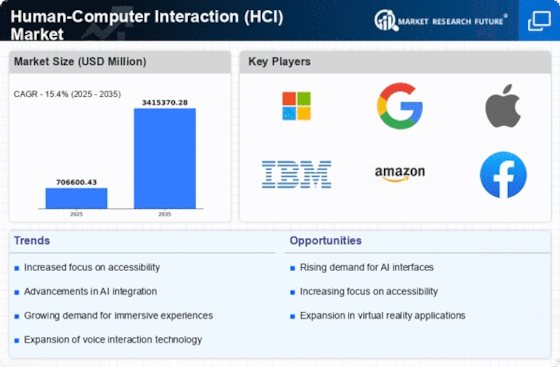
The projected market valuation for the Human-Computer Interaction (HCI) Market by 2035 is approximately 3415370.28 USD Million.

What was the overall market valuation of the HCI Market in 2024?

The overall market valuation of the HCI Market in 2024 was 706600.43 USD Million.

What is the expected CAGR for the HCI Market during the forecast period 2025 - 2035?

The expected CAGR for the Human-Computer Interaction (HCI) Market during the forecast period 2025 - 2035 is 15.4%.

Which companies are considered key players in the HCI Market?

Key players in the HCI Market include Microsoft, Google, Apple, IBM, Amazon, Facebook, Adobe, SAP, NVIDIA, and Oracle.

What are the main application areas for HCI technologies?

The main application areas for HCI technologies include healthcare, personal computers & smartphones, gaming & entertainment, smart home & white goods, wearables, education, automotive, industrial & factories, commercial & businesses, military & defense, and others.

Market Summary

As per MRFR analysis, the Human-Computer Interaction (HCI) Market Size was estimated at 706600.43 USD Million in 2024. The HCI industry is projected to grow from 815416.9 USD Million in 2025 to 3415370.28 USD Million by 2035, exhibiting a compound annual growth rate (CAGR) of 15.4 during the forecast period 2025 - 2035.

Key Market Trends & Highlights

The Human-Computer Interaction (HCI) Market is experiencing a transformative shift towards user-centric design and advanced technologies.

  • The market is witnessing an increased focus on user-centric design, particularly in North America, which remains the largest market.
  • Integration of AI and machine learning is becoming prevalent, enhancing user experiences across various applications in the Asia-Pacific region.
  • Accessibility features are expanding, catering to diverse user needs and driving engagement in both speech and voice recognition segments.
  • The rise of wearable technology and the growth of virtual and augmented reality are major drivers, particularly benefiting large enterprises and the gesture and body recognition segment.

Market Size & Forecast

2024 Market Size 706600.43 (USD Million)
2035 Market Size 3415370.28 (USD Million)
CAGR (2025 - 2035) 15.4%
Largest Regional Market Share in 2024 Asia Pacific

Major Players

<p>Microsoft (US), Google (US), Apple (US), IBM (US), Amazon (US), Facebook (US), Adobe (US), SAP (DE), NVIDIA (US), Oracle (US)</p>

Market Trends

The Human-Computer Interaction (HCI) Market is currently experiencing a transformative phase, driven by advancements in technology and evolving user expectations. As digital interfaces become increasingly integral to daily life, the demand for intuitive and user-friendly designs intensifies. This market encompasses a wide array of applications, from mobile devices to complex software systems, all aimed at enhancing user experience. Companies are investing in research and development to create innovative solutions that cater to diverse user needs, thereby fostering a more inclusive digital environment. Furthermore, the integration of artificial intelligence and machine learning into HCI tools is reshaping how users interact with technology, suggesting a future where systems can adapt to individual preferences and behaviors. In addition, the rise of remote work and digital collaboration tools has further propelled the Human-Computer Interaction (HCI) Market. Organizations are increasingly prioritizing user-centered design principles to ensure that their products not only meet functional requirements but also provide a seamless experience. This shift indicates a broader recognition of the importance of user engagement and satisfaction in driving business success. As the market continues to evolve, it appears poised for sustained growth, with a focus on creating more personalized and efficient interactions between humans and machines.

Increased Focus on User-Centric Design

There is a growing emphasis on user-centric design principles within the Human-Computer Interaction (HCI) Market. Companies are recognizing the necessity of understanding user needs and preferences to create more effective and engaging interfaces. This trend suggests that organizations are likely to invest more in user research and testing to refine their products.

Integration of AI and Machine Learning

The incorporation of artificial intelligence and machine learning technologies is becoming increasingly prevalent in the Human-Computer Interaction (HCI) Market. These technologies enable systems to learn from user interactions, potentially leading to more personalized experiences. This trend indicates a shift towards adaptive interfaces that can respond to individual user behaviors.

Expansion of Accessibility Features

There is a notable trend towards enhancing accessibility features in HCI products. As awareness of diverse user needs grows, companies are striving to create inclusive designs that cater to individuals with varying abilities. This movement highlights the importance of ensuring that technology is usable by everyone, thereby broadening the market's reach.

Human Computer Interaction HCI Market Market Drivers

Rise of Wearable Technology

The proliferation of wearable technology is reshaping the Human-Computer Interaction (HCI) Market. Devices such as smartwatches and fitness trackers are increasingly integrated with advanced sensors and interfaces, allowing for seamless interaction between users and technology. This trend is evidenced by a projected increase in the wearable technology market, which is expected to reach approximately 60 billion USD by 2026. As these devices become more sophisticated, they necessitate innovative HCI solutions that prioritize user experience and engagement. The demand for intuitive interfaces that can adapt to various contexts and user needs is likely to drive further advancements in HCI, fostering a more interconnected ecosystem of devices that enhance daily life.

Advancements in Cognitive Computing

Advancements in cognitive computing are poised to transform the Human-Computer Interaction (HCI) Market. Cognitive systems, which leverage artificial intelligence to simulate human thought processes, are becoming increasingly prevalent in various applications, from customer support to healthcare diagnostics. The cognitive computing market is expected to reach approximately 60 billion USD by 2025, highlighting the growing interest in these technologies. As cognitive systems become more sophisticated, they necessitate the development of HCI solutions that can effectively interpret and respond to user inputs. This evolution suggests a potential shift towards more adaptive and intelligent interfaces that enhance user interaction and engagement, ultimately redefining the relationship between humans and machines.

Emphasis on Data Privacy and Security

The increasing emphasis on data privacy and security is a critical driver in the Human-Computer Interaction (HCI) Market. As users become more aware of their digital footprints, there is a growing demand for HCI solutions that prioritize secure interactions. This trend is underscored by regulatory changes and heightened consumer expectations regarding data protection. Companies are now compelled to design interfaces that not only facilitate user engagement but also ensure the safeguarding of personal information. The HCI market is likely to see innovations that incorporate privacy-by-design principles, fostering trust and confidence among users. This focus on security may also influence the development of new interaction paradigms that balance usability with robust protection measures.

Growth of Virtual and Augmented Reality

The expansion of virtual reality (VR) and augmented reality (AR) technologies is significantly influencing the Human-Computer Interaction (HCI) Market. These immersive technologies are being adopted across various sectors, including gaming, education, and healthcare, creating new avenues for interaction. The VR and AR market is anticipated to surpass 200 billion USD by 2025, indicating a robust demand for HCI solutions that facilitate natural and intuitive user experiences. As users engage with digital environments in novel ways, the need for effective HCI frameworks that support these interactions becomes increasingly critical. This growth suggests a potential shift in how users perceive and interact with digital content, emphasizing the importance of designing user-centric interfaces.

Increased Demand for Natural Language Processing

The rising demand for natural language processing (NLP) technologies is reshaping the Human-Computer Interaction (HCI) Market. As users seek more intuitive ways to communicate with machines, NLP applications are becoming essential in various domains, including customer service, healthcare, and personal assistants. The NLP market is projected to grow to over 35 billion USD by 2026, reflecting a significant shift towards voice-activated and conversational interfaces. This trend indicates that HCI solutions must evolve to accommodate natural language interactions, enhancing user satisfaction and engagement. The integration of NLP into HCI frameworks could lead to more personalized and efficient user experiences, ultimately transforming how individuals interact with technology.

Market Segment Insights

By Technology: Speech & Voice Recognition (Largest) vs. Gesture and Body Recognition (Fastest-Growing)

<p>The Human-Computer Interaction (HCI) market exhibits a diverse range of technology segments, with Speech & Voice Recognition standing as the largest. This segment has captured significant attention due to its versatility and implementation across various applications, from smart assistants to customer service bots. Following closely are Gesture and Body Recognition technologies, which are quickly gaining traction, particularly in gaming and virtual reality environments. These segments collectively illustrate the dynamic nature of HCI technology, reflecting the industry's progression toward more immersive and intuitive user experiences. The growth trends within the HCI market are predominantly fueled by advancements in machine learning and artificial intelligence, which enable devices to understand and respond to human inputs more accurately. The increasing demand for hands-free interaction and accessibility for users with disabilities have further accelerated the adoption of Speech & Voice Recognition technology. Meanwhile, Gesture and Body Recognition are on an upward trajectory fueled by the proliferation of AR/VR technologies, as businesses seek to enhance user engagement and create more immersive experiences. As consumer preferences evolve, these technologies are expected to shape the future of human-computer interaction significantly.</p>

<p>Technology: Speech & Voice Recognition (Dominant) vs. Gesture and Body Recognition (Emerging)</p>

<p>Speech & Voice Recognition stands as a dominant force in the Human-Computer Interaction market, playing a crucial role in user engagement and accessibility. This technology enables seamless, interactive experiences across devices by allowing users to communicate naturally, making it a preferred choice in many applications such as smart devices and customer support systems. In contrast, Gesture and Body Recognition is emerging as a groundbreaking technology, particularly appealing to sectors such as gaming and healthcare. Its ability to create intuitive interfaces that respond to physical movements not only enhances user experiences but also opens pathways for innovative applications in augmented and virtual reality. While Speech & Voice Recognition is well-established, Gesture and Body Recognition is poised for rapid growth as future applications in HCI evolve, illustrating a significant shift toward more interactive and immersive technologies.</p>

By Organization Size: SMEs (Largest) vs. Large Enterprises (Fastest-Growing)

<p>In the Human-Computer Interaction (HCI) market, small and medium-sized enterprises (SMEs) hold a substantial share, driven by their innovative approaches and agility in adopting new technologies. This segment benefits from a growing demand for customized solutions that suit specific business needs, leading to a favorable market position in the overall landscape. On the other hand, large enterprises are also carving a significant niche, with an increasing focus on integrating advanced HCI solutions that enhance user experiences across various applications.</p>

<p>SMEs (Dominant) vs. Large Enterprises (Emerging)</p>

<p>The SMEs segment is characterized by its flexibility and adaptability, allowing these organizations to develop and implement HCI solutions efficiently. Their focus on customer-centric designs drives innovation, making them a dominant force in the market. Conversely, large enterprises are emerging players, leveraging their resources to adopt cutting-edge technology in HCI. While they may take longer to implement changes, their substantial budgets and extensive reach enable them to explore sophisticated solutions that can revolutionize user experiences, positioning them as a rapidly growing segment within the HCI landscape.</p>

By Component: Hardware (Largest) vs. Software (Fastest-Growing)

<p>In the Human-Computer Interaction (HCI) market, the component segment displays a distinct distribution of market shares, with hardware leading significantly. This is due to its foundational role in user interface devices such as keyboards, mice, and touchscreens, which are vital for facilitating interaction between humans and computers. Software follows closely, designed to enhance the functionality and user experience, while services, although important, hold a smaller share as they focus on supportive tasks rather than direct interaction capabilities. As technology evolves, growth trends in the HCI market are heavily influenced by increased user demand for more intuitive interfaces, prompting rapid advancements in software solutions. The rise of AI and machine learning is also creating new opportunities for software innovations, positioning it as the fastest-growing component in the sector. Additionally, hardware continues to adapt, integrating smart features that align with the trends toward seamless, interconnected environments.</p>

<p>Hardware: Input Devices (Dominant) vs. Software: UI/UX Applications (Emerging)</p>

<p>Within the component segment of the Human-Computer Interaction market, input devices, categorized under hardware, are recognized as the dominant force due to their necessity in facilitating daily tech interactions. These devices have evolved into more sophisticated forms, incorporating ergonomic designs and advanced functionalities such as gesture recognition and haptic feedback. On the other hand, UI/UX applications within software are rapidly emerging, driven by the need for enhanced user experiences. These applications focus on optimizing usability and accessibility, integrating data analytics and user feedback to inform iterative design improvements. This dynamic interplay highlights hardware’s established status and software's rising prominence as users seek increasingly engaging and efficient ways to interact with technology.</p>

By Application Area: Healthcare (Largest) vs. Gaming & Entertainment (Fastest-Growing)

<p>The Human-Computer Interaction (HCI) Market exhibits a diverse application area segmentation with significant variations in market share. The healthcare sector stands out as the largest application area, driven by the ongoing integration of advanced HCI technologies like telemedicine and electronic health records. In contrast, the gaming and entertainment sector is emerging rapidly, capitalizing on innovations such as virtual reality (VR) and augmented reality (AR) to create immersive experiences that appeal to consumers' growing desire for engaging digital content. The growth trends within the HCI market are largely propelled by advancements in technology and an increasing focus on user experience. With the healthcare sector leveraging HCI to improve patient interactions and streamline operational efficiencies, the interest in smart home devices and entertainment systems is surging among consumers. The rise of smart wearables and gaming devices is fostering a new generation of HCI applications, reflecting broadening consumer expectations for interactivity and personalization in both personal and professional settings.</p>

<p>Healthcare (Dominant) vs. Wearables (Emerging)</p>

<p>Healthcare remains a dominant application area in the HCI market, primarily due to its critical focus on improving patient care through technology. The adoption of user-friendly interfaces in medical devices and telehealth services facilitates seamless interactions between patients and healthcare providers. This sector addresses vital needs, including accessibility and efficiency, and demonstrates a robust demand for innovations that enhance patient engagement and outcomes. Conversely, wearables are identified as an emerging segment within the HCI landscape, driven by technological advancements in miniaturization and sensor integration. These devices offer users personalized health monitoring and fitness tracking solutions, gaining traction among health-conscious consumers. As the market evolves, the interplay between healthcare systems and wearable technology is anticipated, fostering opportunities for enhanced patient data analytics and real-time health management.</p>

Get more detailed insights about Human-Computer Interaction (HCI) Market Research Report - Global Forecast till 2035

Regional Insights

North America : Innovation and Leadership Hub

North America is the largest market for Human-Computer Interaction (HCI), holding approximately 45% of the global market share. The region's growth is driven by rapid technological advancements, increasing demand for user-friendly interfaces, and significant investments in AI and machine learning. Regulatory support for innovation and data privacy also catalyzes market expansion, making it a key player in the HCI landscape. The United States leads the HCI market, with major players like Microsoft, Google, and Apple headquartered there. The competitive landscape is characterized by continuous innovation and collaboration among tech giants. Canada also plays a significant role, contributing to the market with its focus on research and development in HCI technologies. The presence of these key players ensures a dynamic and competitive environment.

Europe : Emerging Market with Potential

Europe is the second-largest market for Human-Computer Interaction, accounting for approximately 30% of the global market share. The region's growth is fueled by increasing digitalization across various sectors, including healthcare and education, alongside stringent regulations promoting user-centric design. The European Union's focus on digital transformation and innovation acts as a catalyst for HCI advancements, enhancing user experiences and accessibility. Leading countries in Europe include Germany, the UK, and France, where significant investments in technology and research are evident. The competitive landscape features key players like SAP and Adobe, who are actively developing innovative HCI solutions. The presence of a robust startup ecosystem further enhances the region's market dynamics, fostering collaboration and technological advancements.

Asia-Pacific : Rapid Growth and Innovation

Asia-Pacific is witnessing rapid growth in the Human-Computer Interaction market, holding approximately 20% of the global market share. The region's expansion is driven by increasing smartphone penetration, rising internet usage, and a growing emphasis on digital transformation across industries. Government initiatives promoting technology adoption and innovation further support market growth, making it a significant player in the HCI landscape. Countries like China, Japan, and India are at the forefront of this growth, with substantial investments in technology and research. The competitive landscape is marked by the presence of both global giants and local startups, fostering innovation in HCI solutions. Companies like Alibaba and Tencent are leading the charge, focusing on enhancing user experiences through advanced HCI technologies, ensuring a vibrant market environment.

Middle East and Africa : Emerging Market with Challenges

The Middle East and Africa region is gradually emerging in the Human-Computer Interaction market, holding about 5% of the global market share. The growth is primarily driven by increasing internet penetration and a rising demand for digital solutions across various sectors. However, challenges such as infrastructure limitations and varying regulatory environments can hinder rapid expansion. Governments are increasingly recognizing the importance of technology in economic development, which may catalyze future growth in HCI. Leading countries in this region include South Africa and the UAE, where investments in technology and innovation are on the rise. The competitive landscape is still developing, with a mix of local and international players. Companies are focusing on creating tailored HCI solutions to meet the unique needs of the region, paving the way for future advancements in the market.

Key Companies in the Human Computer Interaction HCI Market market include

Industry Developments

June 2022:NTT DATA Italia has formed a strategic cooperation with Cogniac Corporation. With the help of the agreement, NTT DATA will be able to significantly improve its smart factory capabilities in Italy and assist its manufacturing operations with Cogniac's patented visual data processing platform.

April 2022:Cognia teamed with Melco Resorts & Entertainment Limited ("Melco"), a developer, owner, and operator of integrated resort facilities in Asia and Europe. The collaboration puts Cogniac's unique visual data processing platform in place to support Melco's loyalty programme operations. The integrated resort's exclusive rewards programme, Melco Club, is made operationally easier by the AI-based computer vision platform from Cogniac.

April 2021:According to The Verge, Meta is adding additional enhancements to the hand tracking technology on its Quest virtual reality platform, including support for novel motion motions like clapping. A new version of the company's Presence Platform API is now available to all users after a brief developer preview. It promises more nuanced and dependable interactions on the Meta Quest headset.

Future Outlook

Human Computer Interaction HCI Market Future Outlook

<p>The Human-Computer Interaction (HCI) Market is projected to grow at a 15.4% CAGR from 2024 to 2035, driven by advancements in AI, increased automation, and enhanced user experience demands.</p>

New opportunities lie in:

  • <p>Development of AI-driven user interface design tools</p>
  • <p>Expansion of immersive virtual reality training solutions</p>
  • <p>Integration of biometric authentication in consumer applications</p>

<p>By 2035, the HCI market is expected to be robust, reflecting substantial growth and innovation.</p>

Market Segmentation

Human Computer Interaction HCI Market Component Outlook

  • Hardware
  • Software
  • Services

Human Computer Interaction HCI Market Technology Outlook

  • Peripherals
  • Touch Screen GUIs
  • Gesture and Body Recognition
  • Speech & Voice Recognition
  • Natural Language Processing (NLP)
  • Brain Computer Interface
  • Eye Tracking
  • Semiotics Solutions
  • Others

Human Computer Interaction HCI Market Application Area Outlook

  • Healthcare
  • Personal Computers & Smartphones
  • Gaming & Entertainment
  • Smart Home & White Goods
  • Wearables
  • Education
  • Automotive
  • Industrial & Factories
  • Commercial & Businesses
  • Military & Defense
  • Others

Human Computer Interaction HCI Market Organization Size Outlook

  • SMEs
  • Large Enterprises

Report Scope

MARKET SIZE 2024706600.43(USD Million)
MARKET SIZE 2025815416.9(USD Million)
MARKET SIZE 20353415370.28(USD Million)
COMPOUND ANNUAL GROWTH RATE (CAGR)15.4% (2024 - 2035)
REPORT COVERAGERevenue Forecast, Competitive Landscape, Growth Factors, and Trends
BASE YEAR2024
Market Forecast Period2025 - 2035
Historical Data2019 - 2024
Market Forecast UnitsUSD Million
Key Companies ProfiledMarket analysis in progress
Segments CoveredMarket segmentation analysis in progress
Key Market OpportunitiesIntegration of artificial intelligence in user interface design enhances personalization in the Human-Computer Interaction (HCI) Market.
Key Market DynamicsRising demand for intuitive interfaces drives innovation and competition in the Human-Computer Interaction market.
Countries CoveredNorth America, Europe, APAC, South America, MEA

FAQs

What is the projected market valuation of the Human-Computer Interaction (HCI) Market by 2035?

The projected market valuation for the Human-Computer Interaction (HCI) Market by 2035 is approximately 3415370.28 USD Million.

What was the overall market valuation of the HCI Market in 2024?

The overall market valuation of the HCI Market in 2024 was 706600.43 USD Million.

What is the expected CAGR for the HCI Market during the forecast period 2025 - 2035?

The expected CAGR for the Human-Computer Interaction (HCI) Market during the forecast period 2025 - 2035 is 15.4%.

Which companies are considered key players in the HCI Market?

Key players in the HCI Market include Microsoft, Google, Apple, IBM, Amazon, Facebook, Adobe, SAP, NVIDIA, and Oracle.

What are the main application areas for HCI technologies?

The main application areas for HCI technologies include healthcare, personal computers & smartphones, gaming & entertainment, smart home & white goods, wearables, education, automotive, industrial & factories, commercial & businesses, military & defense, and others.

  1. EXECUTIVE SUMMARY 24
    1. MARKET ATTRACTIVENESS ANALYSIS 26
  2. MARKET INTRODUCTION 27
    1. DEFINITION 27
    2. SCOPE OF THE STUDY 27
    3. RESEARCH OBJECTIVE 27
    4. MARKET STRUCTURE 28
  3. RESEARCH METHODOLOGY 29
  4. MARKET DYNAMICS 36
    1. INTRODUCTION 36
    2. DRIVERS 37
      1. HCI IS GROWING THROUGH THE CONFLUENCE OF THREE SUBJECT AREAS – COMPUTER SCIENCE, COGNITIVE SCIENCE, AND INDUSTRIAL DESIGN 37
      2. EXPONENTIAL GROWTH IN THE INTERNET OF THINGS (IOT) PROPELLING THE DEMAND FOR EMBEDDED GUI DEVELOPMENT TOOLS 37
      3. RAPID GROWTH IN THE WEARABLES AND PERSONAL DEVICES SEGMENTS 38
      4. INCREASED CUSTOMER EXPECTATIONS DRIVING THE DEVELOPMENT OF NEW AND INNOVATIVE INTERFACES 38
      5. DRIVERS IMPACT ANALYSIS 39
    3. RESTRAINTS 39
      1. MERGER BETWEEN COMPUTER SCIENCE, COGNITIVE SCIENCE, AND INDUSTRIAL DESIGN 39
      2. CYBERSECURITY THREATS SUCH AS MALWARE AND RANSOMWARE ON INDUSTRIAL HMIS ARE EXPECTED TO POSE MAJOR HINDRANCE 40
      3. RESTRAINTS IMPACT ANALYSIS 40
    4. OPPORTUNITIES 41
      1. OPPORTUNITIES BY SECTOR 41
      2. INCREASING GOVERNMENT INVESTMENTS IN THE HCI SECTOR 45
    5. CHALLENGES 45
      1. GENERALIZABILITY AND CONSISTENCY 45
      2. SETTING UP OF HCI-RELATED STANDARDS 45
      3. IMMERSIVE TECHNOLOGIES AND USER EXPERIENCE (UX AND UI) 45
    6. MARKET TRENDS FOR HCI 46
      1. TREND TOWARDS GREATER CUSTOMIZATION AND PERSONALIZATION OF INTERFACES, AS WELL AS GREATER EMPHASIS ON ACCESSIBILITY AND INCLUSIVITY FOR USERS WITH DIFFERENT ABILITIES AND NEEDS 46
      2. DRIVER INTERFACE 46
      3. AUTOMOTIVE INTERFACE 47
      4. ASSISTIVE AND ACCESSIBLE INTERFACES INTERFACE 47
      5. SOCIAL INTERACTIONS ON THE INTERNET 47
      6. CONVERSATIONAL AGENTS, CHAT, GPT, CHATBOTS 48
      7. NATURAL HUMAN AND ROBOT INTERACTION (SOCIAL ROBOTS) 48
      8. GAME ENGAGEMENT 48
      9. NATURAL LANGUAGE INTERFACE ON DEVICES 50
      10. VISUAL QUERY INTERFACES AND SYMBIOTIC QUERY INTERFACES (GESTURE) 50
      11. SPEECH RECOGNITION AND GESTURE RECOGNITION IS GAINING TRACTION 50
      12. RISING DEMAND FOR GAMING CONTROLLER CONSOLES 51
      13. SURGING DEMAND FOR NEW INTERFACE TECHNOLOGIES 51
      14. EMOTION DETECTION IS EXPECTED TO GAIN MAJOR IMPORTANCE 52
      15. AR/VR TECHNOLOGY 52
    7. STATE-OF-THE-ART HUMAN-COMPUTER-INTERACTION IN METAVERSE 52
    8. COVID-19 IMPACT ON MARKET 53
      1. IMPACT ON GLOBAL ECONOMY 53
      2. IMPACT ON HCI MARKET 53
      3. IMPACT ON SEMICONDUCTOR INDUSTRY 54
      4. IMPACT ON IT SECTOR 54
      5. IMPACT ON HCI END USE SECTORS 54
      6. SUPPLY CHAIN DISRUPTIONS 55
      7. YOY GROWTH 2020-2022 55
    9. PATENT TRENDS IN HCI ANALYSIS 56
    10. REGULATORY LANDSCAPE/STANDARDS FOR HCI MARKET 56
    11. DISCIPLINES THAT CONTRIBUTE TO HCI 57
  5. MARKET FACTOR ANALYSIS 58
    1. SUPPLY CHAIN ANALYSIS 58
      1. HARDWARE MANUFACTURERS 58
      2. SOFTWARE DEVELOPERS 59
      3. PRODUCT TESTING 59
      4. DISTRIBUTORS AND RETAILERS 59
      5. END USER 59
    2. PORTER''S FIVE FORCES MODEL 60
      1. THREAT OF NEW ENTRANTS 61
      2. BARGAINING POWER OF SUPPLIERS 61
      3. THREAT OF SUBSTITUTES 62
      4. BARGAINING POWER OF BUYERS 62
      5. INTENSITY OF RIVALRY 62
  6. GLOBAL HUMAN-COMPUTER INTERACTION (HCI) MARKET, BY TECHNOLOGY 63
    1. OVERVIEW 63
      1. GLOBAL HUMAN-COMPUTER INTERACTION (HCI) MARKET, BY TECHNOLOGY, 2018–2030 (USD MILLION) 64
    2. PERIPHERALS 64
    3. TOUCH SCREEN GUIS 65
    4. GESTURE AND BODY RECOGNITION 65
    5. SPEECH & VOICE RECOGNITION 65
    6. NATURAL LANGUAGE PROCESSING (NLP) 65
    7. BRAIN COMPUTER INTERFACE 66
    8. EYE TRACKING 66
    9. SEMIOTICS SOLUTIONS 66
    10. OTHERS 66
  7. GLOBAL HUMAN-COMPUTER INTERACTION (HCI) MARKET, BY ORGANIZATION SIZE 67
    1. OVERVIEW 67
      1. GLOBAL HUMAN-COMPUTER INTERACTION (HCI) MARKET, BY ORGANIZATION SIZE, 2018–2030 (USD MILLION) 68
    2. SMES 68
    3. LARGE ENTERPRISE 68
  8. GLOBAL HUMAN-COMPUTER INTERACTION (HCI) MARKET, BY COMPONENT 69
    1. OVERVIEW 69
      1. GLOBAL HUMAN-COMPUTER INTERACTION (HCI) MARKET, BY COMPONENT, 2018–2030 (USD MILLION) 70
    2. HARDWARE 70
    3. SOFTWARE 70
    4. SERVICES 70
  9. GLOBAL HUMAN-COMPUTER INTERACTION (HCI) MARKET, BY APPLICATION AREA 71
    1. OVERVIEW 71
      1. GLOBAL HUMAN-COMPUTER INTERACTION (HCI) MARKET, BY APPLICATION AREA, 2018–2030 (USD MILLION) 72
    2. HEALTHCARE 72
    3. PERSONAL COMPUTERS & SMARTPHONES 73
    4. GAMING & ENTERTAINMENT 73
    5. SMART HOME & WHITE GOODS 74
    6. WEARABLES 74
    7. EDUCATION 74
    8. AUTOMOTIVE 74
    9. INDUSTRIAL & FACTORIES 75
    10. COMMERCIAL & BUSINESSES 75
    11. MILITARY & DEFENSE 75
    12. OTHERS 75
  10. GLOBAL HUMAN-COMPUTER INTERACTION (HCI) MARKET, BY REGION 76
    1. OVERVIEW 76
      1. GLOBAL HUMAN-COMPUTER INTERACTION (HCI) MARKET, BY REGION, 2021 VS 2030 (USD MILLION) 77
      2. GLOBAL HUMAN-COMPUTER INTERACTION (HCI) MARKET, BY REGION, 2018–2030 (USD MILLION) 77
    2. NORTH AMERICA 78
      1. NORTH AMERICA: HUMAN-COMPUTER INTERACTION (HCI) MARKET, BY COUNTRY, 2018–2030 (USD MILLION) 79
      2. NORTH AMERICA HUMAN-COMPUTER INTERACTION (HCI) MARKET, BY TECHNOLOGY, 2018–2030 (USD MILLION) 80
      3. NORTH AMERICA HUMAN-COMPUTER INTERACTION (HCI) MARKET, BY ORGANIZATION SIZE, 2018–2030 (USD MILLION) 81
      4. NORTH AMERICA HUMAN-COMPUTER INTERACTION (HCI) MARKET, BY COMPONENT, 2018–2030 (USD MILLION) 82
      5. NORTH AMERICA HUMAN-COMPUTER INTERACTION (HCI) MARKET, BY APPLICATION AREA, 2018–2030 (USD MILLION) 83
      6. US 84
      7. CANADA 86
      8. MEXICO 88
    3. EUROPE 90
      1. EUROPE: HUMAN-COMPUTER INTERACTION (HCI) MARKET, BY COUNTRY, 2018–2030 (USD MILLION) 91
      2. EUROPE HUMAN-COMPUTER INTERACTION (HCI) MARKET, BY TECHNOLOGY, 2018–2030 (USD MILLION) 92
      3. EUROPE HUMAN-COMPUTER INTERACTION (HCI) MARKET, BY ORGANIZATION SIZE, 2018–2030 (USD MILLION) 93
      4. EUROPE HUMAN-COMPUTER INTERACTION (HCI) MARKET, BY COMPONENT, 2018–2030 (USD MILLION) 94
      5. EUROPE HUMAN-COMPUTER INTERACTION (HCI) MARKET, BY APPLICATION AREA, 2018–2030 (USD MILLION) 95
      6. GERMANY 96
      7. UK 98
      8. FRANCE 100
      9. ITALY 102
      10. SPAIN 104
      11. REST OF EUROPE 106
    4. ASIA-PACIFIC 108
      1. ASIA-PACIFIC: HUMAN-COMPUTER INTERACTION (HCI) MARKET, BY COUNTRY, 2018–2030 (USD MILLION) 109
      2. ASIA-PACIFIC HUMAN-COMPUTER INTERACTION (HCI) MARKET, BY TECHNOLOGY, 2018–2030 (USD MILLION) 110
      3. ASIA-PACIFIC HUMAN-COMPUTER INTERACTION (HCI) MARKET, BY ORGANIZATION SIZE, 2018–2030 (USD MILLION) 111
      4. ASIA-PACIFIC HUMAN-COMPUTER INTERACTION (HCI) MARKET, BY COMPONENT, 2018–2030 (USD MILLION) 112
      5. ASIA-PACIFIC HUMAN-COMPUTER INTERACTION (HCI) MARKET, BY APPLICATION AREA, 2018–2030 (USD MILLION) 113
      6. CHINA 114
      7. JAPAN 116
      8. INDIA 118
      9. SOUTH KOREA 120
      10. REST OF ASIA-PACIFIC 122
    5. MIDDLE EAST & AFRICA 124
      1. MIDDLE EAST & AFRICA: HUMAN-COMPUTER INTERACTION (HCI) MARKET, BY COUNTRY, 2018–2030 (USD MILLION) 125
      2. MIDDLE EAST & AFRICA HUMAN-COMPUTER INTERACTION (HCI) MARKET, BY TECHNOLOGY, 2018–2030 (USD MILLION) 126
      3. MIDDLE EAST & AFRICA HUMAN-COMPUTER INTERACTION (HCI) MARKET, BY ORGANIZATION SIZE, 2018–2030 (USD MILLION) 127
      4. MIDDLE EAST & AFRICA HUMAN-COMPUTER INTERACTION (HCI) MARKET, BY COMPONENT, 2018–2030 (USD MILLION) 128
      5. MIDDLE EAST & AFRICA HUMAN-COMPUTER INTERACTION (HCI) MARKET, BY APPLICATION AREA, 2018–2030 (USD MILLION) 129
      6. GCC COUNTRIES 130
      7. SOUTH AFRICA 132
      8. REST OF MEA 134
    6. SOUTH AMERICA 136
      1. SOUTH AMERICA: HUMAN-COMPUTER INTERACTION (HCI) MARKET, BY COUNTRY, 2018–2030 (USD MILLION) 137
      2. SOUTH AMERICA HUMAN-COMPUTER INTERACTION (HCI) MARKET, BY TECHNOLOGY, 2018–2030 (USD MILLION) 138
      3. SOUTH AMERICA HUMAN-COMPUTER INTERACTION (HCI) MARKET, BY ORGANIZATION SIZE, 2018–2030 (USD MILLION) 139
      4. SOUTH AMERICA HUMAN-COMPUTER INTERACTION (HCI) MARKET, BY COMPONENT, 2018–2030 (USD MILLION) 140
      5. SOUTH AMERICA HUMAN-COMPUTER INTERACTION (HCI) MARKET, BY APPLICATION AREA, 2018–2030 (USD MILLION) 141
      6. BRAZIL 142
      7. ARGENTINA 144
      8. REST OF SOUTH AMERICA 146
  11. COMPETITIVE LANDSCAPE 148
    1. COMPETITIVE BENCHMARKING 150
    2. VENDOR SHARE ANALYSIS 151
    3. RECENT DEVELOPMENTS 151
      1. COLLABORATION AND PARTNERSHIP 151
      2. ACQUISITION 152
      3. PRODUCT LAUNCH 153
      4. OTHERS 154
  12. COMPANY PROFILES 155
    1. MICROSOFT 155
      1. COMPANY OVERVIEW 155
      2. FINANCIAL OVERVIEW 156
      3. PRODUCTS OFFERED 156
      4. KEY DEVELOPMENTS 157
      5. SWOT ANALYSIS 157
      6. KEY STRATEGIES 157
    2. GOOGLE 158
      1. COMPANY OVERVIEW 158
      2. FINANCIAL OVERVIEW 159
      3. KEY DEVELOPMENTS 160
      4. SWOT ANALYSIS 160
      5. KEY STRATEGIES 160
    3. APPLE INC. 161
      1. COMPANY OVERVIEW 161
      2. FINANCIAL OVERVIEW 162
      3. PRODUCTS OFFERED 162
      4. KEY DEVELOPMENTS 163
      5. SWOT ANALYSIS 163
      6. KEY STRATEGIES 163
    4. MICROCHIP TECHNOLOGY INC. 164
      1. COMPANY OVERVIEW 164
      2. FINANCIAL OVERVIEW 165
      3. PRODUCTS OFFERED 166
      4. KEY DEVELOPMENTS 166
      5. SWOT ANALYSIS 167
      6. KEY STRATEGIES 167
    5. SONY CORPORATION 168
      1. COMPANY OVERVIEW 168
      2. FINANCIAL OVERVIEW 169
      3. PRODUCTS OFFERED 170
      4. KEY DEVELOPMENTS 170
      5. SWOT ANALYSIS 171
      6. KEY STRATEGIES 171
    6. INFINEON TECHNOLOGIES 172
      1. COMPANY OVERVIEW 172
      2. FINANCIAL OVERVIEW 173
      3. PRODUCTS OFFERED 174
      4. KEY DEVELOPMENTS 174
      5. SWOT ANALYSIS 175
      6. KEY STRATEGIES 175
    7. IBM 176
      1. COMPANY OVERVIEW 176
      2. FINANCIAL OVERVIEW 177
      3. SOLUTIONS OFFERED 177
      4. KEY DEVELOPMENTS 178
      5. SWOT ANALYSIS 178
      6. KEY STRATEGIES 178
    8. AMAZON 179
      1. COMPANY OVERVIEW 179
      2. FINANCIAL OVERVIEW 180
      3. PRODUCTS OFFERED 180
      4. KEY DEVELOPMENTS 181
      5. KEY STRATEGIES 181
    9. META TECHNOLOGIES 182
      1. COMPANY OVERVIEW 182
      2. FINANCIAL OVERVIEW 182
      3. KEY DEVELOPMENTS 183
      4. SWOT ANALYSIS 183
      5. KEY STRATEGIES 183
    10. 3M 184
      1. COMPANY OVERVIEW 184
      2. FINANCIAL OVERVIEW 185
      3. PRODUCTS/SOLUTIONS/SERVICES OFFERED 185
      4. KEY DEVELOPMENTS 186
      5. SWOT ANALYSIS 186
      6. KEY STRATEGIES 186
    11. BRAINALIVE RESEARCH 187
      1. COMPANY OVERVIEW 187
      2. FINANCIAL OVERVIEW 187
      3. PRODUCTS OFFERED 187
      4. KEY DEVELOPMENTS 187
      5. KEY STRATEGIES 187
    12. XTRAVISION.AI 188
      1. COMPANY OVERVIEW 188
      2. FINANCIAL OVERVIEW 188
      3. PRODUCTS OFFERED 188
      4. KEY DEVELOPMENTS 188
    13. TANGI0 LTD. (TGO) 189
      1. COMPANY OVERVIEW 189
      2. FINANCIAL OVERVIEW 189
      3. PRODUCTS OFFERED 189
      4. KEY DEVELOPMENTS 189
    14. HAPTX 190
      1. COMPANY OVERVIEW 190
      2. FINANCIAL OVERVIEW 190
      3. PRODUCTS/SOLUTIONS/SERVICES OFFERED 190
      4. KEY DEVELOPMENTS 190
      5. KEY STRATEGIES 191
    15. COGNIAC 192
      1. COMPANY OVERVIEW 192
      2. FINANCIAL OVERVIEW 192
      3. PRODUCTS/SOLUTIONS/SERVICES OFFERED 192
      4. KEY DEVELOPMENTS 193
      5. KEY STRATEGIES 193
    16. OMMO TECHNOLOGIES 194
      1. COMPANY OVERVIEW 194
      2. FINANCIAL OVERVIEW 194
      3. PRODUCTS/SOLUTIONS/SERVICES OFFERED 194
      4. KEY DEVELOPMENTS 194
    17. APTLYF 195
      1. COMPANY OVERVIEW 195
      2. FINANCIAL OVERVIEW 195
      3. PRODUCTS/SERVICES/SOLUTIONS OFFERED 195
      4. KEY DEVELOPMENTS 195
    18. IFLYTECH CORPORATION 196
      1. COMPANY OVERVIEW 196
      2. FINANCIAL OVERVIEW 196
      3. PRODUCTS OFFERED 196
      4. KEY DEVELOPMENTS 197
      5. SWOT ANALYSIS 197
      6. KEY STRATEGIES 197
    19. INTEL CORPORATION 198
      1. COMPANY OVERVIEW 198
      2. FINANCIAL OVERVIEW 199
      3. PRODUCTS OFFERED 199
      4. KEY DEVELOPMENTS 200
      5. SWOT ANALYSIS 200
      6. KEY STRATEGIES 200
    20. GESTURETEK 201
      1. COMPANY OVERVIEW 201
      2. FINANCIAL OVERVIEW 201
      3. PRODUCTS OFFERED 201
      4. KEY DEVELOPMENTS 202
      5. KEY STRATEGIES 202
  13. LIST OF TABLES
  14. MARKET SYNOPSIS 25
  15. GLOBAL HUMAN-COMPUTER INTERACTION (HCI) MARKET, BY TECHNOLOGY, 2018–2030 (USD MILLION) 64
  16. GLOBAL HUMAN-COMPUTER INTERACTION (HCI) MARKET, BY ORGANIZATION SIZE, 2018–2030 (USD MILLION) 68
  17. GLOBAL HUMAN-COMPUTER INTERACTION (HCI) MARKET, BY COMPONENT, 2018–2030 (USD MILLION) 70
  18. GLOBAL HUMAN-COMPUTER INTERACTION (HCI) MARKET, BY APPLICATION AREA, 2018–2030 (USD MILLION) 72
  19. GLOBAL HUMAN-COMPUTER INTERACTION (HCI) MARKET, BY REGION, 2018–2030 (USD MILLION) 77
  20. NORTH AMERICA HUMAN-COMPUTER INTERACTION (HCI) MARKET, BY COUNTRY, 2018–2030 (USD MILLION) 79
  21. NORTH AMERICA HUMAN-COMPUTER INTERACTION (HCI) MARKET, BY TECHNOLOGY, 2018–2030 (USD MILLION) 80
  22. NORTH AMERICA HUMAN-COMPUTER INTERACTION (HCI) MARKET, BY ORGANIZATION SIZE, 2018–2030 (USD MILLION) 81
  23. NORTH AMERICA HUMAN-COMPUTER INTERACTION (HCI) MARKET, BY COMPONENT, 2018–2030 (USD MILLION) 82
  24. NORTH AMERICA HUMAN-COMPUTER INTERACTION (HCI) MARKET, BY APPLICATION AREA, 2018–2030 (USD MILLION) 83
  25. US HUMAN-COMPUTER INTERACTION (HCI) MARKET, BY TECHNOLOGY, 2018–2030 (USD MILLION) 84
  26. US HUMAN-COMPUTER INTERACTION (HCI) MARKET, BY ORGANIZATION SIZE, 2018–2030 (USD MILLION) 84
  27. US HUMAN-COMPUTER INTERACTION (HCI) MARKET, BY COMPONENT, 2018–2030 (USD MILLION) 85
  28. US HUMAN-COMPUTER INTERACTION (HCI) MARKET, BY APPLICATION AREA, 2018–2030 (USD MILLION) 85
  29. CANADA HUMAN-COMPUTER INTERACTION (HCI) MARKET, BY TECHNOLOGY, 2018–2030 (USD MILLION) 86
  30. CANADA HUMAN-COMPUTER INTERACTION (HCI) MARKET, BY ORGANIZATION SIZE, 2018–2030 (USD MILLION) 86
  31. CANADA HUMAN-COMPUTER INTERACTION (HCI) MARKET, BY COMPONENT, 2018–2030 (USD MILLION) 87
  32. CANADA HUMAN-COMPUTER INTERACTION (HCI) MARKET, BY APPLICATION AREA, 2018–2030 (USD MILLION) 87
  33. MEXICO HUMAN-COMPUTER INTERACTION (HCI) MARKET, BY TECHNOLOGY, 2018–2030 (USD MILLION) 88
  34. MEXICO HUMAN-COMPUTER INTERACTION (HCI) MARKET, BY ORGANIZATION SIZE, 2018–2030 (USD MILLION) 88
  35. MEXICO HUMAN-COMPUTER INTERACTION (HCI) MARKET, BY COMPONENT, 2018–2030 (USD MILLION) 89
  36. MEXICO HUMAN-COMPUTER INTERACTION (HCI) MARKET, BY APPLICATION AREA, 2018–2030 (USD MILLION) 89
  37. EUROPE HUMAN-COMPUTER INTERACTION (HCI) MARKET, BY COUNTRY, 2018–2030 (USD MILLION) 91
  38. EUROPE HUMAN-COMPUTER INTERACTION (HCI) MARKET, BY TECHNOLOGY, 2018–2030 (USD MILLION) 92
  39. EUROPE HUMAN-COMPUTER INTERACTION (HCI) MARKET, BY ORGANIZATION SIZE, 2018–2030 (USD MILLION) 93
  40. EUROPE HUMAN-COMPUTER INTERACTION (HCI) MARKET, BY COMPONENT, 2018–2030 (USD MILLION) 94
  41. EUROPE HUMAN-COMPUTER INTERACTION (HCI) MARKET, BY APPLICATION AREA, 2018–2030 (USD MILLION) 95
  42. GERMANY HUMAN-COMPUTER INTERACTION (HCI) MARKET, BY TECHNOLOGY, 2018–2030 (USD MILLION) 96
  43. GERMANY HUMAN-COMPUTER INTERACTION (HCI) MARKET, BY ORGANIZATION SIZE, 2018–2030 (USD MILLION) 96
  44. GERMANY HUMAN-COMPUTER INTERACTION (HCI) MARKET, BY COMPONENT, 2018–2030 (USD MILLION) 97
  45. GERMANY HUMAN-COMPUTER INTERACTION (HCI) MARKET, BY APPLICATION AREA, 2018–2030 (USD MILLION) 97
  46. UK HUMAN-COMPUTER INTERACTION (HCI) MARKET, BY TECHNOLOGY, 2018–2030 (USD MILLION) 98
  47. UK HUMAN-COMPUTER INTERACTION (HCI) MARKET, BY ORGANIZATION SIZE, 2018–2030 (USD MILLION) 98
  48. UK HUMAN-COMPUTER INTERACTION (HCI) MARKET, BY COMPONENT, 2018–2030 (USD MILLION) 99
  49. UK HUMAN-COMPUTER INTERACTION (HCI) MARKET, BY APPLICATION AREA, 2018–2030 (USD MILLION) 99
  50. FRANCE HUMAN-COMPUTER INTERACTION (HCI) MARKET, BY TECHNOLOGY, 2018–2030 (USD MILLION) 100
  51. FRANCE HUMAN-COMPUTER INTERACTION (HCI) MARKET, BY ORGANIZATION SIZE, 2018–2030 (USD MILLION) 100
  52. FRANCE HUMAN-COMPUTER INTERACTION (HCI) MARKET, BY COMPONENT, 2018–2030 (USD MILLION) 101
  53. FRANCE HUMAN-COMPUTER INTERACTION (HCI) MARKET, BY APPLICATION AREA, 2018–2030 (USD MILLION) 101
  54. ITALY HUMAN-COMPUTER INTERACTION (HCI) MARKET, BY TECHNOLOGY, 2018–2030 (USD MILLION) 102
  55. ITALY HUMAN-COMPUTER INTERACTION (HCI) MARKET, BY ORGANIZATION SIZE, 2018–2030 (USD MILLION) 102
  56. ITALY HUMAN-COMPUTER INTERACTION (HCI) MARKET, BY COMPONENT, 2018–2030 (USD MILLION) 103
  57. ITALY HUMAN-COMPUTER INTERACTION (HCI) MARKET, BY APPLICATION AREA, 2018–2030 (USD MILLION) 103
  58. SPAIN HUMAN-COMPUTER INTERACTION (HCI) MARKET, BY TECHNOLOGY, 2018–2030 (USD MILLION) 104
  59. SPAIN HUMAN-COMPUTER INTERACTION (HCI) MARKET, BY ORGANIZATION SIZE, 2018–2030 (USD MILLION) 104
  60. SPAIN HUMAN-COMPUTER INTERACTION (HCI) MARKET, BY COMPONENT, 2018–2030 (USD MILLION) 105
  61. SPAIN HUMAN-COMPUTER INTERACTION (HCI) MARKET, BY APPLICATION AREA, 2018–2030 (USD MILLION) 105
  62. REST OF EUROPE HUMAN-COMPUTER INTERACTION (HCI) MARKET, BY TECHNOLOGY, 2018–2030 (USD MILLION) 106
  63. REST OF EUROPE HUMAN-COMPUTER INTERACTION (HCI) MARKET, BY ORGANIZATION SIZE, 2018–2030 (USD MILLION) 106
  64. REST OF EUROPE HUMAN-COMPUTER INTERACTION (HCI) MARKET, BY COMPONENT, 2018–2030 (USD MILLION) 107
  65. REST OF EUROPE HUMAN-COMPUTER INTERACTION (HCI) MARKET, BY APPLICATION AREA, 2018–2030 (USD MILLION) 107
  66. ASIA-PACIFIC HUMAN-COMPUTER INTERACTION (HCI) MARKET, BY COUNTRY, 2018–2030 (USD MILLION) 109
  67. ASIA-PACIFIC HUMAN-COMPUTER INTERACTION (HCI) MARKET, BY TECHNOLOGY, 2018–2030 (USD MILLION) 110
  68. ASIA-PACIFIC HUMAN-COMPUTER INTERACTION (HCI) MARKET, BY ORGANIZATION SIZE, 2018–2030 (USD MILLION) 111
  69. ASIA-PACIFIC HUMAN-COMPUTER INTERACTION (HCI) MARKET, BY COMPONENT, 2018–2030 (USD MILLION) 112
  70. ASIA-PACIFIC HUMAN-COMPUTER INTERACTION (HCI) MARKET, BY APPLICATION AREA, 2018–2030 (USD MILLION) 113
  71. CHINA HUMAN-COMPUTER INTERACTION (HCI) MARKET, BY TECHNOLOGY, 2018–2030 (USD MILLION) 114
  72. CHINA HUMAN-COMPUTER INTERACTION (HCI) MARKET, BY ORGANIZATION SIZE, 2018–2030 (USD MILLION) 114
  73. CHINA HUMAN-COMPUTER INTERACTION (HCI) MARKET, BY COMPONENT, 2018–2030 (USD MILLION) 115
  74. CHINA HUMAN-COMPUTER INTERACTION (HCI) MARKET, BY APPLICATION AREA, 2018–2030 (USD MILLION) 115
  75. JAPAN HUMAN-COMPUTER INTERACTION (HCI) MARKET, BY TECHNOLOGY, 2018–2030 (USD MILLION) 116
  76. JAPAN HUMAN-COMPUTER INTERACTION (HCI) MARKET, BY ORGANIZATION SIZE, 2018–2030 (USD MILLION) 116
  77. JAPAN HUMAN-COMPUTER INTERACTION (HCI) MARKET, BY COMPONENT, 2018–2030 (USD MILLION) 117
  78. JAPAN HUMAN-COMPUTER INTERACTION (HCI) MARKET, BY APPLICATION AREA, 2018–2030 (USD MILLION) 117
  79. INDIA HUMAN-COMPUTER INTERACTION (HCI) MARKET, BY TECHNOLOGY, 2018–2030 (USD MILLION) 118
  80. INDIA HUMAN-COMPUTER INTERACTION (HCI) MARKET, BY ORGANIZATION SIZE, 2018–2030 (USD MILLION) 118
  81. INDIA HUMAN-COMPUTER INTERACTION (HCI) MARKET, BY COMPONENT, 2018–2030 (USD MILLION) 119
  82. INDIA HUMAN-COMPUTER INTERACTION (HCI) MARKET, BY APPLICATION AREA, 2018–2030 (USD MILLION) 119
  83. SOUTH KOREA HUMAN-COMPUTER INTERACTION (HCI) MARKET, BY TECHNOLOGY, 2018–2030 (USD MILLION) 120
  84. SOUTH KOREA HUMAN-COMPUTER INTERACTION (HCI) MARKET, BY ORGANIZATION SIZE, 2018–2030 (USD MILLION) 120
  85. SOUTH KOREA HUMAN-COMPUTER INTERACTION (HCI) MARKET, BY COMPONENT, 2018–2030 (USD MILLION) 121
  86. SOUTH KOREA HUMAN-COMPUTER INTERACTION (HCI) MARKET, BY APPLICATION AREA, 2018–2030 (USD MILLION) 121
  87. REST OF ASIA-PACIFIC HUMAN-COMPUTER INTERACTION (HCI) MARKET, BY TECHNOLOGY, 2018–2030 (USD MILLION) 122
  88. REST OF ASIA-PACIFIC HUMAN-COMPUTER INTERACTION (HCI) MARKET, BY ORGANIZATION SIZE, 2018–2030 (USD MILLION) 122
  89. REST OF ASIA-PACIFIC HUMAN-COMPUTER INTERACTION (HCI) MARKET, BY COMPONENT, 2018–2030 (USD MILLION) 123
  90. REST OF ASIA-PACIFIC HUMAN-COMPUTER INTERACTION (HCI) MARKET, BY APPLICATION AREA, 2018–2030 (USD MILLION) 123
  91. MIDDLE EAST & AFRICA HUMAN-COMPUTER INTERACTION (HCI) MARKET, BY COUNTRY, 2018–2030 (USD MILLION) 125
  92. MIDDLE EAST & AFRICA HUMAN-COMPUTER INTERACTION (HCI) MARKET, BY TECHNOLOGY, 2018–2030 (USD MILLION) 126
  93. MIDDLE EAST & AFRICA HUMAN-COMPUTER INTERACTION (HCI) MARKET, BY ORGANIZATION SIZE, 2018–2030 (USD MILLION) 127
  94. MIDDLE EAST & AFRICA HUMAN-COMPUTER INTERACTION (HCI) MARKET, BY COMPONENT, 2018–2030 (USD MILLION) 128
  95. MIDDLE EAST & AFRICA HUMAN-COMPUTER INTERACTION (HCI) MARKET, BY APPLICATION AREA, 2018–2030 (USD MILLION) 129
  96. GCC COUNTRIES HUMAN-COMPUTER INTERACTION (HCI) MARKET, BY TECHNOLOGY, 2018–2030 (USD MILLION) 130
  97. GCC COUNTRIES HUMAN-COMPUTER INTERACTION (HCI) MARKET, BY ORGANIZATION SIZE, 2018–2030 (USD MILLI'

Human-Computer Interaction (HCI) Market Segmentation

Global Human-Computer Interaction (HCI) Market, By Technology Outlook (USD million, 2018-2030)

Peripherals

Touch Screen GUIs

Gesture and Body Recognition

Speech & Voice Recognition

Natural Language Processing (NLP)

Brain Computer Interface

Eye Tracking

Semiotics Solutions

Others

Global Human-Computer Interaction (HCI) Market, By Organization Size Outlook (USD million, 2018-2030)

SMEs

Large Enterprise

Global Human-Computer Interaction (HCI) Market, By Component Outlook (USD million, 2018-2030)

Hardware

Software

Services

Global Human-Computer Interaction (HCI) Market, By Application Area Outlook (USD million, 2018-2030)

Healthcare

Personal Computers & Smartphones

Gaming & Entertainment

Smart Home & White Goods

Wearables

Education

Automotive

Industrial & Factories

Commercial & Businesses

Military & Defense

Others

Global Human-Computer Interaction (HCI) Regional Outlook (USD Million, 2018-2030)

North America Outlook (USD Million, 2018-2030)

North America Human-Computer Interaction (HCI), By Technology Outlook (USD Million, 2018-2030)

Peripherals

Touch Screen GUIs

Gesture and Body Recognition

Speech & Voice Recognition

Natural Language Processing (NLP)

Brain Computer Interface

Eye Tracking

Semiotics Solutions

Others

North America Human-Computer Interaction (HCI), By Organization Size Outlook (USD Million, 2018-2030)

SMEs

Large Enterprise

North America Human-Computer Interaction (HCI), By Component Outlook (USD Million, 2018-2030)

Hardware

Software

Services

North America Human-Computer Interaction (HCI), By Application Area Outlook (USD Million, 2018-2030)

Healthcare

Personal Computers & Smartphones

Gaming & Entertainment

Smart Home & White Goods

Wearables

Education

Automotive

Industrial & Factories

Commercial & Businesses

Military & Defense

Others

  •  
    •  

US Outlook (USD Million, 2018-2030)

US Human-Computer Interaction (HCI), By Technology Outlook (USD Million, 2018-2030)

Peripherals

Touch Screen GUIs

Gesture and Body Recognition

Speech & Voice Recognition

Natural Language Processing (NLP)

Brain Computer Interface

Eye Tracking

Semiotics Solutions

Others

US Human-Computer Interaction (HCI), By Organization Size Outlook (USD Million, 2018-2030)

SMEs

Large Enterprise

US Human-Computer Interaction (HCI), By Component Outlook (USD Million, 2018-2030)

Hardware

Software

Services

US Human-Computer Interaction (HCI), By Application Area Outlook (USD Million, 2018-2030)

Healthcare

Personal Computers & Smartphones

Gaming & Entertainment

Smart Home & White Goods

Wearables

Education

Automotive

Industrial & Factories

Commercial & Businesses

Military & Defense

Others

  •  
    •  

Canada Outlook (USD Million, 2018-2030)

Canada Human-Computer Interaction (HCI), By Technology Outlook (USD Million, 2018-2030)

Peripherals

Touch Screen GUIs

Gesture and Body Recognition

Speech & Voice Recognition

Natural Language Processing (NLP)

Brain Computer Interface

Eye Tracking

Semiotics Solutions

Others

Canada Human-Computer Interaction (HCI), By Organization Size Outlook (USD Million, 2018-2030)

SMEs

Large Enterprise

Canada Human-Computer Interaction (HCI), By Component Outlook (USD Million, 2018-2030)

Hardware

Software

Services

Canada Human-Computer Interaction (HCI), By Application Area Outlook (USD Million, 2018-2030)

Healthcare

Personal Computers & Smartphones

Gaming & Entertainment

Smart Home & White Goods

Wearables

Education

Automotive

Industrial & Factories

Commercial & Businesses

Military & Defense

Others

  •  
    •  

Mexico Outlook (USD Million, 2018-2030)

Mexico Human-Computer Interaction (HCI), By Technology Outlook (USD Million, 2018-2030)

Peripherals

Touch Screen GUIs

Gesture and Body Recognition

Speech & Voice Recognition

Natural Language Processing (NLP)

Brain Computer Interface

Eye Tracking

Semiotics Solutions

Others

Mexico Human-Computer Interaction (HCI), By Organization Size Outlook (USD Million, 2018-2030)

SMEs

Large Enterprise

Mexico Human-Computer Interaction (HCI), By Component Outlook (USD Million, 2018-2030)

Hardware

Software

Services

Mexico Human-Computer Interaction (HCI), By Application Area Outlook (USD Million, 2018-2030)

Healthcare

Personal Computers & Smartphones

Gaming & Entertainment

Smart Home & White Goods

Wearables

Education

Automotive

Industrial & Factories

Commercial & Businesses

Military & Defense

Others

Europe Outlook (USD Million, 2018-2030)

Europe Human-Computer Interaction (HCI), By Technology Outlook (USD Million, 2018-2030)

Peripherals

Touch Screen GUIs

Gesture and Body Recognition

Speech & Voice Recognition

Natural Language Processing (NLP)

Brain Computer Interface

Eye Tracking

Semiotics Solutions

Others

Europe Human-Computer Interaction (HCI), By Organization Size Outlook (USD Million, 2018-2030)

SMEs

Large Enterprise

Europe Human-Computer Interaction (HCI), By Component Outlook (USD Million, 2018-2030)

Hardware

Software

Services

Europe Human-Computer Interaction (HCI), By Application Area Outlook (USD Million, 2018-2030)

Healthcare

Personal Computers & Smartphones

Gaming & Entertainment

Smart Home & White Goods

Wearables

Education

Automotive

Industrial & Factories

Commercial & Businesses

Military & Defense

Others

  •  
    •  

Germany Outlook (USD Million, 2018-2030)

Germany Human-Computer Interaction (HCI), By Technology Outlook (USD Million, 2018-2030)

Peripherals

Touch Screen GUIs

Gesture and Body Recognition

Speech & Voice Recognition

Natural Language Processing (NLP)

Brain Computer Interface

Eye Tracking

Semiotics Solutions

Others

Germany Human-Computer Interaction (HCI), By Organization Size Outlook (USD Million, 2018-2030)

SMEs

Large Enterprise

Germany Human-Computer Interaction (HCI), By Component Outlook (USD Million, 2018-2030)

Hardware

Software

Services

Germany Human-Computer Interaction (HCI), By Application Area Outlook (USD Million, 2018-2030)

Healthcare

Personal Computers & Smartphones

Gaming & Entertainment

Smart Home & White Goods

Wearables

Education

Automotive

Industrial & Factories

Commercial & Businesses

Military & Defense

Others

  •  
    •  

UK Outlook (USD Million, 2018-2030)

UK Human-Computer Interaction (HCI), By Technology Outlook (USD Million, 2018-2030)

Peripherals

Touch Screen GUIs

Gesture and Body Recognition

Speech & Voice Recognition

Natural Language Processing (NLP)

Brain Computer Interface

Eye Tracking

Semiotics Solutions

Others

UK Human-Computer Interaction (HCI), By Organization Size Outlook (USD Million, 2018-2030)

SMEs

Large Enterprise

UK Human-Computer Interaction (HCI), By Component Outlook (USD Million, 2018-2030)

Hardware

Software

Services

UK Human-Computer Interaction (HCI), By Application Area Outlook (USD Million, 2018-2030)

Healthcare

Personal Computers & Smartphones

Gaming & Entertainment

Smart Home & White Goods

Wearables

Education

Automotive

Industrial & Factories

Commercial & Businesses

Military & Defense

Others

  •  
    •  

France Outlook (USD Million, 2018-2030)

France Human-Computer Interaction (HCI), By Technology Outlook (USD Million, 2018-2030)

Peripherals

Touch Screen GUIs

Gesture and Body Recognition

Speech & Voice Recognition

Natural Language Processing (NLP)

Brain Computer Interface

Eye Tracking

Semiotics Solutions

Others

France Human-Computer Interaction (HCI), By Organization Size Outlook (USD Million, 2018-2030)

SMEs

Large Enterprise

France Human-Computer Interaction (HCI), By Component Outlook (USD Million, 2018-2030)

Hardware

Software

Services

France Human-Computer Interaction (HCI), By Application Area Outlook (USD Million, 2018-2030)

Healthcare

Personal Computers & Smartphones

Gaming & Entertainment

Smart Home & White Goods

Wearables

Education

Automotive

Industrial & Factories

Commercial & Businesses

Military & Defense

Others

  •  
    •  

Italy (USD Million, 2018-2030)

Italy Human-Computer Interaction (HCI), By Technology Outlook (USD Million, 2018-2030)

Peripherals

Touch Screen GUIs

Gesture and Body Recognition

Speech & Voice Recognition

Natural Language Processing (NLP)

Brain Computer Interface

Eye Tracking

Semiotics Solutions

Others

Italy Human-Computer Interaction (HCI), By Organization Size Outlook (USD Million, 2018-2030)

SMEs

Large Enterprise

Italy Human-Computer Interaction (HCI), By Component Outlook (USD Million, 2018-2030)

Hardware

Software

Services

Italy Human-Computer Interaction (HCI), By Application Area Outlook (USD Million, 2018-2030)

Healthcare

Personal Computers & Smartphones

Gaming & Entertainment

Smart Home & White Goods

Wearables

Education

Automotive

Industrial & Factories

Commercial & Businesses

Military & Defense

Others

  •  
    •  

Spain (USD Million, 2018-2030)

Spain Human-Computer Interaction (HCI), By Technology Outlook (USD Million, 2018-2030)

Peripherals

Touch Screen GUIs

Gesture and Body Recognition

Speech & Voice Recognition

Natural Language Processing (NLP)

Brain Computer Interface

Eye Tracking

Semiotics Solutions

Others

Spain Human-Computer Interaction (HCI), By Organization Size Outlook (USD Million, 2018-2030)

SMEs

Large Enterprise

Spain Human-Computer Interaction (HCI), By Component Outlook (USD Million, 2018-2030)

Hardware

Software

Services

Spain Human-Computer Interaction (HCI), By Application Area Outlook (USD Million, 2018-2030)

Healthcare

Personal Computers & Smartphones

Gaming & Entertainment

Smart Home & White Goods

Wearables

Education

Automotive

Industrial & Factories

Commercial & Businesses

Military & Defense

Others

  •  
    •  

Rest of Europe (USD Million, 2018-2030)

Rest of Europe Human-Computer Interaction (HCI), By Technology Outlook (USD Million, 2018-2030)

Peripherals

Touch Screen GUIs

Gesture and Body Recognition

Speech & Voice Recognition

Natural Language Processing (NLP)

Brain Computer Interface

Eye Tracking

Semiotics Solutions

Others

Rest of Europe Human-Computer Interaction (HCI), By Organization Size Outlook (USD Million, 2018-2030)

SMEs

Large Enterprise

Rest of Europe Human-Computer Interaction (HCI), By Component Outlook (USD Million, 2018-2030)

Hardware

Software

Services

Rest of Europe Human-Computer Interaction (HCI), By Application Area Outlook (USD Million, 2018-2030)

Healthcare

Personal Computers & Smartphones

Gaming & Entertainment

Smart Home & White Goods

Wearables

Education

Automotive

Industrial & Factories

Commercial & Businesses

Military & Defense

Others

Asia-Pacific Outlook (USD Million, 2018-2030)

Asia-Pacific Human-Computer Interaction (HCI), By Technology Outlook (USD Million, 2018-2030)

Peripherals

Touch Screen GUIs

Gesture and Body Recognition

Speech & Voice Recognition

Natural Language Processing (NLP)

Brain Computer Interface

Eye Tracking

Semiotics Solutions

Others

Asia-Pacific Human-Computer Interaction (HCI), By Organization Size Outlook (USD Million, 2018-2030)

SMEs

Large Enterprise

Asia-Pacific Human-Computer Interaction (HCI), By Component Outlook (USD Million, 2018-2030)

Hardware

Software

Services

Asia-Pacific Human-Computer Interaction (HCI), By Application Area Outlook (USD Million, 2018-2030)

Healthcare

Personal Computers & Smartphones

Gaming & Entertainment

Smart Home & White Goods

Wearables

Education

Automotive

Industrial & Factories

Commercial & Businesses

Military & Defense

Others

  •  
    •  

China Outlook (USD Million, 2018-2030)

China Human-Computer Interaction (HCI), By Technology Outlook (USD Million, 2018-2030)

Peripherals

Touch Screen GUIs

Gesture and Body Recognition

Speech & Voice Recognition

Natural Language Processing (NLP)

Brain Computer Interface

Eye Tracking

Semiotics Solutions

Others

China Human-Computer Interaction (HCI), By Organization Size Outlook (USD Million, 2018-2030)

SMEs

Large Enterprise

China Human-Computer Interaction (HCI), By Component Outlook (USD Million, 2018-2030)

Hardware

Software

Services

China Human-Computer Interaction (HCI), By Application Area Outlook (USD Million, 2018-2030)

Healthcare

Personal Computers & Smartphones

Gaming & Entertainment

Smart Home & White Goods

Wearables

Education

Automotive

Industrial & Factories

Commercial & Businesses

Military & Defense

Others

  •  
    •  

India Outlook (USD Million, 2018-2030)

India Human-Computer Interaction (HCI), By Technology Outlook (USD Million, 2018-2030)

Peripherals

Touch Screen GUIs

Gesture and Body Recognition

Speech & Voice Recognition

Natural Language Processing (NLP)

Brain Computer Interface

Eye Tracking

Semiotics Solutions

Others

India Human-Computer Interaction (HCI), By Organization Size Outlook (USD Million, 2018-2030)

SMEs

Large Enterprise

India Human-Computer Interaction (HCI), By Component Outlook (USD Million, 2018-2030)

Hardware

Software

Services

India Human-Computer Interaction (HCI), By Application Area Outlook (USD Million, 2018-2030)

Healthcare

Personal Computers & Smartphones

Gaming & Entertainment

Smart Home & White Goods

Wearables

Education

Automotive

Industrial & Factories

Commercial & Businesses

Military & Defense

Others

  •  
    •  

Japan Outlook (USD Million, 2018-2030)

Japan Human-Computer Interaction (HCI), By Technology Outlook (USD Million, 2018-2030)

Peripherals

Touch Screen GUIs

Gesture and Body Recognition

Speech & Voice Recognition

Natural Language Processing (NLP)

Brain Computer Interface

Eye Tracking

Semiotics Solutions

Others

Japan Human-Computer Interaction (HCI), By Organization Size Outlook (USD Million, 2018-2030)

SMEs

Large Enterprise

Japan Human-Computer Interaction (HCI), By Component Outlook (USD Million, 2018-2030)

Hardware

Software

Services

Japan Human-Computer Interaction (HCI), By Application Area Outlook (USD Million, 2018-2030)

Healthcare

Personal Computers & Smartphones

Gaming & Entertainment

Smart Home & White Goods

Wearables

Education

Automotive

Industrial & Factories

Commercial & Businesses

Military & Defense

Others

  •  
    •  

South Korea Outlook (USD Million, 2018-2030)

South Korea Human-Computer Interaction (HCI), By Technology Outlook (USD Million, 2018-2030)

Peripherals

Touch Screen GUIs

Gesture and Body Recognition

Speech & Voice Recognition

Natural Language Processing (NLP)

Brain Computer Interface

Eye Tracking

Semiotics Solutions

Others

South Korea Human-Computer Interaction (HCI), By Organization Size Outlook (USD Million, 2018-2030)

SMEs

Large Enterprise

South Korea Human-Computer Interaction (HCI), By Component Outlook (USD Million, 2018-2030)

Hardware

Software

Services

South Korea Human-Computer Interaction (HCI), By Application Area Outlook (USD Million, 2018-2030)

Healthcare

Personal Computers & Smartphones

Gaming & Entertainment

Smart Home & White Goods

Wearables

Education

Automotive

Industrial & Factories

Commercial & Businesses

Military & Defense

Others

  •  
    •  

Rest of Asia-Pacific Outlook (USD Million, 2018-2030)

Rest of Asia-Pacific Human-Computer Interaction (HCI), By Technology Outlook (USD Million, 2018-2030)

Peripherals

Touch Screen GUIs

Gesture and Body Recognition

Speech & Voice Recognition

Natural Language Processing (NLP)

Brain Computer Interface

Eye Tracking

Semiotics Solutions

Others

Rest of Asia-Pacific Human-Computer Interaction (HCI), By Organization Size Outlook (USD Million, 2018-2030)

SMEs

Large Enterprise

Rest of Asia-Pacific Human-Computer Interaction (HCI), By Component Outlook (USD Million, 2018-2030)

Hardware

Software

Services

Rest of Asia-Pacific Human-Computer Interaction (HCI), By Application Area Outlook (USD Million, 2018-2030)

Healthcare

Personal Computers & Smartphones

Gaming & Entertainment

Smart Home & White Goods

Wearables

Education

Automotive

Industrial & Factories

Commercial & Businesses

Military & Defense

Others

Middle East & Africa Outlook (USD Million, 2018-2030)

Middle East & Africa Human-Computer Interaction (HCI), By Technology Outlook (USD Million, 2018-2030)

Peripherals

Touch Screen GUIs

Gesture and Body Recognition

Speech & Voice Recognition

Natural Language Processing (NLP)

Brain Computer Interface

Eye Tracking

Semiotics Solutions

Others

Middle East & Africa Human-Computer Interaction (HCI), By Organization Size Outlook (USD Million, 2018-2030)

SMEs

Large Enterprise

Middle East & Africa Human-Computer Interaction (HCI), By Component Outlook (USD Million, 2018-2030)

Hardware

Software

Services

Middle East & Africa Human-Computer Interaction (HCI), By Application Area Outlook (USD Million, 2018-2030)

Healthcare

Personal Computers & Smartphones

Gaming & Entertainment

Smart Home & White Goods

Wearables

Education

Automotive

Industrial & Factories

Commercial & Businesses

Military & Defense

Others

  •  
    •  

GCC Countries Outlook (USD Million, 2018-2030)

GCC Countries Human-Computer Interaction (HCI), By Technology Outlook (USD Million, 2018-2030)

Peripherals

Touch Screen GUIs

Gesture and Body Recognition

Speech & Voice Recognition

Natural Language Processing (NLP)

Brain Computer Interface

Eye Tracking

Semiotics Solutions

Others

GCC Countries Human-Computer Interaction (HCI), By Organization Size Outlook (USD Million, 2018-2030)

SMEs

Large Enterprise

GCC Countries Human-Computer Interaction (HCI), By Component Outlook (USD Million, 2018-2030)

Hardware

Software

Services

GCC Countries Human-Computer Interaction (HCI), By Application Area Outlook (USD Million, 2018-2030)

Healthcare

Personal Computers & Smartphones

Gaming & Entertainment

Smart Home & White Goods

Wearables

Education

Automotive

Industrial & Factories

Commercial & Businesses

Military & Defense

Others

  •  
    •  

South Africa Outlook (USD Million, 2018-2030)

South Africa Human-Computer Interaction (HCI), By Technology Outlook (USD Million, 2018-2030)

Peripherals

Touch Screen GUIs

Gesture and Body Recognition

Speech & Voice Recognition

Natural Language Processing (NLP)

Brain Computer Interface

Eye Tracking

Semiotics Solutions

Others

South Africa Human-Computer Interaction (HCI), By Organization Size Outlook (USD Million, 2018-2030)

SMEs

Large Enterprise

South Africa Human-Computer Interaction (HCI), By Component Outlook (USD Million, 2018-2030)

Hardware

Software

Services

South Africa Human-Computer Interaction (HCI), By Application Area Outlook (USD Million, 2018-2030)

Healthcare

Personal Computers & Smartphones

Gaming & Entertainment

Smart Home & White Goods

Wearables

Education

Automotive

Industrial & Factories

Commercial & Businesses

Military & Defense

Others

  •  
    •  

Rest of MEA Outlook (USD Million, 2018-2030)

Rest of MEA Human-Computer Interaction (HCI), By Technology Outlook (USD Million, 2018-2030)

Peripherals

Touch Screen GUIs

Gesture and Body Recognition

Speech & Voice Recognition

Natural Language Processing (NLP)

Brain Computer Interface

Eye Tracking

Semiotics Solutions

Others

Rest of MEA Human-Computer Interaction (HCI), By Organization Size Outlook (USD Million, 2018-2030)

SMEs

Large Enterprise

Rest of MEA Human-Computer Interaction (HCI), By Component Outlook (USD Million, 2018-2030)

Hardware

Software

Services

Rest of MEA Human-Computer Interaction (HCI), By Application Area Outlook (USD Million, 2018-2030)

Healthcare

Personal Computers & Smartphones

Gaming & Entertainment

Smart Home & White Goods

Wearables

Education

Automotive

Industrial & Factories

Commercial & Businesses

Military & Defense

Others

South America Outlook (USD Million, 2018-2030)

South America Human-Computer Interaction (HCI), By Technology Outlook (USD Million, 2018-2030)

Peripherals

Touch Screen GUIs

Gesture and Body Recognition

Speech & Voice Recognition

Natural Language Processing (NLP)

Brain Computer Interface

Eye Tracking

Semiotics Solutions

Others

South America Human-Computer Interaction (HCI), By Organization Size Outlook (USD Million, 2018-2030)

SMEs

Large Enterprise

South America Human-Computer Interaction (HCI), By Component Outlook (USD Million, 2018-2030)

Hardware

Software

Services

South America Human-Computer Interaction (HCI), By Application Area Outlook (USD Million, 2018-2030)

Healthcare

Personal Computers & Smartphones

Gaming & Entertainment

Smart Home & White Goods

Wearables

Education

Automotive

Industrial & Factories

Commercial & Businesses

Military & Defense

Others

  •  

Brazil Outlook (USD Million, 2018-2030)

Brazil Human-Computer Interaction (HCI), By Technology Outlook (USD Million, 2018-2030)

Peripherals

Touch Screen GUIs

Gesture and Body Recognition

Speech & Voice Recognition

Natural Language Processing (NLP)

Brain Computer Interface

Eye Tracking

Semiotics Solutions

Others

Brazil Human-Computer Interaction (HCI), By Organization Size Outlook (USD Million, 2018-2030)

SMEs

Large Enterprise

Brazil Human-Computer Interaction (HCI), By Component Outlook (USD Million, 2018-2030)

Hardware

Software

Services

Brazil Human-Computer Interaction (HCI), By Application Area Outlook (USD Million, 2018-2030)

Healthcare

Personal Computers & Smartphones

Gaming & Entertainment

Smart Home & White Goods

Wearables

Education

Automotive

Industrial & Factories

Commercial & Businesses

Military & Defense

Others

  •  

Argentina Outlook (USD Million, 2018-2030)

Argentina Human-Computer Interaction (HCI), By Technology Outlook (USD Million, 2018-2030)

Peripherals

Touch Screen GUIs

Gesture and Body Recognition

Speech & Voice Recognition

Natural Language Processing (NLP)

Brain Computer Interface

Eye Tracking

Semiotics Solutions

Others

Argentina Human-Computer Interaction (HCI), By Organization Size Outlook (USD Million, 2018-2030)

SMEs

Large Enterprise

Argentina Human-Computer Interaction (HCI), By Component Outlook (USD Million, 2018-2030)

Hardware

Software

Services

Argentina Human-Computer Interaction (HCI), By Application Area Outlook (USD Million, 2018-2030)

Healthcare

Personal Computers & Smartphones

Gaming & Entertainment

Smart Home & White Goods

Wearables

Education

Automotive

Industrial & Factories

Commercial & Businesses

Military & Defense

Others

  •  

Rest of South America Outlook (USD Million, 2018-2030)

Rest of South America Human-Computer Interaction (HCI), By Technology Outlook (USD Million, 2018-2030)

Peripherals

Touch Screen GUIs

Gesture and Body Recognition

Speech & Voice Recognition

Natural Language Processing (NLP)

Brain Computer Interface

Eye Tracking

Semiotics Solutions

Others

Rest of South America Human-Computer Interaction (HCI), By Organization Size Outlook (USD Million, 2018-2030)

SMEs

Large Enterprise

Rest of South America Human-Computer Interaction (HCI), By Component Outlook (USD Million, 2018-2030)

Hardware

Software

Services

Rest of South America Human-Computer Interaction (HCI), By Application Area Outlook (USD Million, 2018-2030)

Healthcare

Personal Computers & Smartphones

Gaming & Entertainment

Smart Home & White Goods

Wearables

Education

Automotive

Industrial & Factories

Commercial & Businesses

Military & Defense

Others

Infographic

Free Sample Request

Kindly complete the form below to receive a free sample of this Report

Get Free Sample

Customer Strories

Compare Licence

×
Features License Type
Single User Multiuser License Enterprise User
Price $4,950 $5,950 $7,250
Maximum User Access Limit 1 User Upto 10 Users Unrestricted Access Throughout the Organization
Free Customization
Direct Access to Analyst
Deliverable Format
Platform Access
Discount on Next Purchase 10% 15% 15%
Printable Versions