
Request Free Sample ×

Kindly complete the form below to receive a free sample of this Report

* Please use a valid business email

Leading companies partner with us for data-driven Insights

clients tt-cursor
Hero Background
English
Chinese
French
Japanese
Korean
German
Spanish

Hosting Infrastructure Services Market Trends

ID: MRFR/ICT/10181-HCR
128 Pages
Ankit Gupta
March 2026

Hosting Infrastructure Services Market Size, Share and Trends Analysis Report By Offering (Solution and Services), By Deployment Model (Cloud and On-premises), By End User (Energy and Utilities, Defense and Government, Manufacturing, Transportation, and Logistics, Telecom, IT and ITeS and Others) And By Region (North America, Europe, Asia-Pacific, And Rest Of The World) –Market Forecast Till 2035

Share:
Download PDF ×

We do not share your information with anyone. However, we may send you emails based on your report interest from time to time. You may contact us at any time to opt-out.

Hosting Infrastructure Services Market Infographic
Purchase Options

Market Trends

Key Emerging Trends in the Hosting Infrastructure Services Market

The Hosting Infrastructure Services market has been seeing distinguished patterns that might be molding the scenario of this effective industry. One key pattern is the fast reception of cloud-based total hosting arrangements. Organizations are gradually relocating their infrastructure to the cloud to use the adaptability and cost-talent provided by way of cloud stages. Moreover, there's a developing accentuation of traumatic figuring in the Hosting Infrastructure Services market. As the number of records produced at the edge of groups keeps on flooding, there may be a demand for infrastructure that can interact with and inspect these statistics closer to the source. Edge figuring decreases the state of no activity, improves constant dealing with talents, and supports applications that request set-off reactions. This pattern is specifically vital in ventures like IoT (Internet of Things) and independent motors. Security remains a predominant concern within the Hosting Infrastructure Services market, prompting the rising reception of cutting area protection efforts. With the multiplication of digital risks and the probable effect of information breaks, groups are putting resources into sturdy security conventions to guard their computerized sources. This includes the execution of encryption, multifaceted validation, and manufactured intelligence-driven danger recognition frameworks to guarantee the uprightness and privateness of facts facilitated on infrastructure services. Besides, the Hosting Infrastructure Services market is seeing a flood in the demand for oversaw services. Associations are deciding on oversaw website hosting solutions for offloading the intricacy of infrastructure to the board and highlighting their center commercial enterprise skills. Overseen offerings suppliers offer the ability to maintain with, gazing, and enhance infrastructure, permitting companies to profit from solid and effective website hosting without the requirement for a huge in-residence IT organization. As a way of innovation, the Hosting Infrastructure Services market is encountering a development in the direction of containerization and microservices engineering. Holders give a lightweight and compact answer for sending packages, running with less difficult versatility and asset utilization. Moreover, the Hosting Infrastructure Services market is seeing extended competition, prompting a nonstop development of management contributions. Suppliers are isolating themselves through imaginative highlights, severe comparing models, and upgraded patron service. This vigorous scenario blessings companies as they have many picks to appear over, empowering providers to improve and develop continually.


Author
Author Profile
Ankit Gupta
Team Lead - Research

Ankit Gupta is a seasoned market intelligence and strategic research professional with over six plus years of experience in the ICT and Semiconductor industries. With academic roots in Telecom, Marketing, and Electronics, he blends technical insight with business strategy. Ankit has led 200+ projects, including work for Fortune 500 clients like Microsoft and Rio Tinto, covering market sizing, tech forecasting, and go-to-market strategies. Known for bridging engineering and enterprise decision-making, his insights support growth, innovation, and investment planning across diverse technology markets.

Leave a Comment

FAQs

What is the current valuation of the Hosting Infrastructure Services Market in 2025?

<p>The Hosting Infrastructure Services Market is valued at 17.63 USD Billion in 2024 and is expected to grow significantly in the coming years.</p>

What is the projected market size for the Hosting Infrastructure Services Market by 2035?

<p>The market is projected to reach 44.58 USD Billion by 2035, indicating substantial growth.</p>

What is the expected CAGR for the Hosting Infrastructure Services Market during the forecast period 2025 - 2035?

<p>The expected CAGR for the Hosting Infrastructure Services Market during the forecast period 2025 - 2035 is 8.8%.</p>

Which companies are considered key players in the Hosting Infrastructure Services Market?

<p>Key players in the market include Amazon Web Services, Microsoft Azure, Google Cloud, IBM Cloud, Alibaba Cloud, Oracle Cloud, DigitalOcean, Linode, and Vultr.</p>

What are the main segments of the Hosting Infrastructure Services Market?

<p>The main segments include Offering, Deployment Model, and End User, each with distinct valuation metrics.</p>

How does the Offering segment perform in terms of valuation?

<p>In 2024, the Offering segment was valued at 17.29 USD Billion for Solutions and 27.29 USD Billion for Services.</p>

What is the valuation of the Cloud deployment model in the Hosting Infrastructure Services Market?

The Cloud deployment model was valued at 10.58 USD Billion in 2024 and is expected to grow to 26.89 USD Billion by 2035.

Which end-user sectors are driving growth in the Hosting Infrastructure Services Market?

Key end-user sectors include IT and ITeS, Telecom, and Energy and Utilities, with IT and ITeS valued at 5.0 USD Billion in 2024.

What is the projected growth for the On-premises deployment model?

The On-premises deployment model was valued at 7.05 USD Billion in 2024 and is projected to reach 17.69 USD Billion by 2035.

How does the performance of the Defense and Government sector compare to others in the market?

The Defense and Government sector was valued at 1.8 USD Billion in 2024 and is expected to grow to 4.5 USD Billion by 2035, indicating steady growth.

Market Summary

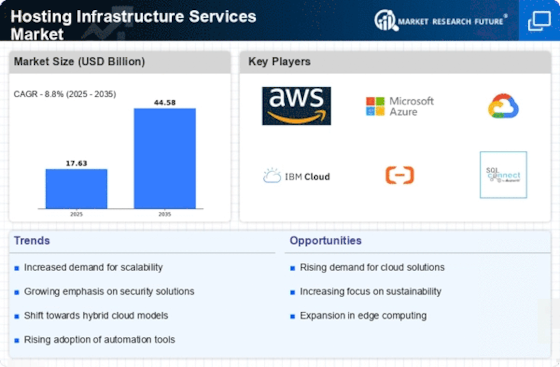
As per Market Research Future analysis, the Hosting Infrastructure Services Market was estimated at 17.63 USD Billion in 2024. The Hosting Infrastructure Services industry is projected to grow from 19.18 USD Billion in 2025 to 44.58 USD Billion by 2035, exhibiting a compound annual growth rate (CAGR) of 8.8% during the forecast period 2025 - 2035

Key Market Trends & Highlights

The Hosting Infrastructure Services Market is experiencing robust growth driven by cloud adoption and evolving security needs.

  • North America remains the largest market for hosting infrastructure services, driven by advanced technological adoption. Asia-Pacific is emerging as the fastest-growing region, fueled by increasing digital transformation initiatives. The solution segment dominates the market, while the services segment is witnessing the fastest growth due to rising customer demands. Key market drivers include the rising demand for scalability and an increased focus on data security, particularly in cloud-based solutions.

Market Size & Forecast

2024 Market Size 17.63 (USD Billion)
2035 Market Size 44.58 (USD Billion)
CAGR (2025 - 2035) 8.8%
Largest Regional Market Share in 2024 North America

Major Players

Amazon Web Services (US), Microsoft Azure (US), Google Cloud (US), IBM Cloud (US), Alibaba Cloud (CN), Oracle Cloud (US), DigitalOcean (US), Linode (US), Vultr (US)

Market Trends

The Hosting Infrastructure Services Market is currently experiencing a dynamic evolution, driven by the increasing demand for scalable and flexible solutions. Organizations are increasingly recognizing the necessity of robust hosting services to support their digital operations. This shift is largely influenced by the growing reliance on cloud computing, which offers enhanced efficiency and cost-effectiveness. As businesses seek to optimize their online presence, the need for reliable infrastructure becomes paramount. Furthermore, the rise of remote work and digital transformation initiatives has accelerated the adoption of hosting services, prompting providers to innovate and expand their offerings. In addition, the Hosting Infrastructure Services Market is witnessing a trend towards greater integration of advanced technologies. The incorporation of artificial intelligence and machine learning into hosting solutions appears to enhance performance and security. This technological advancement not only improves service delivery but also enables organizations to leverage data analytics for better decision-making. As the market continues to evolve, it is likely that service providers will focus on delivering tailored solutions that meet the specific needs of diverse industries, thereby fostering a more competitive landscape.

Cloud Adoption Surge

The ongoing shift towards cloud-based solutions is reshaping the Hosting Infrastructure Services Market. Organizations are increasingly migrating their operations to the cloud, seeking the benefits of scalability and flexibility. This trend indicates a growing preference for Infrastructure as a Service (IaaS) models, which allow businesses to manage resources more efficiently.

Enhanced Security Measures

As cyber threats become more sophisticated, the demand for enhanced security within hosting services is rising. Providers are likely to invest in advanced security protocols and technologies to protect client data. This trend suggests that organizations are prioritizing security as a critical component of their hosting infrastructure.

Sustainability Initiatives

There is a noticeable shift towards sustainability within the Hosting Infrastructure Services Market. Companies are increasingly seeking eco-friendly hosting solutions that minimize environmental impact. This trend indicates a growing awareness of corporate responsibility and the importance of sustainable practices in technology.

Hosting Infrastructure Services Market Market Drivers

Emergence of Edge Computing

The Hosting Infrastructure Services Market is currently influenced by the emergence of edge computing. This technology allows data processing to occur closer to the source, reducing latency and improving performance. As more devices connect to the Internet of Things (IoT), the demand for edge computing solutions is expected to rise significantly. Industry analysts project that the edge computing market will reach a valuation of over 20 billion dollars by 2026. This trend compels hosting providers to adapt their infrastructure to support edge computing capabilities, thereby enhancing service delivery. By integrating edge solutions, companies can offer faster response times and improved user experiences, positioning themselves favorably in a competitive market.

Rising Demand for Scalability

The Hosting Infrastructure Services Market experiences a notable increase in demand for scalable solutions. As businesses expand, they require infrastructure that can grow alongside them. This trend is particularly evident in sectors such as e-commerce and software development, where fluctuating traffic necessitates flexible hosting options. According to recent data, the market for scalable hosting solutions is projected to grow at a compound annual growth rate of approximately 15% over the next five years. This growth is driven by the need for businesses to maintain operational efficiency while managing costs. Consequently, service providers are increasingly offering tailored solutions that allow clients to adjust their resources dynamically, thereby enhancing their competitive edge in the market.

Increased Focus on Data Security

In the current landscape, the Hosting Infrastructure Services Market is witnessing an intensified focus on data security. With the rise in cyber threats, organizations are prioritizing secure hosting solutions to protect sensitive information. Recent statistics indicate that data breaches have increased by over 30% in the past year, prompting businesses to seek robust security measures. Hosting providers are responding by implementing advanced security protocols, including encryption and multi-factor authentication. This shift not only safeguards client data but also enhances the overall reputation of service providers. As a result, companies that prioritize security in their hosting infrastructure are likely to gain a competitive advantage, attracting clients who value data protection.

Regulatory Compliance Requirements

The Hosting Infrastructure Services Market is significantly impacted by regulatory compliance requirements. As data protection laws become more stringent, organizations must ensure that their hosting solutions adhere to these regulations. Compliance with standards such as GDPR and HIPAA is not only a legal obligation but also a critical factor in maintaining customer trust. Recent findings suggest that non-compliance can result in fines exceeding 4% of annual revenue, prompting businesses to prioritize compliant hosting solutions. Hosting providers are increasingly offering services that align with regulatory standards, thereby enabling clients to mitigate risks associated with data handling. This focus on compliance is likely to shape the future of the hosting infrastructure landscape.

Growing Adoption of Hybrid Cloud Solutions

The Hosting Infrastructure Services Market is experiencing a growing adoption of hybrid cloud solutions. Organizations are increasingly recognizing the benefits of combining public and private cloud environments to optimize their operations. This approach allows businesses to maintain control over sensitive data while leveraging the scalability of public clouds. Recent surveys indicate that nearly 70% of enterprises are considering or have already implemented hybrid cloud strategies. This trend is driven by the need for flexibility, cost efficiency, and enhanced performance. Hosting providers are responding by offering integrated solutions that facilitate seamless transitions between cloud environments, thereby meeting the diverse needs of their clients.

Market Segment Insights

By Offering: Solution (Largest) vs. Services (Fastest-Growing)

In the Hosting Infrastructure Services Market, the segment values of 'Solution' and 'Services' are pivotal to understanding overall market dynamics. 'Solution' currently represents the largest portion of the market, benefiting from established customer bases and proven performance. This segment encompasses a variety of hosting solutions tailored to meet different business needs, allowing for streamlined operations and enhanced efficiency across various platforms. On the other hand, the 'Services' segment, though smaller, is witnessing robust growth as businesses increasingly seek comprehensive support and managed services to optimize their hosting environments.

Solution (Dominant) vs. Services (Emerging)

The 'Solution' segment stands as the dominant force in the Hosting Infrastructure Services Market, characterized by its wide range of offerings, including cloud hosting, dedicated servers, and hybrid solutions. This segment appeals to businesses searching for tailored solutions that align with their specific operational requirements. Meanwhile, the 'Services' segment is emerging rapidly, driven by the increasing demand for managed services, security, and additional support that enhance hosting capabilities. As businesses grapple with the complexities of IT environments, the need for reliable and effective services becomes critical, contributing to the segment's accelerated growth and positioning it as a key player in the evolving hosting landscape.

By Deployment Model: Cloud (Largest) vs. On Premises (Fastest-Growing)

In the Hosting Infrastructure Services Market, the deployment model segment is primarily divided into Cloud and On-Premises solutions. The Cloud segment holds the largest market share, driven by its flexibility, scalability, and cost-effectiveness, making it the preferred choice for many organizations. Conversely, the On-Premises segment is rapidly gaining traction, particularly among businesses with specific security and compliance requirements, reflecting a growing demand for localized control over data and applications.

Hosting Infrastructure: Cloud (Dominant) vs. On Premises (Emerging)

The Cloud deployment model is characterized by its ability to provide on-demand resources and services over the internet, enabling companies to scale efficiently and reduce IT costs. It offers various services such as Infrastructure as a Service (IaaS) and Platform as a Service (PaaS), appealing to businesses seeking agility. On the other hand, the On-Premises model caters to organizations that prioritize data privacy and regulatory compliance. While traditionally seen as a legacy approach, it is witnessing a resurgence due to evolving enterprise needs, offering companies greater control over their infrastructure and applications.

By End User: IT and ITeS (Largest) vs. Energy and Utilities (Fastest-Growing)

In the Hosting Infrastructure Services Market, the distribution of market share among end user segments is notably diverse, with IT and ITeS holding a substantial portion of the overall market. This segment is pivotal due to the increasing reliance on cloud computing and digital services, driving demand for robust hosting solutions. Following closely, the Energy and Utilities sector is experiencing rapid growth, reflecting the increasing adoption of digital transformation initiatives aimed at enhancing operational efficiency and reliability in service delivery. The growth trends within these segments highlight the critical role of technological advancements and changing regulatory landscapes. The IT and ITeS sector benefits significantly from continuous innovation, while the Energy and Utilities segment is evolving with the integration of smart technologies and renewable energy sources. These transformations are steering more businesses towards cloud-based hosting solutions to enhance scalability and reduce costs, making these two segments vital in shaping the future landscape of hosting infrastructure services.

IT and ITeS: Dominant vs. Energy and Utilities: Emerging

The IT and ITeS segment is characterized by its substantial contribution to the Hosting Infrastructure Services Market, driven by the escalating demand for advanced IT solutions, cloud services, and data analytics capabilities. Companies in this segment continuously evolve by integrating cutting-edge technologies, such as artificial intelligence and machine learning, to enhance service efficiency and customer experience. Conversely, the Energy and Utilities segment is emerging rapidly, as organizations strive for digital transformation to optimize operational effectiveness and support sustainability goals. This transition involves the adoption of smart grid technologies, which promote better resource management and energy distribution. Both segments are essential in navigating the challenges posed by modern business demands, with IT and ITeS leading in market share and Energy and Utilities showcasing dynamic growth potential.

Get more detailed insights about Hosting Infrastructure Services Market Research Report—Global Forecast till 2035

Regional Insights

North America : Leading Innovation and Growth

North America remains the largest market for hosting infrastructure services, accounting for approximately 45% of the global market share. The region's growth is driven by increasing demand for cloud services, data security regulations, and the proliferation of digital transformation initiatives across various sectors. Regulatory support, such as the Federal Cloud Computing Strategy, further catalyzes this growth, ensuring compliance and security in cloud adoption. The competitive landscape is dominated by major players like Amazon Web Services, Microsoft Azure, and Google Cloud, which are continuously innovating to enhance service offerings. The U.S. leads the market, followed by Canada, which is also witnessing significant growth due to its robust IT infrastructure and favorable government policies. The presence of these key players fosters a dynamic environment, pushing for advancements in technology and service delivery.

Europe : Emerging Market with Potential

Europe is witnessing a rapid increase in the adoption of hosting infrastructure services, holding approximately 30% of the global market share. The region's growth is fueled by stringent data protection regulations like the GDPR, which compel businesses to seek compliant hosting solutions. Additionally, the European Commission's Digital Strategy aims to enhance digital infrastructure, further driving demand for cloud services across member states. Leading countries in this market include Germany, the UK, and France, which are home to several key players such as OVHcloud and Deutsche Telekom. The competitive landscape is characterized by a mix of established firms and emerging startups, all vying for market share. The presence of major global players like Microsoft and Amazon also contributes to a competitive environment, fostering innovation and service diversification.

Asia-Pacific : Rapid Growth and Expansion

Asia-Pacific is rapidly emerging as a significant player in the hosting infrastructure services market, accounting for about 20% of the global market share. The region's growth is driven by increasing internet penetration, a surge in e-commerce, and government initiatives promoting digital transformation. Countries like China and India are at the forefront, with supportive regulations that encourage cloud adoption and innovation in technology. China leads the market, followed closely by India, which is experiencing a boom in startups and tech companies. The competitive landscape is diverse, with local players like Alibaba Cloud and Tencent Cloud competing against global giants such as AWS and Microsoft. This dynamic environment fosters innovation and drives down costs, making hosting services more accessible to businesses of all sizes. The India hosting infrastructure services market is expanding rapidly, supported by strong government-led digital transformation initiatives, rising cloud adoption among enterprises, and growing investments in data center infrastructure.

Middle East and Africa : Untapped Market Potential

The Middle East and Africa region is gradually emerging in the hosting infrastructure services market, currently holding about 5% of the global market share. The growth is primarily driven by increasing internet connectivity, mobile penetration, and government initiatives aimed at enhancing digital infrastructure. Countries like the UAE and South Africa are leading the charge, with investments in technology and favorable regulations promoting cloud adoption. The competitive landscape is still developing, with a mix of local and international players. The presence of companies like MTN and Liquid Telecom is notable, but global giants are also making inroads. As the region continues to invest in technology and infrastructure, the potential for growth in hosting services is significant, attracting both local and foreign investments.

Key Players and Competitive Insights

Leading market players are investing heavily in research and development in order to expand their product lines, which will help the hosting infrastructure services market, grow even more. Market participants are also undertaking a variety of strategic activities to expand their global footprint, with important market developments including new product launches, contractual agreements, mergers and acquisitions, higher investments, and collaboration with other organizations. To expand and survive in a more competitive and rising market climate, hosting infrastructure services industry must offer cost-effective items. Manufacturing locally to minimize operational costs is one of the key business tactics used by manufacturers in the global hosting infrastructure services industry to benefit clients and increase the market sector. In recent years, the hosting infrastructure services industry has offered some of the most significant advantages to medicine. Major players in the hosting infrastructure services market attempting to increase market demand by investing in research and development operations include AT&T Inc., International Business Machines Corporation, Microsoft Corporation, HPE, Google, NetApp, Inc., Equinix Inc., GoDaddy Operating Company, LLC, CoreSite, and Rackspace Inc. A worldwide corporation, IBM Corporation produces and markets software, middleware, and computer hardware in addition to offering hosting and IT consulting services. The five business segments that make up IBM Corporation's operations are gaming, media & entertainment, government, healthcare, retail, and telecommunications. The company provides a range of services in the market for hosting infrastructure services, including web hosting for small and medium-sized organisations, cloud hosting, infrastructure management, colocation hosting services, utility hosting services, and remote infrastructure management. Microsoft Corp creates, licenses, and maintains software-related goods, services, and hardware. The company provides a wide selection of operating systems, cross-device productivity apps, server applications, software development tools, business solution programmes, video games, desktop and server administration tools, and training and certification services. Additionally, it creates, produces, and markets hardware items like PCs, tablets, gaming consoles, and other sophisticated gadgets. The business offers a wide range of services, such as consulting, cloud-based solutions, and solution support.

Key Companies in the Hosting Infrastructure Services Market include

Industry Developments

December 2021 To hasten Brunei's digital transformation, Unified National Networks Sdn Bhd (UNN) has announced the launch of a new cloud-hosting IaaS. Brunei will be one step closer to attaining its Smart Nation objectives with this new programme.

September 2021 In order to increase operational speed and agility for clients and employees, Wells Fargo & Company unveiled its new digital infrastructure plan. This new method would include both third-party data centers and a multi-cloud architecture.

Future Outlook

Hosting Infrastructure Services Market Future Outlook

The Hosting Infrastructure Services Market is projected to grow at an 8.8% CAGR from 2025 to 2035, driven by increasing cloud adoption, demand for scalability, and enhanced security requirements.

New opportunities lie in:

  • <p>Expansion of edge computing services to reduce latency for global clients. Development of hybrid cloud solutions tailored for specific industry needs. Investment in AI-driven analytics for optimizing resource allocation and performance.</p>

By 2035, the market is expected to be robust, reflecting substantial growth and innovation.

Market Segmentation

Hosting Infrastructure Services Market End User Outlook

  • Energy and Utilities
  • Defense and Government
  • Manufacturing
  • Transportation and Logistics
  • Telecom
  • IT and ITeS
  • Others

Hosting Infrastructure Services Market Offering Outlook

  • Solution
  • Services

Hosting Infrastructure Services Market Deployment Model Outlook

  • Cloud
  • On premises

Report Scope

MARKET SIZE 2024 17.63(USD Billion)
MARKET SIZE 2025 19.18(USD Billion)
MARKET SIZE 2035 44.58(USD Billion)
COMPOUND ANNUAL GROWTH RATE (CAGR) 8.8% (2025 - 2035)
REPORT COVERAGE Revenue Forecast, Competitive Landscape, Growth Factors, and Trends
BASE YEAR 2024
Market Forecast Period 2025 - 2035
Historical Data 2019 - 2024
Market Forecast Units USD Billion
Key Companies Profiled Amazon Web Services (US), Microsoft Azure (US), Google Cloud (US), IBM Cloud (US), Alibaba Cloud (CN), Oracle Cloud (US), DigitalOcean (US), Linode (US), Vultr (US)
Segments Covered Offering, Deployment Model, End User, Region
Key Market Opportunities Integration of artificial intelligence and machine learning in Hosting Infrastructure Services Market enhances operational efficiency and customer experience.
Key Market Dynamics Rising demand for cloud services drives competition and innovation in the Hosting Infrastructure Services Market.
Countries Covered North America, Europe, APAC, South America, MEA

FAQs

What is the current valuation of the Hosting Infrastructure Services Market in 2025?

<p>The Hosting Infrastructure Services Market is valued at 17.63 USD Billion in 2024 and is expected to grow significantly in the coming years.</p>

What is the projected market size for the Hosting Infrastructure Services Market by 2035?

<p>The market is projected to reach 44.58 USD Billion by 2035, indicating substantial growth.</p>

What is the expected CAGR for the Hosting Infrastructure Services Market during the forecast period 2025 - 2035?

<p>The expected CAGR for the Hosting Infrastructure Services Market during the forecast period 2025 - 2035 is 8.8%.</p>

Which companies are considered key players in the Hosting Infrastructure Services Market?

<p>Key players in the market include Amazon Web Services, Microsoft Azure, Google Cloud, IBM Cloud, Alibaba Cloud, Oracle Cloud, DigitalOcean, Linode, and Vultr.</p>

What are the main segments of the Hosting Infrastructure Services Market?

<p>The main segments include Offering, Deployment Model, and End User, each with distinct valuation metrics.</p>

How does the Offering segment perform in terms of valuation?

<p>In 2024, the Offering segment was valued at 17.29 USD Billion for Solutions and 27.29 USD Billion for Services.</p>

What is the valuation of the Cloud deployment model in the Hosting Infrastructure Services Market?

The Cloud deployment model was valued at 10.58 USD Billion in 2024 and is expected to grow to 26.89 USD Billion by 2035.

Which end-user sectors are driving growth in the Hosting Infrastructure Services Market?

Key end-user sectors include IT and ITeS, Telecom, and Energy and Utilities, with IT and ITeS valued at 5.0 USD Billion in 2024.

What is the projected growth for the On-premises deployment model?

The On-premises deployment model was valued at 7.05 USD Billion in 2024 and is projected to reach 17.69 USD Billion by 2035.

How does the performance of the Defense and Government sector compare to others in the market?

The Defense and Government sector was valued at 1.8 USD Billion in 2024 and is expected to grow to 4.5 USD Billion by 2035, indicating steady growth.

  1. SECTION I: EXECUTIVE SUMMARY AND KEY HIGHLIGHTS
    1. | 1.1 EXECUTIVE SUMMARY
    2. | | 1.1.1 Market Overview
    3. | | 1.1.2 Key Findings
    4. | | 1.1.3 Market Segmentation
    5. | | 1.1.4 Competitive Landscape
    6. | | 1.1.5 Challenges and Opportunities
    7. | | 1.1.6 Future Outlook
  2. SECTION II: SCOPING, METHODOLOGY AND MARKET STRUCTURE
    1. | 2.1 MARKET INTRODUCTION
    2. | | 2.1.1 Definition
    3. | | 2.1.2 Scope of the study
    4. | | | 2.1.2.1 Research Objective
    5. | | | 2.1.2.2 Assumption
    6. | | | 2.1.2.3 Limitations
    7. | 2.2 RESEARCH METHODOLOGY
    8. | | 2.2.1 Overview
    9. | | 2.2.2 Data Mining
    10. | | 2.2.3 Secondary Research
    11. | | 2.2.4 Primary Research
    12. | | | 2.2.4.1 Primary Interviews and Information Gathering Process
    13. | | | 2.2.4.2 Breakdown of Primary Respondents
    14. | | 2.2.5 Forecasting Model
    15. | | 2.2.6 Market Size Estimation
    16. | | | 2.2.6.1 Bottom-Up Approach
    17. | | | 2.2.6.2 Top-Down Approach
    18. | | 2.2.7 Data Triangulation
    19. | | 2.2.8 Validation
  3. SECTION III: QUALITATIVE ANALYSIS
    1. | 3.1 MARKET DYNAMICS
    2. | | 3.1.1 Overview
    3. | | 3.1.2 Drivers
    4. | | 3.1.3 Restraints
    5. | | 3.1.4 Opportunities
    6. | 3.2 MARKET FACTOR ANALYSIS
    7. | | 3.2.1 Value chain Analysis
    8. | | 3.2.2 Porter's Five Forces Analysis
    9. | | | 3.2.2.1 Bargaining Power of Suppliers
    10. | | | 3.2.2.2 Bargaining Power of Buyers
    11. | | | 3.2.2.3 Threat of New Entrants
    12. | | | 3.2.2.4 Threat of Substitutes
    13. | | | 3.2.2.5 Intensity of Rivalry
    14. | | 3.2.3 COVID-19 Impact Analysis
    15. | | | 3.2.3.1 Market Impact Analysis
    16. | | | 3.2.3.2 Regional Impact
    17. | | | 3.2.3.3 Opportunity and Threat Analysis
  4. SECTION IV: QUANTITATIVE ANALYSIS
    1. | 4.1 Information and Communications Technology, BY Offering (USD Billion)
    2. | | 4.1.1 Solution
    3. | | 4.1.2 Services
    4. | 4.2 Information and Communications Technology, BY Deployment Model (USD Billion)
    5. | | 4.2.1 Cloud
    6. | | 4.2.2 On premises
    7. | 4.3 Information and Communications Technology, BY End User (USD Billion)
    8. | | 4.3.1 Energy and Utilities
    9. | | 4.3.2 Defense and Government
    10. | | 4.3.3 Manufacturing
    11. | | 4.3.4 Transportation and Logistics
    12. | | 4.3.5 Telecom
    13. | | 4.3.6 IT and ITeS
    14. | | 4.3.7 Others
    15. | 4.4 Information and Communications Technology, BY Region (USD Billion)
    16. | | 4.4.1 North America
    17. | | | 4.4.1.1 US
    18. | | | 4.4.1.2 Canada
    19. | | 4.4.2 Europe
    20. | | | 4.4.2.1 Germany
    21. | | | 4.4.2.2 UK
    22. | | | 4.4.2.3 France
    23. | | | 4.4.2.4 Russia
    24. | | | 4.4.2.5 Italy
    25. | | | 4.4.2.6 Spain
    26. | | | 4.4.2.7 Rest of Europe
    27. | | 4.4.3 APAC
    28. | | | 4.4.3.1 China
    29. | | | 4.4.3.2 India
    30. | | | 4.4.3.3 Japan
    31. | | | 4.4.3.4 South Korea
    32. | | | 4.4.3.5 Malaysia
    33. | | | 4.4.3.6 Thailand
    34. | | | 4.4.3.7 Indonesia
    35. | | | 4.4.3.8 Rest of APAC
    36. | | 4.4.4 South America
    37. | | | 4.4.4.1 Brazil
    38. | | | 4.4.4.2 Mexico
    39. | | | 4.4.4.3 Argentina
    40. | | | 4.4.4.4 Rest of South America
    41. | | 4.4.5 MEA
    42. | | | 4.4.5.1 GCC Countries
    43. | | | 4.4.5.2 South Africa
    44. | | | 4.4.5.3 Rest of MEA
  5. SECTION V: COMPETITIVE ANALYSIS
    1. | 5.1 Competitive Landscape
    2. | | 5.1.1 Overview
    3. | | 5.1.2 Competitive Analysis
    4. | | 5.1.3 Market share Analysis
    5. | | 5.1.4 Major Growth Strategy in the Information and Communications Technology
    6. | | 5.1.5 Competitive Benchmarking
    7. | | 5.1.6 Leading Players in Terms of Number of Developments in the Information and Communications Technology
    8. | | 5.1.7 Key developments and growth strategies
    9. | | | 5.1.7.1 New Product Launch/Service Deployment
    10. | | | 5.1.7.2 Merger & Acquisitions
    11. | | | 5.1.7.3 Joint Ventures
    12. | | 5.1.8 Major Players Financial Matrix
    13. | | | 5.1.8.1 Sales and Operating Income
    14. | | | 5.1.8.2 Major Players R&D Expenditure. 2023
    15. | 5.2 Company Profiles
    16. | | 5.2.1 Amazon Web Services (US)
    17. | | | 5.2.1.1 Financial Overview
    18. | | | 5.2.1.2 Products Offered
    19. | | | 5.2.1.3 Key Developments
    20. | | | 5.2.1.4 SWOT Analysis
    21. | | | 5.2.1.5 Key Strategies
    22. | | 5.2.2 Microsoft Azure (US)
    23. | | | 5.2.2.1 Financial Overview
    24. | | | 5.2.2.2 Products Offered
    25. | | | 5.2.2.3 Key Developments
    26. | | | 5.2.2.4 SWOT Analysis
    27. | | | 5.2.2.5 Key Strategies
    28. | | 5.2.3 Google Cloud (US)
    29. | | | 5.2.3.1 Financial Overview
    30. | | | 5.2.3.2 Products Offered
    31. | | | 5.2.3.3 Key Developments
    32. | | | 5.2.3.4 SWOT Analysis
    33. | | | 5.2.3.5 Key Strategies
    34. | | 5.2.4 IBM Cloud (US)
    35. | | | 5.2.4.1 Financial Overview
    36. | | | 5.2.4.2 Products Offered
    37. | | | 5.2.4.3 Key Developments
    38. | | | 5.2.4.4 SWOT Analysis
    39. | | | 5.2.4.5 Key Strategies
    40. | | 5.2.5 Alibaba Cloud (CN)
    41. | | | 5.2.5.1 Financial Overview
    42. | | | 5.2.5.2 Products Offered
    43. | | | 5.2.5.3 Key Developments
    44. | | | 5.2.5.4 SWOT Analysis
    45. | | | 5.2.5.5 Key Strategies
    46. | | 5.2.6 Oracle Cloud (US)
    47. | | | 5.2.6.1 Financial Overview
    48. | | | 5.2.6.2 Products Offered
    49. | | | 5.2.6.3 Key Developments
    50. | | | 5.2.6.4 SWOT Analysis
    51. | | | 5.2.6.5 Key Strategies
    52. | | 5.2.7 DigitalOcean (US)
    53. | | | 5.2.7.1 Financial Overview
    54. | | | 5.2.7.2 Products Offered
    55. | | | 5.2.7.3 Key Developments
    56. | | | 5.2.7.4 SWOT Analysis
    57. | | | 5.2.7.5 Key Strategies
    58. | | 5.2.8 Linode (US)
    59. | | | 5.2.8.1 Financial Overview
    60. | | | 5.2.8.2 Products Offered
    61. | | | 5.2.8.3 Key Developments
    62. | | | 5.2.8.4 SWOT Analysis
    63. | | | 5.2.8.5 Key Strategies
    64. | | 5.2.9 Vultr (US)
    65. | | | 5.2.9.1 Financial Overview
    66. | | | 5.2.9.2 Products Offered
    67. | | | 5.2.9.3 Key Developments
    68. | | | 5.2.9.4 SWOT Analysis
    69. | | | 5.2.9.5 Key Strategies
    70. | 5.3 Appendix
    71. | | 5.3.1 References
    72. | | 5.3.2 Related Reports
  6. LIST OF FIGURES
    1. | 6.1 MARKET SYNOPSIS
    2. | 6.2 NORTH AMERICA MARKET ANALYSIS
    3. | 6.3 US MARKET ANALYSIS BY OFFERING
    4. | 6.4 US MARKET ANALYSIS BY DEPLOYMENT MODEL
    5. | 6.5 US MARKET ANALYSIS BY END USER
    6. | 6.6 CANADA MARKET ANALYSIS BY OFFERING
    7. | 6.7 CANADA MARKET ANALYSIS BY DEPLOYMENT MODEL
    8. | 6.8 CANADA MARKET ANALYSIS BY END USER
    9. | 6.9 EUROPE MARKET ANALYSIS
    10. | 6.10 GERMANY MARKET ANALYSIS BY OFFERING
    11. | 6.11 GERMANY MARKET ANALYSIS BY DEPLOYMENT MODEL
    12. | 6.12 GERMANY MARKET ANALYSIS BY END USER
    13. | 6.13 UK MARKET ANALYSIS BY OFFERING
    14. | 6.14 UK MARKET ANALYSIS BY DEPLOYMENT MODEL
    15. | 6.15 UK MARKET ANALYSIS BY END USER
    16. | 6.16 FRANCE MARKET ANALYSIS BY OFFERING
    17. | 6.17 FRANCE MARKET ANALYSIS BY DEPLOYMENT MODEL
    18. | 6.18 FRANCE MARKET ANALYSIS BY END USER
    19. | 6.19 RUSSIA MARKET ANALYSIS BY OFFERING
    20. | 6.20 RUSSIA MARKET ANALYSIS BY DEPLOYMENT MODEL
    21. | 6.21 RUSSIA MARKET ANALYSIS BY END USER
    22. | 6.22 ITALY MARKET ANALYSIS BY OFFERING
    23. | 6.23 ITALY MARKET ANALYSIS BY DEPLOYMENT MODEL
    24. | 6.24 ITALY MARKET ANALYSIS BY END USER
    25. | 6.25 SPAIN MARKET ANALYSIS BY OFFERING
    26. | 6.26 SPAIN MARKET ANALYSIS BY DEPLOYMENT MODEL
    27. | 6.27 SPAIN MARKET ANALYSIS BY END USER
    28. | 6.28 REST OF EUROPE MARKET ANALYSIS BY OFFERING
    29. | 6.29 REST OF EUROPE MARKET ANALYSIS BY DEPLOYMENT MODEL
    30. | 6.30 REST OF EUROPE MARKET ANALYSIS BY END USER
    31. | 6.31 APAC MARKET ANALYSIS
    32. | 6.32 CHINA MARKET ANALYSIS BY OFFERING
    33. | 6.33 CHINA MARKET ANALYSIS BY DEPLOYMENT MODEL
    34. | 6.34 CHINA MARKET ANALYSIS BY END USER
    35. | 6.35 INDIA MARKET ANALYSIS BY OFFERING
    36. | 6.36 INDIA MARKET ANALYSIS BY DEPLOYMENT MODEL
    37. | 6.37 INDIA MARKET ANALYSIS BY END USER
    38. | 6.38 JAPAN MARKET ANALYSIS BY OFFERING
    39. | 6.39 JAPAN MARKET ANALYSIS BY DEPLOYMENT MODEL
    40. | 6.40 JAPAN MARKET ANALYSIS BY END USER
    41. | 6.41 SOUTH KOREA MARKET ANALYSIS BY OFFERING
    42. | 6.42 SOUTH KOREA MARKET ANALYSIS BY DEPLOYMENT MODEL
    43. | 6.43 SOUTH KOREA MARKET ANALYSIS BY END USER
    44. | 6.44 MALAYSIA MARKET ANALYSIS BY OFFERING
    45. | 6.45 MALAYSIA MARKET ANALYSIS BY DEPLOYMENT MODEL
    46. | 6.46 MALAYSIA MARKET ANALYSIS BY END USER
    47. | 6.47 THAILAND MARKET ANALYSIS BY OFFERING
    48. | 6.48 THAILAND MARKET ANALYSIS BY DEPLOYMENT MODEL
    49. | 6.49 THAILAND MARKET ANALYSIS BY END USER
    50. | 6.50 INDONESIA MARKET ANALYSIS BY OFFERING
    51. | 6.51 INDONESIA MARKET ANALYSIS BY DEPLOYMENT MODEL
    52. | 6.52 INDONESIA MARKET ANALYSIS BY END USER
    53. | 6.53 REST OF APAC MARKET ANALYSIS BY OFFERING
    54. | 6.54 REST OF APAC MARKET ANALYSIS BY DEPLOYMENT MODEL
    55. | 6.55 REST OF APAC MARKET ANALYSIS BY END USER
    56. | 6.56 SOUTH AMERICA MARKET ANALYSIS
    57. | 6.57 BRAZIL MARKET ANALYSIS BY OFFERING
    58. | 6.58 BRAZIL MARKET ANALYSIS BY DEPLOYMENT MODEL
    59. | 6.59 BRAZIL MARKET ANALYSIS BY END USER
    60. | 6.60 MEXICO MARKET ANALYSIS BY OFFERING
    61. | 6.61 MEXICO MARKET ANALYSIS BY DEPLOYMENT MODEL
    62. | 6.62 MEXICO MARKET ANALYSIS BY END USER
    63. | 6.63 ARGENTINA MARKET ANALYSIS BY OFFERING
    64. | 6.64 ARGENTINA MARKET ANALYSIS BY DEPLOYMENT MODEL
    65. | 6.65 ARGENTINA MARKET ANALYSIS BY END USER
    66. | 6.66 REST OF SOUTH AMERICA MARKET ANALYSIS BY OFFERING
    67. | 6.67 REST OF SOUTH AMERICA MARKET ANALYSIS BY DEPLOYMENT MODEL
    68. | 6.68 REST OF SOUTH AMERICA MARKET ANALYSIS BY END USER
    69. | 6.69 MEA MARKET ANALYSIS
    70. | 6.70 GCC COUNTRIES MARKET ANALYSIS BY OFFERING
    71. | 6.71 GCC COUNTRIES MARKET ANALYSIS BY DEPLOYMENT MODEL
    72. | 6.72 GCC COUNTRIES MARKET ANALYSIS BY END USER
    73. | 6.73 SOUTH AFRICA MARKET ANALYSIS BY OFFERING
    74. | 6.74 SOUTH AFRICA MARKET ANALYSIS BY DEPLOYMENT MODEL
    75. | 6.75 SOUTH AFRICA MARKET ANALYSIS BY END USER
    76. | 6.76 REST OF MEA MARKET ANALYSIS BY OFFERING
    77. | 6.77 REST OF MEA MARKET ANALYSIS BY DEPLOYMENT MODEL
    78. | 6.78 REST OF MEA MARKET ANALYSIS BY END USER
    79. | 6.79 KEY BUYING CRITERIA OF INFORMATION AND COMMUNICATIONS TECHNOLOGY
    80. | 6.80 RESEARCH PROCESS OF MRFR
    81. | 6.81 DRO ANALYSIS OF INFORMATION AND COMMUNICATIONS TECHNOLOGY
    82. | 6.82 DRIVERS IMPACT ANALYSIS: INFORMATION AND COMMUNICATIONS TECHNOLOGY
    83. | 6.83 RESTRAINTS IMPACT ANALYSIS: INFORMATION AND COMMUNICATIONS TECHNOLOGY
    84. | 6.84 SUPPLY / VALUE CHAIN: INFORMATION AND COMMUNICATIONS TECHNOLOGY
    85. | 6.85 INFORMATION AND COMMUNICATIONS TECHNOLOGY, BY OFFERING, 2024 (% SHARE)
    86. | 6.86 INFORMATION AND COMMUNICATIONS TECHNOLOGY, BY OFFERING, 2024 TO 2035 (USD Billion)
    87. | 6.87 INFORMATION AND COMMUNICATIONS TECHNOLOGY, BY DEPLOYMENT MODEL, 2024 (% SHARE)
    88. | 6.88 INFORMATION AND COMMUNICATIONS TECHNOLOGY, BY DEPLOYMENT MODEL, 2024 TO 2035 (USD Billion)
    89. | 6.89 INFORMATION AND COMMUNICATIONS TECHNOLOGY, BY END USER, 2024 (% SHARE)
    90. | 6.90 INFORMATION AND COMMUNICATIONS TECHNOLOGY, BY END USER, 2024 TO 2035 (USD Billion)
    91. | 6.91 BENCHMARKING OF MAJOR COMPETITORS
  7. LIST OF TABLES
    1. | 7.1 LIST OF ASSUMPTIONS
    2. | | 7.1.1
    3. | 7.2 North America MARKET SIZE ESTIMATES; FORECAST
    4. | | 7.2.1 BY OFFERING, 2025-2035 (USD Billion)
    5. | | 7.2.2 BY DEPLOYMENT MODEL, 2025-2035 (USD Billion)
    6. | | 7.2.3 BY END USER, 2025-2035 (USD Billion)
    7. | 7.3 US MARKET SIZE ESTIMATES; FORECAST
    8. | | 7.3.1 BY OFFERING, 2025-2035 (USD Billion)
    9. | | 7.3.2 BY DEPLOYMENT MODEL, 2025-2035 (USD Billion)
    10. | | 7.3.3 BY END USER, 2025-2035 (USD Billion)
    11. | 7.4 Canada MARKET SIZE ESTIMATES; FORECAST
    12. | | 7.4.1 BY OFFERING, 2025-2035 (USD Billion)
    13. | | 7.4.2 BY DEPLOYMENT MODEL, 2025-2035 (USD Billion)
    14. | | 7.4.3 BY END USER, 2025-2035 (USD Billion)
    15. | 7.5 Europe MARKET SIZE ESTIMATES; FORECAST
    16. | | 7.5.1 BY OFFERING, 2025-2035 (USD Billion)
    17. | | 7.5.2 BY DEPLOYMENT MODEL, 2025-2035 (USD Billion)
    18. | | 7.5.3 BY END USER, 2025-2035 (USD Billion)
    19. | 7.6 Germany MARKET SIZE ESTIMATES; FORECAST
    20. | | 7.6.1 BY OFFERING, 2025-2035 (USD Billion)
    21. | | 7.6.2 BY DEPLOYMENT MODEL, 2025-2035 (USD Billion)
    22. | | 7.6.3 BY END USER, 2025-2035 (USD Billion)
    23. | 7.7 UK MARKET SIZE ESTIMATES; FORECAST
    24. | | 7.7.1 BY OFFERING, 2025-2035 (USD Billion)
    25. | | 7.7.2 BY DEPLOYMENT MODEL, 2025-2035 (USD Billion)
    26. | | 7.7.3 BY END USER, 2025-2035 (USD Billion)
    27. | 7.8 France MARKET SIZE ESTIMATES; FORECAST
    28. | | 7.8.1 BY OFFERING, 2025-2035 (USD Billion)
    29. | | 7.8.2 BY DEPLOYMENT MODEL, 2025-2035 (USD Billion)
    30. | | 7.8.3 BY END USER, 2025-2035 (USD Billion)
    31. | 7.9 Russia MARKET SIZE ESTIMATES; FORECAST
    32. | | 7.9.1 BY OFFERING, 2025-2035 (USD Billion)
    33. | | 7.9.2 BY DEPLOYMENT MODEL, 2025-2035 (USD Billion)
    34. | | 7.9.3 BY END USER, 2025-2035 (USD Billion)
    35. | 7.10 Italy MARKET SIZE ESTIMATES; FORECAST
    36. | | 7.10.1 BY OFFERING, 2025-2035 (USD Billion)
    37. | | 7.10.2 BY DEPLOYMENT MODEL, 2025-2035 (USD Billion)
    38. | | 7.10.3 BY END USER, 2025-2035 (USD Billion)
    39. | 7.11 Spain MARKET SIZE ESTIMATES; FORECAST
    40. | | 7.11.1 BY OFFERING, 2025-2035 (USD Billion)
    41. | | 7.11.2 BY DEPLOYMENT MODEL, 2025-2035 (USD Billion)
    42. | | 7.11.3 BY END USER, 2025-2035 (USD Billion)
    43. | 7.12 Rest of Europe MARKET SIZE ESTIMATES; FORECAST
    44. | | 7.12.1 BY OFFERING, 2025-2035 (USD Billion)
    45. | | 7.12.2 BY DEPLOYMENT MODEL, 2025-2035 (USD Billion)
    46. | | 7.12.3 BY END USER, 2025-2035 (USD Billion)
    47. | 7.13 APAC MARKET SIZE ESTIMATES; FORECAST
    48. | | 7.13.1 BY OFFERING, 2025-2035 (USD Billion)
    49. | | 7.13.2 BY DEPLOYMENT MODEL, 2025-2035 (USD Billion)
    50. | | 7.13.3 BY END USER, 2025-2035 (USD Billion)
    51. | 7.14 China MARKET SIZE ESTIMATES; FORECAST
    52. | | 7.14.1 BY OFFERING, 2025-2035 (USD Billion)
    53. | | 7.14.2 BY DEPLOYMENT MODEL, 2025-2035 (USD Billion)
    54. | | 7.14.3 BY END USER, 2025-2035 (USD Billion)
    55. | 7.15 India MARKET SIZE ESTIMATES; FORECAST
    56. | | 7.15.1 BY OFFERING, 2025-2035 (USD Billion)
    57. | | 7.15.2 BY DEPLOYMENT MODEL, 2025-2035 (USD Billion)
    58. | | 7.15.3 BY END USER, 2025-2035 (USD Billion)
    59. | 7.16 Japan MARKET SIZE ESTIMATES; FORECAST
    60. | | 7.16.1 BY OFFERING, 2025-2035 (USD Billion)
    61. | | 7.16.2 BY DEPLOYMENT MODEL, 2025-2035 (USD Billion)
    62. | | 7.16.3 BY END USER, 2025-2035 (USD Billion)
    63. | 7.17 South Korea MARKET SIZE ESTIMATES; FORECAST
    64. | | 7.17.1 BY OFFERING, 2025-2035 (USD Billion)
    65. | | 7.17.2 BY DEPLOYMENT MODEL, 2025-2035 (USD Billion)
    66. | | 7.17.3 BY END USER, 2025-2035 (USD Billion)
    67. | 7.18 Malaysia MARKET SIZE ESTIMATES; FORECAST
    68. | | 7.18.1 BY OFFERING, 2025-2035 (USD Billion)
    69. | | 7.18.2 BY DEPLOYMENT MODEL, 2025-2035 (USD Billion)
    70. | | 7.18.3 BY END USER, 2025-2035 (USD Billion)
    71. | 7.19 Thailand MARKET SIZE ESTIMATES; FORECAST
    72. | | 7.19.1 BY OFFERING, 2025-2035 (USD Billion)
    73. | | 7.19.2 BY DEPLOYMENT MODEL, 2025-2035 (USD Billion)
    74. | | 7.19.3 BY END USER, 2025-2035 (USD Billion)
    75. | 7.20 Indonesia MARKET SIZE ESTIMATES; FORECAST
    76. | | 7.20.1 BY OFFERING, 2025-2035 (USD Billion)
    77. | | 7.20.2 BY DEPLOYMENT MODEL, 2025-2035 (USD Billion)
    78. | | 7.20.3 BY END USER, 2025-2035 (USD Billion)
    79. | 7.21 Rest of APAC MARKET SIZE ESTIMATES; FORECAST
    80. | | 7.21.1 BY OFFERING, 2025-2035 (USD Billion)
    81. | | 7.21.2 BY DEPLOYMENT MODEL, 2025-2035 (USD Billion)
    82. | | 7.21.3 BY END USER, 2025-2035 (USD Billion)
    83. | 7.22 South America MARKET SIZE ESTIMATES; FORECAST
    84. | | 7.22.1 BY OFFERING, 2025-2035 (USD Billion)
    85. | | 7.22.2 BY DEPLOYMENT MODEL, 2025-2035 (USD Billion)
    86. | | 7.22.3 BY END USER, 2025-2035 (USD Billion)
    87. | 7.23 Brazil MARKET SIZE ESTIMATES; FORECAST
    88. | | 7.23.1 BY OFFERING, 2025-2035 (USD Billion)
    89. | | 7.23.2 BY DEPLOYMENT MODEL, 2025-2035 (USD Billion)
    90. | | 7.23.3 BY END USER, 2025-2035 (USD Billion)
    91. | 7.24 Mexico MARKET SIZE ESTIMATES; FORECAST
    92. | | 7.24.1 BY OFFERING, 2025-2035 (USD Billion)
    93. | | 7.24.2 BY DEPLOYMENT MODEL, 2025-2035 (USD Billion)
    94. | | 7.24.3 BY END USER, 2025-2035 (USD Billion)
    95. | 7.25 Argentina MARKET SIZE ESTIMATES; FORECAST
    96. | | 7.25.1 BY OFFERING, 2025-2035 (USD Billion)
    97. | | 7.25.2 BY DEPLOYMENT MODEL, 2025-2035 (USD Billion)
    98. | | 7.25.3 BY END USER, 2025-2035 (USD Billion)
    99. | 7.26 Rest of South America MARKET SIZE ESTIMATES; FORECAST
    100. | | 7.26.1 BY OFFERING, 2025-2035 (USD Billion)
    101. | | 7.26.2 BY DEPLOYMENT MODEL, 2025-2035 (USD Billion)
    102. | | 7.26.3 BY END USER, 2025-2035 (USD Billion)
    103. | 7.27 MEA MARKET SIZE ESTIMATES; FORECAST
    104. | | 7.27.1 BY OFFERING, 2025-2035 (USD Billion)
    105. | | 7.27.2 BY DEPLOYMENT MODEL, 2025-2035 (USD Billion)
    106. | | 7.27.3 BY END USER, 2025-2035 (USD Billion)
    107. | 7.28 GCC Countries MARKET SIZE ESTIMATES; FORECAST
    108. | | 7.28.1 BY OFFERING, 2025-2035 (USD Billion)
    109. | | 7.28.2 BY DEPLOYMENT MODEL, 2025-2035 (USD Billion)
    110. | | 7.28.3 BY END USER, 2025-2035 (USD Billion)
    111. | 7.29 South Africa MARKET SIZE ESTIMATES; FORECAST
    112. | | 7.29.1 BY OFFERING, 2025-2035 (USD Billion)
    113. | | 7.29.2 BY DEPLOYMENT MODEL, 2025-2035 (USD Billion)
    114. | | 7.29.3 BY END USER, 2025-2035 (USD Billion)
    115. | 7.30 Rest of MEA MARKET SIZE ESTIMATES; FORECAST
    116. | | 7.30.1 BY OFFERING, 2025-2035 (USD Billion)
    117. | | 7.30.2 BY DEPLOYMENT MODEL, 2025-2035 (USD Billion)
    118. | | 7.30.3 BY END USER, 2025-2035 (USD Billion)
    119. | 7.31 PRODUCT LAUNCH/PRODUCT DEVELOPMENT/APPROVAL
    120. | | 7.31.1
    121. | 7.32 ACQUISITION/PARTNERSHIP
    122. | | 7.32.1

Information and Communications Technology Market Segmentation

Information and Communications Technology By Offering (USD Billion, 2025-2035)

  • Solution
  • Services

Information and Communications Technology By Deployment Model (USD Billion, 2025-2035)

  • Cloud
  • On premises

Information and Communications Technology By End User (USD Billion, 2025-2035)

  • Energy and Utilities
  • Defense and Government
  • Manufacturing
  • Transportation and Logistics
  • Telecom
  • IT and ITeS
  • Others
Infographic

Free Sample Request

Kindly complete the form below to receive a free sample of this Report

Get Free Sample

Customer Strories

Compare Licence

×
Features License Type
Single User Multiuser License Enterprise User
Price $4,950 $5,950 $7,250
Maximum User Access Limit 1 User Upto 10 Users Unrestricted Access Throughout the Organization
Free Customization
Direct Access to Analyst
Deliverable Format
Platform Access
Discount on Next Purchase 10% 15% 15%
Printable Versions
%>