Request Free Sample ×

Kindly complete the form below to receive a free sample of this Report

* Please use a valid business email

Leading companies partner with us for data-driven Insights

clients tt-cursor
Hero Background
English
Chinese
French
Japanese
Korean
German
Spanish

Hormonal Implants Market Size

ID: MRFR/MED/6770-HCR
105 Pages
Vikita Thakur
Last Updated: April 06, 2026

Hormonal Implants Market Research Report Information by Hormone (Levonorgestrel and Etonogestrel), by Type (One Rod Device and Two Rod Device), by Distribution Sector (Public Sector and Private Sector), by End User (Hospitals and Clinics and Academic and Research Institutes) and by Region (Americas, Europe, Asia-Pacific and the Middle East and Africa) - Forecast till 2035

Share:
Download PDF ×

We do not share your information with anyone. However, we may send you emails based on your report interest from time to time. You may contact us at any time to opt-out.

Hormonal Implants Market Infographic
Purchase Options

Hormonal Implants Size

Hormonal Implants Market Growth Projections and Opportunities

The hormonal implants market is affected by the rising commonness of hormonal problems like hormonal imbalance nature, menopausal side effects, and hormonal contraceptives. As the occurrence of these conditions rises worldwide, there is an equal expansion in the demand for hormonal implants as compelling and long-enduring helpful options. The market is driven by the expanding uses of hormonal implants in contraception. Long-acting reversible contraceptives (LARCs), including hormonal implants, offer a helpful and profoundly compelling conception prevention choice, impacting market elements and meeting the developing inclinations of women looking for dependable contraception. The pattern towards long-acting treatments in healthcare impacts the hormonal implants market. Patients and healthcare suppliers progressively favor treatment options that proposition prolonged viability and diminish the requirement for incessant interventions, adding to the demand for hormonal implants. The rising support of ladies in the labor force impacts the demand for advantageous and solid prophylactic options. Hormonal implants, offering long-enduring contraception without the requirement for daily consideration, line up with the necessities of working ladies, impacting market growth. Changing segment patterns, including deferred family planning and a maturing populace, influence the hormonal implants market. More experienced people looking for hormonal treatments for menopausal side effects and deferred family planning add to the expanding segment reach of hormonal embed applications. The globalization of healthcare and further developed admittance to healthcare administrations influence the hormonal implants market. Expanded availability of hormonal embed options in different districts tends to the healthcare needs of a more extensive population, adding to market development.
Hormonal Implants Market Size Graph
Author
Author Profile
Vikita Thakur
Senior Research Analyst

She holds an experience of about 5+ years in market research and business consulting projects for sectors such as life sciences, medical devices, and healthcare IT. She possesses a robust background in data analysis, market estimation, competitive intelligence, pipeline analysis market trend identification, and consumer behavior insights. Her expertise lies in technical Sales support, client interaction and project management, designing and implementing market research studies, conducting competitive analysis, and synthesizing complex data into actionable recommendations that drive business growth.

Leave a Comment

FAQs

What is the projected market valuation of the Hormonal Implants Market by 2035?

<p>The projected market valuation for the Hormonal Implants Market is expected to reach 0.9034 USD Billion by 2035.</p>

What was the market valuation of the Hormonal Implants Market in 2024?

<p>The overall market valuation of the Hormonal Implants Market was 0.4769 USD Billion in 2024.</p>

What is the expected CAGR for the Hormonal Implants Market during the forecast period 2025 - 2035?

<p>The expected CAGR for the Hormonal Implants Market during the forecast period 2025 - 2035 is 5.98%.</p>

Which companies are considered key players in the Hormonal Implants Market?

Key players in the Hormonal Implants Market include Bayer, Merck &amp; Co, Pfizer, Teva Pharmaceutical Industries, and HRA Pharma.

What are the segment valuations for Levonorgestrel and Etonogestrel in the Hormonal Implants Market?

<p>The segment valuation for Levonorgestrel is projected to be between 0.2869 and 0.5468 USD Billion, while Etonogestrel ranges from 0.19 to 0.3566 USD Billion.</p>

How do the one rod and two rod devices compare in terms of market valuation?

Both the one rod and two rod devices are valued between 0.23845 and 0.4517 USD Billion in the Hormonal Implants Market.

What is the distribution sector breakdown for the Hormonal Implants Market?

The distribution sector shows a valuation of approximately 0.2384 to 0.4517 USD Billion for the public sector and 0.2385 to 0.4517 USD Billion for the private sector.

Which end users are significant in the Hormonal Implants Market?

Hospitals and clinics are valued between 0.2869 and 0.5484 USD Billion, while academic and research institutes range from 0.19 to 0.355 USD Billion.

What trends are influencing the growth of the Hormonal Implants Market?

The growth of the Hormonal Implants Market appears to be influenced by increasing demand for effective contraceptive methods and advancements in hormonal implant technology.

How does the Hormonal Implants Market's growth compare to other segments in the pharmaceutical industry?

The Hormonal Implants Market's growth, with a projected CAGR of 5.98%, suggests a robust performance relative to other segments in the pharmaceutical industry.

Market Summary

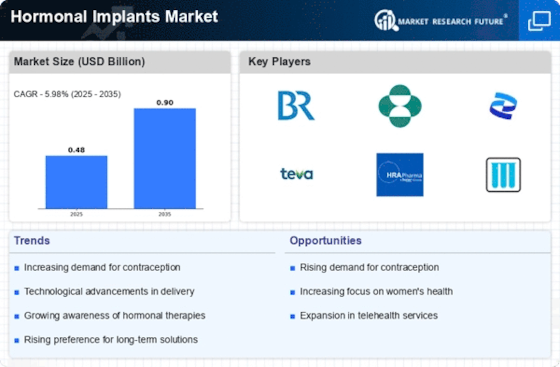
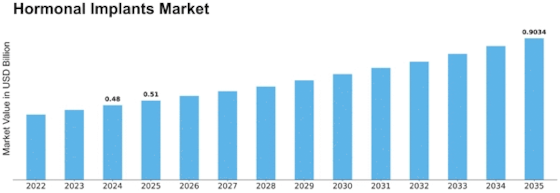
As per Market Research Future analysis, the Hormonal Implants Market Size was estimated at 0.4769 USD Billion in 2024. The Hormonal Implants industry is projected to grow from USD 0.5054 Billion in 2025 to USD 0.9034 Billion by 2035, exhibiting a compound annual growth rate (CAGR) of 5.98% during the forecast period 2025 - 2035

Key Market Trends & Highlights

The Hormonal Implants Market is experiencing robust growth driven by evolving consumer preferences and technological advancements.

  • The demand for long-acting contraceptives is rising, particularly in North America, which remains the largest market. Technological advancements in product development are enhancing the efficacy and user experience of hormonal implants. Increased focus on women's health initiatives is fostering greater acceptance and utilization of hormonal contraceptives in the Asia-Pacific region. Rising awareness of family planning and government support are key drivers propelling the growth of the Levonorgestrel segment, while the Etonogestrel segment is rapidly expanding.

Market Size & Forecast

2024 Market Size 0.4769 (USD Billion)
2035 Market Size 0.9034 (USD Billion)
CAGR (2025 - 2035) 5.98%
Largest Regional Market Share in 2024 Americas

Major Players

Bayer (DE), Merck &amp; Co (US), Pfizer (US), Teva Pharmaceutical Industries (IL), HRA Pharma (FR), Mylan (US), Bristol-Myers Squibb (US), Amgen (US), Boehringer Ingelheim (DE)

Market Trends

The Hormonal Implants Market is currently experiencing a notable transformation, driven by increasing awareness regarding reproductive health and family planning. This shift is largely attributed to the growing emphasis on women's health issues and the need for effective contraceptive methods. As more individuals seek long-term solutions, hormonal implants are gaining traction due to their convenience and efficacy. These developments reflect evolving hormonal implants market trends such as increasing adoption of long-acting contraceptive technologies. Furthermore, advancements in technology are enhancing the development of innovative products, which may lead to improved patient compliance and satisfaction. Regulatory bodies are also playing a crucial role in ensuring the safety and effectiveness of these products, thereby fostering consumer trust.

In addition, the Hormonal Implants Market appears to be influenced by changing societal norms and attitudes towards contraception. As discussions surrounding reproductive rights become more prevalent, there is a potential for increased acceptance of hormonal implants as a viable option. Healthcare providers are likely to play a pivotal role in educating patients about the benefits and risks associated with these implants, which could further drive hormonal implants market size expansion. Overall, the landscape of the Hormonal Implants Market is evolving, with various factors contributing to its expansion and the potential for future innovations.

Rising Demand for Long-Acting Contraceptives

There is a growing preference for long-acting contraceptive methods among consumers, as they offer convenience and reduce the need for frequent medical visits. Hormonal implants, being a form of long-acting reversible contraception, are increasingly favored for their effectiveness and ease of use. This shift represents one of the key hormonal implants market trends influencing global demand.

Technological Advancements in Product Development

Innovations in medical technology are leading to the creation of more effective and user-friendly hormonal implants. These advancements may enhance patient experience and compliance, potentially resulting in a broader acceptance of hormonal implants across various demographics and contributing to growth in hormonal implants market size.

Increased Focus on Women's Health Initiatives

The global emphasis on women's health is driving awareness and education regarding reproductive health options. This trend may lead to a higher adoption rate of hormonal implants as women seek reliable and safe contraceptive solutions, ultimately increasing overall hormonal implants market share.

Hormonal Implants Market Market Drivers

Government Support and Funding

Government initiatives and funding aimed at enhancing reproductive health services are significantly influencing the Hormonal Implants Market. Various countries have implemented policies to improve access to contraceptive methods, including hormonal implants, as part of broader public health strategies. For instance, funding for family planning programs has increased, facilitating the distribution and availability of hormonal implants in underserved areas. This support not only enhances accessibility but also encourages healthcare providers to offer these options to patients. Consequently, the Hormonal Implants Market is poised for growth as government backing fosters a more favorable environment for the adoption of hormonal contraceptives.

Rising Awareness of Family Planning

The increasing awareness regarding family planning is a pivotal driver for the Hormonal Implants Market. As more individuals and couples seek effective contraceptive methods, hormonal implants are gaining traction due to their long-term efficacy and convenience. According to recent data, the demand for long-acting reversible contraceptives, including hormonal implants, has surged, with a notable increase in adoption rates among women of reproductive age. This trend is further supported by educational campaigns and healthcare initiatives aimed at promoting reproductive health. As awareness continues to grow, it is likely that the Hormonal Implants Market will experience sustained growth, driven by a more informed population seeking reliable family planning solutions.

Shift Towards Preventive Healthcare

The ongoing shift towards preventive healthcare is a crucial driver for the Hormonal Implants Market. As healthcare systems increasingly emphasize preventive measures, hormonal implants are recognized for their role in preventing unintended pregnancies. This preventive approach aligns with broader health objectives, including reducing maternal and infant mortality rates. Data indicates that hormonal implants can significantly lower the incidence of unintended pregnancies, thereby contributing to improved health outcomes. As healthcare providers and patients alike prioritize preventive strategies, the Hormonal Implants Market is likely to benefit from this paradigm shift, leading to increased adoption of long-acting contraceptive methods.

Technological Innovations in Implant Design

Technological innovations in the design and formulation of hormonal implants are driving advancements within the Hormonal Implants Market. Recent developments have led to the creation of more effective and user-friendly implants, which enhance patient compliance and satisfaction. Innovations such as biodegradable materials and improved delivery systems are making hormonal implants more appealing to users. Furthermore, these advancements are supported by research indicating that newer formulations can provide extended efficacy and reduced side effects. As technology continues to evolve, the Hormonal Implants Market is expected to expand, attracting a broader demographic of users seeking reliable contraceptive options.

Cultural Shifts Towards Reproductive Autonomy

Cultural shifts towards reproductive autonomy are significantly impacting the Hormonal Implants Market. As societal norms evolve, there is a growing acceptance of women's rights to make informed choices regarding their reproductive health. This cultural transformation is fostering an environment where hormonal implants are increasingly viewed as a viable option for family planning. Data suggests that regions with progressive attitudes towards women's health are witnessing higher adoption rates of hormonal implants. As these cultural shifts continue to gain momentum, the Hormonal Implants Market is likely to experience growth, driven by a population that values reproductive autonomy and effective contraceptive solutions.

Market Segment Insights

By Hormone: Levonorgestrel (Largest) vs. Etonogestrel (Fastest-Growing)

In the Hormonal Implants Market, Levonorgestrel remains the largest segment, commanding a significant share due to its established usage and reliability in effecting pregnancy prevention. Its widespread acceptance among healthcare providers ensures a steady demand. Etonogestrel, while currently smaller in terms of market share, is rapidly gaining traction due to its innovative formulation and favorable side-effect profile, appealing particularly to a younger demographic seeking effective contraceptive solutions.

Levonorgestrel: Dominant vs. Etonogestrel: Emerging

Levonorgestrel is the dominant hormone in the hormonal implants market, known for its long-acting efficacy and reliability over the years. Its well-established presence among users and healthcare providers has solidified its market position. Etonogestrel, on the other hand, represents an emerging force in this sector, appealing to those seeking modern contraceptive solutions with a potentially lesser hormonal load. The rising awareness of reproductive health and the increasing preference for minimally invasive options are driving Etonogestrel's growth, making it an important player with promising future prospects.

By Type: Two Rod Device (Largest) vs. One Rod Device (Fastest-Growing)

The Hormonal Implants Market portrays a significant shift towards a 'Two Rod Device' as the predominant choice among healthcare providers and patients alike. This device is recognized for offering extended contraceptive benefits, leading to its substantial share in the market distribution. In contrast, the One Rod Device, although having a smaller share, is rapidly gaining traction due to its simplicity and ease of use, appealing largely to first-time users and those seeking a less invasive option.

Hormonal Implants: Two Rod Device (Dominant) vs. One Rod Device (Emerging)

The Two Rod Device holds a significant position in the Hormonal Implants Market, primarily due to its prolonged efficacy and dual hormone delivery system. This device stands out for its reliability and effectiveness, making it a preferred choice for long-term contraceptive solutions. On the other hand, the One Rod Device represents an emerging trend characterized by its user-friendly design and lower hormonal dosage. While currently less prevalent, it appeals to younger demographics looking for minimal intervention. As healthcare trends evolve, the distinction between these devices highlights a market poised for innovation, with an increasing focus on patient-centric solutions.

By Distribution Sector: Public Sector (Largest) vs. Private Sector (Fastest-Growing)

In the Hormonal Implants Market, the distribution sector is significantly impacted by the public sector, which commands the largest share due to strong government initiatives and funding for healthcare programs. Public health organizations and government entities often prioritize access to essential hormonal treatments, enhancing their market presence. Conversely, the private sector is emerging as the fastest-growing segment, driven by increased healthcare spending and a rising demand for personalized treatment options, positioning it as a competitive force in the market.

Distribution Sector: Public Sector (Dominant) vs. Private Sector (Emerging)

The public sector dominates the Hormonal Implants Market, leveraging governmental support for healthcare initiatives that ensure widespread access to hormonal treatments. This sector is characterized by state-funded programs that provide subsidized or free implants, fostering community health and outreach efforts. On the other hand, the private sector is rapidly evolving, fueled by innovation in product offerings and enhanced customer service. It aims to address specific patient needs and preferences, often providing a more diverse array of hormonal implant options. As consumer awareness and demand increase, the private sector's ability to adapt quickly to market trends sets it apart as an emerging player.

By End User: Hospitals & Clinics (Largest) vs. Academic & Research Institutes (Fastest-Growing)

In the Hormonal Implants Market, hospitals and clinics represent the largest end user segment, holding a significant share due to their extensive infrastructure and the ability to provide comprehensive treatment options. Hospitals offer a wide range of services, making them the preferred choice for patients requiring hormonal therapies, while clinics focus on more specialized care, further increasing their relevance in this market landscape.

End User: Hospitals &amp; Clinics (Dominant) vs. Academic &amp; Research Institutes (Emerging)

Hospitals and clinics serve as the dominant players in the hormonal implants market, providing critical healthcare services that encompass diagnosis, treatment, and patient follow-up. Their established systems and broad patient base contribute to steady demand for hormonal implants. Conversely, academic and research institutes are gaining momentum as emerging players due to their focus on innovative hormonal therapies and conducting <a href="https://www.marketresearchfuture.com/reports/clinical-trials-market-7787" target="_blank" title="clinical trials">clinical trials</a>. They play a crucial role in advancing research and improving treatments, thus driving growth in this segment. Their collaborations with pharmaceutical companies and healthcare providers aim to improve hormonal implant efficacy, thereby meeting the increasing needs of patients in the market.

Get more detailed insights about Hormonal Implants Market Research Report - Forecast till 2035

Regional Insights

North America : Market Leader in Innovation

North America is the largest market for hormonal implants, accounting for approximately 45% of the global share. The region's growth is driven by increasing awareness of contraceptive options, favorable reimbursement policies, and a strong emphasis on women's health. Regulatory support from agencies like the FDA has also catalyzed market expansion, ensuring safety and efficacy in hormonal implant products. The United States and Canada are the leading countries in this market, with major players like Merck & Co and Pfizer dominating the landscape. The competitive environment is characterized by continuous innovation and product development, with companies investing heavily in research to enhance efficacy and reduce side effects. This focus on innovation positions North America as a hub for hormonal implant advancements.

Europe : Growing Demand and Regulation

Europe is the second-largest market for hormonal implants, holding around 30% of the global share. The region's growth is propelled by increasing healthcare expenditure, rising awareness of reproductive health, and supportive regulatory frameworks. The European Medicines Agency (EMA) plays a crucial role in ensuring the safety and efficacy of hormonal implants, which has led to increased consumer confidence and market demand. Leading countries in Europe include Germany, France, and the UK, where key players like Bayer and HRA Pharma are actively involved. The competitive landscape is marked by a mix of established companies and emerging players, all striving to innovate and meet the diverse needs of consumers. The presence of strong healthcare systems further enhances market opportunities, making Europe a vital region for hormonal implant development.

Asia-Pacific : Emerging Market Potential

Asia-Pacific is an emerging powerhouse in the hormonal implants market, accounting for approximately 20% of the global share. The region's growth is driven by increasing urbanization, rising disposable incomes, and a growing focus on women's health. Countries like India and China are witnessing a surge in demand for contraceptive options, supported by government initiatives promoting family planning and reproductive health. In this region, India and China are the leading markets, with a competitive landscape featuring both multinational corporations and local manufacturers. Key players such as Teva Pharmaceutical Industries and Mylan are expanding their presence, focusing on affordability and accessibility. The region's diverse population and varying healthcare needs present unique opportunities for innovation and tailored solutions in hormonal implants.

Middle East and Africa : Untapped Market Opportunities

The Middle East and Africa represent a resource-rich frontier for the hormonal implants market, holding about 5% of the global share. The region's growth is driven by increasing awareness of reproductive health and family planning, alongside government initiatives aimed at improving healthcare access. However, challenges such as cultural barriers and limited healthcare infrastructure can hinder market penetration. Leading countries in this region include South Africa and the UAE, where there is a growing presence of key players like Amgen and Boehringer Ingelheim. The competitive landscape is evolving, with local manufacturers beginning to enter the market, driven by the demand for affordable and accessible hormonal implant solutions. This presents significant opportunities for growth and innovation in the coming years.

Key Players and Competitive Insights

The Hormonal Implants Market is currently characterized by a dynamic competitive landscape, driven by increasing demand for effective contraceptive solutions and advancements in medical technology. Key players such as Bayer (DE), Merck & Co (US), and Pfizer (US) are strategically positioned to leverage their extensive research and development capabilities. Bayer (DE) focuses on innovation in hormonal therapies, while Merck & Co (US) emphasizes partnerships to enhance its product offerings. Pfizer (US) is actively pursuing regional expansion, particularly in emerging markets, which collectively shapes a competitive environment that is both collaborative and competitive, fostering innovation and accessibility in hormonal implant solutions.
In terms of business tactics, companies are increasingly localizing manufacturing to reduce costs and enhance supply chain efficiency. The market appears moderately fragmented, with several players vying for market share, yet the influence of major companies remains substantial. This competitive structure allows for a diverse range of products and services, catering to varying consumer needs while also driving innovation through competition.
In August 2025, Bayer (DE) announced a strategic partnership with a leading tech firm to develop a digital platform aimed at improving patient adherence to hormonal implant therapies. This initiative is significant as it not only enhances patient engagement but also positions Bayer at the forefront of integrating technology with healthcare solutions, potentially increasing market share in a rapidly evolving landscape.
In September 2025, Merck & Co (US) launched a new hormonal implant designed to provide longer-lasting contraceptive effects, which is expected to address unmet needs in the market. This product introduction reflects Merck's commitment to innovation and its strategic focus on expanding its portfolio to meet diverse consumer demands, thereby strengthening its competitive position.
In October 2025, Pfizer (US) expanded its distribution network in Asia, aiming to enhance access to its hormonal implant products in underserved regions. This move is indicative of Pfizer's strategy to tap into emerging markets, which may yield significant growth opportunities as demand for contraceptive solutions continues to rise in these areas.
As of October 2025, current trends in the Hormonal Implants Market are increasingly defined by digitalization, sustainability, and the integration of artificial intelligence in product development and patient management. Strategic alliances are becoming more prevalent, allowing companies to pool resources and expertise to drive innovation. Looking ahead, competitive differentiation is likely to evolve from traditional price-based competition to a focus on technological advancements, innovative solutions, and reliable supply chains, which will be crucial for sustaining market leadership.

Key Companies in the Hormonal Implants Market include

Industry Developments

Future Outlook

Hormonal Implants Market Future Outlook

The Hormonal Implants Market is projected to grow at a 5.98% CAGR from 2025 to 2035, driven by increasing demand for long-term contraceptive solutions and advancements in implant technology.

New opportunities lie in:

  • <p>Expansion into emerging markets with tailored hormonal implant solutions. Development of biodegradable hormonal implants to enhance patient compliance. Integration of telehealth services for remote monitoring of hormonal implant users.</p>

By 2035, the Hormonal Implants Market is expected to achieve substantial growth and innovation.

Market Segmentation

Hormonal Implants Market Type Outlook

  • One Rod Device
  • Two Rod Device

Hormonal Implants Market Hormone Outlook

  • Levonorgestrel
  • Etonogestrel

Hormonal Implants Market End User Outlook

  • Hospitals & Clinics
  • Academic & Research Institutes

Hormonal Implants Market Distribution Sector Outlook

  • Public Sector
  • Private Sector

Report Scope

MARKET SIZE 2024 0.4769(USD Billion)
MARKET SIZE 2025 0.5054(USD Billion)
MARKET SIZE 2035 0.9034(USD Billion)
COMPOUND ANNUAL GROWTH RATE (CAGR) 5.98% (2025 - 2035)
REPORT COVERAGE Revenue Forecast, Competitive Landscape, Growth Factors, and Trends
BASE YEAR 2024
Market Forecast Period 2025 - 2035
Historical Data 2019 - 2024
Market Forecast Units USD Billion
Key Companies Profiled Bayer (DE), Merck & Co (US), Pfizer (US), Teva Pharmaceutical Industries (IL), HRA Pharma (FR), Mylan (US), Bristol-Myers Squibb (US), Amgen (US), Boehringer Ingelheim (DE)
Segments Covered Hormone, Type, Distribution Sector, End User, Region
Key Market Opportunities Emergence of personalized hormonal implants driven by advancements in biotechnology and consumer demand for tailored healthcare solutions.
Key Market Dynamics Rising consumer preference for long-acting reversible contraception drives innovation and competition in the hormonal implants market.
Countries Covered North America, Europe, APAC, South America, MEA

FAQs

What is the projected market valuation of the Hormonal Implants Market by 2035?

<p>The projected market valuation for the Hormonal Implants Market is expected to reach 0.9034 USD Billion by 2035.</p>

What was the market valuation of the Hormonal Implants Market in 2024?

<p>The overall market valuation of the Hormonal Implants Market was 0.4769 USD Billion in 2024.</p>

What is the expected CAGR for the Hormonal Implants Market during the forecast period 2025 - 2035?

<p>The expected CAGR for the Hormonal Implants Market during the forecast period 2025 - 2035 is 5.98%.</p>

Which companies are considered key players in the Hormonal Implants Market?

Key players in the Hormonal Implants Market include Bayer, Merck &amp; Co, Pfizer, Teva Pharmaceutical Industries, and HRA Pharma.

What are the segment valuations for Levonorgestrel and Etonogestrel in the Hormonal Implants Market?

<p>The segment valuation for Levonorgestrel is projected to be between 0.2869 and 0.5468 USD Billion, while Etonogestrel ranges from 0.19 to 0.3566 USD Billion.</p>

How do the one rod and two rod devices compare in terms of market valuation?

Both the one rod and two rod devices are valued between 0.23845 and 0.4517 USD Billion in the Hormonal Implants Market.

What is the distribution sector breakdown for the Hormonal Implants Market?

The distribution sector shows a valuation of approximately 0.2384 to 0.4517 USD Billion for the public sector and 0.2385 to 0.4517 USD Billion for the private sector.

Which end users are significant in the Hormonal Implants Market?

Hospitals and clinics are valued between 0.2869 and 0.5484 USD Billion, while academic and research institutes range from 0.19 to 0.355 USD Billion.

What trends are influencing the growth of the Hormonal Implants Market?

The growth of the Hormonal Implants Market appears to be influenced by increasing demand for effective contraceptive methods and advancements in hormonal implant technology.

How does the Hormonal Implants Market's growth compare to other segments in the pharmaceutical industry?

The Hormonal Implants Market's growth, with a projected CAGR of 5.98%, suggests a robust performance relative to other segments in the pharmaceutical industry.

  1. SECTION I: EXECUTIVE SUMMARY AND KEY HIGHLIGHTS |
    1. EXECUTIVE SUMMARY | |
      1. Market Overview | |
      2. Key Findings | |
      3. Market Segmentation | |
      4. Competitive Landscape | |
      5. Challenges and Opportunities | |
      6. Future Outlook 2
  2. SECTION II: SCOPING, METHODOLOGY AND MARKET STRUCTURE |
    1. MARKET INTRODUCTION | |
      1. Definition | |
      2. Scope of the study | | |
    2. RESEARCH METHODOLOGY | |
      1. Overview | |
      2. Data Mining | |
      3. Secondary Research | |
      4. Primary Research | | |
      5. Forecasting Model | |
      6. Market Size Estimation | | |
      7. Data Triangulation | |
      8. Validation 3
  3. SECTION III: QUALITATIVE ANALYSIS |
    1. MARKET DYNAMICS | |
      1. Overview | |
      2. Drivers | |
      3. Restraints | |
      4. Opportunities |
    2. MARKET FACTOR ANALYSIS | |
      1. Value chain Analysis | |
      2. Porter's Five Forces Analysis | | |
      3. COVID-19 Impact Analysis | | |
  4. SECTION IV: QUANTITATIVE ANALYSIS |
    1. Healthcare, BY Hormone (USD Billion) | |
      1. Levonorgestrel | |
      2. Etonogestrel |
    2. Healthcare, BY Type (USD Billion) | |
      1. One Rod Device | |
      2. Two Rod Device |
    3. Healthcare, BY Distribution Sector (USD Billion) | |
      1. Public Sector | |
      2. Private Sector |
    4. Healthcare, BY End User (USD Billion) | |
      1. Hospitals & Clinics | |
      2. Academic & Research Institutes |
    5. Healthcare, BY Region (USD Billion) | |
      1. North America | | |
      2. Europe | | |
      3. APAC | | |
      4. South America | | |
      5. MEA | | |
  5. SECTION V: COMPETITIVE ANALYSIS |
    1. Competitive Landscape | |
      1. Overview | |
      2. Competitive Analysis | |
      3. Market share Analysis | |
      4. Major Growth Strategy in the Healthcare | |
      5. Competitive Benchmarking | |
      6. Leading Players in Terms of Number of Developments in the Healthcare | |
      7. Key developments and growth strategies | | |
      8. Major Players Financial Matrix | | |
    2. Company Profiles | |
      1. Bayer (DE) | | |
      2. Merck & Co (US) | | |
      3. Pfizer (US) | | |
      4. Teva Pharmaceutical Industries (IL) | | |
      5. HRA Pharma (FR) | | |
      6. Mylan (US) | | |
      7. Bristol-Myers Squibb (US) | | |
      8. Amgen (US) | | |
      9. Boehringer Ingelheim (DE) | | |
    3. Appendix | |
      1. References | |
      2. Related Reports 6 LIST OF FIGURES |
    4. MARKET SYNOPSIS |
    5. NORTH AMERICA MARKET ANALYSIS |
    6. US MARKET ANALYSIS BY HORMONE |
    7. US MARKET ANALYSIS BY TYPE |
    8. US MARKET ANALYSIS BY DISTRIBUTION SECTOR |
    9. US MARKET ANALYSIS BY END USER |
    10. CANADA MARKET ANALYSIS BY HORMONE |
    11. CANADA MARKET ANALYSIS BY TYPE |
    12. CANADA MARKET ANALYSIS BY DISTRIBUTION SECTOR |
    13. CANADA MARKET ANALYSIS BY END USER |
    14. EUROPE MARKET ANALYSIS |
    15. GERMANY MARKET ANALYSIS BY HORMONE |
    16. GERMANY MARKET ANALYSIS BY TYPE |
    17. GERMANY MARKET ANALYSIS BY DISTRIBUTION SECTOR |
    18. GERMANY MARKET ANALYSIS BY END USER |
    19. UK MARKET ANALYSIS BY HORMONE |
    20. UK MARKET ANALYSIS BY TYPE |
    21. UK MARKET ANALYSIS BY DISTRIBUTION SECTOR |
    22. UK MARKET ANALYSIS BY END USER |
    23. FRANCE MARKET ANALYSIS BY HORMONE |
    24. FRANCE MARKET ANALYSIS BY TYPE |
    25. FRANCE MARKET ANALYSIS BY DISTRIBUTION SECTOR |
    26. FRANCE MARKET ANALYSIS BY END USER |
    27. RUSSIA MARKET ANALYSIS BY HORMONE |
    28. RUSSIA MARKET ANALYSIS BY TYPE |
    29. RUSSIA MARKET ANALYSIS BY DISTRIBUTION SECTOR |
    30. RUSSIA MARKET ANALYSIS BY END USER |
    31. ITALY MARKET ANALYSIS BY HORMONE |
    32. ITALY MARKET ANALYSIS BY TYPE |
    33. ITALY MARKET ANALYSIS BY DISTRIBUTION SECTOR |
    34. ITALY MARKET ANALYSIS BY END USER |
    35. SPAIN MARKET ANALYSIS BY HORMONE |
    36. SPAIN MARKET ANALYSIS BY TYPE |
    37. SPAIN MARKET ANALYSIS BY DISTRIBUTION SECTOR |
    38. SPAIN MARKET ANALYSIS BY END USER |
    39. REST OF EUROPE MARKET ANALYSIS BY HORMONE |
    40. REST OF EUROPE MARKET ANALYSIS BY TYPE |
    41. REST OF EUROPE MARKET ANALYSIS BY DISTRIBUTION SECTOR |
    42. REST OF EUROPE MARKET ANALYSIS BY END USER |
    43. APAC MARKET ANALYSIS |
    44. CHINA MARKET ANALYSIS BY HORMONE |
    45. CHINA MARKET ANALYSIS BY TYPE |
    46. CHINA MARKET ANALYSIS BY DISTRIBUTION SECTOR |
    47. CHINA MARKET ANALYSIS BY END USER |
    48. INDIA MARKET ANALYSIS BY HORMONE |
    49. INDIA MARKET ANALYSIS BY TYPE |
    50. INDIA MARKET ANALYSIS BY DISTRIBUTION SECTOR |
    51. INDIA MARKET ANALYSIS BY END USER |
    52. JAPAN MARKET ANALYSIS BY HORMONE |
    53. JAPAN MARKET ANALYSIS BY TYPE |
    54. JAPAN MARKET ANALYSIS BY DISTRIBUTION SECTOR |
    55. JAPAN MARKET ANALYSIS BY END USER |
    56. SOUTH KOREA MARKET ANALYSIS BY HORMONE |
    57. SOUTH KOREA MARKET ANALYSIS BY TYPE |
    58. SOUTH KOREA MARKET ANALYSIS BY DISTRIBUTION SECTOR |
    59. SOUTH KOREA MARKET ANALYSIS BY END USER |
    60. MALAYSIA MARKET ANALYSIS BY HORMONE |
    61. MALAYSIA MARKET ANALYSIS BY TYPE |
    62. MALAYSIA MARKET ANALYSIS BY DISTRIBUTION SECTOR |
    63. MALAYSIA MARKET ANALYSIS BY END USER |
    64. THAILAND MARKET ANALYSIS BY HORMONE |
    65. THAILAND MARKET ANALYSIS BY TYPE |
    66. THAILAND MARKET ANALYSIS BY DISTRIBUTION SECTOR |
    67. THAILAND MARKET ANALYSIS BY END USER |
    68. INDONESIA MARKET ANALYSIS BY HORMONE |
    69. INDONESIA MARKET ANALYSIS BY TYPE |
    70. INDONESIA MARKET ANALYSIS BY DISTRIBUTION SECTOR |
    71. INDONESIA MARKET ANALYSIS BY END USER |
    72. REST OF APAC MARKET ANALYSIS BY HORMONE |
    73. REST OF APAC MARKET ANALYSIS BY TYPE |
    74. REST OF APAC MARKET ANALYSIS BY DISTRIBUTION SECTOR |
    75. REST OF APAC MARKET ANALYSIS BY END USER |
    76. SOUTH AMERICA MARKET ANALYSIS |
    77. BRAZIL MARKET ANALYSIS BY HORMONE |
    78. BRAZIL MARKET ANALYSIS BY TYPE |
    79. BRAZIL MARKET ANALYSIS BY DISTRIBUTION SECTOR |
    80. BRAZIL MARKET ANALYSIS BY END USER |
    81. MEXICO MARKET ANALYSIS BY HORMONE |
    82. MEXICO MARKET ANALYSIS BY TYPE |
    83. MEXICO MARKET ANALYSIS BY DISTRIBUTION SECTOR |
    84. MEXICO MARKET ANALYSIS BY END USER |
    85. ARGENTINA MARKET ANALYSIS BY HORMONE |
    86. ARGENTINA MARKET ANALYSIS BY TYPE |
    87. ARGENTINA MARKET ANALYSIS BY DISTRIBUTION SECTOR |
    88. ARGENTINA MARKET ANALYSIS BY END USER |
    89. REST OF SOUTH AMERICA MARKET ANALYSIS BY HORMONE |
    90. REST OF SOUTH AMERICA MARKET ANALYSIS BY TYPE |
    91. REST OF SOUTH AMERICA MARKET ANALYSIS BY DISTRIBUTION SECTOR |
    92. REST OF SOUTH AMERICA MARKET ANALYSIS BY END USER |
    93. MEA MARKET ANALYSIS |
    94. GCC COUNTRIES MARKET ANALYSIS BY HORMONE |
    95. GCC COUNTRIES MARKET ANALYSIS BY TYPE |
    96. GCC COUNTRIES MARKET ANALYSIS BY DISTRIBUTION SECTOR |
    97. GCC COUNTRIES MARKET ANALYSIS BY END USER |
    98. SOUTH AFRICA MARKET ANALYSIS BY HORMONE |
    99. SOUTH AFRICA MARKET ANALYSIS BY TYPE |
    100. SOUTH AFRICA MARKET ANALYSIS BY DISTRIBUTION SECTOR |
    101. SOUTH AFRICA MARKET ANALYSIS BY END USER |
    102. REST OF MEA MARKET ANALYSIS BY HORMONE |
    103. REST OF MEA MARKET ANALYSIS BY TYPE |
    104. REST OF MEA MARKET ANALYSIS BY DISTRIBUTION SECTOR |
    105. REST OF MEA MARKET ANALYSIS BY END USER |
    106. KEY BUYING CRITERIA OF HEALTHCARE |
    107. RESEARCH PROCESS OF MRFR |
    108. DRO ANALYSIS OF HEALTHCARE |
    109. DRIVERS IMPACT ANALYSIS: HEALTHCARE |
    110. RESTRAINTS IMPACT ANALYSIS: HEALTHCARE |
    111. SUPPLY / VALUE CHAIN: HEALTHCARE |
    112. HEALTHCARE, BY HORMONE, 2024 (% SHARE) |
    113. HEALTHCARE, BY HORMONE, 2024 TO 2035 (USD Billion) |
    114. HEALTHCARE, BY TYPE, 2024 (% SHARE) |
    115. HEALTHCARE, BY TYPE, 2024 TO 2035 (USD Billion) |
    116. HEALTHCARE, BY DISTRIBUTION SECTOR, 2024 (% SHARE) |
    117. HEALTHCARE, BY DISTRIBUTION SECTOR, 2024 TO 2035 (USD Billion) |
    118. HEALTHCARE, BY END USER, 2024 (% SHARE) |
    119. HEALTHCARE, BY END USER, 2024 TO 2035 (USD Billion) |
    120. BENCHMARKING OF MAJOR COMPETITORS 7 LIST OF TABLES |
    121. LIST OF ASSUMPTIONS | |
      1. |
    122. North America MARKET SIZE ESTIMATES; FORECAST | |
      1. BY HORMONE, 2025-2035 (USD Billion) | |
      2. BY TYPE, 2025-2035 (USD Billion) | |
      3. BY DISTRIBUTION SECTOR, 2025-2035 (USD Billion) | |
      4. BY END USER, 2025-2035 (USD Billion) |
    123. US MARKET SIZE ESTIMATES; FORECAST | |
      1. BY HORMONE, 2025-2035 (USD Billion) | |
      2. BY TYPE, 2025-2035 (USD Billion) | |
      3. BY DISTRIBUTION SECTOR, 2025-2035 (USD Billion) | |
      4. BY END USER, 2025-2035 (USD Billion) |
    124. Canada MARKET SIZE ESTIMATES; FORECAST | |
      1. BY HORMONE, 2025-2035 (USD Billion) | |
      2. BY TYPE, 2025-2035 (USD Billion) | |
      3. BY DISTRIBUTION SECTOR, 2025-2035 (USD Billion) | |
      4. BY END USER, 2025-2035 (USD Billion) |
    125. Europe MARKET SIZE ESTIMATES; FORECAST | |
      1. BY HORMONE, 2025-2035 (USD Billion) | |
      2. BY TYPE, 2025-2035 (USD Billion) | |
      3. BY DISTRIBUTION SECTOR, 2025-2035 (USD Billion) | |
      4. BY END USER, 2025-2035 (USD Billion) |
    126. Germany MARKET SIZE ESTIMATES; FORECAST | |
      1. BY HORMONE, 2025-2035 (USD Billion) | |
      2. BY TYPE, 2025-2035 (USD Billion) | |
      3. BY DISTRIBUTION SECTOR, 2025-2035 (USD Billion) | |
      4. BY END USER, 2025-2035 (USD Billion) |
    127. UK MARKET SIZE ESTIMATES; FORECAST | |
      1. BY HORMONE, 2025-2035 (USD Billion) | |
      2. BY TYPE, 2025-2035 (USD Billion) | |
      3. BY DISTRIBUTION SECTOR, 2025-2035 (USD Billion) | |
      4. BY END USER, 2025-2035 (USD Billion) |
    128. France MARKET SIZE ESTIMATES; FORECAST | |
      1. BY HORMONE, 2025-2035 (USD Billion) | |
      2. BY TYPE, 2025-2035 (USD Billion) | |
      3. BY DISTRIBUTION SECTOR, 2025-2035 (USD Billion) | |
      4. BY END USER, 2025-2035 (USD Billion) |
    129. Russia MARKET SIZE ESTIMATES; FORECAST | |
      1. BY HORMONE, 2025-2035 (USD Billion) | |
      2. BY TYPE, 2025-2035 (USD Billion) | |
      3. BY DISTRIBUTION SECTOR, 2025-2035 (USD Billion) | |
      4. BY END USER, 2025-2035 (USD Billion) |
    130. Italy MARKET SIZE ESTIMATES; FORECAST | |
      1. BY HORMONE, 2025-2035 (USD Billion) | |
      2. BY TYPE, 2025-2035 (USD Billion) | |
      3. BY DISTRIBUTION SECTOR, 2025-2035 (USD Billion) | |
      4. BY END USER, 2025-2035 (USD Billion) |
    131. Spain MARKET SIZE ESTIMATES; FORECAST | |
      1. BY HORMONE, 2025-2035 (USD Billion) | |
      2. BY TYPE, 2025-2035 (USD Billion) | |
      3. BY DISTRIBUTION SECTOR, 2025-2035 (USD Billion) | |
      4. BY END USER, 2025-2035 (USD Billion) |
    132. Rest of Europe MARKET SIZE ESTIMATES; FORECAST | |
      1. BY HORMONE, 2025-2035 (USD Billion) | |
      2. BY TYPE, 2025-2035 (USD Billion) | |
      3. BY DISTRIBUTION SECTOR, 2025-2035 (USD Billion) | |
      4. BY END USER, 2025-2035 (USD Billion) |
    133. APAC MARKET SIZE ESTIMATES; FORECAST | |
      1. BY HORMONE, 2025-2035 (USD Billion) | |
      2. BY TYPE, 2025-2035 (USD Billion) | |
      3. BY DISTRIBUTION SECTOR, 2025-2035 (USD Billion) | |
      4. BY END USER, 2025-2035 (USD Billion) |
    134. China MARKET SIZE ESTIMATES; FORECAST | |
      1. BY HORMONE, 2025-2035 (USD Billion) | |
      2. BY TYPE, 2025-2035 (USD Billion) | |
      3. BY DISTRIBUTION SECTOR, 2025-2035 (USD Billion) | |
      4. BY END USER, 2025-2035 (USD Billion) |
    135. India MARKET SIZE ESTIMATES; FORECAST | |
      1. BY HORMONE, 2025-2035 (USD Billion) | |
      2. BY TYPE, 2025-2035 (USD Billion) | |
      3. BY DISTRIBUTION SECTOR, 2025-2035 (USD Billion) | |
      4. BY END USER, 2025-2035 (USD Billion) |
    136. Japan MARKET SIZE ESTIMATES; FORECAST | |
      1. BY HORMONE, 2025-2035 (USD Billion) | |
      2. BY TYPE, 2025-2035 (USD Billion) | |
      3. BY DISTRIBUTION SECTOR, 2025-2035 (USD Billion) | |
      4. BY END USER, 2025-2035 (USD Billion) |
    137. South Korea MARKET SIZE ESTIMATES; FORECAST | |
      1. BY HORMONE, 2025-2035 (USD Billion) | |
      2. BY TYPE, 2025-2035 (USD Billion) | |
      3. BY DISTRIBUTION SECTOR, 2025-2035 (USD Billion) | |
      4. BY END USER, 2025-2035 (USD Billion) |
    138. Malaysia MARKET SIZE ESTIMATES; FORECAST | |
      1. BY HORMONE, 2025-2035 (USD Billion) | |
      2. BY TYPE, 2025-2035 (USD Billion) | |
      3. BY DISTRIBUTION SECTOR, 2025-2035 (USD Billion) | |
      4. BY END USER, 2025-2035 (USD Billion) |
    139. Thailand MARKET SIZE ESTIMATES; FORECAST | |
      1. BY HORMONE, 2025-2035 (USD Billion) | |
      2. BY TYPE, 2025-2035 (USD Billion) | |
      3. BY DISTRIBUTION SECTOR, 2025-2035 (USD Billion) | |
      4. BY END USER, 2025-2035 (USD Billion) |
    140. Indonesia MARKET SIZE ESTIMATES; FORECAST | |
      1. BY HORMONE, 2025-2035 (USD Billion) | |
      2. BY TYPE, 2025-2035 (USD Billion) | |
      3. BY DISTRIBUTION SECTOR, 2025-2035 (USD Billion) | |
      4. BY END USER, 2025-2035 (USD Billion) |
    141. Rest of APAC MARKET SIZE ESTIMATES; FORECAST | |
      1. BY HORMONE, 2025-2035 (USD Billion) | |
      2. BY TYPE, 2025-2035 (USD Billion) | |
      3. BY DISTRIBUTION SECTOR, 2025-2035 (USD Billion) | |
      4. BY END USER, 2025-2035 (USD Billion) |
    142. South America MARKET SIZE ESTIMATES; FORECAST | |
      1. BY HORMONE, 2025-2035 (USD Billion) | |
      2. BY TYPE, 2025-2035 (USD Billion) | |
      3. BY DISTRIBUTION SECTOR, 2025-2035 (USD Billion) | |
      4. BY END USER, 2025-2035 (USD Billion) |
    143. Brazil MARKET SIZE ESTIMATES; FORECAST | |
      1. BY HORMONE, 2025-2035 (USD Billion) | |
      2. BY TYPE, 2025-2035 (USD Billion) | |
      3. BY DISTRIBUTION SECTOR, 2025-2035 (USD Billion) | |
      4. BY END USER, 2025-2035 (USD Billion) |
    144. Mexico MARKET SIZE ESTIMATES; FORECAST | |
      1. BY HORMONE, 2025-2035 (USD Billion) | |
      2. BY TYPE, 2025-2035 (USD Billion) | |
      3. BY DISTRIBUTION SECTOR, 2025-2035 (USD Billion) | |
      4. BY END USER, 2025-2035 (USD Billion) |
    145. Argentina MARKET SIZE ESTIMATES; FORECAST | |
      1. BY HORMONE, 2025-2035 (USD Billion) | |
      2. BY TYPE, 2025-2035 (USD Billion) | |
      3. BY DISTRIBUTION SECTOR, 2025-2035 (USD Billion) | |
      4. BY END USER, 2025-2035 (USD Billion) |
    146. Rest of South America MARKET SIZE ESTIMATES; FORECAST | |
      1. BY HORMONE, 2025-2035 (USD Billion) | |
      2. BY TYPE, 2025-2035 (USD Billion) | |
      3. BY DISTRIBUTION SECTOR, 2025-2035 (USD Billion) | |
      4. BY END USER, 2025-2035 (USD Billion) |
    147. MEA MARKET SIZE ESTIMATES; FORECAST | |
      1. BY HORMONE, 2025-2035 (USD Billion) | |
      2. BY TYPE, 2025-2035 (USD Billion) | |
      3. BY DISTRIBUTION SECTOR, 2025-2035 (USD Billion) | |
      4. BY END USER, 2025-2035 (USD Billion) |
    148. GCC Countries MARKET SIZE ESTIMATES; FORECAST | |
      1. BY HORMONE, 2025-2035 (USD Billion) | |
      2. BY TYPE, 2025-2035 (USD Billion) | |
      3. BY DISTRIBUTION SECTOR, 2025-2035 (USD Billion) | |
      4. BY END USER, 2025-2035 (USD Billion) |
    149. South Africa MARKET SIZE ESTIMATES; FORECAST | |
      1. BY HORMONE, 2025-2035 (USD Billion) | |
      2. BY TYPE, 2025-2035 (USD Billion) | |
      3. BY DISTRIBUTION SECTOR, 2025-2035 (USD Billion) | |
      4. BY END USER, 2025-2035 (USD Billion) |
    150. Rest of MEA MARKET SIZE ESTIMATES; FORECAST | |
      1. BY HORMONE, 2025-2035 (USD Billion) | |
      2. BY TYPE, 2025-2035 (USD Billion) | |
      3. BY DISTRIBUTION SECTOR, 2025-2035 (USD Billion) | |
      4. BY END USER, 2025-2035 (USD Billion) |
    151. PRODUCT LAUNCH/PRODUCT DEVELOPMENT/APPROVAL | |
      1. |
    152. ACQUISITION/PARTNERSHIP | |

Healthcare Market Segmentation

Healthcare By Hormone (USD Billion, 2025-2035)

  • Levonorgestrel
  • Etonogestrel

Healthcare By Type (USD Billion, 2025-2035)

  • One Rod Device
  • Two Rod Device

Healthcare By Distribution Sector (USD Billion, 2025-2035)

  • Public Sector
  • Private Sector

Healthcare By End User (USD Billion, 2025-2035)

  • Hospitals & Clinics
  • Academic & Research Institutes
Infographic

Free Sample Request

Kindly complete the form below to receive a free sample of this Report

Get Free Sample

Customer Strories

Compare Licence

×
Features License Type
Single User Multiuser License Enterprise User
Price $4,950 $5,950 $7,250
Maximum User Access Limit 1 User Upto 10 Users Unrestricted Access Throughout the Organization
Free Customization
Direct Access to Analyst
Deliverable Format
Platform Access
Discount on Next Purchase 10% 15% 15%
Printable Versions