Request Free Sample ×

Kindly complete the form below to receive a free sample of this Report

* Please use a valid business email

Leading companies partner with us for data-driven Insights

clients tt-cursor
Hero Background
English
Chinese
French
Japanese
Korean
German
Spanish

Honey Market Analysis

ID: MRFR/FnB/3703-CR
128 Pages
Pradeep Nandi
April 2025

Honey Market Size, Share, Industry Trend & Analysis Research Report By Type (Organic Honey, Raw Honey, Regular Honey, Flavored Honey), By Application (Food and Beverage, Cosmetics and Personal Care, Pharmaceuticals), By Distribution Channel (Supermarkets and Hypermarkets, Online Retail, Convenience Stores, Specialty Stores), By Form (Liquid, Granulated, Comb Honey) and By Regional (North America, Europe, South America, Asia Pacific, Middle East and Africa)- Forecast to 2035

Share:
Download PDF ×

We do not share your information with anyone. However, we may send you emails based on your report interest from time to time. You may contact us at any time to opt-out.

Honey Market Infographic
Purchase Options

Market Analysis

In-depth Analysis of Honey Market Industry Landscape

The honey market is characterized by a dynamic interplay of various factors that influence its growth and trends. At its core, the market dynamics of honey are shaped by the delicate balance between supply and demand, environmental factors, and consumer preferences. One key element driving the honey market is the fluctuating supply of honeybees. Bees play a crucial role in the pollination of flowers, which, in turn, affects the quantity and quality of honey produced. Environmental changes, including climate shifts and the use of pesticides, can significantly impact bee populations and, consequently, honey production. This sensitivity to environmental factors makes the honey market inherently volatile, with supply fluctuations influencing prices and availability. Consumer demand also plays a pivotal role in shaping the honey market dynamics. The growing awareness of the health benefits associated with honey consumption has led to an increased demand for natural and organic honey varieties. As consumers become more conscious of their dietary choices, there is a rising preference for honey as a natural sweetener and a healthier alternative to processed sugars. This shift in consumer preferences drives producers to adapt their offerings to meet the rising demand for high-quality, organic, and sustainably sourced honey. Furthermore, international trade significantly impacts the honey market. Different countries have varying capacities for honey production based on climatic conditions, beekeeping practices, and other regional factors. Global trade agreements, tariffs, and geopolitical events can influence the import and export dynamics of honey, creating opportunities or challenges for market players. Additionally, stringent regulations on food safety and quality standards in various countries can affect the cross-border movement of honey, impacting market dynamics. The honey market is also influenced by technological advancements and innovations in beekeeping practices. Modern techniques such as precision beekeeping, which involves the use of sensors and data analytics to monitor hive conditions, can enhance honey production efficiency. Sustainable beekeeping practices and the development of new honey extraction methods contribute to the overall market dynamics by affecting production costs, quality, and sustainability. Moreover, marketing and branding strategies employed by honey producers significantly shape consumer perceptions and purchasing decisions. Companies that emphasize transparent and ethical beekeeping practices, highlight the purity of their honey, and communicate the environmental sustainability of their operations often gain a competitive edge. As consumers become more discerning, the storytelling aspect of honey production, including the origin of the honey and the journey from hive to table, becomes a crucial factor in brand differentiation.


Author
Author Profile
Pradeep Nandi
Senior Research Analyst

I have a bachelor's degree in mechanical engineering and an MBA. I have more than two years of expertise in the retail, food, and beverage, chemical, and material industries, and hence have developed a sound cross-domain expertise. A firm believer in lifelong learning and sharing of knowledge. Having a proclivity for hatching ideas and trying to absorb as much information as possible in a short amount of time. Introducing corporates to the data and insight, which enables them to move from probability to possibility, has been my key areas of interest. 

Leave a Comment

FAQs

What is the current valuation of the honey market as of 2024?

<p>The honey market was valued at 10.5 USD Billion in 2024.</p>

What is the projected market size for the honey market by 2035?

<p>The honey market is projected to reach 15.0 USD Billion by 2035.</p>

What is the expected CAGR for the honey market during the forecast period 2025 - 2035?

<p>The expected CAGR for the honey market during the forecast period 2025 - 2035 is 3.3%.</p>

Which companies are considered key players in the honey market?

<p>Key players in the honey market include Bee Maid Honey Limited, Dutch Gold Honey, Capilano Honey Limited, and Nature Nate's Honey Co.</p>

How does the honey market segment by application perform?

<p>In 2024, the Food and Beverage segment was valued at 5.25 USD Billion, while the Pharmaceuticals segment reached 1.05 USD Billion.</p>

What are the projected values for the cosmetics and personal care segment by 2035?

<p>The cosmetics and personal care segment is projected to grow from 2.1 USD Billion in 2024 to 2.8 USD Billion by 2035.</p>

What types of honey are included in the market segmentation?

<p>The honey market segments include Raw Honey, Processed Honey, Organic Honey, and Flavored Honey.</p>

What is the expected growth for the online retail distribution channel by 2035?

<p>The online retail distribution channel is expected to grow from 1.5 USD Billion in 2024 to 2.0 USD Billion by 2035.</p>

How does the processed honey segment compare to organic honey in terms of market value?

<p>In 2024, the processed honey segment was valued at 4.0 USD Billion, significantly higher than the organic honey segment at 2.0 USD Billion.</p>

What distribution channels are most prominent in the honey market?

<p>Prominent distribution channels in the honey market include Supermarkets, Specialty Stores, and Direct Sales.</p>

Market Summary

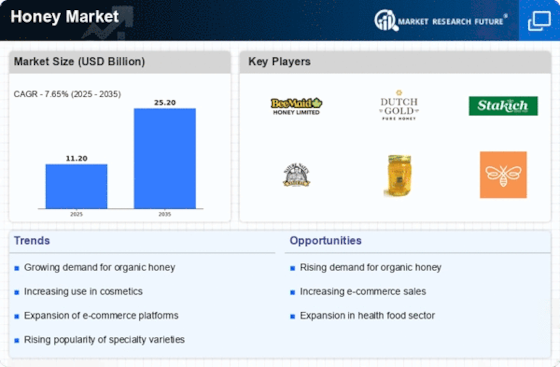
As per Market Research Future analysis, the Honey Market Size was estimated at 9.45 USD Billion in 2024. The Honey industry is projected to grow from 10.0 USD Billion in 2025 to 17.3 USD Billion by 2035, exhibiting a compound annual growth rate (CAGR) of 5.65% during the forecast period 2025 - 2035

Key Market Trends & Highlights

The honey market is experiencing robust growth driven by health trends and sustainability practices.

  • Health consciousness is propelling the demand for organic honey, which remains the largest segment in the market. Sustainability practices are increasingly influencing consumer choices, particularly in the Asia-Pacific region, which is the fastest-growing market. E-commerce growth is reshaping distribution channels, allowing for greater accessibility to honey products across various segments. Rising demand for natural sweeteners and innovations in packaging are key drivers fueling expansion in both the food and beverage sector and the cosmetics and personal care segment.

Market Size & Forecast

2024 Market Size 9.45 (USD Billion)
2035 Market Size 17.3 (USD Billion)
CAGR (2025 - 2035) 5.65%
Largest Regional Market Share in 2024 Europe

Major Players

<a href="https://www.beemaid.com/">Bee Maid Honey Ltd</a> (CA), Dutch Gold Honey (US), Capilano Honey Ltd (AU), Stakich Inc (US), Nature Nate's Honey Co (US), <a href="https://www.honeypacifica.com/">Honey Pacifica</a> (US), Wedderspoon (CA), Manuka Health (NZ), Savannah Bee Company (US)

Market Trends

The Honey Market is currently experiencing a dynamic evolution, driven by various factors that influence consumer preferences and production practices within the honey bees market and honey bee farms market. There is a growing awareness regarding the health benefits associated with honey, which has led to an increase in demand for natural and organic products, including premium varieties such as those in the manuka honey market. Consumers are increasingly seeking alternatives to refined sugars, positioning honey as a preferred natural sweetener within the honey food market. Furthermore, the rise of e-commerce platforms has facilitated greater accessibility to diverse honey products across the world honey market, allowing consumers to explore different varieties from around the globe.

In addition to changing consumer preferences, the Honey Market is also influenced by environmental factors and agricultural practices impacting the honey bee market photos visibility and beekeeping awareness initiatives. Climate change poses challenges to beekeeping, affecting honey production and quality. The market is witnessing a trend towards local sourcing, supporting regional producers and strengthening demand within the american honey market. Overall, the Honey Market appears poised for continued growth, driven by health consciousness, sustainability, and evolving consumer habits.

Health Consciousness

The honey market analysis reflects a steadily evolving natural sweeteners segment driven by rising consumer preference for clean-label, minimally processed, and functional food products. Prominent global honey industry trends include increasing demand for traceable sourcing, raw and unfiltered varieties, and value-added applications across food, beverages, and wellness products. These factors are supporting a positive honey market growth forecast, as honey continues to gain traction as a natural alternative to refined sugar. From a strategic perspective, natural honey market insights highlight growing awareness of nutritional benefits, expanding use in immunity-focused formulations, and rising interest in artisanal and region-specific offerings. In parallel, the organic honey market is witnessing increased adoption due to heightened focus on sustainability, ethical beekeeping practices, and organic food consumption patterns, further strengthening the long-term outlook of the global honey industry.

There is a notable trend towards health consciousness among consumers, leading to increased demand for natural sweeteners. Honey Market products, including raw and organic variants, are widely recognized across the world honey market as healthier alternatives to processed sugars.

Sustainability Practices

Sustainability is becoming a focal point in the Honey Market, particularly across honey bee farms market operations, with producers adopting eco-friendly practices that align with long-term ecosystem preservation. This includes responsible sourcing and environmentally friendly packaging, which resonate with consumers who prioritize sustainability.

E-commerce Growth

The expansion of e-commerce platforms is transforming the Honey Market, strengthening visibility for products such as sprouts farmers market manuka honey, fresh market manuka honey, and specialty offerings within the world market honey category.

Honey Market Market Drivers

Expansion of Online Retail Channels

The Honey Market is experiencing a transformative shift with the expansion of online retail channels. E-commerce platforms are becoming increasingly popular for purchasing honey, providing consumers with convenient access to a wide variety of products. Recent data shows that online sales of honey have surged, with an estimated growth rate of 8% annually. This trend is particularly appealing to younger consumers who prefer the convenience of online shopping. As a result, traditional retailers are adapting by enhancing their online presence and offering exclusive products through digital channels. This shift not only broadens the reach of the Honey Market but also allows for targeted marketing strategies that cater to specific consumer segments.

Growing Awareness of Health Benefits

The Honey Market is benefiting from a growing awareness of the health benefits associated with honey consumption. Research indicates that honey possesses various nutritional properties, including antioxidants and antimicrobial effects, which are increasingly recognized by health-conscious consumers. This awareness is driving demand for honey as a natural remedy for various ailments, further solidifying its position in the health and wellness market. Recent surveys reveal that nearly 60% of consumers are actively seeking products that promote health benefits, suggesting a strong potential for growth in the Honey Market. As more individuals turn to natural solutions for health maintenance, honey is likely to become a staple in many households.

Rising Demand for Natural Sweeteners

The Honey Market is experiencing a notable increase in demand for natural sweeteners as consumers become more health-conscious. This shift is largely driven by a growing awareness of the adverse effects of refined sugars and artificial sweeteners. According to recent data, the market for natural sweeteners, including honey, is projected to grow at a compound annual growth rate of approximately 5.5% over the next few years. This trend indicates that consumers are actively seeking healthier alternatives, which positions honey as a preferred choice due to its natural origins and potential health benefits. As a result, the Honey Market is likely to see a surge in product offerings that emphasize purity and natural sourcing, catering to this evolving consumer preference.

Increased Use in Food and Beverage Sector

The Honey Market is witnessing a significant uptick in the utilization of honey within the food and beverage sector. This trend is attributed to the versatility of honey as an ingredient, which enhances flavor profiles while providing natural sweetness. Recent statistics suggest that honey is increasingly being incorporated into various products, ranging from artisanal breads to craft beverages. The food and beverage industry is projected to account for a substantial share of honey consumption, with an estimated growth rate of around 6% annually. This growing integration of honey into diverse culinary applications not only boosts its market presence but also reinforces its image as a premium ingredient, thereby driving the overall Honey Market forward.

Innovations in Packaging and Product Offerings

The Honey Market is currently experiencing a wave of innovations in packaging and product offerings, which are crucial for attracting modern consumers. Companies are increasingly adopting eco-friendly packaging solutions that resonate with environmentally conscious buyers. Additionally, the introduction of flavored and infused honey products is expanding the market's appeal. Recent data indicates that specialty honey products, such as those infused with herbs or spices, are gaining traction, with sales expected to rise by approximately 7% in the coming years. This diversification in product offerings not only enhances consumer choice but also positions the Honey Market as a dynamic sector capable of adapting to changing consumer preferences.

Market Segment Insights

By Application: Food and Beverage (Largest) vs. Cosmetics and Personal Care (Fastest-Growing)

<p>The honey market showcases a diverse range of applications, with Food and Beverage dominating the segment. This sector significantly outpaces others in terms of market share, driven by the increasing consumer preference for natural and organic products. Cosmetics and Personal Care is gaining traction, emerging as a key player in the market due to shifting consumer trends towards sustainable and health-conscious ingredients. Growth trends in the honey market are being influenced by changing consumer lifestyles and heightened awareness about health benefits associated with honey. The Food and Beverage sector continues to benefit from its established position, but the Cosmetics and Personal Care segment is rapidly expanding, propelled by the rising demand for natural beauty products. As consumers increasingly favor holistic and organic solutions, the market for honey in these applications is set for further evolution.</p>

<p>Food and Beverage: Dominant vs. Cosmetics and Personal Care: Emerging</p>

<p>The Food and Beverage application of honey is characterized by its widespread use as a natural sweetener and ingredient across various culinary products, including beverages, confections, and baked goods. It holds a dominant position due to long-standing consumer preferences and the versatility of honey in enhancing flavor and nutritional profiles. Conversely, the Cosmetics and Personal Care segment is emerging, reflecting a growing recognition of honey's moisturizing and antibacterial properties. This sector is expanding rapidly as brands incorporate honey into skincare and beauty products, targeting consumers looking for natural alternatives. With increasing awareness of the benefits of natural ingredients, the Cosmetics and Personal Care segment is poised for significant growth in the coming years.</p>

By Type: Raw Honey (Largest) vs. Flavored Honey (Fastest-Growing)

<p>In the honey market, the segment distribution reveals that raw honey holds the largest share, appealing to consumers seeking unprocessed, natural options. Processed honey follows, catering to those preferring convenience and shelf stability. Organic honey garners attention from health-conscious buyers, while flavored honey is rapidly gaining traction among younger demographics craving novelty. This dynamic segmentation showcases diverse consumer preferences shaping the market landscape. Growth trends indicate a rising demand for natural and organic products across various food segments, enhancing the appeal of raw and organic honey. Meanwhile, flavored honey is experiencing the fastest growth, driven by innovative marketing strategies and an increasing trend of personalization in food products. As consumers become more adventurous, they seek unique flavors, boosting the overall honey market's trajectory.</p>

<p>Raw Honey (Dominant) vs. Flavored Honey (Emerging)</p>

<p>Raw honey is characterized by its unprocessed nature, maintaining all its natural enzymes and nutrients, making it a favorite among health enthusiasts. It is often perceived as a premium product, leading to strong consumer loyalty within this niche. Conversely, flavored honey, which includes varieties infused with different fruits, spices, or herbs, is an emerging player, especially popular among millennials and younger consumers. This segment thrives on innovation, with brands continually introducing new flavors to attract adventurous eaters. The growing trend of pairing unique foods with beverages further enhances the popularity of flavored honey, establishing it as a vibrant segment in the honey market that complements the traditional offerings.</p>

By Distribution Channel: Online Retail (Largest) vs. Supermarkets (Fastest-Growing)

<p>In the honey market, the distribution channel landscape is varied, with online retail representing the largest share. This channel has seen a significant shift as more consumers favor the convenience of online shopping, particularly post-pandemic. Supermarkets remain a strong player, offering accessibility and immediate purchase options to customers. Specialty stores and direct sales follow, holding smaller shares but still contributing to the market's overall diversity. As consumers increasingly turn to digital shopping channels, online retail is expected to continue its dominance in the coming years. The growth of supermarkets as a distribution channel is propelled by their increasing focus on organic and specialty honey products. Additionally, the rise of specialty stores reflects a consumer trend toward artisanal and local products, while direct sales are gaining traction among local producers looking to connect with consumers directly.</p>

<p>Online Retail (Dominant) vs. Direct Sales (Emerging)</p>

<p>Online retail has established itself as a dominant force in the honey market, offering consumers vast selections and conveniences that traditional purchasing methods cannot match. This channel enables honey brands to reach a broader audience through e-commerce platforms and subscription services. In contrast, direct sales are emerging as a personalized and engaging alternative for consumers who favor local and artisanal products. This segment allows producers to interact directly with customers, enhancing the buying experience and fostering brand loyalty. While online retail focuses on scale and convenience, direct sales emphasize craftsmanship and community engagement, highlighting the unique characteristics of the products. As consumer preferences evolve, both channels are likely to coexist, catering to different market segments.</p>

By Form: Liquid (Largest) vs. Granulated (Fastest-Growing)

<p>In the Honey Market, the 'Form' segment showcases a diverse landscape where Liquid Honey holds the majority market share, capitalizing on its versatility and consumer preference for ready-to-use products. Granulated Honey, while smaller in share, is rapidly gaining traction, appealing particularly to consumers looking for a natural sweetener with a longer shelf life. Comb Honey, although not as widespread, also occupies a niche segment, favored for its artisanal appeal and unique presentation that attracts specialty food lovers.</p>

<p>Liquid Honey (Dominant) vs. Granulated Honey (Emerging)</p>

<p>Liquid Honey is considered the dominant form in the Honey Market due to its ease of use and broad application in various culinary settings, from baking to beverages. Its smooth texture and immediate dissolvability make it a favorite among both consumers and food manufacturers. In contrast, Granulated Honey is emerging as a popular choice for health-conscious consumers seeking a natural sweetening alternative that offers a different texture and a longer shelf life. This form is gaining popularity in product formulations, particularly in health foods and baking, where its physical properties are valued.</p>

Get more detailed insights about Honey Market Research Report- Forecast till 2035

Regional Insights

North America : Market Leader in Honey Market Production

North America is the largest market for honey, accounting for approximately 40% of the global share. North America remains a dominant region within the american honey market, supported by strong consumer demand and regulatory backing. Premium retail offerings and specialty products continue to strengthen the region’s market position. Regulatory support, such as the USDA's organic certification, further drives market growth. The demand for local and raw honey varieties is also on the rise, contributing to the market's expansion. The United States is the leading country in this region, with significant contributions from Canada. Key players like Dutch Gold Honey Market and Nature Nate's Honey Market Co dominate the landscape, focusing on quality and sustainability. The competitive environment is characterized by a mix of large-scale producers and local beekeepers, ensuring a diverse product offering that caters to various consumer preferences.

Europe : Emerging Market with Regulations

Europe is witnessing a growing demand for honey, holding approximately 30% of the global market share. Europe’s honey demand continues to grow, supported by regulatory frameworks and rising imports, contributing to the overall expansion of the world honey market. Regulatory frameworks, such as the EU's Honey Market Directive, ensure quality and authenticity, fostering consumer trust. Countries like Germany and France are the largest markets, with increasing imports to meet local demand. Germany leads the European market, followed closely by France and the UK. The competitive landscape features both large companies and artisanal producers, with brands like Wedderspoon and Manuka Health gaining traction. The focus on sustainable practices and local sourcing is shaping the market, as consumers increasingly seek transparency in their food choices.

Asia-Pacific : Rapidly Growing Honey Market Sector

The Asia-Pacific region is emerging as a significant player in the honey market, accounting for about 20% of the global share. Asia-Pacific is emerging as a key contributor to the world honey market, with increasing production and consumption across China, Australia, and New Zealand. The demand for organic and specialty honey is also on the rise, further fueling market growth. China is the largest honey producer in the region, followed by Australia and New Zealand. The competitive landscape is diverse, with both large-scale producers and small-scale beekeepers. Key players like Capilano Honey Market Ltd and Manuka Health are focusing on premium products, catering to health-conscious consumers. The market is characterized by innovation and a growing emphasis on quality and sustainability.

Middle East and Africa : Untapped Potential in Honey Market

The Middle East and Africa region is gradually emerging in the honey market, holding around 10% of the global share. The Middle East and Africa region demonstrates untapped potential within the world honey market, driven by increasing health awareness and rising demand for raw and organic honey.  The growth is driven by increasing awareness of honey's health benefits and rising disposable incomes. Countries like South Africa and the UAE are leading the market, with government initiatives supporting local production and quality standards. The demand for organic and raw honey is also increasing, indicating a shift in consumer preferences. South Africa is the largest market in this region, followed by the UAE. The competitive landscape is evolving, with local producers and international brands vying for market share. Key players like Honey Market Pacifica and Savannah Bee Company are focusing on quality and sustainability, catering to the growing demand for premium honey products. The region's potential remains largely untapped, presenting opportunities for growth and investment.

Key Players and Competitive Insights

The Honey Market is witnessing a dynamic landscape characterized by increasing demand for natural and organic sweeteners, driven by growing health-conscious consumers who are shifting from sugar to honey for its various health benefits. This shift has led to intensified competition among key players as companies strive to enhance their offerings through innovation, sustainability practices, and maintaining quality standards. Various regions play a critical role in the honey market, with production and consumption patterns influenced by climate, local traditions, and consumer preferences. Companies in this sector face challenges like price fluctuations, supply chain disruptions, and the need for regulatory compliance, which they must strategically navigate to maintain competitive positioning. Manuka Health has established a commendable presence in the Global Honey Market, primarily by leveraging the unique properties of Manuka honey, known for its health benefits and antibacterial properties. The company is recognized for its commitment to quality and authenticity, ensuring that its products meet rigorous standards that resonate with health-focused consumers. Manuka Health’s strengths lie in its strong branding and marketing strategies that effectively communicate the benefits of its honey, positioning it as a premium product in the market. Additionally, the company's practices in sustainable sourcing and environmental stewardship further enhance its reputation, appealing to the growing demographic of eco-conscious buyers.  Through continuous product development and a focus on effective distribution channels, Manuka Health has successfully fortified its competitive edge in the global arena.Dabur is prominent in the Global Honey Market, known for integrating traditional wellness with modern healthcare solutions. The company offers a range of honey products, focusing on purity, health benefits, and natural ingredients, which cater to a health-oriented audience.  Dabur’s strength lies in its established brand reputation, extensive distribution network, and marketing strategies that promote its honey as an essential part of a healthy lifestyle. The company has invested in research and development to expand its product line while also exploring potential mergers and acquisitions to enhance its foothold in the market. Dabur's commitment to quality, combined with strategic partnerships and a strong supply chain, contributes to its resilience in the competitive landscape, allowing it to cater to both local and global consumer bases with effectiveness and efficiency.

Key Companies in the Honey Market include

Industry Developments

Recent developments in the Honey Market reflect increased emphasis on premium and specialty products, including continued expansion of the manuka honey market across global retail and e-commerce platforms. Manuka Health has seen heightened demand for its Manuka honey, attributed to increased health awareness globally. Dabur continues to expand its product range to appeal to health-conscious consumers, while Dutch Gold Honey Market has enhanced its distribution channels to better serve North American markets. 

Capilano Honey Market is focusing on innovation, particularly in eco-friendly packaging solutions. In terms of mergers and acquisitions, there have been no publicly reported significant transactions involving the mentioned companies in recent months. Notably, the honey market has experienced a rise in valuation, driven by consumer preferences for natural and organic sweeteners, with a reported growth rate of 5-6% annually over the past two years. As of March 2023, Honey Market Gardens has launched a new line of infused honey, further demonstrating the market's inclination towards diversity in flavors. 

Companies like Wedderspoon and Comvita are increasingly prioritizing traceability and ethical sourcing, which resonate well with consumers’ growing environmental concerns. Meanwhile, Nature Nate's Honey Market has gained traction in health stores, indicating a shift towards retail expansion for honey products.

Future Outlook

Honey Market Future Outlook

The Honey Market is projected to grow at a 5.65% CAGR from 2025 to 2035, driven by rising health consciousness, demand for natural sweeteners, and innovative product offerings.

New opportunities lie in:

  • <p>Expansion into organic honey product lines Development of honey-based health supplements Implementation of direct-to-consumer e-commerce platforms</p>

By 2035, the Honey Market is expected to achieve robust growth, solidifying its position as a key player in the global food industry.

Market Segmentation

Honey Market Form Outlook

  • Liquid
  • Granulated
  • Comb Honey

Honey Market Type Outlook

  • Organic Honey
  • Raw Honey
  • Regular Honey
  • Flavored Honey

Honey Market Application Outlook

  • Food and Beverage
  • Cosmetics and Personal Care
  • Pharmaceuticals

Honey Market Distribution Channel Outlook

  • Supermarkets and Hypermarkets
  • Online Retail
  • Convenience Stores
  • Specialty Stores

Report Scope

MARKET SIZE 2024 9.45(USD Billion)
MARKET SIZE 2025 10.0(USD Billion)
MARKET SIZE 2035 17.3(USD Billion)
COMPOUND ANNUAL GROWTH RATE (CAGR) 5.65% (2025 - 2035)
REPORT COVERAGE Revenue Forecast, Competitive Landscape, Growth Factors, and Trends
BASE YEAR 2024
Market Forecast Period 2025 - 2035
Historical Data 2019 - 2024
Market Forecast Units USD Billion
Key Companies Profiled Bee Maid Honey Ltd (CA), Dutch Gold Honey (US), Capilano Honey Ltd (AU), Stakich Inc (US), Nature Nate's Honey Co (US), Honey Pacifica (US), Wedderspoon (CA), Manuka Health (NZ), Savannah Bee Company (US)
Segments Covered Type, Application, Distribution Channel, Form, Regional
Key Market Opportunities Growing consumer preference for natural sweeteners drives innovation in the Honey Market.
Key Market Dynamics Rising consumer preference for organic honey drives competition and influences pricing strategies across the honey market.
Countries Covered North America, Europe, APAC, South America, MEA

FAQs

What is the current valuation of the honey market as of 2024?

<p>The honey market was valued at 10.5 USD Billion in 2024.</p>

What is the projected market size for the honey market by 2035?

<p>The honey market is projected to reach 15.0 USD Billion by 2035.</p>

What is the expected CAGR for the honey market during the forecast period 2025 - 2035?

<p>The expected CAGR for the honey market during the forecast period 2025 - 2035 is 3.3%.</p>

Which companies are considered key players in the honey market?

<p>Key players in the honey market include Bee Maid Honey Limited, Dutch Gold Honey, Capilano Honey Limited, and Nature Nate's Honey Co.</p>

How does the honey market segment by application perform?

<p>In 2024, the Food and Beverage segment was valued at 5.25 USD Billion, while the Pharmaceuticals segment reached 1.05 USD Billion.</p>

What are the projected values for the cosmetics and personal care segment by 2035?

<p>The cosmetics and personal care segment is projected to grow from 2.1 USD Billion in 2024 to 2.8 USD Billion by 2035.</p>

What types of honey are included in the market segmentation?

<p>The honey market segments include Raw Honey, Processed Honey, Organic Honey, and Flavored Honey.</p>

What is the expected growth for the online retail distribution channel by 2035?

<p>The online retail distribution channel is expected to grow from 1.5 USD Billion in 2024 to 2.0 USD Billion by 2035.</p>

How does the processed honey segment compare to organic honey in terms of market value?

<p>In 2024, the processed honey segment was valued at 4.0 USD Billion, significantly higher than the organic honey segment at 2.0 USD Billion.</p>

What distribution channels are most prominent in the honey market?

<p>Prominent distribution channels in the honey market include Supermarkets, Specialty Stores, and Direct Sales.</p>

  1. SECTION I: EXECUTIVE SUMMARY AND KEY HIGHLIGHTS
    1. | 1.1 EXECUTIVE SUMMARY
    2. | | 1.1.1 Market Overview
    3. | | 1.1.2 Key Findings
    4. | | 1.1.3 Market Segmentation
    5. | | 1.1.4 Competitive Landscape
    6. | | 1.1.5 Challenges and Opportunities
    7. | | 1.1.6 Future Outlook
  2. SECTION II: SCOPING, METHODOLOGY AND MARKET STRUCTURE
    1. | 2.1 MARKET INTRODUCTION
    2. | | 2.1.1 Definition
    3. | | 2.1.2 Scope of the study
    4. | | | 2.1.2.1 Research Objective
    5. | | | 2.1.2.2 Assumption
    6. | | | 2.1.2.3 Limitations
    7. | 2.2 RESEARCH METHODOLOGY
    8. | | 2.2.1 Overview
    9. | | 2.2.2 Data Mining
    10. | | 2.2.3 Secondary Research
    11. | | 2.2.4 Primary Research
    12. | | | 2.2.4.1 Primary Interviews and Information Gathering Process
    13. | | | 2.2.4.2 Breakdown of Primary Respondents
    14. | | 2.2.5 Forecasting Model
    15. | | 2.2.6 Market Size Estimation
    16. | | | 2.2.6.1 Bottom-Up Approach
    17. | | | 2.2.6.2 Top-Down Approach
    18. | | 2.2.7 Data Triangulation
    19. | | 2.2.8 Validation
  3. SECTION III: QUALITATIVE ANALYSIS
    1. | 3.1 MARKET DYNAMICS
    2. | | 3.1.1 Overview
    3. | | 3.1.2 Drivers
    4. | | 3.1.3 Restraints
    5. | | 3.1.4 Opportunities
    6. | 3.2 MARKET FACTOR ANALYSIS
    7. | | 3.2.1 Value chain Analysis
    8. | | 3.2.2 Porter's Five Forces Analysis
    9. | | | 3.2.2.1 Bargaining Power of Suppliers
    10. | | | 3.2.2.2 Bargaining Power of Buyers
    11. | | | 3.2.2.3 Threat of New Entrants
    12. | | | 3.2.2.4 Threat of Substitutes
    13. | | | 3.2.2.5 Intensity of Rivalry
    14. | | 3.2.3 COVID-19 Impact Analysis
    15. | | | 3.2.3.1 Market Impact Analysis
    16. | | | 3.2.3.2 Regional Impact
    17. | | | 3.2.3.3 Opportunity and Threat Analysis
  4. SECTION IV: QUANTITATIVE ANALYSIS
    1. | 4.1 Food, Beverages & Nutrition, BY Application (USD Billion)
    2. | | 4.1.1 Food and Beverage
    3. | | 4.1.2 Cosmetics and Personal Care
    4. | | 4.1.3 Pharmaceuticals
    5. | | 4.1.4 Nutraceuticals
    6. | 4.2 Food, Beverages & Nutrition, BY Type (USD Billion)
    7. | | 4.2.1 Raw Honey
    8. | | 4.2.2 Processed Honey
    9. | | 4.2.3 Organic Honey
    10. | | 4.2.4 Flavored Honey
    11. | 4.3 Food, Beverages & Nutrition, BY Distribution Channel (USD Billion)
    12. | | 4.3.1 Online Retail
    13. | | 4.3.2 Supermarkets
    14. | | 4.3.3 Specialty Stores
    15. | | 4.3.4 Direct Sales
    16. | 4.4 Food, Beverages & Nutrition, BY Region (USD Billion)
    17. | | 4.4.1 North America
    18. | | | 4.4.1.1 US
    19. | | | 4.4.1.2 Canada
    20. | | 4.4.2 Europe
    21. | | | 4.4.2.1 Germany
    22. | | | 4.4.2.2 UK
    23. | | | 4.4.2.3 France
    24. | | | 4.4.2.4 Russia
    25. | | | 4.4.2.5 Italy
    26. | | | 4.4.2.6 Spain
    27. | | | 4.4.2.7 Rest of Europe
    28. | | 4.4.3 APAC
    29. | | | 4.4.3.1 China
    30. | | | 4.4.3.2 India
    31. | | | 4.4.3.3 Japan
    32. | | | 4.4.3.4 South Korea
    33. | | | 4.4.3.5 Malaysia
    34. | | | 4.4.3.6 Thailand
    35. | | | 4.4.3.7 Indonesia
    36. | | | 4.4.3.8 Rest of APAC
    37. | | 4.4.4 South America
    38. | | | 4.4.4.1 Brazil
    39. | | | 4.4.4.2 Mexico
    40. | | | 4.4.4.3 Argentina
    41. | | | 4.4.4.4 Rest of South America
    42. | | 4.4.5 MEA
    43. | | | 4.4.5.1 GCC Countries
    44. | | | 4.4.5.2 South Africa
    45. | | | 4.4.5.3 Rest of MEA
  5. SECTION V: COMPETITIVE ANALYSIS
    1. | 5.1 Competitive Landscape
    2. | | 5.1.1 Overview
    3. | | 5.1.2 Competitive Analysis
    4. | | 5.1.3 Market share Analysis
    5. | | 5.1.4 Major Growth Strategy in the Food, Beverages & Nutrition
    6. | | 5.1.5 Competitive Benchmarking
    7. | | 5.1.6 Leading Players in Terms of Number of Developments in the Food, Beverages & Nutrition
    8. | | 5.1.7 Key developments and growth strategies
    9. | | | 5.1.7.1 New Product Launch/Service Deployment
    10. | | | 5.1.7.2 Merger & Acquisitions
    11. | | | 5.1.7.3 Joint Ventures
    12. | | 5.1.8 Major Players Financial Matrix
    13. | | | 5.1.8.1 Sales and Operating Income
    14. | | | 5.1.8.2 Major Players R&D Expenditure. 2023
    15. | 5.2 Company Profiles
    16. | | 5.2.1 Bee Maid Honey Limited (CA)
    17. | | | 5.2.1.1 Financial Overview
    18. | | | 5.2.1.2 Products Offered
    19. | | | 5.2.1.3 Key Developments
    20. | | | 5.2.1.4 SWOT Analysis
    21. | | | 5.2.1.5 Key Strategies
    22. | | 5.2.2 Dutch Gold Honey (US)
    23. | | | 5.2.2.1 Financial Overview
    24. | | | 5.2.2.2 Products Offered
    25. | | | 5.2.2.3 Key Developments
    26. | | | 5.2.2.4 SWOT Analysis
    27. | | | 5.2.2.5 Key Strategies
    28. | | 5.2.3 Capilano Honey Limited (AU)
    29. | | | 5.2.3.1 Financial Overview
    30. | | | 5.2.3.2 Products Offered
    31. | | | 5.2.3.3 Key Developments
    32. | | | 5.2.3.4 SWOT Analysis
    33. | | | 5.2.3.5 Key Strategies
    34. | | 5.2.4 Stakich Inc. (US)
    35. | | | 5.2.4.1 Financial Overview
    36. | | | 5.2.4.2 Products Offered
    37. | | | 5.2.4.3 Key Developments
    38. | | | 5.2.4.4 SWOT Analysis
    39. | | | 5.2.4.5 Key Strategies
    40. | | 5.2.5 Nature Nate's Honey Co. (US)
    41. | | | 5.2.5.1 Financial Overview
    42. | | | 5.2.5.2 Products Offered
    43. | | | 5.2.5.3 Key Developments
    44. | | | 5.2.5.4 SWOT Analysis
    45. | | | 5.2.5.5 Key Strategies
    46. | | 5.2.6 Honey Pacifica (US)
    47. | | | 5.2.6.1 Financial Overview
    48. | | | 5.2.6.2 Products Offered
    49. | | | 5.2.6.3 Key Developments
    50. | | | 5.2.6.4 SWOT Analysis
    51. | | | 5.2.6.5 Key Strategies
    52. | | 5.2.7 Wedderspoon (CA)
    53. | | | 5.2.7.1 Financial Overview
    54. | | | 5.2.7.2 Products Offered
    55. | | | 5.2.7.3 Key Developments
    56. | | | 5.2.7.4 SWOT Analysis
    57. | | | 5.2.7.5 Key Strategies
    58. | | 5.2.8 Manuka Health (NZ)
    59. | | | 5.2.8.1 Financial Overview
    60. | | | 5.2.8.2 Products Offered
    61. | | | 5.2.8.3 Key Developments
    62. | | | 5.2.8.4 SWOT Analysis
    63. | | | 5.2.8.5 Key Strategies
    64. | 5.3 Appendix
    65. | | 5.3.1 References
    66. | | 5.3.2 Related Reports
  6. LIST OF FIGURES
    1. | 6.1 MARKET SYNOPSIS
    2. | 6.2 NORTH AMERICA MARKET ANALYSIS
    3. | 6.3 US MARKET ANALYSIS BY APPLICATION
    4. | 6.4 US MARKET ANALYSIS BY TYPE
    5. | 6.5 US MARKET ANALYSIS BY DISTRIBUTION CHANNEL
    6. | 6.6 CANADA MARKET ANALYSIS BY APPLICATION
    7. | 6.7 CANADA MARKET ANALYSIS BY TYPE
    8. | 6.8 CANADA MARKET ANALYSIS BY DISTRIBUTION CHANNEL
    9. | 6.9 EUROPE MARKET ANALYSIS
    10. | 6.10 GERMANY MARKET ANALYSIS BY APPLICATION
    11. | 6.11 GERMANY MARKET ANALYSIS BY TYPE
    12. | 6.12 GERMANY MARKET ANALYSIS BY DISTRIBUTION CHANNEL
    13. | 6.13 UK MARKET ANALYSIS BY APPLICATION
    14. | 6.14 UK MARKET ANALYSIS BY TYPE
    15. | 6.15 UK MARKET ANALYSIS BY DISTRIBUTION CHANNEL
    16. | 6.16 FRANCE MARKET ANALYSIS BY APPLICATION
    17. | 6.17 FRANCE MARKET ANALYSIS BY TYPE
    18. | 6.18 FRANCE MARKET ANALYSIS BY DISTRIBUTION CHANNEL
    19. | 6.19 RUSSIA MARKET ANALYSIS BY APPLICATION
    20. | 6.20 RUSSIA MARKET ANALYSIS BY TYPE
    21. | 6.21 RUSSIA MARKET ANALYSIS BY DISTRIBUTION CHANNEL
    22. | 6.22 ITALY MARKET ANALYSIS BY APPLICATION
    23. | 6.23 ITALY MARKET ANALYSIS BY TYPE
    24. | 6.24 ITALY MARKET ANALYSIS BY DISTRIBUTION CHANNEL
    25. | 6.25 SPAIN MARKET ANALYSIS BY APPLICATION
    26. | 6.26 SPAIN MARKET ANALYSIS BY TYPE
    27. | 6.27 SPAIN MARKET ANALYSIS BY DISTRIBUTION CHANNEL
    28. | 6.28 REST OF EUROPE MARKET ANALYSIS BY APPLICATION
    29. | 6.29 REST OF EUROPE MARKET ANALYSIS BY TYPE
    30. | 6.30 REST OF EUROPE MARKET ANALYSIS BY DISTRIBUTION CHANNEL
    31. | 6.31 APAC MARKET ANALYSIS
    32. | 6.32 CHINA MARKET ANALYSIS BY APPLICATION
    33. | 6.33 CHINA MARKET ANALYSIS BY TYPE
    34. | 6.34 CHINA MARKET ANALYSIS BY DISTRIBUTION CHANNEL
    35. | 6.35 INDIA MARKET ANALYSIS BY APPLICATION
    36. | 6.36 INDIA MARKET ANALYSIS BY TYPE
    37. | 6.37 INDIA MARKET ANALYSIS BY DISTRIBUTION CHANNEL
    38. | 6.38 JAPAN MARKET ANALYSIS BY APPLICATION
    39. | 6.39 JAPAN MARKET ANALYSIS BY TYPE
    40. | 6.40 JAPAN MARKET ANALYSIS BY DISTRIBUTION CHANNEL
    41. | 6.41 SOUTH KOREA MARKET ANALYSIS BY APPLICATION
    42. | 6.42 SOUTH KOREA MARKET ANALYSIS BY TYPE
    43. | 6.43 SOUTH KOREA MARKET ANALYSIS BY DISTRIBUTION CHANNEL
    44. | 6.44 MALAYSIA MARKET ANALYSIS BY APPLICATION
    45. | 6.45 MALAYSIA MARKET ANALYSIS BY TYPE
    46. | 6.46 MALAYSIA MARKET ANALYSIS BY DISTRIBUTION CHANNEL
    47. | 6.47 THAILAND MARKET ANALYSIS BY APPLICATION
    48. | 6.48 THAILAND MARKET ANALYSIS BY TYPE
    49. | 6.49 THAILAND MARKET ANALYSIS BY DISTRIBUTION CHANNEL
    50. | 6.50 INDONESIA MARKET ANALYSIS BY APPLICATION
    51. | 6.51 INDONESIA MARKET ANALYSIS BY TYPE
    52. | 6.52 INDONESIA MARKET ANALYSIS BY DISTRIBUTION CHANNEL
    53. | 6.53 REST OF APAC MARKET ANALYSIS BY APPLICATION
    54. | 6.54 REST OF APAC MARKET ANALYSIS BY TYPE
    55. | 6.55 REST OF APAC MARKET ANALYSIS BY DISTRIBUTION CHANNEL
    56. | 6.56 SOUTH AMERICA MARKET ANALYSIS
    57. | 6.57 BRAZIL MARKET ANALYSIS BY APPLICATION
    58. | 6.58 BRAZIL MARKET ANALYSIS BY TYPE
    59. | 6.59 BRAZIL MARKET ANALYSIS BY DISTRIBUTION CHANNEL
    60. | 6.60 MEXICO MARKET ANALYSIS BY APPLICATION
    61. | 6.61 MEXICO MARKET ANALYSIS BY TYPE
    62. | 6.62 MEXICO MARKET ANALYSIS BY DISTRIBUTION CHANNEL
    63. | 6.63 ARGENTINA MARKET ANALYSIS BY APPLICATION
    64. | 6.64 ARGENTINA MARKET ANALYSIS BY TYPE
    65. | 6.65 ARGENTINA MARKET ANALYSIS BY DISTRIBUTION CHANNEL
    66. | 6.66 REST OF SOUTH AMERICA MARKET ANALYSIS BY APPLICATION
    67. | 6.67 REST OF SOUTH AMERICA MARKET ANALYSIS BY TYPE
    68. | 6.68 REST OF SOUTH AMERICA MARKET ANALYSIS BY DISTRIBUTION CHANNEL
    69. | 6.69 MEA MARKET ANALYSIS
    70. | 6.70 GCC COUNTRIES MARKET ANALYSIS BY APPLICATION
    71. | 6.71 GCC COUNTRIES MARKET ANALYSIS BY TYPE
    72. | 6.72 GCC COUNTRIES MARKET ANALYSIS BY DISTRIBUTION CHANNEL
    73. | 6.73 SOUTH AFRICA MARKET ANALYSIS BY APPLICATION
    74. | 6.74 SOUTH AFRICA MARKET ANALYSIS BY TYPE
    75. | 6.75 SOUTH AFRICA MARKET ANALYSIS BY DISTRIBUTION CHANNEL
    76. | 6.76 REST OF MEA MARKET ANALYSIS BY APPLICATION
    77. | 6.77 REST OF MEA MARKET ANALYSIS BY TYPE
    78. | 6.78 REST OF MEA MARKET ANALYSIS BY DISTRIBUTION CHANNEL
    79. | 6.79 KEY BUYING CRITERIA OF FOOD, BEVERAGES & NUTRITION
    80. | 6.80 RESEARCH PROCESS OF MRFR
    81. | 6.81 DRO ANALYSIS OF FOOD, BEVERAGES & NUTRITION
    82. | 6.82 DRIVERS IMPACT ANALYSIS: FOOD, BEVERAGES & NUTRITION
    83. | 6.83 RESTRAINTS IMPACT ANALYSIS: FOOD, BEVERAGES & NUTRITION
    84. | 6.84 SUPPLY / VALUE CHAIN: FOOD, BEVERAGES & NUTRITION
    85. | 6.85 FOOD, BEVERAGES & NUTRITION, BY APPLICATION, 2024 (% SHARE)
    86. | 6.86 FOOD, BEVERAGES & NUTRITION, BY APPLICATION, 2024 TO 2035 (USD Billion)
    87. | 6.87 FOOD, BEVERAGES & NUTRITION, BY TYPE, 2024 (% SHARE)
    88. | 6.88 FOOD, BEVERAGES & NUTRITION, BY TYPE, 2024 TO 2035 (USD Billion)
    89. | 6.89 FOOD, BEVERAGES & NUTRITION, BY DISTRIBUTION CHANNEL, 2024 (% SHARE)
    90. | 6.90 FOOD, BEVERAGES & NUTRITION, BY DISTRIBUTION CHANNEL, 2024 TO 2035 (USD Billion)
    91. | 6.91 BENCHMARKING OF MAJOR COMPETITORS
  7. LIST OF TABLES
    1. | 7.1 LIST OF ASSUMPTIONS
    2. | | 7.1.1
    3. | 7.2 North America MARKET SIZE ESTIMATES; FORECAST
    4. | | 7.2.1 BY APPLICATION, 2025-2035 (USD Billion)
    5. | | 7.2.2 BY TYPE, 2025-2035 (USD Billion)
    6. | | 7.2.3 BY DISTRIBUTION CHANNEL, 2025-2035 (USD Billion)
    7. | 7.3 US MARKET SIZE ESTIMATES; FORECAST
    8. | | 7.3.1 BY APPLICATION, 2025-2035 (USD Billion)
    9. | | 7.3.2 BY TYPE, 2025-2035 (USD Billion)
    10. | | 7.3.3 BY DISTRIBUTION CHANNEL, 2025-2035 (USD Billion)
    11. | 7.4 Canada MARKET SIZE ESTIMATES; FORECAST
    12. | | 7.4.1 BY APPLICATION, 2025-2035 (USD Billion)
    13. | | 7.4.2 BY TYPE, 2025-2035 (USD Billion)
    14. | | 7.4.3 BY DISTRIBUTION CHANNEL, 2025-2035 (USD Billion)
    15. | 7.5 Europe MARKET SIZE ESTIMATES; FORECAST
    16. | | 7.5.1 BY APPLICATION, 2025-2035 (USD Billion)
    17. | | 7.5.2 BY TYPE, 2025-2035 (USD Billion)
    18. | | 7.5.3 BY DISTRIBUTION CHANNEL, 2025-2035 (USD Billion)
    19. | 7.6 Germany MARKET SIZE ESTIMATES; FORECAST
    20. | | 7.6.1 BY APPLICATION, 2025-2035 (USD Billion)
    21. | | 7.6.2 BY TYPE, 2025-2035 (USD Billion)
    22. | | 7.6.3 BY DISTRIBUTION CHANNEL, 2025-2035 (USD Billion)
    23. | 7.7 UK MARKET SIZE ESTIMATES; FORECAST
    24. | | 7.7.1 BY APPLICATION, 2025-2035 (USD Billion)
    25. | | 7.7.2 BY TYPE, 2025-2035 (USD Billion)
    26. | | 7.7.3 BY DISTRIBUTION CHANNEL, 2025-2035 (USD Billion)
    27. | 7.8 France MARKET SIZE ESTIMATES; FORECAST
    28. | | 7.8.1 BY APPLICATION, 2025-2035 (USD Billion)
    29. | | 7.8.2 BY TYPE, 2025-2035 (USD Billion)
    30. | | 7.8.3 BY DISTRIBUTION CHANNEL, 2025-2035 (USD Billion)
    31. | 7.9 Russia MARKET SIZE ESTIMATES; FORECAST
    32. | | 7.9.1 BY APPLICATION, 2025-2035 (USD Billion)
    33. | | 7.9.2 BY TYPE, 2025-2035 (USD Billion)
    34. | | 7.9.3 BY DISTRIBUTION CHANNEL, 2025-2035 (USD Billion)
    35. | 7.10 Italy MARKET SIZE ESTIMATES; FORECAST
    36. | | 7.10.1 BY APPLICATION, 2025-2035 (USD Billion)
    37. | | 7.10.2 BY TYPE, 2025-2035 (USD Billion)
    38. | | 7.10.3 BY DISTRIBUTION CHANNEL, 2025-2035 (USD Billion)
    39. | 7.11 Spain MARKET SIZE ESTIMATES; FORECAST
    40. | | 7.11.1 BY APPLICATION, 2025-2035 (USD Billion)
    41. | | 7.11.2 BY TYPE, 2025-2035 (USD Billion)
    42. | | 7.11.3 BY DISTRIBUTION CHANNEL, 2025-2035 (USD Billion)
    43. | 7.12 Rest of Europe MARKET SIZE ESTIMATES; FORECAST
    44. | | 7.12.1 BY APPLICATION, 2025-2035 (USD Billion)
    45. | | 7.12.2 BY TYPE, 2025-2035 (USD Billion)
    46. | | 7.12.3 BY DISTRIBUTION CHANNEL, 2025-2035 (USD Billion)
    47. | 7.13 APAC MARKET SIZE ESTIMATES; FORECAST
    48. | | 7.13.1 BY APPLICATION, 2025-2035 (USD Billion)
    49. | | 7.13.2 BY TYPE, 2025-2035 (USD Billion)
    50. | | 7.13.3 BY DISTRIBUTION CHANNEL, 2025-2035 (USD Billion)
    51. | 7.14 China MARKET SIZE ESTIMATES; FORECAST
    52. | | 7.14.1 BY APPLICATION, 2025-2035 (USD Billion)
    53. | | 7.14.2 BY TYPE, 2025-2035 (USD Billion)
    54. | | 7.14.3 BY DISTRIBUTION CHANNEL, 2025-2035 (USD Billion)
    55. | 7.15 India MARKET SIZE ESTIMATES; FORECAST
    56. | | 7.15.1 BY APPLICATION, 2025-2035 (USD Billion)
    57. | | 7.15.2 BY TYPE, 2025-2035 (USD Billion)
    58. | | 7.15.3 BY DISTRIBUTION CHANNEL, 2025-2035 (USD Billion)
    59. | 7.16 Japan MARKET SIZE ESTIMATES; FORECAST
    60. | | 7.16.1 BY APPLICATION, 2025-2035 (USD Billion)
    61. | | 7.16.2 BY TYPE, 2025-2035 (USD Billion)
    62. | | 7.16.3 BY DISTRIBUTION CHANNEL, 2025-2035 (USD Billion)
    63. | 7.17 South Korea MARKET SIZE ESTIMATES; FORECAST
    64. | | 7.17.1 BY APPLICATION, 2025-2035 (USD Billion)
    65. | | 7.17.2 BY TYPE, 2025-2035 (USD Billion)
    66. | | 7.17.3 BY DISTRIBUTION CHANNEL, 2025-2035 (USD Billion)
    67. | 7.18 Malaysia MARKET SIZE ESTIMATES; FORECAST
    68. | | 7.18.1 BY APPLICATION, 2025-2035 (USD Billion)
    69. | | 7.18.2 BY TYPE, 2025-2035 (USD Billion)
    70. | | 7.18.3 BY DISTRIBUTION CHANNEL, 2025-2035 (USD Billion)
    71. | 7.19 Thailand MARKET SIZE ESTIMATES; FORECAST
    72. | | 7.19.1 BY APPLICATION, 2025-2035 (USD Billion)
    73. | | 7.19.2 BY TYPE, 2025-2035 (USD Billion)
    74. | | 7.19.3 BY DISTRIBUTION CHANNEL, 2025-2035 (USD Billion)
    75. | 7.20 Indonesia MARKET SIZE ESTIMATES; FORECAST
    76. | | 7.20.1 BY APPLICATION, 2025-2035 (USD Billion)
    77. | | 7.20.2 BY TYPE, 2025-2035 (USD Billion)
    78. | | 7.20.3 BY DISTRIBUTION CHANNEL, 2025-2035 (USD Billion)
    79. | 7.21 Rest of APAC MARKET SIZE ESTIMATES; FORECAST
    80. | | 7.21.1 BY APPLICATION, 2025-2035 (USD Billion)
    81. | | 7.21.2 BY TYPE, 2025-2035 (USD Billion)
    82. | | 7.21.3 BY DISTRIBUTION CHANNEL, 2025-2035 (USD Billion)
    83. | 7.22 South America MARKET SIZE ESTIMATES; FORECAST
    84. | | 7.22.1 BY APPLICATION, 2025-2035 (USD Billion)
    85. | | 7.22.2 BY TYPE, 2025-2035 (USD Billion)
    86. | | 7.22.3 BY DISTRIBUTION CHANNEL, 2025-2035 (USD Billion)
    87. | 7.23 Brazil MARKET SIZE ESTIMATES; FORECAST
    88. | | 7.23.1 BY APPLICATION, 2025-2035 (USD Billion)
    89. | | 7.23.2 BY TYPE, 2025-2035 (USD Billion)
    90. | | 7.23.3 BY DISTRIBUTION CHANNEL, 2025-2035 (USD Billion)
    91. | 7.24 Mexico MARKET SIZE ESTIMATES; FORECAST
    92. | | 7.24.1 BY APPLICATION, 2025-2035 (USD Billion)
    93. | | 7.24.2 BY TYPE, 2025-2035 (USD Billion)
    94. | | 7.24.3 BY DISTRIBUTION CHANNEL, 2025-2035 (USD Billion)
    95. | 7.25 Argentina MARKET SIZE ESTIMATES; FORECAST
    96. | | 7.25.1 BY APPLICATION, 2025-2035 (USD Billion)
    97. | | 7.25.2 BY TYPE, 2025-2035 (USD Billion)
    98. | | 7.25.3 BY DISTRIBUTION CHANNEL, 2025-2035 (USD Billion)
    99. | 7.26 Rest of South America MARKET SIZE ESTIMATES; FORECAST
    100. | | 7.26.1 BY APPLICATION, 2025-2035 (USD Billion)
    101. | | 7.26.2 BY TYPE, 2025-2035 (USD Billion)
    102. | | 7.26.3 BY DISTRIBUTION CHANNEL, 2025-2035 (USD Billion)
    103. | 7.27 MEA MARKET SIZE ESTIMATES; FORECAST
    104. | | 7.27.1 BY APPLICATION, 2025-2035 (USD Billion)
    105. | | 7.27.2 BY TYPE, 2025-2035 (USD Billion)
    106. | | 7.27.3 BY DISTRIBUTION CHANNEL, 2025-2035 (USD Billion)
    107. | 7.28 GCC Countries MARKET SIZE ESTIMATES; FORECAST
    108. | | 7.28.1 BY APPLICATION, 2025-2035 (USD Billion)
    109. | | 7.28.2 BY TYPE, 2025-2035 (USD Billion)
    110. | | 7.28.3 BY DISTRIBUTION CHANNEL, 2025-2035 (USD Billion)
    111. | 7.29 South Africa MARKET SIZE ESTIMATES; FORECAST
    112. | | 7.29.1 BY APPLICATION, 2025-2035 (USD Billion)
    113. | | 7.29.2 BY TYPE, 2025-2035 (USD Billion)
    114. | | 7.29.3 BY DISTRIBUTION CHANNEL, 2025-2035 (USD Billion)
    115. | 7.30 Rest of MEA MARKET SIZE ESTIMATES; FORECAST
    116. | | 7.30.1 BY APPLICATION, 2025-2035 (USD Billion)
    117. | | 7.30.2 BY TYPE, 2025-2035 (USD Billion)
    118. | | 7.30.3 BY DISTRIBUTION CHANNEL, 2025-2035 (USD Billion)
    119. | 7.31 PRODUCT LAUNCH/PRODUCT DEVELOPMENT/APPROVAL
    120. | | 7.31.1
    121. | 7.32 ACQUISITION/PARTNERSHIP
    122. | | 7.32.1

Food, Beverages & Nutrition Market Segmentation

Food, Beverages & Nutrition By Application (USD Billion, 2025-2035)

  • Food and Beverage
  • Cosmetics and Personal Care
  • Pharmaceuticals
  • Nutraceuticals

Food, Beverages & Nutrition By Type (USD Billion, 2025-2035)

  • Raw Honey
  • Processed Honey
  • Organic Honey
  • Flavored Honey

Food, Beverages & Nutrition By Distribution Channel (USD Billion, 2025-2035)

  • Online Retail
  • Supermarkets
  • Specialty Stores
  • Direct Sales
Infographic

Free Sample Request

Kindly complete the form below to receive a free sample of this Report

Get Free Sample

Customer Strories

Compare Licence

×
Features License Type
Single User Multiuser License Enterprise User
Price $4,950 $5,950 $7,250
Maximum User Access Limit 1 User Upto 10 Users Unrestricted Access Throughout the Organization
Free Customization
Direct Access to Analyst
Deliverable Format
Platform Access
Discount on Next Purchase 10% 15% 15%
Printable Versions