
Request Free Sample ×

Kindly complete the form below to receive a free sample of this Report

* Please use a valid business email

Leading companies partner with us for data-driven Insights

clients tt-cursor
Hero Background
English
Chinese
French
Japanese
Korean
German
Spanish

Homogenizers Market Analysis

ID: MRFR/Equip/1407-CR
119 Pages
Snehal Singh
February 2025

Homogenizers Market Research Report Information by Type (Ultrasonic, Pressure, Mechanical), by Technology Type (Single-valve Assembly, Two-valve Assembly, Other Tech (Frequency and Others)), by Application (Food and Beverages, Personal Care, Pharmaceuticals, Chemical, Others), and by Region (North America, Europe, Asia-Pacific, Middle East & Africa, and South America) –Market Forecast Till 2035

Share:
Download PDF ×

We do not share your information with anyone. However, we may send you emails based on your report interest from time to time. You may contact us at any time to opt-out.

Homogenizers Market Infographic
Purchase Options

Market Analysis

In-depth Analysis of Homogenizers Market Industry Landscape

The global homogenizers market is characterized by dynamic and evolving trends driven by various factors that influence both supply and demand. Homogenizers are essential equipment used in various industries such as food and beverage, pharmaceuticals, cosmetics, and chemicals for the uniform mixing and blending of substances to achieve desired consistency and texture. Market dynamics in the global homogenizers market are shaped by several key factors.

As per the application, the homogenizers market is classified into food and dairy, biotechnologies, pharmaceuticals, cosmetics, and chemicals. The food and dairy industries are responsible for the highest market share in the previous year. This homogenizer market growth is featured in the rising food and beverage industry which offers excellent opportunities and hope to the market key players to manufacture unique and modern homogenized food and beverage products.

Firstly, technological advancements and innovations in homogenizer design and functionality drive market dynamics in the global homogenizers market. Manufacturers are continuously exploring new technologies such as high-pressure homogenization, ultrasonic homogenization, and microfluidization to improve the efficiency, performance, and versatility of homogenizers. Innovations such as adjustable pressure settings, customizable mixing parameters, and automated control systems enhance the functionality and usability of homogenizers across various applications, thereby driving market dynamics in the global homogenizers market.

Secondly, changing consumer preferences and industry trends impact market dynamics in the global homogenizers market. With increasing demand for high-quality and consistent products, manufacturers in industries such as food and beverage and cosmetics are turning to homogenizers to achieve desired product characteristics such as smooth texture, uniform particle size, and enhanced stability. Additionally, the growing trend towards clean-label and natural products is driving the demand for homogenizers that enable gentle processing methods to preserve the nutritional value and sensory properties of ingredients, further influencing market dynamics in the global homogenizers market.

Moreover, market dynamics in the global homogenizers market are influenced by regulatory requirements and industry standards. Regulatory bodies such as the U.S. Food and Drug Administration (FDA) and the European Medicines Agency (EMA) impose stringent guidelines regarding equipment design, manufacturing standards, and compliance with regulations such as cGMP (current Good Manufacturing Practice) for industries such as pharmaceuticals and cosmetics. Compliance with these regulations is essential for manufacturers to ensure product safety, regulatory compliance, and consumer trust, thereby driving market dynamics in the global homogenizers market.

Furthermore, competitive landscape and market consolidation are important factors shaping market dynamics in the global homogenizers market. The market is characterized by the presence of numerous players ranging from small-scale manufacturers to multinational corporations. Intense competition among manufacturers drives innovation, quality improvement, and cost optimization in homogenizer products and services. Market consolidation through mergers, acquisitions, and partnerships also influences market dynamics by reshaping competitive dynamics, market share, and pricing strategies in the global homogenizers market.

Additionally, supply chain considerations impact market dynamics in the global homogenizers market. The homogenizer industry relies on a complex supply chain involving raw material suppliers, component manufacturers, assembly facilities, distributors, and end-users across various industries. Factors such as raw material availability, pricing, transportation costs, and lead times impact supply chain efficiency and pricing dynamics in the homogenizers market. Additionally, disruptions in the supply chain due to factors like natural disasters, geopolitical tensions, or global pandemics can affect market dynamics and lead to supply shortages or price fluctuations.


Author
Author Profile
Snehal Singh
Manager - Research

High acumen in analyzing complex macro & micro markets with more than 6 years of work experience in the field of market research. By implementing her analytical skills in forecasting and estimation into market research reports, she has expertise in Packaging, Construction, and Equipment domains. She handles a team size of 20-25 resources and ensures smooth running of the projects, associated marketing activities, and client servicing.

Leave a Comment

FAQs

What is the projected market valuation of The Global Homogenizers by 2035?

<p>The projected market valuation for The Global Homogenizers is expected to reach 4602.06 USD Million by 2035.</p>

What was the market valuation of The Global Homogenizers in 2024?

<p>The overall market valuation of The Global Homogenizers was 2610.32 USD Million in 2024.</p>

What is the expected CAGR for The Global Homogenizers during the forecast period 2025 - 2035?

<p>The expected CAGR for The Global Homogenizers during the forecast period 2025 - 2035 is 5.29%.</p>

Which companies are considered key players in The Global Homogenizers?

<p>Key players in The Global Homogenizers include GEA Group, SPX Flow, Alfa Laval, and Bühler Group.</p>

What are the main types of homogenizers in the market and their valuation ranges?

<p>The main types of homogenizers include Ultrasonic (780.0 to 1400.0 USD Million), Pressure (900.0 to 1600.0 USD Million), and Mechanical (930.32 to 1602.06 USD Million).</p>

What technology types are prevalent in The Global Homogenizers?

<p>Prevalent technology types include Single-valve Assembly (1045.13 to 1830.0 USD Million), Two-valve Assembly (1045.13 to 1830.0 USD Million), and Other Tech (520.06 to 942.06 USD Million).</p>

Which application segments are driving The Global Homogenizers?

Application segments driving the market include Food and Beverages (1040.0 to 1800.0 USD Million), Personal Care (520.0 to 900.0 USD Million), and Pharmaceuticals (780.0 to 1300.0 USD Million).

How does the performance of the Food and Beverages segment compare to others?

The Food and Beverages segment shows a valuation range of 1040.0 to 1800.0 USD Million, indicating strong performance compared to other segments.

What is the valuation range for the Chemical application segment in The Global Homogenizers?

The valuation range for the Chemical application segment is between 210.32 and 400.0 USD Million.

What potential growth opportunities exist in The Global Homogenizers?

Potential growth opportunities in The Global Homogenizers may arise from advancements in technology and increasing demand across various applications.

Market Summary

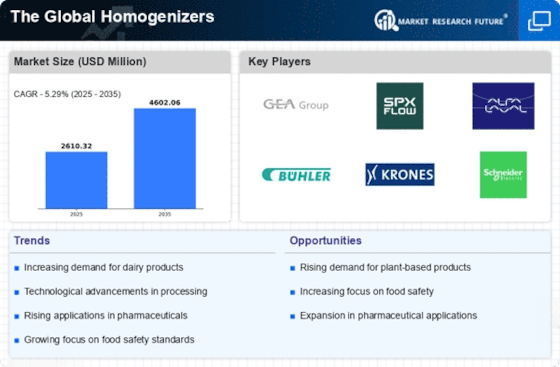
As per Market Research Future analysis, The Global Homogenizers Market Size was estimated at 2610.32 USD Million in 2024. The homogenizers industry is projected to grow from USD 2748.41 Million in 2025 to USD 4602.06 Million by 2035, exhibiting a compound annual growth rate (CAGR) of 5.29% during the forecast period 2025 - 2035

Key Market Trends & Highlights

The Global Homogenizers Market is poised for robust growth driven by technological advancements and increasing demand for quality products.

  • North America remains the largest market for homogenizers, driven by its advanced manufacturing capabilities. Asia-Pacific is emerging as the fastest-growing region, fueled by rapid industrialization and increasing investments. The ultrasonic segment holds the largest market share, while the pressure segment is witnessing the fastest growth due to its efficiency. Key market drivers include technological advancements in homogenization and rising demand for quality products across various end-user industries.

Market Size & Forecast

2024 Market Size 2610.32 (USD Million)
2035 Market Size 4602.06 (USD Million)
CAGR (2025 - 2035) 5.29%
Largest Regional Market Share in 2024 Asia Pacific

Major Players

<a href="https://www.gea.com/en/products/homogenizers/">GEA Group</a> (DE), SPX Flow (US), Alfa Laval (SE), Bühler Group (CH), Krones AG (DE), <a href="https://schneider-industries.de/tetra-pak/homogenizers/300">Schneider Electric</a> (FR), Hielscher Ultrasonics (DE), Avestin Inc. (CA), ProMach (US)

Market Trends

The Homogenizers Market is currently experiencing a dynamic evolution, driven by advancements in technology and increasing demand across various sectors. Industries such as food and beverage, pharmaceuticals, and cosmetics are increasingly adopting homogenization processes to enhance product quality and consistency. This trend appears to be fueled by a growing consumer preference for high-quality, uniform products, which necessitates the use of sophisticated homogenization techniques. Furthermore, the rise of plant-based and organic products is likely to propel the need for effective homogenization solutions, as manufacturers seek to improve texture and stability in their offerings. In addition to technological advancements, sustainability concerns are influencing The Global Homogenizers Market. Companies are increasingly focusing on energy-efficient and environmentally friendly homogenization processes. This shift suggests a potential for innovation in equipment design and operation, as manufacturers strive to reduce their carbon footprint while maintaining product integrity. As the market continues to evolve, it seems that the integration of automation and smart technologies will play a crucial role in enhancing operational efficiency and meeting the diverse needs of end-users across various industries.

Technological Advancements

The Homogenizers Market is witnessing a surge in technological innovations, particularly in the development of high-pressure homogenizers. These advancements enhance the efficiency and effectiveness of homogenization processes, allowing for better product consistency and quality. Manufacturers are increasingly investing in research and development to create more sophisticated equipment that meets the evolving demands of various industries.

Sustainability Initiatives

There is a growing emphasis on sustainability within The Global Homogenizers Market, as companies seek to implement eco-friendly practices. This trend indicates a shift towards energy-efficient homogenization processes, which not only reduce operational costs but also align with global environmental goals. Manufacturers are exploring ways to minimize waste to energy consumption in their operations.

Rising Demand for Quality Products

The demand for high-quality and uniform products is driving growth in The Homogenizers Market. Consumers are increasingly seeking products that meet stringent quality standards, prompting manufacturers to adopt advanced homogenization techniques. This trend highlights the importance of achieving consistent texture and stability in food, pharmaceuticals, and cosmetic products.

Homogenizers Market Market Drivers

Sustainability Initiatives

Sustainability initiatives are gaining traction within The Homogenizers Industry, as companies increasingly prioritize eco-friendly practices. The demand for energy-efficient homogenizers is on the rise, driven by regulatory pressures and consumer preferences for sustainable products. Manufacturers are now focusing on developing homogenizers that minimize waste and reduce carbon footprints management. This shift is not only beneficial for the environment but also aligns with the growing trend of corporate social responsibility. According to recent data, the market for energy-efficient homogenizers is expected to expand significantly, with a projected growth rate of around 7% annually. This trend indicates a broader commitment to sustainability, which is likely to shape the future of the homogenizers market.

Expansion of End-User Industries

The expansion of end-user industries is a pivotal driver for The Homogenizers Industry. Sectors such as pharmaceuticals, food and beverage, and personal care are experiencing robust growth, which in turn fuels the demand for homogenizers. The pharmaceutical industry, in particular, is witnessing an increase in the production of emulsions and suspensions, necessitating advanced homogenization techniques. Additionally, the food and beverage sector is evolving, with a growing emphasis on product innovation and quality. This expansion is expected to contribute to a market growth rate of approximately 6% annually, as manufacturers seek to enhance their production capabilities to meet the rising demands of these industries.

Rising Demand for Quality Products

The Homogenizers Industry is witnessing a rising demand for high-quality products across various sectors, including food and beverage, pharmaceuticals, and cosmetics. Consumers are increasingly discerning, seeking products that meet stringent quality standards. This trend compels manufacturers to invest in advanced homogenization technologies that ensure uniformity and stability in their products. For instance, the food and beverage sector is projected to account for a substantial share of the market, driven by the need for consistent texture and flavor in processed foods. As a result, the homogenizers market is expected to grow, with an estimated CAGR of 5.8% over the next few years, reflecting the industry's response to consumer demands for quality.

Technological Advancements in Homogenization

The Global Homogenizers Industry is experiencing a surge in technological advancements that enhance the efficiency and effectiveness of homogenization processes. Innovations such as high-pressure homogenizers and ultrasonic homogenizers are becoming increasingly prevalent. These technologies not only improve product consistency but also reduce energy consumption, which is a critical factor for manufacturers. The market is projected to grow at a compound annual growth rate (CAGR) of approximately 6.5% over the next five years, driven by these advancements. Furthermore, automation and smart technology integration are likely to streamline operations, thereby reducing labor costs and increasing production capacity. As a result, companies are investing heavily in research and development to stay competitive in this evolving landscape.

Increasing Investment in Research and Development

Increasing investment in research and development is a crucial driver for The Homogenizers Industry. Companies are allocating significant resources to innovate and improve homogenization technologies, aiming to enhance product performance and operational efficiency. This focus on R&D is particularly evident in the development of new material testing and designs that optimize the homogenization process. As competition intensifies, firms are likely to prioritize R&D to differentiate their offerings and meet evolving consumer needs. The market is projected to benefit from this trend, with an anticipated growth rate of around 5.5% over the next few years, as companies strive to stay ahead in a rapidly changing landscape.

Market Segment Insights

By Type: Ultrasonic (Largest) vs. Pressure (Fastest-Growing)

The Homogenizers exhibits a diverse segmentation by type, with Ultrasonic homogenizers commanding the largest share. This dominance is attributed to their effectiveness in producing uniform emulsions and dispersions in various applications, from pharmaceuticals to food and beverages. Pressure homogenizers also represent a substantial portion of the market, particularly favored for liquid formulations, yet they trail behind their ultrasonic counterparts in overall market share. In terms of growth trends, Pressure homogenizers are emerging as the fastest-growing segment due to rising demand for high-efficiency processing in industries such as dairy and cosmetics. Factors driving this growth include technological advancements, increasing demand for high-quality products, and the expanding applications of homogenization techniques in diverse sectors, positioning Pressure as a formidable contender in the homogenizers market.

Ultrasonic: Dominant vs. Mechanical: Emerging

Ultrasonic homogenizers are recognized as the dominant force within The Homogenizers, primarily due to their unmatched efficiency in particle size reduction and emulsification. They utilize high-frequency sound waves to create cavitation bubbles that implode and generate intense shear forces, leading to superior homogenization results. This technology is highly favored in industries requiring precision, such as pharmaceuticals and nanotechnology. In contrast, Mechanical homogenizers, while emerging, offer a cost-effective solution for many applications. They operate by pumping liquids through high-pressure valves and are particularly suited for moderate viscosity products. Despite their slower adoption in certain premium applications, Mechanical homogenizers are gaining traction due to their reliability and ease of operation, catering primarily to the food and beverage sectors.

By Technology Type: Single-valve Assembly (Largest) vs. Two-valve Assembly (Fastest-Growing)

In The Homogenizers, the Single-valve Assembly segment holds the largest share due to its widespread acceptance in various industries. This technology is praised for its reliability and ease of use, making it a preferred choice for many manufacturers. Conversely, the Two-valve Assembly segment is gaining traction as industries seek more versatile and efficient solutions, positioning it as the fastest-growing segment. This growth reflects a shift towards enhanced operational efficiency and cost-effectiveness in homogenization processes.

Technology: Single-valve Assembly (Dominant) vs. Two-valve Assembly (Emerging)

The Single-valve Assembly technology leads the market, characterized by its straightforward design and effectiveness in producing consistent product quality. Its dominance stems from its reliability, making it suitable for a plethora of applications, particularly in the food and pharmaceutical sectors. On the other hand, the Two-valve Assembly technology, although currently emerging, is rapidly transforming the landscape. It offers advanced features like improved efficiency and adaptability, catering to diverse processing needs. As industries increasingly prioritize operational flexibility, the Two-valve Assembly's innovative designs are likely to propel its growth even further, making it a vital player in the market.

By Application: Food and Beverages (Largest) vs. Pharmaceuticals (Fastest-Growing)

The Homogenizers exhibits varied applications across different sectors, with Food and Beverages holding the largest market share due to the increased demand for emulsification and consistency in product quality. This segment thrives on the robust growth of the food processing industry, where homogenizers enhance the stability and shelf-life of products. Meanwhile, Pharmaceuticals actively expands, driven by stringent regulations on formulation consistency and a push for innovative drug delivery systems.

Food and Beverages (Dominant) vs. Pharmaceuticals (Emerging)

The Food and Beverages segment remains a dominant force within The Global Homogenizers, as it is integral to various processes such as milk homogenization and beverage emulsification. This segment benefits from an ongoing trend towards healthier and more sustainable food products, leading manufacturers to invest in advanced homogenizing technologies. On the other hand, the Pharmaceuticals segment is emerging rapidly, influenced by the need for precise formulation in vaccines and biopharmaceuticals. The increasing complexity of drug formulations and bioprocessing demands innovative homogenization solutions, fostering significant growth opportunities.

Get more detailed insights about Global Homogenizers Market Research Report - Forecast to 2035

Regional Insights

North America : Innovation and Demand Surge

North America is the largest market for homogenizers, holding approximately 40% of the global market share. The region's growth is driven by increasing demand in the food and beverage sector, stringent quality regulations, and advancements in technology. The U.S. and Canada are the primary contributors, with a focus on enhancing product quality and efficiency in manufacturing processes. Regulatory support for food safety standards further propels market growth. The competitive landscape in North America is characterized by the presence of major players such as GEA Group, SPX Flow, and Alfa Laval. These companies are investing in R&D to innovate and improve homogenizer technologies. The U.S. market is particularly robust, with a strong emphasis on automation and energy efficiency. The presence of established manufacturing facilities and a skilled workforce also contribute to the region's dominance in the homogenizers market.

Europe : Regulatory Framework and Growth

Europe is the second-largest market for homogenizers, accounting for approximately 30% of the global market share. The region benefits from stringent regulations regarding food safety and quality, which drive demand for advanced homogenization technologies. Countries like Germany and France lead the market, supported by a robust manufacturing base and a focus on sustainability and innovation in food processing. The competitive landscape in Europe is marked by key players such as Bühler Group and Krones AG, who are at the forefront of technological advancements. The European market is characterized by a high level of investment in research and development, aimed at enhancing product efficiency and reducing environmental impact. The presence of regulatory bodies ensures compliance with safety standards, further boosting market growth.

Asia-Pacific : Emerging Markets and Opportunities

Asia-Pacific is witnessing rapid growth in the homogenizers market, holding approximately 20% of the global market share. The region's growth is fueled by increasing industrialization, rising consumer demand for processed foods, and expanding dairy and beverage industries. Countries like China and India are leading this growth, supported by government initiatives to enhance food processing capabilities and improve food safety standards. The competitive landscape in Asia-Pacific is evolving, with both local and international players vying for market share. Companies are focusing on cost-effective solutions and technological advancements to cater to the diverse needs of the food and beverage sector. The presence of key players such as Hielscher Ultrasonics and Avestin Inc. is notable, as they adapt their offerings to meet regional demands and regulatory requirements.

Middle East and Africa : Resource-Rich and Growing Demand

The Middle East and Africa region is emerging as a potential market for homogenizers, currently holding about 10% of the global market share. The growth is driven by increasing investments in food processing and manufacturing sectors, alongside a rising population and urbanization trends. Countries like South Africa and the UAE are at the forefront, with government initiatives aimed at enhancing food safety and quality standards. The competitive landscape in this region is still developing, with opportunities for both local and international players. The presence of key players is gradually increasing, as companies recognize the potential for growth in the food and beverage industry. The market is characterized by a focus on affordable and efficient homogenization solutions, catering to the unique needs of the region's diverse food processing landscape.

Key Players and Competitive Insights

The Global Homogenizers is currently characterized by a dynamic competitive landscape, driven by increasing demand for high-quality emulsification and particle size reduction across various industries, including food and beverage, pharmaceuticals, and cosmetics. Key players such as GEA Group (DE), SPX Flow (US), and Alfa Laval (SE) are strategically positioned to leverage their technological advancements and extensive product portfolios. GEA Group (DE) focuses on innovation in process technology, while SPX Flow (US) emphasizes its commitment to sustainability and energy efficiency in its homogenization solutions. Alfa Laval (SE) is actively pursuing regional expansion, particularly in emerging markets, which collectively shapes a competitive environment that is increasingly focused on technological differentiation and customer-centric solutions.

The market structure appears moderately fragmented, with several players vying for market share through localized manufacturing and optimized supply chains. This fragmentation allows for a diverse range of products and services, catering to specific customer needs. The collective influence of these key players fosters a competitive atmosphere where innovation and operational efficiency are paramount, as companies seek to enhance their market presence and respond to evolving consumer demands.

In August 2025, GEA Group (DE) announced the launch of a new line of high-efficiency homogenizers designed to reduce energy consumption by up to 30%. This strategic move not only underscores GEA's commitment to sustainability but also positions the company as a leader in energy-efficient processing solutions. The introduction of this product line is likely to attract environmentally conscious customers and enhance GEA's competitive edge in the market.

In September 2025, SPX Flow (US) entered into a strategic partnership with a leading biotechnology firm to develop advanced homogenization technologies tailored for the pharmaceutical sector. This collaboration is indicative of SPX Flow's focus on innovation and its intent to penetrate high-growth markets. By aligning with a biotechnology leader, SPX Flow is poised to enhance its product offerings and expand its reach within the pharmaceutical industry, which is increasingly demanding precision and reliability in processing equipment.

In July 2025, Alfa Laval (SE) completed the acquisition of a regional homogenizer manufacturer, thereby strengthening its foothold in the Asia-Pacific market. This acquisition is strategically significant as it allows Alfa Laval to enhance its local manufacturing capabilities and better serve the growing demand in this region. The move reflects a broader trend of consolidation within the industry, as companies seek to optimize their supply chains and improve operational efficiencies.

As of October 2025, the competitive trends in The Global Homogenizers are increasingly defined by digitalization, sustainability, and the integration of artificial intelligence in processing technologies. Strategic alliances are becoming more prevalent, enabling companies to pool resources and expertise to drive innovation. Looking ahead, competitive differentiation is likely to evolve from traditional price-based competition to a focus on technological advancements, supply chain reliability, and sustainable practices, as companies strive to meet the demands of a more discerning customer base.

Key Companies in the Homogenizers Market include

Industry Developments

    • In March 2024, GEA launches NiSoMate, a live product monitoring sensor system for homogenizers. Sensor-based technology offers real-time, inline control of liquid consistency and quality during the homogenization process. This enables early detection of quality issues and immediate intervention, minimizing waste and optimizing energy use.

    • In February 2022, SPX FLOW launched the APV Homogenizer Water Recycling System (HWRS), which recycles up to 97% of the water used by homogenizers. The system recaptures, sanitizes, and chills water used for cooling and lubrication, significantly reducing water consumption.

Future Outlook

Homogenizers Market Future Outlook

The Global Homogenizers Market is projected to grow at a 5.29% CAGR from 2025 to 2035, driven by increasing demand in food processing, pharmaceuticals, and cosmetics.

New opportunities lie in:

  • <p>Expansion into emerging markets with tailored homogenization solutions. Development of energy-efficient homogenizers to reduce operational costs. Integration of IoT technology for real-time monitoring and optimization.</p>

By 2035, the market is expected to achieve robust growth, positioning itself as a leader in industrial processing solutions.

Market Segmentation

Homogenizers Market Type Outlook

  • Ultrasonic
  • Pressure
  • Mechanical

Homogenizers Market Application Outlook

  • Food and Beverages
  • Personal Care
  • Pharmaceuticals
  • Chemical
  • Others

Homogenizers Market Technology Type Outlook

  • Single-valve Assembly
  • Two-valve Assembly
  • Other Tech (Frequency and Others)

Report Scope

MARKET SIZE 2024 2610.32(USD Million)
MARKET SIZE 2025 2748.41(USD Million)
MARKET SIZE 2035 4602.06(USD Million)
COMPOUND ANNUAL GROWTH RATE (CAGR) 5.29% (2025 - 2035)
REPORT COVERAGE Revenue Forecast, Competitive Landscape, Growth Factors, and Trends
BASE YEAR 2024
Market Forecast Period 2025 - 2035
Historical Data 2019 - 2024
Market Forecast Units USD Million
Key Companies Profiled GEA Group (DE), SPX Flow (US), Alfa Laval (SE), Bühler Group (CH), Krones AG (DE), Schneider Electric (FR), Hielscher Ultrasonics (DE), Avestin Inc. (CA), ProMach (US)
Segments Covered Type, Technology Type, Application, Region
Key Market Opportunities Integration of advanced automation and smart technologies in The Global Homogenizers enhances efficiency and precision.
Key Market Dynamics Technological advancements drive innovation in homogenizers, enhancing efficiency and expanding applications across various industries.
Countries Covered North America, Europe, APAC, South America, MEA

FAQs

What is the projected market valuation of The Global Homogenizers by 2035?

<p>The projected market valuation for The Global Homogenizers is expected to reach 4602.06 USD Million by 2035.</p>

What was the market valuation of The Global Homogenizers in 2024?

<p>The overall market valuation of The Global Homogenizers was 2610.32 USD Million in 2024.</p>

What is the expected CAGR for The Global Homogenizers during the forecast period 2025 - 2035?

<p>The expected CAGR for The Global Homogenizers during the forecast period 2025 - 2035 is 5.29%.</p>

Which companies are considered key players in The Global Homogenizers?

<p>Key players in The Global Homogenizers include GEA Group, SPX Flow, Alfa Laval, and Bühler Group.</p>

What are the main types of homogenizers in the market and their valuation ranges?

<p>The main types of homogenizers include Ultrasonic (780.0 to 1400.0 USD Million), Pressure (900.0 to 1600.0 USD Million), and Mechanical (930.32 to 1602.06 USD Million).</p>

What technology types are prevalent in The Global Homogenizers?

<p>Prevalent technology types include Single-valve Assembly (1045.13 to 1830.0 USD Million), Two-valve Assembly (1045.13 to 1830.0 USD Million), and Other Tech (520.06 to 942.06 USD Million).</p>

Which application segments are driving The Global Homogenizers?

Application segments driving the market include Food and Beverages (1040.0 to 1800.0 USD Million), Personal Care (520.0 to 900.0 USD Million), and Pharmaceuticals (780.0 to 1300.0 USD Million).

How does the performance of the Food and Beverages segment compare to others?

The Food and Beverages segment shows a valuation range of 1040.0 to 1800.0 USD Million, indicating strong performance compared to other segments.

What is the valuation range for the Chemical application segment in The Global Homogenizers?

The valuation range for the Chemical application segment is between 210.32 and 400.0 USD Million.

What potential growth opportunities exist in The Global Homogenizers?

Potential growth opportunities in The Global Homogenizers may arise from advancements in technology and increasing demand across various applications.

  1. SECTION I: EXECUTIVE SUMMARY AND KEY HIGHLIGHTS
    1. | 1.1 EXECUTIVE SUMMARY
    2. | | 1.1.1 Market Overview
    3. | | 1.1.2 Key Findings
    4. | | 1.1.3 Market Segmentation
    5. | | 1.1.4 Competitive Landscape
    6. | | 1.1.5 Challenges and Opportunities
    7. | | 1.1.6 Future Outlook
  2. SECTION II: SCOPING, METHODOLOGY AND MARKET STRUCTURE
    1. | 2.1 MARKET INTRODUCTION
    2. | | 2.1.1 Definition
    3. | | 2.1.2 Scope of the study
    4. | | | 2.1.2.1 Research Objective
    5. | | | 2.1.2.2 Assumption
    6. | | | 2.1.2.3 Limitations
    7. | 2.2 RESEARCH METHODOLOGY
    8. | | 2.2.1 Overview
    9. | | 2.2.2 Data Mining
    10. | | 2.2.3 Secondary Research
    11. | | 2.2.4 Primary Research
    12. | | | 2.2.4.1 Primary Interviews and Information Gathering Process
    13. | | | 2.2.4.2 Breakdown of Primary Respondents
    14. | | 2.2.5 Forecasting Model
    15. | | 2.2.6 Market Size Estimation
    16. | | | 2.2.6.1 Bottom-Up Approach
    17. | | | 2.2.6.2 Top-Down Approach
    18. | | 2.2.7 Data Triangulation
    19. | | 2.2.8 Validation
  3. SECTION III: QUALITATIVE ANALYSIS
    1. | 3.1 MARKET DYNAMICS
    2. | | 3.1.1 Overview
    3. | | 3.1.2 Drivers
    4. | | 3.1.3 Restraints
    5. | | 3.1.4 Opportunities
    6. | 3.2 MARKET FACTOR ANALYSIS
    7. | | 3.2.1 Value chain Analysis
    8. | | 3.2.2 Porter's Five Forces Analysis
    9. | | | 3.2.2.1 Bargaining Power of Suppliers
    10. | | | 3.2.2.2 Bargaining Power of Buyers
    11. | | | 3.2.2.3 Threat of New Entrants
    12. | | | 3.2.2.4 Threat of Substitutes
    13. | | | 3.2.2.5 Intensity of Rivalry
    14. | | 3.2.3 COVID-19 Impact Analysis
    15. | | | 3.2.3.1 Market Impact Analysis
    16. | | | 3.2.3.2 Regional Impact
    17. | | | 3.2.3.3 Opportunity and Threat Analysis
  4. SECTION IV: QUANTITATIVE ANALYSIS
    1. | 4.1 Packaging & Transport, BY Type (USD Million)
    2. | | 4.1.1 Ultrasonic
    3. | | 4.1.2 Pressure
    4. | | 4.1.3 Mechanical
    5. | 4.2 Packaging & Transport, BY Technology Type (USD Million)
    6. | | 4.2.1 Single-valve Assembly
    7. | | 4.2.2 Two-valve Assembly
    8. | | 4.2.3 Other Tech (Frequency and Others)
    9. | 4.3 Packaging & Transport, BY Application (USD Million)
    10. | | 4.3.1 Food and Beverages
    11. | | 4.3.2 Personal Care
    12. | | 4.3.3 Pharmaceuticals
    13. | | 4.3.4 Chemical
    14. | | 4.3.5 Others
    15. | 4.4 Packaging & Transport, BY Region (USD Million)
    16. | | 4.4.1 North America
    17. | | | 4.4.1.1 US
    18. | | | 4.4.1.2 Canada
    19. | | 4.4.2 Europe
    20. | | | 4.4.2.1 Germany
    21. | | | 4.4.2.2 UK
    22. | | | 4.4.2.3 France
    23. | | | 4.4.2.4 Russia
    24. | | | 4.4.2.5 Italy
    25. | | | 4.4.2.6 Spain
    26. | | | 4.4.2.7 Rest of Europe
    27. | | 4.4.3 APAC
    28. | | | 4.4.3.1 China
    29. | | | 4.4.3.2 India
    30. | | | 4.4.3.3 Japan
    31. | | | 4.4.3.4 South Korea
    32. | | | 4.4.3.5 Malaysia
    33. | | | 4.4.3.6 Thailand
    34. | | | 4.4.3.7 Indonesia
    35. | | | 4.4.3.8 Rest of APAC
    36. | | 4.4.4 South America
    37. | | | 4.4.4.1 Brazil
    38. | | | 4.4.4.2 Mexico
    39. | | | 4.4.4.3 Argentina
    40. | | | 4.4.4.4 Rest of South America
    41. | | 4.4.5 MEA
    42. | | | 4.4.5.1 GCC Countries
    43. | | | 4.4.5.2 South Africa
    44. | | | 4.4.5.3 Rest of MEA
  5. SECTION V: COMPETITIVE ANALYSIS
    1. | 5.1 Competitive Landscape
    2. | | 5.1.1 Overview
    3. | | 5.1.2 Competitive Analysis
    4. | | 5.1.3 Market share Analysis
    5. | | 5.1.4 Major Growth Strategy in the Packaging & Transport
    6. | | 5.1.5 Competitive Benchmarking
    7. | | 5.1.6 Leading Players in Terms of Number of Developments in the Packaging & Transport
    8. | | 5.1.7 Key developments and growth strategies
    9. | | | 5.1.7.1 New Product Launch/Service Deployment
    10. | | | 5.1.7.2 Merger & Acquisitions
    11. | | | 5.1.7.3 Joint Ventures
    12. | | 5.1.8 Major Players Financial Matrix
    13. | | | 5.1.8.1 Sales and Operating Income
    14. | | | 5.1.8.2 Major Players R&D Expenditure. 2023
    15. | 5.2 Company Profiles
    16. | | 5.2.1 GEA Group (DE)
    17. | | | 5.2.1.1 Financial Overview
    18. | | | 5.2.1.2 Products Offered
    19. | | | 5.2.1.3 Key Developments
    20. | | | 5.2.1.4 SWOT Analysis
    21. | | | 5.2.1.5 Key Strategies
    22. | | 5.2.2 SPX Flow (US)
    23. | | | 5.2.2.1 Financial Overview
    24. | | | 5.2.2.2 Products Offered
    25. | | | 5.2.2.3 Key Developments
    26. | | | 5.2.2.4 SWOT Analysis
    27. | | | 5.2.2.5 Key Strategies
    28. | | 5.2.3 Alfa Laval (SE)
    29. | | | 5.2.3.1 Financial Overview
    30. | | | 5.2.3.2 Products Offered
    31. | | | 5.2.3.3 Key Developments
    32. | | | 5.2.3.4 SWOT Analysis
    33. | | | 5.2.3.5 Key Strategies
    34. | | 5.2.4 Bühler Group (CH)
    35. | | | 5.2.4.1 Financial Overview
    36. | | | 5.2.4.2 Products Offered
    37. | | | 5.2.4.3 Key Developments
    38. | | | 5.2.4.4 SWOT Analysis
    39. | | | 5.2.4.5 Key Strategies
    40. | | 5.2.5 Krones AG (DE)
    41. | | | 5.2.5.1 Financial Overview
    42. | | | 5.2.5.2 Products Offered
    43. | | | 5.2.5.3 Key Developments
    44. | | | 5.2.5.4 SWOT Analysis
    45. | | | 5.2.5.5 Key Strategies
    46. | | 5.2.6 Schneider Electric (FR)
    47. | | | 5.2.6.1 Financial Overview
    48. | | | 5.2.6.2 Products Offered
    49. | | | 5.2.6.3 Key Developments
    50. | | | 5.2.6.4 SWOT Analysis
    51. | | | 5.2.6.5 Key Strategies
    52. | | 5.2.7 Hielscher Ultrasonics (DE)
    53. | | | 5.2.7.1 Financial Overview
    54. | | | 5.2.7.2 Products Offered
    55. | | | 5.2.7.3 Key Developments
    56. | | | 5.2.7.4 SWOT Analysis
    57. | | | 5.2.7.5 Key Strategies
    58. | | 5.2.8 Avestin Inc. (CA)
    59. | | | 5.2.8.1 Financial Overview
    60. | | | 5.2.8.2 Products Offered
    61. | | | 5.2.8.3 Key Developments
    62. | | | 5.2.8.4 SWOT Analysis
    63. | | | 5.2.8.5 Key Strategies
    64. | | 5.2.9 ProMach (US)
    65. | | | 5.2.9.1 Financial Overview
    66. | | | 5.2.9.2 Products Offered
    67. | | | 5.2.9.3 Key Developments
    68. | | | 5.2.9.4 SWOT Analysis
    69. | | | 5.2.9.5 Key Strategies
    70. | 5.3 Appendix
    71. | | 5.3.1 References
    72. | | 5.3.2 Related Reports
  6. LIST OF FIGURES
    1. | 6.1 MARKET SYNOPSIS
    2. | 6.2 NORTH AMERICA MARKET ANALYSIS
    3. | 6.3 US MARKET ANALYSIS BY TYPE
    4. | 6.4 US MARKET ANALYSIS BY TECHNOLOGY TYPE
    5. | 6.5 US MARKET ANALYSIS BY APPLICATION
    6. | 6.6 CANADA MARKET ANALYSIS BY TYPE
    7. | 6.7 CANADA MARKET ANALYSIS BY TECHNOLOGY TYPE
    8. | 6.8 CANADA MARKET ANALYSIS BY APPLICATION
    9. | 6.9 EUROPE MARKET ANALYSIS
    10. | 6.10 GERMANY MARKET ANALYSIS BY TYPE
    11. | 6.11 GERMANY MARKET ANALYSIS BY TECHNOLOGY TYPE
    12. | 6.12 GERMANY MARKET ANALYSIS BY APPLICATION
    13. | 6.13 UK MARKET ANALYSIS BY TYPE
    14. | 6.14 UK MARKET ANALYSIS BY TECHNOLOGY TYPE
    15. | 6.15 UK MARKET ANALYSIS BY APPLICATION
    16. | 6.16 FRANCE MARKET ANALYSIS BY TYPE
    17. | 6.17 FRANCE MARKET ANALYSIS BY TECHNOLOGY TYPE
    18. | 6.18 FRANCE MARKET ANALYSIS BY APPLICATION
    19. | 6.19 RUSSIA MARKET ANALYSIS BY TYPE
    20. | 6.20 RUSSIA MARKET ANALYSIS BY TECHNOLOGY TYPE
    21. | 6.21 RUSSIA MARKET ANALYSIS BY APPLICATION
    22. | 6.22 ITALY MARKET ANALYSIS BY TYPE
    23. | 6.23 ITALY MARKET ANALYSIS BY TECHNOLOGY TYPE
    24. | 6.24 ITALY MARKET ANALYSIS BY APPLICATION
    25. | 6.25 SPAIN MARKET ANALYSIS BY TYPE
    26. | 6.26 SPAIN MARKET ANALYSIS BY TECHNOLOGY TYPE
    27. | 6.27 SPAIN MARKET ANALYSIS BY APPLICATION
    28. | 6.28 REST OF EUROPE MARKET ANALYSIS BY TYPE
    29. | 6.29 REST OF EUROPE MARKET ANALYSIS BY TECHNOLOGY TYPE
    30. | 6.30 REST OF EUROPE MARKET ANALYSIS BY APPLICATION
    31. | 6.31 APAC MARKET ANALYSIS
    32. | 6.32 CHINA MARKET ANALYSIS BY TYPE
    33. | 6.33 CHINA MARKET ANALYSIS BY TECHNOLOGY TYPE
    34. | 6.34 CHINA MARKET ANALYSIS BY APPLICATION
    35. | 6.35 INDIA MARKET ANALYSIS BY TYPE
    36. | 6.36 INDIA MARKET ANALYSIS BY TECHNOLOGY TYPE
    37. | 6.37 INDIA MARKET ANALYSIS BY APPLICATION
    38. | 6.38 JAPAN MARKET ANALYSIS BY TYPE
    39. | 6.39 JAPAN MARKET ANALYSIS BY TECHNOLOGY TYPE
    40. | 6.40 JAPAN MARKET ANALYSIS BY APPLICATION
    41. | 6.41 SOUTH KOREA MARKET ANALYSIS BY TYPE
    42. | 6.42 SOUTH KOREA MARKET ANALYSIS BY TECHNOLOGY TYPE
    43. | 6.43 SOUTH KOREA MARKET ANALYSIS BY APPLICATION
    44. | 6.44 MALAYSIA MARKET ANALYSIS BY TYPE
    45. | 6.45 MALAYSIA MARKET ANALYSIS BY TECHNOLOGY TYPE
    46. | 6.46 MALAYSIA MARKET ANALYSIS BY APPLICATION
    47. | 6.47 THAILAND MARKET ANALYSIS BY TYPE
    48. | 6.48 THAILAND MARKET ANALYSIS BY TECHNOLOGY TYPE
    49. | 6.49 THAILAND MARKET ANALYSIS BY APPLICATION
    50. | 6.50 INDONESIA MARKET ANALYSIS BY TYPE
    51. | 6.51 INDONESIA MARKET ANALYSIS BY TECHNOLOGY TYPE
    52. | 6.52 INDONESIA MARKET ANALYSIS BY APPLICATION
    53. | 6.53 REST OF APAC MARKET ANALYSIS BY TYPE
    54. | 6.54 REST OF APAC MARKET ANALYSIS BY TECHNOLOGY TYPE
    55. | 6.55 REST OF APAC MARKET ANALYSIS BY APPLICATION
    56. | 6.56 SOUTH AMERICA MARKET ANALYSIS
    57. | 6.57 BRAZIL MARKET ANALYSIS BY TYPE
    58. | 6.58 BRAZIL MARKET ANALYSIS BY TECHNOLOGY TYPE
    59. | 6.59 BRAZIL MARKET ANALYSIS BY APPLICATION
    60. | 6.60 MEXICO MARKET ANALYSIS BY TYPE
    61. | 6.61 MEXICO MARKET ANALYSIS BY TECHNOLOGY TYPE
    62. | 6.62 MEXICO MARKET ANALYSIS BY APPLICATION
    63. | 6.63 ARGENTINA MARKET ANALYSIS BY TYPE
    64. | 6.64 ARGENTINA MARKET ANALYSIS BY TECHNOLOGY TYPE
    65. | 6.65 ARGENTINA MARKET ANALYSIS BY APPLICATION
    66. | 6.66 REST OF SOUTH AMERICA MARKET ANALYSIS BY TYPE
    67. | 6.67 REST OF SOUTH AMERICA MARKET ANALYSIS BY TECHNOLOGY TYPE
    68. | 6.68 REST OF SOUTH AMERICA MARKET ANALYSIS BY APPLICATION
    69. | 6.69 MEA MARKET ANALYSIS
    70. | 6.70 GCC COUNTRIES MARKET ANALYSIS BY TYPE
    71. | 6.71 GCC COUNTRIES MARKET ANALYSIS BY TECHNOLOGY TYPE
    72. | 6.72 GCC COUNTRIES MARKET ANALYSIS BY APPLICATION
    73. | 6.73 SOUTH AFRICA MARKET ANALYSIS BY TYPE
    74. | 6.74 SOUTH AFRICA MARKET ANALYSIS BY TECHNOLOGY TYPE
    75. | 6.75 SOUTH AFRICA MARKET ANALYSIS BY APPLICATION
    76. | 6.76 REST OF MEA MARKET ANALYSIS BY TYPE
    77. | 6.77 REST OF MEA MARKET ANALYSIS BY TECHNOLOGY TYPE
    78. | 6.78 REST OF MEA MARKET ANALYSIS BY APPLICATION
    79. | 6.79 KEY BUYING CRITERIA OF PACKAGING & TRANSPORT
    80. | 6.80 RESEARCH PROCESS OF MRFR
    81. | 6.81 DRO ANALYSIS OF PACKAGING & TRANSPORT
    82. | 6.82 DRIVERS IMPACT ANALYSIS: PACKAGING & TRANSPORT
    83. | 6.83 RESTRAINTS IMPACT ANALYSIS: PACKAGING & TRANSPORT
    84. | 6.84 SUPPLY / VALUE CHAIN: PACKAGING & TRANSPORT
    85. | 6.85 PACKAGING & TRANSPORT, BY TYPE, 2024 (% SHARE)
    86. | 6.86 PACKAGING & TRANSPORT, BY TYPE, 2024 TO 2035 (USD Million)
    87. | 6.87 PACKAGING & TRANSPORT, BY TECHNOLOGY TYPE, 2024 (% SHARE)
    88. | 6.88 PACKAGING & TRANSPORT, BY TECHNOLOGY TYPE, 2024 TO 2035 (USD Million)
    89. | 6.89 PACKAGING & TRANSPORT, BY APPLICATION, 2024 (% SHARE)
    90. | 6.90 PACKAGING & TRANSPORT, BY APPLICATION, 2024 TO 2035 (USD Million)
    91. | 6.91 BENCHMARKING OF MAJOR COMPETITORS
  7. LIST OF TABLES
    1. | 7.1 LIST OF ASSUMPTIONS
    2. | | 7.1.1
    3. | 7.2 North America MARKET SIZE ESTIMATES; FORECAST
    4. | | 7.2.1 BY TYPE, 2025-2035 (USD Million)
    5. | | 7.2.2 BY TECHNOLOGY TYPE, 2025-2035 (USD Million)
    6. | | 7.2.3 BY APPLICATION, 2025-2035 (USD Million)
    7. | 7.3 US MARKET SIZE ESTIMATES; FORECAST
    8. | | 7.3.1 BY TYPE, 2025-2035 (USD Million)
    9. | | 7.3.2 BY TECHNOLOGY TYPE, 2025-2035 (USD Million)
    10. | | 7.3.3 BY APPLICATION, 2025-2035 (USD Million)
    11. | 7.4 Canada MARKET SIZE ESTIMATES; FORECAST
    12. | | 7.4.1 BY TYPE, 2025-2035 (USD Million)
    13. | | 7.4.2 BY TECHNOLOGY TYPE, 2025-2035 (USD Million)
    14. | | 7.4.3 BY APPLICATION, 2025-2035 (USD Million)
    15. | 7.5 Europe MARKET SIZE ESTIMATES; FORECAST
    16. | | 7.5.1 BY TYPE, 2025-2035 (USD Million)
    17. | | 7.5.2 BY TECHNOLOGY TYPE, 2025-2035 (USD Million)
    18. | | 7.5.3 BY APPLICATION, 2025-2035 (USD Million)
    19. | 7.6 Germany MARKET SIZE ESTIMATES; FORECAST
    20. | | 7.6.1 BY TYPE, 2025-2035 (USD Million)
    21. | | 7.6.2 BY TECHNOLOGY TYPE, 2025-2035 (USD Million)
    22. | | 7.6.3 BY APPLICATION, 2025-2035 (USD Million)
    23. | 7.7 UK MARKET SIZE ESTIMATES; FORECAST
    24. | | 7.7.1 BY TYPE, 2025-2035 (USD Million)
    25. | | 7.7.2 BY TECHNOLOGY TYPE, 2025-2035 (USD Million)
    26. | | 7.7.3 BY APPLICATION, 2025-2035 (USD Million)
    27. | 7.8 France MARKET SIZE ESTIMATES; FORECAST
    28. | | 7.8.1 BY TYPE, 2025-2035 (USD Million)
    29. | | 7.8.2 BY TECHNOLOGY TYPE, 2025-2035 (USD Million)
    30. | | 7.8.3 BY APPLICATION, 2025-2035 (USD Million)
    31. | 7.9 Russia MARKET SIZE ESTIMATES; FORECAST
    32. | | 7.9.1 BY TYPE, 2025-2035 (USD Million)
    33. | | 7.9.2 BY TECHNOLOGY TYPE, 2025-2035 (USD Million)
    34. | | 7.9.3 BY APPLICATION, 2025-2035 (USD Million)
    35. | 7.10 Italy MARKET SIZE ESTIMATES; FORECAST
    36. | | 7.10.1 BY TYPE, 2025-2035 (USD Million)
    37. | | 7.10.2 BY TECHNOLOGY TYPE, 2025-2035 (USD Million)
    38. | | 7.10.3 BY APPLICATION, 2025-2035 (USD Million)
    39. | 7.11 Spain MARKET SIZE ESTIMATES; FORECAST
    40. | | 7.11.1 BY TYPE, 2025-2035 (USD Million)
    41. | | 7.11.2 BY TECHNOLOGY TYPE, 2025-2035 (USD Million)
    42. | | 7.11.3 BY APPLICATION, 2025-2035 (USD Million)
    43. | 7.12 Rest of Europe MARKET SIZE ESTIMATES; FORECAST
    44. | | 7.12.1 BY TYPE, 2025-2035 (USD Million)
    45. | | 7.12.2 BY TECHNOLOGY TYPE, 2025-2035 (USD Million)
    46. | | 7.12.3 BY APPLICATION, 2025-2035 (USD Million)
    47. | 7.13 APAC MARKET SIZE ESTIMATES; FORECAST
    48. | | 7.13.1 BY TYPE, 2025-2035 (USD Million)
    49. | | 7.13.2 BY TECHNOLOGY TYPE, 2025-2035 (USD Million)
    50. | | 7.13.3 BY APPLICATION, 2025-2035 (USD Million)
    51. | 7.14 China MARKET SIZE ESTIMATES; FORECAST
    52. | | 7.14.1 BY TYPE, 2025-2035 (USD Million)
    53. | | 7.14.2 BY TECHNOLOGY TYPE, 2025-2035 (USD Million)
    54. | | 7.14.3 BY APPLICATION, 2025-2035 (USD Million)
    55. | 7.15 India MARKET SIZE ESTIMATES; FORECAST
    56. | | 7.15.1 BY TYPE, 2025-2035 (USD Million)
    57. | | 7.15.2 BY TECHNOLOGY TYPE, 2025-2035 (USD Million)
    58. | | 7.15.3 BY APPLICATION, 2025-2035 (USD Million)
    59. | 7.16 Japan MARKET SIZE ESTIMATES; FORECAST
    60. | | 7.16.1 BY TYPE, 2025-2035 (USD Million)
    61. | | 7.16.2 BY TECHNOLOGY TYPE, 2025-2035 (USD Million)
    62. | | 7.16.3 BY APPLICATION, 2025-2035 (USD Million)
    63. | 7.17 South Korea MARKET SIZE ESTIMATES; FORECAST
    64. | | 7.17.1 BY TYPE, 2025-2035 (USD Million)
    65. | | 7.17.2 BY TECHNOLOGY TYPE, 2025-2035 (USD Million)
    66. | | 7.17.3 BY APPLICATION, 2025-2035 (USD Million)
    67. | 7.18 Malaysia MARKET SIZE ESTIMATES; FORECAST
    68. | | 7.18.1 BY TYPE, 2025-2035 (USD Million)
    69. | | 7.18.2 BY TECHNOLOGY TYPE, 2025-2035 (USD Million)
    70. | | 7.18.3 BY APPLICATION, 2025-2035 (USD Million)
    71. | 7.19 Thailand MARKET SIZE ESTIMATES; FORECAST
    72. | | 7.19.1 BY TYPE, 2025-2035 (USD Million)
    73. | | 7.19.2 BY TECHNOLOGY TYPE, 2025-2035 (USD Million)
    74. | | 7.19.3 BY APPLICATION, 2025-2035 (USD Million)
    75. | 7.20 Indonesia MARKET SIZE ESTIMATES; FORECAST
    76. | | 7.20.1 BY TYPE, 2025-2035 (USD Million)
    77. | | 7.20.2 BY TECHNOLOGY TYPE, 2025-2035 (USD Million)
    78. | | 7.20.3 BY APPLICATION, 2025-2035 (USD Million)
    79. | 7.21 Rest of APAC MARKET SIZE ESTIMATES; FORECAST
    80. | | 7.21.1 BY TYPE, 2025-2035 (USD Million)
    81. | | 7.21.2 BY TECHNOLOGY TYPE, 2025-2035 (USD Million)
    82. | | 7.21.3 BY APPLICATION, 2025-2035 (USD Million)
    83. | 7.22 South America MARKET SIZE ESTIMATES; FORECAST
    84. | | 7.22.1 BY TYPE, 2025-2035 (USD Million)
    85. | | 7.22.2 BY TECHNOLOGY TYPE, 2025-2035 (USD Million)
    86. | | 7.22.3 BY APPLICATION, 2025-2035 (USD Million)
    87. | 7.23 Brazil MARKET SIZE ESTIMATES; FORECAST
    88. | | 7.23.1 BY TYPE, 2025-2035 (USD Million)
    89. | | 7.23.2 BY TECHNOLOGY TYPE, 2025-2035 (USD Million)
    90. | | 7.23.3 BY APPLICATION, 2025-2035 (USD Million)
    91. | 7.24 Mexico MARKET SIZE ESTIMATES; FORECAST
    92. | | 7.24.1 BY TYPE, 2025-2035 (USD Million)
    93. | | 7.24.2 BY TECHNOLOGY TYPE, 2025-2035 (USD Million)
    94. | | 7.24.3 BY APPLICATION, 2025-2035 (USD Million)
    95. | 7.25 Argentina MARKET SIZE ESTIMATES; FORECAST
    96. | | 7.25.1 BY TYPE, 2025-2035 (USD Million)
    97. | | 7.25.2 BY TECHNOLOGY TYPE, 2025-2035 (USD Million)
    98. | | 7.25.3 BY APPLICATION, 2025-2035 (USD Million)
    99. | 7.26 Rest of South America MARKET SIZE ESTIMATES; FORECAST
    100. | | 7.26.1 BY TYPE, 2025-2035 (USD Million)
    101. | | 7.26.2 BY TECHNOLOGY TYPE, 2025-2035 (USD Million)
    102. | | 7.26.3 BY APPLICATION, 2025-2035 (USD Million)
    103. | 7.27 MEA MARKET SIZE ESTIMATES; FORECAST
    104. | | 7.27.1 BY TYPE, 2025-2035 (USD Million)
    105. | | 7.27.2 BY TECHNOLOGY TYPE, 2025-2035 (USD Million)
    106. | | 7.27.3 BY APPLICATION, 2025-2035 (USD Million)
    107. | 7.28 GCC Countries MARKET SIZE ESTIMATES; FORECAST
    108. | | 7.28.1 BY TYPE, 2025-2035 (USD Million)
    109. | | 7.28.2 BY TECHNOLOGY TYPE, 2025-2035 (USD Million)
    110. | | 7.28.3 BY APPLICATION, 2025-2035 (USD Million)
    111. | 7.29 South Africa MARKET SIZE ESTIMATES; FORECAST
    112. | | 7.29.1 BY TYPE, 2025-2035 (USD Million)
    113. | | 7.29.2 BY TECHNOLOGY TYPE, 2025-2035 (USD Million)
    114. | | 7.29.3 BY APPLICATION, 2025-2035 (USD Million)
    115. | 7.30 Rest of MEA MARKET SIZE ESTIMATES; FORECAST
    116. | | 7.30.1 BY TYPE, 2025-2035 (USD Million)
    117. | | 7.30.2 BY TECHNOLOGY TYPE, 2025-2035 (USD Million)
    118. | | 7.30.3 BY APPLICATION, 2025-2035 (USD Million)
    119. | 7.31 PRODUCT LAUNCH/PRODUCT DEVELOPMENT/APPROVAL
    120. | | 7.31.1
    121. | 7.32 ACQUISITION/PARTNERSHIP
    122. | | 7.32.1

Packaging & Transport Market Segmentation

Packaging & Transport By Type (USD Million, 2025-2035)

  • Ultrasonic
  • Pressure
  • Mechanical

Packaging & Transport By Technology Type (USD Million, 2025-2035)

  • Single-valve Assembly
  • Two-valve Assembly
  • Other Tech (Frequency and Others)

Packaging & Transport By Application (USD Million, 2025-2035)

  • Food and Beverages
  • Personal Care
  • Pharmaceuticals
  • Chemical
  • Others
Infographic

Free Sample Request

Kindly complete the form below to receive a free sample of this Report

Get Free Sample

Customer Strories

Compare Licence

×
Features License Type
Single User Multiuser License Enterprise User
Price $4,950 $5,950 $7,250
Maximum User Access Limit 1 User Upto 10 Users Unrestricted Access Throughout the Organization
Free Customization
Direct Access to Analyst
Deliverable Format
Platform Access
Discount on Next Purchase 10% 15% 15%
Printable Versions