
×
Hero Background
English
Chinese
French
Japanese
Korean
German
Spanish

Homeland Security Surveillance Camera Market Trends

ID: MRFR/AD/2135-HCR
100 Pages
Sejal Akre
October 2025

Homeland Security Surveillance Camera Market Research Report Information by Camera Type (Audio Video Camera, Integrated Video Surveillance Camera, Infrared Camera and IP Camera), Application (Infrastructure Security, Border Security and Public Protection) and Region (North America, Europe, Asia-Pacific, Middle East Africa and Latin America) - Forecast till 2035

Share:
Download PDF ×

We do not share your information with anyone. However, we may send you emails based on your report interest from time to time. You may contact us at any time to opt-out.

Homeland Security Surveillance Camera Market Infographic
Purchase Options

Market Trends

Key Emerging Trends in the Homeland Security Surveillance Camera Market

There are large trends that have been observed in the Homeland Security Surveillance Camera market due to changing security challenges and technological advancements. In the recent past, demand for surveillance cameras has risen sharply because of increased focus on public safety, protection of critical infrastructure, and shift towards advanced monitoring solutions. One conspicuous trend in the Homeland Security Surveillance Camera market is the widespread adoption of high-resolution cameras together with advanced imaging techniques. The latest generation of these cameras has high-definition sensors, thermal imaging capabilities, and low-light visibility features that make them work perfectly under different environmental conditions. The move toward higher resolution helps for better situational awareness, accuracy in identification, and the ability to monitor large areas effectively. Major drivers for homeland security surveillance camera markets comprise citizens' concerns over their countries' safety and the necessity to protect one's own country from external aggression. Additionally, intelligent video analytics usage increases rapidly within this segment. Video analytics using Artificial Intelligence (AI) or machine learning algorithms automatically analyze video feeds, providing real-time insights or interpretive data for security operators, thereby driving down costs through operational efficiencies. Enhancement in technologies brings about smart qualities into surveillance cameras, which form part of the Internet of Things (IoT) or smart city projects where they can be included within comprehensive security systems, allowing easy interaction with other devices and sensors connected with control centers. Smart city applications facilitate seamless connectivity between other systems while enhancing homeland security. This makes the overall efficiency of homeland security stronger, allowing it to be more proactive and better coordinated in relation to emerging threats. Furthermore, there is a trend toward the development of ruggedized and specialized surveillance cameras designed for harsh environmental conditions and specific security applications. In order to achieve this objective, homeland security authorities are investing in turnkey surveillance systems comprising not only cameras but also other sensor technology such as radar, lidar, and acoustic sensors. Integrated sensor networks present a multi-layered approach, making it possible to have a holistic perception of the environment within which these systems are deployed. The Homeland Security Surveillance Camera market is highly influenced by geopolitical factors as well as regulatory considerations. Government initiatives, security regulations, investment in protection of critical infrastructure, etc, drive the demand for advanced surveillance capabilities. Besides this, international cooperation and sharing of information contribute to standardization and interoperability among surveillance systems, thereby creating a cohesive global approach towards countering security.


Author
Sejal Akre
Senior Research Analyst

She has over 5 years of rich experience, in market research and consulting providing valuable market insights to client. Hands on expertise in management consulting, and extensive knowledge in domain including ICT, Automotive & Transportation and Aerospace & Defense. She is skilled in Go-to market strategy, industry analysis, market sizing, in depth company profiling, competitive intelligence & benchmarking and value chain amongst others.

Leave a Comment

FAQs

What is the market value of the global homeland security surveillance camera market?

Homeland security surveillance camera market is anticipated to acquire the market value At A CAGR Of 8.32% By 2035

Who are the eminent players of the global homeland security surveillance camera market?

Robert Bosch GmbH (Germany), Mitsubishi Electric Corporation (Japan), Vicon Industries (U.S.), and Elbit Systems Ltd (Israel) are some of the eminent players in the global homeland security surveillance camera market.

Why is North America likely to dominate the global homeland security surveillance camera market?

North America is likely to dominate the global market owing to the presence of strong defense organizations with the fast adoption of advanced technology.

What are the factors boosting the global homeland security surveillance camera market?

Increasing territorial and geopolitical conflicts are expected to drive the global homeland security surveillance camera market.

Market Summary

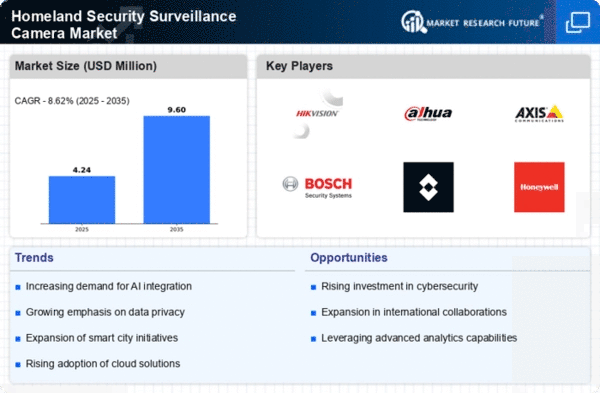
As per MRFR analysis, the The Homeland Security Surveillance Camera market was estimated at 3.9 USD Million in 2024. The Homeland Security Surveillance Camera industry is projected to grow from 4.2 in 2025 to 9.6 by 2035, exhibiting a compound annual growth rate (CAGR) of 8.62 during the forecast period 2025 - 2035.

Key Market Trends & Highlights

The Homeland Security Surveillance Camera Market is experiencing robust growth driven by technological advancements and increasing security concerns.

  • The integration of AI and machine learning is transforming surveillance capabilities, enhancing real-time data analysis.
  • North America remains the largest market, while the Asia-Pacific region is emerging as the fastest-growing area for surveillance technologies.
  • The government segment dominates the market, whereas the military segment is witnessing the most rapid growth.
  • Rising security concerns and government initiatives are key drivers propelling the demand for advanced surveillance systems.

Market Size & Forecast

2024 Market Size 3.9 (USD Million)
2035 Market Size 9.6 (USD Million)
CAGR (2025 - 2035) 8.62%
Largest Regional Market Share in 2024 North America

Major Players

<p>Hikvision (CN), Dahua Technology (CN), Axis Communications (SE), Bosch Security Systems (DE), FLIR Systems (US), Honeywell (US), Motorola Solutions (US), Panasonic (JP), Samsung Techwin (KR), Sony (JP)</p>

Market Trends

The Homeland Security Surveillance Camera Market is currently experiencing a notable evolution, driven by advancements in technology and increasing security concerns across various sectors. The integration of artificial intelligence and machine learning into surveillance systems appears to enhance their capabilities, enabling more efficient monitoring and analysis of vast amounts of data. This trend suggests a shift towards smarter surveillance solutions that not only capture footage but also analyze behaviors and detect anomalies in real-time. Furthermore, the growing emphasis on public safety and crime prevention is likely to propel demand for sophisticated surveillance systems, particularly in urban areas and critical infrastructure sites. In addition to technological advancements, regulatory frameworks and government initiatives play a crucial role in shaping the Homeland Security Surveillance Camera Market. Governments worldwide are increasingly investing in surveillance infrastructure to bolster national security and public safety. This investment may lead to the adoption of more advanced surveillance technologies, as agencies seek to comply with evolving regulations and standards. Moreover, the rising awareness of privacy concerns among citizens could influence the design and deployment of surveillance systems, prompting manufacturers to develop solutions that balance security needs with ethical considerations. Overall, the market appears poised for growth, driven by innovation and a heightened focus on safety and security.

Integration of AI and Machine Learning

The incorporation of artificial intelligence and machine learning technologies into surveillance systems is transforming the Homeland Security Surveillance Camera Market. These advancements enable cameras to not only record but also analyze footage, identifying patterns and detecting unusual activities in real-time. This trend indicates a move towards more proactive security measures, enhancing the effectiveness of surveillance operations.

Government Investment and Regulation

Government initiatives and investments in surveillance infrastructure are significantly influencing the Homeland Security Surveillance Camera Market. As nations prioritize public safety and national security, funding for advanced surveillance technologies is likely to increase. This trend suggests that regulatory frameworks will evolve, potentially leading to the adoption of more sophisticated systems that meet new compliance standards.

Focus on Privacy and Ethical Considerations

As awareness of privacy issues grows, the Homeland Security Surveillance Camera Market is witnessing a shift towards solutions that address ethical concerns. Manufacturers may increasingly develop surveillance systems that incorporate privacy-preserving features, balancing the need for security with respect for individual rights. This trend highlights the importance of designing technologies that are both effective and socially responsible.

Homeland Security Surveillance Camera Market Market Drivers

Increasing Security Concerns

The Global Homeland Security Surveillance Camera Industry is primarily driven by escalating security concerns across various sectors. Governments and organizations are increasingly investing in surveillance technologies to mitigate risks associated with terrorism, crime, and civil unrest. For instance, the implementation of advanced surveillance systems in urban areas has become a priority for law enforcement agencies. In 2024, the market is projected to reach 2.67 USD Billion, reflecting the urgent need for enhanced security measures. This trend is expected to continue as threats evolve, pushing the demand for sophisticated surveillance solutions.

Market Segment Insights

By Application: Surveillance (Largest) vs. Monitoring (Fastest-Growing)

<p>The Homeland Security Surveillance Camera Market currently shows a significant market share distribution, where Surveillance applications dominate the landscape. Following Surveillance, Monitoring applications are rapidly gaining traction among consumers and businesses, indicating a shift towards enhanced monitoring capabilities. Traffic Management and Access Control also occupy notable positions, but their contributions to market share are comparatively smaller. Incident Response, although essential, primarily supports the larger applications. Growth trends in this segment are substantially influenced by the rising concerns over security and the need for situational awareness. The expansion of smart city initiatives and technological advancements have fueled demand for Monitoring systems as they offer real-time analytics. In parallel, incidents of criminal activities and traffic violations boost the Surveillance category, solidifying its largest share in the market while driving other segments towards growth through innovation and integration of new technologies.</p>

<p>Surveillance (Dominant) vs. Access Control (Emerging)</p>

<p>In the Homeland Security Surveillance Camera Market, Surveillance applications hold a dominant position due to their comprehensive approach in ensuring safety across various environments, including urban centers, transportation hubs, and public spaces. Surveillance systems not only capture real-time video footage but also integrate advanced analytics for threat detection, making them indispensable for various stakeholders. In contrast, Access Control is an emerging segment that is progressively gaining importance amidst rising security concerns over unauthorized access. This application focuses on restricting access to critical areas and assets, employing biometric authentication and smart card systems. Its growing relevance is driven by increasing regulatory mandates and the need for secure environments, thus establishing it as a key player in the surveillance ecosystem.</p>

By End Use: Government (Largest) vs. Military (Fastest-Growing)

<p>In the Homeland Security Surveillance Camera Market, the Government segment commands the largest share, primarily fueled by public funding and increased scrutiny over national security concerns. The growth in urbanization and infrastructure spending has led to a surge in demand for surveillance solutions in various government applications, from monitoring public spaces to managing law enforcement activities. Meanwhile, the Military segment is emerging as the fastest-growing area, driven by advancements in technology and rising defense budgets aimed at enhancing national security capabilities through improved surveillance systems.</p>

<p>Government: Surveillance (Dominant) vs. Military: Tactical (Emerging)</p>

<p>The Government segment, characterized by the implementation of comprehensive surveillance systems, plays a critical role in ensuring public safety and security. It encompasses a variety of applications, including city surveillance, disaster management, and traffic monitoring. As government entities increasingly recognize the importance of surveillance in risk mitigation, investment in state-of-the-art cameras and integrated systems has become a priority. On the other hand, the Military segment focuses on tactical surveillance solutions, emphasizing real-time intelligence and strategic operations. The demand for high-definition and covert surveillance technologies is growing rapidly, fostering innovations that enhance operational readiness for military engagements.</p>

By Camera Type: Fixed Camera (Largest) vs. PTZ Camera (Fastest-Growing)

<p>The Homeland Security Surveillance Camera Market exhibits significant diversity within the Camera Type segment. Fixed Cameras dominate the market due to their simplicity, reliability, and cost-effectiveness, capturing a substantial share. Meanwhile, PTZ (Pan-Tilt-Zoom) Cameras are rapidly gaining ground, characterized by their flexibility and versatility, allowing users to control the camera's direction and zoom levels effectively. This growing segment is appealing to users looking for adaptable surveillance solutions in various environments. Market preferences are shifting, leading to evolving needs for different camera functionalities in surveillance purposes.</p>

<p>Fixed Camera (Dominant) vs. PTZ Camera (Emerging)</p>

<p>Fixed Cameras are well-established in the Homeland Security Surveillance Camera Market, recognized for their stability and straightforward deployment. Commonly used in fixed locations, they offer reliable monitoring capabilities, making them ideal for perimeter security and access control. PTZ Cameras, on the other hand, represent an emerging trend among users seeking high levels of situational awareness and responsiveness. Their ability to pan and tilt provides expansive coverage, enhancing the effectiveness of surveillance in dynamic environments. As threats evolve, the demand for PTZ Cameras is increasing, translating to robust market growth and innovation in features that cater to advanced surveillance needs.</p>

By Technology: IP Camera (Largest) vs. Video Analytics (Fastest-Growing)

<p>In the Homeland Security Surveillance Camera Market, the distribution of market share among various technology segments reveals IP cameras as the largest segment, due to their superior image quality and flexibility. Following closely are analog cameras, which still hold a significant share but are gradually being outpaced by advanced technologies. Wireless and cloud-based systems are also gaining traction, driven by the increasing need for flexibility and remote access in surveillance, while video analytics emerges as a promising segment due to the growing demand for smart surveillance solutions.</p>

<p>Technology: IP Camera (Dominant) vs. Video Analytics (Emerging)</p>

<p>IP cameras serve as the dominant technology in the Homeland Security Surveillance Camera Market, offering high-resolution imaging and extensive connectivity options, making them suitable for various applications, including public safety and infrastructure monitoring. Their ability to integrate with modern security systems and provide real-time analytics adds to their appeal. On the other hand, video analytics represents the emerging frontier in this market, leveraging artificial intelligence and machine learning to enhance surveillance capabilities. This technology enables faster threat detection and reduces the need for human monitoring, thus aligning with evolving security demands and enhancing operational efficiency.</p>

By Installation Type: Indoor (Largest) vs. Outdoor (Fastest-Growing)

<p>In the Homeland Security Surveillance Camera Market, the installation type segment is critically important, showcasing a clear distribution of market share across various types. Indoor surveillance cameras hold the largest share, driven by the high demand for security in residential and commercial buildings. These installations are essential for protecting assets, monitoring activities, and ensuring safety in enclosed environments. Conversely, outdoor cameras are experiencing rapid growth, fueled by the increasing need for urban surveillance and crime prevention. As outdoor spaces become more integrated with smart technologies, the demand for high-performance outdoor cameras is on the rise. Growth trends in this segment are heavily influenced by advancements in technology and growing security concerns. The transition towards integrated systems, which combine indoor and outdoor features, is reshaping market dynamics. The surge in outdoor camera deployment can be attributed to the expansion of urban environments and the need for real-time monitoring in public areas. Additionally, the mobile segment is gaining traction, reflecting the demand for flexible surveillance solutions. Market players are focusing on innovative technologies such as AI and analytics to further enhance the capabilities of surveillance systems, ensuring they meet the evolving needs of security professionals.</p>

<p>Indoor (Dominant) vs. Mobile (Emerging)</p>

<p>Within the installation type segment of the Homeland Security Surveillance Camera Market, indoor cameras play a dominant role due to their critical application in both commercial and residential settings. These cameras are typically designed with advanced features that contribute to their effectiveness in monitoring indoor activities and ensuring safety from theft or other incidents. On the other hand, mobile surveillance cameras are emerging as a valuable solution, especially for temporary setups or areas requiring flexibility. With their portability, these cameras can easily be deployed in various environments, making them ideal for events or situations where standard installations may not be feasible. As technological advancements continue, mobile solutions are increasingly incorporating features such as cloud connectivity and real-time streaming, enhancing their appeal in the market.</p>

Get more detailed insights about Homeland Security Surveillance Camera Market Research Report - Global Forecast till 2035

Regional Insights

North America : Market Leader in Surveillance

North America is poised to maintain its leadership in the Homeland Security Surveillance Camera Market, holding a market size of $2.0B in 2025. Key growth drivers include increasing government investments in public safety, advancements in technology, and rising concerns over security threats. Regulatory support, such as the implementation of stricter surveillance laws, further fuels demand for advanced surveillance solutions. The competitive landscape is characterized by major players like FLIR Systems, Honeywell, and Motorola Solutions, which are leveraging innovative technologies to enhance product offerings. The U.S. remains the largest market, driven by high adoption rates of surveillance systems in urban areas. The presence of established companies ensures a robust supply chain and continuous innovation, solidifying North America's position as a market leader.

Europe : Growing Demand for Security Solutions

Europe's Homeland Security Surveillance Camera Market is projected to reach $1.2B by 2025, driven by increasing security concerns and regulatory frameworks promoting surveillance technologies. The European Union's initiatives to enhance public safety and combat crime are significant catalysts for market growth. Additionally, the rise in smart city projects across major cities is expected to boost demand for advanced surveillance systems. Leading countries in this region include the UK, Germany, and France, where companies like Bosch Security Systems and Axis Communications are prominent. The competitive landscape is evolving, with a focus on integrating AI and IoT technologies into surveillance solutions. The presence of stringent regulations ensures that products meet high standards, fostering innovation and reliability in the market.

Asia-Pacific : Emerging Market with High Potential

The Asia-Pacific region is witnessing significant growth in the Homeland Security Surveillance Camera Market, projected to reach $0.9B by 2025. Key drivers include urbanization, increasing crime rates, and government initiatives aimed at enhancing public safety. Countries like China and India are investing heavily in surveillance infrastructure, supported by favorable regulations that encourage technology adoption in security systems. China leads the market, with major players like Hikvision and Dahua Technology dominating the landscape. The competitive environment is characterized by rapid technological advancements and a focus on cost-effective solutions. As governments prioritize security, the demand for surveillance cameras is expected to surge, making Asia-Pacific a critical region for market expansion.

Middle East and Africa : Emerging Security Landscape

The Middle East and Africa region is set to grow in the Homeland Security Surveillance Camera Market, with a projected size of $0.7B by 2025. Factors driving this growth include increasing security threats, urbanization, and government initiatives to enhance public safety. Countries like the UAE and South Africa are investing in advanced surveillance technologies, supported by regulatory frameworks that promote security measures. The competitive landscape features both local and international players, with companies like Panasonic and Samsung Techwin making significant inroads. The region's unique security challenges necessitate tailored surveillance solutions, fostering innovation and collaboration among key stakeholders. As investments in security infrastructure rise, the market is expected to expand rapidly, positioning the region as a growing player in the global landscape.

Key Players and Competitive Insights

The Homeland Security Surveillance Camera Market is characterized by a dynamic competitive landscape, driven by technological advancements and increasing security concerns globally. Major players such as Hikvision (CN), Dahua Technology (CN), and Axis Communications (SE) are at the forefront, each adopting distinct strategies to enhance their market presence. Hikvision (CN) focuses on innovation through the development of AI-powered surveillance solutions, while Dahua Technology (CN) emphasizes regional expansion, particularly in emerging markets. Axis Communications (SE) is known for its commitment to digital transformation, integrating IoT capabilities into its product offerings. Collectively, these strategies contribute to a competitive environment that is increasingly centered around technological differentiation and customer-centric solutions.

Key business tactics within this market include localizing manufacturing and optimizing supply chains to enhance operational efficiency. The market structure appears moderately fragmented, with several key players exerting influence over various segments. This fragmentation allows for a diverse range of products and services, catering to different security needs across regions. The collective influence of these companies shapes market dynamics, as they compete not only on product quality but also on service delivery and technological innovation.

In November 2025, Hikvision (CN) announced the launch of its latest AI-driven surveillance camera, which incorporates advanced facial recognition technology. This strategic move is significant as it positions Hikvision (CN) to capitalize on the growing demand for smart surveillance solutions, particularly in urban areas where security needs are paramount. The introduction of such technology is likely to enhance their competitive edge, appealing to both public and private sector clients.

In October 2025, Dahua Technology (CN) expanded its operations in Southeast Asia by establishing a new manufacturing facility in Vietnam. This expansion is strategically important as it not only reduces production costs but also shortens supply chain logistics, enabling Dahua to respond more swiftly to market demands. This move reflects a broader trend of companies seeking to localize production to mitigate risks associated with global supply chain disruptions.

In September 2025, Axis Communications (SE) entered into a strategic partnership with a leading cybersecurity firm to enhance the security features of its surveillance systems. This collaboration underscores the increasing importance of cybersecurity in the surveillance camera market, as threats to data integrity become more prevalent. By integrating robust cybersecurity measures, Axis Communications (SE) aims to build trust with customers, thereby strengthening its market position.

As of December 2025, current competitive trends in the Homeland Security Surveillance Camera Market are heavily influenced by digitalization, sustainability, and AI integration. Strategic alliances are becoming more common, as companies recognize the need to combine expertise to address complex security challenges. Looking ahead, competitive differentiation is likely to evolve, shifting from price-based competition to a focus on innovation, advanced technology, and supply chain reliability. This transition suggests that companies that prioritize R&D and strategic partnerships will be better positioned to thrive in an increasingly competitive landscape.

Key Companies in the Homeland Security Surveillance Camera Market market include

Industry Developments

Future Outlook

Homeland Security Surveillance Camera Market Future Outlook

<p>The Homeland Security Surveillance Camera Market is projected to grow at 8.62% CAGR from 2024 to 2035, driven by technological advancements, increasing security concerns, and government investments.</p>

New opportunities lie in:

  • <p>Integration of AI-driven analytics for real-time threat detection</p>
  • <p>Expansion into smart city infrastructure projects</p>
  • <p>Development of cloud-based surveillance solutions for remote monitoring</p>

<p>By 2035, the market is expected to be robust, driven by innovation and heightened security demands.</p>

Market Segmentation

Homeland Security Surveillance Camera Market End Use Outlook

  • Government
  • Military
  • Transportation
  • Public Safety
  • Critical Infrastructure

Homeland Security Surveillance Camera Market Technology Outlook

  • Analog
  • IP Camera
  • Wireless
  • Cloud-Based
  • Video Analytics

Homeland Security Surveillance Camera Market Application Outlook

  • Surveillance
  • Monitoring
  • Traffic Management
  • Access Control
  • Incident Response

Homeland Security Surveillance Camera Market Camera Type Outlook

  • Fixed Camera
  • PTZ Camera
  • Thermal Camera
  • Dome Camera
  • Bullet Camera

Homeland Security Surveillance Camera Market Installation Type Outlook

  • Indoor
  • Outdoor
  • Mobile
  • Integrated
  • Standalone

Report Scope

MARKET SIZE 20243.9(USD Million)
MARKET SIZE 20254.2(USD Million)
MARKET SIZE 20359.6(USD Million)
COMPOUND ANNUAL GROWTH RATE (CAGR)8.62% (2024 - 2035)
REPORT COVERAGERevenue Forecast, Competitive Landscape, Growth Factors, and Trends
BASE YEAR2024
Market Forecast Period2025 - 2035
Historical Data2019 - 2024
Market Forecast UnitsUSD Million
Key Companies ProfiledHikvision (CN), Dahua Technology (CN), Axis Communications (SE), Bosch Security Systems (DE), FLIR Systems (US), Honeywell (US), Motorola Solutions (US), Panasonic (JP), Samsung Techwin (KR), Sony (JP)
Segments CoveredApplication, End Use, Camera Type, Technology, Installation Type
Key Market OpportunitiesIntegration of artificial intelligence enhances threat detection in the Homeland Security Surveillance Camera Market.
Key Market DynamicsTechnological advancements and regulatory changes drive growth in the Homeland Security Surveillance Camera Market.
Countries CoveredNorth America, Europe, APAC, South America, MEA

FAQs

What is the market value of the global homeland security surveillance camera market?

Homeland security surveillance camera market is anticipated to acquire the market value At A CAGR Of 8.32% By 2035

Who are the eminent players of the global homeland security surveillance camera market?

Robert Bosch GmbH (Germany), Mitsubishi Electric Corporation (Japan), Vicon Industries (U.S.), and Elbit Systems Ltd (Israel) are some of the eminent players in the global homeland security surveillance camera market.

Why is North America likely to dominate the global homeland security surveillance camera market?

North America is likely to dominate the global market owing to the presence of strong defense organizations with the fast adoption of advanced technology.

What are the factors boosting the global homeland security surveillance camera market?

Increasing territorial and geopolitical conflicts are expected to drive the global homeland security surveillance camera market.

  1. Executive Summary
    1. Market Attractiveness Analysis
      1. Global Homeland Security Surveillance Camera Market, by Camera Type
      2. Global Homeland Security Surveillance Camera Market, by Application
      3. Global Homeland Security Surveillance Camera Market, by Region
  2. Market Introduction
    1. Market Definition
    2. Scope of the Study
    3. Market Structure
    4. Key Buying Criteria
    5. Market Factor Indicator Analysis
  3. Research Methodology
    1. Research Process
    2. Primary Research
    3. Secondary Research
    4. Market Size Estimation
    5. Forecast Model
    6. List of Assumptions
  4. Market Insights
  5. Market Dynamics
    1. Introduction
    2. Drivers
    3. Restraints
    4. Opportunities
    5. Challenges
    6. Market/Technological Trends
    7. Patent Trends
    8. Regulatory Landscape/Standards
  6. Market Factor Analysis
    1. Value Chain/Supply Chain Analysis
      1. R&D
      2. Manufacturing
      3. Distribution & Sales
      4. Post-Sales Monitoring
    2. Porter’s Five Forces Analysis
      1. Threat of New Entrants
      2. Bargaining Power of Buyers
      3. Threat of Substitutes
      4. Intensity of Rivalry
      5. Bargaining Power of Suppliers
  7. Global Homeland Security Surveillance Camera Market, by Camera Type
    1. Introduction
    2. Audio & Video Camera
      1. Market Estimates & Forecast, 2021-2030
      2. Market Estimates & Forecast, by Region, 2021-2030
    3. Integrated Video Surveillance Camera
      1. Market Estimates & Forecast, 2021-2030
      2. Market Estimates & Forecast, by Region, 2021-2030
    4. Infrared Camera
      1. Market Estimates & Forecast, 2021-2030
      2. Market Estimates & Forecast, by Region, 2021-2030
    5. IP Camera
      1. Market Estimates & Forecast, 2021-2030
      2. Market Estimates & Forecast, by Region, 2021-2030
  8. Global Homeland Security Surveillance Camera Market, by Application
    1. Introduction
    2. Infrastructure Security
      1. Market Estimates & Forecast, 2021-2030
      2. Market Estimates & Forecast, by Region, 2021-2030
    3. Border Security
      1. Market Estimates & Forecast, 2021-2030
      2. Market Estimates & Forecast, by Region, 2021-2030
    4. Public Protection
      1. Market Estimates & Forecast, 2021-2030
      2. Market Estimates & Forecast, by Region, 2021-2030
  9. Global Homeland Security Surveillance Camera Market, by Region
    1. Introduction
    2. North America
      1. Market Estimates & Forecast, by Country, 2021-2030
      2. Market Estimates & Forecast, by Camera Type, 2021-2030
      3. Market Estimates & Forecast, by Application, 2021-2030
      4. US
      5. Canada
    3. Europe
      1. Market Estimates & Forecast, by Country, 2021-2030
      2. Market Estimates & Forecast, by Camera Type, 2021-2030
      3. UK
      4. Germany
      5. France
      6. Italy
      7. Rest of Europe
    4. Asia-Pacific
      1. Market Estimates & Forecast, by Country, 2021-2030
      2. Market Estimates & Forecast, by Camera Type, 2021-2030
      3. Market Estimates & Forecast, by Application, 2021-2030
      4. China
      5. Japan
      6. India
      7. Australia
      8. Rest of Asia-Pacific
    5. Middle East & Africa
      1. Market Estimates & Forecast, by Country, 2021-2030
      2. Market Estimates & Forecast, by Camera Type, 2021-2030
      3. Market Estimates & Forecast, by Application, 2021-2030
      4. UAE
      5. Saudi Arabia
      6. Israel
      7. Rest of the Middle East & Africa
    6. Latin America
      1. Market Estimates & Forecast, by Country, 2021-2030
      2. Market Estimates & Forecast, by Camera Type, 2021-2030
      3. Market Estimates & Forecast, by Application, 2021-2030
      4. Brazil
      5. Rest of Latin America
  10. Competitive Landscape
    1. Competitive Overview
    2. Competitor Dashboard
    3. Major Growth Strategies in the Global Homeland Security Surveillance Camera Market
    4. Competitive Benchmarking
    5. Market Share Analysis
    6. Robert Bosch GmbH: The Leading Player in Terms of Number of Developments in the Global Homeland Security Surveillance Camera Market
    7. Key Developments & Growth Strategies
      1. Application Launches/Service Deployments
      2. Mergers & Acquisitions
      3. Joint Ventures
  11. Company Profiles
    1. CONTROP Precision Technologies Ltd.
      1. Company Overview
      2. Products/Services Offered
      3. Financial Overview
      4. Key Developments
      5. SWOT Analysis
      6. Key Strategies
    2. Elbit Systems Ltd
      1. Company Overview
      2. Products/Services Offered
      3. Financial Overview
      4. Key Developments
      5. SWOT Analysis
      6. Key Strategies
    3. FLIR Systems, Inc.
      1. Company Overview
      2. Products/Services Offered
      3. Financial Overview
      4. Key Developments
      5. SWOT Analysis
      6. Key Strategies
    4. General Dynamics Corporation
      1. Company Overview
      2. Products/Services Offered
      3. Financial Overview
      4. Key Developments
      5. SWOT Analysis
      6. Key Strategies
    5. Honeywell International Inc.
      1. Company Overview
      2. Products/Services Offered
      3. Financial Overview
      4. Key Developments
      5. SWOT Analysis
      6. Key Strategies
    6. Mitsubishi Electric Corporation
      1. Company Overview
      2. Products/Services Offered
      3. Financial Overview
      4. Key Developments
      5. SWOT Analysis
      6. Key Strategies
    7. Moog Inc.
      1. Company Overview
      2. Products/Services Offered
      3. Financial Overview
      4. Key Developments
      5. SWOT Analysis
      6. Key Strategies
    8. NetVu
      1. Company Overview
      2. Products/Services Offered
      3. Financial Overview
      4. Key Developments
      5. SWOT Analysis
      6. Key Strategies
    9. Panasonic Corporation
      1. Company Overview
      2. Products/Services Offered
      3. Financial Overview
      4. Key Developments
      5. SWOT Analysis
      6. Key Strategies
    10. Robert Bosch GmbH
      1. Company Overview
      2. Products/Services Offered
      3. Financial Overview
      4. Key Developments
      5. SWOT Analysis
      6. Key Strategies
    11. Silent Sentinel
      1. Company Overview
      2. Products/Services Offered
      3. Financial Overview
      4. Key Developments
      5. SWOT Analysis
      6. Key Strategies
    12. Vicon Industries
      1. Company Overview
      2. Products/Services Offered
      3. Financial Overview
      4. Key Developments
      5. SWOT Analysis
      6. Key Strategies
  12. Appendix
    1. References
    2. Related Reports
    3. List of Abbreviations
  13. Industry Insights
    1. Note: This table of contents is tentative and subject to change as the research progresses.
    2. List of Tables
  14. Global Homeland Security Surveillance Camera Market, by Region, 2021-2030
  15. North America: Homeland Security Surveillance Camera Market, by Country, 2021-2030
  16. Europe: Homeland Security Surveillance Camera Market, by Country, 2021-2030
  17. Asia-Pacific: Homeland Security Surveillance Camera Market, by Country, 2021-2030
  18. Middle East & Africa: Homeland Security Surveillance Camera Market, by Country, 2021-2030
  19. Latin America: Homeland Security Surveillance Camera Market, by Country, 2021-2030
  20. Global Homeland Security Surveillance Camera Market Size, by Region, 2021-2030
  21. North America: Homeland Security Surveillance Camera Market Size, by Country, 2021-2030
  22. Europe: Homeland Security Surveillance Camera Market Size, by Country, 2021-2030
  23. Asia-Pacific: Homeland Security Surveillance Camera Market Size, by Country, 2021-2030
  24. Middle East & Africa: Homeland Security Surveillance Camera Market Size, by Country, 2021-2030
  25. Latin America: Homeland Security Surveillance Camera Market Size, by Country, 2021-2030
  26. Global Homeland Security Surveillance Camera Camera Type Market, by Region, 2021-2030
  27. North America: Homeland Security Surveillance Camera Camera Type Market, by Country, 2021-2030
  28. Europe: Homeland Security Surveillance Camera Camera Type Market, by Country, 2021-2030
  29. Asia-Pacific: Homeland Security Surveillance Camera Camera Type Market, by Country, 2021-2030
  30. Middle East & Africa: Homeland Security Surveillance Camera Camera Type Market, by Country, 2021-2030
  31. Latin America: Homeland Security Surveillance Camera Camera Type Market, by Country, 2021-2030
  32. Global Homeland Security Surveillance Camera Application Market, by Region, 2021-2030
  33. North America: Homeland Security Surveillance Camera Application Market, by Country, 2021-2030
  34. Europe: Homeland Security Surveillance Camera Application Market, by Country, 2021-2030
  35. Asia-Pacific: Homeland Security Surveillance Camera Application Market, by Country, 2021-2030
  36. Middle East & Africa: Homeland Security Surveillance Camera Application Market, by Country, 2021-2030
  37. Latin America: Homeland Security Surveillance Camera Application Market, by Country, 2021-2030
  38. Global Homeland Security Surveillance Camera Market, by Region, 2021-2030
  39. Global Homeland Security Surveillance Camera Market, by Camera Type, 2021-2030
  40. Global Homeland Security Surveillance Camera Market, by Application, 2021-2030
  41. North America: Homeland Security Surveillance Camera Market, by Country, 2021-2030
  42. North America: Homeland Security Surveillance Camera Market, by Camera Type, 2021-2030
  43. North America: Homeland Security Surveillance Camera Market, by Application, 2021-2030
  44. Europe: Homeland Security Surveillance Camera Market, by Country, 2021-2030
  45. Europe: Homeland Security Surveillance Camera Market, by Camera Type, 2021-2030
  46. Europe: Homeland Security Surveillance Camera Market, by Application, 2021-2030
  47. Asia-Pacific: Homeland Security Surveillance Camera Market, by Country, 2021-2030
  48. Asia-Pacific: Homeland Security Surveillance Camera Market, by Camera Type, 2021-2030
  49. Asia-Pacific: Homeland Security Surveillance Camera Market, by Application, 2021-2030
  50. Middle East & Africa: Homeland Security Surveillance Camera Market, by Country, 2021-2030
  51. Middle East & Africa: Homeland Security Surveillance Camera Market, by Camera Type, 2021-2030
  52. Middle East & Africa: Homeland Security Surveillance Camera Market, by Application, 2021-2030
  53. Latin America: Homeland Security Surveillance Camera Market, by Country, 2021-2030
  54. Latin America: Homeland Security Surveillance Camera Market, by Camera Type, 2021-2030
  55. Latin America: Homeland Security Surveillance Camera Market, by Application, 2021-2030
    1. List of Figures
  56. Research Process of MRFR
  57. Top-Down and Bottom-Up Approaches
  58. Market Dynamics
  59. Impact Analysis: Market Drivers
  60. Impact Analysis: Market Restraints
  61. Porter's Five Forces Analysis
  62. Value Chain Analysis
  63. Global Homeland Security Surveillance Camera Market Share, by Camera Type, 2021 (%)
  64. Global Homeland Security Surveillance Camera Market, by Camera Type, 2021-2030 (USD Million)
  65. Global Homeland Security Surveillance Camera Market Share, by Application, 2021 (%)
  66. Global Homeland Security Surveillance Camera Market, by Application, 2021-2030 (USD Million)
  67. Global Homeland Security Surveillance Camera Market Share (%), by Region, 2021
  68. Global Homeland Security Surveillance Camera Market, by Region, 2021-2030 (USD Million)
  69. North America: Homeland Security Surveillance Camera Market Share (%), 2021
  70. North America: Homeland Security Surveillance Camera Market, by Country, 2021-2030 (USD Million)
  71. Europe: Homeland Security Surveillance Camera Market Share (%), 2021
  72. Europe: Homeland Security Surveillance Camera Market, by Country, 2021-2030 (USD Million)
  73. Asia-Pacific: Homeland Security Surveillance Camera Market Share (%), 2021
  74. Asia-Pacific: Homeland Security Surveillance Camera Market, by Country, 2021-2030 (USD Million)
  75. Middle East & Africa: Homeland Security Surveillance Camera Market Share (%), 2021
  76. Middle East & Africa: Homeland Security Surveillance Camera Market, by Country, 2021-2030 (USD Million)
  77. Latin America: Homeland Security Surveillance Camera Market Share (%), 2021
  78. Latin America: Homeland Security Surveillance Camera Market, by Country, 2021-2030 (USD Million)

Homeland Security Surveillance Camera Market Segmentation

Market Segmentation Overview

  • Detailed segmentation data will be available in the full report
  • Comprehensive analysis by multiple parameters
  • Regional and country-level breakdowns
  • Market size forecasts by segment
Infographic

Free Sample Request

Kindly complete the form below to receive a free sample of this Report

Get Free Sample

Customer Strories

Compare Licence

×
Features License Type
Single User Multiuser License Enterprise User
Price $4,950 $5,950 $7,250
Maximum User Access Limit 1 User Upto 10 Users Unrestricted Access Throughout the Organization
Free Customization
Direct Access to Analyst
Deliverable Format
Platform Access
Discount on Next Purchase 10% 15% 15%
Printable Versions