×
Request Free Sample ×

Kindly complete the form below to receive a free sample of this Report

* Please use a valid business email

Leading companies partner with us for data-driven Insights

clients tt-cursor
Hero Background

Gigabit Passive Optical Network Market

ID: MRFR/ICT/8810-HCR
100 Pages
Garvit Vyas
October 2025

Gigabit Passive Optical Network Market Research Report: By Application (Fiber-to-the-Home (FTTH), Fiber-to-the-Building (FTTB), Fiber-to-the-Cabinet (FTTC), Mobile Backhaul), By Component (Optical Line Terminal (OLT), Optical Network Terminal (ONT), Optical Distribution Network (ODN)), By Deployment Type (Greenfield, Brownfield), By Wavelength (10 Gbps, 25 Gbps, 50 Gbps, 100 Gbps) and By Regional (North America, Europe, South America, Asia Pacific, Middle East and Africa) - Forecast to 2035

Share:
Download PDF ×

We do not share your information with anyone. However, we may send you emails based on your report interest from time to time. You may contact us at any time to opt-out.

Gigabit Passive Optical Network Market Infographic
Purchase Options

Gigabit Passive Optical Network Market Summary

As per MRFR analysis, the Gigabit Passive Optical Network Market Size was estimated at 13.53 USD Billion in 2024. The Gigabit Passive Optical Network industry is projected to grow from 15.5 USD Billion in 2025 to 60.13 USD Billion by 2035, exhibiting a compound annual growth rate (CAGR) of 14.52 during the forecast period 2025 - 2035.

Key Market Trends & Highlights

The Gigabit Passive Optical Network Market is poised for substantial growth driven by increasing demand for high-speed internet and technological advancements.

  • North America remains the largest market for Gigabit Passive Optical Networks, driven by robust telecommunications infrastructure.
  • The Asia-Pacific region is experiencing rapid growth, fueled by expanding smart city initiatives and urbanization.
  • The telecommunications segment continues to dominate the market, while the internet service providers segment is witnessing the fastest growth.
  • Key market drivers include the rising demand for high-speed internet and regulatory support, which are propelling investments in fiber optic networks.

Market Size & Forecast

2024 Market Size 13.53 (USD Billion)
2035 Market Size 60.13 (USD Billion)
CAGR (2025 - 2035) 14.52%

Major Players

Huawei (CN), Nokia (FI), ZTE (CN), Cisco (US), Calix (US), ADTRAN (US), FiberHome (CN), Mitsubishi Electric (JP), NEC (JP)

Gigabit Passive Optical Network Market Trends

The Gigabit Passive Optical Network Market is currently experiencing a transformative phase characterized by rapid advancements in technology and increasing demand for high-speed internet connectivity. This market is driven by the need for efficient data transmission solutions that can support the growing number of connected devices and the rising consumption of bandwidth-intensive applications. As urbanization continues to expand, the deployment of fiber optic networks is becoming more prevalent, enabling service providers to offer enhanced broadband services to both residential and commercial customers. Furthermore, the shift towards smart cities and the Internet of Things is propelling the adoption of Gigabit Passive Optical Networks, as these infrastructures are well-suited to meet the requirements of modern digital ecosystems. In addition to technological advancements, regulatory support and investment from both public and private sectors are playing a crucial role in the growth of the Gigabit Passive Optical Network Market. Governments are increasingly recognizing the importance of high-speed internet as a critical infrastructure for economic development and social inclusion. This has led to initiatives aimed at expanding fiber optic networks, particularly in underserved areas. As a result, the market is likely to witness a surge in deployment activities, fostering competition among service providers and ultimately benefiting consumers with improved service quality and affordability. The future of the Gigabit Passive Optical Network Market appears promising, with ongoing innovations and strategic partnerships expected to further enhance its landscape.

Increased Demand for High-Speed Internet

The Gigabit Passive Optical Network Market is witnessing a surge in demand for high-speed internet services. This trend is largely driven by the proliferation of digital content and the growing reliance on online platforms for various activities, including remote work, streaming, and online education. As consumers seek faster and more reliable internet connections, service providers are increasingly investing in Gigabit Passive Optical Networks to meet these expectations.

Expansion of Smart City Initiatives

The development of smart cities is significantly influencing the Gigabit Passive Optical Network Market. Urban areas are increasingly adopting advanced technologies to enhance infrastructure and improve the quality of life for residents. Gigabit Passive Optical Networks are integral to these initiatives, providing the necessary bandwidth to support smart applications such as traffic management, public safety, and energy efficiency.

Regulatory Support and Investment

Government policies and investments are playing a pivotal role in shaping the Gigabit Passive Optical Network Market. Many countries are implementing regulations that promote the expansion of fiber optic networks, particularly in rural and underserved regions. This regulatory environment encourages private sector investment, leading to increased deployment of Gigabit Passive Optical Networks and improved access to high-speed internet for a broader population.

Gigabit Passive Optical Network Market Drivers

Market Growth Projections

The Global Gigabit Passive Optical Network Market Industry is projected to experience substantial growth over the coming years. With a market value of 11.8 USD Billion in 2024, the industry is expected to expand significantly, reaching 60.1 USD Billion by 2035. This growth trajectory suggests a compound annual growth rate of 15.95% from 2025 to 2035, indicating robust demand for high-speed internet solutions. The increasing reliance on digital services and the need for enhanced connectivity are likely to drive this expansion. As the market evolves, stakeholders must remain vigilant to emerging trends and technological advancements that could shape the future of the Global Gigabit Passive Optical Network Market Industry.

Emergence of 5G Technology

The emergence of 5G technology is set to have a profound impact on the Global Gigabit Passive Optical Network Market Industry. As telecommunications providers roll out 5G networks, the demand for complementary infrastructure, such as Gigabit Passive Optical Networks, is likely to increase. These networks can support the high data rates and low latency required by 5G applications, making them essential for the successful deployment of next-generation mobile networks. The synergy between 5G and Gigabit Passive Optical Networks may lead to enhanced connectivity solutions, further driving market growth. As the industry evolves, the integration of these technologies could redefine user experiences and connectivity standards.

Rising Adoption of Smart Technologies

The Global Gigabit Passive Optical Network Market Industry is significantly influenced by the rising adoption of smart technologies across various sectors. Industries such as healthcare, education, and smart cities increasingly rely on high-speed internet for efficient operations and enhanced user experiences. The integration of Internet of Things (IoT) devices necessitates robust connectivity solutions, which Gigabit Passive Optical Networks provide. This trend is expected to drive the market's growth, as organizations seek to leverage advanced technologies that require substantial bandwidth. The anticipated compound annual growth rate of 15.95% from 2025 to 2035 further illustrates the potential of the Global Gigabit Passive Optical Network Market Industry in meeting the demands of a digitally connected world.

Government Initiatives and Investments

Government initiatives play a pivotal role in the expansion of the Global Gigabit Passive Optical Network Market Industry. Various countries are investing in broadband infrastructure to enhance connectivity, particularly in underserved regions. These investments often include subsidies and incentives for telecommunications companies to deploy Gigabit Passive Optical Networks. Such initiatives not only aim to bridge the digital divide but also stimulate economic growth by enabling access to high-speed internet. As a result, the market is expected to witness substantial growth, with projections indicating a rise to 60.1 USD Billion by 2035, underscoring the importance of government support in the Global Gigabit Passive Optical Network Market Industry.

Increasing Demand for High-Speed Internet

The Global Gigabit Passive Optical Network Market Industry experiences a surge in demand for high-speed internet services, driven by the proliferation of digital content and online activities. As consumers and businesses alike seek faster and more reliable internet connections, the adoption of Gigabit Passive Optical Networks becomes increasingly attractive. In 2024, the market is projected to reach 11.8 USD Billion, reflecting a growing recognition of the need for enhanced bandwidth capabilities. This trend is particularly evident in urban areas, where population density and digital consumption are at their peak, further propelling the growth of the Global Gigabit Passive Optical Network Market Industry.

Growing Need for Bandwidth-Intensive Applications

The Global Gigabit Passive Optical Network Market Industry is propelled by the growing need for bandwidth-intensive applications, such as streaming services, online gaming, and cloud computing. As users increasingly engage in activities that require substantial data transfer rates, the demand for Gigabit Passive Optical Networks rises. These networks offer the necessary infrastructure to support high-definition video streaming and real-time data processing, which are becoming standard expectations among consumers. Consequently, the market is poised for growth, with projections indicating a significant increase in revenue as more users transition to high-speed internet solutions. This trend highlights the critical role of Gigabit Passive Optical Networks in facilitating modern digital experiences.


Market Segment Insights

By Application: Telecommunications (Largest) vs. Internet Service Providers (Fastest-Growing)

The Gigabit Passive Optical Network (GPON) market showcases diverse applications, with telecommunications leading the charge. Telecommunications is the largest application segment, leveraging extensive infrastructure to provide high-speed internet and communication services. In contrast, Internet Service Providers (ISPs), while smaller in market share, are rapidly gaining traction due to the increasing demand for high-speed broadband services fueled by remote work and digital connectivity requirements. According to trends, the sector is witnessing modifications in consumer preferences, pushing ISPs to expand their GPON offerings to stay competitive and meet user demand. The growth trends within this segment are significantly influenced by the expanding fiber optic technology adoption, the need for reliable high-speed internet, and the focus on smart city developments. Data centers are also becoming hubs for GPON applications, with expanded bandwidth requirements supporting their operational needs. Moreover, the initiative of governments promoting smart city projects is driving investments in GPON infrastructures across urban areas, further invigorating the growth of internet service providers as they strive to deliver robust broadband solutions at scale.

Telecommunications (Dominant) vs. Smart Cities (Emerging)

Within the GPON market, Telecommunications stands as the dominant force, primarily due to its established network that facilitates higher bandwidth and improved performance for users. This sector has traditionally harnessed GPON technologies for efficient data transmission, ensuring reliable communication for both consumer and business needs. In comparison, Smart Cities represent an emerging segment, characterized by their push towards digital infrastructures that support IoT devices, traffic management systems, and various smart applications. The growth of smart cities is backed by urban development projects, enabling improved connectivity through GPON technology. As citizens increasingly demand seamless connectivity for their smart devices, the role of GPON solutions in urban planning and implementation has become critical, marking Smart Cities as a significant area of growth potential.

By End Use: Residential (Largest) vs. Commercial (Fastest-Growing)

Within the Gigabit Passive Optical Network Market, the end-use segment exhibits a diverse distribution of market share among Residential, Commercial, Industrial, and Government applications. The Residential segment dominates the market, driven by increasing demand for high-speed internet and seamless connectivity in households. In contrast, while the Commercial segment holds a smaller share currently, it is experiencing rapid growth, fueled by businesses' need for reliable, high-performance networks to support digital transformation initiatives.

Residential (Dominant) vs. Commercial (Emerging)

The Residential segment is pivotal in the Gigabit Passive Optical Network Market, providing high-speed, reliable internet directly to homes, which is essential for meeting the growing demands of consumers for data-intensive applications. This segment's dominance is supported by rising adoption rates of smart home devices, streaming services, and online gaming. Conversely, the Commercial segment, though emerging, is poised for substantial growth as businesses invest in advanced networking solutions to enhance productivity and ensure robust communication infrastructure. The increasing trend towards remote working and digital transformation is particularly driving the demand for commercial gigabit services, making it a key focus area for network providers.

By Technology: Passive Optical Network (Largest) vs. Active Optical Network (Fastest-Growing)

The Gigabit Passive Optical Network (GPON) market is primarily dominated by the Passive Optical Network (PON) technology, which holds the largest share due to its efficiency in delivering high-speed internet across wide areas. This segment has gained substantial traction among service providers due to its cost-effectiveness and ability to support multiple users simultaneously, making it the preferred choice for fiber-to-the-home (FTTH) applications. On the other hand, the Active Optical Networks (AON) are witnessing increasing adoption rates, particularly in new infrastructures, due to their flexibility and superior performance in high-demand scenarios.

Technology: Passive Optical Network (Dominant) vs. Active Optical Network (Emerging)

The Passive Optical Network (PON) has established itself as the dominant technology in the Gigabit Passive Optical Network Market, primarily because of its ability to efficiently distribute bandwidth over a single fiber strand, allowing multiple users to share the same connection without performance degradation. This is particularly advantageous in urban environments where demand for connectivity is highest. In contrast, the Active Optical Network (AON) is emerging as a significant player, especially in new deployments. Although traditionally perceived as more expensive due to active components, advancements in technology have made AONs more cost-competitive. Their ability to provide dedicated bandwidth makes them attractive for enterprise applications and locations requiring higher speeds and reliability.

By Component: Optical Line Terminal (Largest) vs. Fiber Optic Cable (Fastest-Growing)

In the Gigabit Passive Optical Network Market, the distribution of market share among key components reveals significant insights. The Optical Line Terminal (OLT) holds the largest share, acting as a crucial interface between the service provider and the fiber optic network, allowing for efficient data transmission. Meanwhile, the Fiber Optic Cable segment is witnessing rapid growth, driven by increasing demand for high-speed internet connectivity and technological advancements in fiber-optic infrastructure. As the demand for bandwidth surges, the Gigabit Passive Optical Network components are adapting to meet these challenges. The market growth is primarily fueled by investments in telecommunications infrastructure and an increasing shift towards fiber optic solutions in both urban and rural areas. This trend is indicative of a broader transition towards digital services, making components such as Optical Network Units and Splitters essential for future network expansions.

Optical Line Terminal (Dominant) vs. Splitter (Emerging)

The Optical Line Terminal (OLT) is the dominant component in the Gigabit Passive Optical Network market, serving as the central point of connectivity for the fiber-optic network. OLTs are responsible for managing data traffic and ensuring network reliability, making them indispensable for service providers looking to enhance operational efficiency. In contrast, the Splitter represents an emerging component, designed to divide the optical signal from a single fiber into multiple outputs. The growth of Splitters is attributed to the rising need for network scalability and cost-effectiveness in deploying fiber optic solutions, especially in expanding markets where infrastructure is being modernized.

By Deployment Type: Centralized (Largest) vs. Distributed (Fastest-Growing)

In the Gigabit Passive Optical Network Market, the deployment type segment exhibits a rich diversity with significant market share distribution among centralized, distributed, and hybrid configurations. Centralized deployment has emerged as the largest segment, predominantly favored for its simplified infrastructure management and cost efficiency. Conversely, the distributed model is rapidly gaining traction, appealing to operators for its enhanced scalability and flexibility in network design. As demand for high-speed internet services rises, understanding these dynamics becomes crucial for stakeholders.

Deployment Type: Centralized (Dominant) vs. Distributed (Emerging)

Centralized deployment types in the Gigabit Passive Optical Network Market are marked by their streamlined architecture, enabling efficient bandwidth allocation and easier maintenance. This model typically requires a single point of control, making it ideal for large organizations that prioritize simplicity and efficiency. On the other hand, the distributed deployment type is rapidly becoming the fastest-growing segment, driven by the need for network resilience and localized service delivery. It distributes network functions across various nodes, providing flexibility and redundancy, thus meeting the growing consumer demand for reliable high-speed internet services. Companies are increasingly recognizing the distributed model for its ability to adapt to diverse geographic and operational requirements.

Get more detailed insights about Gigabit Passive Optical Network Market

Regional Insights

North America : Market Leader in Gigabit PON

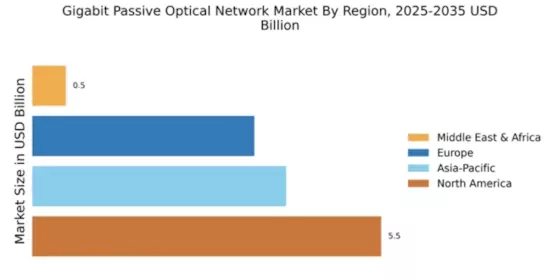
North America is poised to maintain its leadership in the Gigabit Passive Optical Network (PON) market, holding a significant market share of 5.5 in 2024. The region's growth is driven by increasing demand for high-speed internet, advancements in fiber optic technology, and supportive regulatory frameworks. Government initiatives aimed at expanding broadband access further catalyze market growth, ensuring that urban and rural areas alike benefit from enhanced connectivity. The competitive landscape in North America is robust, featuring key players such as Cisco, Calix, and ADTRAN. These companies are at the forefront of innovation, providing cutting-edge solutions that meet the growing demands of consumers and businesses. The presence of established firms like Huawei and Nokia also contributes to a dynamic market environment, fostering competition and driving technological advancements. With a focus on enhancing network infrastructure, North America is set to lead The Gigabit Passive Optical Network well into the future.

Europe : Emerging Market with Growth Potential

Europe is witnessing a significant transformation in its Gigabit Passive Optical Network (PON) market, with a market size of 3.5. The region's growth is fueled by increasing investments in digital infrastructure, government initiatives promoting broadband expansion, and a rising demand for high-speed internet services. Regulatory support, including the European Commission's Digital Single Market strategy, aims to enhance connectivity across member states, driving further adoption of Gigabit PON technologies. Leading countries in this region include Germany, France, and the UK, where major players like Nokia and ZTE are actively involved in deploying advanced fiber optic networks. The competitive landscape is characterized by a mix of established firms and emerging startups, all vying for market share. As Europe continues to prioritize digital transformation, the Gigabit PON market is expected to flourish, providing enhanced connectivity and economic growth opportunities.

Asia-Pacific : Rapid Growth in Connectivity Solutions

The Asia-Pacific region is experiencing rapid growth in the Gigabit Passive Optical Network (PON) market, with a market size of 4.0. This growth is driven by increasing urbanization, rising internet penetration, and government initiatives aimed at enhancing digital infrastructure. Countries like China and Japan are leading the charge, with significant investments in fiber optic technology and broadband expansion, supported by favorable regulatory environments that encourage innovation and competition. China, in particular, stands out as a key player, with companies like Huawei and ZTE dominating the market. The competitive landscape is vibrant, with both local and international firms striving to capture market share. As demand for high-speed internet continues to rise, the Asia-Pacific region is set to become a major hub for Gigabit PON technologies, fostering economic growth and improved connectivity across the region.

Middle East and Africa : Emerging Market with Untapped Potential

The Middle East and Africa (MEA) region presents a nascent yet promising market for Gigabit Passive Optical Networks (PON), with a market size of 0.53. The growth in this region is primarily driven by increasing investments in telecommunications infrastructure and a growing demand for high-speed internet services. Governments are recognizing the importance of digital connectivity, leading to initiatives aimed at expanding broadband access, particularly in underserved areas. Countries like South Africa and the UAE are at the forefront of this development, with key players such as FiberHome and NEC actively participating in the market. The competitive landscape is evolving, with both local and international companies seeking to establish a foothold. As the region continues to invest in digital transformation, the Gigabit PON market is expected to gain traction, unlocking new opportunities for economic growth and connectivity improvements.

Key Players and Competitive Insights

The Gigabit Passive Optical Network Market is currently characterized by a dynamic competitive landscape, driven by the increasing demand for high-speed internet and the proliferation of smart devices. Key players such as Huawei (CN), Nokia (FI), and Cisco (US) are strategically positioned to leverage their technological expertise and extensive portfolios. Huawei (CN) focuses on innovation and R&D, investing heavily in next-generation optical technologies, while Nokia (FI) emphasizes partnerships with telecom operators to enhance service delivery. Cisco (US) is actively pursuing digital transformation initiatives, aiming to integrate advanced networking solutions into its offerings. Collectively, these strategies foster a competitive environment that prioritizes technological advancement and customer-centric solutions.

In terms of business tactics, companies are increasingly localizing manufacturing and optimizing supply chains to enhance operational efficiency. The market structure appears moderately fragmented, with several players vying for market share. However, the influence of major companies is substantial, as they set industry standards and drive technological advancements. This competitive structure encourages innovation and collaboration, as smaller firms often align with larger entities to access resources and expertise.

In November 2025, ZTE (CN) announced a strategic partnership with a leading telecommunications provider to deploy a nationwide Gigabit Passive Optical Network. This collaboration is expected to enhance broadband access in underserved regions, reflecting ZTE's commitment to expanding its market presence while addressing critical connectivity challenges. The strategic importance of this partnership lies in its potential to drive revenue growth and strengthen ZTE's position in the competitive landscape.

In October 2025, Calix (US) launched a new suite of software solutions designed to optimize network performance and enhance customer experience. This initiative underscores Calix's focus on innovation and its commitment to providing cutting-edge solutions that meet the evolving needs of service providers. The launch is likely to bolster Calix's competitive edge by enabling operators to deliver superior services, thereby attracting new customers and retaining existing ones.

In September 2025, FiberHome (CN) expanded its global footprint by entering into a joint venture with a European telecommunications firm. This strategic move aims to enhance FiberHome's capabilities in delivering advanced optical network solutions across Europe. The joint venture is significant as it not only broadens FiberHome's market reach but also facilitates knowledge exchange and technological collaboration, positioning the company for future growth.

As of December 2025, current competitive trends in the Gigabit Passive Optical Network Market are increasingly defined by digitalization, sustainability, and AI integration. Strategic alliances are becoming more prevalent, as companies recognize the value of collaboration in navigating complex market dynamics. Looking ahead, competitive differentiation is likely to evolve, shifting from price-based competition to a focus on innovation, technology, and supply chain reliability. This transition suggests that companies that prioritize R&D and strategic partnerships will be better positioned to thrive in an increasingly competitive environment.

Key Companies in the Gigabit Passive Optical Network Market market include

Industry Developments

The Gigabit Passive Optical Network Market (GPON) market is poised for significant growth over the coming years, driven by increasing demand for high-speed internet access, particularly in emerging markets. According to a recent report, the global GPON market is expected to reach a valuation of USD 10.31 billion in 2023 and USD 34.9 billion by 2032, exhibiting a CAGR of 14.5% during the forecast period (2023-2032). Major players in the GPON market include Huawei, ZTE, Nokia, and Calix. These companies are investing heavily in research and development to enhance the speed and efficiency of their GPON solutions.

Governments worldwide are also promoting GPON technology as a means of bridging the digital divide and providing affordable high-speed internet access to underserved areas.

Future Outlook

Gigabit Passive Optical Network Market Future Outlook

The Gigabit Passive Optical Network Market is projected to grow at a 14.52% CAGR from 2024 to 2035, driven by increasing demand for high-speed internet and advancements in fiber optic technology.

New opportunities lie in:

  • Expansion into underserved rural markets with tailored service packages.
  • Development of integrated smart city solutions leveraging optical networks.
  • Partnerships with telecom providers for enhanced last-mile connectivity solutions.

By 2035, the market is expected to be robust, driven by innovation and strategic partnerships.

Market Segmentation

Gigabit Passive Optical Network Market End Use Outlook

  • Residential
  • Commercial
  • Industrial
  • Government

Gigabit Passive Optical Network Market Component Outlook

  • Optical Line Terminal
  • Optical Network Unit
  • Fiber Optic Cable
  • Splitter

Gigabit Passive Optical Network Market Technology Outlook

  • Active Optical Network
  • Passive Optical Network
  • Hybrid Optical Network

Gigabit Passive Optical Network Market Application Outlook

  • Telecommunications
  • Internet Service Providers
  • Data Centers
  • Smart Cities

Gigabit Passive Optical Network Market Deployment Type Outlook

  • Centralized
  • Distributed
  • Hybrid

Report Scope

MARKET SIZE 202413.53(USD Billion)
MARKET SIZE 202515.5(USD Billion)
MARKET SIZE 203560.13(USD Billion)
COMPOUND ANNUAL GROWTH RATE (CAGR)14.52% (2024 - 2035)
REPORT COVERAGERevenue Forecast, Competitive Landscape, Growth Factors, and Trends
BASE YEAR2024
Market Forecast Period2025 - 2035
Historical Data2019 - 2024
Market Forecast UnitsUSD Billion
Key Companies ProfiledHuawei (CN), Nokia (FI), ZTE (CN), Cisco (US), Calix (US), ADTRAN (US), FiberHome (CN), Mitsubishi Electric (JP), NEC (JP)
Segments CoveredApplication, End Use, Technology, Component, Deployment Type
Key Market OpportunitiesExpansion of fiber optic infrastructure to meet increasing demand for high-speed internet connectivity.
Key Market DynamicsRising demand for high-speed internet drives innovation and competition in the Gigabit Passive Optical Network market.
Countries CoveredNorth America, Europe, APAC, South America, MEA

Leave a Comment

FAQs

What is the market size of the Gigabit Passive Optical Network (GPON) market?

The GPON market is expected to reach USD 13.53 billion in 2024 and USD 52.50 billion by 2034, exhibiting a CAGR of 14.52% during the forecast period.

What are the major regions contributing to the GPON market growth?

North America is expected to dominate the GPON market, followed by North America and Europe. The increasing demand for high-speed internet connectivity and the growing adoption of fiber-optic networks are driving the market growth in these regions.

What are the key applications of GPON technology?

GPON technology is primarily used to provide high-speed internet access, IPTV, and VoIP services to residential and business customers. It is also used in enterprise networks to connect multiple buildings and campuses.

Who are the major competitors in the GPON market?

Major competitors in the GPON market include Huawei, ZTE, Nokia, Ericsson, and Calix. These companies offer a range of GPON equipment and solutions to meet the diverse needs of customers.

What are the factors driving the growth of the GPON market?

The growing demand for high-speed internet connectivity, the increasing adoption of fiber-optic networks, and government initiatives to promote broadband infrastructure development are the key factors driving the growth of the GPON market.

What are the challenges faced by the GPON market?

The high cost of deploying GPON networks and the competition from other broadband technologies, such as DSL and cable, are the major challenges faced by the GPON market.

What are the latest trends in the GPON market?

The latest trends in the GPON market include the adoption of next-generation GPON technology, such as XG-GPON and XGS-GPON, which offer even higher speeds and capacity. Additionally, the integration of GPON with other technologies, such as 5G and IoT, is creating new opportunities for market growth.

What is the future outlook for the GPON market?

The future outlook for the GPON market is positive. The increasing demand for high-speed internet connectivity and the growing adoption of fiber-optic networks are expected to continue to drive market growth in the coming years.

What are the key growth opportunities for the GPON market?

Key growth opportunities for the GPON market include the expansion of fiber-optic networks in underserved and rural areas, the adoption of next-generation GPON technology, and the integration of GPON with other technologies, such as 5G and IoT.

What are the key challenges that the GPON market is likely to face in the future?

Key challenges that the GPON market is likely to face in the future include competition from other broadband technologies, such as DSL and cable, and the high cost of deploying GPON networks.

Download Free Sample

Kindly complete the form below to receive a free sample of this Report

Compare Licence

×
Features License Type
Single User Multiuser License Enterprise User
Price $4,950 $5,950 $6,250
Maximum User Access Limit 1 User Upto 10 Users Unrestricted Access Throughout the Organization
Free Customization
Direct Access to Analyst
Deliverable Format
Platform Access
Discount on Next Purchase 10% 15% 15%
Printable Versions