×
Request Free Sample ×

Kindly complete the form below to receive a free sample of this Report

* Please use a valid business email

Leading companies partner with us for data-driven Insights

clients tt-cursor
Hero Background
English
Chinese
French
Japanese
Korean
German
Spanish

Hollow Concrete Block Market Size

ID: MRFR/PCM/6378-HCR
111 Pages
Varsha More
February 2026

Hollow Concrete Block Market Research Report Information By Product Type (Split-Faced Concrete Blocks, Smooth-Faced Concrete Blocks), By Application (Residential, Commercial, Industrial) And By Region (North America, Europe, Asia-Pacific, And Rest Of The World) –Market Forecast Till 2035

Share:
Download PDF ×

We do not share your information with anyone. However, we may send you emails based on your report interest from time to time. You may contact us at any time to opt-out.

Hollow Concrete Block Market Infographic
Purchase Options

Hollow Concrete Block Size

Hollow Concrete Block Market Growth Projections and Opportunities

The market for the hollow concrete block is dependent on a number of conditions which jointly determine the way it functions. A major factor is the overall condition and development of the construction industry sector. With growing construction sector, the demand for building materials including the hollow concrete block parallelly experiences an increase. What is also very crucial is economic status, because when the economy is strong, construction sector often witnesses huge development activities, and consequently, the demand for concrete hollow blocks increases as well.

In 2022, the size of the hollow concrete block market was already valued at USD 390.8 billion. The Global Concrete Block Hollow Market is estimated to climb from USD 400.9608 Billion in 2023 to USD 492.3577768billion by 2032, portraying a compound annual growth rate (CAGR) of 2.60%.

Besides, government policies have also a great role in shaping the hollow concrete block market. Codes, environmental regulations, and safety standards can dictate the types of materials that can be used in construction projects. These laws can bring about market shifts. Hence, contractors and builders are forced to adapt to these changing rules in order to abide by the new regulations. Furthermore, government programs and rewards for constructing eco-friendly and energy efficient homes which possess better insulation rolls could stimulate people to use hollow concrete blocks.

New technologies and innovations in construction building affecting the concrete block market in a very substantial way. Enhanced production process, new materials, and optimized block forms can greatly contribute to the performance and flexibility of hollow concrete blocks, thereby increasing their demand. The adoption of smart technologies and automation in manufacturing processes can significantly enhance the efficiency, streamline production, and reduce the cost in the market as well.

Environmental factors are becoming important considerations in the construction industry with the construction hollow concrete block sector being affected accordingly. Sustainable and eco-friendly constructions which are growing in popularity, create a demand for building elements with low environmental impact. Hollow concrete blocks in the case when they have been produced and designed with environment in mind they are better ecological option compared to usual building materials. As people start to understand the climate change and resource conservation, the estimate for green building materials like the hollow concrete blocks is expected to increase.
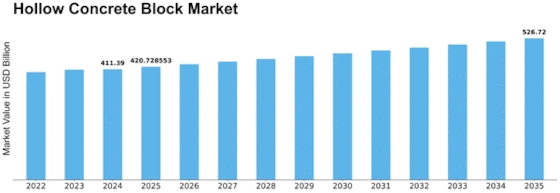

Hollow Concrete Block Market Size Graph
Author
Varsha More
Research Analyst

Experienced business professional with a demonstrated history of working in the CFnB industry. Skilled in market research, and market estimation. Strong professional with a Masters focused in marketing management.

Leave a Comment

FAQs

What is the projected market valuation of the Hollow Concrete Block Market by 2035?

<p>The Hollow Concrete Block Market is projected to reach a valuation of 526.72 USD Billion by 2035.</p>

What was the market valuation of the Hollow Concrete Block Market in 2024?

<p>In 2024, the Hollow Concrete Block Market was valued at 411.39 USD Billion.</p>

What is the expected CAGR for the Hollow Concrete Block Market during the forecast period 2025 - 2035?

<p>The expected CAGR for the Hollow Concrete Block Market during the forecast period 2025 - 2035 is 2.27%.</p>

Which type of hollow concrete blocks had the highest valuation in 2024?

<p>Smooth-Faced Concrete Blocks had the highest valuation at 329.11 USD Billion in 2024.</p>

What is the projected valuation for Split-Faced Concrete Blocks by 2035?

<p>The projected valuation for Split-Faced Concrete Blocks is expected to reach 106.68 USD Billion by 2035.</p>

Which application segment of the Hollow Concrete Block Market had the highest valuation in 2024?

<p>The Residential application segment had the highest valuation at 164.42 USD Billion in 2024.</p>

What is the projected valuation for the Commercial application segment by 2035?

The Commercial application segment is projected to reach a valuation of 160.0 USD Billion by 2035.

Who are the key players in the Hollow Concrete Block Market?

Key players in the Hollow Concrete Block Market include CEMEX, LafargeHolcim, Boral Limited, and HeidelbergCement AG.

What was the valuation of the Industrial application segment in 2024?

The Industrial application segment was valued at 123.97 USD Billion in 2024.

How does the market valuation of Smooth-Faced Concrete Blocks compare to Split-Faced Concrete Blocks in 2024?

In 2024, Smooth-Faced Concrete Blocks were valued at 329.11 USD Billion, significantly higher than the 82.28 USD Billion for Split-Faced Concrete Blocks.

Market Summary

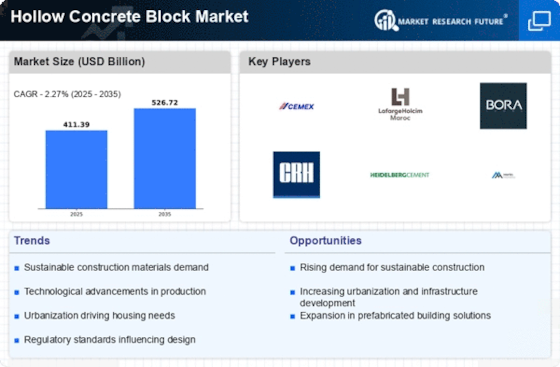
As per Market Research Future analysis, the Hollow Concrete Block Market Size was estimated at 411.39 USD Billion in 2024. The Hollow Concrete Block industry is projected to grow from 420.74 USD Billion in 2025 to 526.72 USD Billion by 2035, exhibiting a compound annual growth rate (CAGR) of 2.27% during the forecast period 2025 - 2035

Key Market Trends & Highlights

The Hollow Concrete Block Market is experiencing a dynamic shift towards sustainability and technological innovation.

  • The market is increasingly driven by a focus on sustainability and eco-friendly construction practices. North America remains the largest market, while Asia-Pacific is recognized as the fastest-growing region. Smooth-faced concrete blocks dominate the market, whereas split-faced concrete blocks are witnessing rapid growth. Rising demand for affordable housing and urbanization are key drivers propelling market expansion.

Market Size & Forecast

2024 Market Size 411.39 (USD Billion)
2035 Market Size 526.72 (USD Billion)
CAGR (2025 - 2035) 2.27%
Largest Regional Market Share in 2024 North America

Major Players

CEMEX (MX), LafargeHolcim (CH), Boral Limited (AU), CRH plc (IE), HeidelbergCement AG (DE), Martin Marietta Materials, Inc. (US), Oldcastle (US), Rinker Group Limited (AU), Tarmac (UK)

Market Trends

The Hollow Concrete Block Market is currently experiencing a dynamic phase characterized by evolving consumer preferences and increasing demand for sustainable construction materials. As urbanization accelerates globally, the need for durable and cost-effective building solutions has become paramount. Hollow concrete blocks, known for their thermal insulation properties and structural integrity, are gaining traction among builders and architects alike. This trend is further fueled by the growing emphasis on energy efficiency and eco-friendly construction practices, which align with contemporary environmental standards. Moreover, advancements in manufacturing technologies are enhancing the production processes of hollow concrete blocks, leading to improved quality and reduced costs. The integration of automation and innovative materials is likely to reshape the market landscape, making these blocks more accessible to a broader range of consumers. As the construction industry continues to evolve, the Hollow Concrete Block Market appears poised for substantial growth, driven by both technological advancements and shifting market demands.

Sustainability Focus

There is a noticeable shift towards sustainable building materials within the Hollow Concrete Block Market. This trend reflects a broader commitment to reducing environmental impact, as consumers and builders increasingly prioritize eco-friendly options. Hollow concrete blocks, with their potential for recycling and energy efficiency, align well with these sustainability goals.

Technological Advancements

Innovations in manufacturing processes are transforming the Hollow Concrete Block Market. Enhanced production techniques are leading to higher quality products and lower costs, making these blocks more appealing to a diverse range of construction projects. Automation and new material applications are likely to play a crucial role in this evolution.

Urbanization and Infrastructure Development

The ongoing trend of urbanization is significantly influencing the demand for hollow concrete blocks. As cities expand and infrastructure projects proliferate, the need for reliable and efficient building materials becomes increasingly critical. This trend suggests a robust future for the Hollow Concrete Block Market as it adapts to meet the needs of modern construction.

Hollow Concrete Block Market Market Drivers

Rising Demand for Affordable Housing

The increasing need for affordable housing solutions is a primary driver in the Hollow Concrete Block Market. As urban populations expand, the demand for cost-effective construction materials rises. Hollow concrete blocks, known for their durability and thermal efficiency, are often favored in residential projects. Recent data indicates that the construction sector is projected to grow at a rate of 5.5% annually, further fueling the demand for hollow concrete blocks. This trend is particularly evident in developing regions where housing shortages are acute, prompting builders to seek economical yet reliable materials. Consequently, the hollow concrete block market is likely to experience significant growth as it aligns with the pressing need for affordable housing options.

Government Initiatives and Regulations

Government policies and regulations aimed at promoting sustainable construction practices are shaping the Hollow Concrete Block Market. Many governments are implementing incentives for using eco-friendly materials and enforcing building codes that favor energy-efficient designs. These initiatives encourage builders to adopt hollow concrete blocks, which meet both regulatory requirements and consumer preferences for sustainability. Recent reports suggest that regions with stringent building regulations have seen a 15% increase in the use of hollow concrete blocks in construction projects. As these policies continue to evolve, they are likely to further bolster the hollow concrete block market, aligning industry practices with governmental sustainability goals.

Technological Innovations in Manufacturing

Technological advancements in the manufacturing processes of hollow concrete blocks are significantly influencing the Hollow Concrete Block Market. Innovations such as automated production lines and improved mixing techniques enhance the quality and consistency of the blocks. These advancements not only reduce production costs but also increase output efficiency, allowing manufacturers to meet rising demand. Recent statistics show that the adoption of advanced manufacturing technologies can lead to a 20% reduction in production time. As the industry embraces these technologies, the hollow concrete block market is poised for growth, driven by enhanced product offerings and competitive pricing.

Urbanization and Infrastructure Development

The ongoing trend of urbanization is a crucial driver for the Hollow Concrete Block Market. As cities expand, there is a heightened need for infrastructure development, including residential, commercial, and public buildings. Hollow concrete blocks are increasingly utilized in these projects due to their structural integrity and cost-effectiveness. Current projections indicate that urban areas will house nearly 70% of the global population by 2050, necessitating substantial construction efforts. This urban growth presents a significant opportunity for the hollow concrete block market, as builders seek reliable materials to support extensive infrastructure initiatives.

Sustainability and Eco-Friendly Construction

Sustainability has become a pivotal concern in the construction industry, influencing the Hollow Concrete Block Market. The shift towards eco-friendly building practices has led to an increased preference for materials that minimize environmental impact. Hollow concrete blocks, made from natural resources and often incorporating recycled materials, align well with these sustainability goals. Furthermore, they offer energy efficiency benefits, which are increasingly sought after in modern construction. Market analysis suggests that the demand for sustainable building materials is expected to rise by approximately 8% over the next five years, indicating a robust opportunity for hollow concrete blocks as builders strive to meet environmental standards.

Market Segment Insights

By Type: Smooth-Faced Concrete Blocks (Largest) vs. Split-Faced Concrete Blocks (Fastest-Growing)

<p>In the Hollow Concrete Block Market, the distribution of market share between split-faced concrete blocks and smooth-faced concrete blocks is notable. Smooth-faced concrete blocks dominate the market by providing a sleek and polished appearance, making them popular for aesthetic-focused construction projects. On the other hand, split-faced concrete blocks are gaining traction due to their appealing texture which offers both durability and an attractive facade, positioning them as a strong alternative in various applications.</p>

<p>Smooth-Faced Concrete Blocks (Dominant) vs. Split-Faced Concrete Blocks (Emerging)</p>

<p>Smooth-faced concrete blocks are known for their clean and refined finish, which makes them ideal for modern architecture and decorative purposes, thus establishing their dominant position in the Hollow Concrete Block Market. Their ability to blend with various design elements contributes significantly to their market presence. Conversely, split-faced concrete blocks have emerged as a preferred choice for builders seeking durability coupled with aesthetic appeal. Their textured surfaces not only enhance visual interest but also provide improved surface bonding for masonry. As construction trends lean towards more sustainable and robust materials, the demand for split-faced blocks is anticipated to grow rapidly.</p>

By Application: Residential (Largest) vs. Industrial (Fastest-Growing)

<p>In the Hollow Concrete Block Market, the application segment is primarily dominated by the residential sector, which utilizes these materials extensively for the construction of houses and low-rise buildings. This segment captures a significant market share due to the ongoing demand for affordable housing and the popularity of energy-efficient construction methods, which hollow concrete blocks provide. The commercial sector follows, leveraging these blocks for various structures, while the industrial application, though smaller in the market share, is growing rapidly due to infrastructural developments.</p>

<p>Residential (Dominant) vs. Industrial (Emerging)</p>

<p>The residential application of hollow concrete blocks remains the dominant segment, characterized by its significant usage in construction for single-family homes and large-scale residential projects. This segment benefits from the increasing trends in urbanization and the need for cost-effective building solutions. In contrast, the industrial segment is emerging as a significant growth area, driven by advancements in manufacturing processes and the need for durable materials in constructing warehouses and factories. As industries prioritize sustainability, the lightweight and energy-efficient characteristics of hollow concrete blocks are gaining traction, positioning them as ideal solutions in industrial applications.</p>

Get more detailed insights about Hollow Concrete Block Market Research Report - Global Forecast till 2035

Regional Insights

North America : Construction Growth Driver

North America is witnessing robust growth in the hollow concrete block market, driven by increasing construction activities and urbanization. The region holds the largest market share at approximately 40%, with the U.S. and Canada leading the demand. Regulatory support for sustainable building practices further fuels this growth, as governments promote energy-efficient construction methods. The U.S. is the primary market, with significant contributions from states like California and Texas. Key players such as Martin Marietta Materials, Inc. and Oldcastle dominate the landscape, ensuring a competitive environment. The presence of established companies and ongoing infrastructure projects are pivotal in maintaining market momentum.

Europe : Sustainable Building Focus

Europe is emerging as a significant player in the hollow concrete block market, holding a market share of around 30%. The region's growth is propelled by stringent building regulations aimed at sustainability and energy efficiency. Countries like Germany and France are at the forefront, implementing policies that encourage the use of eco-friendly materials in construction. Germany leads the market, supported by major companies like HeidelbergCement AG and CRH plc. The competitive landscape is characterized by innovation in product development, with a focus on lightweight and high-strength concrete blocks. The European market is also witnessing collaborations among manufacturers to enhance product offerings and meet regulatory standards.

Asia-Pacific : Rapid Urbanization Impact

Asia-Pacific is rapidly becoming a powerhouse in the hollow concrete block market, accounting for approximately 25% of the global share. The region's growth is driven by urbanization, population growth, and increasing infrastructure investments, particularly in countries like China and India. Government initiatives aimed at improving housing and infrastructure are significant catalysts for market expansion. China is the largest market, with substantial contributions from local manufacturers. The competitive landscape features key players like Boral Limited and Tarmac, who are adapting to local demands and regulations. The focus on affordable housing and sustainable construction practices is shaping the market dynamics in this region, fostering innovation and competition.

Middle East and Africa : Infrastructure Development Focus

The Middle East and Africa region is witnessing a surge in demand for hollow concrete blocks, driven by ongoing infrastructure projects and urban development. The market share is estimated at around 5%, with countries like the UAE and South Africa leading the charge. Government investments in infrastructure and housing are pivotal in stimulating market growth, supported by favorable regulations. The UAE is a key player, with significant contributions from local firms and international companies. The competitive landscape is evolving, with a mix of established players and new entrants focusing on innovative solutions. The region's unique challenges, such as climate considerations, are influencing product development and market strategies.

Key Players and Competitive Insights

Leading market players are investing heavily in research and development to expand their product lines, which will help the Hollow Concrete Block Market grow even more. Market participants are also undertaking various strategic activities to expand their footprint, with important market developments including new product launches, contractual agreements, mergers and acquisitions, higher investments, and collaboration with other organizations. The Hollow Concrete Block industry must offer cost-effective items to expand and survive in a more competitive and rising market climate. Manufacturing locally to minimize operational costs is one of the key business tactics manufacturers use in the Hollow Concrete Block industry to benefit clients and increase the market sector. The Hollow Concrete Block industry has offered some of the most significant advantages in recent years. Major players in the Hollow Concrete Block Market, including Columbia Block & Brick (US), McNear Brick & Block (US), Midland Concrete Products, Inc. (US), CEMEX S.A.B. de C.V. (Mexico), CRH plc (Ireland), Brampton Brick (US), and Taylor Concrete (US)., and others, are attempting to increase market demand by investing in research and development operations. VICAT France is a leading manufacturer of concrete admixtures and specialty building materials. The company is headquartered in Paris, France, and operates in over 50 countries. Bharathi Cement Corporation Pvt. Ltd., a group company of VICAT France, inaugurated its 0.75 MTPA bulk cement terminal in Coimbatore. The company also launched 'QUICKCEM,' a green cement to cater to Precast and Hollow Block Segments in Tamilnadu and Kerala. Al Weher is a manufacturer of roofing materials based in the United Arab Emirates (UAE). The company was founded in 1976 and is headquartered in Dubai.Al Weher's products include clay tiles, concrete tiles, and metal roofing sheets. Al Weher, with the help of Zenith Maschinenfabrik, commissioned another single-pallet plant with its Zenith 1500 single-pallet machine. The company will be able to produce 30,000 hollow blocks or 2,500 m² rectangular pavers with face mix concrete during an 8-hour shift.

Key Companies in the Hollow Concrete Block Market include

Industry Developments

October 2022: Bharathi Cement Corporation Pvt. Ltd., a group company of VICAT France, inaugurated its 0.75 MTPA bulk cement terminal in Coimbatore. The company also launched 'QUICKCEM,' a green cement to cater to Precast and Hollow Block Segments in Tamilnadu and Kerala.

February 2021: Al Weher, with the help of Zenith Maschinenfabrik, commissioned another single-pallet plant with its Zenith 1500 single-pallet machine. The company will be able to produce 30,000 hollow blocks or 2,500 m² rectangular pavers with face mix concrete during an 8-hour shift.

Future Outlook

Hollow Concrete Block Market Future Outlook

The Hollow Concrete Block Market is projected to grow at a 2.27% CAGR from 2025 to 2035, driven by urbanization, infrastructure development, and sustainability initiatives.

New opportunities lie in:

  • <p>Expansion into eco-friendly block production methods Development of automated manufacturing processes Strategic partnerships with construction firms for bulk supply contracts</p>

By 2035, the market is expected to solidify its position as a key player in the construction industry.

Market Segmentation

Hollow Concrete Block Market Type Outlook

  • Split-Faced Concrete Blocks
  • Smooth-Faced Concrete Blocks

Hollow Concrete Block Market Application Outlook

  • Residential
  • Commercial
  • Industrial

Report Scope

MARKET SIZE 2024 411.39(USD Billion)
MARKET SIZE 2025 420.74(USD Billion)
MARKET SIZE 2035 526.72(USD Billion)
COMPOUND ANNUAL GROWTH RATE (CAGR) 2.27% (2025 - 2035)
REPORT COVERAGE Revenue Forecast, Competitive Landscape, Growth Factors, and Trends
BASE YEAR 2024
Market Forecast Period 2025 - 2035
Historical Data 2019 - 2024
Market Forecast Units USD Billion
Key Companies Profiled CEMEX (MX), LafargeHolcim (CH), Boral Limited (AU), CRH plc (IE), HeidelbergCement AG (DE), Martin Marietta Materials, Inc. (US), Oldcastle (US), Rinker Group Limited (AU), Tarmac (UK)
Segments Covered Product Type, Application, Region
Key Market Opportunities Growing demand for sustainable construction materials enhances opportunities in the Hollow Concrete Block Market.
Key Market Dynamics Rising demand for sustainable construction materials drives innovation and competition in the hollow concrete block market.
Countries Covered North America, Europe, APAC, South America, MEA

FAQs

What is the projected market valuation of the Hollow Concrete Block Market by 2035?

<p>The Hollow Concrete Block Market is projected to reach a valuation of 526.72 USD Billion by 2035.</p>

What was the market valuation of the Hollow Concrete Block Market in 2024?

<p>In 2024, the Hollow Concrete Block Market was valued at 411.39 USD Billion.</p>

What is the expected CAGR for the Hollow Concrete Block Market during the forecast period 2025 - 2035?

<p>The expected CAGR for the Hollow Concrete Block Market during the forecast period 2025 - 2035 is 2.27%.</p>

Which type of hollow concrete blocks had the highest valuation in 2024?

<p>Smooth-Faced Concrete Blocks had the highest valuation at 329.11 USD Billion in 2024.</p>

What is the projected valuation for Split-Faced Concrete Blocks by 2035?

<p>The projected valuation for Split-Faced Concrete Blocks is expected to reach 106.68 USD Billion by 2035.</p>

Which application segment of the Hollow Concrete Block Market had the highest valuation in 2024?

<p>The Residential application segment had the highest valuation at 164.42 USD Billion in 2024.</p>

What is the projected valuation for the Commercial application segment by 2035?

The Commercial application segment is projected to reach a valuation of 160.0 USD Billion by 2035.

Who are the key players in the Hollow Concrete Block Market?

Key players in the Hollow Concrete Block Market include CEMEX, LafargeHolcim, Boral Limited, and HeidelbergCement AG.

What was the valuation of the Industrial application segment in 2024?

The Industrial application segment was valued at 123.97 USD Billion in 2024.

How does the market valuation of Smooth-Faced Concrete Blocks compare to Split-Faced Concrete Blocks in 2024?

In 2024, Smooth-Faced Concrete Blocks were valued at 329.11 USD Billion, significantly higher than the 82.28 USD Billion for Split-Faced Concrete Blocks.

  1. SECTION I: EXECUTIVE SUMMARY AND KEY HIGHLIGHTS
    1. | 1.1 EXECUTIVE SUMMARY
    2. | | 1.1.1 Market Overview
    3. | | 1.1.2 Key Findings
    4. | | 1.1.3 Market Segmentation
    5. | | 1.1.4 Competitive Landscape
    6. | | 1.1.5 Challenges and Opportunities
    7. | | 1.1.6 Future Outlook
  2. SECTION II: SCOPING, METHODOLOGY AND MARKET STRUCTURE
    1. | 2.1 MARKET INTRODUCTION
    2. | | 2.1.1 Definition
    3. | | 2.1.2 Scope of the study
    4. | | | 2.1.2.1 Research Objective
    5. | | | 2.1.2.2 Assumption
    6. | | | 2.1.2.3 Limitations
    7. | 2.2 RESEARCH METHODOLOGY
    8. | | 2.2.1 Overview
    9. | | 2.2.2 Data Mining
    10. | | 2.2.3 Secondary Research
    11. | | 2.2.4 Primary Research
    12. | | | 2.2.4.1 Primary Interviews and Information Gathering Process
    13. | | | 2.2.4.2 Breakdown of Primary Respondents
    14. | | 2.2.5 Forecasting Model
    15. | | 2.2.6 Market Size Estimation
    16. | | | 2.2.6.1 Bottom-Up Approach
    17. | | | 2.2.6.2 Top-Down Approach
    18. | | 2.2.7 Data Triangulation
    19. | | 2.2.8 Validation
  3. SECTION III: QUALITATIVE ANALYSIS
    1. | 3.1 MARKET DYNAMICS
    2. | | 3.1.1 Overview
    3. | | 3.1.2 Drivers
    4. | | 3.1.3 Restraints
    5. | | 3.1.4 Opportunities
    6. | 3.2 MARKET FACTOR ANALYSIS
    7. | | 3.2.1 Value chain Analysis
    8. | | 3.2.2 Porter's Five Forces Analysis
    9. | | | 3.2.2.1 Bargaining Power of Suppliers
    10. | | | 3.2.2.2 Bargaining Power of Buyers
    11. | | | 3.2.2.3 Threat of New Entrants
    12. | | | 3.2.2.4 Threat of Substitutes
    13. | | | 3.2.2.5 Intensity of Rivalry
    14. | | 3.2.3 COVID-19 Impact Analysis
    15. | | | 3.2.3.1 Market Impact Analysis
    16. | | | 3.2.3.2 Regional Impact
    17. | | | 3.2.3.3 Opportunity and Threat Analysis
  4. SECTION IV: QUANTITATIVE ANALYSIS
    1. | 4.1 Packaging & Transport, BY Type (USD Billion)
    2. | | 4.1.1 Split-Faced Concrete Blocks
    3. | | 4.1.2 Smooth-Faced Concrete Blocks
    4. | 4.2 Packaging & Transport, BY Application (USD Billion)
    5. | | 4.2.1 Residential
    6. | | 4.2.2 Commercial
    7. | | 4.2.3 Industrial
    8. | 4.3 Packaging & Transport, BY Region (USD Billion)
    9. | | 4.3.1 North America
    10. | | | 4.3.1.1 US
    11. | | | 4.3.1.2 Canada
    12. | | 4.3.2 Europe
    13. | | | 4.3.2.1 Germany
    14. | | | 4.3.2.2 UK
    15. | | | 4.3.2.3 France
    16. | | | 4.3.2.4 Russia
    17. | | | 4.3.2.5 Italy
    18. | | | 4.3.2.6 Spain
    19. | | | 4.3.2.7 Rest of Europe
    20. | | 4.3.3 APAC
    21. | | | 4.3.3.1 China
    22. | | | 4.3.3.2 India
    23. | | | 4.3.3.3 Japan
    24. | | | 4.3.3.4 South Korea
    25. | | | 4.3.3.5 Malaysia
    26. | | | 4.3.3.6 Thailand
    27. | | | 4.3.3.7 Indonesia
    28. | | | 4.3.3.8 Rest of APAC
    29. | | 4.3.4 South America
    30. | | | 4.3.4.1 Brazil
    31. | | | 4.3.4.2 Mexico
    32. | | | 4.3.4.3 Argentina
    33. | | | 4.3.4.4 Rest of South America
    34. | | 4.3.5 MEA
    35. | | | 4.3.5.1 GCC Countries
    36. | | | 4.3.5.2 South Africa
    37. | | | 4.3.5.3 Rest of MEA
  5. SECTION V: COMPETITIVE ANALYSIS
    1. | 5.1 Competitive Landscape
    2. | | 5.1.1 Overview
    3. | | 5.1.2 Competitive Analysis
    4. | | 5.1.3 Market share Analysis
    5. | | 5.1.4 Major Growth Strategy in the Packaging & Transport
    6. | | 5.1.5 Competitive Benchmarking
    7. | | 5.1.6 Leading Players in Terms of Number of Developments in the Packaging & Transport
    8. | | 5.1.7 Key developments and growth strategies
    9. | | | 5.1.7.1 New Product Launch/Service Deployment
    10. | | | 5.1.7.2 Merger & Acquisitions
    11. | | | 5.1.7.3 Joint Ventures
    12. | | 5.1.8 Major Players Financial Matrix
    13. | | | 5.1.8.1 Sales and Operating Income
    14. | | | 5.1.8.2 Major Players R&D Expenditure. 2023
    15. | 5.2 Company Profiles
    16. | | 5.2.1 CEMEX (MX)
    17. | | | 5.2.1.1 Financial Overview
    18. | | | 5.2.1.2 Products Offered
    19. | | | 5.2.1.3 Key Developments
    20. | | | 5.2.1.4 SWOT Analysis
    21. | | | 5.2.1.5 Key Strategies
    22. | | 5.2.2 LafargeHolcim (CH)
    23. | | | 5.2.2.1 Financial Overview
    24. | | | 5.2.2.2 Products Offered
    25. | | | 5.2.2.3 Key Developments
    26. | | | 5.2.2.4 SWOT Analysis
    27. | | | 5.2.2.5 Key Strategies
    28. | | 5.2.3 Boral Limited (AU)
    29. | | | 5.2.3.1 Financial Overview
    30. | | | 5.2.3.2 Products Offered
    31. | | | 5.2.3.3 Key Developments
    32. | | | 5.2.3.4 SWOT Analysis
    33. | | | 5.2.3.5 Key Strategies
    34. | | 5.2.4 CRH plc (IE)
    35. | | | 5.2.4.1 Financial Overview
    36. | | | 5.2.4.2 Products Offered
    37. | | | 5.2.4.3 Key Developments
    38. | | | 5.2.4.4 SWOT Analysis
    39. | | | 5.2.4.5 Key Strategies
    40. | | 5.2.5 HeidelbergCement AG (DE)
    41. | | | 5.2.5.1 Financial Overview
    42. | | | 5.2.5.2 Products Offered
    43. | | | 5.2.5.3 Key Developments
    44. | | | 5.2.5.4 SWOT Analysis
    45. | | | 5.2.5.5 Key Strategies
    46. | | 5.2.6 Martin Marietta Materials, Inc. (US)
    47. | | | 5.2.6.1 Financial Overview
    48. | | | 5.2.6.2 Products Offered
    49. | | | 5.2.6.3 Key Developments
    50. | | | 5.2.6.4 SWOT Analysis
    51. | | | 5.2.6.5 Key Strategies
    52. | | 5.2.7 Oldcastle (US)
    53. | | | 5.2.7.1 Financial Overview
    54. | | | 5.2.7.2 Products Offered
    55. | | | 5.2.7.3 Key Developments
    56. | | | 5.2.7.4 SWOT Analysis
    57. | | | 5.2.7.5 Key Strategies
    58. | | 5.2.8 Rinker Group Limited (AU)
    59. | | | 5.2.8.1 Financial Overview
    60. | | | 5.2.8.2 Products Offered
    61. | | | 5.2.8.3 Key Developments
    62. | | | 5.2.8.4 SWOT Analysis
    63. | | | 5.2.8.5 Key Strategies
    64. | | 5.2.9 Tarmac (UK)
    65. | | | 5.2.9.1 Financial Overview
    66. | | | 5.2.9.2 Products Offered
    67. | | | 5.2.9.3 Key Developments
    68. | | | 5.2.9.4 SWOT Analysis
    69. | | | 5.2.9.5 Key Strategies
    70. | 5.3 Appendix
    71. | | 5.3.1 References
    72. | | 5.3.2 Related Reports
  6. LIST OF FIGURES
    1. | 6.1 MARKET SYNOPSIS
    2. | 6.2 NORTH AMERICA MARKET ANALYSIS
    3. | 6.3 US MARKET ANALYSIS BY TYPE
    4. | 6.4 US MARKET ANALYSIS BY APPLICATION
    5. | 6.5 CANADA MARKET ANALYSIS BY TYPE
    6. | 6.6 CANADA MARKET ANALYSIS BY APPLICATION
    7. | 6.7 EUROPE MARKET ANALYSIS
    8. | 6.8 GERMANY MARKET ANALYSIS BY TYPE
    9. | 6.9 GERMANY MARKET ANALYSIS BY APPLICATION
    10. | 6.10 UK MARKET ANALYSIS BY TYPE
    11. | 6.11 UK MARKET ANALYSIS BY APPLICATION
    12. | 6.12 FRANCE MARKET ANALYSIS BY TYPE
    13. | 6.13 FRANCE MARKET ANALYSIS BY APPLICATION
    14. | 6.14 RUSSIA MARKET ANALYSIS BY TYPE
    15. | 6.15 RUSSIA MARKET ANALYSIS BY APPLICATION
    16. | 6.16 ITALY MARKET ANALYSIS BY TYPE
    17. | 6.17 ITALY MARKET ANALYSIS BY APPLICATION
    18. | 6.18 SPAIN MARKET ANALYSIS BY TYPE
    19. | 6.19 SPAIN MARKET ANALYSIS BY APPLICATION
    20. | 6.20 REST OF EUROPE MARKET ANALYSIS BY TYPE
    21. | 6.21 REST OF EUROPE MARKET ANALYSIS BY APPLICATION
    22. | 6.22 APAC MARKET ANALYSIS
    23. | 6.23 CHINA MARKET ANALYSIS BY TYPE
    24. | 6.24 CHINA MARKET ANALYSIS BY APPLICATION
    25. | 6.25 INDIA MARKET ANALYSIS BY TYPE
    26. | 6.26 INDIA MARKET ANALYSIS BY APPLICATION
    27. | 6.27 JAPAN MARKET ANALYSIS BY TYPE
    28. | 6.28 JAPAN MARKET ANALYSIS BY APPLICATION
    29. | 6.29 SOUTH KOREA MARKET ANALYSIS BY TYPE
    30. | 6.30 SOUTH KOREA MARKET ANALYSIS BY APPLICATION
    31. | 6.31 MALAYSIA MARKET ANALYSIS BY TYPE
    32. | 6.32 MALAYSIA MARKET ANALYSIS BY APPLICATION
    33. | 6.33 THAILAND MARKET ANALYSIS BY TYPE
    34. | 6.34 THAILAND MARKET ANALYSIS BY APPLICATION
    35. | 6.35 INDONESIA MARKET ANALYSIS BY TYPE
    36. | 6.36 INDONESIA MARKET ANALYSIS BY APPLICATION
    37. | 6.37 REST OF APAC MARKET ANALYSIS BY TYPE
    38. | 6.38 REST OF APAC MARKET ANALYSIS BY APPLICATION
    39. | 6.39 SOUTH AMERICA MARKET ANALYSIS
    40. | 6.40 BRAZIL MARKET ANALYSIS BY TYPE
    41. | 6.41 BRAZIL MARKET ANALYSIS BY APPLICATION
    42. | 6.42 MEXICO MARKET ANALYSIS BY TYPE
    43. | 6.43 MEXICO MARKET ANALYSIS BY APPLICATION
    44. | 6.44 ARGENTINA MARKET ANALYSIS BY TYPE
    45. | 6.45 ARGENTINA MARKET ANALYSIS BY APPLICATION
    46. | 6.46 REST OF SOUTH AMERICA MARKET ANALYSIS BY TYPE
    47. | 6.47 REST OF SOUTH AMERICA MARKET ANALYSIS BY APPLICATION
    48. | 6.48 MEA MARKET ANALYSIS
    49. | 6.49 GCC COUNTRIES MARKET ANALYSIS BY TYPE
    50. | 6.50 GCC COUNTRIES MARKET ANALYSIS BY APPLICATION
    51. | 6.51 SOUTH AFRICA MARKET ANALYSIS BY TYPE
    52. | 6.52 SOUTH AFRICA MARKET ANALYSIS BY APPLICATION
    53. | 6.53 REST OF MEA MARKET ANALYSIS BY TYPE
    54. | 6.54 REST OF MEA MARKET ANALYSIS BY APPLICATION
    55. | 6.55 KEY BUYING CRITERIA OF PACKAGING & TRANSPORT
    56. | 6.56 RESEARCH PROCESS OF MRFR
    57. | 6.57 DRO ANALYSIS OF PACKAGING & TRANSPORT
    58. | 6.58 DRIVERS IMPACT ANALYSIS: PACKAGING & TRANSPORT
    59. | 6.59 RESTRAINTS IMPACT ANALYSIS: PACKAGING & TRANSPORT
    60. | 6.60 SUPPLY / VALUE CHAIN: PACKAGING & TRANSPORT
    61. | 6.61 PACKAGING & TRANSPORT, BY TYPE, 2024 (% SHARE)
    62. | 6.62 PACKAGING & TRANSPORT, BY TYPE, 2024 TO 2035 (USD Billion)
    63. | 6.63 PACKAGING & TRANSPORT, BY APPLICATION, 2024 (% SHARE)
    64. | 6.64 PACKAGING & TRANSPORT, BY APPLICATION, 2024 TO 2035 (USD Billion)
    65. | 6.65 BENCHMARKING OF MAJOR COMPETITORS
  7. LIST OF TABLES
    1. | 7.1 LIST OF ASSUMPTIONS
    2. | | 7.1.1
    3. | 7.2 North America MARKET SIZE ESTIMATES; FORECAST
    4. | | 7.2.1 BY TYPE, 2025-2035 (USD Billion)
    5. | | 7.2.2 BY APPLICATION, 2025-2035 (USD Billion)
    6. | 7.3 US MARKET SIZE ESTIMATES; FORECAST
    7. | | 7.3.1 BY TYPE, 2025-2035 (USD Billion)
    8. | | 7.3.2 BY APPLICATION, 2025-2035 (USD Billion)
    9. | 7.4 Canada MARKET SIZE ESTIMATES; FORECAST
    10. | | 7.4.1 BY TYPE, 2025-2035 (USD Billion)
    11. | | 7.4.2 BY APPLICATION, 2025-2035 (USD Billion)
    12. | 7.5 Europe MARKET SIZE ESTIMATES; FORECAST
    13. | | 7.5.1 BY TYPE, 2025-2035 (USD Billion)
    14. | | 7.5.2 BY APPLICATION, 2025-2035 (USD Billion)
    15. | 7.6 Germany MARKET SIZE ESTIMATES; FORECAST
    16. | | 7.6.1 BY TYPE, 2025-2035 (USD Billion)
    17. | | 7.6.2 BY APPLICATION, 2025-2035 (USD Billion)
    18. | 7.7 UK MARKET SIZE ESTIMATES; FORECAST
    19. | | 7.7.1 BY TYPE, 2025-2035 (USD Billion)
    20. | | 7.7.2 BY APPLICATION, 2025-2035 (USD Billion)
    21. | 7.8 France MARKET SIZE ESTIMATES; FORECAST
    22. | | 7.8.1 BY TYPE, 2025-2035 (USD Billion)
    23. | | 7.8.2 BY APPLICATION, 2025-2035 (USD Billion)
    24. | 7.9 Russia MARKET SIZE ESTIMATES; FORECAST
    25. | | 7.9.1 BY TYPE, 2025-2035 (USD Billion)
    26. | | 7.9.2 BY APPLICATION, 2025-2035 (USD Billion)
    27. | 7.10 Italy MARKET SIZE ESTIMATES; FORECAST
    28. | | 7.10.1 BY TYPE, 2025-2035 (USD Billion)
    29. | | 7.10.2 BY APPLICATION, 2025-2035 (USD Billion)
    30. | 7.11 Spain MARKET SIZE ESTIMATES; FORECAST
    31. | | 7.11.1 BY TYPE, 2025-2035 (USD Billion)
    32. | | 7.11.2 BY APPLICATION, 2025-2035 (USD Billion)
    33. | 7.12 Rest of Europe MARKET SIZE ESTIMATES; FORECAST
    34. | | 7.12.1 BY TYPE, 2025-2035 (USD Billion)
    35. | | 7.12.2 BY APPLICATION, 2025-2035 (USD Billion)
    36. | 7.13 APAC MARKET SIZE ESTIMATES; FORECAST
    37. | | 7.13.1 BY TYPE, 2025-2035 (USD Billion)
    38. | | 7.13.2 BY APPLICATION, 2025-2035 (USD Billion)
    39. | 7.14 China MARKET SIZE ESTIMATES; FORECAST
    40. | | 7.14.1 BY TYPE, 2025-2035 (USD Billion)
    41. | | 7.14.2 BY APPLICATION, 2025-2035 (USD Billion)
    42. | 7.15 India MARKET SIZE ESTIMATES; FORECAST
    43. | | 7.15.1 BY TYPE, 2025-2035 (USD Billion)
    44. | | 7.15.2 BY APPLICATION, 2025-2035 (USD Billion)
    45. | 7.16 Japan MARKET SIZE ESTIMATES; FORECAST
    46. | | 7.16.1 BY TYPE, 2025-2035 (USD Billion)
    47. | | 7.16.2 BY APPLICATION, 2025-2035 (USD Billion)
    48. | 7.17 South Korea MARKET SIZE ESTIMATES; FORECAST
    49. | | 7.17.1 BY TYPE, 2025-2035 (USD Billion)
    50. | | 7.17.2 BY APPLICATION, 2025-2035 (USD Billion)
    51. | 7.18 Malaysia MARKET SIZE ESTIMATES; FORECAST
    52. | | 7.18.1 BY TYPE, 2025-2035 (USD Billion)
    53. | | 7.18.2 BY APPLICATION, 2025-2035 (USD Billion)
    54. | 7.19 Thailand MARKET SIZE ESTIMATES; FORECAST
    55. | | 7.19.1 BY TYPE, 2025-2035 (USD Billion)
    56. | | 7.19.2 BY APPLICATION, 2025-2035 (USD Billion)
    57. | 7.20 Indonesia MARKET SIZE ESTIMATES; FORECAST
    58. | | 7.20.1 BY TYPE, 2025-2035 (USD Billion)
    59. | | 7.20.2 BY APPLICATION, 2025-2035 (USD Billion)
    60. | 7.21 Rest of APAC MARKET SIZE ESTIMATES; FORECAST
    61. | | 7.21.1 BY TYPE, 2025-2035 (USD Billion)
    62. | | 7.21.2 BY APPLICATION, 2025-2035 (USD Billion)
    63. | 7.22 South America MARKET SIZE ESTIMATES; FORECAST
    64. | | 7.22.1 BY TYPE, 2025-2035 (USD Billion)
    65. | | 7.22.2 BY APPLICATION, 2025-2035 (USD Billion)
    66. | 7.23 Brazil MARKET SIZE ESTIMATES; FORECAST
    67. | | 7.23.1 BY TYPE, 2025-2035 (USD Billion)
    68. | | 7.23.2 BY APPLICATION, 2025-2035 (USD Billion)
    69. | 7.24 Mexico MARKET SIZE ESTIMATES; FORECAST
    70. | | 7.24.1 BY TYPE, 2025-2035 (USD Billion)
    71. | | 7.24.2 BY APPLICATION, 2025-2035 (USD Billion)
    72. | 7.25 Argentina MARKET SIZE ESTIMATES; FORECAST
    73. | | 7.25.1 BY TYPE, 2025-2035 (USD Billion)
    74. | | 7.25.2 BY APPLICATION, 2025-2035 (USD Billion)
    75. | 7.26 Rest of South America MARKET SIZE ESTIMATES; FORECAST
    76. | | 7.26.1 BY TYPE, 2025-2035 (USD Billion)
    77. | | 7.26.2 BY APPLICATION, 2025-2035 (USD Billion)
    78. | 7.27 MEA MARKET SIZE ESTIMATES; FORECAST
    79. | | 7.27.1 BY TYPE, 2025-2035 (USD Billion)
    80. | | 7.27.2 BY APPLICATION, 2025-2035 (USD Billion)
    81. | 7.28 GCC Countries MARKET SIZE ESTIMATES; FORECAST
    82. | | 7.28.1 BY TYPE, 2025-2035 (USD Billion)
    83. | | 7.28.2 BY APPLICATION, 2025-2035 (USD Billion)
    84. | 7.29 South Africa MARKET SIZE ESTIMATES; FORECAST
    85. | | 7.29.1 BY TYPE, 2025-2035 (USD Billion)
    86. | | 7.29.2 BY APPLICATION, 2025-2035 (USD Billion)
    87. | 7.30 Rest of MEA MARKET SIZE ESTIMATES; FORECAST
    88. | | 7.30.1 BY TYPE, 2025-2035 (USD Billion)
    89. | | 7.30.2 BY APPLICATION, 2025-2035 (USD Billion)
    90. | 7.31 PRODUCT LAUNCH/PRODUCT DEVELOPMENT/APPROVAL
    91. | | 7.31.1
    92. | 7.32 ACQUISITION/PARTNERSHIP
    93. | | 7.32.1

Packaging & Transport Market Segmentation

Packaging & Transport By Type (USD Billion, 2025-2035)

  • Split-Faced Concrete Blocks
  • Smooth-Faced Concrete Blocks

Packaging & Transport By Application (USD Billion, 2025-2035)

  • Residential
  • Commercial
  • Industrial
Infographic

Free Sample Request

Kindly complete the form below to receive a free sample of this Report

Get Free Sample

Customer Strories

Compare Licence

×
Features License Type
Single User Multiuser License Enterprise User
Price $4,950 $5,950 $7,250
Maximum User Access Limit 1 User Upto 10 Users Unrestricted Access Throughout the Organization
Free Customization
Direct Access to Analyst
Deliverable Format
Platform Access
Discount on Next Purchase 10% 15% 15%
Printable Versions