×
Request Free Sample ×

Kindly complete the form below to receive a free sample of this Report

* Please use a valid business email

Leading companies partner with us for data-driven Insights

clients tt-cursor
Hero Background
English
Chinese
French
Japanese
Korean
German
Spanish

High Temperature Elastomers Market Trends

ID: MRFR/CnM/3992-HCR
137 Pages
Chitranshi Jaiswal
October 2025

High-Temperature Elastomers Marke Research Information by product type (silicone elastomers, fluorocarbon elastomers, fluorosilicone elastomers, perfluoro elastomers), end-user industry (automobiles, construction, electronics) – Forecast till 2035

Share:
Download PDF ×

We do not share your information with anyone. However, we may send you emails based on your report interest from time to time. You may contact us at any time to opt-out.

High Temperature Elastomers Market Infographic
Purchase Options

Market Trends

Key Emerging Trends in the High Temperature Elastomers Market

The High Temperature Elastomers Market has been undergoing significant trends and shifts recently, reflecting the transient nature of industrial environment. High temperature elastomers which are often referred to as heat-resistant polymers play a vital role in many sectors where there are extreme temperatures involved. They are specifically created to keep their elasticity even under harsh conditions hence indispensable in areas like automobiles, aircrafts, electrical/electronics and industrial manufacturing.

One such trend in the High Temperature Elastomer’s Market is the growing use of silicone elastomer materials. Silicone elastomer have excellent thermal stability characteristics as well as ageing resistance properties besides great electrical insulating ability. These qualities make them perfect for use in components such as gaskets seals used within automotives among other critical applications where there is exposure to extreme temperatures. The reason why there has been rising demand for Silicone high temperature elastomers by players such as automotive industry because a need has risen for them due engine parts or exhaust systems which are durable.

Another notable trend involves increasing focus on R&D endeavors aimed at improving performance of high temperature elastomers. Manufacturers are investing in new formulations and technologies that will enhance heat resistance as well as overall durability of the elastomeric materials. This involves exploring advanced polymer chemistries as well as innovative processing techniques to meet the changing needs of different industries’ end-users. As a result, market is being presented with high performance elastomers that can withstand more adverse temperatures.

Additionally, aerospace industry also contributes to trends in High Temperature Elastomers Market. The aerospace segment is leveraging on use of advanced materials including high temperature elastomers to develop seals, gaskets and O-rings among others due to increased demand for lightweight and fuel efficient aircrafts. These elastomers help improve the effectiveness and safety of aerospace applications by offering dependable sealing solutions in high-temperature environments such as airplane engines.

Diverse factors including technological advancements, industry-specific demands and environmental considerations are driving significant changes in the High Temperature Elastomer’s Market.The increasing use of silicone elastomers, ongoing research and development efforts, the aerospace industry's emphasis on lightweight materials, and the growing importance of sustainability are shaping the market trends in high temperature elastomers. As businesses continue to evolve calling for sturdier materials that are also eco-friendly; hence this implies that there will be continuous growth and innovation within this sector which manufacture high temperature elastomers.


Author
Chitranshi Jaiswal
Research Analyst Level I

In her 3 years of experience in the market research field, she has handled critical cross-domain projects. She has an in-depth knowledge of market estimation & analysis, problem-solving, primary as well as secondary research, and team management.She holds an engineering degree and is an MBA professional from a well-known university, capable of evaluating the market and competitive conditions. An exceptional strategist with excellent communication skills and a passion for delivering cutting-edge & practical insights for the market. Proficient in multi-tasking, and can successfully deal with competing demands, while maintaining complete confidentiality. Generated business through active client and project development, networking, and high-quality responses. Her knowledge and skills have helped in making solid business decisions, securing funding from investors, and avoiding business failures.

Leave a Comment

FAQs

What is the forecast period of High Temperature Elastomers Market research report?

The forecast period for High Temperature Elastomers Market research report is 2025-2035.

Which region will lead the High Temperature Elastomers Market?

High Temperature Elastomers Market is dominated by APAC region.

Who are the key players in the High Temperature Elastomers Market?

The major players are Dow Corning Corporation (U.S.), Wacker Chemie Ag( Germany), Momentive (U.S.), Shin-Etsu Chemical Co., Ltd (Japan), China National Bluestar (Group) Co. Ltd (China), Daikin Industries Ltd (Japan), DuPont (U.S), KCC Corporation (South Korea), Solvay S.A (Belgium), 3M Company (U.S.)

Market Summary

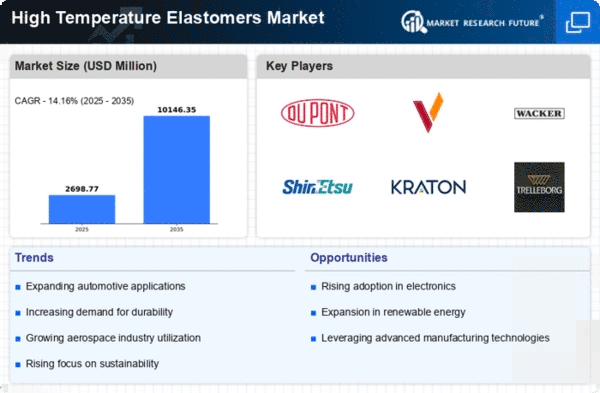
As per MRFR analysis, the High Temperature Elastomers Market Size was estimated at 2364.02 USD Million in 2024. The High Temperature Elastomers industry is projected to grow from 2698.77 USD Million in 2025 to 10146.35 USD Million by 2035, exhibiting a compound annual growth rate (CAGR) of 14.16 during the forecast period 2025 - 2035.

Key Market Trends & Highlights

The High Temperature Elastomers Market is experiencing robust growth driven by technological advancements and increasing demand across various sectors.

  • North America remains the largest market for high temperature elastomers, driven by its strong automotive sector.
  • Asia-Pacific is emerging as the fastest-growing region, fueled by rapid industrialization and technological innovations.
  • The automotive segment dominates the market, while the aerospace segment is witnessing the fastest growth due to rising demand for advanced materials.
  • Key market drivers include the rising demand in the automotive sector and increasing regulatory standards pushing for higher performance materials.

Market Size & Forecast

2024 Market Size 2364.02 (USD Million)
2035 Market Size 10146.35 (USD Million)
CAGR (2025 - 2035) 14.16%
Largest Regional Market Share in 2024 North America

Major Players

DuPont (US), Momentive (US), Wacker Chemie (DE), Shin-Etsu Chemical (JP), Kraton Corporation (US), Trelleborg (SE), Elastomer Solutions (US), Hexpol (SE), Zeon Corporation (JP)

Market Trends

The High Temperature Elastomers Market is currently experiencing a notable transformation, driven by advancements in material science and increasing demand across various industries. These elastomers, known for their ability to withstand extreme temperatures, are finding applications in sectors such as automotive, aerospace, and electronics. The growing emphasis on energy efficiency and sustainability is prompting manufacturers to explore innovative formulations that enhance performance while minimizing environmental impact. As industries evolve, the need for high-performance materials that can endure harsh conditions becomes increasingly critical, suggesting a robust future for this market. In addition, the High Temperature Elastomers Market is witnessing a shift towards customization and specialized solutions. Companies are investing in research and development to create tailored products that meet specific client requirements. This trend indicates a move away from generic offerings, as businesses seek to differentiate themselves in a competitive landscape. Furthermore, the integration of advanced technologies, such as additive manufacturing, is likely to reshape production processes, enhancing efficiency and reducing lead times. Overall, the market appears poised for growth, driven by innovation and a focus on meeting diverse industrial needs.

Sustainability Initiatives

The High Temperature Elastomers Market is increasingly influenced by sustainability initiatives. Manufacturers are exploring eco-friendly materials and production methods to reduce their carbon footprint. This trend reflects a broader commitment to environmental responsibility, as companies aim to align with global sustainability goals.

Customization and Specialization

Customization is becoming a prominent trend within the High Temperature Elastomers Market. Businesses are focusing on developing specialized products tailored to meet unique customer demands. This shift towards bespoke solutions allows companies to differentiate themselves and cater to specific industry requirements.

Technological Advancements

Technological advancements are reshaping the High Temperature Elastomers Market. Innovations in material science and production techniques are enhancing the performance and durability of elastomers. These developments are likely to drive market growth, as industries seek high-performance materials capable of withstanding extreme conditions.

High Temperature Elastomers Market Market Drivers

Growing Demand from Automotive Sector

The automotive industry is a significant driver for the Global High-Temperature Elastomers Market Industry, as manufacturers increasingly seek materials that can withstand extreme conditions. High-temperature elastomers are utilized in various automotive applications, including seals, gaskets, and hoses, which require durability and resistance to heat. The market is projected to reach 19.1 USD Billion in 2024, reflecting the rising demand for advanced materials in vehicle production. As electric vehicles gain traction, the need for high-performance elastomers is likely to increase, further propelling market growth. This trend indicates a robust future for high-temperature elastomers in automotive applications.

Market Segment Insights

By Application: Automotive (Largest) vs. Aerospace (Fastest-Growing)

In the High Temperature Elastomers Market, the automotive sector represents the largest application segment, driven by the increasing demand for durable and high-performance materials in automotive components. This segment has carved out a significant market share, reflecting its essential role in applications such as seals, gaskets, and hoses that need to withstand extreme temperatures. Following automotive, the aerospace sector is experiencing rapid growth, fueled by innovations in aircraft design and the need for lightweight, high-temperature resistant materials to enhance performance and fuel efficiency. The growth trends within the High Temperature Elastomers Market are prominently influenced by technological advancements and the evolving requirements of various industries. The aerospace application is anticipated to witness the fastest growth due to increased air travel and the subsequent demand for aircraft that utilize advanced elastomer technologies. Meanwhile, the automotive sector continues to expand, focusing on sustainability and performance, pushing manufacturers towards high-temperature elastomer solutions to meet stringent regulations and enhance the longevity of automotive components.

Automotive: Dominant vs. Aerospace: Emerging

In the High Temperature Elastomers Market, the automotive sector stands out as the dominant application, leveraging its established supply chain and extensive usage of elastomers for components requiring high-performance in challenging conditions. Automotive applications often prioritize durability and resistance to extreme climates, making high-temperature elastomers essential for parts like exhaust systems, engine seals, and brake components. On the other hand, the aerospace sector, while emerging, is rapidly progressing due to increasing advancements in technology and materials. The emphasis on weight reduction and fuel efficiency in aircraft design propels the demand for high-temperature elastomers, enabling innovative designs that can withstand the rigors of high altitude and varying temperatures, thus positioning aerospace as a critical growth frontier for elastomer manufacturers.

By End Use: Seals (Largest) vs. Gaskets (Fastest-Growing)

In the High Temperature Elastomers Market, the end-use distribution reveals that seals hold the largest share due to their critical applications across various industries. The automotive and aerospace sectors significantly contribute to this dominance, as seals are essential for ensuring performance and reliability. Following seals are gaskets, which are witnessing rapid growth, driven by increased demand for energy-efficient solutions and heightened industrial activity. Hoses, O-Rings, and insulation materials also play important roles, but their market shares are comparatively smaller.

Seals (Dominant) vs. Gaskets (Emerging)

Seals are crucial components in numerous applications, notably in automotive, aerospace, and industrial sectors, where they prevent fluid leakage and enhance system reliability. Their ability to withstand extreme temperatures and harsh conditions makes them essential for high-performance scenarios. Conversely, gaskets are emerging as key players, especially in industries focusing on energy efficiency and safety. As technology advances, gaskets that offer superior sealing capabilities and can operate under high thermal stress are gaining traction. Both segments contribute significantly to the high temperature elastomers market, with seals dominating the landscape and gaskets rapidly evolving to meet contemporary demands.

By Material Type: Silicone (Largest) vs. Fluoroelastomer (Fastest-Growing)

The High Temperature Elastomers Market showcases a diverse range of material types, with Silicone leading the charge as the dominant player. Its superior thermal stability and flexibility make it the preferred choice for high-temperature applications, accounting for a significant portion of the market share. Fluoroelastomer, on the other hand, is rapidly gaining traction, driven by its exceptional resistance to chemicals and high temperatures, making it the fastest-growing segment among competitors. This growth is particularly pronounced in industries such as automotive and aerospace, where performance under extreme conditions is critical. As innovation drives the High Temperature Elastomers Market, the growth trends associated with these material types are significant. Silicone's established reputation ensures steady demand, but emerging applications are propelling Fluoroelastomer into new markets, supported by advancements in polymer technology. The increasing need for high-performance materials in sectors like oil and gas and electronics further supplements the demand for Fluoroelastomer, highlighting a shift in preference towards materials that not only withstand high temperatures but also offer chemical resilience, positioning it favorably for future growth.

Silicone (Dominant) vs. Polyurethane (Emerging)

Silicone has long been recognized as the dominant material in the High Temperature Elastomers Market due to its unparalleled thermal resistance and flexibility, which are essential for applications that experience extreme conditions. Its versatility allows it to be utilized across various sectors, including automotive, aerospace, and industrial applications. Conversely, Polyurethane is emerging as a strong contender, gaining attention for its excellent mechanical properties and elasticity. Its adaptability makes it suitable for various uses, from seals and gaskets to molded components. As industries increasingly seek lightweight and durable materials, Polyurethane's growth trajectory is bolstered by its ability to compete with traditional options while meeting the evolving needs of modern applications.

By Processing Technique: Injection Molding (Largest) vs. 3D Printing (Fastest-Growing)

The High Temperature Elastomers Market is characterized by a diverse range of processing techniques, with Injection Molding holding the largest market share due to its efficiency and extensive capabilities in producing complex shapes. Following closely, Compression Molding and Extrusion are also significant, with notable contributions from Calendering, which provides unique benefits for specific product types. 3D Printing, while currently smaller in share, is rapidly gaining ground as technological advancements improve its feasibility and applications in producing high-temperature elastomer components. The growth trends within the processing techniques segment indicate a shift toward automation and innovative manufacturing processes. Drivers of growth include the increased demand for lightweight materials and the customization capabilities offered by methods like 3D Printing, which caters to niche markets. Additionally, environmental considerations are pushing for more sustainable production techniques, leading to increased investments in green manufacturing practices within this segment.

Injection Molding (Dominant) vs. 3D Printing (Emerging)

Injection Molding remains the dominant processing technique in the High Temperature Elastomers Market, favored for its ability to produce large volumes with high precision and consistency. It is particularly effective for producing complex geometries and intricately molded parts with minimal waste, making it ideal for various industrial applications. On the other hand, 3D Printing, as an emerging technique, offers unparalleled customization and rapid prototyping capabilities. This method is particularly attractive for industries that require tailored solutions and small batch production, allowing for significant design flexibility. While Injection Molding excels in mass production, the growth of 3D Printing signifies a shift towards more personalized manufacturing solutions, catering to the evolving demands of the market.

By Temperature Resistance: Up to 300 Degrees Celsius (Largest) vs. Above 300 Degrees Celsius (Fastest-Growing)

The High Temperature Elastomers Market is prominently segmented by temperature resistance, with the 'Up to 300 Degrees Celsius' category holding the largest share. This segment is a favored choice across various industries due to its broad applicability and reliability in high thermal environments. In contrast, the 'Above 300 Degrees Celsius' segment, although smaller in size, is witnessing rapid growth as industries push the boundaries for applications requiring extreme temperature resilience, reflecting innovation in material science. The growth trends within this segment indicate a strong inclination towards materials that can withstand increasingly high temperatures. This is particularly driven by advancements in automotive and aerospace industries demanding elastomers that maintain performance under harsh conditions. Furthermore, global sustainability initiatives are spurring the development of eco-friendly high-temperature elastomers, contributing to the dynamic nature of the 'Above 300 Degrees Celsius' segment as it emerges to meet modern-day industrial challenges.

Up to 300 Degrees Celsius (Dominant) vs. Above 300 Degrees Celsius (Emerging)

The 'Up to 300 Degrees Celsius' segment remains dominant in the High Temperature Elastomers Market, characterized by its established usage in various applications, including automotive seals, gaskets, and thermal insulation. With a long history of performance and reliability, this category is preferred by manufacturers who prioritize proven material characteristics. On the other hand, the 'Above 300 Degrees Celsius' segment is considered emerging, catering to advanced applications in sectors like aerospace and energy, where extreme conditions are prevalent. While still developing, this category is increasingly becoming essential, driving innovation and encouraging the use of novel compounds that offer superior thermal resistance and enhanced mechanical properties.

Get more detailed insights about High Temperature Elastomers Market Research Report- Forecast till 2035

Regional Insights

North America : Market Leader in Innovation

North America is poised to maintain its leadership in the High Temperature Elastomers market, holding a significant share of 1185.0 million in 2024. The region's growth is driven by robust demand from automotive, aerospace, and industrial sectors, alongside stringent regulations promoting high-performance materials. The increasing focus on sustainability and advanced manufacturing processes further catalyzes market expansion. The United States stands as the primary contributor, with key players like DuPont, Momentive, and Kraton Corporation leading the charge. The competitive landscape is characterized by continuous innovation and strategic partnerships, ensuring a steady supply of high-quality elastomers. The presence of advanced research facilities and a skilled workforce enhances the region's capability to meet evolving market demands.

Europe : Emerging Market with Growth Potential

Europe's High Temperature Elastomers market is projected to grow significantly, with a market size of 650.0 million. The region benefits from a strong automotive industry and increasing demand for high-performance materials in various applications. Regulatory frameworks, such as REACH, are driving manufacturers to adopt advanced elastomer solutions that meet environmental standards, thus fostering market growth. Germany and France are leading countries in this sector, with major companies like Wacker Chemie and Trelleborg at the forefront. The competitive landscape is marked by innovation and collaboration among industry players, enhancing product offerings. As the region focuses on sustainability, the demand for high-quality elastomers is expected to rise, positioning Europe as a key player in the global market.

Asia-Pacific : Rapidly Growing Market Dynamics

The Asia-Pacific region is witnessing rapid growth in the High Temperature Elastomers market, with a size of 450.0 million. This growth is fueled by increasing industrialization, particularly in countries like China and India, where demand for high-performance materials is surging. The region's regulatory environment is also evolving, encouraging the adoption of advanced elastomers in various applications, including automotive and electronics. China is the dominant player in this market, supported by local manufacturers and international companies like Shin-Etsu Chemical and Zeon Corporation. The competitive landscape is characterized by a mix of established players and emerging companies, driving innovation and cost-effective solutions. As the region continues to industrialize, the demand for high temperature elastomers is expected to rise significantly, enhancing its market position.

Middle East and Africa : Emerging Market with Unique Challenges

The Middle East and Africa region, with a market size of 79.02 million, presents unique growth opportunities in the High Temperature Elastomers market. The region's growth is driven by increasing investments in infrastructure and industrial projects, alongside a rising demand for high-performance materials in various sectors. However, challenges such as economic fluctuations and regulatory hurdles may impact market dynamics. Countries like South Africa and the UAE are emerging as key players in this market, with a growing presence of international companies. The competitive landscape is evolving, with local manufacturers striving to enhance their capabilities. As the region focuses on diversifying its economy, the demand for high temperature elastomers is expected to grow, providing opportunities for both local and international players.

Key Players and Competitive Insights

The High Temperature Elastomers Market is currently characterized by a dynamic competitive landscape, driven by increasing demand across various industries such as automotive, aerospace, and electronics. Key players are actively engaging in strategies that emphasize innovation, regional expansion, and partnerships to enhance their market positioning. For instance, DuPont (US) has been focusing on developing advanced materials that cater to high-performance applications, while Momentive (US) is leveraging its expertise in silicone technology to create specialized elastomers that withstand extreme temperatures. These strategic initiatives collectively contribute to a competitive environment that is increasingly shaped by technological advancements and customer-centric solutions.In terms of business tactics, companies are localizing manufacturing to reduce lead times and optimize supply chains, which is particularly crucial in a market that is moderately fragmented. The competitive structure is influenced by the presence of both large multinational corporations and smaller specialized firms, each vying for market share through unique value propositions. This fragmentation allows for a diverse range of products and innovations, fostering a competitive atmosphere where agility and responsiveness are paramount.

In November Wacker Chemie (DE) announced the launch of a new line of high-temperature elastomers designed specifically for the automotive sector. This strategic move is significant as it aligns with the growing trend towards electric vehicles, which require materials that can withstand higher thermal stresses. By targeting this niche, Wacker Chemie not only enhances its product portfolio but also positions itself as a leader in a rapidly evolving market segment.Similarly, in October 2025, Shin-Etsu Chemical (JP) expanded its production capacity for high-performance silicone elastomers in response to increasing global demand. This expansion is indicative of the company's commitment to meeting the needs of its customers while also reinforcing its competitive edge in the market. The ability to scale production effectively allows Shin-Etsu to respond swiftly to market fluctuations and customer requirements, thereby solidifying its market presence.Moreover, in September 2025, Kraton Corporation (US) entered into a strategic partnership with a leading automotive manufacturer to develop custom elastomer solutions for high-temperature applications. This collaboration not only enhances Kraton's innovation capabilities but also underscores the importance of strategic alliances in driving product development and market penetration. Such partnerships are becoming increasingly vital as companies seek to leverage complementary strengths to address complex customer needs.

As of December the competitive trends in the High Temperature Elastomers Market are heavily influenced by digitalization, sustainability, and the integration of AI technologies. Companies are increasingly recognizing the importance of sustainable practices, which are shaping product development and operational strategies. The shift from price-based competition to a focus on innovation, technology, and supply chain reliability is evident, suggesting that future competitive differentiation will hinge on the ability to deliver high-quality, sustainable solutions that meet evolving market demands.

Key Companies in the High Temperature Elastomers Market include

Industry Developments

Future Outlook

High Temperature Elastomers Market Future Outlook

The High Temperature Elastomers Market is projected to grow at a 14.16% CAGR from 2025 to 2035, driven by advancements in automotive and aerospace applications, as well as increasing demand for durable materials.

New opportunities lie in:

  • Development of specialized elastomers for electric vehicle components.
  • Expansion into emerging markets with tailored product offerings.
  • Investment in R&D for high-performance elastomer formulations.

By 2035, the market is expected to achieve substantial growth, solidifying its position as a key player in advanced materials.

Market Segmentation

High Temperature Elastomers Market End Use Outlook

  • Seals
  • Gaskets
  • Hoses
  • O-Rings
  • Insulation

High Temperature Elastomers Market Application Outlook

  • Automotive
  • Aerospace
  • Electronics
  • Industrial
  • Medical

High Temperature Elastomers Market Material Type Outlook

  • Silicone
  • Fluoroelastomer
  • Polyurethane
  • Polyamide
  • Ethylene Propylene Diene Monomer

High Temperature Elastomers Market Processing Technique Outlook

  • Injection Molding
  • Compression Molding
  • Extrusion
  • Calendering
  • 3D Printing

High Temperature Elastomers Market Temperature Resistance Outlook

  • Up to 200 Degrees Celsius
  • Up to 250 Degrees Celsius
  • Up to 300 Degrees Celsius
  • Above 300 Degrees Celsius

Report Scope

MARKET SIZE 20242364.02(USD Million)
MARKET SIZE 20252698.77(USD Million)
MARKET SIZE 203510146.35(USD Million)
COMPOUND ANNUAL GROWTH RATE (CAGR)14.16% (2025 - 2035)
REPORT COVERAGERevenue Forecast, Competitive Landscape, Growth Factors, and Trends
BASE YEAR2024
Market Forecast Period2025 - 2035
Historical Data2019 - 2024
Market Forecast UnitsUSD Million
Key Companies ProfiledDuPont (US), Momentive (US), Wacker Chemie (DE), Shin-Etsu Chemical (JP), Kraton Corporation (US), Trelleborg (SE), Elastomer Solutions (US), Hexpol (SE), Zeon Corporation (JP)
Segments CoveredApplication, End Use, Material Type, Processing Technique, Temperature Resistance
Key Market OpportunitiesGrowing demand for lightweight, high-performance materials in automotive and aerospace sectors drives High Temperature Elastomers Market expansion.
Key Market DynamicsRising demand for high temperature elastomers in automotive and aerospace sectors drives innovation and competitive dynamics.
Countries CoveredNorth America, Europe, APAC, South America, MEA

FAQs

What is the forecast period of High Temperature Elastomers Market research report?

The forecast period for High Temperature Elastomers Market research report is 2025-2035.

Which region will lead the High Temperature Elastomers Market?

High Temperature Elastomers Market is dominated by APAC region.

Who are the key players in the High Temperature Elastomers Market?

The major players are Dow Corning Corporation (U.S.), Wacker Chemie Ag( Germany), Momentive (U.S.), Shin-Etsu Chemical Co., Ltd (Japan), China National Bluestar (Group) Co. Ltd (China), Daikin Industries Ltd (Japan), DuPont (U.S), KCC Corporation (South Korea), Solvay S.A (Belgium), 3M Company (U.S.)

  1. SECTION I: EXECUTIVE SUMMARY AND KEY HIGHLIGHTS
    1. | 1.1 EXECUTIVE SUMMARY
    2. | 1.1.1 Market Overview
    3. | 1.1.2 Key Findings
    4. | 1.1.3 Market Segmentation
    5. | 1.1.4 Competitive Landscape
    6. | 1.1.5 Challenges and Opportunities
    7. | 1.1.6 Future Outlook
  2. SECTION II: SCOPING, METHODOLOGY AND MARKET STRUCTURE
    1. | 2.1 MARKET INTRODUCTION
    2. | 2.1.1 Definition
    3. | 2.1.2 Scope of the study
    4. |-- 2.1.2.1 Research Objective
    5. |-- 2.1.2.2 Assumption
    6. |-- 2.1.2.3 Limitations
    7. | 2.2 RESEARCH METHODOLOGY
    8. | 2.2.1 Overview
    9. | 2.2.2 Data Mining
    10. | 2.2.3 Secondary Research
    11. | 2.2.4 Primary Research
    12. |-- 2.2.4.1 Primary Interviews and Information Gathering Process
    13. |-- 2.2.4.2 Breakdown of Primary Respondents
    14. | 2.2.5 Forecasting Model
    15. | 2.2.6 Market Size Estimation
    16. |-- 2.2.6.1 Bottom-Up Approach
    17. |-- 2.2.6.2 Top-Down Approach
    18. | 2.2.7 Data Triangulation
    19. | 2.2.8 Validation
  3. SECTION III: QUALITATIVE ANALYSIS
    1. | 3.1 MARKET DYNAMICS
    2. | 3.1.1 Overview
    3. | 3.1.2 Drivers
    4. | 3.1.3 Restraints
    5. | 3.1.4 Opportunities
    6. | 3.2 MARKET FACTOR ANALYSIS
    7. | 3.2.1 Value chain Analysis
    8. | 3.2.2 Porter's Five Forces Analysis
    9. |-- 3.2.2.1 Bargaining Power of Suppliers
    10. |-- 3.2.2.2 Bargaining Power of Buyers
    11. |-- 3.2.2.3 Threat of New Entrants
    12. |-- 3.2.2.4 Threat of Substitutes
    13. |-- 3.2.2.5 Intensity of Rivalry
    14. | 3.2.3 COVID-19 Impact Analysis
    15. |-- 3.2.3.1 Market Impact Analysis
    16. |-- 3.2.3.2 Regional Impact
    17. |-- 3.2.3.3 Opportunity and Threat Analysis
  4. SECTION IV: QUANTITATIVE ANALYSIS
    1. | 4.1 Chemicals and Materials, BY Application (USD Million)
    2. | 4.1.1 Automotive
    3. | 4.1.2 Aerospace
    4. | 4.1.3 Electronics
    5. | 4.1.4 Industrial
    6. | 4.1.5 Medical
    7. | 4.2 Chemicals and Materials, BY End Use (USD Million)
    8. | 4.2.1 Seals
    9. | 4.2.2 Gaskets
    10. | 4.2.3 Hoses
    11. | 4.2.4 O-Rings
    12. | 4.2.5 Insulation
    13. | 4.3 Chemicals and Materials, BY Material Type (USD Million)
    14. | 4.3.1 Silicone
    15. | 4.3.2 Fluoroelastomer
    16. | 4.3.3 Polyurethane
    17. | 4.3.4 Polyamide
    18. | 4.3.5 Ethylene Propylene Diene Monomer
    19. | 4.4 Chemicals and Materials, BY Processing Technique (USD Million)
    20. | 4.4.1 Injection Molding
    21. | 4.4.2 Compression Molding
    22. | 4.4.3 Extrusion
    23. | 4.4.4 Calendering
    24. | 4.4.5 3D Printing
    25. | 4.5 Chemicals and Materials, BY Temperature Resistance (USD Million)
    26. | 4.5.1 Up to 200 Degrees Celsius
    27. | 4.5.2 Up to 250 Degrees Celsius
    28. | 4.5.3 Up to 300 Degrees Celsius
    29. | 4.5.4 Above 300 Degrees Celsius
    30. | 4.6 Chemicals and Materials, BY Region (USD Million)
    31. | 4.6.1 North America
    32. |-- 4.6.1.1 US
    33. |-- 4.6.1.2 Canada
    34. | 4.6.2 Europe
    35. |-- 4.6.2.1 Germany
    36. |-- 4.6.2.2 UK
    37. |-- 4.6.2.3 France
    38. |-- 4.6.2.4 Russia
    39. |-- 4.6.2.5 Italy
    40. |-- 4.6.2.6 Spain
    41. |-- 4.6.2.7 Rest of Europe
    42. | 4.6.3 APAC
    43. |-- 4.6.3.1 China
    44. |-- 4.6.3.2 India
    45. |-- 4.6.3.3 Japan
    46. |-- 4.6.3.4 South Korea
    47. |-- 4.6.3.5 Malaysia
    48. |-- 4.6.3.6 Thailand
    49. |-- 4.6.3.7 Indonesia
    50. |-- 4.6.3.8 Rest of APAC
    51. | 4.6.4 South America
    52. |-- 4.6.4.1 Brazil
    53. |-- 4.6.4.2 Mexico
    54. |-- 4.6.4.3 Argentina
    55. |-- 4.6.4.4 Rest of South America
    56. | 4.6.5 MEA
    57. |-- 4.6.5.1 GCC Countries
    58. |-- 4.6.5.2 South Africa
    59. |-- 4.6.5.3 Rest of MEA
  5. SECTION V: COMPETITIVE ANALYSIS
    1. | 5.1 Competitive Landscape
    2. | 5.1.1 Overview
    3. | 5.1.2 Competitive Analysis
    4. | 5.1.3 Market share Analysis
    5. | 5.1.4 Major Growth Strategy in the Chemicals and Materials
    6. | 5.1.5 Competitive Benchmarking
    7. | 5.1.6 Leading Players in Terms of Number of Developments in the Chemicals and Materials
    8. | 5.1.7 Key developments and growth strategies
    9. |-- 5.1.7.1 New Product Launch/Service Deployment
    10. |-- 5.1.7.2 Merger & Acquisitions
    11. |-- 5.1.7.3 Joint Ventures
    12. | 5.1.8 Major Players Financial Matrix
    13. |-- 5.1.8.1 Sales and Operating Income
    14. |-- 5.1.8.2 Major Players R&D Expenditure. 2023
    15. | 5.2 Company Profiles
    16. | 5.2.1 DuPont (US)
    17. |-- 5.2.1.1 Financial Overview
    18. |-- 5.2.1.2 Products Offered
    19. |-- 5.2.1.3 Key Developments
    20. |-- 5.2.1.4 SWOT Analysis
    21. |-- 5.2.1.5 Key Strategies
    22. | 5.2.2 Momentive (US)
    23. |-- 5.2.2.1 Financial Overview
    24. |-- 5.2.2.2 Products Offered
    25. |-- 5.2.2.3 Key Developments
    26. |-- 5.2.2.4 SWOT Analysis
    27. |-- 5.2.2.5 Key Strategies
    28. | 5.2.3 Wacker Chemie (DE)
    29. |-- 5.2.3.1 Financial Overview
    30. |-- 5.2.3.2 Products Offered
    31. |-- 5.2.3.3 Key Developments
    32. |-- 5.2.3.4 SWOT Analysis
    33. |-- 5.2.3.5 Key Strategies
    34. | 5.2.4 Shin-Etsu Chemical (JP)
    35. |-- 5.2.4.1 Financial Overview
    36. |-- 5.2.4.2 Products Offered
    37. |-- 5.2.4.3 Key Developments
    38. |-- 5.2.4.4 SWOT Analysis
    39. |-- 5.2.4.5 Key Strategies
    40. | 5.2.5 Kraton Corporation (US)
    41. |-- 5.2.5.1 Financial Overview
    42. |-- 5.2.5.2 Products Offered
    43. |-- 5.2.5.3 Key Developments
    44. |-- 5.2.5.4 SWOT Analysis
    45. |-- 5.2.5.5 Key Strategies
    46. | 5.2.6 Trelleborg (SE)
    47. |-- 5.2.6.1 Financial Overview
    48. |-- 5.2.6.2 Products Offered
    49. |-- 5.2.6.3 Key Developments
    50. |-- 5.2.6.4 SWOT Analysis
    51. |-- 5.2.6.5 Key Strategies
    52. | 5.2.7 Elastomer Solutions (US)
    53. |-- 5.2.7.1 Financial Overview
    54. |-- 5.2.7.2 Products Offered
    55. |-- 5.2.7.3 Key Developments
    56. |-- 5.2.7.4 SWOT Analysis
    57. |-- 5.2.7.5 Key Strategies
    58. | 5.2.8 Hexpol (SE)
    59. |-- 5.2.8.1 Financial Overview
    60. |-- 5.2.8.2 Products Offered
    61. |-- 5.2.8.3 Key Developments
    62. |-- 5.2.8.4 SWOT Analysis
    63. |-- 5.2.8.5 Key Strategies
    64. | 5.2.9 Zeon Corporation (JP)
    65. |-- 5.2.9.1 Financial Overview
    66. |-- 5.2.9.2 Products Offered
    67. |-- 5.2.9.3 Key Developments
    68. |-- 5.2.9.4 SWOT Analysis
    69. |-- 5.2.9.5 Key Strategies
    70. | 5.3 Appendix
    71. | 5.3.1 References
    72. | 5.3.2 Related Reports

Chemicals and Materials Market Segmentation

Chemicals and Materials By Application (USD Million, 2025-2035)

  • Automotive
  • Aerospace
  • Electronics
  • Industrial
  • Medical

Chemicals and Materials By End Use (USD Million, 2025-2035)

  • Seals
  • Gaskets
  • Hoses
  • O-Rings
  • Insulation

Chemicals and Materials By Material Type (USD Million, 2025-2035)

  • Silicone
  • Fluoroelastomer
  • Polyurethane
  • Polyamide
  • Ethylene Propylene Diene Monomer

Chemicals and Materials By Processing Technique (USD Million, 2025-2035)

  • Injection Molding
  • Compression Molding
  • Extrusion
  • Calendering
  • 3D Printing

Chemicals and Materials By Temperature Resistance (USD Million, 2025-2035)

  • Up to 200 Degrees Celsius
  • Up to 250 Degrees Celsius
  • Up to 300 Degrees Celsius
  • Above 300 Degrees Celsius
Infographic

Free Sample Request

Kindly complete the form below to receive a free sample of this Report

Get Free Sample

Customer Strories

Compare Licence

×
Features License Type
Single User Multiuser License Enterprise User
Price $4,950 $5,950 $7,250
Maximum User Access Limit 1 User Upto 10 Users Unrestricted Access Throughout the Organization
Free Customization
Direct Access to Analyst
Deliverable Format
Platform Access
Discount on Next Purchase 10% 15% 15%
Printable Versions