Request Free Sample ×

Kindly complete the form below to receive a free sample of this Report

* Please use a valid business email

Leading companies partner with us for data-driven Insights

clients tt-cursor
Hero Background
English
Chinese
French
Japanese
Korean
German
Spanish

High pressure seals Market Size

ID: MRFR/CnM/63827-CR
140 Pages
Anshula Mandaokar
Last Updated: January 25, 2026

High Pressure Seals Market Research Report Information By Application (Pumps, Valves, Compressors, Pipes and Ducts), By Material (Elastomers, PTFE, Metal, Rubber-Metal Combination and Others), By End Use (Oil & Gas, Aerospace & Defense, Power Generation, Chemical, Automotive, Pharmaceuticals and Others), And By Region (North America, Europe, Asia-Pacific, And Rest Of The World) –Market Forecast Till 2035

Share:
Download PDF ×

We do not share your information with anyone. However, we may send you emails based on your report interest from time to time. You may contact us at any time to opt-out.

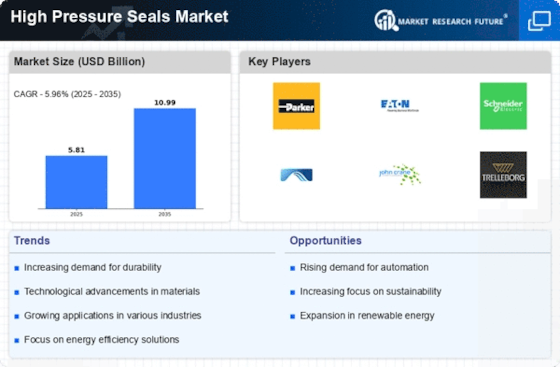
High pressure seals Market Infographic
Purchase Options

High Pressure Seals Size

High pressure seals Market Growth Projections and Opportunities

The High-Pressure Seals Market experiences influences from a variety of factors that collectively impact its growth, demand, and overall dynamics across industries such as oil and gas, manufacturing, and aerospace. These factors play a pivotal role in determining the market's competitiveness and trajectory. Here are key market factors significantly impacting the High-Pressure Seals Market:

Expansion in Oil and Gas Exploration:  The continual expansion of oil and gas exploration activities, particularly in challenging environments such as deep-sea drilling and unconventional reservoirs, drives the demand for high-pressure seals. These seals are crucial components in wellhead equipment and drilling systems, providing reliable containment of fluids under high pressures.

Rising Demand for Energy:  The global demand for energy, including oil and natural gas, continues to rise. As energy exploration and extraction efforts intensify, there is a corresponding increase in the need for high-pressure seals to maintain operational integrity and prevent leaks in high-pressure equipment.

Growing Industrial Manufacturing:  High-pressure seals are essential components in various industrial manufacturing processes, including those in the chemical, pharmaceutical, and food processing industries. The growth of industrial manufacturing activities worldwide contributes to the demand for high-pressure seals to ensure the reliable operation of equipment in high-pressure applications.

Advancements in Hydraulic Systems:  The increasing use of hydraulic systems in various industries, such as construction, agriculture, and manufacturing, contributes to the demand for high-pressure seals. These seals play a critical role in hydraulic cylinders and systems, ensuring efficient and leak-free operation under high-pressure conditions.

Aerospace Industry Requirements:  The aerospace sector, characterized by high-performance and precision requirements, relies on high-pressure seals for critical applications. These seals are used in aircraft hydraulic systems, landing gear, and other components, contributing to the safety and reliability of aerospace equipment.

Technological Advancements in Seal Materials:  Ongoing advancements in materials science lead to the development of high-performance seal materials, including advanced polymers, composites, and metal alloys. Innovations in seal materials enhance durability, wear resistance, and the overall performance of high-pressure seals across diverse applications.

Stringent Regulatory Standards:  Stringent safety and environmental regulations, especially in industries such as oil and gas, drive the adoption of high-quality seals to meet compliance requirements. Manufacturers are compelled to design and produce high-pressure seals that adhere to international standards and ensure safe operations in high-pressure environments.

Focus on Preventive Maintenance:  The emphasis on preventive maintenance in industrial operations encourages the use of high-quality seals to avoid downtime and equipment failures. High-pressure seals, when properly selected and maintained, contribute to the longevity of machinery and reduce the likelihood of costly repairs.

Globalization of Supply Chains:  The globalization of supply chains in various industries increases the demand for high-pressure seals across borders. Manufacturers and suppliers seek reliable sealing solutions to support global operations, leading to a broader market for high-pressure seal products.

Cost-Effective Seal Solutions:  While high-performance is paramount, cost-effective seal solutions are gaining significance in the market. Manufacturers are focused on providing seals that offer a balance between performance and cost efficiency, addressing the need for competitive pricing in diverse industrial applications.
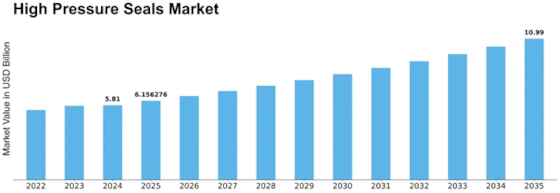
High pressure seals Market Size Graph
Author
Author Profile
Anshula Mandaokar
Team Lead - Research

Anshula Mandaokar holds an academic degree in Chemical Engineering and has been contributing to the field for more than 5 years. She has expertise in Market Research and Business Consulting and serves as a Team Lead for a reputed Market Research firm under the Chemicals and Materials domain spectrum. She has worked on multiple projects, generating explicit results in a quick turnaround time. Her understanding of data interpretation justifies her role as a leader.

Leave a Comment

FAQs

What is the projected market valuation of the High Pressure Seals Market by 2035?

<p>The projected market valuation of the High Pressure Seals Market is expected to reach 10.99 USD Billion by 2035.</p>

What was the market valuation of the High Pressure Seals Market in 2024?

<p>The overall market valuation of the High Pressure Seals Market was 5.81 USD Billion in 2024.</p>

What is the expected CAGR for the High Pressure Seals Market during the forecast period 2025 - 2035?

<p>The expected CAGR for the High Pressure Seals Market during the forecast period 2025 - 2035 is 5.96%.</p>

Which application segment is projected to have the highest valuation by 2035?

<p>The application segment of Compressors is projected to reach 2.2 USD Billion by 2035.</p>

What are the key materials used in High Pressure Seals, and which is expected to grow the most?

<p>Metal is expected to grow the most, with a projected valuation of 2.68 USD Billion by 2035.</p>

Which end-use sector is anticipated to dominate the High Pressure Seals Market by 2035?

<p>The Oil & Gas sector is anticipated to dominate, with a projected valuation of 2.8 USD Billion by 2035.</p>

Who are the leading players in the High Pressure Seals Market?

Key players in the High Pressure Seals Market include Parker Hannifin, Eaton, and John Crane, among others.

What is the projected valuation for the Pipes application segment by 2035?

The projected valuation for the Pipes application segment is expected to reach 2.0 USD Billion by 2035.

How does the projected growth of the High Pressure Seals Market compare across different materials?

The projected growth indicates that Metal and Elastomers will see substantial increases, reaching 2.68 USD Billion and 2.12 USD Billion, respectively, by 2035.

What is the expected valuation for the Pharmaceuticals end-use segment by 2035?

The expected valuation for the Pharmaceuticals end-use segment is projected to be 1.1 USD Billion by 2035.

Market Summary

As per Market Research Future analysis, the High Pressure Seals Market Size was estimated at 5.81 USD Billion in 2024. The High Pressure Seals industry is projected to grow from 6.156 USD Billion in 2025 to 10.99 USD Billion by 2035, exhibiting a compound annual growth rate (CAGR) of 5.96% during the forecast period 2025 - 2035

Key Market Trends & Highlights

The High Pressure Seals Market is poised for robust growth driven by technological advancements and increasing demand across various sectors.

  • Technological advancements in materials are enhancing the performance and durability of high pressure seals. North America remains the largest market, while Asia-Pacific is emerging as the fastest-growing region for high pressure seals. The pumps segment holds the largest market share, whereas the valves segment is experiencing the fastest growth in demand. Rising industrial automation and growth in the energy sector are key drivers propelling the high pressure seals market forward.

Market Size & Forecast

2024 Market Size 5.81 (USD Billion)
2035 Market Size 10.99 (USD Billion)
CAGR (2025 - 2035) 5.96%
Largest Regional Market Share in 2024 Asia Pacific

Major Players

Parker Hannifin (US), Eaton (US), Schneider Electric (FR), Freudenberg Sealing Technologies (DE), John Crane (US), Trelleborg (SE), Klinger (AT), Garlock (US), Seal Science (US), A.W. Chesterton Company (US)

Market Trends

The High Pressure Seals Market is currently experiencing a dynamic evolution, driven by various factors that influence its growth trajectory. Industries such as oil and gas, chemical processing, and power generation are increasingly relying on high pressure seals to ensure operational efficiency and safety. These seals are essential components that prevent leaks and maintain pressure in critical applications, thereby enhancing the reliability of machinery and equipment. As technological advancements continue to emerge, manufacturers are focusing on developing innovative sealing solutions that can withstand extreme conditions, which appears to be a key driver in this sector. Moreover, the growing emphasis on sustainability and environmental protection is prompting companies to adopt high pressure seals that minimize leakage and reduce waste. This trend aligns with global efforts to enhance energy efficiency and reduce carbon footprints. The High Pressure Seals Market is likely to witness further expansion as industries seek to comply with stringent regulations and improve their operational practices. Overall, the market seems poised for growth, with a focus on innovation and sustainability shaping its future.

Technological Advancements in Materials

The High Pressure Seals Market is witnessing a shift towards the use of advanced materials that enhance performance and durability. Innovations in polymer and composite materials are enabling seals to withstand higher pressures and temperatures, which could lead to improved efficiency in various applications.

Increased Demand from Emerging Economies

Emerging economies are showing a rising demand for high pressure seals, driven by industrialization and infrastructure development. As these regions invest in energy and manufacturing sectors, the need for reliable sealing solutions is becoming more pronounced, potentially expanding market opportunities.

Focus on Sustainability and Environmental Compliance

There is a growing trend towards sustainability within the High Pressure Seals Market, as companies prioritize environmentally friendly practices. This includes the development of seals that reduce leakage and waste, aligning with global initiatives aimed at minimizing environmental impact.

High pressure seals Market Market Drivers

Growth in Energy Sector

The energy sector, particularly oil and gas exploration and production, is a substantial driver for the High Pressure Seals Market. As energy demands continue to rise, companies are investing in advanced extraction techniques that require robust sealing solutions to handle high pressures. The need for high pressure seals is particularly pronounced in subsea applications and high-temperature environments, where failure can lead to catastrophic results. Market data indicates that the energy sector is expected to expand, with investments in renewable energy sources also contributing to the demand for specialized sealing solutions. This growth in the energy sector is likely to create a favorable environment for the high pressure seals market.

Rising Industrial Automation

The increasing trend of industrial automation is a pivotal driver for the High Pressure Seals Market. As industries strive for enhanced efficiency and reduced operational costs, the demand for high-performance sealing solutions has surged. Automation technologies, such as robotics and advanced manufacturing processes, necessitate reliable sealing systems that can withstand extreme pressures and temperatures. This trend is particularly evident in sectors like oil and gas, where high pressure seals are critical for maintaining system integrity. According to recent data, the industrial automation market is projected to grow significantly, which in turn is likely to bolster the demand for high pressure seals, thereby driving the market forward.

Increasing Regulatory Standards

The High Pressure Seals Market is significantly influenced by the increasing regulatory standards across various sectors. Governments and regulatory bodies are imposing stringent guidelines to ensure safety and environmental compliance, particularly in industries such as oil and gas, chemical processing, and pharmaceuticals. These regulations necessitate the use of high-quality sealing solutions that can prevent leaks and ensure operational safety. As companies strive to meet these standards, the demand for high pressure seals is expected to rise. Market analysis suggests that compliance with these regulations not only drives the need for advanced sealing solutions but also encourages innovation within the industry, further propelling market growth.

Technological Innovations in Sealing Solutions

Technological innovations play a crucial role in shaping the High Pressure Seals Market. The development of new materials and advanced manufacturing techniques has led to the creation of seals that offer superior performance under extreme conditions. Innovations such as composite materials and enhanced elastomers are enabling seals to withstand higher pressures and temperatures, thus expanding their application range. Furthermore, the integration of smart technologies into sealing solutions is emerging, allowing for real-time monitoring and predictive maintenance. This trend not only enhances the reliability of sealing systems but also reduces downtime, which is critical for industries reliant on high pressure seals. The ongoing advancements in sealing technology are likely to propel market growth.

Expansion of Aerospace and Defense Applications

The aerospace and defense sectors are emerging as significant drivers for the High Pressure Seals Market. With the increasing demand for advanced aircraft and defense systems, the need for high-performance sealing solutions is becoming more pronounced. High pressure seals Market are essential in various applications, including hydraulic systems, fuel systems, and environmental control systems, where reliability and performance are paramount. The aerospace industry is projected to witness substantial growth, driven by advancements in technology and rising air travel. This expansion is likely to create new opportunities for high pressure seals, as manufacturers seek to enhance the safety and efficiency of their systems.

Market Segment Insights

By Application: Pumps (Largest) vs. Valves (Fastest-Growing)

<p>Within the high pressure seals market, the application segments exhibit a diverse share distribution, with pumps significantly holding the largest market share as they are critical in various industrial processes. Valves, while earlier possessing a smaller portion of the market, have been on a rapid growth trajectory due to increasing automation and demand for reliable solutions in fluid control applications.</p>

<p>Pumps (Dominant) vs. Valves (Emerging)</p>

<p>Pumps are the dominant application in the high pressure seals market, largely due to their essential role in transporting fluids across a myriad of industries including oil & gas, chemical, and water management. As an established category, pumps require seals that can withstand extreme pressures and temperatures, ensuring operational efficiency. Conversely, valves represent an emerging segment driven by innovations in the manufacturing process and the push for automated systems. Valves require reliable high pressure seals to enhance their performance in controlling fluid dynamics, making them increasingly popular in packaging, pharmaceuticals, and HVAC systems. This difference in market dynamics highlights the ongoing evolution and technological advancements within the segment.</p>

By Material: Elastomers (Largest) vs. PTFE (Fastest-Growing)

<p>The High Pressure Seals Market is predominantly driven by Elastomers, which command the largest market share among materials used for seals. This segment is favored for its superior flexibility and resilience, making it suitable for various applications in industries such as oil and gas, aerospace, and automotive. PTFE is emerging rapidly in the market due to its chemical resistance and ability to withstand extreme temperatures, making it a preferred choice for high-performance environments. As the demand for durable and efficient sealing solutions increases, growth trends indicate a shift toward the use of advanced materials, particularly PTFE, which is experiencing the fastest growth rate. Factors such as stringent industry regulations, an increase in high-pressure applications, and the need for enhanced longevity and performance in seals are driving innovations in material formulations. These developments cater to a wide range of sectors, from manufacturing to energy, highlighting the critical importance of material choice in seal performance.</p>

<p>Elastomers (Dominant) vs. Metal (Emerging)</p>

<p>Elastomers are recognized as the dominant material in the High Pressure Seals Market due to their excellent elasticity, chemical compatibility, and durability. They are widely used in various high-pressure applications where flexibility and reliable sealing are essential. On the other hand, Metal seals serve as an emerging segment, gaining traction thanks to their robustness and ability to maintain integrity under extreme conditions. Their market position is bolstered by the growing requirement for seals that can withstand higher pressures and temperatures, particularly in sectors like aerospace and oil exploration. The combination of these materials often leads to innovative sealing solutions that cater to diverse operational demands, balancing flexibility with strength.</p>

By End Use: Oil & Gas (Largest) vs. Aerospace & Defense (Fastest-Growing)

<p>The 'End Use' segment of the High Pressure Seals Market is significantly influenced by the oil and gas industry, which commands a substantial share due to the need for effective sealing solutions in exploration and production processes. Other notable segments include aerospace and defense, power generation, and automotive, each contributing to the overall demand for high-performance seals. The other segments, such as pharmaceuticals and chemicals, also represent valuable markets but are currently eclipsed by the leaders in this category. In recent years, growth trends indicate that while oil and gas remain the largest user of high pressure seals, aerospace and defense have emerged as the fastest-growing segment. This growth is driven by expanding aerospace operations and increasing defense expenditures, which require innovative sealing technologies to enhance reliability and performance under extreme pressures and conditions. Additionally, the automotive and pharmaceutical sectors are adapting to include more advanced sealing solutions to meet stringent regulatory and operational demands.</p>

<p>Oil & Gas: Dominant vs. Aerospace & Defense: Emerging</p>

<p>The oil and gas sector is characterized by its extensive applications of high pressure seals in drilling, production, and refining processes. This segment demands robust sealing solutions that can withstand extreme conditions, including high pressures, temperatures, and exposure to corrosive fluids. In contrast, the aerospace and defense segment represents an emerging market fueled by innovations in aerospace technology and increased military spending. This sector necessitates seals that offer unparalleled performance, lightness, and reliability, tailored for high-speed aircraft and advanced defense systems. As regulations tighten and technology advances, both segments are expected to thrive, with aerospace potentially catching up as design innovations continue to evolve the industry.</p>

Get more detailed insights about High Pressure Seals Market Research Report - Global Forecast till 2035

Regional Insights

North America : Market Leader in Innovation

North America is the largest market for high pressure seals, accounting for approximately 40% of the global market share. The region's growth is driven by the increasing demand from the oil and gas, aerospace, and automotive sectors. Regulatory support for advanced manufacturing technologies and stringent safety standards further catalyze market expansion. The presence of major players and continuous innovation in sealing technologies also contribute to the region's robust growth. The United States is the leading country in this market, followed by Canada. Key players such as Parker Hannifin, Eaton, and John Crane dominate the competitive landscape, leveraging advanced technologies and extensive distribution networks. The focus on R&D and the introduction of new materials are pivotal in maintaining competitive advantages. The market is characterized by strategic partnerships and collaborations among leading manufacturers to enhance product offerings and meet evolving customer needs.

Europe : Emerging Market with Regulations

Europe is witnessing significant growth in the high pressure seals market, holding approximately 30% of the global share. The region's growth is propelled by stringent regulations regarding safety and environmental standards, particularly in the automotive and industrial sectors. Countries like Germany and France are at the forefront, driving demand through innovation and sustainability initiatives. The European market is also influenced by the increasing adoption of automation and smart technologies in manufacturing processes. Germany is the largest market in Europe, followed by France and the UK. The competitive landscape features key players such as Freudenberg Sealing Technologies and Schneider Electric, who are investing in R&D to develop advanced sealing solutions. The presence of a well-established manufacturing base and a focus on high-quality standards further enhance the region's market position. Collaboration between industry stakeholders is also fostering innovation and expanding market reach.

Asia-Pacific : Rapid Growth and Demand

Asia-Pacific is rapidly emerging as a significant player in the high pressure seals market, accounting for approximately 25% of the global market share. The region's growth is driven by increasing industrialization, urbanization, and the rising demand for energy. Countries like China and India are leading this growth, supported by government initiatives aimed at enhancing manufacturing capabilities and infrastructure development. The demand for high pressure seals is particularly strong in the oil and gas, chemical, and automotive sectors. China is the largest market in the region, followed by India and Japan. The competitive landscape is characterized by the presence of both local and international players, including Trelleborg and Klinger. These companies are focusing on expanding their product portfolios and enhancing distribution networks to cater to the growing demand. The region's market is also witnessing increased investments in R&D to develop innovative sealing solutions that meet specific industry requirements.

Middle East and Africa : Resource-Rich Market Potential

The Middle East and Africa region is gradually emerging in the high pressure seals market, holding approximately 5% of the global share. The growth is primarily driven by the oil and gas sector, which is a significant contributor to the region's economy. Increasing investments in infrastructure and energy projects are also fueling demand for high pressure seals. Regulatory frameworks are evolving to support industrial growth, although challenges remain in terms of market penetration and competition. Countries like Saudi Arabia and South Africa are leading the market in this region. The competitive landscape includes both local manufacturers and international players looking to expand their footprint. Companies are focusing on establishing partnerships and collaborations to enhance their market presence. The region's potential for growth is significant, particularly as investments in renewable energy and industrialization continue to rise.

Key Players and Competitive Insights

Leading market players are investing heavily in research and development in order to expand their product lines, which will help the high pressure seals market, grow even more. Market participants are also undertaking a variety of strategic activities to expand their footprint, with important market developments including new product launches, contractual agreements, mergers and acquisitions, higher investments, and collaboration with other organizations. To expand and survive in a more competitive and rising market climate, high pressure seals industry must offer cost-effective items. Manufacturing locally to minimize operational costs is one of the key business tactics used by manufacturers in the high pressure seals industry to benefit clients and increase the market sector. In recent years, the high pressure seals industry has offered some of the most significant advantages to market. Major players in the high pressure seals market attempting to increase market demand by investing in research and development operations include EagleBurgmann, Gallagher Seals, Performance Sealing Inc (PSI), FTL, Trelleborg, James Walker, John Crane, Kalsi Engineering, Inc., Parker Hannifin Corp, Flowserve Corporation, F.lli Paris S.r.l., and Bal Seal Engineering. Parker Hannifin Corp is a motion and control technology and system manufacturer. Fluid power systems, electromechanical controllers, and related components are among the company's important motion and control solutions. Its products are used in a variety of industries and applications, such as food production machinery, life sciences and medical, oil and gas, alternative energy, power generation, agriculture, construction machinery, marine, industrial machinery, mining, telecommunications, chemical and refining, aerospace, industrial and commercial refrigeration, and transportation. Engineering polymer solutions are offered by Trelleborg AB. The business provides services for truck and diesel problems as well as automotive boots, sealing solutions, bearings and bushings, float-over solutions, engineered moulded parts, designed coated fabrics, fluid handling solutions, and flexible containment systems. Its sealing solutions include O-Rings, static seals, mechanical face seals, sealing profiles, rotary shaft seals, dampening profiles, oil seals, and pneumatic seals, among other goods. The business also sells vehicle boots, dampening solutions, designed moulded parts, tunnel seals, coated fabrics, anti-vibration solutions, and printing solutions.

Key Companies in the High pressure seals Market include

Industry Developments

September 2021: A famous manufacturer of hydraulic and pneumatic seals, Hallite Seals International Ltd., opened its brand-new, state-of-the-art product and material testing facility. Previously located in separate structures, the new Hallite facility in Hampton, UK, merges laboratory and product testing space. The company's capabilities are enhanced by the redesigned facility, which was designed and outfitted for a wide range of material and product characterization.

July 2020: A novel high-pressure GCU (Gas Conditioning Unit) Seal Gas Booster has been developed by John Crane, a world leader in rotating equipment solutions, to support dry gas seals on turbo compressors. John Crane also provides innovative technology and services to process industries. The GCU Seal Gas Booster establishes a pressure difference between the supply gas and the process gas across the seal faces in order to maintain their cleanliness.

Future Outlook

High pressure seals Market Future Outlook

The High Pressure Seals Market is projected to grow at a 5.96% CAGR from 2025 to 2035, driven by increasing industrial automation, demand for energy efficiency, and advancements in material technology.

New opportunities lie in:

  • <p>Development of smart seals with IoT integration for predictive maintenance. Expansion into emerging markets with tailored sealing solutions. Investment in R&amp;D for high-performance materials to enhance durability.</p>

By 2035, the High Pressure Seals Market is expected to achieve robust growth, reflecting evolving industrial needs.

Market Segmentation

High pressure seals Market End Use Outlook

  • Oil & Gas
  • Aerospace & Defense
  • Power Generation
  • Chemical
  • Automotive
  • Pharmaceuticals
  • Others

High pressure seals Market Material Outlook

  • Elastomers
  • PTFE
  • Metal
  • Rubber-Metal Combination
  • Others

High pressure seals Market Application Outlook

  • Pumps
  • Valves
  • Compressors
  • Pipes
  • Ducts

Report Scope

MARKET SIZE 2024 5.81(USD Billion)
MARKET SIZE 2025 6.156(USD Billion)
MARKET SIZE 2035 10.99(USD Billion)
COMPOUND ANNUAL GROWTH RATE (CAGR) 5.96% (2025 - 2035)
REPORT COVERAGE Revenue Forecast, Competitive Landscape, Growth Factors, and Trends
BASE YEAR 2024
Market Forecast Period 2025 - 2035
Historical Data 2019 - 2024
Market Forecast Units USD Billion
Key Companies Profiled Parker Hannifin (US), Eaton (US), Schneider Electric (FR), Freudenberg Sealing Technologies (DE), John Crane (US), Trelleborg (SE), Klinger (AT), Garlock (US), Seal Science (US), A.W. Chesterton Company (US)
Segments Covered Application, Material, End Use, Region
Key Market Opportunities Advancements in materials technology enhance performance and durability in the High Pressure Seals Market.
Key Market Dynamics Rising demand for high pressure seals driven by advancements in industrial automation and stringent safety regulations.
Countries Covered North America, Europe, APAC, South America, MEA

FAQs

What is the projected market valuation of the High Pressure Seals Market by 2035?

<p>The projected market valuation of the High Pressure Seals Market is expected to reach 10.99 USD Billion by 2035.</p>

What was the market valuation of the High Pressure Seals Market in 2024?

<p>The overall market valuation of the High Pressure Seals Market was 5.81 USD Billion in 2024.</p>

What is the expected CAGR for the High Pressure Seals Market during the forecast period 2025 - 2035?

<p>The expected CAGR for the High Pressure Seals Market during the forecast period 2025 - 2035 is 5.96%.</p>

Which application segment is projected to have the highest valuation by 2035?

<p>The application segment of Compressors is projected to reach 2.2 USD Billion by 2035.</p>

What are the key materials used in High Pressure Seals, and which is expected to grow the most?

<p>Metal is expected to grow the most, with a projected valuation of 2.68 USD Billion by 2035.</p>

Which end-use sector is anticipated to dominate the High Pressure Seals Market by 2035?

<p>The Oil & Gas sector is anticipated to dominate, with a projected valuation of 2.8 USD Billion by 2035.</p>

Who are the leading players in the High Pressure Seals Market?

Key players in the High Pressure Seals Market include Parker Hannifin, Eaton, and John Crane, among others.

What is the projected valuation for the Pipes application segment by 2035?

The projected valuation for the Pipes application segment is expected to reach 2.0 USD Billion by 2035.

How does the projected growth of the High Pressure Seals Market compare across different materials?

The projected growth indicates that Metal and Elastomers will see substantial increases, reaching 2.68 USD Billion and 2.12 USD Billion, respectively, by 2035.

What is the expected valuation for the Pharmaceuticals end-use segment by 2035?

The expected valuation for the Pharmaceuticals end-use segment is projected to be 1.1 USD Billion by 2035.

  1. SECTION I: EXECUTIVE SUMMARY AND KEY HIGHLIGHTS
    1. | 1.1 EXECUTIVE SUMMARY
    2. | | 1.1.1 Market Overview
    3. | | 1.1.2 Key Findings
    4. | | 1.1.3 Market Segmentation
    5. | | 1.1.4 Competitive Landscape
    6. | | 1.1.5 Challenges and Opportunities
    7. | | 1.1.6 Future Outlook
  2. SECTION II: SCOPING, METHODOLOGY AND MARKET STRUCTURE
    1. | 2.1 MARKET INTRODUCTION
    2. | | 2.1.1 Definition
    3. | | 2.1.2 Scope of the study
    4. | | | 2.1.2.1 Research Objective
    5. | | | 2.1.2.2 Assumption
    6. | | | 2.1.2.3 Limitations
    7. | 2.2 RESEARCH METHODOLOGY
    8. | | 2.2.1 Overview
    9. | | 2.2.2 Data Mining
    10. | | 2.2.3 Secondary Research
    11. | | 2.2.4 Primary Research
    12. | | | 2.2.4.1 Primary Interviews and Information Gathering Process
    13. | | | 2.2.4.2 Breakdown of Primary Respondents
    14. | | 2.2.5 Forecasting Model
    15. | | 2.2.6 Market Size Estimation
    16. | | | 2.2.6.1 Bottom-Up Approach
    17. | | | 2.2.6.2 Top-Down Approach
    18. | | 2.2.7 Data Triangulation
    19. | | 2.2.8 Validation
  3. SECTION III: QUALITATIVE ANALYSIS
    1. | 3.1 MARKET DYNAMICS
    2. | | 3.1.1 Overview
    3. | | 3.1.2 Drivers
    4. | | 3.1.3 Restraints
    5. | | 3.1.4 Opportunities
    6. | 3.2 MARKET FACTOR ANALYSIS
    7. | | 3.2.1 Value chain Analysis
    8. | | 3.2.2 Porter's Five Forces Analysis
    9. | | | 3.2.2.1 Bargaining Power of Suppliers
    10. | | | 3.2.2.2 Bargaining Power of Buyers
    11. | | | 3.2.2.3 Threat of New Entrants
    12. | | | 3.2.2.4 Threat of Substitutes
    13. | | | 3.2.2.5 Intensity of Rivalry
    14. | | 3.2.3 COVID-19 Impact Analysis
    15. | | | 3.2.3.1 Market Impact Analysis
    16. | | | 3.2.3.2 Regional Impact
    17. | | | 3.2.3.3 Opportunity and Threat Analysis
  4. SECTION IV: QUANTITATIVE ANALYSIS
    1. | 4.1 Chemicals and Materials, BY Application (USD Billion)
    2. | | 4.1.1 Pumps
    3. | | 4.1.2 Valves
    4. | | 4.1.3 Compressors
    5. | | 4.1.4 Pipes
    6. | | 4.1.5 Ducts
    7. | 4.2 Chemicals and Materials, BY Material (USD Billion)
    8. | | 4.2.1 Elastomers
    9. | | 4.2.2 PTFE
    10. | | 4.2.3 Metal
    11. | | 4.2.4 Rubber-Metal Combination
    12. | | 4.2.5 Others
    13. | 4.3 Chemicals and Materials, BY End Use (USD Billion)
    14. | | 4.3.1 Oil & Gas
    15. | | 4.3.2 Aerospace & Defense
    16. | | 4.3.3 Power Generation
    17. | | 4.3.4 Chemical
    18. | | 4.3.5 Automotive
    19. | | 4.3.6 Pharmaceuticals
    20. | | 4.3.7 Others
    21. | 4.4 Chemicals and Materials, BY Region (USD Billion)
    22. | | 4.4.1 North America
    23. | | | 4.4.1.1 US
    24. | | | 4.4.1.2 Canada
    25. | | 4.4.2 Europe
    26. | | | 4.4.2.1 Germany
    27. | | | 4.4.2.2 UK
    28. | | | 4.4.2.3 France
    29. | | | 4.4.2.4 Russia
    30. | | | 4.4.2.5 Italy
    31. | | | 4.4.2.6 Spain
    32. | | | 4.4.2.7 Rest of Europe
    33. | | 4.4.3 APAC
    34. | | | 4.4.3.1 China
    35. | | | 4.4.3.2 India
    36. | | | 4.4.3.3 Japan
    37. | | | 4.4.3.4 South Korea
    38. | | | 4.4.3.5 Malaysia
    39. | | | 4.4.3.6 Thailand
    40. | | | 4.4.3.7 Indonesia
    41. | | | 4.4.3.8 Rest of APAC
    42. | | 4.4.4 South America
    43. | | | 4.4.4.1 Brazil
    44. | | | 4.4.4.2 Mexico
    45. | | | 4.4.4.3 Argentina
    46. | | | 4.4.4.4 Rest of South America
    47. | | 4.4.5 MEA
    48. | | | 4.4.5.1 GCC Countries
    49. | | | 4.4.5.2 South Africa
    50. | | | 4.4.5.3 Rest of MEA
  5. SECTION V: COMPETITIVE ANALYSIS
    1. | 5.1 Competitive Landscape
    2. | | 5.1.1 Overview
    3. | | 5.1.2 Competitive Analysis
    4. | | 5.1.3 Market share Analysis
    5. | | 5.1.4 Major Growth Strategy in the Chemicals and Materials
    6. | | 5.1.5 Competitive Benchmarking
    7. | | 5.1.6 Leading Players in Terms of Number of Developments in the Chemicals and Materials
    8. | | 5.1.7 Key developments and growth strategies
    9. | | | 5.1.7.1 New Product Launch/Service Deployment
    10. | | | 5.1.7.2 Merger & Acquisitions
    11. | | | 5.1.7.3 Joint Ventures
    12. | | 5.1.8 Major Players Financial Matrix
    13. | | | 5.1.8.1 Sales and Operating Income
    14. | | | 5.1.8.2 Major Players R&D Expenditure. 2023
    15. | 5.2 Company Profiles
    16. | | 5.2.1 Parker Hannifin (US)
    17. | | | 5.2.1.1 Financial Overview
    18. | | | 5.2.1.2 Products Offered
    19. | | | 5.2.1.3 Key Developments
    20. | | | 5.2.1.4 SWOT Analysis
    21. | | | 5.2.1.5 Key Strategies
    22. | | 5.2.2 Eaton (US)
    23. | | | 5.2.2.1 Financial Overview
    24. | | | 5.2.2.2 Products Offered
    25. | | | 5.2.2.3 Key Developments
    26. | | | 5.2.2.4 SWOT Analysis
    27. | | | 5.2.2.5 Key Strategies
    28. | | 5.2.3 Schneider Electric (FR)
    29. | | | 5.2.3.1 Financial Overview
    30. | | | 5.2.3.2 Products Offered
    31. | | | 5.2.3.3 Key Developments
    32. | | | 5.2.3.4 SWOT Analysis
    33. | | | 5.2.3.5 Key Strategies
    34. | | 5.2.4 Freudenberg Sealing Technologies (DE)
    35. | | | 5.2.4.1 Financial Overview
    36. | | | 5.2.4.2 Products Offered
    37. | | | 5.2.4.3 Key Developments
    38. | | | 5.2.4.4 SWOT Analysis
    39. | | | 5.2.4.5 Key Strategies
    40. | | 5.2.5 John Crane (US)
    41. | | | 5.2.5.1 Financial Overview
    42. | | | 5.2.5.2 Products Offered
    43. | | | 5.2.5.3 Key Developments
    44. | | | 5.2.5.4 SWOT Analysis
    45. | | | 5.2.5.5 Key Strategies
    46. | | 5.2.6 Trelleborg (SE)
    47. | | | 5.2.6.1 Financial Overview
    48. | | | 5.2.6.2 Products Offered
    49. | | | 5.2.6.3 Key Developments
    50. | | | 5.2.6.4 SWOT Analysis
    51. | | | 5.2.6.5 Key Strategies
    52. | | 5.2.7 Klinger (AT)
    53. | | | 5.2.7.1 Financial Overview
    54. | | | 5.2.7.2 Products Offered
    55. | | | 5.2.7.3 Key Developments
    56. | | | 5.2.7.4 SWOT Analysis
    57. | | | 5.2.7.5 Key Strategies
    58. | | 5.2.8 Garlock (US)
    59. | | | 5.2.8.1 Financial Overview
    60. | | | 5.2.8.2 Products Offered
    61. | | | 5.2.8.3 Key Developments
    62. | | | 5.2.8.4 SWOT Analysis
    63. | | | 5.2.8.5 Key Strategies
    64. | | 5.2.9 Seal Science (US)
    65. | | | 5.2.9.1 Financial Overview
    66. | | | 5.2.9.2 Products Offered
    67. | | | 5.2.9.3 Key Developments
    68. | | | 5.2.9.4 SWOT Analysis
    69. | | | 5.2.9.5 Key Strategies
    70. | | 5.2.10 A.W. Chesterton Company (US)
    71. | | | 5.2.10.1 Financial Overview
    72. | | | 5.2.10.2 Products Offered
    73. | | | 5.2.10.3 Key Developments
    74. | | | 5.2.10.4 SWOT Analysis
    75. | | | 5.2.10.5 Key Strategies
    76. | 5.3 Appendix
    77. | | 5.3.1 References
    78. | | 5.3.2 Related Reports
  6. LIST OF FIGURES
    1. | 6.1 MARKET SYNOPSIS
    2. | 6.2 NORTH AMERICA MARKET ANALYSIS
    3. | 6.3 US MARKET ANALYSIS BY APPLICATION
    4. | 6.4 US MARKET ANALYSIS BY MATERIAL
    5. | 6.5 US MARKET ANALYSIS BY END USE
    6. | 6.6 CANADA MARKET ANALYSIS BY APPLICATION
    7. | 6.7 CANADA MARKET ANALYSIS BY MATERIAL
    8. | 6.8 CANADA MARKET ANALYSIS BY END USE
    9. | 6.9 EUROPE MARKET ANALYSIS
    10. | 6.10 GERMANY MARKET ANALYSIS BY APPLICATION
    11. | 6.11 GERMANY MARKET ANALYSIS BY MATERIAL
    12. | 6.12 GERMANY MARKET ANALYSIS BY END USE
    13. | 6.13 UK MARKET ANALYSIS BY APPLICATION
    14. | 6.14 UK MARKET ANALYSIS BY MATERIAL
    15. | 6.15 UK MARKET ANALYSIS BY END USE
    16. | 6.16 FRANCE MARKET ANALYSIS BY APPLICATION
    17. | 6.17 FRANCE MARKET ANALYSIS BY MATERIAL
    18. | 6.18 FRANCE MARKET ANALYSIS BY END USE
    19. | 6.19 RUSSIA MARKET ANALYSIS BY APPLICATION
    20. | 6.20 RUSSIA MARKET ANALYSIS BY MATERIAL
    21. | 6.21 RUSSIA MARKET ANALYSIS BY END USE
    22. | 6.22 ITALY MARKET ANALYSIS BY APPLICATION
    23. | 6.23 ITALY MARKET ANALYSIS BY MATERIAL
    24. | 6.24 ITALY MARKET ANALYSIS BY END USE
    25. | 6.25 SPAIN MARKET ANALYSIS BY APPLICATION
    26. | 6.26 SPAIN MARKET ANALYSIS BY MATERIAL
    27. | 6.27 SPAIN MARKET ANALYSIS BY END USE
    28. | 6.28 REST OF EUROPE MARKET ANALYSIS BY APPLICATION
    29. | 6.29 REST OF EUROPE MARKET ANALYSIS BY MATERIAL
    30. | 6.30 REST OF EUROPE MARKET ANALYSIS BY END USE
    31. | 6.31 APAC MARKET ANALYSIS
    32. | 6.32 CHINA MARKET ANALYSIS BY APPLICATION
    33. | 6.33 CHINA MARKET ANALYSIS BY MATERIAL
    34. | 6.34 CHINA MARKET ANALYSIS BY END USE
    35. | 6.35 INDIA MARKET ANALYSIS BY APPLICATION
    36. | 6.36 INDIA MARKET ANALYSIS BY MATERIAL
    37. | 6.37 INDIA MARKET ANALYSIS BY END USE
    38. | 6.38 JAPAN MARKET ANALYSIS BY APPLICATION
    39. | 6.39 JAPAN MARKET ANALYSIS BY MATERIAL
    40. | 6.40 JAPAN MARKET ANALYSIS BY END USE
    41. | 6.41 SOUTH KOREA MARKET ANALYSIS BY APPLICATION
    42. | 6.42 SOUTH KOREA MARKET ANALYSIS BY MATERIAL
    43. | 6.43 SOUTH KOREA MARKET ANALYSIS BY END USE
    44. | 6.44 MALAYSIA MARKET ANALYSIS BY APPLICATION
    45. | 6.45 MALAYSIA MARKET ANALYSIS BY MATERIAL
    46. | 6.46 MALAYSIA MARKET ANALYSIS BY END USE
    47. | 6.47 THAILAND MARKET ANALYSIS BY APPLICATION
    48. | 6.48 THAILAND MARKET ANALYSIS BY MATERIAL
    49. | 6.49 THAILAND MARKET ANALYSIS BY END USE
    50. | 6.50 INDONESIA MARKET ANALYSIS BY APPLICATION
    51. | 6.51 INDONESIA MARKET ANALYSIS BY MATERIAL
    52. | 6.52 INDONESIA MARKET ANALYSIS BY END USE
    53. | 6.53 REST OF APAC MARKET ANALYSIS BY APPLICATION
    54. | 6.54 REST OF APAC MARKET ANALYSIS BY MATERIAL
    55. | 6.55 REST OF APAC MARKET ANALYSIS BY END USE
    56. | 6.56 SOUTH AMERICA MARKET ANALYSIS
    57. | 6.57 BRAZIL MARKET ANALYSIS BY APPLICATION
    58. | 6.58 BRAZIL MARKET ANALYSIS BY MATERIAL
    59. | 6.59 BRAZIL MARKET ANALYSIS BY END USE
    60. | 6.60 MEXICO MARKET ANALYSIS BY APPLICATION
    61. | 6.61 MEXICO MARKET ANALYSIS BY MATERIAL
    62. | 6.62 MEXICO MARKET ANALYSIS BY END USE
    63. | 6.63 ARGENTINA MARKET ANALYSIS BY APPLICATION
    64. | 6.64 ARGENTINA MARKET ANALYSIS BY MATERIAL
    65. | 6.65 ARGENTINA MARKET ANALYSIS BY END USE
    66. | 6.66 REST OF SOUTH AMERICA MARKET ANALYSIS BY APPLICATION
    67. | 6.67 REST OF SOUTH AMERICA MARKET ANALYSIS BY MATERIAL
    68. | 6.68 REST OF SOUTH AMERICA MARKET ANALYSIS BY END USE
    69. | 6.69 MEA MARKET ANALYSIS
    70. | 6.70 GCC COUNTRIES MARKET ANALYSIS BY APPLICATION
    71. | 6.71 GCC COUNTRIES MARKET ANALYSIS BY MATERIAL
    72. | 6.72 GCC COUNTRIES MARKET ANALYSIS BY END USE
    73. | 6.73 SOUTH AFRICA MARKET ANALYSIS BY APPLICATION
    74. | 6.74 SOUTH AFRICA MARKET ANALYSIS BY MATERIAL
    75. | 6.75 SOUTH AFRICA MARKET ANALYSIS BY END USE
    76. | 6.76 REST OF MEA MARKET ANALYSIS BY APPLICATION
    77. | 6.77 REST OF MEA MARKET ANALYSIS BY MATERIAL
    78. | 6.78 REST OF MEA MARKET ANALYSIS BY END USE
    79. | 6.79 KEY BUYING CRITERIA OF CHEMICALS AND MATERIALS
    80. | 6.80 RESEARCH PROCESS OF MRFR
    81. | 6.81 DRO ANALYSIS OF CHEMICALS AND MATERIALS
    82. | 6.82 DRIVERS IMPACT ANALYSIS: CHEMICALS AND MATERIALS
    83. | 6.83 RESTRAINTS IMPACT ANALYSIS: CHEMICALS AND MATERIALS
    84. | 6.84 SUPPLY / VALUE CHAIN: CHEMICALS AND MATERIALS
    85. | 6.85 CHEMICALS AND MATERIALS, BY APPLICATION, 2024 (% SHARE)
    86. | 6.86 CHEMICALS AND MATERIALS, BY APPLICATION, 2024 TO 2035 (USD Billion)
    87. | 6.87 CHEMICALS AND MATERIALS, BY MATERIAL, 2024 (% SHARE)
    88. | 6.88 CHEMICALS AND MATERIALS, BY MATERIAL, 2024 TO 2035 (USD Billion)
    89. | 6.89 CHEMICALS AND MATERIALS, BY END USE, 2024 (% SHARE)
    90. | 6.90 CHEMICALS AND MATERIALS, BY END USE, 2024 TO 2035 (USD Billion)
    91. | 6.91 BENCHMARKING OF MAJOR COMPETITORS
  7. LIST OF TABLES
    1. | 7.1 LIST OF ASSUMPTIONS
    2. | | 7.1.1
    3. | 7.2 North America MARKET SIZE ESTIMATES; FORECAST
    4. | | 7.2.1 BY APPLICATION, 2025-2035 (USD Billion)
    5. | | 7.2.2 BY MATERIAL, 2025-2035 (USD Billion)
    6. | | 7.2.3 BY END USE, 2025-2035 (USD Billion)
    7. | 7.3 US MARKET SIZE ESTIMATES; FORECAST
    8. | | 7.3.1 BY APPLICATION, 2025-2035 (USD Billion)
    9. | | 7.3.2 BY MATERIAL, 2025-2035 (USD Billion)
    10. | | 7.3.3 BY END USE, 2025-2035 (USD Billion)
    11. | 7.4 Canada MARKET SIZE ESTIMATES; FORECAST
    12. | | 7.4.1 BY APPLICATION, 2025-2035 (USD Billion)
    13. | | 7.4.2 BY MATERIAL, 2025-2035 (USD Billion)
    14. | | 7.4.3 BY END USE, 2025-2035 (USD Billion)
    15. | 7.5 Europe MARKET SIZE ESTIMATES; FORECAST
    16. | | 7.5.1 BY APPLICATION, 2025-2035 (USD Billion)
    17. | | 7.5.2 BY MATERIAL, 2025-2035 (USD Billion)
    18. | | 7.5.3 BY END USE, 2025-2035 (USD Billion)
    19. | 7.6 Germany MARKET SIZE ESTIMATES; FORECAST
    20. | | 7.6.1 BY APPLICATION, 2025-2035 (USD Billion)
    21. | | 7.6.2 BY MATERIAL, 2025-2035 (USD Billion)
    22. | | 7.6.3 BY END USE, 2025-2035 (USD Billion)
    23. | 7.7 UK MARKET SIZE ESTIMATES; FORECAST
    24. | | 7.7.1 BY APPLICATION, 2025-2035 (USD Billion)
    25. | | 7.7.2 BY MATERIAL, 2025-2035 (USD Billion)
    26. | | 7.7.3 BY END USE, 2025-2035 (USD Billion)
    27. | 7.8 France MARKET SIZE ESTIMATES; FORECAST
    28. | | 7.8.1 BY APPLICATION, 2025-2035 (USD Billion)
    29. | | 7.8.2 BY MATERIAL, 2025-2035 (USD Billion)
    30. | | 7.8.3 BY END USE, 2025-2035 (USD Billion)
    31. | 7.9 Russia MARKET SIZE ESTIMATES; FORECAST
    32. | | 7.9.1 BY APPLICATION, 2025-2035 (USD Billion)
    33. | | 7.9.2 BY MATERIAL, 2025-2035 (USD Billion)
    34. | | 7.9.3 BY END USE, 2025-2035 (USD Billion)
    35. | 7.10 Italy MARKET SIZE ESTIMATES; FORECAST
    36. | | 7.10.1 BY APPLICATION, 2025-2035 (USD Billion)
    37. | | 7.10.2 BY MATERIAL, 2025-2035 (USD Billion)
    38. | | 7.10.3 BY END USE, 2025-2035 (USD Billion)
    39. | 7.11 Spain MARKET SIZE ESTIMATES; FORECAST
    40. | | 7.11.1 BY APPLICATION, 2025-2035 (USD Billion)
    41. | | 7.11.2 BY MATERIAL, 2025-2035 (USD Billion)
    42. | | 7.11.3 BY END USE, 2025-2035 (USD Billion)
    43. | 7.12 Rest of Europe MARKET SIZE ESTIMATES; FORECAST
    44. | | 7.12.1 BY APPLICATION, 2025-2035 (USD Billion)
    45. | | 7.12.2 BY MATERIAL, 2025-2035 (USD Billion)
    46. | | 7.12.3 BY END USE, 2025-2035 (USD Billion)
    47. | 7.13 APAC MARKET SIZE ESTIMATES; FORECAST
    48. | | 7.13.1 BY APPLICATION, 2025-2035 (USD Billion)
    49. | | 7.13.2 BY MATERIAL, 2025-2035 (USD Billion)
    50. | | 7.13.3 BY END USE, 2025-2035 (USD Billion)
    51. | 7.14 China MARKET SIZE ESTIMATES; FORECAST
    52. | | 7.14.1 BY APPLICATION, 2025-2035 (USD Billion)
    53. | | 7.14.2 BY MATERIAL, 2025-2035 (USD Billion)
    54. | | 7.14.3 BY END USE, 2025-2035 (USD Billion)
    55. | 7.15 India MARKET SIZE ESTIMATES; FORECAST
    56. | | 7.15.1 BY APPLICATION, 2025-2035 (USD Billion)
    57. | | 7.15.2 BY MATERIAL, 2025-2035 (USD Billion)
    58. | | 7.15.3 BY END USE, 2025-2035 (USD Billion)
    59. | 7.16 Japan MARKET SIZE ESTIMATES; FORECAST
    60. | | 7.16.1 BY APPLICATION, 2025-2035 (USD Billion)
    61. | | 7.16.2 BY MATERIAL, 2025-2035 (USD Billion)
    62. | | 7.16.3 BY END USE, 2025-2035 (USD Billion)
    63. | 7.17 South Korea MARKET SIZE ESTIMATES; FORECAST
    64. | | 7.17.1 BY APPLICATION, 2025-2035 (USD Billion)
    65. | | 7.17.2 BY MATERIAL, 2025-2035 (USD Billion)
    66. | | 7.17.3 BY END USE, 2025-2035 (USD Billion)
    67. | 7.18 Malaysia MARKET SIZE ESTIMATES; FORECAST
    68. | | 7.18.1 BY APPLICATION, 2025-2035 (USD Billion)
    69. | | 7.18.2 BY MATERIAL, 2025-2035 (USD Billion)
    70. | | 7.18.3 BY END USE, 2025-2035 (USD Billion)
    71. | 7.19 Thailand MARKET SIZE ESTIMATES; FORECAST
    72. | | 7.19.1 BY APPLICATION, 2025-2035 (USD Billion)
    73. | | 7.19.2 BY MATERIAL, 2025-2035 (USD Billion)
    74. | | 7.19.3 BY END USE, 2025-2035 (USD Billion)
    75. | 7.20 Indonesia MARKET SIZE ESTIMATES; FORECAST
    76. | | 7.20.1 BY APPLICATION, 2025-2035 (USD Billion)
    77. | | 7.20.2 BY MATERIAL, 2025-2035 (USD Billion)
    78. | | 7.20.3 BY END USE, 2025-2035 (USD Billion)
    79. | 7.21 Rest of APAC MARKET SIZE ESTIMATES; FORECAST
    80. | | 7.21.1 BY APPLICATION, 2025-2035 (USD Billion)
    81. | | 7.21.2 BY MATERIAL, 2025-2035 (USD Billion)
    82. | | 7.21.3 BY END USE, 2025-2035 (USD Billion)
    83. | 7.22 South America MARKET SIZE ESTIMATES; FORECAST
    84. | | 7.22.1 BY APPLICATION, 2025-2035 (USD Billion)
    85. | | 7.22.2 BY MATERIAL, 2025-2035 (USD Billion)
    86. | | 7.22.3 BY END USE, 2025-2035 (USD Billion)
    87. | 7.23 Brazil MARKET SIZE ESTIMATES; FORECAST
    88. | | 7.23.1 BY APPLICATION, 2025-2035 (USD Billion)
    89. | | 7.23.2 BY MATERIAL, 2025-2035 (USD Billion)
    90. | | 7.23.3 BY END USE, 2025-2035 (USD Billion)
    91. | 7.24 Mexico MARKET SIZE ESTIMATES; FORECAST
    92. | | 7.24.1 BY APPLICATION, 2025-2035 (USD Billion)
    93. | | 7.24.2 BY MATERIAL, 2025-2035 (USD Billion)
    94. | | 7.24.3 BY END USE, 2025-2035 (USD Billion)
    95. | 7.25 Argentina MARKET SIZE ESTIMATES; FORECAST
    96. | | 7.25.1 BY APPLICATION, 2025-2035 (USD Billion)
    97. | | 7.25.2 BY MATERIAL, 2025-2035 (USD Billion)
    98. | | 7.25.3 BY END USE, 2025-2035 (USD Billion)
    99. | 7.26 Rest of South America MARKET SIZE ESTIMATES; FORECAST
    100. | | 7.26.1 BY APPLICATION, 2025-2035 (USD Billion)
    101. | | 7.26.2 BY MATERIAL, 2025-2035 (USD Billion)
    102. | | 7.26.3 BY END USE, 2025-2035 (USD Billion)
    103. | 7.27 MEA MARKET SIZE ESTIMATES; FORECAST
    104. | | 7.27.1 BY APPLICATION, 2025-2035 (USD Billion)
    105. | | 7.27.2 BY MATERIAL, 2025-2035 (USD Billion)
    106. | | 7.27.3 BY END USE, 2025-2035 (USD Billion)
    107. | 7.28 GCC Countries MARKET SIZE ESTIMATES; FORECAST
    108. | | 7.28.1 BY APPLICATION, 2025-2035 (USD Billion)
    109. | | 7.28.2 BY MATERIAL, 2025-2035 (USD Billion)
    110. | | 7.28.3 BY END USE, 2025-2035 (USD Billion)
    111. | 7.29 South Africa MARKET SIZE ESTIMATES; FORECAST
    112. | | 7.29.1 BY APPLICATION, 2025-2035 (USD Billion)
    113. | | 7.29.2 BY MATERIAL, 2025-2035 (USD Billion)
    114. | | 7.29.3 BY END USE, 2025-2035 (USD Billion)
    115. | 7.30 Rest of MEA MARKET SIZE ESTIMATES; FORECAST
    116. | | 7.30.1 BY APPLICATION, 2025-2035 (USD Billion)
    117. | | 7.30.2 BY MATERIAL, 2025-2035 (USD Billion)
    118. | | 7.30.3 BY END USE, 2025-2035 (USD Billion)
    119. | 7.31 PRODUCT LAUNCH/PRODUCT DEVELOPMENT/APPROVAL
    120. | | 7.31.1
    121. | 7.32 ACQUISITION/PARTNERSHIP
    122. | | 7.32.1

Chemicals and Materials Market Segmentation

Chemicals and Materials By Application (USD Billion, 2025-2035)

  • Pumps
  • Valves
  • Compressors
  • Pipes
  • Ducts

Chemicals and Materials By Material (USD Billion, 2025-2035)

  • Elastomers
  • PTFE
  • Metal
  • Rubber-Metal Combination
  • Others

Chemicals and Materials By End Use (USD Billion, 2025-2035)

  • Oil & Gas
  • Aerospace & Defense
  • Power Generation
  • Chemical
  • Automotive
  • Pharmaceuticals
  • Others
Infographic

Free Sample Request

Kindly complete the form below to receive a free sample of this Report

Get Free Sample

Customer Strories

Compare Licence

×
Features License Type
Single User Multiuser License Enterprise User
Price $4,950 $5,950 $7,250
Maximum User Access Limit 1 User Upto 10 Users Unrestricted Access Throughout the Organization
Free Customization
Direct Access to Analyst
Deliverable Format
Platform Access
Discount on Next Purchase 10% 15% 15%
Printable Versions