Request Free Sample ×

Kindly complete the form below to receive a free sample of this Report

* Please use a valid business email

Leading companies partner with us for data-driven Insights

clients tt-cursor
Hero Background
English
Chinese
French
Japanese
Korean
German
Spanish

High Intensity Focused Ultrasound Therapy Market Trends

ID: MRFR/MED/0383-HCR
110 Pages
Satyendra Maurya
March 2026

High Intensity Focused Ultrasound Therapy Market Research Report Information By Method (Non-Invasive Method and Minimal Invasive Method), By Application (Prostate Cancer, Uterine Fibroids, Neurological Disorders, Cosmetic Medicine, and Others), By End User (Diagnostic Centers, Hospitals, Research Centers, and Others), and By Region (North America, Europe, Asia-Pacific, and Rest Of The World) – HIFU Industry Forecast 2035

Share:
Download PDF ×

We do not share your information with anyone. However, we may send you emails based on your report interest from time to time. You may contact us at any time to opt-out.

High Intensity Focused Ultrasound Therapy Market Infographic
Purchase Options

Market Trends

Key Emerging Trends in the High Intensity Focused Ultrasound Therapy Market

A lot of medical jobs use high-fidelity. First used to treat prostate cancer, it's now utilized in medicine, neurology, and pediatrics. High-frequency ultrasound (HIFU) therapy is increasingly employed for short- and long-term health issues due to its numerous advantages. Most HIFU treatments are for cancer. HiFU may remove large tumors without surgery. HIFU treats liver, breast, and pancreatic cancer well, thus people enjoy it. Cancer may be able to be cured with HIFU. New ideas make HIFU more popular. Thanks to improvements in image technology, precision-guided tools, and constant tracking, high-intensity focused ultrasound (HIFU) treatments are getting better and more accurate. These technology developments make people healthier and open the door to new ways to treat illnesses. The development of HIFU therapy is influenced by a worldwide movement toward quiet medical treatments such as laser therapy. Therapies that ease pain, speed up healing, and lower the risk of problems after surgery are chosen by patients. More people are using HIFU because it doesn't hurt them. Gynecology is increasingly treating uterine cancer and adenomyosis using HIFU. Ultrasound may eliminate aberrant cells without surgery using HIFU. It shows potential for treating reproductive diseases without surgery. Brain illness research and development for HIFU is underway. This therapy is tested for Parkinson's and essential tremor. For neurology patients who cannot or do not want surgery, HIFU may be an option as it is painless. HIFU therapy is growing beyond North America and Europe, driving increasing its worldwide market. Asia and the Pacific are adopting HIFU devices. Healthcare facility expansion, patient awareness, and chronic illness prevalence all contribute. Despite its high cost, HIFU treatment is becoming increasingly popular. Due to varying billing procedures in different nations and healthcare systems, HIFU may have trouble expanding. If these costs are overcome, HIFU therapy will be more accessible. Since it doesn't require hospitalization, HIFU is growing in popularity daily. Patients and doctors benefit from outpatient HIFU. This tendency is reflected in the healthcare industry's focus on patients and cost reduction. Each clinical trial adds to HIFU therapy data. This study examines novel drug uses, therapeutic improvements, and long-term benefits. This study found that HIFU improves treatment.


Author
Author Profile
Satyendra Maurya
Research Analyst

An accomplished research analyst with high proficiency in market forecasting, data visualization, competitive benchmarking, and others. He holds a pronounced track record in research and consulting projects for sectors such as life sciences, medical devices, and healthcare IT. His capabilities in qualitative and quantitative analysis have resulted in positive client outcomes. Working on niche market trends, opportunities, sales, and forecasted value is part of his skill set.

Leave a Comment

FAQs

What is the projected market valuation for High Intensity Focused Ultrasound Therapy by 2035?

<p>The projected market valuation for High Intensity Focused Ultrasound Therapy is expected to reach 620.11 USD Million by 2035.</p>

What was the market valuation for High Intensity Focused Ultrasound Therapy in 2024?

<p>The overall market valuation for High Intensity Focused Ultrasound Therapy was 127.05 USD Million in 2024.</p>

What is the expected CAGR for the High Intensity Focused Ultrasound Therapy market during the forecast period 2025 - 2035?

<p>The expected CAGR for the High Intensity Focused Ultrasound Therapy market during the forecast period 2025 - 2035 is 15.5%.</p>

Which companies are considered key players in the High Intensity Focused Ultrasound Therapy market?

<p>Key players in the High Intensity Focused Ultrasound Therapy market include EDAP TMS, InSightec, FUS Instruments, SonaCare Medical, HIFU Prostate Services, Focus Surgery, Mermaid Medical, and Chongqing Haifu Medical Technology.</p>

What are the main applications of High Intensity Focused Ultrasound Therapy?

<p>The main applications of High Intensity Focused Ultrasound Therapy include Tumor Ablation, Pain Management, Cosmetic Treatment, Neurological Disorders, and Cardiovascular Disorders.</p>

How does the market for High Intensity Focused Ultrasound Therapy segment by end use?

<p>The market segments by end use include Hospitals, Ambulatory Surgical Centers, Specialty Clinics, and Research Institutions.</p>

What are the different technologies used in High Intensity Focused Ultrasound Therapy?

The technologies used in High Intensity Focused Ultrasound Therapy include Ultrasound Imaging, Thermal Ablation, Non-Thermal Ablation, and Focused Ultrasound Surgery.

How is the High Intensity Focused Ultrasound Therapy market segmented by patient type?

The market segments by patient type include Adult Patients, Pediatric Patients, Geriatric Patients, and Pregnant Patients.

What types of procedures are included in the High Intensity Focused Ultrasound Therapy market?

The types of procedures included in the market are Minimally Invasive Procedures, Non-Invasive Procedures, and Surgical Procedures.

What was the valuation range for Tumor Ablation in the High Intensity Focused Ultrasound Therapy market?

The valuation range for Tumor Ablation in the High Intensity Focused Ultrasound Therapy market was between 30.0 and 150.0 USD Million.

Market Summary

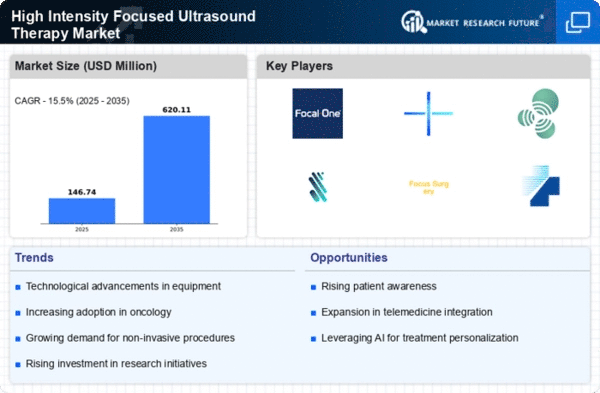
As per MRFR analysis, the High Intensity Focused Ultrasound Therapy Market Size was estimated at 127.05 USD Million in 2024. The High Intensity Focused Ultrasound Therapy industry is projected to grow from 146.75 USD Million in 2025 to 620.11 USD Million by 2035, exhibiting a compound annual growth rate (CAGR) of 15.5% during the forecast period 2025 - 2035.

Key Market Trends & Highlights

The High Intensity Focused Ultrasound Therapy Market is poised for substantial growth driven by technological advancements and increasing demand for non-invasive treatments.

  • Technological advancements in HIFU are enhancing treatment efficacy and precision, particularly in tumor ablation procedures. The demand for non-invasive treatments is rising, leading to a shift in patient preferences towards safer therapeutic options. North America remains the largest market, while the Asia-Pacific region is emerging as the fastest-growing area for HIFU applications. Key market drivers include the rising incidence of cancer and increasing awareness and acceptance of HIFU therapies among healthcare professionals.

Market Size & Forecast

2024 Market Size 127.05 (USD Million)
2035 Market Size 620.11 (USD Million)
CAGR (2025 - 2035) 15.5%
Largest Regional Market Share in 2024 North America

Major Players

EDAP TMS (FR), <a href="https://insightec.com/">InSightec</a> (IL), FUS Instruments (CA), SonaCare Medical (US), Focus Surgery (US), HIFU Prostate Services (US), Meridian Health (US), Chongqing Haifu Medical Technology (CN)

Market Trends

The High Intensity Focused Ultrasound Therapy Market is currently experiencing a notable evolution, driven by advancements in technology and increasing awareness of non-invasive treatment options. This innovative therapy utilizes focused ultrasound waves to target and destroy tissue, offering a promising alternative to traditional surgical methods. As healthcare providers and patients alike seek less invasive solutions, the demand for High Intensity Focused Ultrasound Therapy is likely to grow. Furthermore, ongoing research and clinical trials are expanding the applications of this therapy, potentially leading to new treatment protocols and improved patient outcomes. In addition to technological advancements, the High Intensity Focused Ultrasound Therapy Market is influenced by a growing emphasis on personalized medicine. Tailoring treatments to individual patient needs appears to enhance efficacy and satisfaction. Moreover, the integration of artificial intelligence and machine learning into ultrasound technology may further refine treatment precision and outcomes. As the market continues to evolve, stakeholders must remain vigilant to emerging trends and innovations that could shape the future landscape of High Intensity Focused Ultrasound Therapy.

Technological Advancements

Recent innovations in ultrasound technology are enhancing the capabilities of High Intensity Focused Ultrasound Therapy. These advancements may lead to improved precision in targeting tissues, thereby increasing treatment efficacy and reducing side effects.

Growing Demand for Non-Invasive Treatments

There is a rising preference among patients and healthcare providers for non-invasive treatment options. This trend is likely to drive the adoption of High Intensity Focused Ultrasound Therapy as a viable alternative to traditional surgical procedures.

Integration of Artificial Intelligence

The incorporation of artificial intelligence into ultrasound systems is expected to revolutionize the High Intensity Focused Ultrasound Therapy Market. AI may facilitate better treatment planning and real-time monitoring, potentially enhancing patient outcomes.

High Intensity Focused Ultrasound Therapy Market Market Drivers

Technological Advancements

The Global High Intensity Focused Ultrasound Therapy Market Industry is currently experiencing rapid technological advancements that enhance treatment efficacy and patient outcomes. Innovations in ultrasound technology, such as improved imaging techniques and more precise targeting capabilities, are likely to drive market growth. For instance, the development of real-time imaging systems allows practitioners to monitor treatment progress more effectively. This not only increases the safety of procedures but also boosts patient confidence in non-invasive therapies. As a result, the market is projected to maintain a steady valuation of 0.13 USD Billion in 2024, with expectations of similar figures through 2035.

Growing Awareness and Education

The Global High Intensity Focused Ultrasound Therapy Market Industry is experiencing a surge in awareness and education regarding the benefits of ultrasound therapy. Healthcare professionals and patients alike are becoming more informed about the advantages of non-invasive treatments, leading to increased acceptance and utilization of High Intensity Focused Ultrasound Therapy Market. Educational campaigns and professional training programs are instrumental in disseminating knowledge about this technology, thereby fostering its adoption in clinical settings. As awareness continues to grow, the market is likely to see sustained interest, maintaining its valuation of 0.13 USD Billion in 2024 and beyond.

Government Initiatives and Funding

The Global High Intensity Focused Ultrasound Therapy Market Industry benefits from various government initiatives aimed at promoting advanced medical technologies. Governments across the globe are increasingly investing in healthcare infrastructure and funding research and development in non-invasive treatment options. These initiatives not only enhance the availability of High Intensity Focused Ultrasound Therapy Market but also encourage clinical trials and innovation in treatment protocols. Such support is likely to bolster market growth, as healthcare providers adopt these technologies to improve patient care. The market is expected to remain stable at a valuation of 0.13 USD Billion in 2024, reflecting the positive impact of these initiatives.

Rising Incidence of Chronic Diseases

The Global High Intensity Focused Ultrasound Therapy Market Industry is significantly influenced by the increasing prevalence of chronic diseases, such as cancer and cardiovascular disorders. As these conditions become more common, there is a corresponding rise in the demand for effective treatment modalities. High Intensity Focused Ultrasound Therapy Market has emerged as a promising option for targeting tumors and other pathological tissues with minimal side effects. The growing patient population requiring such interventions is likely to sustain market growth. Despite the challenges posed by economic fluctuations, the market is projected to maintain its valuation of 0.13 USD Billion in 2024, with a CAGR of 0.0% anticipated from 2025 to 2035.

Increasing Demand for Non-Invasive Treatments

The Global High Intensity Focused Ultrasound Therapy Market Industry is witnessing a growing preference for non-invasive treatment options among patients. This trend is largely driven by the desire to avoid the risks and recovery times associated with traditional surgical procedures. High Intensity Focused Ultrasound Therapy Market offers a compelling alternative, providing effective treatment for various conditions, including tumors and fibroids, without the need for incisions. As awareness of these benefits spreads, the market is likely to attract more patients seeking safer and less invasive options. This shift in patient preference is expected to contribute to a stable market valuation of 0.13 USD Billion in 2024.

Market Segment Insights

By Application: Tumor Ablation (Largest) vs. Pain Management (Fastest-Growing)

In the High Intensity Focused Ultrasound Therapy Market, Tumor Ablation emerges as the largest application segment, driven by its effectiveness in treating various tumors with precision and minimal side effects. The segment commands a significant share compared to others, reflecting its established position in clinical practices worldwide. Pain Management, while a smaller segment, is rapidly gaining traction due to an increasing demand for non-invasive treatment options as well as a growing understanding of ultrasound's analgesic capabilities. This is propelling it into the spotlight as one of the fastest-growing applications in the field.

Pain Management (Dominant) vs. Cosmetic Treatment (Emerging)

<a href="https://www.marketresearchfuture.com/reports/pain-management-market-5975">Pain Management</a> stands out as a dominant application in the High Intensity Focused Ultrasound Therapy Market, driven by the relentless pursuit of patients seeking effective, non-invasive alternatives for chronic pain relief. This segment focuses on utilizing ultrasound technology to disrupt pain pathways without the need for surgery or long recovery times, making it appealing for both patients and healthcare providers. On the other hand, Cosmetic Treatment is an emerging application gaining momentum as consumers increasingly seek skin rejuvenation and non-invasive cosmetic procedures. The appeal lies in the technology's ability to promote collagen production and contour the skin, combining aesthetic desires with therapeutic benefits.

By End Use: Hospitals (Largest) vs. Ambulatory Surgical Centers (Fastest-Growing)

In the High Intensity Focused Ultrasound Therapy Market, hospitals command the largest share due to their established infrastructures and comprehensive treatment options. They provide a wide array of services, making them primary centers for advanced medical procedures, including HIFU therapy. Ambulatory surgical centers, while smaller in share, are quickly gaining traction due to their streamlined processes and cost-management advantages, appealing to both patients and insurance providers alike.

Hospitals (Dominant) vs. Ambulatory Surgical Centers (Emerging)

Hospitals are the cornerstone of HIFU therapy utilization, boasting extensive resources and a vast patient base. Their ability to integrate HIFU within multiple departments enhances treatment options, solidifying their market dominance. Conversely, ambulatory surgical centers are emerging as vital players by offering minimally invasive procedures with reduced hospital stay requirements. This appeals to patients seeking convenience and faster recovery times. The shift towards outpatient care is further fueled by cost-effectiveness and technological advancements that make procedures more efficient and accessible.

By Technology: Ultrasound Imaging (Largest) vs. Focused Ultrasound Surgery (Fastest-Growing)

<p>The High Intensity Focused Ultrasound Therapy Market is characterized by a diverse range of technologies, with Ultrasound Imaging holding a dominant position among the segment values due to its widespread applicability and crucial role in diagnostics. This segment is critical for accurate treatment delivery and has garnered significant market share, attributed to advancements in imaging technology that enhance precision and efficacy. In contrast, Focused Ultrasound Surgery is emerging rapidly, recognized for its innovative approach in treating various conditions non-invasively. Its growing adoption signifies a shift towards more patient-friendly options, contributing to its rapid ascension in market share.</p>

<p>Technology: Ultrasound Imaging (Dominant) vs. Focused Ultrasound Surgery (Emerging)</p>

<p>Ultrasound Imaging, as the dominant segment in the High Intensity Focused Ultrasound Therapy Market, stands out for its essential role in guiding treatments with enhanced accuracy and visualization. The increasing preference for non-invasive procedures has led to greater investment in imaging technologies, which play a vital part in treatment planning and monitoring. On the other hand, Focused Ultrasound Surgery represents an emerging segment that is gaining traction owing to its capability to treat tumors and other conditions without the need for incisions. This method not only reduces recovery times but also improves patient outcomes, leading to its increasing recognition and utilization across medical disciplines.</p>

By Patient Type: Adult Patients (Largest) vs. Pediatric Patients (Fastest-Growing)

In the High Intensity Focused Ultrasound Therapy Market, Adult Patients represent the largest segment, accounting for a significant portion of the overall market share. This segment benefits from a higher prevalence of conditions that are treatable with this therapy, such as tumors and other chronic ailments. Conversely, Pediatric Patients constitute the fastest-growing segment, attributed to an increasing focus on non-invasive treatment options that minimize risks and complications in younger populations. As healthcare advancements continue to progress, the interest in HIFU for children is rising.

Adult Patients (Dominant) vs. Pediatric Patients (Emerging)

Adult Patients are at the forefront of the High Intensity Focused Ultrasound Therapy Market, largely due to their higher occurrence of diseases amenable to HIFU treatments, such as prostate issues and various cancers. Their routine adoption of such therapies speaks to their dominance in the field. On the other hand, Pediatric Patients are emerging with growing interest in this non-invasive technology, aligning with global trends towards safer treatment alternatives for children. Healthcare practitioners are increasingly adopting HIFU in pediatric cases, driven by a need to minimize side effects and ensure better quality of life, thereby boosting this market segment.

By Procedure Type: Minimally Invasive Procedures (Largest) vs. Non-Invasive Procedures (Fastest-Growing)

In the High Intensity Focused Ultrasound Therapy Market, the market share distribution reveals a pronounced preference for Minimally Invasive Procedures as the largest segment. This segment continues to attract a significant portion of market interest due to its effectiveness and lower patient recovery times. Non-Invasive Procedures, while smaller in share, are witnessing a surge in popularity, capitalizing on the growing demand for less invasive medical interventions.

Minimally Invasive Procedures (Dominant) vs. Non-Invasive Procedures (Emerging)

Minimally Invasive Procedures remain a dominant force within the High Intensity Focused Ultrasound Therapy Market, characterized by their reduced recovery time and lower risk of complications compared to traditional surgical methods. These procedures leverage advanced technology to provide effective treatment with minimal disruption to the patient's daily life. On the other hand, Non-Invasive Procedures are emerging rapidly, driven by increasing patient awareness and preference for non-surgical options. This segment benefits from technological advancements that enhance the efficacy and safety of treatments, appealing to a broader audience seeking effective yet gentler medical solutions.

Get more detailed insights about High Intensity Focused Ultrasound (HIFU) Therapy Market Research Report - Forecast till 2035

Regional Insights

North America : Market Leader in Innovation

North America is poised to maintain its leadership in the High Intensity Focused Ultrasound (HIFU) therapy market, holding a significant market share of 63.52% as of 2024. The region's growth is driven by increasing healthcare expenditure, technological advancements, and a rising prevalence of chronic diseases. Regulatory support from agencies like the FDA further catalyzes market expansion, ensuring that innovative therapies are swiftly approved and accessible to patients. The competitive landscape in North America is robust, featuring key players such as SonaCare Medical, EDAP TMS, and InSightec. The U.S. stands out as the leading country, with a well-established healthcare infrastructure and a high adoption rate of advanced medical technologies. This region's focus on research and development, coupled with strategic partnerships among industry leaders, positions it favorably for sustained growth in the HIFU therapy market.

Europe : Emerging Market with Potential

Europe is witnessing a growing interest in High Intensity Focused Ultrasound (HIFU) therapy, with a market share of 35.0% as of 2024. Factors such as an aging population, increasing awareness of non-invasive treatment options, and supportive healthcare policies are driving demand. The European Medicines Agency (EMA) plays a crucial role in regulating and approving HIFU technologies, ensuring safety and efficacy in treatments. Leading countries in Europe include Germany, France, and the UK, where healthcare systems are increasingly integrating HIFU therapies into clinical practice. The competitive landscape features companies like EDAP TMS and InSightec, which are actively expanding their market presence. Collaborative efforts between healthcare providers and technology developers are expected to enhance the adoption of HIFU therapies across the region.

Asia-Pacific : Rapidly Growing Market

The Asia-Pacific region is emerging as a significant player in the High Intensity Focused Ultrasound (HIFU) therapy market, with a market share of 24.53% as of 2024. The growth is fueled by increasing healthcare investments, a rising prevalence of cancer, and a growing demand for non-invasive treatment options. Government initiatives aimed at improving healthcare access and affordability are also contributing to market expansion. Countries like China, Japan, and India are leading the charge in adopting HIFU technologies. The presence of key players such as Chongqing Haifu Medical Technology and FUS Instruments enhances the competitive landscape. As healthcare infrastructure improves and awareness of HIFU benefits grows, the region is expected to see accelerated adoption of these therapies, positioning it for significant growth in the coming years.

Middle East and Africa : Emerging Market Opportunities

The Middle East and Africa (MEA) region is in the nascent stages of adopting High Intensity Focused Ultrasound (HIFU) therapy, with a market share of 3.0% as of 2024. The growth potential is driven by increasing healthcare investments, a rising prevalence of chronic diseases, and a growing interest in advanced medical technologies. Regulatory bodies in the region are beginning to recognize the importance of HIFU therapies, paving the way for future approvals and market entry. Countries such as South Africa and the UAE are at the forefront of this emerging market, with healthcare systems gradually integrating HIFU technologies. The competitive landscape is still developing, but the presence of international players is expected to stimulate growth. As awareness and acceptance of HIFU therapies increase, the MEA region is poised for gradual yet significant advancements in this field.

Key Players and Competitive Insights

The High Intensity Focused Ultrasound Therapy Market is characterized by a dynamic competitive landscape, driven by technological advancements and increasing demand for non-invasive treatment options. Key players such as EDAP TMS (FR), InSightec (IL), and SonaCare Medical (US) are at the forefront, each adopting distinct strategies to enhance their market presence. EDAP TMS (FR) focuses on innovation in its HIFU technology, aiming to expand its product offerings and improve treatment efficacy. In contrast, InSightec (IL) emphasizes strategic partnerships to bolster its research capabilities and market reach, while SonaCare Medical (US) is actively pursuing regional expansion to tap into emerging markets, thereby shaping a competitive environment that is increasingly collaborative yet competitive.The market structure appears moderately fragmented, with several players vying for market share through various business tactics. Localizing manufacturing and optimizing supply chains are prevalent strategies among these companies, allowing them to reduce costs and enhance service delivery. The collective influence of these key players fosters a competitive atmosphere where innovation and operational efficiency are paramount, driving the market forward.
In November EDAP TMS (FR) announced a strategic partnership with a leading healthcare provider to enhance the accessibility of its HIFU technology in Europe. This collaboration is expected to facilitate the integration of advanced treatment protocols, thereby increasing patient access and potentially boosting revenue streams. Such partnerships are indicative of a broader trend towards collaborative innovation in the market.
In October InSightec (IL) launched a new clinical trial aimed at evaluating the efficacy of its Exablate Neuro system for treating neurological disorders. This initiative not only underscores the company's commitment to expanding its therapeutic applications but also positions it as a leader in the integration of HIFU technology within neurology. The outcomes of this trial could significantly influence future treatment paradigms and market dynamics.
In September SonaCare Medical (US) unveiled a new training program for healthcare professionals focused on the latest advancements in HIFU techniques. This initiative is crucial for enhancing the skill set of practitioners, ensuring that they are well-equipped to utilize the technology effectively. By investing in education and training, SonaCare Medical (US) is likely to strengthen its market position and foster greater adoption of its products.
As of December current competitive trends in the High Intensity Focused Ultrasound Therapy Market are increasingly defined by digitalization, sustainability, and the integration of artificial intelligence (AI). Strategic alliances are becoming more prevalent, as companies recognize the value of collaboration in driving innovation. The competitive differentiation is expected to evolve, shifting from price-based competition to a focus on technological advancements, innovative treatment solutions, and reliable supply chains. This transition suggests that companies that prioritize R&D and strategic partnerships will likely emerge as leaders in this evolving landscape.

Key Companies in the High Intensity Focused Ultrasound Therapy Market include

Industry Developments

  • Q2 2024: EDAP TMS Receives FDA 510(k) Clearance for Focal One® Robotic HIFU System for Prostate Tissue Ablation EDAP TMS announced it received FDA 510(k) clearance for its Focal One® Robotic High Intensity Focused Ultrasound (HIFU) system, allowing its use for prostate tissue ablation in the United States.
  • Q2 2024: Insightec Announces FDA Approval of Exablate Prostate for Treatment of Prostate Disease Insightec received FDA approval for its Exablate Prostate system, a high intensity focused ultrasound device for the treatment of prostate disease, expanding its clinical indications in the U.S.
  • Q2 2024: Sonablate Corp. Announces Strategic Partnership with Siemens Healthineers to Advance HIFU Technology Sonablate Corp. entered a strategic partnership with Siemens Healthineers to integrate HIFU technology with advanced imaging solutions, aiming to enhance precision in non-invasive therapies.
  • Q3 2024: Theraclion Raises €10 Million in Series C Funding to Accelerate HIFU Platform Development Theraclion, a French medtech company specializing in HIFU, closed a €10 million Series C funding round to support the development and commercialization of its next-generation HIFU platforms.
  • Q3 2024: EDAP TMS Announces Opening of New Manufacturing Facility in Lyon, France EDAP TMS inaugurated a new manufacturing facility in Lyon to expand production capacity for its HIFU devices, supporting growing global demand.
  • Q3 2024: Haifu Medical Receives CE Mark for New HIFU System for Uterine Fibroids Haifu Medical obtained CE Mark approval for its latest high intensity focused ultrasound system designed for the non-invasive treatment of uterine fibroids in Europe.
  • Q4 2024: Profound Medical Announces First Patient Treated in Pivotal TULSA-PRO® HIFU Study for Prostate Cancer Profound Medical announced the treatment of the first patient in its pivotal clinical study evaluating the TULSA-PRO® HIFU system for whole-gland ablation of prostate cancer.
  • Q4 2024: Insightec and Mayo Clinic Expand Collaboration to Advance HIFU for Neurological Disorders Insightec and Mayo Clinic expanded their collaboration to further research and clinical adoption of HIFU for the treatment of neurological disorders, including essential tremor and Parkinson’s disease.
  • Q1 2025: EDAP TMS Appoints New Chief Commercial Officer to Drive Global HIFU Expansion EDAP TMS appointed a new Chief Commercial Officer to lead the company’s global commercial strategy and accelerate the adoption of its HIFU technologies.
  • Q1 2025: Theraclion Signs Distribution Agreement with Medtronic for HIFU Systems in Asia-Pacific Theraclion entered into a distribution agreement with Medtronic to market and distribute its HIFU systems across the Asia-Pacific region.
  • Q2 2025: Profound Medical Receives Health Canada Approval for TULSA-PRO® HIFU System Profound Medical received regulatory approval from Health Canada for its TULSA-PRO® HIFU system, enabling commercialization for prostate disease treatment in Canada.
  • Q2 2025: EDAP TMS Announces Strategic Partnership with Philips to Integrate HIFU with Advanced Imaging EDAP TMS announced a strategic partnership with Philips to integrate its HIFU technology with Philips’ advanced imaging platforms, aiming to improve treatment precision and outcomes.

Future Outlook

High Intensity Focused Ultrasound Therapy Market Future Outlook

The High Intensity Focused Ultrasound Therapy Market is projected to grow at a 15.5% CAGR from 2025 to 2035, driven by technological advancements and increasing demand for non-invasive treatments.

New opportunities lie in:

  • <p>Development of portable ultrasound devices for outpatient settings. Strategic partnerships with healthcare providers for integrated treatment solutions. Expansion into emerging markets with tailored service offerings.</p>

By 2035, the market is expected to solidify its position as a leader in non-invasive therapeutic solutions.

Market Segmentation

High Intensity Focused Ultrasound Therapy Market End Use Outlook

  • Hospitals
  • Ambulatory Surgical Centers
  • Specialty Clinics
  • Research Institutions

High Intensity Focused Ultrasound Therapy Market Technology Outlook

  • Ultrasound Imaging
  • Thermal Ablation
  • Non-Thermal Ablation
  • Focused Ultrasound Surgery

High Intensity Focused Ultrasound Therapy Market Application Outlook

  • Tumor Ablation
  • Pain Management
  • Cosmetic Treatment
  • Neurological Disorders
  • Cardiovascular Disorders

High Intensity Focused Ultrasound Therapy Market Patient Type Outlook

  • Adult Patients
  • Pediatric Patients
  • Geriatric Patients
  • Pregnant Patients

High Intensity Focused Ultrasound Therapy Market Procedure Type Outlook

  • Minimally Invasive Procedures
  • Non-Invasive Procedures
  • Outpatient Procedures

Report Scope

MARKET SIZE 2024 127.05(USD Million)
MARKET SIZE 2025 146.75(USD Million)
MARKET SIZE 2035 620.11(USD Million)
COMPOUND ANNUAL GROWTH RATE (CAGR) 15.5% (2025 - 2035)
REPORT COVERAGE Revenue Forecast, Competitive Landscape, Growth Factors, and Trends
BASE YEAR 2024
Market Forecast Period 2025 - 2035
Historical Data 2019 - 2024
Market Forecast Units USD Million
Key Companies Profiled EDAP TMS (FR), InSightec (IL), FUS Instruments (CA), SonaCare Medical (US), Focus Surgery (US), HIFU Prostate Services (US), Meridian Health (US), Chongqing Haifu Medical Technology (CN)
Segments Covered Application, End Use, Technology, Patient Type, Procedure Type
Key Market Opportunities Advancements in non-invasive treatment technologies enhance patient acceptance in the High Intensity Focused Ultrasound Therapy Market.
Key Market Dynamics Technological advancements and regulatory changes drive growth in the High Intensity Focused Ultrasound Therapy market.
Countries Covered North America, Europe, APAC, South America, MEA

FAQs

What is the projected market valuation for High Intensity Focused Ultrasound Therapy by 2035?

<p>The projected market valuation for High Intensity Focused Ultrasound Therapy is expected to reach 620.11 USD Million by 2035.</p>

What was the market valuation for High Intensity Focused Ultrasound Therapy in 2024?

<p>The overall market valuation for High Intensity Focused Ultrasound Therapy was 127.05 USD Million in 2024.</p>

What is the expected CAGR for the High Intensity Focused Ultrasound Therapy market during the forecast period 2025 - 2035?

<p>The expected CAGR for the High Intensity Focused Ultrasound Therapy market during the forecast period 2025 - 2035 is 15.5%.</p>

Which companies are considered key players in the High Intensity Focused Ultrasound Therapy market?

<p>Key players in the High Intensity Focused Ultrasound Therapy market include EDAP TMS, InSightec, FUS Instruments, SonaCare Medical, HIFU Prostate Services, Focus Surgery, Mermaid Medical, and Chongqing Haifu Medical Technology.</p>

What are the main applications of High Intensity Focused Ultrasound Therapy?

<p>The main applications of High Intensity Focused Ultrasound Therapy include Tumor Ablation, Pain Management, Cosmetic Treatment, Neurological Disorders, and Cardiovascular Disorders.</p>

How does the market for High Intensity Focused Ultrasound Therapy segment by end use?

<p>The market segments by end use include Hospitals, Ambulatory Surgical Centers, Specialty Clinics, and Research Institutions.</p>

What are the different technologies used in High Intensity Focused Ultrasound Therapy?

The technologies used in High Intensity Focused Ultrasound Therapy include Ultrasound Imaging, Thermal Ablation, Non-Thermal Ablation, and Focused Ultrasound Surgery.

How is the High Intensity Focused Ultrasound Therapy market segmented by patient type?

The market segments by patient type include Adult Patients, Pediatric Patients, Geriatric Patients, and Pregnant Patients.

What types of procedures are included in the High Intensity Focused Ultrasound Therapy market?

The types of procedures included in the market are Minimally Invasive Procedures, Non-Invasive Procedures, and Surgical Procedures.

What was the valuation range for Tumor Ablation in the High Intensity Focused Ultrasound Therapy market?

The valuation range for Tumor Ablation in the High Intensity Focused Ultrasound Therapy market was between 30.0 and 150.0 USD Million.

  1. SECTION I: EXECUTIVE SUMMARY AND KEY HIGHLIGHTS
    1. | 1.1 EXECUTIVE SUMMARY
    2. | | 1.1.1 Market Overview
    3. | | 1.1.2 Key Findings
    4. | | 1.1.3 Market Segmentation
    5. | | 1.1.4 Competitive Landscape
    6. | | 1.1.5 Challenges and Opportunities
    7. | | 1.1.6 Future Outlook
  2. SECTION II: SCOPING, METHODOLOGY AND MARKET STRUCTURE
    1. | 2.1 MARKET INTRODUCTION
    2. | | 2.1.1 Definition
    3. | | 2.1.2 Scope of the study
    4. | | | 2.1.2.1 Research Objective
    5. | | | 2.1.2.2 Assumption
    6. | | | 2.1.2.3 Limitations
    7. | 2.2 RESEARCH METHODOLOGY
    8. | | 2.2.1 Overview
    9. | | 2.2.2 Data Mining
    10. | | 2.2.3 Secondary Research
    11. | | 2.2.4 Primary Research
    12. | | | 2.2.4.1 Primary Interviews and Information Gathering Process
    13. | | | 2.2.4.2 Breakdown of Primary Respondents
    14. | | 2.2.5 Forecasting Model
    15. | | 2.2.6 Market Size Estimation
    16. | | | 2.2.6.1 Bottom-Up Approach
    17. | | | 2.2.6.2 Top-Down Approach
    18. | | 2.2.7 Data Triangulation
    19. | | 2.2.8 Validation
  3. SECTION III: QUALITATIVE ANALYSIS
    1. | 3.1 MARKET DYNAMICS
    2. | | 3.1.1 Overview
    3. | | 3.1.2 Drivers
    4. | | 3.1.3 Restraints
    5. | | 3.1.4 Opportunities
    6. | 3.2 MARKET FACTOR ANALYSIS
    7. | | 3.2.1 Value chain Analysis
    8. | | 3.2.2 Porter's Five Forces Analysis
    9. | | | 3.2.2.1 Bargaining Power of Suppliers
    10. | | | 3.2.2.2 Bargaining Power of Buyers
    11. | | | 3.2.2.3 Threat of New Entrants
    12. | | | 3.2.2.4 Threat of Substitutes
    13. | | | 3.2.2.5 Intensity of Rivalry
    14. | | 3.2.3 COVID-19 Impact Analysis
    15. | | | 3.2.3.1 Market Impact Analysis
    16. | | | 3.2.3.2 Regional Impact
    17. | | | 3.2.3.3 Opportunity and Threat Analysis
  4. SECTION IV: QUANTITATIVE ANALYSIS
    1. | 4.1 Healthcare, BY Application (USD Million)
    2. | | 4.1.1 Tumor Ablation
    3. | | 4.1.2 Pain Management
    4. | | 4.1.3 Cosmetic Treatment
    5. | | 4.1.4 Neurological Disorders
    6. | | 4.1.5 Cardiovascular Disorders
    7. | 4.2 Healthcare, BY End Use (USD Million)
    8. | | 4.2.1 Hospitals
    9. | | 4.2.2 Ambulatory Surgical Centers
    10. | | 4.2.3 Specialty Clinics
    11. | | 4.2.4 Research Institutions
    12. | 4.3 Healthcare, BY Technology (USD Million)
    13. | | 4.3.1 Ultrasound Imaging
    14. | | 4.3.2 Thermal Ablation
    15. | | 4.3.3 Non-Thermal Ablation
    16. | | 4.3.4 Focused Ultrasound Surgery
    17. | 4.4 Healthcare, BY Patient Type (USD Million)
    18. | | 4.4.1 Adult Patients
    19. | | 4.4.2 Pediatric Patients
    20. | | 4.4.3 Geriatric Patients
    21. | | 4.4.4 Pregnant Patients
    22. | 4.5 Healthcare, BY Procedure Type (USD Million)
    23. | | 4.5.1 Minimally Invasive Procedures
    24. | | 4.5.2 Non-Invasive Procedures
    25. | | 4.5.3 Surgical Procedures
    26. | 4.6 Healthcare, BY Region (USD Million)
    27. | | 4.6.1 North America
    28. | | | 4.6.1.1 US
    29. | | | 4.6.1.2 Canada
    30. | | 4.6.2 Europe
    31. | | | 4.6.2.1 Germany
    32. | | | 4.6.2.2 UK
    33. | | | 4.6.2.3 France
    34. | | | 4.6.2.4 Russia
    35. | | | 4.6.2.5 Italy
    36. | | | 4.6.2.6 Spain
    37. | | | 4.6.2.7 Rest of Europe
    38. | | 4.6.3 APAC
    39. | | | 4.6.3.1 China
    40. | | | 4.6.3.2 India
    41. | | | 4.6.3.3 Japan
    42. | | | 4.6.3.4 South Korea
    43. | | | 4.6.3.5 Malaysia
    44. | | | 4.6.3.6 Thailand
    45. | | | 4.6.3.7 Indonesia
    46. | | | 4.6.3.8 Rest of APAC
    47. | | 4.6.4 South America
    48. | | | 4.6.4.1 Brazil
    49. | | | 4.6.4.2 Mexico
    50. | | | 4.6.4.3 Argentina
    51. | | | 4.6.4.4 Rest of South America
    52. | | 4.6.5 MEA
    53. | | | 4.6.5.1 GCC Countries
    54. | | | 4.6.5.2 South Africa
    55. | | | 4.6.5.3 Rest of MEA
  5. SECTION V: COMPETITIVE ANALYSIS
    1. | 5.1 Competitive Landscape
    2. | | 5.1.1 Overview
    3. | | 5.1.2 Competitive Analysis
    4. | | 5.1.3 Market share Analysis
    5. | | 5.1.4 Major Growth Strategy in the Healthcare
    6. | | 5.1.5 Competitive Benchmarking
    7. | | 5.1.6 Leading Players in Terms of Number of Developments in the Healthcare
    8. | | 5.1.7 Key developments and growth strategies
    9. | | | 5.1.7.1 New Product Launch/Service Deployment
    10. | | | 5.1.7.2 Merger & Acquisitions
    11. | | | 5.1.7.3 Joint Ventures
    12. | | 5.1.8 Major Players Financial Matrix
    13. | | | 5.1.8.1 Sales and Operating Income
    14. | | | 5.1.8.2 Major Players R&D Expenditure. 2023
    15. | 5.2 Company Profiles
    16. | | 5.2.1 EDAP TMS (FR)
    17. | | | 5.2.1.1 Financial Overview
    18. | | | 5.2.1.2 Products Offered
    19. | | | 5.2.1.3 Key Developments
    20. | | | 5.2.1.4 SWOT Analysis
    21. | | | 5.2.1.5 Key Strategies
    22. | | 5.2.2 InSightec (IL)
    23. | | | 5.2.2.1 Financial Overview
    24. | | | 5.2.2.2 Products Offered
    25. | | | 5.2.2.3 Key Developments
    26. | | | 5.2.2.4 SWOT Analysis
    27. | | | 5.2.2.5 Key Strategies
    28. | | 5.2.3 FUS Instruments (CA)
    29. | | | 5.2.3.1 Financial Overview
    30. | | | 5.2.3.2 Products Offered
    31. | | | 5.2.3.3 Key Developments
    32. | | | 5.2.3.4 SWOT Analysis
    33. | | | 5.2.3.5 Key Strategies
    34. | | 5.2.4 SonaCare Medical (US)
    35. | | | 5.2.4.1 Financial Overview
    36. | | | 5.2.4.2 Products Offered
    37. | | | 5.2.4.3 Key Developments
    38. | | | 5.2.4.4 SWOT Analysis
    39. | | | 5.2.4.5 Key Strategies
    40. | | 5.2.5 HIFU Prostate Services (US)
    41. | | | 5.2.5.1 Financial Overview
    42. | | | 5.2.5.2 Products Offered
    43. | | | 5.2.5.3 Key Developments
    44. | | | 5.2.5.4 SWOT Analysis
    45. | | | 5.2.5.5 Key Strategies
    46. | | 5.2.6 Focus Surgery (AU)
    47. | | | 5.2.6.1 Financial Overview
    48. | | | 5.2.6.2 Products Offered
    49. | | | 5.2.6.3 Key Developments
    50. | | | 5.2.6.4 SWOT Analysis
    51. | | | 5.2.6.5 Key Strategies
    52. | | 5.2.7 Mermaid Medical (DK)
    53. | | | 5.2.7.1 Financial Overview
    54. | | | 5.2.7.2 Products Offered
    55. | | | 5.2.7.3 Key Developments
    56. | | | 5.2.7.4 SWOT Analysis
    57. | | | 5.2.7.5 Key Strategies
    58. | | 5.2.8 Chongqing Haifu Medical Technology (CN)
    59. | | | 5.2.8.1 Financial Overview
    60. | | | 5.2.8.2 Products Offered
    61. | | | 5.2.8.3 Key Developments
    62. | | | 5.2.8.4 SWOT Analysis
    63. | | | 5.2.8.5 Key Strategies
    64. | 5.3 Appendix
    65. | | 5.3.1 References
    66. | | 5.3.2 Related Reports
  6. LIST OF FIGURES
    1. | 6.1 MARKET SYNOPSIS
    2. | 6.2 NORTH AMERICA MARKET ANALYSIS
    3. | 6.3 US MARKET ANALYSIS BY APPLICATION
    4. | 6.4 US MARKET ANALYSIS BY END USE
    5. | 6.5 US MARKET ANALYSIS BY TECHNOLOGY
    6. | 6.6 US MARKET ANALYSIS BY PATIENT TYPE
    7. | 6.7 US MARKET ANALYSIS BY PROCEDURE TYPE
    8. | 6.8 CANADA MARKET ANALYSIS BY APPLICATION
    9. | 6.9 CANADA MARKET ANALYSIS BY END USE
    10. | 6.10 CANADA MARKET ANALYSIS BY TECHNOLOGY
    11. | 6.11 CANADA MARKET ANALYSIS BY PATIENT TYPE
    12. | 6.12 CANADA MARKET ANALYSIS BY PROCEDURE TYPE
    13. | 6.13 EUROPE MARKET ANALYSIS
    14. | 6.14 GERMANY MARKET ANALYSIS BY APPLICATION
    15. | 6.15 GERMANY MARKET ANALYSIS BY END USE
    16. | 6.16 GERMANY MARKET ANALYSIS BY TECHNOLOGY
    17. | 6.17 GERMANY MARKET ANALYSIS BY PATIENT TYPE
    18. | 6.18 GERMANY MARKET ANALYSIS BY PROCEDURE TYPE
    19. | 6.19 UK MARKET ANALYSIS BY APPLICATION
    20. | 6.20 UK MARKET ANALYSIS BY END USE
    21. | 6.21 UK MARKET ANALYSIS BY TECHNOLOGY
    22. | 6.22 UK MARKET ANALYSIS BY PATIENT TYPE
    23. | 6.23 UK MARKET ANALYSIS BY PROCEDURE TYPE
    24. | 6.24 FRANCE MARKET ANALYSIS BY APPLICATION
    25. | 6.25 FRANCE MARKET ANALYSIS BY END USE
    26. | 6.26 FRANCE MARKET ANALYSIS BY TECHNOLOGY
    27. | 6.27 FRANCE MARKET ANALYSIS BY PATIENT TYPE
    28. | 6.28 FRANCE MARKET ANALYSIS BY PROCEDURE TYPE
    29. | 6.29 RUSSIA MARKET ANALYSIS BY APPLICATION
    30. | 6.30 RUSSIA MARKET ANALYSIS BY END USE
    31. | 6.31 RUSSIA MARKET ANALYSIS BY TECHNOLOGY
    32. | 6.32 RUSSIA MARKET ANALYSIS BY PATIENT TYPE
    33. | 6.33 RUSSIA MARKET ANALYSIS BY PROCEDURE TYPE
    34. | 6.34 ITALY MARKET ANALYSIS BY APPLICATION
    35. | 6.35 ITALY MARKET ANALYSIS BY END USE
    36. | 6.36 ITALY MARKET ANALYSIS BY TECHNOLOGY
    37. | 6.37 ITALY MARKET ANALYSIS BY PATIENT TYPE
    38. | 6.38 ITALY MARKET ANALYSIS BY PROCEDURE TYPE
    39. | 6.39 SPAIN MARKET ANALYSIS BY APPLICATION
    40. | 6.40 SPAIN MARKET ANALYSIS BY END USE
    41. | 6.41 SPAIN MARKET ANALYSIS BY TECHNOLOGY
    42. | 6.42 SPAIN MARKET ANALYSIS BY PATIENT TYPE
    43. | 6.43 SPAIN MARKET ANALYSIS BY PROCEDURE TYPE
    44. | 6.44 REST OF EUROPE MARKET ANALYSIS BY APPLICATION
    45. | 6.45 REST OF EUROPE MARKET ANALYSIS BY END USE
    46. | 6.46 REST OF EUROPE MARKET ANALYSIS BY TECHNOLOGY
    47. | 6.47 REST OF EUROPE MARKET ANALYSIS BY PATIENT TYPE
    48. | 6.48 REST OF EUROPE MARKET ANALYSIS BY PROCEDURE TYPE
    49. | 6.49 APAC MARKET ANALYSIS
    50. | 6.50 CHINA MARKET ANALYSIS BY APPLICATION
    51. | 6.51 CHINA MARKET ANALYSIS BY END USE
    52. | 6.52 CHINA MARKET ANALYSIS BY TECHNOLOGY
    53. | 6.53 CHINA MARKET ANALYSIS BY PATIENT TYPE
    54. | 6.54 CHINA MARKET ANALYSIS BY PROCEDURE TYPE
    55. | 6.55 INDIA MARKET ANALYSIS BY APPLICATION
    56. | 6.56 INDIA MARKET ANALYSIS BY END USE
    57. | 6.57 INDIA MARKET ANALYSIS BY TECHNOLOGY
    58. | 6.58 INDIA MARKET ANALYSIS BY PATIENT TYPE
    59. | 6.59 INDIA MARKET ANALYSIS BY PROCEDURE TYPE
    60. | 6.60 JAPAN MARKET ANALYSIS BY APPLICATION
    61. | 6.61 JAPAN MARKET ANALYSIS BY END USE
    62. | 6.62 JAPAN MARKET ANALYSIS BY TECHNOLOGY
    63. | 6.63 JAPAN MARKET ANALYSIS BY PATIENT TYPE
    64. | 6.64 JAPAN MARKET ANALYSIS BY PROCEDURE TYPE
    65. | 6.65 SOUTH KOREA MARKET ANALYSIS BY APPLICATION
    66. | 6.66 SOUTH KOREA MARKET ANALYSIS BY END USE
    67. | 6.67 SOUTH KOREA MARKET ANALYSIS BY TECHNOLOGY
    68. | 6.68 SOUTH KOREA MARKET ANALYSIS BY PATIENT TYPE
    69. | 6.69 SOUTH KOREA MARKET ANALYSIS BY PROCEDURE TYPE
    70. | 6.70 MALAYSIA MARKET ANALYSIS BY APPLICATION
    71. | 6.71 MALAYSIA MARKET ANALYSIS BY END USE
    72. | 6.72 MALAYSIA MARKET ANALYSIS BY TECHNOLOGY
    73. | 6.73 MALAYSIA MARKET ANALYSIS BY PATIENT TYPE
    74. | 6.74 MALAYSIA MARKET ANALYSIS BY PROCEDURE TYPE
    75. | 6.75 THAILAND MARKET ANALYSIS BY APPLICATION
    76. | 6.76 THAILAND MARKET ANALYSIS BY END USE
    77. | 6.77 THAILAND MARKET ANALYSIS BY TECHNOLOGY
    78. | 6.78 THAILAND MARKET ANALYSIS BY PATIENT TYPE
    79. | 6.79 THAILAND MARKET ANALYSIS BY PROCEDURE TYPE
    80. | 6.80 INDONESIA MARKET ANALYSIS BY APPLICATION
    81. | 6.81 INDONESIA MARKET ANALYSIS BY END USE
    82. | 6.82 INDONESIA MARKET ANALYSIS BY TECHNOLOGY
    83. | 6.83 INDONESIA MARKET ANALYSIS BY PATIENT TYPE
    84. | 6.84 INDONESIA MARKET ANALYSIS BY PROCEDURE TYPE
    85. | 6.85 REST OF APAC MARKET ANALYSIS BY APPLICATION
    86. | 6.86 REST OF APAC MARKET ANALYSIS BY END USE
    87. | 6.87 REST OF APAC MARKET ANALYSIS BY TECHNOLOGY
    88. | 6.88 REST OF APAC MARKET ANALYSIS BY PATIENT TYPE
    89. | 6.89 REST OF APAC MARKET ANALYSIS BY PROCEDURE TYPE
    90. | 6.90 SOUTH AMERICA MARKET ANALYSIS
    91. | 6.91 BRAZIL MARKET ANALYSIS BY APPLICATION
    92. | 6.92 BRAZIL MARKET ANALYSIS BY END USE
    93. | 6.93 BRAZIL MARKET ANALYSIS BY TECHNOLOGY
    94. | 6.94 BRAZIL MARKET ANALYSIS BY PATIENT TYPE
    95. | 6.95 BRAZIL MARKET ANALYSIS BY PROCEDURE TYPE
    96. | 6.96 MEXICO MARKET ANALYSIS BY APPLICATION
    97. | 6.97 MEXICO MARKET ANALYSIS BY END USE
    98. | 6.98 MEXICO MARKET ANALYSIS BY TECHNOLOGY
    99. | 6.99 MEXICO MARKET ANALYSIS BY PATIENT TYPE
    100. | 6.100 MEXICO MARKET ANALYSIS BY PROCEDURE TYPE
    101. | 6.101 ARGENTINA MARKET ANALYSIS BY APPLICATION
    102. | 6.102 ARGENTINA MARKET ANALYSIS BY END USE
    103. | 6.103 ARGENTINA MARKET ANALYSIS BY TECHNOLOGY
    104. | 6.104 ARGENTINA MARKET ANALYSIS BY PATIENT TYPE
    105. | 6.105 ARGENTINA MARKET ANALYSIS BY PROCEDURE TYPE
    106. | 6.106 REST OF SOUTH AMERICA MARKET ANALYSIS BY APPLICATION
    107. | 6.107 REST OF SOUTH AMERICA MARKET ANALYSIS BY END USE
    108. | 6.108 REST OF SOUTH AMERICA MARKET ANALYSIS BY TECHNOLOGY
    109. | 6.109 REST OF SOUTH AMERICA MARKET ANALYSIS BY PATIENT TYPE
    110. | 6.110 REST OF SOUTH AMERICA MARKET ANALYSIS BY PROCEDURE TYPE
    111. | 6.111 MEA MARKET ANALYSIS
    112. | 6.112 GCC COUNTRIES MARKET ANALYSIS BY APPLICATION
    113. | 6.113 GCC COUNTRIES MARKET ANALYSIS BY END USE
    114. | 6.114 GCC COUNTRIES MARKET ANALYSIS BY TECHNOLOGY
    115. | 6.115 GCC COUNTRIES MARKET ANALYSIS BY PATIENT TYPE
    116. | 6.116 GCC COUNTRIES MARKET ANALYSIS BY PROCEDURE TYPE
    117. | 6.117 SOUTH AFRICA MARKET ANALYSIS BY APPLICATION
    118. | 6.118 SOUTH AFRICA MARKET ANALYSIS BY END USE
    119. | 6.119 SOUTH AFRICA MARKET ANALYSIS BY TECHNOLOGY
    120. | 6.120 SOUTH AFRICA MARKET ANALYSIS BY PATIENT TYPE
    121. | 6.121 SOUTH AFRICA MARKET ANALYSIS BY PROCEDURE TYPE
    122. | 6.122 REST OF MEA MARKET ANALYSIS BY APPLICATION
    123. | 6.123 REST OF MEA MARKET ANALYSIS BY END USE
    124. | 6.124 REST OF MEA MARKET ANALYSIS BY TECHNOLOGY
    125. | 6.125 REST OF MEA MARKET ANALYSIS BY PATIENT TYPE
    126. | 6.126 REST OF MEA MARKET ANALYSIS BY PROCEDURE TYPE
    127. | 6.127 KEY BUYING CRITERIA OF HEALTHCARE
    128. | 6.128 RESEARCH PROCESS OF MRFR
    129. | 6.129 DRO ANALYSIS OF HEALTHCARE
    130. | 6.130 DRIVERS IMPACT ANALYSIS: HEALTHCARE
    131. | 6.131 RESTRAINTS IMPACT ANALYSIS: HEALTHCARE
    132. | 6.132 SUPPLY / VALUE CHAIN: HEALTHCARE
    133. | 6.133 HEALTHCARE, BY APPLICATION, 2024 (% SHARE)
    134. | 6.134 HEALTHCARE, BY APPLICATION, 2024 TO 2035 (USD Million)
    135. | 6.135 HEALTHCARE, BY END USE, 2024 (% SHARE)
    136. | 6.136 HEALTHCARE, BY END USE, 2024 TO 2035 (USD Million)
    137. | 6.137 HEALTHCARE, BY TECHNOLOGY, 2024 (% SHARE)
    138. | 6.138 HEALTHCARE, BY TECHNOLOGY, 2024 TO 2035 (USD Million)
    139. | 6.139 HEALTHCARE, BY PATIENT TYPE, 2024 (% SHARE)
    140. | 6.140 HEALTHCARE, BY PATIENT TYPE, 2024 TO 2035 (USD Million)
    141. | 6.141 HEALTHCARE, BY PROCEDURE TYPE, 2024 (% SHARE)
    142. | 6.142 HEALTHCARE, BY PROCEDURE TYPE, 2024 TO 2035 (USD Million)
    143. | 6.143 BENCHMARKING OF MAJOR COMPETITORS
  7. LIST OF TABLES
    1. | 7.1 LIST OF ASSUMPTIONS
    2. | | 7.1.1
    3. | 7.2 North America MARKET SIZE ESTIMATES; FORECAST
    4. | | 7.2.1 BY APPLICATION, 2025-2035 (USD Million)
    5. | | 7.2.2 BY END USE, 2025-2035 (USD Million)
    6. | | 7.2.3 BY TECHNOLOGY, 2025-2035 (USD Million)
    7. | | 7.2.4 BY PATIENT TYPE, 2025-2035 (USD Million)
    8. | | 7.2.5 BY PROCEDURE TYPE, 2025-2035 (USD Million)
    9. | 7.3 US MARKET SIZE ESTIMATES; FORECAST
    10. | | 7.3.1 BY APPLICATION, 2025-2035 (USD Million)
    11. | | 7.3.2 BY END USE, 2025-2035 (USD Million)
    12. | | 7.3.3 BY TECHNOLOGY, 2025-2035 (USD Million)
    13. | | 7.3.4 BY PATIENT TYPE, 2025-2035 (USD Million)
    14. | | 7.3.5 BY PROCEDURE TYPE, 2025-2035 (USD Million)
    15. | 7.4 Canada MARKET SIZE ESTIMATES; FORECAST
    16. | | 7.4.1 BY APPLICATION, 2025-2035 (USD Million)
    17. | | 7.4.2 BY END USE, 2025-2035 (USD Million)
    18. | | 7.4.3 BY TECHNOLOGY, 2025-2035 (USD Million)
    19. | | 7.4.4 BY PATIENT TYPE, 2025-2035 (USD Million)
    20. | | 7.4.5 BY PROCEDURE TYPE, 2025-2035 (USD Million)
    21. | 7.5 Europe MARKET SIZE ESTIMATES; FORECAST
    22. | | 7.5.1 BY APPLICATION, 2025-2035 (USD Million)
    23. | | 7.5.2 BY END USE, 2025-2035 (USD Million)
    24. | | 7.5.3 BY TECHNOLOGY, 2025-2035 (USD Million)
    25. | | 7.5.4 BY PATIENT TYPE, 2025-2035 (USD Million)
    26. | | 7.5.5 BY PROCEDURE TYPE, 2025-2035 (USD Million)
    27. | 7.6 Germany MARKET SIZE ESTIMATES; FORECAST
    28. | | 7.6.1 BY APPLICATION, 2025-2035 (USD Million)
    29. | | 7.6.2 BY END USE, 2025-2035 (USD Million)
    30. | | 7.6.3 BY TECHNOLOGY, 2025-2035 (USD Million)
    31. | | 7.6.4 BY PATIENT TYPE, 2025-2035 (USD Million)
    32. | | 7.6.5 BY PROCEDURE TYPE, 2025-2035 (USD Million)
    33. | 7.7 UK MARKET SIZE ESTIMATES; FORECAST
    34. | | 7.7.1 BY APPLICATION, 2025-2035 (USD Million)
    35. | | 7.7.2 BY END USE, 2025-2035 (USD Million)
    36. | | 7.7.3 BY TECHNOLOGY, 2025-2035 (USD Million)
    37. | | 7.7.4 BY PATIENT TYPE, 2025-2035 (USD Million)
    38. | | 7.7.5 BY PROCEDURE TYPE, 2025-2035 (USD Million)
    39. | 7.8 France MARKET SIZE ESTIMATES; FORECAST
    40. | | 7.8.1 BY APPLICATION, 2025-2035 (USD Million)
    41. | | 7.8.2 BY END USE, 2025-2035 (USD Million)
    42. | | 7.8.3 BY TECHNOLOGY, 2025-2035 (USD Million)
    43. | | 7.8.4 BY PATIENT TYPE, 2025-2035 (USD Million)
    44. | | 7.8.5 BY PROCEDURE TYPE, 2025-2035 (USD Million)
    45. | 7.9 Russia MARKET SIZE ESTIMATES; FORECAST
    46. | | 7.9.1 BY APPLICATION, 2025-2035 (USD Million)
    47. | | 7.9.2 BY END USE, 2025-2035 (USD Million)
    48. | | 7.9.3 BY TECHNOLOGY, 2025-2035 (USD Million)
    49. | | 7.9.4 BY PATIENT TYPE, 2025-2035 (USD Million)
    50. | | 7.9.5 BY PROCEDURE TYPE, 2025-2035 (USD Million)
    51. | 7.10 Italy MARKET SIZE ESTIMATES; FORECAST
    52. | | 7.10.1 BY APPLICATION, 2025-2035 (USD Million)
    53. | | 7.10.2 BY END USE, 2025-2035 (USD Million)
    54. | | 7.10.3 BY TECHNOLOGY, 2025-2035 (USD Million)
    55. | | 7.10.4 BY PATIENT TYPE, 2025-2035 (USD Million)
    56. | | 7.10.5 BY PROCEDURE TYPE, 2025-2035 (USD Million)
    57. | 7.11 Spain MARKET SIZE ESTIMATES; FORECAST
    58. | | 7.11.1 BY APPLICATION, 2025-2035 (USD Million)
    59. | | 7.11.2 BY END USE, 2025-2035 (USD Million)
    60. | | 7.11.3 BY TECHNOLOGY, 2025-2035 (USD Million)
    61. | | 7.11.4 BY PATIENT TYPE, 2025-2035 (USD Million)
    62. | | 7.11.5 BY PROCEDURE TYPE, 2025-2035 (USD Million)
    63. | 7.12 Rest of Europe MARKET SIZE ESTIMATES; FORECAST
    64. | | 7.12.1 BY APPLICATION, 2025-2035 (USD Million)
    65. | | 7.12.2 BY END USE, 2025-2035 (USD Million)
    66. | | 7.12.3 BY TECHNOLOGY, 2025-2035 (USD Million)
    67. | | 7.12.4 BY PATIENT TYPE, 2025-2035 (USD Million)
    68. | | 7.12.5 BY PROCEDURE TYPE, 2025-2035 (USD Million)
    69. | 7.13 APAC MARKET SIZE ESTIMATES; FORECAST
    70. | | 7.13.1 BY APPLICATION, 2025-2035 (USD Million)
    71. | | 7.13.2 BY END USE, 2025-2035 (USD Million)
    72. | | 7.13.3 BY TECHNOLOGY, 2025-2035 (USD Million)
    73. | | 7.13.4 BY PATIENT TYPE, 2025-2035 (USD Million)
    74. | | 7.13.5 BY PROCEDURE TYPE, 2025-2035 (USD Million)
    75. | 7.14 China MARKET SIZE ESTIMATES; FORECAST
    76. | | 7.14.1 BY APPLICATION, 2025-2035 (USD Million)
    77. | | 7.14.2 BY END USE, 2025-2035 (USD Million)
    78. | | 7.14.3 BY TECHNOLOGY, 2025-2035 (USD Million)
    79. | | 7.14.4 BY PATIENT TYPE, 2025-2035 (USD Million)
    80. | | 7.14.5 BY PROCEDURE TYPE, 2025-2035 (USD Million)
    81. | 7.15 India MARKET SIZE ESTIMATES; FORECAST
    82. | | 7.15.1 BY APPLICATION, 2025-2035 (USD Million)
    83. | | 7.15.2 BY END USE, 2025-2035 (USD Million)
    84. | | 7.15.3 BY TECHNOLOGY, 2025-2035 (USD Million)
    85. | | 7.15.4 BY PATIENT TYPE, 2025-2035 (USD Million)
    86. | | 7.15.5 BY PROCEDURE TYPE, 2025-2035 (USD Million)
    87. | 7.16 Japan MARKET SIZE ESTIMATES; FORECAST
    88. | | 7.16.1 BY APPLICATION, 2025-2035 (USD Million)
    89. | | 7.16.2 BY END USE, 2025-2035 (USD Million)
    90. | | 7.16.3 BY TECHNOLOGY, 2025-2035 (USD Million)
    91. | | 7.16.4 BY PATIENT TYPE, 2025-2035 (USD Million)
    92. | | 7.16.5 BY PROCEDURE TYPE, 2025-2035 (USD Million)
    93. | 7.17 South Korea MARKET SIZE ESTIMATES; FORECAST
    94. | | 7.17.1 BY APPLICATION, 2025-2035 (USD Million)
    95. | | 7.17.2 BY END USE, 2025-2035 (USD Million)
    96. | | 7.17.3 BY TECHNOLOGY, 2025-2035 (USD Million)
    97. | | 7.17.4 BY PATIENT TYPE, 2025-2035 (USD Million)
    98. | | 7.17.5 BY PROCEDURE TYPE, 2025-2035 (USD Million)
    99. | 7.18 Malaysia MARKET SIZE ESTIMATES; FORECAST
    100. | | 7.18.1 BY APPLICATION, 2025-2035 (USD Million)
    101. | | 7.18.2 BY END USE, 2025-2035 (USD Million)
    102. | | 7.18.3 BY TECHNOLOGY, 2025-2035 (USD Million)
    103. | | 7.18.4 BY PATIENT TYPE, 2025-2035 (USD Million)
    104. | | 7.18.5 BY PROCEDURE TYPE, 2025-2035 (USD Million)
    105. | 7.19 Thailand MARKET SIZE ESTIMATES; FORECAST
    106. | | 7.19.1 BY APPLICATION, 2025-2035 (USD Million)
    107. | | 7.19.2 BY END USE, 2025-2035 (USD Million)
    108. | | 7.19.3 BY TECHNOLOGY, 2025-2035 (USD Million)
    109. | | 7.19.4 BY PATIENT TYPE, 2025-2035 (USD Million)
    110. | | 7.19.5 BY PROCEDURE TYPE, 2025-2035 (USD Million)
    111. | 7.20 Indonesia MARKET SIZE ESTIMATES; FORECAST
    112. | | 7.20.1 BY APPLICATION, 2025-2035 (USD Million)
    113. | | 7.20.2 BY END USE, 2025-2035 (USD Million)
    114. | | 7.20.3 BY TECHNOLOGY, 2025-2035 (USD Million)
    115. | | 7.20.4 BY PATIENT TYPE, 2025-2035 (USD Million)
    116. | | 7.20.5 BY PROCEDURE TYPE, 2025-2035 (USD Million)
    117. | 7.21 Rest of APAC MARKET SIZE ESTIMATES; FORECAST
    118. | | 7.21.1 BY APPLICATION, 2025-2035 (USD Million)
    119. | | 7.21.2 BY END USE, 2025-2035 (USD Million)
    120. | | 7.21.3 BY TECHNOLOGY, 2025-2035 (USD Million)
    121. | | 7.21.4 BY PATIENT TYPE, 2025-2035 (USD Million)
    122. | | 7.21.5 BY PROCEDURE TYPE, 2025-2035 (USD Million)
    123. | 7.22 South America MARKET SIZE ESTIMATES; FORECAST
    124. | | 7.22.1 BY APPLICATION, 2025-2035 (USD Million)
    125. | | 7.22.2 BY END USE, 2025-2035 (USD Million)
    126. | | 7.22.3 BY TECHNOLOGY, 2025-2035 (USD Million)
    127. | | 7.22.4 BY PATIENT TYPE, 2025-2035 (USD Million)
    128. | | 7.22.5 BY PROCEDURE TYPE, 2025-2035 (USD Million)
    129. | 7.23 Brazil MARKET SIZE ESTIMATES; FORECAST
    130. | | 7.23.1 BY APPLICATION, 2025-2035 (USD Million)
    131. | | 7.23.2 BY END USE, 2025-2035 (USD Million)
    132. | | 7.23.3 BY TECHNOLOGY, 2025-2035 (USD Million)
    133. | | 7.23.4 BY PATIENT TYPE, 2025-2035 (USD Million)
    134. | | 7.23.5 BY PROCEDURE TYPE, 2025-2035 (USD Million)
    135. | 7.24 Mexico MARKET SIZE ESTIMATES; FORECAST
    136. | | 7.24.1 BY APPLICATION, 2025-2035 (USD Million)
    137. | | 7.24.2 BY END USE, 2025-2035 (USD Million)
    138. | | 7.24.3 BY TECHNOLOGY, 2025-2035 (USD Million)
    139. | | 7.24.4 BY PATIENT TYPE, 2025-2035 (USD Million)
    140. | | 7.24.5 BY PROCEDURE TYPE, 2025-2035 (USD Million)
    141. | 7.25 Argentina MARKET SIZE ESTIMATES; FORECAST
    142. | | 7.25.1 BY APPLICATION, 2025-2035 (USD Million)
    143. | | 7.25.2 BY END USE, 2025-2035 (USD Million)
    144. | | 7.25.3 BY TECHNOLOGY, 2025-2035 (USD Million)
    145. | | 7.25.4 BY PATIENT TYPE, 2025-2035 (USD Million)
    146. | | 7.25.5 BY PROCEDURE TYPE, 2025-2035 (USD Million)
    147. | 7.26 Rest of South America MARKET SIZE ESTIMATES; FORECAST
    148. | | 7.26.1 BY APPLICATION, 2025-2035 (USD Million)
    149. | | 7.26.2 BY END USE, 2025-2035 (USD Million)
    150. | | 7.26.3 BY TECHNOLOGY, 2025-2035 (USD Million)
    151. | | 7.26.4 BY PATIENT TYPE, 2025-2035 (USD Million)
    152. | | 7.26.5 BY PROCEDURE TYPE, 2025-2035 (USD Million)
    153. | 7.27 MEA MARKET SIZE ESTIMATES; FORECAST
    154. | | 7.27.1 BY APPLICATION, 2025-2035 (USD Million)
    155. | | 7.27.2 BY END USE, 2025-2035 (USD Million)
    156. | | 7.27.3 BY TECHNOLOGY, 2025-2035 (USD Million)
    157. | | 7.27.4 BY PATIENT TYPE, 2025-2035 (USD Million)
    158. | | 7.27.5 BY PROCEDURE TYPE, 2025-2035 (USD Million)
    159. | 7.28 GCC Countries MARKET SIZE ESTIMATES; FORECAST
    160. | | 7.28.1 BY APPLICATION, 2025-2035 (USD Million)
    161. | | 7.28.2 BY END USE, 2025-2035 (USD Million)
    162. | | 7.28.3 BY TECHNOLOGY, 2025-2035 (USD Million)
    163. | | 7.28.4 BY PATIENT TYPE, 2025-2035 (USD Million)
    164. | | 7.28.5 BY PROCEDURE TYPE, 2025-2035 (USD Million)
    165. | 7.29 South Africa MARKET SIZE ESTIMATES; FORECAST
    166. | | 7.29.1 BY APPLICATION, 2025-2035 (USD Million)
    167. | | 7.29.2 BY END USE, 2025-2035 (USD Million)
    168. | | 7.29.3 BY TECHNOLOGY, 2025-2035 (USD Million)
    169. | | 7.29.4 BY PATIENT TYPE, 2025-2035 (USD Million)
    170. | | 7.29.5 BY PROCEDURE TYPE, 2025-2035 (USD Million)
    171. | 7.30 Rest of MEA MARKET SIZE ESTIMATES; FORECAST
    172. | | 7.30.1 BY APPLICATION, 2025-2035 (USD Million)
    173. | | 7.30.2 BY END USE, 2025-2035 (USD Million)
    174. | | 7.30.3 BY TECHNOLOGY, 2025-2035 (USD Million)
    175. | | 7.30.4 BY PATIENT TYPE, 2025-2035 (USD Million)
    176. | | 7.30.5 BY PROCEDURE TYPE, 2025-2035 (USD Million)
    177. | 7.31 PRODUCT LAUNCH/PRODUCT DEVELOPMENT/APPROVAL
    178. | | 7.31.1
    179. | 7.32 ACQUISITION/PARTNERSHIP
    180. | | 7.32.1

Healthcare Market Segmentation

Healthcare By Application (USD Million, 2025-2035)

  • Tumor Ablation
  • Pain Management
  • Cosmetic Treatment
  • Neurological Disorders
  • Cardiovascular Disorders

Healthcare By End Use (USD Million, 2025-2035)

  • Hospitals
  • Ambulatory Surgical Centers
  • Specialty Clinics
  • Research Institutions

Healthcare By Technology (USD Million, 2025-2035)

  • Ultrasound Imaging
  • Thermal Ablation
  • Non-Thermal Ablation
  • Focused Ultrasound Surgery

Healthcare By Patient Type (USD Million, 2025-2035)

  • Adult Patients
  • Pediatric Patients
  • Geriatric Patients
  • Pregnant Patients

Healthcare By Procedure Type (USD Million, 2025-2035)

  • Minimally Invasive Procedures
  • Non-Invasive Procedures
  • Surgical Procedures
Infographic

Free Sample Request

Kindly complete the form below to receive a free sample of this Report

Get Free Sample

Customer Strories

Compare Licence

×
Features License Type
Single User Multiuser License Enterprise User
Price $4,950 $5,950 $7,250
Maximum User Access Limit 1 User Upto 10 Users Unrestricted Access Throughout the Organization
Free Customization
Direct Access to Analyst
Deliverable Format
Platform Access
Discount on Next Purchase 10% 15% 15%
Printable Versions