×
Hero Background
English
Chinese
French
Japanese
Korean
German
Spanish

Hexyl Acetate Market Analysis

ID: MRFR/CnM/10573-HCR
111 Pages
Anshula Mandaokar
October 2025

Hexyl Acetate Market Research Report Information by Type (Catalyzed Reactive Distillation Synthesis and Lipase Catalyzed Ester Synthesis), By Application (Cosmetic, Food and Beverage and Other) And by Region (North America, Europe, Asia-Pacific, And Rest of the World) –Market Forecast Till 2035

Share:
Download PDF ×

We do not share your information with anyone. However, we may send you emails based on your report interest from time to time. You may contact us at any time to opt-out.

Hexyl Acetate Market Infographic
Purchase Options

Market Analysis

In-depth Analysis of Hexyl Acetate Market Industry Landscape

The hexyl acetate market is very dynamic and characterized by forces that shape its growth and trends, driven by the versatile applications of this chemical in flavors and fragrance. Hexyl acetate is a colorless liquid with a sweet, fruity smell which is commonly utilized as a flavoring agent in foods and a fragrance constituent in perfumes and personal care products. The market dynamics are closely related to the demand for hexyl acetate in the flavour and fragrance industry where it imparts pleasant fruity note into various products.

The fragrance industry significantly contribute to hexyl acetate market dynamics since it’s widely used during the formulation of perfumes, colognes among other scented items. The demand for different fragrances that are attractive influenced by consumer preferences, fashion trends, marketing strategies have direct impacts on consumption of hexyl acetate. Perfume manufacturers and fragrance houses adjust their formulations to include hexyl acetate as part of an ever-changing landscape of scents on the market.

In addition to this, flavor industry serves as another strong driver influencing the dynamics experienced within the hexyl acetate market whereby it serves as a synthetic flavoring agent for many food and beverage items. Its fruity sweet profile makes hexyl acetate an excellent choice for improving taste such as candies, deserts or beverages. Market changes linked to consumer preference shifts, dietary habits as well as natural/ nature identical ingredients requested can lead to diverse use of this compound in foods.

Global economic trends and trade dynamics also shape the hexyl acetate market. Economic growth rates, industrial output levels, international trade agreements determine regional demand for hexyl acetate. Currency exchange rates fluctuations can create uncertainties about pricing policies on these markets; geopolitical issues may also introduce uncertainties due to supply chain vulnerability . Moreover, regional distribution patterns regarding production/consumption of hexyl acetates cause any variation within markets with certain areas playing essential roles towards flavors and fragrances.

Moreover environmental issues have led to changes in the hexyl acetate market. Like all the other sectors, flavor and fragrance industries face challenges with regard to environmental impacts, raw material sourcing as well as sustainable practices. Market players have adapted their formulations and production processes to align them with emerging standards by introducing greener alternatives and addressing consumer preference for eco-friendly products.

Author
Anshula Mandaokar
Team Lead - Research

Anshula Mandaokar holds an academic degree in Chemical Engineering and has been contributing to the field for more than 5 years. She has expertise in Market Research and Business Consulting and serves as a Team Lead for a reputed Market Research firm under the Chemicals and Materials domain spectrum. She has worked on multiple projects, generating explicit results in a quick turnaround time. Her understanding of data interpretation justifies her role as a leader.

Leave a Comment

FAQs

What is the projected market valuation of the Hexyl Acetate Market for 2035?

The projected market valuation for the Hexyl Acetate Market in 2035 is 0.1594 USD Billion.

What was the overall market valuation of the Hexyl Acetate Market in 2024?

The overall market valuation of the Hexyl Acetate Market in 2024 was 0.0982 USD Billion.

What is the expected CAGR for the Hexyl Acetate Market during the forecast period 2025 - 2035?

The expected CAGR for the Hexyl Acetate Market during the forecast period 2025 - 2035 is 4.5%.

Which companies are considered key players in the Hexyl Acetate Market?

Key players in the Hexyl Acetate Market include BASF SE, Eastman Chemical Company, Huntsman Corporation, and Solvay S.A.

What are the main applications of Hexyl Acetate in the market?

The main applications of Hexyl Acetate include Cosmetic, Food and Beverage, and Other sectors.

What was the market size for the Cosmetic application of Hexyl Acetate in 2024?

The market size for the Cosmetic application of Hexyl Acetate in 2024 was 0.035 USD Billion.

Market Summary

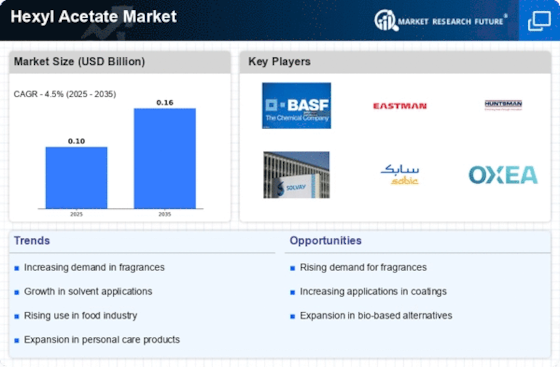
As per MRFR analysis, the Hexyl Acetate Market Size was estimated at 0.0982 USD Billion in 2024. The Hexyl Acetate industry is projected to grow from 0.1027 in 2025 to 0.1594 by 2035, exhibiting a compound annual growth rate (CAGR) of 4.5 during the forecast period 2025 - 2035.

Key Market Trends & Highlights

The Hexyl Acetate Market is experiencing robust growth driven by diverse applications and evolving consumer preferences.

  • The fragrance industry is witnessing a rising demand for hexyl acetate, indicating a strong market trend.
  • There is a notable shift towards natural ingredients in the production of hexyl acetate, reflecting consumer preferences.
  • North America remains the largest market, while Asia-Pacific is emerging as the fastest-growing region for hexyl acetate.
  • The expanding applications in the solvent industry and growth in the personal care sector are key drivers of market momentum.

Market Size & Forecast

2024 Market Size 0.0982 (USD Billion)
2035 Market Size 0.1594 (USD Billion)
CAGR (2025 - 2035) 4.5%
Largest Regional Market Share in 2024 North America

Major Players

<p>BASF SE (DE), Eastman Chemical Company (US), Huntsman Corporation (US), Solvay S.A. (BE), SABIC (SA), Oxea GmbH (DE), Kraton Corporation (US), Mitsubishi Chemical Corporation (JP), Daicel Corporation (JP)</p>

Market Trends

The Hexyl Acetate Market is currently experiencing a dynamic phase characterized by evolving consumer preferences and increasing applications across various industries. This compound, known for its fruity aroma, finds utility in sectors such as food and beverage, cosmetics, and pharmaceuticals. The growing inclination towards natural and organic products is influencing manufacturers to explore hexyl acetate as a viable ingredient, thereby expanding its market presence. Additionally, the rising demand for fragrances and flavoring agents is propelling the market forward, as hexyl acetate is often utilized in these formulations. Moreover, the Hexyl Acetate Market is likely to benefit from advancements in production technologies, which may enhance efficiency and reduce costs. As sustainability becomes a focal point for many industries, the potential for eco-friendly production methods could further drive interest in hexyl acetate. The interplay between regulatory frameworks and market demands suggests a complex landscape, where compliance and innovation must coexist. Overall, the Hexyl Acetate Market appears poised for growth, driven by diverse applications and a shift towards sustainable practices.

Rising Demand in Fragrance Industry

The fragrance sector is witnessing a notable increase in the utilization of hexyl acetate, attributed to its appealing scent profile. This trend indicates a broader acceptance of hexyl acetate in various fragrance formulations, enhancing its market relevance.

Shift Towards Natural Ingredients

There is a growing consumer preference for natural and organic products, prompting manufacturers to incorporate hexyl acetate into their offerings. This shift suggests a potential expansion of the market as brands seek to align with consumer values.

Technological Advancements in Production

Innovations in production techniques are likely to improve the efficiency of hexyl acetate manufacturing. This trend may lead to cost reductions and increased availability, further stimulating market growth.

Hexyl Acetate Market Market Drivers

Rising Demand for Eco-Friendly Products

The Hexyl Acetate Market is poised for growth as the demand for eco-friendly products continues to rise. Consumers are becoming more environmentally conscious, leading to a shift towards sustainable and biodegradable ingredients in various applications. Hexyl acetate, being a naturally derived compound, aligns well with this trend. The market for eco-friendly solvents is projected to grow at a compound annual growth rate of 5% through 2025, indicating a strong preference for sustainable alternatives. As industries such as paints, coatings, and personal care increasingly adopt eco-friendly practices, the demand for hexyl acetate is expected to surge. This shift not only enhances the market potential for hexyl acetate but also positions it as a key player in the transition towards greener formulations within the Hexyl Acetate Market.

Expanding Applications in Solvent Industry

The Hexyl Acetate Market is experiencing a notable expansion due to its increasing applications in the solvent sector. Hexyl acetate is widely utilized as a solvent in various formulations, including paints, coatings, and adhesives. The demand for high-quality solvents is on the rise, driven by the need for improved performance and environmental compliance. In 2025, the solvent market is projected to reach a valuation of approximately 30 billion USD, with hexyl acetate playing a crucial role in this growth. The versatility of hexyl acetate as a solvent, combined with its favorable properties such as low toxicity and high solvency power, positions it as a preferred choice among manufacturers. This trend indicates a robust future for the Hexyl Acetate Market, as it aligns with the increasing focus on sustainable and efficient solvent solutions.

Growth in Personal Care and Cosmetics Sector

The Hexyl Acetate Market is significantly influenced by the growth of the personal care and cosmetics sector. Hexyl acetate is commonly used as a fragrance ingredient and solvent in various cosmetic formulations, including perfumes, lotions, and creams. The Hexyl Acetate Market is anticipated to surpass 500 billion USD by 2025, with a substantial portion attributed to fragrance products. As consumers increasingly seek innovative and high-quality personal care products, the demand for hexyl acetate is likely to rise. This growth is further supported by the trend towards natural and organic formulations, where hexyl acetate serves as a safe and effective ingredient. Consequently, the Hexyl Acetate Market stands to benefit from the expanding personal care sector, as manufacturers continue to incorporate this compound into their product lines.

Increased Regulatory Support for Chemical Safety

The Hexyl Acetate Market is benefiting from increased regulatory support aimed at enhancing chemical safety. Governments and regulatory bodies are implementing stricter guidelines to ensure the safe use of chemicals in various industries. Hexyl acetate, recognized for its relatively low toxicity and favorable safety profile, is likely to gain traction as manufacturers seek compliant alternatives. The regulatory landscape is evolving, with an emphasis on sustainable practices and the reduction of hazardous substances. This shift is expected to bolster the demand for hexyl acetate, as it meets safety standards while providing effective performance in applications such as solvents and fragrances. As the regulatory environment continues to evolve, the Hexyl Acetate Market is well-positioned to capitalize on these changes, fostering growth and innovation.

Technological Innovations in Production Processes

The Hexyl Acetate Market is witnessing advancements in production technologies that enhance efficiency and reduce costs. Innovations in chemical synthesis and processing techniques are enabling manufacturers to produce hexyl acetate more sustainably and economically. For instance, the adoption of green chemistry principles is leading to the development of processes that minimize waste and energy consumption. As production methods become more efficient, the overall cost of hexyl acetate is likely to decrease, making it more accessible to various industries. This trend is particularly relevant in sectors such as coatings and personal care, where cost-effectiveness is crucial. Consequently, the Hexyl Acetate Market stands to benefit from these technological innovations, which may drive increased adoption and market penetration.

Market Segment Insights

By Type: Catalyzed Reactive Distillation Synthesis (Largest) vs. Lipase Catalyzed Ester Synthesis (Fastest-Growing)

<p>In the Hexyl Acetate Market, Catalyzed Reactive Distillation Synthesis commands a significant portion of the segment share, reflecting its established methodologies in synthesizing hexyl acetate. This technique, recognized for its efficiency and effectiveness, has allowed it to maintain dominance in this competitive landscape, catering to diverse industrial applications. In contrast, Lipase Catalyzed Ester Synthesis, while currently representing a smaller segment, is rapidly gaining traction. Its appeal lies in its environmentally friendly approach and the rising preference for biocatalytic processes in chemical production.</p>

<p>Synthesis Methods: Catalyzed Reactive Distillation (Dominant) vs. Lipase Catalyzed Ester (Emerging)</p>

<p>Catalyzed Reactive Distillation Synthesis is well-regarded for its efficiency and relatively lower energy consumption, making it a preferred choice among manufacturers in the Hexyl Acetate Market. Its proven track record and ability to yield high-purity products have solidified its position as the dominant synthesis method. On the other hand, Lipase Catalyzed Ester Synthesis is emerging due to global shifts toward sustainable and eco-friendly production methods. It utilizes lipase enzymes to synthesize esters, aligned with the growing consumer demand for greener products. This segment is witnessing rapid innovation, resulting in enhanced productivity and substrate versatility, making it an attractive alternative for future investments.</p>

By Application: Cosmetic (Largest) vs. Food and Beverage (Fastest-Growing)

<p>The Hexyl Acetate Market exhibits a diverse application landscape, with the cosmetic segment holding the largest market share. This segment benefits from the increasing demand for personal care products, where hexyl acetate is valued for its fragrant properties and stability in formulations. In comparison, the food and beverage segment, while currently smaller, is becoming increasingly significant, driven by the growing trend for natural flavors and fragrances in food products. Consumers are leaning towards products with natural ingredients, positioning hexyl acetate as a favorable choice for flavoring applications.</p>

<p>Cosmetic: Dominant vs. Food and Beverage: Emerging</p>

<p>Within the Hexyl Acetate Market, the cosmetic sector remains the dominant application, leveraging the compound's appealing scent and functionality in a wide array of beauty products such as perfumes, lotions, and shampoos. Its ability to blend seamlessly into formulations while providing a pleasant aroma enhances consumer products, driving demand. Conversely, the food and beverage sector is on the rise, emerging rapidly due to the increasing consumer preference for natural and organic flavors. As manufacturers strive to meet these preferences, hexyl acetate is gaining traction as a flavoring agent that delivers quality and consumer satisfaction. Together, these segments illustrate the versatile nature of hexyl acetate across multiple industries.</p>

Get more detailed insights about Hexyl Acetate Market Research Report - Forecast by 2035

Regional Insights

North America : Innovation and Demand Surge

The North American hexyl acetate market is driven by increasing demand in the fragrance and flavor industries, alongside a growing focus on sustainable products. The region holds the largest market share at approximately 45%, with the U.S. being the primary contributor. Regulatory support for eco-friendly chemicals further propels market growth, as companies adapt to stringent environmental standards. Leading the market, the U.S. is home to major players like Eastman Chemical Company and Huntsman Corporation. The competitive landscape is characterized by innovation and strategic partnerships, with companies investing in R&D to enhance product offerings. The presence of established firms ensures a robust supply chain, catering to diverse applications in cosmetics, food, and industrial sectors.

Europe : Regulatory Framework and Growth

Europe is witnessing significant growth in the hexyl acetate market, driven by stringent regulations promoting the use of safe and sustainable chemicals. The region holds the second-largest market share at around 30%. Countries like Germany and France are leading the charge, with regulatory bodies emphasizing eco-friendly practices that stimulate demand for hexyl acetate in various applications, including personal care and food industries. Germany stands out as a key player, hosting major companies like BASF SE and Oxea GmbH. The competitive landscape is marked by innovation and collaboration among firms to meet regulatory standards. The presence of a well-established chemical industry in Europe fosters a conducive environment for market growth, with companies focusing on product differentiation and sustainability initiatives.

Asia-Pacific : Emerging Markets and Opportunities

The Asia-Pacific region is rapidly emerging as a significant player in the hexyl acetate market, driven by increasing industrialization and urbanization. The region holds a market share of approximately 20%, with China and Japan leading in production and consumption. The growing demand for hexyl acetate in the automotive and electronics sectors is a key growth driver, supported by favorable government policies promoting chemical manufacturing. China is the largest market, with companies like Mitsubishi Chemical Corporation and Daicel Corporation playing pivotal roles. The competitive landscape is evolving, with local manufacturers increasing their market presence through strategic investments and partnerships. The region's focus on innovation and sustainability is expected to further enhance market growth, catering to diverse applications across various industries.

Middle East and Africa : Resource-Rich and Growing Demand

The Middle East and Africa (MEA) region is witnessing a gradual increase in the hexyl acetate market, driven by rising demand in the cosmetics and food sectors. The region holds a smaller market share of about 5%, with countries like South Africa and Saudi Arabia showing potential for growth. The increasing focus on local manufacturing and regulatory support for chemical production is expected to boost market dynamics in the coming years. South Africa is emerging as a key player, with local companies exploring opportunities in the hexyl acetate market. The competitive landscape is characterized by a mix of local and international players, with firms focusing on enhancing production capabilities. As the region continues to develop its chemical industry, the demand for hexyl acetate is anticipated to rise, driven by both domestic consumption and export opportunities.

Key Players and Competitive Insights

Leading market players are investing heavily in research and development in order to expand their product lines, which will help the Hexyl acetate market, grow even more. Market participants are also undertaking a variety of strategic activities to expand their footprint, with important market developments including new product launches, contractual agreements, mergers and acquisitions, higher investments, and collaboration with other organizations. To expand and survive in a more competitive and rising market climate, Hexyl acetate industry must offer cost-effective items.

Manufacturing locally to minimize operational costs is one of the key business tactics used by manufacturers in the Hexyl acetate industry to benefit clients and increase the market sector. In recent years, the Hexyl acetate industry has offered some of the most significant advantages to medicine.

Major players in the Hexyl acetate market, including Lluch Essence, International Flavors&Fragrances, Elan, Bontoux, Beijing Lys Chemicals, Augustus Oils, Apiscent Labs, Alfrebro, Advanced Biotech, RX Marine International, Nimble Technologies, Zhejiang NetSun,Novaphene, Merck KGaA, Ungerer & Company, Elan Chemical Company, among others and others, are attempting to increase market demand by investing in research and development operations.

International Flavors & Fragrances Inc. (IFF) produces and sells complementary goods such cosmetic active ingredients and natural health ingredients as well as beverage, food, health and biosciences, smell, and pharma solutions. The business provides its goods to producers of meat, dairy, beverages, savory, sweet, and baked goods as well as soaps and detergents, personal care items, household cleaners, and cosmetics and fragrances. The products of IFF are also used in dental care goods, pharmaceuticals, newborn and geriatric nutrition, food protection, functional food, and dietary supplements.

In addition to the US, Belgium, the Netherlands, Spain, Indonesia, Turkey, Finland, Brazil, Denmark, Mexico, Slovenia, Ireland, China, Germany, India, and Singapore, it also has production facilities there. The company operates in the Americas, Europe, Africa, the Middle East, and Asia-Pacific. The US city of New York City serves as the headquarters of IFF.

A division of E. Merck KG is the science and technology firm Merck KGaA (Merck). It also creates liquid crystal combinations, organic light-emitting diode (OLED) materials, cosmetic active ingredients, coating pigments, and high-tech materials. These drugs are prescribed to treat cancer, multiple sclerosis, and infertility. Additionally, Merck offers a wide range of goods, such as end-to-end systems for flow cytometry, flow cytometry kits and instruments, cell lines, antibodies, test assays, analytical reagents, lab water systems, gene editing tools, and cell lines. The business provides services to the life sciences, performance materials, and healthcare sectors.

It is present in the Middle East, Africa, Latin America, North America, and Asia-Pacific. The headquarters of Merck are in Darmstadt, Hesse, Germany.

Key Companies in the Hexyl Acetate Market market include

Industry Developments

February 2023: The specialty chemicals company LANXESS has unveiled its broad range of fragrance and flavor applications, which include high purity, reliable, and nature-identical products that enhance the earthy, floral, fruity, cinnamic, or woody notes in cosmetics, food, beverages, and household cleaning products.

Future Outlook

Hexyl Acetate Market Future Outlook

<p>The Hexyl Acetate Market is projected to grow at a 4.5% CAGR from 2024 to 2035, driven by increasing demand in the fragrance and coatings industries.</p>

New opportunities lie in:

  • <p>Expansion into bio-based hexyl acetate production</p>
  • <p>Development of customized fragrance formulations</p>
  • <p>Strategic partnerships with cosmetic manufacturers for exclusive supply agreements</p>

<p>By 2035, the Hexyl Acetate Market is expected to achieve robust growth and enhanced market positioning.</p>

Market Segmentation

Hexyl Acetate Market Type Outlook

  • Catalyzed Reactive Distillation Synthesis
  • Lipase Catalyzed Ester Synthesis

Hexyl Acetate Market Application Outlook

  • Cosmetic
  • Food and Beverage
  • Other

Report Scope

MARKET SIZE 20240.0982(USD Billion)
MARKET SIZE 20250.1027(USD Billion)
MARKET SIZE 20350.1594(USD Billion)
COMPOUND ANNUAL GROWTH RATE (CAGR)4.5% (2024 - 2035)
REPORT COVERAGERevenue Forecast, Competitive Landscape, Growth Factors, and Trends
BASE YEAR2024
Market Forecast Period2025 - 2035
Historical Data2019 - 2024
Market Forecast UnitsUSD Billion
Key Companies ProfiledMarket analysis in progress
Segments CoveredMarket segmentation analysis in progress
Key Market OpportunitiesGrowing demand for eco-friendly solvents drives innovation in the Hexyl Acetate Market.
Key Market DynamicsRising demand for eco-friendly solvents drives innovation and competition in the Hexyl Acetate Market.
Countries CoveredNorth America, Europe, APAC, South America, MEA

FAQs

What is the projected market valuation of the Hexyl Acetate Market for 2035?

The projected market valuation for the Hexyl Acetate Market in 2035 is 0.1594 USD Billion.

What was the overall market valuation of the Hexyl Acetate Market in 2024?

The overall market valuation of the Hexyl Acetate Market in 2024 was 0.0982 USD Billion.

What is the expected CAGR for the Hexyl Acetate Market during the forecast period 2025 - 2035?

The expected CAGR for the Hexyl Acetate Market during the forecast period 2025 - 2035 is 4.5%.

Which companies are considered key players in the Hexyl Acetate Market?

Key players in the Hexyl Acetate Market include BASF SE, Eastman Chemical Company, Huntsman Corporation, and Solvay S.A.

What are the main applications of Hexyl Acetate in the market?

The main applications of Hexyl Acetate include Cosmetic, Food and Beverage, and Other sectors.

What was the market size for the Cosmetic application of Hexyl Acetate in 2024?

The market size for the Cosmetic application of Hexyl Acetate in 2024 was 0.035 USD Billion.

  1. SECTION I: EXECUTIVE SUMMARY AND KEY HIGHLIGHTS
    1. EXECUTIVE SUMMARY
      1. Market Overview
      2. Key Findings
      3. Market Segmentation
      4. Competitive Landscape
      5. Challenges and Opportunities
      6. Future Outlook
  2. SECTION II: SCOPING, METHODOLOGY AND MARKET STRUCTURE
    1. MARKET INTRODUCTION
      1. Definition
      2. Scope of the study
    2. RESEARCH METHODOLOGY
      1. Overview
      2. Data Mining
      3. Secondary Research
      4. Primary Research
      5. Forecasting Model
      6. Market Size Estimation
      7. Data Triangulation
      8. Validation
  3. SECTION III: QUALITATIVE ANALYSIS
    1. MARKET DYNAMICS
      1. Overview
      2. Drivers
      3. Restraints
      4. Opportunities
    2. MARKET FACTOR ANALYSIS
      1. Value chain Analysis
      2. Porter's Five Forces Analysis
      3. COVID-19 Impact Analysis
  4. SECTION IV: QUANTITATIVE ANALYSIS
    1. Chemicals and Materials, BY Type (USD Billion)
      1. Catalyzed Reactive Distillation Synthesis
      2. Lipase Catalyzed Ester Synthesis
    2. Chemicals and Materials, BY Application (USD Billion)
      1. Cosmetic
      2. Food and Beverage
      3. Other
    3. Chemicals and Materials, BY Region (USD Billion)
      1. North America
      2. Europe
      3. APAC
      4. South America
      5. MEA
  5. SECTION V: COMPETITIVE ANALYSIS
    1. Competitive Landscape
      1. Overview
      2. Competitive Analysis
      3. Market share Analysis
      4. Major Growth Strategy in the Chemicals and Materials
      5. Competitive Benchmarking
      6. Leading Players in Terms of Number of Developments in the Chemicals and Materials
      7. Key developments and growth strategies
      8. Major Players Financial Matrix
    2. Company Profiles
      1. BASF SE (DE)
      2. Eastman Chemical Company (US)
      3. Huntsman Corporation (US)
      4. Solvay S.A. (BE)
      5. SABIC (SA)
      6. Oxea GmbH (DE)
      7. Kraton Corporation (US)
      8. Mitsubishi Chemical Corporation (JP)
      9. Daicel Corporation (JP)
    3. Appendix
      1. References
      2. Related Reports
  6. LIST OF FIGURES
    1. MARKET SYNOPSIS
    2. NORTH AMERICA MARKET ANALYSIS
    3. US MARKET ANALYSIS BY TYPE
    4. US MARKET ANALYSIS BY APPLICATION
    5. CANADA MARKET ANALYSIS BY TYPE
    6. CANADA MARKET ANALYSIS BY APPLICATION
    7. EUROPE MARKET ANALYSIS
    8. GERMANY MARKET ANALYSIS BY TYPE
    9. GERMANY MARKET ANALYSIS BY APPLICATION
    10. UK MARKET ANALYSIS BY TYPE
    11. UK MARKET ANALYSIS BY APPLICATION
    12. FRANCE MARKET ANALYSIS BY TYPE
    13. FRANCE MARKET ANALYSIS BY APPLICATION
    14. RUSSIA MARKET ANALYSIS BY TYPE
    15. RUSSIA MARKET ANALYSIS BY APPLICATION
    16. ITALY MARKET ANALYSIS BY TYPE
    17. ITALY MARKET ANALYSIS BY APPLICATION
    18. SPAIN MARKET ANALYSIS BY TYPE
    19. SPAIN MARKET ANALYSIS BY APPLICATION
    20. REST OF EUROPE MARKET ANALYSIS BY TYPE
    21. REST OF EUROPE MARKET ANALYSIS BY APPLICATION
    22. APAC MARKET ANALYSIS
    23. CHINA MARKET ANALYSIS BY TYPE
    24. CHINA MARKET ANALYSIS BY APPLICATION
    25. INDIA MARKET ANALYSIS BY TYPE
    26. INDIA MARKET ANALYSIS BY APPLICATION
    27. JAPAN MARKET ANALYSIS BY TYPE
    28. JAPAN MARKET ANALYSIS BY APPLICATION
    29. SOUTH KOREA MARKET ANALYSIS BY TYPE
    30. SOUTH KOREA MARKET ANALYSIS BY APPLICATION
    31. MALAYSIA MARKET ANALYSIS BY TYPE
    32. MALAYSIA MARKET ANALYSIS BY APPLICATION
    33. THAILAND MARKET ANALYSIS BY TYPE
    34. THAILAND MARKET ANALYSIS BY APPLICATION
    35. INDONESIA MARKET ANALYSIS BY TYPE
    36. INDONESIA MARKET ANALYSIS BY APPLICATION
    37. REST OF APAC MARKET ANALYSIS BY TYPE
    38. REST OF APAC MARKET ANALYSIS BY APPLICATION
    39. SOUTH AMERICA MARKET ANALYSIS
    40. BRAZIL MARKET ANALYSIS BY TYPE
    41. BRAZIL MARKET ANALYSIS BY APPLICATION
    42. MEXICO MARKET ANALYSIS BY TYPE
    43. MEXICO MARKET ANALYSIS BY APPLICATION
    44. ARGENTINA MARKET ANALYSIS BY TYPE
    45. ARGENTINA MARKET ANALYSIS BY APPLICATION
    46. REST OF SOUTH AMERICA MARKET ANALYSIS BY TYPE
    47. REST OF SOUTH AMERICA MARKET ANALYSIS BY APPLICATION
    48. MEA MARKET ANALYSIS
    49. GCC COUNTRIES MARKET ANALYSIS BY TYPE
    50. GCC COUNTRIES MARKET ANALYSIS BY APPLICATION
    51. SOUTH AFRICA MARKET ANALYSIS BY TYPE
    52. SOUTH AFRICA MARKET ANALYSIS BY APPLICATION
    53. REST OF MEA MARKET ANALYSIS BY TYPE
    54. REST OF MEA MARKET ANALYSIS BY APPLICATION
    55. KEY BUYING CRITERIA OF CHEMICALS AND MATERIALS
    56. RESEARCH PROCESS OF MRFR
    57. DRO ANALYSIS OF CHEMICALS AND MATERIALS
    58. DRIVERS IMPACT ANALYSIS: CHEMICALS AND MATERIALS
    59. RESTRAINTS IMPACT ANALYSIS: CHEMICALS AND MATERIALS
    60. SUPPLY / VALUE CHAIN: CHEMICALS AND MATERIALS
    61. CHEMICALS AND MATERIALS, BY TYPE, 2024 (% SHARE)
    62. CHEMICALS AND MATERIALS, BY TYPE, 2024 TO 2035 (USD Billion)
    63. CHEMICALS AND MATERIALS, BY APPLICATION, 2024 (% SHARE)
    64. CHEMICALS AND MATERIALS, BY APPLICATION, 2024 TO 2035 (USD Billion)
    65. BENCHMARKING OF MAJOR COMPETITORS
  7. LIST OF TABLES
    1. LIST OF ASSUMPTIONS
    2. North America MARKET SIZE ESTIMATES; FORECAST
      1. BY TYPE, 2025-2035 (USD Billion)
      2. BY APPLICATION, 2025-2035 (USD Billion)
    3. US MARKET SIZE ESTIMATES; FORECAST
      1. BY TYPE, 2025-2035 (USD Billion)
      2. BY APPLICATION, 2025-2035 (USD Billion)
    4. Canada MARKET SIZE ESTIMATES; FORECAST
      1. BY TYPE, 2025-2035 (USD Billion)
      2. BY APPLICATION, 2025-2035 (USD Billion)
    5. Europe MARKET SIZE ESTIMATES; FORECAST
      1. BY TYPE, 2025-2035 (USD Billion)
      2. BY APPLICATION, 2025-2035 (USD Billion)
    6. Germany MARKET SIZE ESTIMATES; FORECAST
      1. BY TYPE, 2025-2035 (USD Billion)
      2. BY APPLICATION, 2025-2035 (USD Billion)
    7. UK MARKET SIZE ESTIMATES; FORECAST
      1. BY TYPE, 2025-2035 (USD Billion)
      2. BY APPLICATION, 2025-2035 (USD Billion)
    8. France MARKET SIZE ESTIMATES; FORECAST
      1. BY TYPE, 2025-2035 (USD Billion)
      2. BY APPLICATION, 2025-2035 (USD Billion)
    9. Russia MARKET SIZE ESTIMATES; FORECAST
      1. BY TYPE, 2025-2035 (USD Billion)
      2. BY APPLICATION, 2025-2035 (USD Billion)
    10. Italy MARKET SIZE ESTIMATES; FORECAST
      1. BY TYPE, 2025-2035 (USD Billion)
      2. BY APPLICATION, 2025-2035 (USD Billion)
    11. Spain MARKET SIZE ESTIMATES; FORECAST
      1. BY TYPE, 2025-2035 (USD Billion)
      2. BY APPLICATION, 2025-2035 (USD Billion)
    12. Rest of Europe MARKET SIZE ESTIMATES; FORECAST
      1. BY TYPE, 2025-2035 (USD Billion)
      2. BY APPLICATION, 2025-2035 (USD Billion)
    13. APAC MARKET SIZE ESTIMATES; FORECAST
      1. BY TYPE, 2025-2035 (USD Billion)
      2. BY APPLICATION, 2025-2035 (USD Billion)
    14. China MARKET SIZE ESTIMATES; FORECAST
      1. BY TYPE, 2025-2035 (USD Billion)
      2. BY APPLICATION, 2025-2035 (USD Billion)
    15. India MARKET SIZE ESTIMATES; FORECAST
      1. BY TYPE, 2025-2035 (USD Billion)
      2. BY APPLICATION, 2025-2035 (USD Billion)
    16. Japan MARKET SIZE ESTIMATES; FORECAST
      1. BY TYPE, 2025-2035 (USD Billion)
      2. BY APPLICATION, 2025-2035 (USD Billion)
    17. South Korea MARKET SIZE ESTIMATES; FORECAST
      1. BY TYPE, 2025-2035 (USD Billion)
      2. BY APPLICATION, 2025-2035 (USD Billion)
    18. Malaysia MARKET SIZE ESTIMATES; FORECAST
      1. BY TYPE, 2025-2035 (USD Billion)
      2. BY APPLICATION, 2025-2035 (USD Billion)
    19. Thailand MARKET SIZE ESTIMATES; FORECAST
      1. BY TYPE, 2025-2035 (USD Billion)
      2. BY APPLICATION, 2025-2035 (USD Billion)
    20. Indonesia MARKET SIZE ESTIMATES; FORECAST
      1. BY TYPE, 2025-2035 (USD Billion)
      2. BY APPLICATION, 2025-2035 (USD Billion)
    21. Rest of APAC MARKET SIZE ESTIMATES; FORECAST
      1. BY TYPE, 2025-2035 (USD Billion)
      2. BY APPLICATION, 2025-2035 (USD Billion)
    22. South America MARKET SIZE ESTIMATES; FORECAST
      1. BY TYPE, 2025-2035 (USD Billion)
      2. BY APPLICATION, 2025-2035 (USD Billion)
    23. Brazil MARKET SIZE ESTIMATES; FORECAST
      1. BY TYPE, 2025-2035 (USD Billion)
      2. BY APPLICATION, 2025-2035 (USD Billion)
    24. Mexico MARKET SIZE ESTIMATES; FORECAST
      1. BY TYPE, 2025-2035 (USD Billion)
      2. BY APPLICATION, 2025-2035 (USD Billion)
    25. Argentina MARKET SIZE ESTIMATES; FORECAST
      1. BY TYPE, 2025-2035 (USD Billion)
      2. BY APPLICATION, 2025-2035 (USD Billion)
    26. Rest of South America MARKET SIZE ESTIMATES; FORECAST
      1. BY TYPE, 2025-2035 (USD Billion)
      2. BY APPLICATION, 2025-2035 (USD Billion)
    27. MEA MARKET SIZE ESTIMATES; FORECAST
      1. BY TYPE, 2025-2035 (USD Billion)
      2. BY APPLICATION, 2025-2035 (USD Billion)
    28. GCC Countries MARKET SIZE ESTIMATES; FORECAST
      1. BY TYPE, 2025-2035 (USD Billion)
      2. BY APPLICATION, 2025-2035 (USD Billion)
    29. South Africa MARKET SIZE ESTIMATES; FORECAST
      1. BY TYPE, 2025-2035 (USD Billion)
      2. BY APPLICATION, 2025-2035 (USD Billion)
    30. Rest of MEA MARKET SIZE ESTIMATES; FORECAST
      1. BY TYPE, 2025-2035 (USD Billion)
      2. BY APPLICATION, 2025-2035 (USD Billion)
    31. PRODUCT LAUNCH/PRODUCT DEVELOPMENT/APPROVAL
    32. ACQUISITION/PARTNERSHIP

Hexyl Acetate Type Outlook (USD Billion, 2018-2032)

  • Catalyzed Reactive Distillation Synthesis
  • Lipase Catalyzed Ester Synthesis

Hexyl Acetate Application Outlook (USD Billion, 2018-2032)

  • Cosmetic
  • Food And Beverage
  • Other

Hexyl Acetate Regional Outlook (USD Billion, 2018-2032)

  • North America Outlook (USD Billion, 2018-2032)

    • Hexyl Acetate by Type
      • Catalyzed Reactive Distillation Synthesis
      • Lipase Catalyzed Ester Synthesis
    • Hexyl Acetate by Application
      • Cosmetic
      • Food And Beverage
      • Other
    • US Outlook (USD Billion, 2018-2032)

    • Hexyl Acetate by Type
      • Catalyzed Reactive Distillation Synthesis
      • Lipase Catalyzed Ester Synthesis
    • Hexyl Acetate by Application
      • Cosmetic
      • Food And Beverage
      • Other
    • Canada Outlook (USD Billion, 2018-2032)

    • Hexyl Acetate by Type
      • Catalyzed Reactive Distillation Synthesis
      • Lipase Catalyzed Ester Synthesis
    • Hexyl Acetate by Application
      • Cosmetic
      • Food And Beverage
      • Other
  • Europe Outlook (USD Billion, 2018-2032)

    • Hexyl Acetate by Type
      • Catalyzed Reactive Distillation Synthesis
      • Lipase Catalyzed Ester Synthesis
    • Hexyl Acetate by Application
      • Cosmetic
      • Food And Beverage
      • Other
    • Germany Outlook (USD Billion, 2018-2032)

    • Hexyl Acetate by Type
      • Catalyzed Reactive Distillation Synthesis
      • Lipase Catalyzed Ester Synthesis
    • Hexyl Acetate by Application
      • Cosmetic
      • Food And Beverage
      • Other
    • France Outlook (USD Billion, 2018-2032)

    • Hexyl Acetate by Type
      • Catalyzed Reactive Distillation Synthesis
      • Lipase Catalyzed Ester Synthesis
    • Hexyl Acetate by Application
      • Cosmetic
      • Food And Beverage
      • Other
    • UK Outlook (USD Billion, 2018-2032)

    • Hexyl Acetate by Type
      • Catalyzed Reactive Distillation Synthesis
      • Lipase Catalyzed Ester Synthesis
    • Hexyl Acetate by Application
      • Cosmetic
      • Food And Beverage
      • Other
    • Italy Outlook (USD Billion, 2018-2032)

    • Hexyl Acetate by Type
      • Catalyzed Reactive Distillation Synthesis
      • Lipase Catalyzed Ester Synthesis
    • Hexyl Acetate by Application
      • Cosmetic
      • Food And Beverage
      • Other
    • Spain Outlook (USD Billion, 2018-2032)

    • Hexyl Acetate by Type
      • Catalyzed Reactive Distillation Synthesis
      • Lipase Catalyzed Ester Synthesis
    • Hexyl Acetate by Application
      • Cosmetic
      • Food And Beverage
      • Other
    • Rest Of Europe Outlook (USD Billion, 2018-2032)

    • Hexyl Acetate by Type
      • Catalyzed Reactive Distillation Synthesis
      • Lipase Catalyzed Ester Synthesis
    • Hexyl Acetate by Application
      • Cosmetic
      • Food And Beverage
      • Other
  • Asia-Pacific Outlook (USD Billion, 2018-2032)

    • Hexyl Acetate by Type
      • Catalyzed Reactive Distillation Synthesis
      • Lipase Catalyzed Ester Synthesis
    • Hexyl Acetate by Application
      • Cosmetic
      • Food And Beverage
      • Other
    • China Outlook (USD Billion, 2018-2032)

    • Hexyl Acetate by Type
      • Catalyzed Reactive Distillation Synthesis
      • Lipase Catalyzed Ester Synthesis
    • Hexyl Acetate by Application
      • Cosmetic
      • Food And Beverage
      • Other
    • Japan Outlook (USD Billion, 2018-2032)

    • Hexyl Acetate by Type
      • Catalyzed Reactive Distillation Synthesis
      • Lipase Catalyzed Ester Synthesis
    • Hexyl Acetate by Application
      • Cosmetic
      • Food And Beverage
      • Other
    • India Outlook (USD Billion, 2018-2032)

    • Hexyl Acetate by Type
      • Catalyzed Reactive Distillation Synthesis
      • Lipase Catalyzed Ester Synthesis
    • Hexyl Acetate by Application
      • Cosmetic
      • Food And Beverage
      • Other
    • Australia Outlook (USD Billion, 2018-2032)

    • Hexyl Acetate by Type
      • Catalyzed Reactive Distillation Synthesis
      • Lipase Catalyzed Ester Synthesis
    • Hexyl Acetate by Application
      • Cosmetic
      • Food And Beverage
      • Other
    • Rest of Asia-Pacific Outlook (USD Billion, 2018-2032)

    • Hexyl Acetate by Type
      • Catalyzed Reactive Distillation Synthesis
      • Lipase Catalyzed Ester Synthesis
    • Hexyl Acetate by Application
      • Cosmetic
      • Food And Beverage
      • Other
  • Rest of the World Outlook (USD Billion, 2018-2032)

    • Hexyl Acetate by Type
      • Catalyzed Reactive Distillation Synthesis
      • Lipase Catalyzed Ester Synthesis
    • Hexyl Acetate by Application
      • Cosmetic
      • Food And Beverage
      • Other
    • Middle East Outlook (USD Billion, 2018-2032)

    • Hexyl Acetate by Type
      • Catalyzed Reactive Distillation Synthesis
      • Lipase Catalyzed Ester Synthesis
    • Hexyl Acetate by Application
      • Cosmetic
      • Food And Beverage
      • Other
    • Africa Outlook (USD Billion, 2018-2032)

    • Hexyl Acetate by Type
      • Catalyzed Reactive Distillation Synthesis
      • Lipase Catalyzed Ester Synthesis
    • Hexyl Acetate by Application
      • Cosmetic
      • Food And Beverage
      • Other
    • Latin America Outlook (USD Billion, 2018-2032)

    • Hexyl Acetate by Type
      • Catalyzed Reactive Distillation Synthesis
      • Lipase Catalyzed Ester Synthesis
    • Hexyl Acetate by Application
      • Cosmetic
      • Food And Beverage
      • Other


Infographic

Free Sample Request

Kindly complete the form below to receive a free sample of this Report

Get Free Sample

Customer Strories

Compare Licence

×
Features License Type
Single User Multiuser License Enterprise User
Price $4,950 $5,950 $7,250
Maximum User Access Limit 1 User Upto 10 Users Unrestricted Access Throughout the Organization
Free Customization
Direct Access to Analyst
Deliverable Format
Platform Access
Discount on Next Purchase 10% 15% 15%
Printable Versions