
×
Hero Background
English
Chinese
French
Japanese
Korean
German
Spanish

Herbicide Safeners Market Share

ID: MRFR/Agri/8938-HCR
90 Pages
Snehal Singh
October 2025

Herbicide Safeners Market Research Report Information By Type (Benoxacor, Furilazole, Dichlormid, Isoxadifen, and Others), By Application Stage (Post-Emergence and Pre-Emergence), By Herbicide Selectivity (Selective Herbicides, Non-Selective Herbicides), By Crop Type (Wheat, Soybean, Sorghum, Maize, Rice, Barley, Others), And By Region (North America, Europe, Asia-Pacific, And Rest Of The World) –Market Forecast Till 2035

Share:
Download PDF ×

We do not share your information with anyone. However, we may send you emails based on your report interest from time to time. You may contact us at any time to opt-out.

Herbicide Safeners Market Infographic
Purchase Options

Market Share

Herbicide Safeners Market Share Analysis

herbicide safeners market, companies implement various strategies to secure their positions and gain a competitive advantage in catering to the needs of farmers and the agricultural industry. Herbicide safeners, critical for protecting crops from the harmful effects of herbicides while maximizing weed control efficacy, require strategic positioning to effectively capture market share and address the demands of growers.

One of the primary strategies employed in the herbicide safeners market is product differentiation. Companies invest in research and development to create innovative herbicide safener formulations that offer unique benefits to farmers. These formulations may include safeners that enhance crop tolerance to herbicides, reduce phytotoxicity, and minimize crop stress, ultimately leading to improved yields and quality. By differentiating their products based on these desirable traits, companies can attract farmers seeking solutions to optimize herbicide application and protect their crops effectively.

Pricing strategy is also a crucial aspect of market share positioning in the herbicide safeners market. While the development and commercialization of herbicide safener technologies entail significant investment and research costs, companies must balance pricing to remain competitive. Some companies opt to compete based on price by optimizing production processes, minimizing overhead costs, and offering competitively priced herbicide safener products. This approach aims to appeal to cost-conscious farmers while still ensuring profitability and sustainability for safener producers.

Furthermore, companies often target niche markets or specific crop segments to tailor their herbicide safener strategies. For instance, companies may develop safener formulations tailored to specific crops such as corn, soybeans, wheat, or rice. Additionally, companies may focus on addressing particular challenges or needs prevalent in certain regions or farming systems, such as herbicide resistance management or environmental stewardship. By understanding the unique needs and preferences of different customer segments, companies can customize their herbicide safener offerings to provide targeted solutions effectively. This targeted approach allows companies to position themselves as leaders in specific crop segments and build strong relationships with farmers seeking tailored safener solutions.

Branding and marketing efforts also play a crucial role in market share positioning within the herbicide safeners market. Building a strong brand identity helps companies establish credibility, trust, and recognition among farmers, agricultural stakeholders, and industry professionals. Through effective branding, companies can communicate the benefits and value proposition of their herbicide safener technologies, distinguishing themselves from competitors. Additionally, targeted marketing campaigns highlighting the agronomic benefits, environmental safety, and economic advantages of herbicide safeners can influence purchasing decisions and drive demand in the market.

Moreover, strategic partnerships and collaborations are instrumental in expanding market share and enhancing competitive positioning in the herbicide safeners market. Collaborating with agricultural input suppliers, herbicide manufacturers, agricultural distributors, and extension services allows companies to leverage their combined expertise, resources, and networks to penetrate new markets and reach a broader customer base. Partnerships may involve joint research and development projects, licensing agreements, or distribution partnerships to accelerate the adoption and commercialization of herbicide safener technologies. By forging strategic alliances, companies can capitalize on synergies, expand their market reach, and strengthen their competitive position in the herbicide safeners market. herbicide safeners market is characterized by increasing demand for innovative solutions that maximize weed control efficacy while minimizing crop stress and phytotoxicity. To succeed in this competitive landscape, companies employ various market share positioning strategies, including product differentiation, pricing, niche targeting, branding, and strategic partnerships. By understanding the diverse needs of farmers, innovating to meet evolving market demands, and building strong relationships with stakeholders, companies can establish a competitive edge and thrive in the dynamic herbicide safeners market.


Author
Snehal Singh
Assistant Manager - Research

High acumen in analyzing complex macro & micro markets with more than 6 years of work experience in the field of market research. By implementing her analytical skills in forecasting and estimation into market research reports, she has expertise in Packaging, Construction, and Equipment domains. She handles a team size of 20-25 resources and ensures smooth running of the projects, associated marketing activities, and client servicing.

Leave a Comment

FAQs

What is the current valuation of the Herbicide Safeners Market?

The Herbicide Safeners Market was valued at 1.737 USD Billion in 2024.

What is the projected market size for the Herbicide Safeners Market by 2035?

The market is projected to reach 3.516 USD Billion by 2035.

What is the expected CAGR for the Herbicide Safeners Market during the forecast period?

The expected CAGR for the Herbicide Safeners Market from 2025 to 2035 is 6.62%.

Which companies are considered key players in the Herbicide Safeners Market?

Key players include BASF SE, Syngenta AG, Corteva Agriscience, Bayer AG, and FMC Corporation.

What are the main segments of the Herbicide Safeners Market?

The main segments include Type, Application Stage, Herbicide Selectivity, and Crop Type.

How did the Post-Emergence application stage perform in 2024?

The Post-Emergence application stage was valued at 1.045 USD Billion in 2024.

Market Summary

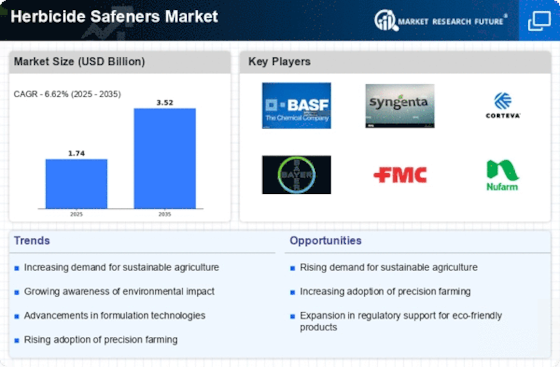
As per MRFR analysis, the Herbicide Safeners Market Size was estimated at 1.737 USD Billion in 2024. The Herbicide Safeners industry is projected to grow from 1.852 USD Billion in 2025 to 3.516 USD Billion by 2035, exhibiting a compound annual growth rate (CAGR) of 6.62 during the forecast period 2025 - 2035.

Key Market Trends & Highlights

The Herbicide Safeners Market is poised for growth driven by sustainability and technological advancements.

  • The market is increasingly influenced by a focus on sustainability, reflecting a broader trend in agriculture.
  • Technological advancements are enhancing the efficacy and safety of herbicide safeners, particularly in North America.
  • The post-emergence segment remains the largest, while the isoxadifen segment is emerging as the fastest-growing in the market.
  • Key drivers include the rising demand for sustainable agriculture and regulatory support for herbicide safeners.

Market Size & Forecast

2024 Market Size 1.737 (USD Billion)
2035 Market Size 3.516 (USD Billion)
CAGR (2025 - 2035) 6.62%
Largest Regional Market Share in 2024 North America

Major Players

<p>BASF SE (DE), Syngenta AG (CH), Corteva Agriscience (US), Bayer AG (DE), FMC Corporation (US), Nufarm Limited (AU), Adama Agricultural Solutions Ltd. (IL), UPL Limited (IN), Sumitomo Chemical Co., Ltd. (JP)</p>

Market Trends

The Herbicide Safeners Market is currently experiencing a notable evolution, driven by the increasing demand for sustainable agricultural practices. Farmers are increasingly seeking solutions that enhance crop protection while minimizing environmental impact. This trend appears to be influenced by a growing awareness of the need for responsible herbicide use, which has led to the development of innovative safeners that protect crops from the adverse effects of herbicides. Furthermore, regulatory frameworks are becoming more stringent, prompting manufacturers to invest in research and development to create safer and more effective products. As a result, the market is likely to witness a shift towards more eco-friendly options that align with global sustainability goals. In addition, the Herbicide Safeners Market seems to be benefiting from advancements in technology, particularly in precision agriculture. The integration of data analytics and smart farming techniques allows for more targeted application of herbicides, thereby reducing the overall quantity needed. This not only enhances the efficacy of herbicide safeners but also contributes to cost savings for farmers. Moreover, the increasing adoption of integrated pest management strategies is expected to further bolster the market, as these approaches often incorporate safeners to optimize herbicide performance. Overall, the Herbicide Safeners Market is poised for growth, driven by innovation, sustainability, and technological advancements.

Sustainability Focus

The emphasis on sustainable agricultural practices is reshaping the Herbicide Safeners Market. As environmental concerns rise, farmers are increasingly inclined to adopt products that minimize ecological impact while ensuring effective crop protection.

Technological Advancements

Innovations in precision agriculture are influencing the Herbicide Safeners Market. The use of data analytics and smart farming techniques allows for more precise herbicide application, enhancing the effectiveness of safeners and reducing overall usage.

Regulatory Changes

Evolving regulatory frameworks are impacting the Herbicide Safeners Market. Stricter guidelines are prompting manufacturers to invest in research and development, leading to the creation of safer and more efficient herbicide safeners.

Herbicide Safeners Market Market Drivers

Rising Awareness of Crop Safety

The growing awareness of crop safety among farmers and consumers is driving the Herbicide Safeners Market. As agricultural practices evolve, there is an increasing recognition of the need to protect crops from herbicide damage while ensuring effective weed control. This awareness is prompting farmers to seek out herbicide safeners that can safeguard their crops without compromising on efficacy. Market Research Future indicates that the demand for crop protection products, including safeners, is expected to rise by approximately 8% over the next few years. This trend reflects a broader shift towards responsible farming practices, where the safety of crops is prioritized. Consequently, the Herbicide Safeners Market is likely to experience growth as stakeholders respond to this heightened awareness.

Regulatory Support for Herbicide Safeners

Regulatory frameworks that support the use of herbicide safeners are emerging as a key driver for the Herbicide Safeners Market. Governments are increasingly recognizing the importance of these products in promoting safe agricultural practices. By establishing guidelines that encourage the use of safeners, regulatory bodies are helping to mitigate the risks associated with herbicide application. This regulatory support not only enhances the safety profile of herbicides but also encourages manufacturers to invest in the development of new safeners. As a result, the market is likely to see a surge in innovation and product offerings, with projections indicating a potential market growth of 7% in the coming years. The alignment of regulatory policies with agricultural practices is thus crucial for the continued expansion of the Herbicide Safeners Market.

Technological Innovations in Crop Protection

Technological advancements in crop protection are significantly influencing the Herbicide Safeners Market. Innovations such as precision agriculture and biotechnology are enabling more efficient use of herbicides, which in turn increases the demand for safeners. These technologies allow for targeted application, reducing the overall quantity of chemicals used and enhancing crop safety. The integration of data analytics and remote sensing technologies is also facilitating better decision-making for farmers, leading to improved crop management. As a result, the market for herbicide safeners is expected to expand, with estimates suggesting a potential increase in market size by 10% over the next five years. This trend underscores the importance of technological integration in modern agriculture and its impact on the Herbicide Safeners Market.

Expansion of Crop Varieties and Herbicide Use

The expansion of crop varieties and the corresponding increase in herbicide use are significant factors influencing the Herbicide Safeners Market. As farmers diversify their crop production to meet changing consumer preferences, the need for effective weed management becomes paramount. Herbicide safeners are essential in this context, as they help protect sensitive crop varieties from the harmful effects of herbicides. Recent data suggests that the market for herbicide safeners could see a growth rate of around 6% as more farmers adopt diverse cropping systems. This diversification not only enhances agricultural resilience but also drives the demand for safeners that can accommodate a wider range of crops. Thus, the Herbicide Safeners Market stands to benefit from this trend towards crop variety expansion.

Increasing Demand for Sustainable Agriculture

The rising emphasis on sustainable agricultural practices is a pivotal driver for the Herbicide Safeners Market. Farmers are increasingly seeking methods to enhance crop yield while minimizing environmental impact. Herbicide safeners play a crucial role in this context, as they protect crops from the adverse effects of herbicides, thereby promoting sustainable farming. According to recent data, the market for herbicide safeners is projected to grow at a compound annual growth rate of approximately 5% over the next few years. This growth is indicative of a broader trend towards eco-friendly agricultural solutions, as consumers demand products that are both effective and environmentally responsible. The Herbicide Safeners Market is thus positioned to benefit from this shift towards sustainability, as more farmers adopt practices that align with these values.

Market Segment Insights

By Type: Benefactor (Largest) vs. Isoxadifen (Fastest-Growing)

<p>In the Herbicide Safeners Market, the distribution of market share among the different types reveals that Benefactor holds the largest slice, establishing its dominance thanks to its effectiveness and widespread adoption by farmers. In comparison, Isoxadifen has gained traction, showing potential for rapid growth as it meets the evolving needs of modern agriculture, especially in herbicide-resistant crops. This competitive landscape indicates a diverse pool of options for growers looking to enhance their crop protection strategies. Growth trends within this segment are influenced by the increasing need for sustainable agricultural practices and the rising resistance of weeds to conventional herbicides. Benefactor's established position is supported by a solid track record and farmer familiarity, while Isoxadifen's innovative formulation attracts attention for its environmentally friendly profile. As regulation pushes for safer options, these factors will drive further market expansion and segmentation.</p>

<p>Benefactor (Dominant) vs. Isoxadifen (Emerging)</p>

<p>Benefactor is widely recognized for its efficacy and reliability in combating specific types of weeds, making it a staple among herbicide safeners. Farmers depend on Benefactor for consistent performance, contributing to its dominant position. On the other hand, Isoxadifen emerges as a promising alternative, particularly appealing to those seeking innovative solutions that comply with evolving regulations around chemical usage. Its formulation targets multiple weed species, enabling farmers to tackle herbicidal resistance effectively. As sustainability becomes a priority, Isoxadifen positions itself as a proactive choice for growers aiming to minimize environmental impact while ensuring crop protection. The juxtaposition of these two products highlights the balancing act between established reliability and innovation-driven growth in the herbicide safeners market.</p>

By Application Stage: Post-Emergence (Largest) vs. Pre-Emergence (Fastest-Growing)

<p>In the Herbicide Safeners Market, the application stage segment is primarily divided into post-emergence and pre-emergence categories. Post-emergence safeners currently command the largest share of the market, owing to their effectiveness in protecting crops during critical growth stages. Conversely, pre-emergence safeners are emerging rapidly, gaining traction among farmers seeking to mitigate weed pressures prior to crop establishment.</p>

<p>Application Stage: Post-Emergence (Dominant) vs. Pre-Emergence (Emerging)</p>

<p>Post-emergence safeners are vital for ensuring the health of crops once they have breached the soil surface, providing protection against herbicides during pivotal growth periods. Their dominant market position is attributed to established efficacy and farmer preference. On the other hand, pre-emergence safeners are swiftly capturing attention as an innovative solution that enables growers to prevent weed competition before it starts. The emerging trend toward sustainable farming practices is further amplifying the interest in pre-emergence options, as they allow for reduced chemical usage while maintaining crop integrity. This dual focus on post-emergence efficacy and pre-emergence innovation highlights a dynamic landscape within the herbicide safeners segment.</p>

By Herbicide Selectivity: Selective Herbicides (Largest) vs. Non-Selective Herbicides (Fastest-Growing)

<p>The Herbicide Safeners Market shows a clear dominance of selective herbicides, which constitute the largest share due to their effective targeting of specific weeds while preserving crop health. These products are preferred, especially in sustainable farming practices, resulting in significant market stability. In contrast, non-selective herbicides are growing rapidly, fueled by the increasing demand for efficient weed control in various agricultural practices, enabling farmers to manage vast areas without discrimination.</p>

<p>Selective Herbicides: Dominant vs. Non-Selective Herbicides: Emerging</p>

<p>Selective herbicides are positioned as the dominant choice in the market, as they provide targeted weed control, preserving desirable crops' growth. This category appeals to environmentally-conscious farmers aiming for sustainable practices, which is driving its popularity. On the other hand, non-selective herbicides represent the emerging segment, gaining traction due to their effectiveness in tackling widespread weed issues, especially in non-crop areas. Their adoption is spurred by advancements in formulations that enhance safety and efficacy, making them appealing for various agricultural applications.</p>

By Crop Type: Wheat (Largest) vs. Soybean (Fastest-Growing)

<p>The Herbicide Safeners Market shows a significant share distribution among various crop types, with Wheat leading as the dominant segment. This is largely due to its extensive cultivation across major agricultural regions, where the demand for effective weed management practices is paramount. Soybean, while smaller in share compared to Wheat, is rapidly gaining traction as a vital segment that showcases substantial growth potential because of increasing adoption of herbicide safeners in sustainable farming practices.</p>

<p>Wheat (Dominant) vs. Soybean (Emerging)</p>

<p>Wheat has established itself as the dominant crop type within the Herbicide Safeners Market due to its extensive area under cultivation and the strong need for effective weed control solutions. Farmers growing wheat are inclined towards utilizing herbicide safeners to protect their crops from the phytotoxic effects of herbicides. On the other hand, Soybean is emerging as a key segment, driven by a surge in demand for sustainable agricultural practices. The increasing awareness about herbicide safeners to protect soybean crops from damage while ensuring effective weed management is propelling its growth. The differences in growth rates, acceptance, and application strategies between these two crop types illustrate diverse market dynamics and evolving farmer preferences in the herbicide safeners landscape.</p>

Get more detailed insights about Herbicide Safeners Market Research Report - Global Forecast till 2035

Regional Insights

North America : Agricultural Innovation Leader

North America is the largest market for herbicide safeners, accounting for approximately 45% of the global market share. The region's growth is driven by increasing agricultural productivity, a shift towards sustainable farming practices, and stringent regulatory frameworks that promote the use of safer herbicides. The demand for herbicide safeners is further fueled by the rising adoption of genetically modified crops that require specific safeners to mitigate crop injury. The United States and Canada are the leading countries in this market, with the U.S. holding a significant share due to its advanced agricultural sector and extensive research initiatives. Key players such as Corteva Agriscience and Bayer AG are actively involved in developing innovative safeners, enhancing their competitive edge. The presence of robust distribution networks and partnerships with local farmers also contributes to the market's growth in this region.

Europe : Regulatory Frameworks Drive Growth

Europe is the second-largest market for herbicide safeners, holding around 30% of the global market share. The region's growth is significantly influenced by stringent EU regulations aimed at promoting sustainable agricultural practices and reducing chemical residues in food. The increasing focus on organic farming and integrated pest management is also driving demand for herbicide safeners, as they help minimize crop damage while ensuring effective weed control. Leading countries in this market include Germany, France, and the Netherlands, where advanced agricultural technologies are widely adopted. Major players like BASF SE and Syngenta AG are investing in research and development to create innovative safeners that comply with EU regulations. The competitive landscape is characterized by collaborations between manufacturers and agricultural organizations to promote the benefits of safeners in sustainable farming practices.

Asia-Pacific : Emerging Market Potential

Asia-Pacific is witnessing rapid growth in the herbicide safeners market, accounting for approximately 20% of the global share. The region's agricultural sector is expanding due to increasing population demands and the need for higher crop yields. Government initiatives promoting modern farming techniques and the adoption of genetically modified crops are key drivers of this growth. Additionally, the rising awareness of environmental sustainability is pushing farmers to utilize safeners to protect their crops from herbicide damage. Countries like India, China, and Australia are leading the market, with significant investments in agricultural research and development. The presence of key players such as Nufarm Limited and Adama Agricultural Solutions Ltd. enhances the competitive landscape. These companies are focusing on developing region-specific safeners that cater to local agricultural practices, thereby strengthening their market position.

Middle East and Africa : Resource-Rich Agricultural Frontier

The Middle East and Africa region is gradually emerging in the herbicide safeners market, holding about 5% of the global share. The growth is primarily driven by the increasing need for food security and the adoption of modern agricultural practices. Governments are implementing policies to enhance agricultural productivity, which includes the use of herbicide safeners to protect crops from herbicide damage. The region's diverse climate and soil conditions also create a demand for tailored safener solutions. Leading countries in this market include South Africa and Egypt, where agricultural sectors are evolving rapidly. The competitive landscape features both local and international players, with companies like UPL Limited and Sumitomo Chemical Co., Ltd. actively participating in the market. These firms are focusing on developing innovative products that meet the specific needs of farmers in the region, thereby driving market growth.

Key Players and Competitive Insights

The Herbicide Safeners Market is currently characterized by a dynamic competitive landscape, driven by increasing agricultural productivity demands and the need for sustainable farming practices. Key players such as BASF SE (Germany), Syngenta AG (Switzerland), and Corteva Agriscience (United States) are strategically positioned to leverage innovation and technological advancements. BASF SE (Germany) focuses on developing new formulations that enhance crop safety while minimizing environmental impact, whereas Syngenta AG (Switzerland) emphasizes partnerships with local farmers to tailor solutions that meet specific regional needs. Corteva Agriscience (United States) is actively pursuing digital transformation initiatives to optimize product delivery and customer engagement, collectively shaping a competitive environment that prioritizes sustainability and efficiency.

In terms of business tactics, companies are increasingly localizing manufacturing to reduce supply chain vulnerabilities and enhance responsiveness to market demands. The Herbicide Safeners Market appears moderately fragmented, with a mix of established players and emerging companies vying for market share. The collective influence of these key players is significant, as they drive innovation and set industry standards, thereby shaping the overall market structure.

In August 2025, BASF SE (Germany) announced the launch of a new herbicide safener designed to improve crop tolerance against specific herbicides, which is expected to enhance yield potential for farmers. This strategic move underscores BASF's commitment to innovation and its focus on developing solutions that align with sustainable agricultural practices. The introduction of this product may strengthen BASF's market position by addressing the growing demand for effective and environmentally friendly agricultural inputs.

In September 2025, Syngenta AG (Switzerland) entered into a collaboration with a leading agricultural technology firm to integrate AI-driven analytics into its herbicide safener development process. This partnership aims to enhance the precision of product formulations and improve application efficiency. By leveraging advanced technologies, Syngenta is likely to gain a competitive edge in the market, positioning itself as a leader in the integration of digital solutions within the agricultural sector.

In October 2025, Corteva Agriscience (United States) unveiled a new initiative focused on sustainable farming practices, which includes the development of herbicide safeners that are not only effective but also biodegradable. This initiative reflects Corteva's strategic pivot towards sustainability, aligning with global trends that favor environmentally responsible agricultural practices. The emphasis on biodegradable products may resonate well with environmentally conscious consumers and farmers, potentially enhancing Corteva's brand reputation and market share.

As of October 2025, the competitive trends within the Herbicide Safeners Market are increasingly defined by digitalization, sustainability, and the integration of artificial intelligence. Strategic alliances among key players are shaping the landscape, fostering innovation and collaboration. Looking ahead, it appears that competitive differentiation will evolve from traditional price-based competition to a focus on innovation, technological advancements, and supply chain reliability, as companies strive to meet the growing expectations of sustainability and efficiency in agriculture.

Key Companies in the Herbicide Safeners Market market include

Industry Developments

May 2022: THE HELM AGRO US, INC. FEARLESS herbicide, an acetochlor-based weed control product for corn, has received EPA registration. The product is an atrazine-free acetochlor formulation with a premium safener to protect corn while controlling broadleaf weeds.

Future Outlook

Herbicide Safeners Market Future Outlook

<p>The Herbicide Safeners Market is projected to grow at a 6.62% CAGR from 2024 to 2035, driven by increasing agricultural productivity and sustainable farming practices.</p>

New opportunities lie in:

  • <p>Development of advanced formulation technologies for enhanced efficacy.</p>
  • <p>Expansion into emerging markets with tailored product offerings.</p>
  • <p>Strategic partnerships with agricultural technology firms for integrated solutions.</p>

<p>By 2035, the market is expected to achieve robust growth, positioning itself as a key player in sustainable agriculture.</p>

Market Segmentation

Herbicide Safeners Market Type Outlook

  • Benefactor
  • Riluzole
  • Dichloride
  • Isoxadifen
  • Others

Herbicide Safeners Market Crop Type Outlook

  • Wheat
  • Soybean
  • Sorghum
  • Maize
  • Rice
  • Barley
  • Others

Herbicide Safeners Market Application Stage Outlook

  • Post-Emergence
  • Pre-Emergence

Herbicide Safeners Market Herbicide Selectivity Outlook

  • Selective Herbicides
  • Non-Selective Herbicides

Report Scope

MARKET SIZE 20241.737(USD Billion)
MARKET SIZE 20251.852(USD Billion)
MARKET SIZE 20353.516(USD Billion)
COMPOUND ANNUAL GROWTH RATE (CAGR)6.62% (2024 - 2035)
REPORT COVERAGERevenue Forecast, Competitive Landscape, Growth Factors, and Trends
BASE YEAR2024
Market Forecast Period2025 - 2035
Historical Data2019 - 2024
Market Forecast UnitsUSD Billion
Key Companies ProfiledMarket analysis in progress
Segments CoveredMarket segmentation analysis in progress
Key Market OpportunitiesGrowing demand for sustainable agriculture practices drives innovation in the Herbicide Safeners Market.
Key Market DynamicsRising demand for sustainable agriculture drives innovation in herbicide safeners and regulatory compliance.
Countries CoveredNorth America, Europe, APAC, South America, MEA

FAQs

What is the current valuation of the Herbicide Safeners Market?

The Herbicide Safeners Market was valued at 1.737 USD Billion in 2024.

What is the projected market size for the Herbicide Safeners Market by 2035?

The market is projected to reach 3.516 USD Billion by 2035.

What is the expected CAGR for the Herbicide Safeners Market during the forecast period?

The expected CAGR for the Herbicide Safeners Market from 2025 to 2035 is 6.62%.

Which companies are considered key players in the Herbicide Safeners Market?

Key players include BASF SE, Syngenta AG, Corteva Agriscience, Bayer AG, and FMC Corporation.

What are the main segments of the Herbicide Safeners Market?

The main segments include Type, Application Stage, Herbicide Selectivity, and Crop Type.

How did the Post-Emergence application stage perform in 2024?

The Post-Emergence application stage was valued at 1.045 USD Billion in 2024.

  1. SECTION I: EXECUTIVE SUMMARY AND KEY HIGHLIGHTS
    1. EXECUTIVE SUMMARY
      1. Market Overview
      2. Key Findings
      3. Market Segmentation
      4. Competitive Landscape
      5. Challenges and Opportunities
      6. Future Outlook
  2. SECTION II: SCOPING, METHODOLOGY AND MARKET STRUCTURE
    1. MARKET INTRODUCTION
      1. Definition
      2. Scope of the study
    2. RESEARCH METHODOLOGY
      1. Overview
      2. Data Mining
      3. Secondary Research
      4. Primary Research
      5. Forecasting Model
      6. Market Size Estimation
      7. Data Triangulation
      8. Validation
  3. SECTION III: QUALITATIVE ANALYSIS
    1. MARKET DYNAMICS
      1. Overview
      2. Drivers
      3. Restraints
      4. Opportunities
    2. MARKET FACTOR ANALYSIS
      1. Value chain Analysis
      2. Porter's Five Forces Analysis
      3. COVID-19 Impact Analysis
  4. SECTION IV: QUANTITATIVE ANALYSIS
    1. Industrial Automation & Equipment, BY Type (USD Billion)
      1. Benefactor
      2. Riluzole
      3. Dichloride
      4. Isoxadifen
      5. Others
    2. Industrial Automation & Equipment, BY Application Stage (USD Billion)
      1. Post-Emergence
      2. Pre-Emergence
    3. Industrial Automation & Equipment, BY Herbicide Selectivity (USD Billion)
      1. Selective Herbicides
      2. Non-Selective Herbicides
    4. Industrial Automation & Equipment, BY Crop Type (USD Billion)
      1. Wheat
      2. Soybean
      3. Sorghum
      4. Maize
      5. Rice
      6. Barley
      7. Others
    5. Industrial Automation & Equipment, BY Region (USD Billion)
      1. North America
      2. Europe
      3. APAC
      4. South America
      5. MEA
  5. SECTION V: COMPETITIVE ANALYSIS
    1. Competitive Landscape
      1. Overview
      2. Competitive Analysis
      3. Market share Analysis
      4. Major Growth Strategy in the Industrial Automation & Equipment
      5. Competitive Benchmarking
      6. Leading Players in Terms of Number of Developments in the Industrial Automation & Equipment
      7. Key developments and growth strategies
      8. Major Players Financial Matrix
    2. Company Profiles
      1. BASF SE (DE)
      2. Syngenta AG (CH)
      3. Corteva Agriscience (US)
      4. Bayer AG (DE)
      5. FMC Corporation (US)
      6. Nufarm Limited (AU)
      7. Adama Agricultural Solutions Ltd. (IL)
      8. UPL Limited (IN)
      9. Sumitomo Chemical Co., Ltd. (JP)
    3. Appendix
      1. References
      2. Related Reports
  6. LIST OF FIGURES
    1. MARKET SYNOPSIS
    2. NORTH AMERICA MARKET ANALYSIS
    3. US MARKET ANALYSIS BY TYPE
    4. US MARKET ANALYSIS BY APPLICATION STAGE
    5. US MARKET ANALYSIS BY HERBICIDE SELECTIVITY
    6. US MARKET ANALYSIS BY CROP TYPE
    7. CANADA MARKET ANALYSIS BY TYPE
    8. CANADA MARKET ANALYSIS BY APPLICATION STAGE
    9. CANADA MARKET ANALYSIS BY HERBICIDE SELECTIVITY
    10. CANADA MARKET ANALYSIS BY CROP TYPE
    11. EUROPE MARKET ANALYSIS
    12. GERMANY MARKET ANALYSIS BY TYPE
    13. GERMANY MARKET ANALYSIS BY APPLICATION STAGE
    14. GERMANY MARKET ANALYSIS BY HERBICIDE SELECTIVITY
    15. GERMANY MARKET ANALYSIS BY CROP TYPE
    16. UK MARKET ANALYSIS BY TYPE
    17. UK MARKET ANALYSIS BY APPLICATION STAGE
    18. UK MARKET ANALYSIS BY HERBICIDE SELECTIVITY
    19. UK MARKET ANALYSIS BY CROP TYPE
    20. FRANCE MARKET ANALYSIS BY TYPE
    21. FRANCE MARKET ANALYSIS BY APPLICATION STAGE
    22. FRANCE MARKET ANALYSIS BY HERBICIDE SELECTIVITY
    23. FRANCE MARKET ANALYSIS BY CROP TYPE
    24. RUSSIA MARKET ANALYSIS BY TYPE
    25. RUSSIA MARKET ANALYSIS BY APPLICATION STAGE
    26. RUSSIA MARKET ANALYSIS BY HERBICIDE SELECTIVITY
    27. RUSSIA MARKET ANALYSIS BY CROP TYPE
    28. ITALY MARKET ANALYSIS BY TYPE
    29. ITALY MARKET ANALYSIS BY APPLICATION STAGE
    30. ITALY MARKET ANALYSIS BY HERBICIDE SELECTIVITY
    31. ITALY MARKET ANALYSIS BY CROP TYPE
    32. SPAIN MARKET ANALYSIS BY TYPE
    33. SPAIN MARKET ANALYSIS BY APPLICATION STAGE
    34. SPAIN MARKET ANALYSIS BY HERBICIDE SELECTIVITY
    35. SPAIN MARKET ANALYSIS BY CROP TYPE
    36. REST OF EUROPE MARKET ANALYSIS BY TYPE
    37. REST OF EUROPE MARKET ANALYSIS BY APPLICATION STAGE
    38. REST OF EUROPE MARKET ANALYSIS BY HERBICIDE SELECTIVITY
    39. REST OF EUROPE MARKET ANALYSIS BY CROP TYPE
    40. APAC MARKET ANALYSIS
    41. CHINA MARKET ANALYSIS BY TYPE
    42. CHINA MARKET ANALYSIS BY APPLICATION STAGE
    43. CHINA MARKET ANALYSIS BY HERBICIDE SELECTIVITY
    44. CHINA MARKET ANALYSIS BY CROP TYPE
    45. INDIA MARKET ANALYSIS BY TYPE
    46. INDIA MARKET ANALYSIS BY APPLICATION STAGE
    47. INDIA MARKET ANALYSIS BY HERBICIDE SELECTIVITY
    48. INDIA MARKET ANALYSIS BY CROP TYPE
    49. JAPAN MARKET ANALYSIS BY TYPE
    50. JAPAN MARKET ANALYSIS BY APPLICATION STAGE
    51. JAPAN MARKET ANALYSIS BY HERBICIDE SELECTIVITY
    52. JAPAN MARKET ANALYSIS BY CROP TYPE
    53. SOUTH KOREA MARKET ANALYSIS BY TYPE
    54. SOUTH KOREA MARKET ANALYSIS BY APPLICATION STAGE
    55. SOUTH KOREA MARKET ANALYSIS BY HERBICIDE SELECTIVITY
    56. SOUTH KOREA MARKET ANALYSIS BY CROP TYPE
    57. MALAYSIA MARKET ANALYSIS BY TYPE
    58. MALAYSIA MARKET ANALYSIS BY APPLICATION STAGE
    59. MALAYSIA MARKET ANALYSIS BY HERBICIDE SELECTIVITY
    60. MALAYSIA MARKET ANALYSIS BY CROP TYPE
    61. THAILAND MARKET ANALYSIS BY TYPE
    62. THAILAND MARKET ANALYSIS BY APPLICATION STAGE
    63. THAILAND MARKET ANALYSIS BY HERBICIDE SELECTIVITY
    64. THAILAND MARKET ANALYSIS BY CROP TYPE
    65. INDONESIA MARKET ANALYSIS BY TYPE
    66. INDONESIA MARKET ANALYSIS BY APPLICATION STAGE
    67. INDONESIA MARKET ANALYSIS BY HERBICIDE SELECTIVITY
    68. INDONESIA MARKET ANALYSIS BY CROP TYPE
    69. REST OF APAC MARKET ANALYSIS BY TYPE
    70. REST OF APAC MARKET ANALYSIS BY APPLICATION STAGE
    71. REST OF APAC MARKET ANALYSIS BY HERBICIDE SELECTIVITY
    72. REST OF APAC MARKET ANALYSIS BY CROP TYPE
    73. SOUTH AMERICA MARKET ANALYSIS
    74. BRAZIL MARKET ANALYSIS BY TYPE
    75. BRAZIL MARKET ANALYSIS BY APPLICATION STAGE
    76. BRAZIL MARKET ANALYSIS BY HERBICIDE SELECTIVITY
    77. BRAZIL MARKET ANALYSIS BY CROP TYPE
    78. MEXICO MARKET ANALYSIS BY TYPE
    79. MEXICO MARKET ANALYSIS BY APPLICATION STAGE
    80. MEXICO MARKET ANALYSIS BY HERBICIDE SELECTIVITY
    81. MEXICO MARKET ANALYSIS BY CROP TYPE
    82. ARGENTINA MARKET ANALYSIS BY TYPE
    83. ARGENTINA MARKET ANALYSIS BY APPLICATION STAGE
    84. ARGENTINA MARKET ANALYSIS BY HERBICIDE SELECTIVITY
    85. ARGENTINA MARKET ANALYSIS BY CROP TYPE
    86. REST OF SOUTH AMERICA MARKET ANALYSIS BY TYPE
    87. REST OF SOUTH AMERICA MARKET ANALYSIS BY APPLICATION STAGE
    88. REST OF SOUTH AMERICA MARKET ANALYSIS BY HERBICIDE SELECTIVITY
    89. REST OF SOUTH AMERICA MARKET ANALYSIS BY CROP TYPE
    90. MEA MARKET ANALYSIS
    91. GCC COUNTRIES MARKET ANALYSIS BY TYPE
    92. GCC COUNTRIES MARKET ANALYSIS BY APPLICATION STAGE
    93. GCC COUNTRIES MARKET ANALYSIS BY HERBICIDE SELECTIVITY
    94. GCC COUNTRIES MARKET ANALYSIS BY CROP TYPE
    95. SOUTH AFRICA MARKET ANALYSIS BY TYPE
    96. SOUTH AFRICA MARKET ANALYSIS BY APPLICATION STAGE
    97. SOUTH AFRICA MARKET ANALYSIS BY HERBICIDE SELECTIVITY
    98. SOUTH AFRICA MARKET ANALYSIS BY CROP TYPE
    99. REST OF MEA MARKET ANALYSIS BY TYPE
    100. REST OF MEA MARKET ANALYSIS BY APPLICATION STAGE
    101. REST OF MEA MARKET ANALYSIS BY HERBICIDE SELECTIVITY
    102. REST OF MEA MARKET ANALYSIS BY CROP TYPE
    103. KEY BUYING CRITERIA OF INDUSTRIAL AUTOMATION & EQUIPMENT
    104. RESEARCH PROCESS OF MRFR
    105. DRO ANALYSIS OF INDUSTRIAL AUTOMATION & EQUIPMENT
    106. DRIVERS IMPACT ANALYSIS: INDUSTRIAL AUTOMATION & EQUIPMENT
    107. RESTRAINTS IMPACT ANALYSIS: INDUSTRIAL AUTOMATION & EQUIPMENT
    108. SUPPLY / VALUE CHAIN: INDUSTRIAL AUTOMATION & EQUIPMENT
    109. INDUSTRIAL AUTOMATION & EQUIPMENT, BY TYPE, 2024 (% SHARE)
    110. INDUSTRIAL AUTOMATION & EQUIPMENT, BY TYPE, 2024 TO 2035 (USD Billion)
    111. INDUSTRIAL AUTOMATION & EQUIPMENT, BY APPLICATION STAGE, 2024 (% SHARE)
    112. INDUSTRIAL AUTOMATION & EQUIPMENT, BY APPLICATION STAGE, 2024 TO 2035 (USD Billion)
    113. INDUSTRIAL AUTOMATION & EQUIPMENT, BY HERBICIDE SELECTIVITY, 2024 (% SHARE)
    114. INDUSTRIAL AUTOMATION & EQUIPMENT, BY HERBICIDE SELECTIVITY, 2024 TO 2035 (USD Billion)
    115. INDUSTRIAL AUTOMATION & EQUIPMENT, BY CROP TYPE, 2024 (% SHARE)
    116. INDUSTRIAL AUTOMATION & EQUIPMENT, BY CROP TYPE, 2024 TO 2035 (USD Billion)
    117. BENCHMARKING OF MAJOR COMPETITORS
  7. LIST OF TABLES
    1. LIST OF ASSUMPTIONS
    2. North America MARKET SIZE ESTIMATES; FORECAST
      1. BY TYPE, 2025-2035 (USD Billion)
      2. BY APPLICATION STAGE, 2025-2035 (USD Billion)
      3. BY HERBICIDE SELECTIVITY, 2025-2035 (USD Billion)
      4. BY CROP TYPE, 2025-2035 (USD Billion)
    3. US MARKET SIZE ESTIMATES; FORECAST
      1. BY TYPE, 2025-2035 (USD Billion)
      2. BY APPLICATION STAGE, 2025-2035 (USD Billion)
      3. BY HERBICIDE SELECTIVITY, 2025-2035 (USD Billion)
      4. BY CROP TYPE, 2025-2035 (USD Billion)
    4. Canada MARKET SIZE ESTIMATES; FORECAST
      1. BY TYPE, 2025-2035 (USD Billion)
      2. BY APPLICATION STAGE, 2025-2035 (USD Billion)
      3. BY HERBICIDE SELECTIVITY, 2025-2035 (USD Billion)
      4. BY CROP TYPE, 2025-2035 (USD Billion)
    5. Europe MARKET SIZE ESTIMATES; FORECAST
      1. BY TYPE, 2025-2035 (USD Billion)
      2. BY APPLICATION STAGE, 2025-2035 (USD Billion)
      3. BY HERBICIDE SELECTIVITY, 2025-2035 (USD Billion)
      4. BY CROP TYPE, 2025-2035 (USD Billion)
    6. Germany MARKET SIZE ESTIMATES; FORECAST
      1. BY TYPE, 2025-2035 (USD Billion)
      2. BY APPLICATION STAGE, 2025-2035 (USD Billion)
      3. BY HERBICIDE SELECTIVITY, 2025-2035 (USD Billion)
      4. BY CROP TYPE, 2025-2035 (USD Billion)
    7. UK MARKET SIZE ESTIMATES; FORECAST
      1. BY TYPE, 2025-2035 (USD Billion)
      2. BY APPLICATION STAGE, 2025-2035 (USD Billion)
      3. BY HERBICIDE SELECTIVITY, 2025-2035 (USD Billion)
      4. BY CROP TYPE, 2025-2035 (USD Billion)
    8. France MARKET SIZE ESTIMATES; FORECAST
      1. BY TYPE, 2025-2035 (USD Billion)
      2. BY APPLICATION STAGE, 2025-2035 (USD Billion)
      3. BY HERBICIDE SELECTIVITY, 2025-2035 (USD Billion)
      4. BY CROP TYPE, 2025-2035 (USD Billion)
    9. Russia MARKET SIZE ESTIMATES; FORECAST
      1. BY TYPE, 2025-2035 (USD Billion)
      2. BY APPLICATION STAGE, 2025-2035 (USD Billion)
      3. BY HERBICIDE SELECTIVITY, 2025-2035 (USD Billion)
      4. BY CROP TYPE, 2025-2035 (USD Billion)
    10. Italy MARKET SIZE ESTIMATES; FORECAST
      1. BY TYPE, 2025-2035 (USD Billion)
      2. BY APPLICATION STAGE, 2025-2035 (USD Billion)
      3. BY HERBICIDE SELECTIVITY, 2025-2035 (USD Billion)
      4. BY CROP TYPE, 2025-2035 (USD Billion)
    11. Spain MARKET SIZE ESTIMATES; FORECAST
      1. BY TYPE, 2025-2035 (USD Billion)
      2. BY APPLICATION STAGE, 2025-2035 (USD Billion)
      3. BY HERBICIDE SELECTIVITY, 2025-2035 (USD Billion)
      4. BY CROP TYPE, 2025-2035 (USD Billion)
    12. Rest of Europe MARKET SIZE ESTIMATES; FORECAST
      1. BY TYPE, 2025-2035 (USD Billion)
      2. BY APPLICATION STAGE, 2025-2035 (USD Billion)
      3. BY HERBICIDE SELECTIVITY, 2025-2035 (USD Billion)
      4. BY CROP TYPE, 2025-2035 (USD Billion)
    13. APAC MARKET SIZE ESTIMATES; FORECAST
      1. BY TYPE, 2025-2035 (USD Billion)
      2. BY APPLICATION STAGE, 2025-2035 (USD Billion)
      3. BY HERBICIDE SELECTIVITY, 2025-2035 (USD Billion)
      4. BY CROP TYPE, 2025-2035 (USD Billion)
    14. China MARKET SIZE ESTIMATES; FORECAST
      1. BY TYPE, 2025-2035 (USD Billion)
      2. BY APPLICATION STAGE, 2025-2035 (USD Billion)
      3. BY HERBICIDE SELECTIVITY, 2025-2035 (USD Billion)
      4. BY CROP TYPE, 2025-2035 (USD Billion)
    15. India MARKET SIZE ESTIMATES; FORECAST
      1. BY TYPE, 2025-2035 (USD Billion)
      2. BY APPLICATION STAGE, 2025-2035 (USD Billion)
      3. BY HERBICIDE SELECTIVITY, 2025-2035 (USD Billion)
      4. BY CROP TYPE, 2025-2035 (USD Billion)
    16. Japan MARKET SIZE ESTIMATES; FORECAST
      1. BY TYPE, 2025-2035 (USD Billion)
      2. BY APPLICATION STAGE, 2025-2035 (USD Billion)
      3. BY HERBICIDE SELECTIVITY, 2025-2035 (USD Billion)
      4. BY CROP TYPE, 2025-2035 (USD Billion)
    17. South Korea MARKET SIZE ESTIMATES; FORECAST
      1. BY TYPE, 2025-2035 (USD Billion)
      2. BY APPLICATION STAGE, 2025-2035 (USD Billion)
      3. BY HERBICIDE SELECTIVITY, 2025-2035 (USD Billion)
      4. BY CROP TYPE, 2025-2035 (USD Billion)
    18. Malaysia MARKET SIZE ESTIMATES; FORECAST
      1. BY TYPE, 2025-2035 (USD Billion)
      2. BY APPLICATION STAGE, 2025-2035 (USD Billion)
      3. BY HERBICIDE SELECTIVITY, 2025-2035 (USD Billion)
      4. BY CROP TYPE, 2025-2035 (USD Billion)
    19. Thailand MARKET SIZE ESTIMATES; FORECAST
      1. BY TYPE, 2025-2035 (USD Billion)
      2. BY APPLICATION STAGE, 2025-2035 (USD Billion)
      3. BY HERBICIDE SELECTIVITY, 2025-2035 (USD Billion)
      4. BY CROP TYPE, 2025-2035 (USD Billion)
    20. Indonesia MARKET SIZE ESTIMATES; FORECAST
      1. BY TYPE, 2025-2035 (USD Billion)
      2. BY APPLICATION STAGE, 2025-2035 (USD Billion)
      3. BY HERBICIDE SELECTIVITY, 2025-2035 (USD Billion)
      4. BY CROP TYPE, 2025-2035 (USD Billion)
    21. Rest of APAC MARKET SIZE ESTIMATES; FORECAST
      1. BY TYPE, 2025-2035 (USD Billion)
      2. BY APPLICATION STAGE, 2025-2035 (USD Billion)
      3. BY HERBICIDE SELECTIVITY, 2025-2035 (USD Billion)
      4. BY CROP TYPE, 2025-2035 (USD Billion)
    22. South America MARKET SIZE ESTIMATES; FORECAST
      1. BY TYPE, 2025-2035 (USD Billion)
      2. BY APPLICATION STAGE, 2025-2035 (USD Billion)
      3. BY HERBICIDE SELECTIVITY, 2025-2035 (USD Billion)
      4. BY CROP TYPE, 2025-2035 (USD Billion)
    23. Brazil MARKET SIZE ESTIMATES; FORECAST
      1. BY TYPE, 2025-2035 (USD Billion)
      2. BY APPLICATION STAGE, 2025-2035 (USD Billion)
      3. BY HERBICIDE SELECTIVITY, 2025-2035 (USD Billion)
      4. BY CROP TYPE, 2025-2035 (USD Billion)
    24. Mexico MARKET SIZE ESTIMATES; FORECAST
      1. BY TYPE, 2025-2035 (USD Billion)
      2. BY APPLICATION STAGE, 2025-2035 (USD Billion)
      3. BY HERBICIDE SELECTIVITY, 2025-2035 (USD Billion)
      4. BY CROP TYPE, 2025-2035 (USD Billion)
    25. Argentina MARKET SIZE ESTIMATES; FORECAST
      1. BY TYPE, 2025-2035 (USD Billion)
      2. BY APPLICATION STAGE, 2025-2035 (USD Billion)
      3. BY HERBICIDE SELECTIVITY, 2025-2035 (USD Billion)
      4. BY CROP TYPE, 2025-2035 (USD Billion)
    26. Rest of South America MARKET SIZE ESTIMATES; FORECAST
      1. BY TYPE, 2025-2035 (USD Billion)
      2. BY APPLICATION STAGE, 2025-2035 (USD Billion)
      3. BY HERBICIDE SELECTIVITY, 2025-2035 (USD Billion)
      4. BY CROP TYPE, 2025-2035 (USD Billion)
    27. MEA MARKET SIZE ESTIMATES; FORECAST
      1. BY TYPE, 2025-2035 (USD Billion)
      2. BY APPLICATION STAGE, 2025-2035 (USD Billion)
      3. BY HERBICIDE SELECTIVITY, 2025-2035 (USD Billion)
      4. BY CROP TYPE, 2025-2035 (USD Billion)
    28. GCC Countries MARKET SIZE ESTIMATES; FORECAST
      1. BY TYPE, 2025-2035 (USD Billion)
      2. BY APPLICATION STAGE, 2025-2035 (USD Billion)
      3. BY HERBICIDE SELECTIVITY, 2025-2035 (USD Billion)
      4. BY CROP TYPE, 2025-2035 (USD Billion)
    29. South Africa MARKET SIZE ESTIMATES; FORECAST
      1. BY TYPE, 2025-2035 (USD Billion)
      2. BY APPLICATION STAGE, 2025-2035 (USD Billion)
      3. BY HERBICIDE SELECTIVITY, 2025-2035 (USD Billion)
      4. BY CROP TYPE, 2025-2035 (USD Billion)
    30. Rest of MEA MARKET SIZE ESTIMATES; FORECAST
      1. BY TYPE, 2025-2035 (USD Billion)
      2. BY APPLICATION STAGE, 2025-2035 (USD Billion)
      3. BY HERBICIDE SELECTIVITY, 2025-2035 (USD Billion)
      4. BY CROP TYPE, 2025-2035 (USD Billion)
    31. PRODUCT LAUNCH/PRODUCT DEVELOPMENT/APPROVAL
    32. ACQUISITION/PARTNERSHIP

Herbicide Safeners Market Segmentation

Herbicide Safeners Type Outlook (USD Billion, 2019-2030)

  • Benoxacor
  • Furilazole
  • Dichlormi
  • Isoxadifen
  • Others

Herbicide Safeners Application Stage Outlook (USD Billion, 2019-2030)

  • Post-Emergence
  • Pre-Emergence

Herbicide Safeners Herbicide Selectivity Outlook (USD Billion, 2019-2030)

  • Selective Herbicides
  • Non-Selective Herbicides

Herbicide Safeners Crop Type (USD Billion, 2019-2030)

  • Wheat
  • Soybean
  • Sorghum
  • Maize
  • Rice
  • Barley
  • Others

Herbicide Safeners Regional Outlook (USD Billion, 2019-2030)

  • North America Outlook (USD Billion, 2019-2030)

    • North America Herbicide Safeners by Type
      • Benoxacor
      • Furilazole
      • Dichlormi
      • Isoxadifen
      • Others
    • North America Herbicide Safeners by Application Stage
      • Post-Emergence
      • Pre-Emergence
    • North America Herbicide Safeners by Herbicide Selectivity
      • Selective Herbicides
      • Non-Selective Herbicides
    • North America Herbicide Safeners by Industries
      • Wheat
      • Soybean
      • Sorghum
      • Maize
      • Rice
      • Barley
      • Others
    • US Outlook (USD Billion, 2019-2030)

    • US Herbicide Safeners by Type
      • Benoxacor
      • Furilazole
      • Dichlormi
      • Isoxadifen
      • Others
    • US Herbicide Safeners by Application Stage
      • Post-Emergence
      • Pre-Emergence
    • US Herbicide Safeners by Herbicide Selectivity
      • Selective Herbicides
      • Non-Selective Herbicides
    • US Herbicide Safeners by Industries
      • Wheat
      • Soybean
      • Sorghum
      • Maize
      • Rice
      • Barley
      • Others
    • CANADA Outlook (USD Billion, 2019-2030)

    • CANADA Herbicide Safeners by Type
      • Benoxacor
      • Furilazole
      • Dichlormi
      • Isoxadifen
      • Others
    • CANADA Herbicide Safeners by Application Stage
      • Post-Emergence
      • Pre-Emergence
    • CANADA Herbicide Safeners by Herbicide Selectivity
      • Selective Herbicides
      • Non-Selective Herbicides
    • CANADA Herbicide Safeners by Industries
      • Wheat
      • Soybean
      • Sorghum
      • Maize
      • Rice
      • Barley
      • Others
  • Europe Outlook (USD Billion, 2019-2030)

    • Europe Herbicide Safeners by Type
      • Benoxacor
      • Furilazole
      • Dichlormi
      • Isoxadifen
      • Others
    • Europe Herbicide Safeners by Application Stage
      • Post-Emergence
      • Pre-Emergence
    • Europe Herbicide Safeners by Herbicide Selectivity
      • Selective Herbicides
      • Non-Selective Herbicides
    • Europe Herbicide Safeners by Industries
      • Wheat
      • Soybean
      • Sorghum
      • Maize
      • Rice
      • Barley
      • Others
    • Germany Outlook (USD Billion, 2019-2030)

    • Germany Herbicide Safeners by Type
      • Benoxacor
      • Furilazole
      • Dichlormi
      • Isoxadifen
      • Others
    • Germany Herbicide Safeners by Application Stage
      • Post-Emergence
      • Pre-Emergence
    • Germany Herbicide Safeners by Herbicide Selectivity
      • Selective Herbicides
      • Non-Selective Herbicides
    • Germany Herbicide Safeners by Industries
      • Wheat
      • Soybean
      • Sorghum
      • Maize
      • Rice
      • Barley
      • Others
    • France Outlook (USD Billion, 2019-2030)

    • France Herbicide Safeners by Type
      • Benoxacor
      • Furilazole
      • Dichlormi
      • Isoxadifen
      • Others
    • France Herbicide Safeners by Application Stage
      • Post-Emergence
      • Pre-Emergence
    • France Herbicide Safeners by Herbicide Selectivity
      • Selective Herbicides
      • Non-Selective Herbicides
    • France Herbicide Safeners by Industries
      • Wheat
      • Soybean
      • Sorghum
      • Maize
    • UK Outlook (USD Billion, 2019-2030)

    • UK Herbicide Safeners by Type
      • Benoxacor
      • Furilazole
      • Dichlormi
      • Isoxadifen
      • Others
    • UK Herbicide Safeners by Application Stage
      • Post-Emergence
      • Pre-Emergence
    • UK Herbicide Safeners by Herbicide Selectivity
      • Selective Herbicides
      • Non-Selective Herbicides
    • UK Herbicide Safeners by Industries
      • Wheat
      • Soybean
      • Sorghum
      • Maize
      • Rice
      • Barley
      • Others
    • ITALY Outlook (USD Billion, 2019-2030)

    • ITALY Herbicide Safeners by Type
      • Benoxacor
      • Furilazole
      • Dichlormi
      • Isoxadifen
      • Others
    • ITALY Herbicide Safeners by Application Stage
      • Post-Emergence
      • Pre-Emergence
    • ITALY Herbicide Safeners by Herbicide Selectivity
      • Selective Herbicides
      • Non-Selective Herbicides
    • ITALY Herbicide Safeners by Industries
      • Wheat
      • Soybean
      • Sorghum
      • Maize
      • Rice
      • Barley
      • Others
    • SPAIN Outlook (USD Billion, 2019-2030)

    • Spain Herbicide Safeners by Type
      • Benoxacor
      • Furilazole
      • Dichlormi
      • Isoxadifen
      • Others
    • Spain Herbicide Safeners by Application Stage
      • Post-Emergence
      • Pre-Emergence
    • Spain Herbicide Safeners by Herbicide Selectivity
      • Selective Herbicides
      • Non-Selective Herbicides
    • Spain Herbicide Safeners by Industries
      • Wheat
      • Soybean
      • Sorghum
      • Maize
      • Rice
      • Barley
      • Others
    • Rest Of Europe Outlook (USD Billion, 2019-2030)

    • Rest Of Europe Herbicide Safeners by Type
      • Benoxacor
      • Furilazole
      • Dichlormi
      • Isoxadifen
      • Others
    • REST OF EUROPE Herbicide Safeners by Application Stage
      • Post-Emergence
      • Pre-Emergence
    • REST OF EUROPE Herbicide Safeners by Herbicide Selectivity
      • Selective Herbicides
      • Non-Selective Herbicides
    • REST OF EUROPE Herbicide Safeners by Industries
      • Wheat
      • Soybean
      • Sorghum
      • Maize
      • Rice
      • Barley
      • Others
  • Asia-Pacific Outlook (USD Billion, 2019-2030)

    • Asia-Pacific Herbicide Safeners by Type
      • Benoxacor
      • Furilazole
      • Dichlormi
      • Isoxadifen
      • Others
    • Asia-Pacific Herbicide Safeners by Application Stage
      • Post-Emergence
      • Pre-Emergence
    • Asia-Pacific Herbicide Safeners by Herbicide Selectivity
      • Selective Herbicides
      • Non-Selective Herbicides
    • Asia-Pacific Herbicide Safeners by Industries
      • Wheat
      • Soybean
      • Sorghum
      • Maize
      • Rice
      • Barley
      • Others
    • China Outlook (USD Billion, 2019-2030)

    • China Herbicide Safeners by Type
      • Benoxacor
      • Furilazole
      • Dichlormi
      • Isoxadifen
      • Others
    • China Herbicide Safeners by Application Stage
      • Post-Emergence
      • Pre-Emergence
    • China Herbicide Safeners by Herbicide Selectivity
      • Selective Herbicides
      • Non-Selective Herbicides
    • China Herbicide Safeners by Industries
      • Wheat
      • Soybean
      • Sorghum
      • Maize
      • Rice
      • Barley
      • Others
    • Japan Outlook (USD Billion, 2019-2030)

    • Japan Herbicide Safeners by Type
      • Benoxacor
      • Furilazole
      • Dichlormi
      • Isoxadifen
      • Others
    • Japan Herbicide Safeners by Application Stage
      • Post-Emergence
      • Pre-Emergence
    • Japan Herbicide Safeners by Herbicide Selectivity
      • Selective Herbicides
      • Non-Selective Herbicides
    • Japan Herbicide Safeners by Industries
      • Wheat
      • Soybean
      • Sorghum
      • Maize
      • Rice
      • Barley
      • Others
    • India Outlook (USD Billion, 2019-2030)

    • India Herbicide Safeners by Type
      • Benoxacor
      • Furilazole
      • Dichlormi
      • Isoxadifen
      • Others
    • India Herbicide Safeners by Application Stage
      • Post-Emergence
      • Pre-Emergence
    • India Herbicide Safeners by Herbicide Selectivity
      • Selective Herbicides
      • Non-Selective Herbicides
    • India Herbicide Safeners by Industries
      • Wheat
      • Soybean
      • Sorghum
      • Maize
      • Rice
      • Barley
      • Others
    • Australia Outlook (USD Billion, 2019-2030)

    • Australia Herbicide Safeners by Type
      • Benoxacor
      • Furilazole
      • Dichlormi
      • Isoxadifen
      • Others
    • Australia Herbicide Safeners by Application Stage
      • Post-Emergence
      • Pre-Emergence
    • Australia Herbicide Safeners by Herbicide Selectivity
      • Selective Herbicides
      • Non-Selective Herbicides
    • Australia Herbicide Safeners by Industries
      • Wheat
      • Soybean
      • Sorghum
      • Maize
      • Rice
      • Barley
      • Others
    • Rest of Asia-Pacific Outlook (USD Billion, 2019-2030)

    • Rest of Asia-Pacific Herbicide Safeners by Type
      • Benoxacor
      • Furilazole
      • Dichlormi
      • Isoxadifen
      • Others
    • Rest of Asia-Pacific Herbicide Safeners by Application Stage
      • Post-Emergence
      • Pre-Emergence
    • Rest of Asia-Pacific Herbicide Safeners by Herbicide Selectivity
      • Selective Herbicides
      • Non-Selective Herbicides
    • Rest of Asia-Pacific Herbicide Safeners by Industries
      • Wheat
      • Soybean
      • Sorghum
      • Maize
      • Rice
      • Barley
      • Others
  • Rest of the World Outlook (USD Billion, 2019-2030)

    • Rest of the World Herbicide Safeners by Type
      • Benoxacor
      • Furilazole
      • Dichlormi
      • Isoxadifen
      • Others
    • Rest of the World Herbicide Safeners by Application Stage
      • Post-Emergence
      • Pre-Emergence
    • Rest of the World Herbicide Safeners by Herbicide Selectivity
      • Selective Herbicides
      • Non-Selective Herbicides
    • Rest of the World Herbicide Safeners by Industries
      • Wheat
      • Soybean
      • Sorghum
      • Maize
      • Rice
      • Barley
      • Others
    • Middle East Outlook (USD Billion, 2019-2030)

    • Middle East Herbicide Safeners by Type
      • Benoxacor
      • Furilazole
      • Dichlormi
      • Isoxadifen
      • Others
    • Middle East Herbicide Safeners by Application Stage
      • Post-Emergence
      • Pre-Emergence
    • Middle East Herbicide Safeners by Herbicide Selectivity
      • Selective Herbicides
      • Non-Selective Herbicides
    • Middle East Herbicide Safeners by Industries
      • Wheat
      • Soybean
      • Sorghum
      • Maize
      • Rice
      • Barley
      • Others
    • Africa Outlook (USD Billion, 2019-2030)

    • Africa Herbicide Safeners by Type
      • Benoxacor
      • Furilazole
      • Dichlormi
      • Isoxadifen
      • Others
    • Africa Herbicide Safeners by Application Stage
      • Post-Emergence
      • Pre-Emergence
    • Africa Herbicide Safeners by Herbicide Selectivity
      • Selective Herbicides
      • Non-Selective Herbicides
    • Africa Herbicide Safeners by Industries
      • Wheat
      • Soybean
      • Sorghum
      • Maize
      • Rice
      • Barley
      • Others
    • Latin America Outlook (USD Billion, 2019-2030)

    • Latin America Herbicide Safeners by Type
      • Benoxacor
      • Furilazole
      • Dichlormi
      • Isoxadifen
      • Others
    • Latin America Herbicide Safeners by Application Stage
      • Post-Emergence
      • Pre-Emergence
    • Latin America Herbicide Safeners by Herbicide Selectivity
      • Selective Herbicides
      • Non-Selective Herbicides
    • Latin America Herbicide Safeners by Industries
      • Wheat
      • Soybean
      • Sorghum
      • Maize
      • Rice
      • Barley
      • Others
Infographic

Free Sample Request

Kindly complete the form below to receive a free sample of this Report

Get Free Sample

Customer Strories

Compare Licence

×
Features License Type
Single User Multiuser License Enterprise User
Price $4,950 $5,950 $7,250
Maximum User Access Limit 1 User Upto 10 Users Unrestricted Access Throughout the Organization
Free Customization
Direct Access to Analyst
Deliverable Format
Platform Access
Discount on Next Purchase 10% 15% 15%
Printable Versions