×
Request Free Sample ×

Kindly complete the form below to receive a free sample of this Report

* Please use a valid business email

Leading companies partner with us for data-driven Insights

clients tt-cursor
Hero Background
English
Chinese
French
Japanese
Korean
German
Spanish

Hepatitis C Drugs Market Trends

ID: MRFR/Pharma/1848-HCR
100 Pages
Rahul Gotadki
February 2026

Hepatitis C Drugs Market Research Report By Drug Type (Direct Acting Antivirals, Interferon-Based Therapies, Ribavirin, Combination Therapies), By Administration Route (Oral, Injectable, Intranasal), By Treatment Duration (Short-Term, Long-Term, Preventive Treatment), By Patient Type (Naive Patients, Experienced Patients, Special Population) and By Regional (North America, Europe, South America, Asia Pacific, Middle East and Africa) - Growth & Industry Forecast 2025 To 2035

Share:
Download PDF ×

We do not share your information with anyone. However, we may send you emails based on your report interest from time to time. You may contact us at any time to opt-out.

Hepatitis C Drugs Market Infographic
Purchase Options

Market Trends

Key Emerging Trends in the Hepatitis C Drugs Market

New developments in Direct-Acting Antivirals (DAAs) have a big effect on the market for Hepatitis C drugs. These antiviral drugs work on specific stages of the HCV lifecycle. Compared to traditional interferon-based medicines, they have higher cure rates, faster treatment times, and fewer side effects.

Pan-genotypic treatments for Hepatitis C are getting a lot of attention. The creation of drugs that work against various HCV genotypes makes treatment easier to get, helps doctors make decisions about treatment, and handles the wide range of Hepatitis C strains found around the world.

Treatment access programs are making the market for hepatitis C drugs grow. Pharmaceutical companies, states, and non-profits are working to make it easier for people to get cheap Hepatitis C medicines. This helps more people get treatment, especially in low- and middle-income countries.

Oral versions and treatment plans that are easier to follow are becoming more popular. Interferon shots are no longer needed with all-oral methods. This makes it easier for patients to stick with their treatment, lowers side effects, and makes Hepatitis C treatment more tolerable overall.

Generic and biosimilar drugs are becoming more and more mixed in the market. Generic forms of DAAs help bring down the price of medicines, which makes treatment for Hepatitis C easier for more people and encourages competition in the market.

There is a clear focus on certain groups, such as people who have more than one illness, like HIV or cirrhosis of the liver. Adapting treatment plans to the specific needs of each patient improves the effectiveness of therapy and solves the unique problems that come up when managing Hepatitis C in different groups.

Hepatitis C removal attempts around the world are changing how markets work. The World Health Organization wants to get rid of Hepatitis C as a public health threat by 2030. This goal drives study, growth, and access programs, which encourages people to work together to fight the disease.

In the market for Hepatitis C drugs, patient education and lobbying efforts are very important. Programs that raise knowledge, lower shame, and give people information help with early identification, starting treatment, and having better results. The main goal of study is to make the next wave of antiviral drugs. Drug resistance and the need for new treatments are two problems that new medicines with different ways of working are trying to solve. These new medicines include host-targeted therapies and new mixtures.

Point-of-care testing is becoming more important for managing Hepatitis C. Rapid testing tools help find HCV cases quickly and accurately, so treatment can begin quickly and effectively, which improves the general quality of care for people with Hepatitis C.

The market is changing because more and more people are using telemedicine and online tracking. Telehealth systems allow for online talks, tracking of drug following, and follow-up care. This is especially helpful for patients in rural or underdeveloped areas.


Author
Rahul Gotadki
Research Manager

He holds an experience of about 9+ years in Market Research and Business Consulting, working under the spectrum of Life Sciences and Healthcare domains. Rahul conceptualizes and implements a scalable business strategy and provides strategic leadership to the clients. His expertise lies in market estimation, competitive intelligence, pipeline analysis, customer assessment, etc.

Leave a Comment

FAQs

What is the current valuation of the Hepatitis C Drugs Market?

<p>The Hepatitis C Drugs Market was valued at 14.35 USD Billion in 2024.</p>

What is the projected market size for the Hepatitis C Drugs Market by 2035?

<p>The market is projected to reach 20.51 USD Billion by 2035.</p>

What is the expected CAGR for the Hepatitis C Drugs Market during the forecast period 2025 - 2035?

<p>The expected CAGR for the Hepatitis C Drugs Market during 2025 - 2035 is 3.3%.</p>

Which companies are the key players in the Hepatitis C Drugs Market?

<p>Key players include Gilead Sciences, AbbVie, Merck & Co, Bristol-Myers Squibb, Johnson & Johnson, Roche, Novartis, Hoffmann-La Roche, and Mylan.</p>

What are the main segments of the Hepatitis C Drugs Market?

<p>The main segments include Direct Acting Antivirals, Interferon-Based Therapies, Ribavirin, and Combination Therapies.</p>

How much revenue is generated from Direct Acting Antivirals in the Hepatitis C Drugs Market?

<p>Direct Acting Antivirals generated revenue of 8.0 USD Billion in 2024 and are projected to reach 11.0 USD Billion by 2035.</p>

What is the revenue outlook for the Injectable administration route in the Hepatitis C Drugs Market?

<p>The Injectable administration route generated 6.0 USD Billion in 2024 and is expected to grow to 8.5 USD Billion by 2035.</p>

What is the market performance for naive patients in the Hepatitis C Drugs Market?

<p>Revenue from naive patients was 5.0 USD Billion in 2024 and is projected to increase to 7.0 USD Billion by 2035.</p>

What is the expected revenue from long-term treatment duration in the Hepatitis C Drugs Market?

<p>Long-term treatment duration generated 6.0 USD Billion in 2024 and is anticipated to reach 8.0 USD Billion by 2035.</p>

What are the projected revenues for combination therapies in the Hepatitis C Drugs Market?

<p>Combination therapies generated 2.35 USD Billion in 2024 and are expected to grow to 4.01 USD Billion by 2035.</p>

Market Summary

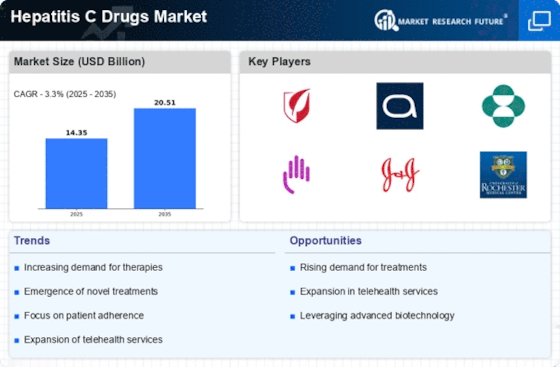
As per Market Research Future analysis, the Hepatitis C Drugs Market Size was estimated at 14.35 USD Billion in 2024. The Hepatitis C Drugs industry is projected to grow from 14.82 USD Billion in 2025 to 20.51 USD Billion by 2035, exhibiting a compound annual growth rate (CAGR) of 3.3% during the forecast period 2025 - 2035

Key Market Trends & Highlights

The Hepatitis C Drugs Market is experiencing transformative growth driven by innovative therapies and increased awareness.

  • The market is witnessing the emergence of novel therapies that enhance treatment efficacy. North America remains the largest market, while Asia-Pacific is recognized as the fastest-growing region. Direct Acting Antivirals dominate the market, whereas Interferon-Based Therapies are rapidly gaining traction. Rising prevalence of Hepatitis C and advancements in drug development are key drivers propelling market expansion.

Market Size & Forecast

2024 Market Size 14.35 (USD Billion)
2035 Market Size 20.51 (USD Billion)
CAGR (2025 - 2035) 3.3%
Largest Regional Market Share in 2024 North America

Major Players

<a title="Gilead Sciences" href="https://www.gilead.com/stories/gilead-sets-sights-on-hepatitis-c-elimination-as-it-marks-10-years-of-curative-therapies" target="_blank" rel="noopener">Gilead Sciences</a> (US), AbbVie (US), Merck &amp; Co (US), Bristol-Myers Squibb (US), Johnson &amp; Johnson (US), Roche (CH), Novartis (CH), Hoffmann-La Roche (CH), Mylan (US)

Market Trends

The Hepatitis C Drugs Market is currently experiencing a transformative phase, driven by advancements in pharmaceutical research and a growing understanding of the disease's epidemiology. The emergence of direct-acting antivirals has revolutionized treatment protocols, leading to higher cure rates and improved patient outcomes. This shift is further supported by increased awareness campaigns and screening initiatives, which aim to identify undiagnosed individuals and facilitate timely intervention. As healthcare systems adapt to these changes, the market is likely to witness a surge in demand for innovative therapies that offer enhanced efficacy and safety profiles. Moreover, the landscape of the Hepatitis C Drugs Market is evolving due to the rising prevalence of the disease in various regions. This trend is compounded by the ongoing efforts to eliminate Hepatitis C as a public health threat, as outlined by global health organizations. The focus on personalized medicine and the development of combination therapies may also play a crucial role in shaping future treatment paradigms. As stakeholders navigate this complex environment, the market appears poised for growth, with potential opportunities for both established and emerging players to contribute to the fight against Hepatitis C.

Emergence of Novel Therapies

The Hepatitis C Drugs Market is witnessing the introduction of innovative treatment options that promise to enhance patient outcomes. These novel therapies, often characterized by their ability to target specific viral mechanisms, may offer improved efficacy and reduced side effects compared to traditional treatments.

Increased Focus on Screening and Diagnosis

There is a growing emphasis on the importance of early detection and diagnosis in the Hepatitis C Drugs Market. Enhanced screening programs are being implemented globally, aiming to identify individuals at risk and facilitate timely access to treatment, thereby potentially reducing the disease burden.

Shift Towards Personalized Medicine

The trend towards personalized medicine is becoming increasingly relevant in the Hepatitis C Drugs Market. Tailoring treatment regimens based on individual patient profiles may lead to more effective management strategies, optimizing therapeutic outcomes and minimizing adverse effects.

Hepatitis C Drugs Market Market Drivers

Emergence of Telemedicine

The emergence of telemedicine is transforming the Hepatitis C Drugs Market by enhancing access to care for patients. Telehealth services allow individuals to consult healthcare providers remotely, facilitating timely diagnosis and treatment initiation without the need for in-person visits. This is particularly beneficial for patients in rural or underserved areas, where access to specialized care may be limited. As telemedicine becomes more integrated into healthcare systems, it is expected to increase patient engagement and adherence to treatment regimens. Moreover, the convenience of telehealth may encourage more individuals to seek testing and treatment for Hepatitis C, thereby driving demand within the Hepatitis C Drugs Market.

Growing Awareness and Education

Growing awareness and education regarding Hepatitis C are pivotal drivers for the Hepatitis C Drugs Market. Public health campaigns aimed at educating individuals about the risks, transmission, and treatment options for Hepatitis C have led to increased screening and diagnosis rates. As more people become aware of their Hepatitis C status, the demand for effective treatment options rises correspondingly. This heightened awareness is particularly important in high-risk populations, where stigma and misinformation have historically hindered access to care. Consequently, as educational initiatives continue to expand, the Hepatitis C Drugs Market is likely to experience sustained growth, driven by an informed patient population seeking treatment.

Advancements in Drug Development

Recent advancements in drug development are significantly influencing the Hepatitis C Drugs Market. The introduction of direct-acting antivirals (DAAs) has revolutionized treatment protocols, offering higher cure rates and shorter treatment durations compared to previous therapies. These innovations have not only improved patient outcomes but have also attracted substantial investments from pharmaceutical companies aiming to develop next-generation therapies. The market is witnessing a shift towards combination therapies that enhance efficacy and reduce the risk of resistance. As a result, the Hepatitis C Drugs Market is expected to expand, with new entrants and established players alike striving to capture market share through innovative product offerings.

Rising Prevalence of Hepatitis C

The increasing prevalence of Hepatitis C infections is a primary driver for the Hepatitis C Drugs Market. According to estimates, millions of individuals are living with chronic Hepatitis C worldwide, leading to a heightened demand for effective treatment options. This surge in cases is attributed to various factors, including changes in lifestyle, increased drug use, and lack of awareness regarding the disease. As the number of diagnosed patients rises, healthcare systems are compelled to invest in innovative therapies and medications, thereby propelling the Hepatitis C Drugs Market forward. Furthermore, the World Health Organization has set ambitious targets for eliminating Hepatitis C as a public health threat by 2030, which may further stimulate market growth as countries ramp up their treatment initiatives.

Government Initiatives and Funding

Government initiatives and funding play a crucial role in shaping the Hepatitis C Drugs Market. Many countries are implementing national strategies to combat Hepatitis C, which include increasing access to screening, diagnosis, and treatment. These initiatives often come with substantial financial backing, aimed at subsidizing the cost of medications and improving healthcare infrastructure. For instance, several nations have launched programs to provide free or low-cost access to DAAs, thereby increasing treatment uptake among affected populations. Such government-led efforts not only enhance public health outcomes but also stimulate market growth by creating a more favorable environment for pharmaceutical companies to operate within the Hepatitis C Drugs Market.

Market Segment Insights

By Type: Direct Acting Antivirals (Largest) vs. Interferon-Based Therapies (Fastest-Growing)

In the Hepatitis C Drugs Market, Direct Acting Antivirals (DAAs) have established a dominant position, accounting for a substantial share of the market. Their effectiveness in targeting the hepatitis C virus directly leads to higher adoption rates amongst healthcare providers and patients. As a result, DAAs have become the first-line treatment option, significantly influencing the overall market dynamics away from older therapies. On the other hand, Interferon-Based Therapies are witnessing a resurgence, being identified as the fastest-growing segment due to an increased focus on combination treatment regimens that incorporate these therapies. The dynamic landscape of treatments, including the favorable outcomes of recent studies, is encouraging healthcare providers to reconsider their utilization, thus driving growth in this segment.

Direct Acting Antivirals (Dominant) vs. Ribavirin (Emerging)

Direct Acting Antivirals (DAAs) remain the dominant segment in the Hepatitis C Drugs Market due to their targeted mechanism of action, which allows for higher cure rates and fewer side effects compared to traditional treatments. Their appeal is further heightened by the convenience of short treatment durations. In contrast, Ribavirin serves as an emerging player, particularly in combination therapies where it boosts the effectiveness of other antiviral agents. While Ribavirin is historically significant, its current role is more about enhancing the effects of DAAs, which positions it as essential but lesser-used compared to the leading DAAs in the prevailing treatment landscape.

By Administration Route: Oral (Largest) vs. Injectable (Fastest-Growing)

The Hepatitis C Drugs Market shows a notable distribution among its administration routes. The Oral segment dominates the market, accounting for a significant proportion of the total share due to its convenience and ease of use for patients. Injectable therapies, while currently smaller in share, are witnessing increased adoption owing to their effectiveness in certain patient populations and are capturing the interest of healthcare providers seeking robust treatment options. Intranasal routes have a minimal presence but are emerging as an alternative, primarily in research phases. Growth trends in the Hepatitis C Drugs Market are largely driven by the rising prevalence of Hepatitis C infections globally and the demand for more patient-friendly treatment options. Oral therapies are favored for their non-invasive nature, while injectable treatments are gaining traction due to innovative formulations and enhanced patient compliance. An increased focus on drug efficacy and safety is propelling investments in research and development, leading to a dynamic evolution of preferred administration routes, with injectable drugs poised for rapid growth in response to market needs.

Oral (Dominant) vs. Injectable (Emerging)

The Oral administration route remains dominant in the Hepatitis C Drugs Market, largely attributed to its patient-centric design that enhances adherence to treatment regimens. These therapies are typically associated with a lower burden on the patient, requiring fewer clinical visits and less invasive procedures. In contrast, Injectable products are emerging as a viable alternative, driven by advancements in drug formulation that offer improved efficacy and faster action. While historically less favored, Injectables are gaining momentum in specific cases where rapid intervention is critical. Both administration routes are critical to patient outcomes; however, Oral treatments continue to lead due to their convenience, making them the preferred choice among healthcare practitioners.

By Treatment Duration: Short-Term (Largest) vs. Long-Term (Fastest-Growing)

In the Hepatitis C Drugs Market, the treatment duration options have distinct market shares. The Short-Term treatment segment holds the largest share, providing quick relief and immediate results for patients. This method appeals to a broader patient base looking for effective solutions within a limited time frame. In contrast, the Long-Term treatment segment, while smaller in current market share, exhibits aggressive growth potential, driven by advancements in therapy and a more extensive understanding of chronic Hepatitis C implications. The growth trends are primarily influenced by evolving treatment protocols and increased patient awareness about the need for sustained therapy. Recent studies indicate that Long-Term treatment has become more desirable, with healthcare providers advocating for prolonged management of Hepatitis C to prevent complications. As a result, the demand for Long-Term therapies is expected to rise, driven by enhanced efficacy and patient adherence.

Short-Term (Dominant) vs. Long-Term (Emerging)

The Short-Term treatment segment in the Hepatitis C Drugs Market is characterized by its quick administration and rapid results, making it the dominant choice for healthcare providers. Patients seeking immediate solutions are more inclined to opt for this approach, particularly in acute cases. In contrast, the Long-Term treatment segment is emerging rapidly, fueled by a growing emphasis on sustained viral suppression and long-term management of chronic Hepatitis C. Healthcare providers are increasingly recognizing the benefits of Long-Term treatment regimens, which focus on preventing disease progression and improving quality of life. This shift is encouraging pharmaceutical companies to invest in new Long-Term therapies, thus positioning it as a vital area for future development and growth in the market.

By Patient Type: Naive Patients (Largest) vs. Experienced Patients (Fastest-Growing)

In the Hepatitis C Drugs Market, the patient segment is primarily dominated by naive patients, particularly due to the increasing number of individuals being diagnosed for the first time. The rise in awareness and screening programs has significantly elevated the patient population seeking treatment. Meanwhile, experienced patients make up a growing portion of the market, as ongoing treatment advancements are enabling many to manage their conditions more effectively and seek specialized therapies after prior unsuccessful attempts. As healthcare providers continue to adopt innovative treatment protocols, the growth trend for experienced patients is expected to accelerate. This segment benefits from improved medications and personalized treatment strategies that contribute to better treatment adherence. Emerging therapies also play a crucial role in attracting experienced patients transitioning from older treatment regimens, thereby driving the overall market growth.

Naive Patients (Dominant) vs. Special Population (Emerging)

Naive patients represent a dominant segment in the Hepatitis C Drugs Market, typically characterized by their initial diagnosis and lack of previous treatment experiences. This group is largely influenced by increased diagnostic screenings and greater awareness of hepatitis C and its long-term consequences. Conversely, special populations, including those with co-morbidities or unique challenges, represent an emerging segment. These patients may require tailored therapeutic regimens that take into account their specific health needs. As more specialized drugs are developed, the treatment landscape becomes increasingly accommodating to these populations, indicating a shift needed to optimize care pathways and enhance patient outcomes through personalized medicine.

Get more detailed insights about Hepatitis C Drugs Market Research Report - Forecast to 2035

Regional Insights

The Global Hepatitis C Drugs Market revenue demonstrates a diverse regional segmentation, highlighting key areas such as North America, Europe, APAC, South America, and the Middle East and Africa (MEA).

In 2024, North America is dominated with a valuation of 6.12 USD Billion, increasing significantly to 8.25 USD Billion by 2035, showcasing its majority holding in the market due to advanced healthcare infrastructure and high demand for Hepatitis C treatments. Europe follows closely, valued at 4.92 USD Billion in 2024 and expected to grow to 6.75 USD Billion by 2035, driven by rigorous public health initiatives and access to innovative treatment options.

APAC, valued at 2.75 USD Billion in 2024 with a forecast to reach 3.8 USD Billion by 2035, plays an increasingly vital role in the market with expanding healthcare access and rising awareness around Hepatitis C. South America and MEA represent the smaller segments, valued at 0.85 USD Billion and 0.71 USD Billion respectively in 2024, yet they exhibit potential for growth as healthcare systems develop and the global focus on combating infectious diseases intensifies.

The interplay of evolving market strategies increased patient awareness, and a demand for effective treatments contributes to the Global Hepatitis C Drugs Market Statistics showcasing these regional dynamics.

Key Players and Competitive Insights

The Global Hepatitis C Drugs Market has emerged as a pivotal sector within the pharmaceutical industry, driven by the rising prevalence of hepatitis C virus infections worldwide. As a result of advances in medical research and development, numerous therapies and treatments have been introduced to effectively manage and cure hepatitis C. 
The market comprises various key players, each offering a distinct set of products aimed at addressing diverse patient needs. The competitive landscape is characterized by considerable research and development investments, collaborations, and strategic alliances among companies striving for innovative and effective treatments. This fierce competition has led to rapid advancements in drug formulations, therapy regimens, and patient care management, ultimately benefiting healthcare professionals and patients alike across the globe. Pfizer has established a noteworthy presence in the Global Hepatitis C Drugs Market, leveraging its vast experience in the pharmaceutical sector to create effective solutions for patients.
The company focuses on developing cutting-edge therapies that enhance treatment effectiveness and minimize side effects for patients suffering from hepatitis C.
 Pfizer’s robust pipeline illustrates its commitment to addressing unmet medical needs, reinforced by substantial investments in innovation and clinical research. Its extensive distribution network allows Pfizer to reach healthcare providers and patients, ensuring broad accessibility to its drugs.
Pfizer's strengths in the market are attributed to its scientific expertise, dedication to quality, and ability to adapt to the evolving landscape of hepatitis C treatment, positioning the company as a significant competitor in this dynamic field.
AbbVie is recognized as a formidable player in the Global Hepatitis C Drugs Market, with its strong portfolio of key products designed to treat hepatitis C effectively. The company's flagship treatments have made a significant impact on patient outcomes and have contributed to its success in this competitive environment. 
AbbVie benefits from a well-established presence in various global markets, which allows it to reach a wide range of healthcare professionals and patients. The company has actively engaged in mergers and acquisitions to strengthen its position, enhance its research capabilities, and expand its therapeutic offerings.
AbbVie's commitment to innovation, combined with its strong brand reputation and extensive market reach, further solidifies its status as a leader in hepatitis C treatment solutions globally.

Key Companies in the Hepatitis C Drugs Market include

Industry Developments

Recent developments in the Global Hepatitis C Drugs Market have seen significant advancements, particularly in the ongoing efforts of companies like Gilead Sciences and AbbVie, which are leading the charge with their innovative treatments. The introduction of new direct-acting antivirals has expanded patient access to effective treatment options. 

In September 2023, Pfizer announced promising results in their ongoing clinical trials for a new Hepatitis C drug, which could potentially enhance cure rates significantly. Moreover, Roche and Merck are collaborating in Research and Development to explore combination therapies aimed at treating Hepatitis C, indicating a drive toward multi-faceted treatment approaches. Regarding mergers and acquisitions, there have been notable activities. In August 2023, Johnson and Johnson completed its acquisition of a biopharmaceutical firm focusing on liver diseases, potentially broadening its Hepatitis C portfolio.

Furthermore, the market is experiencing growth, with estimates suggesting that the Global Hepatitis C Drugs Market is expected to witness substantial valuation increases attributed to rising awareness and government financing initiatives aimed at disease eradication.

Major events in the last two years, such as public health campaigns by the World Health Organization, have significantly influenced treatment accessibility and progression in the Global context.

Future Outlook

Hepatitis C Drugs Market Future Outlook

The Hepatitis C Drugs Market is projected to grow at a 3.3% CAGR from 2025 to 2035, driven by advancements in treatment options, increasing awareness, and rising global prevalence.

New opportunities lie in:

  • Expansion of telehealth services for remote patient monitoring
  • Development of combination therapies to enhance treatment efficacy
  • Investment in patient education programs to improve treatment adherence

By 2035, the Hepatitis C Drugs Market is expected to achieve robust growth and enhanced treatment accessibility.

Market Segmentation

Hepatitis C Drugs Market Type Outlook

  • Direct Acting Antivirals
  • Interferon-Based Therapies
  • Ribavirin
  • Combination Therapies

Hepatitis C Drugs Market Patient Type Outlook

  • Naive Patients
  • Experienced Patients
  • Special Population

Hepatitis C Drugs Market Treatment Duration Outlook

  • Short-Term
  • Long-Term
  • Preventive Treatment

Hepatitis C Drugs Market Administration Route Outlook

  • Oral
  • Injectable
  • Intranasal

Report Scope

MARKET SIZE 2024 14.35(USD Billion)
MARKET SIZE 2025 14.82(USD Billion)
MARKET SIZE 2035 20.51(USD Billion)
COMPOUND ANNUAL GROWTH RATE (CAGR) 3.3% (2025 - 2035)
REPORT COVERAGE Revenue Forecast, Competitive Landscape, Growth Factors, and Trends
BASE YEAR 2024
Market Forecast Period 2025 - 2035
Historical Data 2019 - 2024
Market Forecast Units USD Billion
Key Companies Profiled Gilead Sciences (US), AbbVie (US), Merck & Co (US), Bristol-Myers Squibb (US), Johnson & Johnson (US), Roche (CH), Novartis (CH), Hoffmann-La Roche (CH), Mylan (US)
Segments Covered Drug Type, Administration Route, Treatment Duration, Patient Type, Regional
Key Market Opportunities Emergence of novel antiviral therapies enhances treatment options in the Hepatitis C Drugs Market.
Key Market Dynamics Rising competition among pharmaceutical companies drives innovation and pricing strategies in the Hepatitis C drugs market.
Countries Covered North America, Europe, APAC, South America, MEA

FAQs

What is the current valuation of the Hepatitis C Drugs Market?

<p>The Hepatitis C Drugs Market was valued at 14.35 USD Billion in 2024.</p>

What is the projected market size for the Hepatitis C Drugs Market by 2035?

<p>The market is projected to reach 20.51 USD Billion by 2035.</p>

What is the expected CAGR for the Hepatitis C Drugs Market during the forecast period 2025 - 2035?

<p>The expected CAGR for the Hepatitis C Drugs Market during 2025 - 2035 is 3.3%.</p>

Which companies are the key players in the Hepatitis C Drugs Market?

<p>Key players include Gilead Sciences, AbbVie, Merck & Co, Bristol-Myers Squibb, Johnson & Johnson, Roche, Novartis, Hoffmann-La Roche, and Mylan.</p>

What are the main segments of the Hepatitis C Drugs Market?

<p>The main segments include Direct Acting Antivirals, Interferon-Based Therapies, Ribavirin, and Combination Therapies.</p>

How much revenue is generated from Direct Acting Antivirals in the Hepatitis C Drugs Market?

<p>Direct Acting Antivirals generated revenue of 8.0 USD Billion in 2024 and are projected to reach 11.0 USD Billion by 2035.</p>

What is the revenue outlook for the Injectable administration route in the Hepatitis C Drugs Market?

<p>The Injectable administration route generated 6.0 USD Billion in 2024 and is expected to grow to 8.5 USD Billion by 2035.</p>

What is the market performance for naive patients in the Hepatitis C Drugs Market?

<p>Revenue from naive patients was 5.0 USD Billion in 2024 and is projected to increase to 7.0 USD Billion by 2035.</p>

What is the expected revenue from long-term treatment duration in the Hepatitis C Drugs Market?

<p>Long-term treatment duration generated 6.0 USD Billion in 2024 and is anticipated to reach 8.0 USD Billion by 2035.</p>

What are the projected revenues for combination therapies in the Hepatitis C Drugs Market?

<p>Combination therapies generated 2.35 USD Billion in 2024 and are expected to grow to 4.01 USD Billion by 2035.</p>

  1. SECTION I: EXECUTIVE SUMMARY AND KEY HIGHLIGHTS
    1. | 1.1 EXECUTIVE SUMMARY
    2. | | 1.1.1 Market Overview
    3. | | 1.1.2 Key Findings
    4. | | 1.1.3 Market Segmentation
    5. | | 1.1.4 Competitive Landscape
    6. | | 1.1.5 Challenges and Opportunities
    7. | | 1.1.6 Future Outlook
  2. SECTION II: SCOPING, METHODOLOGY AND MARKET STRUCTURE
    1. | 2.1 MARKET INTRODUCTION
    2. | | 2.1.1 Definition
    3. | | 2.1.2 Scope of the study
    4. | | | 2.1.2.1 Research Objective
    5. | | | 2.1.2.2 Assumption
    6. | | | 2.1.2.3 Limitations
    7. | 2.2 RESEARCH METHODOLOGY
    8. | | 2.2.1 Overview
    9. | | 2.2.2 Data Mining
    10. | | 2.2.3 Secondary Research
    11. | | 2.2.4 Primary Research
    12. | | | 2.2.4.1 Primary Interviews and Information Gathering Process
    13. | | | 2.2.4.2 Breakdown of Primary Respondents
    14. | | 2.2.5 Forecasting Model
    15. | | 2.2.6 Market Size Estimation
    16. | | | 2.2.6.1 Bottom-Up Approach
    17. | | | 2.2.6.2 Top-Down Approach
    18. | | 2.2.7 Data Triangulation
    19. | | 2.2.8 Validation
  3. SECTION III: QUALITATIVE ANALYSIS
    1. | 3.1 MARKET DYNAMICS
    2. | | 3.1.1 Overview
    3. | | 3.1.2 Drivers
    4. | | 3.1.3 Restraints
    5. | | 3.1.4 Opportunities
    6. | 3.2 MARKET FACTOR ANALYSIS
    7. | | 3.2.1 Value chain Analysis
    8. | | 3.2.2 Porter's Five Forces Analysis
    9. | | | 3.2.2.1 Bargaining Power of Suppliers
    10. | | | 3.2.2.2 Bargaining Power of Buyers
    11. | | | 3.2.2.3 Threat of New Entrants
    12. | | | 3.2.2.4 Threat of Substitutes
    13. | | | 3.2.2.5 Intensity of Rivalry
    14. | | 3.2.3 COVID-19 Impact Analysis
    15. | | | 3.2.3.1 Market Impact Analysis
    16. | | | 3.2.3.2 Regional Impact
    17. | | | 3.2.3.3 Opportunity and Threat Analysis
  4. SECTION IV: QUANTITATIVE ANALYSIS
    1. | 4.1 Healthcare, BY Type (USD Billion)
    2. | | 4.1.1 Direct Acting Antivirals
    3. | | 4.1.2 Interferon-Based Therapies
    4. | | 4.1.3 Ribavirin
    5. | | 4.1.4 Combination Therapies
    6. | 4.2 Healthcare, BY Administration Route (USD Billion)
    7. | | 4.2.1 Oral
    8. | | 4.2.2 Injectable
    9. | | 4.2.3 Intranasal
    10. | 4.3 Healthcare, BY Treatment Duration (USD Billion)
    11. | | 4.3.1 Short-Term
    12. | | 4.3.2 Long-Term
    13. | | 4.3.3 Preventive Treatment
    14. | 4.4 Healthcare, BY Patient Type (USD Billion)
    15. | | 4.4.1 Naive Patients
    16. | | 4.4.2 Experienced Patients
    17. | | 4.4.3 Special Population
    18. | 4.5 Healthcare, BY Region (USD Billion)
    19. | | 4.5.1 North America
    20. | | | 4.5.1.1 US
    21. | | | 4.5.1.2 Canada
    22. | | 4.5.2 Europe
    23. | | | 4.5.2.1 Germany
    24. | | | 4.5.2.2 UK
    25. | | | 4.5.2.3 France
    26. | | | 4.5.2.4 Russia
    27. | | | 4.5.2.5 Italy
    28. | | | 4.5.2.6 Spain
    29. | | | 4.5.2.7 Rest of Europe
    30. | | 4.5.3 APAC
    31. | | | 4.5.3.1 China
    32. | | | 4.5.3.2 India
    33. | | | 4.5.3.3 Japan
    34. | | | 4.5.3.4 South Korea
    35. | | | 4.5.3.5 Malaysia
    36. | | | 4.5.3.6 Thailand
    37. | | | 4.5.3.7 Indonesia
    38. | | | 4.5.3.8 Rest of APAC
    39. | | 4.5.4 South America
    40. | | | 4.5.4.1 Brazil
    41. | | | 4.5.4.2 Mexico
    42. | | | 4.5.4.3 Argentina
    43. | | | 4.5.4.4 Rest of South America
    44. | | 4.5.5 MEA
    45. | | | 4.5.5.1 GCC Countries
    46. | | | 4.5.5.2 South Africa
    47. | | | 4.5.5.3 Rest of MEA
  5. SECTION V: COMPETITIVE ANALYSIS
    1. | 5.1 Competitive Landscape
    2. | | 5.1.1 Overview
    3. | | 5.1.2 Competitive Analysis
    4. | | 5.1.3 Market share Analysis
    5. | | 5.1.4 Major Growth Strategy in the Healthcare
    6. | | 5.1.5 Competitive Benchmarking
    7. | | 5.1.6 Leading Players in Terms of Number of Developments in the Healthcare
    8. | | 5.1.7 Key developments and growth strategies
    9. | | | 5.1.7.1 New Product Launch/Service Deployment
    10. | | | 5.1.7.2 Merger & Acquisitions
    11. | | | 5.1.7.3 Joint Ventures
    12. | | 5.1.8 Major Players Financial Matrix
    13. | | | 5.1.8.1 Sales and Operating Income
    14. | | | 5.1.8.2 Major Players R&D Expenditure. 2023
    15. | 5.2 Company Profiles
    16. | | 5.2.1 Gilead Sciences (US)
    17. | | | 5.2.1.1 Financial Overview
    18. | | | 5.2.1.2 Products Offered
    19. | | | 5.2.1.3 Key Developments
    20. | | | 5.2.1.4 SWOT Analysis
    21. | | | 5.2.1.5 Key Strategies
    22. | | 5.2.2 AbbVie (US)
    23. | | | 5.2.2.1 Financial Overview
    24. | | | 5.2.2.2 Products Offered
    25. | | | 5.2.2.3 Key Developments
    26. | | | 5.2.2.4 SWOT Analysis
    27. | | | 5.2.2.5 Key Strategies
    28. | | 5.2.3 Merck & Co (US)
    29. | | | 5.2.3.1 Financial Overview
    30. | | | 5.2.3.2 Products Offered
    31. | | | 5.2.3.3 Key Developments
    32. | | | 5.2.3.4 SWOT Analysis
    33. | | | 5.2.3.5 Key Strategies
    34. | | 5.2.4 Bristol-Myers Squibb (US)
    35. | | | 5.2.4.1 Financial Overview
    36. | | | 5.2.4.2 Products Offered
    37. | | | 5.2.4.3 Key Developments
    38. | | | 5.2.4.4 SWOT Analysis
    39. | | | 5.2.4.5 Key Strategies
    40. | | 5.2.5 Johnson & Johnson (US)
    41. | | | 5.2.5.1 Financial Overview
    42. | | | 5.2.5.2 Products Offered
    43. | | | 5.2.5.3 Key Developments
    44. | | | 5.2.5.4 SWOT Analysis
    45. | | | 5.2.5.5 Key Strategies
    46. | | 5.2.6 Roche (CH)
    47. | | | 5.2.6.1 Financial Overview
    48. | | | 5.2.6.2 Products Offered
    49. | | | 5.2.6.3 Key Developments
    50. | | | 5.2.6.4 SWOT Analysis
    51. | | | 5.2.6.5 Key Strategies
    52. | | 5.2.7 Novartis (CH)
    53. | | | 5.2.7.1 Financial Overview
    54. | | | 5.2.7.2 Products Offered
    55. | | | 5.2.7.3 Key Developments
    56. | | | 5.2.7.4 SWOT Analysis
    57. | | | 5.2.7.5 Key Strategies
    58. | | 5.2.8 Hoffmann-La Roche (CH)
    59. | | | 5.2.8.1 Financial Overview
    60. | | | 5.2.8.2 Products Offered
    61. | | | 5.2.8.3 Key Developments
    62. | | | 5.2.8.4 SWOT Analysis
    63. | | | 5.2.8.5 Key Strategies
    64. | | 5.2.9 Mylan (US)
    65. | | | 5.2.9.1 Financial Overview
    66. | | | 5.2.9.2 Products Offered
    67. | | | 5.2.9.3 Key Developments
    68. | | | 5.2.9.4 SWOT Analysis
    69. | | | 5.2.9.5 Key Strategies
    70. | 5.3 Appendix
    71. | | 5.3.1 References
    72. | | 5.3.2 Related Reports
  6. LIST OF FIGURES
    1. | 6.1 MARKET SYNOPSIS
    2. | 6.2 NORTH AMERICA MARKET ANALYSIS
    3. | 6.3 US MARKET ANALYSIS BY TYPE
    4. | 6.4 US MARKET ANALYSIS BY ADMINISTRATION ROUTE
    5. | 6.5 US MARKET ANALYSIS BY TREATMENT DURATION
    6. | 6.6 US MARKET ANALYSIS BY PATIENT TYPE
    7. | 6.7 CANADA MARKET ANALYSIS BY TYPE
    8. | 6.8 CANADA MARKET ANALYSIS BY ADMINISTRATION ROUTE
    9. | 6.9 CANADA MARKET ANALYSIS BY TREATMENT DURATION
    10. | 6.10 CANADA MARKET ANALYSIS BY PATIENT TYPE
    11. | 6.11 EUROPE MARKET ANALYSIS
    12. | 6.12 GERMANY MARKET ANALYSIS BY TYPE
    13. | 6.13 GERMANY MARKET ANALYSIS BY ADMINISTRATION ROUTE
    14. | 6.14 GERMANY MARKET ANALYSIS BY TREATMENT DURATION
    15. | 6.15 GERMANY MARKET ANALYSIS BY PATIENT TYPE
    16. | 6.16 UK MARKET ANALYSIS BY TYPE
    17. | 6.17 UK MARKET ANALYSIS BY ADMINISTRATION ROUTE
    18. | 6.18 UK MARKET ANALYSIS BY TREATMENT DURATION
    19. | 6.19 UK MARKET ANALYSIS BY PATIENT TYPE
    20. | 6.20 FRANCE MARKET ANALYSIS BY TYPE
    21. | 6.21 FRANCE MARKET ANALYSIS BY ADMINISTRATION ROUTE
    22. | 6.22 FRANCE MARKET ANALYSIS BY TREATMENT DURATION
    23. | 6.23 FRANCE MARKET ANALYSIS BY PATIENT TYPE
    24. | 6.24 RUSSIA MARKET ANALYSIS BY TYPE
    25. | 6.25 RUSSIA MARKET ANALYSIS BY ADMINISTRATION ROUTE
    26. | 6.26 RUSSIA MARKET ANALYSIS BY TREATMENT DURATION
    27. | 6.27 RUSSIA MARKET ANALYSIS BY PATIENT TYPE
    28. | 6.28 ITALY MARKET ANALYSIS BY TYPE
    29. | 6.29 ITALY MARKET ANALYSIS BY ADMINISTRATION ROUTE
    30. | 6.30 ITALY MARKET ANALYSIS BY TREATMENT DURATION
    31. | 6.31 ITALY MARKET ANALYSIS BY PATIENT TYPE
    32. | 6.32 SPAIN MARKET ANALYSIS BY TYPE
    33. | 6.33 SPAIN MARKET ANALYSIS BY ADMINISTRATION ROUTE
    34. | 6.34 SPAIN MARKET ANALYSIS BY TREATMENT DURATION
    35. | 6.35 SPAIN MARKET ANALYSIS BY PATIENT TYPE
    36. | 6.36 REST OF EUROPE MARKET ANALYSIS BY TYPE
    37. | 6.37 REST OF EUROPE MARKET ANALYSIS BY ADMINISTRATION ROUTE
    38. | 6.38 REST OF EUROPE MARKET ANALYSIS BY TREATMENT DURATION
    39. | 6.39 REST OF EUROPE MARKET ANALYSIS BY PATIENT TYPE
    40. | 6.40 APAC MARKET ANALYSIS
    41. | 6.41 CHINA MARKET ANALYSIS BY TYPE
    42. | 6.42 CHINA MARKET ANALYSIS BY ADMINISTRATION ROUTE
    43. | 6.43 CHINA MARKET ANALYSIS BY TREATMENT DURATION
    44. | 6.44 CHINA MARKET ANALYSIS BY PATIENT TYPE
    45. | 6.45 INDIA MARKET ANALYSIS BY TYPE
    46. | 6.46 INDIA MARKET ANALYSIS BY ADMINISTRATION ROUTE
    47. | 6.47 INDIA MARKET ANALYSIS BY TREATMENT DURATION
    48. | 6.48 INDIA MARKET ANALYSIS BY PATIENT TYPE
    49. | 6.49 JAPAN MARKET ANALYSIS BY TYPE
    50. | 6.50 JAPAN MARKET ANALYSIS BY ADMINISTRATION ROUTE
    51. | 6.51 JAPAN MARKET ANALYSIS BY TREATMENT DURATION
    52. | 6.52 JAPAN MARKET ANALYSIS BY PATIENT TYPE
    53. | 6.53 SOUTH KOREA MARKET ANALYSIS BY TYPE
    54. | 6.54 SOUTH KOREA MARKET ANALYSIS BY ADMINISTRATION ROUTE
    55. | 6.55 SOUTH KOREA MARKET ANALYSIS BY TREATMENT DURATION
    56. | 6.56 SOUTH KOREA MARKET ANALYSIS BY PATIENT TYPE
    57. | 6.57 MALAYSIA MARKET ANALYSIS BY TYPE
    58. | 6.58 MALAYSIA MARKET ANALYSIS BY ADMINISTRATION ROUTE
    59. | 6.59 MALAYSIA MARKET ANALYSIS BY TREATMENT DURATION
    60. | 6.60 MALAYSIA MARKET ANALYSIS BY PATIENT TYPE
    61. | 6.61 THAILAND MARKET ANALYSIS BY TYPE
    62. | 6.62 THAILAND MARKET ANALYSIS BY ADMINISTRATION ROUTE
    63. | 6.63 THAILAND MARKET ANALYSIS BY TREATMENT DURATION
    64. | 6.64 THAILAND MARKET ANALYSIS BY PATIENT TYPE
    65. | 6.65 INDONESIA MARKET ANALYSIS BY TYPE
    66. | 6.66 INDONESIA MARKET ANALYSIS BY ADMINISTRATION ROUTE
    67. | 6.67 INDONESIA MARKET ANALYSIS BY TREATMENT DURATION
    68. | 6.68 INDONESIA MARKET ANALYSIS BY PATIENT TYPE
    69. | 6.69 REST OF APAC MARKET ANALYSIS BY TYPE
    70. | 6.70 REST OF APAC MARKET ANALYSIS BY ADMINISTRATION ROUTE
    71. | 6.71 REST OF APAC MARKET ANALYSIS BY TREATMENT DURATION
    72. | 6.72 REST OF APAC MARKET ANALYSIS BY PATIENT TYPE
    73. | 6.73 SOUTH AMERICA MARKET ANALYSIS
    74. | 6.74 BRAZIL MARKET ANALYSIS BY TYPE
    75. | 6.75 BRAZIL MARKET ANALYSIS BY ADMINISTRATION ROUTE
    76. | 6.76 BRAZIL MARKET ANALYSIS BY TREATMENT DURATION
    77. | 6.77 BRAZIL MARKET ANALYSIS BY PATIENT TYPE
    78. | 6.78 MEXICO MARKET ANALYSIS BY TYPE
    79. | 6.79 MEXICO MARKET ANALYSIS BY ADMINISTRATION ROUTE
    80. | 6.80 MEXICO MARKET ANALYSIS BY TREATMENT DURATION
    81. | 6.81 MEXICO MARKET ANALYSIS BY PATIENT TYPE
    82. | 6.82 ARGENTINA MARKET ANALYSIS BY TYPE
    83. | 6.83 ARGENTINA MARKET ANALYSIS BY ADMINISTRATION ROUTE
    84. | 6.84 ARGENTINA MARKET ANALYSIS BY TREATMENT DURATION
    85. | 6.85 ARGENTINA MARKET ANALYSIS BY PATIENT TYPE
    86. | 6.86 REST OF SOUTH AMERICA MARKET ANALYSIS BY TYPE
    87. | 6.87 REST OF SOUTH AMERICA MARKET ANALYSIS BY ADMINISTRATION ROUTE
    88. | 6.88 REST OF SOUTH AMERICA MARKET ANALYSIS BY TREATMENT DURATION
    89. | 6.89 REST OF SOUTH AMERICA MARKET ANALYSIS BY PATIENT TYPE
    90. | 6.90 MEA MARKET ANALYSIS
    91. | 6.91 GCC COUNTRIES MARKET ANALYSIS BY TYPE
    92. | 6.92 GCC COUNTRIES MARKET ANALYSIS BY ADMINISTRATION ROUTE
    93. | 6.93 GCC COUNTRIES MARKET ANALYSIS BY TREATMENT DURATION
    94. | 6.94 GCC COUNTRIES MARKET ANALYSIS BY PATIENT TYPE
    95. | 6.95 SOUTH AFRICA MARKET ANALYSIS BY TYPE
    96. | 6.96 SOUTH AFRICA MARKET ANALYSIS BY ADMINISTRATION ROUTE
    97. | 6.97 SOUTH AFRICA MARKET ANALYSIS BY TREATMENT DURATION
    98. | 6.98 SOUTH AFRICA MARKET ANALYSIS BY PATIENT TYPE
    99. | 6.99 REST OF MEA MARKET ANALYSIS BY TYPE
    100. | 6.100 REST OF MEA MARKET ANALYSIS BY ADMINISTRATION ROUTE
    101. | 6.101 REST OF MEA MARKET ANALYSIS BY TREATMENT DURATION
    102. | 6.102 REST OF MEA MARKET ANALYSIS BY PATIENT TYPE
    103. | 6.103 KEY BUYING CRITERIA OF HEALTHCARE
    104. | 6.104 RESEARCH PROCESS OF MRFR
    105. | 6.105 DRO ANALYSIS OF HEALTHCARE
    106. | 6.106 DRIVERS IMPACT ANALYSIS: HEALTHCARE
    107. | 6.107 RESTRAINTS IMPACT ANALYSIS: HEALTHCARE
    108. | 6.108 SUPPLY / VALUE CHAIN: HEALTHCARE
    109. | 6.109 HEALTHCARE, BY TYPE, 2024 (% SHARE)
    110. | 6.110 HEALTHCARE, BY TYPE, 2024 TO 2035 (USD Billion)
    111. | 6.111 HEALTHCARE, BY ADMINISTRATION ROUTE, 2024 (% SHARE)
    112. | 6.112 HEALTHCARE, BY ADMINISTRATION ROUTE, 2024 TO 2035 (USD Billion)
    113. | 6.113 HEALTHCARE, BY TREATMENT DURATION, 2024 (% SHARE)
    114. | 6.114 HEALTHCARE, BY TREATMENT DURATION, 2024 TO 2035 (USD Billion)
    115. | 6.115 HEALTHCARE, BY PATIENT TYPE, 2024 (% SHARE)
    116. | 6.116 HEALTHCARE, BY PATIENT TYPE, 2024 TO 2035 (USD Billion)
    117. | 6.117 BENCHMARKING OF MAJOR COMPETITORS
  7. LIST OF TABLES
    1. | 7.1 LIST OF ASSUMPTIONS
    2. | | 7.1.1
    3. | 7.2 North America MARKET SIZE ESTIMATES; FORECAST
    4. | | 7.2.1 BY TYPE, 2025-2035 (USD Billion)
    5. | | 7.2.2 BY ADMINISTRATION ROUTE, 2025-2035 (USD Billion)
    6. | | 7.2.3 BY TREATMENT DURATION, 2025-2035 (USD Billion)
    7. | | 7.2.4 BY PATIENT TYPE, 2025-2035 (USD Billion)
    8. | 7.3 US MARKET SIZE ESTIMATES; FORECAST
    9. | | 7.3.1 BY TYPE, 2025-2035 (USD Billion)
    10. | | 7.3.2 BY ADMINISTRATION ROUTE, 2025-2035 (USD Billion)
    11. | | 7.3.3 BY TREATMENT DURATION, 2025-2035 (USD Billion)
    12. | | 7.3.4 BY PATIENT TYPE, 2025-2035 (USD Billion)
    13. | 7.4 Canada MARKET SIZE ESTIMATES; FORECAST
    14. | | 7.4.1 BY TYPE, 2025-2035 (USD Billion)
    15. | | 7.4.2 BY ADMINISTRATION ROUTE, 2025-2035 (USD Billion)
    16. | | 7.4.3 BY TREATMENT DURATION, 2025-2035 (USD Billion)
    17. | | 7.4.4 BY PATIENT TYPE, 2025-2035 (USD Billion)
    18. | 7.5 Europe MARKET SIZE ESTIMATES; FORECAST
    19. | | 7.5.1 BY TYPE, 2025-2035 (USD Billion)
    20. | | 7.5.2 BY ADMINISTRATION ROUTE, 2025-2035 (USD Billion)
    21. | | 7.5.3 BY TREATMENT DURATION, 2025-2035 (USD Billion)
    22. | | 7.5.4 BY PATIENT TYPE, 2025-2035 (USD Billion)
    23. | 7.6 Germany MARKET SIZE ESTIMATES; FORECAST
    24. | | 7.6.1 BY TYPE, 2025-2035 (USD Billion)
    25. | | 7.6.2 BY ADMINISTRATION ROUTE, 2025-2035 (USD Billion)
    26. | | 7.6.3 BY TREATMENT DURATION, 2025-2035 (USD Billion)
    27. | | 7.6.4 BY PATIENT TYPE, 2025-2035 (USD Billion)
    28. | 7.7 UK MARKET SIZE ESTIMATES; FORECAST
    29. | | 7.7.1 BY TYPE, 2025-2035 (USD Billion)
    30. | | 7.7.2 BY ADMINISTRATION ROUTE, 2025-2035 (USD Billion)
    31. | | 7.7.3 BY TREATMENT DURATION, 2025-2035 (USD Billion)
    32. | | 7.7.4 BY PATIENT TYPE, 2025-2035 (USD Billion)
    33. | 7.8 France MARKET SIZE ESTIMATES; FORECAST
    34. | | 7.8.1 BY TYPE, 2025-2035 (USD Billion)
    35. | | 7.8.2 BY ADMINISTRATION ROUTE, 2025-2035 (USD Billion)
    36. | | 7.8.3 BY TREATMENT DURATION, 2025-2035 (USD Billion)
    37. | | 7.8.4 BY PATIENT TYPE, 2025-2035 (USD Billion)
    38. | 7.9 Russia MARKET SIZE ESTIMATES; FORECAST
    39. | | 7.9.1 BY TYPE, 2025-2035 (USD Billion)
    40. | | 7.9.2 BY ADMINISTRATION ROUTE, 2025-2035 (USD Billion)
    41. | | 7.9.3 BY TREATMENT DURATION, 2025-2035 (USD Billion)
    42. | | 7.9.4 BY PATIENT TYPE, 2025-2035 (USD Billion)
    43. | 7.10 Italy MARKET SIZE ESTIMATES; FORECAST
    44. | | 7.10.1 BY TYPE, 2025-2035 (USD Billion)
    45. | | 7.10.2 BY ADMINISTRATION ROUTE, 2025-2035 (USD Billion)
    46. | | 7.10.3 BY TREATMENT DURATION, 2025-2035 (USD Billion)
    47. | | 7.10.4 BY PATIENT TYPE, 2025-2035 (USD Billion)
    48. | 7.11 Spain MARKET SIZE ESTIMATES; FORECAST
    49. | | 7.11.1 BY TYPE, 2025-2035 (USD Billion)
    50. | | 7.11.2 BY ADMINISTRATION ROUTE, 2025-2035 (USD Billion)
    51. | | 7.11.3 BY TREATMENT DURATION, 2025-2035 (USD Billion)
    52. | | 7.11.4 BY PATIENT TYPE, 2025-2035 (USD Billion)
    53. | 7.12 Rest of Europe MARKET SIZE ESTIMATES; FORECAST
    54. | | 7.12.1 BY TYPE, 2025-2035 (USD Billion)
    55. | | 7.12.2 BY ADMINISTRATION ROUTE, 2025-2035 (USD Billion)
    56. | | 7.12.3 BY TREATMENT DURATION, 2025-2035 (USD Billion)
    57. | | 7.12.4 BY PATIENT TYPE, 2025-2035 (USD Billion)
    58. | 7.13 APAC MARKET SIZE ESTIMATES; FORECAST
    59. | | 7.13.1 BY TYPE, 2025-2035 (USD Billion)
    60. | | 7.13.2 BY ADMINISTRATION ROUTE, 2025-2035 (USD Billion)
    61. | | 7.13.3 BY TREATMENT DURATION, 2025-2035 (USD Billion)
    62. | | 7.13.4 BY PATIENT TYPE, 2025-2035 (USD Billion)
    63. | 7.14 China MARKET SIZE ESTIMATES; FORECAST
    64. | | 7.14.1 BY TYPE, 2025-2035 (USD Billion)
    65. | | 7.14.2 BY ADMINISTRATION ROUTE, 2025-2035 (USD Billion)
    66. | | 7.14.3 BY TREATMENT DURATION, 2025-2035 (USD Billion)
    67. | | 7.14.4 BY PATIENT TYPE, 2025-2035 (USD Billion)
    68. | 7.15 India MARKET SIZE ESTIMATES; FORECAST
    69. | | 7.15.1 BY TYPE, 2025-2035 (USD Billion)
    70. | | 7.15.2 BY ADMINISTRATION ROUTE, 2025-2035 (USD Billion)
    71. | | 7.15.3 BY TREATMENT DURATION, 2025-2035 (USD Billion)
    72. | | 7.15.4 BY PATIENT TYPE, 2025-2035 (USD Billion)
    73. | 7.16 Japan MARKET SIZE ESTIMATES; FORECAST
    74. | | 7.16.1 BY TYPE, 2025-2035 (USD Billion)
    75. | | 7.16.2 BY ADMINISTRATION ROUTE, 2025-2035 (USD Billion)
    76. | | 7.16.3 BY TREATMENT DURATION, 2025-2035 (USD Billion)
    77. | | 7.16.4 BY PATIENT TYPE, 2025-2035 (USD Billion)
    78. | 7.17 South Korea MARKET SIZE ESTIMATES; FORECAST
    79. | | 7.17.1 BY TYPE, 2025-2035 (USD Billion)
    80. | | 7.17.2 BY ADMINISTRATION ROUTE, 2025-2035 (USD Billion)
    81. | | 7.17.3 BY TREATMENT DURATION, 2025-2035 (USD Billion)
    82. | | 7.17.4 BY PATIENT TYPE, 2025-2035 (USD Billion)
    83. | 7.18 Malaysia MARKET SIZE ESTIMATES; FORECAST
    84. | | 7.18.1 BY TYPE, 2025-2035 (USD Billion)
    85. | | 7.18.2 BY ADMINISTRATION ROUTE, 2025-2035 (USD Billion)
    86. | | 7.18.3 BY TREATMENT DURATION, 2025-2035 (USD Billion)
    87. | | 7.18.4 BY PATIENT TYPE, 2025-2035 (USD Billion)
    88. | 7.19 Thailand MARKET SIZE ESTIMATES; FORECAST
    89. | | 7.19.1 BY TYPE, 2025-2035 (USD Billion)
    90. | | 7.19.2 BY ADMINISTRATION ROUTE, 2025-2035 (USD Billion)
    91. | | 7.19.3 BY TREATMENT DURATION, 2025-2035 (USD Billion)
    92. | | 7.19.4 BY PATIENT TYPE, 2025-2035 (USD Billion)
    93. | 7.20 Indonesia MARKET SIZE ESTIMATES; FORECAST
    94. | | 7.20.1 BY TYPE, 2025-2035 (USD Billion)
    95. | | 7.20.2 BY ADMINISTRATION ROUTE, 2025-2035 (USD Billion)
    96. | | 7.20.3 BY TREATMENT DURATION, 2025-2035 (USD Billion)
    97. | | 7.20.4 BY PATIENT TYPE, 2025-2035 (USD Billion)
    98. | 7.21 Rest of APAC MARKET SIZE ESTIMATES; FORECAST
    99. | | 7.21.1 BY TYPE, 2025-2035 (USD Billion)
    100. | | 7.21.2 BY ADMINISTRATION ROUTE, 2025-2035 (USD Billion)
    101. | | 7.21.3 BY TREATMENT DURATION, 2025-2035 (USD Billion)
    102. | | 7.21.4 BY PATIENT TYPE, 2025-2035 (USD Billion)
    103. | 7.22 South America MARKET SIZE ESTIMATES; FORECAST
    104. | | 7.22.1 BY TYPE, 2025-2035 (USD Billion)
    105. | | 7.22.2 BY ADMINISTRATION ROUTE, 2025-2035 (USD Billion)
    106. | | 7.22.3 BY TREATMENT DURATION, 2025-2035 (USD Billion)
    107. | | 7.22.4 BY PATIENT TYPE, 2025-2035 (USD Billion)
    108. | 7.23 Brazil MARKET SIZE ESTIMATES; FORECAST
    109. | | 7.23.1 BY TYPE, 2025-2035 (USD Billion)
    110. | | 7.23.2 BY ADMINISTRATION ROUTE, 2025-2035 (USD Billion)
    111. | | 7.23.3 BY TREATMENT DURATION, 2025-2035 (USD Billion)
    112. | | 7.23.4 BY PATIENT TYPE, 2025-2035 (USD Billion)
    113. | 7.24 Mexico MARKET SIZE ESTIMATES; FORECAST
    114. | | 7.24.1 BY TYPE, 2025-2035 (USD Billion)
    115. | | 7.24.2 BY ADMINISTRATION ROUTE, 2025-2035 (USD Billion)
    116. | | 7.24.3 BY TREATMENT DURATION, 2025-2035 (USD Billion)
    117. | | 7.24.4 BY PATIENT TYPE, 2025-2035 (USD Billion)
    118. | 7.25 Argentina MARKET SIZE ESTIMATES; FORECAST
    119. | | 7.25.1 BY TYPE, 2025-2035 (USD Billion)
    120. | | 7.25.2 BY ADMINISTRATION ROUTE, 2025-2035 (USD Billion)
    121. | | 7.25.3 BY TREATMENT DURATION, 2025-2035 (USD Billion)
    122. | | 7.25.4 BY PATIENT TYPE, 2025-2035 (USD Billion)
    123. | 7.26 Rest of South America MARKET SIZE ESTIMATES; FORECAST
    124. | | 7.26.1 BY TYPE, 2025-2035 (USD Billion)
    125. | | 7.26.2 BY ADMINISTRATION ROUTE, 2025-2035 (USD Billion)
    126. | | 7.26.3 BY TREATMENT DURATION, 2025-2035 (USD Billion)
    127. | | 7.26.4 BY PATIENT TYPE, 2025-2035 (USD Billion)
    128. | 7.27 MEA MARKET SIZE ESTIMATES; FORECAST
    129. | | 7.27.1 BY TYPE, 2025-2035 (USD Billion)
    130. | | 7.27.2 BY ADMINISTRATION ROUTE, 2025-2035 (USD Billion)
    131. | | 7.27.3 BY TREATMENT DURATION, 2025-2035 (USD Billion)
    132. | | 7.27.4 BY PATIENT TYPE, 2025-2035 (USD Billion)
    133. | 7.28 GCC Countries MARKET SIZE ESTIMATES; FORECAST
    134. | | 7.28.1 BY TYPE, 2025-2035 (USD Billion)
    135. | | 7.28.2 BY ADMINISTRATION ROUTE, 2025-2035 (USD Billion)
    136. | | 7.28.3 BY TREATMENT DURATION, 2025-2035 (USD Billion)
    137. | | 7.28.4 BY PATIENT TYPE, 2025-2035 (USD Billion)
    138. | 7.29 South Africa MARKET SIZE ESTIMATES; FORECAST
    139. | | 7.29.1 BY TYPE, 2025-2035 (USD Billion)
    140. | | 7.29.2 BY ADMINISTRATION ROUTE, 2025-2035 (USD Billion)
    141. | | 7.29.3 BY TREATMENT DURATION, 2025-2035 (USD Billion)
    142. | | 7.29.4 BY PATIENT TYPE, 2025-2035 (USD Billion)
    143. | 7.30 Rest of MEA MARKET SIZE ESTIMATES; FORECAST
    144. | | 7.30.1 BY TYPE, 2025-2035 (USD Billion)
    145. | | 7.30.2 BY ADMINISTRATION ROUTE, 2025-2035 (USD Billion)
    146. | | 7.30.3 BY TREATMENT DURATION, 2025-2035 (USD Billion)
    147. | | 7.30.4 BY PATIENT TYPE, 2025-2035 (USD Billion)
    148. | 7.31 PRODUCT LAUNCH/PRODUCT DEVELOPMENT/APPROVAL
    149. | | 7.31.1
    150. | 7.32 ACQUISITION/PARTNERSHIP
    151. | | 7.32.1

Healthcare Market Segmentation

Healthcare By Type (USD Billion, 2025-2035)

  • Direct Acting Antivirals
  • Interferon-Based Therapies
  • Ribavirin
  • Combination Therapies

Healthcare By Administration Route (USD Billion, 2025-2035)

  • Oral
  • Injectable
  • Intranasal

Healthcare By Treatment Duration (USD Billion, 2025-2035)

  • Short-Term
  • Long-Term
  • Preventive Treatment

Healthcare By Patient Type (USD Billion, 2025-2035)

  • Naive Patients
  • Experienced Patients
  • Special Population
Infographic

Free Sample Request

Kindly complete the form below to receive a free sample of this Report

Get Free Sample

Customer Strories

Compare Licence

×
Features License Type
Single User Multiuser License Enterprise User
Price $4,950 $5,950 $7,250
Maximum User Access Limit 1 User Upto 10 Users Unrestricted Access Throughout the Organization
Free Customization
Direct Access to Analyst
Deliverable Format
Platform Access
Discount on Next Purchase 10% 15% 15%
Printable Versions