
Request Free Sample ×

Kindly complete the form below to receive a free sample of this Report

* Please use a valid business email

Leading companies partner with us for data-driven Insights

clients tt-cursor
Hero Background
English
Chinese
French
Japanese
Korean
German
Spanish

Heavy-duty Tire Market Trends

ID: MRFR/AT/10073-HCR
100 Pages
Shubham Munde
April 2026

Heavy-duty Tire Market Research Report Information By Vehicle Type (Construction Machinery, Mining Machinery, Agricultural Machinery, Industrial Vehicles), End-user (OEM, Aftermarket), And By Region (North America, Europe, Asia-Pacific, And Rest of The World) - Growth & Industry Forecast to 2035

Share:
Download PDF ×

We do not share your information with anyone. However, we may send you emails based on your report interest from time to time. You may contact us at any time to opt-out.

Heavy-duty Tire Market Infographic
Purchase Options

Market Trends

Key Emerging Trends in the Heavy-duty Tire Market

In the ever-evolving landscape of the Heavy-duty Tire Market, companies deploy a range of market share positioning strategies to secure a competitive foothold in the industry. Differentiation stands out as a prominent strategy, where companies emphasize unique features, advanced technology, and durability to distinguish their heavy-duty tires from competitors. By offering specialized solutions tailored to meet the diverse needs of commercial and industrial users, companies can carve out a distinct market niche, attracting customers looking for specific performance attributes.

Cost leadership is a prevalent strategy in the Heavy-duty Tire Market, focusing on becoming the low-cost provider without compromising on quality. Efficient supply chain management, economies of scale, and streamlined manufacturing processes enable companies to offer competitive prices, making their tires an attractive choice for cost-conscious customers. This approach is particularly effective in markets where price sensitivity plays a pivotal role in purchasing decisions, allowing companies to gain a broader customer base.

Innovation plays a crucial role in the development of heavy-duty tires, and companies often adopt a strategy of continuous technological advancement. This involves incorporating state-of-the-art materials, optimizing tread designs for improved traction and longevity, and enhancing overall performance to meet the rigorous demands of heavy-duty applications. By staying at the forefront of tire technology, companies not only secure market share but also position themselves as industry leaders, driving customer preference towards their innovative solutions.

Market segmentation is another key element in the Heavy-duty Tire Market, where companies tailor their products to meet the specific requirements of different customer segments. For instance, they might develop tires suitable for construction vehicles, long-haul trucks, or off-road equipment. This targeted approach allows companies to address the unique challenges and preferences of diverse customer groups, solidifying their market presence and competitiveness.

Strategic partnerships and collaborations have become increasingly vital in the Heavy-duty Tire Market. Companies form alliances with suppliers, original equipment manufacturers (OEMs), and distributors to leverage each other's strengths, enhance supply chain efficiency, and expand market reach. Collaborative efforts can lead to shared research and development initiatives, facilitating the creation of superior tire solutions. By aligning with strategic partners, companies position themselves to navigate industry challenges collectively and capitalize on emerging opportunities.

Global expansion is a strategy adopted by many companies in the Heavy-duty Tire Market to augment their market share. By entering new geographic markets or strengthening their presence in existing ones, companies can tap into additional customer bases and cater to diverse regional requirements. This expansion strategy necessitates a thorough understanding of local market dynamics, regulatory considerations, and competitive landscapes.

Customer-centric approaches are gaining significance as companies recognize the importance of building strong relationships with end-users. Providing excellent customer service, offering customization options, and actively seeking feedback contribute to enhanced customer satisfaction and loyalty. In the Heavy-duty Tire Market, where reliability and performance are paramount, satisfied customers are more likely to become repeat buyers and advocates, influencing the market share of tire manufacturers positively.

In summary, the Heavy-duty Tire Market is characterized by a multitude of market share positioning strategies that companies employ to gain a competitive edge. Be it through differentiation, cost leadership, innovation, market segmentation, strategic partnerships, global expansion, or customer-centric approaches, these strategies shape the dynamics of the industry. As heavy-duty applications continue to evolve and demand for specialized tire solutions grows, companies will need to adapt their strategies to stay ahead in the highly competitive Heavy-duty Tire Market.


Author
Author Profile
Shubham Munde
Team Lead - Research

Shubham brings over 7 years of expertise in Market Intelligence and Strategic Consulting, with a strong focus on the Automotive, Aerospace, and Defense sectors. Backed by a solid foundation in semiconductors, electronics, and software, he has successfully delivered high-impact syndicated and custom research on a global scale. His core strengths include market sizing, forecasting, competitive intelligence, consumer insights, and supply chain mapping. Widely recognized for developing scalable growth strategies, Shubham empowers clients to navigate complex markets and achieve a lasting competitive edge. Trusted by start-ups and Fortune 500 companies alike, he consistently converts challenges into strategic opportunities that drive sustainable growth.

Leave a Comment

FAQs

What is the current valuation of the Heavy-duty Tire Market as of 2024?

<p>The Heavy-duty Tire Market was valued at 22.62 USD Billion in 2024.</p>

What is the projected market valuation for the Heavy-duty Tire Market in 2035?

<p>The market is projected to reach 39.51 USD Billion by 2035.</p>

What is the expected CAGR for the Heavy-duty Tire Market during the forecast period 2025 - 2035?

<p>The expected CAGR for the Heavy-duty Tire Market during 2025 - 2035 is 5.2%.</p>

Which segments are included in the Heavy-duty Tire Market analysis?

<p>The market analysis includes segments such as Construction Machinery, Mining Machinery, Agricultural Machinery, and Industrial Vehicles.</p>

What was the valuation of the Agricultural Machinery segment in 2024?

<p>The Agricultural Machinery segment was valued at 6.0 USD Billion in 2024.</p>

How much is the Industrial Vehicles segment projected to grow by 2035?

<p>The Industrial Vehicles segment is projected to grow from 7.62 USD Billion in 2024 to 14.51 USD Billion by 2035.</p>

What are the key players in the Heavy-duty Tire Market?

Key players include Michelin, Bridgestone, Goodyear, Continental, Pirelli, Dunlop, Hankook, Yokohama, and Trelleborg.

What was the valuation of the Aftermarket segment in 2024?

The Aftermarket segment was valued at 12.62 USD Billion in 2024.

What is the projected growth for the OEM segment by 2035?

The OEM segment is projected to grow from 10.0 USD Billion in 2024 to 17.0 USD Billion by 2035.

How does the Heavy-duty Tire Market's growth compare across different vehicle types?

The market shows varied growth across vehicle types, with Industrial Vehicles expected to see substantial growth from 7.62 USD Billion to 14.51 USD Billion by 2035.

Market Summary

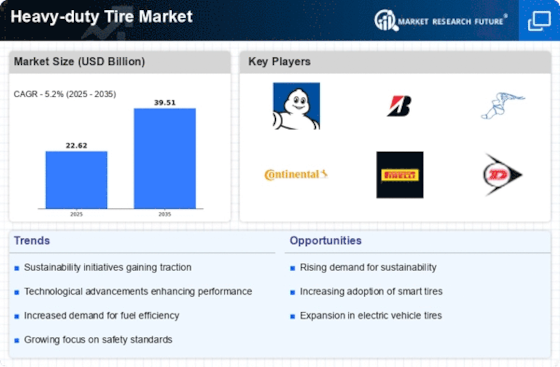
As per Market Research Future analysis, the Heavy-duty Tire Market Size was estimated at 22.62 USD Billion in 2024. The Heavy-duty Tire industry is projected to grow from USD 23.8 Billion in 2025 to USD 39.51 Billion by 2035, exhibiting a compound annual growth rate (CAGR) of 5% during the forecast period 2025 - 2035

Key Market Trends & Highlights

The Heavy-duty Tire Market is poised for growth driven by sustainability and technological advancements.

  • North America remains the largest market for heavy-duty tires, driven by robust demand in the construction sector. The Asia-Pacific region is emerging as the fastest-growing market, fueled by rapid industrialization and infrastructure projects. The construction machinery segment dominates the market, while the mining machinery segment is experiencing the fastest growth due to increased resource extraction activities. Key market drivers include the rising demand for commercial vehicles and a strong focus on fuel efficiency and regulatory compliance.

Market Size & Forecast

2024 Market Size 22.62 (USD Billion)
2035 Market Size 39.51 (USD Billion)
CAGR (2025 - 2035) 5.2%
Largest Regional Market Share in 2024 Europe

Major Players

Michelin (FR), Bridgestone (JP), Goodyear (US), Continental (DE), Pirelli (IT), Dunlop (GB), Hankook (KR), Yokohama (JP), Trelleborg (SE)

Market Trends

The Heavy-duty Tire Market is currently experiencing a dynamic evolution, driven by various factors that influence demand and supply. The increasing focus on sustainability and environmental concerns is prompting manufacturers to innovate and develop eco-friendly tire solutions. This shift is not only beneficial for the environment but also aligns with the growing consumer preference for sustainable products. Additionally, advancements in tire technology are enhancing performance, durability, and safety, which are critical attributes for heavy-duty applications. As industries such as construction, agriculture, and logistics expand, the need for reliable and high-performance tires becomes paramount. Moreover, the Heavy-duty Tire Market is witnessing a trend towards digitalization and smart technologies. The integration of IoT and telematics in tire management systems is enabling fleet operators to monitor tire conditions in real-time, thereby optimizing maintenance and reducing operational costs. This technological advancement appears to be reshaping the market landscape, as companies seek to leverage data for improved decision-making. Furthermore, the competitive landscape is intensifying, with both established players and new entrants striving to capture market share through innovative products and strategic partnerships. Overall, the Heavy-duty Tire Market is poised for growth, driven by technological advancements and evolving consumer preferences.

Sustainability Initiatives

The Heavy-duty Tire Market is increasingly influenced by sustainability initiatives. Manufacturers are focusing on creating eco-friendly products that minimize environmental impact. This trend reflects a broader consumer demand for sustainable practices, prompting companies to innovate in materials and production processes.

Technological Advancements

Technological advancements are reshaping the Heavy-duty Tire Market. Innovations in tire design and materials enhance performance and safety. These developments are crucial for industries that rely on heavy-duty applications, as they seek reliable and efficient solutions.

Digital Transformation

Digital transformation is becoming a key trend in the Heavy-duty Tire Market. The integration of smart technologies and IoT in tire management allows for real-time monitoring and data analysis. This shift enables fleet operators to optimize maintenance and improve operational efficiency.

Heavy-duty Tire Market Market Drivers

Focus on Fuel Efficiency

The Heavy-duty Tire Market is increasingly focusing on fuel efficiency as a critical driver of growth. With rising fuel costs and environmental concerns, fleet operators are seeking tires that not only enhance vehicle performance but also contribute to lower fuel consumption. In 2025, it is projected that tires designed for fuel efficiency will capture a significant portion of the market, as they can reduce rolling resistance and improve overall vehicle efficiency. This trend is prompting manufacturers to invest in research and development to create innovative tire technologies that align with sustainability goals. As a result, the Heavy-duty Tire Market is likely to see a shift towards eco-friendly tire solutions that appeal to environmentally conscious consumers and businesses.

Infrastructure Development Projects

Infrastructure development projects are significantly influencing the Heavy-duty Tire Market. Governments and private entities are investing heavily in road construction and maintenance, which directly impacts the demand for heavy-duty tires. In 2025, it is anticipated that infrastructure spending will reach unprecedented levels, particularly in emerging markets where urbanization is accelerating. This increase in infrastructure projects necessitates the use of heavy-duty vehicles, which in turn drives the demand for specialized tires designed for construction and heavy transport. The Heavy-duty Tire Market must respond to this trend by providing tires that offer enhanced traction, durability, and load-bearing capacity, ensuring they meet the rigorous demands of construction environments.

Increasing Demand for Commercial Vehicles

The Heavy-duty Tire Market is experiencing a notable surge in demand for commercial vehicles, driven by the expansion of e-commerce and logistics sectors. As businesses increasingly rely on freight transportation, the need for durable and reliable tires becomes paramount. In 2025, the commercial vehicle segment is projected to account for a substantial share of the overall tire market, with estimates suggesting a growth rate of approximately 4.5% annually. This trend indicates that manufacturers must adapt to the evolving requirements of commercial fleets, emphasizing the importance of high-performance tires that can withstand rigorous usage. Consequently, the Heavy-duty Tire Market is likely to witness innovations aimed at enhancing tire longevity and performance, catering to the specific needs of commercial vehicle operators.

Regulatory Compliance and Safety Standards

Regulatory compliance and safety standards are becoming increasingly stringent, significantly impacting the Heavy-duty Tire Market. Governments worldwide are implementing regulations aimed at improving road safety and reducing environmental impact, which directly influences tire design and manufacturing. In 2025, it is anticipated that compliance with these regulations will drive demand for tires that meet higher safety and performance standards. Manufacturers will need to invest in quality assurance processes and materials that adhere to these evolving regulations. This focus on compliance not only enhances safety for end-users but also positions the Heavy-duty Tire Market to align with global sustainability initiatives, ultimately fostering consumer trust and brand loyalty.

Technological Innovations in Tire Manufacturing

Technological innovations are reshaping the Heavy-duty Tire Market, with advancements in materials and manufacturing processes leading to enhanced tire performance. The integration of smart technologies, such as sensors and data analytics, is becoming increasingly prevalent, allowing for real-time monitoring of tire conditions. This trend is expected to grow, with manufacturers focusing on developing tires that not only provide superior durability but also offer predictive maintenance capabilities. In 2025, the adoption of these technologies is likely to drive a competitive edge for companies that can deliver high-quality, technologically advanced tires. Consequently, the Heavy-duty Tire Market is poised for transformation as it embraces these innovations to meet the demands of modern transportation.

Market Segment Insights

By Vehicle Type: Construction Machinery (Largest) vs. Mining Machinery (Fastest-Growing)

In the Heavy-duty Tire Market, construction machinery holds the largest share among vehicle types, primarily driven by ongoing infrastructure projects and urbanization. This segment is followed closely by mining machinery, which, due to increasing mineral extraction activities, is experiencing substantial growth. <a href="https://www.marketresearchfuture.com/reports/agriculture-equipment-market-2182">Agricultural machinery</a> and industrial vehicles also contribute to the market but to a lesser extent compared to these two dominant categories.

Construction Machinery (Dominant) vs. Mining Machinery (Emerging)

Construction machinery remains dominant in the Heavy-duty Tire Market, characterized by its extensive applications in road construction, building projects, and civil engineering. These vehicles require robust tire solutions capable of withstanding harsh conditions, making them a critical focus for tire manufacturers. In contrast, mining machinery is an emerging segment driven by technological advancements and rising demand for raw materials. The need for specialized tires designed for extreme environments and high-load capacities fuels this growth, opening opportunities for innovative tire solutions specifically tailored to the mining sector.

By End-User: OEM (Largest) vs. Aftermarket (Fastest-Growing)

In the Heavy-duty Tire Market, the end-user segment is primarily divided into Original Equipment Manufacturers (OEM) and the Aftermarket. The OEM segment holds the largest market share, as it directly supplies tires for new heavy-duty vehicles. On the other hand, the Aftermarket segment is gaining traction, catering to the replacement needs of existing vehicles. This split indicates distinct purchasing patterns where OEMs focus on new constructions while the Aftermarket is driven by maintenance and replacement demands, ensuring it remains a vital sector within the market.

OEM (Dominant) vs. Aftermarket (Emerging)

The OEM segment in the Heavy-duty Tire Market is characterized by its strong relationships with vehicle manufacturers and stringent quality specifications, ensuring robust demand for high-performance tires designed for specific applications. Meanwhile, the Aftermarket segment is emerging rapidly, driven by increased fleet operations and a growing focus on vehicle maintenance and longevity. This segment is adapting to diverse needs, offering a wide range of products to suit various vehicle types and operational requirements. It benefits from trends such as technology advancements in tire design and material, leading to longer-lasting and more reliable options for consumers.

Get more detailed insights about Heavy-duty Tire Market Research Report - Global Forecast till 2035

Regional Insights

North America : Market Leader in Heavy-duty Tires

North America is the largest market for heavy-duty tires, accounting for approximately 40% of the global market share. The region's growth is driven by the booming logistics and transportation sectors, alongside stringent regulations promoting safety and efficiency. The increasing adoption of electric and hybrid vehicles is also contributing to demand, as companies seek sustainable solutions. The United States is the primary market, with Canada following as the second largest. Key players like Goodyear and Michelin dominate the landscape, focusing on innovation and sustainability. The competitive environment is characterized by significant investments in R&D, ensuring that North America remains at the forefront of tire technology.

Europe : Regulatory-Driven Market Growth

Europe is a significant player in the heavy-duty tire market, holding around 30% of the global share. The region's growth is propelled by stringent environmental regulations and a strong push towards sustainable transportation solutions. The European Union's Green Deal aims to reduce carbon emissions, which is influencing tire manufacturers to innovate and develop eco-friendly products. Germany and France are the leading countries in this market, with major companies like Continental and Michelin leading the charge. The competitive landscape is marked by a focus on technological advancements and sustainability, with companies investing heavily in research to meet regulatory standards and consumer demands.

Asia-Pacific : Emerging Market with High Potential

Asia-Pacific is an emerging powerhouse in the heavy-duty tire market, accounting for approximately 25% of the global share. The region's growth is driven by rapid industrialization, urbanization, and increasing demand for logistics and transportation services. Countries like China and India are investing heavily in infrastructure, which is further boosting the demand for heavy-duty vehicles and tires. China is the largest market in the region, with India following closely. The competitive landscape features key players like Bridgestone and Yokohama, who are expanding their operations to meet the growing demand. The focus on innovation and cost-effective solutions is shaping the market dynamics in this region, making it a key area for future growth.

Middle East and Africa : Resource-Rich Market Opportunities

The Middle East and Africa region is witnessing significant growth in the heavy-duty tire market, holding about 5% of the global share. The growth is primarily driven by large-scale infrastructure projects and increasing investments in transportation networks. Countries like the UAE and South Africa are leading the charge, with government initiatives aimed at enhancing logistics and transportation capabilities. The competitive landscape is characterized by a mix of local and international players, including Trelleborg and Dunlop. The region's unique challenges, such as varying road conditions, are prompting manufacturers to innovate and adapt their products. This adaptability is crucial for capturing the growing demand in this diverse market.

Key Players and Competitive Insights

The Heavy-duty Tire Market is currently characterized by a dynamic competitive landscape, driven by factors such as increasing demand for durable and efficient tires, advancements in technology, and a growing emphasis on sustainability. Major players like Michelin (FR), Bridgestone (JP), and Goodyear (US) are strategically positioned to leverage these trends. Michelin (FR) focuses on innovation and sustainability, aiming to reduce carbon footprints through eco-friendly tire production. Bridgestone (JP) emphasizes digital transformation, integrating smart technologies into their products to enhance performance and safety. Goodyear (US) is actively pursuing partnerships to expand its market reach and enhance its product offerings, particularly in the realm of smart tires. Collectively, these strategies contribute to a competitive environment that is increasingly centered on technological advancement and sustainability. Key business tactics within the Heavy-duty Tire Market include localizing manufacturing and optimizing supply chains to enhance efficiency and reduce costs. The market structure appears moderately fragmented, with several key players holding substantial market shares. This fragmentation allows for a diverse range of products and innovations, while the collective influence of these major companies shapes market trends and consumer preferences. In August 2025, Michelin (FR) announced the launch of its new line of eco-friendly tires, which utilize sustainable materials and advanced manufacturing processes. This strategic move not only aligns with global sustainability goals but also positions Michelin as a leader in the green tire segment, potentially attracting environmentally conscious consumers and businesses alike. The introduction of these tires may enhance Michelin's competitive edge in a market increasingly focused on sustainability. In September 2025, Bridgestone (JP) unveiled its latest smart tire technology, which incorporates real-time data analytics to monitor tire performance and optimize maintenance schedules. This innovation is significant as it reflects Bridgestone's commitment to digital transformation and could lead to improved safety and efficiency for fleet operators. By integrating smart technology, Bridgestone may strengthen its market position and appeal to a tech-savvy customer base. In July 2025, Goodyear (US) entered into a strategic partnership with a leading telematics company to develop a comprehensive tire management system for commercial fleets. This collaboration aims to enhance tire performance monitoring and predictive maintenance, which could significantly reduce operational costs for fleet operators. Such partnerships indicate Goodyear's proactive approach to addressing the evolving needs of the market and enhancing its service offerings. As of October 2025, current competitive trends in the Heavy-duty Tire Market are increasingly defined by digitalization, sustainability, and the integration of artificial intelligence. Strategic alliances among key players are shaping the landscape, fostering innovation and enhancing product offerings. Looking ahead, competitive differentiation is likely to evolve from traditional price-based competition to a focus on innovation, technology, and supply chain reliability, as companies strive to meet the demands of a rapidly changing market.

Key Companies in the Heavy-duty Tire Market include

Industry Developments

August 2022: In August 2022, Michelin North America, Inc. unveiled the Michelin X Mine D2 Extra Load L5 35/65R33 tire, an enhanced iteration of one of the company's most popular mining tires. Engineered for quarry and underground mining applications, the new tire is specifically designed to endure harsh mining conditions, boasting an increased load rating to handle higher weights effectively

May 2022: In May 2022, JK Tyre & Industries introduced four innovative products in the off-road tire market. Among these, the 45/65-45 58PR VEM 63 L5 TL stands out. Additionally, the GTL Champ 16 PR G3 TT, Hard Rock Champion 20PR E4 TT (available from 12 to 24), and VEM 045 44PR E3 TT (available from 16 to 25) are tailored to deliver superior stability, longer tread life, and specialized tread compounds that resist wear and cuts, thereby extending the service life of these new tires.

Future Outlook

Heavy-duty Tire Market Future Outlook

The Heavy-duty Tire Market is projected to grow at a 5.2% CAGR from 2025 to 2035, driven by increasing demand for fuel efficiency, sustainability, and advanced tire technologies.

New opportunities lie in:

  • <p>Development of smart tire technologies for real-time monitoring Expansion into emerging markets with tailored product offerings Partnerships with logistics companies for integrated tire solutions</p>

By 2035, the Heavy-duty Tire Market is expected to achieve robust growth and innovation.

Market Segmentation

Heavy-duty Tire Market End-User Outlook

  • OEM
  • Aftermarket

Heavy-duty Tire Market Vehicle Type Outlook

  • Construction Machinery
  • Mining Machinery
  • Agricultural Machinery
  • Industrial Vehicles

Report Scope

MARKET SIZE 2024 22.62(USD Billion)
MARKET SIZE 2025 23.8(USD Billion)
MARKET SIZE 2035 39.51(USD Billion)
COMPOUND ANNUAL GROWTH RATE (CAGR) 5.2% (2025 - 2035)
REPORT COVERAGE Revenue Forecast, Competitive Landscape, Growth Factors, and Trends
BASE YEAR 2024
Market Forecast Period 2025 - 2035
Historical Data 2019 - 2024
Market Forecast Units USD Billion
Key Companies Profiled Michelin (FR), Bridgestone (JP), Goodyear (US), Continental (DE), Pirelli (IT), Dunlop (GB), Hankook (KR), Yokohama (JP), Trelleborg (SE)
Segments Covered Vehicle Type, Region
Key Market Opportunities Adoption of advanced materials enhancing durability and performance in the Heavy-duty Tire Market.

Key Market Dynamics Rising demand for fuel-efficient heavy-duty tires driven by stringent environmental regulations and technological advancements.
Countries Covered North America, Europe, APAC, South America, MEA

FAQs

What is the current valuation of the Heavy-duty Tire Market as of 2024?

<p>The Heavy-duty Tire Market was valued at 22.62 USD Billion in 2024.</p>

What is the projected market valuation for the Heavy-duty Tire Market in 2035?

<p>The market is projected to reach 39.51 USD Billion by 2035.</p>

What is the expected CAGR for the Heavy-duty Tire Market during the forecast period 2025 - 2035?

<p>The expected CAGR for the Heavy-duty Tire Market during 2025 - 2035 is 5.2%.</p>

Which segments are included in the Heavy-duty Tire Market analysis?

<p>The market analysis includes segments such as Construction Machinery, Mining Machinery, Agricultural Machinery, and Industrial Vehicles.</p>

What was the valuation of the Agricultural Machinery segment in 2024?

<p>The Agricultural Machinery segment was valued at 6.0 USD Billion in 2024.</p>

How much is the Industrial Vehicles segment projected to grow by 2035?

<p>The Industrial Vehicles segment is projected to grow from 7.62 USD Billion in 2024 to 14.51 USD Billion by 2035.</p>

What are the key players in the Heavy-duty Tire Market?

Key players include Michelin, Bridgestone, Goodyear, Continental, Pirelli, Dunlop, Hankook, Yokohama, and Trelleborg.

What was the valuation of the Aftermarket segment in 2024?

The Aftermarket segment was valued at 12.62 USD Billion in 2024.

What is the projected growth for the OEM segment by 2035?

The OEM segment is projected to grow from 10.0 USD Billion in 2024 to 17.0 USD Billion by 2035.

How does the Heavy-duty Tire Market's growth compare across different vehicle types?

The market shows varied growth across vehicle types, with Industrial Vehicles expected to see substantial growth from 7.62 USD Billion to 14.51 USD Billion by 2035.

  1. SECTION I: EXECUTIVE SUMMARY AND KEY HIGHLIGHTS
    1. | 1.1 EXECUTIVE SUMMARY
    2. | | 1.1.1 Market Overview
    3. | | 1.1.2 Key Findings
    4. | | 1.1.3 Market Segmentation
    5. | | 1.1.4 Competitive Landscape
    6. | | 1.1.5 Challenges and Opportunities
    7. | | 1.1.6 Future Outlook
  2. SECTION II: SCOPING, METHODOLOGY AND MARKET STRUCTURE
    1. | 2.1 MARKET INTRODUCTION
    2. | | 2.1.1 Definition
    3. | | 2.1.2 Scope of the study
    4. | | | 2.1.2.1 Research Objective
    5. | | | 2.1.2.2 Assumption
    6. | | | 2.1.2.3 Limitations
    7. | 2.2 RESEARCH METHODOLOGY
    8. | | 2.2.1 Overview
    9. | | 2.2.2 Data Mining
    10. | | 2.2.3 Secondary Research
    11. | | 2.2.4 Primary Research
    12. | | | 2.2.4.1 Primary Interviews and Information Gathering Process
    13. | | | 2.2.4.2 Breakdown of Primary Respondents
    14. | | 2.2.5 Forecasting Model
    15. | | 2.2.6 Market Size Estimation
    16. | | | 2.2.6.1 Bottom-Up Approach
    17. | | | 2.2.6.2 Top-Down Approach
    18. | | 2.2.7 Data Triangulation
    19. | | 2.2.8 Validation
  3. SECTION III: QUALITATIVE ANALYSIS
    1. | 3.1 MARKET DYNAMICS
    2. | | 3.1.1 Overview
    3. | | 3.1.2 Drivers
    4. | | 3.1.3 Restraints
    5. | | 3.1.4 Opportunities
    6. | 3.2 MARKET FACTOR ANALYSIS
    7. | | 3.2.1 Value chain Analysis
    8. | | 3.2.2 Porter's Five Forces Analysis
    9. | | | 3.2.2.1 Bargaining Power of Suppliers
    10. | | | 3.2.2.2 Bargaining Power of Buyers
    11. | | | 3.2.2.3 Threat of New Entrants
    12. | | | 3.2.2.4 Threat of Substitutes
    13. | | | 3.2.2.5 Intensity of Rivalry
    14. | | 3.2.3 COVID-19 Impact Analysis
    15. | | | 3.2.3.1 Market Impact Analysis
    16. | | | 3.2.3.2 Regional Impact
    17. | | | 3.2.3.3 Opportunity and Threat Analysis
  4. SECTION IV: QUANTITATIVE ANALYSIS
    1. | 4.1 Automobile, BY Vehicle Type (USD Billion)
    2. | | 4.1.1 Construction Machinery
    3. | | 4.1.2 Mining Machinery
    4. | | 4.1.3 Agricultural Machinery
    5. | | 4.1.4 Industrial Vehicles
    6. | 4.2 Automobile, BY End-User (USD Billion)
    7. | | 4.2.1 OEM
    8. | | 4.2.2 Aftermarket
    9. | 4.3 Automobile, BY Region (USD Billion)
    10. | | 4.3.1 North America
    11. | | | 4.3.1.1 US
    12. | | | 4.3.1.2 Canada
    13. | | 4.3.2 Europe
    14. | | | 4.3.2.1 Germany
    15. | | | 4.3.2.2 UK
    16. | | | 4.3.2.3 France
    17. | | | 4.3.2.4 Russia
    18. | | | 4.3.2.5 Italy
    19. | | | 4.3.2.6 Spain
    20. | | | 4.3.2.7 Rest of Europe
    21. | | 4.3.3 APAC
    22. | | | 4.3.3.1 China
    23. | | | 4.3.3.2 India
    24. | | | 4.3.3.3 Japan
    25. | | | 4.3.3.4 South Korea
    26. | | | 4.3.3.5 Malaysia
    27. | | | 4.3.3.6 Thailand
    28. | | | 4.3.3.7 Indonesia
    29. | | | 4.3.3.8 Rest of APAC
    30. | | 4.3.4 South America
    31. | | | 4.3.4.1 Brazil
    32. | | | 4.3.4.2 Mexico
    33. | | | 4.3.4.3 Argentina
    34. | | | 4.3.4.4 Rest of South America
    35. | | 4.3.5 MEA
    36. | | | 4.3.5.1 GCC Countries
    37. | | | 4.3.5.2 South Africa
    38. | | | 4.3.5.3 Rest of MEA
  5. SECTION V: COMPETITIVE ANALYSIS
    1. | 5.1 Competitive Landscape
    2. | | 5.1.1 Overview
    3. | | 5.1.2 Competitive Analysis
    4. | | 5.1.3 Market share Analysis
    5. | | 5.1.4 Major Growth Strategy in the Automobile
    6. | | 5.1.5 Competitive Benchmarking
    7. | | 5.1.6 Leading Players in Terms of Number of Developments in the Automobile
    8. | | 5.1.7 Key developments and growth strategies
    9. | | | 5.1.7.1 New Product Launch/Service Deployment
    10. | | | 5.1.7.2 Merger & Acquisitions
    11. | | | 5.1.7.3 Joint Ventures
    12. | | 5.1.8 Major Players Financial Matrix
    13. | | | 5.1.8.1 Sales and Operating Income
    14. | | | 5.1.8.2 Major Players R&D Expenditure. 2023
    15. | 5.2 Company Profiles
    16. | | 5.2.1 Michelin (FR)
    17. | | | 5.2.1.1 Financial Overview
    18. | | | 5.2.1.2 Products Offered
    19. | | | 5.2.1.3 Key Developments
    20. | | | 5.2.1.4 SWOT Analysis
    21. | | | 5.2.1.5 Key Strategies
    22. | | 5.2.2 Bridgestone (JP)
    23. | | | 5.2.2.1 Financial Overview
    24. | | | 5.2.2.2 Products Offered
    25. | | | 5.2.2.3 Key Developments
    26. | | | 5.2.2.4 SWOT Analysis
    27. | | | 5.2.2.5 Key Strategies
    28. | | 5.2.3 Goodyear (US)
    29. | | | 5.2.3.1 Financial Overview
    30. | | | 5.2.3.2 Products Offered
    31. | | | 5.2.3.3 Key Developments
    32. | | | 5.2.3.4 SWOT Analysis
    33. | | | 5.2.3.5 Key Strategies
    34. | | 5.2.4 Continental (DE)
    35. | | | 5.2.4.1 Financial Overview
    36. | | | 5.2.4.2 Products Offered
    37. | | | 5.2.4.3 Key Developments
    38. | | | 5.2.4.4 SWOT Analysis
    39. | | | 5.2.4.5 Key Strategies
    40. | | 5.2.5 Pirelli (IT)
    41. | | | 5.2.5.1 Financial Overview
    42. | | | 5.2.5.2 Products Offered
    43. | | | 5.2.5.3 Key Developments
    44. | | | 5.2.5.4 SWOT Analysis
    45. | | | 5.2.5.5 Key Strategies
    46. | | 5.2.6 Dunlop (GB)
    47. | | | 5.2.6.1 Financial Overview
    48. | | | 5.2.6.2 Products Offered
    49. | | | 5.2.6.3 Key Developments
    50. | | | 5.2.6.4 SWOT Analysis
    51. | | | 5.2.6.5 Key Strategies
    52. | | 5.2.7 Hankook (KR)
    53. | | | 5.2.7.1 Financial Overview
    54. | | | 5.2.7.2 Products Offered
    55. | | | 5.2.7.3 Key Developments
    56. | | | 5.2.7.4 SWOT Analysis
    57. | | | 5.2.7.5 Key Strategies
    58. | | 5.2.8 Yokohama (JP)
    59. | | | 5.2.8.1 Financial Overview
    60. | | | 5.2.8.2 Products Offered
    61. | | | 5.2.8.3 Key Developments
    62. | | | 5.2.8.4 SWOT Analysis
    63. | | | 5.2.8.5 Key Strategies
    64. | | 5.2.9 Trelleborg (SE)
    65. | | | 5.2.9.1 Financial Overview
    66. | | | 5.2.9.2 Products Offered
    67. | | | 5.2.9.3 Key Developments
    68. | | | 5.2.9.4 SWOT Analysis
    69. | | | 5.2.9.5 Key Strategies
    70. | 5.3 Appendix
    71. | | 5.3.1 References
    72. | | 5.3.2 Related Reports
  6. LIST OF FIGURES
    1. | 6.1 MARKET SYNOPSIS
    2. | 6.2 NORTH AMERICA MARKET ANALYSIS
    3. | 6.3 US MARKET ANALYSIS BY VEHICLE TYPE
    4. | 6.4 US MARKET ANALYSIS BY END-USER
    5. | 6.5 CANADA MARKET ANALYSIS BY VEHICLE TYPE
    6. | 6.6 CANADA MARKET ANALYSIS BY END-USER
    7. | 6.7 EUROPE MARKET ANALYSIS
    8. | 6.8 GERMANY MARKET ANALYSIS BY VEHICLE TYPE
    9. | 6.9 GERMANY MARKET ANALYSIS BY END-USER
    10. | 6.10 UK MARKET ANALYSIS BY VEHICLE TYPE
    11. | 6.11 UK MARKET ANALYSIS BY END-USER
    12. | 6.12 FRANCE MARKET ANALYSIS BY VEHICLE TYPE
    13. | 6.13 FRANCE MARKET ANALYSIS BY END-USER
    14. | 6.14 RUSSIA MARKET ANALYSIS BY VEHICLE TYPE
    15. | 6.15 RUSSIA MARKET ANALYSIS BY END-USER
    16. | 6.16 ITALY MARKET ANALYSIS BY VEHICLE TYPE
    17. | 6.17 ITALY MARKET ANALYSIS BY END-USER
    18. | 6.18 SPAIN MARKET ANALYSIS BY VEHICLE TYPE
    19. | 6.19 SPAIN MARKET ANALYSIS BY END-USER
    20. | 6.20 REST OF EUROPE MARKET ANALYSIS BY VEHICLE TYPE
    21. | 6.21 REST OF EUROPE MARKET ANALYSIS BY END-USER
    22. | 6.22 APAC MARKET ANALYSIS
    23. | 6.23 CHINA MARKET ANALYSIS BY VEHICLE TYPE
    24. | 6.24 CHINA MARKET ANALYSIS BY END-USER
    25. | 6.25 INDIA MARKET ANALYSIS BY VEHICLE TYPE
    26. | 6.26 INDIA MARKET ANALYSIS BY END-USER
    27. | 6.27 JAPAN MARKET ANALYSIS BY VEHICLE TYPE
    28. | 6.28 JAPAN MARKET ANALYSIS BY END-USER
    29. | 6.29 SOUTH KOREA MARKET ANALYSIS BY VEHICLE TYPE
    30. | 6.30 SOUTH KOREA MARKET ANALYSIS BY END-USER
    31. | 6.31 MALAYSIA MARKET ANALYSIS BY VEHICLE TYPE
    32. | 6.32 MALAYSIA MARKET ANALYSIS BY END-USER
    33. | 6.33 THAILAND MARKET ANALYSIS BY VEHICLE TYPE
    34. | 6.34 THAILAND MARKET ANALYSIS BY END-USER
    35. | 6.35 INDONESIA MARKET ANALYSIS BY VEHICLE TYPE
    36. | 6.36 INDONESIA MARKET ANALYSIS BY END-USER
    37. | 6.37 REST OF APAC MARKET ANALYSIS BY VEHICLE TYPE
    38. | 6.38 REST OF APAC MARKET ANALYSIS BY END-USER
    39. | 6.39 SOUTH AMERICA MARKET ANALYSIS
    40. | 6.40 BRAZIL MARKET ANALYSIS BY VEHICLE TYPE
    41. | 6.41 BRAZIL MARKET ANALYSIS BY END-USER
    42. | 6.42 MEXICO MARKET ANALYSIS BY VEHICLE TYPE
    43. | 6.43 MEXICO MARKET ANALYSIS BY END-USER
    44. | 6.44 ARGENTINA MARKET ANALYSIS BY VEHICLE TYPE
    45. | 6.45 ARGENTINA MARKET ANALYSIS BY END-USER
    46. | 6.46 REST OF SOUTH AMERICA MARKET ANALYSIS BY VEHICLE TYPE
    47. | 6.47 REST OF SOUTH AMERICA MARKET ANALYSIS BY END-USER
    48. | 6.48 MEA MARKET ANALYSIS
    49. | 6.49 GCC COUNTRIES MARKET ANALYSIS BY VEHICLE TYPE
    50. | 6.50 GCC COUNTRIES MARKET ANALYSIS BY END-USER
    51. | 6.51 SOUTH AFRICA MARKET ANALYSIS BY VEHICLE TYPE
    52. | 6.52 SOUTH AFRICA MARKET ANALYSIS BY END-USER
    53. | 6.53 REST OF MEA MARKET ANALYSIS BY VEHICLE TYPE
    54. | 6.54 REST OF MEA MARKET ANALYSIS BY END-USER
    55. | 6.55 KEY BUYING CRITERIA OF AUTOMOBILE
    56. | 6.56 RESEARCH PROCESS OF MRFR
    57. | 6.57 DRO ANALYSIS OF AUTOMOBILE
    58. | 6.58 DRIVERS IMPACT ANALYSIS: AUTOMOBILE
    59. | 6.59 RESTRAINTS IMPACT ANALYSIS: AUTOMOBILE
    60. | 6.60 SUPPLY / VALUE CHAIN: AUTOMOBILE
    61. | 6.61 AUTOMOBILE, BY VEHICLE TYPE, 2024 (% SHARE)
    62. | 6.62 AUTOMOBILE, BY VEHICLE TYPE, 2024 TO 2035 (USD Billion)
    63. | 6.63 AUTOMOBILE, BY END-USER, 2024 (% SHARE)
    64. | 6.64 AUTOMOBILE, BY END-USER, 2024 TO 2035 (USD Billion)
    65. | 6.65 BENCHMARKING OF MAJOR COMPETITORS
  7. LIST OF TABLES
    1. | 7.1 LIST OF ASSUMPTIONS
    2. | | 7.1.1
    3. | 7.2 North America MARKET SIZE ESTIMATES; FORECAST
    4. | | 7.2.1 BY VEHICLE TYPE, 2025-2035 (USD Billion)
    5. | | 7.2.2 BY END-USER, 2025-2035 (USD Billion)
    6. | 7.3 US MARKET SIZE ESTIMATES; FORECAST
    7. | | 7.3.1 BY VEHICLE TYPE, 2025-2035 (USD Billion)
    8. | | 7.3.2 BY END-USER, 2025-2035 (USD Billion)
    9. | 7.4 Canada MARKET SIZE ESTIMATES; FORECAST
    10. | | 7.4.1 BY VEHICLE TYPE, 2025-2035 (USD Billion)
    11. | | 7.4.2 BY END-USER, 2025-2035 (USD Billion)
    12. | 7.5 Europe MARKET SIZE ESTIMATES; FORECAST
    13. | | 7.5.1 BY VEHICLE TYPE, 2025-2035 (USD Billion)
    14. | | 7.5.2 BY END-USER, 2025-2035 (USD Billion)
    15. | 7.6 Germany MARKET SIZE ESTIMATES; FORECAST
    16. | | 7.6.1 BY VEHICLE TYPE, 2025-2035 (USD Billion)
    17. | | 7.6.2 BY END-USER, 2025-2035 (USD Billion)
    18. | 7.7 UK MARKET SIZE ESTIMATES; FORECAST
    19. | | 7.7.1 BY VEHICLE TYPE, 2025-2035 (USD Billion)
    20. | | 7.7.2 BY END-USER, 2025-2035 (USD Billion)
    21. | 7.8 France MARKET SIZE ESTIMATES; FORECAST
    22. | | 7.8.1 BY VEHICLE TYPE, 2025-2035 (USD Billion)
    23. | | 7.8.2 BY END-USER, 2025-2035 (USD Billion)
    24. | 7.9 Russia MARKET SIZE ESTIMATES; FORECAST
    25. | | 7.9.1 BY VEHICLE TYPE, 2025-2035 (USD Billion)
    26. | | 7.9.2 BY END-USER, 2025-2035 (USD Billion)
    27. | 7.10 Italy MARKET SIZE ESTIMATES; FORECAST
    28. | | 7.10.1 BY VEHICLE TYPE, 2025-2035 (USD Billion)
    29. | | 7.10.2 BY END-USER, 2025-2035 (USD Billion)
    30. | 7.11 Spain MARKET SIZE ESTIMATES; FORECAST
    31. | | 7.11.1 BY VEHICLE TYPE, 2025-2035 (USD Billion)
    32. | | 7.11.2 BY END-USER, 2025-2035 (USD Billion)
    33. | 7.12 Rest of Europe MARKET SIZE ESTIMATES; FORECAST
    34. | | 7.12.1 BY VEHICLE TYPE, 2025-2035 (USD Billion)
    35. | | 7.12.2 BY END-USER, 2025-2035 (USD Billion)
    36. | 7.13 APAC MARKET SIZE ESTIMATES; FORECAST
    37. | | 7.13.1 BY VEHICLE TYPE, 2025-2035 (USD Billion)
    38. | | 7.13.2 BY END-USER, 2025-2035 (USD Billion)
    39. | 7.14 China MARKET SIZE ESTIMATES; FORECAST
    40. | | 7.14.1 BY VEHICLE TYPE, 2025-2035 (USD Billion)
    41. | | 7.14.2 BY END-USER, 2025-2035 (USD Billion)
    42. | 7.15 India MARKET SIZE ESTIMATES; FORECAST
    43. | | 7.15.1 BY VEHICLE TYPE, 2025-2035 (USD Billion)
    44. | | 7.15.2 BY END-USER, 2025-2035 (USD Billion)
    45. | 7.16 Japan MARKET SIZE ESTIMATES; FORECAST
    46. | | 7.16.1 BY VEHICLE TYPE, 2025-2035 (USD Billion)
    47. | | 7.16.2 BY END-USER, 2025-2035 (USD Billion)
    48. | 7.17 South Korea MARKET SIZE ESTIMATES; FORECAST
    49. | | 7.17.1 BY VEHICLE TYPE, 2025-2035 (USD Billion)
    50. | | 7.17.2 BY END-USER, 2025-2035 (USD Billion)
    51. | 7.18 Malaysia MARKET SIZE ESTIMATES; FORECAST
    52. | | 7.18.1 BY VEHICLE TYPE, 2025-2035 (USD Billion)
    53. | | 7.18.2 BY END-USER, 2025-2035 (USD Billion)
    54. | 7.19 Thailand MARKET SIZE ESTIMATES; FORECAST
    55. | | 7.19.1 BY VEHICLE TYPE, 2025-2035 (USD Billion)
    56. | | 7.19.2 BY END-USER, 2025-2035 (USD Billion)
    57. | 7.20 Indonesia MARKET SIZE ESTIMATES; FORECAST
    58. | | 7.20.1 BY VEHICLE TYPE, 2025-2035 (USD Billion)
    59. | | 7.20.2 BY END-USER, 2025-2035 (USD Billion)
    60. | 7.21 Rest of APAC MARKET SIZE ESTIMATES; FORECAST
    61. | | 7.21.1 BY VEHICLE TYPE, 2025-2035 (USD Billion)
    62. | | 7.21.2 BY END-USER, 2025-2035 (USD Billion)
    63. | 7.22 South America MARKET SIZE ESTIMATES; FORECAST
    64. | | 7.22.1 BY VEHICLE TYPE, 2025-2035 (USD Billion)
    65. | | 7.22.2 BY END-USER, 2025-2035 (USD Billion)
    66. | 7.23 Brazil MARKET SIZE ESTIMATES; FORECAST
    67. | | 7.23.1 BY VEHICLE TYPE, 2025-2035 (USD Billion)
    68. | | 7.23.2 BY END-USER, 2025-2035 (USD Billion)
    69. | 7.24 Mexico MARKET SIZE ESTIMATES; FORECAST
    70. | | 7.24.1 BY VEHICLE TYPE, 2025-2035 (USD Billion)
    71. | | 7.24.2 BY END-USER, 2025-2035 (USD Billion)
    72. | 7.25 Argentina MARKET SIZE ESTIMATES; FORECAST
    73. | | 7.25.1 BY VEHICLE TYPE, 2025-2035 (USD Billion)
    74. | | 7.25.2 BY END-USER, 2025-2035 (USD Billion)
    75. | 7.26 Rest of South America MARKET SIZE ESTIMATES; FORECAST
    76. | | 7.26.1 BY VEHICLE TYPE, 2025-2035 (USD Billion)
    77. | | 7.26.2 BY END-USER, 2025-2035 (USD Billion)
    78. | 7.27 MEA MARKET SIZE ESTIMATES; FORECAST
    79. | | 7.27.1 BY VEHICLE TYPE, 2025-2035 (USD Billion)
    80. | | 7.27.2 BY END-USER, 2025-2035 (USD Billion)
    81. | 7.28 GCC Countries MARKET SIZE ESTIMATES; FORECAST
    82. | | 7.28.1 BY VEHICLE TYPE, 2025-2035 (USD Billion)
    83. | | 7.28.2 BY END-USER, 2025-2035 (USD Billion)
    84. | 7.29 South Africa MARKET SIZE ESTIMATES; FORECAST
    85. | | 7.29.1 BY VEHICLE TYPE, 2025-2035 (USD Billion)
    86. | | 7.29.2 BY END-USER, 2025-2035 (USD Billion)
    87. | 7.30 Rest of MEA MARKET SIZE ESTIMATES; FORECAST
    88. | | 7.30.1 BY VEHICLE TYPE, 2025-2035 (USD Billion)
    89. | | 7.30.2 BY END-USER, 2025-2035 (USD Billion)
    90. | 7.31 PRODUCT LAUNCH/PRODUCT DEVELOPMENT/APPROVAL
    91. | | 7.31.1
    92. | 7.32 ACQUISITION/PARTNERSHIP
    93. | | 7.32.1

Automobile Market Segmentation

Automobile By Vehicle Type (USD Billion, 2025-2035)

  • Construction Machinery
  • Mining Machinery
  • Agricultural Machinery
  • Industrial Vehicles

Automobile By End-User (USD Billion, 2025-2035)

  • OEM
  • Aftermarket
Infographic

Free Sample Request

Kindly complete the form below to receive a free sample of this Report

Get Free Sample

Customer Strories

Compare Licence

×
Features License Type
Single User Multiuser License Enterprise User
Price $4,950 $5,950 $7,250
Maximum User Access Limit 1 User Upto 10 Users Unrestricted Access Throughout the Organization
Free Customization
Direct Access to Analyst
Deliverable Format
Platform Access
Discount on Next Purchase 10% 15% 15%
Printable Versions