×
Request Free Sample ×

Kindly complete the form below to receive a free sample of this Report

* Please use a valid business email

Leading companies partner with us for data-driven Insights

clients tt-cursor
Hero Background
English
Chinese
French
Japanese
Korean
German
Spanish

Europe Heavy Construction Equipment Market Share

ID: MRFR/Equip/0208-HCR
200 Pages
Tejas Chaudhary
October 2025

Europe Heavy Construction Equipment Market Research Report, By Types (Earthmoving Equipment, Material Handling Equipment, Heavy Construction Vehicles, Others (Cranes, Excavator, Dozer)), By applications (Mining & Excavation, Earthmoving, Transportation, Lifting, Material Handling, Others), end-users (Oil & Gas Industry, Construction Industry, Military, Mining, Agriculture & Forestry and Others) - Forecast to 2035

Share:
Download PDF ×

We do not share your information with anyone. However, we may send you emails based on your report interest from time to time. You may contact us at any time to opt-out.

Heavy Construction Equipment Market Infographic
×
Heavy Construction Equipment Market Infographic Full View
Purchase Options

Market Share

Heavy Construction Equipment Market Share Analysis

The Europe Heavy Construction Equipment market has been witnessing dynamic trends that are reshaping the industry landscape. In recent years, sustainability and technological advancements have become key drivers, steering the market towards a more efficient and eco-friendly future. One prominent trend is the growing emphasis on environmentally conscious construction practices, leading to an increased demand for equipment with lower carbon footprints. This shift aligns with the broader global movement towards sustainable development and is evident in the integration of innovative technologies, such as hybrid and electric engines, into heavy construction equipment.

Another noteworthy trend is the surge in demand for automation and connectivity solutions in construction machinery. With the advent of Industry 4.0, construction equipment is increasingly equipped with advanced telematics, sensors, and IoT connectivity, enabling real-time monitoring and data-driven decision-making. This not only enhances operational efficiency but also contributes to preventive maintenance practices, reducing downtime and overall operational costs. The adoption of such smart technologies is expected to continue shaping the market, driving manufacturers to invest in research and development to stay competitive in this rapidly evolving landscape.

Furthermore, the Europe Heavy Construction Equipment market is experiencing a paradigm shift in customer preferences towards rental and leasing models. Economic uncertainties, coupled with the desire for flexibility and cost-effectiveness, have led construction companies to opt for renting equipment rather than making large capital investments. This trend is reshaping the business models of equipment manufacturers and rental service providers, fostering collaborations and partnerships to cater to the rising demand for flexible equipment solutions.

Government initiatives and regulations are also playing a crucial role in influencing market dynamics. The European Union's focus on infrastructure development, coupled with stringent emission norms, has prompted both manufacturers and end-users to align their strategies with sustainability goals. This has resulted in the development and adoption of construction equipment that not only meets regulatory standards but also addresses the growing need for energy efficiency and reduced environmental impact.

The ongoing COVID-19 pandemic has had its impact on the Europe Heavy Construction Equipment market as well. While the initial phases saw disruptions in supply chains and project delays, the latter stages witnessed a rebound as governments across the region announced stimulus packages to boost infrastructure development and revive economic growth. The construction industry, being a key driver of economic activity, received considerable attention, leading to a resurgence in demand for heavy construction equipment.

In conclusion, the Europe Heavy Construction Equipment market is navigating through a transformative phase characterized by sustainability, technology integration, changing customer preferences, and regulatory influences. Manufacturers are increasingly focusing on innovation to meet the evolving needs of the industry, emphasizing green solutions, smart technologies, and flexible business models. As the market continues to evolve, stakeholders need to stay agile and proactive to capitalize on emerging opportunities and overcome potential challenges in this dynamic landscape.


Author
Tejas Chaudhary
Research Analyst Level II

I have a degree in Engineering (Civil), with masters in Business Administration (Marketing). With more than 4 years of experience in market research and consulting, I am involved in end-to-end process of market research, proposals, project kickoffs and delivery. I have research knowledge and expertise in consumer goods/packaging domain. Also I have worked for various other domains like construction & equipment. Effectively managed and delivered more than 60 report studies for regional as well as global clientele.

Leave a Comment

FAQs

What is the projected market value of the Europe heavy construction equipment market?

The Europe heavy construction equipment market is expected to record a substantial market valuation of 79,466.8 billion by 2032.

What is the estimated growth rate of the Europe heavy construction equipment market?

The Europe heavy construction equipment market is projected to register a moderate 7.07% CAGR in the forecast period.

Who are the key players operative in the Europe heavy construction equipment market?

A few major market players operating in the Europe heavy construction equipment market are Caterpillar Inc., AB Volvo , J C Bamford Excavators Ltd, CNH Industrial N.V., among others.

What is the end-use segment of the Europe heavy construction equipment market expected to witness the highest growth?

The construction segment is slated to expand as the fastest-growing segment.

What is the types segment of the Europe heavy construction equipment market expected to witness the highest growth?

The material handling equipment segment is slated to expand as the fastest-growing segment.

Market Summary

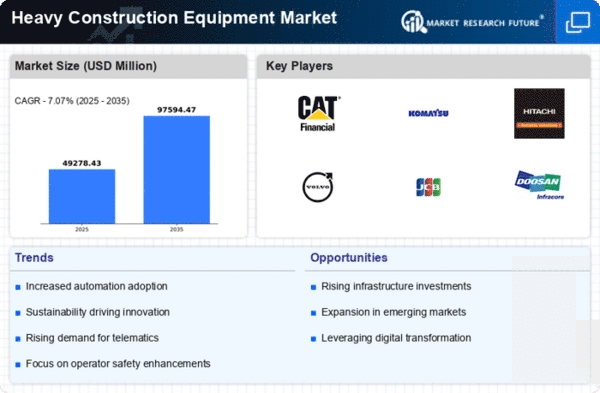
As per MRFR analysis, the Heavy Construction Equipment Market Size was estimated at 46024.5 USD Million in 2024. The Heavy Construction Equipment industry is projected to grow from 49279.36 in 2025 to 97594.47 by 2035, exhibiting a compound annual growth rate (CAGR) of 7.07 during the forecast period 2025 - 2035.

Key Market Trends & Highlights

The Heavy Construction Equipment Market is poised for robust growth driven by technological advancements and sustainability initiatives.

  • The market is experiencing a pronounced shift towards sustainability, influencing equipment design and operational practices.
  • Technological integration, particularly in automation and telematics, is reshaping the operational efficiency of heavy construction equipment.
  • North America remains the largest market, while the Asia-Pacific region is emerging as the fastest-growing area due to rapid urbanization.
  • Increased infrastructure investment and rising demand for sustainable solutions are key drivers propelling market expansion.

Market Size & Forecast

2024 Market Size 46024.5 (USD Million)
2035 Market Size 97594.47 (USD Million)
CAGR (2025 - 2035) 7.07%
Largest Regional Market Share in 2024 Asia-Pacific

Major Players

Caterpillar (US), Komatsu (JP), Hitachi Construction Machinery (JP), Volvo Construction Equipment (SE), JCB (GB), Doosan Infracore (KR), Liebherr (DE), CASE Construction Equipment (US), Terex Corporation (US)

Market Trends

The Heavy Construction Equipment Market is currently experiencing a dynamic evolution, driven by various factors that shape its landscape. The increasing demand for infrastructure development, particularly in emerging economies, appears to be a primary catalyst for growth. As urbanization accelerates, the need for advanced machinery to support construction projects becomes more pronounced. Additionally, technological advancements, such as automation and telematics, are likely enhancing operational efficiency and safety, thereby attracting investments in modern equipment. Furthermore, sustainability initiatives are influencing equipment design and manufacturing processes, as companies strive to reduce their environmental footprint while maintaining productivity. In December 2025, the Heavy Construction Equipment Market seems poised for further transformation. The integration of electric and hybrid machinery is gaining traction, reflecting a shift towards greener alternatives. This trend may not only address environmental concerns but also align with regulatory pressures for emissions reduction. Moreover, the ongoing digitalization of construction processes suggests a future where data-driven decision-making becomes commonplace, potentially revolutionizing project management and execution. As these trends unfold, stakeholders in the Heavy Construction Equipment Market must remain agile to adapt to the evolving demands and opportunities that lie ahead.

Sustainability Focus

The Heavy Construction Equipment Market is increasingly prioritizing sustainability, with manufacturers developing eco-friendly machinery. This trend reflects a growing awareness of environmental issues and regulatory pressures, leading to innovations in electric and hybrid equipment.

Technological Integration

The integration of advanced technologies, such as automation and telematics, is transforming the Heavy Construction Equipment Market. These innovations enhance operational efficiency, improve safety, and enable real-time monitoring of equipment performance.

Urbanization and Infrastructure Development

Rapid urbanization in emerging markets is driving demand for heavy construction equipment. As cities expand and infrastructure projects proliferate, the need for reliable and efficient machinery becomes critical to support these initiatives.

Heavy Construction Equipment Market Market Drivers

Market Growth Projections

The Europe Heavy Construction Equipment Market is poised for substantial growth, with projections indicating a compound annual growth rate (CAGR) of 7.07% from 2025 to 2035. This growth is driven by various factors, including increased infrastructure spending, urbanization, and technological advancements. The market is expected to reach a value of 97.5 USD Billion by 2035, reflecting the ongoing demand for heavy construction equipment across Europe. These projections highlight the industry's potential and the opportunities that lie ahead for stakeholders.

Urbanization and Population Growth

Urbanization continues to be a driving force in the Europe Heavy Construction Equipment Market, as cities expand and populations increase. The demand for residential and commercial construction is surging, leading to a heightened need for heavy machinery. As urban areas become more densely populated, the construction of high-rise buildings and infrastructure becomes imperative. This trend is likely to contribute to the market's growth, with projections indicating a market value of 97.5 USD Billion by 2035. The ongoing urbanization efforts across Europe suggest a sustained demand for heavy construction equipment.

Infrastructure Development Initiatives

The Europe Heavy Construction Equipment Industry is experiencing a notable boost due to extensive infrastructure development initiatives across various European nations. Governments are investing heavily in upgrading transportation networks, including roads, bridges, and railways, to enhance connectivity and stimulate economic growth. For instance, the European Union has allocated substantial funding for infrastructure projects, which is expected to drive demand for heavy construction equipment. This trend is reflected in the projected market value of 46.0 USD Billion in 2024, indicating a robust growth trajectory as these initiatives unfold.

Investment in Renewable Energy Projects

Investment in renewable energy projects is significantly influencing the Europe Heavy Construction Equipment Industry. As European nations strive to meet their climate goals, there is a marked increase in the construction of wind farms, solar power plants, and other renewable energy infrastructures. This trend necessitates the use of heavy construction equipment for site preparation and installation, thereby driving demand. The anticipated growth in this sector aligns with the overall market trajectory, as the industry adapts to support the transition towards sustainable energy solutions.

Technological Advancements in Equipment

Technological advancements are reshaping the Europe Heavy Construction Equipment Industry, as manufacturers increasingly integrate innovative features into their machinery. The adoption of automation, telematics, and fuel-efficient technologies enhances operational efficiency and reduces costs for construction companies. For example, the implementation of smart construction equipment allows for real-time monitoring and predictive maintenance, thereby minimizing downtime. This trend is likely to attract investments and drive market growth, as companies seek to leverage these advancements to improve productivity and competitiveness in the evolving construction landscape.

Sustainability and Environmental Regulations

The Europe Heavy Construction Equipment Industry is witnessing a shift towards sustainability, driven by stringent environmental regulations and a growing emphasis on eco-friendly practices. Governments are implementing policies that encourage the use of low-emission and energy-efficient machinery, prompting manufacturers to innovate and adapt their product offerings. This shift not only aligns with global sustainability goals but also opens new market opportunities for companies that prioritize green technologies. As the industry evolves, the demand for sustainable heavy construction equipment is expected to rise, further propelling market growth.

Market Segment Insights

By Application: Excavation (Largest) vs. Material Handling (Fastest-Growing)

In the Heavy Construction Equipment Market, the application segment is characterized by a diverse distribution among its key values, namely Excavation, Material Handling, Demolition, Road Construction, and Site Development. Among these, Excavation holds the largest share, stemming from its foundational role in various construction projects. Material Handling, while not as large, is witnessing an increase in share due to rising automation and efficiency needs across construction sites, indicating a shifting focus in industry practices.

Excavation (Dominant) vs. Material Handling (Emerging)

Excavation equipment, such as hydraulic excavators and backhoes, remains the dominant force in the Heavy Construction Equipment Market due to its versatility and essential function in initial project stages. This segment’s established position is driven by ongoing infrastructure projects and an emphasis on earth moving applications. In contrast, Material Handling represents an emerging value, focusing on equipment like forklifts and telehandlers, which are gaining popularity as the construction industry increasingly prioritizes efficiency and safety. The rising demand for automated handling solutions is propelling this segment forward, making it one of the most dynamic areas within the market.

By Equipment Type: Excavators (Largest) vs. Dump Trucks (Fastest-Growing)

In the Heavy Construction Equipment Market, excavators hold the largest market share, significantly outpacing other equipment types due to their versatility and efficiency in various applications, from digging and lifting to material handling. Bulldozers and cranes also contribute substantially to the segment, but excavators remain the most sought-after choice among contractors and construction firms, reflecting their integral role in heavy construction activities. On the other hand, dump trucks are rapidly emerging as a crucial segment with increasing demand, driven by the ongoing infrastructure projects and urban development initiatives. As construction activities scale up worldwide, the need for efficient material transport fuels dump truck sales, indicating a robust growth trajectory within the segment. This trend showcases a shift towards maximizing productivity in heavy construction environments, emphasizing the importance of efficient logistics in project success.

Excavators (Dominant) vs. Cranes (Emerging)

Excavators are undeniably the dominant force in the Heavy Construction Equipment Market, primarily due to their multifunctional capabilities that allow them to perform a variety of tasks such as digging, trenching, and earthmoving. Their robust design and advanced hydraulic technology render them essential for both small-scale and large-scale construction projects. In contrast, cranes are emerging as a vital player in this market, especially in vertical construction and lifting heavy materials. As urbanization progresses and the construction of high-rise buildings accelerates, the demand for cranes is on the rise. Modern innovations, including mobile cranes and tower cranes, enhance their operational efficiency and adaptability, marking them as key contributors to the evolving construction landscape.

By Power Source: Internal Combustion Engine (Largest) vs. Electric (Fastest-Growing)

The 'Power Source' segment within the Heavy Construction Equipment Market is characterized by a significant market share distribution, with Internal Combustion Engines leading in popularity and usage. The reliance on these traditional power sources is driven by their established efficiency, availability, and performance levels that cater to heavy-duty tasks. Conversely, while still gaining ground, Electric systems are emerging rapidly, catering to a demand for cleaner and more sustainable options, signaling a shift in industry preferences.

Internal Combustion Engine (Dominant) vs. Electric (Emerging)

Internal Combustion Engines dominate the Heavy Construction Equipment market due to their proven performance in various demanding conditions. These engines are widely utilized for their power output and durability, making them ideal for heavy lifting and construction activities. On the other hand, Electric power sources are rapidly gaining traction as an emerging alternative. The push for sustainability and reduced carbon emissions fosters their growth, leading manufacturers to innovate battery technologies and improve charging infrastructure. As a result, while Internal Combustion Engines remain the standard, Electric systems are positioned to redefine operational efficiencies and environmental standards in the construction sector.

By End User: Construction (Largest) vs. Mining (Fastest-Growing)

In the Heavy Construction Equipment Market, the distribution of market share among end-user segments reveals a significant preference for construction, which dominates the landscape due to continual urbanization and infrastructure projects. This segment's robustness is attributed to its persistent demand, fueling various machinery segments including excavators, loaders, and cranes. On the other hand, the mining sector is witnessing rapid expansion, reflecting significant investments in mineral extraction and the rise in commodity prices, leading to an increased need for advanced heavy machinery. Growth trends indicate a shift in market dynamics driven by advancements in technology and environmental regulations. Construction continues to thrive with smart construction practices and sustainable development, while mining equipment demand surges due to mechanization and automation trends. The oil and gas sector remains stable, and utilities are increasingly adopting advanced heavy equipment to meet modern energy demand. As global economic recovery progresses, all end-user segments are expected to evolve, enhancing their contributions to the overall market.

Construction (Dominant) vs. Oil and Gas (Emerging)

The construction segment stands as the dominant player in the Heavy Construction Equipment Market, characterized by a vibrant ecosystem of equipment types tailored for diverse tasks. This includes everything from earthmoving equipment to material handling machines, highlighting the segment's versatility and adaptability to various projects. On the other hand, the oil and gas sector is emerging but is impacted by fluctuating energy prices and the transition toward renewable energy sources. However, this sector is increasingly investing in heavy equipment to optimize operations and increase safety standards. As more projects lean towards automation and efficient technologies, both segments reveal unique characteristics that influence their market positioning, with construction leading and oil and gas adapting to changing market conditions.

Get more detailed insights about Europe Heavy Construction Equipment Market Research Report - Forecast to 2035

Regional Insights

North America : Established Market Leader

The North American heavy construction equipment market is projected to reach $18,409.0 million by 2025, driven by robust infrastructure investments and a growing demand for advanced machinery. Regulatory support for sustainable construction practices and increased public-private partnerships are key catalysts for growth. The region's market share reflects a strong recovery post-pandemic, with a focus on innovation and efficiency in equipment design. Leading the market are the United States and Canada, where major players like Caterpillar, CASE Construction Equipment, and Terex Corporation dominate. The competitive landscape is characterized by technological advancements and strategic collaborations among key manufacturers. The presence of established companies ensures a steady supply of high-quality equipment, catering to diverse construction needs across various sectors.

Europe : Diverse and Competitive Landscape

Europe's heavy construction equipment market is valued at $11,500.0 million, with a strong emphasis on sustainability and innovation. The region is witnessing a shift towards eco-friendly machinery, driven by stringent regulations and a growing awareness of environmental impact. Countries like Germany, France, and the UK are leading this transition, supported by government initiatives aimed at enhancing infrastructure and promoting green technologies. Germany stands out as a key player, hosting major manufacturers like Liebherr and Volvo Construction Equipment. The competitive landscape is marked by a mix of established firms and emerging players, all vying for market share. The focus on digitalization and automation in construction processes is reshaping the industry, making it more efficient and responsive to market demands.

Asia-Pacific : Emerging Powerhouse in Construction

Asia-Pacific is the largest market for heavy construction equipment, with a projected size of $16,100.0 million. The region's rapid urbanization, infrastructure development, and government investments in public works are driving significant demand. Countries like China and India are at the forefront, with ambitious projects aimed at enhancing connectivity and urban infrastructure. Regulatory frameworks supporting infrastructure growth further bolster market expansion. China remains the dominant player, with major companies like Komatsu and Hitachi Construction Machinery leading the charge. The competitive landscape is characterized by a mix of local and international firms, all striving to capture the growing demand for advanced construction equipment. The focus on innovation and technology adoption is reshaping the market, ensuring that it meets the evolving needs of the construction sector.

Middle East and Africa : Emerging Market Opportunities

The Middle East and Africa heavy construction equipment market is valued at $415.5 million, with significant growth potential driven by ongoing infrastructure projects and urban development initiatives. Countries like the UAE and South Africa are investing heavily in construction to support economic diversification and growth. Regulatory support for infrastructure development is a key driver, fostering a conducive environment for market expansion. The competitive landscape is evolving, with both local and international players vying for market share. Companies like JCB and Doosan Infracore are establishing a strong presence in the region, focusing on innovative solutions tailored to local needs. The emphasis on sustainable construction practices is also gaining traction, aligning with global trends towards eco-friendly development.

Key Players and Competitive Insights

The Heavy Construction Equipment Market is characterized by a dynamic competitive landscape, driven by technological advancements, increasing infrastructure investments, and a growing emphasis on sustainability. Major players such as Caterpillar (US), Komatsu (JP), and Volvo Construction Equipment (SE) are strategically positioned to leverage these trends. Caterpillar (US) focuses on innovation and digital transformation, enhancing its product offerings with advanced telematics and automation features. Komatsu (JP) emphasizes regional expansion and partnerships, particularly in emerging markets, to capture new growth opportunities. Meanwhile, Volvo Construction Equipment (SE) is committed to sustainability, integrating electric and hybrid technologies into its equipment lineup, thereby shaping a competitive environment that prioritizes efficiency and environmental responsibility.Key business tactics within the Heavy Construction Equipment Market include localizing manufacturing and optimizing supply chains to enhance operational efficiency. The market structure appears moderately fragmented, with several key players exerting influence over various segments. This fragmentation allows for a diverse range of products and services, catering to different customer needs while fostering competition among established and emerging companies.

In November Caterpillar (US) announced a strategic partnership with a leading technology firm to develop AI-driven predictive maintenance solutions for its equipment. This initiative is likely to enhance customer satisfaction by minimizing downtime and optimizing equipment performance, thereby reinforcing Caterpillar's position as a market leader in innovation. The integration of AI into their offerings may also set a new standard for operational efficiency in the industry.

In October Komatsu (JP) unveiled a new line of electric excavators aimed at reducing carbon emissions on construction sites. This launch aligns with global sustainability goals and positions Komatsu as a frontrunner in the transition towards greener construction practices. The introduction of electric machinery could potentially reshape customer preferences, driving demand for more environmentally friendly equipment.

In September Volvo Construction Equipment (SE) expanded its production capabilities in Europe by investing €50 million in a new facility dedicated to electric machinery. This investment underscores Volvo's commitment to sustainability and innovation, allowing the company to meet the increasing demand for electric construction equipment. Such strategic moves may enhance Volvo's competitive edge in a market that is progressively leaning towards eco-friendly solutions.

As of December current competitive trends in the Heavy Construction Equipment Market are heavily influenced by digitalization, sustainability, and the integration of AI technologies. Strategic alliances among key players are shaping the landscape, fostering innovation and collaboration. The shift from price-based competition to a focus on technological advancement and supply chain reliability is evident. Companies that prioritize innovation and sustainability are likely to differentiate themselves in an increasingly competitive environment, suggesting a future where operational excellence and environmental stewardship are paramount.

Key Companies in the Heavy Construction Equipment Market include

Industry Developments

Future Outlook

Heavy Construction Equipment Market Future Outlook

The Heavy Construction Equipment Market is projected to grow at a 7.07% CAGR from 2024 to 2035, driven by urbanization, infrastructure investments, and technological advancements.

New opportunities lie in:

  • Integration of IoT for predictive maintenance solutions.
  • Development of electric and hybrid heavy machinery.
  • Expansion into emerging markets with tailored financing options.

By 2035, the market is expected to be robust, driven by innovation and strategic investments.

Market Segmentation

Heavy Construction Equipment Market End User Outlook

  • Construction
  • Mining
  • Infrastructure
  • Oil and Gas
  • Utilities

Heavy Construction Equipment Market Application Outlook

  • Excavation
  • Material Handling
  • Demolition
  • Road Construction
  • Site Development

Heavy Construction Equipment Market Power Source Outlook

  • Internal Combustion Engine
  • Electric
  • Hybrid
  • Hydraulic
  • Pneumatic

Heavy Construction Equipment Market Equipment Type Outlook

  • Excavators
  • Bulldozers
  • Cranes
  • Loaders
  • Dump Trucks

Report Scope

MARKET SIZE 202446024.5(USD Million)
MARKET SIZE 202549279.36(USD Million)
MARKET SIZE 203597594.47(USD Million)
COMPOUND ANNUAL GROWTH RATE (CAGR)7.07% (2025 - 2035)
REPORT COVERAGERevenue Forecast, Competitive Landscape, Growth Factors, and Trends
BASE YEAR2024
Market Forecast Period2025 - 2035
Historical Data2019 - 2024
Market Forecast UnitsUSD Million
Key Companies ProfiledCaterpillar (US), Komatsu (JP), Hitachi Construction Machinery (JP), Volvo Construction Equipment (SE), JCB (GB), Doosan Infracore (KR), Liebherr (DE), CASE Construction Equipment (US), Terex Corporation (US)
Segments CoveredApplication, Equipment Type, Power Source, End User
Key Market OpportunitiesIntegration of advanced automation and telematics in Heavy Construction Equipment Market enhances operational efficiency and safety.
Key Market DynamicsTechnological advancements drive efficiency, while regulatory changes reshape compliance standards in the heavy construction equipment market.
Countries CoveredNorth America, Europe, APAC, South America, MEA

FAQs

What is the projected market value of the Europe heavy construction equipment market?

The Europe heavy construction equipment market is expected to record a substantial market valuation of 79,466.8 billion by 2032.

What is the estimated growth rate of the Europe heavy construction equipment market?

The Europe heavy construction equipment market is projected to register a moderate 7.07% CAGR in the forecast period.

Who are the key players operative in the Europe heavy construction equipment market?

A few major market players operating in the Europe heavy construction equipment market are Caterpillar Inc., AB Volvo , J C Bamford Excavators Ltd, CNH Industrial N.V., among others.

What is the end-use segment of the Europe heavy construction equipment market expected to witness the highest growth?

The construction segment is slated to expand as the fastest-growing segment.

What is the types segment of the Europe heavy construction equipment market expected to witness the highest growth?

The material handling equipment segment is slated to expand as the fastest-growing segment.

  1. SECTION I: EXECUTIVE SUMMARY AND KEY HIGHLIGHTS
    1. | 1.1 EXECUTIVE SUMMARY
  2. SECTION II: SCOPING, METHODOLOGY AND MARKET STRUCTURE
    1. | 2.1 MARKET INTRODUCTION
    2. | 2.2 RESEARCH METHODOLOGY
  3. SECTION III: QUALITATIVE ANALYSIS
    1. | 3.1 MARKET DYNAMICS
    2. | 3.2 MARKET FACTOR ANALYSIS
  4. SECTION IV: QUANTITATIVE ANALYSIS
    1. | 4.1 Pharmaceutical, BY Application (USD Million)
    2. | 4.2 Pharmaceutical, BY Equipment Type (USD Million)
    3. | 4.3 Pharmaceutical, BY Power Source (USD Million)
    4. | 4.4 Pharmaceutical, BY End User (USD Million)
    5. | 4.5 Pharmaceutical, BY Region (USD Million)
  5. SECTION V: COMPETITIVE ANALYSIS
    1. | 5.1 Competitive Landscape
    2. | 5.2 Company Profiles
    3. | 5.3 Appendix

Europe Heavy Construction Equipment Market Segmentation

Market Segmentation Overview

  • Detailed segmentation data will be available in the full report
  • Comprehensive analysis by multiple parameters
  • Regional and country-level breakdowns
  • Market size forecasts by segment
Infographic

Free Sample Request

Kindly complete the form below to receive a free sample of this Report

Get Free Sample

Customer Strories

Compare Licence

×
Features License Type
Single User Multiuser License Enterprise User
Price $4,950 $5,950 $7,250
Maximum User Access Limit 1 User Upto 10 Users Unrestricted Access Throughout the Organization
Free Customization
Direct Access to Analyst
Deliverable Format
Platform Access
Discount on Next Purchase 10% 15% 15%
Printable Versions