×
Request Free Sample ×

Kindly complete the form below to receive a free sample of this Report

* Please use a valid business email

Leading companies partner with us for data-driven Insights

clients tt-cursor
Hero Background
English
Chinese
French
Japanese
Korean
German
Spanish

Heat-treated Steel Plates Market Share

ID: MRFR/CnM/5525-HCR
111 Pages
Snehal Singh
October 2025

Heat-treated Steel Plates Market Research Report Information By Type (Carbon, Stainless Steel, Treatment Process, Annealing, Hardening), By Application (Bridges, Buildings, Offshore Structures), and by Region (North America, Europe, Asia-Pacific, and Rest of the World)—Forecast till 2035

Share:
Download PDF ×

We do not share your information with anyone. However, we may send you emails based on your report interest from time to time. You may contact us at any time to opt-out.

Heat-treated Steel Plates Market Infographic
Purchase Options

Market Share

Heat-treated Steel Plates Market Share Analysis

The market share positioning strategies have a crucial role to play in maximizing the profitability and resilience of any market players within this industry of heat-treated steel plates. Those businesses that are involved in this industry usually use a range of techniques to create their place in the market and enjoy an edge over their opponents. Diversification is the most common strategy companies are using to remain competitive by providing their customers with plates in a high heat-treated product that is different from those offered by other companies. This could include expanding research and development expenditure, owning or licensing for the latest technology through proprietary manufacturing processes, or being in the top 10 with innovative product features to potentially meet the specific needs of certain customers.

Another important approach is a cost leadership which implies, as a rule, decrease in production costs and reduction of the price of products down to the market, in that case, the producer becomes the cheapest one in the market and gets the sale volume. This comprises of improving processes of production and achieving economies of scale, and eventually managing your supply chain well to add up to reduce costs. Through competitive pricing, companies may attract large numbers of customers and compete with the competitors who may charge more. They will very likely gain market share at the expense of the competitors who charge more. Besides that, it is vital to keep an eye on both keeping the price tags down and on the product quality not to lose the reputation and to provide good customer service.

Market segmentation which is also applied is another popular strategy in the heat treated steel plates's market. Companies do customer segmentation and, put their particular needs and preferences about the products into direct marketing, including the tactics such as advertisements and social media marketing based on different customer segments. As a result, businesses are able to focus on each market's own specific needs whereby they can be differentiated from industry-based to energy-based or automotive-based industry and thus corner a distinct niche in the target segments. Also, it helps companies determine which of the regional markets to focus on as poignant makers in light of changing purchasing requirements and customer likings.

Synergies and cooperation replace the competition with regard to thermal processed steel plates. Company relies on their supply chain networks not just with their suppliers, distributors but even their competitors as an additional means to enhance functionality, drive growth and gain competitive advantage. Through the combining of their able competencies, companies can achieve better efficiency as a team, thus they can reach new markets and share resources, which will eventually strengthen their control in the market.


Author
Snehal Singh
Assistant Manager - Research

High acumen in analyzing complex macro & micro markets with more than 6 years of work experience in the field of market research. By implementing her analytical skills in forecasting and estimation into market research reports, she has expertise in Packaging, Construction, and Equipment domains. She handles a team size of 20-25 resources and ensures smooth running of the projects, associated marketing activities, and client servicing.

Leave a Comment

FAQs

What is the study period of the global heat-treated steel plates market report?

The global heat-treated steel plates market forecast period is 2025-2035

What is the heat-treated steel plates market growth rate?

The market is expected to register a CAGR of ~4.70% over the next 10 years, according to the global heat-treated steel plates market research.

Which region has the highest global market growth rate?

North America is expected to register the highest CAGR during 2025 - 2035

Which region has the largest share in the global market?

Asia Pacific held the largest share in 2021

What is the expected global heat-treated steel plates market size by 2035?

The market size is expected to be USD 8,670.9 Millionby 2035.

Who are the key players in the global market?

Essar Steel (India), SAIL (India), POSCO (South Korea), JFE Holding Inc. (Japan), Tata Steel (India), NLMK Group (Russia), ArcelorMittal (Luxembourg), Nippon Steel & Sumitomo Metal Corporation (Japan), Baosteel Group Hu (China), ThyssenKrupp AG (Germany), among others are the major companies operating in the global market.

Market Summary

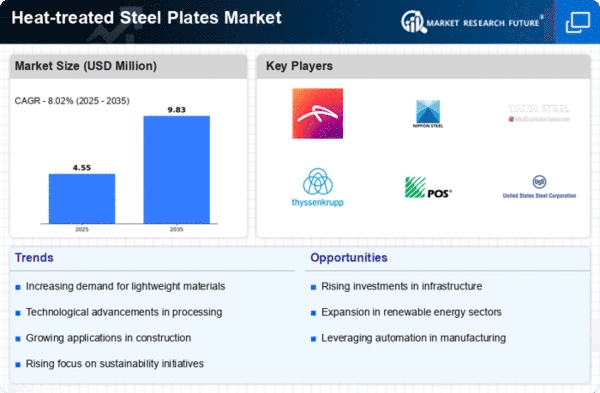
As per MRFR analysis, the Heat-treated Steel Plates Market Size was estimated at 4.21 USD Million in 2024. The Heat-treated Steel Plates industry is projected to grow from 4.55 in 2025 to 9.83 by 2035, exhibiting a compound annual growth rate (CAGR) of 8.02 during the forecast period 2025 - 2035.

Key Market Trends & Highlights

The Heat-treated Steel Plates Market is poised for robust growth driven by technological advancements and rising demand across key sectors.

  • Technological advancements in heat treatment processes are enhancing product quality and performance.
  • The construction sector remains the largest consumer of heat-treated steel plates, reflecting ongoing infrastructure projects in North America.
  • Asia-Pacific is emerging as the fastest-growing region, driven by rapid industrialization and urbanization.
  • Key market drivers include rising demand from the construction sector and increased applications in the automotive industry.

Market Size & Forecast

2024 Market Size 4.21 (USD Million)
2035 Market Size 9.83 (USD Million)
CAGR (2025 - 2035) 8.02%
Largest Regional Market Share in 2024 Asia-Pacific

Major Players

ArcelorMittal (LU), Nippon Steel Corporation (JP), Tata Steel (IN), Thyssenkrupp AG (DE), POSCO (KR), United States Steel Corporation (US), JFE Steel Corporation (JP), SSAB AB (SE), Steel Authority of India Limited (IN)

Market Trends

The Heat-treated Steel Plates Market is currently experiencing a dynamic phase characterized by evolving demands across various industries. The increasing emphasis on durability and strength in construction, automotive, and manufacturing sectors appears to drive the need for high-performance materials. As industries seek to enhance product longevity and performance, heat-treated steel plates are gaining traction due to their superior mechanical properties. Furthermore, advancements in heat treatment technologies may contribute to the development of more efficient and cost-effective production processes, potentially reshaping market dynamics. In addition, the growing focus on sustainability and environmental considerations is likely influencing the Heat-treated Steel Plates Market. Manufacturers are exploring innovative methods to reduce energy consumption during production while maintaining quality standards. This shift towards eco-friendly practices may not only enhance the market's appeal but also align with global sustainability goals. As the market continues to evolve, stakeholders must remain vigilant to emerging trends and technological advancements that could redefine the landscape of heat-treated steel plates.

Technological Advancements in Heat Treatment Processes

Recent innovations in heat treatment technologies are likely enhancing the efficiency and effectiveness of steel plate production. These advancements may lead to improved mechanical properties, allowing manufacturers to meet the increasing demands for high-performance materials across various sectors.

Rising Demand from the Construction Sector

The construction industry appears to be a significant driver for the Heat-treated Steel Plates Market. As infrastructure projects expand globally, the need for robust and durable materials is likely to increase, positioning heat-treated steel plates as a preferred choice for builders and contractors.

Sustainability Initiatives in Manufacturing

There is a growing trend towards sustainable manufacturing practices within the Heat-treated Steel Plates Market. Companies are increasingly adopting eco-friendly methods to reduce their carbon footprint, which may enhance their market competitiveness while addressing environmental concerns.

Heat-treated Steel Plates Market Market Drivers

Market Growth Projections

The Global Heat-treated Steel Plates Market Industry is poised for substantial growth, with projections indicating a market value of 6.08 USD Billion in 2024 and an anticipated increase to 10.9 USD Billion by 2035. The compound annual growth rate (CAGR) of 5.47% from 2025 to 2035 reflects the increasing adoption of heat-treated steel plates across various sectors, including construction, automotive, and renewable energy. This growth trajectory suggests a robust demand for high-performance materials, driven by technological advancements and evolving industry standards.

Growing Automotive Industry

The automotive industry significantly influences the Global Heat-treated Steel Plates Market Industry, as manufacturers increasingly utilize heat-treated steel plates for vehicle components. The demand for lightweight yet strong materials is paramount in automotive design, driving the adoption of heat-treated steel plates in the production of chassis, frames, and safety features. This trend is further supported by the industry's shift towards electric vehicles, which require advanced materials to enhance performance and safety. As the automotive sector continues to expand, the heat-treated steel plates market is expected to grow at a CAGR of 5.47% from 2025 to 2035, reflecting the material's critical role in modern vehicle manufacturing.

Increased Focus on Energy Efficiency

The Global Heat-treated Steel Plates Market Industry is witnessing a shift towards energy efficiency, particularly in industrial applications. Companies are increasingly prioritizing materials that contribute to energy savings and sustainability. Heat-treated steel plates, known for their strength-to-weight ratio, allow for lighter constructions that can lead to reduced energy consumption in operations. Industries such as oil and gas, where equipment durability is paramount, are adopting these materials to enhance efficiency and reduce operational costs. This growing emphasis on energy-efficient solutions is likely to bolster the demand for heat-treated steel plates, aligning with global sustainability goals.

Rising Demand in Construction Sector

The Global Heat-treated Steel Plates Market Industry experiences a notable surge in demand driven by the construction sector. As urbanization accelerates, the need for robust materials in infrastructure projects becomes increasingly critical. Heat-treated steel plates, known for their enhanced strength and durability, are preferred for applications in bridges, buildings, and roads. This trend is underscored by projections indicating that the market is expected to reach 6.08 USD Billion in 2024. The construction industry's growth, particularly in emerging economies, suggests a sustained demand for heat-treated steel plates, thereby reinforcing their significance in the global market.

Expansion of Renewable Energy Projects

The expansion of renewable energy projects significantly impacts the Global Heat-treated Steel Plates Market Industry. As countries invest in wind, solar, and hydroelectric power, the demand for durable materials in the construction of energy infrastructure rises. Heat-treated steel plates are essential in building wind turbine towers, solar panel frames, and hydroelectric dams due to their strength and resistance to environmental stressors. This trend is expected to contribute to the market's growth, as the renewable energy sector continues to expand globally, creating new opportunities for heat-treated steel plate manufacturers.

Technological Advancements in Manufacturing

Technological advancements in the manufacturing processes of heat-treated steel plates play a pivotal role in shaping the Global Heat-treated Steel Plates Market Industry. Innovations such as automated heat treatment processes and improved quality control measures enhance the efficiency and consistency of production. These advancements not only reduce production costs but also improve the mechanical properties of the steel plates. As manufacturers adopt cutting-edge technologies, the market is likely to witness an increase in the quality and variety of heat-treated steel products. This evolution aligns with the projected growth of the market, which is anticipated to reach 10.9 USD Billion by 2035.

Market Segment Insights

By Application: Construction (Largest) vs. Automotive (Fastest-Growing)

The Heat-treated Steel Plates Market is primarily driven by the construction sector, which holds the largest share among application segments. This includes high-strength plates used in buildings, bridges, and infrastructure projects. Following closely is the automotive sector, which accounts for a significant portion of market usage, as automotive manufacturers increasingly rely on heat-treated steel plates for enhanced performance and safety in vehicle production. In terms of growth trends, the automotive segment is currently experiencing the fastest growth due to the increasing demand for lightweight and durable materials. The construction industry remains robust, fueled by infrastructure development and urbanization. Moreover, advancements in manufacturing processes and technologies further bolster the adoption of heat-treated plates across these applications, ensuring their integral role in future projects.

Construction: Dominant vs. Automotive: Emerging

In the Heat-treated Steel Plates Market, the construction sector stands out as the dominant force, characterized by its extensive use of heat-treated plates for structural integrity and safety in various applications. Construction projects frequently require materials that can withstand harsh environmental conditions, and heat-treated plates meet these demands effectively. Conversely, the automotive sector is emerging rapidly, driven by innovations in vehicle design that prioritize safety, efficiency, and lightweight components. Automotive manufacturers are increasingly incorporating heat-treated steel plates into vehicle frames and components to enhance performance. This shift reflects a growing trend towards advanced materials that promote fuel efficiency while ensuring safety, positioning the automotive segment as a key player in the market's future development.

By End Use: Structural Components (Largest) vs. Transport Equipment (Fastest-Growing)

The end use segment of the Heat-treated Steel Plates Market is predominantly driven by Structural Components, which holds the largest market share due to their widespread application in construction and infrastructure. Machinery Parts also contribute significantly, serving essential roles in various industrial applications. Pressure Vessels follow closely behind, specifically in the energy sector, while Transport Equipment, although currently smaller in market size, is rapidly gaining traction as industries pivot towards more resilient and lightweight materials for manufacturing transport vehicles. As global demand for infrastructure and transportation continues to rise, the structural components segment is expected to maintain its leading role. However, the surge in technological advancements and a shift towards more durable and lightweight materials are making Transport Equipment the fastest-growing segment. Factors such as increasing urbanization, environmental regulations, and the need for improved efficiency in transport systems are driving substantial growth trends across these segments.

Structural Components (Dominant) vs. Transport Equipment (Emerging)

Structural Components in the Heat-treated Steel Plates Market are characterized by their integral role in supporting infrastructure projects, from buildings to bridges. Their dominance stems from their reliability and strength, making them essential for load-bearing applications. On the other hand, Transport Equipment is an emerging segment that is increasingly being explored for its potential in manufacturing vehicles. The evolution towards lighter and stronger materials is positioning transport equipment as a pivotal market player. While established in traditional applications, it faces exciting opportunities for innovation, particularly with the rise of electric and autonomous vehicles, showcasing the dynamic shifts within the industry.

By Material Type: Carbon Steel (Largest) vs. Stainless Steel (Fastest-Growing)

In the Heat-treated Steel Plates Market, Carbon Steel holds the largest market share, owing to its wide applications across industries such as construction and automotive. This material type is favored for its excellent strength, machinability, and cost-effectiveness, making it a go-to choice for manufacturers. In contrast, Stainless Steel is rapidly gaining traction due to its superior corrosion resistance and aesthetic appeal, thus becoming a preferred option in sectors like medical and food processing.

Carbon Steel (Dominant) vs. Tool Steel (Emerging)

Carbon Steel is recognized as the dominant segment in the heat-treated steel plates market, renowned for its optimal balance of toughness and affordability. Its versatility allows for myriad applications, from structural components to complex machinery. Conversely, Tool Steel is an emerging segment characterized by its specialized properties for high-impact and high-temperature applications. While it currently commands a smaller market share, the increasing demand for high-performance cutting tools drives its growth. Manufacturers are focusing on enhancing the quality of Tool Steel for precision engineering and industrial applications, indicating a promising future for this segment.

By Heat Treatment Process: Quenching (Largest) vs. Tempering (Fastest-Growing)

In the Heat-treated Steel Plates Market, quenching stands out as the largest segment, representing a significant portion of the overall market share. This process, which involves rapidly cooling hot steel plates to harden them, is integral in industries requiring high strength and durability. Meanwhile, tempering has emerged as the fastest-growing segment, gaining traction due to its ability to enhance the toughness of quenched steels, making it ideal for applications needing a balance between hardness and ductility.

Quenching (Dominant) vs. Tempering (Emerging)

Quenching is the dominant heat treatment process in the steel plates market, known for producing high-strength materials critical for applications in construction and automotive industries. This process is characterized by its efficiency in creating materials that can withstand extreme conditions. On the other hand, tempering is gaining popularity as an emerging process, particularly in sectors focused on producing resilient and versatile steel components. By reducing brittleness in hardened steel, tempering satisfies the growing demand for tough and ductile materials, thus capturing a larger market share rapidly. Together, these two processes shape the competitive landscape of the heat-treated steel plates market.

By Thickness: Thin Plates (Largest) vs. Thick Plates (Fastest-Growing)

In the Heat-treated Steel Plates Market, the thickness segment is characterized by three main categories: Thin Plates, Medium Plates, and Thick Plates. Among these, Thin Plates hold the largest market share, serving diverse industries that require lightweight and resilient materials for applications, such as automotive and construction. Meanwhile, Thick Plates cater to specialized sectors demanding higher durability and strength, contributing to a significant yet smaller share of the overall market. The distribution underscores the critical versatility of Thin Plates in various applications compared to the niche but essential role of Thick Plates. Recent trends indicate robust growth in the demand for Thick Plates, primarily driven by increased construction activities and infrastructure development globally. These plates are favored in heavy-duty applications, including shipbuilding and machinery manufacturing, leading them to emerge as the fastest-growing segment within the market. Furthermore, technological advancements are enhancing the performance criteria of these plates, encouraging more industries to adopt Thick Plates over traditional materials, thus fueling their market growth.

Thin Plates (Dominant) vs. Thick Plates (Emerging)

Thin Plates stand as the dominant category within the Heat-treated Steel Plates Market due to their unrivaled versatility and superior properties, including excellent mechanical strength and lightweight characteristics. Their predominant use in various applications, notably in automotive components and aerospace, positions them as a top choice for manufacturers seeking optimized performance at reduced weights. In contrast, Thick Plates are emerging as a vital segment, particularly for industries requiring sturdy materials for demanding applications. Their enhanced thickness offers superior durability, making them ideal for heavy machinery and infrastructure projects. As industries increasingly invest in durable materials, the market potential for Thick Plates continues to rise, paving the way for future innovations and applications.

Get more detailed insights about Heat-treated Steel Plates Market Research Report - Forecast to 2028

Regional Insights

North America : Established Market with Growth Potential

North America is witnessing a steady demand for heat-treated steel plates, driven by robust construction and automotive sectors. The market size is projected at $1.26 billion, reflecting a significant share in the global landscape. Regulatory support for infrastructure development and advancements in manufacturing processes are key growth drivers. The region's focus on sustainability and innovation further enhances market prospects, positioning it for future growth. The competitive landscape in North America is characterized by the presence of major players such as United States Steel Corporation and ArcelorMittal. These companies are investing in advanced technologies to improve product quality and reduce environmental impact. The U.S. and Canada are leading markets, with a strong emphasis on R&D and collaboration with local industries. This strategic focus is expected to bolster the region's market share in the coming years.

Europe : Innovation and Sustainability Focus

Europe's heat-treated steel plates market is evolving, with a size of $1.1 billion. The region is characterized by a strong emphasis on innovation and sustainability, driven by stringent regulations and a push for eco-friendly manufacturing practices. The automotive and construction sectors are significant contributors to demand, as they increasingly adopt advanced materials to enhance performance and reduce emissions. Regulatory frameworks are fostering a competitive environment that encourages technological advancements. Leading countries in Europe include Germany, France, and Italy, where major players like Thyssenkrupp AG and ArcelorMittal are prominent. The competitive landscape is marked by collaborations and partnerships aimed at enhancing product offerings. The European market is also witnessing a shift towards high-strength steel plates, catering to the growing demand for lightweight and durable materials in various applications. "The European steel industry is committed to achieving carbon neutrality by 2050, driving innovation and investment in sustainable practices."

Asia-Pacific : Dominant Market with High Growth

Asia-Pacific is the largest market for heat-treated steel plates, with a size of $1.85 billion, reflecting its dominant position in the global landscape. The region's growth is fueled by rapid industrialization, urbanization, and increasing demand from sectors such as construction and automotive. Countries like China and India are at the forefront, supported by government initiatives aimed at infrastructure development and manufacturing enhancement. The regulatory environment is conducive to growth, promoting investments in advanced technologies. China is the leading country in this region, with major players like Nippon Steel Corporation and Tata Steel playing significant roles. The competitive landscape is characterized by a mix of domestic and international companies, all vying for market share. The focus on innovation and quality improvement is driving competition, with companies investing heavily in R&D to meet evolving customer demands. The region's market dynamics are expected to remain strong, with continued growth projected in the coming years.

Middle East and Africa : Emerging Market with Potential

The Middle East and Africa region currently shows a nascent market for heat-treated steel plates, with a size of $0.0 billion. Despite the slow growth, there are emerging opportunities driven by infrastructure projects and industrial development. Governments in countries like the UAE and South Africa are investing in construction and manufacturing sectors, which could catalyze demand for heat-treated steel plates. Regulatory frameworks are gradually evolving to support industry growth, although challenges remain. Key players in this region are still establishing their presence, with companies like POSCO and SSAB AB exploring market entry strategies. The competitive landscape is developing, with a focus on local partnerships and collaborations to enhance market penetration. As infrastructure projects gain momentum, the region is expected to attract investments, paving the way for future growth in the heat-treated steel plates market.

Key Players and Competitive Insights

The Heat-treated Steel Plates Market is currently characterized by a dynamic competitive landscape, driven by increasing demand across various sectors such as construction, automotive, and energy. Key players are actively engaging in strategies that emphasize innovation, regional expansion, and sustainability. For instance, in November 2025, ArcelorMittal (LU) announced a significant investment in advanced manufacturing technologies aimed at enhancing the efficiency of heat-treated steel production. This move not only positions the company as a leader in technological advancement but also reflects a broader industry trend towards modernization and efficiency.In terms of business tactics, companies are increasingly localizing manufacturing to reduce lead times and optimize supply chains. The market structure appears moderately fragmented, with several key players exerting considerable influence. This fragmentation allows for a diverse range of offerings, yet the collective strategies of major companies like Nippon Steel Corporation (JP) and Tata Steel (IN) suggest a trend towards consolidation and strategic partnerships to enhance market presence.

In October Nippon Steel Corporation (JP) unveiled a new line of heat-treated steel plates designed specifically for the renewable energy sector. This strategic initiative not only diversifies their product portfolio but also aligns with global sustainability goals, indicating a shift towards eco-friendly solutions in steel production. Such developments are likely to enhance their competitive edge in a market increasingly focused on environmental impact.Similarly, in September 2025, Tata Steel (IN) entered into a joint venture with a leading technology firm to develop AI-driven solutions for optimizing production processes. This collaboration is expected to streamline operations and reduce costs, thereby enhancing Tata Steel's market competitiveness. The integration of AI into manufacturing processes is indicative of a broader trend where technology plays a crucial role in operational efficiency and product quality.

As of December the competitive trends in the Heat-treated Steel Plates Market are heavily influenced by digitalization, sustainability, and the integration of advanced technologies. Strategic alliances are becoming increasingly vital, as companies seek to leverage each other's strengths to navigate the complexities of the market. The shift from price-based competition to a focus on innovation and supply chain reliability is evident, suggesting that future competitive differentiation will hinge on technological advancements and sustainable practices.

Key Companies in the Heat-treated Steel Plates Market include

Industry Developments

January, 2023: Nucor Corp.’s new steel plate mill in Brandenburg, Ky., rolled its first steel plate on Dec. 30, 2022. Nucor Steel Brandenburg, a $1.7 billion capital investment with the ability to produce 1.2 million tons annually, will focus on final commissioning of the mill in the first quarter of 2023 and will ship the first tons to customers during the quarter.

Nucor Steel Brandenburg will be among only a few mills globally – and the only mill in the United States, according to the company – capable of manufacturing at scale the heavy-gauge plate used in monopile foundations for offshore wind towers.The recent passage of the Inflation Reduction Act, which included $300 billion for clean energy development and climate programs, supports the Biden Administration’s announced goal to build 30 gigawatts of offshore wind power by 2030. This could result in approximately 7.5 million tons of additional steel demand.

According to Nucor Steel Brandenburg, it will be able to produce 97% of plate products consumed domestically.November, 2022: Steel Dynamics Announces Planned State-of-the-Art Aluminum Flat Rolled Mill Site Selection - The planned $1.9 billion aluminum flat rolled mill is designed to have an annual production capacity of 650,000 tonnes of finished products, serving the sustainable beverage packaging, automotive, and common alloy industrial sectors. The product offering will be supported by various value-added finishing lines, including CASH (continuous annealing solutions heat treating) lines, continuous coating, and various slitting and packaging operations.

The rolling mill is currently expected to begin operations in mid-2025. The company's focus on decarbonization will also be applied to this aluminum operation, including plans to use a significant amount of pre- and post-consumer aluminum scrap in its production process, supported by the company's metals recycling platform, which is the largest nonferrous metals recycler in North America.

Heat-treated Steel Plates Market Competitive Landscape

The market includes tier-1, tier-2, and local players. The key market participants generally pursue new semiconductor metrology and inspection market categories. In manufacturing, specialized robots programmed for a particular work environment are generally preferable to standard robots. For instance, in February 2022, Tata Steel announced that it would purchase NeelachalIspat Nigam Ltd. The acquisition is probably going to increase the Tata Steel subsidiary's ability to produce long steel.

Prominent players in the heat-treated steel plates market include Essar Steel (India), SAIL (India), POSCO (South Korea), JFE Holding Inc. (Japan), Tata Steel (India), NLMK Group (Russia), ArcelorMittal (Luxembourg), Nippon Steel & Sumitomo Metal Corporation (Japan), Baosteel Group Hu (China), ThyssenKrupp AG (Germany), among others.

Scope of the Heat-treated Steel Plates Market Report

Type Outlook

    • Carbon
    • Stainless Steel
    • Treatment Process
    • Annealing
    • Hardening

Application Outlook

    • Bridges
    • Buildings
    • Offshore Structures

Region Outlook

    • North America
      • US
      • Canada
      • Mexico
    • Europe
      • UK
      • Germany
      • France
      • Italy
      • Spain
      • Rest of Europe
    • Asia-Pacific
      • China
      • India
      • Japan
      • Australia and New Zealand
      • Rest of Asia-Pacific
    • Rest of the World
      • South America
      • Middle East
      • Africa

Objectives of the Study

The objectives of the study are summarized in 5 stages. They are as mentioned below:

Heat-Treated Steel Plates Market Forecast & Size:

To identify and estimate the market size for the heat-treated steel plates market report segmented by type and application by value (in US dollars). Also, to understand the consumption/ demand created by consumers of heat-treated steel plates market forecast between 2022 and 2030

Market Landscape and Trends:

To identify and infer the drivers, restraints, opportunities, and challenges in the heat-treated steel plates market.

Market Influencing Factors:

To find out the factors which are affecting the heat-treated steel plates market among consumers

Company Profiling:

To provide a detailed insight into the major companies operating in the market. The profiling will include the financial health of the company in the past 2-3 years with segmental and regional revenue breakup, product offering, recent developments, SWOT analysis, and key strategies.

Intended Audience

    • Investors and Trade Experts
    • Raw material suppliers
    • Retailers, wholesalers, and distributors
    • Governments, associations, and industrial bodies
    • Investors and Trade Experts

Future Outlook

Heat-treated Steel Plates Market Future Outlook

The Heat-treated Steel Plates Market is projected to grow at 8.02% CAGR from 2025 to 2035, driven by rising demand in construction, automotive, and energy sectors.

New opportunities lie in:

  • Expansion into renewable energy applications for heat-treated steel plates.
  • Development of customized solutions for aerospace and defense industries.
  • Investment in advanced manufacturing technologies to enhance production efficiency.

By 2035, the market is expected to achieve robust growth, solidifying its position in various industrial sectors.

Market Segmentation

Heat-treated Steel Plates Market End Use Outlook

  • Structural Components
  • Machinery Parts
  • Pressure Vessels
  • Transport Equipment

Heat-treated Steel Plates Market Thickness Outlook

  • Thin Plates
  • Medium Plates
  • Thick Plates

Heat-treated Steel Plates Market Application Outlook

  • Construction
  • Automotive
  • Aerospace
  • Marine
  • Oil and Gas

Heat-treated Steel Plates Market Material Type Outlook

  • Carbon Steel
  • Alloy Steel
  • Stainless Steel
  • Tool Steel

Heat-treated Steel Plates Market Heat Treatment Process Outlook

  • Quenching
  • Tempering
  • Annealing
  • Normalizing

Report Scope

MARKET SIZE 20244.21(USD Million)
MARKET SIZE 20254.55(USD Million)
MARKET SIZE 20359.83(USD Million)
COMPOUND ANNUAL GROWTH RATE (CAGR)8.02% (2025 - 2035)
REPORT COVERAGERevenue Forecast, Competitive Landscape, Growth Factors, and Trends
BASE YEAR2024
Market Forecast Period2025 - 2035
Historical Data2019 - 2024
Market Forecast UnitsUSD Million
Key Companies ProfiledArcelorMittal (LU), Nippon Steel Corporation (JP), Tata Steel (IN), Thyssenkrupp AG (DE), POSCO (KR), United States Steel Corporation (US), JFE Steel Corporation (JP), SSAB AB (SE), Steel Authority of India Limited (IN)
Segments CoveredApplication, End Use, Material Type, Heat Treatment Process, Thickness
Key Market OpportunitiesGrowing demand for lightweight, high-strength materials in automotive and aerospace sectors drives Heat-treated Steel Plates Market expansion.
Key Market DynamicsRising demand for high-strength applications drives innovation and competition in the heat-treated steel plates market.
Countries CoveredNorth America, Europe, APAC, South America, MEA

FAQs

What is the study period of the global heat-treated steel plates market report?

The global heat-treated steel plates market forecast period is 2025-2035

What is the heat-treated steel plates market growth rate?

The market is expected to register a CAGR of ~4.70% over the next 10 years, according to the global heat-treated steel plates market research.

Which region has the highest global market growth rate?

North America is expected to register the highest CAGR during 2025 - 2035

Which region has the largest share in the global market?

Asia Pacific held the largest share in 2021

What is the expected global heat-treated steel plates market size by 2035?

The market size is expected to be USD 8,670.9 Millionby 2035.

Who are the key players in the global market?

Essar Steel (India), SAIL (India), POSCO (South Korea), JFE Holding Inc. (Japan), Tata Steel (India), NLMK Group (Russia), ArcelorMittal (Luxembourg), Nippon Steel & Sumitomo Metal Corporation (Japan), Baosteel Group Hu (China), ThyssenKrupp AG (Germany), among others are the major companies operating in the global market.

  1. SECTION I: EXECUTIVE SUMMARY AND KEY HIGHLIGHTS
    1. | 1.1 EXECUTIVE SUMMARY
    2. | 1.1.1 Market Overview
    3. | 1.1.2 Key Findings
    4. | 1.1.3 Market Segmentation
    5. | 1.1.4 Competitive Landscape
    6. | 1.1.5 Challenges and Opportunities
    7. | 1.1.6 Future Outlook
  2. SECTION II: SCOPING, METHODOLOGY AND MARKET STRUCTURE
    1. | 2.1 MARKET INTRODUCTION
    2. | 2.1.1 Definition
    3. | 2.1.2 Scope of the study
    4. |-- 2.1.2.1 Research Objective
    5. |-- 2.1.2.2 Assumption
    6. |-- 2.1.2.3 Limitations
    7. | 2.2 RESEARCH METHODOLOGY
    8. | 2.2.1 Overview
    9. | 2.2.2 Data Mining
    10. | 2.2.3 Secondary Research
    11. | 2.2.4 Primary Research
    12. |-- 2.2.4.1 Primary Interviews and Information Gathering Process
    13. |-- 2.2.4.2 Breakdown of Primary Respondents
    14. | 2.2.5 Forecasting Model
    15. | 2.2.6 Market Size Estimation
    16. |-- 2.2.6.1 Bottom-Up Approach
    17. |-- 2.2.6.2 Top-Down Approach
    18. | 2.2.7 Data Triangulation
    19. | 2.2.8 Validation
  3. SECTION III: QUALITATIVE ANALYSIS
    1. | 3.1 MARKET DYNAMICS
    2. | 3.1.1 Overview
    3. | 3.1.2 Drivers
    4. | 3.1.3 Restraints
    5. | 3.1.4 Opportunities
    6. | 3.2 MARKET FACTOR ANALYSIS
    7. | 3.2.1 Value chain Analysis
    8. | 3.2.2 Porter's Five Forces Analysis
    9. |-- 3.2.2.1 Bargaining Power of Suppliers
    10. |-- 3.2.2.2 Bargaining Power of Buyers
    11. |-- 3.2.2.3 Threat of New Entrants
    12. |-- 3.2.2.4 Threat of Substitutes
    13. |-- 3.2.2.5 Intensity of Rivalry
    14. | 3.2.3 COVID-19 Impact Analysis
    15. |-- 3.2.3.1 Market Impact Analysis
    16. |-- 3.2.3.2 Regional Impact
    17. |-- 3.2.3.3 Opportunity and Threat Analysis
  4. SECTION IV: QUANTITATIVE ANALYSIS
    1. | 4.1 Chemicals and Materials, BY Application (USD Million)
    2. | 4.1.1 Construction
    3. | 4.1.2 Automotive
    4. | 4.1.3 Aerospace
    5. | 4.1.4 Marine
    6. | 4.1.5 Oil and Gas
    7. | 4.2 Chemicals and Materials, BY End Use (USD Million)
    8. | 4.2.1 Structural Components
    9. | 4.2.2 Machinery Parts
    10. | 4.2.3 Pressure Vessels
    11. | 4.2.4 Transport Equipment
    12. | 4.3 Chemicals and Materials, BY Material Type (USD Million)
    13. | 4.3.1 Carbon Steel
    14. | 4.3.2 Alloy Steel
    15. | 4.3.3 Stainless Steel
    16. | 4.3.4 Tool Steel
    17. | 4.4 Chemicals and Materials, BY Heat Treatment Process (USD Million)
    18. | 4.4.1 Quenching
    19. | 4.4.2 Tempering
    20. | 4.4.3 Annealing
    21. | 4.4.4 Normalizing
    22. | 4.5 Chemicals and Materials, BY Thickness (USD Million)
    23. | 4.5.1 Thin Plates
    24. | 4.5.2 Medium Plates
    25. | 4.5.3 Thick Plates
    26. | 4.6 Chemicals and Materials, BY Region (USD Million)
    27. | 4.6.1 North America
    28. |-- 4.6.1.1 US
    29. |-- 4.6.1.2 Canada
    30. | 4.6.2 Europe
    31. |-- 4.6.2.1 Germany
    32. |-- 4.6.2.2 UK
    33. |-- 4.6.2.3 France
    34. |-- 4.6.2.4 Russia
    35. |-- 4.6.2.5 Italy
    36. |-- 4.6.2.6 Spain
    37. |-- 4.6.2.7 Rest of Europe
    38. | 4.6.3 APAC
    39. |-- 4.6.3.1 China
    40. |-- 4.6.3.2 India
    41. |-- 4.6.3.3 Japan
    42. |-- 4.6.3.4 South Korea
    43. |-- 4.6.3.5 Malaysia
    44. |-- 4.6.3.6 Thailand
    45. |-- 4.6.3.7 Indonesia
    46. |-- 4.6.3.8 Rest of APAC
    47. | 4.6.4 South America
    48. |-- 4.6.4.1 Brazil
    49. |-- 4.6.4.2 Mexico
    50. |-- 4.6.4.3 Argentina
    51. |-- 4.6.4.4 Rest of South America
    52. | 4.6.5 MEA
    53. |-- 4.6.5.1 GCC Countries
    54. |-- 4.6.5.2 South Africa
    55. |-- 4.6.5.3 Rest of MEA
  5. SECTION V: COMPETITIVE ANALYSIS
    1. | 5.1 Competitive Landscape
    2. | 5.1.1 Overview
    3. | 5.1.2 Competitive Analysis
    4. | 5.1.3 Market share Analysis
    5. | 5.1.4 Major Growth Strategy in the Chemicals and Materials
    6. | 5.1.5 Competitive Benchmarking
    7. | 5.1.6 Leading Players in Terms of Number of Developments in the Chemicals and Materials
    8. | 5.1.7 Key developments and growth strategies
    9. |-- 5.1.7.1 New Product Launch/Service Deployment
    10. |-- 5.1.7.2 Merger & Acquisitions
    11. |-- 5.1.7.3 Joint Ventures
    12. | 5.1.8 Major Players Financial Matrix
    13. |-- 5.1.8.1 Sales and Operating Income
    14. |-- 5.1.8.2 Major Players R&D Expenditure. 2023
    15. | 5.2 Company Profiles
    16. | 5.2.1 ArcelorMittal (LU)
    17. |-- 5.2.1.1 Financial Overview
    18. |-- 5.2.1.2 Products Offered
    19. |-- 5.2.1.3 Key Developments
    20. |-- 5.2.1.4 SWOT Analysis
    21. |-- 5.2.1.5 Key Strategies
    22. | 5.2.2 Nippon Steel Corporation (JP)
    23. |-- 5.2.2.1 Financial Overview
    24. |-- 5.2.2.2 Products Offered
    25. |-- 5.2.2.3 Key Developments
    26. |-- 5.2.2.4 SWOT Analysis
    27. |-- 5.2.2.5 Key Strategies
    28. | 5.2.3 Tata Steel (IN)
    29. |-- 5.2.3.1 Financial Overview
    30. |-- 5.2.3.2 Products Offered
    31. |-- 5.2.3.3 Key Developments
    32. |-- 5.2.3.4 SWOT Analysis
    33. |-- 5.2.3.5 Key Strategies
    34. | 5.2.4 Thyssenkrupp AG (DE)
    35. |-- 5.2.4.1 Financial Overview
    36. |-- 5.2.4.2 Products Offered
    37. |-- 5.2.4.3 Key Developments
    38. |-- 5.2.4.4 SWOT Analysis
    39. |-- 5.2.4.5 Key Strategies
    40. | 5.2.5 POSCO (KR)
    41. |-- 5.2.5.1 Financial Overview
    42. |-- 5.2.5.2 Products Offered
    43. |-- 5.2.5.3 Key Developments
    44. |-- 5.2.5.4 SWOT Analysis
    45. |-- 5.2.5.5 Key Strategies
    46. | 5.2.6 United States Steel Corporation (US)
    47. |-- 5.2.6.1 Financial Overview
    48. |-- 5.2.6.2 Products Offered
    49. |-- 5.2.6.3 Key Developments
    50. |-- 5.2.6.4 SWOT Analysis
    51. |-- 5.2.6.5 Key Strategies
    52. | 5.2.7 JFE Steel Corporation (JP)
    53. |-- 5.2.7.1 Financial Overview
    54. |-- 5.2.7.2 Products Offered
    55. |-- 5.2.7.3 Key Developments
    56. |-- 5.2.7.4 SWOT Analysis
    57. |-- 5.2.7.5 Key Strategies
    58. | 5.2.8 SSAB AB (SE)
    59. |-- 5.2.8.1 Financial Overview
    60. |-- 5.2.8.2 Products Offered
    61. |-- 5.2.8.3 Key Developments
    62. |-- 5.2.8.4 SWOT Analysis
    63. |-- 5.2.8.5 Key Strategies
    64. | 5.2.9 Steel Authority of India Limited (IN)
    65. |-- 5.2.9.1 Financial Overview
    66. |-- 5.2.9.2 Products Offered
    67. |-- 5.2.9.3 Key Developments
    68. |-- 5.2.9.4 SWOT Analysis
    69. |-- 5.2.9.5 Key Strategies
    70. | 5.3 Appendix
    71. | 5.3.1 References
    72. | 5.3.2 Related Reports

Chemicals and Materials Market Segmentation

Chemicals and Materials By Application (USD Million, 2025-2035)

  • Construction
  • Automotive
  • Aerospace
  • Marine
  • Oil and Gas

Chemicals and Materials By End Use (USD Million, 2025-2035)

  • Structural Components
  • Machinery Parts
  • Pressure Vessels
  • Transport Equipment

Chemicals and Materials By Material Type (USD Million, 2025-2035)

  • Carbon Steel
  • Alloy Steel
  • Stainless Steel
  • Tool Steel

Chemicals and Materials By Heat Treatment Process (USD Million, 2025-2035)

  • Quenching
  • Tempering
  • Annealing
  • Normalizing

Chemicals and Materials By Thickness (USD Million, 2025-2035)

  • Thin Plates
  • Medium Plates
  • Thick Plates
Infographic

Free Sample Request

Kindly complete the form below to receive a free sample of this Report

Get Free Sample

Customer Strories

Compare Licence

×
Features License Type
Single User Multiuser License Enterprise User
Price $4,950 $5,950 $7,250
Maximum User Access Limit 1 User Upto 10 Users Unrestricted Access Throughout the Organization
Free Customization
Direct Access to Analyst
Deliverable Format
Platform Access
Discount on Next Purchase 10% 15% 15%
Printable Versions