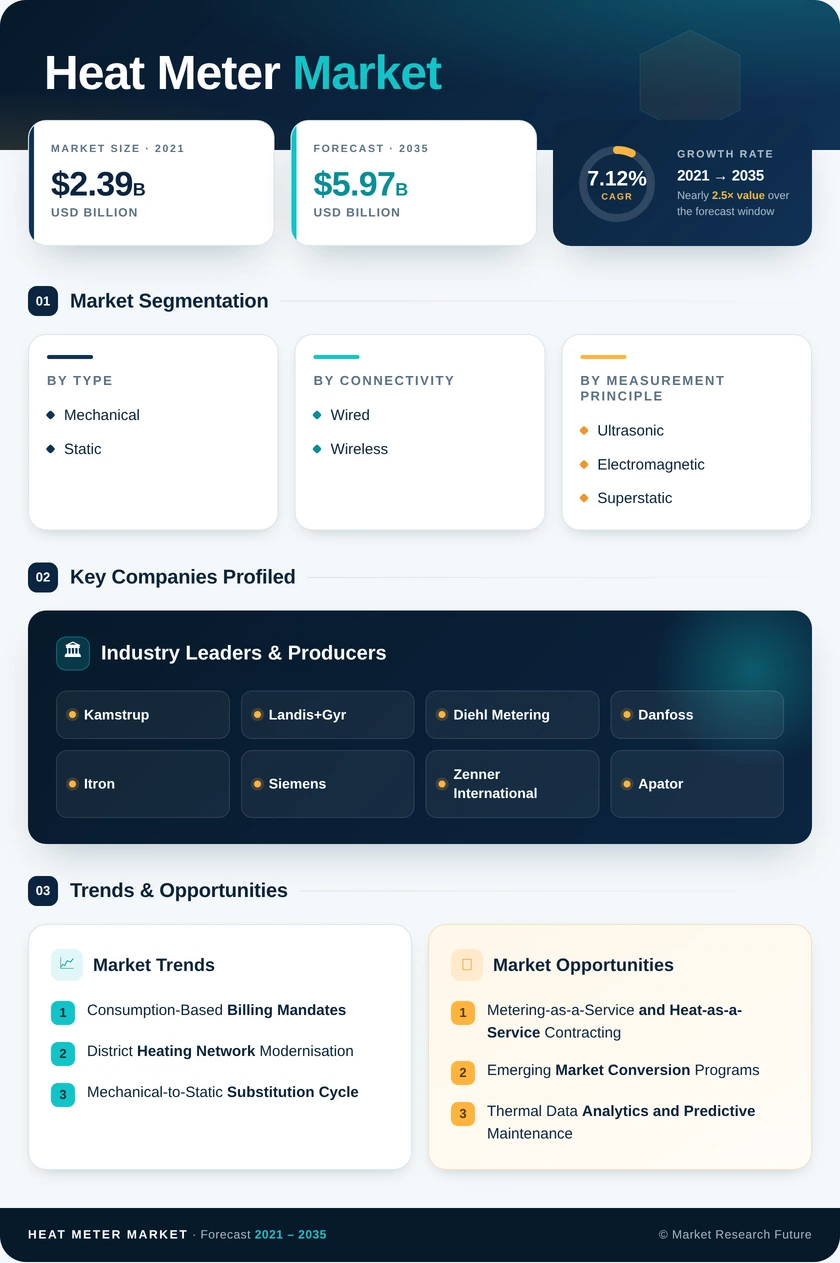
Segmentation Quick Reference
| Dimension | Sub-Segments | Dominant Segment | Fastest Growing Segment |
| By Type | Mechanical, Static | Static (57.6% share, 2025) | Static (8.59% CAGR, 2026–2035) |
| By Connectivity | Wired, Wireless | Wireless (67.2% share, 2025) | Wireless (7.31% CAGR, 2026–2035) |
| By Measurement Principle | Ultrasonic, Electromagnetic, Superstatic | Electromagnetic (62.7% share, 2025) | Ultrasonic (9.06% CAGR, 2026–2035) |
| By End-User | Residential, Commercial, Industrial | Residential (51.5% share, 2025) | Industrial (9.15% CAGR, 2026–2035) |
| By Application | District Heating and Cooling, HVAC Sub-Metering, Process Heat Monitoring | Process Heat Monitoring (42.7% share, 2025) | HVAC Sub-Metering (7.82% CAGR, 2026–2035) |
Market Segmentation Overview
By Type
| Sub-Segment | Key Trend |
| Mechanical | Retained only where grant funding is unavailable and capital budgets cap unit price |
| Static | Specified as default for new network build on twenty-year accuracy stability |
Static devices lead in share and also post the fastest expansion, while mechanical units decline toward a residual replacement role. The gap traces directly to verification economics: impeller wear forces earlier recertification failures, and utilities managing tens of thousands of points cannot absorb that recall volume. Narrowing price differentials removed the last argument for mechanical procurement outside subsidy-constrained social housing.
By Connectivity
| Sub-Segment | Key Trend |
| Wired | Concentrated in hospitals, airports and campuses with existing bus cabling and on-site power |
| Wireless | Expanding on fifteen-year battery life and public LPWAN coverage in China and Europe |
Wireless holds two-thirds of revenue and grows fastest, since avoiding trenching in a congested district saves an order of magnitude more than the radio module costs. Wired connections survive where data density is high enough to justify permanent infrastructure, typically in single-owner estates that already run building automation buses. Utilities inheriting mixed fleets increasingly demand protocol-agnostic gateways to bridge the two.
By Measurement Principle
| Sub-Segment | Key Trend |
| Ultrasonic | Preferred for clean water-glycol circuits serving heat pumps and residential districts |
| Electromagnetic | Selected for conductive, particle-rich and bidirectional industrial loops |
| Superstatic | Niche fluidic-oscillation option where conductivity and acoustic clarity are both uncertain |
Electromagnetic sensing leads on share because industrial loops reverse direction and carry particulates that defeat acoustic paths. Ultrasonic grows fastest, matched to the clean glycol mixtures of low-temperature heat pump networks and requiring effectively no maintenance across its service life. Superstatic remains a small but defensible category, and dual-principle hybrids are entering pilot use where redundancy justifies the cost premium.
By End-User
| Sub-Segment | Key Trend |
| Residential | Driven by mandatory apartment-level allocation and monthly consumption reporting rules |
| Commercial | Room-level data increasingly required for green building certification renewals. |
| Industrial | Process sub-metering shifting from efficiency project to audited disclosure requirement. |
Residential installations dominate revenue through sheer unit volume despite low average selling prices. Industrial demand grows fastest because waste-heat capture and auditable Scope 1 reporting turn instrumentation into a compliance asset rather than a discretionary upgrade, with chemicals and food processing leading. Commercial buyers occupy the middle, purchasing to satisfy certification data requirements rather than billing obligations.
By Application
| Sub-Segment | Key Trend |
| District Heating and Cooling | Largest installed base; growth moderating in Western Europe as heat pumps decentralise supply |
| HVAC Sub-Metering | Accelerating on tighter building codes and tenant cost-transparency expectations |
| Process Heat Monitoring | Largest revenue share; justified by yield protection and steam-cycle efficiency gains |
Process heat monitoring leads because measurement pays back through production quality and avoided downtime rather than billing accuracy, a business case independent of regulation. HVAC sub-metering grows fastest as codes tighten and multi-tenant landlords face pressure to allocate thermal cost transparently. District heating and cooling holds the largest installed base but grows more slowly where building-level heat pumps reduce connection counts.


 Noah Malgeri
Co-Founder

 Peter Groot koerkamp
Account and Business Manager

 Younghwan Choi
Senior Retail Manager

 Mark Irwin
Management Consultant

 Akif Moroglu
Strategy & Business Development Director

 Guilherme Gomes Martins
Product Management Director

 Joseph Aguayo
Sales Operations & Pricing Manager

 La Terria Dodd
Program Support Specialist

 Rob Kooiker
Group Product Manager HVAC & Fire Protection GMA