
Request Free Sample ×

Kindly complete the form below to receive a free sample of this Report

* Please use a valid business email

Leading companies partner with us for data-driven Insights

clients tt-cursor
Hero Background
English
Chinese
French
Japanese
Korean
German
Spanish

Heart Health Ingredients Market Size

ID: MRFR/FnB/3278-HCR
110 Pages
Pradeep Nandi
April 2026

Heart Health Ingredients Market Size, Share, Industry Trend & Analysis Research Report Information by Type (Omega-3, Beta Glucan, Phytosterol, Soy Protein and others), Application (Pharmaceuticals, Supplements, Beverages, Oils and Fats, Bakery and Confectionery, Dairy and Frozen Desserts, Sweet and Savory Snacks and others) and Region - Forecast till 2035

Share:
Download PDF ×

We do not share your information with anyone. However, we may send you emails based on your report interest from time to time. You may contact us at any time to opt-out.

Heart Health Ingredients Market Infographic
Purchase Options

Heart Health Ingredients Size

Heart Health Ingredients Market Growth Projections and Opportunities

The global soy protein ingredients market is poised to experience a remarkable growth trajectory throughout the forecast period. The escalating utilization of soy protein ingredients in various food and beverage products is expected to be a key driver propelling the growth of the global soy protein ingredients market. This surge in demand is driven by the multifaceted benefits and versatile applications that soy protein brings to the table.

One of the noteworthy factors fueling the growth of the global market is the increasing prevalence of lactose intolerance among consumers. As a significant portion of the population grapples with lactose-related issues, the demand for alternative protein sources has witnessed a substantial rise. Soy protein, being a plant-based and lactose-free option, has emerged as a favorable choice, contributing to the expansion of the soy protein ingredients market.

Furthermore, the global market is set to receive a substantial boost from the growing trend of veganism among consumers. A shift towards plant-based diets is becoming increasingly prevalent, driven by concerns related to health, environmental sustainability, and ethical considerations. Soy protein, being a crucial component in many vegetarian and vegan food products, is poised to witness heightened demand. This trend aligns with the broader movement towards sustainable and ethical consumption, further propelling the soy protein ingredients market.

Despite the positive growth indicators, it is essential to acknowledge that the market's trajectory might face constraints due to allergy reactions associated with soy. Some individuals may exhibit allergic responses to soy-based products, posing a challenge for market expansion. As the awareness of food allergies continues to grow, manufacturers will need to address these concerns through innovative product development and clear labeling practices.

The use of soy protein ingredients is becoming increasingly pervasive across a diverse range of food and beverage applications. Soy protein is a versatile ingredient, known for its functional properties such as emulsification, gelling, and foaming. In the food industry, soy protein is widely incorporated into products like meat alternatives, dairy substitutes, baked goods, and nutritional supplements. The demand for plant-based protein sources has surged, driven by changing consumer preferences and a growing awareness of the health benefits associated with plant-based diets.

The functional attributes of soy protein make it an attractive choice for food manufacturers aiming to enhance the nutritional profile of their products. Soy protein ingredients not only contribute to protein fortification but also offer a sustainable and economically viable protein source. With the global population's increasing focus on health and wellness, soy protein ingredients are likely to find an expanding array of applications in the food and beverage sector.

In the beverage industry, soy protein ingredients are gaining prominence, particularly in the formulation of plant-based beverages. Soy milk, in particular, has gained popularity as a dairy milk alternative, appealing to consumers seeking lactose-free and plant-based options. Additionally, soy protein isolates and concentrates are finding utility in sports and nutrition beverages, catering to the growing demand for protein-enriched functional drinks.

The geographical landscape of the soy protein ingredients market reflects a global surge in demand, with regions like North America, Europe, Asia Pacific, and Latin America emerging as key contributors. The Asia Pacific region, with its rich history of soy consumption, is witnessing significant growth in the soy protein ingredients market. The region's culinary traditions, coupled with the rising health-conscious consumer base, are propelling the demand for soy protein ingredients in various food applications.

In conclusion, the global soy protein ingredients market is on a trajectory of impressive growth, driven by factors such as increased usage in food and beverage products, rising awareness of lactose intolerance, and the growing trend of veganism. While challenges related to soy allergies may pose hurdles, the versatile and functional properties of soy protein make it a valuable ingredient across diverse applications. As consumer preferences continue to evolve towards sustainable and plant-based diets, the soy protein ingredients market is poised for further expansion and innovation.

Heart Health Ingredients Market Size Graph
Author
Author Profile
Pradeep Nandi
Senior Research Analyst

I have a bachelor's degree in mechanical engineering and an MBA. I have more than two years of expertise in the retail, food, and beverage, chemical, and material industries, and hence have developed a sound cross-domain expertise. A firm believer in lifelong learning and sharing of knowledge. Having a proclivity for hatching ideas and trying to absorb as much information as possible in a short amount of time. Introducing corporates to the data and insight, which enables them to move from probability to possibility, has been my key areas of interest. 

Leave a Comment

FAQs

What is the projected market valuation for the Heart Health Ingredients Market in 2035?

<p>The projected market valuation for the Heart Health Ingredients Market in 2035 is 34.37 USD Billion.</p>

What was the market valuation for the Heart Health Ingredients Market in 2024?

<p>The market valuation for the Heart Health Ingredients Market in 2024 was 19.09 USD Billion.</p>

What is the expected CAGR for the Heart Health Ingredients Market during the forecast period 2025 - 2035?

<p>The expected CAGR for the Heart Health Ingredients Market during the forecast period 2025 - 2035 is 5.49%.</p>

Which segment is projected to have the highest valuation in the Source category by 2035?

<p>In the Source category, Fruits is projected to have the highest valuation, reaching 8.25 USD Billion by 2035.</p>

What are the leading companies in the Heart Health Ingredients Market?

<p>Key players in the Heart Health Ingredients Market include BASF SE, Cargill, Incorporated, and DuPont de Nemours, Inc.</p>

Which delivery format is expected to grow significantly by 2035?

<p>The Tablets delivery format is expected to grow significantly, with a projected valuation of 8.25 USD Billion by 2035.</p>

What is the projected valuation for Omega-3 Fatty Acids in the Nutrition and Function segment by 2035?

The projected valuation for Omega-3 Fatty Acids in the Nutrition and Function segment is 6.5 USD Billion by 2035.

How does the Heart Health category's valuation compare between 2024 and 2035?

The Heart Health category's valuation is expected to increase from 6.59 USD Billion in 2024 to 11.87 USD Billion by 2035.

What is the expected growth trend for the Heart Disease Prone category by 2035?

The Heart Disease Prone category is expected to grow, with a projected valuation of 9.0 USD Billion by 2035.

Which ingredient category is anticipated to see the most substantial growth in the Heart Health Ingredients Market?

The Others category in Nutrition and Function is anticipated to see substantial growth, reaching 11.87 USD Billion by 2035.

Market Summary

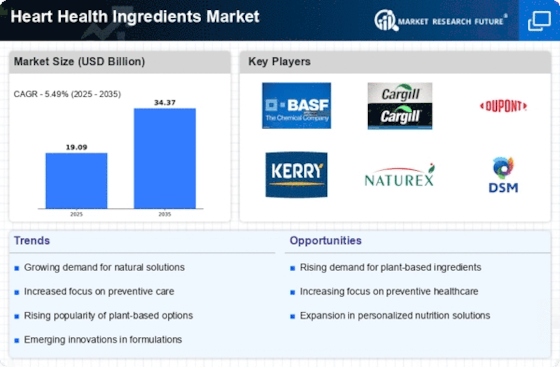
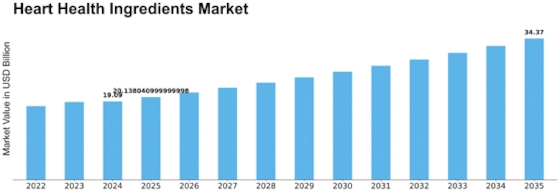
As per Market Research Future analysis, the Heart Health Ingredients Market Size was estimated at 19.09 USD Billion in 2024. The Heart Health Ingredients industry is projected to grow from 20.14 USD Billion in 2025 to 34.37 USD Billion by 2035, exhibiting a compound annual growth rate (CAGR) of 5.49% during the forecast period 2025 - 2035

Key Market Trends & Highlights

The Heart Health Ingredients Market is experiencing a dynamic shift towards plant-based and functional food solutions.

  • The market witnesses a notable rise in the adoption of plant-based ingredients, particularly in North America.
  • Functional foods are gaining traction, driven by increasing consumer demand for health-oriented products in the Asia-Pacific region.
  • Grains and pulses remain the largest segment, while fish ingredients are emerging as the fastest-growing category.
  • Key market drivers include rising consumer awareness of heart health and the aging population, which fuels demand for innovative nutraceuticals.

Market Size & Forecast

2024 Market Size 19.09 (USD Billion)
2035 Market Size 34.37 (USD Billion)
CAGR (2025 - 2035) 5.49%
Largest Regional Market Share in 2024 North America

Major Players

BASF SE (DE), Cargill, Incorporated (US), DuPont de Nemours, Inc. (US), Kerry Group plc (IE), Naturex S.A. (FR), Royal DSM N.V. (NL), Herbalife Nutrition Ltd. (US), Amway Corporation (US), Archer Daniels Midland Company (US)

Market Trends

The Heart Health Ingredients Market is currently experiencing a notable evolution, driven by increasing consumer awareness regarding cardiovascular health. This heightened consciousness appears to stem from a growing body of research linking diet to heart conditions, prompting individuals to seek out ingredients that support heart wellness. As a result, manufacturers are responding by innovating and diversifying their product offerings, incorporating a range of natural and functional ingredients that are perceived to enhance heart health. This trend indicates a shift towards more health-conscious consumption patterns, where consumers are more discerning about the nutritional profiles of the products they choose. Moreover, the Heart Health Ingredients Market seems to be influenced by the rising prevalence of lifestyle-related diseases, which has led to a surge in demand for preventive health solutions. Consumers are increasingly inclined to invest in dietary supplements and functional foods that promise to bolster cardiovascular health. This inclination is further supported by the growing availability of heart-healthy ingredients, such as omega-3 fatty acids, plant sterols, and antioxidants, which are being integrated into various food and beverage products. Consequently, the market landscape is evolving, with a clear emphasis on transparency, quality, and efficacy in ingredient sourcing and formulation, reflecting a broader trend towards holistic health and wellness.

Rise of Plant-Based Ingredients

The Heart Health Ingredients Market is witnessing a significant shift towards plant-based components. This trend is largely driven by consumer preferences for natural and sustainable options. Ingredients such as flaxseeds, chia seeds, and various legumes are gaining traction due to their heart-healthy properties, including high fiber content and beneficial fatty acids. As consumers become more environmentally conscious, the demand for plant-derived ingredients is likely to continue growing.

Focus on Functional Foods

There is an increasing emphasis on functional foods within the Heart Health Ingredients Market. These products are designed not only to provide basic nutrition but also to deliver specific health benefits, particularly for cardiovascular health. Ingredients that enhance heart function, such as coenzyme Q10 and certain vitamins, are being incorporated into everyday foods, making it easier for consumers to integrate heart health into their diets.

Technological Advancements in Ingredient Sourcing

Technological innovations are playing a crucial role in the Heart Health Ingredients Market. Advances in extraction and processing techniques are enabling manufacturers to enhance the bioavailability and efficacy of heart-healthy ingredients. This progress not only improves product quality but also supports the development of new formulations that cater to the evolving needs of health-conscious consumers.

Heart Health Ingredients Market Market Drivers

Innovations in Food Technology

The Heart Health Ingredients Market is being transformed by innovations in food technology, which are enabling the development of new heart-healthy products. Advances in processing techniques and ingredient formulation are allowing manufacturers to create functional foods that retain their nutritional value while enhancing taste. For example, the incorporation of plant-based proteins and fiber into traditional food products is becoming increasingly common. This trend is supported by Market Research Future indicating that functional foods are projected to account for a significant share of the heart health segment, with an expected growth rate of 7% over the next five years. Such innovations are likely to attract a broader consumer base, further driving market expansion.

Rising Popularity of Nutraceuticals

The Heart Health Ingredients Market is witnessing a significant rise in the popularity of nutraceuticals, which are products derived from food sources that offer health benefits. This trend is largely driven by consumers seeking natural alternatives to pharmaceuticals for managing heart health. Ingredients such as garlic extract, resveratrol, and omega-3 fatty acids are gaining traction as consumers become more inclined to adopt preventive health measures. Market data indicates that the nutraceutical segment is expected to grow at a rate of 8% annually, reflecting a shift in consumer preferences towards holistic health solutions. This growing acceptance of nutraceuticals is likely to further propel the heart health market.

Aging Population and Rising Health Concerns

The demographic shift towards an aging population is significantly influencing the Heart Health Ingredients Market. As the global population ages, the prevalence of heart-related ailments is expected to rise, prompting a greater focus on preventive health measures. Market analysis suggests that individuals aged 50 and above are more likely to invest in heart health products, leading to an increased demand for ingredients such as coenzyme Q10 and flavonoids. This demographic trend is anticipated to contribute to a robust growth trajectory for the heart health segment, with projections indicating a market expansion of around 6% annually over the next decade.

Regulatory Support for Heart Health Products

The Heart Health Ingredients Market is benefiting from enhanced regulatory support aimed at promoting heart health. Various health authorities are endorsing the inclusion of specific ingredients in food products that can help reduce the risk of cardiovascular diseases. For instance, the approval of health claims related to omega-3 fatty acids and fiber has encouraged manufacturers to incorporate these ingredients into their offerings. This regulatory backing not only boosts consumer confidence but also stimulates innovation within the industry. As a result, the market is expected to witness a steady increase in the availability of heart health products, with a projected growth rate of 5% over the next few years.

Increasing Consumer Awareness of Heart Health

The Heart Health Ingredients Market is experiencing a notable surge in consumer awareness regarding cardiovascular health. As individuals become more informed about the risks associated with heart disease, there is a growing demand for ingredients that promote heart health. This trend is reflected in market data, which indicates that the heart health segment is projected to grow at a compound annual growth rate of approximately 7% over the next five years. Consumers are increasingly seeking products fortified with omega-3 fatty acids, plant sterols, and other beneficial compounds. This heightened awareness is driving manufacturers to innovate and reformulate their products to meet the evolving preferences of health-conscious consumers.

Market Segment Insights

By Source: Grains and Pulses (Largest) vs. Fish (Fastest-Growing)

<p>In the Heart Health Ingredients Market, 'Grains and Pulses' hold a significant market share, recognized for their vital role in cardiovascular health due to their high fiber content and complex carbohydrates. They are pivotal in promoting heart health through cholesterol management and blood pressure regulation. Meanwhile, 'Fish', known for their omega-3 fatty acids, are gaining rapid traction, driven by increasing consumer awareness regarding heart disease and the associated benefits of fish consumption. This positions fish not just as a supplement, but as a vital ingredient in heart health-focused diets. The growth trends for these source segments highlight a dynamic shift towards more plant-based and nutrient-rich diets. With the surge in health consciousness among consumers, 'Grains and Pulses' are becoming staple components in heart-healthy formulations. Simultaneously, the demand for 'Fish' as an emerging player reflects shifts in dietary preferences, with more individuals seeking effective natural ingredients for heart health. This trend is propelled by the rise in interest towards sustainable sourcing and nutritional awareness, thus enhancing the growth potential of these segments in the market.</p>

<p>Grains and Pulses (Dominant) vs. Fish (Emerging)</p>

<p>'Grains and Pulses' are characterized by their rich nutrient profile, consisting of essential vitamins, minerals, and proteins that are vital for heart health. Their ease of incorporation into various food products makes them a dominant force in the Heart Health Ingredients Market. As a readily available and economical source of heart-healthy ingredients, they appeal to health-conscious consumers and food manufacturers alike. On the other hand, 'Fish' is emerging as a key ingredient due to its unique omega-3 content, which is crucial for reducing inflammation and promoting cardiovascular health. As consumers increasingly prioritize omega-3 fatty acids in their diets, fish-based ingredients are being widely adopted in health-oriented formulations, signaling significant growth potential in the segment.</p>

By Delivery Format: Capsules (Largest) vs. Tablets (Fastest-Growing)

<p>The delivery format segment of the Heart Health Ingredients Market showcases a diverse range of preferences, with capsules leading the market. Their convenience, ease of consumption, and effectiveness in preserving ingredient potency make them a favored choice among consumers. Tablets follow closely, representing a significant portion of the segment, while formats like powders, soft gels, and drops play a more niche role in the overall market distribution. Each format brings unique benefits to consumers, emphasizing the varying preferences based on lifestyle and health goals. As the market evolves, the growth trends indicate a rising interest in tablets as consumers look for more cost-effective solutions with enhanced functionality. Advances in formulation technologies and increasing health awareness drive this shift, with tablets offering greater dosing flexibility and improved absorption. Meanwhile, capsules remain popular for their ease of use, but the focus is shifting towards tablets for specific heart health applications, illustrating a dynamic market landscape.</p>

<p>Capsules (Dominant) vs. Tablets (Emerging)</p>

<p>In the Heart Health Ingredients Market, capsules emerge as the dominant delivery format, favored for their versatility and palatability. They are ideal for consumers seeking quick and effective solutions for heart health, allowing for easy swallowing and targeted ingredient delivery. The encapsulation process also protects sensitive ingredients, ensuring maximum efficacy. In contrast, tablets are considered an emerging format, gaining traction due to their lower production costs and increased demand for multifunctional health supplements. They appeal to health-conscious consumers aiming for cost-effective and convenient health solutions. The competition between these two formats highlights the shifting preferences in the market as consumers balance convenience, affordability, and effectiveness in maintaining heart health.</p>

By Nutrition and Function: Omega-3 Fatty Acids (Largest) vs. Antioxidants (Fastest-Growing)

<p>In the Heart Health Ingredients Market, the Nutrition and Function segment is characterized by diverse component values, with Omega-3 Fatty Acids holding the largest market share due to their established benefits for cardiovascular health. Other significant contributors include Vitamins and Low-Cholesterol/low-fat options, which cater to health-conscious consumers. Antioxidants have emerged as a critical player, demonstrating significant interest from consumers seeking preventive health solutions. The growth trends within this segment are driven by increasing consumer awareness regarding heart health, coupled with a rising preference for natural and functional ingredients. As more individuals seek to improve their heart health through diet, demand for nutrients like Omega-3s and Antioxidants is surging. Additionally, the rise of wellness trends and clean label products is propelling the market, encouraging innovation in ingredient formulations that promote cardiovascular well-being.</p>

<p>Omega-3 Fatty Acids (Dominant) vs. Antioxidants (Emerging)</p>

<p>Omega-3 Fatty Acids are considered the dominant force in the Heart Health Ingredients Market due to their extensive research backing and strong consumer awareness associated with their heart health benefits. These essential fats are derived mainly from fish oil and flaxseed, making them highly sought-after by health enthusiasts. Conversely, Antioxidants represent an emerging segment driven by scientific findings that establish their role in combating oxidative stress and inflammation, key factors in heart disease. Products enriched with antioxidants, such as flavonoids and vitamins C and E, are gaining traction as consumers look for ingredients that support heart health naturally. Together, these segments highlight a market dynamic where established ingredients meet innovative health-focused formulations.</p>

By Category: Heart Health Nutrition (Largest) vs. Heart Disease Prone (Fastest-Growing)

<p>In the Heart Health Ingredients Market, the segment of Heart Health Nutrition stands as the largest category, dominating the market share distribution with a significant preference among consumers. This segment benefits from the growing awareness of cardiovascular health and the increasing incorporation of heart-friendly ingredients in daily diets. Conversely, the Heart Disease Prone segment is rapidly gaining traction, reflecting a shift in consumer focus towards preventive measures and functional ingredients that address specific health concerns. The growth trends within this segment are propelled by several factors, including heightened health consciousness post-pandemic, innovation in product formulations that enhance heart health benefits, and robust marketing strategies from key players. As consumers gravitate towards personalized nutrition, the demand for products targeting heart disease prevention is expected to outpace traditional heart health products, solidifying their emerging status.</p>

<p>Heart Health Nutrition (Dominant) vs. Heart Disease Prone (Emerging)</p>

<p>Heart Health Nutrition is characterized by its broad spectrum of products designed to promote cardiovascular wellness, including supplements, fortified foods, and natural ingredients that support heart function. This dominant segment leverages a wealth of nutritional research to market its offerings, appealing to health-conscious consumers seeking comprehensive solutions for maintaining heart health. In contrast, the Heart Disease Prone segment caters specifically to individuals at risk of cardiovascular conditions, focusing on innovative ingredients and formulations that address these concerns. This emerging category is particularly responsive to trends in personalized nutrition, as it aligns with targeted health interventions and consumer demand for transparency about ingredient efficacy, positioning itself as a crucial player in the evolving landscape of heart health.</p>

Get more detailed insights about Heart Health Ingredients Market Research Report - Forecast till 2035

Regional Insights

North America : Health-Conscious Consumer Base

North America is the largest market for heart health ingredients, accounting for approximately 40% of the global market share. The region's growth is driven by increasing awareness of heart health, rising prevalence of cardiovascular diseases, and a growing demand for functional foods. Regulatory support from agencies like the FDA encourages innovation in heart health products, further boosting market growth. The United States and Canada are the leading countries in this region, with the U.S. holding a significant share due to its advanced healthcare infrastructure and high consumer spending on health products. Key players such as BASF SE, Cargill, and DuPont are actively investing in research and development to introduce innovative heart health solutions, enhancing their competitive edge in the market.

Europe : Regulatory-Driven Market Growth

Europe is the second-largest market for heart health ingredients, holding around 30% of the global market share. The region's growth is propelled by stringent regulations promoting health claims and the increasing adoption of preventive healthcare measures. The European Food Safety Authority (EFSA) plays a crucial role in ensuring product safety and efficacy, which fosters consumer trust and drives demand for heart health ingredients. Leading countries in Europe include Germany, France, and the United Kingdom, where there is a strong focus on natural and organic ingredients. The competitive landscape features key players like Kerry Group and Naturex, who are leveraging innovative formulations to meet the rising consumer demand for heart health products. The presence of established distribution networks further enhances market accessibility across the region.

Asia-Pacific : Rapidly Growing Health Market

Asia-Pacific is witnessing rapid growth in the heart health ingredients market, accounting for approximately 20% of the global share. The region's expansion is driven by increasing urbanization, changing dietary patterns, and a rising awareness of heart health issues among consumers. Governments are also implementing health initiatives aimed at reducing cardiovascular diseases, which further stimulates market demand. Countries like China, India, and Japan are leading the market, with a growing number of health-conscious consumers seeking functional food options. The competitive landscape is becoming increasingly dynamic, with both local and international players, including Herbalife and Amway, actively participating in the market. The focus on research and development is crucial for these companies to innovate and cater to the diverse needs of consumers in this region.

Middle East and Africa : Untapped Market Potential

The Middle East and Africa region is gradually emerging in the heart health ingredients market, holding about 10% of the global share. The growth is primarily driven by increasing health awareness, rising disposable incomes, and a shift towards healthier lifestyles. Regulatory bodies are beginning to implement guidelines that promote heart health, which is expected to catalyze market growth in the coming years. Leading countries in this region include South Africa, UAE, and Nigeria, where there is a growing demand for heart health products. The competitive landscape is still developing, with opportunities for both local and international players to establish a foothold. Companies are focusing on educating consumers about heart health benefits, which is essential for driving market penetration and acceptance of heart health ingredients.

Key Players and Competitive Insights

The market for heart health ingredients is expected to grow even more due to major industry participants making significant R&D investments to diversify their product offerings. Important market developments include new product releases, contractual agreements, mergers and acquisitions, greater investments, and collaboration with other organizations. Market participants also engage in several strategic actions to broaden their worldwide reach. The Heart Health Ingredients industry must supply affordable products to grow and thrive in a more competitive and challenging market environment.

One of the primary business strategies suppliers employ in the Heart Health Ingredients industry to assist customers and expand the market sector is local manufacturing to reduce operating costs. In recent years, the Heart Health Ingredients industry has offered some of the most significant advantages. Major players in the Heart Health Ingredients Market, including Royal DSM., and others, are attempting to increase market demand by investing in research and development operations.

A Dutch firm engaged in the food, health, and materials industries is Koninklijke DSM N.V. The Managing Board receives direct reports from the directors of DSM's five business units, which are organized into groups based on the product and market combinations they serve. The three clusters of nutrition, materials, and innovation center activities have been the division of DSM's operations since 2015.

In November Ava, a Boston-based personalized nutrition platform offering nutrition and coaching recommendations across various health and wellness categories, has been bought by Royal DSM, a science-based firm in nutrition, health, and sustainable living.

Financial information will be made public later. The new step by DSM integrates previously announced collaborations and investments across the essential core competencies, including personalized nutrition delivery platforms like Panaceutics, Mixfit, and Tesp. DSM has made Personalised Nutrition a major pillar in its nutrition strategy.

    • K. Burman created the Indian consumer products corporation Dabur Ltd, which has its headquarters in Ghaziabad.It is one of India's biggest fast-moving consumer goods (FMCG) firms producing natural goods and Ayurvedic medicines. In February 2019 the world's leading science-based Ayurveda company, Dabur India Limited, has introduced a unique medication called "Hridayasava" for enhancing heart health. It is loaded with herbs like Arjuna, Ashwagandha, Giloy, Pushkarmool, and Shankhpushpi, all of which have been shown to affect the heart positively.

  • K. Burman created the Indian consumer products corporation Dabur Ltd, which has its headquarters in Ghaziabad.It is one of India's biggest fast-moving consumer goods (FMCG) firms producing natural goods and Ayurvedic medicines. In February 2019 the world's leading science-based Ayurveda company, Dabur India Limited, has introduced a unique medication called "Hridayasava" for enhancing heart health. It is loaded with herbs like Arjuna, Ashwagandha, Giloy, Pushkarmool, and Shankhpushpi, all of which have been shown to affect the heart positively.

Key Companies in the Heart Health Ingredients Market include

Industry Developments

February 2022: Kerry stated the company would acquire Pharma Foods International Co., expanding its production capacity.

April 2022: Kerry Taste & Nutrition strives to expand its ingredients into new forms as part of its constantly growing portfolio. Its new liquid BC30 probiotic offers prospects in plant-based milk and liquid milk.

June 2020: Omega 3, 6, and 9-rich DHA/EPA mixes have been introduced by Archer Daniels Midland Company (ADM), providing advantages that may improve eye, heart, and immune system health and cognitive function.

Future Outlook

Heart Health Ingredients Market Future Outlook

The Heart Health Ingredients Market is projected to grow at a 5.49% CAGR from 2025 to 2035, driven by increasing health awareness, aging populations, and innovative ingredient formulations.

New opportunities lie in:

  • Development of personalized heart health supplements based on genetic profiling.
  • Expansion into emerging markets with tailored marketing strategies.
  • Partnerships with healthcare providers for integrated heart health solutions.

By 2035, the market is expected to be robust, reflecting significant growth and innovation.

Market Segmentation

Heart Health Ingredients Market Source Outlook

  • Grains and Pulses
  • Fruits
  • Vegetables
  • Tea Leaf Extract
  • Fish

Heart Health Ingredients Market Category Outlook

  • Heart Health Nutrition
  • Heart Disease Prone
  • Heart Health

Heart Health Ingredients Market Delivery Format Outlook

  • Capsules
  • Tablets
  • Powder
  • Soft Gels & Gels
  • Drops

Heart Health Ingredients Market Nutrition and Function Outlook

  • Omega-3 Fatty Acids
  • Vitamins
  • Low-Cholesterol/low-fat
  • Antioxidants
  • Gluten-Free
  • Sodium-free
  • Lactose-Free
  • Others

Report Scope

MARKET SIZE 2024 19.09(USD Billion)
MARKET SIZE 2025 20.14(USD Billion)
MARKET SIZE 2035 34.37(USD Billion)
COMPOUND ANNUAL GROWTH RATE (CAGR) 5.49% (2025 - 2035)
REPORT COVERAGE Revenue Forecast, Competitive Landscape, Growth Factors, and Trends
BASE YEAR 2024
Market Forecast Period 2025 - 2035
Historical Data 2019 - 2024
Market Forecast Units USD Billion
Key Companies Profiled BASF SE (DE), Cargill, Incorporated (US), DuPont de Nemours, Inc. (US), Kerry Group plc (IE), Naturex S.A. (FR), Royal DSM N.V. (NL), Herbalife Nutrition Ltd. (US), Amway Corporation (US), Archer Daniels Midland Company (US)
Segments Covered Type
Key Market Opportunities Growing consumer demand for natural ingredients enhances opportunities in the Heart Health Ingredients Market.
Key Market Dynamics Rising consumer awareness drives demand for heart health ingredients, influencing market dynamics and competitive strategies.
Countries Covered North America, Europe, APAC, South America, MEA

FAQs

What is the projected market valuation for the Heart Health Ingredients Market in 2035?

<p>The projected market valuation for the Heart Health Ingredients Market in 2035 is 34.37 USD Billion.</p>

What was the market valuation for the Heart Health Ingredients Market in 2024?

<p>The market valuation for the Heart Health Ingredients Market in 2024 was 19.09 USD Billion.</p>

What is the expected CAGR for the Heart Health Ingredients Market during the forecast period 2025 - 2035?

<p>The expected CAGR for the Heart Health Ingredients Market during the forecast period 2025 - 2035 is 5.49%.</p>

Which segment is projected to have the highest valuation in the Source category by 2035?

<p>In the Source category, Fruits is projected to have the highest valuation, reaching 8.25 USD Billion by 2035.</p>

What are the leading companies in the Heart Health Ingredients Market?

<p>Key players in the Heart Health Ingredients Market include BASF SE, Cargill, Incorporated, and DuPont de Nemours, Inc.</p>

Which delivery format is expected to grow significantly by 2035?

<p>The Tablets delivery format is expected to grow significantly, with a projected valuation of 8.25 USD Billion by 2035.</p>

What is the projected valuation for Omega-3 Fatty Acids in the Nutrition and Function segment by 2035?

The projected valuation for Omega-3 Fatty Acids in the Nutrition and Function segment is 6.5 USD Billion by 2035.

How does the Heart Health category's valuation compare between 2024 and 2035?

The Heart Health category's valuation is expected to increase from 6.59 USD Billion in 2024 to 11.87 USD Billion by 2035.

What is the expected growth trend for the Heart Disease Prone category by 2035?

The Heart Disease Prone category is expected to grow, with a projected valuation of 9.0 USD Billion by 2035.

Which ingredient category is anticipated to see the most substantial growth in the Heart Health Ingredients Market?

The Others category in Nutrition and Function is anticipated to see substantial growth, reaching 11.87 USD Billion by 2035.

  1. SECTION I: EXECUTIVE SUMMARY AND KEY HIGHLIGHTS
    1. | 1.1 EXECUTIVE SUMMARY
    2. | | 1.1.1 Market Overview
    3. | | 1.1.2 Key Findings
    4. | | 1.1.3 Market Segmentation
    5. | | 1.1.4 Competitive Landscape
    6. | | 1.1.5 Challenges and Opportunities
    7. | | 1.1.6 Future Outlook
  2. SECTION II: SCOPING, METHODOLOGY AND MARKET STRUCTURE
    1. | 2.1 MARKET INTRODUCTION
    2. | | 2.1.1 Definition
    3. | | 2.1.2 Scope of the study
    4. | | | 2.1.2.1 Research Objective
    5. | | | 2.1.2.2 Assumption
    6. | | | 2.1.2.3 Limitations
    7. | 2.2 RESEARCH METHODOLOGY
    8. | | 2.2.1 Overview
    9. | | 2.2.2 Data Mining
    10. | | 2.2.3 Secondary Research
    11. | | 2.2.4 Primary Research
    12. | | | 2.2.4.1 Primary Interviews and Information Gathering Process
    13. | | | 2.2.4.2 Breakdown of Primary Respondents
    14. | | 2.2.5 Forecasting Model
    15. | | 2.2.6 Market Size Estimation
    16. | | | 2.2.6.1 Bottom-Up Approach
    17. | | | 2.2.6.2 Top-Down Approach
    18. | | 2.2.7 Data Triangulation
    19. | | 2.2.8 Validation
  3. SECTION III: QUALITATIVE ANALYSIS
    1. | 3.1 MARKET DYNAMICS
    2. | | 3.1.1 Overview
    3. | | 3.1.2 Drivers
    4. | | 3.1.3 Restraints
    5. | | 3.1.4 Opportunities
    6. | 3.2 MARKET FACTOR ANALYSIS
    7. | | 3.2.1 Value chain Analysis
    8. | | 3.2.2 Porter's Five Forces Analysis
    9. | | | 3.2.2.1 Bargaining Power of Suppliers
    10. | | | 3.2.2.2 Bargaining Power of Buyers
    11. | | | 3.2.2.3 Threat of New Entrants
    12. | | | 3.2.2.4 Threat of Substitutes
    13. | | | 3.2.2.5 Intensity of Rivalry
    14. | | 3.2.3 COVID-19 Impact Analysis
    15. | | | 3.2.3.1 Market Impact Analysis
    16. | | | 3.2.3.2 Regional Impact
    17. | | | 3.2.3.3 Opportunity and Threat Analysis
  4. SECTION IV: QUANTITATIVE ANALYSIS
    1. | 4.1 Food, Beverages & Nutrition, BY Source (USD Billion)
    2. | | 4.1.1 Grains and Pulses
    3. | | 4.1.2 Fruits
    4. | | 4.1.3 Vegetables
    5. | | 4.1.4 Tea Leaf Extract
    6. | | 4.1.5 Fish
    7. | 4.2 Food, Beverages & Nutrition, BY Delivery Format (USD Billion)
    8. | | 4.2.1 Capsules
    9. | | 4.2.2 Tablets
    10. | | 4.2.3 Powder
    11. | | 4.2.4 Soft Gels & Gels
    12. | | 4.2.5 Drops
    13. | 4.3 Food, Beverages & Nutrition, BY Nutrition and Function (USD Billion)
    14. | | 4.3.1 Omega-3 Fatty Acids
    15. | | 4.3.2 Vitamins
    16. | | 4.3.3 Low-Cholesterol/low-fat
    17. | | 4.3.4 Antioxidants
    18. | | 4.3.5 Gluten-Free
    19. | | 4.3.6 Sodium-free
    20. | | 4.3.7 Lactose-Free
    21. | | 4.3.8 Others
    22. | 4.4 Food, Beverages & Nutrition, BY Category (USD Billion)
    23. | | 4.4.1 Heart Health Nutrition
    24. | | 4.4.2 Heart Disease Prone
    25. | | 4.4.3 Heart Health
    26. | 4.5 Food, Beverages & Nutrition, BY Region (USD Billion)
    27. | | 4.5.1 North America
    28. | | | 4.5.1.1 US
    29. | | | 4.5.1.2 Canada
    30. | | 4.5.2 Europe
    31. | | | 4.5.2.1 Germany
    32. | | | 4.5.2.2 UK
    33. | | | 4.5.2.3 France
    34. | | | 4.5.2.4 Russia
    35. | | | 4.5.2.5 Italy
    36. | | | 4.5.2.6 Spain
    37. | | | 4.5.2.7 Rest of Europe
    38. | | 4.5.3 APAC
    39. | | | 4.5.3.1 China
    40. | | | 4.5.3.2 India
    41. | | | 4.5.3.3 Japan
    42. | | | 4.5.3.4 South Korea
    43. | | | 4.5.3.5 Malaysia
    44. | | | 4.5.3.6 Thailand
    45. | | | 4.5.3.7 Indonesia
    46. | | | 4.5.3.8 Rest of APAC
    47. | | 4.5.4 South America
    48. | | | 4.5.4.1 Brazil
    49. | | | 4.5.4.2 Mexico
    50. | | | 4.5.4.3 Argentina
    51. | | | 4.5.4.4 Rest of South America
    52. | | 4.5.5 MEA
    53. | | | 4.5.5.1 GCC Countries
    54. | | | 4.5.5.2 South Africa
    55. | | | 4.5.5.3 Rest of MEA
  5. SECTION V: COMPETITIVE ANALYSIS
    1. | 5.1 Competitive Landscape
    2. | | 5.1.1 Overview
    3. | | 5.1.2 Competitive Analysis
    4. | | 5.1.3 Market share Analysis
    5. | | 5.1.4 Major Growth Strategy in the Food, Beverages & Nutrition
    6. | | 5.1.5 Competitive Benchmarking
    7. | | 5.1.6 Leading Players in Terms of Number of Developments in the Food, Beverages & Nutrition
    8. | | 5.1.7 Key developments and growth strategies
    9. | | | 5.1.7.1 New Product Launch/Service Deployment
    10. | | | 5.1.7.2 Merger & Acquisitions
    11. | | | 5.1.7.3 Joint Ventures
    12. | | 5.1.8 Major Players Financial Matrix
    13. | | | 5.1.8.1 Sales and Operating Income
    14. | | | 5.1.8.2 Major Players R&D Expenditure. 2023
    15. | 5.2 Company Profiles
    16. | | 5.2.1 BASF SE (DE)
    17. | | | 5.2.1.1 Financial Overview
    18. | | | 5.2.1.2 Products Offered
    19. | | | 5.2.1.3 Key Developments
    20. | | | 5.2.1.4 SWOT Analysis
    21. | | | 5.2.1.5 Key Strategies
    22. | | 5.2.2 Cargill, Incorporated (US)
    23. | | | 5.2.2.1 Financial Overview
    24. | | | 5.2.2.2 Products Offered
    25. | | | 5.2.2.3 Key Developments
    26. | | | 5.2.2.4 SWOT Analysis
    27. | | | 5.2.2.5 Key Strategies
    28. | | 5.2.3 DuPont de Nemours, Inc. (US)
    29. | | | 5.2.3.1 Financial Overview
    30. | | | 5.2.3.2 Products Offered
    31. | | | 5.2.3.3 Key Developments
    32. | | | 5.2.3.4 SWOT Analysis
    33. | | | 5.2.3.5 Key Strategies
    34. | | 5.2.4 Kerry Group plc (IE)
    35. | | | 5.2.4.1 Financial Overview
    36. | | | 5.2.4.2 Products Offered
    37. | | | 5.2.4.3 Key Developments
    38. | | | 5.2.4.4 SWOT Analysis
    39. | | | 5.2.4.5 Key Strategies
    40. | | 5.2.5 Naturex S.A. (FR)
    41. | | | 5.2.5.1 Financial Overview
    42. | | | 5.2.5.2 Products Offered
    43. | | | 5.2.5.3 Key Developments
    44. | | | 5.2.5.4 SWOT Analysis
    45. | | | 5.2.5.5 Key Strategies
    46. | | 5.2.6 Royal DSM N.V. (NL)
    47. | | | 5.2.6.1 Financial Overview
    48. | | | 5.2.6.2 Products Offered
    49. | | | 5.2.6.3 Key Developments
    50. | | | 5.2.6.4 SWOT Analysis
    51. | | | 5.2.6.5 Key Strategies
    52. | | 5.2.7 Herbalife Nutrition Ltd. (US)
    53. | | | 5.2.7.1 Financial Overview
    54. | | | 5.2.7.2 Products Offered
    55. | | | 5.2.7.3 Key Developments
    56. | | | 5.2.7.4 SWOT Analysis
    57. | | | 5.2.7.5 Key Strategies
    58. | | 5.2.8 Amway Corporation (US)
    59. | | | 5.2.8.1 Financial Overview
    60. | | | 5.2.8.2 Products Offered
    61. | | | 5.2.8.3 Key Developments
    62. | | | 5.2.8.4 SWOT Analysis
    63. | | | 5.2.8.5 Key Strategies
    64. | | 5.2.9 Archer Daniels Midland Company (US)
    65. | | | 5.2.9.1 Financial Overview
    66. | | | 5.2.9.2 Products Offered
    67. | | | 5.2.9.3 Key Developments
    68. | | | 5.2.9.4 SWOT Analysis
    69. | | | 5.2.9.5 Key Strategies
    70. | 5.3 Appendix
    71. | | 5.3.1 References
    72. | | 5.3.2 Related Reports
  6. LIST OF FIGURES
    1. | 6.1 MARKET SYNOPSIS
    2. | 6.2 NORTH AMERICA MARKET ANALYSIS
    3. | 6.3 US MARKET ANALYSIS BY SOURCE
    4. | 6.4 US MARKET ANALYSIS BY DELIVERY FORMAT
    5. | 6.5 US MARKET ANALYSIS BY NUTRITION AND FUNCTION
    6. | 6.6 US MARKET ANALYSIS BY CATEGORY
    7. | 6.7 CANADA MARKET ANALYSIS BY SOURCE
    8. | 6.8 CANADA MARKET ANALYSIS BY DELIVERY FORMAT
    9. | 6.9 CANADA MARKET ANALYSIS BY NUTRITION AND FUNCTION
    10. | 6.10 CANADA MARKET ANALYSIS BY CATEGORY
    11. | 6.11 EUROPE MARKET ANALYSIS
    12. | 6.12 GERMANY MARKET ANALYSIS BY SOURCE
    13. | 6.13 GERMANY MARKET ANALYSIS BY DELIVERY FORMAT
    14. | 6.14 GERMANY MARKET ANALYSIS BY NUTRITION AND FUNCTION
    15. | 6.15 GERMANY MARKET ANALYSIS BY CATEGORY
    16. | 6.16 UK MARKET ANALYSIS BY SOURCE
    17. | 6.17 UK MARKET ANALYSIS BY DELIVERY FORMAT
    18. | 6.18 UK MARKET ANALYSIS BY NUTRITION AND FUNCTION
    19. | 6.19 UK MARKET ANALYSIS BY CATEGORY
    20. | 6.20 FRANCE MARKET ANALYSIS BY SOURCE
    21. | 6.21 FRANCE MARKET ANALYSIS BY DELIVERY FORMAT
    22. | 6.22 FRANCE MARKET ANALYSIS BY NUTRITION AND FUNCTION
    23. | 6.23 FRANCE MARKET ANALYSIS BY CATEGORY
    24. | 6.24 RUSSIA MARKET ANALYSIS BY SOURCE
    25. | 6.25 RUSSIA MARKET ANALYSIS BY DELIVERY FORMAT
    26. | 6.26 RUSSIA MARKET ANALYSIS BY NUTRITION AND FUNCTION
    27. | 6.27 RUSSIA MARKET ANALYSIS BY CATEGORY
    28. | 6.28 ITALY MARKET ANALYSIS BY SOURCE
    29. | 6.29 ITALY MARKET ANALYSIS BY DELIVERY FORMAT
    30. | 6.30 ITALY MARKET ANALYSIS BY NUTRITION AND FUNCTION
    31. | 6.31 ITALY MARKET ANALYSIS BY CATEGORY
    32. | 6.32 SPAIN MARKET ANALYSIS BY SOURCE
    33. | 6.33 SPAIN MARKET ANALYSIS BY DELIVERY FORMAT
    34. | 6.34 SPAIN MARKET ANALYSIS BY NUTRITION AND FUNCTION
    35. | 6.35 SPAIN MARKET ANALYSIS BY CATEGORY
    36. | 6.36 REST OF EUROPE MARKET ANALYSIS BY SOURCE
    37. | 6.37 REST OF EUROPE MARKET ANALYSIS BY DELIVERY FORMAT
    38. | 6.38 REST OF EUROPE MARKET ANALYSIS BY NUTRITION AND FUNCTION
    39. | 6.39 REST OF EUROPE MARKET ANALYSIS BY CATEGORY
    40. | 6.40 APAC MARKET ANALYSIS
    41. | 6.41 CHINA MARKET ANALYSIS BY SOURCE
    42. | 6.42 CHINA MARKET ANALYSIS BY DELIVERY FORMAT
    43. | 6.43 CHINA MARKET ANALYSIS BY NUTRITION AND FUNCTION
    44. | 6.44 CHINA MARKET ANALYSIS BY CATEGORY
    45. | 6.45 INDIA MARKET ANALYSIS BY SOURCE
    46. | 6.46 INDIA MARKET ANALYSIS BY DELIVERY FORMAT
    47. | 6.47 INDIA MARKET ANALYSIS BY NUTRITION AND FUNCTION
    48. | 6.48 INDIA MARKET ANALYSIS BY CATEGORY
    49. | 6.49 JAPAN MARKET ANALYSIS BY SOURCE
    50. | 6.50 JAPAN MARKET ANALYSIS BY DELIVERY FORMAT
    51. | 6.51 JAPAN MARKET ANALYSIS BY NUTRITION AND FUNCTION
    52. | 6.52 JAPAN MARKET ANALYSIS BY CATEGORY
    53. | 6.53 SOUTH KOREA MARKET ANALYSIS BY SOURCE
    54. | 6.54 SOUTH KOREA MARKET ANALYSIS BY DELIVERY FORMAT
    55. | 6.55 SOUTH KOREA MARKET ANALYSIS BY NUTRITION AND FUNCTION
    56. | 6.56 SOUTH KOREA MARKET ANALYSIS BY CATEGORY
    57. | 6.57 MALAYSIA MARKET ANALYSIS BY SOURCE
    58. | 6.58 MALAYSIA MARKET ANALYSIS BY DELIVERY FORMAT
    59. | 6.59 MALAYSIA MARKET ANALYSIS BY NUTRITION AND FUNCTION
    60. | 6.60 MALAYSIA MARKET ANALYSIS BY CATEGORY
    61. | 6.61 THAILAND MARKET ANALYSIS BY SOURCE
    62. | 6.62 THAILAND MARKET ANALYSIS BY DELIVERY FORMAT
    63. | 6.63 THAILAND MARKET ANALYSIS BY NUTRITION AND FUNCTION
    64. | 6.64 THAILAND MARKET ANALYSIS BY CATEGORY
    65. | 6.65 INDONESIA MARKET ANALYSIS BY SOURCE
    66. | 6.66 INDONESIA MARKET ANALYSIS BY DELIVERY FORMAT
    67. | 6.67 INDONESIA MARKET ANALYSIS BY NUTRITION AND FUNCTION
    68. | 6.68 INDONESIA MARKET ANALYSIS BY CATEGORY
    69. | 6.69 REST OF APAC MARKET ANALYSIS BY SOURCE
    70. | 6.70 REST OF APAC MARKET ANALYSIS BY DELIVERY FORMAT
    71. | 6.71 REST OF APAC MARKET ANALYSIS BY NUTRITION AND FUNCTION
    72. | 6.72 REST OF APAC MARKET ANALYSIS BY CATEGORY
    73. | 6.73 SOUTH AMERICA MARKET ANALYSIS
    74. | 6.74 BRAZIL MARKET ANALYSIS BY SOURCE
    75. | 6.75 BRAZIL MARKET ANALYSIS BY DELIVERY FORMAT
    76. | 6.76 BRAZIL MARKET ANALYSIS BY NUTRITION AND FUNCTION
    77. | 6.77 BRAZIL MARKET ANALYSIS BY CATEGORY
    78. | 6.78 MEXICO MARKET ANALYSIS BY SOURCE
    79. | 6.79 MEXICO MARKET ANALYSIS BY DELIVERY FORMAT
    80. | 6.80 MEXICO MARKET ANALYSIS BY NUTRITION AND FUNCTION
    81. | 6.81 MEXICO MARKET ANALYSIS BY CATEGORY
    82. | 6.82 ARGENTINA MARKET ANALYSIS BY SOURCE
    83. | 6.83 ARGENTINA MARKET ANALYSIS BY DELIVERY FORMAT
    84. | 6.84 ARGENTINA MARKET ANALYSIS BY NUTRITION AND FUNCTION
    85. | 6.85 ARGENTINA MARKET ANALYSIS BY CATEGORY
    86. | 6.86 REST OF SOUTH AMERICA MARKET ANALYSIS BY SOURCE
    87. | 6.87 REST OF SOUTH AMERICA MARKET ANALYSIS BY DELIVERY FORMAT
    88. | 6.88 REST OF SOUTH AMERICA MARKET ANALYSIS BY NUTRITION AND FUNCTION
    89. | 6.89 REST OF SOUTH AMERICA MARKET ANALYSIS BY CATEGORY
    90. | 6.90 MEA MARKET ANALYSIS
    91. | 6.91 GCC COUNTRIES MARKET ANALYSIS BY SOURCE
    92. | 6.92 GCC COUNTRIES MARKET ANALYSIS BY DELIVERY FORMAT
    93. | 6.93 GCC COUNTRIES MARKET ANALYSIS BY NUTRITION AND FUNCTION
    94. | 6.94 GCC COUNTRIES MARKET ANALYSIS BY CATEGORY
    95. | 6.95 SOUTH AFRICA MARKET ANALYSIS BY SOURCE
    96. | 6.96 SOUTH AFRICA MARKET ANALYSIS BY DELIVERY FORMAT
    97. | 6.97 SOUTH AFRICA MARKET ANALYSIS BY NUTRITION AND FUNCTION
    98. | 6.98 SOUTH AFRICA MARKET ANALYSIS BY CATEGORY
    99. | 6.99 REST OF MEA MARKET ANALYSIS BY SOURCE
    100. | 6.100 REST OF MEA MARKET ANALYSIS BY DELIVERY FORMAT
    101. | 6.101 REST OF MEA MARKET ANALYSIS BY NUTRITION AND FUNCTION
    102. | 6.102 REST OF MEA MARKET ANALYSIS BY CATEGORY
    103. | 6.103 KEY BUYING CRITERIA OF FOOD, BEVERAGES & NUTRITION
    104. | 6.104 RESEARCH PROCESS OF MRFR
    105. | 6.105 DRO ANALYSIS OF FOOD, BEVERAGES & NUTRITION
    106. | 6.106 DRIVERS IMPACT ANALYSIS: FOOD, BEVERAGES & NUTRITION
    107. | 6.107 RESTRAINTS IMPACT ANALYSIS: FOOD, BEVERAGES & NUTRITION
    108. | 6.108 SUPPLY / VALUE CHAIN: FOOD, BEVERAGES & NUTRITION
    109. | 6.109 FOOD, BEVERAGES & NUTRITION, BY SOURCE, 2024 (% SHARE)
    110. | 6.110 FOOD, BEVERAGES & NUTRITION, BY SOURCE, 2024 TO 2035 (USD Billion)
    111. | 6.111 FOOD, BEVERAGES & NUTRITION, BY DELIVERY FORMAT, 2024 (% SHARE)
    112. | 6.112 FOOD, BEVERAGES & NUTRITION, BY DELIVERY FORMAT, 2024 TO 2035 (USD Billion)
    113. | 6.113 FOOD, BEVERAGES & NUTRITION, BY NUTRITION AND FUNCTION, 2024 (% SHARE)
    114. | 6.114 FOOD, BEVERAGES & NUTRITION, BY NUTRITION AND FUNCTION, 2024 TO 2035 (USD Billion)
    115. | 6.115 FOOD, BEVERAGES & NUTRITION, BY CATEGORY, 2024 (% SHARE)
    116. | 6.116 FOOD, BEVERAGES & NUTRITION, BY CATEGORY, 2024 TO 2035 (USD Billion)
    117. | 6.117 BENCHMARKING OF MAJOR COMPETITORS
  7. LIST OF TABLES
    1. | 7.1 LIST OF ASSUMPTIONS
    2. | | 7.1.1
    3. | 7.2 North America MARKET SIZE ESTIMATES; FORECAST
    4. | | 7.2.1 BY SOURCE, 2025-2035 (USD Billion)
    5. | | 7.2.2 BY DELIVERY FORMAT, 2025-2035 (USD Billion)
    6. | | 7.2.3 BY NUTRITION AND FUNCTION, 2025-2035 (USD Billion)
    7. | | 7.2.4 BY CATEGORY, 2025-2035 (USD Billion)
    8. | 7.3 US MARKET SIZE ESTIMATES; FORECAST
    9. | | 7.3.1 BY SOURCE, 2025-2035 (USD Billion)
    10. | | 7.3.2 BY DELIVERY FORMAT, 2025-2035 (USD Billion)
    11. | | 7.3.3 BY NUTRITION AND FUNCTION, 2025-2035 (USD Billion)
    12. | | 7.3.4 BY CATEGORY, 2025-2035 (USD Billion)
    13. | 7.4 Canada MARKET SIZE ESTIMATES; FORECAST
    14. | | 7.4.1 BY SOURCE, 2025-2035 (USD Billion)
    15. | | 7.4.2 BY DELIVERY FORMAT, 2025-2035 (USD Billion)
    16. | | 7.4.3 BY NUTRITION AND FUNCTION, 2025-2035 (USD Billion)
    17. | | 7.4.4 BY CATEGORY, 2025-2035 (USD Billion)
    18. | 7.5 Europe MARKET SIZE ESTIMATES; FORECAST
    19. | | 7.5.1 BY SOURCE, 2025-2035 (USD Billion)
    20. | | 7.5.2 BY DELIVERY FORMAT, 2025-2035 (USD Billion)
    21. | | 7.5.3 BY NUTRITION AND FUNCTION, 2025-2035 (USD Billion)
    22. | | 7.5.4 BY CATEGORY, 2025-2035 (USD Billion)
    23. | 7.6 Germany MARKET SIZE ESTIMATES; FORECAST
    24. | | 7.6.1 BY SOURCE, 2025-2035 (USD Billion)
    25. | | 7.6.2 BY DELIVERY FORMAT, 2025-2035 (USD Billion)
    26. | | 7.6.3 BY NUTRITION AND FUNCTION, 2025-2035 (USD Billion)
    27. | | 7.6.4 BY CATEGORY, 2025-2035 (USD Billion)
    28. | 7.7 UK MARKET SIZE ESTIMATES; FORECAST
    29. | | 7.7.1 BY SOURCE, 2025-2035 (USD Billion)
    30. | | 7.7.2 BY DELIVERY FORMAT, 2025-2035 (USD Billion)
    31. | | 7.7.3 BY NUTRITION AND FUNCTION, 2025-2035 (USD Billion)
    32. | | 7.7.4 BY CATEGORY, 2025-2035 (USD Billion)
    33. | 7.8 France MARKET SIZE ESTIMATES; FORECAST
    34. | | 7.8.1 BY SOURCE, 2025-2035 (USD Billion)
    35. | | 7.8.2 BY DELIVERY FORMAT, 2025-2035 (USD Billion)
    36. | | 7.8.3 BY NUTRITION AND FUNCTION, 2025-2035 (USD Billion)
    37. | | 7.8.4 BY CATEGORY, 2025-2035 (USD Billion)
    38. | 7.9 Russia MARKET SIZE ESTIMATES; FORECAST
    39. | | 7.9.1 BY SOURCE, 2025-2035 (USD Billion)
    40. | | 7.9.2 BY DELIVERY FORMAT, 2025-2035 (USD Billion)
    41. | | 7.9.3 BY NUTRITION AND FUNCTION, 2025-2035 (USD Billion)
    42. | | 7.9.4 BY CATEGORY, 2025-2035 (USD Billion)
    43. | 7.10 Italy MARKET SIZE ESTIMATES; FORECAST
    44. | | 7.10.1 BY SOURCE, 2025-2035 (USD Billion)
    45. | | 7.10.2 BY DELIVERY FORMAT, 2025-2035 (USD Billion)
    46. | | 7.10.3 BY NUTRITION AND FUNCTION, 2025-2035 (USD Billion)
    47. | | 7.10.4 BY CATEGORY, 2025-2035 (USD Billion)
    48. | 7.11 Spain MARKET SIZE ESTIMATES; FORECAST
    49. | | 7.11.1 BY SOURCE, 2025-2035 (USD Billion)
    50. | | 7.11.2 BY DELIVERY FORMAT, 2025-2035 (USD Billion)
    51. | | 7.11.3 BY NUTRITION AND FUNCTION, 2025-2035 (USD Billion)
    52. | | 7.11.4 BY CATEGORY, 2025-2035 (USD Billion)
    53. | 7.12 Rest of Europe MARKET SIZE ESTIMATES; FORECAST
    54. | | 7.12.1 BY SOURCE, 2025-2035 (USD Billion)
    55. | | 7.12.2 BY DELIVERY FORMAT, 2025-2035 (USD Billion)
    56. | | 7.12.3 BY NUTRITION AND FUNCTION, 2025-2035 (USD Billion)
    57. | | 7.12.4 BY CATEGORY, 2025-2035 (USD Billion)
    58. | 7.13 APAC MARKET SIZE ESTIMATES; FORECAST
    59. | | 7.13.1 BY SOURCE, 2025-2035 (USD Billion)
    60. | | 7.13.2 BY DELIVERY FORMAT, 2025-2035 (USD Billion)
    61. | | 7.13.3 BY NUTRITION AND FUNCTION, 2025-2035 (USD Billion)
    62. | | 7.13.4 BY CATEGORY, 2025-2035 (USD Billion)
    63. | 7.14 China MARKET SIZE ESTIMATES; FORECAST
    64. | | 7.14.1 BY SOURCE, 2025-2035 (USD Billion)
    65. | | 7.14.2 BY DELIVERY FORMAT, 2025-2035 (USD Billion)
    66. | | 7.14.3 BY NUTRITION AND FUNCTION, 2025-2035 (USD Billion)
    67. | | 7.14.4 BY CATEGORY, 2025-2035 (USD Billion)
    68. | 7.15 India MARKET SIZE ESTIMATES; FORECAST
    69. | | 7.15.1 BY SOURCE, 2025-2035 (USD Billion)
    70. | | 7.15.2 BY DELIVERY FORMAT, 2025-2035 (USD Billion)
    71. | | 7.15.3 BY NUTRITION AND FUNCTION, 2025-2035 (USD Billion)
    72. | | 7.15.4 BY CATEGORY, 2025-2035 (USD Billion)
    73. | 7.16 Japan MARKET SIZE ESTIMATES; FORECAST
    74. | | 7.16.1 BY SOURCE, 2025-2035 (USD Billion)
    75. | | 7.16.2 BY DELIVERY FORMAT, 2025-2035 (USD Billion)
    76. | | 7.16.3 BY NUTRITION AND FUNCTION, 2025-2035 (USD Billion)
    77. | | 7.16.4 BY CATEGORY, 2025-2035 (USD Billion)
    78. | 7.17 South Korea MARKET SIZE ESTIMATES; FORECAST
    79. | | 7.17.1 BY SOURCE, 2025-2035 (USD Billion)
    80. | | 7.17.2 BY DELIVERY FORMAT, 2025-2035 (USD Billion)
    81. | | 7.17.3 BY NUTRITION AND FUNCTION, 2025-2035 (USD Billion)
    82. | | 7.17.4 BY CATEGORY, 2025-2035 (USD Billion)
    83. | 7.18 Malaysia MARKET SIZE ESTIMATES; FORECAST
    84. | | 7.18.1 BY SOURCE, 2025-2035 (USD Billion)
    85. | | 7.18.2 BY DELIVERY FORMAT, 2025-2035 (USD Billion)
    86. | | 7.18.3 BY NUTRITION AND FUNCTION, 2025-2035 (USD Billion)
    87. | | 7.18.4 BY CATEGORY, 2025-2035 (USD Billion)
    88. | 7.19 Thailand MARKET SIZE ESTIMATES; FORECAST
    89. | | 7.19.1 BY SOURCE, 2025-2035 (USD Billion)
    90. | | 7.19.2 BY DELIVERY FORMAT, 2025-2035 (USD Billion)
    91. | | 7.19.3 BY NUTRITION AND FUNCTION, 2025-2035 (USD Billion)
    92. | | 7.19.4 BY CATEGORY, 2025-2035 (USD Billion)
    93. | 7.20 Indonesia MARKET SIZE ESTIMATES; FORECAST
    94. | | 7.20.1 BY SOURCE, 2025-2035 (USD Billion)
    95. | | 7.20.2 BY DELIVERY FORMAT, 2025-2035 (USD Billion)
    96. | | 7.20.3 BY NUTRITION AND FUNCTION, 2025-2035 (USD Billion)
    97. | | 7.20.4 BY CATEGORY, 2025-2035 (USD Billion)
    98. | 7.21 Rest of APAC MARKET SIZE ESTIMATES; FORECAST
    99. | | 7.21.1 BY SOURCE, 2025-2035 (USD Billion)
    100. | | 7.21.2 BY DELIVERY FORMAT, 2025-2035 (USD Billion)
    101. | | 7.21.3 BY NUTRITION AND FUNCTION, 2025-2035 (USD Billion)
    102. | | 7.21.4 BY CATEGORY, 2025-2035 (USD Billion)
    103. | 7.22 South America MARKET SIZE ESTIMATES; FORECAST
    104. | | 7.22.1 BY SOURCE, 2025-2035 (USD Billion)
    105. | | 7.22.2 BY DELIVERY FORMAT, 2025-2035 (USD Billion)
    106. | | 7.22.3 BY NUTRITION AND FUNCTION, 2025-2035 (USD Billion)
    107. | | 7.22.4 BY CATEGORY, 2025-2035 (USD Billion)
    108. | 7.23 Brazil MARKET SIZE ESTIMATES; FORECAST
    109. | | 7.23.1 BY SOURCE, 2025-2035 (USD Billion)
    110. | | 7.23.2 BY DELIVERY FORMAT, 2025-2035 (USD Billion)
    111. | | 7.23.3 BY NUTRITION AND FUNCTION, 2025-2035 (USD Billion)
    112. | | 7.23.4 BY CATEGORY, 2025-2035 (USD Billion)
    113. | 7.24 Mexico MARKET SIZE ESTIMATES; FORECAST
    114. | | 7.24.1 BY SOURCE, 2025-2035 (USD Billion)
    115. | | 7.24.2 BY DELIVERY FORMAT, 2025-2035 (USD Billion)
    116. | | 7.24.3 BY NUTRITION AND FUNCTION, 2025-2035 (USD Billion)
    117. | | 7.24.4 BY CATEGORY, 2025-2035 (USD Billion)
    118. | 7.25 Argentina MARKET SIZE ESTIMATES; FORECAST
    119. | | 7.25.1 BY SOURCE, 2025-2035 (USD Billion)
    120. | | 7.25.2 BY DELIVERY FORMAT, 2025-2035 (USD Billion)
    121. | | 7.25.3 BY NUTRITION AND FUNCTION, 2025-2035 (USD Billion)
    122. | | 7.25.4 BY CATEGORY, 2025-2035 (USD Billion)
    123. | 7.26 Rest of South America MARKET SIZE ESTIMATES; FORECAST
    124. | | 7.26.1 BY SOURCE, 2025-2035 (USD Billion)
    125. | | 7.26.2 BY DELIVERY FORMAT, 2025-2035 (USD Billion)
    126. | | 7.26.3 BY NUTRITION AND FUNCTION, 2025-2035 (USD Billion)
    127. | | 7.26.4 BY CATEGORY, 2025-2035 (USD Billion)
    128. | 7.27 MEA MARKET SIZE ESTIMATES; FORECAST
    129. | | 7.27.1 BY SOURCE, 2025-2035 (USD Billion)
    130. | | 7.27.2 BY DELIVERY FORMAT, 2025-2035 (USD Billion)
    131. | | 7.27.3 BY NUTRITION AND FUNCTION, 2025-2035 (USD Billion)
    132. | | 7.27.4 BY CATEGORY, 2025-2035 (USD Billion)
    133. | 7.28 GCC Countries MARKET SIZE ESTIMATES; FORECAST
    134. | | 7.28.1 BY SOURCE, 2025-2035 (USD Billion)
    135. | | 7.28.2 BY DELIVERY FORMAT, 2025-2035 (USD Billion)
    136. | | 7.28.3 BY NUTRITION AND FUNCTION, 2025-2035 (USD Billion)
    137. | | 7.28.4 BY CATEGORY, 2025-2035 (USD Billion)
    138. | 7.29 South Africa MARKET SIZE ESTIMATES; FORECAST
    139. | | 7.29.1 BY SOURCE, 2025-2035 (USD Billion)
    140. | | 7.29.2 BY DELIVERY FORMAT, 2025-2035 (USD Billion)
    141. | | 7.29.3 BY NUTRITION AND FUNCTION, 2025-2035 (USD Billion)
    142. | | 7.29.4 BY CATEGORY, 2025-2035 (USD Billion)
    143. | 7.30 Rest of MEA MARKET SIZE ESTIMATES; FORECAST
    144. | | 7.30.1 BY SOURCE, 2025-2035 (USD Billion)
    145. | | 7.30.2 BY DELIVERY FORMAT, 2025-2035 (USD Billion)
    146. | | 7.30.3 BY NUTRITION AND FUNCTION, 2025-2035 (USD Billion)
    147. | | 7.30.4 BY CATEGORY, 2025-2035 (USD Billion)
    148. | 7.31 PRODUCT LAUNCH/PRODUCT DEVELOPMENT/APPROVAL
    149. | | 7.31.1
    150. | 7.32 ACQUISITION/PARTNERSHIP
    151. | | 7.32.1

Food, Beverages & Nutrition Market Segmentation

Food, Beverages & Nutrition By Source (USD Billion, 2025-2035)

  • Grains and Pulses
  • Fruits
  • Vegetables
  • Tea Leaf Extract
  • Fish

Food, Beverages & Nutrition By Delivery Format (USD Billion, 2025-2035)

  • Capsules
  • Tablets
  • Powder
  • Soft Gels & Gels
  • Drops

Food, Beverages & Nutrition By Nutrition and Function (USD Billion, 2025-2035)

  • Omega-3 Fatty Acids
  • Vitamins
  • Low-Cholesterol/low-fat
  • Antioxidants
  • Gluten-Free
  • Sodium-free
  • Lactose-Free
  • Others

Food, Beverages & Nutrition By Category (USD Billion, 2025-2035)

  • Heart Health Nutrition
  • Heart Disease Prone
  • Heart Health
Infographic

Free Sample Request

Kindly complete the form below to receive a free sample of this Report

Get Free Sample

Customer Strories

Compare Licence

×
Features License Type
Single User Multiuser License Enterprise User
Price $4,950 $5,950 $7,250
Maximum User Access Limit 1 User Upto 10 Users Unrestricted Access Throughout the Organization
Free Customization
Direct Access to Analyst
Deliverable Format
Platform Access
Discount on Next Purchase 10% 15% 15%
Printable Versions