Request Free Sample ×

Kindly complete the form below to receive a free sample of this Report

* Please use a valid business email

Leading companies partner with us for data-driven Insights

clients tt-cursor
Hero Background
English
Chinese
French
Japanese
Korean
German
Spanish

Healthcare Protective Masks Market Share

ID: MRFR/HC/8292-HCR
120 Pages
Rahul Gotadki
March 2026

Healthcare Protective Masks Market By Product Type (Surgical Masks, Anesthesia Masks, Respirators,), End User (Hospitals & Clinics, Ambulatory Surgical Centers), Region (Americas, Europe, Asia-Pacific, Middle East & Africa) - Growth & Industry Forecast 2025 To 2035

Share:
Download PDF ×

We do not share your information with anyone. However, we may send you emails based on your report interest from time to time. You may contact us at any time to opt-out.

Healthcare Protective Masks Market Infographic
Purchase Options

Market Share

Healthcare Protective Masks Market Share Analysis

Organizations compete for market share by zeroing in on item separation. Developments in mask strategy, materials, and highlights add to a particular market presence. A few organizations focus on comfort, while others underline improved filtration capacities, aiming to take care of different shopper inclinations. A successful dissemination system assumes a critical part in market situating. Organizations decisively choose circulation channels in view of the objective market. Whether through conventional retail outlets, online stages, or associations with healthcare foundations, advancing the compass and accessibility of their items is critical to gaining market share. Market pioneers aim for worldwide development to build their market share. Establishing areas of strength for an in worldwide markets expands the client base as well as alleviates risks related with local economic changes and production network disturbances. Fabricating and maintaining areas of strength for a picture is fundamental in the healthcare protective masks market. Organizations put resources into marketing endeavors to establish trust and credibility among buyers. Openness about item purposes, manufacturing cycles, and adherence to quality standards adds to brand commitment. Tailoring masks to explicit client sections can be a fruitful methodology. Whether planning masks for kids, competitors, or people with specific ailments, taking care of exceptional necessities inside the market permits organizations to cut out specialty portions and catch a dependable client base. With a rising emphasis on natural responsibility, consolidating sustainable practices in assembling and bundling is an essential move. Organizations that line up with buyer values connected with eco-kind disposition and sustainability can separate themselves in the market and draw in environmentally aware purchasers. Remaining at the cutting edge of innovative progressions is fundamental for sustained achievement. Organizations put resources into innovative work to remain ahead as far as advancement, guaranteeing that their items meet current market needs as well as expect future patterns.


Author
Author Profile
Rahul Gotadki
Research Manager

He holds an experience of about 9+ years in Market Research and Business Consulting, working under the spectrum of Life Sciences and Healthcare domains. Rahul conceptualizes and implements a scalable business strategy and provides strategic leadership to the clients. His expertise lies in market estimation, competitive intelligence, pipeline analysis, customer assessment, etc.

Leave a Comment

FAQs

What is the projected market valuation for the Healthcare Protective Masks Market in 2035?

<p>The projected market valuation for the Healthcare Protective Masks Market in 2035 is 25.08 USD Million.</p>

What was the market valuation for the Healthcare Protective Masks Market in 2024?

<p>The overall market valuation for the Healthcare Protective Masks Market was 9.85 USD Million in 2024.</p>

What is the expected CAGR for the Healthcare Protective Masks Market from 2025 to 2035?

<p>The expected CAGR for the Healthcare Protective Masks Market during the forecast period 2025 - 2035 is 8.83%.</p>

Which companies are considered key players in the Healthcare Protective Masks Market?

<p>Key players in the Healthcare Protective Masks Market include 3M, Honeywell, Moldex-Metric, Kimberly-Clark, DuPont, Medline Industries, Cardinal Health, and Alpha Pro Tech.</p>

What are the main applications of healthcare protective masks?

<p>The main applications of healthcare protective masks include Surgical, Dental, Industrial, General Purpose, and Laboratory uses.</p>

What material types are commonly used in the production of healthcare protective masks?

Common material types used in healthcare protective masks include Polypropylene, Cotton, N95, Polyester, and Latex.

What are the primary end-use segments for healthcare protective masks?

Primary end-use segments for healthcare protective masks encompass Healthcare Facilities, Home Care, Research Laboratories, Manufacturing, and Emergency Services.

How are healthcare protective masks distributed in the market?

Healthcare protective masks are distributed through various channels, including Online Retail, Pharmacies, Medical Supply Stores, Direct Sales, and Wholesale.

What types of masks are included in the Healthcare Protective Masks Market?

Types of masks included in the Healthcare Protective Masks Market are Disposable Masks, Reusable Masks, Surgical Masks, N95 Respirators, and Face Shields.

What was the valuation range for surgical masks in the Healthcare Protective Masks Market?

The valuation range for surgical masks in the Healthcare Protective Masks Market was between 2.5 and 6.25 USD Million.

Market Summary

As per MRFR analysis, the Healthcare Protective Masks Market was estimated at 9.85 USD Million in 2024. The Healthcare Protective Masks industry is projected to grow from 10.83 USD Million in 2025 to 25.08 USD Million by 2035, exhibiting a compound annual growth rate (CAGR) of 8.83% during the forecast period 2025 - 2035.

Key Market Trends & Highlights

The Healthcare Protective Masks Market is experiencing a dynamic evolution driven by technological advancements and increasing health awareness.

  • North America remains the largest market for healthcare protective masks, driven by stringent regulatory standards and compliance. The Asia-Pacific region is identified as the fastest-growing market, reflecting a surge in demand for innovative mask solutions. Surgical masks continue to dominate the market, while the dental segment is witnessing rapid growth due to heightened health consciousness. Rising health awareness and innovations in material science are key drivers propelling the market forward.

Market Size & Forecast

2024 Market Size 9.85 (USD Million)
2035 Market Size 25.08 (USD Million)
CAGR (2025 - 2035) 8.83%
Largest Regional Market Share in 2024 North America

Major Players

3M (US), <a href="https://ppe.honeywell.com/us/en/shop/respiratory-protection">Honeywell </a>(US), Moldex-Metric (US), Kimberly-Clark (US), DuPont (US), Cardinal Health (US), Medline Industries (US), Alpha Pro Tech (US), Halyard Health (US)

Market Trends

The Healthcare Protective Masks Market is currently experiencing a notable transformation, driven by evolving consumer awareness and regulatory frameworks. As health concerns continue to rise globally, there is an increasing emphasis on the importance of protective gear in various settings, including healthcare facilities, public spaces, and industrial environments. This heightened awareness appears to be fostering a demand for advanced mask technologies that offer enhanced filtration, comfort, and usability.

Furthermore, the market is witnessing a shift towards sustainable materials, as manufacturers explore eco-friendly options to meet the growing consumer preference for environmentally responsible products. In addition to technological advancements, the Healthcare Protective Masks Market is also influenced by changing consumer behaviors and preferences. The integration of smart technologies into mask designs, such as sensors and connectivity features, suggests a potential for innovation that could redefine user experience.

Moreover, the ongoing focus on personal health and safety is likely to drive the development of specialized masks tailored for specific demographics, such as children and individuals with respiratory conditions. Overall, the market landscape appears dynamic, with various factors converging to shape its future trajectory.

Technological Advancements

The Healthcare Protective Masks Market is witnessing a surge in technological innovations, with manufacturers focusing on enhancing filtration efficiency and comfort. New materials and designs are being developed to improve breathability while maintaining high protection levels. This trend indicates a shift towards masks that not only serve their primary function but also cater to user comfort and usability.

Sustainability Initiatives

There is a growing emphasis on sustainability within the Healthcare Protective Masks Market, as consumers increasingly prefer eco-friendly products. Manufacturers are exploring biodegradable and recyclable materials to reduce environmental impact. This trend reflects a broader societal shift towards responsible consumption and may influence future product development.

Smart Mask Integration

The integration of smart technologies into mask designs is emerging as a notable trend in the Healthcare Protective Masks Market. Features such as sensors and connectivity options are being incorporated to enhance user experience and provide real-time health monitoring. This innovation suggests a potential evolution in how masks are perceived and utilized in daily life.

Healthcare Protective Masks Market Market Drivers

Rising Health Awareness

The increasing awareness regarding health and hygiene among the global population appears to be a pivotal driver for the Global Healthcare Protective Masks Market Industry. With a growing emphasis on personal protective equipment, individuals and healthcare professionals are more inclined to utilize masks to prevent the spread of infections.
 
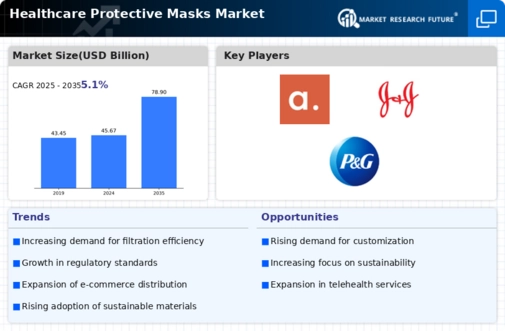
This trend is particularly pronounced in urban areas where pollution levels are high, prompting a demand for effective respiratory protection. As a result, the market is projected to reach 45.67 USD Billion in 2024, reflecting a significant shift in consumer behavior towards health-conscious choices.

Market Growth Projections

The Global Healthcare Protective Masks Market Industry is projected to experience substantial growth over the coming years. With an estimated market value of 45.67 USD Billion in 2024, the industry is poised for a significant expansion, driven by various factors such as rising health awareness and regulatory standards.
 
Furthermore, the market is expected to reach 78.9 USD Billion by 2035, reflecting a compound annual growth rate of 5.1% from 2025 to 2035. This growth trajectory indicates a robust demand for healthcare protective masks, underscoring the importance of continuous innovation and adaptation within the industry.

Global Supply Chain Resilience

The resilience of the global supply chain for healthcare protective masks appears to be a vital factor influencing the Global Healthcare Protective Masks Market Industry. As manufacturers adapt to disruptions and enhance their logistics capabilities, the availability of masks is expected to improve significantly.
 
This resilience not only ensures a steady supply of masks to meet rising demand but also fosters competitive pricing and innovation within the market. With projections indicating a market growth to 78.9 USD Billion by 2035, the ability to maintain a robust supply chain will be essential for sustaining industry momentum.

Regulatory Standards and Guidelines

The implementation of stringent regulatory standards and guidelines by health authorities worldwide seems to be a crucial factor influencing the Global Healthcare Protective Masks Market Industry. Governments are increasingly mandating the use of protective masks in various settings, including healthcare facilities, public transport, and crowded places.
 
These regulations not only enhance public safety but also drive the demand for certified masks that meet specific performance criteria. Consequently, this regulatory push is expected to contribute to the market's growth, with projections indicating a rise to 78.9 USD Billion by 2035, highlighting the long-term implications of such policies.

Increased Demand from Healthcare Sector

The healthcare sector's escalating demand for protective masks is likely to be a primary driver of the Global Healthcare Protective Masks Market Industry. Hospitals and clinics require high-quality masks to safeguard healthcare workers and patients from airborne pathogens. This demand is further amplified by the ongoing need for infection control measures in medical settings. As healthcare facilities expand and adapt to new challenges, the market is expected to thrive, contributing to the overall growth trajectory. The anticipated market value of 45.67 USD Billion in 2024 underscores the critical role that healthcare institutions play in shaping industry dynamics.

Technological Advancements in Mask Production

Innovations in mask production technology appear to play a significant role in shaping the Global Healthcare Protective Masks Market Industry. The development of advanced materials and manufacturing processes enhances the efficacy and comfort of masks, making them more appealing to consumers.
 
For instance, the introduction of breathable fabrics and antimicrobial coatings has improved user experience, thereby increasing adoption rates. As these technological advancements continue to evolve, they are likely to sustain market growth, with an anticipated compound annual growth rate of 5.1% from 2025 to 2035, indicating a robust future for the industry.

Market Segment Insights

By Application: Surgical (Largest) vs. Dental (Fastest-Growing)

In the Healthcare Protective Masks Market, the application segment is divided primarily into Surgical, Dental, Industrial, Laboratory, and General Purpose masks. Surgical masks lead the market, commanding the largest share due to their widespread use in medical procedures and surgeries. Following <a href="https://www.marketresearchfuture.com/reports/surgical-masks-market-19211">surgical masks</a>, dental masks hold a significant position in this space, catering specifically to dental professionals. Other segments like industrial and laboratory masks contribute to the overall market, albeit to a lesser extent, highlighting the diverse applications of protective masks across different healthcare settings.

Surgical (Dominant) vs. Dental (Emerging)

Surgical masks are the most dominant segment in the Healthcare Protective Masks Market, primarily utilized in medical environments to protect both healthcare professionals and patients from infections. These masks are designed for single-use and are regulated for quality and efficacy to ensure safety standards. In contrast, dental masks are emerging rapidly as they are increasingly adopted by dental professionals who require enhanced protection during procedures. While dental masks are gaining traction, particularly amid heightened infection control awareness, they serve a niche market compared to surgical masks, which remain essential across various medical fields.

By Material Type: Polypropylene (Largest) vs. N95 (Fastest-Growing)

In the Healthcare Protective Masks Market, material type distribution is crucial for understanding consumer preferences. Polypropylene stands out as the largest segment, driven by its excellent filtration efficiency and breathability, making it a preferred choice for both healthcare professionals and the general public during health crises. N95 masks, although not the largest, are gaining significant traction due to their effectiveness in filtering airborne particles and their essential role in infection control.

Polypropylene (Dominant) vs. N95 (Emerging)

Polypropylene masks remain the dominant force in the market due to their innovative design and cost-effectiveness, which have made them widely adopted across various sectors. Their manufacturing process, which allows for mass production, enhances their accessibility. On the other hand, N95 masks have emerged as a vital choice amid rising health concerns, particularly during pandemics. Their superior filtration capabilities attract attention, creating a growing segment of demand. While <a href="https://www.marketresearchfuture.com/reports/polypropylene-market-1063">polypropylene </a>caters to everyday use, N95 masks are increasingly regarded as essential protective gear, underscoring their respective positions in the market.

By End Use: Healthcare Facilities (Largest) vs. Home Care (Fastest-Growing)

<p>In the Healthcare Protective Masks Market, the distribution of end-use segments demonstrates a clear leadership by healthcare facilities, which command a significant portion of the market share. This dominance is fueled by the ongoing demand for protective equipment within hospitals and clinics, particularly in the wake of increasing health threats and regulatory mandates. Home care, while smaller in comparison, is experiencing rapid growth as individuals and families seek protective measures at home, indicating a shift in consumer behavior towards health safety.</p>

<p>Healthcare Facilities (Dominant) vs. Home Care (Emerging)</p>

<p>Healthcare facilities remain the dominant sector for protective mask usage, driven by the need for stringent infection control practices and high-volume patient care environments. This segment benefits from extensive regulatory support and an established supply chain that prioritizes quality and safety. In contrast, the home care segment is emerging rapidly, characterized by a growing awareness of personal health and hygiene among consumers. This shift includes an increase in the purchasing of protective masks for home use, highlighting a changing landscape where protection is increasingly seen as essential for everyday safety.</p>

By Distribution Channel: Online Retail (Largest) vs. Pharmacies (Fastest-Growing)

<p>The distribution of healthcare protective masks across different channels indicates a competitive landscape where online retail dominates the space, holding the largest share. Pharmacies, while traditionally significant in the sale of health-related products, are witnessing a remarkable increase in demand due to heightened health awareness and the need for easy access to protective equipment. This scenario creates a robust interplay among various distribution channels, emphasizing the shift in consumer purchasing behaviors that favor convenience and accessibility. Growth trends within this segment are fueled by evolving consumer preferences towards online shopping, particularly under the influence of recent global health crises. As a result, consumers are gravitating towards online retail for the timely acquisition of healthcare protective masks, leading to exponential growth in this channel. Meanwhile, pharmacies are emerging as a crucial player due to their widespread accessibility and trustworthiness among consumers, which is further amplified by initiatives for on-site health consultations and expanding service offerings related to safety protocols.</p>

<p>Online Retail (Dominant) vs. Medical Supply Stores (Emerging)</p>

<p>The online retail sector in the healthcare protective masks market has established itself as the dominant distribution channel, characterized by vast product availability, competitive pricing, and consumer convenience. This channel thrives on the ease of purchasing from home, particularly during health emergencies. Conversely, medical supply stores are emerging as an important segment, gaining traction due to their specialized offerings and knowledge in medical supplies. These stores are becoming increasingly important for consumers seeking tailored advice and higher-quality products, along with personal assurance of the items they are purchasing. The shift towards online purchasing does not overshadow the steady demand for medical supply stores, which cater to niche markets and professionals seeking certified and trusted protective equipment.</p>

By Mask Type: Surgical Masks (Largest) vs. N95 Respirators (Fastest-Growing)

<p>The Healthcare Protective Masks Market showcases a diverse array of mask types, where Surgical Masks dominate the market share due to their widespread use in healthcare settings. N95 Respirators, emerging as the fastest-growing segment, reflect the increasing focus on filtration efficiency and protection in both healthcare and non-healthcare environments. As awareness about respiratory infections rises, the usage of these mask types becomes pivotal in maintaining safety standards.</p>

<p>Surgical Masks (Dominant) vs. N95 Respirators (Emerging)</p>

<p>Surgical Masks are characterized by their availability, ease of use, and effective filtration against large droplets, making them a staple in surgeries and routine healthcare activities. Their dominant presence in the Healthcare Protective Masks Market stems from extensive use during high-risk procedures. On the other hand, N95 Respirators are gaining traction as an emerging choice due to their superior filtration capabilities and fit-testing requirements, enhancing protection against airborne pathogens. The increasing prevalence of infectious diseases and occupational safety regulations further bolster the demand for N95 Respirators, making them a crucial component in personal protective equipment.</p>

Get more detailed insights about Healthcare Protective Masks Market Research Report - Forecast till 2035

Regional Insights

North America : Market Leader in Healthcare Masks

North America continues to lead the Healthcare Protective Masks Market, holding a significant market share of 4.93 in 2024. The region's growth is driven by stringent health regulations, increased healthcare spending, and heightened awareness of infection control. The COVID-19 pandemic has further accelerated demand for high-quality protective masks, with regulatory bodies emphasizing the importance of personal protective equipment (PPE) in healthcare settings.

The competitive landscape is robust, featuring key players such as 3M, Honeywell, and Kimberly-Clark, which dominate the market with innovative products. The U.S. remains the largest market, supported by advanced healthcare infrastructure and a strong focus on research and development. As the demand for protective masks continues to rise, these companies are expected to enhance their production capabilities to meet both domestic and international needs.

Europe : Regulatory Focus on Safety Standards

Europe's Healthcare Protective Masks Market is valued at 2.95, reflecting a growing emphasis on safety and compliance with health regulations. The region is witnessing increased demand for high-quality masks due to rising health concerns and regulatory mandates. The European Union has implemented stringent guidelines for PPE, which has catalyzed market growth and innovation in mask technology, ensuring that products meet high safety standards.

Leading countries in this market include Germany, France, and the UK, where major players like DuPont and Halyard Health are actively involved. The competitive landscape is characterized by a mix of established companies and emerging startups focusing on sustainable and effective mask solutions. As regulations evolve, companies are investing in R&D to develop advanced materials and designs that enhance user comfort and protection.

Asia-Pacific : Emerging Market with High Potential

The Asia-Pacific region, with a market size of 1.87, is rapidly emerging as a significant player in the Healthcare Protective Masks Market. The growth is driven by increasing healthcare expenditures, rising awareness of health and safety, and the ongoing threat of infectious diseases. Governments are implementing policies to enhance healthcare infrastructure, which is further propelling the demand for protective masks across various sectors, including healthcare and manufacturing.

Countries like China, Japan, and India are leading the market, with a growing presence of key players such as Moldex-Metric and Cardinal Health. The competitive landscape is evolving, with local manufacturers ramping up production to meet the surging demand. As the region continues to develop, the focus on quality and compliance with international standards will be crucial for market players to succeed.

Middle East and Africa : Developing Market with Challenges

The Middle East and Africa region, with a market size of 0.1, faces unique challenges in the Healthcare Protective Masks Market. Limited healthcare infrastructure and varying regulatory frameworks hinder rapid growth. However, there is a growing awareness of health and safety, which is gradually increasing the demand for protective masks. Governments are beginning to implement regulations to improve healthcare standards, which may catalyze market growth in the coming years.

Countries like South Africa and the UAE are at the forefront, with local and international players striving to establish a foothold in this developing market. The competitive landscape is characterized by a mix of established brands and new entrants, focusing on affordability and accessibility. As the region's healthcare systems evolve, the demand for quality protective masks is expected to rise, albeit slowly.

Key Players and Competitive Insights

The Healthcare Protective Masks Market is currently characterized by a dynamic competitive landscape, driven by heightened awareness of health and safety standards globally. Key players such as 3M (US), Honeywell (US), and Kimberly-Clark (US) are at the forefront, leveraging their extensive research and development capabilities to innovate and enhance product offerings. 3M (US) has positioned itself as a leader in advanced filtration technology, while Honeywell (US) focuses on integrating smart technologies into its mask designs. Meanwhile, Kimberly-Clark (US) emphasizes sustainability in its production processes, which resonates with the growing consumer demand for environmentally friendly products.
Collectively, these strategies not only enhance their market presence but also shape a competitive environment that prioritizes innovation and sustainability. In terms of business tactics, companies are increasingly localizing manufacturing to mitigate supply chain disruptions and optimize logistics. This approach appears to be a response to the complexities of global supply chains, which have been under scrutiny in recent years. The market structure is moderately fragmented, with several players vying for market share, yet the influence of major companies remains substantial. Their ability to adapt to changing market conditions and consumer preferences is crucial in maintaining competitive advantage.
In November 2025, 3M (US) announced the launch of a new line of N95 respirators that incorporate antimicrobial technology, aimed at enhancing user safety and comfort. This strategic move not only reinforces 3M's commitment to innovation but also addresses the increasing demand for advanced protective equipment in healthcare settings. The introduction of such products is likely to strengthen their market position and appeal to healthcare providers seeking reliable solutions.
In October 2025, Honeywell (US) unveiled a partnership with a leading technology firm to develop AI-driven mask monitoring systems that assess mask integrity in real-time. This initiative signifies a shift towards integrating digital solutions in personal protective equipment, potentially revolutionizing how masks are utilized in clinical environments. By enhancing the functionality of their products, Honeywell is likely to attract a broader customer base, particularly in sectors where safety compliance is paramount.
In September 2025, Kimberly-Clark (US) launched a sustainability initiative aimed at reducing plastic waste in its mask production. This initiative not only aligns with The Healthcare Protective Masks. By focusing on eco-friendly practices, Kimberly-Clark is likely to enhance its brand reputation and appeal to environmentally conscious consumers, thereby differentiating itself from competitors. As of December 2025, the competitive trends in the Healthcare Protective Masks Market are increasingly defined by digitalization, sustainability, and the integration of advanced technologies such as AI. Strategic alliances among key players are shaping the landscape, fostering innovation and enhancing product offerings. Moving forward, competitive differentiation is expected to evolve from traditional price-based competition to a focus on innovation, technological advancements, and supply chain reliability. This shift underscores the importance of adaptability and responsiveness in a rapidly changing market.

Key Companies in the Healthcare Protective Masks Market include

Industry Developments

Future Outlook

Healthcare Protective Masks Market Future Outlook

The Healthcare Protective Masks Market is projected to grow at an 8.83% CAGR from 2025 to 2035, driven by increasing health awareness, regulatory mandates, and technological advancements.

New opportunities lie in:

  • <p>Expansion into biodegradable mask production for eco-conscious consumers. Development of smart masks with integrated health monitoring features. Partnerships with healthcare providers for bulk supply contracts.</p>

By 2035, the market is expected to be robust, driven by innovation and strategic partnerships.

Market Segmentation

Healthcare Protective Masks Market End Use Outlook

  • Hospitals
  • Clinics
  • Home Care
  • Emergency Services
  • Public Health

Healthcare Protective Masks Market Application Outlook

  • Surgical
  • Dental
  • Industrial
  • Laboratory
  • General Purpose

Healthcare Protective Masks Market Product Type Outlook

  • Disposable Masks
  • Reusable Masks
  • Surgical Masks
  • N95 Respirators
  • Face Shields

Healthcare Protective Masks Market Material Type Outlook

  • Polypropylene
  • Cotton
  • N95
  • Polyester
  • Other

Report Scope

MARKET SIZE 2024 9.85(USD Million)
MARKET SIZE 2025 10.83(USD Million)
MARKET SIZE 2035 25.08(USD Million)
COMPOUND ANNUAL GROWTH RATE (CAGR) 8.83% (2025 - 2035)
REPORT COVERAGE Revenue Forecast, Competitive Landscape, Growth Factors, and Trends
BASE YEAR 2024
Market Forecast Period 2025 - 2035
Historical Data 2019 - 2024
Market Forecast Units USD Million
Key Companies Profiled 3M (US), Honeywell (US), Moldex-Metric (US), Kimberly-Clark (US), DuPont (US), Cardinal Health (US), Medline Industries (US), Alpha Pro Tech (US), Halyard Health (US)
Segments Covered Application, Material Type, End Use, Product Type
Key Market Opportunities Integration of advanced filtration technologies enhances effectiveness in the Healthcare Protective Masks Market.
Key Market Dynamics Rising demand for advanced filtration technologies drives innovation in the Healthcare Protective Masks Market.
Countries Covered North America, Europe, APAC, South America, MEA

FAQs

What is the projected market valuation for the Healthcare Protective Masks Market in 2035?

<p>The projected market valuation for the Healthcare Protective Masks Market in 2035 is 25.08 USD Million.</p>

What was the market valuation for the Healthcare Protective Masks Market in 2024?

<p>The overall market valuation for the Healthcare Protective Masks Market was 9.85 USD Million in 2024.</p>

What is the expected CAGR for the Healthcare Protective Masks Market from 2025 to 2035?

<p>The expected CAGR for the Healthcare Protective Masks Market during the forecast period 2025 - 2035 is 8.83%.</p>

Which companies are considered key players in the Healthcare Protective Masks Market?

<p>Key players in the Healthcare Protective Masks Market include 3M, Honeywell, Moldex-Metric, Kimberly-Clark, DuPont, Medline Industries, Cardinal Health, and Alpha Pro Tech.</p>

What are the main applications of healthcare protective masks?

<p>The main applications of healthcare protective masks include Surgical, Dental, Industrial, General Purpose, and Laboratory uses.</p>

What material types are commonly used in the production of healthcare protective masks?

Common material types used in healthcare protective masks include Polypropylene, Cotton, N95, Polyester, and Latex.

What are the primary end-use segments for healthcare protective masks?

Primary end-use segments for healthcare protective masks encompass Healthcare Facilities, Home Care, Research Laboratories, Manufacturing, and Emergency Services.

How are healthcare protective masks distributed in the market?

Healthcare protective masks are distributed through various channels, including Online Retail, Pharmacies, Medical Supply Stores, Direct Sales, and Wholesale.

What types of masks are included in the Healthcare Protective Masks Market?

Types of masks included in the Healthcare Protective Masks Market are Disposable Masks, Reusable Masks, Surgical Masks, N95 Respirators, and Face Shields.

What was the valuation range for surgical masks in the Healthcare Protective Masks Market?

The valuation range for surgical masks in the Healthcare Protective Masks Market was between 2.5 and 6.25 USD Million.

  1. SECTION I: EXECUTIVE SUMMARY AND KEY HIGHLIGHTS
    1. | 1.1 EXECUTIVE SUMMARY
    2. | | 1.1.1 Market Overview
    3. | | 1.1.2 Key Findings
    4. | | 1.1.3 Market Segmentation
    5. | | 1.1.4 Competitive Landscape
    6. | | 1.1.5 Challenges and Opportunities
    7. | | 1.1.6 Future Outlook
  2. SECTION II: SCOPING, METHODOLOGY AND MARKET STRUCTURE
    1. | 2.1 MARKET INTRODUCTION
    2. | | 2.1.1 Definition
    3. | | 2.1.2 Scope of the study
    4. | | | 2.1.2.1 Research Objective
    5. | | | 2.1.2.2 Assumption
    6. | | | 2.1.2.3 Limitations
    7. | 2.2 RESEARCH METHODOLOGY
    8. | | 2.2.1 Overview
    9. | | 2.2.2 Data Mining
    10. | | 2.2.3 Secondary Research
    11. | | 2.2.4 Primary Research
    12. | | | 2.2.4.1 Primary Interviews and Information Gathering Process
    13. | | | 2.2.4.2 Breakdown of Primary Respondents
    14. | | 2.2.5 Forecasting Model
    15. | | 2.2.6 Market Size Estimation
    16. | | | 2.2.6.1 Bottom-Up Approach
    17. | | | 2.2.6.2 Top-Down Approach
    18. | | 2.2.7 Data Triangulation
    19. | | 2.2.8 Validation
  3. SECTION III: QUALITATIVE ANALYSIS
    1. | 3.1 MARKET DYNAMICS
    2. | | 3.1.1 Overview
    3. | | 3.1.2 Drivers
    4. | | 3.1.3 Restraints
    5. | | 3.1.4 Opportunities
    6. | 3.2 MARKET FACTOR ANALYSIS
    7. | | 3.2.1 Value chain Analysis
    8. | | 3.2.2 Porter's Five Forces Analysis
    9. | | | 3.2.2.1 Bargaining Power of Suppliers
    10. | | | 3.2.2.2 Bargaining Power of Buyers
    11. | | | 3.2.2.3 Threat of New Entrants
    12. | | | 3.2.2.4 Threat of Substitutes
    13. | | | 3.2.2.5 Intensity of Rivalry
    14. | | 3.2.3 COVID-19 Impact Analysis
    15. | | | 3.2.3.1 Market Impact Analysis
    16. | | | 3.2.3.2 Regional Impact
    17. | | | 3.2.3.3 Opportunity and Threat Analysis
  4. SECTION IV: QUANTITATIVE ANALYSIS
    1. | 4.1 Healthcare, BY Application (USD Million)
    2. | | 4.1.1 Surgical
    3. | | 4.1.2 Dental
    4. | | 4.1.3 Industrial
    5. | | 4.1.4 General Purpose
    6. | | 4.1.5 Laboratory
    7. | 4.2 Healthcare, BY Material Type (USD Million)
    8. | | 4.2.1 Polypropylene
    9. | | 4.2.2 Cotton
    10. | | 4.2.3 N95
    11. | | 4.2.4 Polyester
    12. | | 4.2.5 Latex
    13. | 4.3 Healthcare, BY End Use (USD Million)
    14. | | 4.3.1 Healthcare Facilities
    15. | | 4.3.2 Home Care
    16. | | 4.3.3 Research Laboratories
    17. | | 4.3.4 Manufacturing
    18. | | 4.3.5 Emergency Services
    19. | 4.4 Healthcare, BY Distribution Channel (USD Million)
    20. | | 4.4.1 Online Retail
    21. | | 4.4.2 Pharmacies
    22. | | 4.4.3 Medical Supply Stores
    23. | | 4.4.4 Direct Sales
    24. | | 4.4.5 Wholesale
    25. | 4.5 Healthcare, BY Mask Type (USD Million)
    26. | | 4.5.1 Disposable Masks
    27. | | 4.5.2 Reusable Masks
    28. | | 4.5.3 Surgical Masks
    29. | | 4.5.4 N95 Respirators
    30. | | 4.5.5 Face Shields
    31. | 4.6 Healthcare, BY Region (USD Million)
    32. | | 4.6.1 North America
    33. | | | 4.6.1.1 US
    34. | | | 4.6.1.2 Canada
    35. | | 4.6.2 Europe
    36. | | | 4.6.2.1 Germany
    37. | | | 4.6.2.2 UK
    38. | | | 4.6.2.3 France
    39. | | | 4.6.2.4 Russia
    40. | | | 4.6.2.5 Italy
    41. | | | 4.6.2.6 Spain
    42. | | | 4.6.2.7 Rest of Europe
    43. | | 4.6.3 APAC
    44. | | | 4.6.3.1 China
    45. | | | 4.6.3.2 India
    46. | | | 4.6.3.3 Japan
    47. | | | 4.6.3.4 South Korea
    48. | | | 4.6.3.5 Malaysia
    49. | | | 4.6.3.6 Thailand
    50. | | | 4.6.3.7 Indonesia
    51. | | | 4.6.3.8 Rest of APAC
    52. | | 4.6.4 South America
    53. | | | 4.6.4.1 Brazil
    54. | | | 4.6.4.2 Mexico
    55. | | | 4.6.4.3 Argentina
    56. | | | 4.6.4.4 Rest of South America
    57. | | 4.6.5 MEA
    58. | | | 4.6.5.1 GCC Countries
    59. | | | 4.6.5.2 South Africa
    60. | | | 4.6.5.3 Rest of MEA
  5. SECTION V: COMPETITIVE ANALYSIS
    1. | 5.1 Competitive Landscape
    2. | | 5.1.1 Overview
    3. | | 5.1.2 Competitive Analysis
    4. | | 5.1.3 Market share Analysis
    5. | | 5.1.4 Major Growth Strategy in the Healthcare
    6. | | 5.1.5 Competitive Benchmarking
    7. | | 5.1.6 Leading Players in Terms of Number of Developments in the Healthcare
    8. | | 5.1.7 Key developments and growth strategies
    9. | | | 5.1.7.1 New Product Launch/Service Deployment
    10. | | | 5.1.7.2 Merger & Acquisitions
    11. | | | 5.1.7.3 Joint Ventures
    12. | | 5.1.8 Major Players Financial Matrix
    13. | | | 5.1.8.1 Sales and Operating Income
    14. | | | 5.1.8.2 Major Players R&D Expenditure. 2023
    15. | 5.2 Company Profiles
    16. | | 5.2.1 3M (US)
    17. | | | 5.2.1.1 Financial Overview
    18. | | | 5.2.1.2 Products Offered
    19. | | | 5.2.1.3 Key Developments
    20. | | | 5.2.1.4 SWOT Analysis
    21. | | | 5.2.1.5 Key Strategies
    22. | | 5.2.2 Honeywell (US)
    23. | | | 5.2.2.1 Financial Overview
    24. | | | 5.2.2.2 Products Offered
    25. | | | 5.2.2.3 Key Developments
    26. | | | 5.2.2.4 SWOT Analysis
    27. | | | 5.2.2.5 Key Strategies
    28. | | 5.2.3 Moldex-Metric (US)
    29. | | | 5.2.3.1 Financial Overview
    30. | | | 5.2.3.2 Products Offered
    31. | | | 5.2.3.3 Key Developments
    32. | | | 5.2.3.4 SWOT Analysis
    33. | | | 5.2.3.5 Key Strategies
    34. | | 5.2.4 Kimberly-Clark (US)
    35. | | | 5.2.4.1 Financial Overview
    36. | | | 5.2.4.2 Products Offered
    37. | | | 5.2.4.3 Key Developments
    38. | | | 5.2.4.4 SWOT Analysis
    39. | | | 5.2.4.5 Key Strategies
    40. | | 5.2.5 DuPont (US)
    41. | | | 5.2.5.1 Financial Overview
    42. | | | 5.2.5.2 Products Offered
    43. | | | 5.2.5.3 Key Developments
    44. | | | 5.2.5.4 SWOT Analysis
    45. | | | 5.2.5.5 Key Strategies
    46. | | 5.2.6 Medline Industries (US)
    47. | | | 5.2.6.1 Financial Overview
    48. | | | 5.2.6.2 Products Offered
    49. | | | 5.2.6.3 Key Developments
    50. | | | 5.2.6.4 SWOT Analysis
    51. | | | 5.2.6.5 Key Strategies
    52. | | 5.2.7 Cardinal Health (US)
    53. | | | 5.2.7.1 Financial Overview
    54. | | | 5.2.7.2 Products Offered
    55. | | | 5.2.7.3 Key Developments
    56. | | | 5.2.7.4 SWOT Analysis
    57. | | | 5.2.7.5 Key Strategies
    58. | | 5.2.8 Alpha Pro Tech (US)
    59. | | | 5.2.8.1 Financial Overview
    60. | | | 5.2.8.2 Products Offered
    61. | | | 5.2.8.3 Key Developments
    62. | | | 5.2.8.4 SWOT Analysis
    63. | | | 5.2.8.5 Key Strategies
    64. | 5.3 Appendix
    65. | | 5.3.1 References
    66. | | 5.3.2 Related Reports
  6. LIST OF FIGURES
    1. | 6.1 MARKET SYNOPSIS
    2. | 6.2 NORTH AMERICA MARKET ANALYSIS
    3. | 6.3 US MARKET ANALYSIS BY APPLICATION
    4. | 6.4 US MARKET ANALYSIS BY MATERIAL TYPE
    5. | 6.5 US MARKET ANALYSIS BY END USE
    6. | 6.6 US MARKET ANALYSIS BY DISTRIBUTION CHANNEL
    7. | 6.7 US MARKET ANALYSIS BY MASK TYPE
    8. | 6.8 CANADA MARKET ANALYSIS BY APPLICATION
    9. | 6.9 CANADA MARKET ANALYSIS BY MATERIAL TYPE
    10. | 6.10 CANADA MARKET ANALYSIS BY END USE
    11. | 6.11 CANADA MARKET ANALYSIS BY DISTRIBUTION CHANNEL
    12. | 6.12 CANADA MARKET ANALYSIS BY MASK TYPE
    13. | 6.13 EUROPE MARKET ANALYSIS
    14. | 6.14 GERMANY MARKET ANALYSIS BY APPLICATION
    15. | 6.15 GERMANY MARKET ANALYSIS BY MATERIAL TYPE
    16. | 6.16 GERMANY MARKET ANALYSIS BY END USE
    17. | 6.17 GERMANY MARKET ANALYSIS BY DISTRIBUTION CHANNEL
    18. | 6.18 GERMANY MARKET ANALYSIS BY MASK TYPE
    19. | 6.19 UK MARKET ANALYSIS BY APPLICATION
    20. | 6.20 UK MARKET ANALYSIS BY MATERIAL TYPE
    21. | 6.21 UK MARKET ANALYSIS BY END USE
    22. | 6.22 UK MARKET ANALYSIS BY DISTRIBUTION CHANNEL
    23. | 6.23 UK MARKET ANALYSIS BY MASK TYPE
    24. | 6.24 FRANCE MARKET ANALYSIS BY APPLICATION
    25. | 6.25 FRANCE MARKET ANALYSIS BY MATERIAL TYPE
    26. | 6.26 FRANCE MARKET ANALYSIS BY END USE
    27. | 6.27 FRANCE MARKET ANALYSIS BY DISTRIBUTION CHANNEL
    28. | 6.28 FRANCE MARKET ANALYSIS BY MASK TYPE
    29. | 6.29 RUSSIA MARKET ANALYSIS BY APPLICATION
    30. | 6.30 RUSSIA MARKET ANALYSIS BY MATERIAL TYPE
    31. | 6.31 RUSSIA MARKET ANALYSIS BY END USE
    32. | 6.32 RUSSIA MARKET ANALYSIS BY DISTRIBUTION CHANNEL
    33. | 6.33 RUSSIA MARKET ANALYSIS BY MASK TYPE
    34. | 6.34 ITALY MARKET ANALYSIS BY APPLICATION
    35. | 6.35 ITALY MARKET ANALYSIS BY MATERIAL TYPE
    36. | 6.36 ITALY MARKET ANALYSIS BY END USE
    37. | 6.37 ITALY MARKET ANALYSIS BY DISTRIBUTION CHANNEL
    38. | 6.38 ITALY MARKET ANALYSIS BY MASK TYPE
    39. | 6.39 SPAIN MARKET ANALYSIS BY APPLICATION
    40. | 6.40 SPAIN MARKET ANALYSIS BY MATERIAL TYPE
    41. | 6.41 SPAIN MARKET ANALYSIS BY END USE
    42. | 6.42 SPAIN MARKET ANALYSIS BY DISTRIBUTION CHANNEL
    43. | 6.43 SPAIN MARKET ANALYSIS BY MASK TYPE
    44. | 6.44 REST OF EUROPE MARKET ANALYSIS BY APPLICATION
    45. | 6.45 REST OF EUROPE MARKET ANALYSIS BY MATERIAL TYPE
    46. | 6.46 REST OF EUROPE MARKET ANALYSIS BY END USE
    47. | 6.47 REST OF EUROPE MARKET ANALYSIS BY DISTRIBUTION CHANNEL
    48. | 6.48 REST OF EUROPE MARKET ANALYSIS BY MASK TYPE
    49. | 6.49 APAC MARKET ANALYSIS
    50. | 6.50 CHINA MARKET ANALYSIS BY APPLICATION
    51. | 6.51 CHINA MARKET ANALYSIS BY MATERIAL TYPE
    52. | 6.52 CHINA MARKET ANALYSIS BY END USE
    53. | 6.53 CHINA MARKET ANALYSIS BY DISTRIBUTION CHANNEL
    54. | 6.54 CHINA MARKET ANALYSIS BY MASK TYPE
    55. | 6.55 INDIA MARKET ANALYSIS BY APPLICATION
    56. | 6.56 INDIA MARKET ANALYSIS BY MATERIAL TYPE
    57. | 6.57 INDIA MARKET ANALYSIS BY END USE
    58. | 6.58 INDIA MARKET ANALYSIS BY DISTRIBUTION CHANNEL
    59. | 6.59 INDIA MARKET ANALYSIS BY MASK TYPE
    60. | 6.60 JAPAN MARKET ANALYSIS BY APPLICATION
    61. | 6.61 JAPAN MARKET ANALYSIS BY MATERIAL TYPE
    62. | 6.62 JAPAN MARKET ANALYSIS BY END USE
    63. | 6.63 JAPAN MARKET ANALYSIS BY DISTRIBUTION CHANNEL
    64. | 6.64 JAPAN MARKET ANALYSIS BY MASK TYPE
    65. | 6.65 SOUTH KOREA MARKET ANALYSIS BY APPLICATION
    66. | 6.66 SOUTH KOREA MARKET ANALYSIS BY MATERIAL TYPE
    67. | 6.67 SOUTH KOREA MARKET ANALYSIS BY END USE
    68. | 6.68 SOUTH KOREA MARKET ANALYSIS BY DISTRIBUTION CHANNEL
    69. | 6.69 SOUTH KOREA MARKET ANALYSIS BY MASK TYPE
    70. | 6.70 MALAYSIA MARKET ANALYSIS BY APPLICATION
    71. | 6.71 MALAYSIA MARKET ANALYSIS BY MATERIAL TYPE
    72. | 6.72 MALAYSIA MARKET ANALYSIS BY END USE
    73. | 6.73 MALAYSIA MARKET ANALYSIS BY DISTRIBUTION CHANNEL
    74. | 6.74 MALAYSIA MARKET ANALYSIS BY MASK TYPE
    75. | 6.75 THAILAND MARKET ANALYSIS BY APPLICATION
    76. | 6.76 THAILAND MARKET ANALYSIS BY MATERIAL TYPE
    77. | 6.77 THAILAND MARKET ANALYSIS BY END USE
    78. | 6.78 THAILAND MARKET ANALYSIS BY DISTRIBUTION CHANNEL
    79. | 6.79 THAILAND MARKET ANALYSIS BY MASK TYPE
    80. | 6.80 INDONESIA MARKET ANALYSIS BY APPLICATION
    81. | 6.81 INDONESIA MARKET ANALYSIS BY MATERIAL TYPE
    82. | 6.82 INDONESIA MARKET ANALYSIS BY END USE
    83. | 6.83 INDONESIA MARKET ANALYSIS BY DISTRIBUTION CHANNEL
    84. | 6.84 INDONESIA MARKET ANALYSIS BY MASK TYPE
    85. | 6.85 REST OF APAC MARKET ANALYSIS BY APPLICATION
    86. | 6.86 REST OF APAC MARKET ANALYSIS BY MATERIAL TYPE
    87. | 6.87 REST OF APAC MARKET ANALYSIS BY END USE
    88. | 6.88 REST OF APAC MARKET ANALYSIS BY DISTRIBUTION CHANNEL
    89. | 6.89 REST OF APAC MARKET ANALYSIS BY MASK TYPE
    90. | 6.90 SOUTH AMERICA MARKET ANALYSIS
    91. | 6.91 BRAZIL MARKET ANALYSIS BY APPLICATION
    92. | 6.92 BRAZIL MARKET ANALYSIS BY MATERIAL TYPE
    93. | 6.93 BRAZIL MARKET ANALYSIS BY END USE
    94. | 6.94 BRAZIL MARKET ANALYSIS BY DISTRIBUTION CHANNEL
    95. | 6.95 BRAZIL MARKET ANALYSIS BY MASK TYPE
    96. | 6.96 MEXICO MARKET ANALYSIS BY APPLICATION
    97. | 6.97 MEXICO MARKET ANALYSIS BY MATERIAL TYPE
    98. | 6.98 MEXICO MARKET ANALYSIS BY END USE
    99. | 6.99 MEXICO MARKET ANALYSIS BY DISTRIBUTION CHANNEL
    100. | 6.100 MEXICO MARKET ANALYSIS BY MASK TYPE
    101. | 6.101 ARGENTINA MARKET ANALYSIS BY APPLICATION
    102. | 6.102 ARGENTINA MARKET ANALYSIS BY MATERIAL TYPE
    103. | 6.103 ARGENTINA MARKET ANALYSIS BY END USE
    104. | 6.104 ARGENTINA MARKET ANALYSIS BY DISTRIBUTION CHANNEL
    105. | 6.105 ARGENTINA MARKET ANALYSIS BY MASK TYPE
    106. | 6.106 REST OF SOUTH AMERICA MARKET ANALYSIS BY APPLICATION
    107. | 6.107 REST OF SOUTH AMERICA MARKET ANALYSIS BY MATERIAL TYPE
    108. | 6.108 REST OF SOUTH AMERICA MARKET ANALYSIS BY END USE
    109. | 6.109 REST OF SOUTH AMERICA MARKET ANALYSIS BY DISTRIBUTION CHANNEL
    110. | 6.110 REST OF SOUTH AMERICA MARKET ANALYSIS BY MASK TYPE
    111. | 6.111 MEA MARKET ANALYSIS
    112. | 6.112 GCC COUNTRIES MARKET ANALYSIS BY APPLICATION
    113. | 6.113 GCC COUNTRIES MARKET ANALYSIS BY MATERIAL TYPE
    114. | 6.114 GCC COUNTRIES MARKET ANALYSIS BY END USE
    115. | 6.115 GCC COUNTRIES MARKET ANALYSIS BY DISTRIBUTION CHANNEL
    116. | 6.116 GCC COUNTRIES MARKET ANALYSIS BY MASK TYPE
    117. | 6.117 SOUTH AFRICA MARKET ANALYSIS BY APPLICATION
    118. | 6.118 SOUTH AFRICA MARKET ANALYSIS BY MATERIAL TYPE
    119. | 6.119 SOUTH AFRICA MARKET ANALYSIS BY END USE
    120. | 6.120 SOUTH AFRICA MARKET ANALYSIS BY DISTRIBUTION CHANNEL
    121. | 6.121 SOUTH AFRICA MARKET ANALYSIS BY MASK TYPE
    122. | 6.122 REST OF MEA MARKET ANALYSIS BY APPLICATION
    123. | 6.123 REST OF MEA MARKET ANALYSIS BY MATERIAL TYPE
    124. | 6.124 REST OF MEA MARKET ANALYSIS BY END USE
    125. | 6.125 REST OF MEA MARKET ANALYSIS BY DISTRIBUTION CHANNEL
    126. | 6.126 REST OF MEA MARKET ANALYSIS BY MASK TYPE
    127. | 6.127 KEY BUYING CRITERIA OF HEALTHCARE
    128. | 6.128 RESEARCH PROCESS OF MRFR
    129. | 6.129 DRO ANALYSIS OF HEALTHCARE
    130. | 6.130 DRIVERS IMPACT ANALYSIS: HEALTHCARE
    131. | 6.131 RESTRAINTS IMPACT ANALYSIS: HEALTHCARE
    132. | 6.132 SUPPLY / VALUE CHAIN: HEALTHCARE
    133. | 6.133 HEALTHCARE, BY APPLICATION, 2024 (% SHARE)
    134. | 6.134 HEALTHCARE, BY APPLICATION, 2024 TO 2035 (USD Million)
    135. | 6.135 HEALTHCARE, BY MATERIAL TYPE, 2024 (% SHARE)
    136. | 6.136 HEALTHCARE, BY MATERIAL TYPE, 2024 TO 2035 (USD Million)
    137. | 6.137 HEALTHCARE, BY END USE, 2024 (% SHARE)
    138. | 6.138 HEALTHCARE, BY END USE, 2024 TO 2035 (USD Million)
    139. | 6.139 HEALTHCARE, BY DISTRIBUTION CHANNEL, 2024 (% SHARE)
    140. | 6.140 HEALTHCARE, BY DISTRIBUTION CHANNEL, 2024 TO 2035 (USD Million)
    141. | 6.141 HEALTHCARE, BY MASK TYPE, 2024 (% SHARE)
    142. | 6.142 HEALTHCARE, BY MASK TYPE, 2024 TO 2035 (USD Million)
    143. | 6.143 BENCHMARKING OF MAJOR COMPETITORS
  7. LIST OF TABLES
    1. | 7.1 LIST OF ASSUMPTIONS
    2. | | 7.1.1
    3. | 7.2 North America MARKET SIZE ESTIMATES; FORECAST
    4. | | 7.2.1 BY APPLICATION, 2025-2035 (USD Million)
    5. | | 7.2.2 BY MATERIAL TYPE, 2025-2035 (USD Million)
    6. | | 7.2.3 BY END USE, 2025-2035 (USD Million)
    7. | | 7.2.4 BY DISTRIBUTION CHANNEL, 2025-2035 (USD Million)
    8. | | 7.2.5 BY MASK TYPE, 2025-2035 (USD Million)
    9. | 7.3 US MARKET SIZE ESTIMATES; FORECAST
    10. | | 7.3.1 BY APPLICATION, 2025-2035 (USD Million)
    11. | | 7.3.2 BY MATERIAL TYPE, 2025-2035 (USD Million)
    12. | | 7.3.3 BY END USE, 2025-2035 (USD Million)
    13. | | 7.3.4 BY DISTRIBUTION CHANNEL, 2025-2035 (USD Million)
    14. | | 7.3.5 BY MASK TYPE, 2025-2035 (USD Million)
    15. | 7.4 Canada MARKET SIZE ESTIMATES; FORECAST
    16. | | 7.4.1 BY APPLICATION, 2025-2035 (USD Million)
    17. | | 7.4.2 BY MATERIAL TYPE, 2025-2035 (USD Million)
    18. | | 7.4.3 BY END USE, 2025-2035 (USD Million)
    19. | | 7.4.4 BY DISTRIBUTION CHANNEL, 2025-2035 (USD Million)
    20. | | 7.4.5 BY MASK TYPE, 2025-2035 (USD Million)
    21. | 7.5 Europe MARKET SIZE ESTIMATES; FORECAST
    22. | | 7.5.1 BY APPLICATION, 2025-2035 (USD Million)
    23. | | 7.5.2 BY MATERIAL TYPE, 2025-2035 (USD Million)
    24. | | 7.5.3 BY END USE, 2025-2035 (USD Million)
    25. | | 7.5.4 BY DISTRIBUTION CHANNEL, 2025-2035 (USD Million)
    26. | | 7.5.5 BY MASK TYPE, 2025-2035 (USD Million)
    27. | 7.6 Germany MARKET SIZE ESTIMATES; FORECAST
    28. | | 7.6.1 BY APPLICATION, 2025-2035 (USD Million)
    29. | | 7.6.2 BY MATERIAL TYPE, 2025-2035 (USD Million)
    30. | | 7.6.3 BY END USE, 2025-2035 (USD Million)
    31. | | 7.6.4 BY DISTRIBUTION CHANNEL, 2025-2035 (USD Million)
    32. | | 7.6.5 BY MASK TYPE, 2025-2035 (USD Million)
    33. | 7.7 UK MARKET SIZE ESTIMATES; FORECAST
    34. | | 7.7.1 BY APPLICATION, 2025-2035 (USD Million)
    35. | | 7.7.2 BY MATERIAL TYPE, 2025-2035 (USD Million)
    36. | | 7.7.3 BY END USE, 2025-2035 (USD Million)
    37. | | 7.7.4 BY DISTRIBUTION CHANNEL, 2025-2035 (USD Million)
    38. | | 7.7.5 BY MASK TYPE, 2025-2035 (USD Million)
    39. | 7.8 France MARKET SIZE ESTIMATES; FORECAST
    40. | | 7.8.1 BY APPLICATION, 2025-2035 (USD Million)
    41. | | 7.8.2 BY MATERIAL TYPE, 2025-2035 (USD Million)
    42. | | 7.8.3 BY END USE, 2025-2035 (USD Million)
    43. | | 7.8.4 BY DISTRIBUTION CHANNEL, 2025-2035 (USD Million)
    44. | | 7.8.5 BY MASK TYPE, 2025-2035 (USD Million)
    45. | 7.9 Russia MARKET SIZE ESTIMATES; FORECAST
    46. | | 7.9.1 BY APPLICATION, 2025-2035 (USD Million)
    47. | | 7.9.2 BY MATERIAL TYPE, 2025-2035 (USD Million)
    48. | | 7.9.3 BY END USE, 2025-2035 (USD Million)
    49. | | 7.9.4 BY DISTRIBUTION CHANNEL, 2025-2035 (USD Million)
    50. | | 7.9.5 BY MASK TYPE, 2025-2035 (USD Million)
    51. | 7.10 Italy MARKET SIZE ESTIMATES; FORECAST
    52. | | 7.10.1 BY APPLICATION, 2025-2035 (USD Million)
    53. | | 7.10.2 BY MATERIAL TYPE, 2025-2035 (USD Million)
    54. | | 7.10.3 BY END USE, 2025-2035 (USD Million)
    55. | | 7.10.4 BY DISTRIBUTION CHANNEL, 2025-2035 (USD Million)
    56. | | 7.10.5 BY MASK TYPE, 2025-2035 (USD Million)
    57. | 7.11 Spain MARKET SIZE ESTIMATES; FORECAST
    58. | | 7.11.1 BY APPLICATION, 2025-2035 (USD Million)
    59. | | 7.11.2 BY MATERIAL TYPE, 2025-2035 (USD Million)
    60. | | 7.11.3 BY END USE, 2025-2035 (USD Million)
    61. | | 7.11.4 BY DISTRIBUTION CHANNEL, 2025-2035 (USD Million)
    62. | | 7.11.5 BY MASK TYPE, 2025-2035 (USD Million)
    63. | 7.12 Rest of Europe MARKET SIZE ESTIMATES; FORECAST
    64. | | 7.12.1 BY APPLICATION, 2025-2035 (USD Million)
    65. | | 7.12.2 BY MATERIAL TYPE, 2025-2035 (USD Million)
    66. | | 7.12.3 BY END USE, 2025-2035 (USD Million)
    67. | | 7.12.4 BY DISTRIBUTION CHANNEL, 2025-2035 (USD Million)
    68. | | 7.12.5 BY MASK TYPE, 2025-2035 (USD Million)
    69. | 7.13 APAC MARKET SIZE ESTIMATES; FORECAST
    70. | | 7.13.1 BY APPLICATION, 2025-2035 (USD Million)
    71. | | 7.13.2 BY MATERIAL TYPE, 2025-2035 (USD Million)
    72. | | 7.13.3 BY END USE, 2025-2035 (USD Million)
    73. | | 7.13.4 BY DISTRIBUTION CHANNEL, 2025-2035 (USD Million)
    74. | | 7.13.5 BY MASK TYPE, 2025-2035 (USD Million)
    75. | 7.14 China MARKET SIZE ESTIMATES; FORECAST
    76. | | 7.14.1 BY APPLICATION, 2025-2035 (USD Million)
    77. | | 7.14.2 BY MATERIAL TYPE, 2025-2035 (USD Million)
    78. | | 7.14.3 BY END USE, 2025-2035 (USD Million)
    79. | | 7.14.4 BY DISTRIBUTION CHANNEL, 2025-2035 (USD Million)
    80. | | 7.14.5 BY MASK TYPE, 2025-2035 (USD Million)
    81. | 7.15 India MARKET SIZE ESTIMATES; FORECAST
    82. | | 7.15.1 BY APPLICATION, 2025-2035 (USD Million)
    83. | | 7.15.2 BY MATERIAL TYPE, 2025-2035 (USD Million)
    84. | | 7.15.3 BY END USE, 2025-2035 (USD Million)
    85. | | 7.15.4 BY DISTRIBUTION CHANNEL, 2025-2035 (USD Million)
    86. | | 7.15.5 BY MASK TYPE, 2025-2035 (USD Million)
    87. | 7.16 Japan MARKET SIZE ESTIMATES; FORECAST
    88. | | 7.16.1 BY APPLICATION, 2025-2035 (USD Million)
    89. | | 7.16.2 BY MATERIAL TYPE, 2025-2035 (USD Million)
    90. | | 7.16.3 BY END USE, 2025-2035 (USD Million)
    91. | | 7.16.4 BY DISTRIBUTION CHANNEL, 2025-2035 (USD Million)
    92. | | 7.16.5 BY MASK TYPE, 2025-2035 (USD Million)
    93. | 7.17 South Korea MARKET SIZE ESTIMATES; FORECAST
    94. | | 7.17.1 BY APPLICATION, 2025-2035 (USD Million)
    95. | | 7.17.2 BY MATERIAL TYPE, 2025-2035 (USD Million)
    96. | | 7.17.3 BY END USE, 2025-2035 (USD Million)
    97. | | 7.17.4 BY DISTRIBUTION CHANNEL, 2025-2035 (USD Million)
    98. | | 7.17.5 BY MASK TYPE, 2025-2035 (USD Million)
    99. | 7.18 Malaysia MARKET SIZE ESTIMATES; FORECAST
    100. | | 7.18.1 BY APPLICATION, 2025-2035 (USD Million)
    101. | | 7.18.2 BY MATERIAL TYPE, 2025-2035 (USD Million)
    102. | | 7.18.3 BY END USE, 2025-2035 (USD Million)
    103. | | 7.18.4 BY DISTRIBUTION CHANNEL, 2025-2035 (USD Million)
    104. | | 7.18.5 BY MASK TYPE, 2025-2035 (USD Million)
    105. | 7.19 Thailand MARKET SIZE ESTIMATES; FORECAST
    106. | | 7.19.1 BY APPLICATION, 2025-2035 (USD Million)
    107. | | 7.19.2 BY MATERIAL TYPE, 2025-2035 (USD Million)
    108. | | 7.19.3 BY END USE, 2025-2035 (USD Million)
    109. | | 7.19.4 BY DISTRIBUTION CHANNEL, 2025-2035 (USD Million)
    110. | | 7.19.5 BY MASK TYPE, 2025-2035 (USD Million)
    111. | 7.20 Indonesia MARKET SIZE ESTIMATES; FORECAST
    112. | | 7.20.1 BY APPLICATION, 2025-2035 (USD Million)
    113. | | 7.20.2 BY MATERIAL TYPE, 2025-2035 (USD Million)
    114. | | 7.20.3 BY END USE, 2025-2035 (USD Million)
    115. | | 7.20.4 BY DISTRIBUTION CHANNEL, 2025-2035 (USD Million)
    116. | | 7.20.5 BY MASK TYPE, 2025-2035 (USD Million)
    117. | 7.21 Rest of APAC MARKET SIZE ESTIMATES; FORECAST
    118. | | 7.21.1 BY APPLICATION, 2025-2035 (USD Million)
    119. | | 7.21.2 BY MATERIAL TYPE, 2025-2035 (USD Million)
    120. | | 7.21.3 BY END USE, 2025-2035 (USD Million)
    121. | | 7.21.4 BY DISTRIBUTION CHANNEL, 2025-2035 (USD Million)
    122. | | 7.21.5 BY MASK TYPE, 2025-2035 (USD Million)
    123. | 7.22 South America MARKET SIZE ESTIMATES; FORECAST
    124. | | 7.22.1 BY APPLICATION, 2025-2035 (USD Million)
    125. | | 7.22.2 BY MATERIAL TYPE, 2025-2035 (USD Million)
    126. | | 7.22.3 BY END USE, 2025-2035 (USD Million)
    127. | | 7.22.4 BY DISTRIBUTION CHANNEL, 2025-2035 (USD Million)
    128. | | 7.22.5 BY MASK TYPE, 2025-2035 (USD Million)
    129. | 7.23 Brazil MARKET SIZE ESTIMATES; FORECAST
    130. | | 7.23.1 BY APPLICATION, 2025-2035 (USD Million)
    131. | | 7.23.2 BY MATERIAL TYPE, 2025-2035 (USD Million)
    132. | | 7.23.3 BY END USE, 2025-2035 (USD Million)
    133. | | 7.23.4 BY DISTRIBUTION CHANNEL, 2025-2035 (USD Million)
    134. | | 7.23.5 BY MASK TYPE, 2025-2035 (USD Million)
    135. | 7.24 Mexico MARKET SIZE ESTIMATES; FORECAST
    136. | | 7.24.1 BY APPLICATION, 2025-2035 (USD Million)
    137. | | 7.24.2 BY MATERIAL TYPE, 2025-2035 (USD Million)
    138. | | 7.24.3 BY END USE, 2025-2035 (USD Million)
    139. | | 7.24.4 BY DISTRIBUTION CHANNEL, 2025-2035 (USD Million)
    140. | | 7.24.5 BY MASK TYPE, 2025-2035 (USD Million)
    141. | 7.25 Argentina MARKET SIZE ESTIMATES; FORECAST
    142. | | 7.25.1 BY APPLICATION, 2025-2035 (USD Million)
    143. | | 7.25.2 BY MATERIAL TYPE, 2025-2035 (USD Million)
    144. | | 7.25.3 BY END USE, 2025-2035 (USD Million)
    145. | | 7.25.4 BY DISTRIBUTION CHANNEL, 2025-2035 (USD Million)
    146. | | 7.25.5 BY MASK TYPE, 2025-2035 (USD Million)
    147. | 7.26 Rest of South America MARKET SIZE ESTIMATES; FORECAST
    148. | | 7.26.1 BY APPLICATION, 2025-2035 (USD Million)
    149. | | 7.26.2 BY MATERIAL TYPE, 2025-2035 (USD Million)
    150. | | 7.26.3 BY END USE, 2025-2035 (USD Million)
    151. | | 7.26.4 BY DISTRIBUTION CHANNEL, 2025-2035 (USD Million)
    152. | | 7.26.5 BY MASK TYPE, 2025-2035 (USD Million)
    153. | 7.27 MEA MARKET SIZE ESTIMATES; FORECAST
    154. | | 7.27.1 BY APPLICATION, 2025-2035 (USD Million)
    155. | | 7.27.2 BY MATERIAL TYPE, 2025-2035 (USD Million)
    156. | | 7.27.3 BY END USE, 2025-2035 (USD Million)
    157. | | 7.27.4 BY DISTRIBUTION CHANNEL, 2025-2035 (USD Million)
    158. | | 7.27.5 BY MASK TYPE, 2025-2035 (USD Million)
    159. | 7.28 GCC Countries MARKET SIZE ESTIMATES; FORECAST
    160. | | 7.28.1 BY APPLICATION, 2025-2035 (USD Million)
    161. | | 7.28.2 BY MATERIAL TYPE, 2025-2035 (USD Million)
    162. | | 7.28.3 BY END USE, 2025-2035 (USD Million)
    163. | | 7.28.4 BY DISTRIBUTION CHANNEL, 2025-2035 (USD Million)
    164. | | 7.28.5 BY MASK TYPE, 2025-2035 (USD Million)
    165. | 7.29 South Africa MARKET SIZE ESTIMATES; FORECAST
    166. | | 7.29.1 BY APPLICATION, 2025-2035 (USD Million)
    167. | | 7.29.2 BY MATERIAL TYPE, 2025-2035 (USD Million)
    168. | | 7.29.3 BY END USE, 2025-2035 (USD Million)
    169. | | 7.29.4 BY DISTRIBUTION CHANNEL, 2025-2035 (USD Million)
    170. | | 7.29.5 BY MASK TYPE, 2025-2035 (USD Million)
    171. | 7.30 Rest of MEA MARKET SIZE ESTIMATES; FORECAST
    172. | | 7.30.1 BY APPLICATION, 2025-2035 (USD Million)
    173. | | 7.30.2 BY MATERIAL TYPE, 2025-2035 (USD Million)
    174. | | 7.30.3 BY END USE, 2025-2035 (USD Million)
    175. | | 7.30.4 BY DISTRIBUTION CHANNEL, 2025-2035 (USD Million)
    176. | | 7.30.5 BY MASK TYPE, 2025-2035 (USD Million)
    177. | 7.31 PRODUCT LAUNCH/PRODUCT DEVELOPMENT/APPROVAL
    178. | | 7.31.1
    179. | 7.32 ACQUISITION/PARTNERSHIP
    180. | | 7.32.1

Healthcare Market Segmentation

Healthcare By Application (USD Million, 2025-2035)

  • Surgical
  • Dental
  • Industrial
  • General Purpose
  • Laboratory

Healthcare By Material Type (USD Million, 2025-2035)

  • Polypropylene
  • Cotton
  • N95
  • Polyester
  • Latex

Healthcare By End Use (USD Million, 2025-2035)

  • Healthcare Facilities
  • Home Care
  • Research Laboratories
  • Manufacturing
  • Emergency Services

Healthcare By Distribution Channel (USD Million, 2025-2035)

  • Online Retail
  • Pharmacies
  • Medical Supply Stores
  • Direct Sales
  • Wholesale

Healthcare By Mask Type (USD Million, 2025-2035)

  • Disposable Masks
  • Reusable Masks
  • Surgical Masks
  • N95 Respirators
  • Face Shields
Infographic

Free Sample Request

Kindly complete the form below to receive a free sample of this Report

Get Free Sample

Customer Strories

Compare Licence

×
Features License Type
Single User Multiuser License Enterprise User
Price $4,950 $5,950 $7,250
Maximum User Access Limit 1 User Upto 10 Users Unrestricted Access Throughout the Organization
Free Customization
Direct Access to Analyst
Deliverable Format
Platform Access
Discount on Next Purchase 10% 15% 15%
Printable Versions