
×
Hero Background
English
Chinese
French
Japanese
Korean
German
Spanish

Healthcare Logistics Market Trends

ID: MRFR/PCM/10178-HCR
111 Pages
Snehal Singh
October 2025

Healthcare Logistics Market Research Report Information By Service (Transportation and Warehousing), By Product (Pharmaceutical Products, Medical Devices, and Medical Equipment), By Type (Branded Drugs and Generic Drugs), By End-Users (Pharmacies, Healthcare Facilities, and Research and Diagnostic Laboratories), And By Region (North America, Europe, Asia-Pacific, And Rest Of The World) –Market Forecast Till 2035

Share:
Download PDF ×

We do not share your information with anyone. However, we may send you emails based on your report interest from time to time. You may contact us at any time to opt-out.

Healthcare Logistics Market Infographic
Purchase Options

Market Trends

Key Emerging Trends in the Healthcare Logistics Market

The healthcare logistics marketplace is presenting transformative process changes driven by the desire for efficient and streamlined supply chain management inside the healthcare industry. Various developments are shaping this market, from improvements in generation to an increased awareness of patient-centric logistics, reflecting a broader shift towards optimizing the delivery of healthcare products and services. A prominent fashion in healthcare logistics is the growing reliance on digital technology for supply chain management. From RFID (Radio-Frequency Identification) tracking to IoT (Internet of Things) devices, digitalization enhances the visibility and traceability of healthcare products, ensuring timely and correct transport while minimizing the hazard of errors. Data analytics plays a pivotal position in healthcare logistics by allowing predictive planning and inventory control. Analyzing ancient facts, demand for patterns, and supply chain performance allows companies to optimize their logistics operations, lower prices, and make sure that healthcare facilities have the proper products at the right time. Compliance with regulatory standards and fine guarantees in healthcare logistics is a developing fashion. Given the vital nature of healthcare merchandise, adherence to regulatory necessities is vital. This trend includes imposing sturdy first-rate management systems, adhering to Good Distribution Practices (GDP), and making sure that logistics tactics meet stringent regulatory standards. Collaborative efforts and partnerships among stakeholders within the healthcare supply chain are at the upward thrust. These collaborations assist in creating extra included and green logistics networks. From producers to vendors and healthcare companies, partnerships make contributions to seamless coordination, lowering delays and enhancing typical supply chain performance. The growth of telehealth offerings and faraway-affected person tracking is influencing healthcare logistics. The need for timely shipping of medical gadgets, diagnostics, and medications to sufferers' houses has increased, prompting logistics carriers to conform their techniques to house the evolving panorama of faraway healthcare offerings. The globalization of the healthcare industry has caused a boom in move-border logistics. As pharmaceutical groups extend their attain and healthcare merchandise is sourced globally, green cross-border transportation and distribution grow to be vital. This fashion includes navigating worldwide rules and customs techniques and ensuring the clean flow of healthcare merchandise across borders.


Author
Snehal Singh
Assistant Manager - Research

High acumen in analyzing complex macro & micro markets with more than 6 years of work experience in the field of market research. By implementing her analytical skills in forecasting and estimation into market research reports, she has expertise in Packaging, Construction, and Equipment domains. She handles a team size of 20-25 resources and ensures smooth running of the projects, associated marketing activities, and client servicing.

Leave a Comment

FAQs

What is the current valuation of the Healthcare Logistics Market in 2025?

The Healthcare Logistics Market is valued at approximately 93.19 USD Billion in 2024.

What is the projected market size for the Healthcare Logistics Market by 2035?

The market is expected to reach a valuation of 260.66 USD Billion by 2035.

What is the expected CAGR for the Healthcare Logistics Market during the forecast period 2025 - 2035?

The anticipated CAGR for the Healthcare Logistics Market is 9.8% from 2025 to 2035.

Which companies are considered key players in the Healthcare Logistics Market?

Key players include McKesson Corporation, Cardinal Health, and AmerisourceBergen Corporation, among others.

What are the primary segments of the Healthcare Logistics Market?

The primary segments include Service, Product, Type, and End Users.

How much is the Transportation segment projected to be worth by 2035?

The Transportation segment is projected to grow from 40.0 USD Billion to 110.0 USD Billion by 2035.

Market Summary

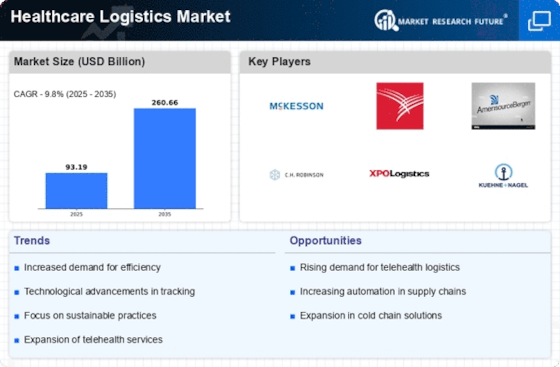
As per MRFR analysis, the Healthcare Logistics Market was estimated at 93.19 USD Billion in 2024. The Healthcare Logistics industry is projected to grow from 102.32 USD Billion in 2025 to 260.66 USD Billion by 2035, exhibiting a compound annual growth rate (CAGR) of 9.8 during the forecast period 2025 - 2035.

Key Market Trends & Highlights

The Healthcare Logistics Market is experiencing a transformative shift towards efficiency and sustainability.

  • Technological integration is reshaping logistics operations, enhancing efficiency and accuracy.
  • Patient-centric approaches are becoming increasingly vital, focusing on improving patient outcomes and satisfaction.
  • North America remains the largest market, while Asia-Pacific is emerging as the fastest-growing region in healthcare logistics.
  • Rising demand for efficient supply chains and regulatory compliance are driving market growth, particularly in the transportation and pharmaceutical products segments.

Market Size & Forecast

2024 Market Size 93.19 (USD Billion)
2035 Market Size 260.66 (USD Billion)
CAGR (2025 - 2035) 9.8%
Largest Regional Market Share in 2024 North America

Major Players

<p>McKesson Corporation (US), Cardinal Health (US), AmerisourceBergen Corporation (US), C.H. Robinson Worldwide, Inc. (US), XPO Logistics, Inc. (US), Kuehne + Nagel International AG (CH), DHL Supply Chain (DE), UPS Supply Chain Solutions (US), FedEx Corporation (US)</p>

Market Trends

The Healthcare Logistics Market is currently experiencing a transformative phase, driven by advancements in technology and an increasing emphasis on efficiency. The integration of automation and digital solutions is reshaping traditional logistics practices, enabling healthcare providers to streamline operations and enhance service delivery. This evolution appears to be fostering a more responsive supply chain, which is crucial for meeting the dynamic demands of the healthcare sector. Furthermore, the growing focus on patient-centric care is prompting logistics providers to adopt innovative strategies that prioritize timely and accurate delivery of medical supplies and pharmaceuticals. In addition, sustainability is emerging as a pivotal consideration within the Healthcare Logistics Market. Stakeholders are increasingly recognizing the importance of environmentally friendly practices, which may lead to the adoption of greener transportation methods and waste reduction initiatives. This shift not only aligns with global sustainability goals but also enhances the reputation of organizations committed to responsible practices. As the market continues to evolve, it seems likely that these trends will shape the future landscape of healthcare logistics, fostering a more efficient, responsive, and sustainable system.

Technological Integration

The incorporation of advanced technologies, such as artificial intelligence and blockchain, is revolutionizing the Healthcare Logistics Market. These innovations facilitate real-time tracking, enhance inventory management, and improve overall operational efficiency.

Patient-Centric Approaches

There is a noticeable shift towards patient-centric logistics strategies. This trend emphasizes the importance of timely delivery and accessibility of medical supplies, ensuring that patient needs are prioritized throughout the supply chain.

Sustainability Initiatives

Sustainability is becoming increasingly vital in the Healthcare Logistics Market. Organizations are exploring eco-friendly practices, such as reducing carbon footprints and minimizing waste, to align with global environmental goals.

Healthcare Logistics Market Market Drivers

Regulatory Compliance and Standards

Regulatory compliance is a significant driver in the Healthcare Logistics Market. The sector is subject to stringent regulations regarding the storage and transportation of medical products. Compliance with these regulations is essential to ensure patient safety and product integrity. Logistics providers must navigate complex regulatory frameworks, which can vary by region and product type. This complexity necessitates the implementation of robust quality management systems and training programs for personnel. As the industry continues to evolve, adherence to these standards will likely become a competitive differentiator, influencing the choice of logistics partners for healthcare organizations.

Technological Advancements in Logistics

Technological advancements play a crucial role in shaping the Healthcare Logistics Market. Innovations such as automation, artificial intelligence, and the Internet of Things are transforming logistics operations. These technologies enable real-time tracking of shipments, predictive analytics for inventory management, and enhanced communication between stakeholders. The integration of these technologies is expected to reduce operational costs and improve service delivery. For instance, the use of automated guided vehicles in warehouses can increase efficiency by up to 30%. As healthcare organizations increasingly adopt these technologies, the logistics sector must evolve to support these advancements, ensuring that the supply chain remains agile and responsive.

Rising Demand for Efficient Supply Chains

The Healthcare Logistics Market experiences a notable increase in demand for efficient supply chains. This demand is driven by the need for timely delivery of medical supplies, pharmaceuticals, and equipment. As healthcare providers strive to enhance patient care, the logistics sector must adapt to ensure that essential products are available when needed. According to recent data, the healthcare logistics market is projected to grow at a compound annual growth rate of approximately 7.5% over the next few years. This growth indicates a shift towards more streamlined operations, where logistics providers are expected to implement advanced tracking systems and inventory management solutions to meet the evolving needs of healthcare facilities.

Increasing Focus on Patient-Centric Logistics

The Healthcare Logistics Market is witnessing a shift towards patient-centric logistics. This approach emphasizes the importance of delivering products and services that prioritize patient needs and experiences. Healthcare providers are increasingly recognizing that efficient logistics can directly impact patient outcomes. For example, timely delivery of medications can significantly enhance treatment efficacy. As a result, logistics providers are adapting their services to align with this focus, offering customized solutions that cater to specific patient requirements. This trend is expected to drive innovation in logistics practices, fostering collaboration between healthcare providers and logistics companies to enhance overall patient care.

Sustainability and Environmental Considerations

Sustainability is becoming an essential consideration in the Healthcare Logistics Market. As environmental concerns grow, healthcare organizations are increasingly seeking logistics solutions that minimize their carbon footprint. This includes optimizing transportation routes, reducing packaging waste, and implementing energy-efficient practices in warehouses. The push for sustainability is not only driven by regulatory pressures but also by consumer demand for environmentally responsible practices. Logistics providers that can demonstrate a commitment to sustainability may gain a competitive edge in the market. As the industry evolves, the integration of sustainable practices into logistics operations will likely become a key factor in shaping future strategies.

Market Segment Insights

By Service: Transportation (Largest) vs. Warehousing (Fastest-Growing)

<p>In the Healthcare Logistics Market, the service segment is primarily divided into two key categories: Transportation and Warehousing. Transportation dominates this segment due to the critical need for timely and safe delivery of medical supplies, pharmaceuticals, and equipment. Efficient transportation solutions ensure that healthcare providers receive necessary materials without delay, which is vital for maintaining patient care. In terms of market presence, transportation continues to hold the largest share, driven by the increasing demand for reliable logistics solutions in the healthcare sector.</p>

<p>Transportation: Dominant vs. Warehousing: Emerging</p>

<p>Transportation services in the healthcare logistics market are characterized by their essential role in ensuring that medical goods reach their destinations promptly and efficiently. This includes a range of solutions such as courier services, freight transportation, and managed transportation services tailored for healthcare requirements. On the other hand, warehousing is recognized as the emerging space within the market, as healthcare organizations increasingly demand specialized storage solutions for their products, especially in response to the surge in e-commerce for pharmaceuticals. Warehousing services are evolving to meet these needs, focusing on temperature control and inventory management, making them crucial in the overall logistics strategy.</p>

By Product: Pharmaceutical Products (Largest) vs. Medical Devices (Fastest-Growing)

<p>In the Healthcare Logistics Market, Pharmaceutical Products hold the largest share, significantly driving the logistics operations. Alongside, Medical Devices have emerged as a rapidly growing segment within this market, reflecting the rising demand for sophisticated healthcare solutions. Medical Equipment also occupies a noteworthy position, offering essential logistical support to healthcare facilities engaged in patient care and treatment. The interplay among these segments shapes the logistics landscape in healthcare, as facilities strategize around their individual needs and operational efficiencies.</p>

<p>Pharmaceutical Products (Dominant) vs. Medical Devices (Emerging)</p>

<p>Pharmaceutical Products dominate the Healthcare Logistics Market due to their critical role in patient treatment and management. This category is characterized by rigorous regulatory requirements and temperature-sensitive shipping needs, impacting how logistics providers operate. Conversely, Medical Devices represent an emerging force, propelled by technological advancements and increasing healthcare investments. These products range from simple items to complex devices requiring specialized handling, ensuring timely delivery and effectiveness. Their growing complexity and value necessitate tailored logistics solutions, making them pivotal in the rapidly evolving healthcare sector.</p>

By Type: Branded Drugs (Largest) vs. Generic Drugs (Fastest-Growing)

<p>In the Healthcare Logistics Market, the segment of Branded Drugs holds a significant share, dominating the landscape due to their established presence and brand loyalty among healthcare providers and patients. Branded medications are often preferred in clinical settings for their perceived reliability and efficacy. In contrast, Generic Drugs, while currently holding a smaller proportion of the market, are rapidly increasing their presence as healthcare systems transition to cost-effective solutions.</p>

<p>Branded Drugs (Dominant) vs. Generic Drugs (Emerging)</p>

<p>Branded Drugs represent the dominant force in the Healthcare Logistics Market, characterized by their higher pricing and established market presence. Their distribution often requires specialized logistics solutions due to regulatory compliance and temperature control requirements. On the other hand, Generic Drugs are emerging as a significant player, benefiting from cost advantages and increasing acceptance by healthcare providers. They often utilize streamlined logistics to expedite delivery and reduce costs, thus appealing to a broader audience. This shift is driven by rising healthcare costs and a growing focus on accessibility, leading to greater investments in logistics solutions tailored to the needs of generic drug transportation.</p>

By End Users: Pharmacies (Largest) vs. Research and Diagnostic Laboratories (Fastest-Growing)

<p>The Healthcare Logistics Market exhibits a varied distribution among its end users, with pharmacies holding the largest share due to their critical role in medication distribution. Healthcare facilities closely follow, as they require efficient logistics for medical supplies and equipment. Research and diagnostic laboratories represent a smaller yet increasingly significant segment, driven by rising investments in healthcare and the need for timely delivery of diagnostic materials. This diverse market structure reflects the unique logistics needs and operational demands of each stakeholder involved in healthcare delivery.</p>

<p>Pharmacies (Dominant) vs. Research and Diagnostic Laboratories (Emerging)</p>

<p>Pharmacies play a dominant role in the Healthcare Logistics Market, leveraging established distribution networks to ensure timely access to medications for patients. Their significance is underscored by the increasing prevalence of chronic diseases and the demand for prescription medications. In contrast, research and diagnostic laboratories are emerging as a vital segment, propelled by advancements in medical technology and heightened focus on research initiatives. These laboratories require specialized logistics solutions to handle sensitive materials and ensure prompt analysis. The differentiation in operational requirements, along with technological advancements, continues to shape the competitive landscape of this segment.</p>

Get more detailed insights about Healthcare Logistics Market Research Report—Global Forecast till 2035

Regional Insights

North America : Healthcare Logistics Market Leader

North America is the largest market for healthcare logistics, holding approximately 40% of the global share. The region's growth is driven by increasing healthcare expenditures, technological advancements, and stringent regulatory frameworks. The demand for efficient supply chain solutions is further fueled by the rise in e-commerce and home healthcare services, making logistics a critical component in healthcare delivery. The United States is the primary player in this market, with significant contributions from Canada. Key players such as McKesson Corporation, Cardinal Health, and AmerisourceBergen dominate the landscape, leveraging advanced technologies and extensive distribution networks. The competitive environment is characterized by strategic partnerships and acquisitions aimed at enhancing service offerings and operational efficiency.

Europe : Emerging Healthcare Logistics Market Hub

Europe is witnessing a significant transformation in healthcare logistics, accounting for approximately 30% of the global market share. The region's growth is propelled by increasing demand for pharmaceuticals, regulatory support for logistics innovations, and a focus on improving patient outcomes. The European Union's initiatives to streamline healthcare supply chains are also contributing to market expansion, enhancing efficiency and compliance. Germany and the United Kingdom are the leading countries in this sector, with a robust presence of key players like DHL Supply Chain and Kuehne + Nagel. The competitive landscape is marked by a mix of established firms and emerging startups, all striving to innovate and meet the evolving needs of the healthcare sector. The emphasis on sustainability and digital transformation is shaping the future of logistics in Europe.

Asia-Pacific : Rapidly Growing Market

Asia-Pacific is rapidly emerging as a key player in the healthcare logistics market, holding around 20% of the global share. The region's growth is driven by rising healthcare demands, increasing investments in healthcare infrastructure, and a growing aging population. Regulatory support for logistics improvements and the expansion of e-commerce are also significant factors contributing to market growth. China and India are the leading countries in this region, with a burgeoning presence of logistics companies. The competitive landscape features both local and international players, including XPO Logistics and FedEx, who are investing in technology and infrastructure to enhance service delivery. The focus on cold chain logistics for pharmaceuticals is particularly critical in this region, given the diverse climate conditions and regulatory requirements.

Middle East and Africa : Emerging Market Potential

The Middle East and Africa region is gradually developing its healthcare logistics market, currently holding about 10% of the global share. The growth is driven by increasing healthcare investments, a rising prevalence of chronic diseases, and government initiatives aimed at improving healthcare infrastructure. Regulatory frameworks are evolving to support logistics advancements, which is crucial for enhancing service delivery in the region. Countries like South Africa and the UAE are at the forefront of this growth, with a mix of local and international logistics providers entering the market. The competitive landscape is characterized by partnerships and collaborations aimed at improving supply chain efficiency. Key players are focusing on technology adoption and capacity building to meet the growing demands of the healthcare sector.

Key Players and Competitive Insights

The Healthcare Logistics Market is currently characterized by a dynamic competitive landscape, driven by the increasing demand for efficient supply chain solutions and the growing complexity of healthcare delivery systems. Major players such as McKesson Corporation (US), Cardinal Health (US), and DHL Supply Chain (DE) are strategically positioning themselves through innovation and partnerships to enhance their operational capabilities. McKesson Corporation (US) focuses on leveraging technology to streamline its logistics processes, while Cardinal Health (US) emphasizes its commitment to sustainability and efficiency in its supply chain operations. DHL Supply Chain (DE) is actively investing in digital transformation initiatives, which collectively shape a competitive environment that prioritizes responsiveness and adaptability to market changes.

The business tactics employed by these companies include localizing manufacturing and optimizing supply chains to meet regional demands. The market appears moderately fragmented, with a mix of large multinational corporations and smaller specialized firms. The collective influence of key players is significant, as they drive advancements in logistics technology and set industry standards that smaller competitors often follow.

In August 2025, McKesson Corporation (US) announced a strategic partnership with a leading telehealth provider to enhance its logistics capabilities in delivering medical supplies directly to patients' homes. This move is indicative of a broader trend towards integrating healthcare logistics with telehealth services, thereby improving patient access and satisfaction. The partnership is likely to bolster McKesson's market position by expanding its service offerings and enhancing its operational efficiency.

In September 2025, Cardinal Health (US) launched a new initiative aimed at reducing carbon emissions across its supply chain. This initiative includes the adoption of electric vehicles and the implementation of energy-efficient practices in its distribution centers. Such actions not only align with global sustainability goals but also position Cardinal Health as a leader in environmentally responsible logistics, potentially attracting clients who prioritize sustainability in their supply chain decisions.

In October 2025, DHL Supply Chain (DE) unveiled a state-of-the-art automated distribution center designed to enhance its operational efficiency and reduce delivery times for healthcare products. This facility incorporates advanced robotics and AI technologies, reflecting a significant investment in digitalization. The strategic importance of this development lies in its potential to improve service levels and reduce costs, thereby reinforcing DHL's competitive edge in the healthcare logistics sector.

As of October 2025, the most prominent trends shaping competition in the Healthcare Logistics Market include digitalization, sustainability, and the integration of artificial intelligence into logistics operations. Strategic alliances are increasingly becoming a cornerstone of competitive strategy, enabling companies to leverage complementary strengths and enhance service offerings. Looking ahead, it is anticipated that competitive differentiation will evolve from traditional price-based competition to a focus on innovation, technological advancements, and the reliability of supply chains, as companies strive to meet the ever-changing demands of the healthcare sector.

Key Companies in the Healthcare Logistics Market market include

Industry Developments

In September 2023, Cipla Limited in conjunction with Skye Air Mobility began drone deliveries. The two partners commenced the campaign in Himachal Pradesh India targeting critical medication's deliveries such as drugs for cardiac and respiratory therapies. It desires to accomplish on-time delivery to remote clinics and chemists while preventing the risks of delays, temperature excursions (higher or lower than normal), and accidents. In April 2023, UPS Healthcare opens its first specialized facility in Giessen Germany.

The first healthcare logistics facility specializes measures 293,000 square foot (27,200 m2), complies with GMP and GDP standards, and incorporates more than 30000 pallet positions for a variety of healthcare products with different temperature including 2C to 8C, 15C to 25C, and minus 20 C degrees. In February 2021, Agility started a service that provides cross-border transportation within the Gulf Region. The service aims to provide FTL and LTL transportation. In December 2020, Agility stated that Maersk selected Agility’s warehouse project in Abidjan, which is 5000 SQM in size, as a warehousing, deconsolidation and distribution center.

It intends to serve the needs of Maersk customers in many sectors. In May 2020, United Parcel Svc. Of America, Inc. announced the enhancement of the company’s healthcare capabilities with the introduction of the new UPS Premier. UPS’s healthcare unit, UPS Premier, focuses on enhancing service dependability, and tracking capability of medical products through cutting-edge technology and tracking features.

Future Outlook

Healthcare Logistics Market Future Outlook

<p>The Healthcare Logistics Market is projected to grow at a 9.8% CAGR from 2024 to 2035, driven by technological advancements, increasing demand for efficient supply chains, and regulatory changes.</p>

New opportunities lie in:

  • <p>Integration of AI-driven inventory management systems</p>
  • <p>Expansion of temperature-controlled logistics solutions</p>
  • <p>Development of blockchain for supply chain transparency</p>

<p>By 2035, the market is expected to be robust, driven by innovation and efficiency.</p>

Market Segmentation

Healthcare Logistics Market Type Outlook

  • Branded Drugs
  • Generic Drugs

Healthcare Logistics Market Product Outlook

  • Pharmaceutical Products
  • Medical Devices
  • Medical Equipment

Healthcare Logistics Market Service Outlook

  • Transportation
  • Warehousing

Healthcare Logistics Market End Users Outlook

  • Pharmacies
  • Healthcare Facilities
  • Research and Diagnostic Laboratories

Report Scope

MARKET SIZE 202493.19(USD Billion)
MARKET SIZE 2025102.32(USD Billion)
MARKET SIZE 2035260.66(USD Billion)
COMPOUND ANNUAL GROWTH RATE (CAGR)9.8% (2024 - 2035)
REPORT COVERAGERevenue Forecast, Competitive Landscape, Growth Factors, and Trends
BASE YEAR2024
Market Forecast Period2025 - 2035
Historical Data2019 - 2024
Market Forecast UnitsUSD Billion
Key Companies ProfiledMarket analysis in progress
Segments CoveredMarket segmentation analysis in progress
Key Market OpportunitiesIntegration of advanced technologies enhances efficiency in the Healthcare Logistics Market.
Key Market DynamicsRising demand for temperature-sensitive shipments drives innovation in healthcare logistics and supply chain management.
Countries CoveredNorth America, Europe, APAC, South America, MEA

FAQs

What is the current valuation of the Healthcare Logistics Market in 2025?

The Healthcare Logistics Market is valued at approximately 93.19 USD Billion in 2024.

What is the projected market size for the Healthcare Logistics Market by 2035?

The market is expected to reach a valuation of 260.66 USD Billion by 2035.

What is the expected CAGR for the Healthcare Logistics Market during the forecast period 2025 - 2035?

The anticipated CAGR for the Healthcare Logistics Market is 9.8% from 2025 to 2035.

Which companies are considered key players in the Healthcare Logistics Market?

Key players include McKesson Corporation, Cardinal Health, and AmerisourceBergen Corporation, among others.

What are the primary segments of the Healthcare Logistics Market?

The primary segments include Service, Product, Type, and End Users.

How much is the Transportation segment projected to be worth by 2035?

The Transportation segment is projected to grow from 40.0 USD Billion to 110.0 USD Billion by 2035.

  1. SECTION I: EXECUTIVE SUMMARY AND KEY HIGHLIGHTS
    1. EXECUTIVE SUMMARY
      1. Market Overview
      2. Key Findings
      3. Market Segmentation
      4. Competitive Landscape
      5. Challenges and Opportunities
      6. Future Outlook
  2. SECTION II: SCOPING, METHODOLOGY AND MARKET STRUCTURE
    1. MARKET INTRODUCTION
      1. Definition
      2. Scope of the study
    2. RESEARCH METHODOLOGY
      1. Overview
      2. Data Mining
      3. Secondary Research
      4. Primary Research
      5. Forecasting Model
      6. Market Size Estimation
      7. Data Triangulation
      8. Validation
  3. SECTION III: QUALITATIVE ANALYSIS
    1. MARKET DYNAMICS
      1. Overview
      2. Drivers
      3. Restraints
      4. Opportunities
    2. MARKET FACTOR ANALYSIS
      1. Value chain Analysis
      2. Porter's Five Forces Analysis
      3. COVID-19 Impact Analysis
  4. SECTION IV: QUANTITATIVE ANALYSIS
    1. Packaging & Transport, BY Service (USD Billion)
      1. Transportation
      2. Warehousing
    2. Packaging & Transport, BY Product (USD Billion)
      1. Pharmaceutical Products
      2. Medical Devices
      3. Medical Equipment
    3. Packaging & Transport, BY Type (USD Billion)
      1. Branded Drugs
      2. Generic Drugs
    4. Packaging & Transport, BY End Users (USD Billion)
      1. Pharmacies
      2. Healthcare Facilities
      3. Research and Diagnostic Laboratories
    5. Packaging & Transport, BY Region (USD Billion)
      1. North America
      2. Europe
      3. APAC
      4. South America
      5. MEA
  5. SECTION V: COMPETITIVE ANALYSIS
    1. Competitive Landscape
      1. Overview
      2. Competitive Analysis
      3. Market share Analysis
      4. Major Growth Strategy in the Packaging & Transport
      5. Competitive Benchmarking
      6. Leading Players in Terms of Number of Developments in the Packaging & Transport
      7. Key developments and growth strategies
      8. Major Players Financial Matrix
    2. Company Profiles
      1. McKesson Corporation (US)
      2. Cardinal Health (US)
      3. AmerisourceBergen Corporation (US)
      4. C.H. Robinson Worldwide, Inc. (US)
      5. XPO Logistics, Inc. (US)
      6. Kuehne + Nagel International AG (CH)
      7. DHL Supply Chain (DE)
      8. UPS Supply Chain Solutions (US)
      9. FedEx Corporation (US)
    3. Appendix
      1. References
      2. Related Reports
  6. LIST OF FIGURES
    1. MARKET SYNOPSIS
    2. NORTH AMERICA MARKET ANALYSIS
    3. US MARKET ANALYSIS BY SERVICE
    4. US MARKET ANALYSIS BY PRODUCT
    5. US MARKET ANALYSIS BY TYPE
    6. US MARKET ANALYSIS BY END USERS
    7. CANADA MARKET ANALYSIS BY SERVICE
    8. CANADA MARKET ANALYSIS BY PRODUCT
    9. CANADA MARKET ANALYSIS BY TYPE
    10. CANADA MARKET ANALYSIS BY END USERS
    11. EUROPE MARKET ANALYSIS
    12. GERMANY MARKET ANALYSIS BY SERVICE
    13. GERMANY MARKET ANALYSIS BY PRODUCT
    14. GERMANY MARKET ANALYSIS BY TYPE
    15. GERMANY MARKET ANALYSIS BY END USERS
    16. UK MARKET ANALYSIS BY SERVICE
    17. UK MARKET ANALYSIS BY PRODUCT
    18. UK MARKET ANALYSIS BY TYPE
    19. UK MARKET ANALYSIS BY END USERS
    20. FRANCE MARKET ANALYSIS BY SERVICE
    21. FRANCE MARKET ANALYSIS BY PRODUCT
    22. FRANCE MARKET ANALYSIS BY TYPE
    23. FRANCE MARKET ANALYSIS BY END USERS
    24. RUSSIA MARKET ANALYSIS BY SERVICE
    25. RUSSIA MARKET ANALYSIS BY PRODUCT
    26. RUSSIA MARKET ANALYSIS BY TYPE
    27. RUSSIA MARKET ANALYSIS BY END USERS
    28. ITALY MARKET ANALYSIS BY SERVICE
    29. ITALY MARKET ANALYSIS BY PRODUCT
    30. ITALY MARKET ANALYSIS BY TYPE
    31. ITALY MARKET ANALYSIS BY END USERS
    32. SPAIN MARKET ANALYSIS BY SERVICE
    33. SPAIN MARKET ANALYSIS BY PRODUCT
    34. SPAIN MARKET ANALYSIS BY TYPE
    35. SPAIN MARKET ANALYSIS BY END USERS
    36. REST OF EUROPE MARKET ANALYSIS BY SERVICE
    37. REST OF EUROPE MARKET ANALYSIS BY PRODUCT
    38. REST OF EUROPE MARKET ANALYSIS BY TYPE
    39. REST OF EUROPE MARKET ANALYSIS BY END USERS
    40. APAC MARKET ANALYSIS
    41. CHINA MARKET ANALYSIS BY SERVICE
    42. CHINA MARKET ANALYSIS BY PRODUCT
    43. CHINA MARKET ANALYSIS BY TYPE
    44. CHINA MARKET ANALYSIS BY END USERS
    45. INDIA MARKET ANALYSIS BY SERVICE
    46. INDIA MARKET ANALYSIS BY PRODUCT
    47. INDIA MARKET ANALYSIS BY TYPE
    48. INDIA MARKET ANALYSIS BY END USERS
    49. JAPAN MARKET ANALYSIS BY SERVICE
    50. JAPAN MARKET ANALYSIS BY PRODUCT
    51. JAPAN MARKET ANALYSIS BY TYPE
    52. JAPAN MARKET ANALYSIS BY END USERS
    53. SOUTH KOREA MARKET ANALYSIS BY SERVICE
    54. SOUTH KOREA MARKET ANALYSIS BY PRODUCT
    55. SOUTH KOREA MARKET ANALYSIS BY TYPE
    56. SOUTH KOREA MARKET ANALYSIS BY END USERS
    57. MALAYSIA MARKET ANALYSIS BY SERVICE
    58. MALAYSIA MARKET ANALYSIS BY PRODUCT
    59. MALAYSIA MARKET ANALYSIS BY TYPE
    60. MALAYSIA MARKET ANALYSIS BY END USERS
    61. THAILAND MARKET ANALYSIS BY SERVICE
    62. THAILAND MARKET ANALYSIS BY PRODUCT
    63. THAILAND MARKET ANALYSIS BY TYPE
    64. THAILAND MARKET ANALYSIS BY END USERS
    65. INDONESIA MARKET ANALYSIS BY SERVICE
    66. INDONESIA MARKET ANALYSIS BY PRODUCT
    67. INDONESIA MARKET ANALYSIS BY TYPE
    68. INDONESIA MARKET ANALYSIS BY END USERS
    69. REST OF APAC MARKET ANALYSIS BY SERVICE
    70. REST OF APAC MARKET ANALYSIS BY PRODUCT
    71. REST OF APAC MARKET ANALYSIS BY TYPE
    72. REST OF APAC MARKET ANALYSIS BY END USERS
    73. SOUTH AMERICA MARKET ANALYSIS
    74. BRAZIL MARKET ANALYSIS BY SERVICE
    75. BRAZIL MARKET ANALYSIS BY PRODUCT
    76. BRAZIL MARKET ANALYSIS BY TYPE
    77. BRAZIL MARKET ANALYSIS BY END USERS
    78. MEXICO MARKET ANALYSIS BY SERVICE
    79. MEXICO MARKET ANALYSIS BY PRODUCT
    80. MEXICO MARKET ANALYSIS BY TYPE
    81. MEXICO MARKET ANALYSIS BY END USERS
    82. ARGENTINA MARKET ANALYSIS BY SERVICE
    83. ARGENTINA MARKET ANALYSIS BY PRODUCT
    84. ARGENTINA MARKET ANALYSIS BY TYPE
    85. ARGENTINA MARKET ANALYSIS BY END USERS
    86. REST OF SOUTH AMERICA MARKET ANALYSIS BY SERVICE
    87. REST OF SOUTH AMERICA MARKET ANALYSIS BY PRODUCT
    88. REST OF SOUTH AMERICA MARKET ANALYSIS BY TYPE
    89. REST OF SOUTH AMERICA MARKET ANALYSIS BY END USERS
    90. MEA MARKET ANALYSIS
    91. GCC COUNTRIES MARKET ANALYSIS BY SERVICE
    92. GCC COUNTRIES MARKET ANALYSIS BY PRODUCT
    93. GCC COUNTRIES MARKET ANALYSIS BY TYPE
    94. GCC COUNTRIES MARKET ANALYSIS BY END USERS
    95. SOUTH AFRICA MARKET ANALYSIS BY SERVICE
    96. SOUTH AFRICA MARKET ANALYSIS BY PRODUCT
    97. SOUTH AFRICA MARKET ANALYSIS BY TYPE
    98. SOUTH AFRICA MARKET ANALYSIS BY END USERS
    99. REST OF MEA MARKET ANALYSIS BY SERVICE
    100. REST OF MEA MARKET ANALYSIS BY PRODUCT
    101. REST OF MEA MARKET ANALYSIS BY TYPE
    102. REST OF MEA MARKET ANALYSIS BY END USERS
    103. KEY BUYING CRITERIA OF PACKAGING & TRANSPORT
    104. RESEARCH PROCESS OF MRFR
    105. DRO ANALYSIS OF PACKAGING & TRANSPORT
    106. DRIVERS IMPACT ANALYSIS: PACKAGING & TRANSPORT
    107. RESTRAINTS IMPACT ANALYSIS: PACKAGING & TRANSPORT
    108. SUPPLY / VALUE CHAIN: PACKAGING & TRANSPORT
    109. PACKAGING & TRANSPORT, BY SERVICE, 2024 (% SHARE)
    110. PACKAGING & TRANSPORT, BY SERVICE, 2024 TO 2035 (USD Billion)
    111. PACKAGING & TRANSPORT, BY PRODUCT, 2024 (% SHARE)
    112. PACKAGING & TRANSPORT, BY PRODUCT, 2024 TO 2035 (USD Billion)
    113. PACKAGING & TRANSPORT, BY TYPE, 2024 (% SHARE)
    114. PACKAGING & TRANSPORT, BY TYPE, 2024 TO 2035 (USD Billion)
    115. PACKAGING & TRANSPORT, BY END USERS, 2024 (% SHARE)
    116. PACKAGING & TRANSPORT, BY END USERS, 2024 TO 2035 (USD Billion)
    117. BENCHMARKING OF MAJOR COMPETITORS
  7. LIST OF TABLES
    1. LIST OF ASSUMPTIONS
    2. North America MARKET SIZE ESTIMATES; FORECAST
      1. BY SERVICE, 2025-2035 (USD Billion)
      2. BY PRODUCT, 2025-2035 (USD Billion)
      3. BY TYPE, 2025-2035 (USD Billion)
      4. BY END USERS, 2025-2035 (USD Billion)
    3. US MARKET SIZE ESTIMATES; FORECAST
      1. BY SERVICE, 2025-2035 (USD Billion)
      2. BY PRODUCT, 2025-2035 (USD Billion)
      3. BY TYPE, 2025-2035 (USD Billion)
      4. BY END USERS, 2025-2035 (USD Billion)
    4. Canada MARKET SIZE ESTIMATES; FORECAST
      1. BY SERVICE, 2025-2035 (USD Billion)
      2. BY PRODUCT, 2025-2035 (USD Billion)
      3. BY TYPE, 2025-2035 (USD Billion)
      4. BY END USERS, 2025-2035 (USD Billion)
    5. Europe MARKET SIZE ESTIMATES; FORECAST
      1. BY SERVICE, 2025-2035 (USD Billion)
      2. BY PRODUCT, 2025-2035 (USD Billion)
      3. BY TYPE, 2025-2035 (USD Billion)
      4. BY END USERS, 2025-2035 (USD Billion)
    6. Germany MARKET SIZE ESTIMATES; FORECAST
      1. BY SERVICE, 2025-2035 (USD Billion)
      2. BY PRODUCT, 2025-2035 (USD Billion)
      3. BY TYPE, 2025-2035 (USD Billion)
      4. BY END USERS, 2025-2035 (USD Billion)
    7. UK MARKET SIZE ESTIMATES; FORECAST
      1. BY SERVICE, 2025-2035 (USD Billion)
      2. BY PRODUCT, 2025-2035 (USD Billion)
      3. BY TYPE, 2025-2035 (USD Billion)
      4. BY END USERS, 2025-2035 (USD Billion)
    8. France MARKET SIZE ESTIMATES; FORECAST
      1. BY SERVICE, 2025-2035 (USD Billion)
      2. BY PRODUCT, 2025-2035 (USD Billion)
      3. BY TYPE, 2025-2035 (USD Billion)
      4. BY END USERS, 2025-2035 (USD Billion)
    9. Russia MARKET SIZE ESTIMATES; FORECAST
      1. BY SERVICE, 2025-2035 (USD Billion)
      2. BY PRODUCT, 2025-2035 (USD Billion)
      3. BY TYPE, 2025-2035 (USD Billion)
      4. BY END USERS, 2025-2035 (USD Billion)
    10. Italy MARKET SIZE ESTIMATES; FORECAST
      1. BY SERVICE, 2025-2035 (USD Billion)
      2. BY PRODUCT, 2025-2035 (USD Billion)
      3. BY TYPE, 2025-2035 (USD Billion)
      4. BY END USERS, 2025-2035 (USD Billion)
    11. Spain MARKET SIZE ESTIMATES; FORECAST
      1. BY SERVICE, 2025-2035 (USD Billion)
      2. BY PRODUCT, 2025-2035 (USD Billion)
      3. BY TYPE, 2025-2035 (USD Billion)
      4. BY END USERS, 2025-2035 (USD Billion)
    12. Rest of Europe MARKET SIZE ESTIMATES; FORECAST
      1. BY SERVICE, 2025-2035 (USD Billion)
      2. BY PRODUCT, 2025-2035 (USD Billion)
      3. BY TYPE, 2025-2035 (USD Billion)
      4. BY END USERS, 2025-2035 (USD Billion)
    13. APAC MARKET SIZE ESTIMATES; FORECAST
      1. BY SERVICE, 2025-2035 (USD Billion)
      2. BY PRODUCT, 2025-2035 (USD Billion)
      3. BY TYPE, 2025-2035 (USD Billion)
      4. BY END USERS, 2025-2035 (USD Billion)
    14. China MARKET SIZE ESTIMATES; FORECAST
      1. BY SERVICE, 2025-2035 (USD Billion)
      2. BY PRODUCT, 2025-2035 (USD Billion)
      3. BY TYPE, 2025-2035 (USD Billion)
      4. BY END USERS, 2025-2035 (USD Billion)
    15. India MARKET SIZE ESTIMATES; FORECAST
      1. BY SERVICE, 2025-2035 (USD Billion)
      2. BY PRODUCT, 2025-2035 (USD Billion)
      3. BY TYPE, 2025-2035 (USD Billion)
      4. BY END USERS, 2025-2035 (USD Billion)
    16. Japan MARKET SIZE ESTIMATES; FORECAST
      1. BY SERVICE, 2025-2035 (USD Billion)
      2. BY PRODUCT, 2025-2035 (USD Billion)
      3. BY TYPE, 2025-2035 (USD Billion)
      4. BY END USERS, 2025-2035 (USD Billion)
    17. South Korea MARKET SIZE ESTIMATES; FORECAST
      1. BY SERVICE, 2025-2035 (USD Billion)
      2. BY PRODUCT, 2025-2035 (USD Billion)
      3. BY TYPE, 2025-2035 (USD Billion)
      4. BY END USERS, 2025-2035 (USD Billion)
    18. Malaysia MARKET SIZE ESTIMATES; FORECAST
      1. BY SERVICE, 2025-2035 (USD Billion)
      2. BY PRODUCT, 2025-2035 (USD Billion)
      3. BY TYPE, 2025-2035 (USD Billion)
      4. BY END USERS, 2025-2035 (USD Billion)
    19. Thailand MARKET SIZE ESTIMATES; FORECAST
      1. BY SERVICE, 2025-2035 (USD Billion)
      2. BY PRODUCT, 2025-2035 (USD Billion)
      3. BY TYPE, 2025-2035 (USD Billion)
      4. BY END USERS, 2025-2035 (USD Billion)
    20. Indonesia MARKET SIZE ESTIMATES; FORECAST
      1. BY SERVICE, 2025-2035 (USD Billion)
      2. BY PRODUCT, 2025-2035 (USD Billion)
      3. BY TYPE, 2025-2035 (USD Billion)
      4. BY END USERS, 2025-2035 (USD Billion)
    21. Rest of APAC MARKET SIZE ESTIMATES; FORECAST
      1. BY SERVICE, 2025-2035 (USD Billion)
      2. BY PRODUCT, 2025-2035 (USD Billion)
      3. BY TYPE, 2025-2035 (USD Billion)
      4. BY END USERS, 2025-2035 (USD Billion)
    22. South America MARKET SIZE ESTIMATES; FORECAST
      1. BY SERVICE, 2025-2035 (USD Billion)
      2. BY PRODUCT, 2025-2035 (USD Billion)
      3. BY TYPE, 2025-2035 (USD Billion)
      4. BY END USERS, 2025-2035 (USD Billion)
    23. Brazil MARKET SIZE ESTIMATES; FORECAST
      1. BY SERVICE, 2025-2035 (USD Billion)
      2. BY PRODUCT, 2025-2035 (USD Billion)
      3. BY TYPE, 2025-2035 (USD Billion)
      4. BY END USERS, 2025-2035 (USD Billion)
    24. Mexico MARKET SIZE ESTIMATES; FORECAST
      1. BY SERVICE, 2025-2035 (USD Billion)
      2. BY PRODUCT, 2025-2035 (USD Billion)
      3. BY TYPE, 2025-2035 (USD Billion)
      4. BY END USERS, 2025-2035 (USD Billion)
    25. Argentina MARKET SIZE ESTIMATES; FORECAST
      1. BY SERVICE, 2025-2035 (USD Billion)
      2. BY PRODUCT, 2025-2035 (USD Billion)
      3. BY TYPE, 2025-2035 (USD Billion)
      4. BY END USERS, 2025-2035 (USD Billion)
    26. Rest of South America MARKET SIZE ESTIMATES; FORECAST
      1. BY SERVICE, 2025-2035 (USD Billion)
      2. BY PRODUCT, 2025-2035 (USD Billion)
      3. BY TYPE, 2025-2035 (USD Billion)
      4. BY END USERS, 2025-2035 (USD Billion)
    27. MEA MARKET SIZE ESTIMATES; FORECAST
      1. BY SERVICE, 2025-2035 (USD Billion)
      2. BY PRODUCT, 2025-2035 (USD Billion)
      3. BY TYPE, 2025-2035 (USD Billion)
      4. BY END USERS, 2025-2035 (USD Billion)
    28. GCC Countries MARKET SIZE ESTIMATES; FORECAST
      1. BY SERVICE, 2025-2035 (USD Billion)
      2. BY PRODUCT, 2025-2035 (USD Billion)
      3. BY TYPE, 2025-2035 (USD Billion)
      4. BY END USERS, 2025-2035 (USD Billion)
    29. South Africa MARKET SIZE ESTIMATES; FORECAST
      1. BY SERVICE, 2025-2035 (USD Billion)
      2. BY PRODUCT, 2025-2035 (USD Billion)
      3. BY TYPE, 2025-2035 (USD Billion)
      4. BY END USERS, 2025-2035 (USD Billion)
    30. Rest of MEA MARKET SIZE ESTIMATES; FORECAST
      1. BY SERVICE, 2025-2035 (USD Billion)
      2. BY PRODUCT, 2025-2035 (USD Billion)
      3. BY TYPE, 2025-2035 (USD Billion)
      4. BY END USERS, 2025-2035 (USD Billion)
    31. PRODUCT LAUNCH/PRODUCT DEVELOPMENT/APPROVAL
    32. ACQUISITION/PARTNERSHIP

Healthcare Logistics Market Segmentation

Healthcare Logistics Service Outlook (USD Billion, 2018-2032)

Transportation

Warehousing

Healthcare Logistics Product Outlook (USD Billion, 2018-2032)

Pharmaceutical Products

Medical Devices

Medical Equipment

Healthcare Logistics Type Outlook (USD Billion, 2018-2032)

Branded Drugs

Generic Drugs

Healthcare Logistics End Users Outlook (USD Billion, 2018-2032)

Pharmacies

Healthcare Facilities

Research and Diagnostic Laboratories

Healthcare Logistics Regional Outlook (USD Billion, 2018-2032)

North America Outlook (USD Billion, 2018-2032)

North America Healthcare Logistics by Service

Transportation

Warehousing

North America Healthcare Logistics by Product

Pharmaceutical Products

Medical Devices

Medical Equipment

North America Healthcare Logistics by Type

Branded Drugs

Generic Drugs

North America Healthcare Logistics by End Users

Pharmacies

Healthcare Facilities

Research and Diagnostic Laboratories

US Outlook (USD Billion, 2018-2032)

US Healthcare Logistics by Service

Transportation

Warehousing

US Healthcare Logistics by Product

Pharmaceutical Products

Medical Devices

Medical Equipment

US Healthcare Logistics by Type

Branded Drugs

Generic Drugs

US Healthcare Logistics by End Users

Pharmacies

Healthcare Facilities

Research and Diagnostic Laboratories

CANADA Outlook (USD Billion, 2018-2032)

CANADA Healthcare Logistics by Service

Transportation

Warehousing

CANADA Healthcare Logistics by Product

Pharmaceutical Products

Medical Devices

Medical Equipment

CANADA Healthcare Logistics by Type

Branded Drugs

Generic Drugs

CANADA Healthcare Logistics by End Users

Pharmacies

Healthcare Facilities

Research and Diagnostic Laboratories

Europe Outlook (USD Billion, 2018-2032)

Europe Healthcare Logistics by Service

Transportation

Warehousing

Europe Healthcare Logistics by Product

Pharmaceutical Products

Medical Devices

Medical Equipment

Europe Healthcare Logistics by Type

Branded Drugs

Generic Drugs

Europe Healthcare Logistics by End Users

Pharmacies

Healthcare Facilities

Research and Diagnostic Laboratories

Germany Outlook (USD Billion, 2018-2032)

Germany Healthcare Logistics by Service

Transportation

Warehousing

Germany Healthcare Logistics by Product

Pharmaceutical Products

Medical Devices

Medical Equipment

Germany Healthcare Logistics by Type

Branded Drugs

Generic Drugs

Germany Healthcare Logistics by End Users

Pharmacies

Healthcare Facilities

Research and Diagnostic Laboratories

France Outlook (USD Billion, 2018-2032)

France Healthcare Logistics by Service

Transportation

Warehousing

France Healthcare Logistics by Product

Pharmaceutical Products

Medical Devices

Medical Equipment

France Healthcare Logistics by Type

Branded Drugs

Generic Drugs

France Healthcare Logistics by End Users

Pharmacies

Healthcare Facilities

Research and Diagnostic Laboratories

UK Outlook (USD Billion, 2018-2032)

UK Healthcare Logistics by Service

Transportation

Warehousing

UK Healthcare Logistics by Product

Pharmaceutical Products

Medical Devices

Medical Equipment

UK Healthcare Logistics by Type

Branded Drugs

Generic Drugs

UK Healthcare Logistics by End Users

Pharmacies

Healthcare Facilities

Research and Diagnostic Laboratories

ITALY Outlook (USD Billion, 2018-2032)

ITALY Healthcare Logistics by Service

Transportation

Warehousing

ITALY Healthcare Logistics by Product

Pharmaceutical Products

Medical Devices

Medical Equipment

ITALY Healthcare Logistics by Type

Branded Drugs

Generic Drugs

ITALY Healthcare Logistics by End Users

Pharmacies

Healthcare Facilities

Research and Diagnostic Laboratories


SPAIN Outlook (USD Billion, 2018-2032)

Spain Healthcare Logistics by Service

Transportation

Warehousing

Spain Healthcare Logistics by Product

Pharmaceutical Products

Medical Devices

Medical Equipment

Spain Healthcare Logistics by Type

Branded Drugs

Generic Drugs

Spain Healthcare Logistics by End Users

Pharmacies

Healthcare Facilities

Research and Diagnostic Laboratories

Rest Of Europe Outlook (USD Billion, 2018-2032)

Rest Of Europe Healthcare Logistics by Service

Transportation

Warehousing

REST OF EUROPE Healthcare Logistics by Product

Pharmaceutical Products

Medical Devices

Medical Equipment

REST OF EUROPE Healthcare Logistics by Type

Branded Drugs

Generic Drugs

REST OF EUROPE Healthcare Logistics by End Users

Pharmacies

Healthcare Facilities

Research and Diagnostic Laboratories

Asia-Pacific Outlook (USD Billion, 2018-2032)

Asia-Pacific Healthcare Logistics by Service

Transportation

Warehousing

Asia-Pacific Healthcare Logistics by Product

Pharmaceutical Products

Medical Devices

Medical Equipment

Asia-Pacific Healthcare Logistics by Type

Branded Drugs

Generic Drugs

Asia-Pacific Healthcare Logistics by End Users

Pharmacies

Healthcare Facilities

Research and Diagnostic Laboratories

China Outlook (USD Billion, 2018-2032)

China Healthcare Logistics by Service

Transportation

Warehousing

China Healthcare Logistics by Product

Pharmaceutical Products

Medical Devices

Medical Equipment

China Healthcare Logistics by Type

Branded Drugs

Generic Drugs

China Healthcare Logistics by End Users

Pharmacies

Healthcare Facilities

Research and Diagnostic Laboratories

Japan Outlook (USD Billion, 2018-2032)

Japan Healthcare Logistics by Service

Transportation

Warehousing

Japan Healthcare Logistics by Product

Pharmaceutical Products

Medical Devices

Medical Equipment

Japan Healthcare Logistics by Type

Branded Drugs

Generic Drugs

Japan Healthcare Logistics by End Users

Pharmacies

Healthcare Facilities

Research and Diagnostic Laboratories

India Outlook (USD Billion, 2018-2032)

India Healthcare Logistics by Service

Transportation

Warehousing

India Healthcare Logistics by Product

Pharmaceutical Products

Medical Devices

Medical Equipment

India Healthcare Logistics by Type

Branded Drugs

Generic Drugs

India Healthcare Logistics by End Users

Pharmacies

Healthcare Facilities

Research and Diagnostic Laboratories

Australia Outlook (USD Billion, 2018-2032)

Australia Healthcare Logistics by Service

Transportation

Warehousing

Australia Healthcare Logistics by Product

Pharmaceutical Products

Medical Devices

Medical Equipment

Australia Healthcare Logistics by Type

Branded Drugs

Generic Drugs

Australia Healthcare Logistics by End Users

Pharmacies

Healthcare Facilities

Research and Diagnostic Laboratories

Rest of Asia-Pacific Outlook (USD Billion, 2018-2032)

Rest of Asia-Pacific Healthcare Logistics by Service

Transportation

Warehousing

Rest of Asia-Pacific Healthcare Logistics by Product

Pharmaceutical Products

Medical Devices

Medical Equipment

Rest of Asia-Pacific Healthcare Logistics by Type

Branded Drugs

Generic Drugs

Rest of Asia-Pacific Healthcare Logistics by End Users

Pharmacies

Healthcare Facilities

Research and Diagnostic Laboratories

Rest of the World Outlook (USD Billion, 2018-2032)

Rest of the World Healthcare Logistics by Service

Transportation

Warehousing

Rest of the World Healthcare Logistics by Product

Pharmaceutical Products

Medical Devices

Medical Equipment

Rest of the World Healthcare Logistics by Type

Branded Drugs

Generic Drugs

Rest of the World Healthcare Logistics by End Users

Pharmacies

Healthcare Facilities

Research and Diagnostic Laboratories

Middle East Outlook (USD Billion, 2018-2032)

Middle East Healthcare Logistics by Service

Transportation

Warehousing

Middle East Healthcare Logistics by Product

Pharmaceutical Products

Medical Devices

Medical Equipment

Middle East Healthcare Logistics by Type

Branded Drugs

Generic Drugs

Middle East Healthcare Logistics by End Users

Pharmacies

Healthcare Facilities

Research and Diagnostic Laboratories

Africa Outlook (USD Billion, 2018-2032)

Africa Healthcare Logistics by Service

Transportation

Warehousing

Africa Healthcare Logistics by Product

Pharmaceutical Products

Medical Devices

Medical Equipment

Africa Healthcare Logistics by Type

Branded Drugs

Generic Drugs

Africa Healthcare Logistics by End Users

Pharmacies

Healthcare Facilities

Research and Diagnostic Laboratories

Latin America Outlook (USD Billion, 2018-2032)

Latin America Healthcare Logistics by Service

Transportation

Warehousing

Latin America Healthcare Logistics by Product

Pharmaceutical Products

Medical Devices

Medical Equipment

Latin America Healthcare Logistics by Type

Branded Drugs

Generic Drugs

Latin America Healthcare Logistics by End Users

Pharmacies

Healthcare Facilities

Research and Diagnostic Laboratories

Infographic

Free Sample Request

Kindly complete the form below to receive a free sample of this Report

Get Free Sample

Customer Strories

Compare Licence

×
Features License Type
Single User Multiuser License Enterprise User
Price $4,950 $5,950 $7,250
Maximum User Access Limit 1 User Upto 10 Users Unrestricted Access Throughout the Organization
Free Customization
Direct Access to Analyst
Deliverable Format
Platform Access
Discount on Next Purchase 10% 15% 15%
Printable Versions