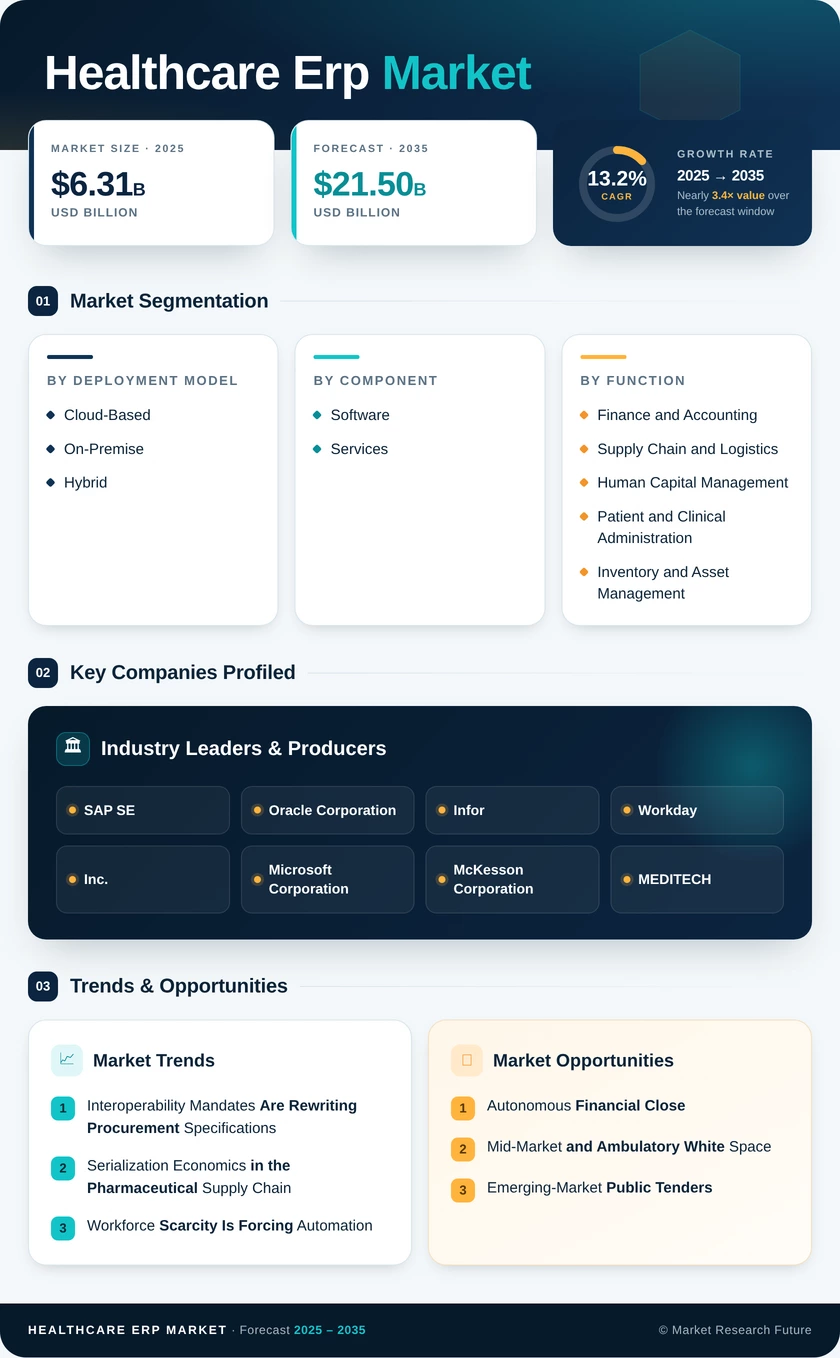
Segmentation Quick Reference
| Dimension | Sub-Segments | Dominant Segment | Fastest Growing Segment |
| By Deployment Model | Cloud-Based, On-Premise, Hybrid | Cloud-Based | Hybrid |
| By Component | Software, Services | Software | Services |
| By Function | Finance and Accounting, Supply Chain and Logistics, Human Capital Management, Patient and Clinical Administration, Inventory and Asset Management, Others | Finance and Accounting | Supply Chain and Logistics |
| By End User | Hospitals, Clinics and Ambulatory Surgical Centers, Pharmaceutical and Biotechnology Companies, Medical Device Manufacturers, Others | Hospitals | Pharmaceutical and Biotechnology Companies |
| By Geography | North America, Europe, Asia-Pacific, South America, Middle East & Africa | North America | Asia-Pacific |
Market Segmentation Overview
By Deployment Model
| Sub-Segment | Key Trend |
| Cloud-Based | Subscription pricing and quarterly release cadence displace multi-year upgrade projects |
| On-Premise | Retained for sovereign hosting mandates and academic medical center integrations |
| Hybrid | Clinical workloads stay local while finance, procurement, and payroll move to public cloud |
Deployment choice has become an architecture decision rather than a cost decision. Hybrid designs win where legal residency rules and legacy interface dependencies coexist, and vendors now price reference architectures rather than raw infrastructure tiers.
By Component
| Sub-Segment | Key Trend |
| Software | Modular licensing with outcome-linked pricing on automation modules |
| Services | Migration, HL7-to-FHIR mapping, and post-go-live optimization retainers |
Software still generates most revenue, yet the services line determines project success. Scarcity of experienced healthcare implementation consultants has become the practical ceiling on how fast the installed base can modernize.
By Function
| Sub-Segment | Key Trend |
| Finance and Accounting | Continuous close replacing periodic reconciliation cycles |
| Supply Chain and Logistics | Serialization, shortage forecasting, and contract-compliance enforcement |
| Human Capital Management | Credentialing automation and contingent-labor cost control |
| Patient and Clinical Administration | Charge-capture accuracy tied to denial reduction |
| Inventory and Asset Management | Implant and device tracking under unique device identification rules |
| Others | Quality reporting, grant accounting, and regulatory submissions |
Functional buying has shifted from suite-wide replacement to module-led entry. Supply chain increasingly serves as the beachhead because its savings case is easiest to quantify and fastest to realize.
By End User
| Sub-Segment | Key Trend |
| Hospitals | Multi-entity consolidation after merger activity |
| Clinics and Ambulatory Surgical Centers | Pre-configured deployments priced for smaller operators |
| Pharmaceutical and Biotechnology Companies | Validated environments with batch genealogy and audit trails |
| Medical Device Manufacturers | Field-inventory visibility and unique device identification compliance |
| Others | Payers, long-term care operators, and diagnostic laboratory networks |
Hospitals remain the revenue anchor, but growth concentrates in adjacent buyers. Life-sciences organizations carry heavier compliance obligations and stronger budgets, making them the most attractive incremental segment through 2035.
By Geography
| Sub-Segment | Key Trend |
| North America | Traceability enforcement and post-merger financial consolidation |
| Europe | Cross-border data standards and sustainability disclosure obligations |
| Asia-Pacific | National digitization programs and cloud-first public tenders |
| South America | Public network inventory reform and currency-hedged contracting |
| Middle East & Africa | Sovereign transformation funding and greenfield hospital deployments |
Regional demand tracks regulatory enforcement more closely than healthcare spending itself. Markets that pair mandates with funding — the Gulf states, Germany, India — convert policy into procurement fastest.

 Noah Malgeri
Co-Founder
Noah Malgeri
Co-Founder

 Peter Groot koerkamp
Account and Business Manager
Peter Groot koerkamp
Account and Business Manager

 Younghwan Choi
Senior Retail Manager
Younghwan Choi
Senior Retail Manager

 Mark Irwin
Management Consultant
Mark Irwin
Management Consultant

 Akif Moroglu
Strategy & Business Development Director
Akif Moroglu
Strategy & Business Development Director

 Guilherme Gomes Martins
Product Management Director
Guilherme Gomes Martins
Product Management Director

 Joseph Aguayo
Sales Operations & Pricing Manager
Joseph Aguayo
Sales Operations & Pricing Manager

 La Terria Dodd
Program Support Specialist
La Terria Dodd
Program Support Specialist

 Rob Kooiker
Group Product Manager HVAC & Fire Protection GMA
Rob Kooiker
Group Product Manager HVAC & Fire Protection GMA