Healthcare Data Storage Market (2026 - 2035)

ID: MRFR/HC/7100-HCR 90 Pages Vikita Thakur Last Updated: September 15, 2026
Healthcare Data Storage Market Research Report Information By Solution (On-Premise, Cloud, and Hybrid Data Storage), By Application (Clinical Analysis, Financial Analysis, and Operational Analysis), By Type (Flash & Solid-State Storage, and Magnetic Storage), By Storage System (Storage Area Network, and Direct-Attached Storage), By End User (Hospitals and Clinics, Pharmaceutical & Biotechnology Companies, CROS, and CMOS), and By Region (North America, Europe, Asia-Pacific, and Rest Of The World) - Growth & Industry Forecast 2025 To 2035
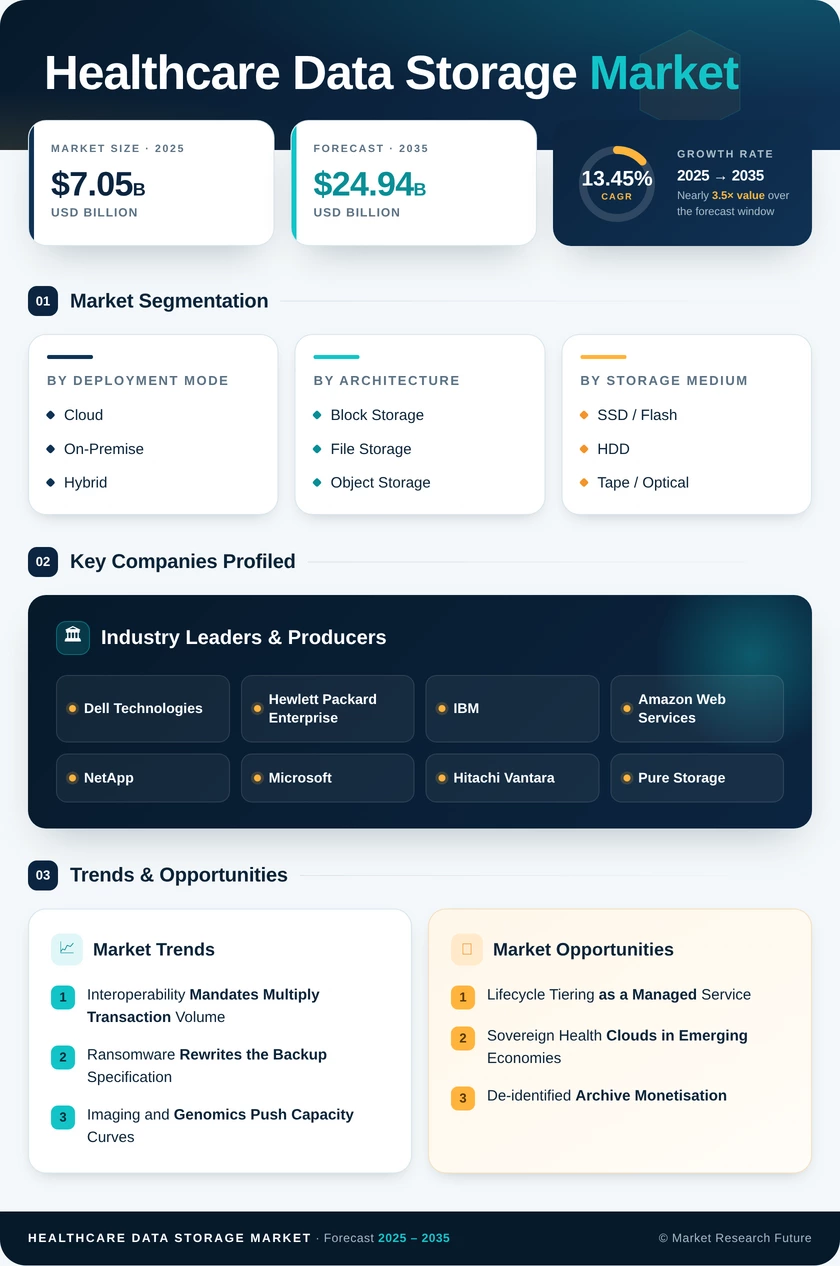
Healthcare Data Storage Market
Market Size
Forecast Period2026-2035
CAGR (2026-2035)13.45%
2025 Market SizeUSD 7.05 Billion
2035 Market SizeUSD 24.94 Billion
Key Players
Dell Technologies
Hewlett Packard Enterprise
IBM
Amazon Web Services
NetApp
Microsoft
Opportunities
  • Lifecycle Tiering as a Managed Service
  • Sovereign Health Clouds in Emerging Economies
  • De-identified Archive Monetisation
  1. 1 Market Overview |
    1. 1.1 Study Assumptions & Market Definition |
    2. 1.2 Scope of the Study |
    3. 1.3 Research Methodology |
    4. 1.4 Market Summary
  2. 2 Key Report Takeaways |
    1. 2.1 Takeaways by Technology |
    2. 2.2 Takeaways by Sector |
    3. 2.3 Takeaways by Geography
  3. 3 Market Size & Forecast (2021–2035) |
    1. 3.1 Historical Market Size (2021–2024) |
    2. 3.2 Base Year Estimate (2025) |
    3. 3.3 Forecast Market Size (2026–2035) |
    4. 3.4 Year-over-Year Growth Analysis
  4. 4 Market Drivers Analysis |
    1. 4.1 Interoperability Mandates & Transaction Volume Growth |
    2. 4.2 Ransomware Exposure & Immutable Backup Investment |
    3. 4.3 Imaging and Genomics Capacity Expansion |
    4. 4.4 Data Residency & Sovereignty Requirements |
    5. 4.5 Driver Impact Matrix
  5. 5 Market Restraints Analysis |
    1. 5.1 Hospital Margin Pressure & Deferred Refresh |
    2. 5.2 Cloud Total Cost of Ownership Volatility |
    3. 5.3 Legacy PACS & VNA Migration Complexity |
    4. 5.4 Restraint Impact Matrix
  6. 6 Market Opportunity Analysis |
    1. 6.1 Lifecycle Tiering as a Managed Service |
    2. 6.2 Sovereign Health Clouds in Emerging Economies |
    3. 6.3 De-identified Archive Monetisation |
    4. 6.4 AI-Ready Data Layers |
    5. 6.5 Ransomware Recovery Guarantees
  7. 7 Regional Analysis |
    1. 7.1 North America | |
      1. 7.1.1 United States | |
      2. 7.1.2 Canada | |
      3. 7.1.3 Mexico |
    2. 7.2 Europe | |
      1. 7.2.1 Germany | |
      2. 7.2.2 United Kingdom | |
      3. 7.2.3 France | |
      4. 7.2.4 Italy | |
      5. 7.2.5 Spain | |
      6. 7.2.6 Nordic Countries | |
      7. 7.2.7 Russia | |
      8. 7.2.8 Rest of Europe |
    3. 7.3 Asia-Pacific | |
      1. 7.3.1 China | |
      2. 7.3.2 India | |
      3. 7.3.3 Japan | |
      4. 7.3.4 South Korea | |
      5. 7.3.5 ASEAN | |
      6. 7.3.6 Rest of Asia-Pacific |
    4. 7.4 South America | |
      1. 7.4.1 Brazil | |
      2. 7.4.2 Argentina | |
      3. 7.4.3 Rest of South America |
    5. 7.5 Middle East & Africa | |
      1. 7.5.1 Saudi Arabia | |
      2. 7.5.2 UAE | |
      3. 7.5.3 South Africa | |
      4. 7.5.4 Egypt | |
      5. 7.5.5 Rest of Middle East & Africa
  8. 8 Future Outlook (2026–2035) |
    1. 8.1 Storage as an AI Substrate |
    2. 8.2 Subscription Economics & Consumption Contracts |
    3. 8.3 Immutability as Procurement Baseline |
    4. 8.4 Sustainability & Energy-Weighted Selection
  9. 9 Segmentation Analysis |
    1. 9.1 By Deployment Mode | |
      1. 9.1.1 On-Premise | |
      2. 9.1.2 Cloud | |
      3. 9.1.3 Hybrid |
    2. 9.2 By Architecture | |
      1. 9.2.1 Block Storage | |
      2. 9.2.2 File Storage | |
      3. 9.2.3 Object Storage |
    3. 9.3 By Storage Medium | |
      1. 9.3.1 HDD | |
      2. 9.3.2 SSD / Flash | |
      3. 9.3.3 Tape / Optical |
    4. 9.4 By End User | |
      1. 9.4.1 Hospitals & Clinics | |
      2. 9.4.2 Diagnostic Labs & Imaging Centres | |
      3. 9.4.3 Pharmaceutical & Biotechnology Companies | |
      4. 9.4.4 Research & Academic Institutes | |
      5. 9.4.5 Payers & Others |
    5. 9.5 By Application | |
      1. 9.5.1 PACS / Enterprise Imaging | |
      2. 9.5.2 EHR/EMR & Clinical Data | |
      3. 9.5.3 Genomics & Bioinformatics | |
      4. 9.5.4 Analytics, AI & Research | |
      5. 9.5.5 Administrative & Claims
  10. 10 Competitive Landscape |
    1. 10.1 Market Concentration Analysis |
    2. 10.2 Competitive Benchmarking Matrix |
    3. 10.3 Company Profiles | |
      1. 10.3.1 Dell Technologies | |
      2. 10.3.2 Hewlett Packard Enterprise | |
      3. 10.3.3 IBM | |
      4. 10.3.4 Amazon Web Services | |
      5. 10.3.5 NetApp | |
      6. 10.3.6 Microsoft | |
      7. 10.3.7 Hitachi Vantara | |
      8. 10.3.8 Pure Storage | |
      9. 10.3.9 Google Cloud | |
      10. 10.3.10 Oracle | |
      11. 10.3.11 Fujifilm Healthcare
  11. 11 Recent News & Developments
  12. 12 Report Scope & Methodology |
    1. 12.1 Study Period & Base Year |
    2. 12.2 Estimation Framework |
    3. 12.3 Abbreviations
  13. 13 Detailed Sources & Citations
  14. 14 Frequently Asked Questions
  15. 15 LIST OF TABLES |
  16. TABLE 1 Global Healthcare Data Storage Market Size & Forecast, by Revenue (USD Billion), 2021–2035 |
  17. TABLE 2 Global Healthcare Data Storage Market – Year-over-Year Growth Analysis, 2021–2035 |
  18. TABLE 3 Driver Impact Matrix – Estimated Contribution to CAGR, 2026–2035 |
  19. TABLE 4 Restraint Impact Matrix – Estimated Drag on CAGR, 2026–2035 |
  20. TABLE 5 Global Healthcare Data Storage Market Size, by Region, 2021–2035 (USD Billion) |
  21. TABLE 6 North America Healthcare Data Storage Market Size, by Country, 2021–2035 (USD Billion) |
  22. TABLE 7 Europe Healthcare Data Storage Market Size, by Country, 2021–2035 (USD Billion) |
  23. TABLE 8 Asia-Pacific Healthcare Data Storage Market Size, by Country, 2021–2035 (USD Billion) |
  24. TABLE 9 South America Healthcare Data Storage Market Size, by Country, 2021–2035 (USD Billion) |
  25. TABLE 10 Middle East & Africa Healthcare Data Storage Market Size, by Country, 2021–2035 (USD Billion) |
  26. TABLE 11 Global Market Size, by Deployment Mode, 2021–2035 (USD Billion) |
  27. TABLE 12 Global Market Size, by Architecture, 2021–2035 (USD Billion) |
  28. TABLE 13 Global Market Size, by Storage Medium, 2021–2035 (USD Billion) |
  29. TABLE 14 Global Market Size, by End User, 2021–2035 (USD Billion) |
  30. TABLE 15 Global Market Size, by Application, 2021–2035 (USD Billion) |
  31. TABLE 16 Regional Investment Themes Summary, 2025 |
  32. TABLE 17 Competitive Benchmarking Matrix, 2026 |
  33. TABLE 18 Company Profiles – Key Players |
  34. TABLE 19 Recent Developments & Strategic Announcements, 2023–2025 |
  35. TABLE 20 Report Scope & Methodology Summary |
  36. TABLE 21 Detailed Sources & Citations Index
  37. 16 LIST OF FIGURES |
  38. FIGURE 1 Market Dynamics Overview – Drivers, Restraints, and Opportunities |
  39. FIGURE 2 Industry Value Chain Analysis – Healthcare Data Storage |
  40. FIGURE 3 Porter's Five Forces Analysis |
  41. FIGURE 4 Global Market Size Trend & Forecast, 2021–2035 (USD Billion) |
  42. FIGURE 5 Year-over-Year Growth Curve, 2022–2035 (%) |
  43. FIGURE 6 Market Share by Deployment Mode, 2025 vs 2035 (%) |
  44. FIGURE 7 Market Share by Architecture, 2025 (%) |
  45. FIGURE 8 Market Share by Storage Medium, 2025 (%) |
  46. FIGURE 9 Market Share by End User, 2025 (%) |
  47. FIGURE 10 Market Share by Application, 2025 (%) |
  48. FIGURE 11 Regional Market Share Distribution, 2025 (%) |
  49. FIGURE 12 Regional CAGR Comparison, 2026–2035 (%) |
  50. FIGURE 13 Country-Level Revenue Heat Map, 2025 |
  51. FIGURE 14 Competitive Landscape Positioning Quadrant, 2026 |
  52. FIGURE 15 Top-5 Vendor Share Concentration Trend, 2021–2026

Segmentation Quick Reference

DimensionSub-SegmentsDominant SegmentFastest Growing Segment
By Deployment ModeOn-Premise, Cloud, HybridCloudCloud
By ArchitectureBlock Storage, File Storage, Object StorageBlock StorageFile Storage
By Storage MediumHDD, SSD/Flash, Tape/OpticalSSD / FlashHDD
By End UserHospitals & Clinics, Diagnostic Labs & Imaging Centres, Pharmaceutical & Biotechnology Companies, Research & Academic Institutes, Payers & OthersHospitals & ClinicsPharmaceutical & Biotechnology Companies
By ApplicationPACS/Enterprise Imaging, EHR/EMR & Clinical Data, Genomics & Bioinformatics, Analytics AI & Research, Administrative & ClaimsPACS / Enterprise ImagingEHR/EMR & Clinical Data
By RegionNorth America, Europe, Asia-Pacific, South America, Middle East & AfricaNorth AmericaAsia-Pacific


Market Segmentation Overview

By Deployment Mode

Sub-SegmentKey Trend
On-PremiseRetained for latency-sensitive clinical systems and jurisdictions without local cloud regions
CloudDefault choice for new imaging archives, analytics, and disaster recovery workloads
HybridFastest-adopted operating model in large integrated delivery networks balancing residency and elasticity


Deployment choice has stopped being ideological. Most health systems now run a split estate deliberately, keeping active clinical data close and pushing everything older than twelve months to remote tiers under automated policy.

By Architecture

Sub-SegmentKey Trend
Block StorageAnchored to transactional EHR and database workloads with strict IOPS requirements
File StorageExpanding rapidly with digital pathology, research shares, and departmental unstructured data
Object StoragePreferred substrate for long-horizon archives, API-based retrieval, and immutable retention


Architecture decisions increasingly follow data type rather than departmental habit. The practical outcome is three tiers in most estates, with object absorbing the majority of raw capacity while block absorbs the majority of spend.

By Storage Medium

Sub-SegmentKey Trend
HDDCost-per-terabyte workhorse for warm archives and emerging-market deployments
SSD / FlashStandard for production clinical tiers and AI training pipelines
Tape / OpticalReturning to favour for air-gapped compliance copies and energy-efficient deep archive


Media strategy is now written as a tiering policy rather than a purchase decision. Energy cost per terabyte has entered the evaluation criteria for the first time, which measurably improves the case for tape at the coldest tier.

By End User

Sub-SegmentKey Trend
Hospitals & ClinicsLargest buyer group, constrained by operating margins and long refresh cycles.
Diagnostic Labs & Imaging CentresStudy volume growth drives steady archive expansion and referral sharing needs.
Pharmaceutical & Biotechnology CompaniesFastest growth, driven by multi-decade trial retention and sequencing throughput
Research & Academic InstitutesReproducibility mandates extend retention horizons well beyond project funding
Payers & OthersAPI compliance and audit immutability reshape claims archive requirements


Buying behaviour diverges sharply across these groups. Providers optimise for cost and continuity; life sciences buyers optimise for throughput and provenance, and they will pay premiums that no hospital finance committee would approve.

By Application

Sub-SegmentKey Trend
PACS / Enterprise ImagingLargest application by revenue, consolidating from departmental silos into vendor-neutral archives
EHR/EMR & Clinical DataFastest growth as interoperability rules multiply exchange transactions and audit records.
Genomics & BioinformaticsVery large file sizes and long retention make object and hybrid cloud the default.
Analytics, AI & ResearchEmerging demand for accelerator-adjacent storage with lineage and versioning built in
Administrative & ClaimsPrior-authorization audit trails create new, legally defined retention obligations.


Application mix explains most of the variance between national markets. Where imaging density is high, PACS dominates spend; where digital health mandates are new, clinical records and claims archives grow from a much smaller base at far higher rates.




Download PDF ×

We do not share your information with anyone. However, we may send you emails based on your report interest from time to time. You may contact us at any time to opt-out.