×
Request Free Sample ×

Kindly complete the form below to receive a free sample of this Report

* Please use a valid business email

Leading companies partner with us for data-driven Insights

clients tt-cursor
Hero Background
English
Chinese
French
Japanese
Korean
German
Spanish

Healthcare Cloud Computing Market Analysis

ID: MRFR/HCIT/5057-HCR
100 Pages
Rahul Gotadki
February 2026

Healthcare Cloud Computing Market Research Report By Deployment Model (Public Cloud, Private Cloud, Hybrid Cloud), By Service Model (Infrastructure as a Service, Platform as a Service, Software as a Service), By Application (Electronic Health Records, Medical Imaging, Patient Management), By End User (Healthcare Providers, Healthcare Payers, Pharmaceutical Companies) and By Regional (North America, Europe, South America, Asia Pacific, Middle East and Africa) - Growth & Industry Forecast 2025 To 2035

Share:
Download PDF ×

We do not share your information with anyone. However, we may send you emails based on your report interest from time to time. You may contact us at any time to opt-out.

Healthcare Cloud Computing Market Infographic
Purchase Options

Market Analysis

In-depth Analysis of Healthcare Cloud Computing Market Industry Landscape

The Healthcare Cloud Computing market is experiencing rapid adoption as healthcare providers embrace cloud-based solutions to enhance their operational efficiency and data management. The move to cloud computing facilitates better availability, flexibility, and economy in handling colossal volumes of health-related data. Although the market for Healthcare Cloud Computing has considerably adopted, data security remains a leading challenge. In order to comply with the industry’s stringent regulatory requirements, providers spend tremendous amounts of money on complex encryption, secure authentication and compliance measures. Cloud computing as a viable cost-effective alternative for healthcare organization this would reduce physical infrastructures and maintenance costs. The pay-as-you go approach enables providers to respond dynamically to demand by expanding the level of their resources, thereby reducing operational costs and fostering financial stability. It is the need for interoperability that has triggered amalgamation of healthcare cloud solutions with current utilities. Through the use of cloud computing, patient data can be shared consistently across various departments and health facilities which leads to collaborative care that eventually benefits patients positively. The increased growth of telehealth services has further fuelled the development of Healthcare Cloud Computing. Cloud-based platforms enable remote consultations, data sharing and real time collaboration which translates to efficient delivery of care that is accessible to patients regardless where they are. Cloud computing is an integral part of Health Information Exchange initiatives. Cloud-based platforms allow for a secure and standardized sharing of patient data among clinicians, increasing the continuity of care and decreasing redundant diagnostic tests. For personalized patient care, predictive analytics and population health management cloud computing provides the required infrastructure for processing enormous datasets that leads to meaningful results. HIPAA and other regulatory frameworks pose notable challenges in terms of adherence among healthcare cloud providers. Market dynamics include persistent efforts to create solutions meeting the required regulations, data security and legality. The number of edge computing in the healthcare cloud setting is significant. Edge computing enables data processing nearer to the source and thereby lowers latency as well as improves real-time capabilities. This is especially important in healthcare situations where timely availability of vital information plays a very critical role.

The global healthcare cloud computing market is growing by the wide spread of providers’ services to international health care systems. This globalization is primarily led by the need for standardized and interoperable solutions, which ensured effective collaboration of healthcare organizations on a worldwide scale. To overcoming the change resistance and ensuring seamless implementation of healthcare cloud computing, education and training initiatives are undertaken by providers. These programs aim to familiarize healthcare professionals with the functionalities of cloud-based systems, ensuring optimal utilization and promoting a culture of continuous learning.


Author
Rahul Gotadki
Research Manager

He holds an experience of about 9+ years in Market Research and Business Consulting, working under the spectrum of Life Sciences and Healthcare domains. Rahul conceptualizes and implements a scalable business strategy and provides strategic leadership to the clients. His expertise lies in market estimation, competitive intelligence, pipeline analysis, customer assessment, etc.

Leave a Comment

FAQs

What is the projected market valuation of the Healthcare Cloud Computing Market by 2035?

<p>The projected market valuation for the Healthcare Cloud Computing Market by 2035 is 96.85 USD Billion.</p>

What was the market valuation of the Healthcare Cloud Computing Market in 2024?

<p>The overall market valuation of the Healthcare Cloud Computing Market was 28.39 USD Billion in 2024.</p>

What is the expected CAGR for the Healthcare Cloud Computing Market during the forecast period 2025 - 2035?

<p>The expected CAGR for the Healthcare Cloud Computing Market during the forecast period 2025 - 2035 is 11.8%.</p>

Which deployment model segment is projected to have the highest valuation by 2035?

<p>The Public Cloud segment is projected to reach 35.0 USD Billion by 2035.</p>

What are the key service models in the Healthcare Cloud Computing Market?

<p>The key service models include Infrastructure as a Service, Platform as a Service, and Software as a Service.</p>

How much is the Software as a Service segment expected to be valued at by 2035?

<p>The Software as a Service segment is expected to be valued at 41.85 USD Billion by 2035.</p>

Which end user segment is anticipated to dominate the market by 2035?

<p>The Healthcare Providers segment is anticipated to dominate the market, reaching 35.0 USD Billion by 2035.</p>

What is the projected valuation for the Hybrid Cloud segment by 2035?

<p>The Hybrid Cloud segment is projected to reach 31.85 USD Billion by 2035.</p>

Who are the leading players in the Healthcare Cloud Computing Market?

<p>Key players in the market include Amazon Web Services, Microsoft Azure, Google Cloud, and IBM Cloud.</p>

What is the expected valuation for the Electronic Health Records application by 2035?

<p>The Electronic Health Records application is expected to be valued at 35.0 USD Billion by 2035.</p>

Market Summary

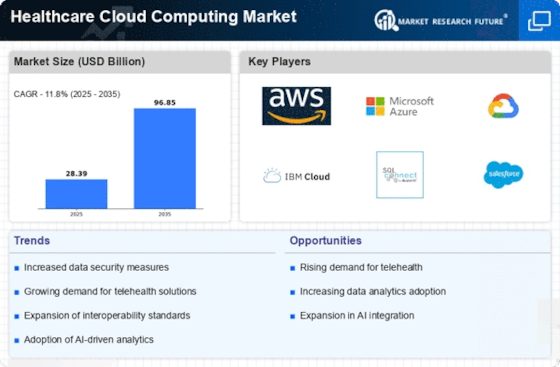
As per MRFR analysis, the Healthcare Cloud Computing Market size was valued at USD 28.39 Billion in 2024. The market is projected to grow from USD 31.74 Billion in 2025 to USD 96.85 Billion by 2035, exhibiting a CAGR of 11.8% during the forecast period 2025-2035. North America dominated the Healthcare Cloud Computing Market with the largest revenue share of 45% in 2024.

Key Market Trends & Highlights

The Healthcare Cloud Computing Market is experiencing robust growth driven by technological advancements and increasing demand for efficient healthcare solutions.

  • North America remains the largest market for healthcare cloud computing, driven by advanced infrastructure and high adoption rates. The Asia-Pacific region is emerging as the fastest-growing market, fueled by increasing investments in healthcare technology and digital transformation. The Public Cloud segment dominates the market, while the Hybrid Cloud segment is witnessing rapid growth due to its flexibility and scalability. Key market drivers include the rising demand for remote patient monitoring and the need for regulatory compliance and data security.

Market Size & Forecast

2024 Market Size 28.39 (USD Billion)
2035 Market Size 96.85 (USD Billion)
CAGR (2025 - 2035) 11.8%
Largest Regional Market Share in 2024 North America

Major Players

Amazon Web Services (US), Microsoft Azure (US), Google Cloud (US), IBM Cloud (US), Oracle Cloud (US), Salesforce (US), Cerner Corporation (US), Allscripts Healthcare Solutions (US), Philips Healthcare (NL), McKesson Corporation (US)

Market Trends

The healthcare cloud computing market size expansion is currently experiencing a transformative phase, driven by the increasing demand for efficient data management and enhanced patient care. Organizations are increasingly adopting healthcare cloud solutions to streamline operations, improve accessibility, and facilitate collaboration among healthcare professionals. This shift appears to be influenced by the need for real-time data sharing and the integration of advanced technologies such as artificial intelligence and machine learning.

As medical cloud computing service providers seek to optimize their services, the cloud offers a flexible and scalable infrastructure that can adapt to evolving needs. Moreover, the ongoing emphasis on data security and compliance with regulatory standards is shaping the landscape of the Healthcare Cloud Computing Market. Providers are investing in robust security measures to protect sensitive patient information while ensuring adherence to guidelines.

This focus on security, coupled with the potential for cost savings and improved operational efficiency, suggests that cloud computing and healthcare will continue to play a pivotal role in the future of medical industry. As the Healthcare Cloud Computing Market evolves, stakeholders must remain vigilant to emerging trends and challenges that could impact the adoption and implementation of cloud technologies in healthcare settings.

Increased Adoption of Telehealth Solutions

The trend towards telehealth solutions is gaining momentum within the Healthcare Cloud Computing Market. As healthcare providers seek to enhance patient engagement and accessibility, telehealth platforms are increasingly integrated into cloud infrastructures. This integration allows for seamless communication between patients and providers, facilitating remote consultations and monitoring.

Focus on Data Security and Compliance

A heightened emphasis on data security and compliance is evident in the Healthcare Cloud Computing Market. Organizations are prioritizing the implementation of advanced security protocols to safeguard sensitive patient information. Compliance with regulations is becoming a critical factor in the selection of cloud service providers.

Integration of Artificial Intelligence and Analytics

The incorporation of artificial intelligence and analytics into healthcare cloud solutions is transforming the Healthcare Cloud Computing Market. These technologies enable healthcare organizations to derive actionable insights from vast amounts of data, improving decision-making processes and enhancing patient outcomes.

Healthcare Cloud Computing Market Market Drivers

Cost Efficiency and Scalability

Cost efficiency remains a pivotal driver in the Healthcare Cloud Computing Market. Healthcare organizations are increasingly recognizing the financial benefits of cloud solutions, which eliminate the need for extensive on-premises infrastructure. By leveraging cloud computing, institutions can reduce operational costs while ensuring scalability to meet fluctuating demands.
 
Reports indicate that healthcare organizations can save up to 30% on IT expenditures by migrating to cloud-based systems. This financial incentive, coupled with the ability to scale resources as needed, positions cloud computing as an attractive option for healthcare providers aiming to optimize their operations and enhance service delivery.

Integration of Advanced Technologies

The integration of advanced technologies is a key driver in the Healthcare Cloud Computing Market. Innovations such as artificial intelligence, machine learning, and big data analytics are increasingly being incorporated into cloud solutions, enhancing their functionality and effectiveness. These technologies enable healthcare providers to analyze vast amounts of data, derive actionable insights, and improve decision-making processes.
 
The market for AI in healthcare is projected to reach substantial figures in the coming years, indicating a strong trend towards leveraging technology to enhance patient care. As healthcare organizations recognize the potential of these advanced technologies, the adoption of cloud computing solutions is expected to accelerate, further transforming the healthcare landscape.

Enhanced Collaboration and Data Sharing

The Healthcare Cloud Computing Market is significantly influenced by the need for enhanced collaboration and data sharing among healthcare stakeholders. Cloud platforms facilitate seamless communication between providers, patients, and payers, fostering a more integrated approach to care. This collaborative environment is essential for improving care coordination and ensuring that all parties have access to up-to-date patient information.
 
As a result, healthcare organizations are increasingly adopting cloud solutions to break down data silos and promote interoperability. The ability to share data securely and efficiently is expected to drive the adoption of cloud computing solutions, thereby enhancing overall healthcare delivery.

Regulatory Compliance and Data Security

Regulatory compliance and data security are paramount concerns within the Healthcare Cloud Computing Market. As healthcare organizations transition to cloud-based solutions, they must navigate complex regulations governing patient data protection. Cloud providers are increasingly offering solutions that comply with stringent regulations, such as HIPAA, ensuring that sensitive patient information is safeguarded.
 
The emphasis on data security is likely to drive the adoption of cloud computing, as organizations seek to mitigate risks associated with data breaches. Furthermore, the market is witnessing a rise in demand for cloud solutions that incorporate advanced security features, indicating a growing awareness of the importance of protecting patient data.

Rising Demand for Remote Patient Monitoring

The Healthcare Cloud Computing Market is experiencing a notable surge in demand for remote patient monitoring solutions. This trend is driven by the increasing prevalence of chronic diseases and the need for continuous patient engagement. As healthcare providers seek to enhance patient outcomes, cloud-based platforms facilitate real-time data collection and analysis, enabling timely interventions.
 
According to recent estimates, the remote patient monitoring segment is projected to grow at a compound annual growth rate of over 25% in the coming years. This growth underscores the critical role of cloud computing in supporting healthcare providers in delivering efficient and effective care, thereby transforming the patient experience.

Market Segment Insights

By Deployment Model: Public Cloud (Largest) vs. Hybrid Cloud (Fastest-Growing)

The Healthcare Cloud Computing Market has shown a diverse distribution among its deployment models. The Public Cloud currently holds the largest market share due to its cost-effectiveness, scalability, and ease of access, making it a preferred choice for many healthcare organizations. In contrast, the Hybrid Cloud is rapidly gaining traction as it combines the benefits of both public and private infrastructures, catering to the specific compliance and security needs of healthcare providers and facilitating the handling of sensitive patient data more efficiently.

Public Cloud (Dominant) vs. Hybrid Cloud (Emerging)

The Public Cloud represents the dominant deployment model in cloud computing and healthcare, largely due to its affordability and straightforward integration into existing systems. Healthcare organizations leverage public healthcare cloud services for data storage and analytics, benefiting from enhanced collaboration and flexibility. On the other hand, the Hybrid Cloud model is emerging as a leading choice for many organizations requiring a blend of public and private resources. This model allows for improved data security and compliance with regulations while also taking advantage of the scalability and cost-effectiveness of public resources, positioning it increasingly favorably in the Healthcare Cloud Computing Market.

By Service Model: Software as a Service (Largest) vs. Infrastructure as a Service (Fastest-Growing)

In the Healthcare Cloud Computing Market, Software as a Service (SaaS) commands the largest share, owing to its comprehensive solutions that cater to a variety of healthcare cloud applications. It has become the preferred choice for many healthcare organizations due to its user-friendly interfaces, reduced IT burden, and immediate updates without the need for manual software installations. On the other hand, Infrastructure as a Service (IaaS) is gaining traction, presenting itself as the fastest-growing segment, providing healthcare organizations with scalable resources that meet fluctuating demand while reducing upfront capital investments.

SaaS (Dominant) vs. IaaS (Emerging)

The Software as a Service (SaaS) segment dominates the market share, offering tailored healthcare cloud applications for various needs such as <a title="electronic health records" href="https://www.marketresearchfuture.com/reports/electronic-health-records-market-66597" target="_blank" rel="noopener">electronic health records</a> (EHR), telemedicine, and patient management systems. Its model reduces the complexity of IT management, allowing healthcare providers to focus on patient care rather than infrastructure concerns. Conversely, Infrastructure as a Service (IaaS) is emerging as a vital player, offering flexible and scalable computing power that allows healthcare organizations to rapidly adapt to changing workloads and ensure compliance with industry standards. This flexibility, coupled with cost efficiency, positions IaaS as an attractive option for organizations looking to optimize their operational expenses while enhancing service delivery.

By Application: Electronic Health Records (Largest) vs. Medical Imaging (Fastest-Growing)

In the Healthcare Cloud Computing Market, Electronic Health Records (EHR) represent the largest share, significantly outperforming other healthcare cloud applications such as <a title="medical imaging" href="https://www.marketresearchfuture.com/reports/medical-imaging-market-1995" target="_blank" rel="noopener">Medical Imaging</a> and Patient Management. EHR systems are integral to modern healthcare, facilitating seamless access to patient data and enhancing communication among healthcare providers. In contrast, Medical Imaging, while smaller in market share, is projected to experience rapid growth, driven by increasing needs for advanced diagnostic solutions and integration with cloud systems. Growth trends in this segment are further propelled by the rising demand for interoperability and scalability within healthcare organizations. The shift towards value-based care is emphasizing the need for comprehensive patient management solutions, which encompass not only EHR but also innovative Medical Imaging solutions. The increasing adoption of telehealth and remote patient monitoring technologies is expanding the scope of patient management healthcare cloud applications, making them essential for modern healthcare delivery.

EHR (Dominant) vs. Medical Imaging (Emerging)

Electronic Health Records (EHR) play a dominant role in the market share, serving as a backbone for patient data management and facilitating enhanced clinical workflows. EHR solutions prioritize patient safety, streamline administrative tasks, and improve overall healthcare delivery. Their established position in various healthcare settings makes them indispensable. In contrast, Medical Imaging is emerging rapidly, utilizing cloud technology to improve the storage, sharing, and analysis of imaging data. With increasing advancements in AI and machine learning integration, Medical Imaging solutions are evolving to provide better diagnostic support, ultimately enhancing healthcare outcomes. The shift towards cloud-based infrastructure is enabling flexibility and cost-effectiveness, allowing healthcare providers to leverage these technologies for improved patient care.

By End User: Healthcare Providers (Largest) vs. Pharmaceutical Companies (Fastest-Growing)

In the Healthcare Cloud Computing Market, Healthcare Providers dominate the segment, representing the largest share among various end users. This includes hospitals, clinics, and other healthcare institutions that rely heavily on healthcare cloud solutions to enhance patient care, manage medical records, and optimize operational efficiencies. Healthcare Payers, including insurance companies, also play a significant role, but their share is comparatively less than that of Healthcare Providers. <a title="pharmaceutical" href="https://www.marketresearchfuture.com/reports/pharmaceutical-market-67551" target="_blank" rel="noopener">Pharmaceutical</a> Companies are emerging as a crucial segment, leveraging cloud computing for healthcare research, drug development, and compliance management, contributing positively to Healthcare Cloud Computing Market dynamics.

Healthcare Providers (Dominant) vs. Pharmaceutical Companies (Emerging)

Healthcare Providers are a dominant force in the market share, as they continuously seek innovative solutions to streamline their operations and enhance patient outcomes. Their reliance on cloud computing for Electronic Health Records (EHR), telemedicine, and analytics solidifies their market position. In contrast, Pharmaceutical Companies are an emerging segment that utilizes cloud technology for accelerated drug discovery and development, leveraging big data analytics and artificial intelligence. As regulatory pressures rise and the need for collaboration intensifies, the pharmaceutical sector's adoption of healthcare cloud solutions is expected to soar, marking a significant shift in the Healthcare Cloud Computing Market.

Get more detailed insights about Healthcare Cloud Computing Market Research Report – Forecast to 2035

Regional Insights

North America : Leading Innovation and Adoption

North America dominated the global Healthcare Cloud Computing Market in 2024, reaching a market size of USD 12.8 billion. The region's growth is driven by increasing demand for digital health solutions, regulatory support for cloud adoption, and the need for cost-effective healthcare delivery. The presence of major cloud based healthcare companies like Amazon Web Services and Microsoft Azure further fuels this growth, supported by favorable government policies promoting healthcare IT advancements.

The United States is the leading country in this region, with a robust competitive landscape featuring key cloud based healthcare companies such as IBM Cloud and Cerner Corporation. The market is characterized by rapid technological advancements and a strong focus on data security and compliance. Canada also plays a significant role, contributing to the overall growth with its emphasis on healthcare innovation and cloud integration, making North America a hub for healthcare cloud solutions.

Europe : Emerging Market with Growth Potential

Europe is witnessing significant growth in the healthcare cloud computing market, accounting for approximately 30% of the global share. The region's expansion is driven by increasing investments in digital health technologies, regulatory frameworks supporting cloud solutions, and a growing emphasis on patient-centric care. Countries like Germany and the UK are at the forefront, implementing policies that encourage the adoption of cloud-based healthcare solutions to enhance service delivery and operational efficiency.

Germany leads the European healthcare cloud infrastructure market, followed closely by the UK, both fostering a competitive environment for cloud service providers. Key players such as Philips Healthcare and Oracle Cloud are actively expanding their presence in the region. The competitive landscape is marked by collaborations between healthcare providers and healthcare cloud technology firms, aimed at leveraging cloud solutions for improved patient outcomes. The European healthcare cloud based analytics market is poised for further growth as regulatory bodies continue to support digital transformation in healthcare.

Asia-Pacific : Rapid Growth and Adoption

Asia-Pacific is rapidly emerging as a significant player in the healthcare cloud computing market, holding around 20% of the global market share. The region's growth is fueled by increasing healthcare expenditure, rising demand for telehealth services, and government initiatives promoting digital health. Countries like China and India are leading this transformation, with substantial investments in healthcare infrastructure and healthcare cloud technology to improve service delivery and patient care.

China is the largest market in the region, driven by a vast population and a growing emphasis on healthcare digitization. India follows closely, with a burgeoning startup ecosystem focused on healthcare cloud technology. The competitive landscape features key players such as Google Cloud and Salesforce, who are actively engaging in partnerships and collaborations to enhance their service offerings. The Asia-Pacific market is expected to continue its upward trajectory as more healthcare providers adopt cloud solutions to streamline operations and improve patient outcomes.

Middle East and Africa : Emerging Market with Unique Challenges

The Middle East and Africa region is gradually adopting cloud computing in healthcare industry, accounting for approximately 5% of the global market share. The growth is driven by increasing investments in healthcare infrastructure, government initiatives to enhance digital health, and a rising demand for efficient healthcare delivery systems. Countries like the UAE and South Africa are leading the charge, focusing on integrating cloud solutions to improve healthcare services and patient management.

The UAE is at the forefront of this transformation, supported by government policies that encourage innovation in healthcare cloud technology. South Africa also plays a crucial role, with a growing number of healthcare providers exploring cloud solutions to enhance operational efficiency. The competitive landscape is characterized by a mix of local and international players, including IBM Cloud and Oracle Cloud, who are working to address the unique challenges of the region while promoting the benefits of cloud adoption in healthcare.

Key Players and Competitive Insights

The Healthcare Cloud Computing Market is currently characterized by a dynamic competitive landscape, driven by rapid technological advancements and an increasing demand for efficient healthcare solutions. Major players such as Amazon Web Services (US), Microsoft Azure (US), and Google Cloud (US) are at the forefront, leveraging their extensive cloud infrastructures to enhance healthcare delivery. These healthcare cloud providers focus on innovation and strategic partnerships, which not only bolster their market positions but also contribute to the overall growth of the sector.
 
Their collective emphasis on digital transformation and data security is reshaping the competitive environment, as healthcare providers increasingly seek reliable cloud solutions to manage sensitive patient data.
In terms of business tactics, key players are adopting strategies such as localizing services and optimizing supply chains to better meet regional healthcare needs. The market appears moderately fragmented, with a mix of established giants and emerging players. This structure allows for a diverse range of offerings, yet the influence of major healthcare cloud providers remains substantial, as they set benchmarks for service quality and technological capabilities.
 
In August 2025, Amazon Web Services (US) announced a partnership with a leading telehealth provider to enhance remote patient monitoring capabilities. This strategic move is significant as it aligns with the growing trend of telehealth services, enabling healthcare providers to leverage AWS's robust cloud infrastructure for improved patient engagement and data analytics. Such initiatives not only expand AWS's service portfolio but also reinforce its commitment to supporting healthcare innovation.
 
Similarly, in September 2025, Microsoft Azure (US) launched a new suite of AI-driven healthcare cloud applications aimed at streamlining clinical workflows, augmenting the cloud applications market. This development is crucial as it reflects the increasing integration of artificial intelligence in healthcare, potentially transforming how providers manage patient care. By enhancing operational efficiencies, Microsoft positions itself as a leader in the healthcare cloud space, catering to the evolving needs of healthcare organizations.
 
In October 2025, Google Cloud (US) unveiled a new data interoperability framework designed to facilitate seamless data exchange among healthcare systems. This initiative is particularly relevant as it addresses one of the critical challenges in healthcare: data silos. By promoting interoperability, Google Cloud not only enhances its service offerings but also contributes to improved patient outcomes through better data accessibility and collaboration among healthcare providers.
 
As of October 2025, the competitive trends in the Healthcare Cloud Computing Market are increasingly defined by digitalization, sustainability, and the integration of artificial intelligence. Strategic alliances among key players are shaping the landscape, fostering innovation and enhancing service delivery. Looking ahead, competitive differentiation is likely to evolve from traditional price-based competition to a focus on technological innovation, reliability of supply chains, and the ability to deliver tailored solutions that meet the unique needs of healthcare providers.

Key Companies in the Healthcare Cloud Computing Market include

Industry Developments

The Healthcare Cloud Computing Market has witnessed significant developments recently, emphasizing advancements in digital healthcare solutions. Cloud computing healthcare companies such as Siemens Healthineers and Philips are expanding their cloud capabilities to enhance data interoperability and patient care. Salesforce is partnering with various healthcare organizations to streamline patient engagements through its cloud platform.

Amazon Web Services continues to dominate with its innovative solutions tailored for the healthcare sector, focusing on data security and scalability. Meanwhile, Google Cloud is forging collaborations to enable advanced analytics and artificial intelligence in healthcare services.

Veritas Technologies and Nutanix are gaining traction with their data management solutions, supporting healthcare facilities in maintaining compliance and efficiency. The market is also experiencing growth in valuation as more organizations recognize the inherent value of healthcare cloud technology in optimizing healthcare delivery.

Recent mergers and acquisitions are shaping the landscape, particularly as Cloud computing healthcare companies like Oracle strengthen their positions through strategic investments. Increased expenditure in healthcare cloud services by major firms such as IBM and Cerner is also contributing to the sector's expansion, highlighting a broader trend toward integrated and patient-centered care solutions.

Future Outlook

Healthcare Cloud Computing Market Future Outlook

The healthcare cloud computing market share is projected to grow at an 11.8% CAGR from 2024 to 2035, driven by increasing data management needs, regulatory compliance, and enhanced patient care solutions.

New opportunities lie in:

  • <p>Development of AI-driven predictive analytics tools for patient management. Integration of <a href="https://www.marketresearchfuture.com/reports/telehealth-market-900">telehealth</a> platforms with cloud services for seamless care delivery. Expansion of cybersecurity solutions tailored for healthcare cloud environments.ture as a Service (IaaS) is ga</p>

By 2035, the Healthcare Cloud Computing Market is expected to be robust, driven by innovation and strategic partnerships.

Market Segmentation

Healthcare Cloud Computing Market End User Outlook

  • Healthcare Providers
  • Healthcare Payers
  • Pharmaceutical Companies

Healthcare Cloud Computing Market Application Outlook

  • Electronic Health Records
  • Medical Imaging
  • Patient Management

Healthcare Cloud Computing Market Service Model Outlook

  • Infrastructure as a Service
  • Platform as a Service
  • Software as a Service

Healthcare Cloud Computing Market Deployment Model Outlook

  • Public Cloud
  • Private Cloud
  • Hybrid Cloud

Report Scope

MARKET SIZE 2024 28.39(USD Billion)
MARKET SIZE 2025 31.74(USD Billion)
MARKET SIZE 2035 96.85(USD Billion)
COMPOUND ANNUAL GROWTH RATE (CAGR) 11.8% (2025 - 2035)
REPORT COVERAGE Revenue Forecast, Competitive Landscape, Growth Factors, and Trends
BASE YEAR 2024
Market Forecast Period 2025 - 2035
Historical Data 2019 - 2024
Market Forecast Units USD Billion
Key Companies Profiled Amazon Web Services (US), Microsoft Azure (US), Google Cloud (US), IBM Cloud (US), Oracle Cloud (US), Salesforce (US), Cerner Corporation (US), Allscripts Healthcare Solutions (US), Philips Healthcare (NL), McKesson Corporation (US)
Segments Covered Deployment Model, Service Model, Application, End User, Regional
Key Market Opportunities Integration of artificial intelligence and machine learning enhances data management in the Healthcare Cloud Computing Market.
Key Market Dynamics Rising demand for data security and compliance drives innovation in Healthcare Cloud Computing solutions.
Countries Covered North America, Europe, APAC, South America, MEA

FAQs

What is the projected market valuation of the Healthcare Cloud Computing Market by 2035?

<p>The projected market valuation for the Healthcare Cloud Computing Market by 2035 is 96.85 USD Billion.</p>

What was the market valuation of the Healthcare Cloud Computing Market in 2024?

<p>The overall market valuation of the Healthcare Cloud Computing Market was 28.39 USD Billion in 2024.</p>

What is the expected CAGR for the Healthcare Cloud Computing Market during the forecast period 2025 - 2035?

<p>The expected CAGR for the Healthcare Cloud Computing Market during the forecast period 2025 - 2035 is 11.8%.</p>

Which deployment model segment is projected to have the highest valuation by 2035?

<p>The Public Cloud segment is projected to reach 35.0 USD Billion by 2035.</p>

What are the key service models in the Healthcare Cloud Computing Market?

<p>The key service models include Infrastructure as a Service, Platform as a Service, and Software as a Service.</p>

How much is the Software as a Service segment expected to be valued at by 2035?

<p>The Software as a Service segment is expected to be valued at 41.85 USD Billion by 2035.</p>

Which end user segment is anticipated to dominate the market by 2035?

<p>The Healthcare Providers segment is anticipated to dominate the market, reaching 35.0 USD Billion by 2035.</p>

What is the projected valuation for the Hybrid Cloud segment by 2035?

<p>The Hybrid Cloud segment is projected to reach 31.85 USD Billion by 2035.</p>

Who are the leading players in the Healthcare Cloud Computing Market?

<p>Key players in the market include Amazon Web Services, Microsoft Azure, Google Cloud, and IBM Cloud.</p>

What is the expected valuation for the Electronic Health Records application by 2035?

<p>The Electronic Health Records application is expected to be valued at 35.0 USD Billion by 2035.</p>

  1. SECTION I: EXECUTIVE SUMMARY AND KEY HIGHLIGHTS
    1. | 1.1 EXECUTIVE SUMMARY
    2. | | 1.1.1 Market Overview
    3. | | 1.1.2 Key Findings
    4. | | 1.1.3 Market Segmentation
    5. | | 1.1.4 Competitive Landscape
    6. | | 1.1.5 Challenges and Opportunities
    7. | | 1.1.6 Future Outlook
  2. SECTION II: SCOPING, METHODOLOGY AND MARKET STRUCTURE
    1. | 2.1 MARKET INTRODUCTION
    2. | | 2.1.1 Definition
    3. | | 2.1.2 Scope of the study
    4. | | | 2.1.2.1 Research Objective
    5. | | | 2.1.2.2 Assumption
    6. | | | 2.1.2.3 Limitations
    7. | 2.2 RESEARCH METHODOLOGY
    8. | | 2.2.1 Overview
    9. | | 2.2.2 Data Mining
    10. | | 2.2.3 Secondary Research
    11. | | 2.2.4 Primary Research
    12. | | | 2.2.4.1 Primary Interviews and Information Gathering Process
    13. | | | 2.2.4.2 Breakdown of Primary Respondents
    14. | | 2.2.5 Forecasting Model
    15. | | 2.2.6 Market Size Estimation
    16. | | | 2.2.6.1 Bottom-Up Approach
    17. | | | 2.2.6.2 Top-Down Approach
    18. | | 2.2.7 Data Triangulation
    19. | | 2.2.8 Validation
  3. SECTION III: QUALITATIVE ANALYSIS
    1. | 3.1 MARKET DYNAMICS
    2. | | 3.1.1 Overview
    3. | | 3.1.2 Drivers
    4. | | 3.1.3 Restraints
    5. | | 3.1.4 Opportunities
    6. | 3.2 MARKET FACTOR ANALYSIS
    7. | | 3.2.1 Value chain Analysis
    8. | | 3.2.2 Porter's Five Forces Analysis
    9. | | | 3.2.2.1 Bargaining Power of Suppliers
    10. | | | 3.2.2.2 Bargaining Power of Buyers
    11. | | | 3.2.2.3 Threat of New Entrants
    12. | | | 3.2.2.4 Threat of Substitutes
    13. | | | 3.2.2.5 Intensity of Rivalry
    14. | | 3.2.3 COVID-19 Impact Analysis
    15. | | | 3.2.3.1 Market Impact Analysis
    16. | | | 3.2.3.2 Regional Impact
    17. | | | 3.2.3.3 Opportunity and Threat Analysis
  4. SECTION IV: QUANTITATIVE ANALYSIS
    1. | 4.1 Healthcare, BY Deployment Model (USD Billion)
    2. | | 4.1.1 Public Cloud
    3. | | 4.1.2 Private Cloud
    4. | | 4.1.3 Hybrid Cloud
    5. | 4.2 Healthcare, BY Service Model (USD Billion)
    6. | | 4.2.1 Infrastructure as a Service
    7. | | 4.2.2 Platform as a Service
    8. | | 4.2.3 Software as a Service
    9. | 4.3 Healthcare, BY Application (USD Billion)
    10. | | 4.3.1 Electronic Health Records
    11. | | 4.3.2 Medical Imaging
    12. | | 4.3.3 Patient Management
    13. | 4.4 Healthcare, BY End User (USD Billion)
    14. | | 4.4.1 Healthcare Providers
    15. | | 4.4.2 Healthcare Payers
    16. | | 4.4.3 Pharmaceutical Companies
    17. | 4.5 Healthcare, BY Region (USD Billion)
    18. | | 4.5.1 North America
    19. | | | 4.5.1.1 US
    20. | | | 4.5.1.2 Canada
    21. | | 4.5.2 Europe
    22. | | | 4.5.2.1 Germany
    23. | | | 4.5.2.2 UK
    24. | | | 4.5.2.3 France
    25. | | | 4.5.2.4 Russia
    26. | | | 4.5.2.5 Italy
    27. | | | 4.5.2.6 Spain
    28. | | | 4.5.2.7 Rest of Europe
    29. | | 4.5.3 APAC
    30. | | | 4.5.3.1 China
    31. | | | 4.5.3.2 India
    32. | | | 4.5.3.3 Japan
    33. | | | 4.5.3.4 South Korea
    34. | | | 4.5.3.5 Malaysia
    35. | | | 4.5.3.6 Thailand
    36. | | | 4.5.3.7 Indonesia
    37. | | | 4.5.3.8 Rest of APAC
    38. | | 4.5.4 South America
    39. | | | 4.5.4.1 Brazil
    40. | | | 4.5.4.2 Mexico
    41. | | | 4.5.4.3 Argentina
    42. | | | 4.5.4.4 Rest of South America
    43. | | 4.5.5 MEA
    44. | | | 4.5.5.1 GCC Countries
    45. | | | 4.5.5.2 South Africa
    46. | | | 4.5.5.3 Rest of MEA
  5. SECTION V: COMPETITIVE ANALYSIS
    1. | 5.1 Competitive Landscape
    2. | | 5.1.1 Overview
    3. | | 5.1.2 Competitive Analysis
    4. | | 5.1.3 Market share Analysis
    5. | | 5.1.4 Major Growth Strategy in the Healthcare
    6. | | 5.1.5 Competitive Benchmarking
    7. | | 5.1.6 Leading Players in Terms of Number of Developments in the Healthcare
    8. | | 5.1.7 Key developments and growth strategies
    9. | | | 5.1.7.1 New Product Launch/Service Deployment
    10. | | | 5.1.7.2 Merger & Acquisitions
    11. | | | 5.1.7.3 Joint Ventures
    12. | | 5.1.8 Major Players Financial Matrix
    13. | | | 5.1.8.1 Sales and Operating Income
    14. | | | 5.1.8.2 Major Players R&D Expenditure. 2023
    15. | 5.2 Company Profiles
    16. | | 5.2.1 Amazon Web Services (US)
    17. | | | 5.2.1.1 Financial Overview
    18. | | | 5.2.1.2 Products Offered
    19. | | | 5.2.1.3 Key Developments
    20. | | | 5.2.1.4 SWOT Analysis
    21. | | | 5.2.1.5 Key Strategies
    22. | | 5.2.2 Microsoft Azure (US)
    23. | | | 5.2.2.1 Financial Overview
    24. | | | 5.2.2.2 Products Offered
    25. | | | 5.2.2.3 Key Developments
    26. | | | 5.2.2.4 SWOT Analysis
    27. | | | 5.2.2.5 Key Strategies
    28. | | 5.2.3 Google Cloud (US)
    29. | | | 5.2.3.1 Financial Overview
    30. | | | 5.2.3.2 Products Offered
    31. | | | 5.2.3.3 Key Developments
    32. | | | 5.2.3.4 SWOT Analysis
    33. | | | 5.2.3.5 Key Strategies
    34. | | 5.2.4 IBM Cloud (US)
    35. | | | 5.2.4.1 Financial Overview
    36. | | | 5.2.4.2 Products Offered
    37. | | | 5.2.4.3 Key Developments
    38. | | | 5.2.4.4 SWOT Analysis
    39. | | | 5.2.4.5 Key Strategies
    40. | | 5.2.5 Oracle Cloud (US)
    41. | | | 5.2.5.1 Financial Overview
    42. | | | 5.2.5.2 Products Offered
    43. | | | 5.2.5.3 Key Developments
    44. | | | 5.2.5.4 SWOT Analysis
    45. | | | 5.2.5.5 Key Strategies
    46. | | 5.2.6 Salesforce (US)
    47. | | | 5.2.6.1 Financial Overview
    48. | | | 5.2.6.2 Products Offered
    49. | | | 5.2.6.3 Key Developments
    50. | | | 5.2.6.4 SWOT Analysis
    51. | | | 5.2.6.5 Key Strategies
    52. | | 5.2.7 Cerner Corporation (US)
    53. | | | 5.2.7.1 Financial Overview
    54. | | | 5.2.7.2 Products Offered
    55. | | | 5.2.7.3 Key Developments
    56. | | | 5.2.7.4 SWOT Analysis
    57. | | | 5.2.7.5 Key Strategies
    58. | | 5.2.8 Allscripts Healthcare Solutions (US)
    59. | | | 5.2.8.1 Financial Overview
    60. | | | 5.2.8.2 Products Offered
    61. | | | 5.2.8.3 Key Developments
    62. | | | 5.2.8.4 SWOT Analysis
    63. | | | 5.2.8.5 Key Strategies
    64. | | 5.2.9 Philips Healthcare (NL)
    65. | | | 5.2.9.1 Financial Overview
    66. | | | 5.2.9.2 Products Offered
    67. | | | 5.2.9.3 Key Developments
    68. | | | 5.2.9.4 SWOT Analysis
    69. | | | 5.2.9.5 Key Strategies
    70. | | 5.2.10 McKesson Corporation (US)
    71. | | | 5.2.10.1 Financial Overview
    72. | | | 5.2.10.2 Products Offered
    73. | | | 5.2.10.3 Key Developments
    74. | | | 5.2.10.4 SWOT Analysis
    75. | | | 5.2.10.5 Key Strategies
    76. | 5.3 Appendix
    77. | | 5.3.1 References
    78. | | 5.3.2 Related Reports
  6. LIST OF FIGURES
    1. | 6.1 MARKET SYNOPSIS
    2. | 6.2 NORTH AMERICA MARKET ANALYSIS
    3. | 6.3 US MARKET ANALYSIS BY DEPLOYMENT MODEL
    4. | 6.4 US MARKET ANALYSIS BY SERVICE MODEL
    5. | 6.5 US MARKET ANALYSIS BY APPLICATION
    6. | 6.6 US MARKET ANALYSIS BY END USER
    7. | 6.7 CANADA MARKET ANALYSIS BY DEPLOYMENT MODEL
    8. | 6.8 CANADA MARKET ANALYSIS BY SERVICE MODEL
    9. | 6.9 CANADA MARKET ANALYSIS BY APPLICATION
    10. | 6.10 CANADA MARKET ANALYSIS BY END USER
    11. | 6.11 EUROPE MARKET ANALYSIS
    12. | 6.12 GERMANY MARKET ANALYSIS BY DEPLOYMENT MODEL
    13. | 6.13 GERMANY MARKET ANALYSIS BY SERVICE MODEL
    14. | 6.14 GERMANY MARKET ANALYSIS BY APPLICATION
    15. | 6.15 GERMANY MARKET ANALYSIS BY END USER
    16. | 6.16 UK MARKET ANALYSIS BY DEPLOYMENT MODEL
    17. | 6.17 UK MARKET ANALYSIS BY SERVICE MODEL
    18. | 6.18 UK MARKET ANALYSIS BY APPLICATION
    19. | 6.19 UK MARKET ANALYSIS BY END USER
    20. | 6.20 FRANCE MARKET ANALYSIS BY DEPLOYMENT MODEL
    21. | 6.21 FRANCE MARKET ANALYSIS BY SERVICE MODEL
    22. | 6.22 FRANCE MARKET ANALYSIS BY APPLICATION
    23. | 6.23 FRANCE MARKET ANALYSIS BY END USER
    24. | 6.24 RUSSIA MARKET ANALYSIS BY DEPLOYMENT MODEL
    25. | 6.25 RUSSIA MARKET ANALYSIS BY SERVICE MODEL
    26. | 6.26 RUSSIA MARKET ANALYSIS BY APPLICATION
    27. | 6.27 RUSSIA MARKET ANALYSIS BY END USER
    28. | 6.28 ITALY MARKET ANALYSIS BY DEPLOYMENT MODEL
    29. | 6.29 ITALY MARKET ANALYSIS BY SERVICE MODEL
    30. | 6.30 ITALY MARKET ANALYSIS BY APPLICATION
    31. | 6.31 ITALY MARKET ANALYSIS BY END USER
    32. | 6.32 SPAIN MARKET ANALYSIS BY DEPLOYMENT MODEL
    33. | 6.33 SPAIN MARKET ANALYSIS BY SERVICE MODEL
    34. | 6.34 SPAIN MARKET ANALYSIS BY APPLICATION
    35. | 6.35 SPAIN MARKET ANALYSIS BY END USER
    36. | 6.36 REST OF EUROPE MARKET ANALYSIS BY DEPLOYMENT MODEL
    37. | 6.37 REST OF EUROPE MARKET ANALYSIS BY SERVICE MODEL
    38. | 6.38 REST OF EUROPE MARKET ANALYSIS BY APPLICATION
    39. | 6.39 REST OF EUROPE MARKET ANALYSIS BY END USER
    40. | 6.40 APAC MARKET ANALYSIS
    41. | 6.41 CHINA MARKET ANALYSIS BY DEPLOYMENT MODEL
    42. | 6.42 CHINA MARKET ANALYSIS BY SERVICE MODEL
    43. | 6.43 CHINA MARKET ANALYSIS BY APPLICATION
    44. | 6.44 CHINA MARKET ANALYSIS BY END USER
    45. | 6.45 INDIA MARKET ANALYSIS BY DEPLOYMENT MODEL
    46. | 6.46 INDIA MARKET ANALYSIS BY SERVICE MODEL
    47. | 6.47 INDIA MARKET ANALYSIS BY APPLICATION
    48. | 6.48 INDIA MARKET ANALYSIS BY END USER
    49. | 6.49 JAPAN MARKET ANALYSIS BY DEPLOYMENT MODEL
    50. | 6.50 JAPAN MARKET ANALYSIS BY SERVICE MODEL
    51. | 6.51 JAPAN MARKET ANALYSIS BY APPLICATION
    52. | 6.52 JAPAN MARKET ANALYSIS BY END USER
    53. | 6.53 SOUTH KOREA MARKET ANALYSIS BY DEPLOYMENT MODEL
    54. | 6.54 SOUTH KOREA MARKET ANALYSIS BY SERVICE MODEL
    55. | 6.55 SOUTH KOREA MARKET ANALYSIS BY APPLICATION
    56. | 6.56 SOUTH KOREA MARKET ANALYSIS BY END USER
    57. | 6.57 MALAYSIA MARKET ANALYSIS BY DEPLOYMENT MODEL
    58. | 6.58 MALAYSIA MARKET ANALYSIS BY SERVICE MODEL
    59. | 6.59 MALAYSIA MARKET ANALYSIS BY APPLICATION
    60. | 6.60 MALAYSIA MARKET ANALYSIS BY END USER
    61. | 6.61 THAILAND MARKET ANALYSIS BY DEPLOYMENT MODEL
    62. | 6.62 THAILAND MARKET ANALYSIS BY SERVICE MODEL
    63. | 6.63 THAILAND MARKET ANALYSIS BY APPLICATION
    64. | 6.64 THAILAND MARKET ANALYSIS BY END USER
    65. | 6.65 INDONESIA MARKET ANALYSIS BY DEPLOYMENT MODEL
    66. | 6.66 INDONESIA MARKET ANALYSIS BY SERVICE MODEL
    67. | 6.67 INDONESIA MARKET ANALYSIS BY APPLICATION
    68. | 6.68 INDONESIA MARKET ANALYSIS BY END USER
    69. | 6.69 REST OF APAC MARKET ANALYSIS BY DEPLOYMENT MODEL
    70. | 6.70 REST OF APAC MARKET ANALYSIS BY SERVICE MODEL
    71. | 6.71 REST OF APAC MARKET ANALYSIS BY APPLICATION
    72. | 6.72 REST OF APAC MARKET ANALYSIS BY END USER
    73. | 6.73 SOUTH AMERICA MARKET ANALYSIS
    74. | 6.74 BRAZIL MARKET ANALYSIS BY DEPLOYMENT MODEL
    75. | 6.75 BRAZIL MARKET ANALYSIS BY SERVICE MODEL
    76. | 6.76 BRAZIL MARKET ANALYSIS BY APPLICATION
    77. | 6.77 BRAZIL MARKET ANALYSIS BY END USER
    78. | 6.78 MEXICO MARKET ANALYSIS BY DEPLOYMENT MODEL
    79. | 6.79 MEXICO MARKET ANALYSIS BY SERVICE MODEL
    80. | 6.80 MEXICO MARKET ANALYSIS BY APPLICATION
    81. | 6.81 MEXICO MARKET ANALYSIS BY END USER
    82. | 6.82 ARGENTINA MARKET ANALYSIS BY DEPLOYMENT MODEL
    83. | 6.83 ARGENTINA MARKET ANALYSIS BY SERVICE MODEL
    84. | 6.84 ARGENTINA MARKET ANALYSIS BY APPLICATION
    85. | 6.85 ARGENTINA MARKET ANALYSIS BY END USER
    86. | 6.86 REST OF SOUTH AMERICA MARKET ANALYSIS BY DEPLOYMENT MODEL
    87. | 6.87 REST OF SOUTH AMERICA MARKET ANALYSIS BY SERVICE MODEL
    88. | 6.88 REST OF SOUTH AMERICA MARKET ANALYSIS BY APPLICATION
    89. | 6.89 REST OF SOUTH AMERICA MARKET ANALYSIS BY END USER
    90. | 6.90 MEA MARKET ANALYSIS
    91. | 6.91 GCC COUNTRIES MARKET ANALYSIS BY DEPLOYMENT MODEL
    92. | 6.92 GCC COUNTRIES MARKET ANALYSIS BY SERVICE MODEL
    93. | 6.93 GCC COUNTRIES MARKET ANALYSIS BY APPLICATION
    94. | 6.94 GCC COUNTRIES MARKET ANALYSIS BY END USER
    95. | 6.95 SOUTH AFRICA MARKET ANALYSIS BY DEPLOYMENT MODEL
    96. | 6.96 SOUTH AFRICA MARKET ANALYSIS BY SERVICE MODEL
    97. | 6.97 SOUTH AFRICA MARKET ANALYSIS BY APPLICATION
    98. | 6.98 SOUTH AFRICA MARKET ANALYSIS BY END USER
    99. | 6.99 REST OF MEA MARKET ANALYSIS BY DEPLOYMENT MODEL
    100. | 6.100 REST OF MEA MARKET ANALYSIS BY SERVICE MODEL
    101. | 6.101 REST OF MEA MARKET ANALYSIS BY APPLICATION
    102. | 6.102 REST OF MEA MARKET ANALYSIS BY END USER
    103. | 6.103 KEY BUYING CRITERIA OF HEALTHCARE
    104. | 6.104 RESEARCH PROCESS OF MRFR
    105. | 6.105 DRO ANALYSIS OF HEALTHCARE
    106. | 6.106 DRIVERS IMPACT ANALYSIS: HEALTHCARE
    107. | 6.107 RESTRAINTS IMPACT ANALYSIS: HEALTHCARE
    108. | 6.108 SUPPLY / VALUE CHAIN: HEALTHCARE
    109. | 6.109 HEALTHCARE, BY DEPLOYMENT MODEL, 2024 (% SHARE)
    110. | 6.110 HEALTHCARE, BY DEPLOYMENT MODEL, 2024 TO 2035 (USD Billion)
    111. | 6.111 HEALTHCARE, BY SERVICE MODEL, 2024 (% SHARE)
    112. | 6.112 HEALTHCARE, BY SERVICE MODEL, 2024 TO 2035 (USD Billion)
    113. | 6.113 HEALTHCARE, BY APPLICATION, 2024 (% SHARE)
    114. | 6.114 HEALTHCARE, BY APPLICATION, 2024 TO 2035 (USD Billion)
    115. | 6.115 HEALTHCARE, BY END USER, 2024 (% SHARE)
    116. | 6.116 HEALTHCARE, BY END USER, 2024 TO 2035 (USD Billion)
    117. | 6.117 BENCHMARKING OF MAJOR COMPETITORS
  7. LIST OF TABLES
    1. | 7.1 LIST OF ASSUMPTIONS
    2. | | 7.1.1
    3. | 7.2 North America MARKET SIZE ESTIMATES; FORECAST
    4. | | 7.2.1 BY DEPLOYMENT MODEL, 2025-2035 (USD Billion)
    5. | | 7.2.2 BY SERVICE MODEL, 2025-2035 (USD Billion)
    6. | | 7.2.3 BY APPLICATION, 2025-2035 (USD Billion)
    7. | | 7.2.4 BY END USER, 2025-2035 (USD Billion)
    8. | 7.3 US MARKET SIZE ESTIMATES; FORECAST
    9. | | 7.3.1 BY DEPLOYMENT MODEL, 2025-2035 (USD Billion)
    10. | | 7.3.2 BY SERVICE MODEL, 2025-2035 (USD Billion)
    11. | | 7.3.3 BY APPLICATION, 2025-2035 (USD Billion)
    12. | | 7.3.4 BY END USER, 2025-2035 (USD Billion)
    13. | 7.4 Canada MARKET SIZE ESTIMATES; FORECAST
    14. | | 7.4.1 BY DEPLOYMENT MODEL, 2025-2035 (USD Billion)
    15. | | 7.4.2 BY SERVICE MODEL, 2025-2035 (USD Billion)
    16. | | 7.4.3 BY APPLICATION, 2025-2035 (USD Billion)
    17. | | 7.4.4 BY END USER, 2025-2035 (USD Billion)
    18. | 7.5 Europe MARKET SIZE ESTIMATES; FORECAST
    19. | | 7.5.1 BY DEPLOYMENT MODEL, 2025-2035 (USD Billion)
    20. | | 7.5.2 BY SERVICE MODEL, 2025-2035 (USD Billion)
    21. | | 7.5.3 BY APPLICATION, 2025-2035 (USD Billion)
    22. | | 7.5.4 BY END USER, 2025-2035 (USD Billion)
    23. | 7.6 Germany MARKET SIZE ESTIMATES; FORECAST
    24. | | 7.6.1 BY DEPLOYMENT MODEL, 2025-2035 (USD Billion)
    25. | | 7.6.2 BY SERVICE MODEL, 2025-2035 (USD Billion)
    26. | | 7.6.3 BY APPLICATION, 2025-2035 (USD Billion)
    27. | | 7.6.4 BY END USER, 2025-2035 (USD Billion)
    28. | 7.7 UK MARKET SIZE ESTIMATES; FORECAST
    29. | | 7.7.1 BY DEPLOYMENT MODEL, 2025-2035 (USD Billion)
    30. | | 7.7.2 BY SERVICE MODEL, 2025-2035 (USD Billion)
    31. | | 7.7.3 BY APPLICATION, 2025-2035 (USD Billion)
    32. | | 7.7.4 BY END USER, 2025-2035 (USD Billion)
    33. | 7.8 France MARKET SIZE ESTIMATES; FORECAST
    34. | | 7.8.1 BY DEPLOYMENT MODEL, 2025-2035 (USD Billion)
    35. | | 7.8.2 BY SERVICE MODEL, 2025-2035 (USD Billion)
    36. | | 7.8.3 BY APPLICATION, 2025-2035 (USD Billion)
    37. | | 7.8.4 BY END USER, 2025-2035 (USD Billion)
    38. | 7.9 Russia MARKET SIZE ESTIMATES; FORECAST
    39. | | 7.9.1 BY DEPLOYMENT MODEL, 2025-2035 (USD Billion)
    40. | | 7.9.2 BY SERVICE MODEL, 2025-2035 (USD Billion)
    41. | | 7.9.3 BY APPLICATION, 2025-2035 (USD Billion)
    42. | | 7.9.4 BY END USER, 2025-2035 (USD Billion)
    43. | 7.10 Italy MARKET SIZE ESTIMATES; FORECAST
    44. | | 7.10.1 BY DEPLOYMENT MODEL, 2025-2035 (USD Billion)
    45. | | 7.10.2 BY SERVICE MODEL, 2025-2035 (USD Billion)
    46. | | 7.10.3 BY APPLICATION, 2025-2035 (USD Billion)
    47. | | 7.10.4 BY END USER, 2025-2035 (USD Billion)
    48. | 7.11 Spain MARKET SIZE ESTIMATES; FORECAST
    49. | | 7.11.1 BY DEPLOYMENT MODEL, 2025-2035 (USD Billion)
    50. | | 7.11.2 BY SERVICE MODEL, 2025-2035 (USD Billion)
    51. | | 7.11.3 BY APPLICATION, 2025-2035 (USD Billion)
    52. | | 7.11.4 BY END USER, 2025-2035 (USD Billion)
    53. | 7.12 Rest of Europe MARKET SIZE ESTIMATES; FORECAST
    54. | | 7.12.1 BY DEPLOYMENT MODEL, 2025-2035 (USD Billion)
    55. | | 7.12.2 BY SERVICE MODEL, 2025-2035 (USD Billion)
    56. | | 7.12.3 BY APPLICATION, 2025-2035 (USD Billion)
    57. | | 7.12.4 BY END USER, 2025-2035 (USD Billion)
    58. | 7.13 APAC MARKET SIZE ESTIMATES; FORECAST
    59. | | 7.13.1 BY DEPLOYMENT MODEL, 2025-2035 (USD Billion)
    60. | | 7.13.2 BY SERVICE MODEL, 2025-2035 (USD Billion)
    61. | | 7.13.3 BY APPLICATION, 2025-2035 (USD Billion)
    62. | | 7.13.4 BY END USER, 2025-2035 (USD Billion)
    63. | 7.14 China MARKET SIZE ESTIMATES; FORECAST
    64. | | 7.14.1 BY DEPLOYMENT MODEL, 2025-2035 (USD Billion)
    65. | | 7.14.2 BY SERVICE MODEL, 2025-2035 (USD Billion)
    66. | | 7.14.3 BY APPLICATION, 2025-2035 (USD Billion)
    67. | | 7.14.4 BY END USER, 2025-2035 (USD Billion)
    68. | 7.15 India MARKET SIZE ESTIMATES; FORECAST
    69. | | 7.15.1 BY DEPLOYMENT MODEL, 2025-2035 (USD Billion)
    70. | | 7.15.2 BY SERVICE MODEL, 2025-2035 (USD Billion)
    71. | | 7.15.3 BY APPLICATION, 2025-2035 (USD Billion)
    72. | | 7.15.4 BY END USER, 2025-2035 (USD Billion)
    73. | 7.16 Japan MARKET SIZE ESTIMATES; FORECAST
    74. | | 7.16.1 BY DEPLOYMENT MODEL, 2025-2035 (USD Billion)
    75. | | 7.16.2 BY SERVICE MODEL, 2025-2035 (USD Billion)
    76. | | 7.16.3 BY APPLICATION, 2025-2035 (USD Billion)
    77. | | 7.16.4 BY END USER, 2025-2035 (USD Billion)
    78. | 7.17 South Korea MARKET SIZE ESTIMATES; FORECAST
    79. | | 7.17.1 BY DEPLOYMENT MODEL, 2025-2035 (USD Billion)
    80. | | 7.17.2 BY SERVICE MODEL, 2025-2035 (USD Billion)
    81. | | 7.17.3 BY APPLICATION, 2025-2035 (USD Billion)
    82. | | 7.17.4 BY END USER, 2025-2035 (USD Billion)
    83. | 7.18 Malaysia MARKET SIZE ESTIMATES; FORECAST
    84. | | 7.18.1 BY DEPLOYMENT MODEL, 2025-2035 (USD Billion)
    85. | | 7.18.2 BY SERVICE MODEL, 2025-2035 (USD Billion)
    86. | | 7.18.3 BY APPLICATION, 2025-2035 (USD Billion)
    87. | | 7.18.4 BY END USER, 2025-2035 (USD Billion)
    88. | 7.19 Thailand MARKET SIZE ESTIMATES; FORECAST
    89. | | 7.19.1 BY DEPLOYMENT MODEL, 2025-2035 (USD Billion)
    90. | | 7.19.2 BY SERVICE MODEL, 2025-2035 (USD Billion)
    91. | | 7.19.3 BY APPLICATION, 2025-2035 (USD Billion)
    92. | | 7.19.4 BY END USER, 2025-2035 (USD Billion)
    93. | 7.20 Indonesia MARKET SIZE ESTIMATES; FORECAST
    94. | | 7.20.1 BY DEPLOYMENT MODEL, 2025-2035 (USD Billion)
    95. | | 7.20.2 BY SERVICE MODEL, 2025-2035 (USD Billion)
    96. | | 7.20.3 BY APPLICATION, 2025-2035 (USD Billion)
    97. | | 7.20.4 BY END USER, 2025-2035 (USD Billion)
    98. | 7.21 Rest of APAC MARKET SIZE ESTIMATES; FORECAST
    99. | | 7.21.1 BY DEPLOYMENT MODEL, 2025-2035 (USD Billion)
    100. | | 7.21.2 BY SERVICE MODEL, 2025-2035 (USD Billion)
    101. | | 7.21.3 BY APPLICATION, 2025-2035 (USD Billion)
    102. | | 7.21.4 BY END USER, 2025-2035 (USD Billion)
    103. | 7.22 South America MARKET SIZE ESTIMATES; FORECAST
    104. | | 7.22.1 BY DEPLOYMENT MODEL, 2025-2035 (USD Billion)
    105. | | 7.22.2 BY SERVICE MODEL, 2025-2035 (USD Billion)
    106. | | 7.22.3 BY APPLICATION, 2025-2035 (USD Billion)
    107. | | 7.22.4 BY END USER, 2025-2035 (USD Billion)
    108. | 7.23 Brazil MARKET SIZE ESTIMATES; FORECAST
    109. | | 7.23.1 BY DEPLOYMENT MODEL, 2025-2035 (USD Billion)
    110. | | 7.23.2 BY SERVICE MODEL, 2025-2035 (USD Billion)
    111. | | 7.23.3 BY APPLICATION, 2025-2035 (USD Billion)
    112. | | 7.23.4 BY END USER, 2025-2035 (USD Billion)
    113. | 7.24 Mexico MARKET SIZE ESTIMATES; FORECAST
    114. | | 7.24.1 BY DEPLOYMENT MODEL, 2025-2035 (USD Billion)
    115. | | 7.24.2 BY SERVICE MODEL, 2025-2035 (USD Billion)
    116. | | 7.24.3 BY APPLICATION, 2025-2035 (USD Billion)
    117. | | 7.24.4 BY END USER, 2025-2035 (USD Billion)
    118. | 7.25 Argentina MARKET SIZE ESTIMATES; FORECAST
    119. | | 7.25.1 BY DEPLOYMENT MODEL, 2025-2035 (USD Billion)
    120. | | 7.25.2 BY SERVICE MODEL, 2025-2035 (USD Billion)
    121. | | 7.25.3 BY APPLICATION, 2025-2035 (USD Billion)
    122. | | 7.25.4 BY END USER, 2025-2035 (USD Billion)
    123. | 7.26 Rest of South America MARKET SIZE ESTIMATES; FORECAST
    124. | | 7.26.1 BY DEPLOYMENT MODEL, 2025-2035 (USD Billion)
    125. | | 7.26.2 BY SERVICE MODEL, 2025-2035 (USD Billion)
    126. | | 7.26.3 BY APPLICATION, 2025-2035 (USD Billion)
    127. | | 7.26.4 BY END USER, 2025-2035 (USD Billion)
    128. | 7.27 MEA MARKET SIZE ESTIMATES; FORECAST
    129. | | 7.27.1 BY DEPLOYMENT MODEL, 2025-2035 (USD Billion)
    130. | | 7.27.2 BY SERVICE MODEL, 2025-2035 (USD Billion)
    131. | | 7.27.3 BY APPLICATION, 2025-2035 (USD Billion)
    132. | | 7.27.4 BY END USER, 2025-2035 (USD Billion)
    133. | 7.28 GCC Countries MARKET SIZE ESTIMATES; FORECAST
    134. | | 7.28.1 BY DEPLOYMENT MODEL, 2025-2035 (USD Billion)
    135. | | 7.28.2 BY SERVICE MODEL, 2025-2035 (USD Billion)
    136. | | 7.28.3 BY APPLICATION, 2025-2035 (USD Billion)
    137. | | 7.28.4 BY END USER, 2025-2035 (USD Billion)
    138. | 7.29 South Africa MARKET SIZE ESTIMATES; FORECAST
    139. | | 7.29.1 BY DEPLOYMENT MODEL, 2025-2035 (USD Billion)
    140. | | 7.29.2 BY SERVICE MODEL, 2025-2035 (USD Billion)
    141. | | 7.29.3 BY APPLICATION, 2025-2035 (USD Billion)
    142. | | 7.29.4 BY END USER, 2025-2035 (USD Billion)
    143. | 7.30 Rest of MEA MARKET SIZE ESTIMATES; FORECAST
    144. | | 7.30.1 BY DEPLOYMENT MODEL, 2025-2035 (USD Billion)
    145. | | 7.30.2 BY SERVICE MODEL, 2025-2035 (USD Billion)
    146. | | 7.30.3 BY APPLICATION, 2025-2035 (USD Billion)
    147. | | 7.30.4 BY END USER, 2025-2035 (USD Billion)
    148. | 7.31 PRODUCT LAUNCH/PRODUCT DEVELOPMENT/APPROVAL
    149. | | 7.31.1
    150. | 7.32 ACQUISITION/PARTNERSHIP
    151. | | 7.32.1

Healthcare Market Segmentation

Healthcare By Deployment Model (USD Billion, 2025-2035)

  • Public Cloud
  • Private Cloud
  • Hybrid Cloud

Healthcare By Service Model (USD Billion, 2025-2035)

  • Infrastructure as a Service
  • Platform as a Service
  • Software as a Service

Healthcare By Application (USD Billion, 2025-2035)

  • Electronic Health Records
  • Medical Imaging
  • Patient Management

Healthcare By End User (USD Billion, 2025-2035)

  • Healthcare Providers
  • Healthcare Payers
  • Pharmaceutical Companies
Infographic

Free Sample Request

Kindly complete the form below to receive a free sample of this Report

Get Free Sample

Customer Strories

Compare Licence

×
Features License Type
Single User Multiuser License Enterprise User
Price $4,950 $5,950 $7,250
Maximum User Access Limit 1 User Upto 10 Users Unrestricted Access Throughout the Organization
Free Customization
Direct Access to Analyst
Deliverable Format
Platform Access
Discount on Next Purchase 10% 15% 15%
Printable Versions