Market Growth Projections
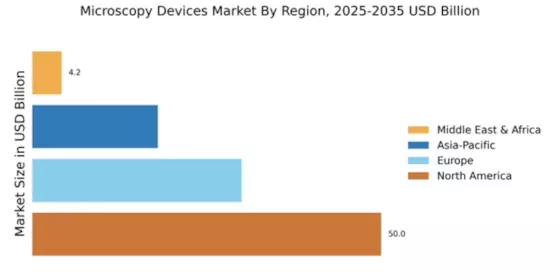
The Global Microscopy Devices Market Industry is projected to experience substantial growth over the coming years. With an estimated market value of 102.2 USD Billion in 2024, the industry is expected to expand significantly, reaching 199.6 USD Billion by 2035. This growth trajectory suggests a compound annual growth rate of 6.27% from 2025 to 2035. Factors contributing to this growth include technological advancements, increased research funding, and rising demand in healthcare and educational sectors. The market's expansion reflects the critical role of microscopy in various scientific disciplines, indicating a robust future for microscopy devices.
Technological Advancements
The Global Microscopy Devices Market Industry is experiencing rapid technological advancements, particularly in imaging techniques and automation. Innovations such as super-resolution microscopy and digital holographic microscopy enhance imaging capabilities, allowing researchers to visualize cellular structures with unprecedented clarity. These advancements are crucial for applications in life sciences, materials science, and nanotechnology. As a result, the market is projected to reach 102.2 USD Billion in 2024, driven by the increasing demand for high-resolution imaging solutions. The integration of artificial intelligence in microscopy devices further streamlines workflows, potentially increasing productivity in laboratories and research institutions.
Growing Demand in Healthcare
The healthcare sector's expanding need for advanced diagnostic tools is a key driver of the Global Microscopy Devices Market Industry. Microscopy devices are increasingly utilized in clinical laboratories for disease diagnosis, particularly in pathology and histology. The rising prevalence of chronic diseases necessitates precise diagnostic techniques, thereby boosting the demand for high-quality microscopy solutions. As healthcare providers seek to improve patient outcomes, the market is anticipated to witness a compound annual growth rate of 6.27% from 2025 to 2035. This growth reflects the critical role that microscopy plays in enhancing diagnostic accuracy and facilitating personalized medicine.
Educational and Academic Growth
The expansion of educational and academic institutions globally is contributing to the growth of the Global Microscopy Devices Market Industry. Universities and research institutions are increasingly incorporating advanced microscopy techniques into their curricula, fostering a new generation of scientists skilled in utilizing these technologies. This trend is supported by government initiatives aimed at enhancing STEM education, which emphasizes the importance of microscopy in scientific research. As educational institutions invest in state-of-the-art microscopy equipment, the market is likely to benefit from increased demand, ensuring that students and researchers have access to cutting-edge tools for their studies.
Rising Research and Development Activities
Increased investment in research and development across various sectors is propelling the Global Microscopy Devices Market Industry. Governments and private entities are allocating substantial funds to enhance scientific research, particularly in biotechnology and pharmaceuticals. This trend is evident in the growing number of research projects that require advanced microscopy techniques for analysis and visualization. The market is expected to grow significantly, with projections indicating a rise to 199.6 USD Billion by 2035. This growth is likely fueled by the need for innovative solutions in drug discovery and development, where microscopy plays a pivotal role in understanding complex biological processes.
Environmental and Material Science Applications
The Global Microscopy Devices Market Industry is also driven by the growing applications of microscopy in environmental and material sciences. Researchers are utilizing advanced microscopy techniques to analyze materials at the nanoscale, providing insights into their properties and behaviors. This is particularly relevant in the context of developing sustainable materials and understanding environmental impacts. The increasing focus on sustainability and environmental conservation is likely to propel the demand for microscopy devices, as they play a crucial role in characterizing materials and assessing their environmental compatibility. This trend indicates a broader application scope for microscopy beyond traditional fields.