
Request Free Sample ×

Kindly complete the form below to receive a free sample of this Report

* Please use a valid business email

Leading companies partner with us for data-driven Insights

clients tt-cursor
Hero Background
English
Chinese
French
Japanese
Korean
German
Spanish

Gum Turpentine Oil Market Analysis

ID: MRFR/CnM/9582-CR
110 Pages
Priya Nagrale
Last Updated: April 06, 2026

Gum Turpentine Oil Market Research Report Information By Type (Wood Turpentine, Sulphate Turpentine, Fat Turpentine, Carbonization Turpentine) Application (Adhesives & Sealants, Rubber, Paints & Coatings, Perfumes/ Fragrances, Pharmaceutical Products, Others) Forecast 2030

Share:
Download PDF ×

We do not share your information with anyone. However, we may send you emails based on your report interest from time to time. You may contact us at any time to opt-out.

Gum Turpentine Oil Market Infographic
Purchase Options

Market Analysis

In-depth Analysis of Gum Turpentine Oil Market Industry Landscape

The pine chemical industry's resilience can be attributed to its foundation on sustainable practices, practices that have proven effective over many centuries. Even before the term "sustainable development" became widely known, this industry was already championing sustainability. The tradition of harvesting compounds from pine trees can be traced back to ancient times, even mentioned in the Bible. In the modern era, the industry places great importance on responsible forest management, efficient extraction of raw materials, and sustainable operations to ensure the long-term value of this natural resource.

There are three primary methods employed to extract compounds from pine trees. During the pulping process, Crude Tall Oil (CTO) and Crude Sulphate Turpentine (CST) are recovered as co-products. These chemicals, naturally present in pine trees, play a vital role in the papermaking process. Another method involves extracting "oleoresin" by tapping into pine trees, which can then be separated into Gum Rosin (GR) and Gum Turpentine. Additionally, old pine tree stumps are ground up and undergo solvent extraction to produce wood rosin and specific terpenes, although this constitutes a niche industry.

These extracted compounds serve as the chemical building blocks for a wide range of finished goods. Any residues left after extraction are burned to generate steam for bio-refinery processes when further upgrading is not feasible. Pine trees are strategically utilized for their sap for a brief period before being cut down and processed into timber or chips for pulp. Even the parts of the tree that are not directly used are converted into fuel. After harvesting, new trees are planted, ensuring a continuous and sustainable cycle of production for the future.

With the increasing global preference for eco-friendly products, there has been a corresponding surge in demand for chemicals derived from pine. These chemicals play a crucial role in reducing the carbon footprint, utilizing renewable and naturally occurring resources to create essential products. The raw materials for pine-derived compounds come from various sources in the forestry sector, including living trees, pine stumps, and logs.

The American Chemistry Council (ACC) foresees rapid growth in the market between 2022 and 2030 due to the rising popularity of pine-derived compounds compared to their synthetic counterparts. This shift in consumer preference, coupled with the continued demand for rosin and TOFA (Tall Oil Fatty Acid) across diverse industries, is expected to fuel significant growth during the forecast period.

In simpler terms, the pine chemical industry has a long history of sustainable practices, even before sustainability became a trend. They've been extracting useful compounds from pine trees for centuries, and today, they focus on responsible forest management and sustainable operations. Different methods are used to extract chemicals from pine trees, and these chemicals are used to make a wide variety of products. The leftover bits are even used to generate steam for various processes. Pine trees are used smartly – their sap is collected for a while, and then they are cut down for timber and other uses. The unused parts become fuel, and new trees are planted for future use. As people become more interested in eco-friendly products, the demand for chemicals from pine trees is growing. These chemicals are considered more environmentally friendly as they use renewable resources. According to the American Chemistry Council, the market for these pine-derived compounds is expected to grow rapidly due to increased popularity and demand.


Author
Author Profile
Priya Nagrale
Senior Research Analyst

With an experience of over five years in market research industry (Chemicals & Materials domain), I gather and analyze market data from diverse sources to produce results, which are then presented back to a client. Also, provide recommendations based on the findings. As a Senior Research Analyst, I perform quality checks (QC) for market estimations, QC for reports, and handle queries and work extensively on client customizations. Also, handle the responsibilities of client proposals, report planning, report finalization, and execution

Leave a Comment

FAQs

What is the projected market valuation of the Gum Turpentine Oil Market by 2035?

<p>The projected market valuation of the Gum Turpentine Oil Market is expected to reach 29.5 USD Million by 2035.</p>

What was the overall market valuation of the Gum Turpentine Oil Market in 2024?

<p>The overall market valuation of the Gum Turpentine Oil Market was 15.61 USD Million in 2024.</p>

What is the expected CAGR for the Gum Turpentine Oil Market during the forecast period 2025 - 2035?

<p>The expected CAGR for the Gum Turpentine Oil Market during the forecast period 2025 - 2035 is 5.96%.</p>

Which companies are considered key players in the Gum Turpentine Oil Market?

<p>Key players in the Gum Turpentine Oil Market include Georgia-Pacific LLC, Kraton Corporation, and Pine Chemical Group, Inc.</p>

What are the main applications of Gum Turpentine Oil and their market values?

<p>Main applications include Paints valued at 5.75 USD Million and Coatings valued at 8.5 USD Million.</p>

How does the market for natural Gum Turpentine Oil compare to synthetic and recycled sources?

Natural Gum Turpentine Oil is valued at 15.0 USD Million, while synthetic and recycled sources are valued at 8.0 USD Million and 6.5 USD Million, respectively.

What are the different purity levels of Gum Turpentine Oil and their market valuations?

Purity levels include Technical Grade at 9.0 USD Million and Industrial Grade at 12.0 USD Million.

What distribution channels are utilized in the Gum Turpentine Oil Market?

Distribution channels include Direct Sales valued at 11.52 USD Million and Retail Sales at 12.22 USD Million.

What end-use sectors are driving the demand for Gum Turpentine Oil?

End-use sectors include Chemical Manufacturing valued at 8.75 USD Million and Automotive at 5.75 USD Million.

How does the market for Gum Turpentine Oil appear to be evolving in terms of growth?

The market for Gum Turpentine Oil appears to be evolving positively, with a projected increase in valuation and a steady CAGR of 5.96%.

Market Summary

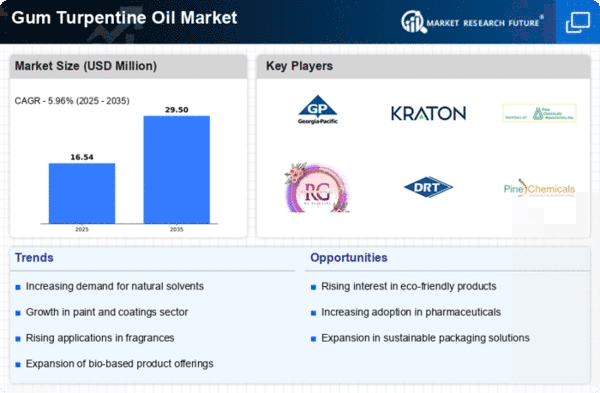
As per MRFR analysis, the Gum Turpentine Oil Market Size was estimated at 15.61 USD Million in 2024. The Gum Turpentine Oil industry is projected to grow from 16.54 USD Million in 2025 to 29.5 USD Million by 2035, exhibiting a compound annual growth rate (CAGR) of 5.96% during the forecast period 2025 - 2035.

Key Market Trends & Highlights

The Gum Turpentine Oil Market is experiencing a dynamic shift towards sustainability and diverse applications.

  • North America remains the largest market for gum turpentine oil, driven by robust demand in various industries. Asia-Pacific is emerging as the fastest-growing region, reflecting increasing industrialization and consumer demand. The solvent segment continues to dominate the market, while the paints and coatings segment is witnessing rapid growth. Key market drivers include rising demand in the paint and coatings sector and a growing focus on sustainability initiatives. Perfumes & fragrances represent the fastest-growing segment, projected to expand at a CAGR of 6.4%, driven by rising demand for natural and sustainable ingredients in personal care and cosmetic products.

Market Size & Forecast

2024 Market Size 15.61 (USD Million)
2035 Market Size 29.5 (USD Million)
CAGR (2025 - 2035) 5.96%
Largest Regional Market Share in 2024 North America

Major Players

Georgia-Pacific LLC (US), Kraton Corporation (US), Pine Chemical Group, Inc. (US), Resin &amp; Pitch, Inc. (US), DRT (FR), Wuzhou Pine Chemicals Co., Ltd. (CN), Sundarban Chemicals (IN), Sierra Pine Limited (US)

Market Trends

The Gum Turpentine Oil Market is currently experiencing a dynamic phase characterized by evolving consumer preferences and increasing applications across various industries. This natural resin, derived from pine trees, is valued for its solvent properties and is widely utilized in the production of paints, varnishes, and adhesives. Additionally, the market is witnessing a growing interest in eco-friendly and sustainable products, which is likely to drive demand for natural gum turpentine oil as an alternative to synthetic solvents. As environmental regulations become more stringent, manufacturers are adapting their processes to meet these standards, potentially enhancing the market's appeal to environmentally conscious consumers. Moreover, the Gum Turpentine Oil Market is influenced by advancements in extraction technologies, which may improve yield and quality. The rise of the personal care and cosmetics sector is also contributing to market growth, as gum turpentine oil is increasingly incorporated into formulations for its aromatic properties. This trend suggests a diversification of applications, which could lead to new opportunities for producers. Overall, the Gum Turpentine Oil Market appears poised for growth, driven by a combination of sustainability trends, technological innovations, and expanding industrial applications.

Sustainability Focus

There is a noticeable shift towards sustainable practices within the Gum Turpentine Oil Market. Consumers and manufacturers alike are increasingly prioritizing eco-friendly products, leading to a heightened demand for natural gum turpentine oil as a viable alternative to synthetic options. This trend is likely to influence production methods and sourcing strategies.

Technological Advancements

Innovations in extraction and processing technologies are shaping the Gum Turpentine Oil Market. Enhanced methods may lead to improved efficiency and product quality, potentially attracting new players and expanding market reach. These advancements could also facilitate the development of specialized products tailored to specific industry needs.

Diverse Applications

The range of applications for gum turpentine oil is broadening, particularly in sectors such as personal care and cosmetics. As manufacturers explore new uses for this versatile oil, the market may witness increased demand from various industries, indicating a trend towards diversification and innovation in product offerings.

Gum Turpentine Oil Market Market Drivers

Rising Demand in Paints and Coatings

The Global Gum Turpentine Oil Market Industry is experiencing a notable increase in demand from the paints and coatings sector. This growth is driven by the need for natural solvents and additives that enhance the performance of products. Gum turpentine oil, known for its ability to improve drying times and provide a smooth finish, is becoming a preferred choice among manufacturers. As the market evolves, the industry is projected to reach 1.08 USD Billion in 2024, reflecting a robust interest in eco-friendly solutions. This trend suggests that the Global Gum Turpentine Oil Market Industry will continue to expand, potentially doubling by 2035.

Surge in Demand for Natural Products

The Global Gum Turpentine Oil Market Industry is likely to benefit from the increasing consumer preference for natural and organic products. As awareness of synthetic chemicals' adverse effects grows, industries such as cosmetics and personal care are shifting towards natural alternatives. Gum turpentine oil, with its natural origin and beneficial properties, is gaining traction in formulations. This shift is indicative of a broader trend where consumers are willing to pay a premium for products perceived as safer and more environmentally friendly. Consequently, this could drive the market towards an estimated value of 2.17 USD Billion by 2035.

Growth in the Adhesives and Sealants Sector

The Global Gum Turpentine Oil Market Industry is witnessing growth due to the expanding adhesives and sealants sector. Gum turpentine oil serves as a vital ingredient in formulating various adhesive products, providing excellent bonding properties and enhancing performance. The increasing construction and automotive industries are contributing to the rising demand for adhesives, which in turn fuels the need for gum turpentine oil. As these sectors continue to grow, the market is expected to see a compound annual growth rate of 6.54% from 2025 to 2035, indicating a sustained interest in gum turpentine oil as a key component.

Regulatory Support for Sustainable Practices

The Global Gum Turpentine Oil Market Industry is supported by regulatory frameworks promoting sustainable practices. Governments worldwide are implementing policies that encourage the use of renewable resources and environmentally friendly products. This regulatory support is likely to enhance the market for gum turpentine oil, as it aligns with global sustainability goals. Companies that prioritize eco-friendly practices may gain a competitive edge, attracting consumers who value sustainability. As a result, the industry may experience growth, driven by both regulatory incentives and consumer demand for greener alternatives.

Technological Advancements in Extraction Processes

The Global Gum Turpentine Oil Market Industry is likely to benefit from technological advancements in extraction processes. Innovations in distillation and extraction techniques are enhancing the efficiency and yield of gum turpentine oil production. These advancements not only improve the quality of the oil but also reduce production costs, making it more competitive against synthetic alternatives. As manufacturers adopt these new technologies, the market could see an increase in supply, meeting the growing demand across various applications. This trend suggests a positive outlook for the industry, potentially leading to increased market share in the coming years.

Market Segment Insights

By Application: Paints (Largest) vs. Cleaning Agents (Fastest-Growing)

The Application segment of the Gum Turpentine Oil Market showcases a diverse range of values, including Paints, Adhesives, Coatings, Inks, and Cleaning Agents. Among these, Paints hold the largest market share, driven by their extensive usage in various sectors, including construction and automotive. Cleaning Agents, on the other hand, are gaining significant traction, reflecting evolving consumer preferences for eco-friendly and effective cleaning solutions. These two segments distinctly represent the breadth of application for Gum Turpentine Oil. As market dynamics shift, the growth trends for these segments reveal intriguing insights. Paints, despite being the largest segment, show moderate growth due to market saturation. Conversely, Cleaning Agents are the fastest-growing segment, propelled by increasing awareness of sustainability and health benefits. Additionally, the rise in demand for high-performance cleaning products further fuels this growth, indicating a potential shift in market priorities toward eco-conscious consumerism.<br>Perfumes &amp; Fragrances: The primary value driver. Turpentine is the feedstock for Geraniol, Linalool, and Camphor, which are essential for the personal care and household fragrance markets.<br>Pharmaceutical Products: Utilized in topical ointments, decongestants, and rubefacients. Its antiseptic and anti-inflammatory properties drive consistent demand in the OTC healthcare sector.<br>Paints &amp; Coatings: Historically a major solvent, it is now used as a high-end specialty thinner and as a precursor for synthetic resins.<br>Adhesives &amp; Sealants: Essential for the production of tackifier resins, which are critical for pressure-sensitive adhesives used in packaging and medical tapes.<br>Rubber: Acts as a processing aid and reclaiming agent in the tire and specialized rubber industries.

Paints (Dominant) vs. Cleaning Agents (Emerging)

The Paints segment of the Gum Turpentine Oil Market stands as the dominant force, characterized by its established application in various industries. This segment enjoys strong demand due to its essential role in product formulations that require high-quality solvents and resins. The versatility of gum turpentine in paint manufacturing positions it as a vital ingredient, ensuring consistent quality and performance in end products. As sustainability becomes a focal point, manufacturers are also reformulating products to use natural gums, which bolsters this segment further. Conversely, Cleaning Agents represent an emerging segment with significant growth potential. The surge in environmentally friendly products has led to enhanced market interest, with consumers increasingly seeking effective and non-toxic cleaning solutions. Innovations in formulations that incorporate gum turpentine enhance efficacy while ensuring safety, creating an appealing option for modern consumers. This progressive shift is attracting investment and driving advancements in the cleaning agents category.

By End Use: Automotive (Largest) vs. Construction (Fastest-Growing)

In the Gum Turpentine Oil market, the end use segment is critical for evaluating application areas. Automotive stands out as the largest segment, driven by the utilization of turpentine oil in paint thinners and cleaning agents, which are essential for vehicle maintenance. In contrast, the construction sector is witnessing rapid growth due to a resurgence in infrastructure projects and an increasing preference for eco-friendly alternatives in materials, making it a focal point in the market landscape.

Automotive: Dominant vs. Construction: Emerging

The automotive sector remains dominant in the Gum Turpentine Oil market, leveraging its applications in coatings and solvents essential for automotive manufacturing and repairs. The use of turpentine oil in this industry provides high-quality finishes and reduces environmental impact through its natural composition. On the other hand, the construction sector is emerging rapidly, fueled by growing demands for sustainable building materials and practices. Construction firms are increasingly adopting gum turpentine oil for its non-toxic properties, thus enhancing safety and eco-friendliness on construction sites, positioning it as a critical player for future growth.

By Source: Natural (Largest) vs. Synthetic (Fastest-Growing)

In the Gum Turpentine Oil Market, the 'Source' segment is primarily dominated by Natural turpentine oil, which has carved out a significant portion of the market due to its traditional usage and preference among manufacturers. Natural turpentine oil is derived from the resin of pine trees and holds a long-standing reputation for quality and effectiveness, ensuring its leading position in market share. Conversely, Synthetic turpentine oil, though currently a smaller segment, is gaining traction due to advancements in chemical production processes and the rise of eco-friendly consumer preferences, resulting in increasing demand.

Gum Turpentine Oil: Natural (Dominant) vs. Synthetic (Emerging)

Natural gum turpentine oil is recognized for its authenticity and is extensively used in various applications including paints, varnishes, and as a solvent in the production of chemical compounds. Its dominance is fueled by a longstanding tradition in the industry as well as continuous consumer preference for natural products, which has fostered loyalty among key user groups. On the other hand, Synthetic gum turpentine oil has emerged rapidly as a preferred alternative in some markets, propelled by innovations in synthetic chemistry that allow for greater consistency and lower production costs. While still positioning itself as an alternative, its capacity to meet specific industrial requirements rapidly is driving its growth, attracting attention from manufacturers looking for higher efficiency and sustainability.

By Purity Level: Technical Grade (Largest) vs. Industrial Grade (Fastest-Growing)

The Gum Turpentine Oil Market displays a distinct division in purity levels, where Technical Grade holds a significant share, catering primarily to industrial applications. This segment is favored for its versatility, used extensively in manufacturing, furniture, and paint industries. Industrial Grade follows closely, gaining traction due to its expanding use in diverse sectors and product formulations, further emphasizing its rising importance and share in the market.

Technical Grade (Dominant) vs. Industrial Grade (Emerging)

Technical Grade Gum Turpentine Oil is classified for its high purity, making it ideal for various industrial applications. Its dominant position in the market is attributed to its reliability and consistency, preferred by manufacturers for its applications in paints, varnishes, and resins. In contrast, Industrial Grade is emerging as a significant contender, driven by its accessibility and cost-effectiveness, appealing to manufacturers looking for economically viable solutions. Both segments exhibit unique characteristics: Technical Grade is characterized by its refined quality, while Industrial Grade offers functional versatility, fulfilling different market needs.

By Distribution Channel: Direct Sales (Largest) vs. Online Sales (Fastest-Growing)

In the Gum Turpentine Oil Market, the distribution channels exhibit a varied market share, with Direct Sales being the most significant contributor to overall sales. This channel leverages established relationships between producers and consumers, ensuring a robust distribution framework. On the other hand, Online Sales are rapidly gaining traction, driven by the increasing acceptance of e-commerce, which provides customers with convenience and a broader product access. As consumer preferences evolve, Online Sales are expected to experience the fastest growth in the Gum Turpentine Oil Market. The shift towards digital purchasing is fueled by the rise of online platforms and social media marketing efforts, allowing brands to connect with a wider audience. Moreover, the ongoing technological advancements in payment processing and logistics are paving the way for a smoother online shopping experience, further bolstering this channel's growth potential.

Direct Sales (Dominant) vs. Online Sales (Emerging)

Direct Sales maintain a dominant position in the Gum Turpentine Oil Market due to their strong presence and established relationships between manufacturers and consumers. This channel facilitates immediate transactions, allowing customers to engage directly with suppliers, which often leads to greater trust and satisfaction. The ability to provide personalized services also reinforces the customer relationship in this distribution segment. In contrast, Online Sales represent an emerging avenue for market penetration, appealing to a modern demographic increasingly inclined to shop digitally. This segment is characterized by its flexibility, offering customers 24/7 accessibility and the ability to compare products easily. The expansion of e-commerce platforms, combined with targeted marketing strategies, is driving the awareness and accessibility of Gum Turpentine Oil products through this channel.

By Type: Source and Purity

Gum Turpentine (Fat Turpentine): The highest grade, obtained by distilling the resin of living pine trees. It is preferred for fragrance and pharmaceutical use due to its superior chemical profile.<br>Wood Turpentine: Extracted from pine stumps through steam distillation or solvent extraction. It is primarily utilized in industrial-grade solvents and coatings.<br>Sulphate Turpentine: A byproduct of the kraft paper pulping process. While more cost-effective, it requires extensive refining to remove sulfurous odors, making it common in large-scale industrial applications.<br>Carbonization Turpentine: Obtained through the destructive distillation of pine wood; used predominantly in traditional medicinal and niche industrial sectors.

Get more detailed insights about Gum Turpentine Oil Market Research Report—Global Forecast till 2035

Regional Insights

North America : Market Leader in Turpentine Oil

North America is the largest market for gum turpentine oil, holding a significant share of 7.83 in 2024. The region's growth is driven by increasing demand in various applications, including paints, coatings, and adhesives. Regulatory support for sustainable sourcing and production practices further enhances market dynamics. The rise in eco-friendly products is also a key driver, as consumers increasingly prefer natural over synthetic alternatives. The competitive landscape in North America is robust, featuring key players such as Georgia-Pacific LLC, Kraton Corporation, and Pine Chemical Group, Inc. These companies leverage advanced technologies and sustainable practices to maintain their market positions. The U.S. remains the leading country, supported by a strong manufacturing base and innovation in product development. The presence of established firms ensures a steady supply chain and competitive pricing, contributing to the region's market strength.

Europe : Emerging Market with Growth Potential

Europe's gum turpentine oil market is valued at 3.12, reflecting a growing interest in natural solvents and eco-friendly products. The region's growth is fueled by stringent regulations promoting the use of sustainable materials in industries such as cosmetics and pharmaceuticals. Additionally, the increasing focus on reducing carbon footprints drives demand for natural alternatives, positioning gum turpentine oil as a viable option in various applications. Leading countries in Europe include France and Germany, where companies like DRT are making significant strides in production and innovation. The competitive landscape is characterized by a mix of established players and emerging startups, all vying for market share. The European market is also witnessing collaborations aimed at enhancing product offerings and expanding distribution networks, further solidifying its position in the global market.

Asia-Pacific : Rapid Growth in Emerging Markets

The Asia-Pacific region, with a market size of 4.0, is witnessing rapid growth in the gum turpentine oil sector. This growth is driven by increasing industrialization and urbanization, leading to higher demand in sectors such as construction, automotive, and consumer goods. Regulatory frameworks are gradually evolving to support sustainable practices, which is expected to further boost market growth. The region's diverse applications for gum turpentine oil are also contributing to its expanding market presence. Key players in the Asia-Pacific market include Wuzhou Pine Chemicals Co., Ltd. and Sundarban Chemicals, which are focusing on enhancing production capabilities and expanding their product portfolios. Countries like China and India are leading the charge, supported by a growing middle class and rising disposable incomes. The competitive landscape is becoming increasingly dynamic, with both local and international players striving to capture market share in this burgeoning sector.

Asia-Pacific leads the global market with an estimated 48% share in 2025, driven by strong production and consumption in countries such as China and Vietnam. The region benefits from a well-established chemical processing base and a rapidly expanding fragrance manufacturing industry.

Middle East and Africa : Niche Market with Growth Opportunities

The Middle East and Africa region, with a market size of 0.66, presents a niche opportunity for gum turpentine oil. The growth in this region is primarily driven by increasing industrial activities and a shift towards natural products in various sectors. Regulatory initiatives aimed at promoting sustainable practices are beginning to take shape, which could enhance the market's potential. The demand for gum turpentine oil is expected to rise as industries seek eco-friendly alternatives to synthetic chemicals. Countries like South Africa and Nigeria are emerging as key players in the market, with local companies exploring production opportunities. The competitive landscape is still developing, with a mix of local and international firms. As awareness of the benefits of natural solvents grows, the region is likely to see increased investments and innovations in gum turpentine oil production, paving the way for future growth.

Key Players and Competitive Insights

The Gum Turpentine Oil Market is currently characterized by a competitive landscape that is both dynamic and multifaceted. Key growth drivers include the increasing demand for natural solvents in various industries, particularly in paints, coatings, and adhesives. Major players such as Georgia-Pacific LLC (US), Kraton Corporation (US), and Pine Chemical Group, Inc. (US) are strategically positioned to leverage their extensive production capabilities and established distribution networks. Georgia-Pacific LLC (US) focuses on innovation in sustainable sourcing, while Kraton Corporation (US) emphasizes the development of bio-based products, indicating a collective shift towards environmentally friendly solutions that shape the competitive environment.In terms of business tactics, companies are increasingly localizing manufacturing to reduce lead times and optimize supply chains. The market structure appears moderately fragmented, with several key players exerting influence over pricing and product availability. This fragmentation allows for niche players to thrive, although the collective strength of major companies like Resin & Pitch, Inc. (US) and DRT (FR) remains significant in shaping market dynamics.
In November Georgia-Pacific LLC (US) announced a partnership with a leading technology firm to enhance its production efficiency through advanced automation. This strategic move is likely to bolster their operational capabilities, enabling them to meet rising demand while maintaining cost-effectiveness. Such initiatives reflect a broader trend towards digital transformation within the industry, positioning Georgia-Pacific as a forward-thinking leader.
In October Kraton Corporation (US) unveiled a new line of bio-based turpentine products aimed at the cosmetics and personal care sectors. This launch not only diversifies their product portfolio but also aligns with the growing consumer preference for sustainable and natural ingredients. The strategic importance of this development lies in its potential to capture a new customer base, thereby enhancing Kraton's market share.
In September Pine Chemical Group, Inc. (US) expanded its production facility in the southeastern US, a move that is expected to increase output capacity by 30%. This expansion is indicative of Pine Chemical's commitment to meeting the surging demand for gum turpentine oil, particularly in the North American market. The strategic implications of this expansion suggest a proactive approach to market growth, positioning the company favorably against competitors.
As of December current competitive trends in the Gum Turpentine Oil Market are increasingly defined by digitalization, sustainability, and the integration of AI technologies. Strategic alliances are becoming more prevalent, as companies seek to enhance their innovation capabilities and market reach. The competitive differentiation is likely to evolve from traditional price-based competition towards a focus on technological advancements, sustainable practices, and supply chain reliability. This shift underscores the importance of adaptability and innovation in maintaining a competitive edge in the market.

Key Companies in the Gum Turpentine Oil Market include

Industry Developments

Future Outlook

Gum Turpentine Oil Market Future Outlook

The Gum Turpentine Oil Market is projected to grow at a 5.96% CAGR from 2025 to 2035, driven by increasing demand in the paint and coatings industry, eco-friendly products, and expanding applications in pharmaceuticals.

New opportunities lie in:

  • <p>Development of bio-based gum turpentine oil products for sustainable markets. Expansion into emerging markets with tailored marketing strategies. Investment in advanced extraction technologies to enhance yield and quality.</p>

By 2035, the Gum Turpentine Oil Market is expected to achieve robust growth and diversification.

Market Segmentation

Gum Turpentine Oil Market Form Outlook

  • Liquid
  • Solid
  • Concentrate

Gum Turpentine Oil Market Source Outlook

  • Natural
  • Synthetic

Gum Turpentine Oil Market End Use Outlook

  • Chemical Industry
  • Automotive
  • Construction
  • Cosmetics
  • Food Industry

Gum Turpentine Oil Market Application Outlook

  • Solvent
  • Paints and Coatings
  • Adhesives
  • Fragrance
  • Pharmaceuticals

Gum Turpentine Oil Market Distribution Channel Outlook

  • Direct Sales
  • Online Sales
  • Retail Sales

Report Scope

MARKET SIZE 2024 15.61(USD Million)
MARKET SIZE 2025 16.54(USD Million)
MARKET SIZE 2035 29.5(USD Million)
COMPOUND ANNUAL GROWTH RATE (CAGR) 5.96% (2025 - 2035)
REPORT COVERAGE Revenue Forecast, Competitive Landscape, Growth Factors, and Trends
BASE YEAR 2024
Market Forecast Period 2025 - 2035
Historical Data 2019 - 2024
Market Forecast Units USD Million
Key Companies Profiled Georgia-Pacific LLC (US), Kraton Corporation (US), Pine Chemical Group, Inc. (US), Resin & Pitch, Inc. (US), DRT (FR), Wuzhou Pine Chemicals Co., Ltd. (CN), Sundarban Chemicals (IN), Sierra Pine Limited (US)
Segments Covered Application, End Use, Source, Distribution Channel, Form
Key Market Opportunities Growing demand for natural solvents in eco-friendly applications enhances opportunities in the Gum Turpentine Oil Market.
Key Market Dynamics Rising demand for natural solvents drives innovation and competition in the Gum Turpentine Oil market.
Countries Covered North America, Europe, APAC, South America, MEA

FAQs

What is the projected market valuation of the Gum Turpentine Oil Market by 2035?

<p>The projected market valuation of the Gum Turpentine Oil Market is expected to reach 29.5 USD Million by 2035.</p>

What was the overall market valuation of the Gum Turpentine Oil Market in 2024?

<p>The overall market valuation of the Gum Turpentine Oil Market was 15.61 USD Million in 2024.</p>

What is the expected CAGR for the Gum Turpentine Oil Market during the forecast period 2025 - 2035?

<p>The expected CAGR for the Gum Turpentine Oil Market during the forecast period 2025 - 2035 is 5.96%.</p>

Which companies are considered key players in the Gum Turpentine Oil Market?

<p>Key players in the Gum Turpentine Oil Market include Georgia-Pacific LLC, Kraton Corporation, and Pine Chemical Group, Inc.</p>

What are the main applications of Gum Turpentine Oil and their market values?

<p>Main applications include Paints valued at 5.75 USD Million and Coatings valued at 8.5 USD Million.</p>

How does the market for natural Gum Turpentine Oil compare to synthetic and recycled sources?

Natural Gum Turpentine Oil is valued at 15.0 USD Million, while synthetic and recycled sources are valued at 8.0 USD Million and 6.5 USD Million, respectively.

What are the different purity levels of Gum Turpentine Oil and their market valuations?

Purity levels include Technical Grade at 9.0 USD Million and Industrial Grade at 12.0 USD Million.

What distribution channels are utilized in the Gum Turpentine Oil Market?

Distribution channels include Direct Sales valued at 11.52 USD Million and Retail Sales at 12.22 USD Million.

What end-use sectors are driving the demand for Gum Turpentine Oil?

End-use sectors include Chemical Manufacturing valued at 8.75 USD Million and Automotive at 5.75 USD Million.

How does the market for Gum Turpentine Oil appear to be evolving in terms of growth?

The market for Gum Turpentine Oil appears to be evolving positively, with a projected increase in valuation and a steady CAGR of 5.96%.

  1. SECTION I: EXECUTIVE SUMMARY AND KEY HIGHLIGHTS |
    1. EXECUTIVE SUMMARY | |
      1. Market Overview | |
      2. Key Findings | |
      3. Market Segmentation | |
      4. Competitive Landscape | |
      5. Challenges and Opportunities | |
      6. Future Outlook 2
  2. SECTION II: SCOPING, METHODOLOGY AND MARKET STRUCTURE |
    1. MARKET INTRODUCTION | |
      1. Definition | |
      2. Scope of the study | | |
    2. RESEARCH METHODOLOGY | |
      1. Overview | |
      2. Data Mining | |
      3. Secondary Research | |
      4. Primary Research | | |
      5. Forecasting Model | |
      6. Market Size Estimation | | |
      7. Data Triangulation | |
      8. Validation 3
  3. SECTION III: QUALITATIVE ANALYSIS |
    1. MARKET DYNAMICS | |
      1. Overview | |
      2. Drivers | |
      3. Restraints | |
      4. Opportunities |
    2. MARKET FACTOR ANALYSIS | |
      1. Value chain Analysis | |
      2. Porter's Five Forces Analysis | | |
      3. COVID-19 Impact Analysis | | |
  4. SECTION IV: QUANTITATIVE ANALYSIS |
    1. Chemicals and Materials, BY Application (USD Million) | |
      1. Paints | |
      2. Adhesives | |
      3. Coatings | |
      4. Inks | |
      5. Cleaning Agents |
    2. Chemicals and Materials, BY End Use (USD Million) | |
      1. Automotive | |
      2. Construction | |
      3. Chemical Manufacturing | |
      4. Woodworking | |
      5. Textiles |
    3. Chemicals and Materials, BY Source (USD Million) | |
      1. Natural | |
      2. Synthetic | |
      3. Recycled |
    4. Chemicals and Materials, BY Purity Level (USD Million) | |
      1. Technical Grade | |
      2. Industrial Grade | |
      3. Food Grade |
    5. Chemicals and Materials, BY Distribution Channel (USD Million) | |
      1. Direct Sales | |
      2. Online Sales | |
      3. Retail Sales |
    6. Chemicals and Materials, BY Region (USD Million) | |
      1. North America | | |
      2. Europe | | |
      3. APAC | | |
      4. South America | | |
      5. MEA | | |
  5. SECTION V: COMPETITIVE ANALYSIS |
    1. Competitive Landscape | |
      1. Overview | |
      2. Competitive Analysis | |
      3. Market share Analysis | |
      4. Major Growth Strategy in the Chemicals and Materials | |
      5. Competitive Benchmarking | |
      6. Leading Players in Terms of Number of Developments in the Chemicals and Materials | |
      7. Key developments and growth strategies | | |
      8. Major Players Financial Matrix | | |
    2. Company Profiles | |
      1. Georgia-Pacific LLC (US) | | |
      2. Kraton Corporation (US) | | |
      3. Pine Chemical Group, Inc. (US) | | |
      4. Resin & Pitch, Inc. (US) | | |
      5. DRT (FR) | | |
      6. Wuzhou Pine Chemicals Co., Ltd. (CN) | | |
      7. Sundarban Chemicals (IN) | | |
      8. Sierra Pine Limited (US) | | |
    3. Appendix | |
      1. References | |
      2. Related Reports 6 LIST OF FIGURES |
    4. MARKET SYNOPSIS |
    5. NORTH AMERICA MARKET ANALYSIS |
    6. US MARKET ANALYSIS BY APPLICATION |
    7. US MARKET ANALYSIS BY END USE |
    8. US MARKET ANALYSIS BY SOURCE |
    9. US MARKET ANALYSIS BY PURITY LEVEL |
    10. US MARKET ANALYSIS BY DISTRIBUTION CHANNEL |
    11. CANADA MARKET ANALYSIS BY APPLICATION |
    12. CANADA MARKET ANALYSIS BY END USE |
    13. CANADA MARKET ANALYSIS BY SOURCE |
    14. CANADA MARKET ANALYSIS BY PURITY LEVEL |
    15. CANADA MARKET ANALYSIS BY DISTRIBUTION CHANNEL |
    16. EUROPE MARKET ANALYSIS |
    17. GERMANY MARKET ANALYSIS BY APPLICATION |
    18. GERMANY MARKET ANALYSIS BY END USE |
    19. GERMANY MARKET ANALYSIS BY SOURCE |
    20. GERMANY MARKET ANALYSIS BY PURITY LEVEL |
    21. GERMANY MARKET ANALYSIS BY DISTRIBUTION CHANNEL |
    22. UK MARKET ANALYSIS BY APPLICATION |
    23. UK MARKET ANALYSIS BY END USE |
    24. UK MARKET ANALYSIS BY SOURCE |
    25. UK MARKET ANALYSIS BY PURITY LEVEL |
    26. UK MARKET ANALYSIS BY DISTRIBUTION CHANNEL |
    27. FRANCE MARKET ANALYSIS BY APPLICATION |
    28. FRANCE MARKET ANALYSIS BY END USE |
    29. FRANCE MARKET ANALYSIS BY SOURCE |
    30. FRANCE MARKET ANALYSIS BY PURITY LEVEL |
    31. FRANCE MARKET ANALYSIS BY DISTRIBUTION CHANNEL |
    32. RUSSIA MARKET ANALYSIS BY APPLICATION |
    33. RUSSIA MARKET ANALYSIS BY END USE |
    34. RUSSIA MARKET ANALYSIS BY SOURCE |
    35. RUSSIA MARKET ANALYSIS BY PURITY LEVEL |
    36. RUSSIA MARKET ANALYSIS BY DISTRIBUTION CHANNEL |
    37. ITALY MARKET ANALYSIS BY APPLICATION |
    38. ITALY MARKET ANALYSIS BY END USE |
    39. ITALY MARKET ANALYSIS BY SOURCE |
    40. ITALY MARKET ANALYSIS BY PURITY LEVEL |
    41. ITALY MARKET ANALYSIS BY DISTRIBUTION CHANNEL |
    42. SPAIN MARKET ANALYSIS BY APPLICATION |
    43. SPAIN MARKET ANALYSIS BY END USE |
    44. SPAIN MARKET ANALYSIS BY SOURCE |
    45. SPAIN MARKET ANALYSIS BY PURITY LEVEL |
    46. SPAIN MARKET ANALYSIS BY DISTRIBUTION CHANNEL |
    47. REST OF EUROPE MARKET ANALYSIS BY APPLICATION |
    48. REST OF EUROPE MARKET ANALYSIS BY END USE |
    49. REST OF EUROPE MARKET ANALYSIS BY SOURCE |
    50. REST OF EUROPE MARKET ANALYSIS BY PURITY LEVEL |
    51. REST OF EUROPE MARKET ANALYSIS BY DISTRIBUTION CHANNEL |
    52. APAC MARKET ANALYSIS |
    53. CHINA MARKET ANALYSIS BY APPLICATION |
    54. CHINA MARKET ANALYSIS BY END USE |
    55. CHINA MARKET ANALYSIS BY SOURCE |
    56. CHINA MARKET ANALYSIS BY PURITY LEVEL |
    57. CHINA MARKET ANALYSIS BY DISTRIBUTION CHANNEL |
    58. INDIA MARKET ANALYSIS BY APPLICATION |
    59. INDIA MARKET ANALYSIS BY END USE |
    60. INDIA MARKET ANALYSIS BY SOURCE |
    61. INDIA MARKET ANALYSIS BY PURITY LEVEL |
    62. INDIA MARKET ANALYSIS BY DISTRIBUTION CHANNEL |
    63. JAPAN MARKET ANALYSIS BY APPLICATION |
    64. JAPAN MARKET ANALYSIS BY END USE |
    65. JAPAN MARKET ANALYSIS BY SOURCE |
    66. JAPAN MARKET ANALYSIS BY PURITY LEVEL |
    67. JAPAN MARKET ANALYSIS BY DISTRIBUTION CHANNEL |
    68. SOUTH KOREA MARKET ANALYSIS BY APPLICATION |
    69. SOUTH KOREA MARKET ANALYSIS BY END USE |
    70. SOUTH KOREA MARKET ANALYSIS BY SOURCE |
    71. SOUTH KOREA MARKET ANALYSIS BY PURITY LEVEL |
    72. SOUTH KOREA MARKET ANALYSIS BY DISTRIBUTION CHANNEL |
    73. MALAYSIA MARKET ANALYSIS BY APPLICATION |
    74. MALAYSIA MARKET ANALYSIS BY END USE |
    75. MALAYSIA MARKET ANALYSIS BY SOURCE |
    76. MALAYSIA MARKET ANALYSIS BY PURITY LEVEL |
    77. MALAYSIA MARKET ANALYSIS BY DISTRIBUTION CHANNEL |
    78. THAILAND MARKET ANALYSIS BY APPLICATION |
    79. THAILAND MARKET ANALYSIS BY END USE |
    80. THAILAND MARKET ANALYSIS BY SOURCE |
    81. THAILAND MARKET ANALYSIS BY PURITY LEVEL |
    82. THAILAND MARKET ANALYSIS BY DISTRIBUTION CHANNEL |
    83. INDONESIA MARKET ANALYSIS BY APPLICATION |
    84. INDONESIA MARKET ANALYSIS BY END USE |
    85. INDONESIA MARKET ANALYSIS BY SOURCE |
    86. INDONESIA MARKET ANALYSIS BY PURITY LEVEL |
    87. INDONESIA MARKET ANALYSIS BY DISTRIBUTION CHANNEL |
    88. REST OF APAC MARKET ANALYSIS BY APPLICATION |
    89. REST OF APAC MARKET ANALYSIS BY END USE |
    90. REST OF APAC MARKET ANALYSIS BY SOURCE |
    91. REST OF APAC MARKET ANALYSIS BY PURITY LEVEL |
    92. REST OF APAC MARKET ANALYSIS BY DISTRIBUTION CHANNEL |
    93. SOUTH AMERICA MARKET ANALYSIS |
    94. BRAZIL MARKET ANALYSIS BY APPLICATION |
    95. BRAZIL MARKET ANALYSIS BY END USE |
    96. BRAZIL MARKET ANALYSIS BY SOURCE |
    97. BRAZIL MARKET ANALYSIS BY PURITY LEVEL |
    98. BRAZIL MARKET ANALYSIS BY DISTRIBUTION CHANNEL |
    99. MEXICO MARKET ANALYSIS BY APPLICATION |
    100. MEXICO MARKET ANALYSIS BY END USE |
    101. MEXICO MARKET ANALYSIS BY SOURCE |
    102. MEXICO MARKET ANALYSIS BY PURITY LEVEL |
    103. MEXICO MARKET ANALYSIS BY DISTRIBUTION CHANNEL |
    104. ARGENTINA MARKET ANALYSIS BY APPLICATION |
    105. ARGENTINA MARKET ANALYSIS BY END USE |
    106. ARGENTINA MARKET ANALYSIS BY SOURCE |
    107. ARGENTINA MARKET ANALYSIS BY PURITY LEVEL |
    108. ARGENTINA MARKET ANALYSIS BY DISTRIBUTION CHANNEL |
    109. REST OF SOUTH AMERICA MARKET ANALYSIS BY APPLICATION |
    110. REST OF SOUTH AMERICA MARKET ANALYSIS BY END USE |
    111. REST OF SOUTH AMERICA MARKET ANALYSIS BY SOURCE |
    112. REST OF SOUTH AMERICA MARKET ANALYSIS BY PURITY LEVEL |
    113. REST OF SOUTH AMERICA MARKET ANALYSIS BY DISTRIBUTION CHANNEL |
    114. MEA MARKET ANALYSIS |
    115. GCC COUNTRIES MARKET ANALYSIS BY APPLICATION |
    116. GCC COUNTRIES MARKET ANALYSIS BY END USE |
    117. GCC COUNTRIES MARKET ANALYSIS BY SOURCE |
    118. GCC COUNTRIES MARKET ANALYSIS BY PURITY LEVEL |
    119. GCC COUNTRIES MARKET ANALYSIS BY DISTRIBUTION CHANNEL |
    120. SOUTH AFRICA MARKET ANALYSIS BY APPLICATION |
    121. SOUTH AFRICA MARKET ANALYSIS BY END USE |
    122. SOUTH AFRICA MARKET ANALYSIS BY SOURCE |
    123. SOUTH AFRICA MARKET ANALYSIS BY PURITY LEVEL |
    124. SOUTH AFRICA MARKET ANALYSIS BY DISTRIBUTION CHANNEL |
    125. REST OF MEA MARKET ANALYSIS BY APPLICATION |
    126. REST OF MEA MARKET ANALYSIS BY END USE |
    127. REST OF MEA MARKET ANALYSIS BY SOURCE |
    128. REST OF MEA MARKET ANALYSIS BY PURITY LEVEL |
    129. REST OF MEA MARKET ANALYSIS BY DISTRIBUTION CHANNEL |
    130. KEY BUYING CRITERIA OF CHEMICALS AND MATERIALS |
    131. RESEARCH PROCESS OF MRFR |
    132. DRO ANALYSIS OF CHEMICALS AND MATERIALS |
    133. DRIVERS IMPACT ANALYSIS: CHEMICALS AND MATERIALS |
    134. RESTRAINTS IMPACT ANALYSIS: CHEMICALS AND MATERIALS |
    135. SUPPLY / VALUE CHAIN: CHEMICALS AND MATERIALS |
    136. CHEMICALS AND MATERIALS, BY APPLICATION, 2024 (% SHARE) |
    137. CHEMICALS AND MATERIALS, BY APPLICATION, 2024 TO 2035 (USD Million) |
    138. CHEMICALS AND MATERIALS, BY END USE, 2024 (% SHARE) |
    139. CHEMICALS AND MATERIALS, BY END USE, 2024 TO 2035 (USD Million) |
    140. CHEMICALS AND MATERIALS, BY SOURCE, 2024 (% SHARE) |
    141. CHEMICALS AND MATERIALS, BY SOURCE, 2024 TO 2035 (USD Million) |
    142. CHEMICALS AND MATERIALS, BY PURITY LEVEL, 2024 (% SHARE) |
    143. CHEMICALS AND MATERIALS, BY PURITY LEVEL, 2024 TO 2035 (USD Million) |
    144. CHEMICALS AND MATERIALS, BY DISTRIBUTION CHANNEL, 2024 (% SHARE) |
    145. CHEMICALS AND MATERIALS, BY DISTRIBUTION CHANNEL, 2024 TO 2035 (USD Million) |
    146. BENCHMARKING OF MAJOR COMPETITORS 7 LIST OF TABLES |
    147. LIST OF ASSUMPTIONS | |
      1. |
    148. North America MARKET SIZE ESTIMATES; FORECAST | |
      1. BY APPLICATION, 2025-2035 (USD Million) | |
      2. BY END USE, 2025-2035 (USD Million) | |
      3. BY SOURCE, 2025-2035 (USD Million) | |
      4. BY PURITY LEVEL, 2025-2035 (USD Million) | |
      5. BY DISTRIBUTION CHANNEL, 2025-2035 (USD Million) |
    149. US MARKET SIZE ESTIMATES; FORECAST | |
      1. BY APPLICATION, 2025-2035 (USD Million) | |
      2. BY END USE, 2025-2035 (USD Million) | |
      3. BY SOURCE, 2025-2035 (USD Million) | |
      4. BY PURITY LEVEL, 2025-2035 (USD Million) | |
      5. BY DISTRIBUTION CHANNEL, 2025-2035 (USD Million) |
    150. Canada MARKET SIZE ESTIMATES; FORECAST | |
      1. BY APPLICATION, 2025-2035 (USD Million) | |
      2. BY END USE, 2025-2035 (USD Million) | |
      3. BY SOURCE, 2025-2035 (USD Million) | |
      4. BY PURITY LEVEL, 2025-2035 (USD Million) | |
      5. BY DISTRIBUTION CHANNEL, 2025-2035 (USD Million) |
    151. Europe MARKET SIZE ESTIMATES; FORECAST | |
      1. BY APPLICATION, 2025-2035 (USD Million) | |
      2. BY END USE, 2025-2035 (USD Million) | |
      3. BY SOURCE, 2025-2035 (USD Million) | |
      4. BY PURITY LEVEL, 2025-2035 (USD Million) | |
      5. BY DISTRIBUTION CHANNEL, 2025-2035 (USD Million) |
    152. Germany MARKET SIZE ESTIMATES; FORECAST | |
      1. BY APPLICATION, 2025-2035 (USD Million) | |
      2. BY END USE, 2025-2035 (USD Million) | |
      3. BY SOURCE, 2025-2035 (USD Million) | |
      4. BY PURITY LEVEL, 2025-2035 (USD Million) | |
      5. BY DISTRIBUTION CHANNEL, 2025-2035 (USD Million) |
    153. UK MARKET SIZE ESTIMATES; FORECAST | |
      1. BY APPLICATION, 2025-2035 (USD Million) | |
      2. BY END USE, 2025-2035 (USD Million) | |
      3. BY SOURCE, 2025-2035 (USD Million) | |
      4. BY PURITY LEVEL, 2025-2035 (USD Million) | |
      5. BY DISTRIBUTION CHANNEL, 2025-2035 (USD Million) |
    154. France MARKET SIZE ESTIMATES; FORECAST | |
      1. BY APPLICATION, 2025-2035 (USD Million) | |
      2. BY END USE, 2025-2035 (USD Million) | |
      3. BY SOURCE, 2025-2035 (USD Million) | |
      4. BY PURITY LEVEL, 2025-2035 (USD Million) | |
      5. BY DISTRIBUTION CHANNEL, 2025-2035 (USD Million) |
    155. Russia MARKET SIZE ESTIMATES; FORECAST | |
      1. BY APPLICATION, 2025-2035 (USD Million) | |
      2. BY END USE, 2025-2035 (USD Million) | |
      3. BY SOURCE, 2025-2035 (USD Million) | |
      4. BY PURITY LEVEL, 2025-2035 (USD Million) | |
      5. BY DISTRIBUTION CHANNEL, 2025-2035 (USD Million) |
    156. Italy MARKET SIZE ESTIMATES; FORECAST | |
      1. BY APPLICATION, 2025-2035 (USD Million) | |
      2. BY END USE, 2025-2035 (USD Million) | |
      3. BY SOURCE, 2025-2035 (USD Million) | |
      4. BY PURITY LEVEL, 2025-2035 (USD Million) | |
      5. BY DISTRIBUTION CHANNEL, 2025-2035 (USD Million) |
    157. Spain MARKET SIZE ESTIMATES; FORECAST | |
      1. BY APPLICATION, 2025-2035 (USD Million) | |
      2. BY END USE, 2025-2035 (USD Million) | |
      3. BY SOURCE, 2025-2035 (USD Million) | |
      4. BY PURITY LEVEL, 2025-2035 (USD Million) | |
      5. BY DISTRIBUTION CHANNEL, 2025-2035 (USD Million) |
    158. Rest of Europe MARKET SIZE ESTIMATES; FORECAST | |
      1. BY APPLICATION, 2025-2035 (USD Million) | |
      2. BY END USE, 2025-2035 (USD Million) | |
      3. BY SOURCE, 2025-2035 (USD Million) | |
      4. BY PURITY LEVEL, 2025-2035 (USD Million) | |
      5. BY DISTRIBUTION CHANNEL, 2025-2035 (USD Million) |
    159. APAC MARKET SIZE ESTIMATES; FORECAST | |
      1. BY APPLICATION, 2025-2035 (USD Million) | |
      2. BY END USE, 2025-2035 (USD Million) | |
      3. BY SOURCE, 2025-2035 (USD Million) | |
      4. BY PURITY LEVEL, 2025-2035 (USD Million) | |
      5. BY DISTRIBUTION CHANNEL, 2025-2035 (USD Million) |
    160. China MARKET SIZE ESTIMATES; FORECAST | |
      1. BY APPLICATION, 2025-2035 (USD Million) | |
      2. BY END USE, 2025-2035 (USD Million) | |
      3. BY SOURCE, 2025-2035 (USD Million) | |
      4. BY PURITY LEVEL, 2025-2035 (USD Million) | |
      5. BY DISTRIBUTION CHANNEL, 2025-2035 (USD Million) |
    161. India MARKET SIZE ESTIMATES; FORECAST | |
      1. BY APPLICATION, 2025-2035 (USD Million) | |
      2. BY END USE, 2025-2035 (USD Million) | |
      3. BY SOURCE, 2025-2035 (USD Million) | |
      4. BY PURITY LEVEL, 2025-2035 (USD Million) | |
      5. BY DISTRIBUTION CHANNEL, 2025-2035 (USD Million) |
    162. Japan MARKET SIZE ESTIMATES; FORECAST | |
      1. BY APPLICATION, 2025-2035 (USD Million) | |
      2. BY END USE, 2025-2035 (USD Million) | |
      3. BY SOURCE, 2025-2035 (USD Million) | |
      4. BY PURITY LEVEL, 2025-2035 (USD Million) | |
      5. BY DISTRIBUTION CHANNEL, 2025-2035 (USD Million) |
    163. South Korea MARKET SIZE ESTIMATES; FORECAST | |
      1. BY APPLICATION, 2025-2035 (USD Million) | |
      2. BY END USE, 2025-2035 (USD Million) | |
      3. BY SOURCE, 2025-2035 (USD Million) | |
      4. BY PURITY LEVEL, 2025-2035 (USD Million) | |
      5. BY DISTRIBUTION CHANNEL, 2025-2035 (USD Million) |
    164. Malaysia MARKET SIZE ESTIMATES; FORECAST | |
      1. BY APPLICATION, 2025-2035 (USD Million) | |
      2. BY END USE, 2025-2035 (USD Million) | |
      3. BY SOURCE, 2025-2035 (USD Million) | |
      4. BY PURITY LEVEL, 2025-2035 (USD Million) | |
      5. BY DISTRIBUTION CHANNEL, 2025-2035 (USD Million) |
    165. Thailand MARKET SIZE ESTIMATES; FORECAST | |
      1. BY APPLICATION, 2025-2035 (USD Million) | |
      2. BY END USE, 2025-2035 (USD Million) | |
      3. BY SOURCE, 2025-2035 (USD Million) | |
      4. BY PURITY LEVEL, 2025-2035 (USD Million) | |
      5. BY DISTRIBUTION CHANNEL, 2025-2035 (USD Million) |
    166. Indonesia MARKET SIZE ESTIMATES; FORECAST | |
      1. BY APPLICATION, 2025-2035 (USD Million) | |
      2. BY END USE, 2025-2035 (USD Million) | |
      3. BY SOURCE, 2025-2035 (USD Million) | |
      4. BY PURITY LEVEL, 2025-2035 (USD Million) | |
      5. BY DISTRIBUTION CHANNEL, 2025-2035 (USD Million) |
    167. Rest of APAC MARKET SIZE ESTIMATES; FORECAST | |
      1. BY APPLICATION, 2025-2035 (USD Million) | |
      2. BY END USE, 2025-2035 (USD Million) | |
      3. BY SOURCE, 2025-2035 (USD Million) | |
      4. BY PURITY LEVEL, 2025-2035 (USD Million) | |
      5. BY DISTRIBUTION CHANNEL, 2025-2035 (USD Million) |
    168. South America MARKET SIZE ESTIMATES; FORECAST | |
      1. BY APPLICATION, 2025-2035 (USD Million) | |
      2. BY END USE, 2025-2035 (USD Million) | |
      3. BY SOURCE, 2025-2035 (USD Million) | |
      4. BY PURITY LEVEL, 2025-2035 (USD Million) | |
      5. BY DISTRIBUTION CHANNEL, 2025-2035 (USD Million) |
    169. Brazil MARKET SIZE ESTIMATES; FORECAST | |
      1. BY APPLICATION, 2025-2035 (USD Million) | |
      2. BY END USE, 2025-2035 (USD Million) | |
      3. BY SOURCE, 2025-2035 (USD Million) | |
      4. BY PURITY LEVEL, 2025-2035 (USD Million) | |
      5. BY DISTRIBUTION CHANNEL, 2025-2035 (USD Million) |
    170. Mexico MARKET SIZE ESTIMATES; FORECAST | |
      1. BY APPLICATION, 2025-2035 (USD Million) | |
      2. BY END USE, 2025-2035 (USD Million) | |
      3. BY SOURCE, 2025-2035 (USD Million) | |
      4. BY PURITY LEVEL, 2025-2035 (USD Million) | |
      5. BY DISTRIBUTION CHANNEL, 2025-2035 (USD Million) |
    171. Argentina MARKET SIZE ESTIMATES; FORECAST | |
      1. BY APPLICATION, 2025-2035 (USD Million) | |
      2. BY END USE, 2025-2035 (USD Million) | |
      3. BY SOURCE, 2025-2035 (USD Million) | |
      4. BY PURITY LEVEL, 2025-2035 (USD Million) | |
      5. BY DISTRIBUTION CHANNEL, 2025-2035 (USD Million) |
    172. Rest of South America MARKET SIZE ESTIMATES; FORECAST | |
      1. BY APPLICATION, 2025-2035 (USD Million) | |
      2. BY END USE, 2025-2035 (USD Million) | |
      3. BY SOURCE, 2025-2035 (USD Million) | |
      4. BY PURITY LEVEL, 2025-2035 (USD Million) | |
      5. BY DISTRIBUTION CHANNEL, 2025-2035 (USD Million) |
    173. MEA MARKET SIZE ESTIMATES; FORECAST | |
      1. BY APPLICATION, 2025-2035 (USD Million) | |
      2. BY END USE, 2025-2035 (USD Million) | |
      3. BY SOURCE, 2025-2035 (USD Million) | |
      4. BY PURITY LEVEL, 2025-2035 (USD Million) | |
      5. BY DISTRIBUTION CHANNEL, 2025-2035 (USD Million) |
    174. GCC Countries MARKET SIZE ESTIMATES; FORECAST | |
      1. BY APPLICATION, 2025-2035 (USD Million) | |
      2. BY END USE, 2025-2035 (USD Million) | |
      3. BY SOURCE, 2025-2035 (USD Million) | |
      4. BY PURITY LEVEL, 2025-2035 (USD Million) | |
      5. BY DISTRIBUTION CHANNEL, 2025-2035 (USD Million) |
    175. South Africa MARKET SIZE ESTIMATES; FORECAST | |
      1. BY APPLICATION, 2025-2035 (USD Million) | |
      2. BY END USE, 2025-2035 (USD Million) | |
      3. BY SOURCE, 2025-2035 (USD Million) | |
      4. BY PURITY LEVEL, 2025-2035 (USD Million) | |
      5. BY DISTRIBUTION CHANNEL, 2025-2035 (USD Million) |
    176. Rest of MEA MARKET SIZE ESTIMATES; FORECAST | |
      1. BY APPLICATION, 2025-2035 (USD Million) | |
      2. BY END USE, 2025-2035 (USD Million) | |
      3. BY SOURCE, 2025-2035 (USD Million) | |
      4. BY PURITY LEVEL, 2025-2035 (USD Million) | |
      5. BY DISTRIBUTION CHANNEL, 2025-2035 (USD Million) |
    177. PRODUCT LAUNCH/PRODUCT DEVELOPMENT/APPROVAL | |
      1. |
    178. ACQUISITION/PARTNERSHIP | |

Chemicals and Materials Market Segmentation

Chemicals and Materials By Application (USD Million, 2025-2035)

  • Paints
  • Adhesives
  • Coatings
  • Inks
  • Cleaning Agents

Chemicals and Materials By End Use (USD Million, 2025-2035)

  • Automotive
  • Construction
  • Chemical Manufacturing
  • Woodworking
  • Textiles

Chemicals and Materials By Source (USD Million, 2025-2035)

  • Natural
  • Synthetic
  • Recycled

Chemicals and Materials By Purity Level (USD Million, 2025-2035)

  • Technical Grade
  • Industrial Grade
  • Food Grade

Chemicals and Materials By Distribution Channel (USD Million, 2025-2035)

  • Direct Sales
  • Online Sales
  • Retail Sales
Infographic

Free Sample Request

Kindly complete the form below to receive a free sample of this Report

Get Free Sample

Customer Strories

Compare Licence

×
Features License Type
Single User Multiuser License Enterprise User
Price $4,950 $5,950 $7,250
Maximum User Access Limit 1 User Upto 10 Users Unrestricted Access Throughout the Organization
Free Customization
Direct Access to Analyst
Deliverable Format
Platform Access
Discount on Next Purchase 10% 15% 15%
Printable Versions