×
Hero Background
English
Chinese
French
Japanese
Korean
German
Spanish

Green Composites Market Share

ID: MRFR/CnM/2675-HCR
140 Pages
Priya Nagrale
October 2025

Green Composites Market Research Report Information - by Fibers Type (Non-Wood Fibers (Polyethylene, Polypropylene, Polyvinyl Chloride, and others), Wood Fibers (Jute, Hemp, Kenaf, Sisal, Coir, and others), by Application (Automotive & Transportation, Aerospace, Healthcare, Military, Construction, Packaging and others), by Region - Forecast till 2035

Share:
Download PDF ×

We do not share your information with anyone. However, we may send you emails based on your report interest from time to time. You may contact us at any time to opt-out.

Green Composites Market Infographic
Purchase Options

Market Share

Green Composites Market Share Analysis

The Green Composites market has adopted several strategies aimed at positioning it strategically and increasing its market share. One fundamental strategy commonly used by green composite manufacturers is product differentiation, which separates their products from those made by competing firms operating within similar industry segmentations. This involves developing unique formulations, optimizing material properties, or creating specialized composite products tailored to specific applications. Pricing plays a crucial role in determining where green composites sit within the market landscape. To capture bigger slices of the sustainable consumption pie by offering eco-friendly, cost-effective solutions, companies may adopt competitive pricing geared towards price-sensitive customers who are looking for quality but cannot afford to pay much more than what it costs to produce equivalent conventional commodity items of similar quality standards leading its poor performance rates against environmental friendlier alternatives resulting into lesser sales volume unlike those brands using premium prices to position themselves as providers high-grade ecological materials for discriminating consumers who are willing pay the extra money per unit sold justifiable reasons, i.e., reduced energy consumption during production processes associated with environmentally friendly lifestyles. Therefore, a balance has to be struck between sustainability and pricing for a brand to thrive in the market. Distribution channels are very important in positioning Green Composites' market share. Green Composites are available widely by establishing strong relationships with distributors, manufacturers, and end users. Thus, it becomes easy for customers to find Green Branding publicity campaigns and strategies in marketing, which are fundamental components of market share positioning in the Green Composites industry. Companies should have a well-developed brand image that is associated with sustainability because this can greatly influence customer preferences. Marketing initiatives that are specific, like environmentally friendly advertisements, taking part in sustainable development events, and online promotions, help improve its visibility and increase product recall, hence increasing market share. Dynamic Green Composites markets require companies to be innovative as well as adaptable. They can be leaders by maintaining their technological advancements and monitoring trends in sustainability. Additionally, strategic partnerships and collaborations also highly influence market share positioning for the Green Composites industry. This rod can lead to synergies that will enhance product quality and streamline production processes, resulting in competitive industrial complexes; such cooperation frameworks may include alliances among other players within the sector as raw material suppliers or research institutions. Global market dynamics, together with regional considerations, are factors essential to market share positioning for green composites. It enables firms to focus on markets through customization strategies after understanding the unique needs/preferences of distinct regions, thereby making them more targeted and effective.

Author
Priya Nagrale
Senior Research Analyst

With an experience of over five years in market research industry (Chemicals & Materials domain), I gather and analyze market data from diverse sources to produce results, which are then presented back to a client. Also, provide recommendations based on the findings. As a Senior Research Analyst, I perform quality checks (QC) for market estimations, QC for reports, and handle queries and work extensively on client customizations. Also, handle the responsibilities of client proposals, report planning, report finalization, and execution

Leave a Comment

FAQs

What is the major growth driver of the global green composites market?

The global green composites market is driven the need for sustainable materials for production and manufacture.

What are the biggest growth opportunities for the global green composites market?

Construction and marine sectors are expected to drive up growth opportunities for the global green composites market.

Which region can dominate the global green composites market?

The APAC region is deemed to dominate the global green composites market from 2025 to 2035

Which region stands second in the global green composites market?

North America has grabbed the second position in the global green composites market due to strict regulations pertaining to the environment by federal agencies.

Who are the prominent industry participants of the global green composites market?

ALPAS srl, UPM Biocomposites, Procotex SA Corporation NV, GreenGran BN, MCG Biocomposites LLC., Flex Form Technologies, TECNARO GMBH, and others are major players of the global green composites market.

Market Summary

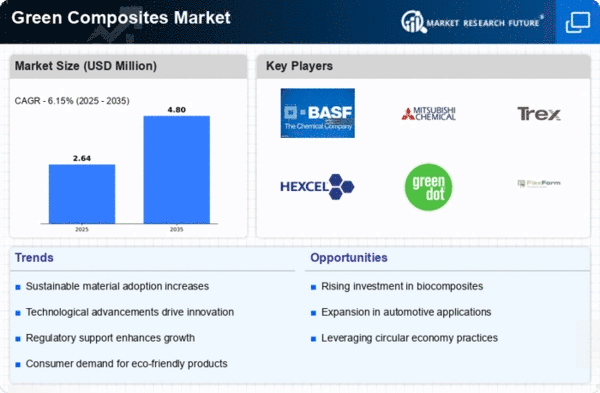
As per MRFR analysis, the Green Composites Market Size was estimated at 2.49 USD Million in 2024. The Green Composites industry is projected to grow from 2.64 in 2025 to 4.8 by 2035, exhibiting a compound annual growth rate (CAGR) of 6.15 during the forecast period 2025 - 2035.

Key Market Trends & Highlights

The Green Composites Market is poised for substantial growth driven by sustainability and innovation.

  • The market experiences a rising demand for sustainable materials, particularly in North America, which remains the largest market.
  • Technological innovations are transforming the production processes, enhancing the performance of green composites across various applications.
  • Regulatory support and incentives are increasingly shaping market dynamics, especially in the Asia-Pacific region, which is the fastest-growing area.
  • Key market drivers include increasing environmental awareness and consumer preference for eco-friendly products, particularly in the automotive and building materials segments.

Market Size & Forecast

2024 Market Size 2.49 (USD Million)
2035 Market Size 4.8 (USD Million)
CAGR (2025 - 2035) 6.15%
Largest Regional Market Share in 2024 North America

Major Players

<p>BASF SE (DE), Mitsubishi Chemical Corporation (JP), Trex Company, Inc. (US), Hexcel Corporation (US), Green Dot Corporation (US), SABIC (SA), NatureWorks LLC (US), Bioware (US)</p>

Market Trends

The Green Composites Market is currently experiencing a notable transformation, driven by increasing environmental awareness and the demand for sustainable materials. This market encompasses a variety of composite materials that utilize renewable resources, such as natural fibers and bio-based resins, which are gaining traction across multiple industries. The shift towards eco-friendly alternatives is not merely a trend but appears to be a fundamental change in how materials are sourced and utilized. As industries seek to reduce their carbon footprints, the adoption of green composites is likely to expand, influencing manufacturing processes and product designs. Moreover, the Green Composites Market is characterized by innovation and technological advancements. Research and development efforts are focused on enhancing the performance and durability of these materials, making them more competitive with traditional composites. This evolution suggests a growing recognition of the potential benefits of green composites, including reduced environmental impact and improved lifecycle sustainability. As consumer preferences shift towards greener products, companies are increasingly investing in sustainable practices, which may further propel the market forward. Overall, the Green Composites Market is poised for growth, reflecting a broader commitment to sustainability in various sectors.

Rising Demand for Sustainable Materials

There is an increasing preference for sustainable materials across various industries, which is driving the growth of the Green Composites Market. Companies are actively seeking alternatives to traditional materials that have a lower environmental impact, leading to a surge in the use of bio-based composites.

Technological Innovations

Advancements in technology are enhancing the performance and applicability of green composites. Research initiatives are focused on improving the mechanical properties and durability of these materials, making them more appealing for a wider range of applications.

Regulatory Support and Incentives

Government policies and regulations are increasingly favoring the use of sustainable materials. Incentives for adopting eco-friendly practices are encouraging businesses to invest in green composites, thereby fostering market growth.

Green Composites Market Market Drivers

Regulatory Support

Regulatory support is a crucial driver for the Global Green Composites Market Industry, as governments worldwide implement policies that favor sustainable materials. Initiatives such as tax incentives, subsidies, and grants for companies utilizing green composites are becoming increasingly common. For instance, the United States has introduced various programs aimed at promoting the use of renewable materials in manufacturing. This regulatory landscape encourages businesses to transition towards greener alternatives, fostering market growth. The anticipated compound annual growth rate of 9.07% from 2025 to 2035 indicates that regulatory measures will likely play a significant role in shaping the future of the industry.

Market Diversification

Market diversification is emerging as a key driver for the Global Green Composites Market Industry. As industries seek to reduce reliance on traditional materials, the adoption of green composites is expanding into new sectors such as aerospace, sports equipment, and electronics. This diversification not only broadens the application range of green composites but also enhances their market appeal. The anticipated growth trajectory, with a value of 25 USD Billion in 2024 and a CAGR of 9.07% from 2025 to 2035, suggests that as more industries recognize the benefits of green composites, the market will likely witness increased investments and innovations.

Market Growth Projections

The Global Green Composites Market Industry is poised for substantial growth, with projections indicating a market value of 25 USD Billion in 2024 and an impressive increase to 65 USD Billion by 2035. This growth trajectory is underpinned by a compound annual growth rate of 9.07% from 2025 to 2035. The increasing adoption of green composites across various sectors, driven by sustainability initiatives and technological advancements, suggests a robust future for the industry. As companies continue to innovate and consumers demand more sustainable options, the market is likely to expand, creating opportunities for stakeholders across the supply chain.

Sustainability Initiatives

The Global Green Composites Market Industry is experiencing a surge in demand driven by increasing sustainability initiatives across various sectors. Governments and organizations are prioritizing eco-friendly materials to reduce carbon footprints. For instance, the European Union has set ambitious targets for reducing greenhouse gas emissions, which encourages the adoption of green composites in construction and automotive industries. This shift is projected to contribute to the market's growth, with an estimated value of 25 USD Billion in 2024. The emphasis on sustainable practices is likely to propel the industry forward, as companies seek to align with environmental regulations and consumer preferences.

Technological Advancements

Technological advancements play a pivotal role in shaping the Global Green Composites Market Industry. Innovations in material science and manufacturing processes have led to the development of high-performance green composites that meet stringent industry standards. For example, the integration of bio-based resins and natural fibers has enhanced the mechanical properties of composites, making them suitable for diverse applications. As a result, the market is expected to grow significantly, reaching 65 USD Billion by 2035. The continuous evolution of technology not only improves product performance but also reduces production costs, thereby attracting more manufacturers to invest in green composite solutions.

Consumer Awareness and Demand

Consumer awareness regarding environmental issues is driving the Global Green Composites Market Industry. As individuals become more conscious of their purchasing decisions, there is a growing demand for products made from sustainable materials. This trend is particularly evident in sectors such as packaging, automotive, and consumer goods, where eco-friendly options are increasingly preferred. Companies are responding by incorporating green composites into their product lines to meet consumer expectations. The market's projected growth to 65 USD Billion by 2035 reflects this shift in consumer behavior, as businesses strive to align their offerings with the values of environmentally conscious consumers.

Market Segment Insights

By Application: Automotive (Largest) vs. Consumer Goods (Fastest-Growing)

<p>In the Green Composites Market, the automotive sector holds the largest share, driven by increasing demand for lightweight materials that enhance vehicle efficiency and sustainability. This is followed closely by the construction and marine sectors, which are also significant consumers of green composites, leveraging their environmental benefits. The consumer goods sector, meanwhile, is emerging rapidly as manufacturers increasingly prioritize eco-friendly materials to align with consumer preferences for sustainable products.</p>

<p>Automotive (Dominant) vs. Consumer Goods (Emerging)</p>

<p>The automotive sector stands as the dominant player in the green composites market, primarily due to stringent regulations prioritizing emissions reduction and the push for fuel-efficient vehicles. This sector benefits from advancements in composite technologies that allow for lightweight yet durable components. Conversely, the consumer goods sector is categorized as an emerging segment, with companies innovating in product designs that incorporate green composites. This shift is largely driven by changing consumer preferences and corporate sustainability commitments, pushing manufacturers to explore eco-friendly alternatives that align with newer market trends.</p>

By End Use: Building Materials (Largest) vs. Automotive Components (Fastest-Growing)

<p>In the Green Composites Market, the distribution of market share among the various end use segments reveals that Building Materials is the largest segment, significantly contributing to the overall demand for eco-friendly solutions. This sector is driven by rising construction activities and a shift towards sustainable practices in architecture and design, showcasing the growing preference for green building materials. On the other hand, Automotive Components represent the fastest-growing segment as manufacturers increasingly adopt green composites for lightweighting vehicles and improving fuel efficiency, driven by stringent environmental regulations and consumer demand for more sustainable transport options.</p>

<p>Building Materials: Dominant vs. Automotive Components: Emerging</p>

<p>Building Materials are recognized as the dominant segment within the Green Composites Market, owing to a substantial commitment from the construction industry towards sustainability. This includes the use of green composites in various applications ranging from insulation to structural components. The push for sustainable building practices has made these materials a preferred choice for construction projects. In contrast, Automotive Components are emerging rapidly, with automotive manufacturers integrating green composites to enhance vehicle performance and reduce environmental footprints. The sector is witnessing technological advancements aimed at improving the strength-to-weight ratio of vehicle components, thus catering to both performance and sustainability.</p>

By Type: Natural Fiber Composites (Largest) vs. Bio-based Composites (Fastest-Growing)

<p>In the Green Composites Market, Natural Fiber Composites take the lead as the largest segment, reflecting the growing preference for sustainable materials in various industrial applications. Bio-based Composites are rapidly gaining momentum, attributed to heightened environmental awareness and a shift towards sustainable sourcing, making them an increasingly prominent player in the market landscape. Growth trends for these segments indicate a shift toward more sustainable practices in manufacturing and construction. The rising demand for green products contributes to the heightened adoption of Bio-based Composites, which are the fastest-growing segment due to favorable government policies and consumer preferences for eco-friendly alternatives. Natural Fiber Composites, while dominant, are also seeing steady growth fueled by innovations in material processing and enhanced performance characteristics.</p>

<p>Natural Fiber Composites (Dominant) vs. Bio-based Composites (Emerging)</p>

<p>Natural Fiber Composites are recognized for their lightweight, strength, and biodegradable attributes, primarily composed of natural fibers like jute, hemp, and flax. They are predominantly utilized in automotive, construction, and consumer goods, with a strong emphasis on sustainability and carbon footprint reduction. This segment benefits from established technologies and a stable supply chain. On the other hand, Bio-based Composites, made from renewable resources such as starch-based polymers, represent an emerging category that is becoming increasingly significant. Their growth is propelled by advancements in biopolymer technology and the increasing application in packaging and automotive sectors, making them appealing to manufacturers who prioritize eco-friendliness and resource efficiency.</p>

By Manufacturing Process: Injection Molding (Largest) vs. 3D Printing (Fastest-Growing)

<p>In the manufacturing process segment of the Green Composites Market, injection molding emerges as the largest segment, commanding significant market share thanks to its efficiency in producing complex shapes and high production rates. Meanwhile, 3D printing is rapidly gaining ground, appealing to industries looking for customization and rapid prototyping capabilities. Compression molding and pultrusion also hold substantial shares, though they are overshadowed by the remarkable growth trajectory of 3D printing.</p>

<p>Injection Molding (Dominant) vs. 3D Printing (Emerging)</p>

<p>Injection molding is characterized by its speed and capability to create intricate designs, making it the dominant manufacturing process in the green composites domain. It efficiently utilizes materials, minimizing waste, which aligns with sustainability goals. Conversely, 3D printing is seen as an emerging process due to its flexibility and ability to manufacture on-demand with minimal material usage. This innovation caters particularly to sectors that require rapid design adjustments and small batch productions, positioning 3D printing as a formidable player in the evolving landscape of green composites.</p>

By Reinforcement Type: Natural Fibers (Largest) vs. Biocomposites (Fastest-Growing)

<p>In the Green Composites Market, Natural Fibers dominate the reinforcement types, capturing the largest share due to their sustainable properties and widespread availability. This category includes materials such as jute, hemp, and flax, which are not only renewable but also offer high strength-to-weight ratios, making them attractive for various applications. On the other hand, Biocomposites are emerging as a significant player, particularly due to their innovative use of organic materials combined with synthetic resins, which enhances performance while maintaining eco-friendliness. Growth trends indicate a rising preference for sustainable and eco-friendly materials across industries, driving the development of Green Composites. This shift is influenced by strict environmental regulations and increasing consumer awareness about sustainability. Biocomposites, in particular, are experiencing rapid adoption as industries seek alternatives that not only reduce environmental impact but also perform effectively in applications ranging from automotive to construction.</p>

<p>Natural Fibers (Dominant) vs. Biocomposites (Emerging)</p>

<p>Natural Fibers are characterized by their renewable nature and excellent mechanical properties, making them the dominant choice in the Green Composites Market. These materials are often lighter and more cost-effective compared to synthetic alternatives, leading to their widespread adoption in sectors such as automotive and construction. However, Biocomposites are emerging as a viable alternative, combining natural fibers and biopolymers to create products that boast both sustainability and enhanced performance. This segment is driven by technological advancements that improve material properties and expanding applications in various industries, indicating a promising future for both Natural Fibers and Biocomposites in the green materials space.</p>

Get more detailed insights about Green Composites Market Research Report- Global Forecast till 2035

Regional Insights

North America : Leading Market Innovators

North America is poised to maintain its leadership in the Green Composites Market, holding a market size of $1.0B in 2025. The region benefits from strong demand driven by increasing environmental regulations and a shift towards sustainable materials. Key drivers include government incentives for green technologies and rising consumer awareness about eco-friendly products. The market is expected to grow as industries adopt greener practices, supported by favorable policies and investments in R&D. The competitive landscape in North America is robust, featuring major players like BASF SE, Trex Company, and Hexcel Corporation. The U.S. leads the market, driven by advancements in bio-based materials and composites. Companies are focusing on innovation and sustainability, enhancing their product offerings to meet the growing demand. The presence of established firms and startups alike fosters a dynamic environment, ensuring continuous growth and development in the sector.

Europe : Sustainable Growth Initiatives

Europe is emerging as a significant player in the Green Composites Market, with a market size of $0.8B in 2025. The region's growth is fueled by stringent environmental regulations and a strong commitment to sustainability. Initiatives like the European Green Deal aim to promote eco-friendly materials, driving demand for green composites across various industries. The increasing focus on circular economy principles further enhances market potential, encouraging innovation and investment in sustainable solutions. Leading countries in Europe include Germany, France, and the UK, where companies are actively investing in green technologies. Key players such as Mitsubishi Chemical Corporation and SABIC are at the forefront, leveraging their expertise to develop advanced composite materials. The competitive landscape is characterized by collaborations between industry and academia, fostering innovation and ensuring that Europe remains a leader in sustainable materials. "The European Union is committed to reducing carbon emissions by 55% by 2030, promoting the use of sustainable materials in all sectors."

Asia-Pacific : Emerging Market Potential

Asia-Pacific is rapidly gaining traction in the Green Composites Market, with a market size of $0.55B in 2025. The region's growth is driven by increasing industrialization, urbanization, and a rising awareness of environmental issues. Governments are implementing policies to promote sustainable practices, which is expected to boost demand for green composites. The region's diverse industries, including automotive and construction, are increasingly adopting eco-friendly materials to meet regulatory requirements and consumer preferences. Countries like Japan, China, and India are leading the charge in adopting green technologies. The competitive landscape features companies such as NatureWorks LLC and Bioware, which are innovating to meet the growing demand for sustainable materials. The presence of a large manufacturing base and a focus on R&D are key factors driving growth in this region, positioning Asia-Pacific as a significant player in the global market.

Middle East and Africa : Untapped Market Opportunities

The Middle East and Africa region is still in the nascent stages of the Green Composites Market, with a market size of $0.14B in 2025. However, there is significant potential for growth driven by increasing awareness of sustainability and environmental issues. Governments are beginning to recognize the importance of green technologies, leading to initiatives aimed at promoting eco-friendly materials. The region's diverse economic landscape presents opportunities for the adoption of green composites across various sectors, including construction and automotive. Countries like South Africa and the UAE are starting to invest in sustainable practices, with local companies exploring green composite solutions. The competitive landscape is evolving, with emerging players looking to capitalize on the growing demand for sustainable materials. As awareness and regulatory support increase, the Middle East and Africa could see substantial growth in the green composites sector, making it an area to watch in the coming years.

Key Players and Competitive Insights

The Green Composites Market is currently characterized by a dynamic competitive landscape, driven by increasing environmental awareness and the demand for sustainable materials. Key players are actively engaging in innovation and strategic partnerships to enhance their market positioning. For instance, BASF SE (DE) has focused on developing bio-based composites that cater to the automotive and construction sectors, while Mitsubishi Chemical Corporation (JP) emphasizes the integration of advanced materials technology to improve product performance. These strategies collectively foster a competitive environment that prioritizes sustainability and technological advancement.

In terms of business tactics, companies are increasingly localizing manufacturing to reduce carbon footprints and optimize supply chains. The market structure appears moderately fragmented, with several players vying for market share. However, the influence of major companies like Trex Company, Inc. (US) and Hexcel Corporation (US) is notable, as they leverage their established reputations and innovative capabilities to shape market dynamics.

In November 2025, Trex Company, Inc. (US) announced the launch of a new line of eco-friendly decking products made from 95% recycled materials. This strategic move not only aligns with the growing consumer preference for sustainable products but also reinforces Trex's commitment to environmental stewardship. The introduction of these products is expected to enhance their market share and appeal to eco-conscious consumers.

In October 2025, Hexcel Corporation (US) unveiled a partnership with a leading aerospace manufacturer to develop lightweight composite materials aimed at reducing aircraft emissions. This collaboration signifies a strategic pivot towards addressing the aviation industry's sustainability challenges, potentially positioning Hexcel as a leader in the aerospace segment of the Green Composites Market. The partnership is likely to yield innovative solutions that could redefine material applications in aviation.

In September 2025, NatureWorks LLC (US) expanded its production capacity for Ingeo biopolymer, a key component in green composites. This expansion is indicative of NatureWorks' strategy to meet the rising demand for sustainable materials across various industries, including packaging and textiles. By increasing production capabilities, NatureWorks is poised to strengthen its market presence and cater to a broader customer base.

As of December 2025, the competitive trends in the Green Composites Market are increasingly influenced by digitalization, sustainability initiatives, and the integration of AI technologies. Strategic alliances are becoming more prevalent, as companies recognize the value of collaboration in driving innovation. The competitive landscape is shifting from traditional price-based competition to a focus on technological advancements and supply chain reliability. This evolution suggests that future differentiation will hinge on the ability to innovate and deliver sustainable solutions that meet the demands of an environmentally conscious market.

Key Companies in the Green Composites Market market include

Industry Developments

Future Outlook

Green Composites Market Future Outlook

<p>The Green Composites Market is projected to grow at a 6.15% CAGR from 2024 to 2035, driven by sustainability trends, regulatory support, and technological advancements.</p>

New opportunities lie in:

  • <p>Development of bio-based resin formulations for automotive applications.</p>
  • <p>Expansion into construction materials with enhanced thermal properties.</p>
  • <p>Partnerships with recycling firms to create closed-loop systems for composite materials.</p>

<p>By 2035, the Green Composites Market is expected to achieve substantial growth, reflecting a robust commitment to sustainability.</p>

Market Segmentation

Green Composites Market Type Outlook

  • Natural Fiber Composites
  • Bio-based Composites
  • Recycled Composites
  • Hybrid Composites
  • Green Polymer Composites

Green Composites Market End Use Outlook

  • Building Materials
  • Automotive Components
  • Sports Equipment
  • Packaging
  • Electronics

Green Composites Market Application Outlook

  • Automotive
  • Construction
  • Consumer Goods
  • Aerospace
  • Marine

Green Composites Market Reinforcement Type Outlook

  • Natural Fibers
  • Synthetic Fibers
  • Mineral Fillers
  • Wood-based Reinforcements
  • Biocomposites

Green Composites Market Manufacturing Process Outlook

  • Injection Molding
  • Compression Molding
  • Pultrusion
  • Filament Winding
  • 3D Printing

Report Scope

MARKET SIZE 20242.49(USD Million)
MARKET SIZE 20252.64(USD Million)
MARKET SIZE 20354.8(USD Million)
COMPOUND ANNUAL GROWTH RATE (CAGR)6.15% (2024 - 2035)
REPORT COVERAGERevenue Forecast, Competitive Landscape, Growth Factors, and Trends
BASE YEAR2024
Market Forecast Period2025 - 2035
Historical Data2019 - 2024
Market Forecast UnitsUSD Million
Key Companies ProfiledBASF SE (DE), Mitsubishi Chemical Corporation (JP), Trex Company, Inc. (US), Hexcel Corporation (US), Green Dot Corporation (US), SABIC (SA), NatureWorks LLC (US), Bioware (US)
Segments CoveredApplication, End Use, Type, Manufacturing Process, Reinforcement Type
Key Market OpportunitiesGrowing demand for sustainable materials drives innovation in the Green Composites Market.
Key Market DynamicsRising demand for sustainable materials drives innovation and competition in the Green Composites Market.
Countries CoveredNorth America, Europe, APAC, South America, MEA

FAQs

What is the major growth driver of the global green composites market?

The global green composites market is driven the need for sustainable materials for production and manufacture.

What are the biggest growth opportunities for the global green composites market?

Construction and marine sectors are expected to drive up growth opportunities for the global green composites market.

Which region can dominate the global green composites market?

The APAC region is deemed to dominate the global green composites market from 2025 to 2035

Which region stands second in the global green composites market?

North America has grabbed the second position in the global green composites market due to strict regulations pertaining to the environment by federal agencies.

Who are the prominent industry participants of the global green composites market?

ALPAS srl, UPM Biocomposites, Procotex SA Corporation NV, GreenGran BN, MCG Biocomposites LLC., Flex Form Technologies, TECNARO GMBH, and others are major players of the global green composites market.

  1. Executive Summary
  2. Scope of The Report
    1. Market Definition
    2. Scope of The
      1. Research Objectives
      2. Assumptions & Limitations
    3. Study
    4. Markets Structure
    5. Market Research Methodology
    6. Research
    7. Process
    8. Secondary Research
    9. Primary Research
    10. Forecast Model
  3. Market Landscape
    1. Five Forces Analysis
      1. Bargaining
      2. Threat of substitutes
      3. Segment rivalry
    2. Threat of New Entrants
    3. power of buyers
    4. Value Chain/Supply Chain of Global Green Composites Market
  4. Industry Overview of Global Green Composites Market
    1. Introduction
    2. Growth Drivers
    3. Impact analysis
    4. Market Challenges
    5. Impact analysis
  5. Market Trends
    1. Introduction
    2. Growth Trends
    3. Impact analysis
  6. Global Green Composites Market by Region
  7. Global Green Composites Market by Fiber type
    1. (Wood Fibers (jute, hemp, kenaf, sisal, coir, and others) and Non-wood Fibers (polyethylene,
    2. polypropylene, polyvinyl chloride, and other))
  8. Global
    1. Green Composites Market by Application (automotive & transportation, aerospace,
    2. healthcare, military, construction, packaging and others (marine))
    3. Company Landscape
  9. Company Profiles
    1. Flex Form Technologies
      1. Product/Business Segment Overview
      2. Financial Updates
      3. Key Developments
    2. Company Overview
    3. TECNARO GMBH
      1. Company
      2. Product/Business Segment Overview
      3. Key Developments
    4. Overview
    5. Financial Updates
    6. Procotex SA Corporation NV
      1. Company
      2. Product/Business Segment Overview
      3. Key Developments
    7. Overview
    8. Financial Updates
    9. GreenGran BN
      1. Company
      2. Product/Business Segment Overview
      3. Key Developments
    10. Overview
    11. Financial Updates
    12. UPM Biocomposites
      1. Company
      2. Product/Business Segment Overview
      3. Key Developments
    13. Overview
    14. Financial Updates
    15. MCG Biocomposites LLC
      1. Company
      2. Product/Business Segment Overview
      3. Key Developments
    16. Overview
    17. Financial Updates
    18. ALPAS srl
      1. Company Overview
      2. Product/Business Segment Overview
      3. Key Developments
    19. Financial Updates
  10. Conclusion
  11. LIST OF TABLES
  12. World Population by Major
    1. Regions (2020-2027)
  13. Global
    1. Green Composites Market: By Region, 2020-2027
    2. Table 3
    3. North America Green Composites Market: By Country, 2020-2027
    4. Table 4
    5. Europe Green Composites Market: By Country, 2020-2027
  14. Asia-Pacific Green Composites Market:
    1. By Country, 2020-2027
  15. Middle East
    1. & Africa Green Composites Market: By Country, 2020-2027
    2. Table 6
    3. Latin America Green Composites Market: By Country, 2020-2027
  16. Global Green Composites by Fiber
    1. Type Market: By Regions, 2020-2027
  17. North
    1. America Green Composites by Fiber Type Market: By Country, 2020-2027
    2. Table
  18. Europe Green Composites by Fiber Type Market: By Country,
  19. Asia-Pacific Green Composites by Fiber
    1. Type Market: By Country, 2020-2027
  20. Middle
    1. East & Africa Green Composites by Fiber Type Market: By Country, 2020-2027
  21. Latin America Green Composites by Fiber Type Market:
    1. By Country, 2020-2027
  22. North America Green Composites
    1. for Application Market: By Country, 2020-2027
  23. Europe
    1. Green Composites for Application Market: By Country, 2020-2027
    2. Table 14
    3. Asia-Pacific Green Composites for Application Market: By Country, 2020-2027
  24. Middle East & Africa Green Composites for Application
    1. Market: By Country, 2020-2027
  25. Latin America Green
    1. Composites for Application Market: By Country, 2016-2023
    2. Table 23
    3. Global Fiber Type Market: By Region, 2020-2027
    4. Table 24
    5. Global Application Market: By Region, 2020-2027
    6. Table 25
  26. North America Green Composites Market, By Country
    1. Table
  27. North America Green Composites Market, By Fiber Type
  28. North America Green Composites Market,
    1. By Application
  29. Europe: Green Composites Market,
    1. By Country
  30. Europe: Green Composites Market,
    1. By Fiber Type
  31. Europe: Green Composites
  32. Market, By Application
  33. Asia-Pacific: Green
  34. Composites Market, By Country
  35. Asia-Pacific:
  36. Green Composites Market, By Fiber Type
  37. Asia-Pacific:
  38. Green Composites Market, By Application
  39. Middle
  40. East & Africa: Green Composites Market, By Country
    1. Table 35
  41. Middle East & Africa Green Composites Market, By Fiber Type
  42. Middle East & Africa: Green Composites Market,
    1. By Application
  43. Latin America: Green Composites
  44. Market, By Country
  45. Latin America Green Composites
  46. Market, By Fiber Type
    1. Table39 Latin America:
  47. Green Composites Market, By Application
  48. LIST OF FIGURES
  49. Global Green Composites
    1. Market segmentation
  50. Forecast Methodology
    1. FIGURE
  51. Five Forces Analysis of Global Green Composites Market
    1. FIGURE
  52. Value Chain of Global Green Composites Market
    1. FIGURE 5
  53. Share of Global Green Composites Market in 2020, by country (in %)
    1. FIGURE
  54. Global Green Composites Market, 2020-2027, (USD billion)
  55. Sub-segments of Applications
    1. FIGURE 8
    2. Global Green Composites Market size by Fiber type, 2020
    3. FIGURE 9
    4. Share of Global Green Composites Market by Fiber type,
  56. Global
    1. Green Composites Market size by Application, 2020
    2. FIGURE 11
    3. Share of Global Green Composites Market by Application, 2020-2027

Green Composites Market Segmentation

Market Segmentation Overview

  • Detailed segmentation data will be available in the full report
  • Comprehensive analysis by multiple parameters
  • Regional and country-level breakdowns
  • Market size forecasts by segment
Infographic

Free Sample Request

Kindly complete the form below to receive a free sample of this Report

Get Free Sample

Customer Strories

Compare Licence

×
Features License Type
Single User Multiuser License Enterprise User
Price $4,950 $5,950 $7,250
Maximum User Access Limit 1 User Upto 10 Users Unrestricted Access Throughout the Organization
Free Customization
Direct Access to Analyst
Deliverable Format
Platform Access
Discount on Next Purchase 10% 15% 15%
Printable Versions