Request Free Sample ×

Kindly complete the form below to receive a free sample of this Report

* Please use a valid business email

Leading companies partner with us for data-driven Insights

clients tt-cursor
Hero Background
English
Chinese
French
Japanese
Korean
German
Spanish

Green Ammonia Market Trends

ID: MRFR/CnM/9999-HCR
128 Pages
Chitranshi Jaiswal
Last Updated: April 06, 2026

Green Ammonia Market Size, Share & Industry Analysis Research Report Information By Gasifier Technology (Alkaline Water Electrolysis, Proton Exchange Membrane Electrolysis and Solid Oxide Electrolysis), By Gasifier Application (Power Generation, Transportation and Industrial Feedstocks), and By Region (North America, Europe, Asia-Pacific, And Rest Of The World) –Market Forecast Till 2035

Share:
Download PDF ×

We do not share your information with anyone. However, we may send you emails based on your report interest from time to time. You may contact us at any time to opt-out.

Green Ammonia Market Infographic
Purchase Options

Market Trends

Key Emerging Trends in the Green Ammonia Market

The market trends of the green ammonia industry are witnessing significant momentum as the world shifts towards sustainable and eco-friendly energy sources. Green ammonia, produced through renewable energy sources like wind, solar, or hydro power, is gaining traction as a viable alternative to traditional ammonia production methods, which heavily rely on fossil fuels. One of the key driving factors behind this trend is the increasing global awareness of the urgent need to mitigate climate change and reduce greenhouse gas emissions. As governments worldwide implement stricter regulations on carbon emissions, industries are seeking cleaner alternatives, thus fueling the demand for green ammonia.

Furthermore, the growing emphasis on decarbonizing various sectors such as agriculture, transportation, and energy production is propelling the adoption of green ammonia. In agriculture, for instance, green ammonia holds promise as a sustainable fertilizer, offering a way to reduce the carbon footprint associated with conventional ammonia-based fertilizers. Similarly, in the transportation sector, green ammonia is being explored as a potential carbon-neutral fuel for ships and heavy-duty vehicles, presenting an opportunity to reduce reliance on fossil fuels and curb emissions.

The market trends also reflect a surge in investment and innovation within the green ammonia sector. As stakeholders recognize the economic and environmental benefits of transitioning to green ammonia, there has been a notable increase in research and development activities aimed at improving production efficiency and lowering costs. Technological advancements, such as electrolysis-powered ammonia synthesis and advanced catalysts, are driving down the production costs of green ammonia, making it more competitive with conventional ammonia production methods.

Moreover, partnerships and collaborations between governments, industry players, and research institutions are fostering the growth of the green ammonia market. Joint initiatives are being undertaken to scale up production capacity, establish supply chains, and create supportive regulatory frameworks conducive to the widespread adoption of green ammonia. These collaborative efforts are crucial for accelerating the commercialization of green ammonia and expanding its market presence.

Another notable trend in the green ammonia market is the increasing focus on global trade and international cooperation. Countries with abundant renewable energy resources are positioning themselves as key players in the green ammonia market, aiming to export surplus green ammonia to regions with high demand but limited production capacity. This trend highlights the potential for green ammonia to become a globally traded commodity, facilitating the transition to a more sustainable and interconnected energy landscape.

Furthermore, consumer preferences and corporate sustainability goals are driving the uptake of green ammonia across various industries. Businesses are increasingly recognizing the importance of incorporating environmentally friendly practices into their operations and supply chains to meet consumer expectations and stay competitive in the market. As a result, there is a growing demand for green ammonia as an input for sustainable products and processes, further bolstering its market growth.


Author
Author Profile
Chitranshi Jaiswal
Team Lead - Research

Chitranshi is a Team Leader in the Chemicals & Materials (CnM) and Energy & Power (EnP) domains, with 6+ years of experience in market research. She leads and mentors teams to deliver cross-domain projects that equip clients with actionable insights and growth strategies. She is skilled in market estimation, forecasting, competitive benchmarking, and both primary & secondary research, enabling her to turn complex data into decision-ready insights. An engineer and MBA professional, she combines technical expertise with strategic acumen to solve dynamic market challenges. Chitranshi has successfully managed projects that support market entry, investment planning, and competitive positioning, while building strong client relationships. Certified in Advanced Excel & Power BI she leverages data-driven approaches to ensure accuracy, clarity, and impactful outcomes.

Leave a Comment

FAQs

What is the current valuation of the Green Ammonia Market as of 2024?

<p>The Green Ammonia Market was valued at 1.567 USD Billion in 2024.</p>

What is the projected market valuation for Green Ammonia by 2035?

<p>The market is projected to reach a valuation of 672.02 USD Billion by 2035.</p>

What is the expected CAGR for the Green Ammonia Market during the forecast period 2025 - 2035?

<p>The expected CAGR for the Green Ammonia Market during 2025 - 2035 is 73.5%.</p>

Which companies are considered key players in the Green Ammonia Market?

<p>Key players include Yara International, Norsk Hydro, Siemens Energy, and CF Industries, among others.</p>

What are the main segments of the Green Ammonia Market?

<p>The main segments include Gasifier Technology and Gasifier Application.</p>

What is the valuation of the Alkaline Water Electrolysis segment in 2024?

<p>The Alkaline Water Electrolysis segment was valued at 0.472 USD Billion in 2024.</p>

How much is the Industrial Feedstocks segment projected to be worth by 2035?

The Industrial Feedstocks segment is projected to reach 322.02 USD Billion by 2035.

What is the valuation of the Power Generation application in the Green Ammonia Market?

The Power Generation application was valued at 0.5 USD Billion in 2024.

What does the future hold for the Proton Exchange Membrane Electrolysis segment?

The Proton Exchange Membrane Electrolysis segment is expected to maintain a valuation of 0.472 USD Billion through 2025.

What are the anticipated trends in the Green Ammonia Market by 2035?

The market is likely to experience substantial growth, driven by advancements in technology and increasing demand for sustainable energy solutions.

Market Summary

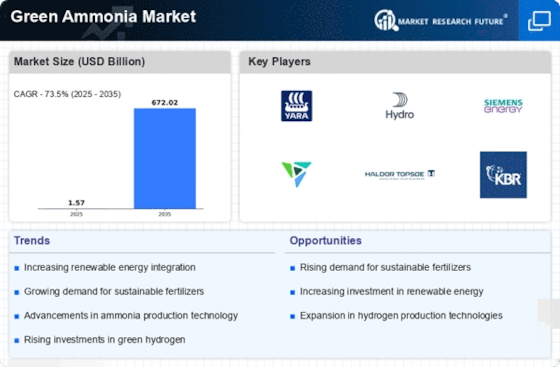
As per Market Research Future analysis, the Green Ammonia Market Size was estimated at 1.567 USD Billion in 2024. The Green Ammonia industry is projected to grow from 2.719 USD Billion in 2025 to 672.02 USD Billion by 2035, exhibiting a compound annual growth rate (CAGR) of 73% during the forecast period 2025 - 2035

Key Market Trends & Highlights

The Green Ammonia Market is poised for substantial growth driven by sustainability and technological advancements.

  • North America emerges as the largest market for green ammonia, reflecting a robust demand for sustainable fertilizers. Asia-Pacific is recognized as the fastest-growing region, indicating a shift towards eco-friendly agricultural solutions. Alkaline Water Electrolysis dominates the market, while Proton Exchange Membrane Electrolysis is rapidly gaining traction. Increasing regulatory support for green ammonia and a growing interest in the hydrogen economy are key drivers propelling market expansion.

Market Size & Forecast

2024 Market Size 1.567 (USD Billion)
2035 Market Size 672.02 (USD Billion)
CAGR (2025 - 2035) 73.5%
Largest Regional Market Share in 2024 North America

Major Players

Yara International (NO), Norsk Hydro (NO), Siemens Energy (DE), CF Industries (US), Haldor Topsoe (DK), KBR (US), Thyssenkrupp (DE), ACWA Power (SA), Green Hydrogen Systems (DK)

Market Trends

The green ammonia market is currently experiencing a transformative phase, driven by the increasing emphasis on sustainable energy solutions. This market appears to be gaining traction as industries seek alternatives to traditional ammonia production methods, which are often carbon-intensive. The shift towards green ammonia is largely influenced by global initiatives aimed at reducing greenhouse gas emissions and promoting renewable energy sources. As a result, various stakeholders, including governments and private enterprises, are investing in research and development to enhance production technologies and expand applications. This evolving landscape suggests a potential for significant growth in the green ammonia market, as it aligns with broader environmental goals and energy transition strategies. Moreover, the Green Ammonia Market seems poised to play a crucial role in decarbonizing sectors such as agriculture and transportation. The versatility of green ammonia as a clean fuel and a hydrogen carrier indicates its potential to facilitate the transition to a low-carbon economy. Additionally, collaborations between technology providers and end-users are likely to foster innovation and accelerate the adoption of green ammonia solutions. As the market continues to mature, it may witness the emergence of new business models and partnerships that further enhance its viability and attractiveness to investors and consumers alike.

Rising Demand for Sustainable Fertilizers

The green ammonia market is witnessing an increasing demand for sustainable fertilizers as agricultural practices evolve towards more eco-friendly solutions. This trend indicates a shift in consumer preferences, with farmers seeking alternatives that minimize environmental impact while maintaining crop yields.

Technological Advancements in Production

Innovations in production technologies are emerging as a key trend within the Green Ammonia Market. Enhanced methods for synthesizing ammonia from renewable energy sources are likely to improve efficiency and reduce costs, making green ammonia more accessible to various industries.

Integration with Renewable Energy Systems

The integration of green ammonia with renewable energy systems is becoming increasingly prominent. This trend suggests that green ammonia could serve as a vital component in energy storage and transportation, facilitating the broader adoption of renewable energy solutions.

Green Ammonia Market Market Drivers

Growing Interest in Hydrogen Economy

The Green Ammonia Market is closely linked to the burgeoning hydrogen economy, which is gaining traction as a viable solution for energy storage and transportation. Green ammonia serves as an effective hydrogen carrier, facilitating the storage and transport of hydrogen produced from renewable sources. The International Energy Agency has indicated that the demand for hydrogen could reach 500 million tons by 2050, with green ammonia playing a pivotal role in this transition. This growing interest in hydrogen applications is likely to drive investments in the green ammonia market, as stakeholders seek to capitalize on the synergies between hydrogen and ammonia production.

Integration with Renewable Energy Sources

The Green Ammonia Market is poised for growth due to its integration with renewable energy sources such as wind and solar power. Green ammonia production relies on renewable energy to power the electrolysis process, which splits water into hydrogen and oxygen. This synergy not only enhances the sustainability of ammonia production but also provides a means of storing excess renewable energy. As the share of renewables in the energy mix continues to rise, the demand for green ammonia as an energy carrier is likely to increase. This trend indicates a promising future for the Green Ammonia Market, as it aligns with global efforts to transition to cleaner energy systems.

Increasing Regulatory Support for Green Ammonia

The green ammonia market is experiencing a surge in regulatory support aimed at reducing carbon emissions. Governments are implementing stringent policies and incentives to promote the use of green ammonia as a sustainable alternative to traditional ammonia production. For instance, various countries have set ambitious targets for carbon neutrality, which has led to increased funding for research and development in green ammonia technologies. This regulatory environment not only encourages investment but also fosters innovation within the Green Ammonia Market. As a result, companies are more likely to invest in green ammonia production facilities, thereby expanding the market and enhancing its overall growth potential.

Technological Innovations in Production Processes

The green ammonia market is benefiting from ongoing technological innovations that enhance production efficiency and reduce costs. Advances in electrolysis and Haber-Bosch processes are making it increasingly feasible to produce green ammonia at scale. For instance, new catalysts and process optimizations are being developed to improve the energy efficiency of ammonia synthesis. As production costs decrease, the competitiveness of green ammonia in various applications, including fertilizers and energy storage, is likely to improve. This technological progress is expected to attract more players to the Green Ammonia Market, further driving its growth and adoption across multiple sectors.

Rising Agricultural Demand for Eco-Friendly Solutions

The green ammonia market is witnessing an increase in demand for eco-friendly fertilizers, driven by the agricultural sector's need for sustainable practices. Farmers are increasingly seeking alternatives to conventional fertilizers, which often contribute to environmental degradation. Green ammonia, produced through renewable energy sources, offers a sustainable solution that aligns with the growing emphasis on organic farming and sustainable agriculture. According to industry reports, the market for sustainable fertilizers is projected to grow at a compound annual growth rate of over 10% in the coming years. This trend is likely to bolster the Green Ammonia Market, as more agricultural stakeholders adopt green ammonia as a viable fertilizer option.

Market Segment Insights

By Gasifier Technology: Alkaline Water Electrolysis (Largest) vs. Proton Exchange Membrane Electrolysis (Fastest-Growing)

In the Green Ammonia Market, the gasifier technology segment exhibits a diverse array of technologies, with Alkaline <a href="https://www.marketresearchfuture.com/reports/water-electrolysis-market-4133" target="_blank" title="water electrolysis">Water Electrolysis</a> leading in market share. This segment holds a significant place due to its extensive adoption and established infrastructure, capturing the majority of the market. Conversely, the Proton Exchange Membrane Electrolysis is gaining traction due to its higher efficiency and lower operational costs, making it a promising contender in the market.

Technology: Alkaline Water Electrolysis (Dominant) vs. Proton Exchange Membrane Electrolysis (Emerging)

Alkaline Water Electrolysis is the dominant technology within the Green Ammonia Market, known for its reliability and cost-effectiveness. It employs a simple design and has been around for decades, making it the preferred choice for many large-scale applications. In contrast, Proton Exchange Membrane Electrolysis is emerging as a game-changer due to its rapid response times and greater efficiency at lower scales. This technology is particularly appealing for renewable energy integration, allowing for more flexible ammonia production, thus catering to the evolving energy landscape.

By Gasifier Application: Power Generation (Largest) vs. Transportation (Fastest-Growing)

In the Green Ammonia Market, the Gasifier Application segment is predominantly led by Power Generation, which holds the largest share. This application is essential for producing ammonia as it directly utilizes the gasification process to convert resources into <a href="https://www.marketresearchfuture.com/reports/syngas-market-7487">syngas</a>, subsequently used in ammonia synthesis. Following Power Generation, the Transportation sector is emerging rapidly, capturing a growing share of the market as ammonia is adopted for its potential as a zero-emission fuel alternative in shipping and transportation.

Power Generation: Dominant vs. Transportation: Emerging

Power generation stands out as the dominant application within the gasifier sector of the green ammonia market due to its established technology and significant investment in infrastructure. This application is crucial for contributing to renewable energy systems, as it enables efficient conversion of biomass and other feedstocks into ammonia, aiding in energy storage solutions. Conversely, transportation is quickly emerging, fueled by growing interest in ammonia as an alternative fuel for heavy-duty vehicles and maritime shipping. The rising need for sustainable fuel sources has prompted innovations in ammonia engines and infrastructure, positioning this application as a rapidly developing area with potential for substantial growth.

Get more detailed insights about Green Ammonia Market Research Report—Global Forecast till 2035

Regional Insights

North America : Innovation and Investment Hub

North America is poised to dominate the green ammonia market, driven by significant investments in renewable energy and supportive regulatory frameworks. The region is expected to hold approximately 40% of the global market share, with the U.S. and Canada leading the charge. Key drivers include federal incentives for clean energy technologies and increasing demand for sustainable fertilizers and energy storage solutions. The U.S. is the largest market, with major players like CF Industries and KBR spearheading advancements in green ammonia production. Canada follows closely, with companies like Yara International and Norsk Hydro investing in innovative technologies. The competitive landscape is characterized by collaborations between private firms and government initiatives aimed at scaling up production and reducing costs.

Europe : Sustainability Leader in Ammonia

Europe is a frontrunner in the green ammonia market, driven by stringent environmental regulations and ambitious climate goals. The region is expected to capture around 35% of the global market share, with Germany and the Netherlands being the largest contributors. The European Green Deal and various national policies are catalyzing investments in green technologies, making the region a hub for innovation in sustainable ammonia production. Germany leads the market, supported by key players like Siemens Energy and Thyssenkrupp, while the Netherlands is rapidly expanding its green ammonia initiatives. The competitive landscape is marked by partnerships between governments and private sectors, focusing on research and development to enhance production efficiency. The presence of established companies and startups alike fosters a dynamic environment for growth.

Asia-Pacific : Emerging Market Potential

Asia-Pacific is witnessing a surge in demand for green ammonia, driven by increasing energy needs and a shift towards sustainable practices. The region is projected to hold about 20% of the global market share, with countries like Japan and Australia leading the way. Government initiatives aimed at reducing carbon emissions and promoting renewable energy sources are key growth drivers in this region, fostering a favorable environment for green ammonia production. Japan is at the forefront, with companies like ACWA Power and Green Hydrogen Systems investing in innovative projects. Australia is also emerging as a significant player, focusing on large-scale production and export opportunities. The competitive landscape is evolving, with both established firms and new entrants vying for market share, supported by favorable policies and investment incentives.

Middle East and Africa : Resource-Rich Opportunities

The Middle East and Africa region is increasingly recognized for its potential in the green ammonia market, driven by abundant renewable resources and strategic investments. This region is expected to account for approximately 5% of the global market share, with countries like Saudi Arabia and South Africa leading initiatives. The focus on diversifying energy sources and reducing reliance on fossil fuels is propelling the growth of green ammonia production in this area. Saudi Arabia is making significant strides, with ACWA Power leading projects aimed at large-scale green ammonia production. South Africa is also exploring opportunities to leverage its renewable energy resources for ammonia production. The competitive landscape is characterized by collaborations between local and international players, aiming to establish a robust green ammonia supply chain in the region.

Key Players and Competitive Insights

Leading market players are investing heavily in research and development in order to expand their product lines, which will help the green ammonia market grow even more. Market participants are also undertaking a variety of strategic activities to expand their global footprint, with important market developments including new product launches, contractual agreements, mergers and acquisitions, higher investments, and collaboration with other organizations. To expand and survive in a more competitive and rising market climate, green ammonia industry must offer cost-effective items.
Manufacturing locally to minimize operational costs is one of the key business tactics used by manufacturers in the global green ammonia industry to benefit clients and increase the market sector. In recent years, the green ammonia industry has offered some of the most significant advantages.
Major players in the green ammonia market are attempting to increase market demand by investing in research and development operations are Siemens AG, NEL ASA, ThyssenKrupp, ITM Power, CF Industries Holdings, Inc., Ballard Power Systems, AMMPower Corp, FUELPOSITIVE Corporation, Haldor Topsoe, Uniper, Hyport Duqm, Enapter, Starfire Energy, Engie, BASF SE, Yara International, Hiringa Energy, Queensland Nitrates Pty Ltd.
The industrial group ThyssenKrupp AG (ThyssenKrupp) was founded. Automobile, building, steel, and related processing, energy and utilities, public sector, packaging, trading, engineering, and other customer sectors are among its business segments. Steel goods, component technology solutions, maritime systems, supply chain management, and automation solutions for automotive OEMs are among the services offered by the business. ThyssenKrupp also offers services for industrial systems and plants and acts as a partner in engineering and construction.
In August 2021, Thyssenkrupp AG and Helios, a business based in the United Arab Emirates, have a contract for the construction of a plant to produce green hydrogen and green ammonia using the latter's patented technology.
ITM Power Plc (ITM Power) is a manufacturer and designer of hydrogen energy systems for the production of clean fuels and energy storage. The business creates tools to transform renewable energy into a clean fuel that can be stored for use in transportation, industry, and household uses, as well as a variety of materials that help lower the cost of hydrogen generation. Electrolysis equipment and hydrogen storage systems are sold by ITM Power, which also develops and produces prototype items.
In April 2020, the UK government awarded ITM Energy a project to create green hydrogen production methods employing 100 MW electrolyzers.

Key Companies in the Green Ammonia Market include

Industry Developments

In January of 2024, Yara International declared its intentions to increase its green ammonia production in Norway. The company intends to modernize their current facilities and seize opportunities to capture renewable energy to produce low carbon fertilizers and more for industrial uses. This expansion is part of Yara’s initiatives to cut emissions and increase sustainable agriculture.

In December of 2023 CF Industries Holdings, Inc. entered a large agreement with another renewable energy company to construct a green ammonia facility in the United States. The plant is expected to harness carbon-free ammonia utilizing wind and solar powered electrolyzers, thereby fulfilling the increased demand in the shipping and power generation fuels.

In November of 2023 Siemens Energy partnered with Linde Engineering to develop a new method of producing green ammonia to help reduce the cost of production. The companies said that the focus of the project is combining modern electrolysis with nitrogen separation to achieve increased clarity in green ammonia production.

In August 2023, Thyssenkrupp Uhde revealed the adoption of a new modular green ammonia production system with renewable energy-powered modular electrolyzers. The system is intended for remote regions with high solar and wind energy potential to enable the production of ammonia in an off grid decentralised manner.

In July 2023, LSB Industries Inc. entered into a contract with one well known renewable energy supplier to fabricate one of their ammonia plants in the Usa into a green ammonia plant. The company plans to shift from the traditional form of ammonia produced using fossil fuels toward a fully sustainable system within five years.

In June 2023 Iberdrola and Fertiberia announced their ambitions to enhance their production of green ammonia in Spain. The firms aim to provide low-emission ammonia to agriculture and transport industries, thus facilitating the European Union de-carbonization efforts.

Future Outlook

Green Ammonia Market Future Outlook

The Green Ammonia Market is poised for rapid growth, driven by sustainability initiatives and technological advancements, with a projected 73.5% CAGR from 2025 to 2035.

New opportunities lie in:

  • Development of green ammonia production facilities in emerging markets.
  • Integration of green ammonia in renewable energy storage solutions.
  • Partnerships with agricultural sectors for ammonia-based fertilizers.

By 2035, the Green Ammonia Market is expected to achieve substantial growth, establishing itself as a key player in the global energy landscape.

Market Segmentation

Green Ammonia Market Gasifier Technology Outlook

  • Alkaline Water Electrolysis
  • Proton Exchange Membrane Electrolysis
  • Solid Oxide Electrolysis

Green Ammonia Market Gasifier Application Outlook

  • Power Generation
  • Transportation
  • Industrial Feedstocks

Report Scope

MARKET SIZE 2024 1.567(USD Billion)
MARKET SIZE 2025 2.719(USD Billion)
MARKET SIZE 2035 672.02(USD Billion)
COMPOUND ANNUAL GROWTH RATE (CAGR) 73.5% (2025 - 2035)
REPORT COVERAGE Revenue Forecast, Competitive Landscape, Growth Factors, and Trends
BASE YEAR 2024
Market Forecast Period 2025 - 2035
Historical Data 2019 - 2024
Market Forecast Units USD Billion
Key Companies Profiled Yara International (NO), Norsk Hydro (NO), Siemens Energy (DE), CF Industries (US), Haldor Topsoe (DK), KBR (US), Thyssenkrupp (DE), ACWA Power (SA), Green Hydrogen Systems (DK)
Segments Covered Gasifier Technology, Gasifier Application, Region
Key Market Opportunities Growing demand for sustainable fertilizers and energy storage solutions drives innovation in the Green Ammonia Market.
Key Market Dynamics Rising demand for sustainable fertilizers drives innovation and investment in green ammonia production technologies.
Countries Covered North America, Europe, APAC, South America, MEA

FAQs

What is the current valuation of the Green Ammonia Market as of 2024?

<p>The Green Ammonia Market was valued at 1.567 USD Billion in 2024.</p>

What is the projected market valuation for Green Ammonia by 2035?

<p>The market is projected to reach a valuation of 672.02 USD Billion by 2035.</p>

What is the expected CAGR for the Green Ammonia Market during the forecast period 2025 - 2035?

<p>The expected CAGR for the Green Ammonia Market during 2025 - 2035 is 73.5%.</p>

Which companies are considered key players in the Green Ammonia Market?

<p>Key players include Yara International, Norsk Hydro, Siemens Energy, and CF Industries, among others.</p>

What are the main segments of the Green Ammonia Market?

<p>The main segments include Gasifier Technology and Gasifier Application.</p>

What is the valuation of the Alkaline Water Electrolysis segment in 2024?

<p>The Alkaline Water Electrolysis segment was valued at 0.472 USD Billion in 2024.</p>

How much is the Industrial Feedstocks segment projected to be worth by 2035?

The Industrial Feedstocks segment is projected to reach 322.02 USD Billion by 2035.

What is the valuation of the Power Generation application in the Green Ammonia Market?

The Power Generation application was valued at 0.5 USD Billion in 2024.

What does the future hold for the Proton Exchange Membrane Electrolysis segment?

The Proton Exchange Membrane Electrolysis segment is expected to maintain a valuation of 0.472 USD Billion through 2025.

What are the anticipated trends in the Green Ammonia Market by 2035?

The market is likely to experience substantial growth, driven by advancements in technology and increasing demand for sustainable energy solutions.

  1. SECTION I: EXECUTIVE SUMMARY AND KEY HIGHLIGHTS
    1. | 1.1 EXECUTIVE SUMMARY
    2. | | 1.1.1 Market Overview
    3. | | 1.1.2 Key Findings
    4. | | 1.1.3 Market Segmentation
    5. | | 1.1.4 Competitive Landscape
    6. | | 1.1.5 Challenges and Opportunities
    7. | | 1.1.6 Future Outlook
  2. SECTION II: SCOPING, METHODOLOGY AND MARKET STRUCTURE
    1. | 2.1 MARKET INTRODUCTION
    2. | | 2.1.1 Definition
    3. | | 2.1.2 Scope of the study
    4. | | | 2.1.2.1 Research Objective
    5. | | | 2.1.2.2 Assumption
    6. | | | 2.1.2.3 Limitations
    7. | 2.2 RESEARCH METHODOLOGY
    8. | | 2.2.1 Overview
    9. | | 2.2.2 Data Mining
    10. | | 2.2.3 Secondary Research
    11. | | 2.2.4 Primary Research
    12. | | | 2.2.4.1 Primary Interviews and Information Gathering Process
    13. | | | 2.2.4.2 Breakdown of Primary Respondents
    14. | | 2.2.5 Forecasting Model
    15. | | 2.2.6 Market Size Estimation
    16. | | | 2.2.6.1 Bottom-Up Approach
    17. | | | 2.2.6.2 Top-Down Approach
    18. | | 2.2.7 Data Triangulation
    19. | | 2.2.8 Validation
  3. SECTION III: QUALITATIVE ANALYSIS
    1. | 3.1 MARKET DYNAMICS
    2. | | 3.1.1 Overview
    3. | | 3.1.2 Drivers
    4. | | 3.1.3 Restraints
    5. | | 3.1.4 Opportunities
    6. | 3.2 MARKET FACTOR ANALYSIS
    7. | | 3.2.1 Value chain Analysis
    8. | | 3.2.2 Porter's Five Forces Analysis
    9. | | | 3.2.2.1 Bargaining Power of Suppliers
    10. | | | 3.2.2.2 Bargaining Power of Buyers
    11. | | | 3.2.2.3 Threat of New Entrants
    12. | | | 3.2.2.4 Threat of Substitutes
    13. | | | 3.2.2.5 Intensity of Rivalry
    14. | | 3.2.3 COVID-19 Impact Analysis
    15. | | | 3.2.3.1 Market Impact Analysis
    16. | | | 3.2.3.2 Regional Impact
    17. | | | 3.2.3.3 Opportunity and Threat Analysis
  4. SECTION IV: QUANTITATIVE ANALYSIS
    1. | 4.1 Chemicals and Materials, BY Gasifier Technology (USD Billion)
    2. | | 4.1.1 Alkaline Water Electrolysis
    3. | | 4.1.2 Proton Exchange Membrane Electrolysis
    4. | | 4.1.3 Solid Oxide Electrolysis
    5. | 4.2 Chemicals and Materials, BY Gasifier Application (USD Billion)
    6. | | 4.2.1 Power Generation
    7. | | 4.2.2 Transportation
    8. | | 4.2.3 Industrial Feedstocks
    9. | 4.3 Chemicals and Materials, BY Region (USD Billion)
    10. | | 4.3.1 North America
    11. | | | 4.3.1.1 US
    12. | | | 4.3.1.2 Canada
    13. | | 4.3.2 Europe
    14. | | | 4.3.2.1 Germany
    15. | | | 4.3.2.2 UK
    16. | | | 4.3.2.3 France
    17. | | | 4.3.2.4 Russia
    18. | | | 4.3.2.5 Italy
    19. | | | 4.3.2.6 Spain
    20. | | | 4.3.2.7 Rest of Europe
    21. | | 4.3.3 APAC
    22. | | | 4.3.3.1 China
    23. | | | 4.3.3.2 India
    24. | | | 4.3.3.3 Japan
    25. | | | 4.3.3.4 South Korea
    26. | | | 4.3.3.5 Malaysia
    27. | | | 4.3.3.6 Thailand
    28. | | | 4.3.3.7 Indonesia
    29. | | | 4.3.3.8 Rest of APAC
    30. | | 4.3.4 South America
    31. | | | 4.3.4.1 Brazil
    32. | | | 4.3.4.2 Mexico
    33. | | | 4.3.4.3 Argentina
    34. | | | 4.3.4.4 Rest of South America
    35. | | 4.3.5 MEA
    36. | | | 4.3.5.1 GCC Countries
    37. | | | 4.3.5.2 South Africa
    38. | | | 4.3.5.3 Rest of MEA
  5. SECTION V: COMPETITIVE ANALYSIS
    1. | 5.1 Competitive Landscape
    2. | | 5.1.1 Overview
    3. | | 5.1.2 Competitive Analysis
    4. | | 5.1.3 Market share Analysis
    5. | | 5.1.4 Major Growth Strategy in the Chemicals and Materials
    6. | | 5.1.5 Competitive Benchmarking
    7. | | 5.1.6 Leading Players in Terms of Number of Developments in the Chemicals and Materials
    8. | | 5.1.7 Key developments and growth strategies
    9. | | | 5.1.7.1 New Product Launch/Service Deployment
    10. | | | 5.1.7.2 Merger & Acquisitions
    11. | | | 5.1.7.3 Joint Ventures
    12. | | 5.1.8 Major Players Financial Matrix
    13. | | | 5.1.8.1 Sales and Operating Income
    14. | | | 5.1.8.2 Major Players R&D Expenditure. 2023
    15. | 5.2 Company Profiles
    16. | | 5.2.1 Yara International (NO)
    17. | | | 5.2.1.1 Financial Overview
    18. | | | 5.2.1.2 Products Offered
    19. | | | 5.2.1.3 Key Developments
    20. | | | 5.2.1.4 SWOT Analysis
    21. | | | 5.2.1.5 Key Strategies
    22. | | 5.2.2 Norsk Hydro (NO)
    23. | | | 5.2.2.1 Financial Overview
    24. | | | 5.2.2.2 Products Offered
    25. | | | 5.2.2.3 Key Developments
    26. | | | 5.2.2.4 SWOT Analysis
    27. | | | 5.2.2.5 Key Strategies
    28. | | 5.2.3 Siemens Energy (DE)
    29. | | | 5.2.3.1 Financial Overview
    30. | | | 5.2.3.2 Products Offered
    31. | | | 5.2.3.3 Key Developments
    32. | | | 5.2.3.4 SWOT Analysis
    33. | | | 5.2.3.5 Key Strategies
    34. | | 5.2.4 CF Industries (US)
    35. | | | 5.2.4.1 Financial Overview
    36. | | | 5.2.4.2 Products Offered
    37. | | | 5.2.4.3 Key Developments
    38. | | | 5.2.4.4 SWOT Analysis
    39. | | | 5.2.4.5 Key Strategies
    40. | | 5.2.5 Haldor Topsoe (DK)
    41. | | | 5.2.5.1 Financial Overview
    42. | | | 5.2.5.2 Products Offered
    43. | | | 5.2.5.3 Key Developments
    44. | | | 5.2.5.4 SWOT Analysis
    45. | | | 5.2.5.5 Key Strategies
    46. | | 5.2.6 KBR (US)
    47. | | | 5.2.6.1 Financial Overview
    48. | | | 5.2.6.2 Products Offered
    49. | | | 5.2.6.3 Key Developments
    50. | | | 5.2.6.4 SWOT Analysis
    51. | | | 5.2.6.5 Key Strategies
    52. | | 5.2.7 Thyssenkrupp (DE)
    53. | | | 5.2.7.1 Financial Overview
    54. | | | 5.2.7.2 Products Offered
    55. | | | 5.2.7.3 Key Developments
    56. | | | 5.2.7.4 SWOT Analysis
    57. | | | 5.2.7.5 Key Strategies
    58. | | 5.2.8 ACWA Power (SA)
    59. | | | 5.2.8.1 Financial Overview
    60. | | | 5.2.8.2 Products Offered
    61. | | | 5.2.8.3 Key Developments
    62. | | | 5.2.8.4 SWOT Analysis
    63. | | | 5.2.8.5 Key Strategies
    64. | | 5.2.9 Green Hydrogen Systems (DK)
    65. | | | 5.2.9.1 Financial Overview
    66. | | | 5.2.9.2 Products Offered
    67. | | | 5.2.9.3 Key Developments
    68. | | | 5.2.9.4 SWOT Analysis
    69. | | | 5.2.9.5 Key Strategies
    70. | 5.3 Appendix
    71. | | 5.3.1 References
    72. | | 5.3.2 Related Reports
  6. LIST OF FIGURES
    1. | 6.1 MARKET SYNOPSIS
    2. | 6.2 NORTH AMERICA MARKET ANALYSIS
    3. | 6.3 US MARKET ANALYSIS BY GASIFIER TECHNOLOGY
    4. | 6.4 US MARKET ANALYSIS BY GASIFIER APPLICATION
    5. | 6.5 CANADA MARKET ANALYSIS BY GASIFIER TECHNOLOGY
    6. | 6.6 CANADA MARKET ANALYSIS BY GASIFIER APPLICATION
    7. | 6.7 EUROPE MARKET ANALYSIS
    8. | 6.8 GERMANY MARKET ANALYSIS BY GASIFIER TECHNOLOGY
    9. | 6.9 GERMANY MARKET ANALYSIS BY GASIFIER APPLICATION
    10. | 6.10 UK MARKET ANALYSIS BY GASIFIER TECHNOLOGY
    11. | 6.11 UK MARKET ANALYSIS BY GASIFIER APPLICATION
    12. | 6.12 FRANCE MARKET ANALYSIS BY GASIFIER TECHNOLOGY
    13. | 6.13 FRANCE MARKET ANALYSIS BY GASIFIER APPLICATION
    14. | 6.14 RUSSIA MARKET ANALYSIS BY GASIFIER TECHNOLOGY
    15. | 6.15 RUSSIA MARKET ANALYSIS BY GASIFIER APPLICATION
    16. | 6.16 ITALY MARKET ANALYSIS BY GASIFIER TECHNOLOGY
    17. | 6.17 ITALY MARKET ANALYSIS BY GASIFIER APPLICATION
    18. | 6.18 SPAIN MARKET ANALYSIS BY GASIFIER TECHNOLOGY
    19. | 6.19 SPAIN MARKET ANALYSIS BY GASIFIER APPLICATION
    20. | 6.20 REST OF EUROPE MARKET ANALYSIS BY GASIFIER TECHNOLOGY
    21. | 6.21 REST OF EUROPE MARKET ANALYSIS BY GASIFIER APPLICATION
    22. | 6.22 APAC MARKET ANALYSIS
    23. | 6.23 CHINA MARKET ANALYSIS BY GASIFIER TECHNOLOGY
    24. | 6.24 CHINA MARKET ANALYSIS BY GASIFIER APPLICATION
    25. | 6.25 INDIA MARKET ANALYSIS BY GASIFIER TECHNOLOGY
    26. | 6.26 INDIA MARKET ANALYSIS BY GASIFIER APPLICATION
    27. | 6.27 JAPAN MARKET ANALYSIS BY GASIFIER TECHNOLOGY
    28. | 6.28 JAPAN MARKET ANALYSIS BY GASIFIER APPLICATION
    29. | 6.29 SOUTH KOREA MARKET ANALYSIS BY GASIFIER TECHNOLOGY
    30. | 6.30 SOUTH KOREA MARKET ANALYSIS BY GASIFIER APPLICATION
    31. | 6.31 MALAYSIA MARKET ANALYSIS BY GASIFIER TECHNOLOGY
    32. | 6.32 MALAYSIA MARKET ANALYSIS BY GASIFIER APPLICATION
    33. | 6.33 THAILAND MARKET ANALYSIS BY GASIFIER TECHNOLOGY
    34. | 6.34 THAILAND MARKET ANALYSIS BY GASIFIER APPLICATION
    35. | 6.35 INDONESIA MARKET ANALYSIS BY GASIFIER TECHNOLOGY
    36. | 6.36 INDONESIA MARKET ANALYSIS BY GASIFIER APPLICATION
    37. | 6.37 REST OF APAC MARKET ANALYSIS BY GASIFIER TECHNOLOGY
    38. | 6.38 REST OF APAC MARKET ANALYSIS BY GASIFIER APPLICATION
    39. | 6.39 SOUTH AMERICA MARKET ANALYSIS
    40. | 6.40 BRAZIL MARKET ANALYSIS BY GASIFIER TECHNOLOGY
    41. | 6.41 BRAZIL MARKET ANALYSIS BY GASIFIER APPLICATION
    42. | 6.42 MEXICO MARKET ANALYSIS BY GASIFIER TECHNOLOGY
    43. | 6.43 MEXICO MARKET ANALYSIS BY GASIFIER APPLICATION
    44. | 6.44 ARGENTINA MARKET ANALYSIS BY GASIFIER TECHNOLOGY
    45. | 6.45 ARGENTINA MARKET ANALYSIS BY GASIFIER APPLICATION
    46. | 6.46 REST OF SOUTH AMERICA MARKET ANALYSIS BY GASIFIER TECHNOLOGY
    47. | 6.47 REST OF SOUTH AMERICA MARKET ANALYSIS BY GASIFIER APPLICATION
    48. | 6.48 MEA MARKET ANALYSIS
    49. | 6.49 GCC COUNTRIES MARKET ANALYSIS BY GASIFIER TECHNOLOGY
    50. | 6.50 GCC COUNTRIES MARKET ANALYSIS BY GASIFIER APPLICATION
    51. | 6.51 SOUTH AFRICA MARKET ANALYSIS BY GASIFIER TECHNOLOGY
    52. | 6.52 SOUTH AFRICA MARKET ANALYSIS BY GASIFIER APPLICATION
    53. | 6.53 REST OF MEA MARKET ANALYSIS BY GASIFIER TECHNOLOGY
    54. | 6.54 REST OF MEA MARKET ANALYSIS BY GASIFIER APPLICATION
    55. | 6.55 KEY BUYING CRITERIA OF CHEMICALS AND MATERIALS
    56. | 6.56 RESEARCH PROCESS OF MRFR
    57. | 6.57 DRO ANALYSIS OF CHEMICALS AND MATERIALS
    58. | 6.58 DRIVERS IMPACT ANALYSIS: CHEMICALS AND MATERIALS
    59. | 6.59 RESTRAINTS IMPACT ANALYSIS: CHEMICALS AND MATERIALS
    60. | 6.60 SUPPLY / VALUE CHAIN: CHEMICALS AND MATERIALS
    61. | 6.61 CHEMICALS AND MATERIALS, BY GASIFIER TECHNOLOGY, 2024 (% SHARE)
    62. | 6.62 CHEMICALS AND MATERIALS, BY GASIFIER TECHNOLOGY, 2024 TO 2035 (USD Billion)
    63. | 6.63 CHEMICALS AND MATERIALS, BY GASIFIER APPLICATION, 2024 (% SHARE)
    64. | 6.64 CHEMICALS AND MATERIALS, BY GASIFIER APPLICATION, 2024 TO 2035 (USD Billion)
    65. | 6.65 BENCHMARKING OF MAJOR COMPETITORS
  7. LIST OF TABLES
    1. | 7.1 LIST OF ASSUMPTIONS
    2. | | 7.1.1
    3. | 7.2 North America MARKET SIZE ESTIMATES; FORECAST
    4. | | 7.2.1 BY GASIFIER TECHNOLOGY, 2025-2035 (USD Billion)
    5. | | 7.2.2 BY GASIFIER APPLICATION, 2025-2035 (USD Billion)
    6. | 7.3 US MARKET SIZE ESTIMATES; FORECAST
    7. | | 7.3.1 BY GASIFIER TECHNOLOGY, 2025-2035 (USD Billion)
    8. | | 7.3.2 BY GASIFIER APPLICATION, 2025-2035 (USD Billion)
    9. | 7.4 Canada MARKET SIZE ESTIMATES; FORECAST
    10. | | 7.4.1 BY GASIFIER TECHNOLOGY, 2025-2035 (USD Billion)
    11. | | 7.4.2 BY GASIFIER APPLICATION, 2025-2035 (USD Billion)
    12. | 7.5 Europe MARKET SIZE ESTIMATES; FORECAST
    13. | | 7.5.1 BY GASIFIER TECHNOLOGY, 2025-2035 (USD Billion)
    14. | | 7.5.2 BY GASIFIER APPLICATION, 2025-2035 (USD Billion)
    15. | 7.6 Germany MARKET SIZE ESTIMATES; FORECAST
    16. | | 7.6.1 BY GASIFIER TECHNOLOGY, 2025-2035 (USD Billion)
    17. | | 7.6.2 BY GASIFIER APPLICATION, 2025-2035 (USD Billion)
    18. | 7.7 UK MARKET SIZE ESTIMATES; FORECAST
    19. | | 7.7.1 BY GASIFIER TECHNOLOGY, 2025-2035 (USD Billion)
    20. | | 7.7.2 BY GASIFIER APPLICATION, 2025-2035 (USD Billion)
    21. | 7.8 France MARKET SIZE ESTIMATES; FORECAST
    22. | | 7.8.1 BY GASIFIER TECHNOLOGY, 2025-2035 (USD Billion)
    23. | | 7.8.2 BY GASIFIER APPLICATION, 2025-2035 (USD Billion)
    24. | 7.9 Russia MARKET SIZE ESTIMATES; FORECAST
    25. | | 7.9.1 BY GASIFIER TECHNOLOGY, 2025-2035 (USD Billion)
    26. | | 7.9.2 BY GASIFIER APPLICATION, 2025-2035 (USD Billion)
    27. | 7.10 Italy MARKET SIZE ESTIMATES; FORECAST
    28. | | 7.10.1 BY GASIFIER TECHNOLOGY, 2025-2035 (USD Billion)
    29. | | 7.10.2 BY GASIFIER APPLICATION, 2025-2035 (USD Billion)
    30. | 7.11 Spain MARKET SIZE ESTIMATES; FORECAST
    31. | | 7.11.1 BY GASIFIER TECHNOLOGY, 2025-2035 (USD Billion)
    32. | | 7.11.2 BY GASIFIER APPLICATION, 2025-2035 (USD Billion)
    33. | 7.12 Rest of Europe MARKET SIZE ESTIMATES; FORECAST
    34. | | 7.12.1 BY GASIFIER TECHNOLOGY, 2025-2035 (USD Billion)
    35. | | 7.12.2 BY GASIFIER APPLICATION, 2025-2035 (USD Billion)
    36. | 7.13 APAC MARKET SIZE ESTIMATES; FORECAST
    37. | | 7.13.1 BY GASIFIER TECHNOLOGY, 2025-2035 (USD Billion)
    38. | | 7.13.2 BY GASIFIER APPLICATION, 2025-2035 (USD Billion)
    39. | 7.14 China MARKET SIZE ESTIMATES; FORECAST
    40. | | 7.14.1 BY GASIFIER TECHNOLOGY, 2025-2035 (USD Billion)
    41. | | 7.14.2 BY GASIFIER APPLICATION, 2025-2035 (USD Billion)
    42. | 7.15 India MARKET SIZE ESTIMATES; FORECAST
    43. | | 7.15.1 BY GASIFIER TECHNOLOGY, 2025-2035 (USD Billion)
    44. | | 7.15.2 BY GASIFIER APPLICATION, 2025-2035 (USD Billion)
    45. | 7.16 Japan MARKET SIZE ESTIMATES; FORECAST
    46. | | 7.16.1 BY GASIFIER TECHNOLOGY, 2025-2035 (USD Billion)
    47. | | 7.16.2 BY GASIFIER APPLICATION, 2025-2035 (USD Billion)
    48. | 7.17 South Korea MARKET SIZE ESTIMATES; FORECAST
    49. | | 7.17.1 BY GASIFIER TECHNOLOGY, 2025-2035 (USD Billion)
    50. | | 7.17.2 BY GASIFIER APPLICATION, 2025-2035 (USD Billion)
    51. | 7.18 Malaysia MARKET SIZE ESTIMATES; FORECAST
    52. | | 7.18.1 BY GASIFIER TECHNOLOGY, 2025-2035 (USD Billion)
    53. | | 7.18.2 BY GASIFIER APPLICATION, 2025-2035 (USD Billion)
    54. | 7.19 Thailand MARKET SIZE ESTIMATES; FORECAST
    55. | | 7.19.1 BY GASIFIER TECHNOLOGY, 2025-2035 (USD Billion)
    56. | | 7.19.2 BY GASIFIER APPLICATION, 2025-2035 (USD Billion)
    57. | 7.20 Indonesia MARKET SIZE ESTIMATES; FORECAST
    58. | | 7.20.1 BY GASIFIER TECHNOLOGY, 2025-2035 (USD Billion)
    59. | | 7.20.2 BY GASIFIER APPLICATION, 2025-2035 (USD Billion)
    60. | 7.21 Rest of APAC MARKET SIZE ESTIMATES; FORECAST
    61. | | 7.21.1 BY GASIFIER TECHNOLOGY, 2025-2035 (USD Billion)
    62. | | 7.21.2 BY GASIFIER APPLICATION, 2025-2035 (USD Billion)
    63. | 7.22 South America MARKET SIZE ESTIMATES; FORECAST
    64. | | 7.22.1 BY GASIFIER TECHNOLOGY, 2025-2035 (USD Billion)
    65. | | 7.22.2 BY GASIFIER APPLICATION, 2025-2035 (USD Billion)
    66. | 7.23 Brazil MARKET SIZE ESTIMATES; FORECAST
    67. | | 7.23.1 BY GASIFIER TECHNOLOGY, 2025-2035 (USD Billion)
    68. | | 7.23.2 BY GASIFIER APPLICATION, 2025-2035 (USD Billion)
    69. | 7.24 Mexico MARKET SIZE ESTIMATES; FORECAST
    70. | | 7.24.1 BY GASIFIER TECHNOLOGY, 2025-2035 (USD Billion)
    71. | | 7.24.2 BY GASIFIER APPLICATION, 2025-2035 (USD Billion)
    72. | 7.25 Argentina MARKET SIZE ESTIMATES; FORECAST
    73. | | 7.25.1 BY GASIFIER TECHNOLOGY, 2025-2035 (USD Billion)
    74. | | 7.25.2 BY GASIFIER APPLICATION, 2025-2035 (USD Billion)
    75. | 7.26 Rest of South America MARKET SIZE ESTIMATES; FORECAST
    76. | | 7.26.1 BY GASIFIER TECHNOLOGY, 2025-2035 (USD Billion)
    77. | | 7.26.2 BY GASIFIER APPLICATION, 2025-2035 (USD Billion)
    78. | 7.27 MEA MARKET SIZE ESTIMATES; FORECAST
    79. | | 7.27.1 BY GASIFIER TECHNOLOGY, 2025-2035 (USD Billion)
    80. | | 7.27.2 BY GASIFIER APPLICATION, 2025-2035 (USD Billion)
    81. | 7.28 GCC Countries MARKET SIZE ESTIMATES; FORECAST
    82. | | 7.28.1 BY GASIFIER TECHNOLOGY, 2025-2035 (USD Billion)
    83. | | 7.28.2 BY GASIFIER APPLICATION, 2025-2035 (USD Billion)
    84. | 7.29 South Africa MARKET SIZE ESTIMATES; FORECAST
    85. | | 7.29.1 BY GASIFIER TECHNOLOGY, 2025-2035 (USD Billion)
    86. | | 7.29.2 BY GASIFIER APPLICATION, 2025-2035 (USD Billion)
    87. | 7.30 Rest of MEA MARKET SIZE ESTIMATES; FORECAST
    88. | | 7.30.1 BY GASIFIER TECHNOLOGY, 2025-2035 (USD Billion)
    89. | | 7.30.2 BY GASIFIER APPLICATION, 2025-2035 (USD Billion)
    90. | 7.31 PRODUCT LAUNCH/PRODUCT DEVELOPMENT/APPROVAL
    91. | | 7.31.1
    92. | 7.32 ACQUISITION/PARTNERSHIP
    93. | | 7.32.1

Chemicals and Materials Market Segmentation

Chemicals and Materials By Gasifier Technology (USD Billion, 2025-2035)

  • Alkaline Water Electrolysis
  • Proton Exchange Membrane Electrolysis
  • Solid Oxide Electrolysis

Chemicals and Materials By Gasifier Application (USD Billion, 2025-2035)

  • Power Generation
  • Transportation
  • Industrial Feedstocks
Infographic

Free Sample Request

Kindly complete the form below to receive a free sample of this Report

Get Free Sample

Customer Strories

Compare Licence

×
Features License Type
Single User Multiuser License Enterprise User
Price $4,950 $5,950 $7,250
Maximum User Access Limit 1 User Upto 10 Users Unrestricted Access Throughout the Organization
Free Customization
Direct Access to Analyst
Deliverable Format
Platform Access
Discount on Next Purchase 10% 15% 15%
Printable Versions