Request Free Sample ×

Kindly complete the form below to receive a free sample of this Report

* Please use a valid business email

Leading companies partner with us for data-driven Insights

clients tt-cursor
Hero Background
English
Chinese
French
Japanese
Korean
German
Spanish

Greek Yoghurt Market Share

ID: MRFR/FnB/1705-HCR
110 Pages
Pradeep Nandi
March 2026

Greek Yogurt Market Size, Share, Industry Trend & Analysis Research Report Information By Flavor (Unflavored, Vanilla, Strawberry, Blueberry, Raspberry, and Blends), By Category (Organic, Conventional, and Others), By Distribution Channel (Store-Based and Non-Store-Based), And By Region (North America, Europe, Asia-Pacific, And the Rest Of The World) – Forecast Till 2035

Share:
Download PDF ×

We do not share your information with anyone. However, we may send you emails based on your report interest from time to time. You may contact us at any time to opt-out.

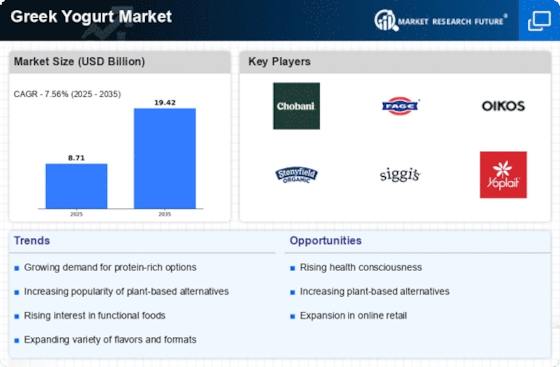
Greek Yoghurt Market Infographic
Purchase Options

Market Share

Greek Yoghurt Market Share Analysis

The Greek Yogurt market has witnessed significant growth and competition, prompting companies to employ diverse market share positioning strategies. One fundamental approach is product differentiation. Companies strive to distinguish their Greek Yogurt offerings by focusing on unique attributes such as thickness, creaminess, and authentic taste. Emphasizing high protein content and probiotic benefits also sets products apart, appealing to health-conscious consumers seeking nutritious alternatives.

Branding is a pivotal element in the Greek Yogurt market. Successful companies invest in building strong and recognizable brand identities that resonate with consumers. Establishing trust through transparent labeling, highlighting natural ingredients, and communicating a commitment to quality contribute to a positive brand image. Distinctive packaging and marketing messages play a role in capturing consumer attention and fostering brand loyalty in this competitive market.

Pricing strategies play a crucial role in market share positioning within the Greek Yogurt industry. Companies must strike a balance between offering premium-quality products and maintaining competitive prices. Some brands position themselves as premium options, emphasizing the use of high-quality ingredients and production methods. Others focus on affordability, targeting a broader consumer base. Promotional offers, bundle deals, and discounts are common tactics to influence consumer choices and gain a competitive edge.

Distribution channels are key to expanding market share in the Greek Yogurt market. Companies optimize their distribution networks to ensure widespread availability, partnering with supermarkets, health food stores, and online platforms. The convenience of finding Greek Yogurt in various retail outlets, coupled with strategic placement within stores, contributes to increased visibility and market penetration.

Innovation is a driving force in the Greek Yogurt market, with companies continually introducing new flavors, formulations, and packaging options. Responding to dietary trends, such as lactose-free or plant-based alternatives, allows brands to cater to a broader consumer base. Staying ahead in terms of innovation not only attracts new customers but also retains existing ones by offering a diverse and up-to-date product portfolio.

Collaborations and partnerships are gaining prominence in the Greek Yogurt market. By teaming up with health and wellness influencers, chefs, or other food brands, companies can enhance their market presence. Co-branded products, joint marketing campaigns, and exclusive collaborations generate excitement and interest among consumers, fostering brand loyalty and expanding market share.

Health positioning is increasingly important in the Greek Yogurt market. Companies highlight the nutritional benefits of Greek Yogurt, such as being a rich source of protein, calcium, and probiotics. Health-conscious consumers seeking wholesome and functional food options are drawn to these messages. Brands that successfully communicate their commitment to well-being are better positioned to capture a share of the growing market demand for healthier food choices.


Author
Author Profile
Pradeep Nandi
Senior Research Analyst

I have a bachelor's degree in mechanical engineering and an MBA. I have more than two years of expertise in the retail, food, and beverage, chemical, and material industries, and hence have developed a sound cross-domain expertise. A firm believer in lifelong learning and sharing of knowledge. Having a proclivity for hatching ideas and trying to absorb as much information as possible in a short amount of time. Introducing corporates to the data and insight, which enables them to move from probability to possibility, has been my key areas of interest. 

Leave a Comment

FAQs

What is the current valuation of the Greek Yogurt Market as of 2024?

<p>The Greek Yogurt Market was valued at 8.71 USD Billion in 2024.</p>

What is the projected market valuation for Greek Yogurt by 2035?

<p>The market is projected to reach 19.42 USD Billion by 2035.</p>

What is the expected CAGR for the Greek Yogurt Market during the forecast period 2025 - 2035?

<p>The expected CAGR for the Greek Yogurt Market during 2025 - 2035 is 7.56%.</p>

Which flavor segment is projected to have the highest growth in the Greek Yogurt Market?

<p>The Unflavored segment is projected to grow from 1.5 USD Billion to 3.5 USD Billion.</p>

How does the Organic category compare to Conventional in terms of market valuation?

<p>The Organic category was valued at 1.74 USD Billion in 2024 and is projected to reach 4.02 USD Billion by 2035, whereas Conventional was valued at 5.0 USD Billion and is expected to grow to 11.5 USD Billion.</p>

What are the leading companies in the Greek Yogurt Market?

<p>Key players in the market include Chobani, Fage, Oikos, Stonyfield, Siggi's, Yoplait, Danone, and Wallaby Organic.</p>

What is the market size for the Non-Store-Based distribution channel in 2024?

The Non-Store-Based distribution channel was valued at 3.49 USD Billion in 2024.

Which flavor segment is expected to see the most substantial increase by 2035?

The Vanilla flavor segment is expected to grow from 2.0 USD Billion to 4.5 USD Billion by 2035.

What is the market valuation for the Blends segment in 2024?

The Blends segment was valued at 2.1 USD Billion in 2024 and is projected to reach 4.5 USD Billion by 2035.

How does the Store-Based distribution channel compare to Non-Store-Based in terms of growth?

The Store-Based channel was valued at 5.22 USD Billion in 2024 and is projected to grow to 11.12 USD Billion, indicating a stronger growth trajectory compared to Non-Store-Based.

Market Summary

As per Market Research Future analysis, the Greek Yogurt Market Size was estimated at 8.71 USD Billion in 2024. The Greek Yogurt industry is projected to grow from 9.369 USD Billion in 2025 to 19.42 USD Billion by 2035, exhibiting a compound annual growth rate (CAGR) of 7.56% during the forecast period 2025 - 2035

Key Market Trends & Highlights

The Greek yogurt market is experiencing robust growth driven by health trends and flavor innovations.

  • The North American market remains the largest, characterized by a strong focus on health and wellness.
  • In the Asia-Pacific region, the Greek yogurt market is the fastest-growing, fueled by increasing consumer interest in nutritious options.
  • Vanilla continues to dominate as the largest flavor segment, while strawberry is emerging as the fastest-growing flavor choice.
  • Rising demand for protein-rich foods and innovative packaging solutions are key drivers propelling market expansion.

Market Size & Forecast

2024 Market Size 8.71 (USD Billion)
2035 Market Size 19.42 (USD Billion)
CAGR (2025 - 2035) 7.56%
Largest Regional Market Share in 2024 North America

Major Players

Chobani (US), Fage (GR), Oikos (US), Stonyfield (US), Siggi's (US), Yoplait (FR), Danone (FR), Wallaby Organic (US)

Market Trends

The Greek Yogurt Market is currently experiencing a dynamic evolution, characterized by shifting consumer preferences and an increasing demand for health-oriented products. This market appears to be influenced by a growing awareness of nutritional benefits associated with Greek yogurt, such as its high protein content and probiotic properties. As consumers become more health-conscious, they seem to gravitate towards options that align with their dietary goals, which may include low-fat or organic varieties. Additionally, the rise of plant-based diets could potentially impact the traditional dairy segment, prompting manufacturers to innovate and diversify their offerings to cater to a broader audience. Moreover, the Greek Yogurt Market is witnessing a surge in product innovation, with brands exploring unique flavors and functional ingredients. This trend suggests that companies are not only focusing on traditional offerings but are also experimenting with exotic flavors and added health benefits, such as enhanced vitamins or superfoods. The competitive landscape appears to be intensifying, as new entrants and established players alike strive to capture market share. As the market continues to evolve, it is likely that consumer preferences will further shape the direction of product development and marketing strategies, leading to a more diverse and vibrant Greek yogurt landscape.

Health and Wellness Focus

The Greek Yogurt Market is increasingly aligning with health and wellness trends, as consumers prioritize nutritious options. This focus on health is driving demand for products that offer high protein content and probiotic benefits, appealing to those seeking healthier dietary choices.

Flavor Innovation

There is a notable trend towards flavor innovation within the Greek Yogurt Market. Brands are experimenting with unique and exotic flavors, moving beyond traditional offerings to attract a wider consumer base and enhance the overall eating experience.

Sustainability Initiatives

Sustainability is becoming a key consideration in the Greek Yogurt Market, as consumers show preference for environmentally friendly products. Brands are likely to adopt sustainable practices in sourcing and packaging, reflecting a growing commitment to ecological responsibility.

Greek Yoghurt Market Market Drivers

Innovative Packaging Solutions

Innovative packaging solutions are emerging as a key driver in the Greek Yogurt Market, enhancing consumer convenience and product appeal. Manufacturers are increasingly adopting eco-friendly packaging materials and designs that cater to on-the-go lifestyles. Single-serve containers, resealable pouches, and portion-controlled packaging are becoming more prevalent, allowing consumers to enjoy Greek yogurt easily and conveniently. Additionally, attractive packaging designs can influence purchasing decisions, as consumers are drawn to visually appealing products. Market data suggests that products with innovative packaging often see higher sales, as they meet the demands of busy consumers seeking convenience without compromising on quality. This trend towards innovative packaging is likely to continue shaping the Greek Yogurt Market.

Rising Demand for Protein-Rich Foods

The increasing consumer awareness regarding health and nutrition has led to a rising demand for protein-rich foods, which significantly influences the Greek Yogurt Market. Greek yogurt, known for its high protein content, appeals to health-conscious individuals and fitness enthusiasts. According to recent data, the protein content in Greek yogurt can be up to twice that of regular yogurt, making it a preferred choice for those seeking to enhance their protein intake. This trend is further supported by the growing popularity of high-protein diets, such as the ketogenic and paleo diets, which emphasize protein consumption. As consumers continue to prioritize their health, the Greek Yogurt Market is likely to experience sustained growth, driven by the demand for nutritious and protein-rich food options.

Health Benefits and Nutritional Awareness

The Greek Yogurt Market benefits from a growing awareness of the health benefits associated with Greek yogurt consumption. Rich in probiotics, calcium, and essential nutrients, Greek yogurt is often marketed as a functional food that supports digestive health and overall well-being. Research indicates that regular consumption of Greek yogurt can contribute to improved gut health and may aid in weight management. As consumers become more informed about nutrition, they are increasingly seeking products that offer health benefits. This trend is likely to drive demand for Greek yogurt, as it aligns with the broader movement towards healthier eating habits. The Greek Yogurt Market stands to gain from this heightened focus on health and nutrition.

Increased Availability of Diverse Flavors

Flavor innovation plays a crucial role in the Greek Yogurt Market, as manufacturers continuously introduce new and exciting flavors to attract a broader consumer base. The traditional plain Greek yogurt is now complemented by a variety of flavors, including fruit-infused, dessert-inspired, and even savory options. This diversification caters to different taste preferences and dietary needs, thereby expanding the market reach. Data indicates that flavored Greek yogurt accounts for a significant portion of sales, with consumers increasingly seeking unique and indulgent flavor experiences. As the trend towards flavor innovation continues, the Greek Yogurt Market is poised for growth, appealing to both traditional yogurt consumers and those looking for novel taste experiences.

Growing Popularity of Plant-Based Alternatives

The rise of plant-based diets has prompted a shift in consumer preferences, leading to the emergence of plant-based Greek yogurt alternatives. This trend is particularly relevant in the Greek Yogurt Market, where traditional dairy products are being challenged by non-dairy options made from almond, coconut, and soy. As consumers become more health-conscious and environmentally aware, the demand for plant-based products is likely to increase. Market data suggests that the plant-based yogurt segment is experiencing rapid growth, with many consumers opting for these alternatives due to lactose intolerance or dietary choices. This shift presents both challenges and opportunities for the Greek Yogurt Market, as traditional yogurt brands may need to adapt to changing consumer preferences.

Market Segment Insights

By Flavor: Vanilla (Largest) vs. Strawberry (Fastest-Growing)

In the Greek yogurt market, the flavor segment showcases a diverse range of options, with unflavored as a foundational choice and flavored variants driving consumer preference. Among the flavors, vanilla holds the largest market share, appealing to those seeking a classic taste experience. Strawberry, however, is rapidly gaining traction, reflecting evolving consumer tastes and a booming interest in fruity flavors that align with healthier eating trends. The growth trends in this segment are closely linked to changing consumer lifestyles and preferences for natural ingredients. Striving for healthier snacking options has positioned Greek yogurt as a leading alternative. The rise of innovative flavors and blends has drawn in a younger audience. The industry is now focusing on reducing sugar content, enhancing the perception of health benefits while satisfying taste preferences.

Vanilla: Dominant vs. Strawberry: Emerging

Vanilla Greek yogurt stands as a dominant player in the flavor segment, celebrated for its classic appeal and versatility in culinary applications. Its creamy, rich taste renders it ideal for pairing with various toppings, enhancing its market appeal. Meanwhile, strawberry Greek yogurt is an emerging choice that captures the interest of health-conscious consumers, offering not just a delightful flavor but also potential added health benefits associated with fruit consumption. This flavor has seen a surge in popularity, particularly among younger demographics seeking natural options that align with their lifestyles. As consumer demand for yogurt with bold yet familiar flavors rises, the competition between these two flavors is likely to intensify, reshaping market dynamics.

By Category: Organic (Largest) vs. Conventional (Fastest-Growing)

In the Greek Yogurt Market, the category segment is prominently divided into organic, conventional, and others. The organic variant holds the largest market share, appealing to health-conscious consumers who prioritize natural ingredients. Conventional Greek yogurt, while having a smaller market share, has been gaining traction due to its affordability and broad availability. The 'others' category generally comprises niche products and less-known brands, which has a minimal impact on the overall market share compared to its organic and conventional counterparts.

Organic (Dominant) vs. Conventional (Emerging)

Organic Greek yogurt has established itself as the dominant force in the market, characterized by its all-natural ingredients and a growing emphasis on sustainability. Consumers are increasingly gravitating towards organic options, driven by health trends and the demand for clean-label products. On the other hand, conventional Greek yogurt is emerging as a competitive category, thanks to its cost-effectiveness and widespread distribution. While it may not boast the same health-oriented image as organic varieties, innovations in flavors and packaging are enhancing its appeal to diverse consumer demographics, making it a significant contender in the market.

By Distribution Channel: Store-Based (Largest) vs. Non-Store-Based (Fastest-Growing)

In the Greek Yogurt Market, the distribution of products is widely dominated by store-based channels, which include supermarkets, hypermarkets, and convenience stores. These channels capture a significant portion of market share due to their accessibility and the established consumer habit of purchasing yogurts during grocery shopping. The extensive shelf space allocated for dairy products in these stores further solidifies their strong standing within this sector.

Distribution Channels: Store-Based (Dominant) vs. Non-Store-Based (Emerging)

Store-based distribution channels represent the dominant force in the Greek Yogurt Market, providing consumers with a familiar shopping environment and the convenience of browsing various brands and flavors. This traditional approach is characterized by physical retail spaces that facilitate impulse purchases. Conversely, non-store-based channels, such as e-commerce platforms and direct-to-consumer sales, are emerging rapidly, driven by the increasing trend of online shopping and home delivery services. This segment appeals particularly to younger consumers who prioritize convenience and the ability to shop from home, suggesting a shift in purchasing behavior that could influence future market dynamics.

Get more detailed insights about Greek Yogurt Market Research Report - Forecast till 2035

Regional Insights

By Region, the study provides market insights into North America, Europe, Asia-Pacific, and the Rest of the World. The North American Greek Yogurt market accounted for USD 3.7 billion in 2022 and will likely exhibit a significant CAGR growth over the study period. Greek yogurt is becoming increasingly popular throughout the region as a healthier alternative to ice cream, particularly among children and young adults, as obesity rates in developed nations like Canada, the U.S., and Mexico continue to rise.

Organic greek yogurt consumption is increasing in the North American market due to its probiotic product line and ability to enhance metabolism, improve digestion, and support the immune system. Desserts made from greek yogurt are also popular in the region. It is available in various flavors, including fruit yogurt, organic yogurt, and drinkable yogurt, which customers receive well. Yogurt products, for example, are popular in the United States and are expected to remain this way throughout the forecast period, owing to their health benefits.

Further, the major countries studied in the global market report are the U.S., Germany, Canada, France, the UK, Spain, Italy, Japan, India, Australia, China, South Korea, and Brazil.

The European greek yogurt market accounts for the second-largest market share. Several untapped opportunities for the Greek yogurt industry drive the regional market. Additionally, the developing Eastern Europe region is anticipated to outperform Western European markets, where dairy sales suffer due to the growing acceptance of dairy-free alternatives. Several European yogurt producers are modernizing their plants with automated fresh milk production lines. General Mills also sold the Yoplait business in Europe in 2021. Sodiaal, a dairy cooperative, purchased a 51% stake in the company.

Moreover, stringent health and fitness regulations imposed by governments in various European countries drive the market demand for Greek yogurt in this region. Further, the German market of greek yogurt held the largest market share, and the UK greek yogurt industry was the fastest-growing market in the European region.

The Asia-Pacific market of greek yogurt is expected to grow at the fastest CAGR from 2022 to 2030, owing to rising demand for probiotics in the region, particularly in China, Japan, and India. In China, approximately 83% of the total population consumes organic yogurt. These people consume organic greek yogurt as it contains probiotics. The rising consumption of organic yogurt as a snack in China propels the overall market expansion. Rising disposable income in the Asia Pacific developing countries has increased spending on premium food items, which is expected to propel the regional maret of greek yogurt forward.

Moreover, China’s greek yogurt industry held the largest market share, and the Indian greek yogurt market was the fastest-growing market in the Asia-Pacific region.

Key Players and Competitive Insights

Major market players focus on introducing new flavors made from natural ingredients and collaborating with universities to broaden their product reach. The greek yogurt industry has recently provided organic yogurts with some of the most significant health benefits and flavors. The greek yogurt market major players, such as Sun Valley Dairy, General Mills Inc, Nestle S.A., Danone S.A., and others, mainly focus on providing consumers with innovative and exotic flavors while including functional benefits in each yogurt product category.The key players in the greek yogurt industry are now concentrating on social media sites and online sales channels for their product's online branding and marketing to attract more customers. With significant market developments like introducing new products, contractual agreements, collaborations and acquisitions, increased R&D investments, and mergers with other organizations, market participants are also undertaking various strategic initiatives to expand their global footprint. Competitors in the greek yogurt industry combine organic yogurt with probiotic drinks to entice consumers to choose the product over traditional probiotic offerings.Nestle SA, for example, sells probiotic 'Bliss Plus' yogurt drinks that contain probiotic strains for digestive health.Danone S.A. (Danone) develops and manufactures dairy and nutritional products. The business sells medical items, early-life nutrition, bottled water, and fresh dairy products. Yogurt-fermented dairy products, dairy specialties, plant-based nutritional cooking products, beverages, and specialized food for infants and older adults with health issues are all included in its portfolio. Danone also sells packaged water, flavored water, and vitamin-enriched water. Danone's 'Silk' brand introduced Greek yogurt made of plants in August 2021.The Silk Greek Style Coconut milk Yogurt line comes in four flavors: vanilla, strawberry, lemon, and blueberry, and it is made with a base of coconut milk and pea protein. Each serving is vegan-friendly, contains 10 grams of protein, and contains active cultures.Chobani manufactures and sells Greek yogurt without artificial flavors, sweeteners, or preservatives. Chobani, a leading US yogurt brand, introduced its new plant-based coconut yogurt in January 2019. Chobani aims to grow its nondairy yogurt business and promote plant-based yogurt products with this innovative product launch. In addition, Chobani introduced a line of Greek yogurts free of lactose in 2020, with unusual flavors like lemon meringue pie, banana cream pie, and super berry rocket.

Key Companies in the Greek Yoghurt Market include

Industry Developments

  • Q2 2025: Atlante and the Greek Yogurt Market: Growth, Innovation, and New Launches for 2025 Atlante announced a 20% year-over-year increase in Greek yogurt sales for 2024 and revealed plans for new product launches in 2025, focusing on indulgent and functional Greek yogurt varieties.

Future Outlook

Greek Yoghurt Market Future Outlook

The Greek Yogurt Market is projected to grow at a 7.56% CAGR from 2025 to 2035, driven by health trends, product innovation, and increasing consumer demand for high-protein foods.

New opportunities lie in:

  • Expansion into plant-based Greek yogurt alternatives
  • Development of single-serve packaging for on-the-go consumption
  • Strategic partnerships with fitness and wellness brands for co-marketing initiatives

By 2035, the Greek Yogurt Market is expected to solidify its position as a leading segment in the dairy industry.

Market Segmentation

Greek Yoghurt Market Flavor Outlook

  • Unflavored
  • Vanilla
  • Strawberry
  • Blueberry
  • Raspberry
  • Blends

Greek Yoghurt Market Category Outlook

  • Organic
  • Conventional
  • Others

Greek Yoghurt Market Distribution Channel Outlook

  • Store-Based
  • Non-Store-Based

Report Scope

MARKET SIZE 2024 8.71(USD Billion)
MARKET SIZE 2025 9.369(USD Billion)
MARKET SIZE 2035 19.42(USD Billion)
COMPOUND ANNUAL GROWTH RATE (CAGR) 7.56% (2025 - 2035)
REPORT COVERAGE Revenue Forecast, Competitive Landscape, Growth Factors, and Trends
BASE YEAR 2024
Market Forecast Period 2025 - 2035
Historical Data 2019 - 2024
Market Forecast Units USD Billion
Key Companies Profiled Chobani (US), Fage (GR), Oikos (US), Stonyfield (US), Siggi's (US), Yoplait (FR), Danone (FR), Wallaby Organic (US)
Segments Covered Flavor, Category, Distribution Channel, Region
Key Market Opportunities Growing consumer demand for high-protein, low-sugar options in the Greek Yogurt Market presents significant growth opportunities.
Key Market Dynamics Rising consumer preference for high-protein snacks drives innovation and competition in the Greek yogurt sector.
Countries Covered North America, Europe, APAC, South America, MEA

FAQs

What is the current valuation of the Greek Yogurt Market as of 2024?

<p>The Greek Yogurt Market was valued at 8.71 USD Billion in 2024.</p>

What is the projected market valuation for Greek Yogurt by 2035?

<p>The market is projected to reach 19.42 USD Billion by 2035.</p>

What is the expected CAGR for the Greek Yogurt Market during the forecast period 2025 - 2035?

<p>The expected CAGR for the Greek Yogurt Market during 2025 - 2035 is 7.56%.</p>

Which flavor segment is projected to have the highest growth in the Greek Yogurt Market?

<p>The Unflavored segment is projected to grow from 1.5 USD Billion to 3.5 USD Billion.</p>

How does the Organic category compare to Conventional in terms of market valuation?

<p>The Organic category was valued at 1.74 USD Billion in 2024 and is projected to reach 4.02 USD Billion by 2035, whereas Conventional was valued at 5.0 USD Billion and is expected to grow to 11.5 USD Billion.</p>

What are the leading companies in the Greek Yogurt Market?

<p>Key players in the market include Chobani, Fage, Oikos, Stonyfield, Siggi's, Yoplait, Danone, and Wallaby Organic.</p>

What is the market size for the Non-Store-Based distribution channel in 2024?

The Non-Store-Based distribution channel was valued at 3.49 USD Billion in 2024.

Which flavor segment is expected to see the most substantial increase by 2035?

The Vanilla flavor segment is expected to grow from 2.0 USD Billion to 4.5 USD Billion by 2035.

What is the market valuation for the Blends segment in 2024?

The Blends segment was valued at 2.1 USD Billion in 2024 and is projected to reach 4.5 USD Billion by 2035.

How does the Store-Based distribution channel compare to Non-Store-Based in terms of growth?

The Store-Based channel was valued at 5.22 USD Billion in 2024 and is projected to grow to 11.12 USD Billion, indicating a stronger growth trajectory compared to Non-Store-Based.

  1. SECTION I: EXECUTIVE SUMMARY AND KEY HIGHLIGHTS
    1. | 1.1 EXECUTIVE SUMMARY
    2. | | 1.1.1 Market Overview
    3. | | 1.1.2 Key Findings
    4. | | 1.1.3 Market Segmentation
    5. | | 1.1.4 Competitive Landscape
    6. | | 1.1.5 Challenges and Opportunities
    7. | | 1.1.6 Future Outlook
  2. SECTION II: SCOPING, METHODOLOGY AND MARKET STRUCTURE
    1. | 2.1 MARKET INTRODUCTION
    2. | | 2.1.1 Definition
    3. | | 2.1.2 Scope of the study
    4. | | | 2.1.2.1 Research Objective
    5. | | | 2.1.2.2 Assumption
    6. | | | 2.1.2.3 Limitations
    7. | 2.2 RESEARCH METHODOLOGY
    8. | | 2.2.1 Overview
    9. | | 2.2.2 Data Mining
    10. | | 2.2.3 Secondary Research
    11. | | 2.2.4 Primary Research
    12. | | | 2.2.4.1 Primary Interviews and Information Gathering Process
    13. | | | 2.2.4.2 Breakdown of Primary Respondents
    14. | | 2.2.5 Forecasting Model
    15. | | 2.2.6 Market Size Estimation
    16. | | | 2.2.6.1 Bottom-Up Approach
    17. | | | 2.2.6.2 Top-Down Approach
    18. | | 2.2.7 Data Triangulation
    19. | | 2.2.8 Validation
  3. SECTION III: QUALITATIVE ANALYSIS
    1. | 3.1 MARKET DYNAMICS
    2. | | 3.1.1 Overview
    3. | | 3.1.2 Drivers
    4. | | 3.1.3 Restraints
    5. | | 3.1.4 Opportunities
    6. | 3.2 MARKET FACTOR ANALYSIS
    7. | | 3.2.1 Value chain Analysis
    8. | | 3.2.2 Porter's Five Forces Analysis
    9. | | | 3.2.2.1 Bargaining Power of Suppliers
    10. | | | 3.2.2.2 Bargaining Power of Buyers
    11. | | | 3.2.2.3 Threat of New Entrants
    12. | | | 3.2.2.4 Threat of Substitutes
    13. | | | 3.2.2.5 Intensity of Rivalry
    14. | | 3.2.3 COVID-19 Impact Analysis
    15. | | | 3.2.3.1 Market Impact Analysis
    16. | | | 3.2.3.2 Regional Impact
    17. | | | 3.2.3.3 Opportunity and Threat Analysis
  4. SECTION IV: QUANTITATIVE ANALYSIS
    1. | 4.1 Food, Beverages & Nutrition, BY Flavor (USD Billion)
    2. | | 4.1.1 Unflavored
    3. | | 4.1.2 Vanilla
    4. | | 4.1.3 Strawberry
    5. | | 4.1.4 Blueberry
    6. | | 4.1.5 Raspberry
    7. | | 4.1.6 Blends
    8. | 4.2 Food, Beverages & Nutrition, BY Category (USD Billion)
    9. | | 4.2.1 Organic
    10. | | 4.2.2 Conventional
    11. | | 4.2.3 Others
    12. | 4.3 Food, Beverages & Nutrition, BY Distribution Channel (USD Billion)
    13. | | 4.3.1 Store-Based
    14. | | 4.3.2 Non-Store-Based
    15. | 4.4 Food, Beverages & Nutrition, BY Region (USD Billion)
    16. | | 4.4.1 North America
    17. | | | 4.4.1.1 US
    18. | | | 4.4.1.2 Canada
    19. | | 4.4.2 Europe
    20. | | | 4.4.2.1 Germany
    21. | | | 4.4.2.2 UK
    22. | | | 4.4.2.3 France
    23. | | | 4.4.2.4 Russia
    24. | | | 4.4.2.5 Italy
    25. | | | 4.4.2.6 Spain
    26. | | | 4.4.2.7 Rest of Europe
    27. | | 4.4.3 APAC
    28. | | | 4.4.3.1 China
    29. | | | 4.4.3.2 India
    30. | | | 4.4.3.3 Japan
    31. | | | 4.4.3.4 South Korea
    32. | | | 4.4.3.5 Malaysia
    33. | | | 4.4.3.6 Thailand
    34. | | | 4.4.3.7 Indonesia
    35. | | | 4.4.3.8 Rest of APAC
    36. | | 4.4.4 South America
    37. | | | 4.4.4.1 Brazil
    38. | | | 4.4.4.2 Mexico
    39. | | | 4.4.4.3 Argentina
    40. | | | 4.4.4.4 Rest of South America
    41. | | 4.4.5 MEA
    42. | | | 4.4.5.1 GCC Countries
    43. | | | 4.4.5.2 South Africa
    44. | | | 4.4.5.3 Rest of MEA
  5. SECTION V: COMPETITIVE ANALYSIS
    1. | 5.1 Competitive Landscape
    2. | | 5.1.1 Overview
    3. | | 5.1.2 Competitive Analysis
    4. | | 5.1.3 Market share Analysis
    5. | | 5.1.4 Major Growth Strategy in the Food, Beverages & Nutrition
    6. | | 5.1.5 Competitive Benchmarking
    7. | | 5.1.6 Leading Players in Terms of Number of Developments in the Food, Beverages & Nutrition
    8. | | 5.1.7 Key developments and growth strategies
    9. | | | 5.1.7.1 New Product Launch/Service Deployment
    10. | | | 5.1.7.2 Merger & Acquisitions
    11. | | | 5.1.7.3 Joint Ventures
    12. | | 5.1.8 Major Players Financial Matrix
    13. | | | 5.1.8.1 Sales and Operating Income
    14. | | | 5.1.8.2 Major Players R&D Expenditure. 2023
    15. | 5.2 Company Profiles
    16. | | 5.2.1 Chobani (US)
    17. | | | 5.2.1.1 Financial Overview
    18. | | | 5.2.1.2 Products Offered
    19. | | | 5.2.1.3 Key Developments
    20. | | | 5.2.1.4 SWOT Analysis
    21. | | | 5.2.1.5 Key Strategies
    22. | | 5.2.2 Fage (GR)
    23. | | | 5.2.2.1 Financial Overview
    24. | | | 5.2.2.2 Products Offered
    25. | | | 5.2.2.3 Key Developments
    26. | | | 5.2.2.4 SWOT Analysis
    27. | | | 5.2.2.5 Key Strategies
    28. | | 5.2.3 Oikos (US)
    29. | | | 5.2.3.1 Financial Overview
    30. | | | 5.2.3.2 Products Offered
    31. | | | 5.2.3.3 Key Developments
    32. | | | 5.2.3.4 SWOT Analysis
    33. | | | 5.2.3.5 Key Strategies
    34. | | 5.2.4 Stonyfield (US)
    35. | | | 5.2.4.1 Financial Overview
    36. | | | 5.2.4.2 Products Offered
    37. | | | 5.2.4.3 Key Developments
    38. | | | 5.2.4.4 SWOT Analysis
    39. | | | 5.2.4.5 Key Strategies
    40. | | 5.2.5 Siggi's (US)
    41. | | | 5.2.5.1 Financial Overview
    42. | | | 5.2.5.2 Products Offered
    43. | | | 5.2.5.3 Key Developments
    44. | | | 5.2.5.4 SWOT Analysis
    45. | | | 5.2.5.5 Key Strategies
    46. | | 5.2.6 Yoplait (FR)
    47. | | | 5.2.6.1 Financial Overview
    48. | | | 5.2.6.2 Products Offered
    49. | | | 5.2.6.3 Key Developments
    50. | | | 5.2.6.4 SWOT Analysis
    51. | | | 5.2.6.5 Key Strategies
    52. | | 5.2.7 Danone (FR)
    53. | | | 5.2.7.1 Financial Overview
    54. | | | 5.2.7.2 Products Offered
    55. | | | 5.2.7.3 Key Developments
    56. | | | 5.2.7.4 SWOT Analysis
    57. | | | 5.2.7.5 Key Strategies
    58. | | 5.2.8 Wallaby Organic (US)
    59. | | | 5.2.8.1 Financial Overview
    60. | | | 5.2.8.2 Products Offered
    61. | | | 5.2.8.3 Key Developments
    62. | | | 5.2.8.4 SWOT Analysis
    63. | | | 5.2.8.5 Key Strategies
    64. | 5.3 Appendix
    65. | | 5.3.1 References
    66. | | 5.3.2 Related Reports
  6. LIST OF FIGURES
    1. | 6.1 MARKET SYNOPSIS
    2. | 6.2 NORTH AMERICA MARKET ANALYSIS
    3. | 6.3 US MARKET ANALYSIS BY FLAVOR
    4. | 6.4 US MARKET ANALYSIS BY CATEGORY
    5. | 6.5 US MARKET ANALYSIS BY DISTRIBUTION CHANNEL
    6. | 6.6 CANADA MARKET ANALYSIS BY FLAVOR
    7. | 6.7 CANADA MARKET ANALYSIS BY CATEGORY
    8. | 6.8 CANADA MARKET ANALYSIS BY DISTRIBUTION CHANNEL
    9. | 6.9 EUROPE MARKET ANALYSIS
    10. | 6.10 GERMANY MARKET ANALYSIS BY FLAVOR
    11. | 6.11 GERMANY MARKET ANALYSIS BY CATEGORY
    12. | 6.12 GERMANY MARKET ANALYSIS BY DISTRIBUTION CHANNEL
    13. | 6.13 UK MARKET ANALYSIS BY FLAVOR
    14. | 6.14 UK MARKET ANALYSIS BY CATEGORY
    15. | 6.15 UK MARKET ANALYSIS BY DISTRIBUTION CHANNEL
    16. | 6.16 FRANCE MARKET ANALYSIS BY FLAVOR
    17. | 6.17 FRANCE MARKET ANALYSIS BY CATEGORY
    18. | 6.18 FRANCE MARKET ANALYSIS BY DISTRIBUTION CHANNEL
    19. | 6.19 RUSSIA MARKET ANALYSIS BY FLAVOR
    20. | 6.20 RUSSIA MARKET ANALYSIS BY CATEGORY
    21. | 6.21 RUSSIA MARKET ANALYSIS BY DISTRIBUTION CHANNEL
    22. | 6.22 ITALY MARKET ANALYSIS BY FLAVOR
    23. | 6.23 ITALY MARKET ANALYSIS BY CATEGORY
    24. | 6.24 ITALY MARKET ANALYSIS BY DISTRIBUTION CHANNEL
    25. | 6.25 SPAIN MARKET ANALYSIS BY FLAVOR
    26. | 6.26 SPAIN MARKET ANALYSIS BY CATEGORY
    27. | 6.27 SPAIN MARKET ANALYSIS BY DISTRIBUTION CHANNEL
    28. | 6.28 REST OF EUROPE MARKET ANALYSIS BY FLAVOR
    29. | 6.29 REST OF EUROPE MARKET ANALYSIS BY CATEGORY
    30. | 6.30 REST OF EUROPE MARKET ANALYSIS BY DISTRIBUTION CHANNEL
    31. | 6.31 APAC MARKET ANALYSIS
    32. | 6.32 CHINA MARKET ANALYSIS BY FLAVOR
    33. | 6.33 CHINA MARKET ANALYSIS BY CATEGORY
    34. | 6.34 CHINA MARKET ANALYSIS BY DISTRIBUTION CHANNEL
    35. | 6.35 INDIA MARKET ANALYSIS BY FLAVOR
    36. | 6.36 INDIA MARKET ANALYSIS BY CATEGORY
    37. | 6.37 INDIA MARKET ANALYSIS BY DISTRIBUTION CHANNEL
    38. | 6.38 JAPAN MARKET ANALYSIS BY FLAVOR
    39. | 6.39 JAPAN MARKET ANALYSIS BY CATEGORY
    40. | 6.40 JAPAN MARKET ANALYSIS BY DISTRIBUTION CHANNEL
    41. | 6.41 SOUTH KOREA MARKET ANALYSIS BY FLAVOR
    42. | 6.42 SOUTH KOREA MARKET ANALYSIS BY CATEGORY
    43. | 6.43 SOUTH KOREA MARKET ANALYSIS BY DISTRIBUTION CHANNEL
    44. | 6.44 MALAYSIA MARKET ANALYSIS BY FLAVOR
    45. | 6.45 MALAYSIA MARKET ANALYSIS BY CATEGORY
    46. | 6.46 MALAYSIA MARKET ANALYSIS BY DISTRIBUTION CHANNEL
    47. | 6.47 THAILAND MARKET ANALYSIS BY FLAVOR
    48. | 6.48 THAILAND MARKET ANALYSIS BY CATEGORY
    49. | 6.49 THAILAND MARKET ANALYSIS BY DISTRIBUTION CHANNEL
    50. | 6.50 INDONESIA MARKET ANALYSIS BY FLAVOR
    51. | 6.51 INDONESIA MARKET ANALYSIS BY CATEGORY
    52. | 6.52 INDONESIA MARKET ANALYSIS BY DISTRIBUTION CHANNEL
    53. | 6.53 REST OF APAC MARKET ANALYSIS BY FLAVOR
    54. | 6.54 REST OF APAC MARKET ANALYSIS BY CATEGORY
    55. | 6.55 REST OF APAC MARKET ANALYSIS BY DISTRIBUTION CHANNEL
    56. | 6.56 SOUTH AMERICA MARKET ANALYSIS
    57. | 6.57 BRAZIL MARKET ANALYSIS BY FLAVOR
    58. | 6.58 BRAZIL MARKET ANALYSIS BY CATEGORY
    59. | 6.59 BRAZIL MARKET ANALYSIS BY DISTRIBUTION CHANNEL
    60. | 6.60 MEXICO MARKET ANALYSIS BY FLAVOR
    61. | 6.61 MEXICO MARKET ANALYSIS BY CATEGORY
    62. | 6.62 MEXICO MARKET ANALYSIS BY DISTRIBUTION CHANNEL
    63. | 6.63 ARGENTINA MARKET ANALYSIS BY FLAVOR
    64. | 6.64 ARGENTINA MARKET ANALYSIS BY CATEGORY
    65. | 6.65 ARGENTINA MARKET ANALYSIS BY DISTRIBUTION CHANNEL
    66. | 6.66 REST OF SOUTH AMERICA MARKET ANALYSIS BY FLAVOR
    67. | 6.67 REST OF SOUTH AMERICA MARKET ANALYSIS BY CATEGORY
    68. | 6.68 REST OF SOUTH AMERICA MARKET ANALYSIS BY DISTRIBUTION CHANNEL
    69. | 6.69 MEA MARKET ANALYSIS
    70. | 6.70 GCC COUNTRIES MARKET ANALYSIS BY FLAVOR
    71. | 6.71 GCC COUNTRIES MARKET ANALYSIS BY CATEGORY
    72. | 6.72 GCC COUNTRIES MARKET ANALYSIS BY DISTRIBUTION CHANNEL
    73. | 6.73 SOUTH AFRICA MARKET ANALYSIS BY FLAVOR
    74. | 6.74 SOUTH AFRICA MARKET ANALYSIS BY CATEGORY
    75. | 6.75 SOUTH AFRICA MARKET ANALYSIS BY DISTRIBUTION CHANNEL
    76. | 6.76 REST OF MEA MARKET ANALYSIS BY FLAVOR
    77. | 6.77 REST OF MEA MARKET ANALYSIS BY CATEGORY
    78. | 6.78 REST OF MEA MARKET ANALYSIS BY DISTRIBUTION CHANNEL
    79. | 6.79 KEY BUYING CRITERIA OF FOOD, BEVERAGES & NUTRITION
    80. | 6.80 RESEARCH PROCESS OF MRFR
    81. | 6.81 DRO ANALYSIS OF FOOD, BEVERAGES & NUTRITION
    82. | 6.82 DRIVERS IMPACT ANALYSIS: FOOD, BEVERAGES & NUTRITION
    83. | 6.83 RESTRAINTS IMPACT ANALYSIS: FOOD, BEVERAGES & NUTRITION
    84. | 6.84 SUPPLY / VALUE CHAIN: FOOD, BEVERAGES & NUTRITION
    85. | 6.85 FOOD, BEVERAGES & NUTRITION, BY FLAVOR, 2024 (% SHARE)
    86. | 6.86 FOOD, BEVERAGES & NUTRITION, BY FLAVOR, 2024 TO 2035 (USD Billion)
    87. | 6.87 FOOD, BEVERAGES & NUTRITION, BY CATEGORY, 2024 (% SHARE)
    88. | 6.88 FOOD, BEVERAGES & NUTRITION, BY CATEGORY, 2024 TO 2035 (USD Billion)
    89. | 6.89 FOOD, BEVERAGES & NUTRITION, BY DISTRIBUTION CHANNEL, 2024 (% SHARE)
    90. | 6.90 FOOD, BEVERAGES & NUTRITION, BY DISTRIBUTION CHANNEL, 2024 TO 2035 (USD Billion)
    91. | 6.91 BENCHMARKING OF MAJOR COMPETITORS
  7. LIST OF TABLES
    1. | 7.1 LIST OF ASSUMPTIONS
    2. | | 7.1.1
    3. | 7.2 North America MARKET SIZE ESTIMATES; FORECAST
    4. | | 7.2.1 BY FLAVOR, 2025-2035 (USD Billion)
    5. | | 7.2.2 BY CATEGORY, 2025-2035 (USD Billion)
    6. | | 7.2.3 BY DISTRIBUTION CHANNEL, 2025-2035 (USD Billion)
    7. | 7.3 US MARKET SIZE ESTIMATES; FORECAST
    8. | | 7.3.1 BY FLAVOR, 2025-2035 (USD Billion)
    9. | | 7.3.2 BY CATEGORY, 2025-2035 (USD Billion)
    10. | | 7.3.3 BY DISTRIBUTION CHANNEL, 2025-2035 (USD Billion)
    11. | 7.4 Canada MARKET SIZE ESTIMATES; FORECAST
    12. | | 7.4.1 BY FLAVOR, 2025-2035 (USD Billion)
    13. | | 7.4.2 BY CATEGORY, 2025-2035 (USD Billion)
    14. | | 7.4.3 BY DISTRIBUTION CHANNEL, 2025-2035 (USD Billion)
    15. | 7.5 Europe MARKET SIZE ESTIMATES; FORECAST
    16. | | 7.5.1 BY FLAVOR, 2025-2035 (USD Billion)
    17. | | 7.5.2 BY CATEGORY, 2025-2035 (USD Billion)
    18. | | 7.5.3 BY DISTRIBUTION CHANNEL, 2025-2035 (USD Billion)
    19. | 7.6 Germany MARKET SIZE ESTIMATES; FORECAST
    20. | | 7.6.1 BY FLAVOR, 2025-2035 (USD Billion)
    21. | | 7.6.2 BY CATEGORY, 2025-2035 (USD Billion)
    22. | | 7.6.3 BY DISTRIBUTION CHANNEL, 2025-2035 (USD Billion)
    23. | 7.7 UK MARKET SIZE ESTIMATES; FORECAST
    24. | | 7.7.1 BY FLAVOR, 2025-2035 (USD Billion)
    25. | | 7.7.2 BY CATEGORY, 2025-2035 (USD Billion)
    26. | | 7.7.3 BY DISTRIBUTION CHANNEL, 2025-2035 (USD Billion)
    27. | 7.8 France MARKET SIZE ESTIMATES; FORECAST
    28. | | 7.8.1 BY FLAVOR, 2025-2035 (USD Billion)
    29. | | 7.8.2 BY CATEGORY, 2025-2035 (USD Billion)
    30. | | 7.8.3 BY DISTRIBUTION CHANNEL, 2025-2035 (USD Billion)
    31. | 7.9 Russia MARKET SIZE ESTIMATES; FORECAST
    32. | | 7.9.1 BY FLAVOR, 2025-2035 (USD Billion)
    33. | | 7.9.2 BY CATEGORY, 2025-2035 (USD Billion)
    34. | | 7.9.3 BY DISTRIBUTION CHANNEL, 2025-2035 (USD Billion)
    35. | 7.10 Italy MARKET SIZE ESTIMATES; FORECAST
    36. | | 7.10.1 BY FLAVOR, 2025-2035 (USD Billion)
    37. | | 7.10.2 BY CATEGORY, 2025-2035 (USD Billion)
    38. | | 7.10.3 BY DISTRIBUTION CHANNEL, 2025-2035 (USD Billion)
    39. | 7.11 Spain MARKET SIZE ESTIMATES; FORECAST
    40. | | 7.11.1 BY FLAVOR, 2025-2035 (USD Billion)
    41. | | 7.11.2 BY CATEGORY, 2025-2035 (USD Billion)
    42. | | 7.11.3 BY DISTRIBUTION CHANNEL, 2025-2035 (USD Billion)
    43. | 7.12 Rest of Europe MARKET SIZE ESTIMATES; FORECAST
    44. | | 7.12.1 BY FLAVOR, 2025-2035 (USD Billion)
    45. | | 7.12.2 BY CATEGORY, 2025-2035 (USD Billion)
    46. | | 7.12.3 BY DISTRIBUTION CHANNEL, 2025-2035 (USD Billion)
    47. | 7.13 APAC MARKET SIZE ESTIMATES; FORECAST
    48. | | 7.13.1 BY FLAVOR, 2025-2035 (USD Billion)
    49. | | 7.13.2 BY CATEGORY, 2025-2035 (USD Billion)
    50. | | 7.13.3 BY DISTRIBUTION CHANNEL, 2025-2035 (USD Billion)
    51. | 7.14 China MARKET SIZE ESTIMATES; FORECAST
    52. | | 7.14.1 BY FLAVOR, 2025-2035 (USD Billion)
    53. | | 7.14.2 BY CATEGORY, 2025-2035 (USD Billion)
    54. | | 7.14.3 BY DISTRIBUTION CHANNEL, 2025-2035 (USD Billion)
    55. | 7.15 India MARKET SIZE ESTIMATES; FORECAST
    56. | | 7.15.1 BY FLAVOR, 2025-2035 (USD Billion)
    57. | | 7.15.2 BY CATEGORY, 2025-2035 (USD Billion)
    58. | | 7.15.3 BY DISTRIBUTION CHANNEL, 2025-2035 (USD Billion)
    59. | 7.16 Japan MARKET SIZE ESTIMATES; FORECAST
    60. | | 7.16.1 BY FLAVOR, 2025-2035 (USD Billion)
    61. | | 7.16.2 BY CATEGORY, 2025-2035 (USD Billion)
    62. | | 7.16.3 BY DISTRIBUTION CHANNEL, 2025-2035 (USD Billion)
    63. | 7.17 South Korea MARKET SIZE ESTIMATES; FORECAST
    64. | | 7.17.1 BY FLAVOR, 2025-2035 (USD Billion)
    65. | | 7.17.2 BY CATEGORY, 2025-2035 (USD Billion)
    66. | | 7.17.3 BY DISTRIBUTION CHANNEL, 2025-2035 (USD Billion)
    67. | 7.18 Malaysia MARKET SIZE ESTIMATES; FORECAST
    68. | | 7.18.1 BY FLAVOR, 2025-2035 (USD Billion)
    69. | | 7.18.2 BY CATEGORY, 2025-2035 (USD Billion)
    70. | | 7.18.3 BY DISTRIBUTION CHANNEL, 2025-2035 (USD Billion)
    71. | 7.19 Thailand MARKET SIZE ESTIMATES; FORECAST
    72. | | 7.19.1 BY FLAVOR, 2025-2035 (USD Billion)
    73. | | 7.19.2 BY CATEGORY, 2025-2035 (USD Billion)
    74. | | 7.19.3 BY DISTRIBUTION CHANNEL, 2025-2035 (USD Billion)
    75. | 7.20 Indonesia MARKET SIZE ESTIMATES; FORECAST
    76. | | 7.20.1 BY FLAVOR, 2025-2035 (USD Billion)
    77. | | 7.20.2 BY CATEGORY, 2025-2035 (USD Billion)
    78. | | 7.20.3 BY DISTRIBUTION CHANNEL, 2025-2035 (USD Billion)
    79. | 7.21 Rest of APAC MARKET SIZE ESTIMATES; FORECAST
    80. | | 7.21.1 BY FLAVOR, 2025-2035 (USD Billion)
    81. | | 7.21.2 BY CATEGORY, 2025-2035 (USD Billion)
    82. | | 7.21.3 BY DISTRIBUTION CHANNEL, 2025-2035 (USD Billion)
    83. | 7.22 South America MARKET SIZE ESTIMATES; FORECAST
    84. | | 7.22.1 BY FLAVOR, 2025-2035 (USD Billion)
    85. | | 7.22.2 BY CATEGORY, 2025-2035 (USD Billion)
    86. | | 7.22.3 BY DISTRIBUTION CHANNEL, 2025-2035 (USD Billion)
    87. | 7.23 Brazil MARKET SIZE ESTIMATES; FORECAST
    88. | | 7.23.1 BY FLAVOR, 2025-2035 (USD Billion)
    89. | | 7.23.2 BY CATEGORY, 2025-2035 (USD Billion)
    90. | | 7.23.3 BY DISTRIBUTION CHANNEL, 2025-2035 (USD Billion)
    91. | 7.24 Mexico MARKET SIZE ESTIMATES; FORECAST
    92. | | 7.24.1 BY FLAVOR, 2025-2035 (USD Billion)
    93. | | 7.24.2 BY CATEGORY, 2025-2035 (USD Billion)
    94. | | 7.24.3 BY DISTRIBUTION CHANNEL, 2025-2035 (USD Billion)
    95. | 7.25 Argentina MARKET SIZE ESTIMATES; FORECAST
    96. | | 7.25.1 BY FLAVOR, 2025-2035 (USD Billion)
    97. | | 7.25.2 BY CATEGORY, 2025-2035 (USD Billion)
    98. | | 7.25.3 BY DISTRIBUTION CHANNEL, 2025-2035 (USD Billion)
    99. | 7.26 Rest of South America MARKET SIZE ESTIMATES; FORECAST
    100. | | 7.26.1 BY FLAVOR, 2025-2035 (USD Billion)
    101. | | 7.26.2 BY CATEGORY, 2025-2035 (USD Billion)
    102. | | 7.26.3 BY DISTRIBUTION CHANNEL, 2025-2035 (USD Billion)
    103. | 7.27 MEA MARKET SIZE ESTIMATES; FORECAST
    104. | | 7.27.1 BY FLAVOR, 2025-2035 (USD Billion)
    105. | | 7.27.2 BY CATEGORY, 2025-2035 (USD Billion)
    106. | | 7.27.3 BY DISTRIBUTION CHANNEL, 2025-2035 (USD Billion)
    107. | 7.28 GCC Countries MARKET SIZE ESTIMATES; FORECAST
    108. | | 7.28.1 BY FLAVOR, 2025-2035 (USD Billion)
    109. | | 7.28.2 BY CATEGORY, 2025-2035 (USD Billion)
    110. | | 7.28.3 BY DISTRIBUTION CHANNEL, 2025-2035 (USD Billion)
    111. | 7.29 South Africa MARKET SIZE ESTIMATES; FORECAST
    112. | | 7.29.1 BY FLAVOR, 2025-2035 (USD Billion)
    113. | | 7.29.2 BY CATEGORY, 2025-2035 (USD Billion)
    114. | | 7.29.3 BY DISTRIBUTION CHANNEL, 2025-2035 (USD Billion)
    115. | 7.30 Rest of MEA MARKET SIZE ESTIMATES; FORECAST
    116. | | 7.30.1 BY FLAVOR, 2025-2035 (USD Billion)
    117. | | 7.30.2 BY CATEGORY, 2025-2035 (USD Billion)
    118. | | 7.30.3 BY DISTRIBUTION CHANNEL, 2025-2035 (USD Billion)
    119. | 7.31 PRODUCT LAUNCH/PRODUCT DEVELOPMENT/APPROVAL
    120. | | 7.31.1
    121. | 7.32 ACQUISITION/PARTNERSHIP
    122. | | 7.32.1

Food, Beverages & Nutrition Market Segmentation

Food, Beverages & Nutrition By Flavor (USD Billion, 2025-2035)

  • Unflavored
  • Vanilla
  • Strawberry
  • Blueberry
  • Raspberry
  • Blends

Food, Beverages & Nutrition By Category (USD Billion, 2025-2035)

  • Organic
  • Conventional
  • Others

Food, Beverages & Nutrition By Distribution Channel (USD Billion, 2025-2035)

  • Store-Based
  • Non-Store-Based
Infographic

Free Sample Request

Kindly complete the form below to receive a free sample of this Report

Get Free Sample

Customer Strories

Compare Licence

×
Features License Type
Single User Multiuser License Enterprise User
Price $4,950 $5,950 $7,250
Maximum User Access Limit 1 User Upto 10 Users Unrestricted Access Throughout the Organization
Free Customization
Direct Access to Analyst
Deliverable Format
Platform Access
Discount on Next Purchase 10% 15% 15%
Printable Versions