×
Hero Background
English
Chinese
French
Japanese
Korean
German
Spanish

GPON Technology Market Analysis

ID: MRFR/ICT/10961-HCR
128 Pages
Shubhendra Anand
October 2025

GPON Technology Market Research Report Information By Technology (2.5G PON, XG-PON, XGS-PON, NG-PON2), By Component (Optical Network Terminal, Optical Line Terminal), By Application (FTTH, Other FTTx, Mobile Backhaul), And By Region (North America, Europe, Asia-Pacific, And Rest Of The World) –Market Forecast Till 2035

Share:
Download PDF ×

We do not share your information with anyone. However, we may send you emails based on your report interest from time to time. You may contact us at any time to opt-out.

GPON Technology Market Infographic
Purchase Options

Market Analysis

In-depth Analysis of GPON Technology Market Industry Landscape

The Gigabit Passive Optical Network (GPON) technology market is influenced by various factors that are shaping its growth and adoption across the telecommunications industry. One pivotal factor is the increasing demand for high-speed broadband connectivity. As the need for faster and more reliable internet services continues to grow, GPON technology emerges as a cost-effective and efficient solution. GPON provides the capacity for providing gigabit speeds through optical fiber networks making the resultant bandwidth enough for both home and business use as a mean of meeting the escalating demand.

The FTTH and FTTP deployments are major factors based on which market extension of GPON technology is taking place now Since customers and businesses want to have faster and better Internet connectivity at their fingertips, telecommunication service providers day by day are allocating money needed to embark on the spread of fiber infrastructure to meet the growing needs. High speed fiber to the home (FTTH) and fiber to the premises (FTTP) deployments, which receive key support from GPON technology, play a catalyst role by bringing gigabit speed internet access right to home or business locations and assisting in network expansion, resulting in availability of high-speed broadband networks.

GPON's scalability can also be considered as one of the many factors that makes this system more promising in the market. The scalability of GPON networks is therefore very straight forward and it can be upgraded to handle the rising bandwidth demand from the front-end. The scalability of this technology is significant as the network operators can modify to the changing needs of the time and do not need to do costly upgrades of the whole infrastructure. The capacity to scale at a massively low cost is the main advantage of GPON technology which will remain future proof. To be on par with the dynamic needs of various industries; especially enterprises which are using remote working, GPON is the answer.

The ecological impact and energy-miserliness of GPON technology are very important features when considering market parameters. Fiber-optic infrastructures which encompass GPON require minimum energy compared to substandard copper-based network options. As energy efficiency is associated with global efforts to cut carbon footprints and encourage sustainable technology, it is linked to this global strategy. With environmental issues mattering more and more to clients and consumers alike, the GPU power management a prominent cause of the technology growing in popularity.

In the GPON Technology Market, competition and consolidation of the market is the other factor which affects the GPON Technologies Market. With the ever-growing need for high-performance broad Internet access, the technology suppliers of GPON solutions become competitors as the market rapidly defends. This competitive landscape fosters innovation, pushing vendors to develop advanced features, improve performance, and offer cost-effective solutions. Market consolidation, through mergers and acquisitions, further shapes the competitive dynamics of the GPON technology market, influencing the availability of diverse product offerings and driving industry advancements.


Author
Shubhendra Anand
Head Research

Having diverse understanding in both qualitative & quantitative research for Life Science, Chemicals & Materials. His multi-tasking skill always aided to obtain real time information for many critical projects. On the other hand, he has worked with many Fortune 500 companies over the last few years and helped them to take strategic move.

Leave a Comment

FAQs

What is the projected market valuation of the GPON Technology Market by 2035?

The GPON Technology Market is projected to reach a valuation of 14.43 USD Billion by 2035.

What was the market valuation of the GPON Technology Market in 2024?

In 2024, the GPON Technology Market was valued at 7.444 USD Billion.

What is the expected CAGR for the GPON Technology Market during the forecast period 2025 - 2035?

The expected CAGR for the GPON Technology Market during the forecast period 2025 - 2035 is 6.2%.

Which companies are considered key players in the GPON Technology Market?

Key players in the GPON Technology Market include Huawei, Nokia, ZTE, Cisco, Calix, ADTRAN, FiberHome, Mitsubishi Electric, and Alcatel-Lucent.

What are the main technology segments within the GPON Technology Market?

The main technology segments include 2.5G PON, XG-PON, XGS-PON, and NG-PON2, with valuations ranging from 1.5 to 5.93 USD Billion.

What components are included in the GPON Technology Market analysis?

The components analyzed in the GPON Technology Market include Optical Network Terminals and Optical Line Terminals, valued between 3.5 and 7.43 USD Billion.

Market Summary

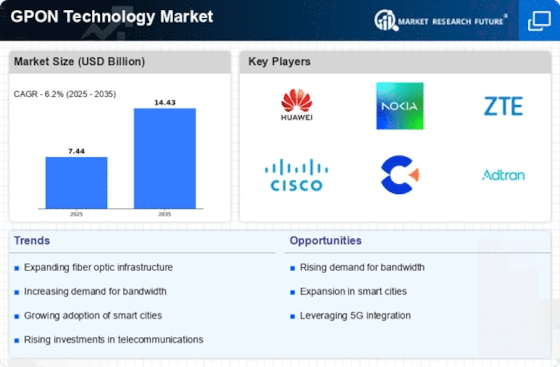
As per MRFR analysis, the GPON Technology Market Size was estimated at 7.444 USD Billion in 2024. The GPON industry is projected to grow from 7.906 USD Billion in 2025 to 14.43 USD Billion by 2035, exhibiting a compound annual growth rate (CAGR) of 6.2 during the forecast period 2025 - 2035.

Key Market Trends & Highlights

The GPON Technology Market is poised for substantial growth driven by increasing demand for high-speed connectivity and smart technologies.

  • North America remains the largest market for GPON technology, driven by robust infrastructure and high internet penetration. The Asia-Pacific region is emerging as the fastest-growing market, fueled by rapid urbanization and increasing data consumption. XGS-PON technology leads the market in terms of size, while NG-PON2 is gaining traction as the fastest-growing segment. Key market drivers include rising adoption of fiber optic networks and government initiatives aimed at enhancing connectivity.

Market Size & Forecast

2024 Market Size 7.444 (USD Billion)
2035 Market Size 14.43 (USD Billion)
CAGR (2025 - 2035) 6.2%
Largest Regional Market Share in 2024 North America

Major Players

<p>Huawei (CN), Nokia (FI), ZTE (CN), Cisco (US), Calix (US), ADTRAN (US), FiberHome (CN), Mitsubishi Electric (JP), <a title="Alcatel-Lucent" href="https://www.al-enterprise.com/en/blog/gpon-for-hotels" target="_blank" rel="noopener">Alcatel-Lucent</a> (FR)</p>

Market Trends

The GPON Technology Market is currently experiencing a transformative phase characterized by rapid advancements and increasing adoption across various sectors. This technology, which facilitates high-speed internet access through fiber-optic networks, appears to be gaining traction due to the growing demand for reliable and efficient broadband solutions. As urbanization continues to rise, the need for robust telecommunications infrastructure becomes more pronounced, suggesting that GPON technology may play a pivotal role in meeting these demands. Furthermore, the integration of smart technologies and the Internet of Things (IoT) into everyday life is likely to drive further growth in this market, as consumers and businesses alike seek faster and more dependable connectivity options. In addition to the increasing demand for high-speed internet, the GPON Technology Market is also influenced by ongoing innovations in network management and optimization. Service providers are exploring ways to enhance their offerings, which may lead to the development of more sophisticated GPON solutions. This trend indicates a shift towards more user-centric services, where customer experience is prioritized. As competition intensifies, companies within the GPON Technology Market are expected to invest in research and development to stay ahead, potentially resulting in a more dynamic and diverse marketplace in the near future.

Rising Demand for High-Speed Connectivity

The GPON Technology Market is witnessing a surge in demand for high-speed internet services. This trend is driven by the increasing reliance on digital platforms for work, education, and entertainment. As consumers seek faster and more reliable connections, service providers are compelled to enhance their infrastructure, thereby propelling the growth of GPON technology.

Integration of Smart Technologies

The integration of smart technologies into everyday life is influencing the GPON Technology Market. As homes and businesses adopt IoT devices, the need for robust and efficient broadband solutions becomes critical. This trend suggests that GPON technology may be essential in supporting the connectivity requirements of smart ecosystems.

Focus on Network Optimization

There is a growing emphasis on network optimization within the GPON Technology Market. Service providers are increasingly investing in advanced management tools to enhance performance and reliability. This focus on optimization indicates a shift towards more efficient service delivery, which could reshape customer experiences in the telecommunications sector.

GPON Technology Market Market Drivers

Increasing Internet Penetration

The expansion of internet access across various regions is a primary driver for the GPON Technology Market. As more households and businesses seek reliable and high-speed internet connections, the demand for GPON technology is likely to surge. Reports indicate that internet penetration rates have been steadily increasing, with many countries aiming for universal access. This trend suggests that service providers are investing in GPON infrastructure to meet the growing needs of consumers. The GPON Technology Market is thus positioned to benefit from this increasing demand, as it offers efficient solutions for delivering high-speed internet to a larger audience.

Increased Data Consumption Trends

The exponential growth in data consumption is a pivotal driver for the GPON Technology Market. With the proliferation of streaming services, online gaming, and cloud computing, consumers are demanding faster and more reliable internet connections. Recent statistics indicate that data traffic is expected to continue its upward trajectory, necessitating the deployment of advanced technologies like GPON to handle the increased load. Service providers are thus compelled to upgrade their networks to accommodate this surge in demand, which bodes well for the GPON Technology Market as it offers the necessary infrastructure to support high data throughput.

Government Initiatives and Funding

Government initiatives aimed at enhancing telecommunications infrastructure are playing a crucial role in the GPON Technology Market. Many governments are recognizing the importance of high-speed internet for economic development and are allocating funds to support the deployment of advanced technologies like GPON. These initiatives often include subsidies, grants, and public-private partnerships that encourage investment in fiber optic networks. As a result, the GPON Technology Market is expected to benefit from increased funding and support, facilitating the expansion of GPON networks in underserved areas and promoting digital inclusion.

Growing Demand for Smart City Solutions

The emergence of smart city initiatives is driving the GPON Technology Market as municipalities seek to implement advanced technologies for improved urban living. Smart cities rely on robust communication networks to support various applications, including traffic management, public safety, and energy efficiency. GPON technology, with its ability to provide high-speed connectivity, is well-suited for these applications. As cities invest in infrastructure to support smart technologies, the demand for GPON solutions is likely to rise, positioning the GPON Technology Market as a key player in the development of future urban environments.

Rising Adoption of Fiber Optic Networks

The shift towards fiber optic networks is a significant factor influencing the GPON Technology Market. Fiber optics provide superior bandwidth and speed compared to traditional copper networks, making them an attractive option for telecommunications companies. Recent data indicates that the deployment of fiber optic networks has been accelerating, with many regions prioritizing this technology to enhance connectivity. This transition not only improves service quality but also supports the increasing data consumption trends observed in various sectors. Consequently, the GPON Technology Market is likely to experience growth as more operators adopt fiber optic solutions to meet consumer demands.

Market Segment Insights

By Technology: XGS-PON (Largest) vs. NG-PON2 (Fastest-Growing)

<p>In the GPON Technology Market, XGS-PON represents the largest share of the market owing to its enhanced bandwidth capabilities and ability to support a wide range of applications. The technology has gained traction due to its scalable infrastructure which is appealing to service providers looking for efficient and reliable solutions. On the other hand, NG-PON2 is emerging rapidly, capturing interest due to its ability to deliver multi-gigabit services and support future-proof networking solutions, making it a key player in the evolving market landscape. The growth driver for XGS-PON lies in the demand for high-speed internet connectivity, particularly in urban areas, where the population density necessitates advanced infrastructure. In contrast, NG-PON2 is gaining momentum amid increasing requirements for bandwidth as businesses switch to cloud-centric operations and IoT devices proliferate. The shift towards <a title="digital transformation" href="https://www.marketresearchfuture.com/reports/digital-transformation-market-8685" target="_blank" rel="noopener">digital transformation</a> globally is propelling both technologies, but NG-PON2's adaptability for future advancements positions it for robust expansion over the coming years.</p>

<p>Technology: XGS-PON (Dominant) vs. NG-PON2 (Emerging)</p>

<p>XGS-PON is distinguished as the dominant technology in the GPON segment, characterized by its ability to provide symmetric bandwidth and support high-capacity applications, making it particularly well-suited for residential and business customers seeking more robust internet solutions. Its widespread adoption has positioned it favorably against traditional GPON solutions, enabling service providers to meet increasing consumer demands. In contrast, NG-PON2 is emerging as a transformative technology with its unique capability to offer multiple wavelength channels simultaneously. This flexibility not only allows for seamless service upgrades but also caters to diverse customer needs, positioning NG-PON2 as a competitive option for next-generation networks. While XGS-PON dominates with established infrastructure, NG-PON2&rsquo;s innovative approach makes it a crucial player ready for substantial future growth.</p>

By Component: Optical Network Terminal (Largest) vs. Optical Line Terminal (Fastest-Growing)

<p>In the GPON Technology Market, the Optical Network Terminal (ONT) represents the largest segment, dominating the market with its essential role in connecting end users to the fiber optic network. The ONT's capability to facilitate high-speed internet access makes it a critical component for telecommunication companies, thereby securing a significant share. Conversely, the Optical Line Terminal (OLT) is on the rise, witnessing rapid adoption as telecommunication providers upgrade their infrastructure to meet increasing data demands, marking it as a fast-growing segment.</p>

<p>Component: ONT (Dominant) vs. OLT (Emerging)</p>

<p>The Optical Network Terminal (ONT) stands as the dominant player in the GPON Technology Market due to its crucial function in accessing broadband services directly by consumers. It serves as the point of termination for fiber optic connections, ensuring efficient delivery of high-speed internet services. ONTs are characterized by their interoperability with various service providers, making them a preferable choice in residential and commercial applications. On the other hand, the Optical Line Terminal (OLT) is positioned as the emerging segment, instrumental in managing and controlling multiple ONTs. The rapid growth of OLTs is largely driven by the increasing deployment of GPON architecture, necessitated by growing consumer demand for higher bandwidth and smarter network management.</p>

By Application: FTTH (Largest) vs. Other FTTx (Fastest-Growing)

<p>In the GPON Technology Market, the application segment showcases a diverse distribution of market values, primarily dominated by FTTH (Fiber To The Home). This segment significantly outpaces others like Other FTTx and Mobile Backhaul, reflecting a strong preference for high-speed broadband solutions in residential areas. While FTTH remains the leading application providing exceptional bandwidth and reliable connectivity, Other FTTx applications are rapidly gaining traction, driven by the increasing demand for hybrid network solutions across urban and suburban landscapes.</p>

<p>FTTH (Dominant) vs. Other FTTx (Emerging)</p>

<p>FTTH is recognized as the dominant application in the GPON Technology Market, offering unparalleled speeds and connectivity directly to homes. This approach not only enhances user experience but also supports the rising demand for data-heavy applications, such as streaming and online gaming. On the other hand, Other FTTx applications are marked as emerging, gaining ground due to their versatility and ability to serve various connectivity needs. These include FTTB (Fiber To The Building) and FTTN (Fiber To The Node), which provide flexible solutions for urban centers looking to upgrade their existing infrastructure without extensive investments. As both segments evolve, they reflect the growing trend towards fiber-based technologies.</p>

Get more detailed insights about GPON Technology Market Research Report - Global Forecast till 2035

Regional Insights

North America : Technology Adoption Leader

North America is witnessing significant growth in the GPON technology market, driven by increasing demand for high-speed internet and government initiatives promoting broadband expansion. The region holds approximately 40% of the global market share, making it the largest market for GPON technology. Regulatory support, such as the Federal Communications Commission's initiatives, further catalyzes this growth, ensuring widespread access to fiber-optic networks. The United States and Canada are the leading countries in this region, with major players like Cisco, Calix, and ADTRAN dominating the competitive landscape. These companies are investing heavily in R&D to enhance their offerings and maintain market leadership. The presence of established telecommunications infrastructure and a tech-savvy population also contribute to the region's robust market dynamics.

Europe : Emerging Fiber Optic Hub

Europe is rapidly evolving into a significant player in the GPON technology market, driven by increasing demand for high-speed internet and government-backed initiatives aimed at enhancing digital infrastructure. The region accounts for approximately 30% of the global market share, making it the second-largest market. Regulatory frameworks, such as the European Union's Digital Agenda, are pivotal in promoting fiber-optic deployment across member states, ensuring a competitive edge in the global market. Leading countries in Europe include Germany, France, and the UK, where companies like Nokia and Alcatel-Lucent are at the forefront of innovation. The competitive landscape is characterized by a mix of established players and emerging startups, all vying for market share. The emphasis on sustainability and green technology is also shaping the future of GPON deployments in the region.

Asia-Pacific : Rapidly Growing Market

The Asia-Pacific region is experiencing a rapid surge in the GPON technology market, fueled by urbanization, increasing internet penetration, and government initiatives to enhance digital connectivity. This region holds approximately 25% of the global market share, making it a key player in the GPON landscape. Countries like China and India are leading the charge, with significant investments in broadband infrastructure and supportive regulatory environments that encourage fiber-optic deployment. China is the largest market in the region, with major players like Huawei and ZTE dominating the competitive landscape. The presence of a vast population and a growing middle class further drives demand for high-speed internet services. Additionally, the competitive environment is marked by rapid technological advancements and collaborations among key players to enhance service offerings and expand market reach.

Middle East and Africa : Emerging Connectivity Frontier

The Middle East and Africa (MEA) region is emerging as a frontier for GPON technology, driven by increasing investments in telecommunications infrastructure and a growing demand for high-speed internet. The region currently holds about 5% of the global market share, but this is expected to grow significantly as governments prioritize digital transformation initiatives. Regulatory bodies are increasingly supporting fiber-optic deployments to enhance connectivity in urban and rural areas alike. Leading countries in this region include South Africa and the UAE, where companies are beginning to invest in GPON technology to meet rising consumer demands. The competitive landscape is still developing, with both local and international players vying for market presence. The focus on improving digital infrastructure is expected to drive further growth in the GPON market across the MEA region.

Key Players and Competitive Insights

Entrepreneurs are investing heavily in research and development to diversify their products, which will lead to the growth of the global pontech market. Significant business development includes new product development, contractual agreements, mergers and acquisitions, larger investments, and partnerships with other organizations. Entrepreneurs have also resorted to various actions to expand their influence around the world. If the GPON technology business wants to grow and survive in a competitive and competitive business environment, it must provide the necessary products.

Local manufacturing to reduce operating costs is one of the key business strategies adopted by global GPON business technology companies to benefit their customers and grow their businesses. In recent years, commercial GPON technology has provided some of the best results in the medical field. Major players in the GPON technology market, including Nokia, Fiberhome, ZTE, Calix, Huawei, Cisco, DASAN Zhone, Allied Telesis, Iskratel, NEC, Alphion, Unizyx, and ADTRAN.

Nokia Corporation, based in Espoo, Finland, is a multinational technology company renowned for its contributions to the telecommunications industry. Founded in 1865, Nokia has evolved over the years from a pulp mill into a global technology powerhouse. Nokia operates in various sectors, including telecommunications infrastructure, technology licensing, and consumer electronics. 

The company is a pioneer in the development and deployment of mobile networks, playing a pivotal role in the evolution of cellular technologies. Nokia provides solutions and services to communication service providers, enterprises, and government agencies worldwide. Nokia's GPON solution powered AirFiber Networks' fiber expansion in May 2021. With the help of a broadband solution, this company launched high-speed data services and expanded its network to serve its customers better. By implementing the solution, AirFiber Network is anticipated to have the ability to offer broadband services to 100,000 subscribers in India within a year.

Bell Canada, commonly known as Bell, is one of Canada's largest telecommunications companies, providing a comprehensive range of services to residential, business, and government customers. Bell Canada is a leading communications company headquartered in Montreal, Quebec, Canada. It is a subsidiary of BCE Inc., one of Canada's largest holding companies. Bell offers a wide array of services, including wireline and wireless voice and data communications, high-speed and fiber-optic internet, television, and digital media services. 

The company continually invests in research and development to enhance its network technologies and services. Bell Canada utilizes Nokia's 25G Pon technology starting in November 2021. Nokia's 25G PON technology successfully complements current GPON and XGS-PON deployments, proving that its capabilities complement these technologies. A 25G PON test is being conducted for the first time in North America; Nokia has customers in Europe who currently employ 25G PON.

Key Companies in the GPON Technology Market market include

Industry Developments

November 2021: Global Connect has recently acquired the single-dwelling unit (SDU) fiber assets from Telenor Sweden and its wholesale company, Open Universe. This acquisition includes approximately 200,000 connected homes on Open Universe's platform and an additional 14,000 homes within Telenor's SDU fiber network. The main objective of GlobalConnect's purchase is to address the digital divide in Sweden. The total cost of this transaction was 3 billion Swedish kronor.

December 2021: Turk Telekom has expedited the implementation of its high-speed network in Türkiye. As part of this undertaking, the company has successfully conducted a trial of 25G PON, resulting in network speeds over ten times faster than those achievable with the current GPON technology.

Future Outlook

GPON Technology Market Future Outlook

<p>The GPON Technology Market is projected to grow at a 6.2% CAGR from 2024 to 2035, driven by increasing demand for high-speed internet and smart city initiatives.</p>

New opportunities lie in:

  • <p>Expansion into underserved rural markets with tailored GPON solutions.</p>
  • <p>Development of integrated GPON systems for smart home applications.</p>
  • <p>Partnerships with local governments for urban fiber deployment projects.</p>

<p>By 2035, the GPON Technology Market is expected to be robust, driven by innovation and strategic partnerships.</p>

Market Segmentation

GPON Technology Market Component Outlook

  • Optical Network Terminal
  • Optical Line Terminal

GPON Technology Market Technology Outlook

  • 2.5G PON
  • XG-PON
  • XGS-PON
  • NG-PON2

GPON Technology Market Application Outlook

  • FTTH
  • Other FTTx
  • Mobile Backhaul

Report Scope

MARKET SIZE 2024 7.444(USD Billion)
MARKET SIZE 2025 7.906(USD Billion)
MARKET SIZE 2035 14.43(USD Billion)
COMPOUND ANNUAL GROWTH RATE (CAGR) 6.2% (2024 - 2035)
REPORT COVERAGE Revenue Forecast, Competitive Landscape, Growth Factors, and Trends
BASE YEAR 2024
Market Forecast Period 2025 - 2035
Historical Data 2019 - 2024
Market Forecast Units USD Billion
Key Companies Profiled Market analysis in progress
Segments Covered Market segmentation analysis in progress
Key Market Opportunities Expansion of fiber optic infrastructure driven by increasing demand for high-speed internet access.
Key Market Dynamics Rising demand for high-speed internet drives competition and innovation in the GPON technology market.
Countries Covered North America, Europe, APAC, South America, MEA

FAQs

What is the projected market valuation of the GPON Technology Market by 2035?

The GPON Technology Market is projected to reach a valuation of 14.43 USD Billion by 2035.

What was the market valuation of the GPON Technology Market in 2024?

In 2024, the GPON Technology Market was valued at 7.444 USD Billion.

What is the expected CAGR for the GPON Technology Market during the forecast period 2025 - 2035?

The expected CAGR for the GPON Technology Market during the forecast period 2025 - 2035 is 6.2%.

Which companies are considered key players in the GPON Technology Market?

Key players in the GPON Technology Market include Huawei, Nokia, ZTE, Cisco, Calix, ADTRAN, FiberHome, Mitsubishi Electric, and Alcatel-Lucent.

What are the main technology segments within the GPON Technology Market?

The main technology segments include 2.5G PON, XG-PON, XGS-PON, and NG-PON2, with valuations ranging from 1.5 to 5.93 USD Billion.

What components are included in the GPON Technology Market analysis?

The components analyzed in the GPON Technology Market include Optical Network Terminals and Optical Line Terminals, valued between 3.5 and 7.43 USD Billion.

  1. SECTION I: EXECUTIVE SUMMARY AND KEY HIGHLIGHTS
    1. EXECUTIVE SUMMARY
      1. Market Overview
      2. Key Findings
      3. Market Segmentation
      4. Competitive Landscape
      5. Challenges and Opportunities
      6. Future Outlook 2
  2. SECTION II: SCOPING, METHODOLOGY AND MARKET STRUCTURE
    1. MARKET INTRODUCTION
      1. Definition
      2. Scope of the study
    2. RESEARCH METHODOLOGY
      1. Overview
      2. Data Mining
      3. Secondary Research
      4. Primary Research
      5. Forecasting Model
      6. Market Size Estimation
      7. Data Triangulation
      8. Validation 3
  3. SECTION III: QUALITATIVE ANALYSIS
    1. MARKET DYNAMICS
      1. Overview
      2. Drivers
      3. Restraints
      4. Opportunities
    2. MARKET FACTOR ANALYSIS
      1. Value chain Analysis
      2. Porter's Five Forces Analysis
      3. COVID-19 Impact Analysis
  4. SECTION IV: QUANTITATIVE ANALYSIS
    1. Information and Communications Technology, BY Technology (USD Billion)
      1. XG-PON
      2. XGS-PON
      3. NG-PON2
    2. 2.5G PON
    3. Information and Communications Technology, BY Component (USD Billion)
      1. Optical Network Terminal
      2. Optical Line Terminal
    4. Information and Communications Technology, BY Application (USD Billion)
      1. FTTH
      2. Other FTTx
      3. Mobile Backhaul
    5. Information and Communications Technology, BY Region (USD Billion)
      1. North America
      2. Europe
      3. APAC
      4. South America
      5. MEA
  5. SECTION V: COMPETITIVE ANALYSIS
    1. Competitive Landscape
      1. Overview
      2. Competitive Analysis
      3. Market share Analysis
      4. Major Growth Strategy in the Information and Communications Technology
      5. Competitive Benchmarking
      6. Leading Players in Terms of Number of Developments in the Information and Communications Technology
      7. Key developments and growth strategies
      8. Major Players Financial Matrix
    2. Company Profiles
      1. Huawei (CN)
      2. Nokia (FI)
      3. ZTE (CN)
      4. Cisco (US)
      5. Calix (US)
      6. ADTRAN (US)
      7. FiberHome (CN)
      8. Mitsubishi Electric (JP)
      9. Alcatel-Lucent (FR)
    3. Appendix
      1. References
      2. Related Reports 6 LIST OF FIGURES
    4. MARKET SYNOPSIS
    5. NORTH AMERICA MARKET ANALYSIS
    6. US MARKET ANALYSIS BY TECHNOLOGY
    7. US MARKET ANALYSIS BY COMPONENT
    8. US MARKET ANALYSIS BY APPLICATION
    9. CANADA MARKET ANALYSIS BY TECHNOLOGY
    10. CANADA MARKET ANALYSIS BY COMPONENT
    11. CANADA MARKET ANALYSIS BY APPLICATION
    12. EUROPE MARKET ANALYSIS
    13. GERMANY MARKET ANALYSIS BY TECHNOLOGY
    14. GERMANY MARKET ANALYSIS BY COMPONENT
    15. GERMANY MARKET ANALYSIS BY APPLICATION
    16. UK MARKET ANALYSIS BY TECHNOLOGY
    17. UK MARKET ANALYSIS BY COMPONENT
    18. UK MARKET ANALYSIS BY APPLICATION
    19. FRANCE MARKET ANALYSIS BY TECHNOLOGY
    20. FRANCE MARKET ANALYSIS BY COMPONENT
    21. FRANCE MARKET ANALYSIS BY APPLICATION
    22. RUSSIA MARKET ANALYSIS BY TECHNOLOGY
    23. RUSSIA MARKET ANALYSIS BY COMPONENT
    24. RUSSIA MARKET ANALYSIS BY APPLICATION
    25. ITALY MARKET ANALYSIS BY TECHNOLOGY
    26. ITALY MARKET ANALYSIS BY COMPONENT
    27. ITALY MARKET ANALYSIS BY APPLICATION
    28. SPAIN MARKET ANALYSIS BY TECHNOLOGY
    29. SPAIN MARKET ANALYSIS BY COMPONENT
    30. SPAIN MARKET ANALYSIS BY APPLICATION
    31. REST OF EUROPE MARKET ANALYSIS BY TECHNOLOGY
    32. REST OF EUROPE MARKET ANALYSIS BY COMPONENT
    33. REST OF EUROPE MARKET ANALYSIS BY APPLICATION
    34. APAC MARKET ANALYSIS
    35. CHINA MARKET ANALYSIS BY TECHNOLOGY
    36. CHINA MARKET ANALYSIS BY COMPONENT
    37. CHINA MARKET ANALYSIS BY APPLICATION
    38. INDIA MARKET ANALYSIS BY TECHNOLOGY
    39. INDIA MARKET ANALYSIS BY COMPONENT
    40. INDIA MARKET ANALYSIS BY APPLICATION
    41. JAPAN MARKET ANALYSIS BY TECHNOLOGY
    42. JAPAN MARKET ANALYSIS BY COMPONENT
    43. JAPAN MARKET ANALYSIS BY APPLICATION
    44. SOUTH KOREA MARKET ANALYSIS BY TECHNOLOGY
    45. SOUTH KOREA MARKET ANALYSIS BY COMPONENT
    46. SOUTH KOREA MARKET ANALYSIS BY APPLICATION
    47. MALAYSIA MARKET ANALYSIS BY TECHNOLOGY
    48. MALAYSIA MARKET ANALYSIS BY COMPONENT
    49. MALAYSIA MARKET ANALYSIS BY APPLICATION
    50. THAILAND MARKET ANALYSIS BY TECHNOLOGY
    51. THAILAND MARKET ANALYSIS BY COMPONENT
    52. THAILAND MARKET ANALYSIS BY APPLICATION
    53. INDONESIA MARKET ANALYSIS BY TECHNOLOGY
    54. INDONESIA MARKET ANALYSIS BY COMPONENT
    55. INDONESIA MARKET ANALYSIS BY APPLICATION
    56. REST OF APAC MARKET ANALYSIS BY TECHNOLOGY
    57. REST OF APAC MARKET ANALYSIS BY COMPONENT
    58. REST OF APAC MARKET ANALYSIS BY APPLICATION
    59. SOUTH AMERICA MARKET ANALYSIS
    60. BRAZIL MARKET ANALYSIS BY TECHNOLOGY
    61. BRAZIL MARKET ANALYSIS BY COMPONENT
    62. BRAZIL MARKET ANALYSIS BY APPLICATION
    63. MEXICO MARKET ANALYSIS BY TECHNOLOGY
    64. MEXICO MARKET ANALYSIS BY COMPONENT
    65. MEXICO MARKET ANALYSIS BY APPLICATION
    66. ARGENTINA MARKET ANALYSIS BY TECHNOLOGY
    67. ARGENTINA MARKET ANALYSIS BY COMPONENT
    68. ARGENTINA MARKET ANALYSIS BY APPLICATION
    69. REST OF SOUTH AMERICA MARKET ANALYSIS BY TECHNOLOGY
    70. REST OF SOUTH AMERICA MARKET ANALYSIS BY COMPONENT
    71. REST OF SOUTH AMERICA MARKET ANALYSIS BY APPLICATION
    72. MEA MARKET ANALYSIS
    73. GCC COUNTRIES MARKET ANALYSIS BY TECHNOLOGY
    74. GCC COUNTRIES MARKET ANALYSIS BY COMPONENT
    75. GCC COUNTRIES MARKET ANALYSIS BY APPLICATION
    76. SOUTH AFRICA MARKET ANALYSIS BY TECHNOLOGY
    77. SOUTH AFRICA MARKET ANALYSIS BY COMPONENT
    78. SOUTH AFRICA MARKET ANALYSIS BY APPLICATION
    79. REST OF MEA MARKET ANALYSIS BY TECHNOLOGY
    80. REST OF MEA MARKET ANALYSIS BY COMPONENT
    81. REST OF MEA MARKET ANALYSIS BY APPLICATION
    82. KEY BUYING CRITERIA OF INFORMATION AND COMMUNICATIONS TECHNOLOGY
    83. RESEARCH PROCESS OF MRFR
    84. DRO ANALYSIS OF INFORMATION AND COMMUNICATIONS TECHNOLOGY
    85. DRIVERS IMPACT ANALYSIS: INFORMATION AND COMMUNICATIONS TECHNOLOGY
    86. RESTRAINTS IMPACT ANALYSIS: INFORMATION AND COMMUNICATIONS TECHNOLOGY
    87. SUPPLY / VALUE CHAIN: INFORMATION AND COMMUNICATIONS TECHNOLOGY
    88. INFORMATION AND COMMUNICATIONS TECHNOLOGY, BY TECHNOLOGY, 2024 (% SHARE)
    89. INFORMATION AND COMMUNICATIONS TECHNOLOGY, BY TECHNOLOGY, 2024 TO 2035 (USD Billion)
    90. INFORMATION AND COMMUNICATIONS TECHNOLOGY, BY COMPONENT, 2024 (% SHARE)
    91. INFORMATION AND COMMUNICATIONS TECHNOLOGY, BY COMPONENT, 2024 TO 2035 (USD Billion)
    92. INFORMATION AND COMMUNICATIONS TECHNOLOGY, BY APPLICATION, 2024 (% SHARE)
    93. INFORMATION AND COMMUNICATIONS TECHNOLOGY, BY APPLICATION, 2024 TO 2035 (USD Billion)
    94. BENCHMARKING OF MAJOR COMPETITORS 7 LIST OF TABLES
    95. LIST OF ASSUMPTIONS
    96. North America MARKET SIZE ESTIMATES; FORECAST
      1. BY TECHNOLOGY, 2025-2035 (USD Billion)
      2. BY COMPONENT, 2025-2035 (USD Billion)
      3. BY APPLICATION, 2025-2035 (USD Billion)
    97. US MARKET SIZE ESTIMATES; FORECAST
      1. BY TECHNOLOGY, 2025-2035 (USD Billion)
      2. BY COMPONENT, 2025-2035 (USD Billion)
      3. BY APPLICATION, 2025-2035 (USD Billion)
    98. Canada MARKET SIZE ESTIMATES; FORECAST
      1. BY TECHNOLOGY, 2025-2035 (USD Billion)
      2. BY COMPONENT, 2025-2035 (USD Billion)
      3. BY APPLICATION, 2025-2035 (USD Billion)
    99. Europe MARKET SIZE ESTIMATES; FORECAST
      1. BY TECHNOLOGY, 2025-2035 (USD Billion)
      2. BY COMPONENT, 2025-2035 (USD Billion)
      3. BY APPLICATION, 2025-2035 (USD Billion)
    100. Germany MARKET SIZE ESTIMATES; FORECAST
      1. BY TECHNOLOGY, 2025-2035 (USD Billion)
      2. BY COMPONENT, 2025-2035 (USD Billion)
      3. BY APPLICATION, 2025-2035 (USD Billion)
    101. UK MARKET SIZE ESTIMATES; FORECAST
      1. BY TECHNOLOGY, 2025-2035 (USD Billion)
      2. BY COMPONENT, 2025-2035 (USD Billion)
      3. BY APPLICATION, 2025-2035 (USD Billion)
    102. France MARKET SIZE ESTIMATES; FORECAST
      1. BY TECHNOLOGY, 2025-2035 (USD Billion)
      2. BY COMPONENT, 2025-2035 (USD Billion)
      3. BY APPLICATION, 2025-2035 (USD Billion)
    103. Russia MARKET SIZE ESTIMATES; FORECAST
      1. BY TECHNOLOGY, 2025-2035 (USD Billion)
      2. BY COMPONENT, 2025-2035 (USD Billion)
      3. BY APPLICATION, 2025-2035 (USD Billion)
    104. Italy MARKET SIZE ESTIMATES; FORECAST
      1. BY TECHNOLOGY, 2025-2035 (USD Billion)
      2. BY COMPONENT, 2025-2035 (USD Billion)
      3. BY APPLICATION, 2025-2035 (USD Billion)
    105. Spain MARKET SIZE ESTIMATES; FORECAST
      1. BY TECHNOLOGY, 2025-2035 (USD Billion)
      2. BY COMPONENT, 2025-2035 (USD Billion)
      3. BY APPLICATION, 2025-2035 (USD Billion)
    106. Rest of Europe MARKET SIZE ESTIMATES; FORECAST
      1. BY TECHNOLOGY, 2025-2035 (USD Billion)
      2. BY COMPONENT, 2025-2035 (USD Billion)
      3. BY APPLICATION, 2025-2035 (USD Billion)
    107. APAC MARKET SIZE ESTIMATES; FORECAST
      1. BY TECHNOLOGY, 2025-2035 (USD Billion)
      2. BY COMPONENT, 2025-2035 (USD Billion)
      3. BY APPLICATION, 2025-2035 (USD Billion)
    108. China MARKET SIZE ESTIMATES; FORECAST
      1. BY TECHNOLOGY, 2025-2035 (USD Billion)
      2. BY COMPONENT, 2025-2035 (USD Billion)
      3. BY APPLICATION, 2025-2035 (USD Billion)
    109. India MARKET SIZE ESTIMATES; FORECAST
      1. BY TECHNOLOGY, 2025-2035 (USD Billion)
      2. BY COMPONENT, 2025-2035 (USD Billion)
      3. BY APPLICATION, 2025-2035 (USD Billion)
    110. Japan MARKET SIZE ESTIMATES; FORECAST
      1. BY TECHNOLOGY, 2025-2035 (USD Billion)
      2. BY COMPONENT, 2025-2035 (USD Billion)
      3. BY APPLICATION, 2025-2035 (USD Billion)
    111. South Korea MARKET SIZE ESTIMATES; FORECAST
      1. BY TECHNOLOGY, 2025-2035 (USD Billion)
      2. BY COMPONENT, 2025-2035 (USD Billion)
      3. BY APPLICATION, 2025-2035 (USD Billion)
    112. Malaysia MARKET SIZE ESTIMATES; FORECAST
      1. BY TECHNOLOGY, 2025-2035 (USD Billion)
      2. BY COMPONENT, 2025-2035 (USD Billion)
      3. BY APPLICATION, 2025-2035 (USD Billion)
    113. Thailand MARKET SIZE ESTIMATES; FORECAST
      1. BY TECHNOLOGY, 2025-2035 (USD Billion)
      2. BY COMPONENT, 2025-2035 (USD Billion)
      3. BY APPLICATION, 2025-2035 (USD Billion)
    114. Indonesia MARKET SIZE ESTIMATES; FORECAST
      1. BY TECHNOLOGY, 2025-2035 (USD Billion)
      2. BY COMPONENT, 2025-2035 (USD Billion)
      3. BY APPLICATION, 2025-2035 (USD Billion)
    115. Rest of APAC MARKET SIZE ESTIMATES; FORECAST
      1. BY TECHNOLOGY, 2025-2035 (USD Billion)
      2. BY COMPONENT, 2025-2035 (USD Billion)
      3. BY APPLICATION, 2025-2035 (USD Billion)
    116. South America MARKET SIZE ESTIMATES; FORECAST
      1. BY TECHNOLOGY, 2025-2035 (USD Billion)
      2. BY COMPONENT, 2025-2035 (USD Billion)
      3. BY APPLICATION, 2025-2035 (USD Billion)
    117. Brazil MARKET SIZE ESTIMATES; FORECAST
      1. BY TECHNOLOGY, 2025-2035 (USD Billion)
      2. BY COMPONENT, 2025-2035 (USD Billion)
      3. BY APPLICATION, 2025-2035 (USD Billion)
    118. Mexico MARKET SIZE ESTIMATES; FORECAST
      1. BY TECHNOLOGY, 2025-2035 (USD Billion)
      2. BY COMPONENT, 2025-2035 (USD Billion)
      3. BY APPLICATION, 2025-2035 (USD Billion)
    119. Argentina MARKET SIZE ESTIMATES; FORECAST
      1. BY TECHNOLOGY, 2025-2035 (USD Billion)
      2. BY COMPONENT, 2025-2035 (USD Billion)
      3. BY APPLICATION, 2025-2035 (USD Billion)
    120. Rest of South America MARKET SIZE ESTIMATES; FORECAST
      1. BY TECHNOLOGY, 2025-2035 (USD Billion)
      2. BY COMPONENT, 2025-2035 (USD Billion)
      3. BY APPLICATION, 2025-2035 (USD Billion)
    121. MEA MARKET SIZE ESTIMATES; FORECAST
      1. BY TECHNOLOGY, 2025-2035 (USD Billion)
      2. BY COMPONENT, 2025-2035 (USD Billion)
      3. BY APPLICATION, 2025-2035 (USD Billion)
    122. GCC Countries MARKET SIZE ESTIMATES; FORECAST
      1. BY TECHNOLOGY, 2025-2035 (USD Billion)
      2. BY COMPONENT, 2025-2035 (USD Billion)
      3. BY APPLICATION, 2025-2035 (USD Billion)
    123. South Africa MARKET SIZE ESTIMATES; FORECAST
      1. BY TECHNOLOGY, 2025-2035 (USD Billion)
      2. BY COMPONENT, 2025-2035 (USD Billion)
      3. BY APPLICATION, 2025-2035 (USD Billion)
    124. Rest of MEA MARKET SIZE ESTIMATES; FORECAST
      1. BY TECHNOLOGY, 2025-2035 (USD Billion)
      2. BY COMPONENT, 2025-2035 (USD Billion)
      3. BY APPLICATION, 2025-2035 (USD Billion)
    125. PRODUCT LAUNCH/PRODUCT DEVELOPMENT/APPROVAL
    126. ACQUISITION/PARTNERSHIP

GPON Technology Market Segmentation

GPON Technology Technology Outlook (USD Billion, 2018-2032)

2.5G PON

XG-PON

XGS-PON

NG-PON2

GPON Technology Component Outlook (USD Billion, 2018-2032)

Optical Network Terminal

Optical Line Terminal

GPON Technology Application Outlook (USD Billion, 2018-2032)

FTTH

Other FTTx

Mobile Backhaul

GPON Technology Regional Outlook (USD Billion, 2018-2032)

North America Outlook (USD Billion, 2018-2032)

North America GPON Technology by Technology

2.5G PON

XG-PON

XGS-PON

NG-PON2

North America GPON Technology by Component

Optical Network Terminal

Optical Line Terminal

North America GPON Technology by Application

FTTH

Other FTTx

Mobile Backhaul

US Outlook (USD Billion, 2018-2032)

US GPON Technology by Technology

2.5G PON

XG-PON

XGS-PON

NG-PON2

US GPON Technology by Component

Optical Network Terminal

Optical Line Terminal

US GPON Technology by Application

FTTH

Other FTTx

Mobile Backhaul

CANADA Outlook (USD Billion, 2018-2032)

CANADA GPON Technology by Technology

2.5G PON

XG-PON

XGS-PON

NG-PON2

CANADA GPON Technology by Component

Optical Network Terminal

Optical Line Terminal

CANADA GPON Technology by Application

FTTH

Other FTTx

Mobile Backhaul

Europe Outlook (USD Billion, 2018-2032)

Europe GPON Technology by Technology

2.5G PON

XG-PON

XGS-PON

NG-PON2

Europe GPON Technology by Component

Optical Network Terminal

Optical Line Terminal

Europe GPON Technology by Application

FTTH

Other FTTx

Mobile Backhaul

Germany Outlook (USD Billion, 2018-2032)

Germany GPON Technology by Technology

2.5G PON

XG-PON

XGS-PON

NG-PON2

Germany GPON Technology by Component

Optical Network Terminal

Optical Line Terminal

Germany GPON Technology by Application

FTTH

Other FTTx

Mobile Backhaul

France Outlook (USD Billion, 2018-2032)

France GPON Technology by Technology

2.5G PON

XG-PON

XGS-PON

NG-PON2

France GPON Technology by Component

Optical Network Terminal

Optical Line Terminal

France GPON Technology by Application

FTTH

Other FTTx

Mobile Backhaul

UK Outlook (USD Billion, 2018-2032)

UK GPON Technology by Technology

2.5G PON

XG-PON

XGS-PON

NG-PON2

UK GPON Technology by Component

Optical Network Terminal

Optical Line Terminal

UK GPON Technology by Application

FTTH

Other FTTx

Mobile Backhaul

ITALY Outlook (USD Billion, 2018-2032)

ITALY GPON Technology by Technology

2.5G PON

XG-PON

XGS-PON

NG-PON2

ITALY GPON Technology by Component

Optical Network Terminal

Optical Line Terminal

ITALY GPON Technology by Application

FTTH

Other FTTx

Mobile Backhaul

SPAIN Outlook (USD Billion, 2018-2032)

Spain GPON Technology by Technology

2.5G PON

XG-PON

XGS-PON

NG-PON2

Spain GPON Technology by Component

Optical Network Terminal

Optical Line Terminal

Spain GPON Technology by Application

FTTH

Other FTTx

Mobile Backhaul

Rest Of Europe Outlook (USD Billion, 2018-2032)

Rest Of Europe GPON Technology by Technology

2.5G PON

XG-PON

XGS-PON

NG-PON2

REST OF EUROPE GPON Technology by Component

Optical Network Terminal

Optical Line Terminal

Rest of Europe GPON Technology by Application

FTTH

Other FTTx

Mobile Backhaul

Asia-Pacific Outlook (USD Billion, 2018-2032)

Asia-Pacific GPON Technology by Technology

2.5G PON

XG-PON

XGS-PON

NG-PON2

Asia-Pacific GPON Technology by Component

Optical Network Terminal

Optical Line Terminal

Asia-Pacific GPON Technology by Application

FTTH

Other FTTx

Mobile Backhaul

China Outlook (USD Billion, 2018-2032)

China GPON Technology by Technology

2.5G PON

XG-PON

XGS-PON

NG-PON2

China GPON Technology by Component

Optical Network Terminal

Optical Line Terminal

China GPON Technology by Application

FTTH

Other FTTx

Mobile Backhaul

Japan Outlook (USD Billion, 2018-2032)

Japan GPON Technology by Technology

2.5G PON

XG-PON

XGS-PON

NG-PON2

Japan GPON Technology by Component

Optical Network Terminal

Optical Line Terminal

Japan GPON Technology by Application

FTTH

Other FTTx

Mobile Backhaul

India Outlook (USD Billion, 2018-2032)

India GPON Technology by Technology

2.5G PON

XG-PON

XGS-PON

NG-PON2

India GPON Technology by Component

Optical Network Terminal

Optical Line Terminal

India GPON Technology by Application

FTTH

Other FTTx

Mobile Backhaul

Australia Outlook (USD Billion, 2018-2032)

Australia GPON Technology by Technology

2.5G PON

XG-PON

XGS-PON

NG-PON2

Australia GPON Technology by Component

Optical Network Terminal

Optical Line Terminal

Australia GPON Technology by Application

FTTH

Other FTTx

Mobile Backhaul

Rest of Asia-Pacific Outlook (USD Billion, 2018-2032)

Rest of Asia-Pacific GPON Technology by Technology

2.5G PON

XG-PON

XGS-PON

NG-PON2

Rest of Asia-Pacific GPON Technology by Component

Optical Network Terminal

Optical Line Terminal

Rest of Asia-Pacific GPON Technology by Application

FTTH

Other FTTx

Mobile Backhaul

Rest of the World Outlook (USD Billion, 2018-2032)

Rest of the World GPON Technology by Technology

2.5G PON

XG-PON

XGS-PON

NG-PON2

Rest of the World GPON Technology by Component

Optical Network Terminal

Optical Line Terminal

Rest of the world GPON Technology by Application

FTTH

Other FTTx

Mobile Backhaul

Middle East Outlook (USD Billion, 2018-2032)

Middle East GPON Technology by Technology

2.5G PON

XG-PON

XGS-PON

NG-PON2

Middle East GPON Technology by Component

Optical Network Terminal

Optical Line Terminal

Middle East GPON Technology by Application

FTTH

Other FTTx

Mobile Backhaul

Africa Outlook (USD Billion, 2018-2032)

Africa GPON Technology by Technology

2.5G PON

XG-PON

XGS-PON

NG-PON2

Africa GPON Technology by Component

Optical Network Terminal

Optical Line Terminal

Africa GPON Technology by Application

FTTH

Other FTTx

Mobile Backhaul

Latin America Outlook (USD Billion, 2018-2032)

Latin America GPON Technology by Technology

2.5G PON

XG-PON

XGS-PON

NG-PON2

Latin America GPON Technology by Component

Optical Network Terminal

Optical Line Terminal

Latin America GPON Technology by Application

FTTH

Other FTTx

Mobile Backhaul

Infographic

Free Sample Request

Kindly complete the form below to receive a free sample of this Report

Get Free Sample

Customer Strories

Compare Licence

×
Features License Type
Single User Multiuser License Enterprise User
Price $4,950 $5,950 $7,250
Maximum User Access Limit 1 User Upto 10 Users Unrestricted Access Throughout the Organization
Free Customization
Direct Access to Analyst
Deliverable Format
Platform Access
Discount on Next Purchase 10% 15% 15%
Printable Versions