×
Hero Background
English
Chinese
French
Japanese
Korean
German
Spanish

Glycol Market Trends

ID: MRFR/CnM/11088-HCR
128 Pages
Chitranshi Jaiswal
October 2025

Glycol Market Research Report Information By Product (Ethylene Glycol and Propylene Glycol), By Application (Automotive, HVAC, Textiles, Airlines, Medical, Pipeline Maintenance, Polyester Fibers and Resins, Food and Beverage and Others), By End User (Automotive and Transportation, Packaging, Food and Beverage, Cosmetics, Pharmaceuticals, Textile and Other) And By Region (North America, Europe, Asia-Pacific, And Rest Of The World) –Market Forecast Till 2035

Share:
Download PDF ×

We do not share your information with anyone. However, we may send you emails based on your report interest from time to time. You may contact us at any time to opt-out.

Glycol Market Infographic
Purchase Options

Market Trends

Key Emerging Trends in the Glycol Market

The dynamic landscape of the glycol market has seen several trends in recent times due to a number of factors. A prominent one notable among these is the increasing demand for glycols in the automotive industry which is a consequence of growing electric vehicles production. In line with sustainability goals, EVs require ethylene glycol and propylene glycol for their cooling systems and heat exchangers. This increase in consumption can be attributed not only to the increase in production of electric vehicles but also to the larger trend towards environmental consciousness where energy efficiency is enhanced through use of glycols.

Another major trend that shapes the global market for Glycol is on renewable and bio-based Glycols. Many industries are looking for alternatives to conventional petroleum based Glycols as they focus more on sustainable practices and reducing carbon footprints. These eco- friendly substances produced from renewable sources like corn or sugarcane, have gained popularity among many people. On top of that, there are world-wide moves towards greener futures hence companies worldwide moving into biorenewable alternatives as part of their manufacturing processes.

Moreover, the Glycol Market is experiencing developments in product formulations that meet industry-specific needs. The practice of customizing Glycol solutions to different purposes across various sectors has become popular. For instance, high purity standards compliant-glycols are increasingly being sought by customers within pharmaceutical and food industries. This indicates how adaptable this market can be where manufacturers concentrate on creating niche specific glycol products so as widen their consumer base further.

The digital transformation is also making its mark on the glycol market, with advanced technologies integrated to enhance efficient supply chain management and product distribution. Companies have embraced data analytics and automation to optimize production processes, monitor inventory levels and streamline logistics. This trend toward digitalization improves operational efficiency while lowering costs thus enabling a more responsive supply chain to meet dynamic needs of the glycol market.

Author
Chitranshi Jaiswal
Research Analyst Level I

In her 3 years of experience in the market research field, she has handled critical cross-domain projects. She has an in-depth knowledge of market estimation & analysis, problem-solving, primary as well as secondary research, and team management.She holds an engineering degree and is an MBA professional from a well-known university, capable of evaluating the market and competitive conditions. An exceptional strategist with excellent communication skills and a passion for delivering cutting-edge & practical insights for the market. Proficient in multi-tasking, and can successfully deal with competing demands, while maintaining complete confidentiality. Generated business through active client and project development, networking, and high-quality responses. Her knowledge and skills have helped in making solid business decisions, securing funding from investors, and avoiding business failures.

Leave a Comment

FAQs

What is the current valuation of the Glycol Market as of 2024?

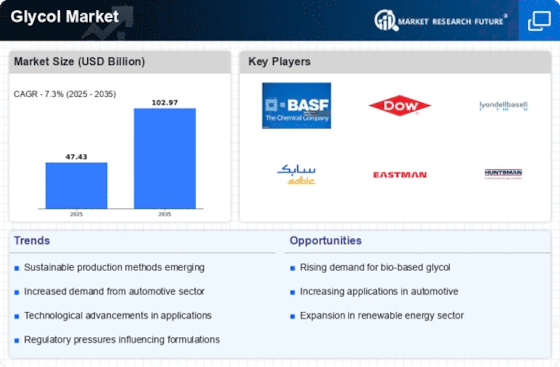
The Glycol Market was valued at 47.43 USD Billion in 2024.

What is the projected market size for the Glycol Market by 2035?

The Glycol Market is projected to reach 102.97 USD Billion by 2035.

What is the expected CAGR for the Glycol Market during the forecast period 2025 - 2035?

The expected CAGR for the Glycol Market during the forecast period 2025 - 2035 is 7.3%.

Which companies are considered key players in the Glycol Market?

Key players in the Glycol Market include BASF SE, Dow Inc., LyondellBasell Industries N.V., SABIC, and Eastman Chemical Company.

What are the primary product segments in the Glycol Market?

The primary product segments in the Glycol Market are Ethylene Glycol and Propylene Glycol, with valuations of 27.43 and 20.0 USD Billion respectively in 2024.

How does the Automotive sector contribute to the Glycol Market?

The Automotive sector contributed 6.0 USD Billion to the Glycol Market in 2024, with projections of 13.0 USD Billion by 2035.

Market Summary

As per MRFR analysis, the Glycol Market Size was estimated at 47.43 USD Billion in 2024. The Glycol industry is projected to grow from 50.89 USD Billion in 2025 to 102.97 USD Billion by 2035, exhibiting a compound annual growth rate (CAGR) of 7.3 during the forecast period 2025 - 2035.

Key Market Trends & Highlights

The Glycol Market is experiencing a dynamic shift driven by sustainability and technological advancements.

  • North America remains the largest market for glycol, driven by robust demand in the automotive sector.
  • Asia-Pacific is the fastest-growing region, reflecting increasing industrialization and urbanization.
  • Ethylene glycol continues to dominate the market, while propylene glycol is emerging as the fastest-growing segment.
  • Rising demand in the automotive sector and a focus on sustainable practices are key drivers propelling market growth.

Market Size & Forecast

2024 Market Size 47.43 (USD Billion)
2035 Market Size 102.97 (USD Billion)
CAGR (2025 - 2035) 7.3%
Largest Regional Market Share in 2024 North America

Major Players

<p>BASF SE (DE), Dow Inc. (US), LyondellBasell Industries N.V. (US), SABIC (SA), Eastman Chemical Company (US), Huntsman Corporation (US), Ineos Group Limited (GB), Formosa Plastics Corporation (TW), Oxea GmbH (DE)</p>

Market Trends

The Glycol Market is currently experiencing a dynamic phase characterized by evolving consumer preferences and technological advancements. The demand for glycols, particularly ethylene glycol and propylene glycol, is driven by their extensive applications across various industries, including automotive, textiles, and pharmaceuticals. As sustainability becomes a focal point, manufacturers are increasingly exploring bio-based alternatives, which may reshape the competitive landscape. Furthermore, the ongoing innovations in production processes suggest a potential for enhanced efficiency and reduced environmental impact, aligning with global sustainability goals. In addition, the Glycol Market appears to be influenced by regulatory frameworks that promote eco-friendly practices. This regulatory environment encourages companies to invest in research and development, potentially leading to breakthroughs in glycol formulations. The interplay between traditional and emerging applications indicates a complex market landscape, where adaptability and foresight are crucial for stakeholders. As the market evolves, it is essential for industry participants to remain vigilant and responsive to these trends, ensuring they capitalize on opportunities while navigating challenges ahead.

Sustainability Initiatives

The Glycol Market is witnessing a shift towards sustainability, with companies increasingly focusing on eco-friendly production methods. This trend is driven by consumer demand for greener products and regulatory pressures that promote environmental responsibility. Manufacturers are exploring bio-based glycols, which may offer a more sustainable alternative to traditional petroleum-derived options.

Technological Advancements

Innovations in production technologies are reshaping the Glycol Market. Enhanced processes are likely to improve efficiency and reduce costs, making glycols more accessible across various applications. These advancements may also lead to the development of new glycol formulations that cater to specific industry needs, further expanding market opportunities.

Diverse Applications

The versatility of glycols continues to drive their demand across multiple sectors. From automotive antifreeze to pharmaceutical formulations, the range of applications is broadening. This diversification suggests that the Glycol Market may remain resilient, as it adapts to the changing needs of different industries.

Glycol Market Market Drivers

Rising Demand in Automotive Sector

The Glycol Market experiences a notable surge in demand driven by the automotive sector. Glycols, particularly ethylene glycol and propylene glycol, are essential in the production of antifreeze and coolants, which are critical for vehicle performance and safety. As the automotive industry continues to evolve, with a focus on enhancing fuel efficiency and reducing emissions, the need for high-quality glycol products is likely to increase. In 2023, the automotive sector accounted for approximately 30% of the total glycol consumption, indicating a robust market presence. This trend is expected to persist, as manufacturers seek to meet stringent regulatory standards and consumer preferences for environmentally friendly solutions. Consequently, the Glycol Market is poised for growth, driven by innovations in automotive technologies and the increasing production of electric vehicles.

Expansion in Chemical Manufacturing

The Glycol Market is significantly influenced by the expansion of chemical manufacturing processes. Glycols serve as vital intermediates in the production of various chemicals, including plastics, resins, and solvents. The increasing demand for these end-products, particularly in the construction and packaging sectors, suggests a corresponding rise in glycol consumption. In recent years, the chemical manufacturing sector has seen a compound annual growth rate (CAGR) of around 4%, which is expected to continue as industries seek to innovate and diversify their product offerings. This growth is likely to drive the demand for glycols, as manufacturers require reliable and efficient raw materials. As a result, the Glycol Market stands to benefit from the ongoing expansion and modernization of chemical production facilities worldwide.

Growth in Personal Care and Cosmetics

The Glycol Market is also experiencing growth due to the increasing utilization of glycols in the personal care and cosmetics sector. Glycols, such as propylene glycol, are widely used as humectants, solvents, and emulsifiers in various cosmetic formulations. The Glycol Market has shown a steady growth trajectory, with an estimated value of over 500 billion USD in 2023. This growth is likely to drive the demand for glycols, as manufacturers seek to enhance product performance and consumer appeal. Additionally, the trend towards natural and organic products may further influence the Glycol Market, as companies explore innovative formulations that incorporate glycols derived from renewable sources. The intersection of consumer preferences and product efficacy positions glycols as essential components in the evolving personal care landscape.

Technological Innovations in Production

Technological innovations play a crucial role in shaping the Glycol Market. Advances in production techniques, such as the development of more efficient catalytic processes and the integration of automation, are enhancing the overall efficiency and cost-effectiveness of glycol manufacturing. These innovations not only improve yield but also reduce energy consumption, aligning with the industry's sustainability goals. In recent years, the introduction of new technologies has led to a reduction in production costs by approximately 15%, making glycols more accessible to various industries. As manufacturers continue to adopt these cutting-edge technologies, the Glycol Market is likely to experience increased competitiveness and growth, driven by enhanced production capabilities and the ability to meet diverse customer needs.

Increased Focus on Sustainable Practices

The Glycol Market is witnessing a shift towards sustainable practices, which is reshaping demand dynamics. As industries increasingly prioritize sustainability, the production and use of bio-based glycols are gaining traction. These renewable alternatives are derived from natural sources, reducing reliance on fossil fuels and minimizing environmental impact. In 2023, the market for bio-based glycols was valued at approximately 1 billion USD, reflecting a growing consumer preference for eco-friendly products. This trend is likely to accelerate as regulatory frameworks tighten and consumers become more environmentally conscious. Consequently, the Glycol Market is expected to adapt, with manufacturers investing in research and development to create sustainable glycol solutions that meet both market demands and environmental standards.

Market Segment Insights

By Product: Ethylene Glycol Market (Largest) vs. Propylene Glycol Market (Fastest-Growing)

<p>In the Glycol Market, Ethylene Glycol Market holds a significant portion of the market share, dominating the segment due to its extensive applications in antifreeze, coolant formulations, and polyester fibers. This widespread usage places Ethylene Glycol Market as the go-to choice among manufacturers, contributing to its strong presence in the market. On the other hand, Propylene Glycol Market is increasingly gaining traction as industries recognize its importance in food, pharmaceuticals, and cosmetics, marking a notable distribution shift among consumers toward its safer and more versatile options. Growth trends indicate that the Ethylene Glycol Market is stabilizing due to established applications, while Propylene Glycol Market is on an upward trajectory, driven by rising demand in various sectors, particularly food safety and environmental concerns. Sustainability initiatives and the push for bio-based products serve as catalysts for Propylene Glycol Market, facilitating its rapid expansion. Businesses are increasingly investing in the development of Propylene Glycol Market alternatives, showcasing the segment's potential for growth in applications that require non-toxic properties, thereby carving a niche in the Glycol Market.</p>

<p>Ethylene Glycol Market (Dominant) vs. Propylene Glycol Market (Emerging)</p>

<p>Ethylene Glycol Market is recognized as the dominant player within the Glycol Market due to its widespread utility and substantial production scale. This compound is primarily utilized in the automotive and textile industries, particularly for antifreeze solutions and the manufacture of polyethylene terephthalate (PET) fibers. Its established position leads to continuous investments and innovations aimed at enhancing production efficiency. On the other hand, Propylene Glycol Market is an emerging segment that holds promise in various end-use applications such as food grade, pharmaceuticals, and personal care products. Its non-toxic and safe characteristics make it a preferred option for diverse industries seeking safer alternatives. As market dynamics shift toward sustainable and eco-friendly solutions, the growth of Propylene Glycol Market is expected to accelerate, leading to increased competition with its Ethylene counterpart.</p>

By Application: Automotive (Largest) vs. HVAC (Fastest-Growing)

<p>In the Glycol Market, the application segment shows a diverse distribution among several sectors. The automotive industry holds the largest share, dominating the market due to its critical reliance on glycols for antifreeze and coolant applications. Conversely, HVAC is rapidly climbing the ranks, experiencing significant growth as energy efficiency standards evolve, leading to increased demand for glycol-based heat transfer fluids.</p>

<p>Automotive (Dominant) vs. HVAC (Emerging)</p>

<p>The automotive sector's dominance in the Glycol Market stems from its extensive use of ethylene glycol and propylene glycol in various cooling systems. These glycols are essential in maintaining optimal engine temperatures and preventing freeze damage, making them indispensable in vehicle manufacturing. On the other hand, the HVAC market is emerging rapidly, driven by the increasing need for efficient heating and cooling solutions. The incorporation of glycols in HVAC systems enhances thermal performance and reduces energy consumption, making this segment a key player in the overall growth of the Glycol Market. As regulations tighten around energy efficiency, the HVAC segment is anticipated to witness robust growth.</p>

By End User: Automotive and Transportation (Largest) vs. Pharmaceuticals (Fastest-Growing)

<p>Within the Glycol Market, the Automotive and Transportation segment holds a substantial share, primarily driven by the increasing use of glycol in antifreeze and coolant applications. This sector is prominent due to the growing automotive industry and the necessity for efficient thermal management systems. Meanwhile, the Pharmaceuticals segment, while smaller in comparison, is rapidly gaining traction as a significant user of glycol for its roles in drug formulation and preservation, suggesting a shifting landscape in end-user applications. The growth trends in the Glycol Market for these segments are distinct. The automotive industry is primarily driven by technological advancements in vehicle manufacturing and an increase in vehicle production rates. Conversely, the Pharmaceuticals segment's growth is fueled by an uptick in health awareness and the expanding global healthcare sector. The demand for high-quality, safe compounds in drug production positions glycol as a critical component, indicating a potential future where pharmaceutical applications could rival automotive usage.</p>

<p>Automotive and Transportation: Dominant vs. Pharmaceuticals: Emerging</p>

<p>The Automotive and Transportation segment stands out as a dominant force in the Glycol Market, relying heavily on glycol's thermal properties for engine cooling and anti-freeze products. It benefits from the automotive industry's robust growth and innovation, as manufacturers increasingly adopt advanced materials. Meanwhile, the Pharmaceuticals segment is emerging, gaining importance due to the rising demand for biopharmaceuticals and the need for effective drug storage solutions. The versatility of glycol in medicinal applications, notably in solubility enhancement and stability, underscores its rising profile. As regulatory standards in pharmaceuticals tighten, the demand for high-purity glycol variants is anticipated to increase, further solidifying its role in this sector.</p>

Get more detailed insights about Glycol Market Research Report—Global Forecast till 2035

Regional Insights

North America : Innovation and Demand Surge

The North American glycol market is driven by increasing demand from automotive, construction, and chemical industries. The region is the largest market, holding approximately 40% of the global share, with the U.S. being the primary contributor. Regulatory support for sustainable practices and the push for eco-friendly products are further catalyzing growth. The market is also witnessing a shift towards bio-based glycols, aligning with environmental regulations. Leading countries in this region include the United States and Canada, with major players like Dow Inc. and BASF SE dominating the landscape. The competitive environment is characterized by innovation and strategic partnerships among key players. The presence of advanced manufacturing facilities and R&D centers enhances the region's capability to meet growing demand, ensuring a robust supply chain for glycol products.

Europe : Sustainability and Innovation Focus

Europe is witnessing a significant transformation in the glycol market, driven by stringent environmental regulations and a strong emphasis on sustainability. The region holds approximately 30% of the global market share, with Germany and France being the largest contributors. Regulatory frameworks such as REACH are pushing manufacturers towards greener alternatives, fostering innovation in bio-based glycols and recycling technologies. Germany, the UK, and France are leading countries in this market, with key players like BASF SE and Oxea GmbH at the forefront. The competitive landscape is marked by collaborations and investments in sustainable technologies. The presence of a well-established chemical industry and a focus on reducing carbon footprints are pivotal in shaping the market dynamics, ensuring a steady growth trajectory for glycol products.

Asia-Pacific : Emerging Markets and Growth Potential

The Asia-Pacific region is rapidly emerging as a powerhouse in the glycol market, driven by industrialization and urbanization. This region holds approximately 25% of the global market share, with China and India being the largest markets. The increasing demand for glycols in automotive, textiles, and pharmaceuticals is propelling growth, supported by favorable government policies and investments in infrastructure. China is the leading country in this market, with significant contributions from local manufacturers and multinational corporations. The competitive landscape is characterized by a mix of established players like LyondellBasell and emerging companies. The region's focus on expanding production capacities and enhancing supply chain efficiencies is crucial for meeting the rising demand for glycol products, positioning it for sustained growth in the coming years.

Middle East and Africa : Resource-Rich and Growing Demand

The Middle East and Africa region is witnessing a gradual increase in glycol market demand, driven by the growing petrochemical industry and rising applications in various sectors. This region holds approximately 5% of the global market share, with Saudi Arabia and South Africa being the primary contributors. The availability of raw materials and government initiatives to boost industrial growth are key factors supporting market expansion. Saudi Arabia is the leading country in this region, with major players like SABIC and Ineos Group Limited playing a significant role. The competitive landscape is evolving, with investments in new technologies and production facilities. The region's strategic location and resource availability position it well for future growth, as it seeks to diversify its economy and enhance its manufacturing capabilities.

Key Players and Competitive Insights

Leading market players are investing heavily in research and development in order to expand their product lines, which will help the Glycol Market grow even more. Market participants are also undertaking a variety of strategic activities to expand their global footprint, with important market developments including new product launches, contractual agreements, mergers and acquisitions, higher investments, and collaboration with other organizations. To expand and survive in a more competitive and rising market climate, the Glycol industry must offer cost-effective items.

Manufacturing locally to minimize operational costs is one of the key business tactics used by manufacturers in the global Glycol industry to benefit clients and increase the market sector. In recent years, the Glycol industry has offered some of the most significant advantages to several industries.

Major players in the Glycol Market, including Dow, LyondellBasell Industries N.V., BASF SE, ADM, Global Bio-chem Technology Group Company Limited, DuPont Tate & Lyle Bio Products, SKC, Temix Oleo, INEOS Oxide, Huntsman International LLC, ADEKA CORPORATION, Chaoyang Chemicals, Inc., Manali Petrochemicals Limited, Haike Chemical Group Co., Ltd., Arch Chemicals Inc., Repsol, and others, are attempting to increase market demand by investing in research and development operations.

LyondellBasell is a global chemical company known for its operations in the production of polyolefins, chemicals, and refining. LyondellBasell is a major player in the chemical industry, with a diversified product portfolio that includes polyethylene, polypropylene, chemicals, advanced polymers, and refining. They serve a wide range of industries, including packaging, automotive, construction, and electronics. LyondellBasell places a strong emphasis on research and innovation. They invest in research and development to develop new materials, technologies, and solutions for various industries. Their focus on innovation often involves creating advanced plastics and polymers.

In May 2023, LyondellBasell and Neste announced a partnership to develop and commercialize sustainable glycol products made from renewable feedstocks. The two companies will collaborate on the development of new technologies and the construction of new production facilities.

BASF is a diversified company that produces a wide range of chemical products and materials with a focus on innovation and technology. Their products are used in various industries, including automotive, construction, agriculture, pharmaceuticals, and consumer goods. The company produces a broad spectrum of chemicals, polymers, and specialty materials, including engineered materials, acetyl products, and other high-performance products. Their offerings include materials used in the manufacture of everything from automotive components to consumer electronics and medical devices.

In June 2023, BASF and INVISTA announced a partnership to develop and market a new generation of sustainable glycols. The two companies will combine their expertise in catalysis and technology to develop new processes for the production of glycol from renewable feedstocks.

Key Companies in the Glycol Market market include

Industry Developments

July 2023: Dow and Shell announced a partnership to develop and commercialize sustainable glycol technologies. The two companies will collaborate on research and development, as well as on the construction and operation of a commercial-scale sustainable glycol plant.

August 2023: Eastman Chemical announced the acquisition of Avantor Performance Materials' glycol business for $2.1 billion. This acquisition will expand Eastman's portfolio of glycol products and strengthen its position in the growing market for sustainable glycols.

June 2023: Saudi Basic Industries Corporation (SABIC) announced the acquisition of the ethylene oxide and ethylene glycol business of ExxonMobil Chemical for $1.5 billion. This acquisition is part of SABIC's strategy to expand its global presence and become a leading producer of ethylene glycol.

Future Outlook

Glycol Market Future Outlook

<p>The Glycol Market is projected to grow at a 7.3% CAGR from 2024 to 2035, driven by increasing demand in automotive and industrial applications.</p>

New opportunities lie in:

  • <p>Expansion into bio-based glycol production facilities.</p>
  • <p>Development of advanced glycol-based thermal fluids for renewable energy systems.</p>
  • <p>Strategic partnerships with automotive manufacturers for integrated glycol solutions.</p>

<p>By 2035, the Glycol Market is expected to achieve robust growth, solidifying its position as a key industry player.</p>

Market Segmentation

Glycol Market Product Outlook

  • Ethylene Glycol
  • Propylene Glycol

Glycol Market End User Outlook

  • Automotive and Transportation
  • Packaging
  • Food and Beverage
  • Cosmetics
  • Pharmaceuticals
  • Textile
  • Others

Glycol Market Application Outlook

  • Automotive
  • HVAC
  • Textiles
  • Airlines
  • Medical
  • Pipeline Maintenance
  • Polyester Fibers and Resins
  • Food and Beverage
  • Others

Report Scope

MARKET SIZE 202447.43(USD Billion)
MARKET SIZE 202550.89(USD Billion)
MARKET SIZE 2035102.97(USD Billion)
COMPOUND ANNUAL GROWTH RATE (CAGR)7.3% (2024 - 2035)
REPORT COVERAGERevenue Forecast, Competitive Landscape, Growth Factors, and Trends
BASE YEAR2024
Market Forecast Period2025 - 2035
Historical Data2019 - 2024
Market Forecast UnitsUSD Billion
Key Companies ProfiledMarket analysis in progress
Segments CoveredMarket segmentation analysis in progress
Key Market OpportunitiesGrowing demand for bio-based glycols driven by sustainability initiatives and regulatory support.
Key Market DynamicsRising demand for bio-based glycols driven by sustainability initiatives and regulatory pressures on traditional petrochemical sources.
Countries CoveredNorth America, Europe, APAC, South America, MEA

FAQs

What is the current valuation of the Glycol Market as of 2024?

The Glycol Market was valued at 47.43 USD Billion in 2024.

What is the projected market size for the Glycol Market by 2035?

The Glycol Market is projected to reach 102.97 USD Billion by 2035.

What is the expected CAGR for the Glycol Market during the forecast period 2025 - 2035?

The expected CAGR for the Glycol Market during the forecast period 2025 - 2035 is 7.3%.

Which companies are considered key players in the Glycol Market?

Key players in the Glycol Market include BASF SE, Dow Inc., LyondellBasell Industries N.V., SABIC, and Eastman Chemical Company.

What are the primary product segments in the Glycol Market?

The primary product segments in the Glycol Market are Ethylene Glycol and Propylene Glycol, with valuations of 27.43 and 20.0 USD Billion respectively in 2024.

How does the Automotive sector contribute to the Glycol Market?

The Automotive sector contributed 6.0 USD Billion to the Glycol Market in 2024, with projections of 13.0 USD Billion by 2035.

  1. SECTION I: EXECUTIVE SUMMARY AND KEY HIGHLIGHTS
    1. EXECUTIVE SUMMARY
      1. Market Overview
      2. Key Findings
      3. Market Segmentation
      4. Competitive Landscape
      5. Challenges and Opportunities
      6. Future Outlook
  2. SECTION II: SCOPING, METHODOLOGY AND MARKET STRUCTURE
    1. MARKET INTRODUCTION
      1. Definition
      2. Scope of the study
    2. RESEARCH METHODOLOGY
      1. Overview
      2. Data Mining
      3. Secondary Research
      4. Primary Research
      5. Forecasting Model
      6. Market Size Estimation
      7. Data Triangulation
      8. Validation
  3. SECTION III: QUALITATIVE ANALYSIS
    1. MARKET DYNAMICS
      1. Overview
      2. Drivers
      3. Restraints
      4. Opportunities
    2. MARKET FACTOR ANALYSIS
      1. Value chain Analysis
      2. Porter's Five Forces Analysis
      3. COVID-19 Impact Analysis
  4. SECTION IV: QUANTITATIVE ANALYSIS
    1. Chemicals and Materials, BY Product (USD Billion)
      1. Ethylene Glycol
      2. Propylene Glycol
    2. Chemicals and Materials, BY Application (USD Billion)
      1. Automotive
      2. HVAC
      3. Textiles
      4. Airlines
      5. Medical
      6. Pipeline Maintenance
      7. Polyester Fibers and Resins
      8. Food and Beverage
      9. Others
    3. Chemicals and Materials, BY End User (USD Billion)
      1. Automotive and Transportation
      2. Packaging
      3. Food and Beverage
      4. Cosmetics
      5. Pharmaceuticals
      6. Textile
      7. Others
    4. Chemicals and Materials, BY Region (USD Billion)
      1. North America
      2. Europe
      3. APAC
      4. South America
      5. MEA
  5. SECTION V: COMPETITIVE ANALYSIS
    1. Competitive Landscape
      1. Overview
      2. Competitive Analysis
      3. Market share Analysis
      4. Major Growth Strategy in the Chemicals and Materials
      5. Competitive Benchmarking
      6. Leading Players in Terms of Number of Developments in the Chemicals and Materials
      7. Key developments and growth strategies
      8. Major Players Financial Matrix
    2. Company Profiles
      1. BASF SE (DE)
      2. Dow Inc. (US)
      3. LyondellBasell Industries N.V. (US)
      4. SABIC (SA)
      5. Eastman Chemical Company (US)
      6. Huntsman Corporation (US)
      7. Ineos Group Limited (GB)
      8. Formosa Plastics Corporation (TW)
      9. Oxea GmbH (DE)
    3. Appendix
      1. References
      2. Related Reports
  6. LIST OF FIGURES
    1. MARKET SYNOPSIS
    2. NORTH AMERICA MARKET ANALYSIS
    3. US MARKET ANALYSIS BY PRODUCT
    4. US MARKET ANALYSIS BY APPLICATION
    5. US MARKET ANALYSIS BY END USER
    6. CANADA MARKET ANALYSIS BY PRODUCT
    7. CANADA MARKET ANALYSIS BY APPLICATION
    8. CANADA MARKET ANALYSIS BY END USER
    9. EUROPE MARKET ANALYSIS
    10. GERMANY MARKET ANALYSIS BY PRODUCT
    11. GERMANY MARKET ANALYSIS BY APPLICATION
    12. GERMANY MARKET ANALYSIS BY END USER
    13. UK MARKET ANALYSIS BY PRODUCT
    14. UK MARKET ANALYSIS BY APPLICATION
    15. UK MARKET ANALYSIS BY END USER
    16. FRANCE MARKET ANALYSIS BY PRODUCT
    17. FRANCE MARKET ANALYSIS BY APPLICATION
    18. FRANCE MARKET ANALYSIS BY END USER
    19. RUSSIA MARKET ANALYSIS BY PRODUCT
    20. RUSSIA MARKET ANALYSIS BY APPLICATION
    21. RUSSIA MARKET ANALYSIS BY END USER
    22. ITALY MARKET ANALYSIS BY PRODUCT
    23. ITALY MARKET ANALYSIS BY APPLICATION
    24. ITALY MARKET ANALYSIS BY END USER
    25. SPAIN MARKET ANALYSIS BY PRODUCT
    26. SPAIN MARKET ANALYSIS BY APPLICATION
    27. SPAIN MARKET ANALYSIS BY END USER
    28. REST OF EUROPE MARKET ANALYSIS BY PRODUCT
    29. REST OF EUROPE MARKET ANALYSIS BY APPLICATION
    30. REST OF EUROPE MARKET ANALYSIS BY END USER
    31. APAC MARKET ANALYSIS
    32. CHINA MARKET ANALYSIS BY PRODUCT
    33. CHINA MARKET ANALYSIS BY APPLICATION
    34. CHINA MARKET ANALYSIS BY END USER
    35. INDIA MARKET ANALYSIS BY PRODUCT
    36. INDIA MARKET ANALYSIS BY APPLICATION
    37. INDIA MARKET ANALYSIS BY END USER
    38. JAPAN MARKET ANALYSIS BY PRODUCT
    39. JAPAN MARKET ANALYSIS BY APPLICATION
    40. JAPAN MARKET ANALYSIS BY END USER
    41. SOUTH KOREA MARKET ANALYSIS BY PRODUCT
    42. SOUTH KOREA MARKET ANALYSIS BY APPLICATION
    43. SOUTH KOREA MARKET ANALYSIS BY END USER
    44. MALAYSIA MARKET ANALYSIS BY PRODUCT
    45. MALAYSIA MARKET ANALYSIS BY APPLICATION
    46. MALAYSIA MARKET ANALYSIS BY END USER
    47. THAILAND MARKET ANALYSIS BY PRODUCT
    48. THAILAND MARKET ANALYSIS BY APPLICATION
    49. THAILAND MARKET ANALYSIS BY END USER
    50. INDONESIA MARKET ANALYSIS BY PRODUCT
    51. INDONESIA MARKET ANALYSIS BY APPLICATION
    52. INDONESIA MARKET ANALYSIS BY END USER
    53. REST OF APAC MARKET ANALYSIS BY PRODUCT
    54. REST OF APAC MARKET ANALYSIS BY APPLICATION
    55. REST OF APAC MARKET ANALYSIS BY END USER
    56. SOUTH AMERICA MARKET ANALYSIS
    57. BRAZIL MARKET ANALYSIS BY PRODUCT
    58. BRAZIL MARKET ANALYSIS BY APPLICATION
    59. BRAZIL MARKET ANALYSIS BY END USER
    60. MEXICO MARKET ANALYSIS BY PRODUCT
    61. MEXICO MARKET ANALYSIS BY APPLICATION
    62. MEXICO MARKET ANALYSIS BY END USER
    63. ARGENTINA MARKET ANALYSIS BY PRODUCT
    64. ARGENTINA MARKET ANALYSIS BY APPLICATION
    65. ARGENTINA MARKET ANALYSIS BY END USER
    66. REST OF SOUTH AMERICA MARKET ANALYSIS BY PRODUCT
    67. REST OF SOUTH AMERICA MARKET ANALYSIS BY APPLICATION
    68. REST OF SOUTH AMERICA MARKET ANALYSIS BY END USER
    69. MEA MARKET ANALYSIS
    70. GCC COUNTRIES MARKET ANALYSIS BY PRODUCT
    71. GCC COUNTRIES MARKET ANALYSIS BY APPLICATION
    72. GCC COUNTRIES MARKET ANALYSIS BY END USER
    73. SOUTH AFRICA MARKET ANALYSIS BY PRODUCT
    74. SOUTH AFRICA MARKET ANALYSIS BY APPLICATION
    75. SOUTH AFRICA MARKET ANALYSIS BY END USER
    76. REST OF MEA MARKET ANALYSIS BY PRODUCT
    77. REST OF MEA MARKET ANALYSIS BY APPLICATION
    78. REST OF MEA MARKET ANALYSIS BY END USER
    79. KEY BUYING CRITERIA OF CHEMICALS AND MATERIALS
    80. RESEARCH PROCESS OF MRFR
    81. DRO ANALYSIS OF CHEMICALS AND MATERIALS
    82. DRIVERS IMPACT ANALYSIS: CHEMICALS AND MATERIALS
    83. RESTRAINTS IMPACT ANALYSIS: CHEMICALS AND MATERIALS
    84. SUPPLY / VALUE CHAIN: CHEMICALS AND MATERIALS
    85. CHEMICALS AND MATERIALS, BY PRODUCT, 2024 (% SHARE)
    86. CHEMICALS AND MATERIALS, BY PRODUCT, 2024 TO 2035 (USD Billion)
    87. CHEMICALS AND MATERIALS, BY APPLICATION, 2024 (% SHARE)
    88. CHEMICALS AND MATERIALS, BY APPLICATION, 2024 TO 2035 (USD Billion)
    89. CHEMICALS AND MATERIALS, BY END USER, 2024 (% SHARE)
    90. CHEMICALS AND MATERIALS, BY END USER, 2024 TO 2035 (USD Billion)
    91. BENCHMARKING OF MAJOR COMPETITORS
  7. LIST OF TABLES
    1. LIST OF ASSUMPTIONS
    2. North America MARKET SIZE ESTIMATES; FORECAST
      1. BY PRODUCT, 2025-2035 (USD Billion)
      2. BY APPLICATION, 2025-2035 (USD Billion)
      3. BY END USER, 2025-2035 (USD Billion)
    3. US MARKET SIZE ESTIMATES; FORECAST
      1. BY PRODUCT, 2025-2035 (USD Billion)
      2. BY APPLICATION, 2025-2035 (USD Billion)
      3. BY END USER, 2025-2035 (USD Billion)
    4. Canada MARKET SIZE ESTIMATES; FORECAST
      1. BY PRODUCT, 2025-2035 (USD Billion)
      2. BY APPLICATION, 2025-2035 (USD Billion)
      3. BY END USER, 2025-2035 (USD Billion)
    5. Europe MARKET SIZE ESTIMATES; FORECAST
      1. BY PRODUCT, 2025-2035 (USD Billion)
      2. BY APPLICATION, 2025-2035 (USD Billion)
      3. BY END USER, 2025-2035 (USD Billion)
    6. Germany MARKET SIZE ESTIMATES; FORECAST
      1. BY PRODUCT, 2025-2035 (USD Billion)
      2. BY APPLICATION, 2025-2035 (USD Billion)
      3. BY END USER, 2025-2035 (USD Billion)
    7. UK MARKET SIZE ESTIMATES; FORECAST
      1. BY PRODUCT, 2025-2035 (USD Billion)
      2. BY APPLICATION, 2025-2035 (USD Billion)
      3. BY END USER, 2025-2035 (USD Billion)
    8. France MARKET SIZE ESTIMATES; FORECAST
      1. BY PRODUCT, 2025-2035 (USD Billion)
      2. BY APPLICATION, 2025-2035 (USD Billion)
      3. BY END USER, 2025-2035 (USD Billion)
    9. Russia MARKET SIZE ESTIMATES; FORECAST
      1. BY PRODUCT, 2025-2035 (USD Billion)
      2. BY APPLICATION, 2025-2035 (USD Billion)
      3. BY END USER, 2025-2035 (USD Billion)
    10. Italy MARKET SIZE ESTIMATES; FORECAST
      1. BY PRODUCT, 2025-2035 (USD Billion)
      2. BY APPLICATION, 2025-2035 (USD Billion)
      3. BY END USER, 2025-2035 (USD Billion)
    11. Spain MARKET SIZE ESTIMATES; FORECAST
      1. BY PRODUCT, 2025-2035 (USD Billion)
      2. BY APPLICATION, 2025-2035 (USD Billion)
      3. BY END USER, 2025-2035 (USD Billion)
    12. Rest of Europe MARKET SIZE ESTIMATES; FORECAST
      1. BY PRODUCT, 2025-2035 (USD Billion)
      2. BY APPLICATION, 2025-2035 (USD Billion)
      3. BY END USER, 2025-2035 (USD Billion)
    13. APAC MARKET SIZE ESTIMATES; FORECAST
      1. BY PRODUCT, 2025-2035 (USD Billion)
      2. BY APPLICATION, 2025-2035 (USD Billion)
      3. BY END USER, 2025-2035 (USD Billion)
    14. China MARKET SIZE ESTIMATES; FORECAST
      1. BY PRODUCT, 2025-2035 (USD Billion)
      2. BY APPLICATION, 2025-2035 (USD Billion)
      3. BY END USER, 2025-2035 (USD Billion)
    15. India MARKET SIZE ESTIMATES; FORECAST
      1. BY PRODUCT, 2025-2035 (USD Billion)
      2. BY APPLICATION, 2025-2035 (USD Billion)
      3. BY END USER, 2025-2035 (USD Billion)
    16. Japan MARKET SIZE ESTIMATES; FORECAST
      1. BY PRODUCT, 2025-2035 (USD Billion)
      2. BY APPLICATION, 2025-2035 (USD Billion)
      3. BY END USER, 2025-2035 (USD Billion)
    17. South Korea MARKET SIZE ESTIMATES; FORECAST
      1. BY PRODUCT, 2025-2035 (USD Billion)
      2. BY APPLICATION, 2025-2035 (USD Billion)
      3. BY END USER, 2025-2035 (USD Billion)
    18. Malaysia MARKET SIZE ESTIMATES; FORECAST
      1. BY PRODUCT, 2025-2035 (USD Billion)
      2. BY APPLICATION, 2025-2035 (USD Billion)
      3. BY END USER, 2025-2035 (USD Billion)
    19. Thailand MARKET SIZE ESTIMATES; FORECAST
      1. BY PRODUCT, 2025-2035 (USD Billion)
      2. BY APPLICATION, 2025-2035 (USD Billion)
      3. BY END USER, 2025-2035 (USD Billion)
    20. Indonesia MARKET SIZE ESTIMATES; FORECAST
      1. BY PRODUCT, 2025-2035 (USD Billion)
      2. BY APPLICATION, 2025-2035 (USD Billion)
      3. BY END USER, 2025-2035 (USD Billion)
    21. Rest of APAC MARKET SIZE ESTIMATES; FORECAST
      1. BY PRODUCT, 2025-2035 (USD Billion)
      2. BY APPLICATION, 2025-2035 (USD Billion)
      3. BY END USER, 2025-2035 (USD Billion)
    22. South America MARKET SIZE ESTIMATES; FORECAST
      1. BY PRODUCT, 2025-2035 (USD Billion)
      2. BY APPLICATION, 2025-2035 (USD Billion)
      3. BY END USER, 2025-2035 (USD Billion)
    23. Brazil MARKET SIZE ESTIMATES; FORECAST
      1. BY PRODUCT, 2025-2035 (USD Billion)
      2. BY APPLICATION, 2025-2035 (USD Billion)
      3. BY END USER, 2025-2035 (USD Billion)
    24. Mexico MARKET SIZE ESTIMATES; FORECAST
      1. BY PRODUCT, 2025-2035 (USD Billion)
      2. BY APPLICATION, 2025-2035 (USD Billion)
      3. BY END USER, 2025-2035 (USD Billion)
    25. Argentina MARKET SIZE ESTIMATES; FORECAST
      1. BY PRODUCT, 2025-2035 (USD Billion)
      2. BY APPLICATION, 2025-2035 (USD Billion)
      3. BY END USER, 2025-2035 (USD Billion)
    26. Rest of South America MARKET SIZE ESTIMATES; FORECAST
      1. BY PRODUCT, 2025-2035 (USD Billion)
      2. BY APPLICATION, 2025-2035 (USD Billion)
      3. BY END USER, 2025-2035 (USD Billion)
    27. MEA MARKET SIZE ESTIMATES; FORECAST
      1. BY PRODUCT, 2025-2035 (USD Billion)
      2. BY APPLICATION, 2025-2035 (USD Billion)
      3. BY END USER, 2025-2035 (USD Billion)
    28. GCC Countries MARKET SIZE ESTIMATES; FORECAST
      1. BY PRODUCT, 2025-2035 (USD Billion)
      2. BY APPLICATION, 2025-2035 (USD Billion)
      3. BY END USER, 2025-2035 (USD Billion)
    29. South Africa MARKET SIZE ESTIMATES; FORECAST
      1. BY PRODUCT, 2025-2035 (USD Billion)
      2. BY APPLICATION, 2025-2035 (USD Billion)
      3. BY END USER, 2025-2035 (USD Billion)
    30. Rest of MEA MARKET SIZE ESTIMATES; FORECAST
      1. BY PRODUCT, 2025-2035 (USD Billion)
      2. BY APPLICATION, 2025-2035 (USD Billion)
      3. BY END USER, 2025-2035 (USD Billion)
    31. PRODUCT LAUNCH/PRODUCT DEVELOPMENT/APPROVAL
    32. ACQUISITION/PARTNERSHIP

Glycol Market Segmentation

Glycol Product Outlook (USD Billion, 2018-2032)

  • Ethylene Glycol
  • Propylene Glycol

Glycol Application Outlook (USD Billion, 2018-2032)

  • Automotive
  • HVAC
  • Textiles
  • Airlines
  • Medical
  • Pipeline Maintenance
  • Polyester Fibers and Resins
  • Food and Beverage
  • Others

Glycol End User Outlook (USD Billion, 2018-2032)

  • Automotive and Transportation
  • Packaging
  • Food and Beverage
  • Cosmetics
  • Pharmaceuticals
  • Textile
  • Other

Glycol Regional Outlook (USD Billion, 2018-2032)

  • North America Outlook (USD Billion, 2018-2032)
    • North America Glycol by Product
      • Ethylene Glycol
      • Propylene Glycol
    • North America Glycol by Application
      • Automotive
      • HVAC
      • Textiles
      • Airlines
      • Medical
      • Pipeline Maintenance
      • Polyester Fibers and Resins
      • Food and Beverage
      • Others
    • North America Glycol by End User
      • Automotive and Transportation
      • Packaging
      • Food and Beverage
      • Cosmetics
      • Pharmaceuticals
      • Textile
      • Other
    • US Outlook (USD Billion, 2018-2032)
    • US Glycol by Product
      • Ethylene Glycol
      • Propylene Glycol
    • US Glycol by Application
      • Automotive
      • HVAC
      • Textiles
      • Airlines
      • Medical
      • Pipeline Maintenance
      • Polyester Fibers and Resins
      • Food and Beverage
      • Others
    • US Glycol by End User
      • Automotive and Transportation
      • Packaging
      • Food and Beverage
      • Cosmetics
      • Pharmaceuticals
      • Textile
      • Other
    • CANADA Outlook (USD Billion, 2018-2032)
    • CANADA Glycol by Product
      • Ethylene Glycol
      • Propylene Glycol
    • CANADA Glycol by Application
      • Automotive
      • HVAC
      • Textiles
      • Airlines
      • Medical
      • Pipeline Maintenance
      • Polyester Fibers and Resins
      • Food and Beverage
      • Others
    • CANADA Glycol by End User
      • Automotive and Transportation
      • Packaging
      • Food and Beverage
      • Cosmetics
      • Pharmaceuticals
      • Textile
      • Other
    • Europe Outlook (USD Billion, 2018-2032)
      • Europe Glycol by Product
        • Ethylene Glycol
        • Propylene Glycol
      • Europe Glycol by Application
        • Automotive
        • HVAC
        • Textiles
        • Airlines
        • Medical
        • Pipeline Maintenance
        • Polyester Fibers and Resins
        • Food and Beverage
        • Others
      • Europe Glycol by End User
        • Automotive and Transportation
        • Packaging
        • Food and Beverage
        • Cosmetics
        • Pharmaceuticals
        • Textile
        • Other
      • Germany Outlook (USD Billion, 2018-2032)
      • Germany Glycol by Product
        • Ethylene Glycol
        • Propylene Glycol
      • Germany Glycol by Application
        • Automotive
        • HVAC
        • Textiles
        • Airlines
        • Medical
        • Pipeline Maintenance
        • Polyester Fibers and Resins
        • Food and Beverage
        • Others
      • Germany Glycol by End User
        • Automotive and Transportation
        • Packaging
        • Food and Beverage
        • Cosmetics
        • Pharmaceuticals
        • Textile
        • Other
      • France Outlook (USD Billion, 2018-2032)
      • France Glycol by Product
        • Ethylene Glycol
        • Propylene Glycol
      • France Glycol by Application
        • Automotive
        • HVAC
        • Textiles
        • Airlines
        • Medical
        • Pipeline Maintenance
        • Polyester Fibers and Resins
        • Food and Beverage
        • Others
      • France Glycol by End User
        • Automotive and Transportation
        • Packaging
        • Food and Beverage
        • Cosmetics
        • Pharmaceuticals
        • Textile
        • Other
      • UK Outlook (USD Billion, 2018-2032)
      • UK Glycol by Product
        • Ethylene Glycol
        • Propylene Glycol
      • UK Glycol by Application
        • Automotive
        • HVAC
        • Textiles
        • Airlines
        • Medical
        • Pipeline Maintenance
        • Polyester Fibers and Resins
        • Food and Beverage
        • Others
      • UK Glycol by End User
        • Automotive and Transportation
        • Packaging
        • Food and Beverage
        • Cosmetics
        • Pharmaceuticals
        • Textile
        • Other
      • ITALY Outlook (USD Billion, 2018-2032)
      • ITALY Glycol by Product
        • Ethylene Glycol
        • Propylene Glycol
      • ITALY Glycol by Application
        • Automotive
        • HVAC
        • Textiles
        • Airlines
        • Medical
        • Pipeline Maintenance
        • Polyester Fibers and Resins
        • Food and Beverage
        • Others
      • ITALY Glycol by End User
        • Automotive and Transportation
        • Packaging
        • Food and Beverage
        • Cosmetics
        • Pharmaceuticals
        • Textile
        • Other
      • SPAIN Outlook (USD Billion, 2018-2032)
      • Spain Glycol by Product
        • Ethylene Glycol
        • Propylene Glycol
      • Spain Glycol by Application
        • Automotive
        • HVAC
        • Textiles
        • Airlines
        • Medical
        • Pipeline Maintenance
        • Polyester Fibers and Resins
        • Food and Beverage
        • Others
      • Spain Glycol by End User
        • Automotive and Transportation
        • Packaging
        • Food and Beverage
        • Cosmetics
        • Pharmaceuticals
        • Textile
        • Other
      • Rest Of Europe Outlook (USD Billion, 2018-2032)
      • Rest Of Europe Glycol by Product
        • Ethylene Glycol
        • Propylene Glycol
      • REST OF EUROPE Glycol by Application
        • Automotive
        • HVAC
        • Textiles
        • Airlines
        • Medical
        • Pipeline Maintenance
        • Polyester Fibers and Resins
        • Food and Beverage
        • Others
      • REST OF EUROPE Glycol by End User
        • Automotive and Transportation
        • Packaging
        • Food and Beverage
        • Cosmetics
        • Pharmaceuticals
        • Textile
        • Other
      • Asia-Pacific Outlook (USD Billion, 2018-2032)
        • Asia-Pacific Glycol by Product
          • Ethylene Glycol
          • Propylene Glycol
        • Asia-Pacific Glycol by Application
          • Automotive
          • HVAC
          • Textiles
          • Airlines
          • Medical
          • Pipeline Maintenance
          • Polyester Fibers and Resins
          • Food and Beverage
          • Others
        • Asia-Pacific Glycol by End User
          • Automotive and Transportation
          • Packaging
          • Food and Beverage
          • Cosmetics
          • Pharmaceuticals
          • Textile
          • Other
        • China Outlook (USD Billion, 2018-2032)
        • China Glycol by Product
          • Ethylene Glycol
          • Propylene Glycol
        • China Glycol by Application
          • Automotive
          • HVAC
          • Textiles
          • Airlines
          • Medical
          • Pipeline Maintenance
          • Polyester Fibers and Resins
          • Food and Beverage
          • Others
        • China Glycol by End User
          • Automotive and Transportation
          • Packaging
          • Food and Beverage
          • Cosmetics
          • Pharmaceuticals
          • Textile
          • Other
        • Japan Outlook (USD Billion, 2018-2032)
        • Japan Glycol by Product
          • Ethylene Glycol
          • Propylene Glycol
        • Japan Glycol by Application
          • Automotive
          • HVAC
          • Textiles
          • Airlines
          • Medical
          • Pipeline Maintenance
          • Polyester Fibers and Resins
          • Food and Beverage
          • Others
        • Japan Glycol by End User
          • Automotive and Transportation
          • Packaging
          • Food and Beverage
          • Cosmetics
          • Pharmaceuticals
          • Textile
          • Other
        • India Outlook (USD Billion, 2018-2032)
        • India Glycol by Product
          • Ethylene Glycol
          • Propylene Glycol
        • India Glycol by Application
          • Automotive
          • HVAC
          • Textiles
          • Airlines
          • Medical
          • Pipeline Maintenance
          • Polyester Fibers and Resins
          • Food and Beverage
          • Others
        • India Glycol by End User
          • Automotive and Transportation
          • Packaging
          • Food and Beverage
          • Cosmetics
          • Pharmaceuticals
          • Textile
          • Other
        • Australia Outlook (USD Billion, 2018-2032)
        • Australia Glycol by Product
          • Ethylene Glycol
          • Propylene Glycol
        • Australia Glycol by Application
          • Automotive
          • HVAC
          • Textiles
          • Airlines
          • Medical
          • Pipeline Maintenance
          • Polyester Fibers and Resins
          • Food and Beverage
          • Others
        • Australia Glycol by End User
          • Automotive and Transportation
          • Packaging
          • Food and Beverage
          • Cosmetics
          • Pharmaceuticals
          • Textile
          • Other
        • Rest of Asia-Pacific Outlook (USD Billion, 2018-2032)
        • Rest of Asia-Pacific Glycol by Product
          • Ethylene Glycol
          • Propylene Glycol
        • Rest of Asia-Pacific Glycol by Application
          • Automotive
          • HVAC
          • Textiles
          • Airlines
          • Medical
          • Pipeline Maintenance
          • Polyester Fibers and Resins
          • Food and Beverage
          • Others
        • Rest of Asia-Pacific Glycol by End User
          • Automotive and Transportation
          • Packaging
          • Food and Beverage
          • Cosmetics
          • Pharmaceuticals
          • Textile
          • Other
        • Rest of the World Outlook (USD Billion, 2018-2032)
          • Rest of the World Glycol by Product
            • Ethylene Glycol
            • Propylene Glycol
          • Rest of the World Glycol by Application
            • Automotive
            • HVAC
            • Textiles
            • Airlines
            • Medical
            • Pipeline Maintenance
            • Polyester Fibers and Resins
            • Food and Beverage
            • Others
          • Rest of the World Glycol by End User
            • Automotive and Transportation
            • Packaging
            • Food and Beverage
            • Cosmetics
            • Pharmaceuticals
            • Textile
            • Other
          • Middle East Outlook (USD Billion, 2018-2032)
          • Middle East Glycol by Product
            • Ethylene Glycol
            • Propylene Glycol
          • Middle East Glycol by Application
            • Automotive
            • HVAC
            • Textiles
            • Airlines
            • Medical
            • Pipeline Maintenance
            • Polyester Fibers and Resins
            • Food and Beverage
            • Others
          • Middle East Glycol by End User
            • Automotive and Transportation
            • Packaging
            • Food and Beverage
            • Cosmetics
            • Pharmaceuticals
            • Textile
            • Other
          • Africa Outlook (USD Billion, 2018-2032)
          • Africa Glycol by Product
            • Ethylene Glycol
            • Propylene Glycol
          • Africa Glycol by Application
            • Automotive
            • HVAC
            • Textiles
            • Airlines
            • Medical
            • Pipeline Maintenance
            • Polyester Fibers and Resins
            • Food and Beverage
            • Others
          • Africa Glycol by End User
            • Automotive and Transportation
            • Packaging
            • Food and Beverage
            • Cosmetics
            • Pharmaceuticals
            • Textile
            • Other
          • Latin America Outlook (USD Billion, 2018-2032)
          • Latin America Glycol by Product
            • Ethylene Glycol
            • Propylene Glycol
          • Latin America Glycol by Application
            • Automotive
            • HVAC
            • Textiles
            • Airlines
            • Medical
            • Pipeline Maintenance
            • Polyester Fibers and Resins
            • Food and Beverage
            • Others
          • Latin America Glycol by End User
            • Automotive and Transportation
            • Packaging
            • Food and Beverage
            • Cosmetics
            • Pharmaceuticals
            • Textile
            • Other
Infographic

Free Sample Request

Kindly complete the form below to receive a free sample of this Report

Get Free Sample

Customer Strories

Compare Licence

×
Features License Type
Single User Multiuser License Enterprise User
Price $4,950 $5,950 $7,250
Maximum User Access Limit 1 User Upto 10 Users Unrestricted Access Throughout the Organization
Free Customization
Direct Access to Analyst
Deliverable Format
Platform Access
Discount on Next Purchase 10% 15% 15%
Printable Versions