
Request Free Sample ×

Kindly complete the form below to receive a free sample of this Report

* Please use a valid business email

Leading companies partner with us for data-driven Insights

clients tt-cursor
Hero Background
English
Chinese
French
Japanese
Korean
German
Spanish

Global Heavy Construction Equipment Market Trends

ID: MRFR/PCM/0210-CR
132 Pages
Pradeep Nandi
March 2024

Heavy Construction Equipment Market Research Report Information by Type (Earthmoving Equipment, Material Handling, Heavy Vehicle, Crushers, Others), by Application (Excavation & Demolition, Material Handling, Heavy Lifting, Recycling & Waste Management, Tunneling), by End Use(Metal, Mineral, Coal, Aggregate, Infrastructure, Real Estate, Oil & Gas, Mining, Forestry & Agriculture and Others),–Market Forecast Till 2035

Share:
Download PDF ×

We do not share your information with anyone. However, we may send you emails based on your report interest from time to time. You may contact us at any time to opt-out.

Global Heavy Construction Equipment Market Infographic
Purchase Options

Market Trends

Key Emerging Trends in the Global Heavy Construction Equipment Market

There are notable trends in the heavy construction equipment market that highlight how the sector has responded to different causes. This is a thorough synopsis of the market trends influencing the heavy construction equipment industry, organized into paragraphs with helpful hints: Global Supply Chain Difficulties The market for heavy construction equipment has difficulties in its global supply chain. Factors like trade conflicts, natural disasters, or the COVID-19 epidemic can cause disruptions in the supply of raw materials, components, or completed products, which can impact production capacities and cause changes in market dynamics. Initiatives for Government Infrastructure: Market dynamics are significantly shaped by public-private partnerships and government-led infrastructure programs. Government-funded large-scale projects have the potential to generate significant demand for heavy construction machinery. Market participants keep a careful eye on budgets, plans for infrastructure, and government regulations in order to predict possibilities and obstacles. Mergers and Consolidation: The heavy construction equipment market is characterized by mergers and acquisitions, which lead to market consolidation. Major equipment manufacturers frequently buy out smaller businesses to broaden their product offerings and increase their global presence. The strategic alliances and collaborations that transform the competitive landscape have an impact on market dynamics. In demand in developing nations Demand patterns in developing nations have an effect on the dynamics of the heavy construction equipment industry. Increased equipment sales are a result of the rapid infrastructure development and urbanization in nations like Brazil, India, and China. In order to take advantage of these new markets' growth potential, manufacturers frequently modify their business plans. Cost of Ownership: Market dynamics are influenced by total cost of ownership factors like as resale value, maintenance, and fuel efficiency. When making judgments about what equipment to buy, construction businesses consider these variables. Manufacturers can have a favorable effect on market dynamics by concentrating on providing long-lasting, inexpensive, and low-maintenance products. Transition to Electric and Hybrid Equipment: As a result of technology improvements and environmental concerns, the construction sector is seeing a transition toward electric and hybrid equipment. Market dynamics are impacted by the use of greener energy sources as manufacturers launch electric or hybrid versions to satisfy customer demands and legal constraints. Emphasis on Safety Features: Given the dynamism of the heavy construction equipment business, safety is of utmost importance. Advanced safety features including real-time monitoring, operator aid technology, and accident avoidance systems improve the equipment. Manufacturers prioritizing safety contribute to shaping market trends.


Author
Author Profile
Pradeep Nandi
Senior Research Analyst

I have a bachelor's degree in mechanical engineering and an MBA. I have more than two years of expertise in the retail, food, and beverage, chemical, and material industries, and hence have developed a sound cross-domain expertise. A firm believer in lifelong learning and sharing of knowledge. Having a proclivity for hatching ideas and trying to absorb as much information as possible in a short amount of time. Introducing corporates to the data and insight, which enables them to move from probability to possibility, has been my key areas of interest. 

Leave a Comment

FAQs

What is the projected market valuation of The Global Heavy Construction Equipment by 2035?

<p>The projected market valuation for The Global Heavy Construction Equipment is 343316.86 USD Million by 2035.</p>

What was the overall market valuation of The Global Heavy Construction Equipment in 2024?

<p>The overall market valuation of The Global Heavy Construction Equipment was 206708.4 USD Million in 2024.</p>

What is the expected CAGR for The Global Heavy Construction Equipment during the forecast period 2025 - 2035?

<p>The expected CAGR for The Global Heavy Construction Equipment during the forecast period 2025 - 2035 is 4.72%.</p>

Which companies are considered key players in The Global Heavy Construction Equipment?

<p>Key players in The Global Heavy Construction Equipment include Caterpillar, Komatsu, Hitachi Construction Machinery, and Volvo Construction Equipment.</p>

What are the projected valuations for the Excavation segment by 2035?

<p>The projected valuation for the Excavation segment is expected to range from 62000.0 to 100000.0 USD Million by 2035.</p>

How does the Material Handling segment perform in terms of projected valuation by 2035?

<p>The Material Handling segment is projected to have a valuation between 52000.0 and 80000.0 USD Million by 2035.</p>

What is the expected valuation range for the Demolition segment by 2035?

The expected valuation range for the Demolition segment is between 30000.0 and 50000.0 USD Million by 2035.

What is the projected valuation for the Road Construction segment by 2035?

The projected valuation for the Road Construction segment is anticipated to be between 35000.0 and 60000.0 USD Million by 2035.

What are the expected valuations for the Excavators segment by 2035?

The expected valuations for the Excavators segment are projected to range from 60000.0 to 100000.0 USD Million by 2035.

What is the anticipated valuation for the Electric power source segment by 2035?

The anticipated valuation for the Electric power source segment is expected to be between 30000.0 and 60000.0 USD Million by 2035.

Market Summary

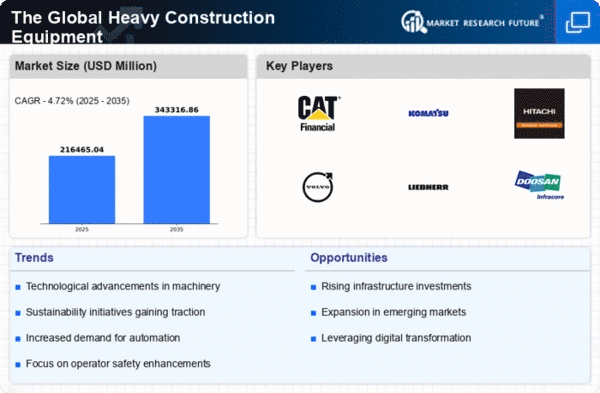
As per MRFR analysis, The Global Heavy Construction Equipment was estimated at 206708.4 USD Million in 2024. The heavy construction equipment industry is projected to grow from 216465.54 USD Million in 2025 to 343316.86 USD Million by 2035, exhibiting a compound annual growth rate (CAGR) of 4.72% during the forecast period 2025 - 2035.

Key Market Trends & Highlights

The Global Heavy Construction Equipment is experiencing a dynamic shift driven by technological advancements and changing consumer preferences.

  • Technological integration is reshaping the heavy construction equipment landscape, enhancing efficiency and productivity. The rental services segment is gaining traction, reflecting a shift in consumer preferences towards flexibility and cost-effectiveness. Sustainability initiatives are increasingly influencing equipment design and operational practices across the industry. Infrastructure development initiatives and economic growth are key drivers propelling demand in North America and the Asia-Pacific region, particularly in the excavation and cranes segments.

Market Size & Forecast

2024 Market Size 206708.4 (USD Million)
2035 Market Size 343316.86 (USD Million)
CAGR (2025 - 2035) 4.72%
Largest Regional Market Share in 2024 Asia-Pacific

Major Players

Caterpillar (US), Komatsu (JP), Hitachi Construction Machinery (JP), Volvo Construction Equipment (SE), Liebherr (DE), Doosan Infracore (KR), JCB (GB), CASE Construction Equipment (US), Terex Corporation (US)

Market Trends

The Heavy Construction Equipment is currently experiencing a dynamic evolution, driven by various factors that shape its landscape. The increasing demand for infrastructure development, particularly in emerging economies, appears to be a primary catalyst for growth. 

Governments are investing heavily in transportation networks, urban development, and energy projects, which necessitate the use of advanced machinery. 

Furthermore, the integration of technology into heavy equipment, such as automation and telematics, seems to enhance operational efficiency and safety, thereby attracting more investments into this sector. 

As sustainability becomes a focal point, manufacturers are likely to innovate towards eco-friendly solutions, which may redefine market dynamics in the coming years.

In addition, the competitive landscape of Global Heavy Construction Equipment is marked by a blend of established players and new entrants. This competition fosters innovation and drives down costs, benefiting end-users. The trend towards rental services is also gaining traction, as companies seek flexibility and reduced capital expenditure. 

Overall, the Heavy Construction Equipment Market appears poised for continued growth, with technological advancements and changing consumer preferences shaping its trajectory. Stakeholders must remain vigilant to adapt to these shifts and leverage emerging opportunities for success.

Technological Integration

The integration of cutting-edge technologies into heavy construction equipment is transforming operational capabilities. Innovations such as automation, artificial intelligence, and telematics are enhancing efficiency and safety on job sites. Multiple technological integration, specifically the adoption of autonomous and remote-controlled systems, is a key driver currently accelerating Heavy Construction Equipment Market growth.

Shift Towards Rental Services

The heavy construction equipment rental market is gaining traction as contractors prioritize capital flexibility and look to avoid the high upfront costs of machinery ownership. This shift allows companies to access the latest machinery without the burden of ownership costs. The flexibility offered by rental services is appealing, particularly in a market characterized by fluctuating demand and project-based work.

Distribution of Heavy Construction Equipment

The distribution of heavy construction equipment market share is increasingly influenced by a brand's ability to integrate IoT sensors and data analytics into their standard equipment packages.

Global Heavy Construction Equipment Market Market Drivers

Urbanization Trends

Rapid urbanization is a significant driver of the Global Heavy Construction Equipment Market Industry. As populations migrate to urban areas, the demand for residential, commercial, and infrastructure projects escalates. This trend is particularly evident in developing regions, where cities are expanding rapidly to accommodate growing populations. The need for heavy construction equipment, such as concrete mixers and loaders, is likely to increase as urban development projects proliferate. By 2035, the market is expected to reach 342.2 USD Billion, underscoring the impact of urbanization on equipment demand.

Market Growth Projections

The Global Heavy Construction Equipment Market Industry is projected to experience substantial growth over the next decade. With a market value of 206.7 USD Billion in 2024, the industry is expected to expand to 342.2 USD Billion by 2035. This growth trajectory, characterized by a CAGR of 4.69% from 2025 to 2035, reflects the increasing demand for heavy construction equipment driven by infrastructure development, urbanization, and technological advancements. Charts illustrating this growth can provide a visual representation of the market's potential, highlighting key trends and projections.

Technological Advancements

Technological advancements are playing a pivotal role in shaping the Global Heavy Construction Equipment Market Industry. Innovations such as automation, telematics, and electric machinery are enhancing operational efficiency and reducing environmental impact. For example, manufacturers are increasingly integrating IoT technology into their equipment, allowing for real-time monitoring and predictive maintenance. This shift not only improves productivity but also aligns with global sustainability goals. As a result, the market is poised for growth, with a projected CAGR of 4.69% from 2025 to 2035, reflecting the industry's adaptation to these technological changes.

Infrastructure Development Initiatives

The Global Heavy Construction Equipment Market Industry is currently experiencing a surge due to extensive infrastructure development initiatives across various countries. Governments are investing heavily in transportation, energy, and urban development projects, which require advanced heavy construction equipment. For instance, the United States has allocated significant funding for infrastructure improvements, which is expected to drive demand for excavators, bulldozers, and cranes. This trend is reflected in the market's projected value of 206.7 USD Billion in 2024, indicating a robust growth trajectory fueled by these initiatives.

Increased Investment in Renewable Energy

The Global Heavy Construction Equipment Market Industry is witnessing a shift towards increased investment in renewable energy projects. Governments and private sectors are allocating substantial resources to develop wind, solar, and hydroelectric power facilities. This trend necessitates the use of specialized heavy construction equipment for the installation and maintenance of renewable energy infrastructure. As the world moves towards sustainable energy solutions, the demand for heavy machinery tailored for these projects is expected to rise. This shift could significantly impact market dynamics, contributing to the overall growth of the industry.

Regulatory Compliance and Safety Standards

The Global Heavy Construction Equipment Market Industry is influenced by stringent regulatory compliance and safety standards imposed by governments worldwide. These regulations necessitate the use of advanced equipment that meets safety and environmental criteria. For instance, the European Union has established regulations that require construction machinery to adhere to specific emissions standards. Consequently, manufacturers are compelled to innovate and produce cleaner, safer equipment. This focus on compliance not only drives demand for new machinery but also enhances the overall market value, contributing to the industry's growth.

Market Segment Insights

By Application: Excavation (Largest) vs. Material Handling (Fastest-Growing)

The Global Heavy Construction Equipment exhibits a diverse distribution of applications, with excavation equipment commanding a significant share due to its essential role in groundwork and foundation laying. In contrast, <a href="https://www.marketresearchfuture.com/reports/material-handling-equipment-market-3214">material handling</a> has emerged as a rapidly growing segment, fueled by increasing demands for efficient logistics and supply chain management in the construction sector. Additionally, demolition, construction, and mining contribute to the overall market dynamics, each carving out a unique space based on projects' specific needs and technological advancements. Market growth trends within the application sector reflect a shift towards automation and enhanced efficiency. The excavation segment remains steadfast as the largest contributor, while material handling is witnessing robust growth due to the rise of smart construction technologies and a focus on reducing project timelines. Furthermore, the mining sector is set to gain momentum due to the accelerating demand for minerals and resources, indicating a versatile landscape where competition is driven by innovation and adaptability.

Excavation (Dominant) vs. Demolition (Emerging)

Excavation is recognized as the dominant segment within The Global Heavy Construction Equipment, primarily due to its foundational role in various <a href="https://www.marketresearchfuture.com/reports/construction-market-16065">construction</a> projects. It encompasses a wide array of machinery, such as <a title="excavators" href="https://www.marketresearchfuture.com/reports/excavators-market-2332" target="_blank" rel="noopener">excavators</a> and backhoes, that are integral for site preparation and earthmoving activities. On the other hand, demolition is emerging as a significant player in the market, characterized by advancements in technology that enhance safety and efficiency. This segment includes hydraulic excavators and demolition robots, which are increasingly employed for urban redevelopment and site clearance. As regulatory environments evolve and sustainability concerns rise, both excavation and demolition are adapting to new standards, with excavation focusing on innovative earthmoving solutions and demolition embracing green technologies to minimize environmental impact.

By Equipment Type: Excavators (Largest) vs. Loaders (Fastest-Growing)

<p>The Global Heavy Construction Equipment showcases a competitive landscape across various equipment types, with excavators currently holding the largest market share. This segment's prominence stems from their versatile applications in construction, mining, and demolition activities. Following closely are bulldozers and cranes, which enjoy significant demand due to their specialized functions in earthmoving and lifting operations, respectively. Dump trucks also contribute to the market, particularly in logistics and material handling functions. In recent years, the growth trends within this sector have been influenced by several factors, including infrastructure development initiatives globally and an increasing focus on automation in construction processes. Loaders, in particular, have been identified as the fastest-growing segment, driven by the rising demand for efficient material handling. The overall push towards eco-friendly equipment is steering innovations in all categories, compelling manufacturers to adapt and evolve their product offerings.</p>

<p>Excavators (Dominant) vs. Loaders (Emerging)</p>

<p>Excavators have long been a dominant force in The Global Heavy Construction Equipment, recognized for their multi-functionality and efficiency in various operations, including digging, demolition, and lifting. The versatility of excavators allows them to be used in diverse construction projects, ranging from small residential jobs to large-scale infrastructure developments. On the other hand, loaders, while emerging in their growth trajectory, are witnessing increased adoption due to their essential role in material handling and earthmoving, particularly in urban construction settings. Their efficiency in loading and transporting materials makes them vital for contemporary construction sites. As technology advances, both segments are expected to witness enhancements, with excavators integrating more intelligent features and loaders becoming more powerful and compact.</p>

By Power Source: Internal Combustion Engine (Largest) vs. Electric (Fastest-Growing)

In The Global Heavy Construction Equipment, the power source segment showcases a distinct distribution among various technologies. Internal Combustion Engines (ICE) dominate the market due to their widespread use, established infrastructure, and adaptability to various heavy machinery applications. Electric power sources, albeit currently smaller in share, are witnessing a surge in adoption thanks to advancements in battery technology and increasing demand for environmentally conscious solutions. The growth trends in the power source segment reflect a significant shift towards sustainable solutions alongside traditional power sources. Electric equipment is emerging as the fastest-growing segment, driven by strict emissions regulations and incentives for greener technologies. Hybrid models are gaining traction as well, blending the reliability of ICE with the efficiency of electric systems, thereby presenting a compelling alternative in the competitive landscape of heavy construction equipment.

Power Source: Internal Combustion Engine (Dominant) vs. Electric (Emerging)

The Internal Combustion Engine (ICE) remains the dominant power source in The Global Heavy Construction Equipment, renowned for its reliability and power. These engines are integral to heavy machinery like excavators and bulldozers, offering robust performance that has established them as the go-to choice for many contractors. However, the rise of Electric power sources is noteworthy, with companies increasingly investing in electric models to meet regulatory demands and consumer preferences. Electric solutions provide significant reductions in emissions, lower operating costs, and quieter operation, positioning them as an attractive emerging option. The transition towards electric equipment not only aligns with the global push for sustainability but also enhances operational efficiencies, foreshadowing a potential paradigm shift in power source utilization within the market.

By End Use: Infrastructure Development (Largest) vs. Residential Construction (Fastest-Growing)

<p>In The Global Heavy Construction Equipment, the end-use segment has varied distribution with Infrastructure Development leading as the largest sector. It comprises a significant share of the market due to ongoing government projects and urbanization trends. Following closely, Residential Construction shows considerable demand, fueled by rising housing needs and urban expansion in developing economies. Commercial Construction and Industrial Construction also contribute to the market but with relatively smaller shares. Lastly, Mining Operations holds a vital position but is heavily influenced by commodity prices and regulatory factors.</p>

<p>Infrastructure Development (Dominant) vs. Residential Construction (Emerging)</p>

<p>Infrastructure Development stands as the dominant end use in The Global Heavy Construction Equipment, driven by increased public spending on essential services such as transportation, utilities, and communal facilities. This segment is characterized by high capital investments, robust project pipelines, and long-term contracts, making it a steady revenue source for equipment manufacturers. On the other hand, Residential Construction is the emerging segment, fueled by growing urban populations and a surge in affordable housing initiatives. Although it currently lags behind in market share, its rapid growth trajectory indicates a shift in demand dynamics, spurred by private sector investments and a focus on sustainable building practices.</p>

Get more detailed insights about Heavy Construction Equipment Market Research Report - Global Forecast 2035

Regional Insights

North America : Established Market Leader

North America is witnessing robust growth in the heavy construction equipment market, driven by increased infrastructure spending and a booming construction sector. The market size reached $62,000.0 million in 2025, reflecting a significant demand for advanced machinery. Regulatory support for sustainable construction practices is also a catalyst, encouraging investments in eco-friendly equipment and technologies.

Technological leadership in the North America heavy construction equipment market is characterized by the widespread adoption of advanced telematics and semi-autonomous grading systems. Key players such as Caterpillar, CASE Construction Equipment, and Terex Corporation are leading the charge, focusing on innovation and efficiency. The competitive landscape is characterized by a mix of established firms and emerging players, all vying for a share in this lucrative market.

Europe : Innovative Construction Hub

Europe's heavy construction equipment market is expected to reach $48,000M by December 2025, fueled by stringent environmental regulations and a shift towards sustainable construction practices. The region's commitment to reducing carbon emissions is driving demand for eco-friendly machinery. Countries like Germany and France are leading the charge, with significant investments in infrastructure projects that align with EU sustainability goals. Germany, France, and the UK are at the forefront of this market, with key players such as Liebherr and Volvo Construction Equipment making substantial contributions. The competitive landscape is marked by innovation, with companies focusing on developing energy-efficient and technologically advanced equipment. The presence of strong regulatory frameworks further enhances market stability and growth potential.

Asia-Pacific : Emerging Powerhouse

The Asia Pacific heavy construction equipment market is a global hub for manufacturing innovation, particularly in the rapid scaling of compact and mid-sized hydraulic excavators. APAC is the largest market for heavy construction equipment, with a market size of $80,000.0 million in 2025. The region's growth is fueled by rapid urbanization, infrastructure development, and government initiatives aimed at enhancing connectivity. Countries like China and India are leading the charge, with significant investments in construction projects that drive demand for heavy machinery.

The China heavy construction equipment market is undergoing a strategic shift toward domestic innovation, with a major focus on the production of electric and hybrid machinery to meet new environmental standards.

Middle East and Africa : Resource-Rich Frontier

The Middle East and Africa region is witnessing a gradual increase in the heavy construction equipment market, with a size of $6,808.4 million in 2025. The growth in Africa heavy construction equipment market is benefiting from extensive cross-border transport corridor projects and the rising demand for mineral extraction machinery. Governments are investing in transportation and housing, which is expected to boost demand for heavy machinery in the coming years.

Countries like the UAE and South Africa are leading the market, with significant contributions from local and international players. The competitive landscape is evolving, with companies focusing on providing tailored solutions to meet the unique demands of the region. As infrastructure development continues, the market is poised for steady growth, attracting investments from key players in the industry.

Key Players and Competitive Insights

The Global Heavy Construction Equipment is characterized by a dynamic competitive landscape, driven by factors such as urbanization, infrastructure development, and technological advancements. Major players like Caterpillar (US), Komatsu (JP), and Volvo Construction Equipment (SE) are strategically positioned to leverage these growth drivers. Caterpillar (US) focuses on innovation and digital transformation, enhancing its product offerings with advanced technologies. Komatsu (JP) emphasizes sustainability and efficiency, aligning its operations with global environmental standards. Meanwhile, Volvo Construction Equipment (SE) is investing in electric and hybrid machinery, reflecting a commitment to reducing carbon footprints. Collectively, these strategies shape a competitive environment that prioritizes technological advancement and sustainability.Key business tactics within the market include localizing manufacturing and optimizing supply chains to enhance operational efficiency. The competitive structure appears moderately fragmented, with several key players exerting influence over market dynamics. This fragmentation allows for a diverse range of products and services, catering to various customer needs while fostering innovation through competition.

In November Caterpillar (US) announced a partnership with a leading tech firm to develop AI-driven predictive maintenance solutions for construction equipment. This strategic move is likely to enhance operational efficiency for customers, reducing downtime and maintenance costs. By integrating AI into its offerings, Caterpillar (US) positions itself as a leader in technological innovation, potentially setting new industry standards.
In October Komatsu (JP) unveiled its latest line of electric excavators, aimed at reducing emissions and operational costs for construction companies. This launch underscores Komatsu's commitment to sustainability and reflects a growing trend towards eco-friendly machinery. The introduction of electric models may attract environmentally conscious clients, thereby expanding Komatsu's market share in a competitive landscape increasingly focused on sustainability.

In September Volvo Construction Equipment (SE) expanded its manufacturing capabilities in Europe, focusing on producing electric and hybrid models. This expansion is indicative of Volvo's strategic intent to lead in the green construction equipment sector. By enhancing its production capacity, Volvo (SE) is likely to meet the rising demand for sustainable equipment, further solidifying its competitive position.
As of December current trends in The Global Heavy Construction Equipment are heavily influenced by digitalization, sustainability, and AI integration. Strategic alliances among key players are shaping the landscape, fostering innovation and collaboration. The competitive differentiation is expected to evolve, moving away from price-based competition towards a focus on technological innovation, reliability, and sustainability. This shift indicates a future where companies that prioritize advanced technologies and sustainable practices will likely gain a competitive edge.

Key Companies in the Global Heavy Construction Equipment Market include

Industry Developments

November 2023- Komatsu Ltd. announced the introduction of their new electric dump HD1500-8 EQ truck. A highly effective and reliable machine, this pioneering tipper is designed to minimize carbon emissions and operational costs. Compared to conventional diesel-powered dump trucks, the HD1500-8 EQ promises a great deal of fuel economy and environmental considerations due to its electric drive system as well as regenerative braking technology.

March 2023- Volvo AB has entered into a strategic partnership with Nvidia Corporation for the development of AI-driven autonomous construction equipment. This cooperation seeks to incorporate Nvidia’s AI technology into Volvo’s heavy machinery, thereby making it operate on an autonomous basis thus boosting efficiency and safety in construction sites. Through this partnership, Volvo demonstrates its dedication to innovation and technological progress within the sector of construction equipment; thus positioning itself as a thought leader in terms of self-driving solutions for building purposes.

March 2023 – Teleo, an organization that develops autonomous technologies for heavy construction equipment, signed agreements with John Aarts Group, Teichert, and Tomahawk Construction today, respectively, for remote-operated wheel loaders, bulldozers, and dump trucks.

March 2023 – Manitex International Inc., a globally recognized provider of truck cranes, specialized industrial equipment as well as infrastructure & construction markets rental solutions, announced the official launch of the ECSY-Electric Crane System together with opening day at CONEXPO-Las Vegas.

Future Outlook

Global Heavy Construction Equipment Market Future Outlook

The Global Heavy Construction Equipment is projected to grow at a 4.72% CAGR from 2025 to 2035, driven by urbanization, infrastructure development, and technological advancements.<br>The overall heavy construction equipment market size is expanding as emerging economies invest heavily in modernizing their energy and utility infrastructure. Manufacturers are competing for heavy construction equipment market share by expanding their local dealer networks and offering comprehensive after-sales maintenance contracts.

New opportunities lie in:

  • <p>Integration of IoT for <a title="predictive maintenance" href="https://www.marketresearchfuture.com/reports/predictive-maintenance-market-2377" target="_blank" rel="noopener">predictive maintenance</a> solutions. Development of electric and hybrid construction machinery. Expansion into emerging markets with tailored financing options.</p>

By 2035, the market is expected to exhibit robust growth, driven by innovation and increased demand.

Market Segmentation

Global Heavy Construction Equipment Market End User Outlook

  • Construction Companies
  • Mining Firms
  • Infrastructure Developers
  • Government Agencies
  • Rental Services

Global Heavy Construction Equipment Market Application Outlook

  • Excavation
  • Material Handling
  • Demolition
  • Construction
  • Mining

Global Heavy Construction Equipment Market Power Source Outlook

  • Electric
  • Hybrid
  • Internal Combustion Engine
  • Hydraulic
  • Pneumatic

Global Heavy Construction Equipment Market Equipment Type Outlook

  • Excavators
  • Bulldozers
  • Cranes
  • Loaders
  • Dump Trucks

Report Scope

MARKET SIZE 2024 206708.4(USD Million)
MARKET SIZE 2025 216465.54(USD Million)
MARKET SIZE 2035 343316.86(USD Million)
COMPOUND ANNUAL GROWTH RATE (CAGR) 4.72% (2025 - 2035)
REPORT COVERAGE Revenue Forecast, Competitive Landscape, Growth Factors, and Trends
BASE YEAR 2024
Market Forecast Period 2025 - 2035
Historical Data 2019 - 2024
Market Forecast Units USD Million
Key Companies Profiled Caterpillar (US), Komatsu (JP), Hitachi Construction Machinery (JP), Volvo Construction Equipment (SE), Liebherr (DE), Doosan Infracore (KR), JCB (GB), CASE Construction Equipment (US), Terex Corporation (US)
Segments Covered Application, Equipment Type, Power Source, End User
Key Market Opportunities Integration of advanced automation and artificial intelligence in heavy construction equipment operations.
Key Market Dynamics Technological advancements drive efficiency, while regulatory changes reshape compliance standards in heavy construction equipment.
Countries Covered North America, Europe, APAC, South America, MEA

FAQs

What is the projected market valuation of The Global Heavy Construction Equipment by 2035?

<p>The projected market valuation for The Global Heavy Construction Equipment is 343316.86 USD Million by 2035.</p>

What was the overall market valuation of The Global Heavy Construction Equipment in 2024?

<p>The overall market valuation of The Global Heavy Construction Equipment was 206708.4 USD Million in 2024.</p>

What is the expected CAGR for The Global Heavy Construction Equipment during the forecast period 2025 - 2035?

<p>The expected CAGR for The Global Heavy Construction Equipment during the forecast period 2025 - 2035 is 4.72%.</p>

Which companies are considered key players in The Global Heavy Construction Equipment?

<p>Key players in The Global Heavy Construction Equipment include Caterpillar, Komatsu, Hitachi Construction Machinery, and Volvo Construction Equipment.</p>

What are the projected valuations for the Excavation segment by 2035?

<p>The projected valuation for the Excavation segment is expected to range from 62000.0 to 100000.0 USD Million by 2035.</p>

How does the Material Handling segment perform in terms of projected valuation by 2035?

<p>The Material Handling segment is projected to have a valuation between 52000.0 and 80000.0 USD Million by 2035.</p>

What is the expected valuation range for the Demolition segment by 2035?

The expected valuation range for the Demolition segment is between 30000.0 and 50000.0 USD Million by 2035.

What is the projected valuation for the Road Construction segment by 2035?

The projected valuation for the Road Construction segment is anticipated to be between 35000.0 and 60000.0 USD Million by 2035.

What are the expected valuations for the Excavators segment by 2035?

The expected valuations for the Excavators segment are projected to range from 60000.0 to 100000.0 USD Million by 2035.

What is the anticipated valuation for the Electric power source segment by 2035?

The anticipated valuation for the Electric power source segment is expected to be between 30000.0 and 60000.0 USD Million by 2035.

  1. SECTION I: EXECUTIVE SUMMARY AND KEY HIGHLIGHTS
    1. | 1.1 EXECUTIVE SUMMARY
    2. | | 1.1.1 Market Overview
    3. | | 1.1.2 Key Findings
    4. | | 1.1.3 Market Segmentation
    5. | | 1.1.4 Competitive Landscape
    6. | | 1.1.5 Challenges and Opportunities
    7. | | 1.1.6 Future Outlook
  2. SECTION II: SCOPING, METHODOLOGY AND MARKET STRUCTURE
    1. | 2.1 MARKET INTRODUCTION
    2. | | 2.1.1 Definition
    3. | | 2.1.2 Scope of the study
    4. | | | 2.1.2.1 Research Objective
    5. | | | 2.1.2.2 Assumption
    6. | | | 2.1.2.3 Limitations
    7. | 2.2 RESEARCH METHODOLOGY
    8. | | 2.2.1 Overview
    9. | | 2.2.2 Data Mining
    10. | | 2.2.3 Secondary Research
    11. | | 2.2.4 Primary Research
    12. | | | 2.2.4.1 Primary Interviews and Information Gathering Process
    13. | | | 2.2.4.2 Breakdown of Primary Respondents
    14. | | 2.2.5 Forecasting Model
    15. | | 2.2.6 Market Size Estimation
    16. | | | 2.2.6.1 Bottom-Up Approach
    17. | | | 2.2.6.2 Top-Down Approach
    18. | | 2.2.7 Data Triangulation
    19. | | 2.2.8 Validation
  3. SECTION III: QUALITATIVE ANALYSIS
    1. | 3.1 MARKET DYNAMICS
    2. | | 3.1.1 Overview
    3. | | 3.1.2 Drivers
    4. | | 3.1.3 Restraints
    5. | | 3.1.4 Opportunities
    6. | 3.2 MARKET FACTOR ANALYSIS
    7. | | 3.2.1 Value chain Analysis
    8. | | 3.2.2 Porter's Five Forces Analysis
    9. | | | 3.2.2.1 Bargaining Power of Suppliers
    10. | | | 3.2.2.2 Bargaining Power of Buyers
    11. | | | 3.2.2.3 Threat of New Entrants
    12. | | | 3.2.2.4 Threat of Substitutes
    13. | | | 3.2.2.5 Intensity of Rivalry
    14. | | 3.2.3 COVID-19 Impact Analysis
    15. | | | 3.2.3.1 Market Impact Analysis
    16. | | | 3.2.3.2 Regional Impact
    17. | | | 3.2.3.3 Opportunity and Threat Analysis
  4. SECTION IV: QUANTITATIVE ANALYSIS
    1. | 4.1 Packaging & Transport, BY Application (USD Million)
    2. | | 4.1.1 Excavation
    3. | | 4.1.2 Material Handling
    4. | | 4.1.3 Demolition
    5. | | 4.1.4 Road Construction
    6. | | 4.1.5 Mining
    7. | 4.2 Packaging & Transport, BY Equipment Type (USD Million)
    8. | | 4.2.1 Excavators
    9. | | 4.2.2 Bulldozers
    10. | | 4.2.3 Cranes
    11. | | 4.2.4 Loaders
    12. | | 4.2.5 Dump Trucks
    13. | 4.3 Packaging & Transport, BY Power Source (USD Million)
    14. | | 4.3.1 Internal Combustion Engine
    15. | | 4.3.2 Electric
    16. | | 4.3.3 Hybrid
    17. | | 4.3.4 Hydraulic
    18. | | 4.3.5 Pneumatic
    19. | 4.4 Packaging & Transport, BY End Use (USD Million)
    20. | | 4.4.1 Residential Construction
    21. | | 4.4.2 Commercial Construction
    22. | | 4.4.3 Infrastructure Development
    23. | | 4.4.4 Industrial Construction
    24. | | 4.4.5 Mining Operations
    25. | 4.5 Packaging & Transport, BY Region (USD Million)
    26. | | 4.5.1 North America
    27. | | | 4.5.1.1 US
    28. | | | 4.5.1.2 Canada
    29. | | 4.5.2 Europe
    30. | | | 4.5.2.1 Germany
    31. | | | 4.5.2.2 UK
    32. | | | 4.5.2.3 France
    33. | | | 4.5.2.4 Russia
    34. | | | 4.5.2.5 Italy
    35. | | | 4.5.2.6 Spain
    36. | | | 4.5.2.7 Rest of Europe
    37. | | 4.5.3 APAC
    38. | | | 4.5.3.1 China
    39. | | | 4.5.3.2 India
    40. | | | 4.5.3.3 Japan
    41. | | | 4.5.3.4 South Korea
    42. | | | 4.5.3.5 Malaysia
    43. | | | 4.5.3.6 Thailand
    44. | | | 4.5.3.7 Indonesia
    45. | | | 4.5.3.8 Rest of APAC
    46. | | 4.5.4 South America
    47. | | | 4.5.4.1 Brazil
    48. | | | 4.5.4.2 Mexico
    49. | | | 4.5.4.3 Argentina
    50. | | | 4.5.4.4 Rest of South America
    51. | | 4.5.5 MEA
    52. | | | 4.5.5.1 GCC Countries
    53. | | | 4.5.5.2 South Africa
    54. | | | 4.5.5.3 Rest of MEA
  5. SECTION V: COMPETITIVE ANALYSIS
    1. | 5.1 Competitive Landscape
    2. | | 5.1.1 Overview
    3. | | 5.1.2 Competitive Analysis
    4. | | 5.1.3 Market share Analysis
    5. | | 5.1.4 Major Growth Strategy in the Packaging & Transport
    6. | | 5.1.5 Competitive Benchmarking
    7. | | 5.1.6 Leading Players in Terms of Number of Developments in the Packaging & Transport
    8. | | 5.1.7 Key developments and growth strategies
    9. | | | 5.1.7.1 New Product Launch/Service Deployment
    10. | | | 5.1.7.2 Merger & Acquisitions
    11. | | | 5.1.7.3 Joint Ventures
    12. | | 5.1.8 Major Players Financial Matrix
    13. | | | 5.1.8.1 Sales and Operating Income
    14. | | | 5.1.8.2 Major Players R&D Expenditure. 2023
    15. | 5.2 Company Profiles
    16. | | 5.2.1 Caterpillar (US)
    17. | | | 5.2.1.1 Financial Overview
    18. | | | 5.2.1.2 Products Offered
    19. | | | 5.2.1.3 Key Developments
    20. | | | 5.2.1.4 SWOT Analysis
    21. | | | 5.2.1.5 Key Strategies
    22. | | 5.2.2 Komatsu (JP)
    23. | | | 5.2.2.1 Financial Overview
    24. | | | 5.2.2.2 Products Offered
    25. | | | 5.2.2.3 Key Developments
    26. | | | 5.2.2.4 SWOT Analysis
    27. | | | 5.2.2.5 Key Strategies
    28. | | 5.2.3 Hitachi Construction Machinery (JP)
    29. | | | 5.2.3.1 Financial Overview
    30. | | | 5.2.3.2 Products Offered
    31. | | | 5.2.3.3 Key Developments
    32. | | | 5.2.3.4 SWOT Analysis
    33. | | | 5.2.3.5 Key Strategies
    34. | | 5.2.4 Volvo Construction Equipment (SE)
    35. | | | 5.2.4.1 Financial Overview
    36. | | | 5.2.4.2 Products Offered
    37. | | | 5.2.4.3 Key Developments
    38. | | | 5.2.4.4 SWOT Analysis
    39. | | | 5.2.4.5 Key Strategies
    40. | | 5.2.5 Liebherr (DE)
    41. | | | 5.2.5.1 Financial Overview
    42. | | | 5.2.5.2 Products Offered
    43. | | | 5.2.5.3 Key Developments
    44. | | | 5.2.5.4 SWOT Analysis
    45. | | | 5.2.5.5 Key Strategies
    46. | | 5.2.6 Doosan Infracore (KR)
    47. | | | 5.2.6.1 Financial Overview
    48. | | | 5.2.6.2 Products Offered
    49. | | | 5.2.6.3 Key Developments
    50. | | | 5.2.6.4 SWOT Analysis
    51. | | | 5.2.6.5 Key Strategies
    52. | | 5.2.7 JCB (GB)
    53. | | | 5.2.7.1 Financial Overview
    54. | | | 5.2.7.2 Products Offered
    55. | | | 5.2.7.3 Key Developments
    56. | | | 5.2.7.4 SWOT Analysis
    57. | | | 5.2.7.5 Key Strategies
    58. | | 5.2.8 CASE Construction Equipment (US)
    59. | | | 5.2.8.1 Financial Overview
    60. | | | 5.2.8.2 Products Offered
    61. | | | 5.2.8.3 Key Developments
    62. | | | 5.2.8.4 SWOT Analysis
    63. | | | 5.2.8.5 Key Strategies
    64. | | 5.2.9 Terex Corporation (US)
    65. | | | 5.2.9.1 Financial Overview
    66. | | | 5.2.9.2 Products Offered
    67. | | | 5.2.9.3 Key Developments
    68. | | | 5.2.9.4 SWOT Analysis
    69. | | | 5.2.9.5 Key Strategies
    70. | 5.3 Appendix
    71. | | 5.3.1 References
    72. | | 5.3.2 Related Reports
  6. LIST OF FIGURES
    1. | 6.1 MARKET SYNOPSIS
    2. | 6.2 NORTH AMERICA MARKET ANALYSIS
    3. | 6.3 US MARKET ANALYSIS BY APPLICATION
    4. | 6.4 US MARKET ANALYSIS BY EQUIPMENT TYPE
    5. | 6.5 US MARKET ANALYSIS BY POWER SOURCE
    6. | 6.6 US MARKET ANALYSIS BY END USE
    7. | 6.7 CANADA MARKET ANALYSIS BY APPLICATION
    8. | 6.8 CANADA MARKET ANALYSIS BY EQUIPMENT TYPE
    9. | 6.9 CANADA MARKET ANALYSIS BY POWER SOURCE
    10. | 6.10 CANADA MARKET ANALYSIS BY END USE
    11. | 6.11 EUROPE MARKET ANALYSIS
    12. | 6.12 GERMANY MARKET ANALYSIS BY APPLICATION
    13. | 6.13 GERMANY MARKET ANALYSIS BY EQUIPMENT TYPE
    14. | 6.14 GERMANY MARKET ANALYSIS BY POWER SOURCE
    15. | 6.15 GERMANY MARKET ANALYSIS BY END USE
    16. | 6.16 UK MARKET ANALYSIS BY APPLICATION
    17. | 6.17 UK MARKET ANALYSIS BY EQUIPMENT TYPE
    18. | 6.18 UK MARKET ANALYSIS BY POWER SOURCE
    19. | 6.19 UK MARKET ANALYSIS BY END USE
    20. | 6.20 FRANCE MARKET ANALYSIS BY APPLICATION
    21. | 6.21 FRANCE MARKET ANALYSIS BY EQUIPMENT TYPE
    22. | 6.22 FRANCE MARKET ANALYSIS BY POWER SOURCE
    23. | 6.23 FRANCE MARKET ANALYSIS BY END USE
    24. | 6.24 RUSSIA MARKET ANALYSIS BY APPLICATION
    25. | 6.25 RUSSIA MARKET ANALYSIS BY EQUIPMENT TYPE
    26. | 6.26 RUSSIA MARKET ANALYSIS BY POWER SOURCE
    27. | 6.27 RUSSIA MARKET ANALYSIS BY END USE
    28. | 6.28 ITALY MARKET ANALYSIS BY APPLICATION
    29. | 6.29 ITALY MARKET ANALYSIS BY EQUIPMENT TYPE
    30. | 6.30 ITALY MARKET ANALYSIS BY POWER SOURCE
    31. | 6.31 ITALY MARKET ANALYSIS BY END USE
    32. | 6.32 SPAIN MARKET ANALYSIS BY APPLICATION
    33. | 6.33 SPAIN MARKET ANALYSIS BY EQUIPMENT TYPE
    34. | 6.34 SPAIN MARKET ANALYSIS BY POWER SOURCE
    35. | 6.35 SPAIN MARKET ANALYSIS BY END USE
    36. | 6.36 REST OF EUROPE MARKET ANALYSIS BY APPLICATION
    37. | 6.37 REST OF EUROPE MARKET ANALYSIS BY EQUIPMENT TYPE
    38. | 6.38 REST OF EUROPE MARKET ANALYSIS BY POWER SOURCE
    39. | 6.39 REST OF EUROPE MARKET ANALYSIS BY END USE
    40. | 6.40 APAC MARKET ANALYSIS
    41. | 6.41 CHINA MARKET ANALYSIS BY APPLICATION
    42. | 6.42 CHINA MARKET ANALYSIS BY EQUIPMENT TYPE
    43. | 6.43 CHINA MARKET ANALYSIS BY POWER SOURCE
    44. | 6.44 CHINA MARKET ANALYSIS BY END USE
    45. | 6.45 INDIA MARKET ANALYSIS BY APPLICATION
    46. | 6.46 INDIA MARKET ANALYSIS BY EQUIPMENT TYPE
    47. | 6.47 INDIA MARKET ANALYSIS BY POWER SOURCE
    48. | 6.48 INDIA MARKET ANALYSIS BY END USE
    49. | 6.49 JAPAN MARKET ANALYSIS BY APPLICATION
    50. | 6.50 JAPAN MARKET ANALYSIS BY EQUIPMENT TYPE
    51. | 6.51 JAPAN MARKET ANALYSIS BY POWER SOURCE
    52. | 6.52 JAPAN MARKET ANALYSIS BY END USE
    53. | 6.53 SOUTH KOREA MARKET ANALYSIS BY APPLICATION
    54. | 6.54 SOUTH KOREA MARKET ANALYSIS BY EQUIPMENT TYPE
    55. | 6.55 SOUTH KOREA MARKET ANALYSIS BY POWER SOURCE
    56. | 6.56 SOUTH KOREA MARKET ANALYSIS BY END USE
    57. | 6.57 MALAYSIA MARKET ANALYSIS BY APPLICATION
    58. | 6.58 MALAYSIA MARKET ANALYSIS BY EQUIPMENT TYPE
    59. | 6.59 MALAYSIA MARKET ANALYSIS BY POWER SOURCE
    60. | 6.60 MALAYSIA MARKET ANALYSIS BY END USE
    61. | 6.61 THAILAND MARKET ANALYSIS BY APPLICATION
    62. | 6.62 THAILAND MARKET ANALYSIS BY EQUIPMENT TYPE
    63. | 6.63 THAILAND MARKET ANALYSIS BY POWER SOURCE
    64. | 6.64 THAILAND MARKET ANALYSIS BY END USE
    65. | 6.65 INDONESIA MARKET ANALYSIS BY APPLICATION
    66. | 6.66 INDONESIA MARKET ANALYSIS BY EQUIPMENT TYPE
    67. | 6.67 INDONESIA MARKET ANALYSIS BY POWER SOURCE
    68. | 6.68 INDONESIA MARKET ANALYSIS BY END USE
    69. | 6.69 REST OF APAC MARKET ANALYSIS BY APPLICATION
    70. | 6.70 REST OF APAC MARKET ANALYSIS BY EQUIPMENT TYPE
    71. | 6.71 REST OF APAC MARKET ANALYSIS BY POWER SOURCE
    72. | 6.72 REST OF APAC MARKET ANALYSIS BY END USE
    73. | 6.73 SOUTH AMERICA MARKET ANALYSIS
    74. | 6.74 BRAZIL MARKET ANALYSIS BY APPLICATION
    75. | 6.75 BRAZIL MARKET ANALYSIS BY EQUIPMENT TYPE
    76. | 6.76 BRAZIL MARKET ANALYSIS BY POWER SOURCE
    77. | 6.77 BRAZIL MARKET ANALYSIS BY END USE
    78. | 6.78 MEXICO MARKET ANALYSIS BY APPLICATION
    79. | 6.79 MEXICO MARKET ANALYSIS BY EQUIPMENT TYPE
    80. | 6.80 MEXICO MARKET ANALYSIS BY POWER SOURCE
    81. | 6.81 MEXICO MARKET ANALYSIS BY END USE
    82. | 6.82 ARGENTINA MARKET ANALYSIS BY APPLICATION
    83. | 6.83 ARGENTINA MARKET ANALYSIS BY EQUIPMENT TYPE
    84. | 6.84 ARGENTINA MARKET ANALYSIS BY POWER SOURCE
    85. | 6.85 ARGENTINA MARKET ANALYSIS BY END USE
    86. | 6.86 REST OF SOUTH AMERICA MARKET ANALYSIS BY APPLICATION
    87. | 6.87 REST OF SOUTH AMERICA MARKET ANALYSIS BY EQUIPMENT TYPE
    88. | 6.88 REST OF SOUTH AMERICA MARKET ANALYSIS BY POWER SOURCE
    89. | 6.89 REST OF SOUTH AMERICA MARKET ANALYSIS BY END USE
    90. | 6.90 MEA MARKET ANALYSIS
    91. | 6.91 GCC COUNTRIES MARKET ANALYSIS BY APPLICATION
    92. | 6.92 GCC COUNTRIES MARKET ANALYSIS BY EQUIPMENT TYPE
    93. | 6.93 GCC COUNTRIES MARKET ANALYSIS BY POWER SOURCE
    94. | 6.94 GCC COUNTRIES MARKET ANALYSIS BY END USE
    95. | 6.95 SOUTH AFRICA MARKET ANALYSIS BY APPLICATION
    96. | 6.96 SOUTH AFRICA MARKET ANALYSIS BY EQUIPMENT TYPE
    97. | 6.97 SOUTH AFRICA MARKET ANALYSIS BY POWER SOURCE
    98. | 6.98 SOUTH AFRICA MARKET ANALYSIS BY END USE
    99. | 6.99 REST OF MEA MARKET ANALYSIS BY APPLICATION
    100. | 6.100 REST OF MEA MARKET ANALYSIS BY EQUIPMENT TYPE
    101. | 6.101 REST OF MEA MARKET ANALYSIS BY POWER SOURCE
    102. | 6.102 REST OF MEA MARKET ANALYSIS BY END USE
    103. | 6.103 KEY BUYING CRITERIA OF PACKAGING & TRANSPORT
    104. | 6.104 RESEARCH PROCESS OF MRFR
    105. | 6.105 DRO ANALYSIS OF PACKAGING & TRANSPORT
    106. | 6.106 DRIVERS IMPACT ANALYSIS: PACKAGING & TRANSPORT
    107. | 6.107 RESTRAINTS IMPACT ANALYSIS: PACKAGING & TRANSPORT
    108. | 6.108 SUPPLY / VALUE CHAIN: PACKAGING & TRANSPORT
    109. | 6.109 PACKAGING & TRANSPORT, BY APPLICATION, 2024 (% SHARE)
    110. | 6.110 PACKAGING & TRANSPORT, BY APPLICATION, 2024 TO 2035 (USD Million)
    111. | 6.111 PACKAGING & TRANSPORT, BY EQUIPMENT TYPE, 2024 (% SHARE)
    112. | 6.112 PACKAGING & TRANSPORT, BY EQUIPMENT TYPE, 2024 TO 2035 (USD Million)
    113. | 6.113 PACKAGING & TRANSPORT, BY POWER SOURCE, 2024 (% SHARE)
    114. | 6.114 PACKAGING & TRANSPORT, BY POWER SOURCE, 2024 TO 2035 (USD Million)
    115. | 6.115 PACKAGING & TRANSPORT, BY END USE, 2024 (% SHARE)
    116. | 6.116 PACKAGING & TRANSPORT, BY END USE, 2024 TO 2035 (USD Million)
    117. | 6.117 BENCHMARKING OF MAJOR COMPETITORS
  7. LIST OF TABLES
    1. | 7.1 LIST OF ASSUMPTIONS
    2. | | 7.1.1
    3. | 7.2 North America MARKET SIZE ESTIMATES; FORECAST
    4. | | 7.2.1 BY APPLICATION, 2025-2035 (USD Million)
    5. | | 7.2.2 BY EQUIPMENT TYPE, 2025-2035 (USD Million)
    6. | | 7.2.3 BY POWER SOURCE, 2025-2035 (USD Million)
    7. | | 7.2.4 BY END USE, 2025-2035 (USD Million)
    8. | 7.3 US MARKET SIZE ESTIMATES; FORECAST
    9. | | 7.3.1 BY APPLICATION, 2025-2035 (USD Million)
    10. | | 7.3.2 BY EQUIPMENT TYPE, 2025-2035 (USD Million)
    11. | | 7.3.3 BY POWER SOURCE, 2025-2035 (USD Million)
    12. | | 7.3.4 BY END USE, 2025-2035 (USD Million)
    13. | 7.4 Canada MARKET SIZE ESTIMATES; FORECAST
    14. | | 7.4.1 BY APPLICATION, 2025-2035 (USD Million)
    15. | | 7.4.2 BY EQUIPMENT TYPE, 2025-2035 (USD Million)
    16. | | 7.4.3 BY POWER SOURCE, 2025-2035 (USD Million)
    17. | | 7.4.4 BY END USE, 2025-2035 (USD Million)
    18. | 7.5 Europe MARKET SIZE ESTIMATES; FORECAST
    19. | | 7.5.1 BY APPLICATION, 2025-2035 (USD Million)
    20. | | 7.5.2 BY EQUIPMENT TYPE, 2025-2035 (USD Million)
    21. | | 7.5.3 BY POWER SOURCE, 2025-2035 (USD Million)
    22. | | 7.5.4 BY END USE, 2025-2035 (USD Million)
    23. | 7.6 Germany MARKET SIZE ESTIMATES; FORECAST
    24. | | 7.6.1 BY APPLICATION, 2025-2035 (USD Million)
    25. | | 7.6.2 BY EQUIPMENT TYPE, 2025-2035 (USD Million)
    26. | | 7.6.3 BY POWER SOURCE, 2025-2035 (USD Million)
    27. | | 7.6.4 BY END USE, 2025-2035 (USD Million)
    28. | 7.7 UK MARKET SIZE ESTIMATES; FORECAST
    29. | | 7.7.1 BY APPLICATION, 2025-2035 (USD Million)
    30. | | 7.7.2 BY EQUIPMENT TYPE, 2025-2035 (USD Million)
    31. | | 7.7.3 BY POWER SOURCE, 2025-2035 (USD Million)
    32. | | 7.7.4 BY END USE, 2025-2035 (USD Million)
    33. | 7.8 France MARKET SIZE ESTIMATES; FORECAST
    34. | | 7.8.1 BY APPLICATION, 2025-2035 (USD Million)
    35. | | 7.8.2 BY EQUIPMENT TYPE, 2025-2035 (USD Million)
    36. | | 7.8.3 BY POWER SOURCE, 2025-2035 (USD Million)
    37. | | 7.8.4 BY END USE, 2025-2035 (USD Million)
    38. | 7.9 Russia MARKET SIZE ESTIMATES; FORECAST
    39. | | 7.9.1 BY APPLICATION, 2025-2035 (USD Million)
    40. | | 7.9.2 BY EQUIPMENT TYPE, 2025-2035 (USD Million)
    41. | | 7.9.3 BY POWER SOURCE, 2025-2035 (USD Million)
    42. | | 7.9.4 BY END USE, 2025-2035 (USD Million)
    43. | 7.10 Italy MARKET SIZE ESTIMATES; FORECAST
    44. | | 7.10.1 BY APPLICATION, 2025-2035 (USD Million)
    45. | | 7.10.2 BY EQUIPMENT TYPE, 2025-2035 (USD Million)
    46. | | 7.10.3 BY POWER SOURCE, 2025-2035 (USD Million)
    47. | | 7.10.4 BY END USE, 2025-2035 (USD Million)
    48. | 7.11 Spain MARKET SIZE ESTIMATES; FORECAST
    49. | | 7.11.1 BY APPLICATION, 2025-2035 (USD Million)
    50. | | 7.11.2 BY EQUIPMENT TYPE, 2025-2035 (USD Million)
    51. | | 7.11.3 BY POWER SOURCE, 2025-2035 (USD Million)
    52. | | 7.11.4 BY END USE, 2025-2035 (USD Million)
    53. | 7.12 Rest of Europe MARKET SIZE ESTIMATES; FORECAST
    54. | | 7.12.1 BY APPLICATION, 2025-2035 (USD Million)
    55. | | 7.12.2 BY EQUIPMENT TYPE, 2025-2035 (USD Million)
    56. | | 7.12.3 BY POWER SOURCE, 2025-2035 (USD Million)
    57. | | 7.12.4 BY END USE, 2025-2035 (USD Million)
    58. | 7.13 APAC MARKET SIZE ESTIMATES; FORECAST
    59. | | 7.13.1 BY APPLICATION, 2025-2035 (USD Million)
    60. | | 7.13.2 BY EQUIPMENT TYPE, 2025-2035 (USD Million)
    61. | | 7.13.3 BY POWER SOURCE, 2025-2035 (USD Million)
    62. | | 7.13.4 BY END USE, 2025-2035 (USD Million)
    63. | 7.14 China MARKET SIZE ESTIMATES; FORECAST
    64. | | 7.14.1 BY APPLICATION, 2025-2035 (USD Million)
    65. | | 7.14.2 BY EQUIPMENT TYPE, 2025-2035 (USD Million)
    66. | | 7.14.3 BY POWER SOURCE, 2025-2035 (USD Million)
    67. | | 7.14.4 BY END USE, 2025-2035 (USD Million)
    68. | 7.15 India MARKET SIZE ESTIMATES; FORECAST
    69. | | 7.15.1 BY APPLICATION, 2025-2035 (USD Million)
    70. | | 7.15.2 BY EQUIPMENT TYPE, 2025-2035 (USD Million)
    71. | | 7.15.3 BY POWER SOURCE, 2025-2035 (USD Million)
    72. | | 7.15.4 BY END USE, 2025-2035 (USD Million)
    73. | 7.16 Japan MARKET SIZE ESTIMATES; FORECAST
    74. | | 7.16.1 BY APPLICATION, 2025-2035 (USD Million)
    75. | | 7.16.2 BY EQUIPMENT TYPE, 2025-2035 (USD Million)
    76. | | 7.16.3 BY POWER SOURCE, 2025-2035 (USD Million)
    77. | | 7.16.4 BY END USE, 2025-2035 (USD Million)
    78. | 7.17 South Korea MARKET SIZE ESTIMATES; FORECAST
    79. | | 7.17.1 BY APPLICATION, 2025-2035 (USD Million)
    80. | | 7.17.2 BY EQUIPMENT TYPE, 2025-2035 (USD Million)
    81. | | 7.17.3 BY POWER SOURCE, 2025-2035 (USD Million)
    82. | | 7.17.4 BY END USE, 2025-2035 (USD Million)
    83. | 7.18 Malaysia MARKET SIZE ESTIMATES; FORECAST
    84. | | 7.18.1 BY APPLICATION, 2025-2035 (USD Million)
    85. | | 7.18.2 BY EQUIPMENT TYPE, 2025-2035 (USD Million)
    86. | | 7.18.3 BY POWER SOURCE, 2025-2035 (USD Million)
    87. | | 7.18.4 BY END USE, 2025-2035 (USD Million)
    88. | 7.19 Thailand MARKET SIZE ESTIMATES; FORECAST
    89. | | 7.19.1 BY APPLICATION, 2025-2035 (USD Million)
    90. | | 7.19.2 BY EQUIPMENT TYPE, 2025-2035 (USD Million)
    91. | | 7.19.3 BY POWER SOURCE, 2025-2035 (USD Million)
    92. | | 7.19.4 BY END USE, 2025-2035 (USD Million)
    93. | 7.20 Indonesia MARKET SIZE ESTIMATES; FORECAST
    94. | | 7.20.1 BY APPLICATION, 2025-2035 (USD Million)
    95. | | 7.20.2 BY EQUIPMENT TYPE, 2025-2035 (USD Million)
    96. | | 7.20.3 BY POWER SOURCE, 2025-2035 (USD Million)
    97. | | 7.20.4 BY END USE, 2025-2035 (USD Million)
    98. | 7.21 Rest of APAC MARKET SIZE ESTIMATES; FORECAST
    99. | | 7.21.1 BY APPLICATION, 2025-2035 (USD Million)
    100. | | 7.21.2 BY EQUIPMENT TYPE, 2025-2035 (USD Million)
    101. | | 7.21.3 BY POWER SOURCE, 2025-2035 (USD Million)
    102. | | 7.21.4 BY END USE, 2025-2035 (USD Million)
    103. | 7.22 South America MARKET SIZE ESTIMATES; FORECAST
    104. | | 7.22.1 BY APPLICATION, 2025-2035 (USD Million)
    105. | | 7.22.2 BY EQUIPMENT TYPE, 2025-2035 (USD Million)
    106. | | 7.22.3 BY POWER SOURCE, 2025-2035 (USD Million)
    107. | | 7.22.4 BY END USE, 2025-2035 (USD Million)
    108. | 7.23 Brazil MARKET SIZE ESTIMATES; FORECAST
    109. | | 7.23.1 BY APPLICATION, 2025-2035 (USD Million)
    110. | | 7.23.2 BY EQUIPMENT TYPE, 2025-2035 (USD Million)
    111. | | 7.23.3 BY POWER SOURCE, 2025-2035 (USD Million)
    112. | | 7.23.4 BY END USE, 2025-2035 (USD Million)
    113. | 7.24 Mexico MARKET SIZE ESTIMATES; FORECAST
    114. | | 7.24.1 BY APPLICATION, 2025-2035 (USD Million)
    115. | | 7.24.2 BY EQUIPMENT TYPE, 2025-2035 (USD Million)
    116. | | 7.24.3 BY POWER SOURCE, 2025-2035 (USD Million)
    117. | | 7.24.4 BY END USE, 2025-2035 (USD Million)
    118. | 7.25 Argentina MARKET SIZE ESTIMATES; FORECAST
    119. | | 7.25.1 BY APPLICATION, 2025-2035 (USD Million)
    120. | | 7.25.2 BY EQUIPMENT TYPE, 2025-2035 (USD Million)
    121. | | 7.25.3 BY POWER SOURCE, 2025-2035 (USD Million)
    122. | | 7.25.4 BY END USE, 2025-2035 (USD Million)
    123. | 7.26 Rest of South America MARKET SIZE ESTIMATES; FORECAST
    124. | | 7.26.1 BY APPLICATION, 2025-2035 (USD Million)
    125. | | 7.26.2 BY EQUIPMENT TYPE, 2025-2035 (USD Million)
    126. | | 7.26.3 BY POWER SOURCE, 2025-2035 (USD Million)
    127. | | 7.26.4 BY END USE, 2025-2035 (USD Million)
    128. | 7.27 MEA MARKET SIZE ESTIMATES; FORECAST
    129. | | 7.27.1 BY APPLICATION, 2025-2035 (USD Million)
    130. | | 7.27.2 BY EQUIPMENT TYPE, 2025-2035 (USD Million)
    131. | | 7.27.3 BY POWER SOURCE, 2025-2035 (USD Million)
    132. | | 7.27.4 BY END USE, 2025-2035 (USD Million)
    133. | 7.28 GCC Countries MARKET SIZE ESTIMATES; FORECAST
    134. | | 7.28.1 BY APPLICATION, 2025-2035 (USD Million)
    135. | | 7.28.2 BY EQUIPMENT TYPE, 2025-2035 (USD Million)
    136. | | 7.28.3 BY POWER SOURCE, 2025-2035 (USD Million)
    137. | | 7.28.4 BY END USE, 2025-2035 (USD Million)
    138. | 7.29 South Africa MARKET SIZE ESTIMATES; FORECAST
    139. | | 7.29.1 BY APPLICATION, 2025-2035 (USD Million)
    140. | | 7.29.2 BY EQUIPMENT TYPE, 2025-2035 (USD Million)
    141. | | 7.29.3 BY POWER SOURCE, 2025-2035 (USD Million)
    142. | | 7.29.4 BY END USE, 2025-2035 (USD Million)
    143. | 7.30 Rest of MEA MARKET SIZE ESTIMATES; FORECAST
    144. | | 7.30.1 BY APPLICATION, 2025-2035 (USD Million)
    145. | | 7.30.2 BY EQUIPMENT TYPE, 2025-2035 (USD Million)
    146. | | 7.30.3 BY POWER SOURCE, 2025-2035 (USD Million)
    147. | | 7.30.4 BY END USE, 2025-2035 (USD Million)
    148. | 7.31 PRODUCT LAUNCH/PRODUCT DEVELOPMENT/APPROVAL
    149. | | 7.31.1
    150. | 7.32 ACQUISITION/PARTNERSHIP
    151. | | 7.32.1

Packaging & Transport Market Segmentation

Packaging & Transport By Application (USD Million, 2025-2035)

  • Excavation
  • Material Handling
  • Demolition
  • Road Construction
  • Mining

Packaging & Transport By Equipment Type (USD Million, 2025-2035)

  • Excavators
  • Bulldozers
  • Cranes
  • Loaders
  • Dump Trucks

Packaging & Transport By Power Source (USD Million, 2025-2035)

  • Internal Combustion Engine
  • Electric
  • Hybrid
  • Hydraulic
  • Pneumatic

Packaging & Transport By End Use (USD Million, 2025-2035)

  • Residential Construction
  • Commercial Construction
  • Infrastructure Development
  • Industrial Construction
  • Mining Operations
Infographic

Free Sample Request

Kindly complete the form below to receive a free sample of this Report

Get Free Sample

Customer Strories

Compare Licence

×
Features License Type
Single User Multiuser License Enterprise User
Price $4,950 $5,950 $7,250
Maximum User Access Limit 1 User Upto 10 Users Unrestricted Access Throughout the Organization
Free Customization
Direct Access to Analyst
Deliverable Format
Platform Access
Discount on Next Purchase 10% 15% 15%
Printable Versions