Request Free Sample ×

Kindly complete the form below to receive a free sample of this Report

* Please use a valid business email

Leading companies partner with us for data-driven Insights

clients tt-cursor
Hero Background
English
Chinese
French
Japanese
Korean
German
Spanish

Global Cold Insulation Market Size

ID: MRFR/CnM/0309-CR
127 Pages
Chitranshi Jaiswal
June 2016

Cold Insulation Market Research Report by Material (Phenolic Foam, Fiber Glass, Polystyrene Foam, Polyurethane Foam, Other) By end use industry (Oil and Gas, Chemicals, HVAC, Refrigeration, Others)- Forecast to 2035

Share:
Download PDF ×

We do not share your information with anyone. However, we may send you emails based on your report interest from time to time. You may contact us at any time to opt-out.

Global Cold Insulation Market Infographic
Purchase Options

Global Cold Insulation Size

Global Cold Insulation Market Growth Projections and Opportunities

The cold insulation industry relies on an array of multiple factors for a combined impact on the industry dynamics that drive or limit its growth. One of the main roles of advancement of Cold Insulation market is the accelerating demand among the industrial and commercial properties segments, thanks to the need for electricity efficiency and temperature control. In addition to temperature controlling, cold insulation materials also serves as a vital part of saving the temperature in cold storages, Industrial processes and HVAC systems. The increase in conscientiousness and the observation of strict terms which guide energy conservation in addition to energy efficiency, are among the chief moving factors of the market development, demonstrating the remarkable influence of cold insulation in current industries.

The Cold Insulation market is anticipated to be valued at USD 1,22,53,208 Million by 2030, portraying a CAGR of 14% in the period of forecast stated as 2022-2030.)

The international economic situation is crucial in composing market forester of Cold Insulation. Economy, or the fluctuation of it, is a decisive factor in deciding whether construction projects take place, industrial activities happen and people buy cold insulation products, which is key to their demand. In particular, construction and industrial activities that require decreased energy consumption in times of economic expansion stimulate a rise in the global insulation and foam markets. However, in contrary, economic recessions could lead pull people's attention to up budgeting through reassessments of project budgets and impact the Cold Insulation Market.

Development of new technologies through the designing of advanced engineering processes is the key to the growth of the Cold Insulation market. Through persistent innovation of insulation material and application techniques, research and development helps to the development. The use of technological innovations is the factor that gives cold insulation options the opportunity to stay relevant and fit conditions of new sleeping markets as they arise, besides, they can also invent new applications across various industries such as oil and gas, chemicals and food storage.

Oil and gas Industry which is very essential in the Cold Insulation market. The industry call for highly effective insulation solutions, specifically for the transportation and storage of LNG and other cryogenic fluids, becomes a driving factor of the market which energies the market. The maintenance of the low temperatures needed for safe and efficient use of such liquids is of primary importance for the insulation materials of cold insulation Growth in the oil and gas sector and demand for cold temperature specific to the Cold Insulations market.

Regulations on the environment and sustainability considerations are the primary dispositioning factors for the Cold Insulation market. We can see at present the manufacturers of the products for industries becoming more eco-friendly. Therefore, the market is cutting its losses on materials that are less friendly to the environment. The industry transition is set by the strict supervision and eco-friendly insulation technology innovations, that supply information for the market evolution. The market shows its support to the industries that are moving towards lessening their carbon emissions and making sustainability as a general way of operation.
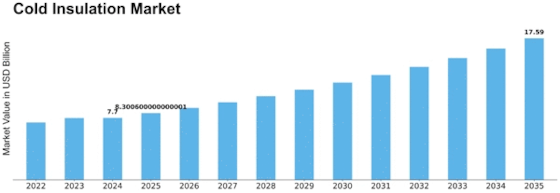
Global Cold Insulation Market Size Graph
Author
Author Profile
Chitranshi Jaiswal
Team Lead - Research

Chitranshi is a Team Leader in the Chemicals & Materials (CnM) and Energy & Power (EnP) domains, with 6+ years of experience in market research. She leads and mentors teams to deliver cross-domain projects that equip clients with actionable insights and growth strategies. She is skilled in market estimation, forecasting, competitive benchmarking, and both primary & secondary research, enabling her to turn complex data into decision-ready insights. An engineer and MBA professional, she combines technical expertise with strategic acumen to solve dynamic market challenges. Chitranshi has successfully managed projects that support market entry, investment planning, and competitive positioning, while building strong client relationships. Certified in Advanced Excel & Power BI she leverages data-driven approaches to ensure accuracy, clarity, and impactful outcomes.

Leave a Comment

FAQs

What is the current valuation of the Cold Insulation Market as of 2024?

<p>The Cold Insulation Market was valued at 7.7 USD Billion in 2024.</p>

What is the projected market valuation for the Cold Insulation Market in 2035?

<p>The market is projected to reach 17.59 USD Billion by 2035.</p>

What is the expected CAGR for the Cold Insulation Market during the forecast period 2025 - 2035?

<p>The expected CAGR for the Cold Insulation Market during 2025 - 2035 is 7.8%.</p>

Which end-use industries are driving growth in the Cold Insulation Market?

<p>Key end-use industries include Oil and Gas, Chemicals, HVAC, and Refrigeration.</p>

What was the market size for the Oil and Gas segment in 2024?

<p>The Oil and Gas segment was valued at 2.5 USD Billion in 2024.</p>

How much is the Polyurethane Foam segment projected to grow by 2035?

The Polyurethane Foam segment is projected to grow from 2.31 USD Billion in 2024 to 5.51 USD Billion by 2035.

Who are the leading companies in the Cold Insulation Market?

Leading companies include BASF SE, Dow Inc., Saint-Gobain, and Huntsman Corporation.

What is the projected growth for the Refrigeration segment by 2035?

The Refrigeration segment is expected to grow from 1.2 USD Billion in 2024 to 2.8 USD Billion by 2035.

What materials are primarily used in the Cold Insulation Market?

Primary materials include Phenolic Foam, Fiber Glass, Polystyrene Foam, and Polyurethane Foam.

What was the market size for the Chemicals segment in 2024?

The Chemicals segment was valued at 1.8 USD Billion in 2024.

Market Summary

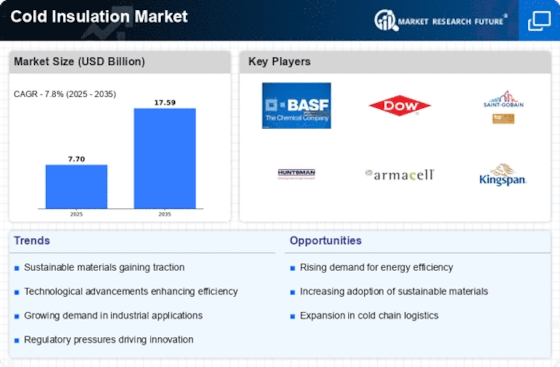
As per Market Research Future analysis, the Cold Insulation Market Size was estimated at 7.7 USD Billion in 2024. The Cold Insulation industry is projected to grow from 8.301 USD Billion in 2025 to 17.59 USD Billion by 2035, exhibiting a compound annual growth rate (CAGR) of 7.8% during the forecast period 2025 - 2035

Key Market Trends & Highlights

The Cold Insulation Market is experiencing a dynamic shift towards energy efficiency and sustainability.

  • North America remains the largest market for cold insulation, driven by stringent energy efficiency regulations. Asia-Pacific is emerging as the fastest-growing region, fueled by rapid industrialization and urbanization. The Oil and Gas segment continues to dominate the market, while the HVAC segment is witnessing the fastest growth due to increasing demand for climate control solutions. Key market drivers include rising regulatory standards and growing awareness of environmental impacts, which are propelling the adoption of advanced insulation materials.

Market Size & Forecast

2024 Market Size 7.7 (USD Billion)
2035 Market Size 17.59 (USD Billion)
CAGR (2025 - 2035) 7.8%
Largest Regional Market Share in 2024 Asia Pacific

Major Players

BASF SE (DE), Dow Inc. (US), Saint-Gobain (FR), Huntsman Corporation (US), Armacell International S.A. (LU), Kingspan Group (IE), Owens Corning (US), Rockwool International A/S (DK), Johns Manville (US)

Market Trends

The Cold Insulation Market is currently experiencing a notable transformation, driven by various factors that influence its growth trajectory. The increasing demand for energy-efficient solutions across multiple industries, including construction, refrigeration, and transportation, appears to be a primary catalyst. As organizations strive to reduce energy consumption and minimize environmental impact, the adoption of advanced insulation materials is gaining momentum. Furthermore, regulatory frameworks promoting sustainability and energy conservation are likely to bolster market expansion, encouraging manufacturers to innovate and enhance their product offerings. In addition to energy efficiency, the Cold Insulation Market is witnessing a shift towards the use of environmentally friendly materials. This trend reflects a growing awareness of ecological concerns and the need for sustainable practices within the industry. Manufacturers are increasingly focusing on developing insulation solutions that not only meet performance standards but also align with environmental regulations. As a result, the market landscape is evolving, with a greater emphasis on products that offer both thermal performance and reduced environmental footprints. Overall, the Cold Insulation Market is poised for continued growth, driven by technological advancements and a commitment to sustainability.

Rising Demand for Energy Efficiency

The Cold Insulation Market is seeing a surge in demand for energy-efficient solutions. Industries are increasingly prioritizing insulation materials that minimize energy loss, thereby reducing operational costs and environmental impact. This trend is particularly evident in sectors such as construction and refrigeration, where energy consumption is a critical concern.

Shift Towards Sustainable Materials

There is a noticeable shift towards the use of sustainable materials within the Cold Insulation Market trends. Manufacturers are focusing on developing products that not only provide effective insulation but also adhere to environmental standards. This trend reflects a broader commitment to sustainability and responsible resource management.

Technological Innovations in Insulation

Technological advancements are playing a crucial role in shaping the Cold Insulation Market. Innovations in material science are leading to the development of high-performance insulation solutions that offer improved thermal resistance and durability. These advancements are likely to enhance product offerings and meet the evolving needs of various industries.

Global Cold Insulation Market Market Drivers

Increasing Regulatory Standards

The Cold Insulation Market is experiencing a notable shift due to the implementation of stringent regulatory standards aimed at enhancing energy efficiency and reducing greenhouse gas emissions. Governments across various regions are enacting policies that mandate the use of high-performance insulation materials in construction and industrial applications. This regulatory push not only encourages the adoption of cold insulation solutions but also drives manufacturers to innovate and improve their product offerings. As a result, the market is likely to witness a surge in demand for advanced insulation materials that comply with these regulations, thereby fostering growth in the Cold Insulation Market.

Expansion of Industrial Applications

The Cold Insulation Market is benefiting from the expansion of industrial applications, particularly in sectors such as oil and gas, chemicals, and food processing. These industries require effective insulation solutions to maintain temperature control and ensure operational efficiency. As industrial activities ramp up, the demand for cold insulation materials is likely to increase, driven by the need for reliable thermal management. Furthermore, the integration of cold insulation in new projects and retrofitting existing facilities is expected to contribute to market growth. This trend underscores the critical role of cold insulation in enhancing productivity and safety within the Cold Insulation Market.

Growth in Refrigeration and HVAC Sectors

The Cold Insulation Market is significantly influenced by the expansion of the refrigeration and HVAC sectors. As urbanization continues to rise, the demand for efficient cooling and heating systems is escalating. This trend is particularly evident in developing regions where infrastructure development is underway. According to recent data, the HVAC market is projected to grow at a compound annual growth rate of over 5% in the coming years. Consequently, the increased installation of refrigeration systems and HVAC units necessitates the use of effective cold insulation materials to enhance energy efficiency and reduce operational costs, thereby propelling the Cold Insulation Market forward.

Rising Awareness of Environmental Impact

There is a growing awareness regarding the environmental impact of energy consumption, which is significantly affecting the Cold Insulation Market. Consumers and businesses alike are becoming more conscious of their carbon footprints and are actively seeking solutions that minimize energy usage. This shift in mindset is driving the demand for cold insulation materials that not only provide thermal efficiency but also contribute to sustainability goals. As a result, manufacturers are increasingly focusing on developing eco-friendly insulation products, which is likely to enhance their market position and appeal to environmentally conscious consumers within the Cold Insulation Market.

Technological Advancements in Insulation Materials

The Cold Insulation Market is witnessing a wave of technological advancements that are revolutionizing insulation materials. Innovations such as the development of aerogel and vacuum insulation panels are providing superior thermal performance and space-saving solutions. These advanced materials are gaining traction in various applications, including industrial refrigeration and cryogenic storage, where traditional insulation may fall short. The introduction of these cutting-edge technologies is expected to create new opportunities for growth within the Cold Insulation Market, as they offer enhanced efficiency and performance that meet the evolving needs of consumers and industries.

Market Segment Insights

By End Use Industry: Oil and Gas (Largest) vs. HVAC (Fastest-Growing)

In the Cold Insulation Market, the Oil and Gas industry represents the largest segment, driven by the demand for efficient <a href="https://www.marketresearchfuture.com/reports/thermal-management-market-3201" target="_blank" title="thermal management">thermal management</a> and energy preservation in extraction and transportation processes. This sector is crucial as it ensures the minimization of energy loss, optimizing operational efficiency while maintaining environmental compliance. Following closely is the HVAC sector, which is rapidly expanding due to increased demand for energy-efficient heating and cooling systems, working in tandem with global sustainability initiatives. As environmental concerns heighten, the growth trends for the Cold Insulation segment indicate a strong focus on adopting innovative insulation solutions. The demand in the Chemicals and Refrigeration sectors is also robust, but their growth is currently surpassed by HVAC solutions, which are increasingly favored for their sustainable benefits. The integration of advanced materials and technologies continues to propel the market forward, as various industries aim to reduce their carbon footprints and enhance system efficiencies.

Oil and Gas (Dominant) vs. HVAC (Emerging)

The Oil and Gas sector remains the dominant player in the Cold Insulation Market, primarily due to its vast operational infrastructure requiring stringent thermal insulation to minimize energy waste and ensure safety in high-temperature environments. This sector utilizes a diverse range of materials designed to withstand extreme conditions, making it a critical necessity for pipeline systems and storage tanks. In contrast, the HVAC industry is emerging as a significant contender, characterized by its push toward energy efficiency and sustainability. Innovative epoxy and foam insulation materials tailored for HVAC systems are gaining traction, responding to growing regulatory pressures and consumer demands for greener technologies. This dual dynamic within the segment emphasizes a shift towards sustainability while maintaining the crucial operational needs of traditional industries.

By Material: Polyurethane Foam (Largest) vs. Phenolic Foam (Fastest-Growing)

The Cold Insulation Market shows a noteworthy distribution in material types. <a href="https://www.marketresearchfuture.com/reports/polyurethane-foam-market-1697">Polyurethane Foam</a> remains the largest segment, driven by its superior insulating properties, making it a preferred choice across various applications. Following closely is Phenolic Foam, which, while currently smaller in market share, is gaining traction due to its enhanced fire resistance and low thermal conductivity, appealing to sectors like construction and refrigeration.

Polyurethane Foam (Dominant) vs. Phenolic Foam (Emerging)

<a href="https://www.marketresearchfuture.com/reports/polyurethane-market-2444" target="_blank" title="polyurethane">Polyurethane</a> Foam stands out as the dominant player in the Cold Insulation Market, appreciated for its versatility and effective thermal performance in refrigeration, HVAC, and building insulation applications. Its propensity for application in varied conditions and energy efficiency makes it the material of choice for many industries. Conversely, Phenolic Foam is the emerging contender, increasingly recognized for its excellent thermal properties and fire resistance. This material is becoming essential where safety and energy efficiency are priorities, especially as regulations tighten around building materials.

Get more detailed insights about Cold Insulation Market Research Report - Global Forecast to 2035

Regional Insights

North America : Innovation and Demand Surge

North America is the largest region for Cold Insulation Market, holding approximately 40% of the global share. The region's growth is driven by increasing demand in the oil and gas sector, stringent energy efficiency regulations, and a focus on sustainable building practices. The U.S. and Canada are the primary contributors, with significant investments in infrastructure and energy projects fueling market expansion. The competitive landscape is characterized by the presence of major players such as Dow Inc., Owens Corning, and BASF SE. These companies are leveraging advanced technologies and innovative materials to enhance product performance. The market is also witnessing a trend towards eco-friendly insulation solutions, aligning with regulatory mandates for reduced carbon footprints. This dynamic environment positions North America as a leader in the cold insulation market.

Europe : Sustainability and Innovation Focus

Europe is the second largest Cold Insulation Market , accounting for approximately 30% of the global market share. The region's growth is propelled by stringent environmental regulations, a push for energy efficiency, and increasing investments in renewable energy projects. Countries like Germany and France are at the forefront, implementing policies that promote the use of advanced insulation materials in various sectors. The competitive landscape in Europe is marked by key players such as Saint-Gobain and Rockwool International A/S, who are innovating to meet regulatory standards and consumer demands. The market is also seeing a rise in partnerships and collaborations aimed at developing sustainable insulation solutions. This focus on innovation and sustainability is expected to drive further growth in the European cold insulation market.

Asia-Pacific : Emerging Market Potential

Asia-Pacific is witnessing steady progress in the Cold Insulation Market growth, holding approximately 25% of the global share. The region's expansion is driven by increasing industrialization, urbanization, and a growing focus on energy efficiency. Countries like China and India are leading the charge, with significant investments in infrastructure and energy sectors, which are expected to boost demand for cold insulation solutions. The competitive landscape is evolving, with local and international players vying for market share. Companies such as Armacell International S.A. and Huntsman Corporation are expanding their presence in the region, focusing on innovative products tailored to meet local needs. The market is also influenced by government initiatives aimed at promoting sustainable building practices, further enhancing growth prospects in Asia-Pacific.

Middle East and Africa : Resource-Rich Opportunities

The Middle East and Africa regions are emerging as a significant player in the Cold Insulation Market, accounting for approximately 5% of the global share. The growth is primarily driven by the oil and gas industry, which demands high-performance insulation solutions. Countries like Saudi Arabia and the UAE are investing heavily in infrastructure projects, creating a robust demand for cold insulation materials. The competitive landscape is characterized by a mix of local and international companies, including key players like Johns Manville and Kingspan Group. The market is also witnessing an increase in awareness regarding energy efficiency and sustainability, prompting investments in advanced insulation technologies. As the region continues to develop, the cold insulation market is expected to expand significantly, driven by both industrial and commercial applications.

Key Players and Competitive Insights

The Cold Insulation Market is currently characterized by a dynamic competitive landscape, driven by increasing demand for energy-efficient solutions across various industries. Key players such as BASF SE (Germany), Dow Inc. (US), and Saint-Gobain (France) are strategically positioned to leverage innovation and sustainability as core components of their operational focus. BASF SE (Germany) emphasizes its commitment to developing advanced insulation materials that enhance energy efficiency, while Dow Inc. (US) is actively pursuing partnerships to expand its product offerings in the cold insulation segment. Saint-Gobain (France) is focusing on regional expansion, particularly in emerging markets, to capitalize on the growing demand for insulation solutions. Collectively, these strategies not only enhance their competitive positioning but also contribute to a more robust market environment.

In terms of business tactics, companies are increasingly localizing manufacturing to reduce lead times and optimize supply chains. This approach appears to be particularly effective in a moderately fragmented market, where the collective influence of key players shapes pricing strategies and product availability. The competitive structure is evolving, with larger firms seeking to consolidate their market share through strategic acquisitions and partnerships, thereby enhancing their operational efficiencies and market reach.

In August 2025, Dow Inc. (US) announced a strategic partnership with a leading renewable energy firm to develop eco-friendly insulation solutions. This collaboration is poised to enhance Dow's product portfolio, aligning with the growing consumer preference for sustainable materials. The strategic importance of this partnership lies in its potential to position Dow as a leader in the sustainable insulation market, catering to environmentally conscious consumers and businesses alike.

In September 2025, BASF SE (Germany) launched a new line of bio-based insulation materials aimed at reducing carbon footprints in construction. This initiative not only reflects BASF's commitment to sustainability but also addresses the increasing regulatory pressures for greener building materials. The introduction of these products is likely to strengthen BASF's market position and appeal to a broader customer base seeking sustainable solutions.

In October 2025, Saint-Gobain (France) completed the acquisition of a regional insulation manufacturer, enhancing its production capabilities and market presence in Europe. This acquisition is strategically significant as it allows Saint-Gobain to tap into new customer segments and improve its supply chain efficiency. The move is indicative of a broader trend where companies are consolidating resources to better compete in a rapidly evolving market.

As of October 2025, the Cold Insulation Market is witnessing trends such as digitalization, sustainability, and the integration of artificial intelligence in product development and supply chain management. Strategic alliances are increasingly shaping the competitive landscape, enabling companies to pool resources and expertise. Looking ahead, competitive differentiation is likely to evolve from traditional price-based competition to a focus on innovation, technology, and supply chain reliability. This shift underscores the importance of adaptability and forward-thinking strategies in maintaining a competitive edge in the market.

Key Companies in the Global Cold Insulation Market include

Industry Developments

November 2021-Frank And Oak (Canada), a sustainable clothing company has introduced its latest men’s outerwear range for fall/winter 2021, which includes the sustainably developed Alpine parka. This Alpine winter coat will be available in rosin, coffee bean, and black. The latest outerwear collection has been developed using organic and recycled materials, such as animal-free PrimaLoft insulation, and 100% polyester fibres. The Alpine parka is a combination of classic design along with function, created to lock in the heat while keeping out the cold wind, coupled with 2-layer breathable fabric, a recycled sherpa-lined hood, as well as ribbed storm cuffs.

Its estimated warmth rating is around -25° C to -10° C.

December 2021- LifeLabs (California) introduces the warmest jacket in the world, claims the company. With a 9.25 CLO score, this MegaWarm jacket can deliver close to 38% higher warmth level compared to a Canada Goose Snow Mantra (6.7 CLO), 17% higher warmth level than the Arc’teryx Leaf Cold WX Parka SVX (7.91 CLO) and around 53% higher warmth compared to the North Face Summit AMK L6 Parka (6.06 CLO). The jacket has been powered by the company’s WarmLife technology, which is an advanced textile reflecting a human’s complete radiant heat right back to the body.

With the use of aluminium’s nano-layer, this jacket is able to attain maximum CLO rating across the globe, while its minimalist design helps develop a more packable, more sustainable, and lighter jacket.

October 2021 : Eco Depot Inc., a consumer goods company in Nevada, announces that its subsidiary Bronya Canada Group has been granted the required R-Value for its Bronya Climate Shield Façade product range. The R-value indicates the rate at which the insulation type can keep the heat from either entering or leaving the house. The insulation R-values differ depending on the type, density and thickness of the cold insulation material. Generally, a better insulation R rating would mean higher climate control and energy efficiency for the house.

The received R 20-Value will now help the brand to commercialize its Bronya Climate Shield product range in the cold insulation market. The wide range of Bronya Climate Shield products help foster energy savings, energy efficiency, and bring down carbon emissions via energy conservation.

Future Outlook

Global Cold Insulation Market Future Outlook

The Cold Insulation Market size is projected to grow at a 7.8% CAGR from 2025 to 2035, driven by increasing energy efficiency regulations and rising demand in various industries.<br>The Cold Insulation Market is surging as global industries prioritize thermal efficiency. Rapid expansion in LNG infrastructure, cryogenic storage, and pharmaceutical cold chains is driving high demand for advanced, sustainable, and moisture-resistant materials.

New opportunities lie in:

  • <p>Development of eco-friendly insulation materials Expansion into emerging markets with tailored solutions Integration of smart technology for real-time monitoring</p>

By 2035, the Cold Insulation Market is expected to achieve substantial growth and innovation.

Market Segmentation

Global Cold Insulation Market Material Outlook

  • Phenolic Foam
  • Fiber Glass
  • Polystyrene Foam
  • Polyurethane Foam
  • Other

Global Cold Insulation Market End Use Industry Outlook

  • Oil and Gas
  • Chemicals
  • HVAC
  • Refrigeration
  • Others

Report Scope

MARKET SIZE 2024 7.7(USD Billion)
MARKET SIZE 2025 8.301(USD Billion)
MARKET SIZE 2035 17.59(USD Billion)
COMPOUND ANNUAL GROWTH RATE (CAGR) 7.8% (2025 - 2035)
REPORT COVERAGE Revenue Forecast, Competitive Landscape, Growth Factors, and Trends
BASE YEAR 2024
Market Forecast Period 2025 - 2035
Historical Data 2019 - 2024
Market Forecast Units USD Billion
Key Companies Profiled BASF SE (DE), Dow Inc. (US), Saint-Gobain (FR), Huntsman Corporation (US), Armacell International S.A. (LU), Kingspan Group (IE), Owens Corning (US), Rockwool International A/S (DK), Johns Manville (US)
Segments Covered Material, end use industry
Key Market Opportunities Growing demand for energy-efficient solutions drives innovation in the Cold Insulation Market.
Key Market Dynamics Rising demand for energy-efficient solutions drives innovation and competition in the cold insulation market.
Countries Covered North America, Europe, APAC, South America, MEA

FAQs

What is the current valuation of the Cold Insulation Market as of 2024?

<p>The Cold Insulation Market was valued at 7.7 USD Billion in 2024.</p>

What is the projected market valuation for the Cold Insulation Market in 2035?

<p>The market is projected to reach 17.59 USD Billion by 2035.</p>

What is the expected CAGR for the Cold Insulation Market during the forecast period 2025 - 2035?

<p>The expected CAGR for the Cold Insulation Market during 2025 - 2035 is 7.8%.</p>

Which end-use industries are driving growth in the Cold Insulation Market?

<p>Key end-use industries include Oil and Gas, Chemicals, HVAC, and Refrigeration.</p>

What was the market size for the Oil and Gas segment in 2024?

<p>The Oil and Gas segment was valued at 2.5 USD Billion in 2024.</p>

How much is the Polyurethane Foam segment projected to grow by 2035?

The Polyurethane Foam segment is projected to grow from 2.31 USD Billion in 2024 to 5.51 USD Billion by 2035.

Who are the leading companies in the Cold Insulation Market?

Leading companies include BASF SE, Dow Inc., Saint-Gobain, and Huntsman Corporation.

What is the projected growth for the Refrigeration segment by 2035?

The Refrigeration segment is expected to grow from 1.2 USD Billion in 2024 to 2.8 USD Billion by 2035.

What materials are primarily used in the Cold Insulation Market?

Primary materials include Phenolic Foam, Fiber Glass, Polystyrene Foam, and Polyurethane Foam.

What was the market size for the Chemicals segment in 2024?

The Chemicals segment was valued at 1.8 USD Billion in 2024.

  1. SECTION I: EXECUTIVE SUMMARY AND KEY HIGHLIGHTS
    1. | 1.1 EXECUTIVE SUMMARY
    2. | | 1.1.1 Market Overview
    3. | | 1.1.2 Key Findings
    4. | | 1.1.3 Market Segmentation
    5. | | 1.1.4 Competitive Landscape
    6. | | 1.1.5 Challenges and Opportunities
    7. | | 1.1.6 Future Outlook
  2. SECTION II: SCOPING, METHODOLOGY AND MARKET STRUCTURE
    1. | 2.1 MARKET INTRODUCTION
    2. | | 2.1.1 Definition
    3. | | 2.1.2 Scope of the study
    4. | | | 2.1.2.1 Research Objective
    5. | | | 2.1.2.2 Assumption
    6. | | | 2.1.2.3 Limitations
    7. | 2.2 RESEARCH METHODOLOGY
    8. | | 2.2.1 Overview
    9. | | 2.2.2 Data Mining
    10. | | 2.2.3 Secondary Research
    11. | | 2.2.4 Primary Research
    12. | | | 2.2.4.1 Primary Interviews and Information Gathering Process
    13. | | | 2.2.4.2 Breakdown of Primary Respondents
    14. | | 2.2.5 Forecasting Model
    15. | | 2.2.6 Market Size Estimation
    16. | | | 2.2.6.1 Bottom-Up Approach
    17. | | | 2.2.6.2 Top-Down Approach
    18. | | 2.2.7 Data Triangulation
    19. | | 2.2.8 Validation
  3. SECTION III: QUALITATIVE ANALYSIS
    1. | 3.1 MARKET DYNAMICS
    2. | | 3.1.1 Overview
    3. | | 3.1.2 Drivers
    4. | | 3.1.3 Restraints
    5. | | 3.1.4 Opportunities
    6. | 3.2 MARKET FACTOR ANALYSIS
    7. | | 3.2.1 Value chain Analysis
    8. | | 3.2.2 Porter's Five Forces Analysis
    9. | | | 3.2.2.1 Bargaining Power of Suppliers
    10. | | | 3.2.2.2 Bargaining Power of Buyers
    11. | | | 3.2.2.3 Threat of New Entrants
    12. | | | 3.2.2.4 Threat of Substitutes
    13. | | | 3.2.2.5 Intensity of Rivalry
    14. | | 3.2.3 COVID-19 Impact Analysis
    15. | | | 3.2.3.1 Market Impact Analysis
    16. | | | 3.2.3.2 Regional Impact
    17. | | | 3.2.3.3 Opportunity and Threat Analysis
  4. SECTION IV: QUANTITATIVE ANALYSIS
    1. | 4.1 Chemicals and Materials, BY End Use Industry (USD Billion)
    2. | | 4.1.1 Oil and Gas
    3. | | 4.1.2 Chemicals
    4. | | 4.1.3 HVAC
    5. | | 4.1.4 Refrigeration
    6. | | 4.1.5 Others
    7. | 4.2 Chemicals and Materials, BY Material (USD Billion)
    8. | | 4.2.1 Phenolic Foam
    9. | | 4.2.2 Fiber Glass
    10. | | 4.2.3 Polystyrene Foam
    11. | | 4.2.4 Polyurethane Foam
    12. | | 4.2.5 Other
    13. | 4.3 Chemicals and Materials, BY Region (USD Billion)
    14. | | 4.3.1 North America
    15. | | | 4.3.1.1 US
    16. | | | 4.3.1.2 Canada
    17. | | 4.3.2 Europe
    18. | | | 4.3.2.1 Germany
    19. | | | 4.3.2.2 UK
    20. | | | 4.3.2.3 France
    21. | | | 4.3.2.4 Russia
    22. | | | 4.3.2.5 Italy
    23. | | | 4.3.2.6 Spain
    24. | | | 4.3.2.7 Rest of Europe
    25. | | 4.3.3 APAC
    26. | | | 4.3.3.1 China
    27. | | | 4.3.3.2 India
    28. | | | 4.3.3.3 Japan
    29. | | | 4.3.3.4 South Korea
    30. | | | 4.3.3.5 Malaysia
    31. | | | 4.3.3.6 Thailand
    32. | | | 4.3.3.7 Indonesia
    33. | | | 4.3.3.8 Rest of APAC
    34. | | 4.3.4 South America
    35. | | | 4.3.4.1 Brazil
    36. | | | 4.3.4.2 Mexico
    37. | | | 4.3.4.3 Argentina
    38. | | | 4.3.4.4 Rest of South America
    39. | | 4.3.5 MEA
    40. | | | 4.3.5.1 GCC Countries
    41. | | | 4.3.5.2 South Africa
    42. | | | 4.3.5.3 Rest of MEA
  5. SECTION V: COMPETITIVE ANALYSIS
    1. | 5.1 Competitive Landscape
    2. | | 5.1.1 Overview
    3. | | 5.1.2 Competitive Analysis
    4. | | 5.1.3 Market share Analysis
    5. | | 5.1.4 Major Growth Strategy in the Chemicals and Materials
    6. | | 5.1.5 Competitive Benchmarking
    7. | | 5.1.6 Leading Players in Terms of Number of Developments in the Chemicals and Materials
    8. | | 5.1.7 Key developments and growth strategies
    9. | | | 5.1.7.1 New Product Launch/Service Deployment
    10. | | | 5.1.7.2 Merger & Acquisitions
    11. | | | 5.1.7.3 Joint Ventures
    12. | | 5.1.8 Major Players Financial Matrix
    13. | | | 5.1.8.1 Sales and Operating Income
    14. | | | 5.1.8.2 Major Players R&D Expenditure. 2023
    15. | 5.2 Company Profiles
    16. | | 5.2.1 BASF SE (DE)
    17. | | | 5.2.1.1 Financial Overview
    18. | | | 5.2.1.2 Products Offered
    19. | | | 5.2.1.3 Key Developments
    20. | | | 5.2.1.4 SWOT Analysis
    21. | | | 5.2.1.5 Key Strategies
    22. | | 5.2.2 Dow Inc. (US)
    23. | | | 5.2.2.1 Financial Overview
    24. | | | 5.2.2.2 Products Offered
    25. | | | 5.2.2.3 Key Developments
    26. | | | 5.2.2.4 SWOT Analysis
    27. | | | 5.2.2.5 Key Strategies
    28. | | 5.2.3 Saint-Gobain (FR)
    29. | | | 5.2.3.1 Financial Overview
    30. | | | 5.2.3.2 Products Offered
    31. | | | 5.2.3.3 Key Developments
    32. | | | 5.2.3.4 SWOT Analysis
    33. | | | 5.2.3.5 Key Strategies
    34. | | 5.2.4 Huntsman Corporation (US)
    35. | | | 5.2.4.1 Financial Overview
    36. | | | 5.2.4.2 Products Offered
    37. | | | 5.2.4.3 Key Developments
    38. | | | 5.2.4.4 SWOT Analysis
    39. | | | 5.2.4.5 Key Strategies
    40. | | 5.2.5 Armacell International S.A. (LU)
    41. | | | 5.2.5.1 Financial Overview
    42. | | | 5.2.5.2 Products Offered
    43. | | | 5.2.5.3 Key Developments
    44. | | | 5.2.5.4 SWOT Analysis
    45. | | | 5.2.5.5 Key Strategies
    46. | | 5.2.6 Kingspan Group (IE)
    47. | | | 5.2.6.1 Financial Overview
    48. | | | 5.2.6.2 Products Offered
    49. | | | 5.2.6.3 Key Developments
    50. | | | 5.2.6.4 SWOT Analysis
    51. | | | 5.2.6.5 Key Strategies
    52. | | 5.2.7 Owens Corning (US)
    53. | | | 5.2.7.1 Financial Overview
    54. | | | 5.2.7.2 Products Offered
    55. | | | 5.2.7.3 Key Developments
    56. | | | 5.2.7.4 SWOT Analysis
    57. | | | 5.2.7.5 Key Strategies
    58. | | 5.2.8 Rockwool International A/S (DK)
    59. | | | 5.2.8.1 Financial Overview
    60. | | | 5.2.8.2 Products Offered
    61. | | | 5.2.8.3 Key Developments
    62. | | | 5.2.8.4 SWOT Analysis
    63. | | | 5.2.8.5 Key Strategies
    64. | | 5.2.9 Johns Manville (US)
    65. | | | 5.2.9.1 Financial Overview
    66. | | | 5.2.9.2 Products Offered
    67. | | | 5.2.9.3 Key Developments
    68. | | | 5.2.9.4 SWOT Analysis
    69. | | | 5.2.9.5 Key Strategies
    70. | 5.3 Appendix
    71. | | 5.3.1 References
    72. | | 5.3.2 Related Reports
  6. LIST OF FIGURES
    1. | 6.1 MARKET SYNOPSIS
    2. | 6.2 NORTH AMERICA MARKET ANALYSIS
    3. | 6.3 US MARKET ANALYSIS BY END USE INDUSTRY
    4. | 6.4 US MARKET ANALYSIS BY MATERIAL
    5. | 6.5 CANADA MARKET ANALYSIS BY END USE INDUSTRY
    6. | 6.6 CANADA MARKET ANALYSIS BY MATERIAL
    7. | 6.7 EUROPE MARKET ANALYSIS
    8. | 6.8 GERMANY MARKET ANALYSIS BY END USE INDUSTRY
    9. | 6.9 GERMANY MARKET ANALYSIS BY MATERIAL
    10. | 6.10 UK MARKET ANALYSIS BY END USE INDUSTRY
    11. | 6.11 UK MARKET ANALYSIS BY MATERIAL
    12. | 6.12 FRANCE MARKET ANALYSIS BY END USE INDUSTRY
    13. | 6.13 FRANCE MARKET ANALYSIS BY MATERIAL
    14. | 6.14 RUSSIA MARKET ANALYSIS BY END USE INDUSTRY
    15. | 6.15 RUSSIA MARKET ANALYSIS BY MATERIAL
    16. | 6.16 ITALY MARKET ANALYSIS BY END USE INDUSTRY
    17. | 6.17 ITALY MARKET ANALYSIS BY MATERIAL
    18. | 6.18 SPAIN MARKET ANALYSIS BY END USE INDUSTRY
    19. | 6.19 SPAIN MARKET ANALYSIS BY MATERIAL
    20. | 6.20 REST OF EUROPE MARKET ANALYSIS BY END USE INDUSTRY
    21. | 6.21 REST OF EUROPE MARKET ANALYSIS BY MATERIAL
    22. | 6.22 APAC MARKET ANALYSIS
    23. | 6.23 CHINA MARKET ANALYSIS BY END USE INDUSTRY
    24. | 6.24 CHINA MARKET ANALYSIS BY MATERIAL
    25. | 6.25 INDIA MARKET ANALYSIS BY END USE INDUSTRY
    26. | 6.26 INDIA MARKET ANALYSIS BY MATERIAL
    27. | 6.27 JAPAN MARKET ANALYSIS BY END USE INDUSTRY
    28. | 6.28 JAPAN MARKET ANALYSIS BY MATERIAL
    29. | 6.29 SOUTH KOREA MARKET ANALYSIS BY END USE INDUSTRY
    30. | 6.30 SOUTH KOREA MARKET ANALYSIS BY MATERIAL
    31. | 6.31 MALAYSIA MARKET ANALYSIS BY END USE INDUSTRY
    32. | 6.32 MALAYSIA MARKET ANALYSIS BY MATERIAL
    33. | 6.33 THAILAND MARKET ANALYSIS BY END USE INDUSTRY
    34. | 6.34 THAILAND MARKET ANALYSIS BY MATERIAL
    35. | 6.35 INDONESIA MARKET ANALYSIS BY END USE INDUSTRY
    36. | 6.36 INDONESIA MARKET ANALYSIS BY MATERIAL
    37. | 6.37 REST OF APAC MARKET ANALYSIS BY END USE INDUSTRY
    38. | 6.38 REST OF APAC MARKET ANALYSIS BY MATERIAL
    39. | 6.39 SOUTH AMERICA MARKET ANALYSIS
    40. | 6.40 BRAZIL MARKET ANALYSIS BY END USE INDUSTRY
    41. | 6.41 BRAZIL MARKET ANALYSIS BY MATERIAL
    42. | 6.42 MEXICO MARKET ANALYSIS BY END USE INDUSTRY
    43. | 6.43 MEXICO MARKET ANALYSIS BY MATERIAL
    44. | 6.44 ARGENTINA MARKET ANALYSIS BY END USE INDUSTRY
    45. | 6.45 ARGENTINA MARKET ANALYSIS BY MATERIAL
    46. | 6.46 REST OF SOUTH AMERICA MARKET ANALYSIS BY END USE INDUSTRY
    47. | 6.47 REST OF SOUTH AMERICA MARKET ANALYSIS BY MATERIAL
    48. | 6.48 MEA MARKET ANALYSIS
    49. | 6.49 GCC COUNTRIES MARKET ANALYSIS BY END USE INDUSTRY
    50. | 6.50 GCC COUNTRIES MARKET ANALYSIS BY MATERIAL
    51. | 6.51 SOUTH AFRICA MARKET ANALYSIS BY END USE INDUSTRY
    52. | 6.52 SOUTH AFRICA MARKET ANALYSIS BY MATERIAL
    53. | 6.53 REST OF MEA MARKET ANALYSIS BY END USE INDUSTRY
    54. | 6.54 REST OF MEA MARKET ANALYSIS BY MATERIAL
    55. | 6.55 KEY BUYING CRITERIA OF CHEMICALS AND MATERIALS
    56. | 6.56 RESEARCH PROCESS OF MRFR
    57. | 6.57 DRO ANALYSIS OF CHEMICALS AND MATERIALS
    58. | 6.58 DRIVERS IMPACT ANALYSIS: CHEMICALS AND MATERIALS
    59. | 6.59 RESTRAINTS IMPACT ANALYSIS: CHEMICALS AND MATERIALS
    60. | 6.60 SUPPLY / VALUE CHAIN: CHEMICALS AND MATERIALS
    61. | 6.61 CHEMICALS AND MATERIALS, BY END USE INDUSTRY, 2024 (% SHARE)
    62. | 6.62 CHEMICALS AND MATERIALS, BY END USE INDUSTRY, 2024 TO 2035 (USD Billion)
    63. | 6.63 CHEMICALS AND MATERIALS, BY MATERIAL, 2024 (% SHARE)
    64. | 6.64 CHEMICALS AND MATERIALS, BY MATERIAL, 2024 TO 2035 (USD Billion)
    65. | 6.65 BENCHMARKING OF MAJOR COMPETITORS
  7. LIST OF TABLES
    1. | 7.1 LIST OF ASSUMPTIONS
    2. | | 7.1.1
    3. | 7.2 North America MARKET SIZE ESTIMATES; FORECAST
    4. | | 7.2.1 BY END USE INDUSTRY, 2025-2035 (USD Billion)
    5. | | 7.2.2 BY MATERIAL, 2025-2035 (USD Billion)
    6. | 7.3 US MARKET SIZE ESTIMATES; FORECAST
    7. | | 7.3.1 BY END USE INDUSTRY, 2025-2035 (USD Billion)
    8. | | 7.3.2 BY MATERIAL, 2025-2035 (USD Billion)
    9. | 7.4 Canada MARKET SIZE ESTIMATES; FORECAST
    10. | | 7.4.1 BY END USE INDUSTRY, 2025-2035 (USD Billion)
    11. | | 7.4.2 BY MATERIAL, 2025-2035 (USD Billion)
    12. | 7.5 Europe MARKET SIZE ESTIMATES; FORECAST
    13. | | 7.5.1 BY END USE INDUSTRY, 2025-2035 (USD Billion)
    14. | | 7.5.2 BY MATERIAL, 2025-2035 (USD Billion)
    15. | 7.6 Germany MARKET SIZE ESTIMATES; FORECAST
    16. | | 7.6.1 BY END USE INDUSTRY, 2025-2035 (USD Billion)
    17. | | 7.6.2 BY MATERIAL, 2025-2035 (USD Billion)
    18. | 7.7 UK MARKET SIZE ESTIMATES; FORECAST
    19. | | 7.7.1 BY END USE INDUSTRY, 2025-2035 (USD Billion)
    20. | | 7.7.2 BY MATERIAL, 2025-2035 (USD Billion)
    21. | 7.8 France MARKET SIZE ESTIMATES; FORECAST
    22. | | 7.8.1 BY END USE INDUSTRY, 2025-2035 (USD Billion)
    23. | | 7.8.2 BY MATERIAL, 2025-2035 (USD Billion)
    24. | 7.9 Russia MARKET SIZE ESTIMATES; FORECAST
    25. | | 7.9.1 BY END USE INDUSTRY, 2025-2035 (USD Billion)
    26. | | 7.9.2 BY MATERIAL, 2025-2035 (USD Billion)
    27. | 7.10 Italy MARKET SIZE ESTIMATES; FORECAST
    28. | | 7.10.1 BY END USE INDUSTRY, 2025-2035 (USD Billion)
    29. | | 7.10.2 BY MATERIAL, 2025-2035 (USD Billion)
    30. | 7.11 Spain MARKET SIZE ESTIMATES; FORECAST
    31. | | 7.11.1 BY END USE INDUSTRY, 2025-2035 (USD Billion)
    32. | | 7.11.2 BY MATERIAL, 2025-2035 (USD Billion)
    33. | 7.12 Rest of Europe MARKET SIZE ESTIMATES; FORECAST
    34. | | 7.12.1 BY END USE INDUSTRY, 2025-2035 (USD Billion)
    35. | | 7.12.2 BY MATERIAL, 2025-2035 (USD Billion)
    36. | 7.13 APAC MARKET SIZE ESTIMATES; FORECAST
    37. | | 7.13.1 BY END USE INDUSTRY, 2025-2035 (USD Billion)
    38. | | 7.13.2 BY MATERIAL, 2025-2035 (USD Billion)
    39. | 7.14 China MARKET SIZE ESTIMATES; FORECAST
    40. | | 7.14.1 BY END USE INDUSTRY, 2025-2035 (USD Billion)
    41. | | 7.14.2 BY MATERIAL, 2025-2035 (USD Billion)
    42. | 7.15 India MARKET SIZE ESTIMATES; FORECAST
    43. | | 7.15.1 BY END USE INDUSTRY, 2025-2035 (USD Billion)
    44. | | 7.15.2 BY MATERIAL, 2025-2035 (USD Billion)
    45. | 7.16 Japan MARKET SIZE ESTIMATES; FORECAST
    46. | | 7.16.1 BY END USE INDUSTRY, 2025-2035 (USD Billion)
    47. | | 7.16.2 BY MATERIAL, 2025-2035 (USD Billion)
    48. | 7.17 South Korea MARKET SIZE ESTIMATES; FORECAST
    49. | | 7.17.1 BY END USE INDUSTRY, 2025-2035 (USD Billion)
    50. | | 7.17.2 BY MATERIAL, 2025-2035 (USD Billion)
    51. | 7.18 Malaysia MARKET SIZE ESTIMATES; FORECAST
    52. | | 7.18.1 BY END USE INDUSTRY, 2025-2035 (USD Billion)
    53. | | 7.18.2 BY MATERIAL, 2025-2035 (USD Billion)
    54. | 7.19 Thailand MARKET SIZE ESTIMATES; FORECAST
    55. | | 7.19.1 BY END USE INDUSTRY, 2025-2035 (USD Billion)
    56. | | 7.19.2 BY MATERIAL, 2025-2035 (USD Billion)
    57. | 7.20 Indonesia MARKET SIZE ESTIMATES; FORECAST
    58. | | 7.20.1 BY END USE INDUSTRY, 2025-2035 (USD Billion)
    59. | | 7.20.2 BY MATERIAL, 2025-2035 (USD Billion)
    60. | 7.21 Rest of APAC MARKET SIZE ESTIMATES; FORECAST
    61. | | 7.21.1 BY END USE INDUSTRY, 2025-2035 (USD Billion)
    62. | | 7.21.2 BY MATERIAL, 2025-2035 (USD Billion)
    63. | 7.22 South America MARKET SIZE ESTIMATES; FORECAST
    64. | | 7.22.1 BY END USE INDUSTRY, 2025-2035 (USD Billion)
    65. | | 7.22.2 BY MATERIAL, 2025-2035 (USD Billion)
    66. | 7.23 Brazil MARKET SIZE ESTIMATES; FORECAST
    67. | | 7.23.1 BY END USE INDUSTRY, 2025-2035 (USD Billion)
    68. | | 7.23.2 BY MATERIAL, 2025-2035 (USD Billion)
    69. | 7.24 Mexico MARKET SIZE ESTIMATES; FORECAST
    70. | | 7.24.1 BY END USE INDUSTRY, 2025-2035 (USD Billion)
    71. | | 7.24.2 BY MATERIAL, 2025-2035 (USD Billion)
    72. | 7.25 Argentina MARKET SIZE ESTIMATES; FORECAST
    73. | | 7.25.1 BY END USE INDUSTRY, 2025-2035 (USD Billion)
    74. | | 7.25.2 BY MATERIAL, 2025-2035 (USD Billion)
    75. | 7.26 Rest of South America MARKET SIZE ESTIMATES; FORECAST
    76. | | 7.26.1 BY END USE INDUSTRY, 2025-2035 (USD Billion)
    77. | | 7.26.2 BY MATERIAL, 2025-2035 (USD Billion)
    78. | 7.27 MEA MARKET SIZE ESTIMATES; FORECAST
    79. | | 7.27.1 BY END USE INDUSTRY, 2025-2035 (USD Billion)
    80. | | 7.27.2 BY MATERIAL, 2025-2035 (USD Billion)
    81. | 7.28 GCC Countries MARKET SIZE ESTIMATES; FORECAST
    82. | | 7.28.1 BY END USE INDUSTRY, 2025-2035 (USD Billion)
    83. | | 7.28.2 BY MATERIAL, 2025-2035 (USD Billion)
    84. | 7.29 South Africa MARKET SIZE ESTIMATES; FORECAST
    85. | | 7.29.1 BY END USE INDUSTRY, 2025-2035 (USD Billion)
    86. | | 7.29.2 BY MATERIAL, 2025-2035 (USD Billion)
    87. | 7.30 Rest of MEA MARKET SIZE ESTIMATES; FORECAST
    88. | | 7.30.1 BY END USE INDUSTRY, 2025-2035 (USD Billion)
    89. | | 7.30.2 BY MATERIAL, 2025-2035 (USD Billion)
    90. | 7.31 PRODUCT LAUNCH/PRODUCT DEVELOPMENT/APPROVAL
    91. | | 7.31.1
    92. | 7.32 ACQUISITION/PARTNERSHIP
    93. | | 7.32.1

Chemicals and Materials Market Segmentation

Chemicals and Materials By End Use Industry (USD Billion, 2025-2035)

  • Oil and Gas
  • Chemicals
  • HVAC
  • Refrigeration
  • Others

Chemicals and Materials By Material (USD Billion, 2025-2035)

  • Phenolic Foam
  • Fiber Glass
  • Polystyrene Foam
  • Polyurethane Foam
  • Other
Infographic

Free Sample Request

Kindly complete the form below to receive a free sample of this Report

Get Free Sample

Customer Strories

Compare Licence

×
Features License Type
Single User Multiuser License Enterprise User
Price $4,950 $5,950 $7,250
Maximum User Access Limit 1 User Upto 10 Users Unrestricted Access Throughout the Organization
Free Customization
Direct Access to Analyst
Deliverable Format
Platform Access
Discount on Next Purchase 10% 15% 15%
Printable Versions