Telecom Cloud Market

Key Players: Amazon Web Services (AWS), Microsoft Azure, Google Cloud, Ericsson, Nokia, IBM, Cisco, Oracle

Telecom Cloud Market

Telecom Cloud Market Size, Share and Research Report By Solution Type (Solution, Services), By Cloud Platform (Infrastructure-as-a-Service (IaaS), Platform-as-a-Service (PaaS), Software-as-a-Service (SaaS)), By Application (Billing and Provisioning, Traffic Management, Others), By End User (BFSI, Healthcare, Retail, Manufacturing, Others) and By Regional (North America, Europe, South America, Asia Pacific, Middle East and Africa) - Industry Forecast to 2035.
ID: MRFR/ICT/1495-HCR
200 Pages
Aarti Dhapte
Last Updated: June 19, 2026

Telecom Cloud Market Summary

The Telecom Cloud Market was valued at USD 33.52 Billion in 2025 and is projected to grow from USD 41.73 Billion in 2026 to USD 299.89 Billion by 2035, registering a 24.5% CAGR during the forecast period (2026–2035). Operators worldwide are channeling capital toward cloud-native network cores as 5G standalone deployments accelerate and edge computing use cases proliferate. AT&T's USD 14 billion Open RAN agreement with Ericsson signals the capital intensity reshaping the Telecom Cloud Market at an infrastructure level [1].

Legacy monolithic network architectures — built around proprietary hardware stacks — are giving way to software-defined, containerized platforms that run on commercial off-the-shelf servers. Vodafone's USD 1.5 billion multi-cloud partnership with Microsoft illustrates how carriers are re-platforming core and edge workloads to meet performance, sovereignty, and compliance mandates simultaneously [2]. This shift compresses operational expenditure cycles from years to months, letting carriers launch new revenue-generating services at software speed.

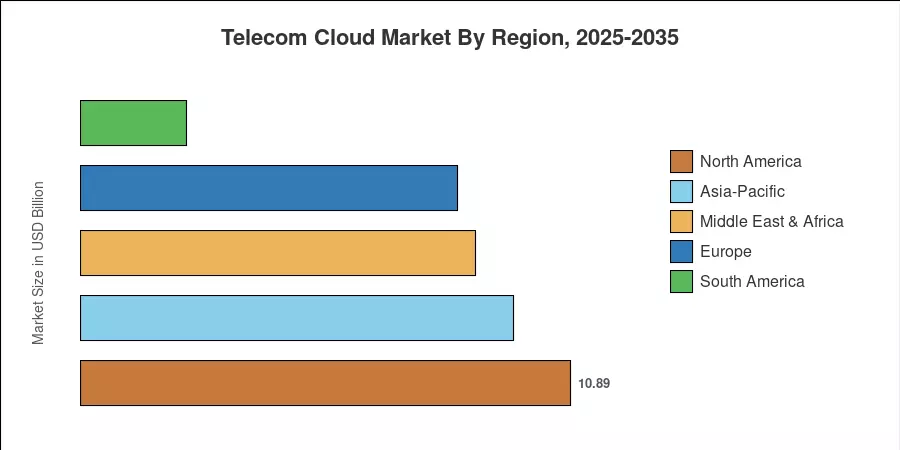
North America commands approximately 32.5% of the Telecom Cloud Market revenue, supported by hyperscaler proximity and early 5G core migrations. Asia-Pacific is the fastest-growing region at a 28.7% CAGR, propelled by India's Jio-scale investments and China's state-backed cloud-native rollouts. Europe holds the second-largest share, near 25.0%, driven by the EU's Digital Decade targets and Open RAN pilots across multiple national carriers [3]. The Telecom Cloud Market is poised to reshape connectivity economics through 2035 as carriers convert network functions into cloud-native microservices.


Key Report Takeaways

• By Solution Type

  • Solution offerings captured 48.9% of Telecom Cloud Market revenue in 2025, reflecting demand for turnkey cloud-native network platforms among Tier 1 operators.
  • Services are projected to expand at a 29.2% CAGR through 2035 as managed migration, integration, and optimization engagements grow.

• By Platform

  • Infrastructure-as-a-Service held 45.4% of the Telecom Cloud Market share in 2025, anchored by compute and storage outsourcing for virtualized network functions.
  • Platform-as-a-Service is forecast to climb at a 30.4% CAGR to 2035, fueled by DevOps toolchains for telecom application development.

• By Application

  • Billing and Provisioning represented 41.5% of the Telecom Cloud Market in 2025, the first workload most operators migrate to the cloud.
  • Traffic Management is on track for a 29.8% CAGR through 2035 as real-time analytics demand intensifies.

• By End User

  • BFSI accounted for 34.4% of the Telecom Cloud Market share in 2025, driven by low-latency trading and secure connectivity needs.
  • Healthcare exhibits the fastest end-user expansion at a 26.1% CAGR through 2035.

• By Region

  • North America represented 32.5% of the Telecom Cloud Market revenue in 2025.
  • Asia-Pacific is projected to grow at a 28.7% CAGR between 2026 and 2035.


Market Size and Forecast (2021–2035)

Market Research Future's estimates are derived from a combination of primary interviews with telecom CIOs and CTOs, carrier capex disclosures, hyperscaler revenue breakdowns, and validated against third-party benchmarks. Historical figures reflect actual reported spending; forecast values apply the calibrated 24.5% CAGR with adjustments for macroeconomic cycles.
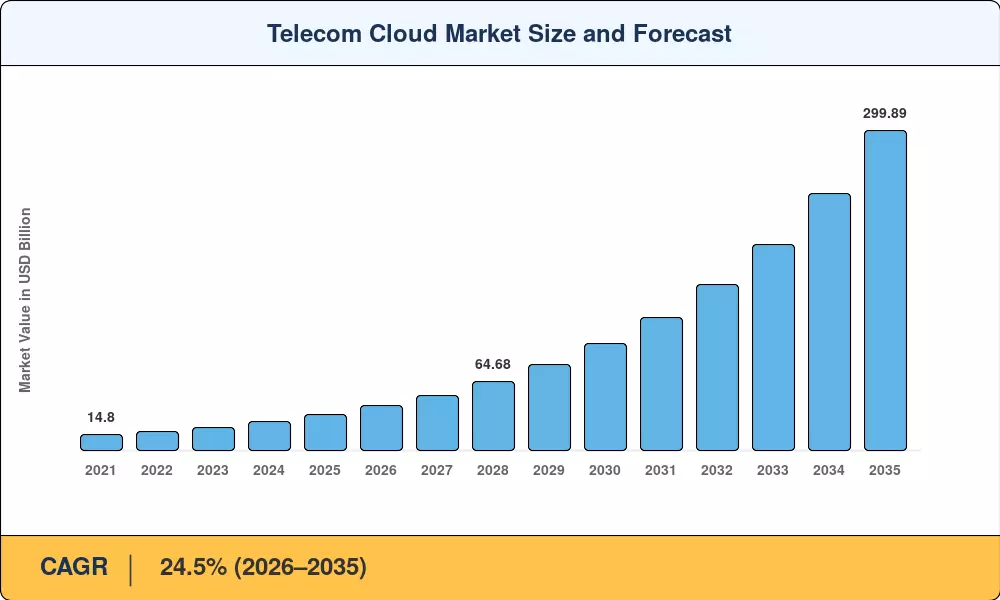
Telecom Cloud Market Size and Forecast
Our Impact
Enabled $4.3B Revenue Impact for Fortune 500 and Leading Multinationals
Partnering with 2000+ Global Organizations Each Year
30K+ Citations by Top-Tier Firms in the Industry

Driver Impact Analysis

Driver ~% Impact on CAGR Geographic Relevance Impact Timeline
5G Standalone Core Deployments ~22% Global Short-term (≤2 yr)
Open RAN Adoption ~18% North America, Europe Medium-term (2–4 yr)
Edge Computing and MEC Proliferation ~16% North America, Asia-Pacific Medium-term (2–4 yr)
AI/ML-Driven Network Automation ~14% Global Long-term (≥4 yr)
Regulatory Push for Data Sovereignty ~12% Europe, Asia-Pacific Medium-term (2–4 yr)
Carrier Cost-Reduction Imperatives ~10% Global Short-term (≤2 yr)
Enterprise Private 5G Demand ~8% North America, Asia-Pacific Long-term (≥4 yr)


5G Standalone Core Deployments

Carrier transitions from non-standalone to standalone 5G core architectures are the primary factor driving the growth of the telecom cloud market. Although it is anticipated that by 2027, 5G technology will account for up to 60% of all mobile data traffic worldwide, the underlying transition to cloud-native 5G SA cores is a consistent, multi-year infrastructure cycle. Massive IoT, ultra-reliable low-latency communication, and network slicing are all made possible by standalone cores, which are not achievable on conventional EPC platforms. Together, operators including T-Mobile, SK Telecom, and Reliance Jio have invested more than USD 30 billion in capital expenditures for these migrations, thereby increasing the addressable base of the telecom cloud market.


Open RAN Adoption

Open RAN disaggregates proprietary baseband hardware into software components running on cloud infrastructure, creating substantial new demand within the Telecom Cloud Market. AT&T's USD 14 billion Ericsson deal includes a significant Open RAN component, while the European Commission allocated EUR 900 million under Horizon Europe for Open RAN R&D [1][10]. Rakuten Mobile's fully virtualized network in Japan demonstrated 40% capex savings versus legacy deployments, a benchmark that Tier 1 carriers globally are racing to replicate.

Edge Computing and MEC Proliferation

Verizon's multi-access edge computing trials cut application latency by 50%, validating carrier-edge cloud as a viable platform for autonomous vehicles, AR/VR, and industrial automation [8]. AWS Wavelength, Azure Edge Zones, and Google Distributed Cloud now integrate directly into carrier networks, creating a Telecom Cloud Market sub-segment that barely existed before 2022. Spending on MEC infrastructure is expected to surpass USD 12 billion annually by 2028, according to GSMA Intelligence estimates.

AI/ML-Driven Network Automation

Artificial intelligence is transforming how telecom clouds operate. Self-optimizing networks powered by ML reduce manual intervention by up to 70%, per Ericsson's operational benchmarks [9]. Carriers deploying AIOps platforms report 35% faster fault resolution and 25% lower opex, accelerating cloud migration ROI. The Telecom Cloud Market benefits directly as AI workloads demand elastic, GPU-enabled cloud infrastructure at both core and edge.


Restraints Impact Analysis

Restraint impact estimates are directional. They represent headwinds that moderate — but do not reverse — the Telecom Cloud Market's growth trajectory.

Restraint ~% Negative Impact on CAGR Geographic Relevance Impact Timeline
Legacy System Integration Complexity ~–6% Global Short-term (≤2 yr)
Data Sovereignty and Compliance Fragmentation ~–5% Europe, Asia-Pacific Medium-term (2–4 yr)
Cybersecurity and Multi-Tenant Risk ~–4% Global Long-term (≥4 yr)
Shortage of Cloud-Native Telecom Talent ~–3% Global Medium-term (2–4 yr)
Vendor Lock-In Concerns ~–3% Europe, South America Medium-term (2–4 yr)


Legacy System Integration Complexity

Most carriers operate hybrid environments where decades-old OSS/BSS platforms coexist with cloud-native microservices. A McKinsey survey found that 58% of telecom CIOs cite integration complexity as the top barrier to Telecom Cloud Market adoption [13]. Migration timelines frequently extend 12–18 months beyond initial estimates, and middleware costs can consume 15–20% of total cloud transformation budgets.

Data Sovereignty and Compliance Fragmentation

Europe's GDPR, India's DPDPA, and China's PIPL each impose distinct data localization requirements that complicate multi-cloud deployments. Carriers operating across jurisdictions must maintain separate data-plane configurations, inflating operational overhead. The EU's proposed European Cloud Certification Scheme adds another compliance layer that can delay Telecom Cloud Market procurement cycles by six to nine months [10].

Cybersecurity and Multi-Tenant Risk

In contrast to isolated, purpose-built legacy hardware, shared-infrastructure approaches introduce architectural attack surfaces. The shift to open cloud environments structurally shifts the threat profile toward microservices and web-facing configurations, even though official agency telemetry from ENISA shows that software development bugs and defective updates continue to be the primary baseline technical causes of cross-network disruption. As a result, in order to protect against API vulnerabilities, operators moving workloads to multi-tenant environments are paying more for complete zero-trust frameworks, which raises deployment costs in the short term.


Telecom Cloud Market Opportunities

Private 5G and Network-as-a-Service

A greenfield telecom cloud market potential is created by enterprise demand for specialized 5G connectivity. Carriers may attract manufacturing, logistics, and mining verticals ready to pay premium SLAs by packaging cloud-hosted private 5G cores as managed services. According to a recent report, cloud-native managed service configurations will drive the largest long-term operational margins in the worldwide private 5G market, which is expected to grow by an incremental value of over USD 10 billion by 2029 [12].

Sovereign and Hybrid Cloud Frameworks

Regulatory pressure for data residency is paradoxically an opportunity: carriers already operating local data centers can offer sovereign cloud platforms that hyperscalers cannot easily replicate. Deutsche Telekom's Open Telekom Cloud and Orange's Flexible Engine illustrate how Telecom Cloud Market participants monetize compliance as a differentiator.

AI and Data Monetization at the Edge

Carrier networks generate petabytes of anonymized mobility, usage, and performance data daily. Cloud-native platforms enable real-time analytics pipelines that transform raw telemetry into monetizable insights for retail, transportation, and urban planning clients. The Telecom Cloud Market stands to add USD 4–6 Billion in annual data-as-a-service revenue by 2030 [9].

Emerging Markets Leapfrogging Legacy Infrastructure

Operators in Sub-Saharan Africa, Southeast Asia, and Latin America are deploying cloud-native cores from day one, bypassing the legacy hardware cycle entirely. India's BharatNet program and Indonesia's Palapa Ring create fiber backbones that feed directly into Telecom Cloud Market growth. The World Bank estimates that every 10% increase in broadband penetration adds 1.38% to GDP in developing economies [17].

Carrier-Neutral Edge and Multi-Cloud Orchestration

As no single hyperscaler can satisfy every latency, sovereignty, and pricing requirement, multi-cloud orchestration platforms are emerging as a high-growth niche within the Telecom Cloud Market. Companies like Amdocs and Netcracker provide abstraction layers that let carriers dynamically place workloads across AWS, Azure, and Google — plus on-premises infrastructure — based on real-time policy.


Telecom Cloud Market Future Outlook

AI-Native Autonomous Networks

By 2030, closed-loop automation—in which AI agents handle network slicing, traffic engineering, and problem remediation without human intervention—will have a greater influence on the telecom cloud market. According to Ericsson, autonomous network operations could result in a 40% reduction in carrier opex [9]. As the industry moves from assisted to completely autonomous operations, carriers who develop AI-native cloud platforms now will earn disproportionate profits.


Platform Economics and API Monetization

Telecom cloud platforms are evolving into API-first ecosystems — GSMA Open Gateway alone has attracted 60+ carrier participants globally [20]. This platform model lets carriers monetize identity verification, location, and quality-on-demand APIs directly to developers. The Telecom Cloud Market is transitioning from an infrastructure cost center to a revenue-generating platform, a shift that could add 5–8 percentage points to carrier EBITDA margins by 2032.

Energy Efficiency and Sustainable Operations

Cloud-native architectures consume 30–50% less energy per workload than equivalent bare-metal deployments, per ETSI benchmarks [21]. As telecom operators face mounting ESG disclosure requirements — the EU's CSRD mandates Scope 3 reporting from 2026 — the Telecom Cloud Market benefits from sustainability-driven migration incentives. Carriers targeting net-zero by 2040 view cloudification as a primary decarbonization lever.

Satellite-Terrestrial Cloud Convergence

The integration of LEO satellite constellations (Starlink, AST SpaceMobile, Amazon Kuiper) with terrestrial telecom clouds will extend the Telecom Cloud Market into previously unconnectable geographies by the early 2030s. 3GPP's NTN (Non-Terrestrial Network) standards, expected in Release 19, define how satellite backhaul integrates with cloud-native cores. This convergence could add USD 15–20 billion to the addressable market by 2035 [22].


Telecom Cloud Market Segmentation

By Solution Type

Segment Key Metric Primary Demand Driver
Solution 48.9% share (2025) Turnkey cloud-native core platforms
Services 29.2% CAGR (2026–2035) Managed migration and optimization


Solution offerings dominate the Telecom Cloud Market because operators prefer integrated platforms that bundle virtualized network functions, orchestration, and management. Ericsson's Cloud Native Infrastructure and Nokia's CloudBand are leading examples. Services, while smaller by revenue today, are growing faster as carriers lack in-house expertise for complex multi-cloud migrations. Accenture, IBM, and TCS have each established dedicated telecom cloud practices exceeding 5,000 consultants [15].

By Cloud Platform

Segment Key Metric Primary Demand Driver
Infrastructure-as-a-Service (IaaS) 45.4% share (2025) Compute and storage for VNFs
Platform-as-a-Service (PaaS) 30.4% CAGR (2026–2035) DevOps and CI/CD for telecom apps
Software-as-a-Service (SaaS) USD 5.87 Billion (2025) BSS/OSS cloud applications


IaaS dominates the Telecom Cloud Market because the initial migration wave involves moving compute-heavy virtualized network functions from on-premises hardware to cloud infrastructure. PaaS is the fastest-growing platform segment as operators increasingly build custom applications — network slicing managers, real-time analytics dashboards, and API gateways — on cloud-native development platforms. SaaS adoption concentrates in BSS domains where vendors like Amdocs and CSG offer fully hosted billing and CRM solutions.

By Application

Segment Key Metric Primary Demand Driver
Billing and Provisioning 41.5% share (2025) First-wave cloud migration workload
Traffic Management 29.8% CAGR (2026–2035) Real-time analytics for 5G slicing
Others USD 6.52 Billion (2025) CRM, workforce management, security


Billing and provisioning were the first workload most operators migrated to the cloud, driven by the need for elastic scaling during peak subscriber events and the maturity of cloud-hosted BSS platforms. Traffic Management is the fastest-growing application in the Telecom Cloud Market, as 5G network slicing requires real-time, AI-powered traffic steering that only cloud-native architectures can deliver at scale.

By End User

Segment Key Metric Primary Demand Driver
BFSI 34.4% share (2025) Low-latency connectivity, secure cloud
Healthcare 26.1% CAGR (2026–2035) Telemedicine, remote monitoring
Retail USD 3.82 Billion (2025) Omnichannel connectivity
Manufacturing 25.4% CAGR (2026–2035) Private 5G, industrial IoT


BFSI leads end-user adoption of the Telecom Cloud Market because financial institutions demand ultra-low-latency, highly secure cloud connectivity for algorithmic trading, real-time fraud detection, and digital banking platforms. Healthcare is the fastest-growing end user, powered by the explosion of telemedicine, connected medical devices, and cloud-hosted electronic health records that require carrier-grade reliability and HIPAA-compliant infrastructure.


Regional Market Share Analysis

Region Key Metric Primary Investment Themes
North America 32.5% revenue share (2025) Hyperscaler integration, Open RAN, MEC
Europe USD 8.38 Billion (2025) Sovereign cloud, GDPR compliance, Open RAN pilots
Asia-Pacific 28.7% CAGR (2026–2035) 5G SA rollouts, smart city programs, digital inclusion
South America USD 2.35 Billion (2025) 4G-to-5G transition, rural connectivity
Middle East & Africa 26.2% CAGR (2026–2035) Vision programs, greenfield cloud-native builds
Total USD 33.52 Billion (2025)

The Telecom Cloud Market exhibits significant regional variation, shaped by regulatory maturity, 5G deployment timelines, and hyperscaler data-center density.


North America

Country Key Metric Key Driver
US 78.5% of regional share Hyperscaler co-investment, FCC spectrum policy [7]
Canada USD 1.45 Billion (2025) CRTC broadband mandates, 5G mid-band rollout
Mexico 22.8% CAGR (2026–2035) América Móvil cloud migration, IFT reforms


The US dominates the North American Telecom Cloud Market thanks to the co-location of three global hyperscalers, aggressive 5G SA timelines from T-Mobile and Verizon, and favorable FCC spectrum auction outcomes that fund network cloudification. Canada's CRTC universal broadband mandate is accelerating carrier cloud investments in underserved provinces, while Mexico's América Móvil is shifting core workloads to a hybrid-cloud model under IFT oversight.

Europe

Country Key Metric Key Driver
Germany 22.1% of regional share Deutsche Telekom cloud-native migration [10]
UK USD 1.58 Billion (2025) BT/EE Open RAN, Ofcom 5G framework
France 18.4% CAGR (2026–2035) Orange sovereign cloud strategy
Italy USD 0.67 Billion (2025) TIM network separation, cloud core
Spain 17.9% CAGR (2026–2035) Telefónica Tech edge expansion
Nordic Countries USD 0.72 Billion (2025) Telia, Telenor cloud-first mandates
Russia 15.2% CAGR (2026–2035) Domestic cloud substitution policy
Rest of Europe USD 0.94 Billion (2025) EU Digital Decade funding


Europe's Telecom Cloud Market benefits from the EU's Digital Decade policy targeting 75% cloud adoption among enterprises by 2030. Deutsche Telekom and Orange are building sovereign cloud alternatives, while BT's partnership with Dell and Nokia on Open RAN across the UK creates a multi-vendor cloud RAN blueprint. GDPR compliance costs, however, add 10–15% to cloud migration budgets, a dynamic unique to this region [10].

Asia-Pacific

Country Key Metric Key Driver
China 35.2% of regional share China Mobile/Unicom/Telecom state cloud mandates [18]
India 30.5% CAGR (2026–2035) Jio, Airtel 5G SA, BharatNet backbone [17]
Japan USD 1.72 Billion (2025) Rakuten Symphony, NTT IOWN
South Korea 27.8% CAGR (2026–2035) SK Telecom AI-native cloud, KT convergence
ASEAN USD 1.15 Billion (2025) Singtel, PLDT cloud partnerships
Rest of Asia-Pacific 25.6% CAGR (2026–2035) Australia 5G, New Zealand fiber-cloud integration


Asia-Pacific is the fastest-growing region in the Telecom Cloud Market, driven by a combination of massive subscriber bases, government digital inclusion mandates, and greenfield 5G SA deployments. China's three state-owned carriers collectively invested over USD 20 billion in cloud infrastructure during 2024 [18]. India's Jio and Airtel are deploying cloud-native 5G cores at unprecedented scale, while Rakuten Symphony in Japan exports its fully virtualized network blueprint to carriers across the region.

South America

Country Key Metric Key Driver
Brazil 62.0% of regional share Claro/TIM cloud migration, Anatel 5G mandates
Argentina 19.8% CAGR (2026–2035) Telecom Argentina hybrid cloud
Rest of South America USD 0.42 Billion (2025) Chile, Colombia fiber-cloud expansion


Brazil anchors the South American Telecom Cloud Market, with Anatel's 5G auction obligations requiring cloud-ready network architectures. Claro and TIM are migrating billing and provisioning workloads to hybrid cloud platforms. Argentina's Telecom Argentina is piloting edge-cloud services in Buenos Aires, though macroeconomic instability moderates investment timelines across the broader region.

Middle East & Africa

Country Key Metric Key Driver
Saudi Arabia 33.8% of regional share NEOM, stc cloud-native vision [19]
UAE USD 0.52 Billion (2025) e& (Etisalat) multi-cloud strategy
South Africa 23.5% CAGR (2026–2035) MTN, Vodacom cloud partnerships
Egypt 22.0% CAGR (2026–2035) Telecom Egypt fiber backbone investment
Rest of MEA USD 0.48 Billion (2025) Kenya, Nigeria mobile-first cloud plays


Saudi Arabia's Vision 2030 and NEOM smart-city program are catalyzing cloud-native telecom investments, making the Kingdom the largest Telecom Cloud Market in MEA. UAE's e& is deploying multi-cloud orchestration across its operating companies, while South Africa's MTN partners with hyperscalers to extend cloud services into previously underserved markets. Greenfield deployments across East Africa represent a long-term growth vector.


Telecom Cloud Market By Region, 2025-2035

Competitive Benchmarking

The Telecom Cloud Market exhibits medium concentration, with the top five players collectively holding an estimated 35–45% revenue share. The HHI index sits below 1,000, indicating a fragmented but consolidating landscape where hyperscalers compete alongside traditional telecom infrastructure vendors and systems integrators.

Company Est. Revenue Share Range Key Offerings for Telecom Cloud Market Strategic Positioning
Amazon Web Services (AWS) ~8–12% AWS Wavelength, Outposts, Telecom Network Builder Hyperscaler with deepest carrier partnerships
Microsoft Azure ~7–11% Azure for Operators, Azure Edge Zones Enterprise-cloud-to-carrier bridge strategy
Google Cloud ~5–8% Distributed Cloud, Anthos for Telecom Open-source-first, Kubernetes-native approach
Ericsson ~5–8% Cloud Native Infrastructure, Cloud RAN Telecom-heritage cloud-native vendor
Nokia ~4–7% CloudBand, AnyRAN Cloud End-to-end network cloudification
IBM ~4–6% Cloud Pak for Network Automation, Red Hat Hybrid cloud with open-source stack
Cisco ~3–6% Cloud-Native Broadband Router, Crosswork Network automation and multi-cloud visibility
Oracle ~3–5% Oracle Communications Cloud BSS/OSS cloud-native suite
Huawei ~3–5% Huawei Cloud Stack, CloudFabric Dominant in China and emerging markets
VMware (Broadcom) ~2–4% Telco Cloud Platform, VeloCloud Virtualization layer specialist


Recent News & Developments

  • AT&T (January 2025): Expanded its Open RAN deployment with Ericsson to cover 70% of US wireless traffic by 2027, committing additional capital within the USD 14 billion framework agreement. This accelerates the Telecom Cloud Market's Open RAN segment [1].
  • Vodafone (November 2024): Signed a 10-year, USD 1.5 billion strategic partnership with Microsoft to deploy Azure-based network functions across 15 European markets, the largest single-carrier cloud deal in Europe [2].
  • Reliance Jio (September 2024): Announced completion of its fully cloud-native 5G SA core deployment across all 22 Indian telecom circles, serving over 130 million 5G subscribers on a single Telecom Cloud Market platform [17].
  • Rakuten Symphony (July 2024): Secured contracts with 12 new carrier clients across Asia-Pacific and Europe for its Symworld cloud-native network platform, validating the fully virtualized operator model [23].
  • Deutsche Telekom (May 2024): Launched its sovereign cloud offering in partnership with Google Cloud under the T-Systems umbrella, targeting GDPR-sensitive enterprise workloads in Germany and Central Europe [10].
  • AWS (March 2024): Released AWS Telecom Network Builder GA, enabling carriers to automate 5G core and RAN deployment through infrastructure-as-code templates, reducing deployment cycles by 60% [8].


Telecom Cloud Market Report Scope

Parameter Detail
Market Scope Global Telecom Cloud Market covering solutions, services, cloud platforms, applications, end users, and regional analysis
Study Period 2021–2035
CAGR 24.5% (2026–2035)
Market Size (2025) USD 33.52 Billion
Market Size (2035) USD 299.89 Billion
Fastest Growing Segment Services (by type); PaaS (by platform); Healthcare (by end user)
Companies Profiled AWS, Microsoft, Google, Ericsson, Nokia, IBM, Cisco, Oracle, Huawei, VMware (Broadcom)
Valuation Currency USD Billion


FAQs

How does the Telecom Cloud Market differ from the broader enterprise cloud market?

Telecom clouds must satisfy carrier-grade reliability (99.999% uptime) and sub-millisecond latency requirements that standard enterprise clouds do not guarantee. Workloads involve real-time signaling, subscriber state management, and regulatory lawful-intercept compliance unique to licensed operators [6].

What switching costs do operators face when changing Telecom Cloud Market vendors?

Switching costs typically range from 15–25% of the original deployment value due to data migration, retraining, and API reintegration. Multi-cloud orchestration platforms are emerging specifically to reduce this lock-in risk.

How does Open RAN impact the competitive dynamics of the Telecom Cloud Market?

Open RAN dismantles single-vendor dependency, enabling carriers to mix software from multiple suppliers on shared cloud infrastructure. This lowers barriers for new entrants and compresses incumbent margins by 8–12 percentage points [1].

What role does edge computing play in Telecom Cloud Market revenue models?

Edge cloud lets carriers monetize latency-sensitive applications — autonomous driving, real-time gaming, and industrial robotics — through premium network slices priced 3–5x above best-effort connectivity [8].

How are Telecom Cloud Market investments evaluated for ROI by carrier CFOs?

Carriers benchmark cloud migration ROI against a three-year payback threshold, measuring opex reduction, time-to-market acceleration, and incremental service revenue. Typical approved projects target 25–30% opex savings within 36 months [11].

What compliance certifications should buyers require from Telecom Cloud Market vendors?

Buyers should verify SOC 2 Type II, ISO 27001, ISO 27017, and jurisdiction-specific certifications such as C5 in Germany or MTCS in Singapore. Carrier-grade vendors also hold TL 9000 quality management certification [14].

How will 6G standardization, beginning around 2030, reshape the Telecom Cloud Market?

6G will demand AI-native, sub-terahertz-capable cloud architectures that extend beyond current 5G platforms. Early R&D from Samsung, NTT, and Nokia targets cloud-integrated sensing and communication capabilities that could redefine the platform layer [22].


Author
Author
Author Profile
Aarti Dhapte LinkedIn
AVP - Research
A consulting professional focused on helping businesses navigate complex markets through structured research and strategic insights. I partner with clients to solve high-impact business problems across market entry strategy, competitive intelligence, and opportunity assessment. Over the course of my experience, I have led and contributed to 100+ market research and consulting engagements, delivering insights across multiple industries and geographies, and supporting strategic decisions linked to $500M+ market opportunities. My core expertise lies in building robust market sizing, forecasting, and commercial models (top-down and bottom-up), alongside deep-dive competitive and industry analysis. I have played a key role in shaping go-to-market strategies, investment cases, and growth roadmaps, enabling clients to make confident, data-backed decisions in dynamic markets.

Research Approach


Secondary Research

The secondary research process involved comprehensive analysis of regulatory databases, telecommunications standardization bodies, peer-reviewed technology journals, and authoritative ICT industry organizations. Key sources included the US Federal Communications Commission (FCC), European Telecommunications Standards Institute (ETSI), International Telecommunication Union (ITU) World Telecommunication/ICT Indicators Database, National Institute of Standards and Technology (NIST) Cloud Computing Program, European Union Agency for Cybersecurity (ENISA), GSMA Intelligence, Cloud Native Computing Foundation (CNCF) Research, Linux Foundation Networking (LFN) Insights, 3GPP Standardization Reports, O-RAN Alliance Technical Specifications, OECD Digital Economy Outlook, Uptime Institute Annual Data Center Industry Survey, Synergy Research Group Cloud Market Data, IDC Worldwide Telco Cloud Infrastructure Software Forecast, Gartner Magic Quadrant for Cloud Infrastructure & Platform Services, IEEE Communications Society Publications, ACM Computing Surveys, and national regulatory authority reports from key markets including Ofcom (UK), Bundesnetzagentur (Germany), ARCEP (France), Ministry of Industry and Information Technology (China), and Telecommunications Bureau (Japan). These sources were used to collect network virtualization adoption statistics, 5G deployment data, regulatory compliance frameworks, cloud infrastructure investment trends, and market landscape analysis for public cloud, private cloud, hybrid cloud deployments, Network Functions Virtualization (NFV), Software-Defined Networking (SDN), and cloud-native network functions (CNF).


Primary Research

During the initial research process, both supply-side and demand-side stakeholders were interviewed to gather both qualitative and quantitative information. Supply-side sources were CEOs, CTOs, VPs of Cloud Infrastructure, heads of Network Strategy, and product directors from telecom cloud platform providers, hyperscale cloud operators, telecoms equipment manufacturers (TEMs), and communication service providers (CSPs). Demand-side sources included Chief Information Officers (CIOs), Chief Technology Officers (CTOs), heads of IT Infrastructure, network architects, and procurement leads from large businesses, communication service providers, mobile network operators (MNOs), and multi-system operators (MSOs) that were using telecom cloud solutions. Primary research confirmed the timelines for deploying 5G core networks, validated market segmentation across SaaS, PaaS, and IaaS service models, and gathered information on how NFV/SDN is being used, how cloud-native transformation strategies are being used, how edge computing is being used, and how pricing is changing across virtualized network function deployments.

Primary Respondent Breakdown:

By Designation: C-level Primaries (38%), Director Level (32%), Others (30%)

By Region: North America (32%), Europe (30%), Asia-Pacific (28%), Rest of World (10%)


Market Size Estimation

Global market valuation was derived through revenue mapping and infrastructure deployment volume analysis. The methodology included:

Identification of 50+ key vendors across North America, Europe, Asia-Pacific, and Latin America spanning hyperscale cloud providers, telecom equipment vendors, pure-play NFV software vendors, and systems integrators

Product mapping across Platforms (Cloud Infrastructure, Virtualization Software), Solutions (NFV Orchestration, SDN Controllers, Cloud-Native Core), and Services (Professional Services, Managed Services)

Deployment model analysis across Public Cloud, Private Cloud, and Hybrid Cloud architectures

Cloud service model segmentation covering Infrastructure-as-a-Service (IaaS), Platform-as-a-Service (PaaS), and Software-as-a-Service (SaaS) specific to telecom workloads

NFV software categorization including Virtual Network Functions (VNFs), Cloud-Native Network Functions (CNFs), and NFV Infrastructure (NFVI)

Analysis of reported and modeled annual revenues specific to telecom cloud and network virtualization portfolios

Coverage of vendors representing 75-80% of global market share in 2024

Extrapolation using bottom-up (deployment volume × ASP by country/region across core networks, RAN, edge computing, and OSS/BSS) and top-down (vendor revenue validation and service provider capex analysis) approaches to derive segment-specific valuations

Triangulation with service provider capital expenditure (Capex) data for cloud infrastructure, 5G network virtualization investments, and datacenter capacity expansion metrics

The current model has reached its conversation limit. It will reset in 3 hours. Upgrade to unlock more conversations. Go to recharge

Download Free Sample

Kindly complete the form below to receive a free sample of this Report

Download PDF ×

We do not share your information with anyone. However, we may send you emails based on your report interest from time to time. You may contact us at any time to opt-out.