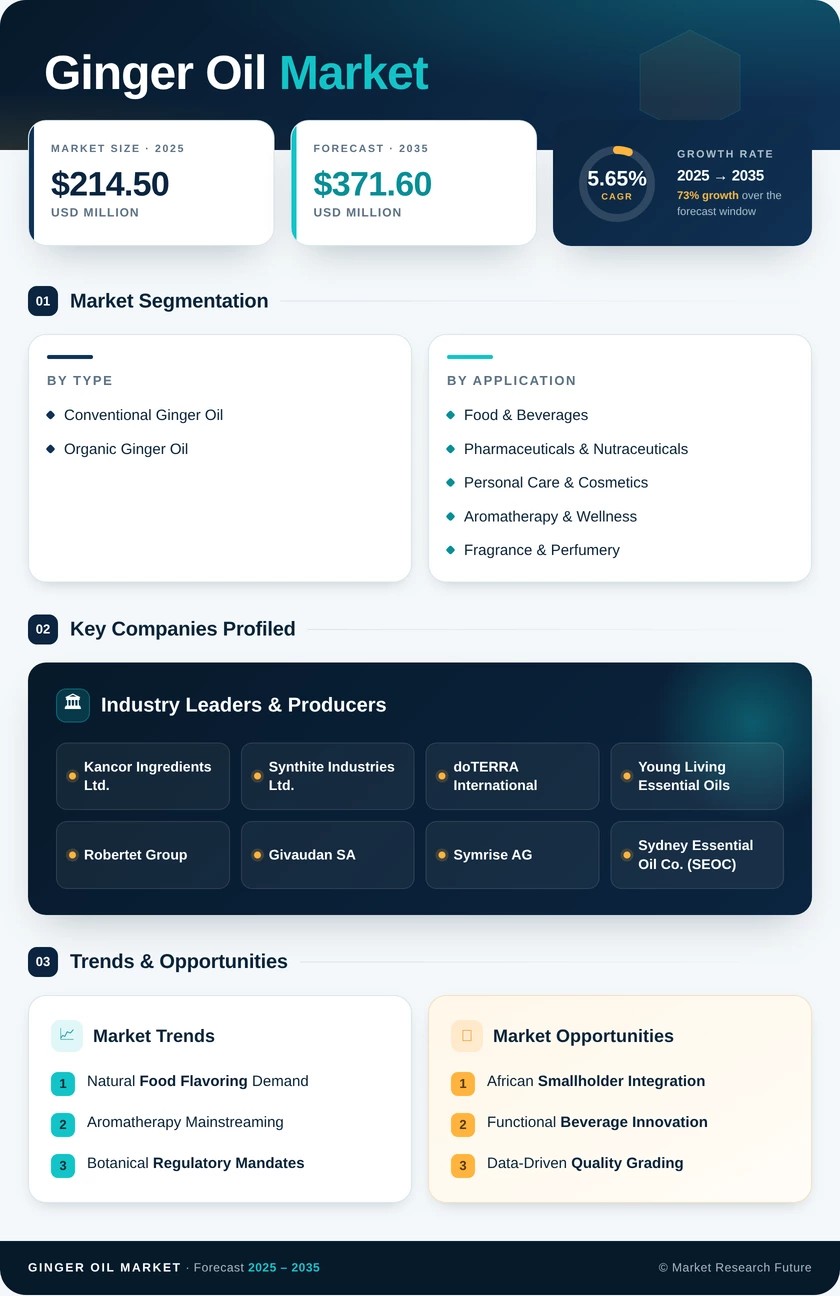
Ginger Oil Market (2026 - 2035)

ID: MRFR/FnB/28785-HCR 128 Pages Varsha More Last Updated: September 17, 2026
Ginger Oil Market Size, Share, Industry Trend & Analysis Research Report By Product Type (Conventional Ginger Oil, Organic Ginger Oil), By Application (Food & Beverages, Pharmaceuticals & Nutraceuticals, Personal Care & Cosmetics, Aromatherapy & Wellness, Fragrance & Perfumery, Others), By Geography (North America, Europe, Asia-Pacific, South America, Middle East & Africa) - Forecast to 2035
Ginger Oil Market
Market Size
Forecast Period2026-2035
CAGR (2026-2035)5.65%
2025 Market SizeUSD 214.50 Million
2035 Market SizeUSD 371.60 Million
Key Players
Kancor Ingredients Ltd.
Synthite Industries Ltd.
doTERRA International
Young Living Essential Oils
Robertet Group
Givaudan SA
Opportunities
  • African Smallholder Integration
  • Functional Beverage Innovation
  • Data-Driven Quality Grading
  1. 1 Market Overview |
    1. 1.1 Study Assumptions & Market Definition |
    2. 1.2 Scope of the Study |
    3. 1.3 Research Methodology
  2. 2 Market Summary & Key Takeaways
  3. 3 Market Dynamics |
    1. 3.1 Market Drivers Analysis | |
      1. 3.1.1 Rising Demand for Natural Food Flavoring Agents | |
      2. 3.1.2 Aromatherapy and Wellness Mainstreaming | |
      3. 3.1.3 Clean-Label & Botanical Regulatory Mandates | |
      4. 3.1.4 Pharmaceutical Bioactive Ingredient Sourcing | |
      5. 3.1.5 Organic & Traceable Supply Chain Premiums | |
      6. 3.1.6 GCC Wellness Tourism Infrastructure Investment | |
      7. 3.1.7 E-Commerce DTC Channel Expansion |
    2. 3.2 Market Restraints Analysis | |
      1. 3.2.1 Raw-Material Price Volatility & Crop Yield Fluctuation | |
      2. 3.2.2 Adulteration & Quality Inconsistency | |
      3. 3.2.3 Competition from Synthetic Ginger Flavor Isolates | |
      4. 3.2.4 High Organic Certification Costs for Smallholders | |
      5. 3.2.5 Limited Cold-Chain Logistics in Emerging Origins |
    3. 3.3 Market Opportunity Analysis | |
      1. 3.3.1 African Smallholder Integration | |
      2. 3.3.2 Functional Beverage Innovation | |
      3. 3.3.3 Data-Driven Quality Grading | |
      4. 3.3.4 Pharmaceutical Anti-Inflammatory Pipeline | |
      5. 3.3.5 Subscription Wellness & DTC Channels |
    4. 3.4 Industry Value Chain Analysis |
    5. 3.5 Porter's Five Forces Analysis
  4. 4 Global Ginger Oil Market Size & Forecast (2021–2035) |
    1. 4.1 Historical Market Size (2021–2025) |
    2. 4.2 Current & Forecast Market Size (2026–2035) |
    3. 4.3 Market Size by Revenue (USD Million) |
    4. 4.4 Year-over-Year Growth Analysis
  5. 5 Segmentation Analysis |
    1. 5.1 By Product Type | |
      1. 5.1.1 Conventional Ginger Oil | |
      2. 5.1.2 Organic Ginger Oil |
    2. 5.2 By Application | |
      1. 5.2.1 Food & Beverages | |
      2. 5.2.2 Pharmaceuticals & Nutraceuticals | |
      3. 5.2.3 Personal Care & Cosmetics | |
      4. 5.2.4 Aromatherapy & Wellness | |
      5. 5.2.5 Fragrance & Perfumery | |
      6. 5.2.6 Others
  6. 6 Regional Analysis |
    1. 6.1 North America | |
      1. 6.1.1 United States | |
      2. 6.1.2 Canada | |
      3. 6.1.3 Mexico |
    2. 6.2 Europe | |
      1. 6.2.1 Germany | |
      2. 6.2.2 United Kingdom | |
      3. 6.2.3 France | |
      4. 6.2.4 Italy | |
      5. 6.2.5 Spain | |
      6. 6.2.6 Nordic Countries | |
      7. 6.2.7 Russia | |
      8. 6.2.8 Rest of Europe |
    3. 6.3 Asia-Pacific | |
      1. 6.3.1 China | |
      2. 6.3.2 India | |
      3. 6.3.3 Japan | |
      4. 6.3.4 South Korea | |
      5. 6.3.5 ASEAN | |
      6. 6.3.6 Rest of Asia-Pacific |
    4. 6.4 South America | |
      1. 6.4.1 Brazil | |
      2. 6.4.2 Argentina | |
      3. 6.4.3 Rest of South America |
    5. 6.5 Middle East & Africa | |
      1. 6.5.1 Saudi Arabia | |
      2. 6.5.2 UAE | |
      3. 6.5.3 South Africa | |
      4. 6.5.4 Egypt | |
      5. 6.5.5 Rest of MEA
  7. 7 Competitive Landscape |
    1. 7.1 Market Share Analysis (2025) |
    2. 7.2 Competitive Benchmarking Matrix |
    3. 7.3 Company Profiles | |
      1. 7.3.1 Kancor Ingredients Ltd. | |
      2. 7.3.2 Synthite Industries Ltd. | |
      3. 7.3.3 doTERRA International | |
      4. 7.3.4 Young Living Essential Oils | |
      5. 7.3.5 Robertet Group | |
      6. 7.3.6 Givaudan SA | |
      7. 7.3.7 Symrise AG | |
      8. 7.3.8 Sydney Essential Oil Co. (SEOC) | |
      9. 7.3.9 Guangxi Wanshan Spice Co. | |
      10. 7.3.10 Biolandes SAS
  8. 8 Future Outlook & Strategic Recommendations (2026–2035) |
    1. 8.1 AI-Powered Quality Assurance and Traceability |
    2. 8.2 Sustainable Sourcing and ESG Reporting |
    3. 8.3 Convergence of Wellness and Pharmaceuticals |
    4. 8.4 Climate Adaptation in Cultivation Regions
  9. 9 Recent Developments & News
  10. 10 Frequently Asked Questions (FAQs)
  11. 11 Report Scope & Methodology |
    1. 11.1 Study Period & Base Year |
    2. 11.2 Data Sources & Citations |
    3. 11.3 Abbreviations
  12. 12 LIST OF TABLES |
  13. TABLE 1 Global Ginger Oil Market Size & Forecast, by Revenue (USD Million), 2021–2035 |
  14. TABLE 2 Global Ginger Oil Market – Year-over-Year Growth Analysis, 2021–2035 |
  15. TABLE 3 Global Ginger Oil Market – Driver Impact Analysis, 2026–2035 |
  16. TABLE 4 Global Ginger Oil Market – Restraint Impact Analysis, 2026–2035 |
  17. TABLE 5 Global Ginger Oil Market Size, by Product Type, 2021–2035 (USD Million) |
  18. TABLE 6 Global Ginger Oil Market Size, by Application, 2021–2035 (USD Million) |
  19. TABLE 7 Global Ginger Oil Market Size, by Region, 2021–2035 (USD Million) |
  20. TABLE 8 North America Ginger Oil Market Size, by Country, 2021–2035 (USD Million) |
  21. TABLE 9 Europe Ginger Oil Market Size, by Country, 2021–2035 (USD Million) |
  22. TABLE 10 Asia-Pacific Ginger Oil Market Size, by Country, 2021–2035 (USD Million) |
  23. TABLE 11 South America Ginger Oil Market Size, by Country, 2021–2035 (USD Million) |
  24. TABLE 12 Middle East & Africa Ginger Oil Market Size, by Country, 2021–2035 (USD Million) |
  25. TABLE 13 Competitive Benchmarking Matrix – Global Ginger Oil Market, 2025 |
  26. TABLE 14 Company Profiles – Key Players, Global Ginger Oil Market |
  27. TABLE 15 Recent Developments & Strategic Announcements, 2023–2025 |
  28. TABLE 16 Report Scope & Methodology Summary |
  29. TABLE 17 Detailed Sources and Citations
  30. 13 LIST OF FIGURES |
  31. FIGURE 1 Ginger Oil Market Dynamics — Drivers, Restraints & Opportunities |
  32. FIGURE 2 Ginger Oil Industry Value Chain Analysis |
  33. FIGURE 3 Porter's Five Forces Analysis — Ginger Oil Market |
  34. FIGURE 4 Global Ginger Oil Market Size Trend & Forecast (USD Million), 2021–2035 |
  35. FIGURE 5 Ginger Oil Market Share, by Product Type (%), 2025 |
  36. FIGURE 6 Ginger Oil Market Share, by Application (%), 2025 |
  37. FIGURE 7 Ginger Oil Market Share, by Region (%), 2025 |
  38. FIGURE 8 North America Ginger Oil Market Share, by Country (%), 2025 |
  39. FIGURE 9 Europe Ginger Oil Market Share, by Country (%), 2025 |
  40. FIGURE 10 Asia-Pacific Ginger Oil Market Share, by Country (%), 2025 |
  41. FIGURE 11 South America Ginger Oil Market Share, by Country (%), 2025 |
  42. FIGURE 12 Middle East & Africa Ginger Oil Market Share, by Country (%), 2025 |
  43. FIGURE 13 Competitive Landscape — Ginger Oil Market Revenue Share Analysis, 2025

Segmentation Quick Reference

DimensionSub-SegmentsDominant SegmentFastest Growing Segment
Product TypeConventional Ginger Oil, Organic Ginger OilConventional Ginger Oil (68.10% share, 2025)Organic Ginger Oil (7.10% CAGR)
ApplicationFood & Beverages, Ginger Oil Markets & Nutraceuticals, Personal Care & Cosmetics, Aromatherapy & Wellness, Fragrance & Perfumery, OthersFood & Beverages (63.00% share, 2025)Aromatherapy & Wellness (7.78% CAGR)
GeographyNorth America, Europe, Asia-Pacific, South America, Middle East & AfricaAsia-Pacific (42.45% share, 2025)Middle East & Africa (8.40% CAGR)


Market Segmentation Overview

By Product Type

Sub-SegmentKey Trend
Conventional Ginger OilCost-competitive Chinese exports drive bulk supply; quality gap widening between commodity and premium grades
Organic Ginger OilRetailer-mandated organic sourcing and USDA/EU certification programs accelerating supply-chain conversion


Conventional ginger oil continues to serve as the backbone of industrial supply, while organic variants attract premium pricing power. The product-type split reflects a broader industry tension between volume-oriented commodity processors and traceability-focused, certified-organic suppliers competing for different end-use channels.

By Application

Sub-SegmentKey Trend
Food & BeveragesClean-label replacement of synthetic flavors in craft beverages, confectionery, and Asian-fusion sauces
Ginger Oil Markets & NutraceuticalsClinical pipeline expansion for ginger-based anti-inflammatory and digestive-health formulations
Personal Care & CosmeticsScalp-care, anti-aging, and warming massage oil formulations driving ingredient demand
Aromatherapy & WellnessMainstream adoption across professional spas, home diffusers, and subscription wellness kits
Fragrance & PerfumeryWarm-spicy accord demand in niche and artisanal perfumery
OthersIndustrial cleaning, household fragrancing, and veterinary applications


Food & beverages remains the largest application by a wide margin, but the aromatherapy & wellness segment is gaining share rapidly as consumer awareness of essential-oil benefits expands beyond niche wellness circles into mainstream retail and e-commerce channels.

By Geography

Sub-SegmentKey Trend
North AmericaFunctional beverage boom and DTC aromatherapy retail expansion
EuropeClean-label food regulation and premium personal-care ingredient demand
Asia-PacificProduction hub with cultivation modernization and intra-regional export growth
South AmericaOrganic farming expansion in Brazil and Andean nations for export markets
Middle East & AfricaWellness tourism investment in GCC and smallholder distillation programs in West Africa


Asia-Pacific anchors global supply and consumption, while the Middle East & Africa region is emerging as the fastest-growing demand center — driven by sovereign wellness investment programs and untapped cultivation potential across Nigeria, Ethiopia, and East African highlands.


Download PDF ×

We do not share your information with anyone. However, we may send you emails based on your report interest from time to time. You may contact us at any time to opt-out.